


Introduction
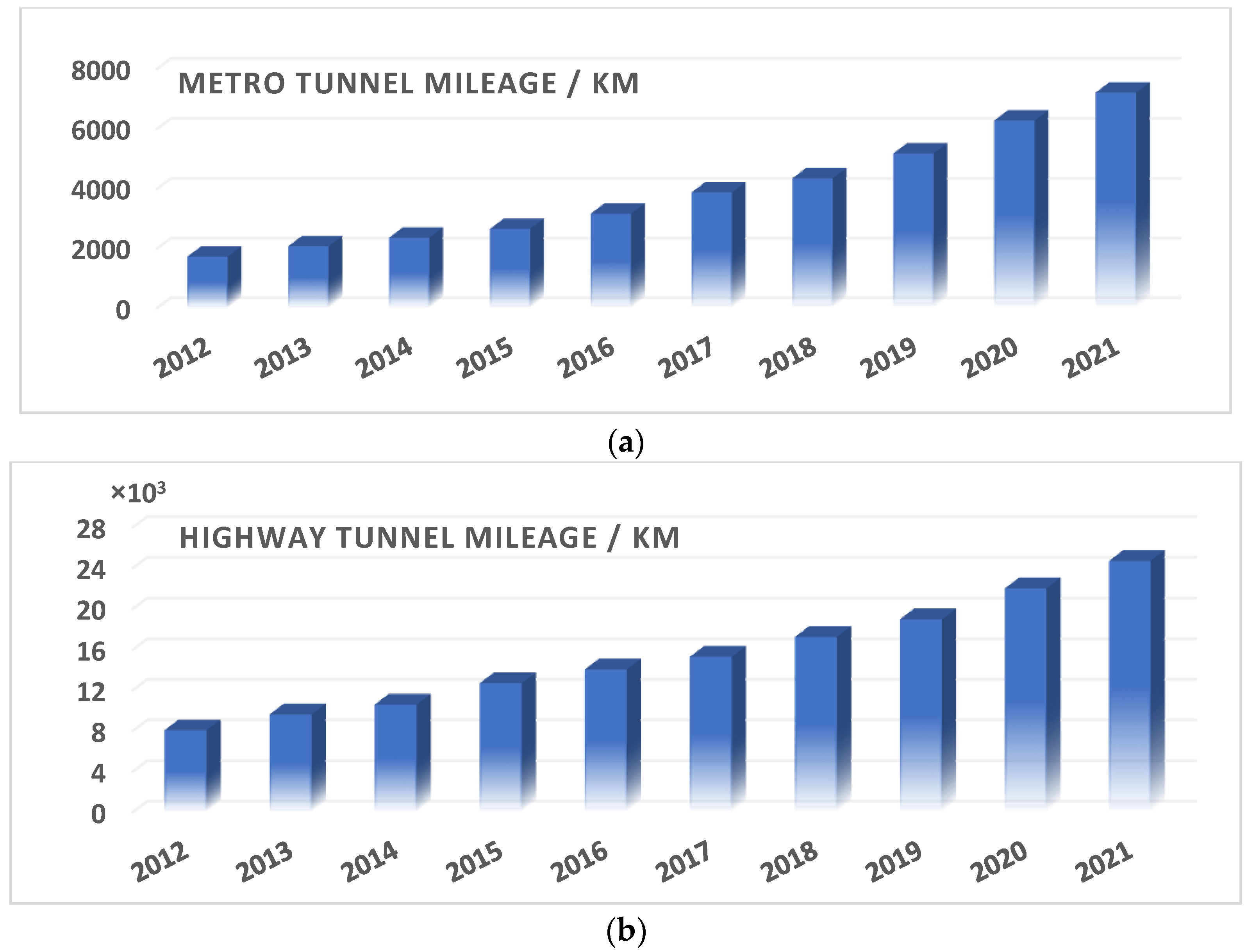
China is the country with the largest number of tunnels, the largest tunnel construction scale, and the fastest development of tunnels in the world. Figure 1 shows the development history of metro and highway tunnels; it can be seen that tunnels have experienced rapid development in recent years. By the end of the year of 2021, there were a total of 23,268 highway tunnels, with a total length of 24,698.9 kilometers [1]; 7209.7 km of this distance is made up of tunnels operating the metro in China [2].
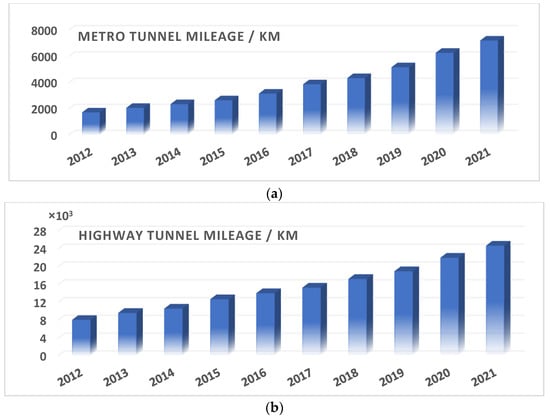
Figure 1.
Tunnel development history: (a) metro tunnels; (b) highway tunnels.
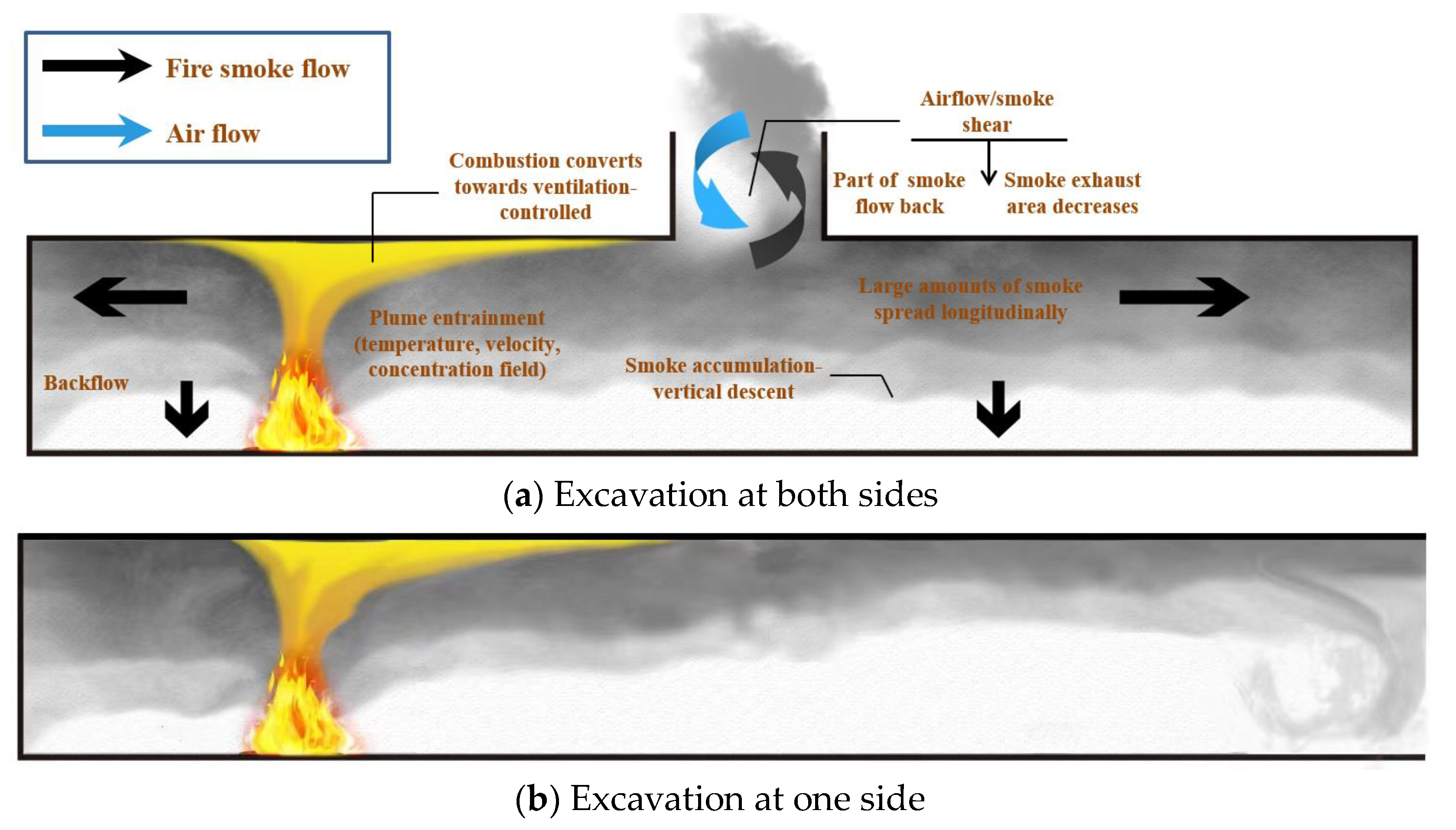
According to statistics from the International Tunneling and the Underground Space Association (ITA), in recent years, the tunnels under construction in China account for about 50% of the world’s total tunnels under construction. The rapid development of tunnel construction has also brought significant fire safety hazards [3,4,5]. Ventilation and smoke extraction facilities in tunnels under construction cannot be set according to the requirements of the completed operating tunnel, and in the event of a fire, smoke is very difficult to control; the consequences of this are likely very serious. Figure 2 shows two typical structures of a tunnel under construction, and the typical characteristics of fire accidents. In the first scenario, the tunnel under construction consists of a vertical or inclined shaft (the construction passageway) and an excavation tunnel with two working faces. In the second scenario, one end of the tunnel under construction is the working face, and the other end is connected to the outside.
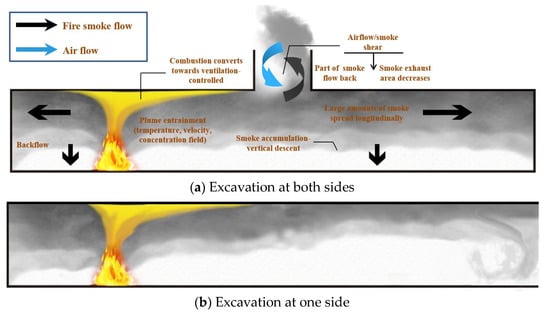
Figure 2.
Two typical structures of tunnels under construction, and the main characteristics of fire accidents.
Compared with an operating tunnel with openings at both ends, the structure of a tunnel under construction is more confined. The characteristics of fire and smoke spread in tunnels under construction are completely different from those in operating tunnels, and can be summarized as follows: (1) one or two ends of the tunnel are closed, and the accumulated combustion products cause the combustion to evolve dynamically, making it difficult to determine the combustion state of the fire (i.e., whether it is ventilation-controlled or fuel-controlled); (2) the air intake and smoke exhaust usually only pass through one portal at the same time, making it difficult to control smoke; meanwhile, it is likely that the smoke follows a longitudinal–vertical two-dimensional spread law.
In response to the fire characteristics of the above tunnels under construction, some scholars have studied the movement of smoke and the evolution of temperature through experimental and simulation methods [6,7,8,9,10,11].
For fire and smoke control and personnel evacuation in tunnels under construction, Yao et al. [11] proposed a simple improvement method for controlling smoke from fires in tunnels under construction, wherein a drainage device is placed in the middle of the construction passageway to divide the access for both natural ventilation and smoke exhaust, after which the temperature rise in the tunnel decreases significantly and the mass flow rate of the smoke through the construction passageway increases. Yuan et al. [12] invented a fire smoke control device for a single exit tunnel under construction by fully considering the particularity of having only one exit. Mehaddi [13] discussed the feasibility and effectiveness of using fine water mist for smoke limitation and radiation shielding in the case of a fire in a tunnel under construction. The research group of Ingason [14,15] conducted a relatively systematic study on fires in tunnel under construction; their research content mainly concerns heat release rate, and evacuation and rescue operations.
This Special Issue touches on many issues central to understanding turbulent combustion and fire accidents in confined spaces [16,17,18]. These articles highlight the particularity and hazards of fires in confined spaces, which should receive widespread attention and be researched in depth. Potential research directions may include
- (1)
- Special air entrainment characteristics and flame behaviors;
- (2)
- The conditions of the transition from a fuel-controlled combustion state to a ventilation-controlled combustion state;
- (3)
- Prediction models of smoke’s longitudinal spread and vertical descent velocity;
- (4)
- Efficient smoke exhaust devices and methods.
Author Contributions
Conceptualization, Y.Y.; methodology, Y.Y. and F.R.; software, Z.X. and R.W.; validation, Y.Y., Z.G., J.Z. and Q.W.; formal analysis, F.R., Z.X. and R.W.; investigation, Y.Y., Z.X. and R.W.; resources, Y.Y. and Z.G.; data curation, Z.X. and R.W.; writing—original draft preparation, Y.Y. and F.R.; writing—review and editing, J.Z. and Q.W.; supervision, F.R. and Z.G.; project administration, F.R.; funding acquisition, Y.Y., Z.G., J.Z. and Q.W. All authors have read and agreed to the published version of the manuscript.
Funding
This work was funded by the National Key R&D Program of China (2021YFB3201900), the National Natural Science Foundation of China [No. 52206186 and 51976051], the Fundamental Research Funds for the Central Universities [No. 2022JCCXAQ05] and the Youth Talent Promotion Project of Henan Province [2022HYTP019].
Conflicts of Interest
The authors declare no conflict of interest.
References
- Ministry of Transport of the People’s Republic of China. Statistical Bulletin on the Development of the Transportation Industry in 2021. Available online: https://xxgk.mot.gov.cn/2020/jigou/zhghs/202205/t20220524_3656659.html (accessed on 25 May 2022).
- China Association of Metros. 2021 Statistical and Analysis Report on Urban Rail Transit. Available online: https://www.camet.org.cn/tjxx/9944 (accessed on 22 April 2022).
- Zhao, Y.H. Experimental Study and Analysis on the Characteristics of Smoke Transport in Construction Tunnel Fires; Shandong Jianzhu University: Jinan, China, 2022. [Google Scholar]
- Feng, K.; Xu, Q.K. Analysis on the effect of different slopes on fire smoke flow in being constructed tunnel. Fire Sci. Technol. 2015, 34, 41–45. [Google Scholar]
- Liu, T. Numerical Simulation on Fire Accident for Risk Prevention in the Tunneling Process of a Narrow and Long Tunnel; Shanghai Jiao Tong University: Shanghai, China, 2010. [Google Scholar]
- Xu, Q.K.; Yang, L.Z.; Zhan, J.L.; Li, X. Analysis on numerical simulation to fire smoke flow in being constructed tunnel with one closed-end. J. Saf. Environ. 2010, 10, 156–159. [Google Scholar]
- Yu, G. Numerical simulation study on temperature and smoke diffusion during tunnel fire. Installation 2020, 11, 28–30. [Google Scholar]
- Han, J.Q.; Liu, F.; Wang, F.; Weng, M.C.; Wang, J. Study on the smoke movement and downstream temperature distribution in a sloping tunnel with one closed portal. Int. J. Therm. Sci. 2020, 149, 106165. [Google Scholar] [CrossRef]
- Xu, L.; Qiu, M.X.; Zhao, Y.G.; Ding, C.; Yu, W.; Zhao, S.Z.; Li, L.Y.; Liu, J. Experimental study on vertical temperature distribution of the two-layer smoke flow in tunnel during construction. Tunn. Undergr. Space Technol. 2023, 136, 105105. [Google Scholar] [CrossRef]
- Yao, Y.Z.; Li, Y.Z.; Lonnermark, A.; Ingason, H.; Cheng, X.D. Study of tunnel fires during construction using a model scale tunnel. Tunn. Undergr. Space Technol. 2019, 89, 50–67. [Google Scholar] [CrossRef]
- Yao, Y.Z.; Wang, R.; Xia, Z.Y.; Ren, F.; Zhao, J.L.; Zhu, H.Q.; Cheng, X.D. Numerical study of the characteristics of smoke spread in tunnel fires during construction and method for improvement of smoke control. Case Stud. Therm. Eng. 2022, 34, 102043. [Google Scholar] [CrossRef]
- Yuan, J.P.; Zhang, J.L.; Liu, L.; Fang, Z. A fire smoke control device for single exit tunnels during construction [P]. China, ZL 201320127746.X, 2013.03.20.
- Mehaddi, R.; Collin, A.; Boulet, P.; Acem, Z.; Telassamou, J.; Becker, S.; Demeurie, F.; Morel, J.Y. Use of a water mist for smoke confinement and radiation shielding in case of fire during tunnel construction. Int. J. Therm. Sci. 2020, 148, 106156. [Google Scholar] [CrossRef]
- Lonnermark, A.; Hugosson, J.; Ingason, H. Fire Incidents during Construction Work of Tunnels—Model Scale Experiments. In SP Report; SP Technical Research Institute of Sweden: Borås, Sweden, 2010. [Google Scholar]
- Ingason, H.; Lönnermark, A.; Frantzich, H.; Kumm, M. Fire Incidents during Construction Work of Tunnels, Evacuation Aspects. In SP Report; SP Technical Research Institute of Sweden: Borås, Sweden, 2010. [Google Scholar]
- Yao, Y.Z.; Wang, Y.T.; Zhang, Y.; Zhao, J.L. Simulation research on effects of ambient pressure on plug-holing phenomenon in tunnel fires with a shaft. Fire 2023, 6, 143. [Google Scholar] [CrossRef]
- Yao, Y.Z.; Wang, Y.T.; Chen, L.; Ren, F.; Shi, C.L. Numerical study on coupled smoke control using longitudinal ventilation and naturally ventilated shafts during fires in a road tunnel. Fire 2023, 6, 126. [Google Scholar] [CrossRef]
- Zhao, J.L.; Wang, Z.H.; Hu, Z.Q.; Cui, X.Y.; Peng, X.D.; Zhang, J.P. Effects of fire location and forced air volume on fire development for single-ended tunnel fire with forced ventilation. Fire 2023, 6, 111. [Google Scholar] [CrossRef]
Disclaimer/Publisher’s Note: The statements, opinions and data contained in all publications are solely those of the individual author(s) and contributor(s) and not of MDPI and/or the editor(s). MDPI and/or the editor(s) disclaim responsibility for any injury to people or property resulting from any ideas, methods, instructions or products referred to in the content. |
© 2023 by the authors. Licensee MDPI, Basel, Switzerland. This article is an open access article distributed under the terms and conditions of the Creative Commons Attribution (CC BY) license (https://creativecommons.org/licenses/by/4.0/).