


Abstract
Gas sensors based on metal oxide (MOX) semiconductors doped with oxygen vacancies (VO) have many advantages over stoichiometric MOX, such as higher surface reactivity and lower operating temperature. However, preparing reduced MOX is challenging, and the impact of different VO types and concentration on sensing performance is still unclear. In this work, we developed a tailored reducing thermal treatment for creating controlled VO in MOX. The effect of the length and temperature of the treatment was investigated using several characterization methods. Finally, measurements were performed to evaluate the impact of VO type and concentration on reduced MOX sensing performance.
1. Introduction
Chemoresistive gas sensors are the most widely used solid-state devices because of their small size, sensitivity, and low cost [1]. However, the most widely used sensing materials, nanostructured MOX, lack selectivity and show high power consumption, which limits their effective and widespread adoption. To address these limitations, recent research has focused on developing new sensing materials with improved chemoresistive properties, particularly modified MOX (doped or functionalized) that combine MOX stability with enhanced selectivity through surface sensitization, as well as lower working temperature. One area of interest has been intrinsic dopants, including VO, which have a significant impact on MOX electrical properties and surface reactivity [2]. However, a lack of stable and repeatable methods for preparing reduced MOX and a limited understanding of the impact of different types and concentration of VO on gas-sensing performance have hindered the development of sensors based on these materials [2]. This study aimed to investigate the development of reduced WO3 and SnO2 nanoparticles with controlled VO concentration, obtained through a tailored thermal reducing treatment. Impact of the thermal treatment length and temperature on the type and concentration of VO developed, as well as their influence on the gas-sensing performance of reduced MOX, were investigated.
2. Materials and Methods
To synthesize stoichiometric WO3 and SnO2 nanoparticles, simple sol–gel syntheses were used with precursors tungsten hexachloride and tin(II) ethylhexanoate. The reagents were dissolved in 2-propanol at specific temperatures, and deionized water was used to obtain MOX colloids, which were then separated by filtration and calcinated at 650 °C in air. The resulting nanoparticles were reduced at different temperatures (300–800 °C) using a rapid thermal processing instrument (RTP, Annealsys sas, Montpellier, France) in an N2/H2 (96%/4%) environment. Different treatment lengths were explored to investigate the effect of process time and temperature on the VO type and concentration. The elemental (XPS, EDX), optical (UV-vis spectroscopy), and structural (XRD) properties of the reduced powders were characterized. Finally, both stoichiometric and reduced WO3 and SnO2 nanopowders were deposited onto silicon substrates, and their sensing performance was tested towards different target gases in a gas test bench.
3. Discussion
The XPS analysis showed that different oxidation states were present for W (5+, 4+ and 3+) and Sn (1+ and 0) in the WO3 and SnO2 reduced powders. These were caused by the formation of surface VO resulting from reducing thermal treatments. Increasing the reducing thermal treatment temperature increased the surface VO concentration and produced both in-plane and bridging VO. XRD and optical characterizations revealed that VO was also present in the bulk of the samples, resulting in changes to the crystal lattice dimensions and a reduction in the band gap compared to the stoichiometric WO3 and SnO2. The sensing characterization revealed a strong increase in the sensing performance in the detection of NH3 and NO2 for reduced WO3 (Figure 1a) and reduced SnO2 (Figure 1b), respectively, compared to the stoichiometric powders. A decrease in the working temperature of reduced SnO2 and WO3 compared to stoichiometric powders was observed as well. A proposed explanation for the role of surface VO in the sensing mechanism is also presented.
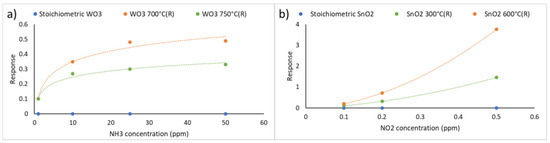
Figure 1.
(a) Sensing responses, at a working temperature of 70 °C, of (a) stoichiometric and reduced (R) WO3 powders vs. NH3 and (b) stoichiometric and reduced (R) SnO2 powders vs. NO2.
Author Contributions
Conceptualization, A.G.; methodology, A.G. and S.K.; software, S.K.; validation, A.G., L.V., A.P., M.V. and S.K.; formal analysis, A.G., L.V., A.P., M.V. and S.K.; investigation, A.G., L.V., A.P., M.V. and S.K.; resources, A.G.; data curation, L.V., A.P., M.V. and S.K.; writing—original draft preparation, A.G.; writing—review and editing, L.V., A.P., M.V. and S.K.; supervision, A.G.; project administration, A.G.; funding acquisition, A.G. All authors have read and agreed to the published version of the manuscript.
Funding
This research was partially funded by the CARIT foundation (Terni, Italy), TERNARIA pProject, grant number “call 1/2021_Scientific research”, and by the CARIVERONA foundation (Verona, Italy), SILICA project, grant number 2022.0098.
Institutional Review Board Statement
Not applicable.
Informed Consent Statement
Not applicable.
Data Availability Statement
The data that support the findings of this study are available on request from the corresponding author (A.G.).
Conflicts of Interest
The authors declare no conflicts of interest.
References
- Gaiardo, A.; Novel, D.; Scattolo, E.; Crivellari, M.; Picciotto, A.; Ficorella, F.; Iacob, E.; Bucciarelli, A.; Petti, L.; Lugli, P.; et al. Optimization of a low-power chemoresistive gas sensor: Predictive thermal modelling and mechanical failure analysis. Sensors 2021, 21, 783. [Google Scholar] [CrossRef] [PubMed]
- Al-Hashem, M.; Akbar, S.; Morris, P. Role of Oxygen Vacancies in Nanostructured Metal-Oxide Gas Sensors: A Review. Sens. Actuators B Chem. 2019, 301, 126845. [Google Scholar] [CrossRef]
Disclaimer/Publisher’s Note: The statements, opinions and data contained in all publications are solely those of the individual author(s) and contributor(s) and not of MDPI and/or the editor(s). MDPI and/or the editor(s) disclaim responsibility for any injury to people or property resulting from any ideas, methods, instructions or products referred to in the content. |
© 2024 by the authors. Licensee MDPI, Basel, Switzerland. This article is an open access article distributed under the terms and conditions of the Creative Commons Attribution (CC BY) license (https://creativecommons.org/licenses/by/4.0/).