Abstract
In this work, equivalent circuit models for conductivity, reference, and potassium ion sensors are introduced and validated. The models help to understand and verify the sensors’ functioning and to determine the selective element of the potassium sensor as a capacitance that occurs below 1 Hz. Measurements at 100 mHz suggest that the phase response of the sensor reveals advantages concerning response time and stability compared to the typically used magnitude.
1. Introduction
With increasing health risks coming from environmental pollution, it has become more important to monitor our health and environment in a comprehensive and accessible way [1,2]. To solve this, we are developing cost-effective impedimetric biosensors for the detection of ion concentrations in, e.g., water or sweat [2,3]. Electrochemical impedance spectroscopy (EIS) is a powerful measurement method that allows for the fitting of equivalent circuit models. This allows us to understand the working principle of our sensors and to determine and improve the selective sensor element. Moreover, we show that once the impedance behaviour of a sensor is well understood, it can be used for sensor failure detection during development, but also later during application. Therefore, we present an extensive study of the impedance behaviour of multiple miniaturized sensors for ion detection in fluids.
2. Materials and Methods
We manufactured three sensor types, namely conductivity sensors, reference sensors, potassium (K+) sensors. Sensor electrodes were manufactured as described in the work presented in [2]. The conductivity sensors consist only of bare gold interdigitated electrodes (IDES) on flexible polyethylene naphthalate (PEN) foil. On top of the IDES we placed the ion-selective membrane (ISM), which contains either no ionophores (reference) or K+ ionophore III. All sensors were characterized using EIS at frequencies from one MHz–100 mHz (sensor functioning was shown in [2]). EIS measurement results were used to gradually develop equivalent circuit models of the sensors. We then compared the fitted values (Gamry Echem Analyst) for the passive components (i.e., R, C) to the theoretical values obtained from FEM simulations (COMSOL) in order to verify coherent results.
3. Results and Discussion
3.1. Circuit Fitting
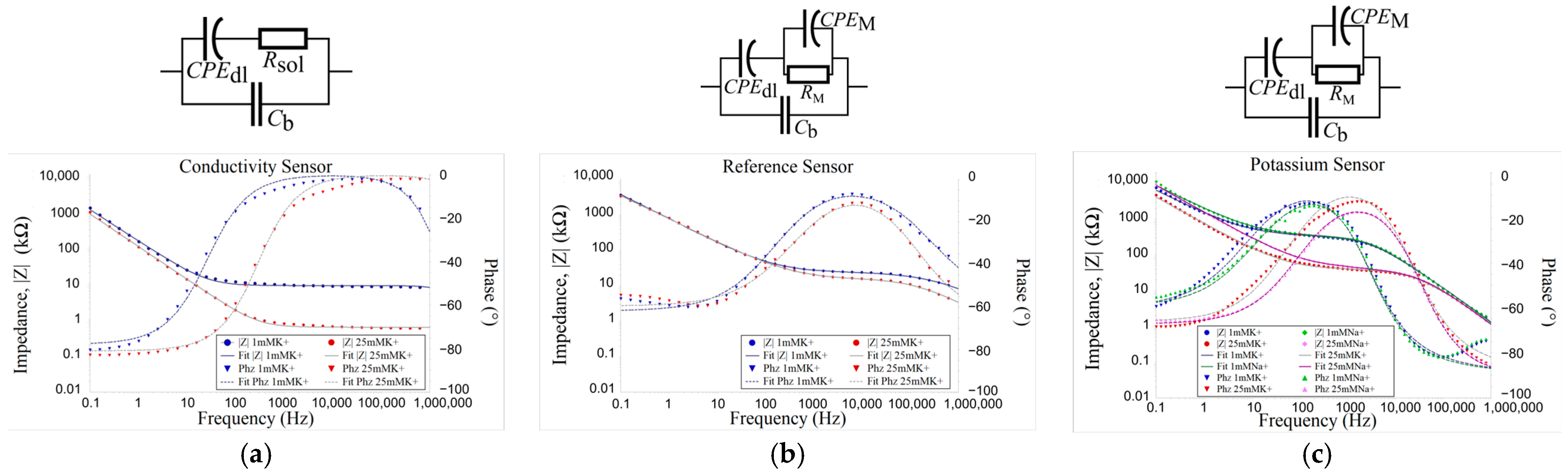
We derived three circuit models for conductivity, reference and K+ sensors (see Figure 1). The solution resistance Rsol is the sensitive element for the conductivity sensor, but due to the lack of an ISM, there is no selectivity for a specific ion. A reference sensor without ionophores contains an added R||CPE circuit of the membrane. The constant phase element CPEdl representing the electrode|membrane interface is independent of the ion concentrations. For sensors containing ionophores, we observed selectivity at this interface, which is visible as a capacitive behaviour at frequencies below 1 Hz. Therefore, further sensor characterizations were performed at a frequency of 100 mHz. Moreover, the circuit fitting helped to improve the sensor design by finding the optimum ISM thickness and overcoming issues with interface charges. Lastly, defect membranes can be identified during development but also during sensor application, allowing for fast failure detection.
Figure 1.
Equivalent circuits and fitting results for 1 mM and 25 mM K+ solutions. (a) A conductivity sensor, (b) a reference sensor and (c) a K+ sensor that shows cross-sensitivity towards Na+ below 1 Hz.
3.2. Potassium Sensor Response
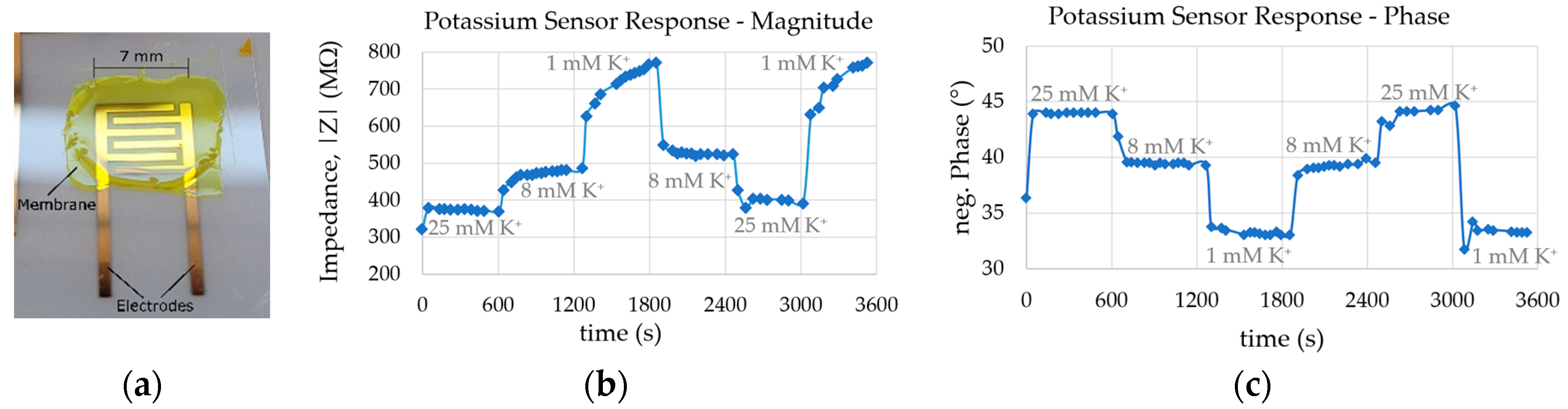
Measurement results of a potassium sensor in different concentrations of K+ at 100 mHz are shown in Figure 2. The response time of the phase is faster and shows less drift than for the magnitude. This is related to the capacitive behaviour of the sensor at low frequencies. To our knowledge, until now there had been no research performed on the phase response of impedimetric or conductometric ion sensors.
Figure 2.
Potassium sensor and its response at 100 mHz. (a) Picture of the potassium sensor. (b) Change in magnitude of the impedance and (c) change in phase for varying K+ ion concentrations.
Author Contributions
Conceptualization, E.-M.K. and R.B.; methodology, E.-M.K.; software, E.-M.K.; validation, E.-M.K., E.C.K. and R.B.: formal analysis, E.-M.K.; investigation, E.-M.K. and E.C.K.; resources, E.-M.K.; data curation, E.-M.K.; writing—original draft preparation, E.-M.K.; writing—review and editing, E.-M.K. and R.B.; visualization, E.-M.K.; supervision, R.B.; project administration, E.-M.K. and R.B.; funding acquisition, R.B. All authors have read and agreed to the published version of the manuscript.
Funding
This research was supported in part by the German Federal Ministry for Economic Affairs and Climate Action, ZIM grant number ZF4746801BA9.
Institutional Review Board Statement
Not applicable.
Informed Consent Statement
Not applicable.
Data Availability Statement
The data presented in this study are available on request from the corresponding author.
Acknowledgments
We thank Bernhard Wolfrum for his valuable advice and the opportunity to work in his lab. Moreover, we would like to thank Anika Kwiatkowski for technical support and Szabolcs Molnar for IT support.
Conflicts of Interest
The authors declare no conflicts of interest.
References
- Day, C.; Søpstad, S.; Ma, H.; Jiang, C.; Nathan, A.; Elliott, S.R.; Hutter, T. Impedance-based sensor for potassium ions. Anal. Chim. Acta 2018, 1034, 39–45. [Google Scholar] [CrossRef] [PubMed]
- Korek, E.; Kounoupioti, E.; Brederlow, R. Manufacturing of Flexible, Impedimetric Potassium Sensors. IEEE Sens. Lett. 2023, 7, 2000604. [Google Scholar] [CrossRef]
- Pfeffer, C.; Zips, S.; Muellner, E.; Hefele, M.; Kreupl, F.; Wolf, B.; Brederlow, R. A cost-effective, impediometric Na+-sensor in fluids. IEEE Sens. Lett. 2021, 5, 4500304. [Google Scholar] [CrossRef]
Disclaimer/Publisher’s Note: The statements, opinions and data contained in all publications are solely those of the individual author(s) and contributor(s) and not of MDPI and/or the editor(s). MDPI and/or the editor(s) disclaim responsibility for any injury to people or property resulting from any ideas, methods, instructions or products referred to in the content. |
© 2024 by the authors. Licensee MDPI, Basel, Switzerland. This article is an open access article distributed under the terms and conditions of the Creative Commons Attribution (CC BY) license (https://creativecommons.org/licenses/by/4.0/).