


Abstract
This article presents a magnetic tracking system using on-chip anisotropic magnetoresistive (AMR) sensors. The system consists of four air-core coils sequentially generating four dc magnetic fields. The implemented localization algorithm is quadrilateration, and the accuracy of the system is dependent on the accuracy of the sensors and the simulated field maps. The performance of the system was evaluated using an in-house magnetic field camera (MFC), and the results showed that the system exhibits mean Euclidean errors below 1 mm where the source produces strong gradients. Given the dimensions of the sensors (0.82 × 0.82 mm2), this system is suitable for tracking minimally invasive surgical tools.
1. Introduction
Magnetic tracking systems are of particular interest in biomedical engineering as they provide a non-ionizing localization modality for surgical tools. Magnetic tracking is a good candidate to track deep brain stimulation electrodes or cardiac ablation catheters. However, commercially available magnetic tracking systems often feature micro-coils, which are sensitive to deformation through mechanical stress. This work demonstrates the performance of a magnetic tracking system using robust on-chip anisotropic magnetoresistive AMR sensors instead of micro-coils.
2. Materials and Methods
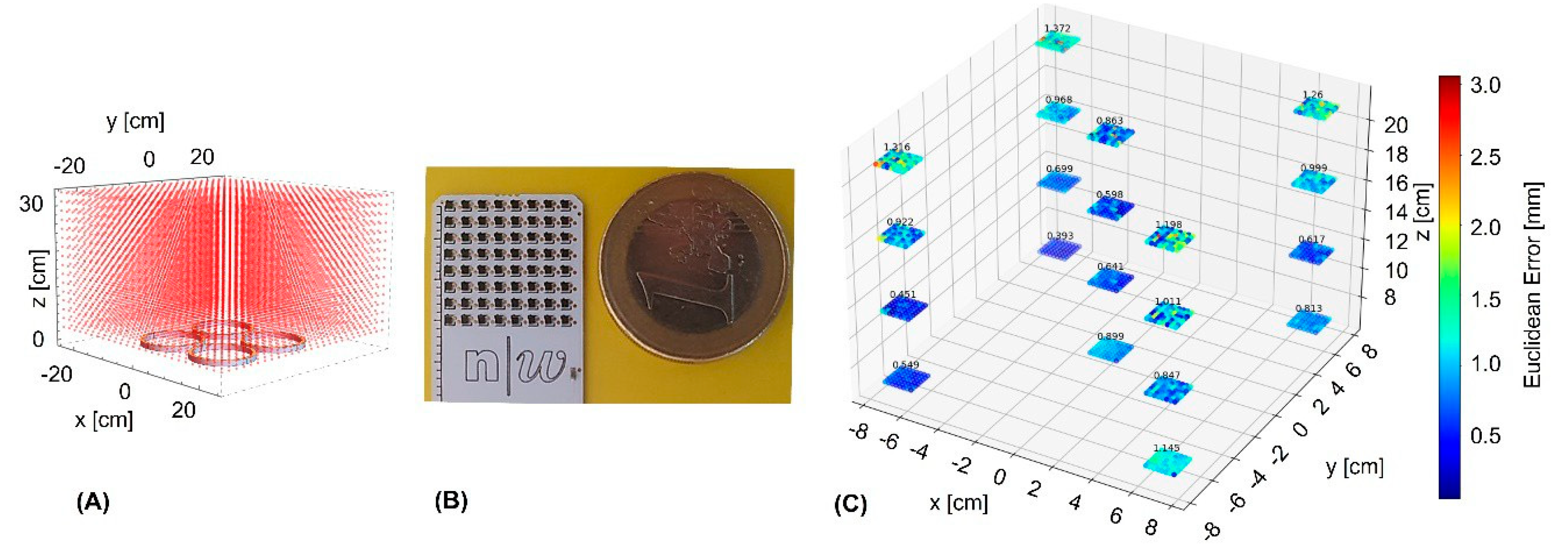
The proposed magnetic tracking system consists of four air-core coils sequentially generating a dc magnetic field, which allows us to track the position of three-axis on-chip AMR sensors. The number of coils was set to four to reach a trade-off between complexity and tracking performance. The magnetic fields generated by the coils were simulated with the Radia module [1] of Mathematica (Wolfram Research, Champaign, IL, USA). This module approximates the current in a coil’s winding as a uniform current density flowing through a single conductor that has the full dimensions of the coil (Figure 1A). The coils are made of 320 turns and have a diameter of 138 mm. They exhibit a resistance of 6.5 ohms. The four coils are powered sequentially with a regulated dc current of 1 A and do not require any cooling system. The localization algorithm implements a quadrilateration. The simulated field maps are interpolated with the tricubic spline interpolation function of the Python library eqtools to increase the spatial resolution. The algorithm minimizes the function (1), which finds the best position triplet by comparing the sensor’s measurements and the theoretical maps .
Figure 1.
(A) Geometry of the magnetic source simulated with Radia, (B) magnetic field camera (MFC) featuring 64 sensors, (C) and Euclidean error of the 64 sensors of the MFC for 20 different locations. The figure written on top of each of the 20 color maps represents the mean Euclidean error.
An in-house magnetic field camera (MFC) was placed at 20 arbitrary reference locations to assess the performance of the system. The MFC consisted of an array of eight-by-eight three-axis AMR sensors (MMC5603NJ, MEMSIC Semiconductor Co., Tianjin, China) (Figure 1B). The sensors exhibited a resolution of 6.25 nT/LSB (rms noise = 200 nT) and a dynamic range of ±3.2 mT. The readout of the 64 sensors was sequential, which resulted in an output data rate of 1.8 Hz for the MFC. Prior to the tracking performance assessment, each sensor was calibrated within a Helmholtz coil.
3. Discussion
For the tracking performance assessment, the MFC served as the object to track. In this manner, through a single acquisition we could acquire a dataset of 64 points for each position of the MFC and, which provides a robust statistical sample. The MFC was positioned at 20 different locations. By using Lego® supports to place the MFC, the reference locations are known with an uncertainty below 100 µm. The evaluated volume was 16 × 16 × 20 cm3. The tracking performance was evaluated within this volume through the estimation of the Euclidean error. Figure 1D summarizes the results obtained for the 20 positions of the MFC. Depending on the MFC location, the mean Euclidean error varied between 0.393 and 1.372 mm.
We observed that the magnetic tracking system performs best where the source produces strong gradients. Given that the AMR sensor dimensions (0.82 × 0.82 mm2) and the demonstrated tracking accuracy, the presented system is of particular interest for the tracking of minimally invasive surgical tools.
Author Contributions
Conceptualization, T.Q., C.F., C.V., M.M., L.H. and J.P.; methodology, T.Q., C.F., C.V., M.M., L.H. and J.P; software, C.F.; formal analysis, T.Q., C.F., M.M., L.H. and J.P.; writing—original draft preparation, T.Q.; writing—review and editing, T.Q., L.H. and J.P.; visualization, C.F. and C.V.; supervision, M.M., L.H. and J.P. All authors have read and agreed to the published version of the manuscript.
Funding
This research received no external funding.
Institutional Review Board Statement
Not applicable.
Informed Consent Statement
Not applicable.
Data Availability Statement
The original contributions presented in the study are included in the article, further inquiries can be directed to the corresponding author.
Conflicts of Interest
The authors declare no conflicts of interest.
Reference
- Chubar, O.; Elleaume, P.; Chavanne, J. A Three-Dimensional Magnetostatics Computer Code for Insertion Devices. J. Synchrotron Radiat. 1998, 5, 481–484. [Google Scholar] [CrossRef] [Scilit] [PubMed]

Disclaimer/Publisher’s Note: The statements, opinions and data contained in all publications are solely those of the individual author(s) and contributor(s) and not of MDPI and/or the editor(s). MDPI and/or the editor(s) disclaim responsibility for any injury to people or property resulting from any ideas, methods, instructions or products referred to in the content. |
© 2024 by the authors. Licensee MDPI, Basel, Switzerland. This article is an open access article distributed under the terms and conditions of the Creative Commons Attribution (CC BY) license (https://creativecommons.org/licenses/by/4.0/).