


Abstract
Neuroaesthetics is a relatively young field that connects neuroscience with empirical aesthetics and originates in the neurological theory of aesthetic experience. It investigates brain structures and activity during the phenomena of artistic perception and production and, at the same time, attempts to understand the influence of neurological pathologies on these mechanisms. For each participant (six subjects with mild cognitive decline and ten controls), electroencephalography (EEG) and functional near-infrared spectroscopy (fNIRS) data were acquired thanks to a wearable EEG–fNIRS system during the execution of a P300 task.
1. Introduction
Neuroaesthetics is derived from psychophysiology and cognitive neuroscience [1], and research on this topic focuses on how our systems of neurocognitive analysis of visual and synaesthetic stimuli can process those linked to art or aesthetics in its broadest sense [2]. The ERP P300 oddball paradigm component has been associated with cognitive and speed information processing. This study aims to correlate cognitive, neurophysiological, and psychophysiological findings to set the stage for criteria for personalizing daily living environments [3] to improve cognitive performance in subjects with mild cognitive deterioration.
2. Materials and Methods
Eighteen subjects ≥65 years of age [4] were selected at the Neurophysiopathology Unit of Bari Policlinico General Hospital and divided according to their Mini Mental State Examination (MMSE) score [5], thus defining a control group of normal ageing (NA, n. 10) and a group of subjects with impaired ageing (IA, n. 6). The EEG/fNirs task involves an initial two-minute resting state at baseline, in which the subject is asked to stare at a cross in the center of a black screen. A total of 165 visual stimuli are selected, divided into 115 single-color frequent images and 50 target images, represented by 25 static and 25 dynamic aesthetic stimuli. Each visual stimulus has a duration of 5 s, and the inter-stimulus interval was 8 s. The motor task, upon the appearance of the target stimulus (static or dynamic images), consists of pressing, as quickly as possible, the space bar key of a PC keyboard. At the end of the task, the subjects were asked to evaluate the liking index of the images on a Likert scale from 1 to 10 (low = 1–4; neutral = 5–6; high = 7–10).
3. Discussion
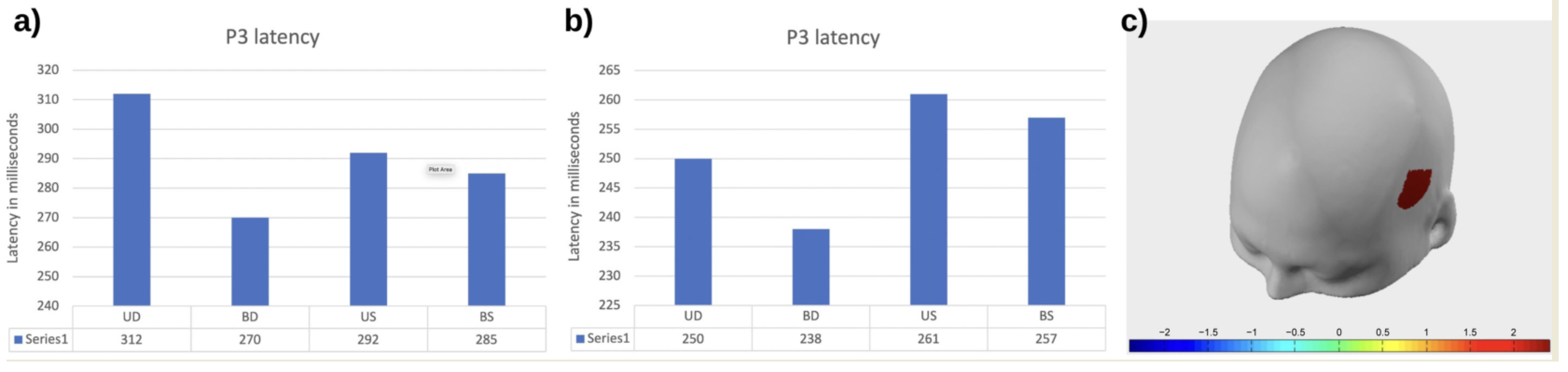
The aim of this EEG-fNIRS P300 study is to correlate cognitive and psychophysiological outcomes in order to develop a conceptual understanding of how aesthetic experiences can contribute to cognitive facilitation, to set the stage for criteria for personalizing daily living environments [3], and to foster an ambitious project for an inclusive ageing society. Despite the study being conducted on a small sample, the preliminary results show differences in latency and morphology within the two groups. Analysis of the EEG signal reveals an overall difference in the latency of the P300 response (Figure 1a,b): in both groups, an increased latency of the P300 response emerges in relation to stimuli judged to be aesthetically less pleasing; the same pattern is evident in relation to static vs. dynamic stimuli. A statistically significant difference was found in the latency of the P300 for dynamic images with low aesthetic liking index (250 ms vs. 312 ms, p < 0.05). fNirs comparison shows elevated cortical hemodynamic activation of the control group in the left hemisphere (Figure 1c) in the same condition (dynamic images with a low aesthetic index), while no statistically significant difference emerges in the analysis of other conditions.
Figure 1.
The figure shows the preliminary results of the study: (a) IA group P300 latency under different conditions (ugly dynamic = UD; beautiful dynamic = BD; ugly static = US; beautiful static = BS); (b) NA group P300 latency in the different conditions; (c) control group shows elevated haemodynamic cortical activation in the left hemisphere.
Author Contributions
Conceptualization, M.d.T.; methodology, M.d.T.; software, V.B. and A.B.; formal analysis, L.C. and M.L.R.; investigation, L.C. and M.D.; data curation, M.d.T., L.C. and M.D.; writing—original draft preparation, M.d.T. and L.C.; writing—review and editing, L.C., M.L.R. and M.D.; visualization, K.R., G.T. and G.P.; supervision, M.d.T.; project administration, M.d.T.; funding acquisition, M.d.T. All authors have read and agreed to the published version of the manuscript.
Funding
This research was funded by Regione Puglia, Dipartimento Sviluppo economico, innovazione, istruzione, formazione e lavoro. Sezione Ricerca Innovazione e Capacità Istituzionale. POR Puglia FESR-FSE 2014-2020—Asse I—Azione 1.4.b.
Institutional Review Board Statement
The study was conducted in accordance with the Declaration of Helsinki and approved by the Ethics Committee of the "Azienda Policlinico" of Bari and was conducted according to the principles outlined in the Declaration of Helsinki (No. ET-20-01). The participant provided their written informed consent to contribute to this study.
Informed Consent Statement
Informed consent was obtained from all subjects involved in the study.
Data Availability Statement
The raw data supporting the conclusions of this article will be made available by the authors, without undue reservation.
Conflicts of Interest
The authors declare no conflicts of interest.
References
- Zeki, S.; Lamb, M. The neurology of kinetic art. Brain 1994, 117, 607–636. [Google Scholar] [CrossRef] [PubMed]
- Ramachandran, V.S.; Hirstein, W. The science of art: A neurological theory of aesthetic experience. J. Conscious. Stud. 1999, 6, 15–51. [Google Scholar]
- de Tommaso, M.; Pecoraro, C.; Sardaro, M.; Serpino, C.; Lancioni, G.; Livrea, P. Influence of aesthetic perception on visual event-related potentials. Conscious. Cogn. 2008, 17, 933–945. [Google Scholar] [CrossRef] [PubMed]
- Hanninen, T.; Koivisto, K.; Reinikainen, K.J.; Helkala, E.-L.; Soininen, H.; Mykkänen, L.; Laakso, M.; Riekkinen, P.J. Prevalence of ageing-associated cognitive decline in an elderly population. Age Ageing 1996, 25, 201–205. [Google Scholar] [CrossRef] [PubMed]
- Chopra, A.; Cavalieri, T.A.; Libon, D.J. Dementia screening tools for the primary care physician. Clin. Geriatr. 2007, 15, 38. [Google Scholar]
Disclaimer/Publisher’s Note: The statements, opinions and data contained in all publications are solely those of the individual author(s) and contributor(s) and not of MDPI and/or the editor(s). MDPI and/or the editor(s) disclaim responsibility for any injury to people or property resulting from any ideas, methods, instructions or products referred to in the content. |
© 2024 by the authors. Licensee MDPI, Basel, Switzerland. This article is an open access article distributed under the terms and conditions of the Creative Commons Attribution (CC BY) license (https://creativecommons.org/licenses/by/4.0/).

