
Abstract
Hazards like landslides have significant economic and societal repercussions; hence, the issue of remote structure health monitoring has grown in significance for geologic applications. Wireless sensor networks (WSNs) stand out among the new sensing architectures as a particularly well-suited solution, thanks to the versatility they offer. This research, necessary for safety reasons, predictive maintenance and emergency evacuation, presents a WSN-based landslide monitoring system with multi-technology sensor implementation. Its goal is to track the land movements on a hillside. The network is composed of long range (LoRa) sensor nodes connected using a LoRaWAN media access control (MAC) layer. The nodes are several and of different natures and help monitor land movements, hydric parameters and rockfall events, and they also offer a camera view of the landslide in case of an emergency. The system is built on an Internet of Things (IoT) framework, enabling online access to data and reports. The final work will include a system description of the hardware and functionality of all the devices, a description of the web section for remote monitoring, a power analysis and statistics from actual scenarios.
1. Introduction
Geologic hazards can be caused by the Earth’s natural processes or by human activity. In the worst circumstances, these occurrences endanger lives and inflict property loss and damage [1]. The various triggering factors for landslides include heavy rain, seismic activity, vegetation interaction and human intervention. The application of fundamental geologic engineering is the basis for the prevention of the aforementioned catastrophes [2]. Landslide-subjected situations have been studied in research in the past for several reasons, some of them being risk mitigation and land planning [3]. In the past, wired acquisition systems were often used to gather data for structural monitoring [4], encountering wiring and power constraints. WSNs can help to address these issues, especially if combined with Internet of Things (IoT) paradigms.
In this work, a remote landslide monitoring system, installed in a real scenario in Liguria, Italy, is presented. A WSN has been implemented to monitor the main system parameters.
2. System Architecture
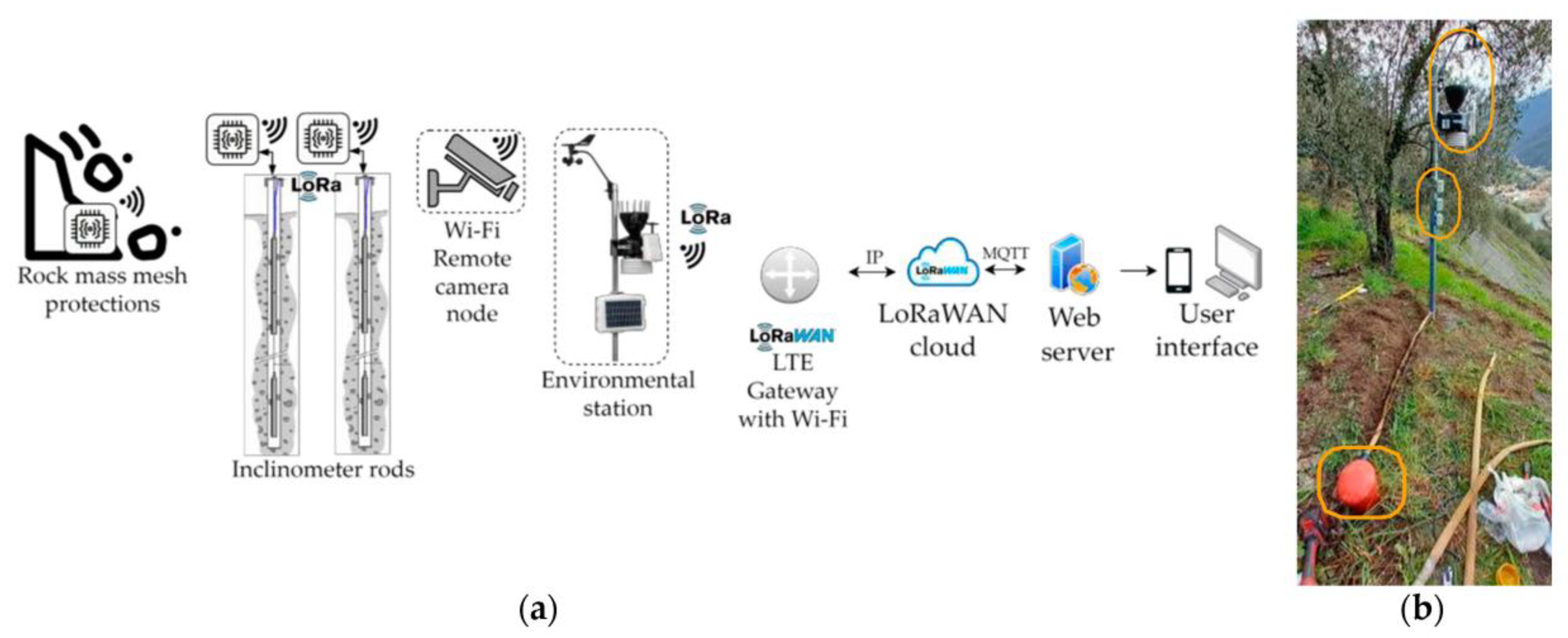
The system architecture is equipped with hole inclinometers to observe the inclination of underground columns as those move together with the land. These sensing elements are based on a microelectromechanical system (MEMS), encapsulated in inox steel containers. Rockfall accelerometer nodes are installed on mesh protections. A weather station is used to take information on the various environmental parameters in landslide monitoring such as temperature, relative humidity, barometric pressure, rainfall, dew point, wind speed and direction and solar radiation. In the case of warnings or manual activation, a camera provides a remote view of the site for distance inspection. All the data retrieved from the inclinometer and environmental sensor nodes are then transmitted over LoRaWAN [5] to a solar-powered gateway. The camera communicates over the Wi-Fi network provided by the aforementioned gateway. The area is not covered with fixed internet access, so a cellular connection is used. Data are directed to a remote server which enables a user interface for analysis and storage. Figure 1 reports the application scheme of the proposed sensing system.
Figure 1.
(a) System application scheme; (b) an installation point for one of the sensing stations.
The WSN is based on low-power devices that exploit solar harvesting as an energy source. The low quiescent currents, in the range of microamperes, enable the system to operate for long periods of time in case of supply failures.
Author Contributions
Conceptualization, M.R. and V.S.; methodology, M.R. and V.S.; software, G.B. and V.S.; validation, P.E. and V.S.; formal analysis, M.R. and P.E.; investigation, M.R.; resources, M.R., P.E., G.F. and V.S.; data curation, M.R. and V.S.; writing—original draft preparation, M.R. and P.E.; writing—review and editing, M.R., G.F. and V.S.; visualization, M.R., G.B. and G.F.; supervision, V.S.; project administration, V.S. All authors have read and agreed to the published version of the manuscript.
Funding
This research received no external funding.
Institutional Review Board Statement
Not applicable.
Informed Consent Statement
Not applicable.
Data Availability Statement
Data sharing is not applicable due to privacy.
Acknowledgments
The authors acknowledge Frutti Carlo M+M, WeMonitoring brand, Ecogrid s.r.l. and Geoprodotti s.r.l.
Conflicts of Interest
The authors declare no conflicts of interest.
References
- Gutiérrez, F.; Parise, M.; De Waele, J.; Jourde, H. A Review on Natural and Human-Induced Geohazards and Impacts in Karst. Earth Sci. Rev. 2014, 138, 61–88. [Google Scholar] [CrossRef]
- Wang, X.; Zhang, C.; Wang, C.; Liu, G.; Wang, H. GIS-Based for Prediction and Prevention of Environmental Geological Disaster Susceptibility: From a Perspective of Sustainable Development. Ecotoxicol. Environ. Saf. 2021, 226, 112881. [Google Scholar] [CrossRef]
- Wang, X.; Frattini, P.; Crosta, G.B.; Zhang, L.; Agliardi, F.; Lari, S.; Yang, Z. Uncertainty Assessment in Quantitative Rockfall Risk Assessment. Landslides 2014, 11, 711–722. [Google Scholar] [CrossRef]
- Ishikawa, K.I.; Mita, A. Time Synchronization of a Wired Sensor Network for Structural Health Monitoring. Smart Mater. Struct. 2008, 17, 015016. [Google Scholar] [CrossRef]
- Haxhibeqiri, J.; De Poorter, E.; Moerman, I.; Hoebeke, J. A Survey of LoRaWAN for IoT: From Technology to Application. Sensors 2018, 18, 3995. [Google Scholar] [CrossRef]
Disclaimer/Publisher’s Note: The statements, opinions and data contained in all publications are solely those of the individual author(s) and contributor(s) and not of MDPI and/or the editor(s). MDPI and/or the editor(s) disclaim responsibility for any injury to people or property resulting from any ideas, methods, instructions or products referred to in the content. |
© 2024 by the authors. Licensee MDPI, Basel, Switzerland. This article is an open access article distributed under the terms and conditions of the Creative Commons Attribution (CC BY) license (https://creativecommons.org/licenses/by/4.0/).