

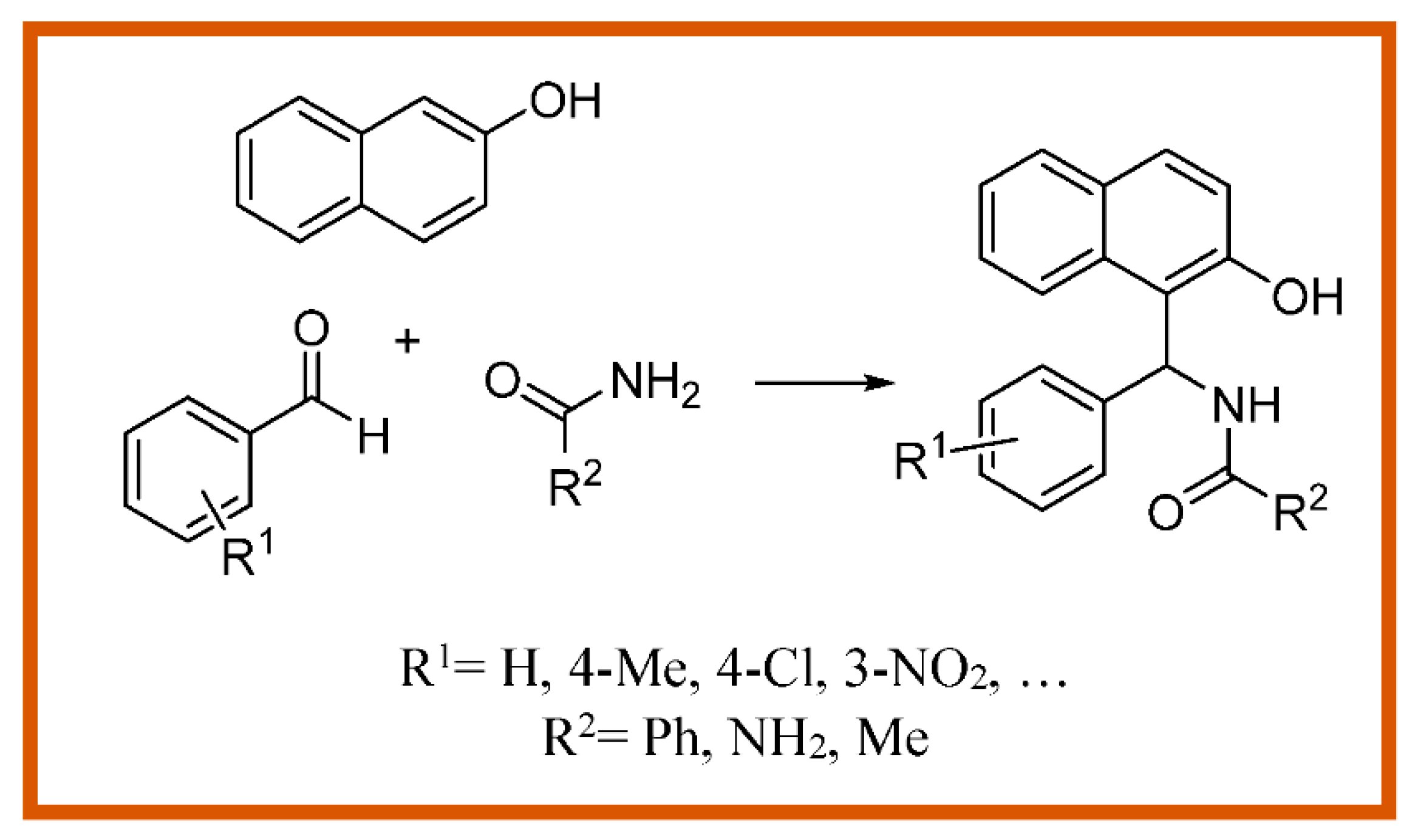
Microwave Accelerates the Synthesis of 1-Amidoalkyl-2-Naphthols Using Cu2(NH2-BDC)2(DABCO)-Sal-Co(II) as a Heterogeneous Catalyst †


References
- Devi, I.; Bhuyan, P.J. Sodium bromide catalysed one-pot synthesis of tetrahydrobenzo[b]pyrans via a three-component cyclocondensation under microwave irradiation and solvent free conditions. Tetrahedron Lett. 2004, 45, 8625. [Google Scholar] [CrossRef]
- Mashraqui, S.H.; Patil, M.B.; Mistry, H.D. A Three-component Reaction of Phenol, Aldehyde, and Active Methylene Substrate under Lewis acid Catalysis: Successful Trapping of o-Quinone Methide to Afford Benzopyran Systems. Ghadigaonkar, S.; Meetsma, A. Chem. Lett. 2004, 33, 1058. [Google Scholar] [CrossRef]
- Shen, A.Y.; Chen, C.L.; Lin, C.C. Electrophysiological basis for the bradycardic effects of 1-(1-pyrrolidinylmethyl)-2-naphthol in rodents. J. Physiol. 1992, 35, 45. [Google Scholar]
- Cook, T.R.; Zheng, Y.R.; Stang, P.J. Metal–Organic Frameworks and Self-Assembled Supramolecular Coordination Complexes: Comparing and Contrasting the Design, Synthesis, and Functionality of Metal–Organic Materials. Chem. Rev. 2013, 113, 734–777. [Google Scholar] [CrossRef] [PubMed]
Publisher’s Note: MDPI stays neutral with regard to jurisdictional claims in published maps and institutional affiliations. |
© 2018 by the authors. Licensee MDPI, Basel, Switzerland. This article is an open access article distributed under the terms and conditions of the Creative Commons Attribution (CC BY) license (https://creativecommons.org/licenses/by/4.0/).
Share and Cite
Panahi, L.; Naimi-Jamal, M.R. Microwave Accelerates the Synthesis of 1-Amidoalkyl-2-Naphthols Using Cu2(NH2-BDC)2(DABCO)-Sal-Co(II) as a Heterogeneous Catalyst. Proceedings 2019, 9, 68. https://doi.org/10.3390/ecsoc-22-05698
Panahi L, Naimi-Jamal MR. Microwave Accelerates the Synthesis of 1-Amidoalkyl-2-Naphthols Using Cu2(NH2-BDC)2(DABCO)-Sal-Co(II) as a Heterogeneous Catalyst. Proceedings. 2019; 9(1):68. https://doi.org/10.3390/ecsoc-22-05698
Chicago/Turabian StylePanahi, Leila, and M. Reza Naimi-Jamal. 2019. "Microwave Accelerates the Synthesis of 1-Amidoalkyl-2-Naphthols Using Cu2(NH2-BDC)2(DABCO)-Sal-Co(II) as a Heterogeneous Catalyst" Proceedings 9, no. 1: 68. https://doi.org/10.3390/ecsoc-22-05698
APA StylePanahi, L., & Naimi-Jamal, M. R. (2019). Microwave Accelerates the Synthesis of 1-Amidoalkyl-2-Naphthols Using Cu2(NH2-BDC)2(DABCO)-Sal-Co(II) as a Heterogeneous Catalyst. Proceedings, 9(1), 68. https://doi.org/10.3390/ecsoc-22-05698

