


Wood represents one of the most encountered materials in Romanian traditional buildings. Exposed to a wide variety of factors (including organic and inorganic pollutants, climatic factors or exposure to microbial colonization), the wood can lose not only its aesthetic characteristics but also its functional and mechanical properties [1].
The present work evaluates three of the most encountered antimicrobial consolidants currently applied on cultural heritage artifacts, by studying their influence on the properties of selected wood models.
The wooden models used for the experiments consisted of birch wood spatulas with standard dimensions (150 × 18 × 1.6 mm), to which the consolidants were applied by immersion. Microscopical aspects of the treated samples were collected using an OPTIKA B-150DBR optical microscope, while the mechanical properties were evaluated using a DMA Q800 (TA Instruments, New Castle, DE, USA), which has a force resolution of 0.00001 N and a strain resolution of 1 nm, operating in multi-frequency–strain mode, samples heated up to 285 °C with a heating rate of 3 °C/min, in air. The results obtained suggest the influence of the different consolidants on the properties of the wooden materials.
The study of the consolidants’ influence on the mechanical properties allows the proposal of appropriate consolidants for the selected materials (Figure 1).
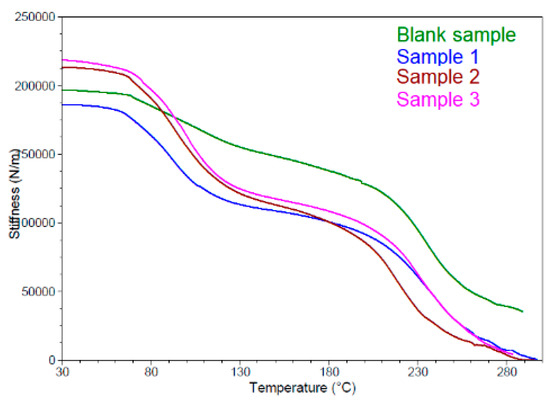
Figure 1.
DMA results obtained for the treated samples, compared with the untreated sample.
Acknowledgments
This work was supported by the Romanian Ministry of Research and Innovation (Romanian Ministry of Education and Research)—Sectorial Program, project 5PS/2018—Innovative methods and techniques for evaluating conservation-restoration interventions and monitoring the conservation status of traditional constructions in Romania.
Reference
- Fierascu, R.C.; Doni, M.; Fierascu, I. Selected Aspects Regarding the Restoration/Conservation of Traditional Wood and Masonry Building Materials: A Short Overview of the Last Decade Findings. Appl. Sci. 2020, 10, 1164. [Google Scholar] [CrossRef]
Publisher’s Note: MDPI stays neutral with regard to jurisdictional claims in published maps and institutional affiliations. |
© 2020 by the authors. Licensee MDPI, Basel, Switzerland. This article is an open access article distributed under the terms and conditions of the Creative Commons Attribution (CC BY) license (https://creativecommons.org/licenses/by/4.0/).