


Abstract
Even though Ecuador is a country with one of the highest concentration of rivers per square kilometer, its water resources are of poor quality d there is a lack of drinking water and sewage systems for its population. In 2013, only 34% of the rural population had access to drinking water and 25% to sewerage services. This is because of a lack of infrastructure and the necessary budgets allocated to them. This paper deals with a proposal for water purification that consists of the use of the Moringa olifeira plant to facilitate the flocculation process, considering that its use reduces the costs associated with the water treatment and minimizes the concentration of metals in the residual sludge. The dosage effects of the plant seeds during the flocculation processes were explored with Jar tests using a solution in doses from 250 to 350 mg per liter of water and then evaluating Chemical Oxygen Demand (COD) and turbidity as selected response variables. The COD reduction goes from the 45% to 55% while the turbidity reduction goes from the 77% to 81%, making the use of the plant possible and feasible.
1. Introduction
Ecuador is a country where there are problems of access to drinking water and sewage systems for its population because of the lack of infrastructure and the necessary budgets allocated to it.
In this country, the most adopted treatment in drinking water works consists of the flocculation-coagulation steps by means of ferric and aluminum salts. This treatments leads to the production of potable sludge containing these metals and thus it is necessary to treat it before its disposal.
Moringa oleifera Lam. is a native plant of South Asia that is well spread throughout the Tropics for its uses especially in the medical and cosmetic fields [1,2]. Recently its use in the environmental sector, due to its promising adsorption properties, is increasing and is becoming common in drinking water treatments in the coagulation and flocculation steps [3,4].
In this work, the influence of the dosage of Moringa oleifera Lam. seeds during coagulation-flocculation processes is explored using Jar tests with the goal of finding if this plant’s seeds are efficient in water treatment, making it an economical and a sustainable solution to suggest in developing countries, including Ecuador [5].
This evaluation takes into consideration one of the four rivers of Cuenca city in Ecuador: Machangara river, which is characterized by high pollution levels due to the nearby industrial area of the city.
Collected results show a high efficiency of the Moringa oleifera Lam. seeds in the flocculation-coagulation processes, making possible a partial or complete substitution of traditional chemicals (ferric and aluminum salts) used during clarification treatments for drinking water in Ecuador.
2. Results
The evaluated parameters after the Jar tests to prove the efficiency of Moringa olifeira seeds were Chemical Oxygen Demand (COD) and turbidity.
2.1. COD Removal
The initial concentration of COD was around 500 mg/L. It was found that the COD reduction varies from 45% to 55% (Figure 1). It can be concluded that the optimum dose of Moringa is 250 mg/L leading to 55% of COD reduction. Doses higher than 300 mg/L of Moringa seeds have the same removal efficiency of the organic substance.
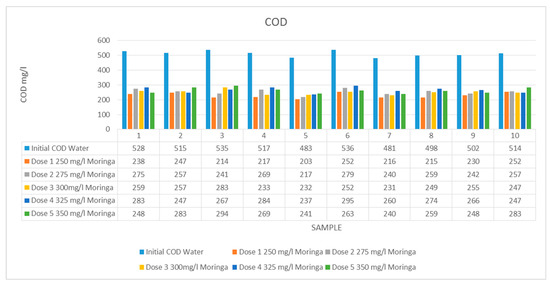
Figure 1.
Removal of Chemical Oxygen Demand (COD) by adding different dosages of Moringa Oleifera.
Even if there is a good efficiency in the reduction of COD, the collected results do not respect the Ecuadorian regulations (Texto Unificado de Legislacion Secundaria de Medio Ambiente, Decreto Ejecutivo 3516 TULSMA, //www.ambiente.gob.ec/wp-content/uploads/downloads/2018/05/TULSMA.pdf).
2.2. Turbidity
The initial concentration of the turbidity was 9–11 Nephelometric Turbidity Units NTU (Figure 2). The removal achieved by the different dosages of seeds varied from 77% to 81%. It can be concluded that the optimum dose of Moringa is 250 mg/L, leading to a 81% of turbidity reduction.
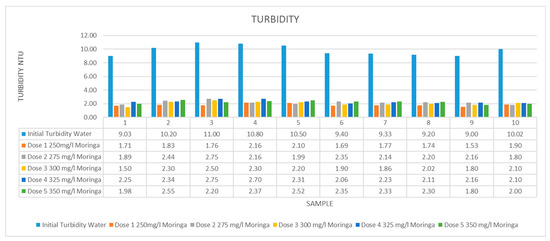
Figure 2.
Removal of turbidity (in Nephelometric Turbidity Units, NTU) by adding different dosages of Moring Oleifera.
According to the Ecuadorian regulations (TULSMA), a maximum value of turbidity of 10 NTU is requested for human consumption and domestic uses and values in the range 0–10 NTU are required for flora and fauna preservation. All of the applied doses reached this requirement.
3. Materials and Methods
3.1. Water Source
The Machangara River is one of the four rivers that cross Cuenca city, and it supplies 60% of the city’s rural population with drinking water (Figure 3).
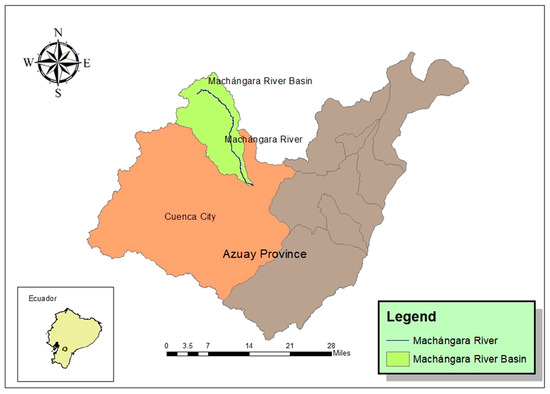
Figure 3.
Water source localization.
It is a water source characterized by a high level of contamination with an average value of COD on an annual basis of 540 mg/L. The main causes of the bad water quality of the river, which is placed near an industrialized area that interact with the river, are water withdrawals and above all the release of industrial effluents.
3.2. Sampling Campaign
Water samples used for the evaluation of the Moringa oleifera seeds efficiency in the flocculation process where divided in 10 sample sets. Each set corresponds to a sampling month and the presented values as “initial” for the response variables are the average monthly values.
The sampling campaign took place from September 2018 to July 2019.
3.3. Dosage Variations
Previous studies involving the effect of Moringa oleifera Lam. seeds have shown that a dosage of 250 mg/L was sufficient to obtain good removal of COD and turbidity.
In this study, the dosages were increased: doses from 250 mg/L to 350 mg/L of Moringa oleifera Lam. seeds were tested with variations of 25 mg/L, having in this way five different doses.
3.4. Jar Tests
Jar tests were performed to evaluate the coagulation-flocculation processes using a solution of Moringa oleifera Lam. seeds in doses from 250 mg to 350 mg per litter of water.
Real surface water was used: 900 mL of (polluted) water withdrawn from the river were mixed with 100 mL of a solution containing Moringa oleifera Lam. Seeds. In each test these conditions were applied: 1 min of agitation at 100 rpm, and then 25 min agitation at 20 rpm.
After this time, all jars rested for 2 h and then COD and turbidity were evaluated as selected response variables.
4. Conclusions
The use of Moringa oleifera Lam seeds in the process of coagulation-flocculation in the evaluated parameters (COD and turbidity) shows good results with a reduction of 50% and 80%, respectively, so it could be an environmentally viable alternative in the treatment of drinking water.
As for the analyzed parameters in this study (COD and turbidity), the dose of Moringa oleifera Lam seeds that presents the highest efficiency is the one of 250 mg/L.
With regard to COD, the investigations show that the removal achieved does not produce an effluent fulfilling the limits set by the Ecuadorian regulation. This means that pre- or post-treatments of the tested coagulation-flocculation process should be added in order to respect the limit.
It is important to investigate the behavior of other parameters such as E. coli, Total suspended solids (TSS), and total nitrogen, among others, and analyze the efficiency of Moringa for their removal. These parameters were not evaluated in this study due to the lack of availability of financial resources in this investigation.
Author Contributions
For this research article all of the authors contributed extensively to the work. P.V. and E.A.S. led this research: both authors contributed to data analysis and to the manuscript writing and reviewing.
Acknowledgments
This work was financially supported by the Politécnica Salesiana University.
Conflicts of Interest
The authors declare no conflict of interest.
Abbreviation
| COD | Chemical Oxygen Demand |
References
- Araújo, C.S.T.; Alves, V.; Rezende, H.C.; Almeida, I.L.S.; De Assunção, R.M.N.; Tarley, C.R.T.; Segatelli, M.G.; Coelho, N.M.M. Characterization and use of Moringa oleifera seeds as biosorbent for removing metal ions from aqueous effluents. Water Sci. Technol. 2010, 62, 2198–2203. [Google Scholar] [CrossRef] [PubMed]
- FAO. Traditional Crop of the Month: Moringa. 2016. Available online: http://www.fao.org/traditional-crops/moringa/en/?amp%3Butm_medium=web&%3Butm_source=faohomepage (accessed on 1 June 2020).
- Gopalakrishnan, L.; Doriya, K.; Devarai, S.K. Moringa oleifera: A review on nutritive importance and its medicinal application. Food Sci. Hum. Wellness 2016, 5, 49–56. [Google Scholar] [CrossRef]
- Martín, C.; Martín, G.; García, A.; Fernández, T.; Ena, H.; y Jürgen, P. Potenciales aplicaciones de Moringa oleifera. Una revisión crítica. Pastos Y Forrajes 2013, 36, 137–149. [Google Scholar]
- Ravikumar, K.; Sheeja, A.K. Heavy Metal Removal from Water using Moringa oleifera Seed Coagulant and Double Filtration. Int. J. Sci. Eng. Res. 2013, 4, 10–13. Available online: http://www.ijser.org (accessed on 1 June 2020).
Publisher’s Note: MDPI stays neutral with regard to jurisdictional claims in published maps and institutional affiliations. |
© 2019 by the authors. Licensee MDPI, Basel, Switzerland. This article is an open access article distributed under the terms and conditions of the Creative Commons Attribution (CC BY) license (https://creativecommons.org/licenses/by/4.0/).