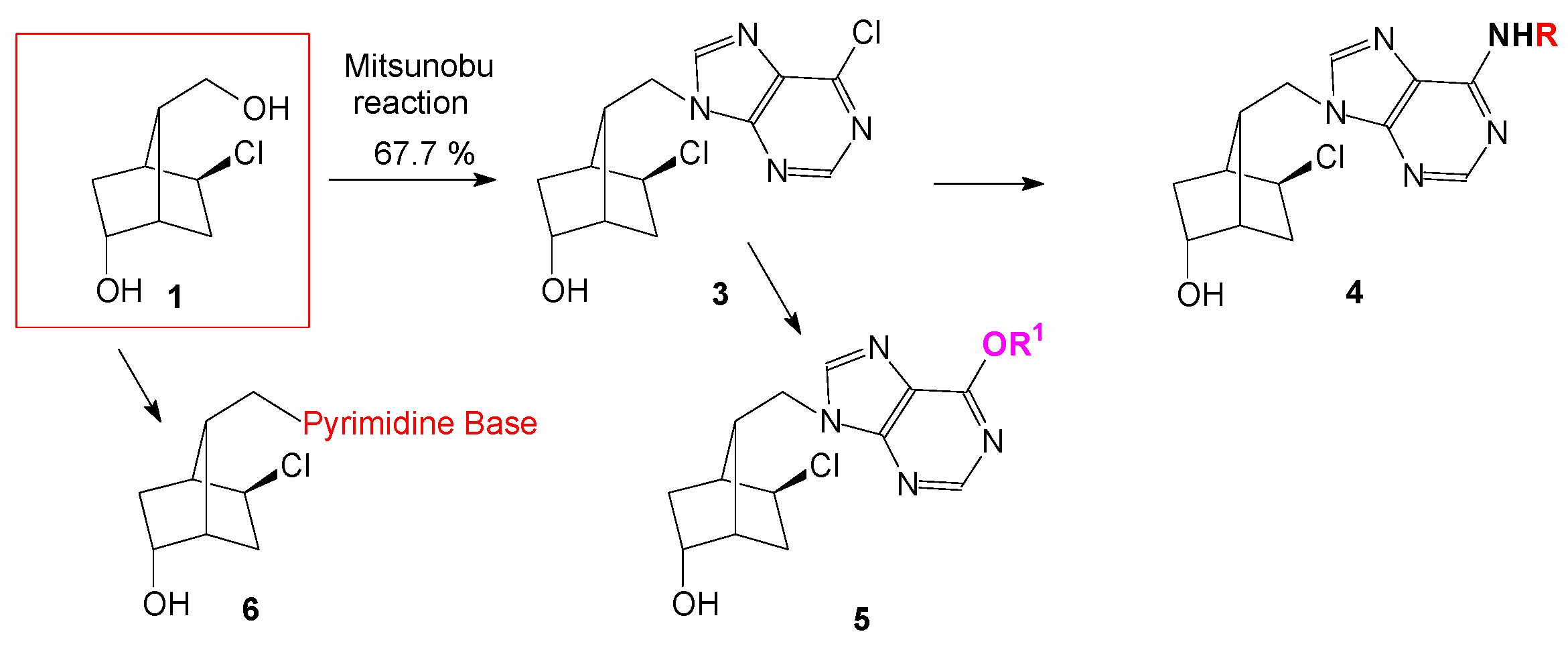
New Carbocyclic Nucleosides with a Constrained Bicyclo[2.2.1]Heptane Fragment as a Glycoside Moiety †


 , ,
, , 
Acknowledgments
References
- Sala, M.; Palma, A.; Hrebabecky, H.; Dejmek, M.; Dracinsky, M.; Leysen, P.; Neyts, J.; Mertlikova-Kaiserova, H.; Nencka, R. SAR studies of 9-norbornylpurines as Coxsackievirus B3 inhibitors. Bioorg. Med. Chem. Lett. 2011, 21, 4271–4275. [Google Scholar] [CrossRef] [PubMed]
- Tănase, C.; Drăghici, C.; Cojocaru, A.; Galochkina, A.V.; Orshanskaya, J.R.; Zarubaev, V.V.; Shova, S.; Enache, C.; Maganu, M. New carbocyclic N6-substituted adenine and pyrimidine nucleoside analogues with a bicyclo[2.2.1]heptane fragment as sugar moiety; synthesis, antiviral, anticancer activity and X-ray crystallography. Bioorg. Med. Chem. 2015, 23, 6246–6254. [Google Scholar] [CrossRef] [PubMed]
- Tănase, C.; Drăghici, C.; Hanganu, A.; Pintilie, L.; Maganu, M.; Volobueva, A.; Sinegubova, E.; Zarubaev, V.V.; Neyts, J.; Jochmans, D.; et al. New HSV-1 Anti-Viral 1′-Homocarbocyclic Nucleoside Analogs with an Optically Active Substituted Bicyclo[2.2.1]Heptane Fragment as a Glycoside Moiety. Molecules 2019, 24, 2446. [Google Scholar] [CrossRef] [PubMed]

© 2019 by the authors. Licensee MDPI, Basel, Switzerland. This article is an open access article distributed under the terms and conditions of the Creative Commons Attribution (CC BY) license (https://creativecommons.org/licenses/by/4.0/).
Share and Cite
Tanase, C.I.; Draghici, C.; Hanganu, A.; Pintilie, L.; Maganu, M.; Munteanu, C.V.A.; Volobueva, A.; Sinegubova, E.; Zarubaev, V.V.; Neyts, J.; et al. New Carbocyclic Nucleosides with a Constrained Bicyclo[2.2.1]Heptane Fragment as a Glycoside Moiety. Proceedings 2019, 29, 21. https://doi.org/10.3390/proceedings2019029021
Tanase CI, Draghici C, Hanganu A, Pintilie L, Maganu M, Munteanu CVA, Volobueva A, Sinegubova E, Zarubaev VV, Neyts J, et al. New Carbocyclic Nucleosides with a Constrained Bicyclo[2.2.1]Heptane Fragment as a Glycoside Moiety. Proceedings. 2019; 29(1):21. https://doi.org/10.3390/proceedings2019029021
Chicago/Turabian StyleTanase, Constantin I., Constantin Draghici, Anamaria Hanganu, Lucia Pintilie, Maria Maganu, Cristian V. A. Munteanu, Alexandrina Volobueva, Ekaterina Sinegubova, Vladimir V. Zarubaev, Johan Neyts, and et al. 2019. "New Carbocyclic Nucleosides with a Constrained Bicyclo[2.2.1]Heptane Fragment as a Glycoside Moiety" Proceedings 29, no. 1: 21. https://doi.org/10.3390/proceedings2019029021
APA StyleTanase, C. I., Draghici, C., Hanganu, A., Pintilie, L., Maganu, M., Munteanu, C. V. A., Volobueva, A., Sinegubova, E., Zarubaev, V. V., Neyts, J., Jochmans, D., & Slita, A. V. (2019). New Carbocyclic Nucleosides with a Constrained Bicyclo[2.2.1]Heptane Fragment as a Glycoside Moiety. Proceedings, 29(1), 21. https://doi.org/10.3390/proceedings2019029021