


Abstract
Carbon dioxide concentration is an important parameter to know Indoor Air Quality of a building. One of the most important sources of CO2 in poor ventilated building is human activity. This work presents a method for experimental determination of human CO2 generation rate based on measuring of time evolution of indoor CO2 concentration. The method is applied to 5 rooms of an educational building from Bialystok (Poland). Similar carbon dioxide gains were obtained in all rooms, around 0.0046 L/s, which correspond to theoretical CO2 generation rates of a sedentary activity for persons, males and females, between 21–30 years old, characteristics of occupants of analyzed rooms.
1. Introduction
A good quality of indoor air (IAQ) in buildings is important in terms of health and thermal comfort of the occupants. As noted by Śmiełowska et al. [1] poor indoor air quality may significantly affect an increase in the incidence of various types of civilisation diseases. Carbon dioxide (CO2) concentration is a parameter commonly used as an indicator of this quality. CO2 itself is not harmful potentially, however its excessive exposure is found to cause drowsy, fatigue and lower performance at work. According ASHRAE standard this concentration should not exceed 2500 ppm, being 1000 ppm recommended upper limit [2]. Knowledge of CO2 concentration helps also to know adequate ventilation rates in building. One of most important parameters influencing changes in CO2 concentration in buildings with high people density are CO2 gains from users, therefore it is necessary to know gain values related to various people activities. As showed by Liu et al. [3] and Orava et al. [4] a human metabolic rate does not only vary with activity intensity but also can be affected by factors such as temperature variation, clothing diversity, gender difference and microclimate. Persili and Jonge [5] introduce the following equation to estimate the CO2 gains from person or human CO2 generation rate, g:
where RQ is a respiratory quotient (ratio of the volumetric rate at which CO2 is produced to the rate at which oxygen is consumed in respiration) with a value approximate of 0.85, BMR is basal metabolic rate in MJ/day that is energy requirement for the diary life (maintenance of body temperature, brain function, and cardiac and respiratory function) and depend of age and mass of the person, and M is metabolic rate in met, that depends of physical activity [6,7].For male adults from 21 to 50 years old with sedentary activity (Met M = 1.2), BMR varies between 8.00 and 8.24 MJ/day and CO2 gains between 0.0050 and 0.0052 L/s. For female adults, BMR and CO2 gains are lower, between 6.16 and 6.49 MJ/day and between 0.0039 and 0.0041 L/s, respectively.
g[L/s] = 0.000569 RQ BMR M
This work presents a method for experimental determination of this CO2 gain based on the dependence of CO2 concentration on time. This method is introduced in the next section. The method was applied to several rooms of an educational building located in Poland with high occupancy and low ventilation intensity.
2. Material and Method
As has been mentioned, the method is based on measurements of time evolution of CO2 concentration. Previous studies showed that this evolution can be well described by the mathematic expression given in [8] and presented in [9]:
where: ACH—the air change rate [1/h], t—time [h], P—pressure [Pa], CCO2in—carbon dioxide concentration in indoor air [ppm], CCO2out—carbon dioxide concentration in outdoor air [ppm], V—the volume of indoor air [m3], g—CO2 gains from a person [g/(h per)], N—number of people occupied a room in this instant t, T—temperature [K], R—gas constant, μCO2—the molar mass of carbon dioxide.
When we multiplied concentration by factor (1 + ACH t), this expression is transformed into a linear dependence on time with slope, m, equal:
In low ACH condition, the second term of the parenthesis can be neglected and slope can be used directly to estimates CO2 gain by person, g:
But if ventilation influence is not neglected or you need more accuracy, gain by user can be obtained directly from Equation (3). To test the method, it was applied to rooms of an educational building located in Poland (Bialystok University of Technology), a meeting room with a mobile wall, two computer laboratories and a project room. Measurements in the meeting room were conducted with different occupancy (23 and 55 persons) and two sizes (215 and 318.8 m2). Similar percentage of males and females were during measurements. Characteristics of these rooms during measurements are shown in Table 1.

Table 1.
Parameters of rooms and atmospheric conditions during measurements.
Measurements of indoor CO2 concentration, temperature, pressure and humidity of indoor air were conducted using a multi-function meter TSI 9565 1.0 m above the floor.
3. Results and Discussion
Example of temporal variations of CO2 concentrations multiplied by (1 + ACH t) factor is represented in Figure 1 together its linear fitting (meeting room in measurement 2). It is observed good agreement with linear behaviour predicted by theory. In all cases, correlation factors are higher to 0.99. Slope of the linear fitting, m, allows us to obtain the CO2 gains g from Equation (4). These gains are also calculated directly from Equation (3) to know influence of ventilation on the method.
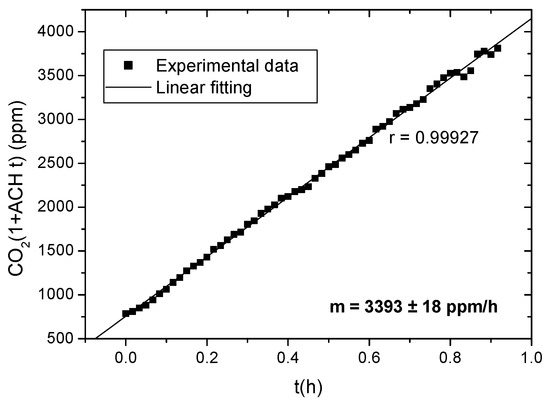
Figure 1.
Temporal variations of CO2 concentrations multiplied by (1 + ACH t) factor for meeting room in measurements in measurement 2.
Results of g calculations for five measurements are shown in Table 2. For g values obtained from Equation (4), neglecting ventilation contribution, values are too high compared with theoretical values for similar male and female percentage. Dispersion of obtained g values for different rooms is also too high. If correction by including ACH effect is made, the values of CO2 gains are similar in all rooms, about 0.0046 L/s, and agree with theoretical value with sedentary activity (M = met) and similar male and female contribution. Exception is measurement in the computer laboratory 2, where g is 0.00424 L/s. This low value is due probably to a higher woman percentage in this case.
Table 2.
Results of g calculations.
4. Conclusions
This work presents an experimental method to determine CO2 gains from persons in the building based on measurement of temporal evolution of CO2 concentrations in low ventilated rooms. In a first approximation, ACH can be neglected in the calculations, but if more accuracy results are necessary, effect of ventilation have also to be included, as has been demonstrated in this paper. Proposed method was verified by experiment in selected rooms of the educational building in Bialystok, Poland. Despite the fact that rooms with low ventilation were selected (ACH = 0.3–0.55 h−1), corrections for this effect have been necessary in the calculations. Values of gains by person in all rooms, except one, were similar around 0.0046 l/s, that agrees with gains from young person with sedentary and M = 1.3 met. This preliminary results shows that introduced method is useful for determination human CO2 gains generation rate in the experimental conditions studied in this paper, sedentary activity and low-medium ACH. It is necessary in further works to check the method with other conditions of activity, metabolic rate and ventilation.
Author Contributions
D.A.K. and A.R. conceived and designed the experiments; performed tests; analyzed the data and made conclusions while A.R. wrote the paper. All authors have read and agreed to the published version of the manuscript.
Acknowledgments
Cost of development of e-lab used as a tool in this analysis as well as participation in a conference and publishing was covered by funds of VIPSKILLS project (Virtual and Intensive Course Developing Practical Skills of Future Engineers. Strategic Partnerships Erasmus +). The study was carried out under the scientific project realized by Bialystok University of Technology and School of Engineering Sciences of Belmez, University of Córdoba “The possibility of the renewable energy sources usage in the context of improving energy efficiency and air quality in buildings and civil constructions”. It was implemented from the resources of the S/WBiIS/4/14 statutory work financed by the Ministry of Science and Higher Education of Poland References.
Conflicts of Interest
The authors declare no conflict of interest. The founding sponsors had no role in the design of the study; in the collection, analyses, or interpretation of data; in the writing of the manuscript, and in the decision to publish the results.
References
- Śmiełowska, M.; Marć, M.; Zabiegała, B. Indoor air quality in public utility environments—A review. Environ. Sci. Pollut. Res. Int. 2017, 24, 11166–11176. [Google Scholar] [CrossRef] [PubMed]
- ASHRAE Standard 62-2001; ASHRAE: Atlanta, GA, USA, 2001.
- Luo, M.; Zhou, X.; Zhu, Y.; Sundell, J. Revisiting an overlooked parameter in thermal comfort studies, the metabolic rate. Energy Build. 2016, 118, 152–159. [Google Scholar] [CrossRef]
- Orava, J.; Nuutila, P.; Lidell, M.E.; Oikonen, V.; Noponen, T.; Viljanen, T.; Scheinin, M.; Taittonen, M.; Niemi, T.; Enerbäck, S.; et al. Different Metabolic Responses of Human Brown Adipose Tissue to Activation by Cold and Insulin. Cell Metab. 2011, 14, 272–279. [Google Scholar] [CrossRef]
- Persiliy, A.; de Jonge, L. Carbon dioxide generation rates for building occupants. Indoor Air 2017, 27, 868–879. [Google Scholar] [CrossRef] [PubMed]
- Ainsworth, B.E.; Haskell, W.L.; Herrmann, S.D.; Meckes, N.; Bassett, D.R., Jr.; Tudor-Locke, C.; Greer, J.L.; Vezina, J.; Whitt-Glover, M.C.; Leon, A.S. The Compendium of Physical Activities Tracking Guide. Healthy Lifestyles Research Center, College of Nursing & Health Innovation, Arizona State University. 2011. Available online: https://sites.google.com/site/compendiumofphysicalactivities/ (accessed on 16 October 2018).
- Ainsworth, B.E.; Haskell, W.L.; Herrmann, S.D.; Meckes, N.; Bassett, D.R., Jr.; Tudor-Locke, C.; Greer, J.L.; Vezina, J.; Whitt-Glover, M.C.; Leon, A.S. Compendium of physical activities: A second update of codes and met values. Med. Sci. Sports Exerc. 2011, 43, 1575–1581. [Google Scholar] [CrossRef] [PubMed]
- Krawczyk, D.A.; Rodero, A.; Gładyszewska-Fiedoruk, K.; Gajewski, A. CO2 concentration in naturally ventilated classrooms located in different climates—Measurements and simulations. Energy Build. 2016, 129, 491–498. [Google Scholar] [CrossRef]
- VIPSKILLS Project (Virtual and Intensive Course Developing Practical Skills of Future Engineers. Strategic Partnerships Erasmus +)—e-Laboratories. Available online: http://vipskills.pb.edu.pl/e-labs (accessed on 16 October 2018).
Publisher’s Note: MDPI stays neutral with regard to jurisdictional claims in published maps and institutional affiliations. |
© 2018 by the authors. Licensee MDPI, Basel, Switzerland. This article is an open access article distributed under the terms and conditions of the Creative Commons Attribution (CC BY) license (https://creativecommons.org/licenses/by/4.0/).