


Abstract
In this short article the concept of Software Defined Radio (SDR) is introduced and compared with the traditional radio. Then, a research project of atlanTTic center which used this technology was briefly presented and lastly, we include a reference to some dissemination activities related with SDR to be developed shortly.
1. Introduction
A radio is a system with technology for transferring information wirelessly by means of electromagnetic radiation [1]. In the past a radio was composed of many discrete circuits and electronic devices and it had a fixed functionality which could not be modified after manufacturing. For example, with a traditional radio one could not turn a commercial FM receiver into a digital radio receiver. However, nowadays with the Software Defined Radio (SDR) one can buy an USB DVB-T2 dongle designed for reception of terrestrial TV in a computer and use it as a GPS receiver, or to decode ADS-B (Automatic Dependent Surveillance-Broadcast) signals and obtain the positions of all the planes in the nearby. This shows how a SDR outperforms a traditional radio in terms of flexibility and reconfigurability.
According to the Wireless Innovation Forum a SDR is a radio in which all or part of the functions of the physical layer are defined by software. The increase in the power of the processors and FPGAs, the reduction of its price and consumption and the emergence of various integrated RF transceiver circuits made it possible for this technology to grow in recent years extending from military and research to commercial and amateur systems. Figure 1 shows a simplified block diagram of a SDR. In the middle we have an Analog to Digital Convertor (ADC) which transforms real world analogue signals into digital and discrete signals which a digital circuit can process and a Digital to Analog Convertor (DAC) which transforms digital samples into an analogue waveform to feed the Radio Frequency (RF) stage which prepares the signal to be transmitted by the antenna.
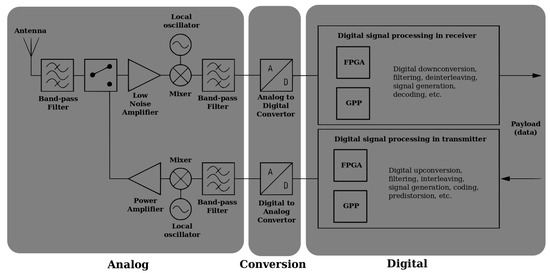
Figure 1.
Possible design of a software defined radio. Adapted from [2].
The last component of a SDR is typically a General Purpose Processor (GPP) where all the digital signal processing takes place. Therefore, it is possible to modify many parameters of the physical layer of a system (or even change all the physical layer!) since it is software defined. In the same way as we install different programs or applications in a computer or smartphone and we give it a new functionality, changing the software which is run in the GPP we can convert the radio into a communication system which follows any given standard as Bluetooth, WiFi, FM, DVB-T2, GSM, LTE, etc., or even in a system with an arbitrary user-defined waveform as is sometimes done in research, for example. A SDR, due to its flexibility, is considered an enabling technology for advanced communication systems which require some type of reconfiguration capability as adaptive or cognitive radio.
2. atlanTTic Experience with SDR
In atlanTTic, the research center for Telecommunication Technologies promoted by the University of Vigo (Galicia, Spain), we have been using SDR in some of our research projects. Recently, in a project named Tactica [3] this technology was used to validate algorithms for adaptive communications in a real scenario, see Figure 2. Using two SDR platforms, a two-way link was established communicating a mobile terminal (embarked on a car or a fixed-wing Unmanned Aerial Vehicle, UAV) with a base station through a medium orbit (MEO) satellite.
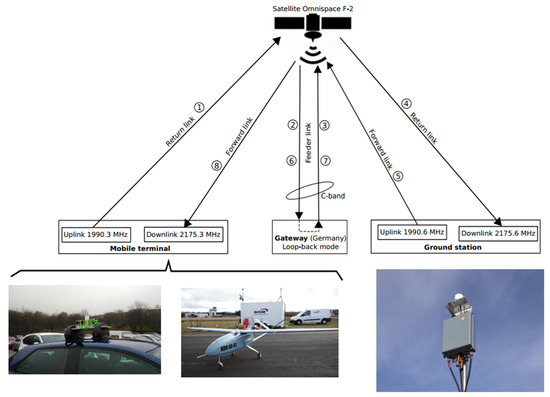
Figure 2.
Block diagrams of the satellite communications system created in Tactica project.
The SDR platform selected for the project was the USRP Ettus E310 which has a Xilinx Zynq 7020 SoC (System on Chip) and it allowed the system to operate in real time to send up to approximately 200 kbps when the 16-QAM constellation was selected. The physical layer of the communications system was based on the standard ETSI TS 102 704, a specification of the satellite component of 3G cellular networks which is used by the BGAN service of Inmarsat. In this standard the transmitter is able to adapt its parameters to follow the varying channel conditions, being this able to modify the bandwidth, the transmitted power, the modulation and also the coding rate of the channel encoder. The SDR technology allowed us to develop more easily a prototype of an adaptive satellite communications system and test different algorithms to select the proper configuration of the physical layer automatically without any human intervention.
3. Dissemination Activities Related with SDR
In the developed countries companies are facing difficulties in recruiting ICT skilled workers and this problem is even worst when they look for engineers specialized in communications and signal processing. Moreover, in our universities students also do not find the latter specialities so appealing. Knowing this, a group of engineers of the atlanTTic and CINAE research centers has started a projected for realizing dissemination activities of the SDR technology, see Figure 3. This project has founding from Iniciativa Xove, a program of the Youth Department of the Galicia Government.
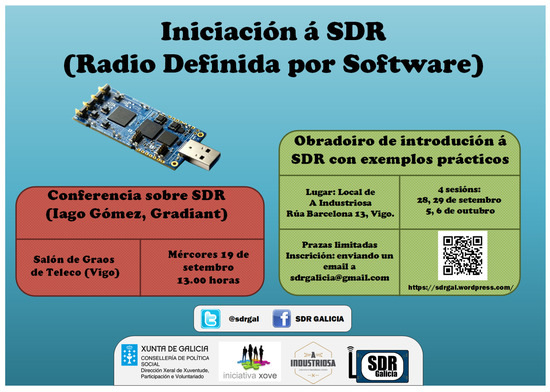
Figure 3.
Poster of the dissemination activities related with SDR.
The project [4] would allow to introduce the SDR technology to young students of engineering by means of a conference where a senior researcher will explain it from scratch with examples of his recent projects and developments. It is also foreseen the realization of a four-day workshop where the participants can do some hands-on projects with the SDR boards LimeSDR Mini and GNU Radio framework. The ultimate goal is to arouse their curiosity about wireless communication and put in practice with real hardware what they learn in the university courses. On the long term, we would like to encourage the creation of a community of people who works and experiments with SDR in the same way as there are also developers groups around other software technologies and programming languages.
Acknowledgments
This work was funded by the Xunta de Galicia (Secretaria Xeral de Universidades) under a predoctoral scholarship (co-funded by the European Social Fund).
Conflicts of Interest
The author declares no conflict of interest. The founding sponsors had no role in the design of the study; in the collection, analyses, or interpretation of data; in the writing of the manuscript, and in the decision to publish the results.
References
- Collins, T.F.; Getz, R.; Pu, D.; Wyglinski, A.M. Software-Defined Radio for Engineers; Artech House: Norwood, MA, USA, 2018. [Google Scholar]
- Software Defined Radios—Overview and Hardware. Available online: https://cdn.rohde-schwarz.com/pws/dl_downloads/dl_common_library/dl_news_from_rs/182/n182_radiocomunit.pdf (accessed on 7 September 2018).
- Tato, A.; Mosquera, C.; Gomez, I. Link adaptation in mobile satellite links: Field trials results. In Proceedings of the 8th Advanced Satellite Multimedia Systems Conference and the 14th Signal Processing for Space Communications Workshop (ASMS/SPSC), Palma de Mallorca, Spain, 5–7 September 2016. [Google Scholar]
- SDR Galicia. Available online: https://sdrgal.wordpress.com (accessed on 7 September 2018).
Publisher’s Note: MDPI stays neutral with regard to jurisdictional claims in published maps and institutional affiliations. |
© 2018 by the author. Licensee MDPI, Basel, Switzerland. This article is an open access article distributed under the terms and conditions of the Creative Commons Attribution (CC BY) license (https://creativecommons.org/licenses/by/4.0/).