


Abstract
Olive fruit fly (Bactrocera oleae) is a pest affecting olive production, causing both qualitative and quantitative damage in all regions of the Mediterranean. This study investigates the spatiotemporal dynamics of olive fruit fly populations obtained from an extensive trap network in five olive-growing regions of Greece—Chalkidiki, Samos, Lesvos, Lasithi, and Chania—over a two-year period (2022–2023). The aim was to understand if and how factors such as variety, temperature, and altitude affect the population of the olive fruit fly. Using Geographical Information System (GIS) tools and spatial analysis, we correlated olive fruit fly numbers with temperature thresholds and altitude categories to analyze different patterns of pest movement. The results show significant variation in population dynamics based on these factors: altitudes, region, and a temperature threshold (at least above 32 °C). These insights are necessary for developing effective and sustainable pest management practices while considering spatial and temporal variability of olive fruit fly movements.
1. Introduction
Olive cultivation (Olea europaea) has major significance for Mediterranean countries, where it plays a crucial role in local economies and sustainable agriculture [1]. Among the various challenges faced by olive production, the olive fruit fly, Bactrocera oleae (Rossi) Diptera: Tephritidae, represents the most important pest threat. This species causes extended damage to olive fruits and significant economic losses. It is estimated that olive fruit fly infestations are responsible for reducing olive oil production by approximately 5–15% across the Mediterranean region [2].
During its life cycle, Bactrocera oleae has an important negative impact on the production of olive oil and edible olives. Female olive fruit flies lay their eggs inside olives, with a single female being able to lay about 12 eggs per day, totaling up to 200 to 250 eggs during its lifetime [3]. The larvae feed on the olive fruit, reducing the quality of the fruit and leading to quantitative and qualitative losses. These infestations not only affect productivity, but also degrade the quality of the final product, leading to a reduction in its market value [4].
Environmental factors, such as mosaic, microclimate, and interactions between organisms like parasitoid insects, affect the population dynamics of most insects, including the olive fruit fly, at the landscape level [5,6]. Furthermore, a correlation between variety [7], altitude [8], and changes in population density over time has been discovered, suggesting that the olive fruit fly moves to different altitudes and different landscapes or even regions.
This paper investigates the influence of olive variety, temperature, and altitude on olive fruit fly population dynamics in five major olive-growing regions in Greece (Chalkidiki, Lesvos, Samos, Lasithi, and Chania). Using an integrated GIS and spatial analysis, the study analyzes population fluctuations under different environmental conditions to better understand the role of these factors in shaping the behavior and spatial movements of the olive fruit fly.
2. Methodology
2.1. Study Areas and Data Collection
Five regions in Greece were selected for collecting the data from olive fruit fly populations: Chalkidiki, Lesvos, Samos, Lasithi, and Chania (Figure 1). The selected areas represent different environments across Greece, as olive groves grow under different geomorphological and climatic conditions. Differences can be found between and in the selected areas, as different olive varieties are cultivated in many altitudes and microclimates, while some groves are continuous and some other discontinuous.
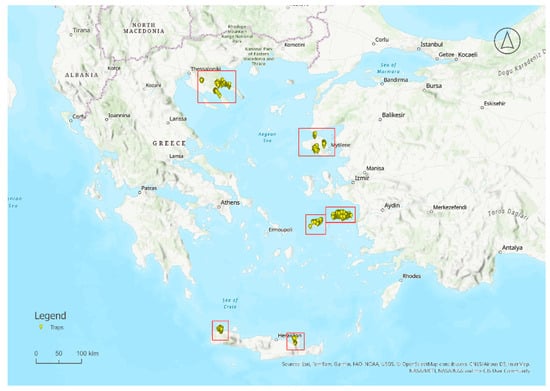
Figure 1.
Study areas.
Hourly mean temperature measurements were taken from weather stations located in each region for the two study seasons (June to October). The location of each trap was determined using a global positioning system (GPS). Based on the location and using the DEM of Greece, the altitudes at which the traps were placed were also calculated.
Olive fruit fly populations for those areas were obtained from the McPhail trap network of the “National Program for the Control of Olive Fruit Fly in Greece” for the years 2022–2023 (Table 1). The trap networks provided data from 1 June until 31 October, and they were checked every five days. To better monitor and manage the populations of the pest, an integrated GIS system was used, consisting of three levels: the user level, the webGIS level, and the geospatial database. The user level includes the Android application which allows the “trap-setter”, based on location of the user and the trap, to input data of the insect population. Those data are stored and are available in real time in the geospatial database to increase the accuracy and reliability of measurements.

Table 1.
The number of traps and main cultivated olive varieties of the study areas.
2.2. Statistical Analysis
Statistical analysis was performed to evaluate the relationships between olive fruit fly populations and environmental factors, particularly altitude and temperature, in the five regions. Descriptive statistics, including mean and standard deviations, summarized the olive fruit fly population. Analysis of Variance (ANOVA) was used to assess population differences based on region and altitude, while post-hoc Tukey tests identified significant differences between groups. Z-score values were calculated to standardize olive fruit fly values and compare them between regions and time periods, highlighting extreme variations. The relationships between temperature thresholds and population dynamics were examined to interpret the data and inform targeted pest management strategies.
To make it easier to compare the data obtained in the present study, some of them were recalculated as shown in Table 2.
Table 2.
List of variables used for the statistical analysis.
The choice of specific elevation categories (0–200 m, 200–400 m, >400 m) is because they represent the typical range of olive-growing zones in the study areas. Temperature thresholds of 32 °C, 35 °C, and 37 °C were selected based on the literature, showing that these temperatures are critical for the reduction of olive fruit fly populations, either weakening their activity or killing the pest [9].
3. Results
The total numbers of olive fruit flies per 10-day-period across different regions (2022–2023), as shown in Figure 2, highlight significant variations in population dynamics, particularly between Crete (Chania and Lasithi) and the other regions. Populations in Crete showed the highest levels, with Chania and Lasithi following similar distribution patterns in both years. Olive fruit fly populations in 2023 were generally lower and more manageable than those in 2022. Despite these general trends, populations vary from region to region, reflecting the influence of various external factors. These differences may be attributed to a combination of factors such as local weather conditions, cultural practices, olive tree variety, or other site-specific factors affecting the behavior and reproduction of the olive fruit fly.
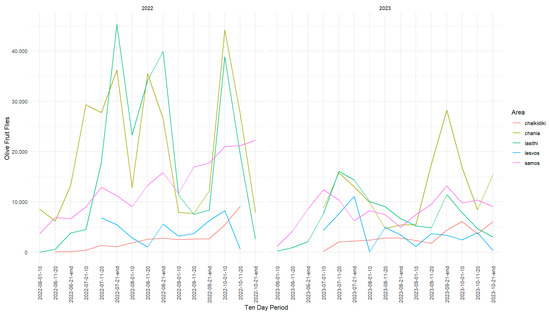
Figure 2.
Total number of olive flies per ten days and region (2022–2023).
The distribution of values for the selected areas (Figure 3a,b) from June to October (2022–2023) reveals some trends in olive fruit fly populations, with several extreme values, especially in Chania. These extreme values indicate very high populations in individual cases, underlining the significant pressure of the olive fruit fly in these areas. Lasithi recorded the highest values in almost all months for both years, indicating a high presence of the insect. Furthermore, while most regions showed a significant increase in olive fruit fly populations later in the season, mainly in September and October, Lasithi showed a different trend. This region had the highest values earlier in July and August.
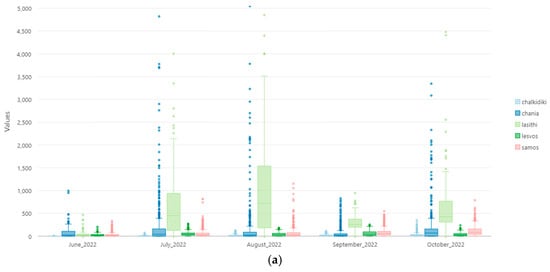
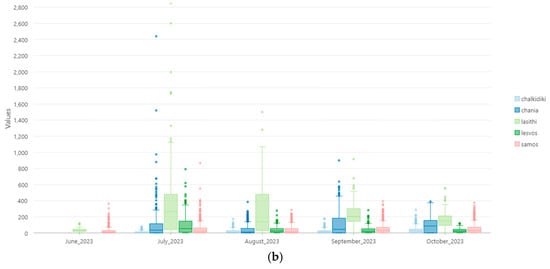
Figure 3.
(a) Values distribution for selected regions: June to October 2022. (b) Values distribution for selected regions: June to October 2023.
The Z-scores for the selected areas (Figure 4a,b) from June to October (2022–2023) show variability in olive fruit fly populations, especially in Lasithi during July and August, where high Z-scores are observed. These increased Z-score values indicate that population values in Lasithi deviate significantly from the mean, suggesting large variations in population levels during this period. In contrast, the areas of Lesvos, Samos, and Chalkidiki show more concentrated and relatively low Z-scores, with most values close to 0. This indicates that in these areas, olive fruit fly populations are more aligned with the mean, reflecting more stable population dynamics.
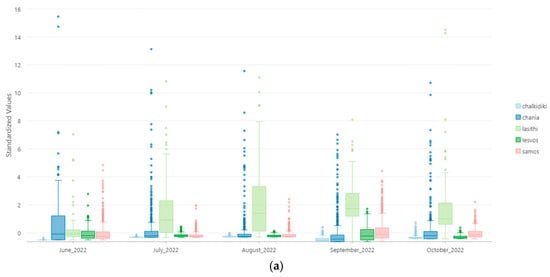
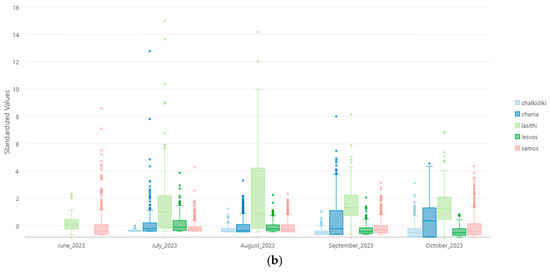
Figure 4.
(a) Z-scores for selected regions: June to October 2022. (b) Z-scores for selected regions: June to October 2023.
Figure 5 is about the impact of temperature thresholds on olive fruit fly populations in all regions (2022–2023). It shows a clear relationship between increasing temperatures and decreasing populations. When temperatures exceed critical limits—especially above 35 °C and 37 °C—there is a marked decrease in populations. This suggests that higher temperatures negatively affect the survival or activity of the pest, especially during critical periods of their life cycle. In 2023, when there were more hours of high temperatures (particularly during June and July, when the first generations of the pest appear), overall population levels were consistently lower compared to 2022.
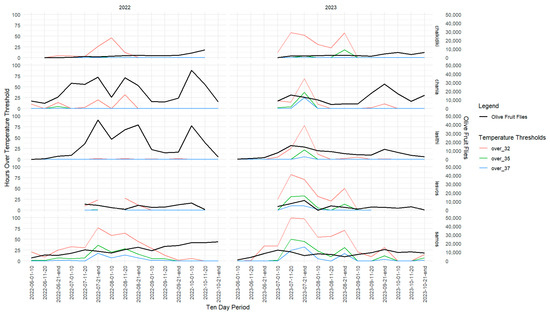
Figure 5.
Impact of temperature thresholds on olive fruit fly populations across regions (2022–2023).
ANOVA analysis of monthly olive fruit fly counts reveals that the presence of the pest varies with altitude (Table 3) and region (Table 4). All months show statistically significant differences between (means of) groups. June 2022 and 2023 for altitude and June 2023 for region showed statistically significant p-values, but the F-values are much lower, indicating a weaker effect compared to the other months.
Table 3.
ANOVA—Monthly olive fruit fly numbers with elevation categories (statistically significant differences (p < 0.05) are marked with *).
Table 4.
ANOVA—Monthly olive fruit fly numbers with region (statistically significant differences (p < 0.05) are marked with *).
4. Conclusions
The study reveals the spatial patterns of olive fruit fly population dynamics, with location-related differences in the five study areas of Greece. In some areas, climatic conditions favor very high populations, highlighting the strong influence of environmental factors [10]. The observed differences between regions are strongly related to their relative geographical location, suggesting that the climate of the region plays a more crucial role than other factors. Altitude also emerged as a factor, with higher altitudes generally supporting lower populations of the olive fruit fly, highlighting the importance of the topography of the region in the appearance of the pest.
Furthermore, it was found that variation in olive fruit fly numbers at specific points (traps) was significant, with variation not only between points but also between different years, suggesting that pest–insect dynamics can change significantly over time. These findings highlight the need for regionally tailored pest management strategies that consider local climatic conditions, altitude, and temporal variability to effectively control populations and reduce damage to production.
Author Contributions
Conceptualization: S.S. Investigation: S.S., S.Z., G.S. and T.K. Data curation: S.S., S.Z., G.S. and T.K. Writing-original draft preparation: S.S. and S.Z. Writing-review and editing: G.S. and T.K. Visualization: S.Z. Supervision: G.S. and T.K. All authors have read and agreed to the published version of the manuscript.
Funding
This research received no external funding.
Institutional Review Board Statement
Not applicable.
Informed Consent Statement
Not applicable.
Data Availability Statement
The raw data supporting the conclusions of this article will be made available by the authors on request.
Conflicts of Interest
The authors declare no conflicts of interest.
Abbreviations
The following abbreviations are used in this manuscript:
| GIS | Geographical Information System |
| GPS | Global Positioning System |
| ANOVA | Analysis of Variance |
References
- Duarte, F.; Jones, N.; Fleskens, L. Traditional Olive Orchards on Sloping Land: Sustainability or Abandonment? J. Environ. Manag. 2008, 89, 86–98. [Google Scholar] [CrossRef] [PubMed]
- Mazomenos, B.E.; Pantazi-Mazomenou, A.; Stefanou, D.T. Attract and Kill of the Olive Fruit Fly Bactrocera oleae in Greece as a Part of an Integrated Control System. IOBC Wprs Bull. 2002, 25, 137–146. Available online: https://api.semanticscholar.org/CorpusID:53392047 (accessed on 20 September 2024).
- Mavragani-Tsipidou, P. Genetic and Cytogenetic Analysis of the Olive Fruit Fly Bactrocera oleae (Diptera: Tephritidae). Genetica 2002, 116, 45–57. [Google Scholar] [CrossRef] [PubMed]
- Stavrianakis, G.; Sentas, E.; Zafeirelli, S.; Tscheulin, T.; Kizos, T. Utilizing Olive Fly Ecology Towards Sustainable Pest Management. Biology 2025, 14, 125. [Google Scholar] [CrossRef] [PubMed]
- Tscharntke, T.; Bommarco, R.; Clough, Y.; Crist, T.O.; Kleijn, D.; Rand, T.A.; Tylianakis, J.M.; Nouhuys, S.V.; Vidal, S. Conservation Biological Control and Enemy Diversity on a Landscape Scale. Biol. Control 2008, 45, 238–253. [Google Scholar] [CrossRef]
- Bourakna, Z.; Righi, K.; Assia, F.; Elouissi, A. Flight Activity of Bactrocera oleae (Rossi, 1790) (Diptera: Tephritidae) Infesting Two Algerian Olive Varieties in North-West Algeria. AAS 2022, 118, 1–8. [Google Scholar] [CrossRef]
- Rizzo, R.; Caleca, V.; Lombardo, A. Relation of Fruit Color, Elongation, Hardness, and Volume to the Infestation of Olive Cultivars by the Olive Fruit Fly, Bactrocera oleae. Entomol. Exp Appl. 2012, 145, 15–22. [Google Scholar] [CrossRef]
- Castrignanò, A.; Boccaccio, L.; Cohen, Y.; Nestel, D.; Kounatidis, I.; Papadopoulos, N.T.; De Benedetto, D.; Mavragani-Tsipidou, P. Spatio-Temporal Population Dynamics and Area-Wide Delineation of Bactrocera oleae Monitoring Zones Using Multi-Variate Geostatistics. Precis. Agric. 2012, 13, 421–441. [Google Scholar] [CrossRef]
- Wang, X.; Levy, K.; Son, Y.; Johnson, M.W.; Daane, K.M. Comparison of the Thermal Performance between a Population of the Olive Fruit Fly and Its Co-Adapted Parasitoids. Biol. Control 2012, 60, 247–254. [Google Scholar] [CrossRef]
- Katsikogiannis, G.; Kavroudakis, D.; Tscheulin, T.; Kizos, T. Population Dynamics of the Olive Fly, Bactrocera oleae (Diptera: Tephritidae), Are Influenced by Different Climates, Seasons, and Pest Management. Sustainability 2023, 15, 14466. [Google Scholar] [CrossRef]
Disclaimer/Publisher’s Note: The statements, opinions and data contained in all publications are solely those of the individual author(s) and contributor(s) and not of MDPI and/or the editor(s). MDPI and/or the editor(s) disclaim responsibility for any injury to people or property resulting from any ideas, methods, instructions or products referred to in the content. |
© 2025 by the authors. Licensee MDPI, Basel, Switzerland. This article is an open access article distributed under the terms and conditions of the Creative Commons Attribution (CC BY) license (https://creativecommons.org/licenses/by/4.0/).