Abstract
In this paper, we study a split-step Galerkin finite element (FE) method for the two-dimensional Riesz space-fractional coupled nonlinear Schrödinger equations (CNLSs). The proposed method adopts a second-order split-step technique to handle the nonlinearity and FE approximation to discretize the fractional derivatives in space, which avoids iteration at each time layer. The analysis of mass conservative and convergent properties for this split-step FE scheme is performed. To test its capability, some numerical tests and the simulation of the double solitons intersection and plane wave are carried out. The results and comparisons with the algorithm combined with Newton’s iteration illustrate its effectiveness and advantages in computational efficiency.
1. Introduction
The nonlinear Schrödinger equation (NLS) was raised by Feynman and Hibbs from the path integral over the Brownian paths [1], which presents an effective model for describing the quantum state of physical systems. The space-fractional NLS was generated by Laskin via extending the Feynman path integral to a novel path integral over the Lévy quantum mechanical paths, which opens a new perspective for quantum mechanics and can characterize many new phenomena absent from the classical NLS [2,3]. The fractional NLS plays an important role in mathematical physics and it is ubiquitous in various fields as diverse as quantum optics, water wave dynamics [4], beam propagation inside crystals, the study of Boson–Einstein condensation, and the continuum limit with long-range lattice interaction [5]. The space-fractional NLS on 2D domains appears as follows:
with
and real numbers
,
,
,
, and
is the Riesz fractional derivative with respect to x [6]:
with
and
being the
-th left- and right-hand Riemann–Liouville derivatives of x, respectively, and
is similarly defined. The fractional NLS happens to be the classical cubic NLS when
, which is necessary to characterize the evolution of nonrelativistic systems and can provide a detailed description of the true nature of the microscopic events in a probabilistic sense.
The space-fractional NLS and CNLS have been of great interest over recent years. However, due to their nonlocal fractional operators involved in space, solving them numerically appears extremely challenging, so the existent algorithms still remain limited for high-dimensional problems. There are many research works devoted to studying the 1D space-fractional NLS, but fewer works investigate the numerical approaches for the high-dimensional space-fractional NLS/CNLS. Amore et al. derived a simple collocation method based on little Sinc functions for the quantum mechanical equation involving the fractional Laplacian [7]. Herzallaha and Gepreel developed an adomian decomposition method to solve the time–space-fractional NLS [8]. In [9,10,11], several second-order finite difference (FD) methods have been established for the 1D single and coupled space-fractional NLS, where the mass and energy conservation properties are rigorously discussed. The Fourier spectral method was first proposed by Klein et al. to study the finite time blow-up, the stability of nonlinear ground states and the long-time behavior of solutions in classical or semiclassical settings [12]. Such a spectral method was further investigated by Duo and Zhang for the 1D space-fractional NLS in a semiclassical regime with the split step, Crank–Nicolson and relaxation schemes being used in time [13]. In [14,15,16], the linearized Galerkin FE schemes for the space-fractional NLS and CNLS on 1D domains were developed. In [17], we proposed an implicit FE scheme to solve the 1D time–space-fractional equations of NLS type and further extended this scheme to the 2D situation. Li et al. gave a fast linearized conservative FE scheme for the 1D strongly space-fractional CNLS [18]. Fan and Qi proposed an efficient FE method for the 2D time–space-fractional NLS [19]. In [20], Aboelenen constructed a high-order nodal discontinuous Galerkin FE method for the 1D space-fractional problem of NLS type.
Aside from the difficulty in designing the algorithm to approximate the fractional derivatives in high dimensions, another main concern about the construction of numerical schemes for the fractional NLS and CNLS is how to efficiently discretize the nonlinear terms. A wealth of experience has shown that the split-step method is one of the important approaches to solve high-dimensional nonlinear problems, which is linearized and can reduce the computational cost and memory requirement. A few works have been devoted to this area. Wang and Huang developed a split-step conservative ADI FD method for the 2D space-fractional NLS [21], which solves the problem without any iteration by splitting the governing equation into linear and nonlinear subparts. Along the same line, a high-order split-step FD method for the 1D space-fractional CNLS was proposed in [22]. Recently, Wang et al. considered the semiclassical linear space-fractional Schrödinger equation by a Lie–Trotter operator splitting spectral method [23]. In [24], Aboelenen proposed a split-step Fourier pseudo-spectral scheme for the 1D space-fractional CNLS. Wang et al. developed a split-step spectral Galerkin scheme for 2D space-fractional NLS [25].
In this work, we consider the 2D space-fractional CNLS
with the real numbers
,
,
and
. When
, the above problem degenerates to the single fractional NLS, which preserves
along with the time evolution [21], where
is the conjugate of u.
Although the spectral Galerkin method based on orthogonal polynomials is a kind of high-accuracy technique, it has a strict limit on computational domains, which are usually multiplicative rectangular regions. Besides, it requires high regularity for the model problem. The FE method is a high-performing and commonly used algorithm for complex domain problems with unstructured meshes in scientific and engineering computing, which can achieve high accuracy with lower regularity, but due to the nonlocality of fractional derivative operators, seldom works have been reported on this method for the high-dimensional space-fractional NLS and CNLS. Inspired by this, we try to establish an efficient split-step Galerkin FE scheme for the 2D space-fractional CNLS (4)–(7). The mass conservation property is proved and the convergence is also analyzed. The proposed method is utilized to simulate these problems on unstructured meshes, and no internal iteration is required at each time layer, thereby greatly reducing the computational complexity.
The outline is as follows. In Section 2, some preliminaries are introduced, and in Section 3, the variational formulation is derived. In Section 4, we engage in a detailed derivative course of the split-step FE scheme for Equations (4)–(7) and further analyze its mass conservation property and error estimates. In Section 5, a numerical study on the dynamics of NLS and CNLS involving fractional derivatives is conducted, and a short conclusion is made lastly.
2. Preliminaries
We recall some auxiliary definitions and results about the fractional derivatives. If
is smooth enough, the
-th left-hand Riemann–Liouville derivative is defined by
and
-th right-hand Riemann–Liouville derivative is defined by
where
,
and
.
Another commonly used fractional derivative is called the Riesz derivative:
and similarly, we can define the fractional derivatives with regard to y.
Meanwhile, letting
,
and
, we denote
by
,
by
and
,
by
with
. For a real-valued
on
, we define the following fractional derivative spaces [26,27]:
Definition 1.
Letting
, we define the left seminorm
and left norm
and let
be the closure of
with respect to
.
Definition 2.
Letting
, we define the right seminorm
and right norm
and let
be the closure of
with respect to
.
Definition 3.
Letting
and
be the Fourier transform of u defined in Ω, i.e.,
we define the seminorm
and norm
and denote the closure of
with respect to
by
, where
and
is the extension of u by zero outside of Ω.
Similar to
,
and
, we define
,
and
by the closures of
with respect to
,
and
, respectively. If
,
,
,
and
are equivalent with the equivalent seminorms and norms, i.e.,
where
and
and
are two positive constants independent of u.
Lemma 1.
Letting
, we have the below identities in the
-nrom sense:
Proof.
Firstly, according to [27], we have
with
. Then, from
and the property of Fourier transform, it follows that
and the similar result
Consequently, we come to Equation (8) by summing these equations together, and Equation (9) can be easily deduced in the same way as above. □
Moreover, for any
, we have
, and for
,
,
, there holds
, which are the well-known fractional Poincaré–Friedrichs inequalities, where C is a positive constant independent of u. For any
or
and
, the similar inequalities can be validated, such as
,
.
3. Variational Formulation
To derive the weak problem, we define the energy norm
and introduce a family of regular triangular subdivisions
of
with the meshsize h. Also, for
or
, we have
and the analogous results hold for
,
[26].
Rewrite u and v in Equations (4)–(7) by their real and imaginary parts, i.e.,
,
, and introduce the symmetric bilinear form:
which satisfies the coercivity and continuity properties:
Using the property (10) and splitting u and v, the weak problem can be defined as follows: find
to fulfill
with
and
, subjected to
Denoting the set of polynomials of degree not greater than
on element K by
, we define the FE subspace
on
as follows:
Then, the semidiscrete FE scheme is defined as follows: find
, such that
with
subjected to
where
,
,
and
are the appropriate approximations of
,
,
and
, respectively.
4. Fully Discrete Split-Step FE Method
Letting
, we define
on
with
,
. In what follows, we propose a fully discrete split-step Galerkin FE scheme for Equations (4)–(7) and analyze its discrete conversation property and error estimate.
4.1. Discretization in Time
The idea of the split-step method is to solve the nonlinear problem by splitting the considered equation into linear and nonlinear parts [28,29,30], which is a popular technique in nonlinear dynamics. If the classical NLS is given by
with
,
being the linear and nonlinear operators, then by separation of variables, we obtain
Then, the second-order Strang split-step scheme is reported as follows:
from
to
, where
and
are integrated exactly from
.
Inspired by this, we consider the coupled system of space-fractional CNLS:
with
and
being the nonlinear terms, i.e.,
Take the inner product sequentially with
,
,
and
in the above equations; then, the sums of Equations (25)–(28) give
which implies that
,
are invariant in time, i.e.,
,
. Meanwhile, we split the coupled system (25)–(28) into the subproblems:
- •
- Nonlinear subproblem:
- •
- Linear subproblem:
then, to solve Equations (25)–(28), one can solve the linear subproblem firstly, followed by solving the nonlinear subproblem. Next, we are devoted to finding the analytic solutions to the nonlinear Equations (29)–(32). To this end, consider Equations (29) and (30) and separate
from Equation (30), i.e.,
. Using the property
and substituting it into Equation (29) yields
with the characteristic equation
. Due to
, we have
where
,
. Since
, it is easy to obtain
. Taking the derivative of both sides on Equation (38) with respect to t at
, there exists
Then, we obtain
by comparing Equation (30) with Equation (39), which yields
and substituting it into Equation (30), we obtain
Doing a similar process as above for Equations (31) and (32), it is not difficult to prove
4.2. Crank–Nicolson FE Scheme
As the solutions to Equations (29)–(32) have been found, we now focus on the linear subproblem and propose a fully discrete Crank–Nicolson FE scheme for it. Let
with
. Applying the Crank–Nicolson scheme in time, the fully discrete FE scheme reads as follows: find
, such that
with
subjected to
where
,
,
and
are the appropriate approximations of
,
,
and
, respectively.
To obtain the error bound, we introduce a general constant C that can be different on different occasions and the fractional orthogonal projection operator
[31]:
which has the approximate property
.
Theorem 1.
Proof.
We mainly focus on
, and the result related to v can be analogously derived. Choosing
in Equation (44), there exists
and choosing
in Equation (45) reaches to
Lemma 2
(Discrete Gronwall inequality [32]). If the non-negative numbers
,
,
,
(
), τ and H satisfy
and supposing that
and
, one obtains
In the sequel, we analyze the error estimate of the Crank–Nicolson FE scheme (44)–(49). For this purpose, we define the complex-valued fractional derivative spaces:
, equipped with the complex norm
with
. Let u and v be the exact solutions of Equations (4)–(7) with their real and imaginary parts being
,
and
,
, respectively. Also, letting
,
and
,
be the solutions at
obtained by the above scheme and denoting
,
and
, we define
and the similar norm
by
,
and
,
,
.
Theorem 2.
Assume
,
,
,
,
,
and
; then, for the Crank–Nicolson FE scheme (44)–(49), we have
where C is a constant independent of τ and h and
.
Proof.
Since the scheme is decoupled, we only prove the error bound of
, and the result for
follows similarly. Letting
,
,
and
, write
By virtue of the approximate property of
, we know that
then we only have to evaluate
,
. Let
, and for
, we have
Using the definition of
and Equations (33) and (44), there exists
where
is the identity operator.
Similarly, for the term
, using Equations (34) and (45), we derive
Choosing
,
in Equations (53) and (54), using the symmetry of
and adding them together, we obtain
Substituting
into the above equation, we further obtain
where
Then, by Young’s inequality, we have
and by the variational principle (10), there holds
where
, but
. Substituting (56) and (57) into Equation (55) and summing it from
to n, we obtain
Next, we estimate each term on the right side of the above inequality item by item. Firstly, from the approximate property of
, it follows that
Secondly, using Taylor expansions, we have the upper bounds for the terms
Meanwhile, by the equivalency of fractional norms, there is no doubt that
which yields
and in the same fashion, we can prove
4.3. Split-Step FE Scheme
According to the idea of the split-step method, the space-fractional CNLS can be split by solving the subproblems (29)–(32) and (33)–(36). Then, combining with the split step via the second-order Strang splitting technique and using the analytical solutions (40)–(43), the split-step FE scheme can be established by the following three steps:
- •
- Step 1:
- •
- Step 2:
- •
- Step 3:
with
,
,
,
subjected to
where
and
,
,
and
are also the appropriate approximations of
,
,
and
, respectively.
Theorem 3.
Proof.
We only prove that
and
can be analogously obtained. Using the properties of the triangular function, we have
and
. Noting the argument in Theorem 1, we obtain
and thus
. This completes the proof. □
Theorem 4.
If we let
,
,
and
, then for the split-step FE scheme (66)–(79), there holds
where C is a constant independent of τ and h and
.
Proof.
One can easily find this result by combining the property of the standard second-order Strang split-step technique and Theorem 2, and hence the details are omitted. □
Remark 1.
The present split-step FE scheme together with its theoretical results are applicable to α,
because Lemma 1 and Equation (10) also hold in this case. The only issue required to be addressed is the generation of the stiffness matrix, but the algorithm is similar to the case of
and
.
5. Numerical Experiments
In this section, three numerical examples are provided to illustrate the computational accuracy and conservation property of the proposed split-step FE method. The uniform unstructured triangular meshes are utilized in all the tests and the algorithm to assemble the stiffness matrices, which is a difficult issue that we addressed in [31]. The codes are tested on the numerical simulation of the double solitons intersection and plane wave. All the tests are carried out by using linear interpolation, i.e.,
, and run by MATLAB R2015b on a PC with Windows 7 Ultimate SP1, AMD Athlon(tm) II
250 3.00 GHz Processor and 8 GB DDR3 1600MHz RAM. According to the foregoing theoretical analysis, we anticipate the second-order convergent rates both in time and space.
5.1. One-Dimensional Problem
Example 1.
We simulate the intersection of double solitons governed by the following 1D coupled space-fractional CNLS:
with the initial wave functions [33]:
where
is the amplitude and
is the propagation velocity with
.
When
tends to infinity, the solitons can be negligible; then, we truncate the problem on
by taking a large enough ℓ and imposing the homogeneous boundary conditions as follows:
In particular, the above problem is an integrable Manakov model if we take
and
, which describes an elastic collision without any reflection, transmission, trapping and the new solitary wave created by the intersection of two solitons.
Letting
,
and
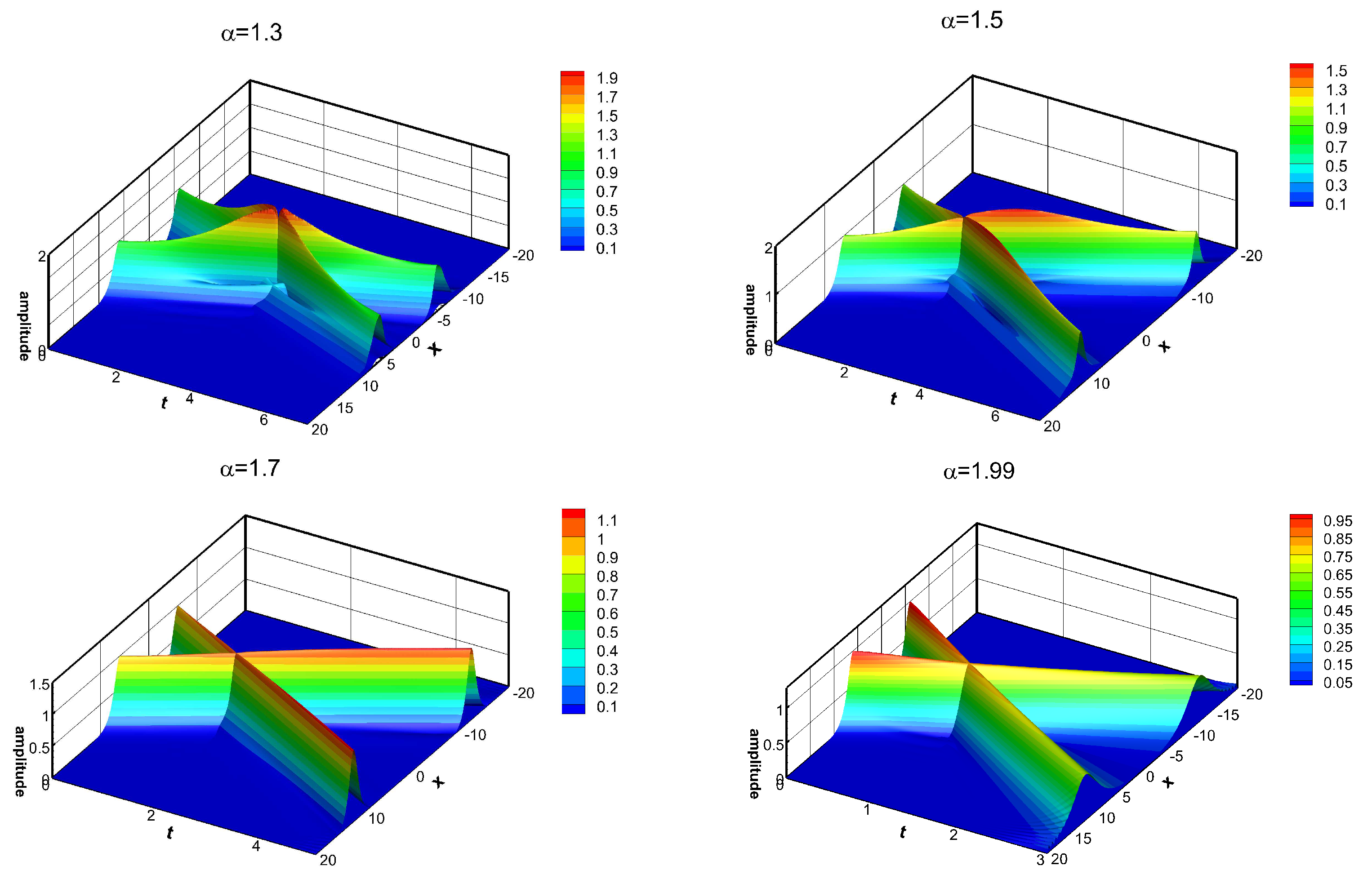
, we simulate the dynamics of the double solitons intersection with and study the potential impact brought by fractional derivatives to double solitons collision. For this purpose, letting the velocity of both moving solitons be opposite but with equivalent size, i.e., , we take
2.0
× 10−2 and
and present the evolution of solitons over time for
,
,
and
with
and
in Figure 1. As we observed, as
becomes smaller, the propagation velocity of solitons will be slower, which means that the time of the solitons collision will be delayed if
is assigned a small number. Meanwhile, the shape of the solitons changes with
, including both the width and amplitude. More specifically, the smaller the
is, the higher the amplitude of solitons would be, and the variation trend of width seems to be the opposite. In addition, this phenomenon is more evident when they collide with each other. The reason for this phenomenon may be that
and can affect the diffusion rate of microscopic particles in Lévy processes. Resetting 5.0
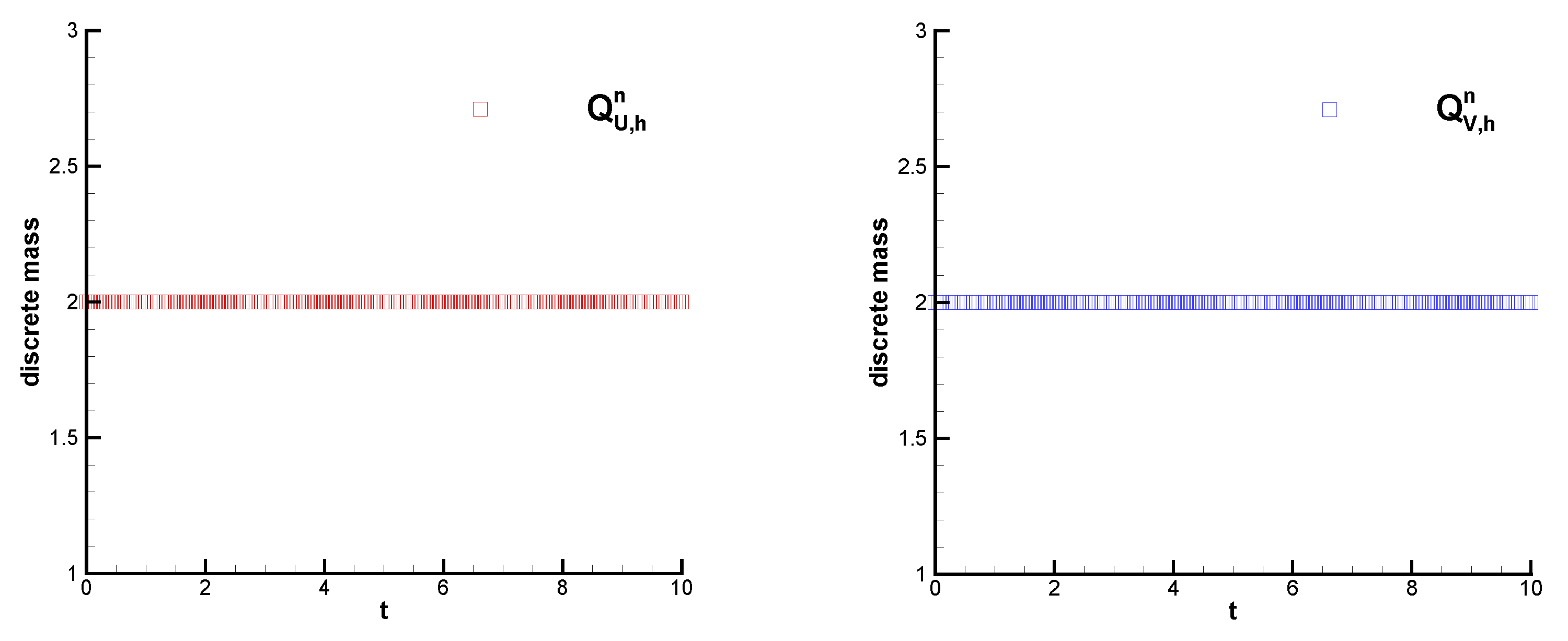
× 10−2 and , we compute the conservation quantities
and
and present their variation versus time for
in Figure 2. Besides, we report the values of
and
at different times for
,
and
in Table 1. From these figures and table, it is observed that our split-step FE scheme preserves
and
and can be applied to long-time simulation in practice.
Figure 1.
Interaction of double solitons with different
.
Figure 2.
The variation in conservation quantities
and
for
.
Table 1.
The values of
and
at different time.
In order to obtain more insight about computational efficiency, we use the pure Crank–Nicolson FE scheme to discretize the above space-fractional CNLS and run the algorithm with a Newton’s iteration loop to obtain the solutions at each time layer. We compare the computational time of the pure Crank–Nicolson FE and split-step FE methods with a different
and h, where the Newton’s iteration algorithm is terminated by reaching a solution with the tolerant error 1.0 × 10⁻¹². Letting
and
, we compute the solutions at
by using both methods and report the used CPU times in Table 2. From this table, we easily observe that the CPU times of our method are markedly less than those of the Crank–Nicolson FE scheme with Newton’s iteration, which implies that the proposed split-step FE method is more efficient than iteration algorithms.
Table 2.
The CPU times of split-step FE method and Crank–Nicolson FE method with Newton’s iteration.
5.2. Two-Dimensional Problems
Example 2.
We consider the 2D space-fractional problem of CNLS type:
on the domain
, where the right-side terms are as follows:
with
,
and the functions
It can be validated that the analytical solutions are
In this test, we evaluate the convergent accuracy of the Crank–Nicolson FE and split-step FE methods. On the one hand, we take and , and then the problem degenerates into a coupled linear problem and the Crank–Nicolson FE scheme is applied. We compute the mean square errors and at with different by using , and the numerical results for and are documented in Table 3. Next, taking 1.0 × 10 −3, we compute the errors at with a different h and document the numerical results in Table 4, where in order to verify the accuracy, we calculate the temporal convergent order by
and the spatial convergent order by
with being the error computed by using the time and space meshsizes and .
Table 3.
The errors and order
of Crank–Nicolson FE scheme for
and
.
Table 4.
The errors and order
of Crank–Nicolson FE scheme for
and
.
On the other hand, we take and and apply the split-step FE scheme to treat this nonlinear coupled system. We test the codes as above and document the corresponding results at for and , which are in Table 5 and Table 6, respectively. We easily observe from the tables that the convergent order of two FE schemes are almost two both in time and space, which demonstrates that the proposed FE schemes are convergent with theoretical accuracy.
Table 5.
The errors and order
of split-step FE scheme for
and
.
Table 6.
The errors and order
of split-step FE scheme for
and
.
Example 3.
Letting
, we simulate the dynamic of plane wave governed by
with the initial wave function
When
and
tend to infinity, the initial wave exponentially decays to zero, and if Ω is large enough, then the height of the wave is nearly zero outside of Ω; thus, we suggest the homogeneous boundary condition imposed as
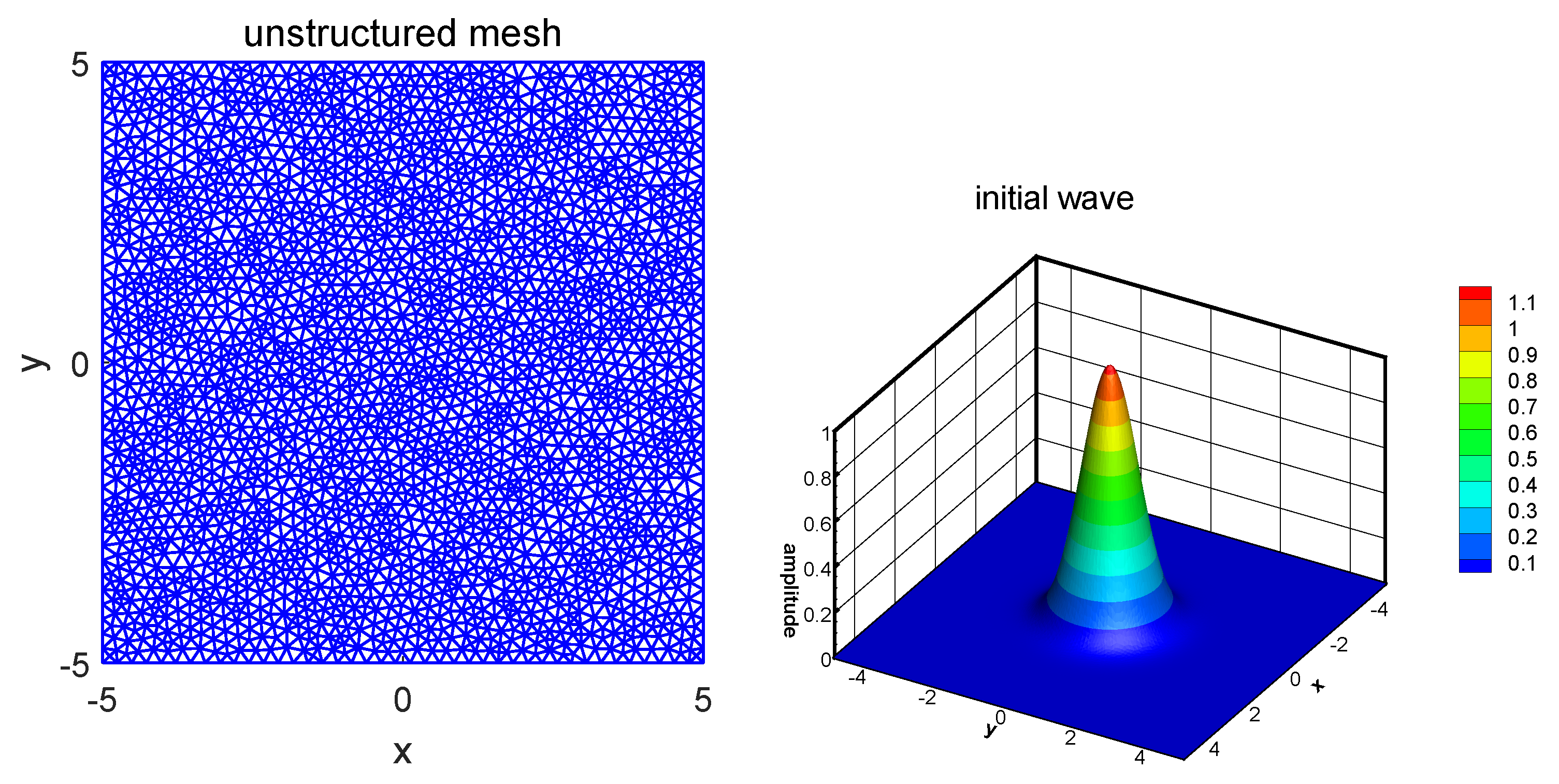
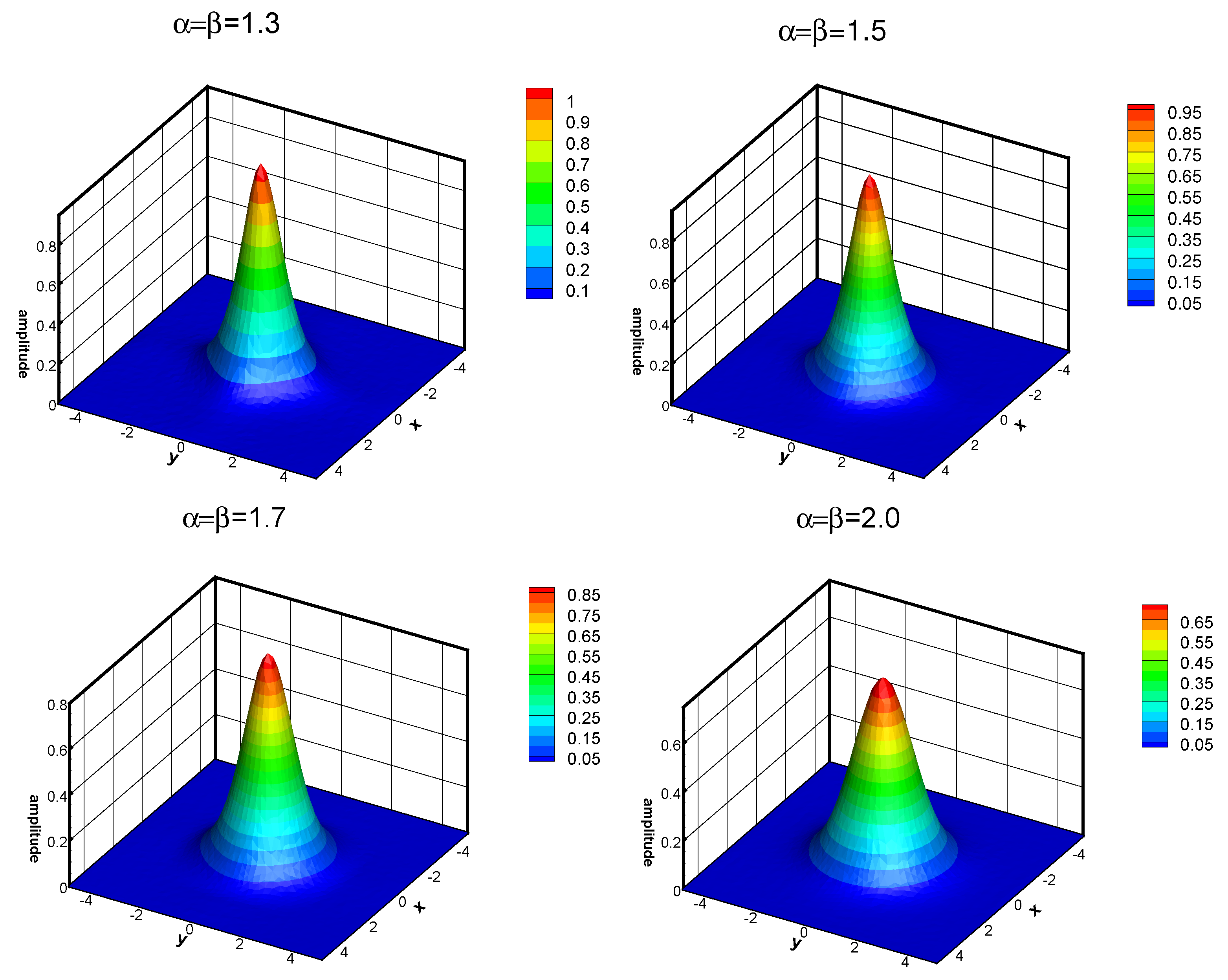
The main purpose of this test is to evaluate the actual performance of the proposed split-step FE scheme in practice, and we conduct the numerical simulation divided into three steps. Firstly, the evolution of the wave over time will be simulated. On a finer unstructured triangular mesh, the initial wave is plotted, which is given in Figure 3 (right). We easily see that its amplitude is nearly one. Letting ,
,
and
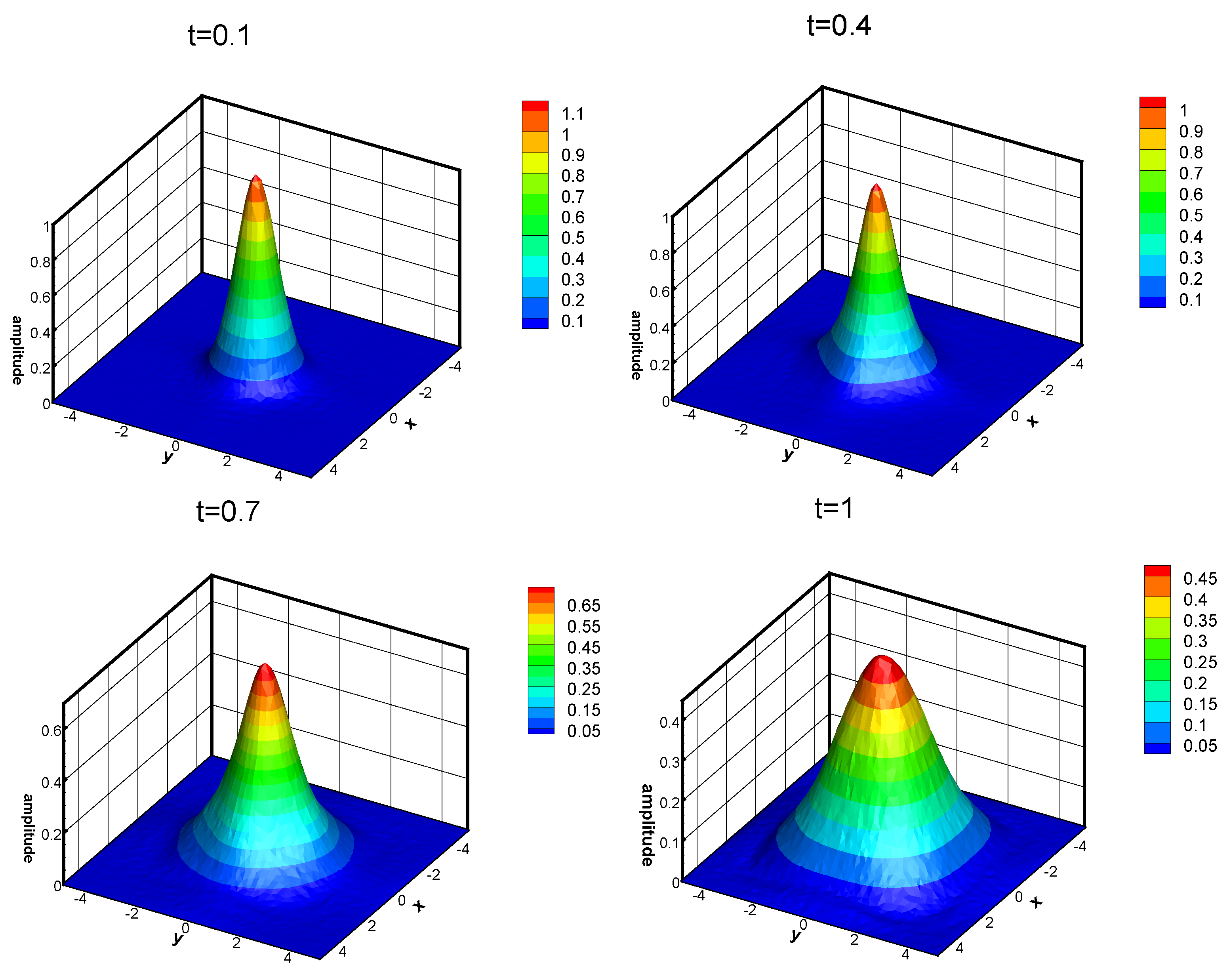
, we use the split-step FE scheme to handle this problem. The used unstructured triangular mesh is given in Figure 3 (left), and the profiles of the approximate wave at the time
, 0.4, 0.7 and 1 for
are plotted in Figure 4. The comparison of the approximate waves at
for different
and
are presented in Figure 5. From these figures, we observe that the wave travels with its size and height being continuously variable. More precisely, the plane wave is centered at origin coordinates with the height being one at
, and as time goes on, the modulus of the wave solution becomes smaller and the wave gets fatter and fatter. The physical shape of the waves can obviously be affected by the fractional derivatives, and a bigger
and
would lead to a faster rate of decay of plane waves. As compared to the classical ones, the wave governed by the fractional model possesses a narrower width and larger amplitude, and such an impact would grow as
and
become small. Letting
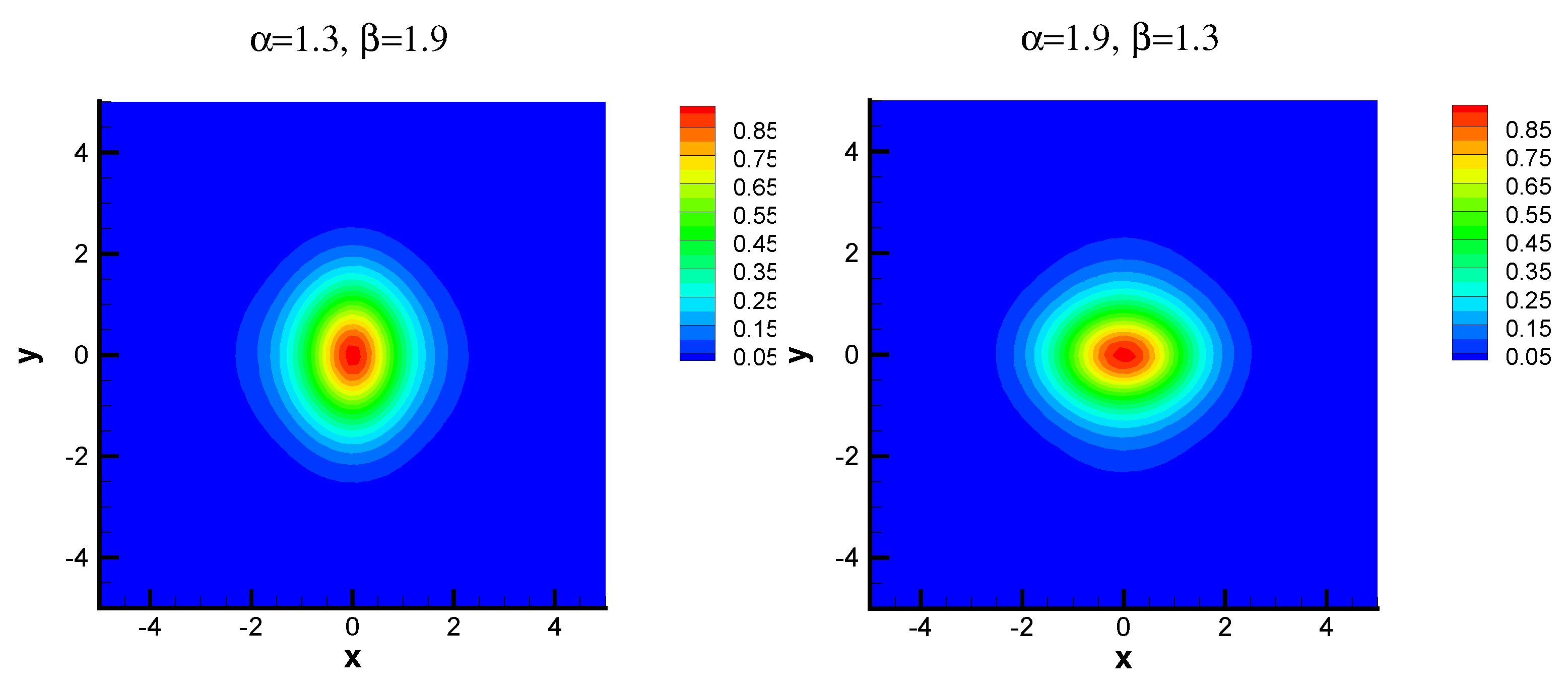
and
, Figure 6 (left) shows the contour of an approximate wave. We observe that the decay speed of the wave solution along the x-axis is smaller than that of the y-axis. On the contrary, reletting
and
, the exact opposite result is observed in Figure 6 (right), which further confirms that
and
can affect the decay speed of the wave solution and a large fractional power would lead to a fast decay velocity. What caused this phenomenon? The most intuitive explanation is that the value of fractional exponents
and
have an impact on the diffusion behavior of particles. More precisely, as
and
increase toward two, the diffusion occurs faster, and conversely, the diffusion occurs slowly if
and
are small. As to why this occurred, it may be related to how the value of
and
determines how a particular "non-Gaussian" probability distribution of particle displacements becomes in Lévy flights.
Figure 3.
Unstructured triangular mesh and initial plane wave.
Figure 4.
Profiles of wave solution at different time for
.
Figure 5.
Profiles of wave solution for different
and
at
.
Figure 6.
Contour plots of wave solution with
.
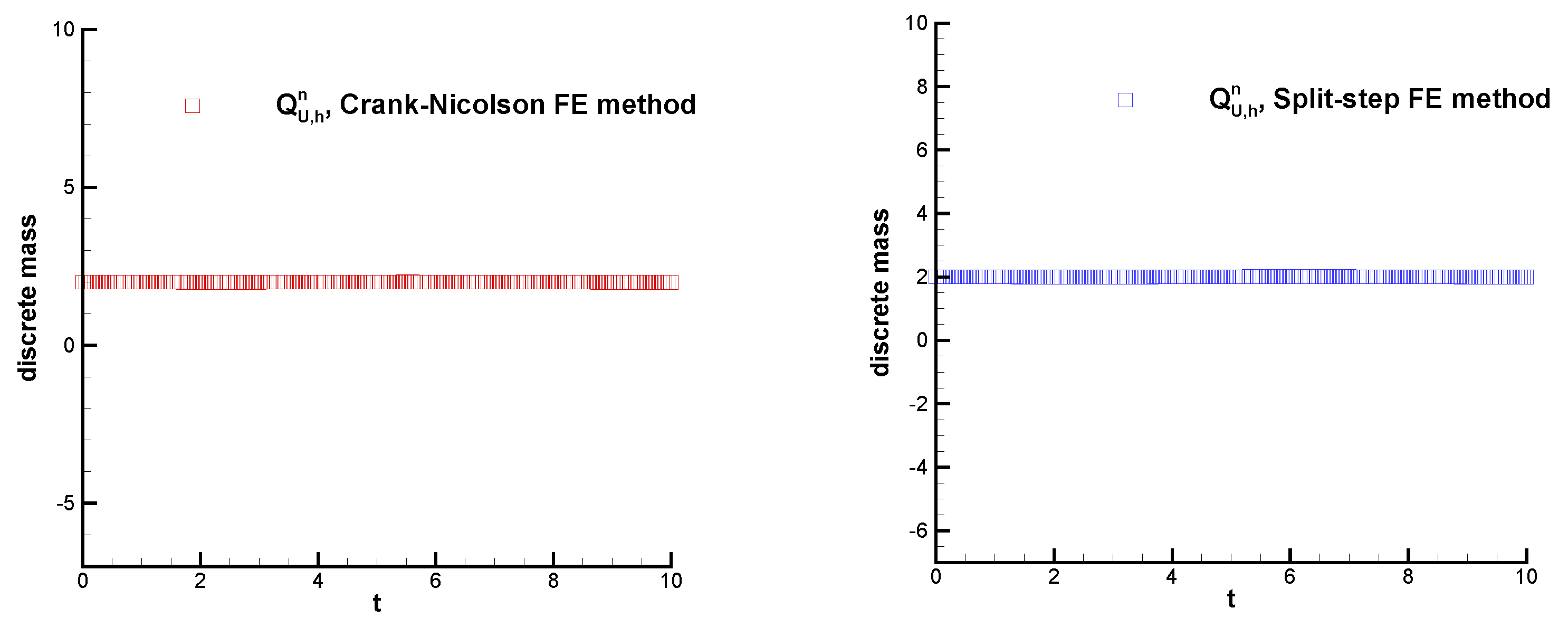
Secondly, we show that the mass conservation property is maintained by both Crank–Nicolson FE and split-step FE schemes. Taking
, and
, we use the Crank–Nicolson FE scheme to solve this problem based on the meshsizes
and
and exhibit how the conservation quantity
changes over time in Figure 7 (left). Furthermore, retaking
, we use the split-step FE scheme to solve this problem and present the variation tendency of the value of
versus time in Figure 7 (right). The computational results in the above figures illustrate that both two FE schemes preserve
.
Figure 7.
The variation in conservation quantity
for
.
Finally, as we did before, we use the pure Crank–Nicolson FE scheme with Newton’s iteration to discretize the above problem with
and compare the time cost of the Crank–Nicolson FE and split-step FE schemes, where the tolerant error is also chosen to be 1.0 × 10 −12. Letting
and
, we compute the solutions at
by both methods and report the used CPU times in Table 7. It is easy to observe that the CPU times of our method are much less than those of the pure Crank–Nicolson FE scheme, which demonstrates that the proposed split-step FE method is very competitive in an actual numerical simulation.
Table 7.
The CPU times of split-step FE method and Crank–Nicolson FE method with Newton’s iteration.
6. Conclusions
The high-dimensional space-fractional CNLS is a coupled nonlinear system, and its main difficulty comes from the nonlocality of fractional derivatives. This paper considered a split-step Galerkin FE scheme for the 2D space-fractional CNLS, and the proposed method is particularly adequate for solving this type of equation. The designed split-step FE scheme avoids solving nonlinear algebraic equations and can effectively reduce computational burden in practice. We also studied its mass conservation property in a discrete sense and unconditional convergence. The algorithm was evaluated by a constructive numerical test and the simulation of a double solitons collision and plane wave on unstructured meshes. The numerical outcomes and comparison with the pure Crank–Nicolson FE method with Newton’s iteration have illustrated its superiority and capacity.
The fractional NLS extends the application scope of classical NLS, and it tremendously enriches the connotation of quantum mechanics. The nonlocal convolution structure in fractional derivatives brings forward a great challenge in numerical simulation. Hence, an efficient numerical technique like our method can not only help to study the inner mechanisms of a microscopic quantum system but also play a certain role in increasing the popularity of fractional NLS/CNLS, and this would indirectly promote the upgrading of technological products. For example, we can study how a light beam travels in a fractional diffraction system in a numerical sense to provide a reference for the production of highly sensitive optical switches, optical devices, beam splitters, etc. Moreover, it is worth mentioning that artificial neural networks have also recently emerged as a promising alternative to simulate the systems involving fractional calculus [34,35,36,37]. As a kind of artificial intelligence algorithm, they have many advantages, such as strong fault tolerance and robustness for all quantitative applications and sensibility to spatial dimensions. We believe that they can be extended to simulate the high-dimensional space-fractional CNLS as well and would possess strong competitiveness as compared to the existing methods for our algorithm. We will consider this interesting topic in the future.

Author Contributions
Conceptualization, X.Z.; methodology, X.Z. and Y.N.; validation, Y.N.; formal analysis, X.Z. and Y.Z.; investigation, X.Z. and Y.N.; data curation, X.Z.; writing—original draft preparation, X.Z.; writing—review and editing, Y.Z.; supervision, Y.N.; funding acquisition, X.Z. and Y.N. All authors have read and agreed to the published version of the manuscript.
Funding
The Science and Technology Planning Projects of Shaoyang: 2023ZD0074; the Scientific Research Funds of Hunan Provincial Education Department: 22B0756, 22C0455, 21C0607; the Natural Science Foundation of Hunan Province of China: 2022JJ30548; the Teaching Reform Research Project of Hunan Province: 202401001284; and the National Natural Science Foundation of China: 11971386.
Data Availability Statement
The data that support this study are included in this article.
Acknowledgments
The authors thank both reviewers for their careful reading and valuable comments.
Conflicts of Interest
The authors declare no conflicts of interest.
References
- Feynman, R.P.; Hibbs, A.R. Quantum Mechanics and Path Integrals; McGraw-Hill: New York, NY, USA, 1965. [Google Scholar]
- Laskin, N. Fractional quantum mechanics. Phys. Rev. E 2000, 62, 3135–3145. [Google Scholar] [CrossRef] [PubMed]
- Laskin, N. Fractional quantum mechanics and Lévy path integrals. Phys. Lett. A 2000, 268, 298–305. [Google Scholar] [CrossRef]
- Obrecht, C. Remarks on the full dispersion Davey-Stewartson systems. Commun. Pure Appl. Anal. 2015, 14, 1547–1561. [Google Scholar] [CrossRef]
- Kirkpatrick, K.; Lenzmann, E.; Staffilani, G. On the continuum limit for discrete NLS with long-range lattice interactions. Comm. Math. Phys. 2013, 317, 563–591. [Google Scholar] [CrossRef]
- Kilbas, A.A.; Srivastava, H.M.; Trujillo, J.J. Theory and Applications of Fractional Differential Equations; Elsevier: Amsterdam, The Netherlands, 2006. [Google Scholar]
- Amore, P.; Fernández, F.M.; Hofmann, C.P.; Sáenz, R.A. Collocation method for fractional quantum mechanics. J. Math. Phys. 2010, 51, 122101. [Google Scholar] [CrossRef]
- Herzallaha, M.A.E.; Gepreel, K.A. Approximate solution to the time-space fractional cubic nonlinear Schrödinger equation. Appl. Math. Model. 2012, 36, 5678–5685. [Google Scholar] [CrossRef]
- Wang, D.L.; Xiao, A.G.; Yang, W. Crank-Nicolson difference scheme for the coupled nonlinear Schrödinger equations with the Riesz space fractional derivative. J. Comput. Phys. 2013, 242, 670–681. [Google Scholar] [CrossRef]
- Wang, D.L.; Xiao, A.G.; Yang, W. Maximum-norm error analysis of a difference scheme for the space fractional CNLS. Appl. Math. Comput. 2015, 257, 241–251. [Google Scholar] [CrossRef]
- Wang, P.D.; Huang, C.M. An energy conservative difference scheme for the nonlinear fractional Schrödinger equations. J. Comput. Phys. 2015, 293, 238–251. [Google Scholar] [CrossRef]
- Klein, C.; Sparber, C.; Markowich, P. Numerical study of fractional nonlinear Schrödinger equations. Proc. R. Soc. A 2014, 470, 20140364. [Google Scholar] [CrossRef]
- Duo, S.W.; Zhang, Y.Z. Mass-conservative Fourier spectral methods for solving the fractional nonlinear Schrödinger equation. Comput. Math. Appl. 2016, 71, 2257–2271. [Google Scholar] [CrossRef]
- Li, M.; Huang, C.M.; Wang, P.D. Galerkin finite element method for nonlinear fractional Schrödinger equations. Numer. Algorithms 2017, 74, 499–525. [Google Scholar] [CrossRef]
- Li, M.; Huang, C.M.; Zhang, Z.B. Unconditional error analysis of Galerkin FEMs for nonlinear fractional Schrödinger equation. Appl. Anal. 2018, 97, 295–315. [Google Scholar] [CrossRef]
- Zhu, X.G.; Nie, Y.F.; Yuan, Z.B.; Wang, J.G.; Yang, Z.Z. A Galerkin FEM for Riesz space-fractional CNLS. Adv. Differ. Equ. 2019, 2019, 329. [Google Scholar] [CrossRef]
- Zhu, X.G.; Yuan, Z.B.; Wang, J.G.; Nie, Y.F.; Yang, Z.Z. Finite element method for time-space-fractional Schrödinger equation. Electron. J. Differ. Equ. 2017, 166, 1–18. [Google Scholar]
- Li, M.; Gu, X.M.; Huang, C.M.; Fei, M.F.; Zhang, G.Y. A fast linearized conservative finite element method for the strongly coupled nonlinear fractional Schrödinger equations. J. Comput. Phys. 2018, 358, 256–282. [Google Scholar] [CrossRef]
- Fan, W.P.; Qi, H.T. An efficient finite element method for the two-dimensional nonlinear time–space fractional Schrödinger equation on an irregular convex domain. Appl. Math. Lett. 2018, 86, 103–110. [Google Scholar] [CrossRef]
- Aboelenen, T. A high-order nodal discontinuous Galerkin method for nonlinear fractional Schrödinger type equations. Commun. Nonlinear Sci. Numer. Simul. 2018, 54, 428–452. [Google Scholar] [CrossRef]
- Wang, P.D.; Huang, C.M. Split-step alternating direction implicit difference scheme for the fractional Schrödinger equation in two dimensions. Comput. Math. Appl. 2016, 71, 1114–1128. [Google Scholar] [CrossRef]
- Li, M. A high-order split-step finite difference method for the system of the space fractional CNLS. Eur. Phys. J. Plus 2019, 134, 1–22. [Google Scholar] [CrossRef]
- Wang, W.S.; Huang, Y.; Tang, J. Lie-Trotter operator splitting spectral method for linear semiclassical fractional Schrödinger equation. Comput. Math. Appl. 2022, 113, 117–129. [Google Scholar] [CrossRef]
- Wang, Y.; Mei, L.Q.; Li, Q.; Bu, L.L. Split-step spectral Galerkin method for the two-dimensional nonlinear space-fractional Schrödinger equation. Appl. Numer. Math. 2019, 136, 257–278. [Google Scholar] [CrossRef]
- Abdolabadi, F.; Zakeri, A.; Amiraslani, A. A split-step Fourier pseudo-spectral method for solving the space fractional coupled nonlinear Schrödinger equations. Commun. Nonlinear Sci. Numer. Simul. 2023, 120, 107150. [Google Scholar] [CrossRef]
- Bu, W.P.; Tang, Y.F.; Yang, J.Y. Galerkin finite element method for two-dimensional Riesz space fractional diffusion equations. J. Comput. Phys. 2014, 276, 26–38. [Google Scholar] [CrossRef]
- Ervin, V.J.; Roop, J.P. Variational formulation for the stationary fractional advection dispersion equation. Numer. Meth. Part Differ. Equ. 2006, 22, 558–576. [Google Scholar] [CrossRef]
- Gauckler, L. Convergence of a split-step Hermite method for the Gross–Pitaevskii equation. IMA J. Numer. Anal. 2011, 31, 396–415. [Google Scholar] [CrossRef]
- Lee, J.; Fornberg, B. A split step approach for the 3-D Maxwell’s equations. J. Comput. Appl. Math. 2003, 158, 485–505. [Google Scholar] [CrossRef]
- Weideman, J.A.C.; Herbst, B.M. Split-step methods for the solution of the nonlinear Schrödinger equation. SIAM J. Numer. Anal. 1986, 23, 485–507. [Google Scholar] [CrossRef]
- Zhu, X.G.; Nie, Y.F.; Wang, J.G.; Yuan, Z.B. A numerical approach for the Riesz space-fractional Fisher’equation in two-dimensions. Int. J. Comput. Math. 2017, 94, 296–315. [Google Scholar] [CrossRef]
- Heywood, J.G.; Rannacher, R. Finite-element approximation of the nonstationary Navier–Stokes problem. Part IV: Error analysis for second-order time discretization. SIAM J. Numer. Anal. 1990, 27, 353–384. [Google Scholar] [CrossRef]
- Yang, J.K. Multisoliton perturbation theory for the Manakov equations and its applications to nonlinear optics. Phys. Rev. E 1999, 59, 2393. [Google Scholar] [CrossRef]
- Hajimohammadi, Z.; Baharifard, F.; Ghodsi, A.; Parand, K. Fractional Chebyshev deep neural network (FCDNN) for solving differential models. Chaos Soliton. Fract. 2021, 153, 111530. [Google Scholar] [CrossRef]
- Pakdaman, M.; Ahmadian, A.; Effati, S.; Salahshour, S.; Baleanu, D. Solving differential equations of fractional order using an optimization technique based on training artificial neural network. Appl. Math. Comput. 2017, 293, 81–95. [Google Scholar] [CrossRef]
- Sabouri, J.; Effati, S.; Pakdaman, M. A neural network approach for solving a class of fractional optimal control problems. Neural Process. Lett. 2017, 45, 59–74. [Google Scholar] [CrossRef]
- Viera-Martin, E.; Gómez-Aguilar, J.F.; Solís-Pérez, J.E.; Hernández-Pérez, J.A.; Escobar-Jiménez, R.F. Artificial neural networks: A practical review of applications involving fractional calculus. Eur. Phys. J.-Spec. Top. 2022, 231, 2059–2095. [Google Scholar] [CrossRef]
Disclaimer/Publisher’s Note: The statements, opinions and data contained in all publications are solely those of the individual author(s) and contributor(s) and not of MDPI and/or the editor(s). MDPI and/or the editor(s) disclaim responsibility for any injury to people or property resulting from any ideas, methods, instructions or products referred to in the content. |
© 2024 by the authors. Licensee MDPI, Basel, Switzerland. This article is an open access article distributed under the terms and conditions of the Creative Commons Attribution (CC BY) license (https://creativecommons.org/licenses/by/4.0/).