


Abstract
We investigate the topological degree for generalized monotone operators of class with compact set-valued perturbations. It is assumed that perturbations can be represented as the composition of a continuous single-valued mapping and an upper semicontinuous set-valued mapping with aspheric values. This allows us to extend the standard degree theory for convex-valued operators to set-valued mappings whose values can have complex geometry. Several theoretical aspects concerning the definition and main properties of the topological degree for such set-valued mappings are discussed. In particular, it is shown that the introduced degree has the homotopy invariance property and can be used as a convenient tool in checking the existence of solutions to corresponding operator inclusions. To illustrate the applicability of our approach to studying models of real processes, we consider an optimal feedback control problem for the steady-state internal flow of a generalized Newtonian fluid in a 3D (or 2D) bounded domain with a Lipschitz boundary. By using the proposed topological degree method, we prove the solvability of this problem in the weak formulation.
Keywords:
topological degree; generalized monotone operators; set-valued mappings; aspheric set; fractals; fixed point; coincidence set; generalized Navier–Stokes system; shear-thickening fluids; optimal feedback control MSC:
47H11; 47H04; 47H05
1. Introduction
Fixed point theory is a very important and emerging scientific branch, which lies at the intersection of pure and applied mathematics [1,2,3,4,5,6,7,8]. It provides effective methods for solving numerous complex (both linear and nonlinear) problems arising in diverse fields such as physics, chemistry, biology, engineering, game theory, and mathematical economics. An interesting deep connection has been discovered between fixed point theory and fractal geometry [9,10,11,12,13,14,15,16,17]. In particular, fractals, which are intuitively understood as highly irregular sets with fractional dimension and self-similarity properties, can be realized as fixed points of special operators on the space of compact subsets of a metric-type space. Using the formalism of iterated function systems, one can provide a way of constructing such operators and a scheme for the approximation of their fixed points [18,19,20], as well as obtain sharp results on the Hausdorff dimension in terms of fractal structures [21].
A natural generalization of the fixed point problem is the coincidence problem. Recall that for given nonempty sets X, Y and mappings , a point satisfying the equality is said to be a coincidence point of the mappings and in the set X. Clearly, if (or ) is a one-to-one operator, then finding a coincidence point is reduced to finding a fixed point of the mapping (or , respectively). However, in applications, it is very often needed to deal with mappings that are not bijective. Interesting results from the coincidence theory (the study of coincidence points) can be found in the works [22,23,24,25,26,27,28,29].
The further development of this theory is related to the consideration of the case where one of the mappings in a pair is set-valued. For the sake of being definite, let the single-valued mapping be replaced by a set-valued mapping . The passing from the equation to the inclusion produces significant difficulties in handling the corresponding “set-valued” coincidence problem. To overcome these difficulties, various coincidence point principles were developed by introducing and applying the topological degree for different classes of set-valued perturbations of single-valued operators [30,31,32,33,34,35,36,37,38]. The proposed approaches and abstract results are successfully used to solve complex problems arising in various real-world applications (see, for example, [39,40,41]).
The present paper continues and extends the results of the PhD thesis [37] of the first author, in which a variant of the topological degree theory for set-valued perturbations of monotone-like operators between a reflexive Banach space and its dual has been proposed. Our aim is to discuss the definition, some properties and new applications of the topological degree for set-valued mappings that can be represented in the form , where T is a single-valued -operator [42,43,44], while is a compact set-valued operator with not necessarily convex values. More precisely, unlike conventional approaches that require the convexity values property for the definition of topological degree [25,45,46,47], we use set-valued operators with aspheric values. This allows us to consider set-valued mappings with values having complex geometry, in particular, with values that are fractal-type contractible sets. We present the construction of the degree mapping, which is based on the principle of continuous single-valued approximations [26,47] and essentially uses the monotonicity arguments that are appropriate for -operators [48]. It is shown that the introduced topological degree can be used as a tool for checking the existence of a solution to the inclusion .
The remainder of this paper is organized as follows. The next section is entirely devoted to the necessary preliminaries. In Section 3, we construct the topological degree for -operators with compact set-valued perturbations (Definition 13) and show that this degree is well defined. Section 4 is devoted to studying the main properties of the introduced degree (Theorems 1–3) and obtaining sufficient conditions for the existence of solutions to the inclusion (Theorem 4). Finally, in Section 5, we apply our abstract results to the analysis of the solvability of an optimal control problem for a model of incompressible fluid dynamics with shear-dependent viscosity (Theorem 6).
2. Preliminaries
This section provides the notions and statements that will be needed to obtain our main results.
2.1. Topological Degree for Operators of Class
Let X be a real reflexive Banach space. denotes its dual space.
For any and , by we denote the value of the functional ℓ on the element x. For brevity, we will sometimes write instead of when it is clear from the context that a duality pairing is meant.
The symbol → (⇀, resp.) denotes strong (weak, resp.) convergence.
Let be an arbitrary open set in X and let be its closure.
Definition 1.
An operator is called strong-to-weak continuous (or demicontinuous) on , if, for any sequence and , from in X it follows that in as .
Definition 2.
An operator is called weak-to-strong continuous (or completely continuous) on , if, for any sequence and , from in X it follows that in as .
Definition 3.
An operator is called monotone if the following inequality holds:
Moreover, if there exists a positive constant c such that
then the operator M is said to be strongly monotone.
The monotonicity property, in conjunction with some other conditions, makes it possible to obtain existence theorems for solutions to operator equations and these theorems have applications to various boundary value problems of partial differential equations, to differential equations in Banach spaces, and to integral equations [48,49,50].
Let us recall the definitions of three frequently used classes of generalized monotone mappings in Banach spaces (see [48]).
Definition 4.
Let be operators.
- An operator is said to be pseudo-monotone if it is bounded and if, for any sequence , from in X andit follows that
- We say that an operator satisfies the condition , where is a subset , if, for any sequence , from in X, in , andit follows that in X as .
- We say that the operator satisfies the condition if, for any sequence , from in X andit follows that in X as .
Mappings that satisfy the condition are sometimes called -operators or operators of class .
The following proposition gives an important example of -operators.
Proposition 1.
Suppose that
- is a strongly monotone operator;
- is a monotone operator;
- is a weak-to-strong continuous operator.
Then the operator is an -operator.
The proof of this statement can be found in [40].
Skrypnik has developed the theory of topological degree for operators satisfying the condition (or the condition ) and has considered its applications to the study of nonlinear elliptic boundary value problems [48].
Here, we give a scheme of the construction of the topological degree for -operators.
By denote the set of all finite-dimensional subspaces of X. Let and . We introduce the projection by
where is a basis of the space .
Lemma 1.
Let be an operator such the following two conditions hold:
- T is strong-to-weak continuous and satisfies the condition
- for any , where denotes the boundary of the set .
Then there exists a subspace such that, for any satisfying the containment , we have
and
where“deg”denotes the topological degree for a finite-dimensional mapping (Brouwer’s degree [51]).
Consider the triplet , where . Taking into account Lemma 1, one can define the topological degree of this triplet as follows
The numerical characteristic introduced in this way is well defined and has all the natural properties of the Brouwer degree. In particular, the following existence result holds.
Proposition 2.
Suppose a strong-to-weak continuous operator satisfies the condition and for any . Moreover, suppose that
Then the equation has at least one solution in the domain .
2.2. Set-Valued Mappings of C-ASV-Type
Let us give the definition of one class of set-valued mappings, denoted by C-ASV. First, we recall some concepts and facts (see [26,52]).
Let , , and be metric spaces.
Definition 5.
A set-valued mapping is called compact-set-valued if the is compact in for all .
Below, we will consider only compact-set-valued mappings.
Definition 6.
A nonempty compact set in is called aspheric if, for any , there exists a number δ, , such that, for each , any continuous mapping can be extended to a continuous mapping , where
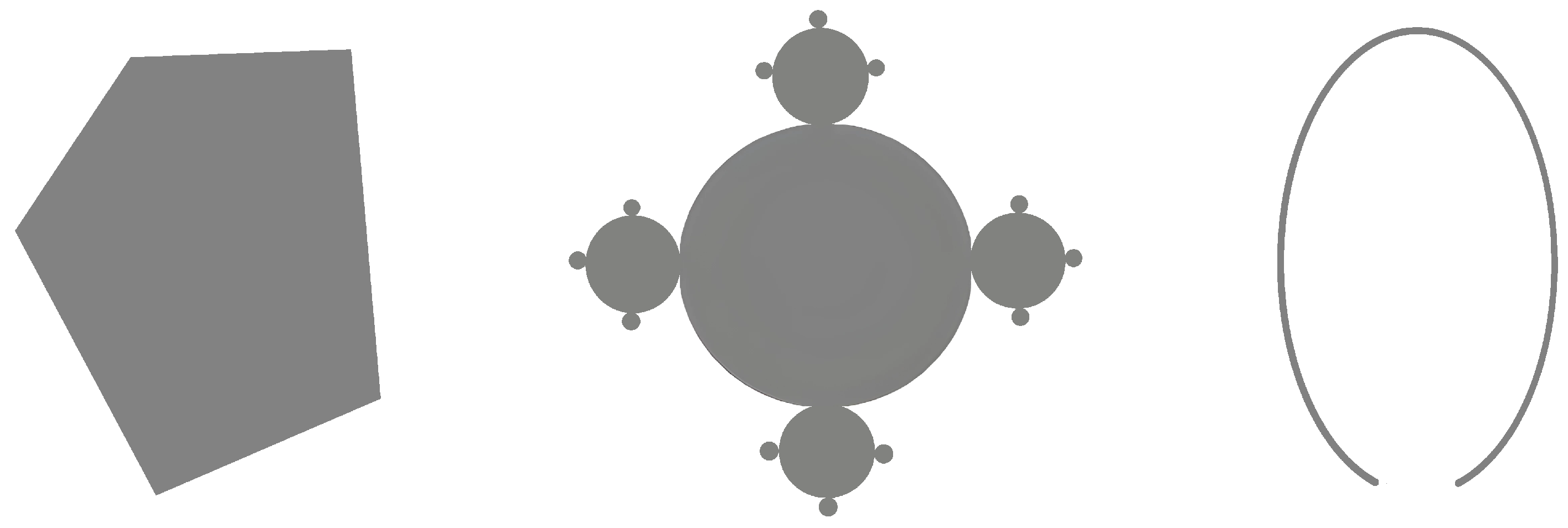
Three examples of aspheric sets in are given in Figure 1.
Figure 1.
Examples of aspheric sets: one convex non-smooth set and two non-convex smooth sets.
Definition 7.
A set-valued mapping is called ASV-mapping if is an aspheric set for any .
Of course, the initialism ASV stands for “Aspheric-Set-Valued”.
If is an upper semicontinuous ASV-mapping, we write . By denote the set of all set-valued mappings representable in the form , where and is a continuous single-valued mapping.
In order to demonstrate how wide the C-ASV-class of set-valued mappings is, we recall the following definitions and statements (see [26,53] for details).
Definition 8.
A metric space is said to be an ANR-space (absolute neighborhood retract) if, for any closed subset of any metric space and any continuous mapping , there exist a neighborhood U of the set in and a continuous extension of the mapping f.
Definition 9.
A topological space is said to be locally contractible at a point if any neighborhood U of contains a neighborhood contractible to a point with respect to U.
Definition 10.
A space is said to be locally contractible if this space is locally contractible at each of its points.
Proposition 3.
A finite-dimensional compact set is an ANR-space if and only if it is locally contractible.
Definition 11.
A compact nonempty set is said to be an -set if it can be expressed as the intersection of a decreasing sequence of compact contractible sets.
Proposition 4.
Suppose is an ANR-space and is an upper semicontinuous set-valued mapping. Then if at least one of the following conditions hold:
- is a convex set, for any
- is a contractible set, for any
- is a -set, for any .
2.3. Continuous Single-Valued Approximations of Set-Valued Mappings
Let and be metric spaces and let be a set-valued mapping.
Definition 12.
For a positive number ε, a continuous single-valued mapping is called an ε-approximation of the set-valued mapping Σ if, for any element , there exists an element such that .
By we denote the set of all -approximations of the set-valued mapping .
In the next two lemmas, we summarize some important properties of -approximations (see [26] for details).
Lemma 2.
Let be an upper semicontinuous set-valued mapping. Then the following statements hold.
- (i)
- For any compact subset of and for any positive number ε, there exists a positive number δ such that
- (ii)
- Suppose is a compact set and is a continuous mapping. Then, for any , there exists such that
- (iii)
- Suppose is a compact set and is an upper semicontinuous set-valued mapping. Then, for any and , there exists such that
Let be a single-valued mapping and let be a set-valued mapping. By we denote the solutions set for the inclusion , that is,
Lemma 3.
Suppose and are continuous mappings and is an upper semicontinuous set-valued mapping. Let be a compact subset of such that
If is sufficiently small and the inclusion holds, then
In the paper [54], the following approximability properties of ASV-mappings have been established.
Proposition 5.
Suppose is a compact ANR-space, , then
- (i)
- the set-valued mapping Σ is approximable, that is, for any there exists
- (ii)
- for any , there exists such that, for any δ and any δ-approximations , , there exists a continuous mapping satisfying the following properties:
- 1)
- and
- 2)
- for any .
2.4. Leray–Schauder Lemma
Lemma 4
(see [55]). Let be a bounded open subset of such that
Suppose that is a continuous mapping such that
Then
where the mapping is defined by
3. Topological Degree for -Operators with Set-Valued Perturbations
3.1. Construction of Topological Degree
Let X be a real separable reflexive Banach space and let be a metric space. Suppose is a bounded open subset of X such that for any , the set is locally contractible.
We will construct the topological degree of a set-valued mapping that satisfies the following four conditions:
- (H.1)
- the single-valued mapping is strong-to-weak continuous and satisfies the condition
- (H.2)
- the set-valued mapping belongs to the class ;
- (H.3)
- the set is relatively compact in ;
- (H.4)
- the equality holds.
Let be a finite-dimensional subspace of X with a basis and let be the mapping defined in (1).
For an arbitrary subset of X, by we denote the intersection .
Let us consider the three mappings:
The following statement is true.
Lemma 5.
Suppose conditions(H.1) and (H.3)hold and is a subset of such that
- (i)
- the set is closed;
- (ii)
- the equality holds.
Then there exists a space such that
Proof.
Following [37], we introduce the set by
First, we show there exists a subspace such that
Assume the converse, that is, for any subspace , there exists a subspace such that
Let
By we denote the weak closure of . We claim that the following system
is centered.
Let be an arbitrary finite subsystem of this system. By we denote the linear hull of . By our assumption, there exists such that
Let us show that and .
Consider such that . Taking into account the inclusion , we see that there exist sequences and such that
Moreover, since the set is relatively compact, we can assume without loss of generality that
for some .
Note that the following representation of holds:
Clearly, the second and third terms in the right-hand side of equality (7) converge to zero.
Since the operator T satisfies the condition , inequality (8) and the inclusion
holds, and in X as , so we have in X as . Therefore, recalling that the set is closed, we obtain the inclusion .
Moreover, from the conditions
and the upper semicontinuity of the set-valued mapping , it follows that .
Further, we pass the limit in equality (6); this gives
Therefore, for any space such that , there exists satisfying equality (9).
In view of the space in which X is separable, there exists a countable set such that and is dense in X. For the sake of being definite, let .
Consider the sequence of spaces , where
From the above reasoning, it follows that, for any , there exists such that
Without loss of generality, it can be assumed that
because the set is compact.
Let us show that . Fix arbitrary and . Suppose C is a constant such that
Because the set is dense in X, there exists an element such that
Let us take a sufficiently large integer k such that and
This is possible since the element x is fixed and convergence (11) holds.
We observe that . Therefore, from equality (10), it follows that
Moreover, taking into account that x is an arbitrary element from the space X, we deduce from equality (16) the relation and hence, . Combining this with , we obtain
which contradicts condition (ii).
Thus, we have proved the existence of a subspace such that implication (3) holds for any .
Now we will show that the subspace satisfies implication (2). Assume the converse. Then there exists a subspace such that
Let be an element satisfying
We show that . Due to the inclusion
there exists such that
Let be a basis of . Then equality (17) is equivalent to
Since , we have the representation
where , ..., are some real numbers.
Similarly, we derive
Thus, we have established . On the other hand, for the subspaces and , we have . This contradiction proves Lemma 5. □
Now we can return to constructing the topological degree of the set-valued mapping . Note that for the set conditions (i) and (ii) of Lemma 5 hold. Let us fix a subspace such that
From our assumptions on the geometrical properties of , it follows that the set is locally contractible. Therefore, applying Proposition 3, we see that is a compact ANR-space. Thus, for , all the conditions of Proposition 5 hold. This implies that, for any , there exists a continuous -approximation .
From equality (20) and Lemma 3 it follows that there exists such that, for any , we have
Moreover, applying Proposition 5 (ii), we deduce that there exists such that, for any and , there exists a continuous mapping satisfying the following conditions:
Fix . Assuming that conditions (H.1)–(H.4) hold, we give the next definition.
Definition 13.
The topological degree of a set-valued mapping with respect to and is defined by the equality
where denotes the Brouwer degree of the mapping
with respect to and .
3.2. Well-Definedness of Topological Degree
Let us show that the topological degree is well defined, that is, its value depends neither on the choice of an -approximation nor on the choice of a subspace .
Step 1. First, we establish the independence of from the choice of an -approximation. More precisely, it is necessary to prove that, for any and , the following equality holds:
From relations (21) and (23) it follows that
which together with (22) yield that the mappings
are homotopic. Therefore, in view of the homotopy invariance property of the Brouwer degree, we arrive at equality (24).
Step 2. Now we will show the independence of from the choice of a subspace .
Let us fix such that and prove that the following equality is valid:
where .
Let us choose a basis of in the form , where is a basis of , and consider the three finite-dimensional mappings:
where and is an element from the space such that
and is the Kronecker delta.
In view of Lemma 4, we have
Moreover, we will show that if is small enough, then
Due to the homotopy invariance property of the Brouwer degree, it is sufficient to prove the next lemma.
Lemma 6.
There exists such that, for any with , the following relation is true:
Proof.
Assume the converse. Then there exist sequences , , and such that as and
for some .
Without loss of generality, it can be assumed that
We claim that, in the last equality, . Assume the converse. Then
Since we have the representation
with some . Applying the functional to both sides of equality (33), we obtain
Recalling that , we arrive at the equality . Therefore,
and hence
Moreover, from the definition of the mapping and equality (31), it follows that
This means that
whence, taking into account inclusion , we deduce
which contradicts equality (20). Thus, we have established that .
Similarly, it can be shown that
From the relations established above, it follows that . On the other hand, in the framework of the proof of Lemma 5, we have shown that . This contradiction proves Lemma 6. □
Thus, we have established that the introduced characteristic is well defined.
Remark 1.
The topological degree for mappings of class with maximal monotone perturbations has been developed in [32,35].
4. Properties of Topological Degree for -Operators with Set-Valued Perturbations
In this section, following [37], we show that the constructed characteristic possesses natural properties of a topological degree.
Theorem 1
(Additivity property). Let and be disjoint open subsets of such that
- the equality holds;
- the sets and are local contractible, for any .
Then
Proof.
Note that the set satisfies the conditions of Lemma 5. Hence, there exists a subspace such that
where and stand for and , respectively.
Due to Proposition 5, there exists , for any .
From equality (36) and Lemma 3 it follows that if is small enough, then
Taking into account the additivity property of the Brouwer degree, we obtain
On the other hand, according to Definition 13, we have
Now, we will discuss the property of homotopy invariance of the constructed topological degree. Consider operators and , where , satisfying conditions (H.1)–(H.3) with
Definition 14.
The set-valued mappings and are homotopic with respect to the set if the following four conditions hold:
- There exists a strong-to-weak continuous mapping such thatand, for any sequences and , from in X andit follows that in X as .
- There exist a set-valued mapping and a continuous single-valued mapping such that
- For the set-valued mapping defined bythe set is relatively compact in .
- The intersection of the sets and , whereis the empty set.
Theorem 2
(Invariance under homotopy). If the set-valued mappings and are homotopic with respect to the set , then
Proof.
Taking into account the last condition in Definition 14, by the same arguments as in Lemma 5, one can prove the existence of a subspace such that
For the set-valued mapping , all the conditions of Proposition 5. Therefore, there exists , for any .
Let , where . Clearly, if is small enough, then the mapping can be used as a continuous approximation of the set-valued mapping (see Lemma 2 (iii)) to calculate . Namely, we have
Therefore, to prove Theorem 2, it is sufficient to establish the following equality
Let us use a one-parameter family of mappings defined by
Clearly, we have
Moreover, from equality (41) and Lemma 3 it follows that
and hence,
Therefore, by the homotopy invariance property of the Brouwer degree, we obtain
One of the most important properties of the introduced degree is formulated in the following theorem.
Theorem 3
(Zero degree). If conditions (H.1)–(H.3) hold and , then
Proof.
For the set , all the conditions of Lemma 5 are valid. Therefore, there exists a subspace such that
In view of Proposition 5, there exists , for any .
From equality (45) and Lemma 3 it follows that if is small enough, then
whence, by the properties of the Brouwer degree and Definition 13, we obtain
Thus, Theorem 3 is proved. □
As a direct consequence, we obtain the following coincidence principle.
Theorem 4
(Existence solution property). Suppose that conditions (H.1)–(H.4) hold and
Then the coincidence set is nonempty; that is, the inclusion has at least one solution in the set .
The last theorem shows that our degree theory can be used as a tool for checking the existence of solutions to operator inclusions. Moreover, arguing as in [40], one can establish the compactness of the coincidence set.
Theorem 5
(Compactness property). Under the conditions of Theorem 4, the coincidence set is compact.
6. Conclusions
This article develops the topological degree method for studying the operator inclusions of the form , where T is a single-valued -operator and is a compact set-valued operator. Using the topological degree of , we have established sufficient conditions for the solvability of the inclusion . This result is an important generalization of the known results from fixed point theory for set-valued mappings. A feature of our approach is that it successfully combines very different techniques such as the monotonicity method and the principle of continuous single-valued approximation of set-valued mappings. Moreover, unlike conventional approaches used in topological degree theory for set-valued operators, we do not require the convexity condition of values of . This extends a range of possible applications. In particular, we give an example illustrating how the introduced topological degree can be used in the analysis of the solvability of a strongly nonlinear system of partial differential equations and inclusions describing feedback control with complex geometry of admissible controls sets. A natural extension of this work includes analyzing topological characteristics of monotone-type single-valued operators with non-compact (for example, T-condensing) set-valued perturbations and their real-world applications.
Author Contributions
Conceptualization, E.S.B.; methodology, E.S.B.; investigation, E.S.B. and M.A.A.; writing—original draft preparation, E.S.B.; visualization, E.S.B.; writing—review and editing, E.S.B. and M.A.A. All authors have read and agreed to the published version of the manuscript.
Funding
This research received no external funding.
Institutional Review Board Statement
Not applicable.
Informed Consent Statement
Not applicable.
Data Availability Statement
Data are contained within the article.
Conflicts of Interest
The authors declare no conflicts of interest.
References
- Agarwal, R.P.; Meehan, M.; O’Regan, D. Fixed Point Theory and Applications; Cambridge University Press: Cambridge, UK, 2001. [Google Scholar] [CrossRef]
- Granas, A.; Dugundji, J. Fixed Point Theory; Springer: New York, NY, USA, 2003. [Google Scholar] [CrossRef]
- Farmakis, I.; Moskowitz, M. Fixed Point Theorems and Their Applications; World Scientific Publishing: Singapore, 2013. [Google Scholar] [CrossRef]
- Pathak, H.K. An Introduction to Nonlinear Analysis and Fixed Point Theory; Springer: Singapore, 2018. [Google Scholar] [CrossRef]
- Subrahmanyam, P.V. Elementary Fixed Point Theorems; Springer: Singapore, 2018. [Google Scholar] [CrossRef]
- Pata, V. Fixed Point Theorems and Applications; Springer: Cham, Switzerland, 2019. [Google Scholar] [CrossRef]
- Debnath, P.; Konwar, N.; Radenović, S. (Eds.) Metric Fixed Point Theory. Applications in Science, Engineering and Behavioural Sciences; Springer: Singapore, 2021. [Google Scholar] [CrossRef]
- Firozjah, A.A.; Rahimi, H.; Rad, G.S. Fixed and periodic point results in cone b-metric spaces over Banach algebras; a survey. Fixed Point Theory 2021, 22, 157–168. [Google Scholar] [CrossRef]
- Hutchinson, J.E. Fractals and self-similarity. Indiana Univ. Math. J. 1981, 30, 713–747. [Google Scholar] [CrossRef]
- Kashyap, S.K.; Sharma, B.K.; Banerjee, A. On Krasnoselskii fixed point theorem and fractal. Chaos Solit. Fractals 2014, 61, 44–45. [Google Scholar] [CrossRef]
- Ri, S. A new fixed point theorem in the fractal space. Indag. Math. 2016, 27, 85–93. [Google Scholar] [CrossRef]
- Nazeer, W.S.; Kang, M.; Tanveer, M.; Shahid, A.A. Fixed point results in the generation of Julia and Mandelbrot sets. J. Inequal. Appl. 2015, 2015, 298. [Google Scholar] [CrossRef]
- Petruşel, A.; Petruşel, G.; Wong, M.M. Fixed point results for locally contractions with applications to fractals. J. Nonlinear Convex Anal. 2020, 21, 403–411. [Google Scholar]
- Antal, S.; Tomar, A.; Prajapati, D.J.; Sajid, M. Fractals as Julia sets of complex sine function via fixed point iterations. Fractal Fract. 2021, 5, 272. [Google Scholar] [CrossRef]
- Choudhury, B.S.; Chakraborty, P. Strong fixed points of Φ-couplings and generation of fractals. Chaos Solit. Fractals 2022, 163, 112514. [Google Scholar] [CrossRef]
- Navascués, M.A. Stability of fixed points of partial contractivities and fractal surfaces. Axioms 2024, 13, 474. [Google Scholar] [CrossRef]
- Shaheryar, M.; Ud Din, F.; Hussain, A.; Alsulami, H. Fixed point results for Fuzzy enriched contraction in fuzzy Banach spaces with applications to fractals and dynamic market equillibrium. Fractal Fract. 2024, 8, 609. [Google Scholar] [CrossRef]
- Barnsley, M. Fractals Everywhere, 2nd ed.; Academic Press: Cambridge, MA, USA, 2014. [Google Scholar] [CrossRef]
- Qi, X. Fixed Points, Fractals, Iterated Function Systems and Generalized Support Vector Machines; Mälardalen University Press Licentiate Theses, No. 247. License Thesis, Mälardalen University, Västerås, Sweden, 2016. [Google Scholar]
- Navascués, M.A. Approximation of fixed points and fractal functions by means of different iterative algorithms. Chaos Solit. Fractals 2024, 180, 114535. [Google Scholar] [CrossRef]
- Buescu, J.; Serpa, C. Fractal and Hausdorff dimensions for systems of iterative functional equations. J. Math. Anal. Appl. 2019, 480, 123429. [Google Scholar] [CrossRef]
- Mawhin, J. Topological Degree Methods in Nonlinear Boundary Value Problems; McGraw-Hill: New York, NY, USA, 1976. [Google Scholar]
- Gaines, R.E.; Mawhin, J.L. Coincidence Degree and Nonlinear Differential Equations; Springer: Berlin/Heidelberg, Germany, 1977. [Google Scholar] [CrossRef]
- Han, Z.-Q. Coincidence degree and nontrivial solutions of elliptic boundary value problems at resonance. Nonlinear Anal. 2004, 56, 739–750. [Google Scholar] [CrossRef]
- O’Regan, D.; Cho, Y.J.; Chen, Y.Q. Topological Degree Theory and Applications; Chapman and Hall/CRC: New York, NY, USA, 2006. [Google Scholar] [CrossRef]
- Górniewicz, L. Topological Fixed Point Theory of Multivalued Mappings; Kluwer: Dordrecht, The Netherlands; Boston, MA, USA; London, UK, 1999. [Google Scholar] [CrossRef]
- Arutyunov, A.V.; Zhukovskiy, E.S.; Zhukovskiy, S.E. Coincidence points principle for mappings in partially ordered spaces. Topol. Appl. 2015, 179, 13–33. [Google Scholar] [CrossRef]
- Benarab, S.; Zhukovskiy, E.S. Coincidence points of two mappings acting from a partially ordered space to an arbitrary set. Russ. Math. 2020, 64, 8–16. [Google Scholar] [CrossRef]
- Sessa, S.; Akkouchi, M. Coincidence points for mappings in metric spaces satisfying weak commuting conditions. Symmetry 2022, 14, 504. [Google Scholar] [CrossRef]
- Tarafdar, E.; Teo, S.K. On the existence of solutions of the equation Lx ∈ Nx and a coincidence degree theory. J. Austral. Math. Soc. Ser. A 1979, 28, 139–173. [Google Scholar]
- Pruszko, T. A coincidence degree for L-compact convex-valued mappings and its application to the Picard problem of orientor. Bull. Acad. Pol. Sci. Sér. Sci Math. 1979, 27, 895–902. [Google Scholar]
- Browder, F.E. Fixed point theory and nonlinear problems. Bull. Amer. Math. Soc. 1983, 9, 1–39. [Google Scholar] [CrossRef]
- Hu, S.C.; Papageorgiou, N.S. Generalizations of Browder’s degree theory. Trans. Amer. Math. Soc. 1995, 347, 233–259. [Google Scholar] [CrossRef]
- Gabor, D. The coincidence index for fundamentally contractible multivalued maps with nonconvex values. Ann. Pol. Math. 2000, 75, 143–166. [Google Scholar] [CrossRef]
- Kobayashi, J.; Ôtani, M. Topological degree for (S)+-mappings with maximal monotone perturbations and its applications to variational inequalities. Nonlinear Anal. 2004, 59, 147–172. [Google Scholar] [CrossRef]
- Kartsatos, A.G.; Skrypnik, I.V. A new topological degree theory for densely defined quasibounded mathematical equation-perturbations of multivalued maximal monotone operators in reflexive Banach spaces. Abstr. Appl. Anal. 2005, 2005, 121–158. [Google Scholar] [CrossRef]
- Baranovskii, E.S. Topological Degree for Multivalued Perturbations of (S)+-Maps and Its Applications. Ph.D. Thesis, Voronezh State University, Voronezh, Russia, 2010. [Google Scholar]
- Asfaw, T.M. A degree theory for compact perturbations of monotone type operators and application to nonlinear parabolic problem. Abstr. Appl. Anal. 2017, 2017, 7236103. [Google Scholar] [CrossRef]
- Baranovskii, E.S. Optimal problems for parabolic-type systems with aspheric sets of admissible controls. Russ. Math. 2009, 53, 63–67. [Google Scholar] [CrossRef]
- Baranovskii, E.S. Feedback optimal control problem for a network model of viscous fluid flows. Math. Notes 2022, 112, 26–39. [Google Scholar] [CrossRef]
- Baranovskii, E.S.; Brizitskii, R.V.; Saritskaia, Z.Y. Optimal control problems for the reaction–diffusion–convection equation with variable coefficients. Nonlinear Anal. Real World Appl. 2024, 75, 103979. [Google Scholar] [CrossRef]
- Browder, F.E. Nonlinear elliptic boundary value problems and the generalized topological degree. Bull. Amer. Math. Soc. 1970, 76, 999–1005. [Google Scholar] [CrossRef]
- Skrypnik, I.V. Nonlinear Elliptic Equations of Higher Order; Naukova Dumka: Kiev, Ukraine, 1973. [Google Scholar]
- Browder, F.E. Degree theory for nonlinear mapping. Proc. Sympos. Pure Math. Soc. 1986, 45, 203–226. [Google Scholar]
- Granas, A. Sur la notion du degré topologique pour une certaine classe de transformations multivalentes dans les espaces de Banach. Bull. Acad. Polon. Sci. 1959, 7, 191–194. [Google Scholar]
- Granas, A. Theorem on antipodes and theorems on fixed points for a certain class of multi-valued maps in Banach spaces. Bull. Acad. Polon. Sci. 1959, 7, 271–275. [Google Scholar]
- Cellina, A.; Lasota, A. A new approach to the definition of topological degree for multivalued mappings. Atti Accad. Naz. Lincei Rend. Cl. Sci. Fis. Mat. Natur. 1969, 47, 434–440. [Google Scholar]
- Skrypnik, I.V. Methods for Analysis of Nonlinear Elliptic Boundary Value Problems; American Mathematical Society: Providence, RI, USA, 1994; Volume 139. [Google Scholar]
- Kachurovskii, R.I. Non-linear monotone operators in Banach spaces. Russ. Math. Surv. 1969, 23, 117–165. [Google Scholar] [CrossRef]
- Zeidler, E. Nonlinear Functional Analysis and Its Applications; Springer: New York, NY, USA, 1990; Volume II/B. [Google Scholar]
- Dinca, G.; Mawhin, J. Brouwer Degree: The Core of Nonlinear Analysis; Birkhäuser: Cham, Switzerland, 2021. [Google Scholar] [CrossRef]
- Myshkis, A.D. Generalizations of the theorem on a fixed point of a dynamical system inside of a closed trajectory. Mat. Sb. 1954, 34, 525–540. [Google Scholar]
- Borsuk, K. Theory of Retracts; Monografie Matematyczne PWN: Warsaw, Poland, 1967; Volume 44. [Google Scholar]
- Górniewicz, L.; Granas, A.; Kryszewski, W. On the homotopy method in the fixed point index theory for multi-mappings of compact absolute neighborhood retracts. J. Math. Anal. Appl. 1991, 161, 457–473. [Google Scholar] [CrossRef]
- Leray, J.; Schauder, J. Topologie et équations fonctionnelles. Ann. Sci. Ecole Norm. Sup. 1934, 51, 45–78. [Google Scholar] [CrossRef]
- Fursikov, A.V. Optimal Control of Distributed Systems; AMS: Providence, RI, USA, 2000. [Google Scholar]
- Adams, R.A.; Fournier, J.J.F. Sobolev Spaces. In Pure and Applied Mathematics; Elsevier: Amsterdam, The Netherlands, 2003; Volume 40. [Google Scholar]
- Boyer, F.; Fabrie, P. Mathematical Tools for the Study of the Incompressible Navier–Stokes Equations and Related Models; Springer: New York, NY, USA, 2013. [Google Scholar] [CrossRef]
- Astarita, G.; Marucci, G. Principles of Non-Newtonian Fluid Mechanics; McGraw-Hill: New York, NY, USA, 1974. [Google Scholar]
- Pak, J.; Sin, C.; Baranovskii, E.S. Regularity criterion for 3D shear-thinning fluids via one component of velocity. Appl. Math. Optim. 2023, 88, 48. [Google Scholar] [CrossRef]
- Sin, C.; Baranovskii, E.S. A note on regularity criterion for 3D shear thickening fluids in terms of velocity. Math. Ann. 2024, 389, 515–524. [Google Scholar] [CrossRef]
- Baranovskii, E.S. On steady motion of viscoelastic fluid of Oldroyd type. Sb. Math. 2014, 205, 763–776. [Google Scholar] [CrossRef]
- Baranovskii, E.S.; Artemov, M.A. Mixed boundary-value problems for motion equations of a viscoelastic medium. Electron. J. Diff. Equ. 2015, 2015, 252. [Google Scholar]
- Ershkov, S.V. About existence of stationary points for the Arnold–Beltrami–Childress (ABC) flow. Appl. Math. Comput. 2016, 276, 379–383. [Google Scholar] [CrossRef][Green Version]
- Mallea-Zepeda, E.; Ortega-Torres, E.; Villamizar-Roa, É.J. An optimal control problem for the Navier–Stokes-α system. J. Dyn. Control Syst. 2023, 29, 129–156. [Google Scholar] [CrossRef]
- Ershkov, S.V.; Leshchenko, D.D. Non-Newtonian pressure-governed rivulet flows on inclined surface. Mathematics 2024, 12, 779. [Google Scholar] [CrossRef]
- Brizitskii, R.V.; Saritskaia, Z.Y. Analysis of inhomogeneous boundary value problems for generalized Boussinesq model of mass transfer. J. Dyn. Control Syst. 2023, 29, 1809–1828. [Google Scholar] [CrossRef]
- Mallea-Zepeda, E.; Lenes, E.; Valero, E. Boundary control problem for heat convection equations with slip boundary condition. Math. Probl. Eng. 2018, 2018, 7959761. [Google Scholar] [CrossRef]
- Baranovskii, E.S. Exact solutions for non-isothermal flows of second grade fluid between parallel plates. Nanomaterials 2023, 13, 1409. [Google Scholar] [CrossRef]
- Brizitskii, R.V. Generalised Boussinesq model with variable coefficients. Sib. El. Math. Rep. 2024, 21, 213–227. [Google Scholar] [CrossRef]
- Baranovskii, E.S.; Brizitskii, R.V.; Saritskaia, Z.Y. Boundary value and control problems for the stationary heat transfer model with variable coefficients. J. Dynam. Control Syst. 2024, 30, 26. [Google Scholar] [CrossRef]
Disclaimer/Publisher’s Note: The statements, opinions and data contained in all publications are solely those of the individual author(s) and contributor(s) and not of MDPI and/or the editor(s). MDPI and/or the editor(s) disclaim responsibility for any injury to people or property resulting from any ideas, methods, instructions or products referred to in the content. |
© 2024 by the authors. Licensee MDPI, Basel, Switzerland. This article is an open access article distributed under the terms and conditions of the Creative Commons Attribution (CC BY) license (https://creativecommons.org/licenses/by/4.0/).

