


Numerical Approximation of the Fractional Rayleigh–Stokes Problem Arising in a Generalised Maxwell Fluid



Abstract
:1. Introduction
2. The Time Discretization
3. The Space Discretization
4. Theoretical Analysis of the Proposed Method
4.1. Stability Analysis
4.2. Convergence Analysis
5. Results and Discussion
6. Concluding Remarks
Author Contributions
Funding
Institutional Review Board Statement
Informed Consent Statement
Data Availability Statement
Conflicts of Interest
References
- Milici, C.; Drăgănescu, G.; Machado, J.T. Introduction to Fractional Differential Equations; Springer: Berlin/Heidelberg, Germany, 2019; Volume 25. [Google Scholar]
- Biswas, K.; Bohannan, G.; Caponetto, R.; Lopes, A.M.; Machado, J.A.T. Fractional-Order Devices; Springer: Berlin/Heidelberg, Germany, 2017. [Google Scholar]
- Qi, F.; Qu, J.; Chai, Y.; Chen, L.; Lopes, A.M. Synchronization of incommensurate fractional-order chaotic systems based on linear feedback control. Fractal Fract. 2022, 6, 221. [Google Scholar] [CrossRef]
- Chen, L.; Li, X.; Chen, Y.; Wu, R.; Lopes, A.M.; Ge, S. Leader-follower non-fragile consensus of delayed fractional-order nonlinear multi-agent systems. Appl. Math. Comput. 2022, 414, 126688. [Google Scholar] [CrossRef]
- Sabatier, J.; Agrawal, O.P.; Machado, J.T. Advances in Fractional Calculus; Springer: Berlin/Heidelberg, Germany, 2007; Volume 4. [Google Scholar]
- Gutiérrez, R.E.; Rosário, J.M.; Tenreiro Machado, J. Fractional order calculus: Basic concepts and engineering applications. Math. Probl. Eng. 2010, 2010, 375858. [Google Scholar] [CrossRef]
- Nikan, O.; Avazzadeh, Z. Numerical simulation of fractional evolution model arising in viscoelastic mechanics. Appl. Numer. Math. 2021, 169, 303–320. [Google Scholar] [CrossRef]
- Qiu, W.; Xu, D.; Guo, J.; Zhou, J. A time two-grid algorithm based on finite difference method for the two-dimensional nonlinear time-fractional mobile/immobile transport model. Numer. Algorithms 2020, 85, 39–58. [Google Scholar] [CrossRef]
- Xu, D.; Qiu, W.; Guo, J. A compact finite difference scheme for the fourth-order time-fractional integro-differential equation with a weakly singular kernel. Numer. Meth. Part Differ. Equ. 2020, 36, 439–458. [Google Scholar] [CrossRef]
- Farnam, B.; Esmaeelzade Aghdam, Y.; Nikan, O. Numerical investigation of the two-dimensional space-time fractional diffusion equation in porous media. Math. Sci. 2021, 15, 153–160. [Google Scholar] [CrossRef]
- Qiu, W.; Xu, D.; Guo, J. The Crank-Nicolson-type Sinc-Galerkin method for the fourth-order partial integro-differential equation with a weakly singular kernel. Appl. Numer. Math. 2021, 159, 239–258. [Google Scholar] [CrossRef]
- Aghdam, Y.E.; Mesgrani, H.; Javidi, M.; Nikan, O. A computational approach for the space-time fractional advection–diffusion equation arising in contaminant transport through porous media. Eng. Comput. 2021, 37, 3615–3627. [Google Scholar] [CrossRef]
- Qiu, W.; Xu, D.; Guo, J. Numerical solution of the fourth-order partial integro-differential equation with multi-term kernels by the Sinc-collocation method based on the double exponential transformation. Appl. Math. Comput. 2021, 392, 125693. [Google Scholar] [CrossRef]
- Nikan, O.; Avazzadeh, Z.; Machado, J.T. Numerical approach for modeling fractional heat conduction in porous medium with the generalized Cattaneo model. Appl. Math. Model. 2021, 100, 107–124. [Google Scholar] [CrossRef]
- Wenchang, T.; Wenxiao, P.; Mingyu, X. A note on unsteady flows of a viscoelastic fluid with the fractional Maxwell model between two parallel plates. Int. J. Non-Linear Mech. 2003, 38, 645–650. [Google Scholar] [CrossRef]
- Hayat, T.; Nadeem, S.; Asghar, S. Periodic unidirectional flows of a viscoelastic fluid with the fractional Maxwell model. Appl. Math. Comput. 2004, 151, 153–161. [Google Scholar] [CrossRef]
- Heymans, N. Fractional calculus description of non-linear viscoelastic behaviour of polymers. Nonlinear Dyn. 2004, 38, 221–231. [Google Scholar] [CrossRef]
- Shen, F.; Tan, W.; Zhao, Y.; Masuoka, T. The Rayleigh–Stokes problem for a heated generalized second grade fluid with fractional derivative model. Nonlinear Anal. Real World Appl. 2006, 7, 1072–1080. [Google Scholar] [CrossRef]
- Mainardi, F. Fractional Calculus and Waves in Linear Viscoelasticity: An Introduction to Mathematical Models; World Scientific: Singapore, 2010. [Google Scholar]
- Qi, H.; Xu, M. Unsteady flow of viscoelastic fluid with fractional Maxwell model in a channel. Mech. Res. Commun. 2007, 34, 210–212. [Google Scholar] [CrossRef]
- Xue, C.; Nie, J. Exact solutions of the Rayleigh–Stokes problem for a heated generalized second grade fluid in a porous half-space. Appl. Math. Model. 2009, 33, 524–531. [Google Scholar] [CrossRef]
- Chen, C.M.; Liu, F.; Anh, V. Numerical analysis of the Rayleigh–Stokes problem for a heated generalized second grade fluid with fractional derivatives. Appl. Math. Comput. 2008, 204, 340–351. [Google Scholar] [CrossRef] [Green Version]
- Wu, C. Numerical solution for Stokes’ first problem for a heated generalized second grade fluid with fractional derivative. Appl. Numer. Math. 2009, 59, 2571–2583. [Google Scholar] [CrossRef]
- Lin, Y.; Jiang, W. Numerical method for Stokes’ first problem for a heated generalized second grade fluid with fractional derivative. Numer. Methods Partial. Differ. Equations 2011, 27, 1599–1609. [Google Scholar] [CrossRef]
- Mohebbi, A.; Abbaszadeh, M.; Dehghan, M. Compact finite difference scheme and RBF meshless approach for solving 2D Rayleigh–Stokes problem for a heated generalized second grade fluid with fractional derivatives. Comput. Methods Appl. Mech. Eng. 2013, 264, 163–177. [Google Scholar] [CrossRef]
- Zaky, M.A. An improved tau method for the multi-dimensional fractional Rayleigh–Stokes problem for a heated generalized second grade fluid. Comput. Math. Appl. 2018, 75, 2243–2258. [Google Scholar] [CrossRef]
- Shivanian, E.; Jafarabadi, A. Rayleigh–Stokes problem for a heated generalized second grade fluid with fractional derivatives: A stable scheme based on spectral meshless radial point interpolation. Eng. Comput. 2018, 34, 77–90. [Google Scholar] [CrossRef]
- Hafez, R.M.; Zaky, M.A.; Abdelkawy, M.A. Jacobi Spectral Galerkin method for Distributed-Order Fractional Rayleigh-Stokes problem for a Generalized Second Grade Fluid. Front. Phys 2020, 7, 240. [Google Scholar] [CrossRef]
- Safari, F.; Sun, H. Improved singular boundary method and dual reciprocity method for fractional derivative Rayleigh–Stokes problem. Eng. Comput. 2020, 37, 3151–3166. [Google Scholar] [CrossRef]
- Nikan, O.; Golbabai, A.; Machado, J.T.; Nikazad, T. Numerical solution of the fractional Rayleigh–Stokes model arising in a heated generalized second-grade fluid. Eng. Comput. 2021, 37, 1751–1764. [Google Scholar] [CrossRef]
- Khan, M.A.; Ali, N.H.M. High-order compact scheme for the two-dimensional fractional Rayleigh–Stokes problem for a heated generalized second-grade fluid. Adv. Differ. Equ. 2020, 2020, 233. [Google Scholar] [CrossRef]
- Naz, A.; Ali, U.; Elfasakhany, A.; Ismail, K.A.; Al-Sehemi, A.G.; Al-Ghamdi, A.A. An Implicit Numerical Approach for 2D Rayleigh Stokes Problem for a Heated Generalized Second Grade Fluid with Fractional Derivative. Fractal Fract. 2021, 5, 283. [Google Scholar] [CrossRef]
- Yuste, S.B. Weighted average finite difference methods for fractional diffusion equations. J. Comput. Phys. 2006, 216, 264–274. [Google Scholar] [CrossRef] [Green Version]
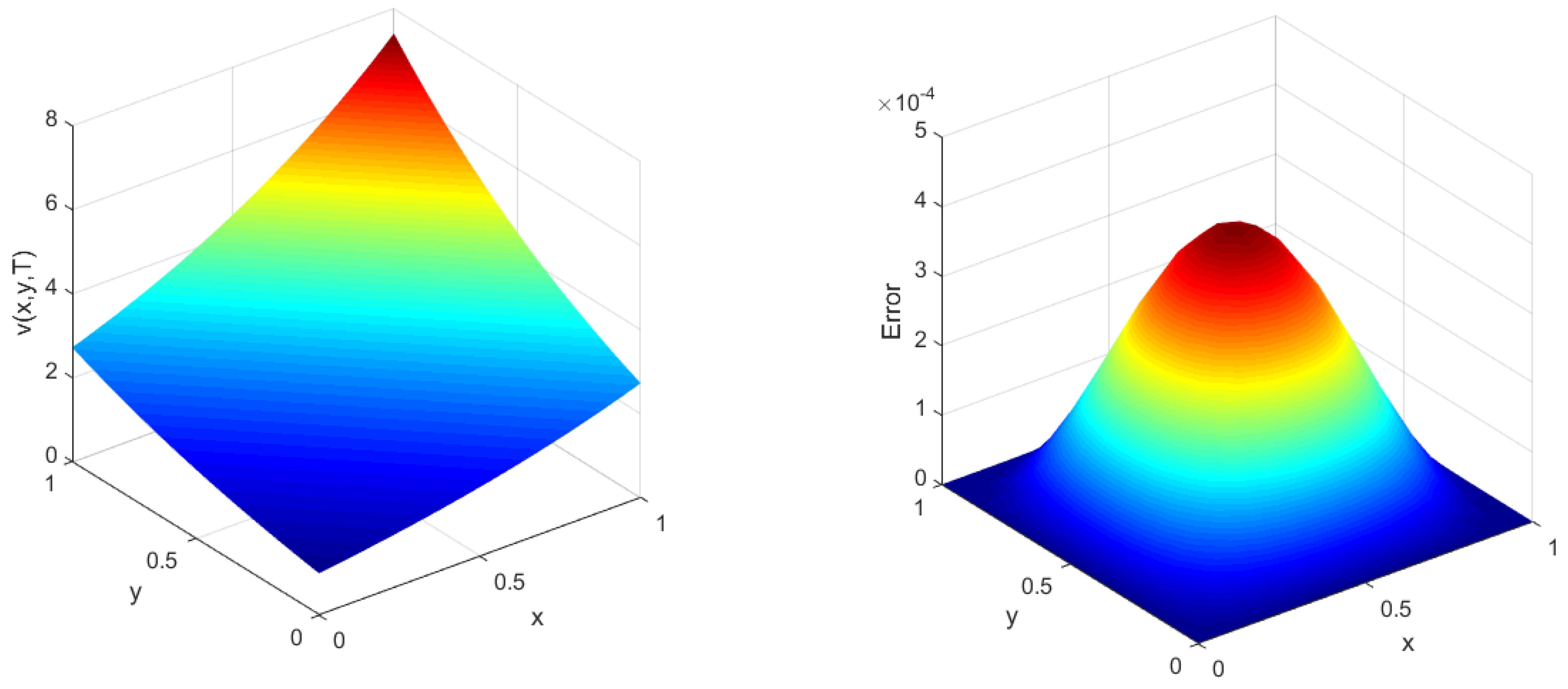
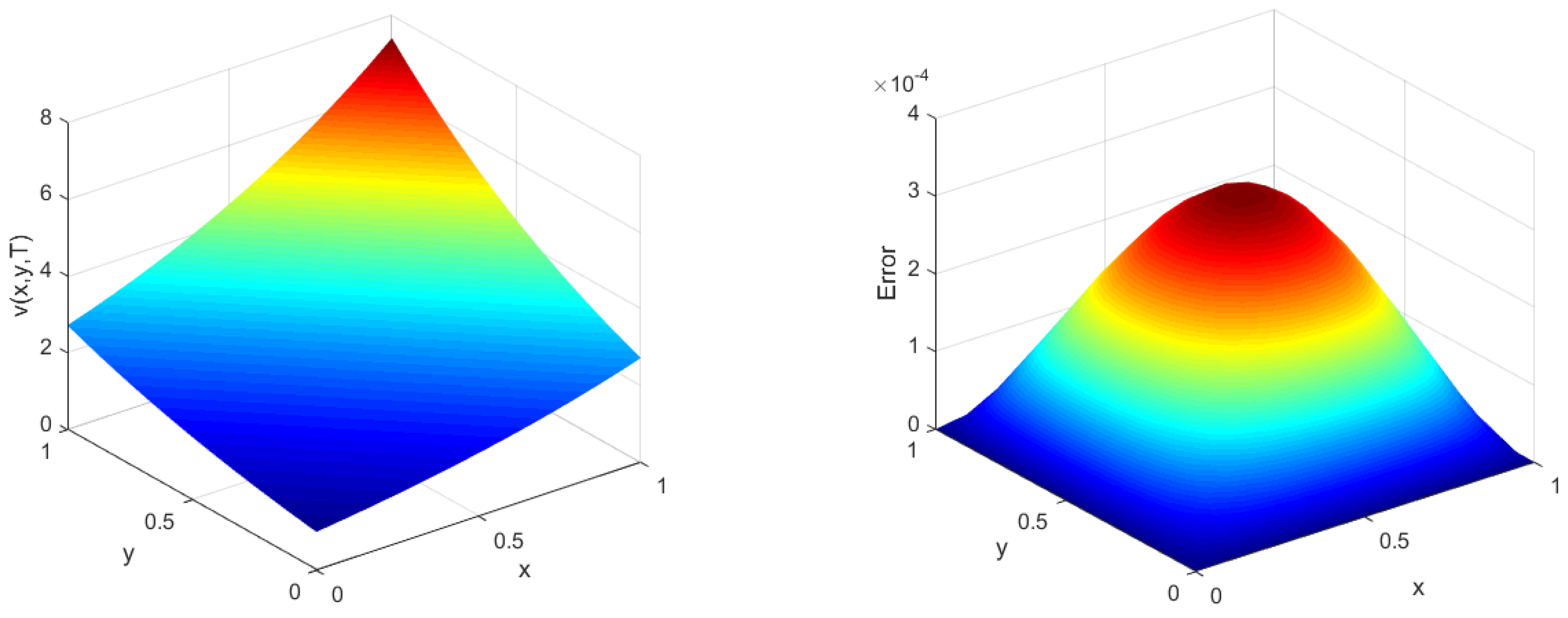

| CPU Time (s) | CPU Time (s) | |||||||
|---|---|---|---|---|---|---|---|---|
| 1/8 | 65 | − | 47 | − | ||||
| 1/10 | 63 | 47 | ||||||
| 1/16 | 65 | 48 | ||||||
| 1/40 | 66 | 44 | ||||||
| 1/64 | 64 | 40 | ||||||
| 1/128 | 70 | 32 | ||||||
| 1/4 | 1/4 | 8 | 7 | ||
| 1/10 | 1/64 | 117 | 80 | ||
| 1/16 | 1/128 | 419 | 200 | ||
| 1/8 | 1/210 | 387 | 40 |
| Proposed Method | RMM [25] | CFDM [25] | ||
|---|---|---|---|---|
| 1/10 | 672 | |||
| 1/20 | 775 | |||
| 1/30 | 791 |
| Proposed Method | CFDM [25] | |||||
|---|---|---|---|---|---|---|
| n | CPU Time (s) | CPU Time (s) | ||||
| 1/4 | 1/50 | 13 | ||||
| 1/8 | 1/128 | 116 | ||||
| 1/18 | 1/28 | 900 | ||||
| Proposed Method | RMM [25] | CFDM [25] | ||
|---|---|---|---|---|
| 5 | ||||
| 4 | ||||
| 4 |
| 1/10 | 54 | - | 117 | − | ||
| 1/40 | 57 | 34 | ||||
| 1/90 | 52 | 31 | ||||
| 1/190 | 45 | 22 | ||||
| 1/1200 | 21 | 25 | ||||
| 1/4 | 1/8 | 160 | 8 | ||
| 1/8 | 1/8 | 151 | 73 | ||
| 1/16 | 1/8 | 486 | 290 | ||
| 1/8 | 1/64 | 88 | 46 | ||
| 1/12 | 1/64 | 283 | 116 | ||
| 1/4 | 1/12 | 11 | 7 | ||
| 1/15 | 1/128 | 947 | 160 | ||
| 1/8 | 1/30 | 95 | 51 | ||
| 1/60 | 1/16 | 740 | 243 |
| Proposed Method | Implicit Method [25] | |||
|---|---|---|---|---|
| 1/4 | 1/50 | 9 | ||
| 1/8 | 1/128 | 84 | ||
| 1/16 | 1/32 | 55 |
| Proposed Method | Implicit Method [25] | ||||
|---|---|---|---|---|---|
| n | CPU Time (s) | CPU Time (s) | |||
| 8 | |||||
| 6 | |||||
| 3 | |||||
| 4 | |||||
| 3 |
Publisher’s Note: MDPI stays neutral with regard to jurisdictional claims in published maps and institutional affiliations. |
© 2022 by the authors. Licensee MDPI, Basel, Switzerland. This article is an open access article distributed under the terms and conditions of the Creative Commons Attribution (CC BY) license (https://creativecommons.org/licenses/by/4.0/).
Share and Cite
Long, L.D.; Moradi, B.; Nikan, O.; Avazzadeh, Z.; Lopes, A.M. Numerical Approximation of the Fractional Rayleigh–Stokes Problem Arising in a Generalised Maxwell Fluid. Fractal Fract. 2022, 6, 377. https://doi.org/10.3390/fractalfract6070377
Long LD, Moradi B, Nikan O, Avazzadeh Z, Lopes AM. Numerical Approximation of the Fractional Rayleigh–Stokes Problem Arising in a Generalised Maxwell Fluid. Fractal and Fractional. 2022; 6(7):377. https://doi.org/10.3390/fractalfract6070377
Chicago/Turabian StyleLong, Le Dinh, Bahman Moradi, Omid Nikan, Zakieh Avazzadeh, and António M. Lopes. 2022. "Numerical Approximation of the Fractional Rayleigh–Stokes Problem Arising in a Generalised Maxwell Fluid" Fractal and Fractional 6, no. 7: 377. https://doi.org/10.3390/fractalfract6070377
APA StyleLong, L. D., Moradi, B., Nikan, O., Avazzadeh, Z., & Lopes, A. M. (2022). Numerical Approximation of the Fractional Rayleigh–Stokes Problem Arising in a Generalised Maxwell Fluid. Fractal and Fractional, 6(7), 377. https://doi.org/10.3390/fractalfract6070377

