

Abstract
The distance centric parameter in the theory of networks called by metric dimension plays a vital role in encountering the distance-related problems for the monitoring of the large-scale networks in the various fields of chemistry and computer science such as navigation, image processing, pattern recognition, integer programming, optimal transportation models and drugs discovery. In particular, it is used to find the locations of robots with respect to shortest distance among the destinations, minimum consumption of time, lesser number of the utilized nodes, and to characterize the chemical compounds, having unique presentations in molecular networks. After the arrival of its weighted version, known as fractional metric dimension, the rectification of distance-related problems in the aforementioned fields has revived to a great extent. In this article, we compute fractional as well as local fractional metric dimensions of web-related networks called by subdivided QCL, 2-faced web, 3-faced web, and antiprism web networks. Moreover, we analyse their final results using 2D and 3D plots.
MSC:
05C12; 05C90; 05C15; 05C62
1. Introduction
The rising sun of each day arrives with a bunch of advancements related to the arena of information and technology, cheminformatics, and medicines. These advancements raised disciplines such as artificial intelligence, drug discovery, and image processing. Besides many concepts, metric dimensions of networks have a stake in their emergence. Such as in robotics, distance intervenes when we have to allocate robots to different sites known as landmarks without loss of economical operation cost and employing fewer robots. This objective is achieved by turning this whole situation into a graph-theoretic model and allowing metric dimension to give an appropriate picturesque model. Topics such as these have been covered in [1,2,3].
The domains of chemistry, which include chemical bonding, drug discovery, and development of diagnostic kits for different diseases are incomplete without the notion of distance centric dimensions. With the help of graph-theoretic picturesque imagery of chemical compounds along with metric dimensions, people from the chemical and medical fraternity can develop drugs, chemical compounds, and testing kits having higher accuracy and parsimony with ease. For further insight into this topic, we refer to [4,5,6].
In a network , the path with the shortest distance between two distinct vertices s and t is denoted by . Consider and a vertex the metric form of s regarding is an ordered k-tuple . The set , having a unique metric form with respect to s in , is called the resolving set. The metric basis of determined by the resolving set having the least number of elements and its cardinality represents its metric dimension (MD).
After Slater [2,7], Harary and Melter [8] have discovered by themselves the notions of resolving sets and MDs of networks, many researchers have incorporated the same for various network types. These findings can be found in [3,4,9,10]. Chartrand et al. employed the MD for solving the integer programming problem (IPP) [4]. Afterwards, Currie et al. laid the foundation of fractional metric dimension (FMD) with its aid, and evaluated the IPP acquiring results with high precision [11]. It was Arumugam and Mathew who formally defined the FMD by bringing into light its undercover features [12]. Afterwards, researchers have stormed with the results of FMD of networks, which are the resultants of various graph operations such as comb, corona, Cartesian, hierarchical, and lexicographic products, see [13,14,15,16]. Similarly, the FMDs of the generalized Jahangir network, metal organic networks, rotationally symmetric and planar networks, tetrahedral diamond and grid-like networks can be found in [17,18,19,20,21]. Moreover, for improved lower bound of FMD and bounds of FMD of convex polytopes, see [22].
Aisyah et al. (2019) founded the local fractional metric dimension (LFMD) and obtained it for corona product of two networks [23]. The results regarding the sharp bounds of LFMD of connected networks and prism related networks can be found in [24,25]. In this article, we calculate the upper bounds of FMD as well as LFMD of web-related networks called by subdivided divided QCL, 2-faced web, 3-faced web, and antiprism web networks. These networks bear rotational symmetry and planarity, which will help in designing information and chemical structures. The upper extremal values of FMD and LFMD are analyzed numerically as well as graphically. The flow of the article is as follows: Section 1 is the introduction, Section 2 discussed the preliminaries and construction of networks under consideration and Section 3 deals with the local as well as pairwise resolving neighborhood sets of the networks titled above. In Section 4, the evaluation of the FMDs as well as the LFMDs of , , , and is done. Section 5, ends the article with the conclusions and future directions.
2. Preliminaries
For any node and then f is said to resolve the pair if . The set comprising of all such nodes is called the resolving neighborhood set (RNs). The RNs of is denoted by . For that is connected and having v as its order, a resolving function (RF) of is a function fulfilling the condition ∀, where . An RF of is known as the minimal resolving function (MRF) if ∃ some function where and for some , which is not the RF of . For , the FMD is denoted by is given by is the MRF of , where . For more details, see [12]. The resolving function is called the local resolving function (LRF) if . Similarly, FMD will become LFMD if we only consider the pair of adjacent vertices only, denoted by [23]. We are sharing the following results, without which our article is incomplete.
Theorem 1
([25]). Suppose that is a connected network. If , ∀, then
where , and .
Theorem 2
([21]). Suppose that is the connected network and is the resolving neighborhood set for in . If , and then
where .
Theorem 3
([25]). Suppose that is the connected network,
- (a)
- If is bipartite then ,
- (b)
- If then either is either bipartite or it bears a distinct odd cycle of minimum length.
Construction of Web-Related Networks
This section is dedicated to the construction of the networks under consideration.
As defined in [19], for a quadrangular circular ladder (QCL) is a cubic network that is the network obtained after the Cartesian product of . A subdivided QCL denoted by is formed after applying the subdivision operation on QCL by adding vertex between vertices and , between vertices and and between vertices and . It can be seen that subdivided QCL is a bipartite network. The sets and are given by: and respectively. The subdivided QCL is shown in Figure 1.
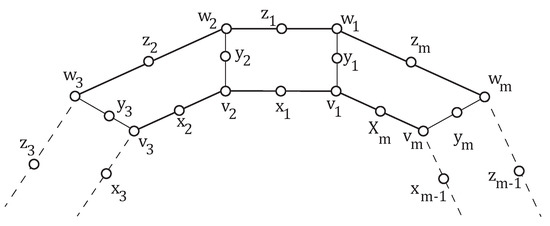
Figure 1.
.
The 2-faced web network is formed by joining vertices to the vertices of 2-faced QCL as defined in [19]. Its order is and size is . Its and are given as follows:
and respectively. The Figure 2 illustrates .
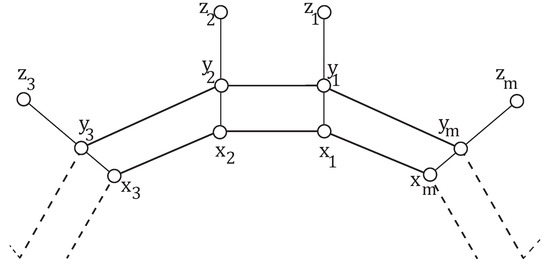
Figure 2.
The 2-faced web network .
It is clear from Figure 2 that is a bipartite network.
The 3-faced web networks and are formed by joining vertices to the vertices of 3-faced QCLs and as defined in [19]. Their order is and size is . The sets , , and are given as follows:
- ,
- ,
- , and
- respectively.
The Figure 3 illustrates (a) and (b) .
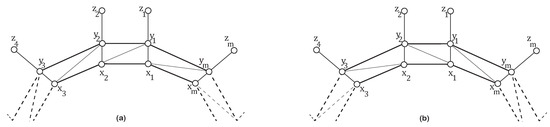
Figure 3.
Possible 3-faced web networks (a) (b) (right).
From Figure 3 we can see that .
An Antiprism web network is formed by joining vertices to vertex of Antiprism . Its order is and size is . Its sets and are given by: , and respectively.
The Figure 4 illustrates .
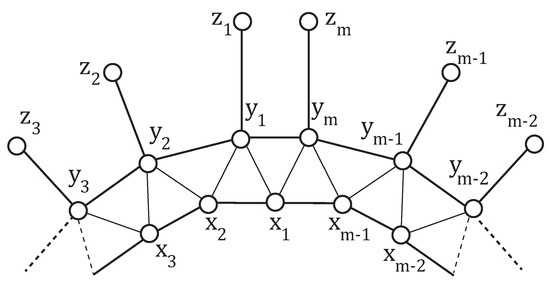
Figure 4.
Antiprism Web Network .
3. RNs of Web-Related Networks
The present section concerns with the local as well as pairwise RNs of the networks under consideration.
3.1. RNs of Subdivided QCL
Lemma 1.
Let be a subdivided QCL, for any non-zero positive number and then:
- (a)
- For , and and
- (b)
- For , and , for each RNs other than of .
Proof.

The RN having a fewer number of elements in is
.
Hence, for , and .
(b) For the proof of required RNs, the following variables will be needed:
- and
- and
- and
for other than are
- ,
- ,
- ,
- ,
- ,
- ,
- ,
- ,
- ,
- ,
- ,
- ,
- ,
- ,
- ,
- .
Their cardinalities can be summarized in Table 1. □
Table 1.
RNs for .
Table 1 shows that and .
3.2. RNs of 2-Faced Web Network
Lemma 2.
Let be a 2-faced subdivided web network, for any non-zero positive number and then:
- (a)
- For , and and
- (b)
- For , and , for each RN set other than of .
Proof.
The RN bearing fewer number of elements in is
.
Thus, for , and .
(b) For the proof of required RNs, the following variables will be needed:
- and
- and
- and
RNs for other than are as under:
- ,
- ,
- ,
- ,
- .
Whereas, their cardinalities are listed in Table 2. □
Table 2.
RNs for .
Table 2 shows that and .
3.3. RNs of 3-Faced Web Network
Lemma 3.
Let be a 3-faced subdivided web network, for any non-zero positive number and then:
(a) For , and and
(b) For , and , for each RN set different from of .
Proof.
The RN having a fewer number of elements in is .
Therefore, for , and .
(b) For the proof of required RNs, the following variables will be needed:
- and
- and
- and
RNs for other than are given as follows:
- ,
- ,
- ,
- ,
- ,
- ,
- ,
- ,
- ,
- .
□
The cardinalities of the aforementioned RNs have been summarized in Table 3.
Table 3.
RNs for .
Table 3 shows that and .
Lemma 4.
Let be a 3-faced subdivided web network, for any non-zero positive number and then:
- (a)
- For , and an
- (b)
- For , and , for each RN set different from of .
Proof.
For proof, see Lemma 3(a).
(b) The required LRNs for are as follows:
- ,
- ,
- ,
- ,
- .
□
The cardinalities of the aforementioned RNs have been summarized in Table 4.
Table 4.
RNs for .
Table 4 shows that and .
3.4. RNs of Antiprism Web Network
Lemma 5.
Let be an antiprism web network, for any non-zero positive number and then:
- (a)
- For , and and
- (b)
- For , and , for each RN set of different from .
Proof.
The RN having fewer number of elements in is .
Consequently, for , and .
(b) For the proof of required RNs, the following variables will be needed:
- and
- and
- and
for other than are given by:
- ,
- ,
- ,
- ,
- ,
- ,
- ,
- ,
- .
The cardinalities of the aforementioned RNs have been summarized in Table 5. □
Table 5.
RNs for .
Table 5 shows that and .
Lemma 6.
Let be an antiprism web network, for any non-zero positive number and then:
- (a)
- For , and and
- (b)
- For , and , for each RN set of different from .
Proof.
For proof see Lemma 5(a).
(b) The required LRNs for are given as follows:
- ,
- ,
- ,
- .
The cardinalities of the aforementioned RNs has been summarized in Table 6. □
Table 6.
RNs for .
Table 6 shows that and .
4. FMD and LFMD of Web-Related Networks
This section covers the results regarding the FMD and LFMD of the networks under consideration.
4.1. FMD and LFMD of Subdivided QCL
Theorem 4.
Suppose that be subdivided QCL network, taking any non-zero positive number and , then .
Proof. Case I:
For .
By making use of symmetry, the RNs are tabulated as below:
Table 7 is exhibiting the RNs with the least cardinality of 17. Whereas RNs with maximum cardinality has been shown by Table 8, Table 9, Table 10, Table 11, Table 12, Table 13 and Table 14, respectively. Hence , and , where . Now, we are defining a mapping such that . We can see that for of are intersecting in a pairwise manner, showing non-cyclic behavior with , so, by Theorem 3, we arrive at .
Table 7.
RNs for .
Table 8.
RNs for .
Table 9.
RNs for .
Table 10.
RNs for and .
Table 11.
RNs for .
Table 12.
RNs for .
Table 13.
RNs for .
Table 14.
RNs for .
Case II: For any :
As we can see from Lemma 1 the RN with the least cardinality of is , and ∀. Suppose that and . Then we define a mapping such that
We can see that is a RF for with because ∀. On contrary, assume that there exists a different RF , such that , for some . Consequently, , where is an RN of having the least cardinality . This shows that is not an RF. Thus, is a MRF that acquires minimum for . Also, all the are intersecting in pairwise manner, holding non-cyclic behavior with , thus by Theorem 3, assigning to the vertices of in and evaluating the summation of all the weights, we get: □
Theorem 5.
Suppose that is a subdivided QCL network, taking any non-zero positive number and , then .
Proof.
Since is a bipartite network, therefore by Theorem 2,
□
4.2. FMD and LFMD of 2-Faced Web Network
Theorem 6.
Suppose that is a 2-faced web network, taking any non-zero positive number and , then .
Proof. Case I:
For .
By making use of symmetry, the RNs are tabulated as below:
Table 15 exhibits the RNs with the least cardinality of 7. Whereas RNs with maximum cardinality has been shown by Table 16, Table 17, Table 18, Table 19 and Table 20 respectively. Thus . It is observed that and , where . Now, we are defining a mapping such that . It can be seen that for of intersecting in pairwise manner, showing non-cyclic behavior with , therefore, by Theorem 3, we have .
Table 15.
RNs for .
Table 16.
RNs for .
Table 17.
RNs for .
Table 18.
RNs for .
Table 19.
RNs for .
Table 20.
RNs for .
□
Case II: For any : As we can see from Lemma 3.2.1 the RN with the least cardinality of is , and ∀. Suppose that and . Then, we define a mapping such that
It is observed that is a RF for with because ∀. Assume on the contrary that ∃ a different RF , such that , for some . Consequently, , where is an RN of having the least cardinality . This shows that is not a RF a contradiction. Hence, is a MRF that attains minimum for . Also, all the are intersecting in pairwise manner, exhibiting non-cyclic behaviour with , thus by Theorem 3, assigning to the vertices of in and evaluating the summation of all the weights, we get:
Theorem 7.
Suppose that is a 2-faced web network network, taking any non-zero positive number and , then .
Proof.
Since is a bipartite network, therefore by Theorem 2,
□
4.3. FMD and LFMD of 3-Faced Web Network
Theorem 8.
Suppose that is a 3-faced web network network, taking any non-zero positive number and , then .
Proof. Case I:
For . By making use of symmetry, the RNs are tabulated as below:
Table 21 is exhibiting the RNs with the least cardinality of 9. Whereas RNs with maximum cardinality has been shown by Table 22, Table 23, Table 24, Table 25, Table 26 and Table 27, respectively. Thus . It is observed that and , where . Now, we are defining a mapping such that . We have seen that for of intersecting in pairwise manner, holding non-cyclic behavior with , therefore, by Theorem 3, we have .
Table 21.
RNs for .
Table 22.
RNs for .
Table 23.
RNs for .
Table 24.
RNs for .
Table 25.
RNs for .
Table 26.
RNs for .
Table 27.
RNs for .
□
Case II: For any :
As we can see from Lemma 3. the RN with the least cardinality of is , and ∀. Suppose that and . Then we define a mapping such that
It is observed that is a RF for with because ∀. Assume on the contrary that there exists a different RF , such that , for some . Consequently, , where is an RN of having the least cardinality . This shows that is not a RF contradiction. Consequently, is a MRF that attains minimum for . Also, all the are intersecting in a pairwise manner, representing non-cyclic pattern with , thus by Theorem 3, assigning to the vertices of in and evaluating the summation of all the weights, we get:
Corollary 1.
Suppose that is a 3-faced web network network, taking any non-zero positive number and , then .
Proof.
The above statement is true as . □
Theorem 9.
Suppose that is a 3-faced web network network, taking any non-zero positive number and , then .
Proof. Case I:
For .
By making use of symmetry, the LRNs are tabulated as below:
Table 28 is exhibiting the LRNs with the least cardinality of 9. Whereas LRNs with maximum cardinality has been shown by Table 29, Table 30 and Table 31 respectively. Thus . It is observed that and , where . Now, we are defining a mapping such that . It is observed that for of intersecting in pairwise manner, representing non-cyclic pattern with , therefore, by Theorem 1, we have .
Table 28.
RNs for .
Table 29.
LRNs for .
Table 30.
LRNs for .
Table 31.
LRNs for .
□
Case II: For any :
As we can see from Lemma 4 the LRN with the least cardinality of is , and ∀. Suppose that and . Then we define a mapping such that
It is observed that is a LRF for with because ∀. On the contrary, suppose that there exists a different LRF , such that , for some . Consequently, , where is an RN of having the least cardinality . This shows that is not a LRF a contradiction. Therefore, is a MRF that attains minimum for . Also, all the intersecting in pairwise manner, show non-cyclic behavior with , thus by Theorem 1, assigning to the vertices of in and evaluating the summation of all the weights, we get:
4.4. FMD and LFMD of Antiprism Web Network
Theorem 4.4.1:
Suppose that is the antiprism web network network, taking any non-zero positive number and , then .
Proof. Case I:
For .
By making use of symmetry, the RNs are tabulated as below:
Table 32 is exhibiting the RNs with the least cardinality of 9. Whereas RNs with maximum cardinality has been shown by Table 33, Table 34, Table 35, Table 36 and Table 37 respectively. Thus . It is observed that and , where . Now, we are defining a mapping such that . It is observed that for of intersecting in pairwise manner, holding non-cyclic behavior with , therefore, by Theorem 3, we have .
Table 32.
RNs for .
Table 33.
RNs for .
Table 34.
RNs for .
Table 35.
RNs for .
Table 36.
RNs for .
Table 37.
RNs for .
□
Case II: For any :
As we can see from Lemma 5. the RN with the least cardinality of is , and ∀. Suppose that and . Then we define a mapping such that
It is observed that is a RF for with because ∀. Assume on the contrary that there exists a different RF , such that , for some . Consequently, , where is an RN of having the least cardinality . This shows that is not a RF contradiction. Hence, is a MRF that attains minimum for . Also, all the intersecting in pairwise manner, representing non-cyclic behavior with , thus by Theorem 3, assigning to the vertices of in and evaluating the summation of all the weights, we get:
Theorem 10.
Suppose that is a antiprism web network, taking any non-zero positive number and , then .
Proof. Case I:
For .
By making use of symmetry, the LRNs are tabulated as below:
Table 38 is exhibiting the LRNs with the least cardinality of 9. Whereas LRNs with maximum cardinality has been shown by Table 39, Table 40 and Table 41 respectively. Thus . It is observed that and , where . Now, we are defining a mapping such that . It is observed that for of are intersecting in a pairwise manner, showing non-cyclic behavior with , therefore, by Theorem 1, we have .
Table 38.
LRNs for .
Table 39.
LRNs for .
Table 40.
LRNs for .
Table 41.
LRNs for .
□
Case II: For any :
As we can see from Lemma 6. the LRN with the least cardinality of is , and ∀. Suppose that and . Then we define a mapping such that
It is observed that is a LRF for with because ∀. Assume on the contrary that there exists a different LRF , such that , for some . Consequently, , where is an RN of having the least cardinality . This shows that is not a LRF a contradiction. Therefore, is a MRF that attains minimum for . Also, all the are intersecting in pairwise manner, holding non-cyclic behavior with , thus by Theorem 1, assigning to the vertices of in and evaluating the summation of all the weights, we get:
5. Conclusions
In this article, we have:
- Found the FMD and LFMD of networks called by subdivided QCL, 2-faced web, 3-faced web, and antiprism web networks;
- Since subdivided QCL and 2-faced web networks are bipartite in nature, both thus have as unity;
- The 3-faced web and antiprism web networks have FMD and LFMD in the interval ;
- The summary of obtained results are shown in Table 42.
Table 42. Summarized Numerical Results.
- The graphical analysis of obtained results at ∞ is shown in Figure 5.
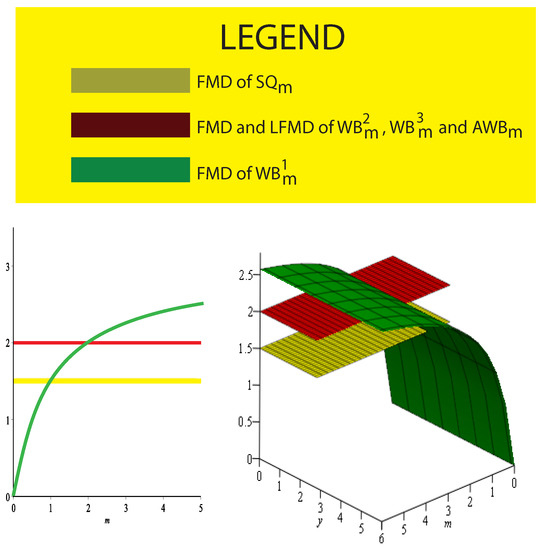 Figure 5. Graphical analysis, 2D (left) and 3D (right).
 - The networks under consideration bear rotational symmetry and planarity as well. Moreover, they are non-regular and vertex transitive networks with the attachment of a pendent edge that they can use to help solve the problems related to designing a fire exit plan, computer network, or in chemical strata.
- These results strengthen and prove the tautology of Theorem 1, Theorems 2 and 3 proved in [21,25].
- However, finding the distance-based fractional dimensions of families of networks other than web-related ones is still an open problem.
Author Contributions
Validation, formal analysis and writing—review, M.J.; writing—original draft, M.K.A.; investigation, M.I.A.; funding acquisition, B.N.A.; formal analysis, M.I.; visualization, B.A. All authors have read and agreed to the published version of the manuscript.
Funding
This research received no external funding.
Institutional Review Board Statement
Not applicable.
Informed Consent Statement
Not applicable.
Data Availability Statement
Not applicable.
Acknowledgments
Authors extend their appreciation to the Deanship of Scientific Research of King Saud University for funding this work through research group no RG-1441-327.
Conflicts of Interest
The authors declare no conflict of interest.
References
- Khuller, S.; Raghavachari, B.; Rosenfield, A. Landmarks in graphs. Discret. Appl. Math. 1996, 70, 217–229. [Google Scholar] [CrossRef] [Green Version]
- Slater, P.J. Leaves of trees. Congr. Numer. 1975, 14, 549–559. [Google Scholar]
- Melter, R.A.; Tomescu, I. Metric bases in digital geometry. Comput. Vis. Graph. Image. Process. 1984, 25, 113–121. [Google Scholar] [CrossRef]
- Chartrand, G.; Eroh, L.; Johnson, M.A.; Oellermann, O.R. Resolvability in graphs and the metric dimension of a graph. Discret. Appl. Math. 2002, 105, 99–113. [Google Scholar] [CrossRef] [Green Version]
- Buczkowski, P.; Chartrand, G.; Poisson, C.; Zhang, P. On k- dimensional graphs and their bases. Period. Math. Hung. 2003, 46, 9–15. [Google Scholar] [CrossRef]
- Slater, P.J. Dominating and reference sets in graphs. J. Math. Phys. Sci. 1998, 22, 445–455. [Google Scholar]
- Slater, P.J. Domination and location in acyclic graphs. Networks 1987, 17, 55–64. [Google Scholar] [CrossRef]
- Harary, F.; Melter, R.A. On the metric dimension of a graph. ARS Combin. 1976, 2, 191–195. [Google Scholar]
- Imran, M.; Baig, A.Q.; Shafiq, M.K.; Tomescu, I. On metric dimension of generalized Petersen graphs P(n,3). ARS Comb. 2014, 117, 113–130. [Google Scholar]
- Imran, M.; Siddiqui, M.K.; Naeem, R. On metric dimension of generalized Petersen Multigraphs. IEEE Access 2018, 6, 74328–74338. [Google Scholar] [CrossRef]
- Currie, J.; Oellermann, O.R. The metric dimension and metric independence of a graph. J. Combin. Math. Combin. Comput. 2001, 39, 157–167. [Google Scholar]
- Arumugam, S.; Mathew, V. The fractional metric dimension of graphs. Discret. Math. 2012, 9, 1584–1590. [Google Scholar] [CrossRef] [Green Version]
- Arumugam, S.; Mathew, V.; Shen, J. On fractional metric dimension of graphs. Discret. Math. Algorithms Appl. 2013, 5, 1–8. [Google Scholar] [CrossRef]
- Feng, M.; Lv, B.; Wang, K. On the fractional metric dimension of graphs. Discret. Appl. Math. 2014, 170, 55–63. [Google Scholar] [CrossRef]
- Feng, M.; Wang, K. On the metric dimension and fractional metric dimension of the hierarchical product of graphs. Appl. Anal. Discret. Math. 2013, 7, 302–313. [Google Scholar] [CrossRef]
- Saputro, S.W.; Fenovcikova, A.S.; Baca, M.; Lascsakova, M. On fractional metric dimension of comb product graphs. Stat. Optim. Inf. Comput. 2018, 6, 150–158. [Google Scholar] [CrossRef] [Green Version]
- Liu, J.B.; Kashif, A.; Rasheed, T.; Javaid, M. Fractional metric dimension of Generalized Jahangir Graph. Mathematics 2019, 4, 100. [Google Scholar] [CrossRef] [Green Version]
- Raza, M.; Javaid, M.; Saleem, N. Fractional metric dimension of metal organic frameworks. Main Group Met. Chem. 2021, in press. [Google Scholar] [CrossRef]
- Javaid, M.; Aslam, M.K.; Liu, J.B. On the Upper Bounds of Fractional Metric Dimension of Symmetric Networks. J. Math. 2021. [Google Scholar] [CrossRef]
- Javaid, M.; Aslam, M.K.; Alanazi, A.M.; Aljohani, M.M. Characterization of (Molecular) Graphs with Fractional Metric Dimension as Unity. J. Chem. 2021, 2021, 9910572. [Google Scholar] [CrossRef]
- Alkhaldi, A.H.; Aslam, M.K.; Javaid, M.; Alanazi, A.M. Bounds of Fractional Metric Dimension and Applications with Grid-Related Networks. Mathematics 2021, 9, 1383. [Google Scholar] [CrossRef]
- Aslam, M.K.; Javaid, M.; Zhu, Q.; Raheem, A. On the Fractional Metric Dimension of Convex Polytopes. Math. Probl. Eng. 2021, 2021, 3925925. [Google Scholar] [CrossRef]
- Aisyah, S.; Utoyo, M.I.; Susilowati, L. On the local fractional metric dimension of corona product graphs. IOP Conf. Ser. Earth Environ. Sci. Hung. 2019, 243, 012043. [Google Scholar] [CrossRef]
- Javaid, M.; Zafar, H.; Zhu, Q.; Alanazi, A.M. Improved Lower Bound of LFMD with Applications of Prism-Related Networks. Math. Probl. Eng. 2021, 2021, 9950310. [Google Scholar] [CrossRef]
- Javaid, M.; Raza, M.; Kumam, P.; Liu, J.B. Sharp Bounds of Local Fractional Metric Dimensions of Connected Networks. IEEE Access 2020, 8, 172329–172342. [Google Scholar] [CrossRef]
Publisher’s Note: MDPI stays neutral with regard to jurisdictional claims in published maps and institutional affiliations. |
© 2021 by the authors. Licensee MDPI, Basel, Switzerland. This article is an open access article distributed under the terms and conditions of the Creative Commons Attribution (CC BY) license (https://creativecommons.org/licenses/by/4.0/).