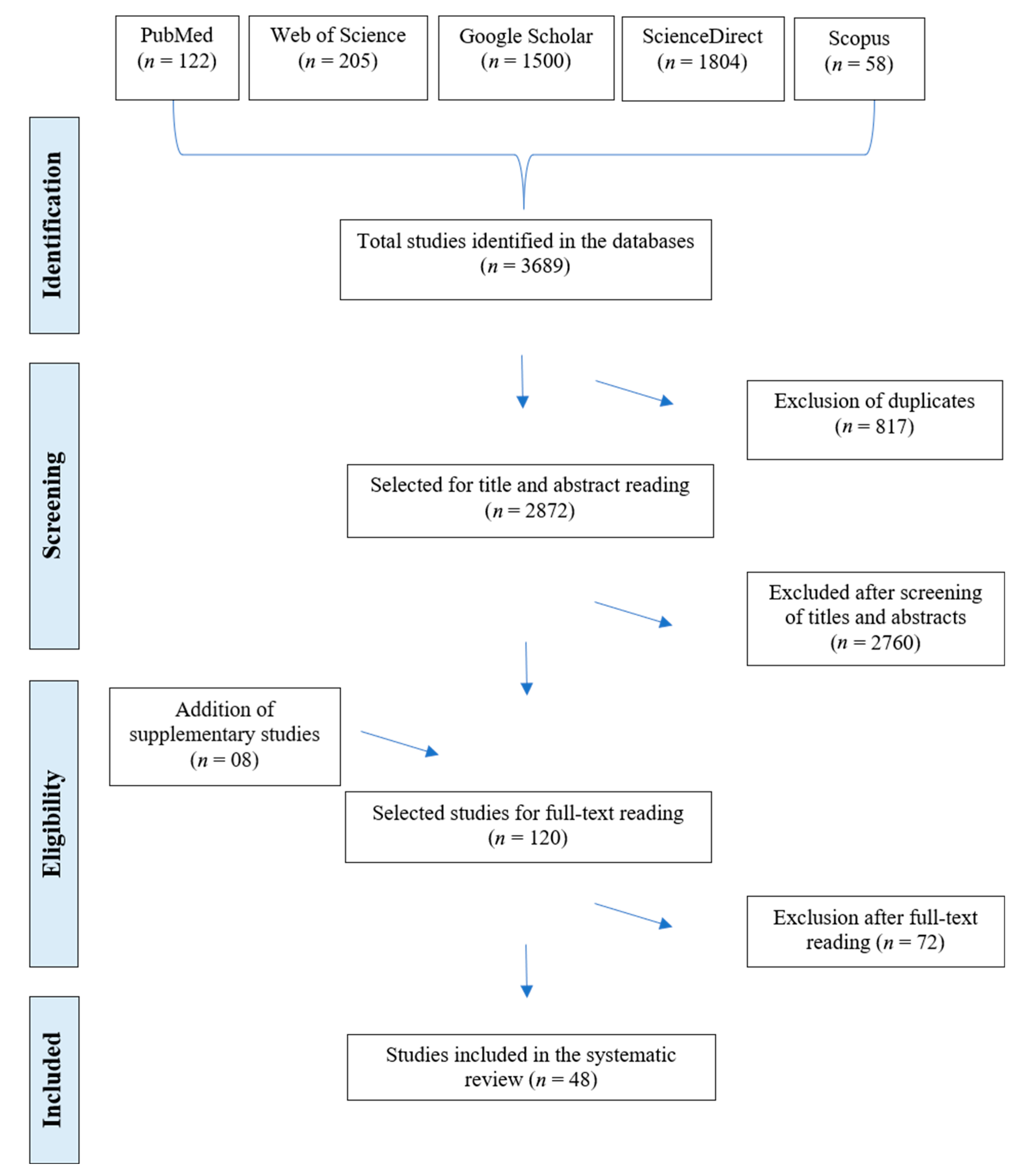

Epidemiology of Human Cryptosporidiosis in Brazil: A Systematic Review Highlighting Cryptosporidium parvum
 ,
,  and
and 
Abstract
1. Introduction
2. Materials and Methods
2.1. Search Strategies
2.2. Inclusion Criteria and Selection Process
2.3. Data Extraction and Analysis
3. Results
4. Discussion
5. Conclusions
Author Contributions
Funding
Institutional Review Board Statement
Informed Consent Statement
Data Availability Statement
Conflicts of Interest
References
- Gerace, E.; Lo Presti, V.D.M.; Biondo, C. Cryptosporidium infection: Epidemiology, pathogenesis, and differential diagnosis. Eur. J. Microbiol. Immunol. 2019, 9, 119–123. [Google Scholar] [CrossRef]
- Cunha, F.S.; Peralta, R.H.S.; Peralta, J.M. New insights into the detection and molecular characterization of Cryptosporidium with emphasis in Brazilian studies: A review. Rev. Inst. Med. Trop. São Paulo 2019, 61, e28. [Google Scholar] [CrossRef]
- Zahedi, A.; Paparini, A.; Jian, F.; Robertson, I.; Ryan, U. Cryptosporidium species and subtypes in animals inhabiting drinking water catchments in three states across Australia. Water Res. 2018, 134, 327–340. [Google Scholar] [CrossRef]
- Ryan, U.M.; Feng, Y.; Fayer, R.; Xiao, L. Taxonomy and molecular epidemiology of Cryptosporidium and Giardia—A 50-year perspective (1971–2021). Int. J. Parasitol. 2021, 51, 1099–1119. [Google Scholar] [CrossRef]
- Vilela, V.L.R.; Feitosa, T.F.; Silva, W.I.; Katzer, F. Cryptosporidium spp. in livestock in Brazil: An underestimated threat to animal and human health. Curr. Res. Parasitol. Vector-Borne Dis. 2025, 8, 100–312. [Google Scholar] [CrossRef] [PubMed]
- Xiao, L. Molecular epidemiology of cryptosporidiosis: An update. Exp. Parasitol. 2010, 124, 80–89. [Google Scholar] [CrossRef]
- Khan, A.; Shaik, J.S.; Grigg, M.E. Genomics and molecular epidemiology of Cryptosporidium species. Acta Trop. 2018, 184, 1–14. [Google Scholar] [CrossRef]
- Sannella, A.R.; Suputtamongkol, Y.; Wongsawat, E.; Prasertbun, R.; Cacciò, S.M. A retrospective molecular study of Cryptosporidium species and genotypes in HIV-infected patients in Thailand. Parasites Vectors 2019, 12, 91. [Google Scholar] [CrossRef] [PubMed]
- Ahmadpour, E.; Safarpour, H.; Xiao, L.; Zarean, M.; Hatam-Nahavandi, K.; Barac, A.; Picot, S.; Rahimi, M.T.; Rubino, S.; Mahami-Oskouei, M.; et al. Cryptosporidiosis in HIV-positive patients and related risk factors: A systematic review and meta-analysis. Parasite 2020, 27, 27. [Google Scholar] [CrossRef]
- Danziger-Isakov, L. Gastrointestinal infections after transplantation. Curr. Opin. Gastroenterol. 2014, 30, 40–46. [Google Scholar] [CrossRef]
- Siddiqui, Z.A. An overview of parasitic infections of the gastro-intestinal tract in developed countries affecting immunocompromised individuals. J. Parasit. Dis. 2017, 41, 621–626. [Google Scholar] [CrossRef]
- Cunha, F.S.; Jann, H.W.; Lugon, J.R.; Peralta, J.M.; Peralta, R.H.S. Molecular characterization of Cryptosporidium spp. obtained from fecal samples of immunosuppressed patients from Brazil. Rev. Soc. Bras. Med. Trop. 2022, 55, e0555. [Google Scholar] [CrossRef] [PubMed]
- Dixon, B.R.; Parrington, L.J.; Cook, A.; Pintar, K.D.M.; Pollari, F.; Kelton, D.; Farber, J.M. The potential for zoonotic transmission of Giardia duodenalis and Cryptosporidium spp. from beef and dairy cattle in Ontario, Canada. Vet. Parasitol. 2011, 175, 20–26. [Google Scholar] [CrossRef] [PubMed]
- Cacciò, S.M.; Chalmers, R.M. Human cryptosporidiosis in Europe. Clin. Microbiol. Infect. 2016, 22, 471–480. [Google Scholar] [CrossRef]
- Smith, R.P.; Newton, K.; Rimdap, E.; Wight, A.; Robinson, G.; Chalmers, R.M. A review of investigations of animal premises, linked to human outbreaks of cryptosporidiosis in England and Wales, from 2009–2019. Vet. Rec. 2021, 189, e246. [Google Scholar] [CrossRef]
- Hadfield, S.J.; Robinson, G.; Elwin, K.; Chalmers, R.M. Detection and differentiation of Cryptosporidium spp. in human clinical samples by real-time PCR. J. Clin. Microbiol. 2011, 49, 918–924. [Google Scholar] [CrossRef]
- Chalmers, R.M.; Giles, M. Zoonotic cryptosporidiosis in the UK—Challenges for control. J. Appl. Microbiol. 2010, 109, 1487–1497. [Google Scholar] [CrossRef] [PubMed]
- Delling, C.; Daugschies, A. Literature review: Coinfection in young ruminant livestock—Cryptosporidium spp. and its companions. Pathogens 2022, 11, 103. [Google Scholar] [CrossRef]
- Page, M.J.; McKenzie, J.E.; Bossuyt, P.M.; Boutron, I.; Hoffmann, T.C.; Mulrow, C.D.; Shamseer, L.; Tetzlaff, J.M.; Moher, D. Updating guidance for reporting systematic reviews: Development of the PRISMA 2020 statement. J. Clin. Epidemiol. 2021, 134, 103–112. [Google Scholar] [CrossRef]
- Dias, R.M.D.S.; Mangini, A.C.S.; Torres, D.M.A.G.V.; Corrêa, M.O.A.; Lupetti, N.; Corrêa, F.M.A.; Chieffi, P.P. Cryptosporidiosis among patients with acquired immunodeficiency syndrome (AIDS) in the county of São Paulo, Brazil. Rev. Inst. Med. Trop. São Paulo 1988, 30, 310–312. [Google Scholar] [CrossRef]
- Garlipp, C.R.; Bottini, P.V.; Teixeira, A.T. The relevance of laboratory diagnosis of human cryptosporidiosis and other coccidia. Rev. Inst. Med. Trop. São Paulo 1995, 37, 467–469. [Google Scholar] [CrossRef]
- Franco, R.M.; Cordeiro, N.d.S. Giardiose e criptosporidiose em creches no município de Campinas, SP. Rev. Soc. Bras. Med. Trop. 1996, 29, 585–591. [Google Scholar] [CrossRef]
- Chieffi, P.P.; Sens, Y.A.S.; Paschoalotti, M.A.; Miorin, L.A.; Silva, H.G.C.; Jabur, P. Infection by Cryptosporidium parvum in renal patients submitted to renal transplant or hemodialysis. Rev. Soc. Bras. Med. Trop. 1998, 31, 333–337. [Google Scholar] [CrossRef]
- Cimerman, S.; Cimerman, B.; Lewi, D.S. Avaliação da relação entre parasitoses intestinais e fatores de risco para o HIV em pacientes com AIDS. Rev. Soc. Bras. Med. Trop. 1999, 32, 181–185. [Google Scholar] [CrossRef] [PubMed]
- Medeiros, M.I.C.; Neme, S.N.; Silva, P.; Capuano, D.M.; Errera, M.C.; Fernandes, S.A.; Valle, G.R.; Avila, F.A. Etiology of acute diarrhea among children in Ribeirão Preto-SP, Brazil. Rev. Inst. Med. Trop. São Paulo 2001, 43, 21–24. [Google Scholar] [CrossRef] [PubMed]
- Silva, C.V.; Ferreira, M.S.; Gonçalves-Pires, M.R.; Costa-Cruz, J.M. Detection of Cryptosporidium-specific coproantigen in human immunodeficiency virus/acquired immunodeficiency syndrome patients by using a commercially available immunoenzymatic assay. Memórias Inst. Oswaldo Cruz 2003, 98, 1097–1099. [Google Scholar] [CrossRef]
- Cox, M.J.; Elwin, K.; Massad, E.; Azevedo, R.S. Age-specific seroprevalence to an immunodominant Cryptosporidium sporozoite antigen in a Brazilian population. Epidemiol. Infect. 2005, 133, 951–956. [Google Scholar] [CrossRef]
- Marques, F.R.; Cardoso, L.V.; Cavasini, C.E.; Almeida, M.C.; Bassi, N.A.; Almeida, M.T.G.; Rossit, A.R.B.; Machado, R.L.D. Performance of an immunoenzymatic assay for Cryptosporidium diagnosis of fecal samples. Braz. J. Infect. Dis. 2005, 9, 3–5. [Google Scholar] [CrossRef] [PubMed][Green Version]
- Almeida, T.T.C.; Pinto, P.L.S.; Quadros, C.M.S.; Torres, D.M.A.G.V.; Kanamura, H.Y.; Casimiro, A.M. Detection of Cryptosporidium sp. in non-diarrheal faeces from children in a day care center in the city of São Paulo, Brazil. Rev. Inst. Med. Trop. São Paulo 2006, 48, 27–32. [Google Scholar] [CrossRef]
- Carvalho, T.B.; Carvalho, L.R.; Mascarini, L.M. Occurrence of enteroparasites in day care centers in Botucatu (São Paulo State, Brazil) with emphasis on Cryptosporidium sp., Giardia duodenalis and Enterobius vermicularis. Rev. Inst. Med. Trop. São Paulo 2006, 48, 269–273. [Google Scholar] [CrossRef]
- Mascarini, L.M.; Donalísio, M.R. Giardiasis and cryptosporidiosis in children institutionalized at daycare centers in the State of São Paulo. Rev. Soc. Bras. Med. Trop. 2006, 39, 577–579. [Google Scholar] [CrossRef]
- Costa, F.A.C.; Gonçalves, A.Q.; Lassance, S.L.; Albuquerque, C.P.; Leite, J.P.G.; Bóia, M.N. Detection of Cryptosporidium spp and other intestinal parasites in children with acute diarrhea and severe dehydration in Rio de Janeiro. Rev. Soc. Bras. Med. Trop. 2007, 40, 346–348. [Google Scholar] [CrossRef]
- Rossit, A.R.B.; Almeida, M.T.G.; Nogueira, C.A.M.; Oliveira, J.G.C.; Barbosa, D.M.U.; Moscardini, A.C.; Mascarenhas, J.D.P.; Gabbay, Y.B.; Marques, F.R.; Cardoso, L.V.; et al. Bacterial, yeast, parasitic, and viral enteropathogens in HIV-infected children from São Paulo State, Southeastern Brazil. Diagn. Microbiol. Infect. Dis. 2007, 57, 59–66. [Google Scholar] [CrossRef]
- Silva, M.B.O.; Oliveira, L.R.; Resende, J.C.P.; Peghini, B.C.; Ramirez, L.E.; Lages-Silva, E.; Correia, D. Seasonal profile and level of CD4+ lymphocytes in the occurrence of cryptosporidiosis and cystoisosporidiosis in HIV/AIDS patients in the Triângulo Mineiro region, Brazil. Rev. Soc. Bras. Med. Trop. 2007, 40, 512–515. [Google Scholar] [CrossRef]
- Araújo, A.J.U.S.; Kanamura, H.Y.; Almeida, M.E.; Gomes, A.H.S.; Pinto, T.H.L.; Da Silva, A.J. Genotypic identification of Cryptosporidium spp. isolated from HIV-infected patients and immunocompetent children of São Paulo, Brazil. Rev. Inst. Med. Trop. São Paulo 2008, 50, 139–143. [Google Scholar] [CrossRef]
- Lucca, P.D.; De Gaspari, E.N.; Bozzoli, L.M.; Funada, M.R.; Silva, S.O.; Iuliano, W.; Soares, R.M. Molecular characterization of Cryptosporidium spp. from HIV infected patients from an urban area of Brazil. Rev. Inst. Med. Trop. São Paulo 2009, 51, 341–343. [Google Scholar] [CrossRef]
- Cardoso, L.V.; Galisteu, K.J.; Schiesari Júnior, A.; Abou Chahla, L.A.O.; Canille, R.M.S.; Belloto, M.V.T.; Franco, C.; Maia, I.L.; Rossit, A.R.B.; Machado, R.L.D. Enteric parasites in HIV-1/AIDS-infected patients from a Northwestern São Paulo reference unit in the highly active antiretroviral therapy era. Rev. Soc. Bras. Med. Trop. 2011, 44, 665–669. [Google Scholar] [CrossRef] [PubMed]
- Rolando, R.F.; Silva, S.d.; Peralta, R.H.; Silva, A.J.; Cunha, F.S.; Bello, A.R.; Peralta, J.M. Detection and differentiation of Cryptosporidium by real-time polymerase chain reaction in stool samples from patients in Rio de Janeiro, Brazil. Memórias Inst. Oswaldo Cruz 2012, 107, 476–479. [Google Scholar] [CrossRef] [PubMed]
- Assis, D.C.; Resende, D.V.; Cabrine-Santos, M.; Correia, D.; Oliveira-Silva, M.B. Prevalence and genetic characterization of Cryptosporidium spp. and Cystoisospora belli in HIV-infected patients. Rev. Inst. Med. Trop. São Paulo 2013, 55, 149–154. [Google Scholar] [CrossRef]
- Gil, F.F.; Barros, M.J.; Macedo, N.A.; Júnior, C.G.E.; Redoan, R.; Busatti, H.; Gomes, M.A.; Santos, J.F.G. Prevalence of intestinal parasitism and associated symptomatology among hemodialysis patients. Rev. Inst. Med. Trop. São Paulo 2013, 55, 69–74. [Google Scholar] [CrossRef] [PubMed]
- Girotto, K.G.; Grama, D.F.; Cunha, M.J.R.; Faria, E.S.M.; Limongi, J.E.; Pinto, R.M.C.; Cury, M.C. Prevalence and risk factors for intestinal protozoa infection in elderly residents at long term residency institutions in Southeastern Brazil. Rev. Inst. Med. Trop. São Paulo 2013, 55, 19–24. [Google Scholar] [CrossRef]
- Fregonesi, B.; Suzuki, M.N.; Machado, C.S.; Tonani, K.A.A.; Fernandes, A.P.M.; Monroe, A.A.; Cervi, M.C.; Segura-Muñoz, S. Emergent and re-emergent parasites in HIV-infected children: Immunological and socio-environmental conditions that are involved in the transmission of Giardia spp. and Cryptosporidium spp. Rev. Soc. Bras. Med. Trop. 2015, 48, 753–758. [Google Scholar] [CrossRef]
- Peralta, R.H.S.; Velásquez, J.N.; Cunha, F.S.; Pantano, M.L.; Sodré, F.C.; Silva, S.; Astudillo, O.G.; Peralta, J.M.; Carnevale, S. Genetic diversity of Cryptosporidium identified in clinical samples from cities in Brazil and Argentina. Memórias Inst. Oswaldo Cruz 2016, 111, 30–36. [Google Scholar] [CrossRef] [PubMed]
- Adami, Y.L.; Gama, N.A.; Cunha, F.S.; Peralta, R.H.S.; Lugon, J.R. Presence of Cryptosporidium spp. and other enteroparasites with pathogenic potential in hemodialysis patients: An open controlled study. Braz. J. Nephrol. 2025, 47, e20240015. [Google Scholar] [CrossRef]
- Newman, R.D.; Zu, S.-X.; Wuhib, T.; Lima, A.A.M.; Guerrant, R.L.; Sears, C.L. Household epidemiology of Cryptosporidium parvum infection in an urban community in Northeast Brazil. Ann. Intern. Med. 1994, 120, 500–505. [Google Scholar] [CrossRef]
- Wuhib, T.; Silva, T.M.J.; Newman, R.D.; Garcia, L.S.; Pereira, M.L.D.; Chaves, C.S.; Wahlquist, S.P.; Bryan, R.T.; Guerrant, R.L.; Sousa, A.Q.; et al. Cryptosporidial and microsporidial infections in human immunodeficiency virus-infected patients in Northeastern Brazil. J. Infect. Dis. 1994, 170, 494–497. [Google Scholar] [CrossRef]
- Agnew, D.G.; Lima, A.A.M.; Newman, R.D.; Wuhib, T.; Moore, R.D.; Guerrant, R.L.; Sears, C.L. Cryptosporidiosis in Northeastern Brazilian children: Association with increased diarrhea morbidity. J. Infect. Dis. 1998, 177, 754–760. [Google Scholar] [CrossRef] [PubMed]
- Newman, R.D.; Sears, C.L.; Moore, S.R.; Nataro, J.P.; Wuhib, T.; Agnew, D.A.; Guerrant, R.L.; Lima, A.A.M. Longitudinal study of Cryptosporidium infection in children in Northeastern Brazil. J. Infect. Dis. 1999, 180, 167–175. [Google Scholar] [CrossRef] [PubMed]
- Lima, A.A.M.; Moore, S.R.; Barboza, M.S., Jr.; Soares, A.M.; Schleupner, M.A.; Newman, R.D.; Sears, C.L.; Nataro, J.P.; Fedorko, D.P.; Wuhib, T.; et al. Persistent diarrhea signals a critical period of increased diarrhea burdens and nutritional shortfalls: A prospective cohort study among children in Northeastern Brazil. J. Infect. Dis. 2000, 181, 1643–1651. [Google Scholar] [CrossRef][Green Version]
- Brantley, R.K.; Williams, K.R.; Silva, T.M.; Sistrom, M.; Thielman, N.M.; Ward, H.; Lima, A.A.; Guerrant, R.L. AIDS-associated diarrhea and wasting in Northeast Brazil is associated with subtherapeutic plasma levels of antiretroviral medications and with both bovine and human subtypes of Cryptosporidium parvum. Braz. J. Infect. Dis. 2003, 7, 16–22. [Google Scholar] [CrossRef]
- Bushen, O.Y.; Kohli, A.; Pinkerton, R.C.; Dupnik, K.; Newman, R.D.; Sears, C.L.; Fayer, R.; Lima, A.A.M.; Guerrant, R.L. Heavy cryptosporidial infections in children in northeast Brazil: Comparison of Cryptosporidium hominis and Cryptosporidium parvum. Trans. R. Soc. Trop. Med. Hyg. 2007, 101, 378–384. [Google Scholar] [CrossRef]
- Teixeira, M.C.A.; Barreto, M.L.; Melo, C.; Silva, L.R.; Moraes, L.R.S.; Alcântara-Neves, N.M. A serological study of Cryptosporidium transmission in a periurban area of a Brazilian Northeastern city. Trop. Med. Int. Health 2007, 12, 1096–1104. [Google Scholar] [CrossRef] [PubMed]
- Nascimento, W.R.C.; Cavalcanti, I.M.F.; Irmão, J.I.; Rocha, F.J.S. Presença de Cryptosporidium spp em crianças com diarreia aguda em uma creche pública de Recife, Estado de Pernambuco. Rev. Soc. Bras. Med. Trop. 2009, 42, 175–178. [Google Scholar] [CrossRef] [PubMed][Green Version]
- Jeske, S.; Bianchi, T.F.; Moura, M.Q.; Baccega, B.; Pinto, N.B.; Berne, M.E.A.; Villela, M.M. Intestinal parasites in cancer patients in the South of Brazil. Braz. J. Biol. 2018, 78, 574–578. [Google Scholar] [CrossRef] [PubMed]
- Oshiro, E.T.; Dorval, M.E.C.; Nunes, V.L.B.; Silva, M.A.A.; Said, L.A.M. Prevalence of Cryptosporidium parvum among children of less than 5 years of age in the urban zone of Campo Grande, Mato Grosso do Sul State, Brazil, 1996. Rev. Soc. Bras. Med. Trop. 2000, 33, 277–280. [Google Scholar] [CrossRef]
- Pereira, M.G.C.; Atwill, E.R.; Barbosa, A.P.; Silva, S.A.; García-Zapata, M.T.A. Intra-familial and extra-familial risk factors associated with Cryptosporidium parvum infection among children hospitalized for diarrhea in Goiania, Goias, Brazil. Am. J. Trop. Med. Hyg. 2002, 66, 787–793. [Google Scholar] [CrossRef]
- Barcelos, N.B.; Silva, L.F.E.; Dias, R.F.G.; Menezes-Filho, H.R.; Rodrigues, R.M. Opportunistic and non-opportunistic intestinal parasites in HIV/AIDS patients in relation to their clinical and epidemiological status in a specialized medical service in Goiás, Brazil. Rev. Inst. Med. Trop. São Paulo 2018, 60, 13. [Google Scholar] [CrossRef]
- Loureiro, E.C.B.; Linhares, A.C.; Mata, L. Cryptosporidiosis in children (1–2 years old) with acute diarrhoea from Belém, Pará, Brazil. Memórias Inst. Oswaldo Cruz 1989, 84, 117–122. [Google Scholar] [CrossRef]
- Clemente, C.M.; Caramori, C.A.; Padula, P.; Rodrigues, M.A.M. Gastric cryptosporidiosis as a clue for the diagnosis of the acquired immunodeficiency syndrome. Arq. Gastroenterol. 2000, 37, 180–182. [Google Scholar] [CrossRef]
- Souza, D.S.; Barreiros, J.T.; Papp, K.M.; Steindel, M.; Simões, C.M.; Barardi, C.R. Comparison between immunomagnetic separation, coupled with immunofluorescence, and the techniques of Faust et al. and of Lutz for the diagnosis of Giardia lamblia cysts in human feces. Rev. Inst. Med. Trop. São Paulo 2004, 45, 339–342. [Google Scholar] [CrossRef]
- Reina, F.T.R.; Ribeiro, C.A.; Araújo, R.S.; Matté, M.H.; Castanho, R.E.P.; Tanaka, I.I.; Viggiani, A.M.F.S.; Martins, L.P.A. Intestinal and pulmonary infection by Cryptosporidium parvum in two patients with HIV/AIDS. Rev. Inst. Med. Trop. São Paulo 2016, 58, 21. [Google Scholar] [CrossRef]
- Rezende, N.C.C.; Bezerra, C.L.P.A.M.; Almeida, J.J.S.; Fernandes, T.U.G.; Luz, K.G. Secondary transmission of cryptosporidiosis associated with well water consumption: Two case studies. Rev. Soc. Bras. Med. Trop. 2016, 49, 260–262. [Google Scholar] [CrossRef]
- Barros, M.A.F.; Navarro, I.T.; Menezes, M.C.N.D.; Osaki, S.C.; Souza, C.F. Cryptosporidium sp. em ser humano na zona rural do município de Londrina, Paraná, Brasil: Relato de caso. Semin. Ciênc. Agrár. 1994, 15, 52–56. [Google Scholar] [CrossRef]
- Chiuchetta, F.A. Criptosporidiose em paciente com espondilite anquilosante usando adalimumabe. Rev. Bras. Reumatol. 2010, 50, 328–332. [Google Scholar] [CrossRef] [PubMed][Green Version]
- Cabral, B.G.; Storer, J.M.; Bono, C.S.R.; Carrilho, C.M.D.M.; Pascual, J.; Tanita, M.T.; Capobiango, J.D.; Beraldo, E.G.; Belei, R.A.; Neto, R.P. Surto por Cryptosporidium spp em unidade de terapia intensiva: Medidas de controle. Braz. J. Infect. Dis. 2021, 25 (Suppl. S1), 101078. [Google Scholar] [CrossRef]
- Rosendo, R.Z.; Bianchini, A.J.; Corrêa de Barros, R.; Breda, G.L.; Lotha, G. Disseminated cryptosporidiosis in a child submitted to hematopoietic stem cell transplantation for CD40 ligand deficiency: Case report. Braz. J. Infect. Dis. 2023, 27 (Suppl. S1), 102812. [Google Scholar] [CrossRef]
- Jann, H.W.; Cabral-Castro, M.J.; Costa, J.V.B.; Alencar, A.C.M.B.; Peralta, J.M.; Peralta, R.H.S. Prevalence of human cryptosporidiosis in the Americas: Systematic review and meta-analysis. Rev. Inst. Med. Trop. São Paulo 2022, 64, 70. [Google Scholar] [CrossRef]
- Sidone, O.J.G.; Haddad, E.A.; Mena-Chalco, J.P. Science in Brazilian regions: Evolution of production and collaboration networks. Transinformação 2016, 28, 15–31. [Google Scholar] [CrossRef]
- Afzal, M.; Agarwal, S.; Elshaikh, R.H.; Babker, A.M.A.; Osman, E.A.I.; Choudhary, R.K.; Jaiswal, S.; Zahir, F.; Prabhakar, P.K.; Abbas, A.M.; et al. Innovative diagnostic approaches and challenges in the management of HIV: Bridging basic science and clinical practice. Life 2025, 15, 209. [Google Scholar] [CrossRef]
- Smith, R.P.; Clifton-Hadley, F.A.; Cheney, T.; Giles, M. Prevalence and molecular typing of Cryptosporidium in dairy cattle in England and Wales and examination of potential on-farm transmission routes. Vet. Parasitol. 2014, 204, 111–119. [Google Scholar] [CrossRef]
- Morris, A.; Robinson, G.; Swain, M.T.; Chalmers, R.M. Direct sequencing of Cryptosporidium in stool samples for public health. Front. Public Health 2019, 7, 360. [Google Scholar] [CrossRef]
- Costa, D.; Soulieux, L.; Razakandrainibe, R.; Basmaciyan, L.; Gargala, G.; Valot, S.; Dalle, F.; Favennec, L. Comparative Performance of eight PCR methods to detect Cryptosporidium species. Pathogens 2021, 10, 647. [Google Scholar] [CrossRef] [PubMed]
- Dabas, A.; Shah, D.; Bhatnagar, S.; Lodha, R. Epidemiology of Cryptosporidium in Pediatric Diarrheal Illnesses. Indian Pediatr. 2017, 54, 299–309. [Google Scholar] [CrossRef] [PubMed]
- Colford, J.M., Jr.; Tager, I.B.; Hirozawa, A.M.; Lemp, G.F.; Aragon, T.; Petersen, C. Cryptosporidiosis among patients infected with human immunodeficiency virus: Factors related to symptomatic infection and survival. Am. J. Epidemiol. 1996, 144, 807–816. [Google Scholar] [CrossRef] [PubMed]

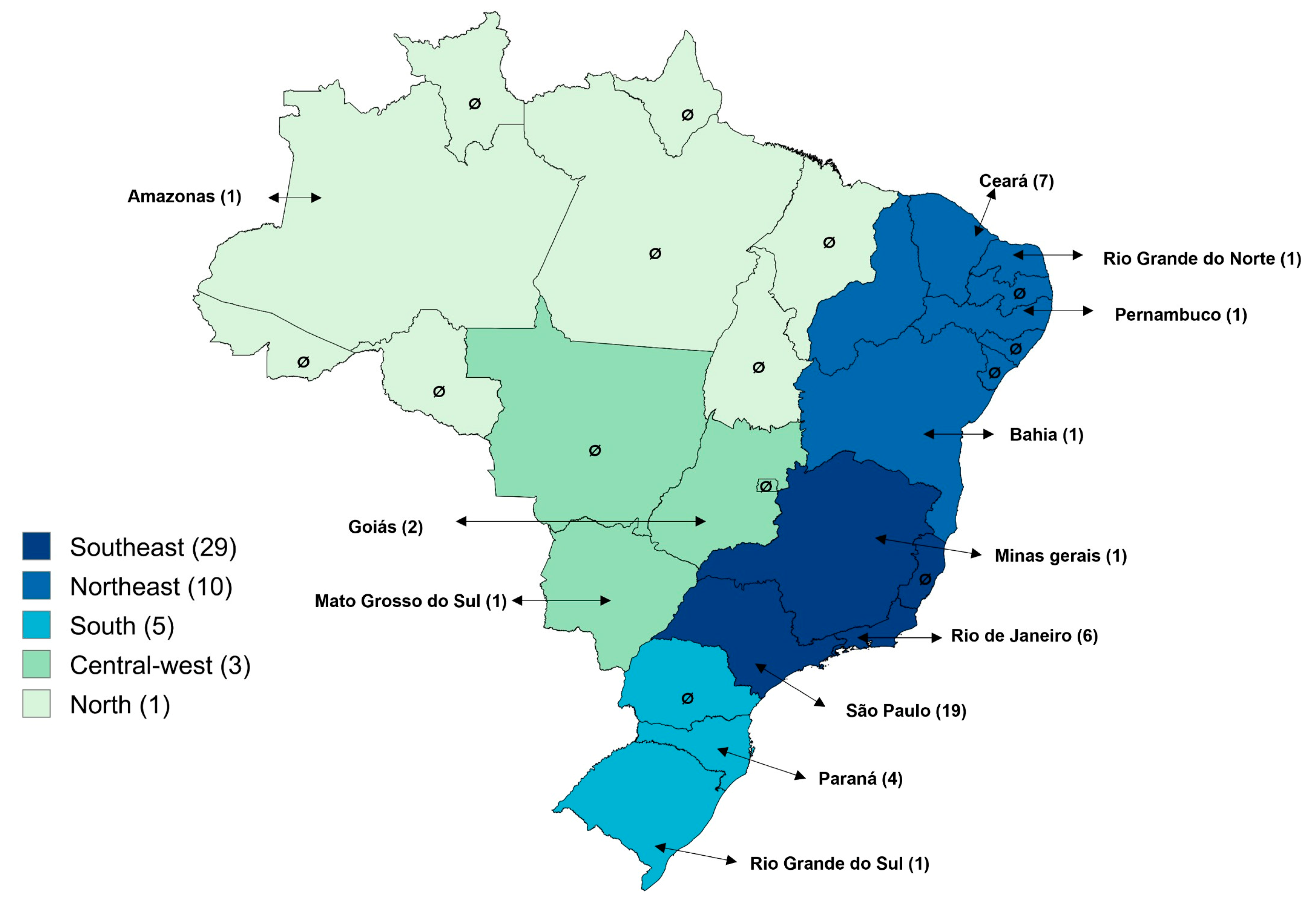
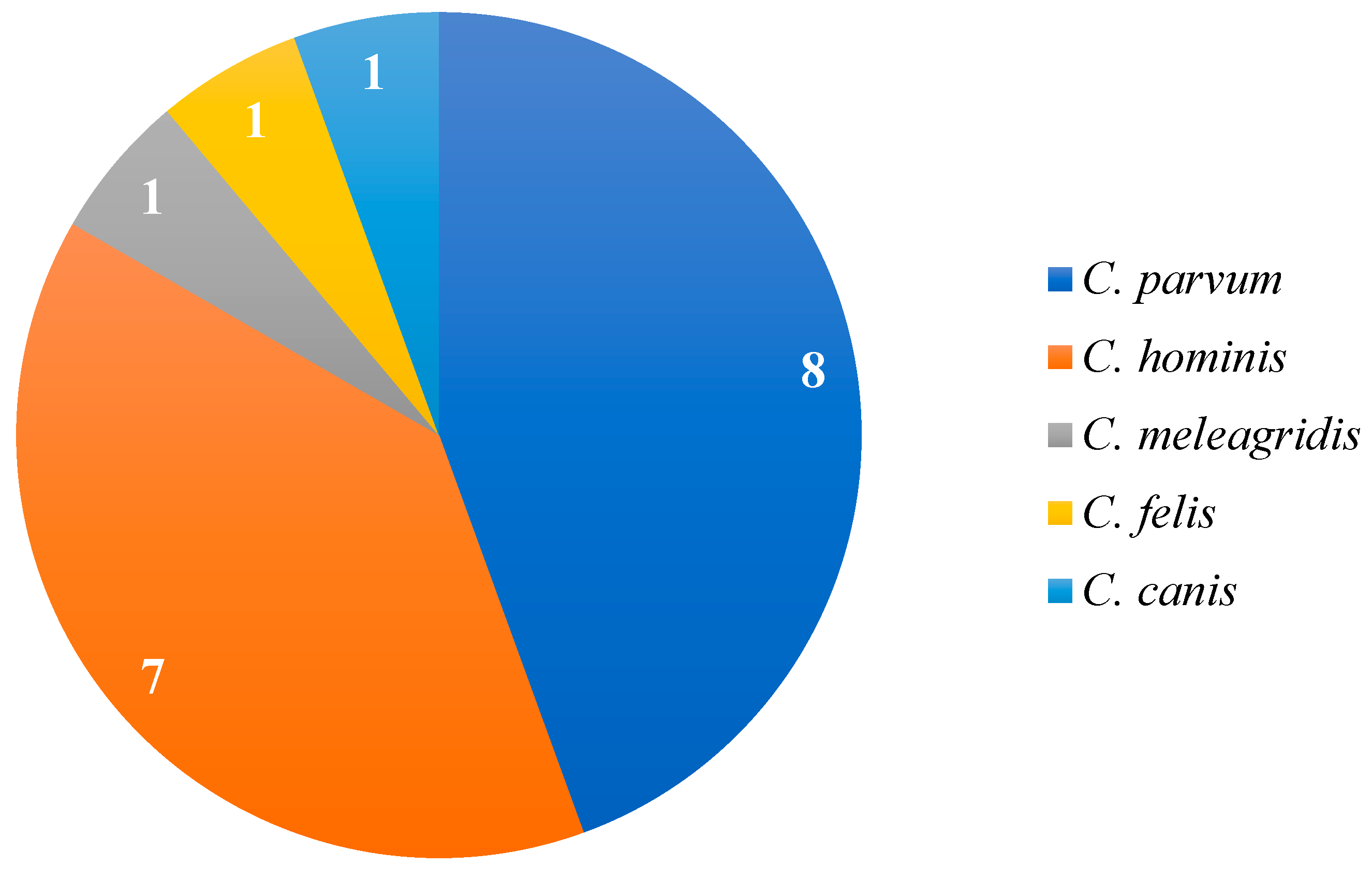

| Region and State | Reference | Age | Diagnostic Method | Total of Samples | Positives | Prevalence (%) | Gender or Species | Study Type |
|---|---|---|---|---|---|---|---|---|
| Southeast | ||||||||
| São Paulo | Dias et al. [20] | NA | Microscopy | 157 | 19 | 12.1 | Cryptosporidium spp. | Crosssectional |
| São Paulo | Garlipp et al. [21] | 2 months to 76 years | Microscopy | 111 | 20 | 18.0 | Cryptosporidium spp. | Crosssectional |
| São Paulo | Franco et al. [22] | 2 months to 5 years | Microscopy | 930 | 20 | 6.4 | C. parvum | Crosssectional |
| São Paulo | Chieffi et al. [23] | NA | Microscopy | 82 | 20 | 24.4 | C. parvum | Longitudinal |
| São Paulo | Cimerman et al. [24] | >18 years | Microscopy | 200 | 14 | 7 | C. parvum | Crosssectional |
| São Paulo | Mederios et al. [25] | 1 day to 10 years | Microscopy | 1836 | 34 | 1.8 | Cryptosporidium spp. | Crosssectional |
| Rio de Janeiro | Silva et al. [26] | 18 to 59 years | Microscopy | 90 | 3 | 3.3 | Cryptosporidium spp. | Crosssectional |
| Direct ELISA | 7 | 7.7 | ||||||
| São Paulo | Cox and Azevedo, [27] | 1 day to 39 years | Indirect ELISA | 512 | 307 | 60 | anti-C. parvum antibodies | Crosssectional |
| São Paulo | Marques et al. [28] | NA | Microscopy | 144 | 8 | 5.5 | C. parvum | Crosssectional |
| Direct ELISA | 9 | 6.2 | ||||||
| São Paulo | Almeida et al. [29] | 1 day to 6 years–21 to 50 years | Microscopy | 87 | 14 | 16.1 | Cryptosporidium spp. | Crosssectional |
| São Paulo | Carvalho et al. [30] | 1 to 6 years | Microscopy | 279 | 42 | 15.5 | Cryptosporidium spp. | Crosssectional |
| São Paulo | Mascarini and Donalisio [31] | 1 day to 7 years | Microscopy | 776 | 74 | 9.5 | Cryptosporidium spp. | Crosssectional |
| Rio de Janeiro | Costa et al. [32] | 6 months to 5 years | Microscopy | 193 | 18 | 9.3 | Cryptosporidium spp. | Longitudinal |
| São Paulo | Rossit et al. [33] | 1 to 13 years | Immunochromatography | 100 | 62 | 62 | C. parvum | Crosssectional |
| Minas Gerais | Silva et al. [34] | 2 to 72 years | Microscopy | 359 | 31 | 8.6 | Cryptosporidium spp. | Crosssectional |
| São Paulo | Araújo et al. [35] | NA | Microscopy/Molecular (nested PCR) | 14 | 14 | 100 | C. parvum, C. hominis, C. meleagridis | Crosssectional |
| São Paulo | Lucca et al. [36] | NA | Microscopy/Molecular (nested PCR) | 27 | 27 | 100 | C. parvum, C. hominis, C. felis, C. canis | Crosssectional |
| São Paulo | Cardoso et al. [37] | 42 years | Microscopy | 500 | 1 | 0.3 | C. parvum | Crosssectional |
| Rio de Janeiro | Rolando et al. [38] | NA | Microscopy/Molecular (nested PCR) | 1207 | 42 | 3.5 | C. parvum, C. hominis | Crosssectional |
| Minas Gerais | Assis et al. [39] | 14 to 56 years | Microscopy | 120 | 6 | 10.1 | Cryptosporidium spp. | Crosssectional |
| Minas Gerais | Gil et al. [40] | NA | Microscopy | 110 | 0 | 0 | Cryptosporidium spp. | Crosssectional |
| Direct ELISA | 29 | 26.3 | ||||||
| Minas Gerais | Girotto et al. [41] | 60 to 106 years | Microscopy | 293 | 3 | 1 | Cryptosporidium spp. | Crosssectional |
| São Paulo | Fregonesi et al. [42] | 3 to 12 years | Microscopy | 17 | 4 | 23.5 | Cryptosporidium spp. | Crosssectional |
| Rio de Janeiro | Peralta et al. [43] | 1 to 75 years | Microscopy/Molecular (nested PCR) | 89 | 20 | 22.5 | C. parvum, C. hominis | Crosssectional |
| Rio de Janeiro | Cunha et al. [12] | 21 to 75 years | Microscopy/Molecular (nested PCR) | 125 | 12 | 9.6 | C. parvum, C. hominis | Crosssectional |
| Rio de Janeiro | Adami et al. [44] | NA | Microscopy/Molecular (nested PCR) | 97 | 6 | 6.2 | Cryptosporidium spp./C. hominis | Crosssectional |
| Northeast | ||||||||
| Ceará | Newman et al. [45] | 3 months to 81 years | Microscopy | 202 | 48 | 23.7 | C. parvum/anti-C. parvum antibodies | Longitudinal |
| Indirect ELISA | 191 | 94.5 | ||||||
| Ceará | Wuhib et al. [46] | 3 months to 68 years | Microscopy | 295 | 24 | 14.5 | C. parvum | Crosssectional |
| Ceará | Agnew et al. [47] | 3 to 27 months | Microscopy | 59 | 43 | 72.8 | C. parvum | Longitudinal |
| Ceará | Newman et al. [48] | 1 day to 4 years | Microscopy | 189 | 58 | 31.2 | Cryptosporidium spp. | Longitudinal |
| Ceará | Lima et al. [49] | 1 day to 3 years | Microscopy | 762 | 74 | 9.8 | Cryptosporidium spp. | Longitudinal |
| Ceará | Brantley et al. [50] | 21 to 46 years | Microscopy/Molecular (nested PCR) | 12 | 5 | 41.7 | C. parvum | Crosssectional |
| Ceará | Bushen et al. [51] | 1 day to 5 years | Microscopy/Molecular (nested PCR) | 157 | 24 | 26.7 | C. parvum, C. hominis | Longitudinal |
| Bahia | Teixeira et al. [52] | 1 day to 35 years | Microscopy | 332 | 0 | 0 | Cryptosporidium spp./anti-Cryptosporidium spp. antibodies | Crosssectional |
| Indirect ELISA | 62 | 62 | ||||||
| Pernambuco | Nascimento et al. [53] | 1 to 14 years | Microscopy | 182 | 59 | 32.4 | Cryptosporidium spp. | Crosssectional |
| South | ||||||||
| Rio Grande do Sul | Jeske et al. [54] | 20 to 85 years | Microscopy | 73 | 9 | 13.3 | Cryptosporidium spp. | Crosssectional |
| Midwest | ||||||||
| Mato Grosso do Sul | Oshiro et al. [55] | 1 day to 59 months | Microscopy | 1051 | 12 | 1.1 | C. parvum | Crosssectional |
| Goiás | Pereira [56] | 21 days to 10 years | Microscopy | 445 | 64 | 14.4 | C. parvum | Crosssectional |
| DIF | 83 | 18.7 | ||||||
| Goiás | Barcelos et al. [57] | 21 to 41 years | Microscopy | 90 | 1 | 1.1 | Cryptosporidium spp. | Crosssectional |
| North | ||||||||
| Amazonas | Loureiro et al. [58] | 1 to 2 years | Microscopy | 201 | 6 | 5.2 | Cryptosporidium spp. | Longitudinal |
| Regions | Total of Samples | Positive Samples | Prevalence (%) |
|---|---|---|---|
| Direct Methods | |||
| Southeast | 7943 | 514 | 6.5 |
| Northeast | 1958 | 353 | 18 |
| Midwest | 1586 | 160 | 10.1 |
| South | 73 | 9 | 12.3 |
| North | 201 | 6 | 3 |
| Total | 11,761 | 1042 | 9 |
| Indirect Methods | |||
| Southeast | 856 | 352 | 41.1 |
| Northeast | 302 | 253 | 83.8 |
| Total | 1158 | 605 | 52.2 |
| Region and State | Reference | Age | Diagnostic Method | Total of Samples | Positives | Prevalence (%) | Gender or Species |
|---|---|---|---|---|---|---|---|
| Southeast | |||||||
| São Paulo | Clemente et al. [59] | 64 years | Histopathology | 1 | 1 | 100 | Cryptosporidium spp. |
| São Paulo | Souza et al. [60] | 43 years | Histopathology | 1 | 1 | 100 | Cryptosporidium spp. |
| São Paulo | Reina et al. [61] | 44 to 59 years | Microscopy/Molecular (nested PCR) | 2 | 2 | 100 | C. parvum |
| Northeast | |||||||
| Rio Grande do Norte | Rezende et al. [62] | 60 to 87 years | Microscopy | 2 | 2 | 100 | Cryptosporidium spp. |
| South | |||||||
| Paraná | Barros et al. [63] | 2 to 71 years | Microscopy | 20 | 1 | 5 | Cryptosporidium spp. |
| Paraná | Chiuchetta [64] | 33 years | Microscopy | 1 | 1 | 100 | Cryptosporidium spp. |
| Paraná | Cabral et al. [65] | NA | Microscopy | 5 | 5 | 100 | Cryptosporidium spp. |
| Paraná | Rosende et al. [66] | 12 years | Microscopy | 1 | 1 | 100 | Cryptosporidium spp. |
| Direct Methods | Datasets | Total of Samples | Positive Samples | Prevalence (%) |
|---|---|---|---|---|
| Microscopy | 29 | 8871 | 616 | 6.9 |
| Microscopy + Molecular | 9 | 1730 | 170 | 9.8 |
| Microscopy + Indirect ELISA * | 5 | 646 | 59 | 9.1 |
| Histopathology | 2 | 2 | 2 | 100 |
| Microscopy + DIF | 1 | 445 | 147 | 33 |
| Immunochromatography | 1 | 100 | 62 | 62 |
| Total | 47 | 11,794 | 1056 | 9.0 |
| Indirect Methods | ||||
| Direct ELISA | 1 | 512 | 307 | 60 |
| Microscopy + Indirect ELISA ** | 5 | 646 | 298 | 46.1 |
| Total | 6 | 1158 | 605 | 52.2 |
Disclaimer/Publisher’s Note: The statements, opinions and data contained in all publications are solely those of the individual author(s) and contributor(s) and not of MDPI and/or the editor(s). MDPI and/or the editor(s) disclaim responsibility for any injury to people or property resulting from any ideas, methods, instructions or products referred to in the content. |
© 2025 by the authors. Licensee MDPI, Basel, Switzerland. This article is an open access article distributed under the terms and conditions of the Creative Commons Attribution (CC BY) license (https://creativecommons.org/licenses/by/4.0/).
Share and Cite
Santos, J.V.I.; Silva, W.I.; Lima Neto, B.F.; Feitosa, T.F.; Vilela, V.L.R. Epidemiology of Human Cryptosporidiosis in Brazil: A Systematic Review Highlighting Cryptosporidium parvum. Trop. Med. Infect. Dis. 2025, 10, 313. https://doi.org/10.3390/tropicalmed10110313
Santos JVI, Silva WI, Lima Neto BF, Feitosa TF, Vilela VLR. Epidemiology of Human Cryptosporidiosis in Brazil: A Systematic Review Highlighting Cryptosporidium parvum. Tropical Medicine and Infectious Disease. 2025; 10(11):313. https://doi.org/10.3390/tropicalmed10110313
Chicago/Turabian StyleSantos, João Victor Inácio, Welitânia Inácia Silva, Basílio Felizardo Lima Neto, Thais Ferreira Feitosa, and Vinícius Longo Ribeiro Vilela. 2025. "Epidemiology of Human Cryptosporidiosis in Brazil: A Systematic Review Highlighting Cryptosporidium parvum" Tropical Medicine and Infectious Disease 10, no. 11: 313. https://doi.org/10.3390/tropicalmed10110313
APA StyleSantos, J. V. I., Silva, W. I., Lima Neto, B. F., Feitosa, T. F., & Vilela, V. L. R. (2025). Epidemiology of Human Cryptosporidiosis in Brazil: A Systematic Review Highlighting Cryptosporidium parvum. Tropical Medicine and Infectious Disease, 10(11), 313. https://doi.org/10.3390/tropicalmed10110313