

Environmentally Sustainable and Climate-Adapted Bitumen–Composite Materials for Road Construction in Central Asia

 , ,
, ,  and
and 
Abstract
1. Introduction
- 1.
- availability of local secondary resources (plastics, lignin, rubber, industrial by-products);
- 2.
- technological simplicity and compatibility with existing production processes (dry/wet integration, masterbatch techniques, local mini-plants);
- 3.
- compliance with required mechanical and rheological performance under regional climatic conditions.
- to systematize current approaches to the recycling and adaptation of polymer–bitumen composites, from mechanical recycling of plastics to thermo-mechanical and chemical compatibilization methods;
- to identify the interrelation between climatic and environmental factors in Central Asia and the performance requirements of materials, highlighting climate-determined rheological passports for asphalt binders and mixtures;
- to outline technological and policy directions (LCA-oriented implementation scenarios, pilot standards, and localized supply chains) that may enable the safe and large-scale application of secondary resources in the regional road construction sector.
2. Nature, Structure, and Challenges of Road Materials: Adaptivity as a Key Parameter
2.1. The Functional Role of the Surface Layer and Its Relation to Binder Structure
2.2. Chemical–Fractional Composition and Colloidal Organization
2.3. Aging Mechanisms and Their Kinetics
2.4. Effects of Polymer and Biopolymer Modifiers on Structure and Rheology
2.5. Design Challenges for Central Asia and Kazakhstan
- Standard polymer modification recipes require regional adaptation (dosage, incorporation method, polymer pre-treatment);
- Local raw material characteristics must be considered (bitumens derived from regional crudes exhibit distinctive SARA profiles);
2.6. Section Summary and Research Gaps
- systematic correlation of SARA profiles of local bitumens with pavement performance across climatic zones of Kazakhstan;
- long-term field evaluation of polymer–biopolymer composites under regional solar radiation and thermocyclic conditions;
- standardization of accelerated laboratory aging methods (combined RTFOT/PAV + UV + freeze–thaw protocols) to ensure valid correspondence with field performance.
3. Interrelation Between the Climate of Central Asia and Engineering Challenges
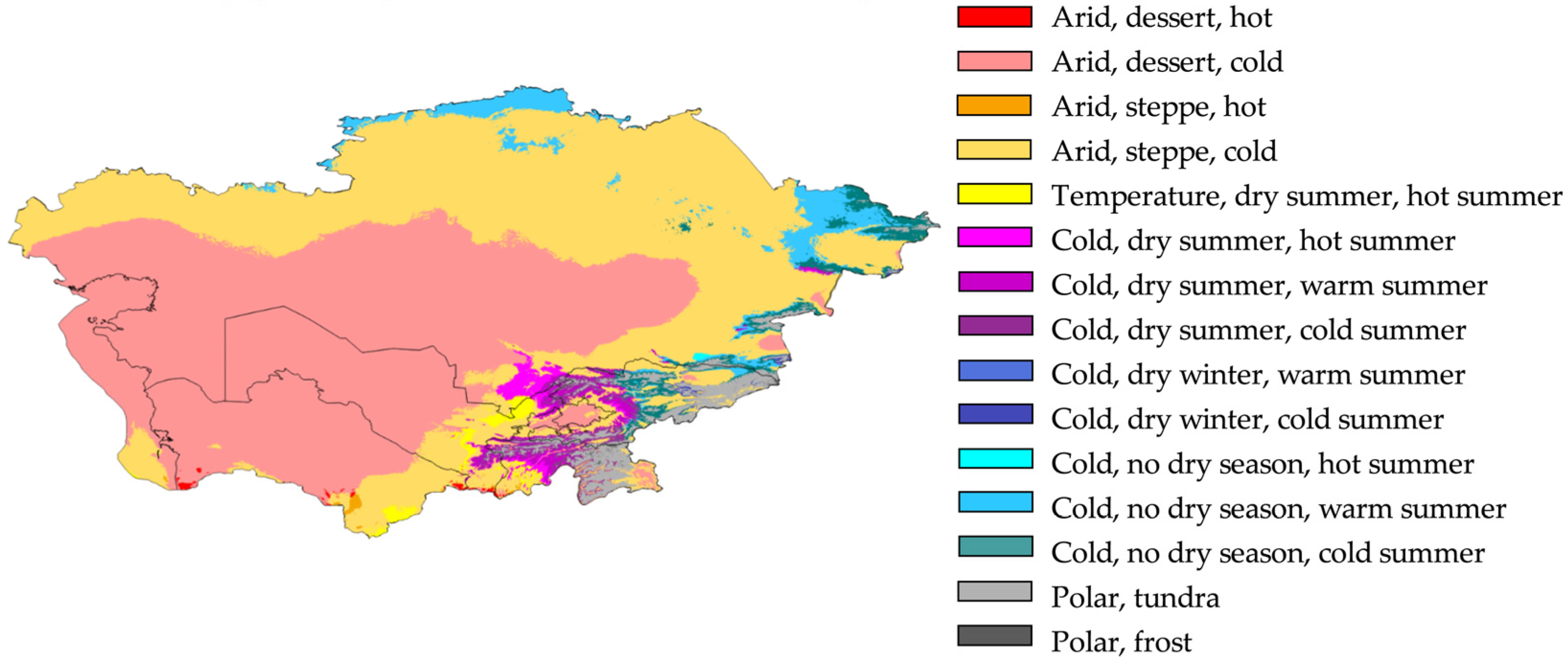
3.1. Climatic Stratification of Central Asia
3.2. Key Climatic Factors and Their Engineering Implications
3.3. Concept of “Climatically Selective” Formulations
3.4. Regional Standards and Engineering Practices
3.5. Conclusions and Implications for Design
4. Recycled Polymers as Bitumen Modifiers
4.1. Technological Approaches to Producing Polymer-Bitumen Composites
4.2. Modification of Asphalt Pavements
5. Biopolymer Modifiers for Asphalt-Bitumen Binders
5.1. Major Biopolymer Modifiers and Their Properties
5.2. Rheological Evaluation Methods and Observed Effects
5.3. Practical Results for Mixtures and Pavements
- Different lignin types, chitosan sources, and starch polymerization degrees result in highly heterogeneous outcomes; standardization is currently lacking.
- Many biopolymer fractions are poorly soluble in the aromatic fraction of bitumen, forming phase-inhomogeneous composites. Use of plasticizers, functionalization, or combined systems (biopolymer + small percentage of petroleum polymer/plasticizer) is often required. [99]
- Some biopolymers decompose at temperatures typical for hot asphalt (160–180 °C), necessitating lower temperatures (WMA), pretreatment, or thermally stable biopolymer variants.
5.4. Current Limitations and Research Directions
- Standardization of raw materials and pretreatment methods (fractionation, purification, functionalization) is critical to reproduce rheological effects.
- Investigation of compatibility mechanisms at the molecular level (FTIR, GPC, NMR, MD simulations) to predict behavior in complex real systems; recent MD studies of rejuvenators demonstrate the potential of this approach [112].
- Optimization of production processes (use of WMA technologies, sequential addition regimes, combined modifiers) to prevent thermal degradation of biopolymers.
- Comprehensive field testing and LCA to evaluate long-term performance, the influence of climatic and operational factors, and actual environmental benefits.
6. Rheological and Structural Aspects of Composite Bitumens
6.1. Interpretation of Key Parameters
6.2. Influence of Composite Additives on Temperature Stability and Rheology
6.3. Rheology–Climate Correlation: Boundary Conditions for Central Asia
6.4. Practical Implementation of the “Climate Rheology Profile” Concept
6.5. Example Box: Translating Rheological Metrics into PG (Kazakhstan North Zone)
- DSR (original): G*/sin δ = 1.35 kPa at 64 °C
- DSR (RTFO): G*/sin δ = 2.45 kPa at 64 °C
- MSCR: Jnr3.2 = 1.8 kPa−1, recovery R3.2 = 24%
- BBR (PAV-aged): S = 245 MPa, m = 0.315 at −34 °C
7. Experimental Approaches, Modeling, and Pilot Studies
7.1. Laboratory Studies of Road Bitumens
7.2. Field Studies of Road Bitumens and Pavements
7.3. Modeling of Climatic Loads on Road Bitumens and Pavements
- take cores/field samples on a grid;
- for each point measure a set of rheological parameters;
- interpolate the point values (geostatistics/kriging, splines) into a continuous field of visco-viscoplastic parameters;
- assign each finite element in the model its local parameter set.
8. Economic and Environmental Efficiency
8.1. Methodological Bases: LCA and LCC for Pavement Systems
8.2. What Recent LCA Studies Show for Plastic-Modifiers
- The “wet” method—melting and introducing recycled polymer into the bitumen (polymer-modified binder, PMB)—more often yields environmental benefit compared to using virgin polymers or full replacement of aggregates by plastic “synthetic filler” [169]. For example, Santos et al. found that with reasonable logistics and local recycling the wet route reduces GWP compared to virgin-polymer use, without a large increase in energy consumption [166].
- The “dry” method—replacing part of the mineral aggregate with plastic granules—can lead to an increase in GWP and other inventory indicators at high replacement fractions (≈5–10% or more), mainly due to the energy required for synthetic-granule production and transportation [174]. In the Santos et al. study, at ~20% aggregate replacement the authors documented GWP increases in several hundred % in their specific technological implementation [166].
- Review studies (Ashish et al., 2023; Xu et al., 2021) confirm that environmental gains are achieved when recycling is local, polymer loading is moderate (typically <4% by mass of binder for wet method), and when the modification truly extends the service life of the pavement (thus reducing repair frequency) [167,168].
8.3. Economic Efficiency: What Should the “Break-Even Threshold” Be
- Construction cost C0 = 1000 USD per lane-km (for example);
- Annual maintenance cost for baseline M = 20 USD per lane-km;
- The modification increases CAPEX by ΔC0 = 100USD per lane-km (due to recycling/modifier cost) and raises service life from 15 to 20 years (i.e., ΔT ≈ 33%);
- Discount rate i = 3%.
8.4. Environmental Risks and Un-Balanced Externalities
8.5. Environmental and Economic Recommendations
9. Conclusions
- availability of regional recycling and biomass processing infrastructure;
- long-term stability of renewable feedstock supply chains;
- variability in chemical composition of biopolymer feedstocks;
- limited long-term field performance data under sharply continental climates;
- insufficient adaptation of current international standards to extreme Central Asian climatic conditions.
10. Challenges and Suggestions
- develop a Central Asia–specific rheological classification aligned with the proposed Climatic Rheology Profile;
- establish accelerated aging protocols that reflect regional stressors;
- conduct long-term field monitoring of biopolymer-modified pavements;
- prepare a draft regional standard or guideline annex for adoption by road agencies;
- initiate pilot projects under ongoing “green infrastructure” programs.
Funding
Conflicts of Interest
References
- Yang, R.; Xu, G.; Tao, W.; Wang, Q.; Tang, Y. Recycled Polymer: Green Roads for Polyester Plastics. Green Carbon 2024, 2, 1–11. [Google Scholar] [CrossRef]
- Su, Z.Z.; Zhang, D.Y.; Zhang, S. Green Road Design Concept. AMR 2013, 726–731, 3573–3579. [Google Scholar] [CrossRef]
- Corvellec, H.; Stowell, A.F.; Johansson, N. Critiques of the Circular Economy. J. Ind. Ecol. 2022, 26, 421–432. [Google Scholar] [CrossRef]
- Sehnem, S.; Vazquez-Brust, D.; Pereira, S.C.F.; Campos, L.M.S. Circular Economy: Benefits, Impacts and Overlapping. SCM 2019, 24, 784–804. [Google Scholar] [CrossRef]
- Neumann, F.; Hampp, J.; Brown, T. Green Energy and Steel Imports Reduce Europe’s Net-Zero Infrastructure Needs. Nat. Commun. 2025, 16, 5302. [Google Scholar] [CrossRef]
- Abd Karim, S.B.; Norman, S.; Koting, S.; Simarani, K.; Loo, S.-C.; Mohd Rahim, F.A.; Ibrahim, M.R.; Md Yusoff, N.I.; Nagor Mohamed, A.H. Plastic Roads in Asia: Current Implementations and Should It Be Considered? Materials 2023, 16, 5515. [Google Scholar] [CrossRef]
- Appiah, J.K.; Berko-Boateng, V.N.; Tagbor, T.A. Use of Waste Plastic Materials for Road Construction in Ghana. Case Stud. Constr. Mater. 2017, 6, 1–7. [Google Scholar] [CrossRef]
- Patil, P.; Stankevich, N.; Tsydenova, N.; Diana, Z. Plastic Waste In Road Construction: A Path Worth Paving? Methods 2023, 26, 28. [Google Scholar]
- Liu, Z.; Kringos, N. Transition from Linear to Circular Economy in Pavement Engineering: A Historical Review. J. Clean. Prod. 2024, 449, 141809. [Google Scholar] [CrossRef]
- IEA. Net Zero by 2050—A Roadmap for the Global Energy Sector; International Energy Agency (IEA): Paris, France, 2021. [Google Scholar]
- Izimov, R.; Muratalieva, Z. China’s Belt and Road Initiative: Impacts and Effects for Central Asia. In The “Roads” and “Belts” of Eurasia; Lukin, A., Ed.; Springer: Singapore, 2020; pp. 83–101. ISBN 978-981-15-0855-4. [Google Scholar]
- Sun, Y.; Li, H.; Yang, B.; Han, Y.; Zou, Z. Investigation on Rheological Properties and Aging Mechanism of Asphalt under Multiple Environmental Conditions. Constr. Build. Mater. 2024, 443, 137713. [Google Scholar] [CrossRef]
- OECD. Realising the Potential of the Middle Corridor; OECD Publishing: Paris, France, 2023; ISBN 978-92-64-32753-5. [Google Scholar]
- Bulatkulova, S. Nurly Zhol Infrastructure Project Pledges 95 Percent of Local Roads to Be Improved by 2025; The Astana Times: Astana, Kazakhstan, 2021. [Google Scholar]
- TERA International Group, Inc. REG: Central Asia Regional Economic Cooperation Transport Sector Strategy Study. 2008. Available online: https://www.adb.org/sites/default/files/project-documents/37362-reg-tacr.pdf (accessed on 28 November 2025).
- Lesueur, D. The Colloidal Structure of Bitumen: Consequences on the Rheology and on the Mechanisms of Bitumen Modification. Adv. Colloid Interface Sci. 2009, 145, 42–82. [Google Scholar] [CrossRef]
- Kheirollahi, S.; BinDahbag, M.; Bagherzadeh, H.; Abbasi, Z.; Hassanzadeh, H. Improved Determination of Saturate, Aromatic, Resin, and Asphaltene (SARA) Fractions Using Automated High-Performance Liquid Chromatography Approach. Fuel 2024, 371, 131884. [Google Scholar] [CrossRef]
- Li, J.; Xing, X.; Hou, X.; Wang, T.; Wang, J.; Xiao, F. Determination of SARA Fractions in Asphalts by Mid-Infrared Spectroscopy and Multivariate Calibration. Measurement 2022, 198, 111361. [Google Scholar] [CrossRef]
- Nurullayev, V.; Ismayilov, G. Graph-analytical method for determination of cavitation areas in oil pipelines in steady regime. PES 2024, 6, 1643–1652. [Google Scholar] [CrossRef]
- Dehghanghadikolaei, A.; Ansary, J.; Ghoreishi, R. Sol-Gel Process Applications: A Mini-Review. Proc. Nat. Res. Soc. 2018, 2, 02008–02029. [Google Scholar] [CrossRef]
- Malkin, A.Y.; Derkach, S.R. Gelation of Polymer Solutions as a Rheological Phenomenon (Mechanisms and Kinetics). Curr. Opin. Colloid Interface Sci. 2024, 73, 101844. [Google Scholar] [CrossRef]
- Skvortsov, I.Y.; Kuzin, M.S.; Gerasimenko, P.S.; Kulichikhin, V.G.; Malkin, A.Y. Role of Small Amounts of Water in the Gelation of Polyacrylonitrile Solutions in Dimethyl Sulfoxide: Rheology, Kinetics, and Mechanism. Macromolecules 2024, 57, 3647–3663. [Google Scholar] [CrossRef]
- Liu, X.; Li, T.; Zhang, H. Short-Term Aging Resistance Investigations of Polymers and Polyphosphoric Acid Modified Asphalt Binders under RTFOT Aging Process. Constr. Build. Mater. 2018, 191, 787–794. [Google Scholar] [CrossRef]
- Jin, T.; Feng, Y.; Li, M.; Liu, L.; Yuan, J.; Sun, L. Laboratory Short-Term Aging of Crumb Rubber Modified Asphalt: RTFOT Temperature Optimization and Performance Investigation. J. Clean. Prod. 2024, 434, 140327. [Google Scholar] [CrossRef]
- Camargo, I.G.D.N.; Hofko, B.; Mirwald, J.; Grothe, H. Effect of Thermal and Oxidative Aging on Asphalt Binders Rheology and Chemical Composition. Materials 2020, 13, 4438. [Google Scholar] [CrossRef]
- Abouelsaad, A.; White, G. The Combined Effect of Ultraviolet Irradiation and Temperature on Hot Mix Asphalt Mixture Aging. Sustainability 2022, 14, 5942. [Google Scholar] [CrossRef]
- Abouelsaad, A.; White, G. Comparing the Effect of Thermal-Oxidation and Photo-Oxidation of Asphalt Mixtures on the Rheological and Chemical Properties of Extracted Bituminous Binder. Materials 2022, 15, 6793. [Google Scholar] [CrossRef] [PubMed]
- Airey, G. Rheological Properties of Styrene Butadiene Styrene Polymer Modified Road Bitumens⋆. Fuel 2003, 82, 1709–1719. [Google Scholar] [CrossRef]
- Pipintakos, G.; Škulteckė, J.; Vaitkus, A.; Šernas, O.; Soenen, H.; Van Den Bergh, W. Optimising Bitumen Modification: How Styrene–Butadiene–Styrene (SBS) Characteristics and Content Affect Bitumen Behaviour. Road Mater. Pavement Des. 2025, 26, 443–463. [Google Scholar] [CrossRef]
- Sagitova, G.F.; Ainabekov, N.B.; Daurenbek, N.M.; Assylbekova, D.D.; Sadyrbayeva, A.S.; Bitemirova, A.E.; Takibayeva, G.A. Modified Bitumen Materials from Kazakhstani Oilfield. Adv. Polym. Technol. 2024, 2024, 1–10. [Google Scholar] [CrossRef]
- Tomani, P. The Lignoboost Process. Cellul. Chem. Technol. 2010, 44, 53. [Google Scholar]
- Koutinas, A. D5.2 Market Development Potential of Most Promising Ligninvalorisation Chains. 2025. Available online: https://lignocost.eu/wp-content/uploads/2023/04/D5.2-Market-development-potential-of-most-promising-lignin-valorisation-chains_approved.pdf (accessed on 28 November 2025).
- Teltayev, B.; Radovskiy, B. Low Temperature Cracking Problem for Asphalt Pavements in Kazakhstan. In 8th RILEM International Conference on Mechanisms of Cracking and Debonding in Pavements; Chabot, A., Buttlar, W.G., Dave, E.V., Petit, C., Tebaldi, G., Eds.; RILEM Bookseries; Springer: Dordrecht, The Netherlands, 2016; Volume 13, pp. 139–144. ISBN 978-94-024-0866-9. [Google Scholar]
- Budziński, B.; Ratajczak, M.; Majer, S.; Wilmański, A. Influence of Bitumen Grade and Air Voids on Low-Temperature Cracking of Asphalt. Case Stud. Constr. Mater. 2023, 19, e02255. [Google Scholar] [CrossRef]
- Isacsson, U.; Lu, X. Testing and Appraisal of Polymer Modified Road Bitumens—State of the Art. Mater. Struct. 1995, 28, 139–159. [Google Scholar] [CrossRef]
- Teltayev, B.; Kaganovich, E. Evaluating the Low Temperature Resistance of the Asphalt Pavement under the Climatic Conditions of Kazakhstan. In 7th RILEM International Conference on Cracking in Pavements; Scarpas, A., Kringos, N., Al-Qadi, I.A.L., Eds.; RILEM Bookseries; Springer: Dordrecht, The Netherlands, 2012; Volume 4, pp. 211–221. ISBN 978-94-007-4565-0. [Google Scholar]
- Suhaimi, N.H.; Yeong, Y.F.; Jusoh, N.; Chew, T.L.; Bustam, M.A.; Mubashir, M. RSM Modeling and Optimization of CO2 Separation from High CO2 Feed Concentration over Functionalized Membrane. Polymers 2022, 14, 1371. [Google Scholar] [CrossRef]
- Samal, K. THE POLYMER EFFECTS ON BITUMEN PERFORMANCE PROPERTIES IN KAZAKHSTAN. Int. J. GEOMATE 2022, 23, 34–43. [Google Scholar] [CrossRef]
- He, H.; Luo, G.; Cai, P.; Hamdi, R.; Termonia, P.; De Maeyer, P.; Kurban, A.; Li, J. Assessment of Climate Change in Central Asia from 1980 to 2100 Using the Köppen-Geiger Climate Classification. Atmosphere 2021, 12, 123. [Google Scholar] [CrossRef]
- Beck, H.E.; McVicar, T.R.; Vergopolan, N.; Berg, A.; Lutsko, N.J.; Dufour, A.; Zeng, Z.; Jiang, X.; Van Dijk, A.I.J.M.; Miralles, D.G. High-Resolution (1 Km) Köppen-Geiger Maps for 1901–2099 Based on Constrained CMIP6 Projections. Sci Data 2023, 10, 724. [Google Scholar] [CrossRef] [PubMed]
- Nahar, S.; Porot, L.; Apostolidis, P. RILEM TC272 PIM: Phase Morphology of Bituminous Binders with Liquid Additives. Mater. Struct. 2022, 55, 239. [Google Scholar] [CrossRef]
- Rønning, T.F.; Wigum, B.J.; Lindgård, J.; Nixon, P.; Sims, I. Recommendation of RILEM TC 258-AAA: RILEM AAR-0 Outline Guide to the Use of RILEM Methods in the Assessment of the Alkali-Reactivity Potential of Concrete. Mater. Struct. 2021, 54, 206. [Google Scholar] [CrossRef]
- Zheng, Q.; He, P.; Zhang, D.; Weng, Y.; Lu, J.; Wang, T. A Holistic View of Asphalt Binder Aging under Ultraviolet Conditions: Chemical, Structural, and Rheological Characterization. Buildings 2024, 14, 3276. [Google Scholar] [CrossRef]
- Xie, T.; He, Z.; Ma, Y.; Yu, H.; Wang, Z.; Huang, C.; Yang, F.; Wang, P. Performance Degradation and Fatigue Life Prediction of Hot Recycled Asphalt Mixture Under the Coupling Effect of Ultraviolet Radiation and Freeze–Thaw Cycle. Coatings 2025, 15, 849. [Google Scholar] [CrossRef]
- Moreno-Navarro, F.; Rubio-Gámez, M.C. A Review of Fatigue Damage in Bituminous Mixtures: Understanding the Phenomenon from a New Perspective. Constr. Build. Mater. 2016, 113, 927–938. [Google Scholar] [CrossRef]
- Zhou, L.; Airey, G.; Zhang, Y.; Huang, W.; Wang, C. A Novel Fatigue Test Method for Bitumen-Stone Combinations under Cyclic Tension-Compression Loading. Mater. Des. 2025, 249, 113577. [Google Scholar] [CrossRef]
- Babadopulos, L.F.D.A.L.; Orozco, G.; Sauzéat, C.; Di Benedetto, H. Reversible Phenomena and Fatigue Damage during Cyclic Loading and Rest Periods on Bitumen. Int. J. Fatigue 2019, 124, 303–314. [Google Scholar] [CrossRef]
- Hu, M.; Ma, J.; Sun, D.; Ling, S.; Lu, T.; Ni, H. Understanding the Aging Depth Gradient Distribution of High Viscosity Modified Asphalt under the Effect of Solar Radiation and Diffuse Oxygen. ACS Sustain. Chem. Eng. 2021, 9, 15175–15189. [Google Scholar] [CrossRef]
- Teltayev, B.; Radovskiy, B. Predicting Thermal Cracking of Asphalt Pavements from Bitumen and Mix Properties. Road Mater. Pavement Des. 2018, 19, 1832–1847. [Google Scholar] [CrossRef]
- Zhu, B.; Zhou, Z.; Li, Z. Soil Erosion and Controls in the Slope-Gully System of the Loess Plateau of China: A Review. Front. Environ. Sci. 2021, 9, 657030. [Google Scholar] [CrossRef]
- Teltayev, B.; Iskakbayev, A.; Oliviero Rossi, C.; Abu, B. Unsteady-State Creep of an Asphalt Concrete. Appl. Sci. 2022, 12, 1615. [Google Scholar] [CrossRef]
- Dias, C.R.C.; Núñez, W.P.; Fedrigo, W. A Bitumen-Stabilized Base Course as a Pavement Overlay Anti-Reflective Cracking Solution. In 14th International Conference on Asphalt Pavements ISAP2024 Montreal; Carter, A., Vasconcelos, K., Dave, E., Eds.; Springer: Cham, Switzerland, 2024; pp. 401–406. ISBN 978-3-031-67251-4. [Google Scholar]
- Cheela, V.; John, M.; Biswas, W.; Sarker, P. Combating Urban Heat Island Effect—A Review of Reflective Pavements and Tree Shading Strategies. Buildings 2021, 11, 93. [Google Scholar] [CrossRef]
- Støvring, J.; Dam, T.; Bergen Jensen, M. Surface Sedimentation at Permeable Pavement Systems: Implications for Planning and Design. Urban Water J. 2018, 15, 124–131. [Google Scholar] [CrossRef]
- Sousa, M.; Dinis Almeida, M.; Fael, C.; Bentes, I. Permeable Asphalt Pavements (PAP): Benefits, Clogging Factors and Methods for Evaluation and Maintenance—A Review. Materials 2024, 17, 6063. [Google Scholar] [CrossRef]
- Razzaghmanesh, M.; Beecham, S. A Review of Permeable Pavement Clogging Investigations and Recommended Maintenance Regimes. Water 2018, 10, 337. [Google Scholar] [CrossRef]
- JTG F40-2004; Technical Specifications for Construction of Highway Asphalt Pavements. People’s Republic of China Ministry of Transportation: Beijing, China, 2005.
- Vieira, F.R.; Gama, N.V.; Evtuguin, D.V.; Amorim, C.O.; Amaral, V.S.; Pinto, P.C.O.R.; Barros-Timmons, A. Bio-Based Polyurethane Foams from Kraft Lignin with Improved Fire Resistance. Polymers 2023, 15, 1074. [Google Scholar] [CrossRef]
- Wang, M.; Wang, C.; Yu, J.; Li, Y.; Wen, P.; Fan, Q. Investigation of the Grouting Effect of Blast Furnace Slag-Based Mortar on Void Road Bases Based on the Grouting Simulation Test. Constr. Build. Mater. 2021, 282, 122567. [Google Scholar] [CrossRef]
- Zhao, C.; Liu, M.; Du, H.; Gong, Y. The Evolutionary Trend and Impact of Global Plastic Waste Trade Network. Sustainability 2021, 13, 3662. [Google Scholar] [CrossRef]
- Karati, S.; Karmakar, S.; Roy, T.K. Moisture Effect Analysis on Bituminous Mix Containing Reclaimed Asphalt Pavement Material by Durability Index. J. Mater. Civ. Eng. 2022, 34, 04021482. [Google Scholar] [CrossRef]
- EN 12591; Bitumen for Road Construction. DYM RESOURCES GmbH: Berlin, Germany, 2009.
- Daehn, G.S. Modeling Thermally Activated Deformation with a Variety of Obstacles, and Its Application to Creep Transients. Acta Mater. 2001, 49, 2017–2026. [Google Scholar] [CrossRef]
- Zhang, F.; Zhu, J.; Sun, Y.; Mariam Benny, C.; Wang, D.; Cannone Falchetto, A. Effect Analysis of Using Tall Oil Pitch (TOP) to Partially Extend Bitumen in Asphalt Pavements: Comparison of Different TOPs. Road Mater. Pavement Des. 2025, 26, 361–380. [Google Scholar] [CrossRef]
- Bearsley, S.R.; Haverkamp, R.G. Adhesive Properties of Tall Oil Pitch Modified Bitumen. Road Mater. Pavement Des. 2007, 8, 449–465. [Google Scholar] [CrossRef]
- Enfrin, M.; Giustozzi, F. Recent Advances in the Construction of Sustainable Asphalt Roads with Recycled Plastic. Polym. Int. 2022, 71, 1376–1383. [Google Scholar] [CrossRef]
- Rashid, S.; Mudavath, R.; Chandra, H.; Shekhar, I.; Kumar, P.; Srivastava, M.; Kumar, K. A Review on Virgin or Waste Polymers in Bitumen Modification for Ageing and Rejuvenation. Chem. Eng. Technol. 2024, 47, 624–637. [Google Scholar] [CrossRef]
- Lysyannikov, A.V.; Egorov, A.V.; Lysyannikova, N.N.; Shram, V.G.; Kovaleva, M.A.; Lynev, A.S.; Kaizer, Y.F. Polymer Materials from Recycled Plastic in Road Construction. J. Phys. Conf. Ser. 2019, 1399, 044064. [Google Scholar] [CrossRef]
- Biswas, A.; Goel, A.; Potnis, S. Performance Evaluation of Sustainable Bituminous-Plastic Roads for Indian Conditions. IJEAT 2019, 9, 6384–6392. [Google Scholar] [CrossRef]
- Yang, Q.; Lin, J.; Wang, X.; Wang, D.; Xie, N.; Shi, X. A Review of Polymer-Modified Asphalt Binder: Modification Mechanisms and Mechanical Properties. Clean. Mater. 2024, 12, 100255. [Google Scholar] [CrossRef]
- González, O.; Peña, J.J.; Muñoz, M.E.; Santamaría, A.; Pérez-Lepe, A.; Martínez-Boza, F.; Gallegos, C. Rheological Techniques as a Tool To Analyze Polymer−Bitumen Interactions: Bitumen Modified with Polyethylene and Polyethylene-Based Blends. Energy Fuels 2002, 16, 1256–1263. [Google Scholar] [CrossRef]
- Hansen, C.M. Hansen Solubility Parameters: A User’s Handbook, 2nd ed.; CRC Press: Boca Raton, FL, USA, 2007; ISBN 978-0-429-12752-6. [Google Scholar]
- Peters, S.T. Handbook of Composites; Springer Science & Business Media: Berlin/Heidelberg, Germany, 2013; ISBN 1-4615-6389-5. [Google Scholar]
- Wei, H.; Bai, X.; Qian, G.; Wang, F.; Li, Z.; Jin, J.; Zhang, Y. Aging Mechanism and Properties of SBS Modified Bitumen under Complex Environmental Conditions. Materials 2019, 12, 1189. [Google Scholar] [CrossRef] [PubMed]
- Srikanth, G.; Saha, A.; Kumar, R. An Experimental Investigation on the Effect of Mixing Procedures on Polypropylene Modified Bituminous Mix. Int. J. Recent Technol. Eng. 2019, 8, 1204–1210. [Google Scholar]
- Li, H.; Han, Y.; Guangxun, E.; Sun, Y.; Wang, L.; Liu, X.; Ren, J.; Lin, Z. Recycling of Waste Polyethylene in Asphalt and Its Performance Enhancement Methods: A Critical Literature Review. J. Clean. Prod. 2024, 451, 142072. [Google Scholar] [CrossRef]
- Lu, D.X.; Enfrin, M.; Masood, H.; Giustozzi, F. Performance Evaluation of Post-Consumer and Post-Industrial Recycled Plastics as Binder Modifier in Asphalt Mixes. Int. J. Pavement Res. Technol. 2024. [Google Scholar] [CrossRef]
- Miranda, H.M.B.; Domingues, D.; Rato, M.J. The Influence of Recycled Plastics Added via the Dry Process on the Properties of Bitumen and Asphalt Mixtures. Transp. Eng. 2023, 13, 100197. [Google Scholar] [CrossRef]
- Pasetto, M.; Baliello, A.; Pasquini, E.; Poulikakos, L. Dry Addition of Recycled Waste Polyethylene in Asphalt Mixtures: A Laboratory Study. Materials 2022, 15, 4739. [Google Scholar] [CrossRef]
- Shah, S.K.; Gao, Y.; Abdelfatah, A. Plastic-Waste-Modified Asphalt for Sustainable Road Infrastructure: A Comprehensive Review. Sustainability 2025, 17, 9832. [Google Scholar] [CrossRef]
- Cardone, F.; Spadoni, S.; Ferrotti, G.; Canestrari, F. Asphalt Mixture Modification with a Plastomeric Compound Containing Recycled Plastic: Laboratory and Field Investigation. Mater. Struct. 2022, 55, 109. [Google Scholar] [CrossRef]
- Yu, L.; Kang, H.; Li, R.; Pei, J.; Du, Y. A Study on the Environmental Performance of an Asphalt Mixture Modified with Directly Added Waste Plastic. Materials 2025, 18, 1168. [Google Scholar] [CrossRef]
- Liu, Y.; Liu, Z.; Zhu, Y.; Zhang, H. A Review of Sustainability in Hot Asphalt Production: Greenhouse Gas Emissions and Energy Consumption. Appl. Sci. 2024, 14, 10246. [Google Scholar] [CrossRef]
- Yousef, S.; Stasiulaitiene, I. Life Cycle Assessment of Recycling Metallised Food Packaging Plastics Using Mechanical, Thermal and Chemical Processes. Heliyon 2024, 10, e36547. [Google Scholar] [CrossRef]
- Vanapalli, K.R.; Sharma, H.B.; Ranjan, V.P.; Samal, B.; Bhattacharya, J.; Dubey, B.K.; Goel, S. Challenges and Strategies for Effective Plastic Waste Management during and Post COVID-19 Pandemic. Sci. Total Environ. 2021, 750, 141514. [Google Scholar] [CrossRef] [PubMed]
- Ghabchi, R.; Pereira Castro, M.P. Effect of Laboratory-Produced Cellulose Nanofiber as an Additive on Performance of Asphalt Binders and Mixes. Constr. Build. Mater. 2021, 286, 122922. [Google Scholar] [CrossRef]
- Li, Z.; Guo, T.; Chen, Y.; Liu, J.; Ma, J.; Wang, J.; Jin, L. Study on Pavement Performance of Cotton Straw Cellulose Modified Asphalt. Mater. Res. Express 2022, 9, 025508. [Google Scholar] [CrossRef]
- Aljubory, A.; Teama, Z.T.; Salman, H.T.; Abd Alkareem, H.M. Effects of Cellulose Fibers on the Properties of Asphalt Mixtures. Mater. Today Proc. 2021, 42, 2941–2947. [Google Scholar] [CrossRef]
- Xu, X.; Chu, Y.; Chen, R.; Wu, Q.; Chen, X.; Zou, F.; Peng, C. Thermo-Mechanochemical Recycling of Waste Polypropylene into Degradation Products as Modifiers for Cleaner Production and Properties Enhancement of Bitumen. J. Clean. Prod. 2022, 379, 134792. [Google Scholar] [CrossRef]
- Hu, J.; Jiang, X.; Chu, Y.; Xu, S.; Xu, X. Mechanochemical Upcycling of Waste Polypropylene into Warm-Mix Modifier for Asphalt Pavement Incorporating Recycled Concrete Aggregates. Polymers 2024, 16, 2494. [Google Scholar] [CrossRef]
- Borhanuddin, N.; Mohd Satar, M.K.I.; Yaacob, H. Glass Fiber Waste as a Potential Bitumen Modifier and Stabilizing Agent in Asphalt Mixture. Environ. Sci. Pollut. Res. 2024. [Google Scholar] [CrossRef]
- MAHREZ, A.; Karim, M.R.; Katman, H.Y.B. Fatigue and deformation properties of glass fiber reinforced bituminous mixes. J. East. Asia Soc. Transp. Stud. 2005, 6, 997–1007. [Google Scholar]
- Yang, Q.; Hong, B.; Lin, J.; Wang, D.; Zhong, J.; Oeser, M. Study on the Reinforcement Effect and the Underlying Mechanisms of a Bitumen Reinforced with Recycled Glass Fiber Chips. J. Clean. Prod. 2020, 251, 119768. [Google Scholar] [CrossRef]
- Haq, M.F.U.; Ahmad, N.; Nasir, M.A.; Jamal; Hafeez, M.; Rafi, J.; Zaidi, S.B.A.; Haroon, W. Carbon Nanotubes (CNTs) in Asphalt Binder: Homogeneous Dispersion and Performance Enhancement. Appl. Sci. 2018, 8, 2651. [Google Scholar] [CrossRef]
- Faramarzi, M.; Arabani, M.; Haghi, A.K.; Mottaghitalab, V. Carbon Nanotubes-Modified Asphalt Binder: Preparation and Characterization. Int. J. Pavement Res. Technol. 2015, 8, 29–37. [Google Scholar] [CrossRef]
- Eisa, M.S.; Mohamady, A.; Basiouny, M.E.; Abdulhamid, A.; Kim, J.R. Mechanical Properties of Asphalt Concrete Modified with Carbon Nanotubes (CNTs). Case Stud. Constr. Mater. 2022, 16, e00930. [Google Scholar] [CrossRef]
- Gaudenzi, E.; Cardone, F.; Lu, X.; Canestrari, F. Performance Assessment of Asphalt Mixtures Produced with a Bio-Binder Containing 30% of Lignin. Mater. Struct. 2022, 55, 221. [Google Scholar] [CrossRef]
- Yao, H.; Wang, Y.; Liu, J.; Xu, M.; Ma, P.; Ji, J.; You, Z. Review on Applications of Lignin in Pavement Engineering: A Recent Survey. Front. Mater. 2022, 8, 803524. [Google Scholar] [CrossRef]
- Abe, A.A.; Oliviero Rossi, C.; Caputo, P. Biomaterials and Their Potentialities as Additives in Bitumen Technology: A Review. Molecules 2022, 27, 8826. [Google Scholar] [CrossRef]
- Norgbey, E.; Huang, J.; Hirsch, V.; Liu, W.J.; Wang, M.; Ripke, O.; Li, Y.; Takyi Annan, G.E.; Ewusi-Mensah, D.; Wang, X.; et al. Unravelling the Efficient Use of Waste Lignin as a Bitumen Modifier for Sustainable Roads. Constr. Build. Mater. 2020, 230, 116957. [Google Scholar] [CrossRef]
- Gaudenzi, E.; Cardone, F.; Lu, X.; Canestrari, F. The Use of Lignin for Sustainable Asphalt Pavements: A Literature Review. Constr. Build. Mater. 2023, 362, 129773. [Google Scholar] [CrossRef]
- Guo, G.; Gao, J.; Jin, D.; Wang, X.; Bi, Y.; Guo, P. Study on the Storage Stability and Rheological Property of Bio-Oil/Lignin Composite-Modified Asphalt. Polymers 2024, 16, 2484. [Google Scholar] [CrossRef]
- Li, S.; Wang, Y.; Zhou, S. Investigation of Purified Lignin as an Antioxidant for Sustainable Bitumen. Constr. Build. Mater. 2025, 458, 139499. [Google Scholar] [CrossRef]
- Zhang, Y.; Liu, X.; Apostolidis, P.; Jing, R.; Erkens, S.; Poeran, N.; Skarpas, A. Evaluation of Organosolv Lignin as an Oxidation Inhibitor in Bitumen. Molecules 2020, 25, 2455. [Google Scholar] [CrossRef] [PubMed]
- Iwaura, R.; Komba, S. Modification of Asphalt by Starch-Derived Supramolecular Fibers: A Simple Way to Tune Flow Resistance. ACS Sustain. Chem. Eng. 2022, 10, 7447–7452. [Google Scholar] [CrossRef]
- Malinowski, S.; Woszuk, A.; Wróbel, M.; Makowska, M.; Franus, W.; Zofka, A. Bitumen Binders Modified with Chemically-Crosslinked Chitosan. Road Mater. Pavement Des. 2023, 24, 3–18. [Google Scholar] [CrossRef]
- Cavalli, M.C.; Wu, W.; Poulikakos, L. Bio-Based Rejuvenators in Asphalt Pavements: A Comprehensive Review and Analytical Study. J. Road Eng. 2024, 4, 282–291. [Google Scholar] [CrossRef]
- Aydın, D.; Kizilel, R.; Caniaz, R.O.; Kizilel, S. Gelation-Stabilized Functional Composite-Modified Bitumen for Anti-Icing Purposes. Ind. Eng. Chem. Res. 2015, 54, 12587–12596. [Google Scholar] [CrossRef]
- Frey, M.R.; Williams, S.L.; Srubar, W.V.; Torres-Machi, C. Characterization and Evaluation of Agar as a Bio-Based Asphalt Binder Alternative. Infrastructures 2025, 10, 223. [Google Scholar] [CrossRef]
- Cai, M.; Peng, C.; Cheng, C. Study on the Rheological Properties of Formic Acid Lignin Modified Asphalt. Buildings 2023, 13, 655. [Google Scholar] [CrossRef]
- Zhang, Y.; Wang, X.; Ji, G.; Fan, Z.; Guo, Y.; Gao, W.; Xin, L. Mechanical Performance Characterization of Lignin-Modified Asphalt Mixture. Appl. Sci. 2020, 10, 3324. [Google Scholar] [CrossRef]
- Bhatt, B.; Wu, S. A Comprehensive State-of-Art Review on the Use of Rejuvenators in Asphalt Pavement. J. Road Eng. 2025, 5, 1–20. [Google Scholar] [CrossRef]
- Zhu, J.; Lu, X.; Langfjell, M.; Gudmarsson, A. Quantitative Relationship of Fundamental Rheological Properties of Bitumen with the Empirical Ring and Ball Softening Point. Road Mater. Pavement Des. 2021, 22, S345–S364. [Google Scholar] [CrossRef]
- Jiang, W.; Bao, R.; Lu, H.; Yuan, D.; Lu, R.; Sha, A.; Shan, J. Analysis of Rheological Properties and Aging Mechanism of Bitumen after Short-Term and Long-Term Aging. Constr. Build. Mater. 2021, 273, 121777. [Google Scholar] [CrossRef]
- Mielczarek, M.; Fornalczyk, S.; Słowik, M. Evaluation of Rheological Properties of Polymer-Modified Asphalt Binders and Mastics with Organic Additive—Imidazoline. Sustainability 2024, 16, 1434. [Google Scholar] [CrossRef]
- Druta, C. A Micromechanical Approach for Predicting the Complex Shear Modulus and Accumulated Shear Strain of Asphalt Mixtures from Binder and Mastics. Ph.D. Thesis, Louisiana State University and Agricultural and Mechanical College, Baton Rouge, LA, USA, 2006. [Google Scholar]
- Ali Shafabakhsh, G.; Sadeghneja, M.; Alizadeh, S. Engineering the Effect of Nanomaterials on Bitumen and Asphalt Mixture Properties. A Review. BJRBE 2023, 18, 1–31. [Google Scholar] [CrossRef]
- Alizadeh, S.; Shafabakhsh, G.; Sadeghnejad, M. Sustainable Asphalt Mixtures: Enhancing Environmental Impact by Partial Fine Aggregate Substitution with Rubber Powder and Bitumen Modification Using Nano-SiO2. Int. J. Pavement Eng. 2023, 24, 2257851. [Google Scholar] [CrossRef]
- Huo, D.; Yao, X.; Guo, M.; Luo, D. Effect of Simultaneous Changes in Asphalt Binder Bee Structure Components on Mechanical Properties during the Aging and Rejuvenation Process. Appl. Sci. 2023, 13, 10308. [Google Scholar] [CrossRef]
- Ren, S.; Zhang, Y.; Pipintakos, G.; Xu, S.; Liu, Q.; Den Bergh, W.V. Elucidating the Role of Lignin in Bio-Rejuvenated Bitumen: Insights into Rheological and Anti-Aging Properties via Experiments and Molecular Simulations. Fuel 2025, 395, 135244. [Google Scholar] [CrossRef]
- Ren, S.; Liu, X.; Lin, P.; Jing, R.; Erkens, S. Toward the Long-Term Aging Influence and Novel Reaction Kinetics Models of Bitumen. Int. J. Pavement Eng. 2023, 24, 2024188. [Google Scholar] [CrossRef]
- Guo, S.; Zhang, Y.; Tang, H. Investigation of Relationship between Accelerated Ultraviolet Radiation Aging in Laboratory and Weathering Aging for Asphalt Binder. Int. J. Pavement Res. Technol. 2021, 14, 466–472. [Google Scholar] [CrossRef]
- AASHTO M 320-10; Performance-Graded Asphalt Binder. American Association of State Highway and Transportation Officials: Washington, DC, USA, 2015.
- FHWA-HRT-11-045; Performance Testing for Superpave and Structural Validation. Office of Infrastructure Research and Development: Georgetown Pike, VA, USA, 2012.
- AASHTO M 332; Performance-Graded Asphalt Binder Using Multiple Stress Creep Recovery (MSCR) Test. American Association of State Highway and Transportation Officials: Washington, DC, USA, 2014.
- AASHTO T 313-12; Determining the Flexural Creep Stiffness of Asphalt Binder Using the Bending Beam Rheometer (BBR). American Association of State Highway and Transportation Officials: Washington, DC, USA, 2012.
- ASTM D2872; Standard Test Method for Effect of Heat and Air on a Moving Film of Asphalt Binder (Rolling Thin-Film Oven Test). American Society for Testing and Materials: West Conshohocken, PA, USA, 1997.
- ASTM D6521; Standard Practice for Accelerated Aging of Asphalt Binder Using a Pressurized Aging Vessel (PAV). American Society for Testing and Materials: West Conshohocken, PA, USA, 2022.
- AASHTO R 28-12; Accelerated Aging of Asphalt Binder Using a Pressurized Aging Vessel (PAV). American Association of State Highway and Transportation Officials: Washington, DC, USA, 2012.
- AASHTO T 315-12; Determining the Rheological Properties of Asphalt Binder Using a Dynamic Shear Rheometer (DSR). American Association of State Highway and Transportation Officials: Washington, DC, USA, 2012.
- Sirin, O.; Paul, D.K.; Kassem, E. State of the Art Study on Aging of Asphalt Mixtures and Use of Antioxidant Additives. Adv. Civ. Eng. 2018, 2018, 3428961. [Google Scholar] [CrossRef]
- Lamontagne, J. Comparison by Fourier Transform Infrared (FTIR) Spectroscopy of Different Ageing Techniques: Application to Road Bitumens. Fuel 2001, 80, 483–488. [Google Scholar] [CrossRef]
- Hofko, B.; Porot, L.; Falchetto Cannone, A.; Poulikakos, L.; Huber, L.; Lu, X.; Mollenhauer, K.; Grothe, H. FTIR Spectral Analysis of Bituminous Binders: Reproducibility and Impact of Ageing Temperature. Mater. Struct. 2018, 51, 45. [Google Scholar] [CrossRef]
- Poulikakos, L.; Wang, D.; Porot, L.; Hofko, B. Impact of Asphalt Aging Temperature on Chemo-Mechanics. RSC Adv. 2019, 9, 11602–11613. [Google Scholar] [CrossRef] [PubMed]
- Zou, L.; Zhang, Y.; Liu, B. Aging Characteristics of Asphalt Binder under Strong Ultraviolet Irradiation in Northwest China. Sustainability 2021, 13, 10753. [Google Scholar] [CrossRef]
- Stępień, J.; Remišová, E. Characterization of Hot-Applied Joint Sealants and Their Components in Terms of Their Chemical Composition and Basic Performance Properties. Materials 2023, 16, 6490. [Google Scholar] [CrossRef]
- AASHTO T 350-14; Multiple Stress Creep Recovery (MSCR) Test of Asphalt Binder Using a Dynamic Shear Rheometer (DSR). American Association of State Highway and Transportation Officials: Washington, DC, USA, 2014.
- Mačiūnas, D.; Nosewicz, S.; Kačianauskas, R.; Boris, R.; Stonys, R. Numerical Simulation of Thermal Conductivity and Thermal Stress in Lightweight Refractory Concrete with Cenospheres. Materials 2022, 16, 190. [Google Scholar] [CrossRef]
- AASHTO T 283:2014; Method of Test for Resistance of Compacted Asphalt Mixtures to Moisture-Induced Damage. American Association of State Highway and Transportation Officials: Washington, DC, USA, 2014.
- Wang, H.; Cheng, Y.; Liang, J.; Zhao, W.; Li, A. Evaluating the Fracture Characterization of Asphalt Mixtures under Freeze-Thaw Damage Based on Full-Field Measurements. Measurement 2024, 228, 114393. [Google Scholar] [CrossRef]
- AASHTO T 324-14; Hamburg Wheel-Track Testing of Compacted Hot Mix Asphalt (HMA). American Association of State Highway and Transportation Officials: Washington, DC, USA, 2014.
- Kringos, N.; Scarpas, A. Physical and Mechanical Moisture Susceptibility of Asphaltic Mixtures. Int. J. Solids Struct. 2008, 45, 2671–2685. [Google Scholar] [CrossRef]
- Caro, S.; Masad, E.; Bhasin, A.; Little, D.N. Moisture Susceptibility of Asphalt Mixtures, Part 1: Mechanisms. Int. J. Pavement Eng. 2008, 9, 81–98. [Google Scholar] [CrossRef]
- Saykin, V.V.; Zhang, Y.; Cao, Y.; Wang, M.L.; McDaniel, J.G. Pavement Macrotexture Monitoring through Sound Generated by a Tire-Pavement Interaction. J. Eng. Mech. 2013, 139, 264–271. [Google Scholar] [CrossRef]
- ASTM D 7175-08; Standard Test Method for Determining the Rheological Properties of Asphalt Binder Using a Dynamic Shear Rheometer. American Society for Testing and Materials: West Conshohocken, PA, USA, 2008.
- Pan, Y.; Han, D.; Yang, T.; Tang, D.; Huang, Y.; Tang, N.; Zhao, Y. Field Observations and Laboratory Evaluations of Asphalt Pavement Maintenance Using Hot In-Place Recycling. Constr. Build. Mater. 2021, 271, 121864. [Google Scholar] [CrossRef]
- Li, C.; Ning, F.; Gan, X.; Li, Y.; Li, H. Evaluation of the Field Segregation of Asphalt Pavement with 30# Low Penetration Asphalt Binder. Int. J. Pavement Res. Technol. 2019, 12, 139–146. [Google Scholar] [CrossRef]
- Salata, S.; Uzelli, T. Are Soil and Geology Characteristics Considered in Urban Planning? An Empirical Study in Izmir (Türkiye). Urban Sci. 2022, 7, 5. [Google Scholar] [CrossRef]
- Teltayev, B.; Kaganovich, E. Thermal Resistance of Blown Bitumens to The Conditions of Sharp-Continental Climate. J. Appl. Sci. 2012, 12, 1297–1302. [Google Scholar] [CrossRef][Green Version]
- Siao, J.-H.; Chang, T.-C.; Wang, Y.-M. A Finite Element Model for Simulating Stress Responses of Permeable Road Pavement. Materials 2024, 17, 3012. [Google Scholar] [CrossRef]
- Behnke, R.; Wollny, I.; Hartung, F.; Kaliske, M. Thermo-Mechanical Finite Element Prediction of the Structural Long-Term Response of Asphalt Pavements Subjected to Periodic Traffic Load: Tire-Pavement Interaction and Rutting. Comput. Struct. 2019, 218, 9–31. [Google Scholar] [CrossRef]
- Zbiciak, A.; Michalczyk, R.; Brzeziński, K. Time–Temperature Superposition for Viscoelastic Materials with Application to Asphalt–Aggregate Mixes. Int. J. Environ. Sci. Technol. 2019, 16, 5059–5064. [Google Scholar] [CrossRef]
- Huang, C.; Gao, D.; Meng, T.; Yang, C. Investigation into Viscoelastic Properties of Fiber-Reinforced Asphalt Composite Concrete Based on the Burgers Model. Buildings 2023, 13, 449. [Google Scholar] [CrossRef]
- Darabi, M.K.; Abu Al-Rub, R.K.; Masad, E.A.; Little, D.N. Cyclic Hardening-Relaxation Viscoplasticity Model for Asphalt Concrete Materials. J. Eng. Mech. 2013, 139, 832–847. [Google Scholar] [CrossRef]
- Zhang, Y.; Gu, F.; Birgisson, B.; Lytton, R.L. Viscoelasticplastic–Fracture Modeling of Asphalt Mixtures Under Monotonic and Repeated Loads. Transp. Res. Rec. J. Transp. Res. Board 2017, 2631, 20–29. [Google Scholar] [CrossRef]
- Zhang, Y.; Liu, X.; Yin, B.; Luo, W. A Nonlinear Fractional Viscoelastic-Plastic Creep Model of Asphalt Mixture. Polymers 2021, 13, 1278. [Google Scholar] [CrossRef]
- Chang, Z.; Gao, H.; Huang, F.; Chen, J.; Huang, J.; Guo, Z. Study on the Creep Behaviours and the Improved Burgers Model of a Loess Landslide Considering Matric Suction. Nat. Hazards 2020, 103, 1479–1497. [Google Scholar] [CrossRef]
- Nguyen, S.; Vu, M.-H.; Vu, M.; Nguyen, T.; Gasser, A.; Rekik, A. Generalized Maxwell Model for Micro-Cracked Viscoelastic Materials. Int. J. Damage Mech. 2017, 26, 697–710. [Google Scholar] [CrossRef]
- Heeres, O.M.; Suiker, A.S.J.; De Borst, R. A Comparison between the Perzyna Viscoplastic Model and the Consistency Viscoplastic Model. Eur. J. Mech.-A/Solids 2002, 21, 1–12. [Google Scholar] [CrossRef]
- Kabwe, E. Verification and Implementation of a Creep Model Considering the Duvaut-Lion Overstress Function. Min. Metall. Explor. 2021, 38, 1761–1771. [Google Scholar] [CrossRef]
- Levenberg, E.; Uzan, J. Triaxial Small-Strain Viscoelastic-Viscoplastic Modeling of Asphalt Aggregate Mixes. Mech. Time-Depend. Mater. 2004, 8, 365–384. [Google Scholar] [CrossRef]
- Zhao, J.; Zhao, W.; Xie, K.; Yang, Y. A Fractional Creep Constitutive Model Considering the Viscoelastic–Viscoplastic Coexistence Mechanism. Materials 2023, 16, 6131. [Google Scholar] [CrossRef]
- Mazzotta, F.; Tataranni, P.; Simone, A.; Fornai, D.; Airey, G.; Sangiorgi, C. Multi-Scale Rheo-Mechanical Study of SMA Mixtures Containing Fine Crumb Rubber in a New Dry-Hybrid Technology. Appl. Sci. 2020, 10, 3887. [Google Scholar] [CrossRef]
- Klimczak, M.; Cecot, W. Towards Asphalt Concrete Modeling by the Multiscale Finite Element Method. Finite Elem. Anal. Des. 2020, 171, 103367. [Google Scholar] [CrossRef]
- Gao, L.; Kong, H.; Deng, X.; Wang, Z. Multi-Scale Finite Element Simulation of Asphalt Mixture Anti-Cracking Performance. Theor. Appl. Fract. Mech. 2022, 121, 103490. [Google Scholar] [CrossRef]
- Santos, J.; Pham, A.; Stasinopoulos, P.; Giustozzi, F. Recycling Waste Plastics in Roads: A Life-Cycle Assessment Study Using Primary Data. Sci. Total Environ. 2021, 751, 141842. [Google Scholar] [CrossRef]
- Ashish, P.K.; Sreeram, A.; Xu, X.; Chandrasekar, P.; Jagadeesh, A.; Adwani, D.; Padhan, R.K. Closing the Loop: Harnessing Waste Plastics for Sustainable Asphalt Mixtures—A Comprehensive Review. Constr. Build. Mater. 2023, 400, 132858. [Google Scholar] [CrossRef]
- Xu, F.; Zhao, Y.; Li, K. Using Waste Plastics as Asphalt Modifier: A Review. Materials 2021, 15, 110. [Google Scholar] [CrossRef] [PubMed]
- Jaysawal, D.; Bandyopadhyaya, R. Behavior Analysis of Polymer Modified Bitumen in Wet Process: A Literature Review. Adv. Sci. Technol. Res. J. 2025, 19, 332–344. [Google Scholar] [CrossRef] [PubMed]
- ISO 14040; Environmental Management—Life Cycle Assessment—Principles and Framework. International Organization for Standardization: Geneva, Switzerland, 2006.
- Oreto, C.; Russo, F.; Veropalumbo, R.; Viscione, N.; Biancardo, S.A.; Dell’Acqua, G. Life Cycle Assessment of Sustainable Asphalt Pavement Solutions Involving Recycled Aggregates and Polymers. Materials 2021, 14, 3867. [Google Scholar] [CrossRef] [PubMed]
- Rafiq, W.; Musarat, M.A.; Altaf, M.; Napiah, M.; Sutanto, M.H.; Alaloul, W.S.; Javed, M.F.; Mosavi, A. Life Cycle Cost Analysis Comparison of Hot Mix Asphalt and Reclaimed Asphalt Pavement: A Case Study. Sustainability 2021, 13, 4411. [Google Scholar] [CrossRef]
- Trofimenko, I.; Chen, Y.; Müller, A.-K.; Liebau, U.; Flore, A. Real-Time LCA/LCC Integration: A Framework of Agile Sustainability and Cost Management. Sustainability 2025, 17, 9433. [Google Scholar] [CrossRef]
- Belyaev, P.S.; Frolov, V.A.; Belyaev, V.P.; Varepo, L.G.; Bezzateeva, E.G. Petroleum Bitumen and Polymer-Bitumen Binders: Current State and Russian Specifics. Review. AIP Conf. Proc. 2021, 2412, 060001. [Google Scholar] [CrossRef]
- Boom, Y.J.; Xuan, D.L.; Enfrin, M.; Swaney, M.; Masood, H.; Pramanik, B.K.; Robert, D.; Giustozzi, F. Engineering Properties, Microplastics and Emissions Assessment of Recycled Plastic Modified Asphalt Mixtures. Sci. Total Environ. 2023, 893, 164869. [Google Scholar] [CrossRef]
- Enfrin, M.; Myszka, R.; Giustozzi, F. Paving Roads with Recycled Plastics: Microplastic Pollution or Eco-Friendly Solution? J. Hazard. Mater. 2022, 437, 129334. [Google Scholar] [CrossRef]
- García-Gutiérrez, P.; Amadei, A.M.; Klenert, D.; Nessi, S.; Tonini, D.; Tosches, D.; Ardente, F.; Saveyn, H.G.M. Environmental and Economic Assessment of Plastic Waste Recycling and Energy Recovery Pathways in the EU. Resour. Conserv. Recycl. 2025, 215, 108099. [Google Scholar] [CrossRef]
- Rosmiati, V.; Hadiyanto. Life Cycle Assessment and Energy Efficiency from Industry of Plastic Waste Recycling. E3S Web Conf. 2020, 202, 06015. [Google Scholar] [CrossRef]
- Ibrahim, H.; Alam, G.; Faheem, A. Eco-Economic Analysis of Utilizing High Volumes of Recycled Plastic and Rubber Waste for Green Pavements: A Comparative Life Cycle Analysis. Case Stud. Constr. Mater. 2024, 21, e03690. [Google Scholar] [CrossRef]
- Jung, H.; Oli, T.; Nam, J.; Yun, K.; Kim, S.; Park, C. Life-Cycle Cost Analysis on Application of Asphalt and Concrete Pavement Overlay. Appl. Sci. 2022, 12, 5098. [Google Scholar] [CrossRef]
- Hasan, U.; Whyte, A.; Al Jassmi, H.; Hasan, A. Lifecycle Cost Analysis of Recycled Asphalt Pavements: Determining Cost of Recycled Materials for an Urban Highway Section. CivilEng 2022, 3, 316–331. [Google Scholar] [CrossRef]
- Smyth, K.; Tan, S.; Van Seters, T.; Henderson, V.; Passeport, E.; Drake, J. Pavement Wear Generates Microplastics in Stormwater Runoff. J. Hazard. Mater. 2025, 481, 136495. [Google Scholar] [CrossRef]
- Yamahara, S.; Nakata, H. Road Dust-Associated Microplastics as a Carrier of Plastic Additives in Urban Small-Scale River Sediment. EMCR 2025, 5, 10–25. [Google Scholar] [CrossRef]
- Germin-Aizac, J.; Maitre, A.; Balducci, F.; Montlevier, S.; Marques, M.; Tribouiller, J.; Demeilliers, C.; Persoons, R. Bitumen Fumes and PAHs in Asphalt Road Paving: Emission Characteristics, Determinants of Exposure and Environmental Impact. Environ. Res. 2023, 228, 115824. [Google Scholar] [CrossRef]
- Chen, S.; Wang, J.; Li, Q.; Zhang, W.; Yan, C. The Investigation of Volatile Organic Compounds (VOCs) Emissions in Environmentally Friendly Modified Asphalt. Polymers 2022, 14, 3459. [Google Scholar] [CrossRef]
- Calderón-Ramírez, J.; Sepúlveda-Valdez, D.; García, L.; Lomeli-Banda, M.A.; Salazar-Briones, C.; Montoya-Alcaraz, M. Recycled Plastics in Asphalt Mixtures: A Systematic Review of Mechanical Performance, Environmental Impact and Practical Implementation. Appl. Sci. 2025, 15, 9901. [Google Scholar] [CrossRef]



| Parameter/Stage | Wet Process (PMB: High-Shear Blending) | Dry Process (Plastic Dosing at Asphalt Plant) |
|---|---|---|
| Additional high-shear milling energy | ≈72 MJ·t−1 (≈20 kWh·t−1) per 1 t of PMB (milling) | Not required (no high-shear reactor) |
| Baseline plant energy consumption (for comparison) | ≈320–390 MJ·t−1 of asphalt mixture (aggregate heating/drying)—identical for both methods | ≈320–390 MJ·t−1 |
| Additional fuel use/emissions from wet stage | Examples: ~10 kg HFO per t → approx. ~10–15 kg CO2-eq·t−1 (from high-shear milling/heating, separate accounting) | 0 (no wet stage), but emissions from plastic pre-treatment may occur |
| Pre-treatment energy (shredding/granulation) | Depends on polymer source; if ready-to-use polymer is supplied—minimal (included in supply chain) | Can be significant: ≈15 kWh·t−1 (54 MJ·t−1) to >100 kWh·t−1 for complex waste streams or small batches |
| CAPEX (capital investment) | High—requires high-shear mixer/PMB reactor/heating units | Low to moderate—usually limited to dosing and feeding units; minimal plant modifications |
| Energy-related conclusion | Additional ~70–100 MJ·t−1 above baseline due to milling and fuel operations (approximate estimate) | At plant level often ≈0–50 MJ·t−1 additional, but off-site plastic pre-treatment may add >>100 MJ·t−1 |
| Biopolymer Type | Source | Dosage (wt%) | Main Mechanisms of Action | Key Rheological and Performance Effects | Technological Notes/Limitations | Refs. |
|---|---|---|---|---|---|---|
| Lignin | By-product of pulp and paper and biotechnological industries | 3–6 | Physical filling; antioxidant action; partial chemical interaction with polar fractions | ↑ G*, ↑ rutting resistance; ↓ thermal sensitivity; slowed thermo-oxidative aging; generally maintained low-temperature performance | Excess dosage may cause phase separation, sedimentation, loss of workability; requires high-shear mixing | [6,90,93,94,95,96,97,98] |
| Pretreated lignin | Fractionated/purified lignin | 3–6 | Enhanced chemical compatibility; stabilized colloidal equilibrium; reduced aggregation | Improved storage stability (ΔSP ≤ 0.9 °C at 165 °C/48 h); ↑ complex modulus; preserved low-T cracking resistance; reduced carbonyl/sulfoxide formation after PAV/UV | Requires additional processing cost (fractionation, milling, esterification) | [97,99] |
| Bio-oil–lignin composites | Bio-oil from biomass + lignin | 5–10 | Combined rejuvenation + structuring + antioxidant effect | Excellent storage stability; controlled viscosity; balanced high-T stiffness and low-T flexibility | Sensitive to bio-oil polarity and lignin fraction type | [96] |
| Polysaccharides | Marine biomass, plant fibers, agricultural by-products | 0.5–3 | Dispersed phase formation; supramolecular network formation; chemical interaction (for modified chitosan) | ↑ adhesion to aggregates; ↑ thermal stability; “anti-flow” behavior at high T; minor stiffening at service temperatures | Prone to agglomeration without surface modification; moisture sensitivity for native forms | [100,101] |
| Bio-oils/plant-derived esters | Pyrolysis oils, vegetable oils | 3–10 | Softening of aged binder; alteration of SARA fractions; compatibility control | ↓ viscosity; restoration of ductility in aged binders; may reduce high-T rutting resistance if overdosed | Requires combination with polymers for durability; volatility and aging resistance must be controlled | [97] |
| Protein fractions, agar, alginate gels | Agricultural and marine biomass | 0.5–2 | Gel structuring; surface chemical interaction; colloidal stabilization | Local rheological structuring; potential thixotropy control; experimental improvement of fatigue behavior | Limited industrial data; storage and moisture stability under study | [105] |
| Parameter | Cold Continental Zone (Northern Kazakhstan, Mongolia) | Hot Semi-Desert Zone (Southern Uzbekistan, Turkmenistan) |
|---|---|---|
| Köppen–Geiger climate type | Dfb/Dfc (cold continental) | BSh/BWk (hot semi-desert) |
| Typical air temperature range, °C | −40…+35 | −5…+50 |
| Estimated pavement surface temperature, °C | Tmin: −34…−40 | Tmax: +60…+64 | Tmin: −10…−16 | Tmax: +68…+72 |
| Dominant climatic stressors | Freeze–thaw cycling (40–120 cycles/year), thermal shock, low-temperature cracking | UV radiation, oxidative aging, rutting, surface hardening |
| Design traffic class (typical) | Standard–Heavy (S–H) | Heavy–Very Heavy (H–V) |
| Target PG grade (Climate-Rheology based) | PG 64−34 (H) | PG 70−22 (V) |
| DSR G/sin δ (RTFO), kPa* | ≥2.20 at 64 °C | ≥2.20 at 70 °C |
| MSCR Jnr, kPa−1 | ≤2.0 (heavy traffic) | ≤1.0 (very heavy traffic) |
| MSCR R, % | ≥20 | ≥25 |
| BBR stiffness S (60 s), MPa | ≤300 at −34 °C | ≤300 at −22 °C |
| BBR m-value | ≥0.300 | ≥0.300 |
| Primary performance risks | Thermal cracking, moisture damage, aging under freeze–thaw | Rutting, oxidative hardening, UV-induced embrittlement |
| Recommended modification strategy | Elastomeric polymers (SBS 3–5%), crumb rubber 10–15%, biopolymer + plasticizer systems | High-temperature polymers (SBS 4–6%), recycled plastics (4–8%), antioxidants |
| Key aging protocols for validation | RTFO + PAV + freeze–thaw cycling | RTFO + PAV + UV + thermal aging |
| Climate Rheology Profile emphasis | Low-temperature relaxation and crack resistance | High-temperature stiffness, rutting and UV resistance |
| Test/Parameter | Specification Requirement | PG Interpretation | Source |
|---|---|---|---|
| DSR—G/sin δ (original)* | ≥1.00 kPa at test temperature | Defines PG high-temperature grade | AASHTO M 320 [123] |
| DSR—G/sin δ (RTFO) | ≥2.20 kPa | Confirms rutting resistance at PG high-temp | FHWA-HRT-11-045 [124] |
| MSCR—Jnr3.2 (S) | ≤4.5 kPa−1 | PG-S (standard traffic) per | AASHTO M 332 [125] |
| MSCR—Jnr3.2 (H) | ≤2.0 kPa−1 | PG-H (heavy traffic) | AASHTO M 332 [125] |
| MSCR—Jnr3.2 (V) | ≤1.0 kPa−1 | PG-V (very heavy traffic) | AASHTO M 332 [125] |
| BBR—S (60 s) | ≤300 MPa | Defines low-temperature grade | AASHTO M 320 [123] |
| BBR—m-value | ≥0.300 | Ensures relaxation capacity at low temperatures | AASHTO T 313 [126] |
| Source | Scenario/Method | Title 3 | Title 4 |
|---|---|---|---|
| [166] | Wet vs. dry; data from recyclers (Australia) | The wet process in most scenarios reduces GWP compared to virgin polymers; the dry process increases GWP at higher RPP contents | Cost savings are achievable with local recycling and moderate polymer contents; the dry process requires optimization. |
| [167] | Review of waste-to-road studies | Recycled plastics improve rutting and fatigue performance, but LCA results are highly sensitive to logistics and pellet production technology. | Economic benefits occur only when service life increases and local recycling facilities are available. |
| [168] | Performance review | Improved mechanical properties (rutting resistance, stiffness) at polymer contents of approximately 2–6%. | Plant modernization is often required; ROI depends on polymer price and maintenance savings. |
| [176] | Abrasion → microplastics | Microplastic release observed during wear, particularly for the dry method and under cold/acidic conditions. | Potential environmental costs (stormwater treatment, regulatory risks) may become economically significant when scaled up. |
| [175] | Emissions and engineering properties | Possible reduction in PAH and VOC emissions; mixed outcomes regarding GWP. | Field validation is needed before firm economic conclusions can be drawn. |
Disclaimer/Publisher’s Note: The statements, opinions and data contained in all publications are solely those of the individual author(s) and contributor(s) and not of MDPI and/or the editor(s). MDPI and/or the editor(s) disclaim responsibility for any injury to people or property resulting from any ideas, methods, instructions or products referred to in the content. |
© 2025 by the authors. Licensee MDPI, Basel, Switzerland. This article is an open access article distributed under the terms and conditions of the Creative Commons Attribution (CC BY) license (https://creativecommons.org/licenses/by/4.0/).
Share and Cite
Shambilova, G.K.; Iskakov, R.M.; Shazhdekeyeva, N.K.; Kuanbayeva, B.U.; Kuzin, M.S.; Skvortsov, I.Y.; Makarov, I.S. Environmentally Sustainable and Climate-Adapted Bitumen–Composite Materials for Road Construction in Central Asia. Infrastructures 2025, 10, 345. https://doi.org/10.3390/infrastructures10120345
Shambilova GK, Iskakov RM, Shazhdekeyeva NK, Kuanbayeva BU, Kuzin MS, Skvortsov IY, Makarov IS. Environmentally Sustainable and Climate-Adapted Bitumen–Composite Materials for Road Construction in Central Asia. Infrastructures. 2025; 10(12):345. https://doi.org/10.3390/infrastructures10120345
Chicago/Turabian StyleShambilova, Gulbarshin K., Rinat M. Iskakov, Nurgul K. Shazhdekeyeva, Bayan U. Kuanbayeva, Mikhail S. Kuzin, Ivan Yu. Skvortsov, and Igor S. Makarov. 2025. "Environmentally Sustainable and Climate-Adapted Bitumen–Composite Materials for Road Construction in Central Asia" Infrastructures 10, no. 12: 345. https://doi.org/10.3390/infrastructures10120345
APA StyleShambilova, G. K., Iskakov, R. M., Shazhdekeyeva, N. K., Kuanbayeva, B. U., Kuzin, M. S., Skvortsov, I. Y., & Makarov, I. S. (2025). Environmentally Sustainable and Climate-Adapted Bitumen–Composite Materials for Road Construction in Central Asia. Infrastructures, 10(12), 345. https://doi.org/10.3390/infrastructures10120345