


The National Laboratories in Frascati (LNF INFN) were conceived and created by a group of collaborators of Enrico Fermi, including Edoardo Amaldi, Gilberto Bernardini, and Enrico Persico, after World War II, with the goal of hosting a 1 GeV electron synchrotron for nuclear physics. It was completed in 1958 on the hills of the small town of Frascati, south of Rome, a region well known for the production of Frascati wine and Renaissance villas on the Tuscolo mountain. Guido Barbiellini graduated in physics from the University of Rome, presenting a thesis based on his research on electron bremsstrahlung in monocrystals carried out at Frascati National Laboratories under the supervision of a skilled experimentalist, Prof. Giordano Diambrini. In 1962, they succeeded in demonstrating the production of a quasi-monochromatic γ-ray beam from the Frascati 1 GeV electron synchrotrons [1,2,3], marking the beginning of a new era in the physics of γ-ray scattering by nuclei [4].
Barbiellini and his collaborators observed, for the first time, a coherent bremsstrahlung from a 1000 MeV electron beam using a diamond target at the 1 GeV Frascati electron synchrotron, a result later replicated in many synchrotrons around the world. Importantly, during the experiment, a theory predicting radiation (by Dayson and Uberall; Ter-Mikaelyan and Ferretti) was corrected. The decision to use a diamond crystal was motivated by its high Debye temperature and small lattice spacing, as well as its high performance as a gamma-ray source due to the realization of an excellent goniometer, which was a key element. They measured the photon energy spectra emitted by 1 GeV electrons incident on the diamond crystal at various angles (~5, 11, and 23 mrad) between the direction of the beam and the crystal axis normal to the diamond surface. The experimental results were in very good agreement with the theoretical predictions. The peak position changes as a function of the angle between the electron beam direction and the crystal axis because the recoil momentum transferred to the crystal during photon emission must be discrete and coincide with a reciprocal lattice vector of the crystal.
A similar coherent bremsstrahlung beam was produced at the DESY laboratory in Hamburg in collaboration with the Frascati group, and the most prestigious laboratories adopted the new technique—including SLAC, Harvard, MIT, and Cornell in the U.S.; the University of Tokyo in Japan; and research centers in Dubna and Yerevan in the USSR.
Guido and his colleagues often recalled that another scientific discovery (which remained undeclared at the time) was made while aligning the crystal during the coherent bremsstrahlung (CB) experiments. They observed a powerful burst of hard electromagnetic radiation at strictly defined angles, a phenomenon not predicted by the coherent bremsstrahlung theory. Much later, this effect was predicted and then discovered [5], and today it is known as channeling radiation, but it should be noted that at the time of the CB experiments in Frascati, the channeling effect was not yet known (see, for instance, the review paper [6]).
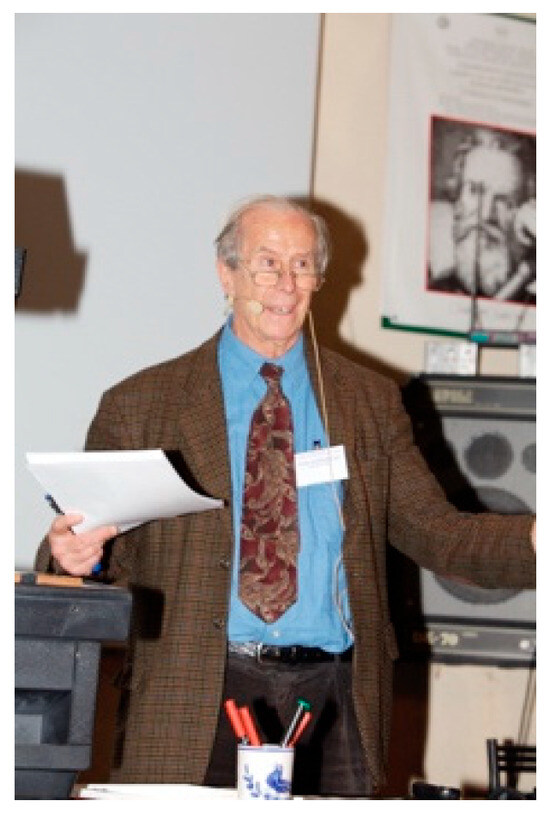
Later, Guido gave an invited talk at the Channeling 2008 workshop in Erice, titled “Charged and Neutral Particles Channeling Phenomena”, see Figure 1, which focused on the interaction and propagation of charged and neutral particles through various structures, including crystals and micro- and nano-channel structures.
Figure 1.
Guido Barbiellini presenting his eventual discovery of electromagnetic radiation by channeled electrons (“channeling radiation”) at the 1 GeV synchrotron during the “Channeling 2008—Charged and Neutral Particles Channeling Phenomena” workshop in Erice.
The event brought together researchers to discuss theoretical and experimental research on phenomena such as channeling and coherent radiation, with applications in future accelerators and photon sources. In the conference proceedings, edited by Sultan B. Dabagov and Luigi Palumbo, Guido reported [7] that “…after a long search for the possible source of the over-exposure it was found that the effect is observed every time when the angle between the electron beam and the crystal axis was equal to zero as remained after the previous working run. The correlation was confirmed by many film exposures at the same experimental conditions…”
The polarized gamma-ray beam was used to measure the angular distribution of electron pairs produced by polarized photons [8], including those produced by polarized photons interacting with the deuteron [9], and in the photoproduction of π0 on protons [10].
In 1967, as a student of nuclear physics at the University of Rome, I met Guido Barbiellini during a laboratory stage at the Laboratori Nazionali di Frascati of Comitato Nazionale di Energia Nucleare (CNEN), where I worked on the photoproduction of π0. In 1966–1967, the main topic of discussion in Frascati was the planning of experiments to be performed with ADONE, the new high-energy 1.5 GeV matter–antimatter storage ring designed by Bruno Touschek, which was completed in 1967 but it was operational only in november 1969 [11]. Bruno Toushek previously designed and built the first small electron–positron colliders: Anello di Accumulazione AdA in Frascati, and later the ACO storage ring in Orsay, France [12,13]. Guido Barbiellini began his work on hadron pair production using electron–positron colliding beams in ADONE since 1969, observing muon pair production from photon–photon interactions in 1973, in collaboration with Prof. Marcello Conversi, his mentor [14,15,16].
During my post-doc research in 1971, I shifted my scientific focus to X-ray spectroscopy as a fast and local tool to investigate nanoscale and short-lived states in complex quantum matter, with the long-term objective of developing a new physics of living matter. In synchrotrons and storage rings, the electrons are accelerated to nearly the speed of light and then forced to bend by magnets inside a vacuum tube with a doughnut shape, causing them to emit brilliant “synchrotron light” with a continuum spectrum, similar to the polarized synchrotron radiation emitted by the Crab nebula observed in astrophysics.
The new 1.5 GeV Adone storage ring in 1971 was considered an ideal source of continuum synchrotron radiation emitted by a relativistic electron beam inside the circular tube. However, a proposal involving X-ray spectroscopy to build synchrotron radiation beam lines for condensed matter studies was rejected. On the contrary, Edoardo Amaldi and Italo Federico Quercia, then director of the LNF, along with Daria Bocciarelli and Mario Ageno of Physics Laboratory of Istituto Superiore di Sanità, strongly supported in 1971 the proposal to build a facility with two beam lines for soft X-ray and ultraviolet spectroscopy, called “solidi Roma”, using the old 1 GeV synchrotron [17]. The first beam line for synchrotron radiation studies, called “Sanità Luce”, was originally located near Barbiellini’s old polarized γ-ray beam, while the two new beam lines of the new Solidi Roma facilty were located in the site previously occupied by AdA. The high-resolution Al(2p) core-level X-ray absorption near edge spectra of alumina self-supported films with different short-range orders were measured in 1973. This experiment, supervised by Ugo Fano, demonstrated that the X-ray absorption near-edge structure (XANES) was a sensitive probe of nanoscale lattice structure near selected atomic sites via photoelectron multiple scattering and it was published in 1974 [18]. This experiment disproved the previous assignment of the near-edge structure to the so-called Kossel features, i.e., the density of states of unoccupied atomic, chemical, or molecular orbital states, or crystalline conduction band structures.
While the ADONE electron and positron storage ring, completed in 1967, provided a platform for the first systematic studies of hadron and lepton pair production, it was not allowed to be used for X-ray spectroscopy via synchrotron radiation because of the lack of interest in condensed matter by the majority, who were only interested in nuclear physics at the time, with a few exceptions such as Guido Barbiellini, Marcello Conversi, Edoardo Amaldi, and Italo Federrico Quercia, who consistently supported the development of synchrotron radiation research in Frascati laboratories.
In 1974, another electron–positron storage ring using the SLAC linear accelerator in Palo Alto in California, became operational. Synchrotron radiation research and nuclear physics have been developed in parallel since the early days at SPEAR (Stanford Positron–Electron Accelerating Ring), which was completed in 1972 at SLAC in Palo Alto, California, and operated with circulating electrons and positrons at energies of up to approximately 4 GeV. The Stanford Synchrotron Radiation Project (SSRP) directed by Seb Doniach and Herman Winick was completed in 1974 and the first extended X-ray absorption spectra (EXAFS) was published in 1975.
In high-energy nuclear physics at SPEAR, the 4π detector Mark I operated from about 1973 to 1977, led to the discovery of the J/ψ (J/Psi) meson in 1974 (recognized by the 1976 Nobel Prize in Physics) and the τ lepton in 1976 (for which Martin Perl was awarded the 1995 Nobel Prize in Physics). We were together at the Frascati laboratory in November 1974 when the J/psi particle was discovered, and we shared the excitement of seeing it rapidly confirmed in Frascati by several groups using different detectors at the e+-e− collision points in the ADONE collider, revealing a very narrow resonance at the correct J/psi energy [19].
Guido Barbiellini continued to study the physics of the J/psi particle [20,21,22,23]. Burton Richter, one of the discoverers of the J/ψ meson at SLAC, and Guido Barbiellini developed a strong friendship during their years of collaboration in particle physics. From this collaboration emerged the proposal of radiative Z0 production as a method for neutrino counting in e+e− collisions, which had a lasting impact on the field [24]. The paper introduced a clean and elegant method to determine the number of light neutrino species: in high-energy e+e− annihilation, Z0 bosons can be produced in association with a photon. When the Z0 decays invisibly into neutrino–antineutrino pairs, it is indicated by a single energetic photon accompanied by missing energy and momentum. By measuring the rate of such single-photon events and comparing them with Standard Model predictions, one can directly infer the invisible decay width of the Z0 and thus the number of neutrino families. This idea was visionary. It anticipated the strategy later realized at the LEP collider at CERN, where precision measurements of the Z0 confirmed that there are exactly three light neutrino families.
The work by Barbiellini, Richter, and Siegrist laid crucial conceptual groundwork for one of the most significant advances in particle physics in the late 20th century. The collaboration between Richter and Barbiellini reflected a shared conviction that electron–positron colliders offer the cleanest and most powerful environment to explore the Standard Model. Unlike hadronic collisions, e+e− collisions provide a well-defined initial state with minimal background, enabling precision tests of electroweak theory.
After its pioneering role in collider physics of subnuclear particles, the storage ring SPEAR was converted into a dedicated synchrotron radiation source, leading to the establishment of the Stanford Synchrotron Radiation Laboratory (SSRL). This marked a transition from high-energy physics to condensed matter science, with SPEAR evolving into a world-class dedicated synchrotron radiation facility through successive upgrades. Herman Winick, a close friend of Guido Barbiellini, a key figure in this transformation, helped to establish the scientific vision and infrastructure for synchrotron radiation research at SLAC. Guido and Herman first met in 1966 at Harvard, when Guido received a Fulbright fellowship to work with Professor Karl Strauch, a distinguished high-energy physicist and a pivotal figure in the development of particle physics infrastructure at Harvard University. Strauch was instrumental in establishing the Harvard Cyclotron Laboratory, which became a cornerstone of experimental physics in the U.S. These early connections fostered lifelong collaborations and friendships, which later contributed to SPEAR’s successful transition from a collider to a synchrotron radiation facility, bridging the worlds of high-energy physics and photon science.
While early synchrotron radiation research at Stanford [25] focused on EXAFS spectroscopy, called in the thirties Kronig structure [26,27,28], of biological matter, Bianconi and Bachrach in collaboration with Fred Brown and Seb Doniach in Stanford, after the theoretical predictions of Dehmer and Dill of shape resonances in nitrogen gas [29], focused on experiments with synchrotron radiation on XANES of simple molecules in the gas phase [30,31], and its applications in surface science [32,33,34], and biological matter [35].
In the spring of 1974, Balzarotti, Bianconi, Burattini, and Piacentini, supported by Edorado Amaldi, submitted a proposal to CNR and the Laboratory Nazionali di Frascati to create a new synchrotron radiation facility with X-ray and ultraviolet beam lines at ADONE, similar to SPEAR. The project, called Progetto Utilizzazione Luce di Sincrotrone (PULS), was led by Franco Bassani.
After the discovery of the J/Psi particle in November 1974, the PULS project was approved; however, it was only in 1980 that the Adone storage ring was dedicated to synchrotron radiation, produced by a single (e−) electron beam circulating in the storage ring with high luminosity. The first XANES experiment at PULS focused on measuring the local structure of metal-active sites of biological molecules in solution [36,37]. The experimental spectra were interpreted using the XANES multiple scattering theory [38], which allowed the extraction of higher-order nanoscale structural correlations in complex materials and biological matter [39,40,41,42,43].
Guido Barbiellini’s expertise in high-precision measurements and his understanding of accelerator-based photon sources later informed his contributions to synchrotron-based medical imaging in 1997. In the mammography project at ELETTRA in Trieste, for example, Barbiellini and his colleagues applied principles of synchrotron radiation physics to produce high-resolution, low-dose X-ray images for breast cancer screening [44]. This work exemplifies how skills and insights gained from fundamental research in electron–positron collisions and photon sources can translate into innovative applications in medical physics, bridging the gap between high-energy physics and practical technology.
Acknowledgments
The author thanks Sultan Dabagov and Bernardo Barbiellini for their insightful discussions.
Conflicts of Interest
The author declares no conflicts of interest.
References
- Barbiellini, G.; Bologna, G.; Diambrini, G.; Murtas, G.P. Production of a Quasi-Monochromatic γ-Ray Beam from Multi-Gev Electron Accelerators. Phys. Rev. Lett. 1962, 8, 112. [Google Scholar] [CrossRef] [Scilit]
- Barbiellini, G.; Bologna, G.; Diambrini, G.; Murtas, G.P. Experimental evidence for a quasi-monochromatic bremsstrahlung intensity from the Frascati 1-GeV electron synchrotron. Phys. Rev. Lett. 1962, 8, 454. [Google Scholar] [CrossRef] [Scilit]
- Barbiellini, G.; Bologna, G.; Diambrini, G.; Murtas, G.P. Measurement of the polarization of the Frascati 1-GeV electron synchrotron γ-ray beam from a diamond crystal radiator. Phys. Rev. Lett. 1962, 9, 396. [Google Scholar] [CrossRef] [Scilit]
- Fano, U. On the Scattering of gamma Rays by Nuclei; US Department of Commerce, Office of Technical Services, National Institute of Standards and Technology: Gaithersburg, MD, USA, 1960; Volume 83. [Google Scholar]
- Kumakhov, M.A. On the theory of electromagnetic radiation of charged particles in a crystal. Phys. Lett. A 1976, 57, 17–18. [Google Scholar] [CrossRef] [Scilit]
- Dabagov, S.B.; Zheyago, N.K. On radiation by relativistic electrons and positrons channeled in crystals. Riv. Nuovo C 2008, 31, 491–529. [Google Scholar]
- Barbiellini, G.; Murtas, G.; Dabagov, S. On the discovery of coherent bremsstrahlung in a single crystal at the Frascati National Laboratories. Int. J. Mod. Phys. A 2010, 25, 1–8. [Google Scholar] [CrossRef] [Scilit]
- Barbiellini, G.; Bernardini, C.; Felicetti, F.; Murtas, G.P. Photodisintegration of the Deuteron by Polarized Gamma Rays. Phys. Rev. 1967, 154, 988. [Google Scholar] [CrossRef] [Scilit]
- Barbiellini, G.; Capon, G.; De Zorzi, G.; Murtas, G.P. Proton Compton Effect by Polarized Photons at 90° in the CM System in the First Resonance Region. Phys. Rev. 1968, 174, 1665. [Google Scholar] [CrossRef] [Scilit]
- Barbiellini, G.; Bologna, G.; Capon, G.; DeZorzi, G.; Fabbri, F.L.; Murtas, G.P.; Diambrini, G.; Sette, G.; De Wire, J. Photoproduction of π0 on Protons by Polarized γ Rays. Phys. Rev. 1969, 184, 1402. [Google Scholar] [CrossRef] [Scilit]
- Pellegrini, C. The Making of ADONE. In Bruno Touschek 100 Years: Memorial Symposium 2021; Springer International Publishing: Cham, Switzerland, 2023; pp. 215–226. [Google Scholar]
- Bonolis, L. Bruno Touschek vs. machine builders: AdA, the first matter-antimatter collider. Riv. Nuovo C 2005, 28, 1–60. [Google Scholar]
- Pancheri, G. The Making of AdA: Bruno Touschek’s Journey from Widerøe’s Betatron to Storage Rings. In Bruno Touschek 100 Years: Memorial Symposium 2021; Springer International Publishing: Cham, Switzerland, 2023; pp. 193–213. [Google Scholar]
- Barbiellini, G.; Grilli, M.; Iarocci, E.; Spillantini, P.; Valente, V.; Visentin, R.; Ceradini, F.; Conversi, M.; D’Angelo, S.; Giannoli, G. Hadron pair production by electron-positron colliding beams. Lett. Nuovo C 1973, 6, 557–565. [Google Scholar] [CrossRef] [Scilit]
- Barbiellini, G.; Nicoletti, G.; Barbarino, G.; Castellano, M.; Cevenini, F.; Di Giugno, G.; Biancastelli, R. Preliminary results on the energy dependence of the production of collinear relativistic particles at ADONE in the 3.1 GeV cm energy region. Lett. Nuovo C 1974, 11, 718–722. [Google Scholar] [CrossRef] [Scilit]
- Barbiellini, G.; Orito, S.; Tsuru, T.; Visentin, R.; Ceradini, F.; Conversi, M.; d’Angelo, S.; Ferrer, M.L.; Paoluzi, L.; Santonico, R. Muon Pair Production by Photon-Photon Interactions in e+ e− Storage Rings. Phys. Rev. Lett. 1974, 32, 385. [Google Scholar] [CrossRef] [Scilit]
- Balzarotti, A.; Bianconi, A.; Burattini, E.; Piacentini, M.; Bartolini, L.; Habel, R.; Grandolfo, M. Ultraviolet Spectroscopy Using Synchrotron Radiation; Servizio Documentazione (No. CNEN-LNF-72-98); Laboratori Nazionali di Frascati: Frascati, Italy, 1972. [Google Scholar]
- Balzarotti, A.; Bianconi, A.; Burattini, E.; Grandolfo, M.; Habel, R.; Piacentini, M. Core transitions from the Al 2p level in amorphous and crystalline Al2O3. Phys. Status Solidi (B) 1974, 63, 77–87. [Google Scholar] [CrossRef] [Scilit]
- Bacci, C.; Celio, R.B.; Berna-Rodini, M.; Caton, G.; Del Fabbro, R.; Grilli, M.; Iarocci, E.; Locci, M.; Mencuccini, C.; Murtas, G.P.; et al. Preliminary Result of Frascati (ADONE) on the Nature of a New 3.1-GeV Particle Produced in e+e− Annihilation. Phys. Rev. Lett. 1974, 33, 1408–1410. [Google Scholar] [CrossRef] [Scilit]
- Barbiellini, G.; Ceradini, F.; Paoluzi, L.; Santonico, R. Storage ring luminosity measurements by small angle e+ e− scattering. Nucl. Instrum. Methods 1975, 123, 125–129. [Google Scholar] [CrossRef] [Scilit]
- Barbiellini, G.; Nicoletti, G.; Ambrosio, M.; Barbarino, G.; Castellano, M.; Cevenini, F.; Grancagnolo, F.; Parascandolo, P.; Paternoster, G.; Patricelli, S.; et al. Search for Psi like resonance below 3 GeV in e+ e− annihilation. Phys. Lett. B 1976, 64, 359–361. [Google Scholar] [CrossRef] [Scilit]
- Preparata, G. J-Psi and the New Physics. Europhys. News 1977, 8, 3–7. [Google Scholar] [CrossRef] [Scilit]
- Diddens, A.; Jonker, M.; Panman, J.; Udo, F.; Allaby, J.; Amaldi, U.; Barbiellini, G.; Baroncelli, A.; Blobel, V.; Cocconi, G.; et al. A detector for neutral-current interactions of high-energy neutrinos. Nucl. Instrum. Methods 1980, 178, 27–48. [Google Scholar] [CrossRef] [Scilit]
- Barbiellini, G.; Richter, B.; Siegrrist, J.L. Radiative Z0 production: A method for neutrino counting in e+ e− collisions. Phys. Lett. B 1981, 106, 414–418. [Google Scholar] [CrossRef] [Scilit]
- Doniach, S.; Hodgson, K.; Lindau, I.; Pianetta, P.; Winick, H. Early work with synchrotron radiation at Stanford. Synchrotron Radiat. 1997, 4, 380–395. [Google Scholar] [CrossRef] [Scilit]
- Kronig, R.D.L. Zur theorie der feinstruktur in den röntgenabsorptionsspektren. Z. Phys. 1931, 70, 317–323. [Google Scholar] [CrossRef] [Scilit]
- Kronig, R.D.L. Zur theorie der feinstruktur in den Röntgenabsorptionsspektren. II. Z. Phys. 1932, 75, 191–210. [Google Scholar] [CrossRef] [Scilit]
- Hartree, D.R.; Kronig, R.D.L.; Petersen, H. A theoretical calculation of the fine structure for the K-absorption band of Ge in GeCl4. Physica 1934, 1, 895–924. [Google Scholar] [CrossRef] [Scilit]
- Dehmer, J.L.; Dill, D. Shape resonances in K-shell photoionization of diatomic molecules. Phys. Rev. Lett. 1975, 35, 213. [Google Scholar] [CrossRef] [Scilit]
- Bianconi, A.; Petersen, H.; Brown, F.C.; Bachrach, R.Z. K-shell photoabsorption spectra of N2 and N2O using synchrotron radiation. Phys. Rev. A 1978, 17, 1907. [Google Scholar] [CrossRef] [Scilit]
- Brown, F.C.; Bachrach, R.Z.; Bianconi, A. Fine structure above the carbon K-edge in methane and in the fluoromethanes. Chem. Phys. Lett. 1978, 54, 425–429. [Google Scholar] [CrossRef] [Scilit]
- Bianconi, A.; Bachrach, R.Z. Al surface relaxation using surface extended X-ray-absorption fine structure. Phys. Rev. Lett. 1979, 42, 104. [Google Scholar] [CrossRef] [Scilit]
- Bianconi, A.; Bachrach, R.Z.; Hagstrom, S.B.M.; Flodström, S.A. Al-Al2O3 interface study using surface soft-x-ray absorption and photoemission spectroscopy. Phys. Rev. B 1979, 19, 2837. [Google Scholar] [CrossRef] [Scilit]
- Bianconi, A. Surface X-ray absorption spectroscopy: Surface EXAFS and surface XANES. Appl. Surf. Sci. 1980, 6, 392–418. [Google Scholar] [CrossRef] [Scilit]
- Bianconi, A.; Doniach, S.; Lublin, D. X-ray Ca K edge of calcium adenosine triphosphate system and of simple Ca compunds. Chem. Phys. Lett. 1978, 59, 121–124. [Google Scholar] [CrossRef] [Scilit]
- Belli, M.; Scafati, A.; Bianconi, A.; Mobilio, S.; Palladino, L.; Reale, A.; Burattini, E. X-ray absorption near edge structures (XANES) in simple and complex Mn compounds. Solid State Commun. 1980, 35, 355–361. [Google Scholar] [CrossRef] [Scilit]
- Bianconi, A.; Congiu-Castellano, A.; Durham, P.J.; Hasnain, S.S.; Phillips, S. The CO bond angle of carboxymyoglobin determined by angular-resolved XANES spectroscopy. Nature 1985, 318, 685–687. [Google Scholar] [CrossRef] [Scilit] [PubMed]
- Bianconi, A.; Dell’Ariccia, M.; Durham, P.J.; Pendry, J.B. Multiple-scattering resonances and structural effects in the x-ray-absorption near-edge spectra of Fe II and Fe III hexacyanide complexes. Phys. Rev. B 1982, 26, 6502. [Google Scholar] [CrossRef] [Scilit]
- Bianconi, A.; Incoccia, L.; Stipcich, S. (Eds.) EXAFS and Near Edge Structure. In Proceedings of the International Conference, Frascati, Italy, 13–17 September 1982; Springer Science & Business Media: London, UK, 2012; Volume 27. [Google Scholar]
- Koningsberger, D.C.; Prins, R. (Eds.) X-Ray Absorption: Principles, Applications, Techniques of EXAFS, SEXAFS and XANES; John Wiley and Sons Inc.: New York, NY, USA, 1987; Chapter 11, Wiley-Interscience 1988; ISBN 0-471-87547-3. [Google Scholar]
- Stizza, S.; Mancini, G.; Benfatto, M.; Natoli, C.R.; Garcia, J.; Bianconi, A. Structure of oriented V2O5 gel studied by polarized x-ray-absorption spectroscopy at the vanadium K edge. Phys. Rev. B 1989, 40, 12229. [Google Scholar] [CrossRef] [Scilit] [PubMed]
- Bianconi, A. Higher order correlations in proteins by X-Ray spectroscopy. In Biophysics and Synchrotron Radiation; Springer: Berlin/Heidelberg, Germany, 1987; pp. 81–88. [Google Scholar]
- Bianconi, A.; Garcia, J.; Benfatto, M. XANES in condensed systems. In Synchrotron Radiation in Chemistry and Biology I. Topics in Current Chemistry; Springer: Berlin, Heidelberg, 1988; Volume 145. [Google Scholar] [CrossRef] [Scilit]
- Arfelli, F.; Barbiellini, G.; Bonvicini, V.; Bravin, A.; Cantatore, G.; Castelli, E.; Vacchi, A. The mammography project at ELETTRA. Phys. Medica 1997, 13, 7–12. [Google Scholar]
Disclaimer/Publisher’s Note: The statements, opinions and data contained in all publications are solely those of the individual author(s) and contributor(s) and not of MDPI and/or the editor(s). MDPI and/or the editor(s) disclaim responsibility for any injury to people or property resulting from any ideas, methods, instructions or products referred to in the content. |
© 2025 by the author. Licensee MDPI, Basel, Switzerland. This article is an open access article distributed under the terms and conditions of the Creative Commons Attribution (CC BY) license (https://creativecommons.org/licenses/by/4.0/).