
Article

Implementation of Hospital-Based Supplemental Duchenne Muscular Dystrophy Newborn Screening (sDMDNBS): A Pathway to Broadening Adoption

by
Richard B. Parad
1,*,
Yvonne Sheldon
1 and
Arindam Bhattacharjee
2,3,*
1
Department of Pediatric Newborn Medicine, Brigham & Women’s Hospital, Harvard Medical School, Boston, MA 02115, USA
2
NCGM, Inc., Raleigh, NC 27606, USA
3
ABDX Consulting, LLC, Raleigh, NC 27609, USA
*
Authors to whom correspondence should be addressed.
Int. J. Neonatal Screen. 2021, 7(4), 77; https://doi.org/10.3390/ijns7040077
Submission received: 2 October 2021 / Revised: 29 October 2021 / Accepted: 8 November 2021 / Published: 15 November 2021
(This article belongs to the Special Issue Next Generation Sequencing (NGS) in Newborn Screening)

Abstract

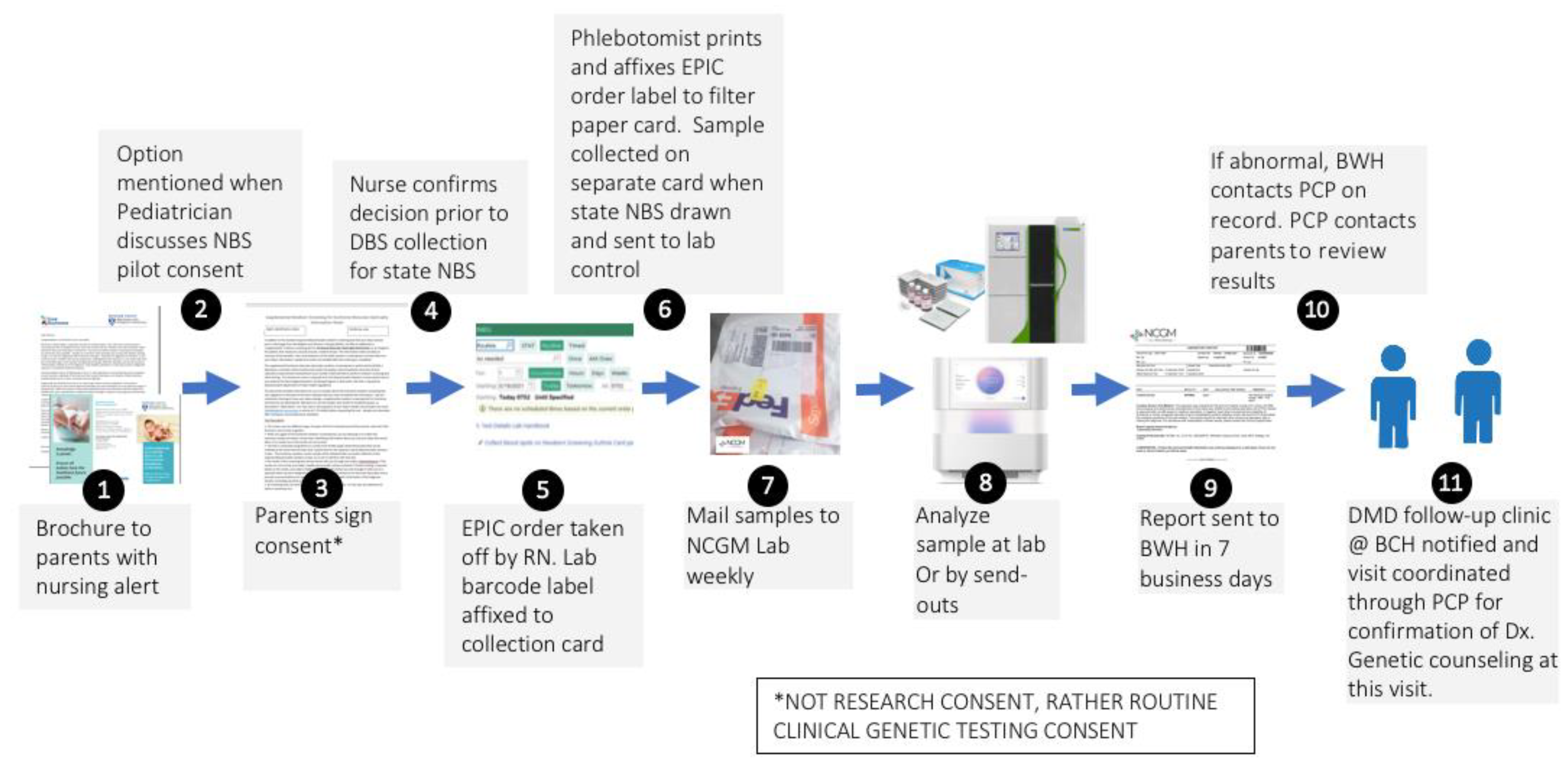
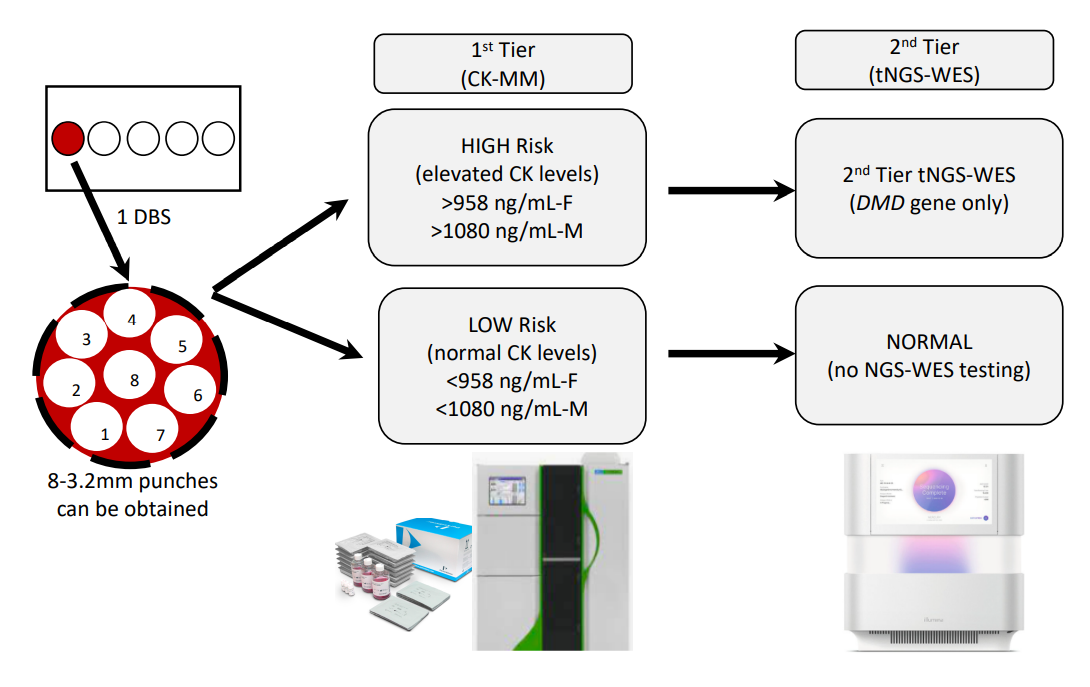
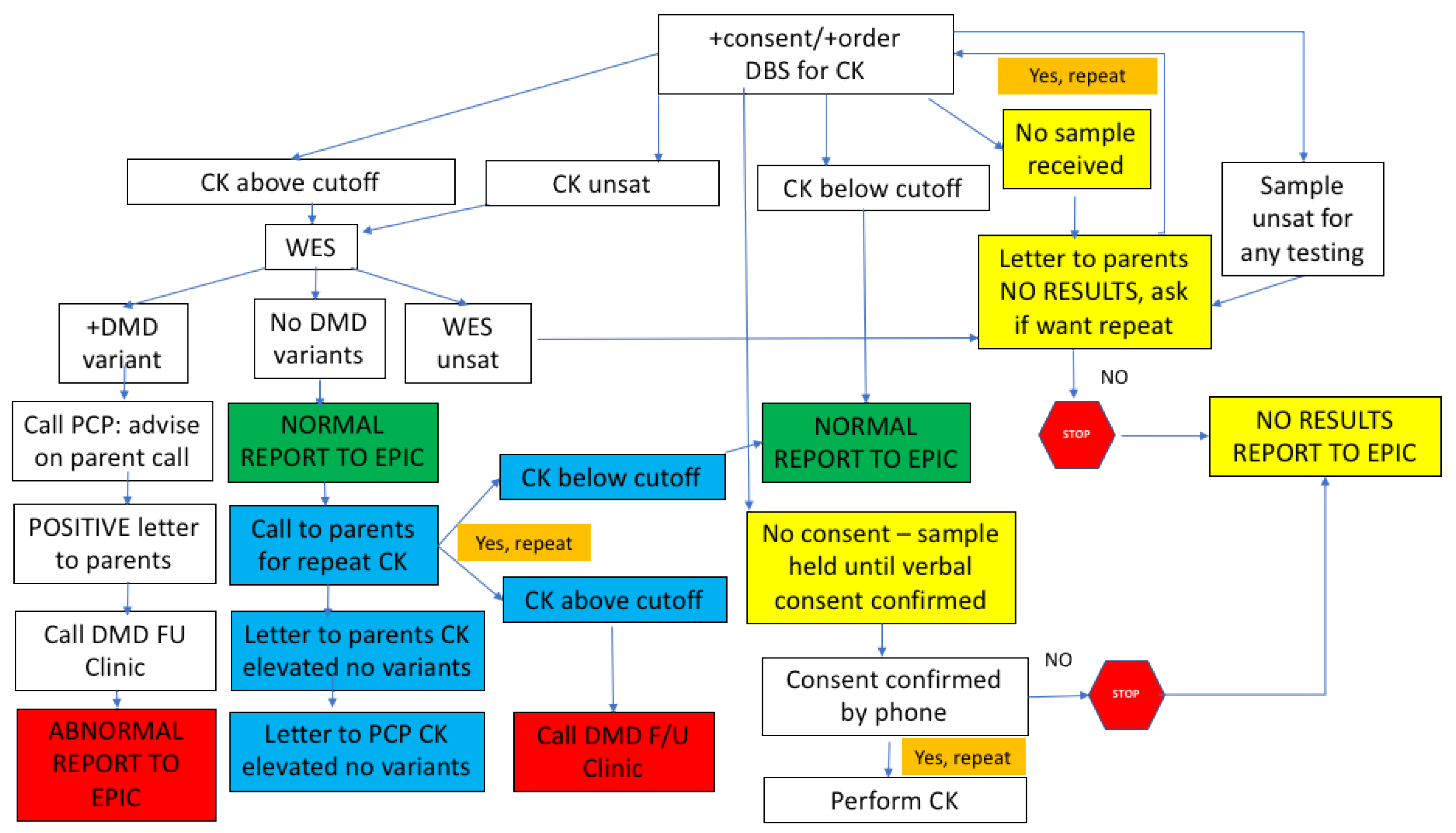
Duchenne muscular dystrophy (DMD) is not currently part of mandatory newborn screening, despite the availability of a test since 1975. In the absence of screening, a DMD diagnosis is often not established in patients until 3–6 years of age. During this time, irreversible muscle degeneration takes place, and clinicians agree that the earlier therapy is initiated, the better the long-term outcome. With recent availability of FDA-approved DMD therapies, interest has renewed for adoption by state public health programs, but such implementation is a multiyear process. To speed access to approved therapies, we implemented a unique, hospital-based program offering parents of newborns an optional, supplemental DMD newborn screen (NBS) via a two-tiered approach: utilizing a creatine kinase (CK) enzyme assay coupled with rapid targeted next-generation sequencing (tNGS) for the DMD gene (using a Whole-Exome Sequencing (WES) assay). The tNGS/WES assay integrates the ability to detect both point mutations and large deletion/duplication events. This tiered newborn screening approach allows for the opportunity to improve treatment and outcomes, avoid the diagnostic delays, and diminish healthcare disparities. To implement this screening algorithm through hospitals in a way that would ultimately be acceptable to public health laboratories, we chose an FDA-approved CK-MM immunoassay to avoid the risks of false-negative/-positive results. Because newborn CK values can be affected due to non-DMD-related causes such as birth trauma, a confirmatory repeat CK assay on a later dried blood spot (DBS) collection has been proposed. Difficulties associated with non-routine repeat DBS collection, including the tracking and recall of families, and the potential creation of parental anxiety associated with false-positive results, can be avoided with this algorithm. Whereas a DMD diagnosis is essentially ruled out by the absence of detected DMD sequence abnormalities, a subsequent CK would still be warranted to confirm resolution of the initial elevation, and thus the absence of non-DMD muscular dystrophy or other pathologies. To date, we have screened over 1500 newborns (uptake rate of ~80%) by a CK-MM assay, and reflexed DMD tNGS in 29 of those babies. We expect the experience from this screening effort will serve as a model that will allow further expansion to other hospital systems until a universal public health screening is established.
Keywords: duchenne muscular dystrophy (DMD); creatine kinase (CK); targeted next-generation sequencing (tNGS); newborn screening (NBS); newly approved targeted molecular therapies; avoiding delays and early initiation of therapy duchenne muscular dystrophy (DMD); creatine kinase (CK); targeted next-generation sequencing (tNGS); newborn screening (NBS); newly approved targeted molecular therapies; avoiding delays and early initiation of therapy