
Article

Enhanced Electrochemical Performance of Surface-Modified LiNi0.5Mn1.5O4 Cathode at High Voltages

1
School of Materials and Architectural Engineering, Guizhou Normal University, Guiyang 550001, China
2
Institute of Flexible Electronics, Northwestern Polytechnical University, Xi’an 710129, China
3
School of Physics and Electronic-information Engineering, Hubei Engineering University, Xiaogan 432000, China
4
Guizhou Engineering Research Center for Carbon Materials of Aluminum Electrolysis, Guiyang 550001, China
*
Authors to whom correspondence should be addressed.
Batteries 2026, 12(2), 44; https://doi.org/10.3390/batteries12020044
Submission received: 14 December 2025 / Revised: 15 January 2026 / Accepted: 23 January 2026 / Published: 26 January 2026

Abstract

Spinel LiNi0.5Mn1.5O4 (LNMO) has emerged as a highly competitive cobalt-free cathode material for higher-energy-density lithium-ion batteries. However, its practical application is hindered by severe capacity degradation, particularly under high-voltage operation. To solve this problem, we put forward a surface modification strategy employing a Li0.4La0.54TiO3 (LLTO) coating. The LLTO coating forms a protective cathode–electrolyte interphase that helps to inhibit interfacial side reactions, enabling enhanced electrochemical performance up to 5 V. As a result, the optimized 1 wt% LLTO-coated LNMO exhibits a remarkable capacity retention of 96.5% after 200 cycles at 0.1 C and delivers a high-rate capacity of 103.5 mAh g−1 at 2 C, significantly outperforming its pristine counterpart (86.8% and 89.6 mAh g−1, respectively). This work provides a viable and efficient surface modification approach for achieving robust high-voltage LNMO cathode material, underscoring its great potential for next-generation energy storage systems.

1. Introduction

Lithium-ion batteries serve as a very important part of contemporary energy storage, dominating the markets for consumer electronics, communications, and electric vehicles [1,2,3]. Although considerable advancements have been achieved, the cathode material continues to be a critical bottleneck restricting energy density and cost-effectiveness [2,3,4,5,6,7,8]. Among next-generation cathodes, cobalt-free spinel LiNi0.5Mn1.5O4 (LNMO) is considered a highly potential candidate owing to its rapid three-dimensional Li+ diffusion pathways, elevated working voltage (~4.7 V vs. Li+/Li), and substantial theoretical energy density approaching 650 Wh kg−1 [9,10,11,12,13]. Nevertheless, the practical application of LNMO is hampered by severe interfacial side reactions at high voltages, including transition metal dissolution, phase transitions, and electrolyte decomposition, leading to poor cycling stability [14,15,16,17,18,19,20,21].
Extensive research efforts have focused on stabilizing the LNMO interface by applying various coating materials, including oxides (Al2O3 [22,23], TiO2 [24], SiO2 [25]), fluorides (AlF3 [26], PrF3 [27]), and phosphates (Li3PO4 [28], AlPO4 [29]). These coatings act as physical barriers, isolating the cathode from the corrosive electrolyte and improving cyclability. For instance, an ultrathin composite Al2O3/LiAlO2 coating layer can enhance the cycling stability of LNMO to 84.99% over 350 cycles at 1 C [22]. Similarly, phosphate-based coatings like Li3PO4 and AlPO4 have been shown to mitigate HF attack and reduce surface Li+ depletion [28,29]. However, many conventional coatings are inert or possess low ionic conductivity, which can increase interfacial impedance and seriously affect the rate capability as well as long-term cycling stability.
To overcome this trade-off, recent strategies have adopted active or ion-conductive coatings that simultaneously passivate the surface and facilitate Li+ transport, showing promise in improving both stability and kinetics [30,31,32]. For example, Wang et al. demonstrated that a Li2ZrO3 coating reduces the charge transfer resistance of LNMO and improves its capacity retention at 5 C [33]. Chang et al. developed a Li2O-0.2B2O3-1.8SiO2 hybrid coating that increases the retained capacity from 69% to 83% after 100 cycles [34]. Additionally, Liu et al. reported a Li1.5Al0.5Ge1.5(PO4)3 coating that contributes to the suppression of transition metal dissolution while maintaining high ionic conductivity [35]. Despite these advances, it is crucial to develop an appropriate strategy for maintaining interfacial stability of LNMO under prolonged high-voltage cycling.
In this work, a perovskite-type Li0.4La0.54TiO3 (LLTO) was employed as a protective layer for LNMO via a facile hydrothermal method. While the bulk stability and ionic conductivity of LLTO can be influenced by the voltage and its grain boundaries [36,37], the ultrathin coating architecture used here is designed primarily to engineer the electrode-electrolyte interface. The LLTO layer plays a role as a physical barrier to isolate the cathode material from the electrolyte. The impact of coating content on the crystal structural, morphological, and electrochemical characteristics of LNMO was systematically studied. The optimized 1 wt% LLTO-coated LNMO delivers improved capacity retention of 96.5% after 200 cycles at 0.1 C up to 5 V, as well as a high-rate capacity of 103.5 mAh g−1 at 2 C. These results demonstrate that an optimized LLTO coating significantly enhances cycling stability, rate capability, and interfacial charge transfer, offering an effective and scalable approach to realizing durable high-voltage LNMO cathodes for emerging lithium-ion batteries.

2. Experimental

2.1. Synthesis of Li0.4La0.54TiO3@LiNi0.5Mn1.5O4 Cathode

A pristine LNMO sample was prepared via a sol–gel process. Stoichiometric ratios of CH3COOLi·2H2O, (CH3COO)2Ni·4H2O, and (CH3COO)2Mn·4H2O were dispersed in deionized water, and subsequently citric acid (C6H8O7·H2O) was added as a chelating agent. The mixture was stirred at 50 °C with the pH adjusted to 7.0 to produce a uniform sol. The resulting sol was dried at 120 °C for 24 h to gain the precursor. The dried gel was subsequently calcined in a muffle oven at 800 °C for 18 h in air, followed by cooling to 600 °C and holding for 2 h, using a ramp rate of 5 °C min−1.
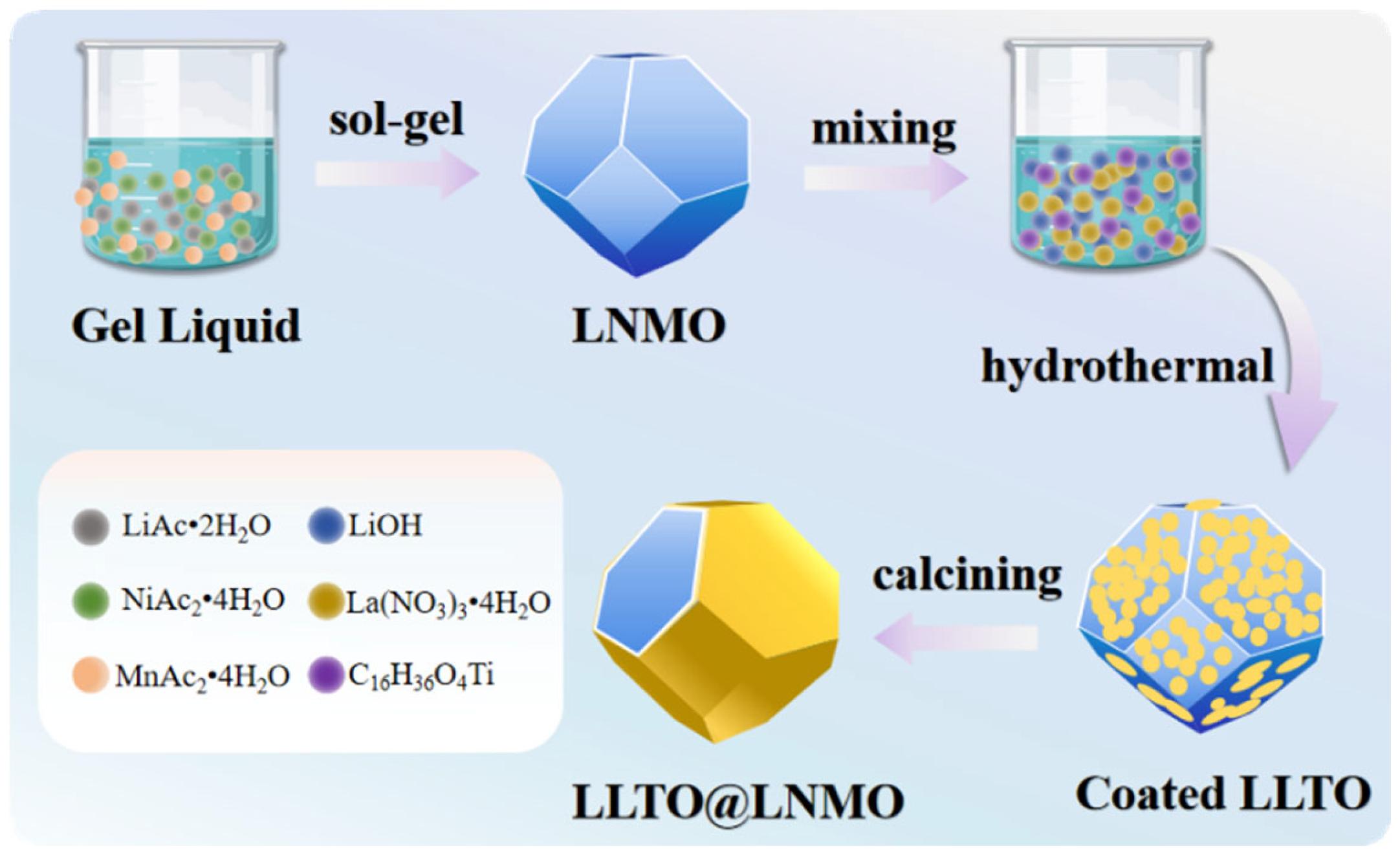
The Li0.4La0.54TiO3@LiNi0.5Mn1.5O4 (LLTO@LNMO) materials were obtained using a hydrothermal process. Specifically, LiOH, La(NO3)3·6H2O, and C16H36O4Ti were mixed with deionized water and stirred for 6 h to yield a clear precursor solution. The as-synthesized LNMO powder was then dispersed into the aforementioned solution with constant stirring for 2 h. The mixture was treated via a hydrothermal reaction at 120 °C for 18 h. After centrifugation and washing, the product was dried at 80 °C for 12 h and subsequently annealed at 500 °C for 4 h in air to obtain the LLTO@LNMO. The mass ratios of the LLTO coating in the composites were controlled to be 1, 2, and 3 wt%, and the corresponding samples are denoted as 1-LLTO@LNMO, 2-LLTO@LNMO, and 3-LLTO@LNMO, respectively. The schematic diagram of the preparation process of LNMO and LLTO@LNMO cathodes is shown in Figure 1.

2.2. Materials Characterization

The crystalline structure was characterized by powder X-ray diffraction (XRD, D8 Advance, Bruker, Berlin, Germany) with Cu Kα radiation over a 2θ range from 10° to 90°. Rietveld refinement was conducted employing the General Structure Analysis System (GSASII, Version 5455) software. Morphological and microstructural features were examined by field-emission scanning electron microscopy (FESEM, ZEISS SIGMA 300, ZEISS, Jena, Germany) and transmission electron microscopy (TEM, FEI Tecnai G2 F20, FEI, Hillsboro, OR, America). The surface elemental composition and chemical states were analyzed by X-ray photoelectron spectroscopy (XPS, PHI-5000 VP4, ULVAC-PHI, Chigasaki, Japan) with an Al Kα source.

2.3. Electrochemical Measurements

The coating slurry was formulated by mixing the active material, conductive carbon (Super P), and polyvinylidene fluoride (PVDF) binder in a mass ratio of 80:10:10, using N-methyl-2-pyrrolidone (NMP) as the solvent. The homogeneous slurry was coated onto an aluminum foil and dried in a vacuum at 120 °C for 12 h. CR2032-type coin cells were assembled in an argon-filled glove box (H2O, O2 < 0.1 ppm) using lithium metal as the counter/reference electrode, a polypropylene (PP) membrane as the separator, and 1 M LiPF6 in a mixture of ethylene carbonate (EC), ethyl methyl carbonate (EMC), and dimethyl carbonate (DMC) (1:1:1 by volume) as the electrolyte.
Galvanostatic charge–discharge tests were conducted on a LAND battery test system operating a voltage window of 3.0–5.0 V. Cyclic voltammetry (CV) and electrochemical impedance spectroscopy (EIS) were performed on an IVIUM electrochemical workstation. The CV scans were recorded at 0.1–2.0 mV s−1 within 3.0–5.0 V. For the EIS measurements, a sinusoidal signal with an AC amplitude of 5 mV was applied across a frequency spectrum between 100 kHz and 0.01 Hz.

3. Results and Discussion

3.1. Structural and Morphological Characterization

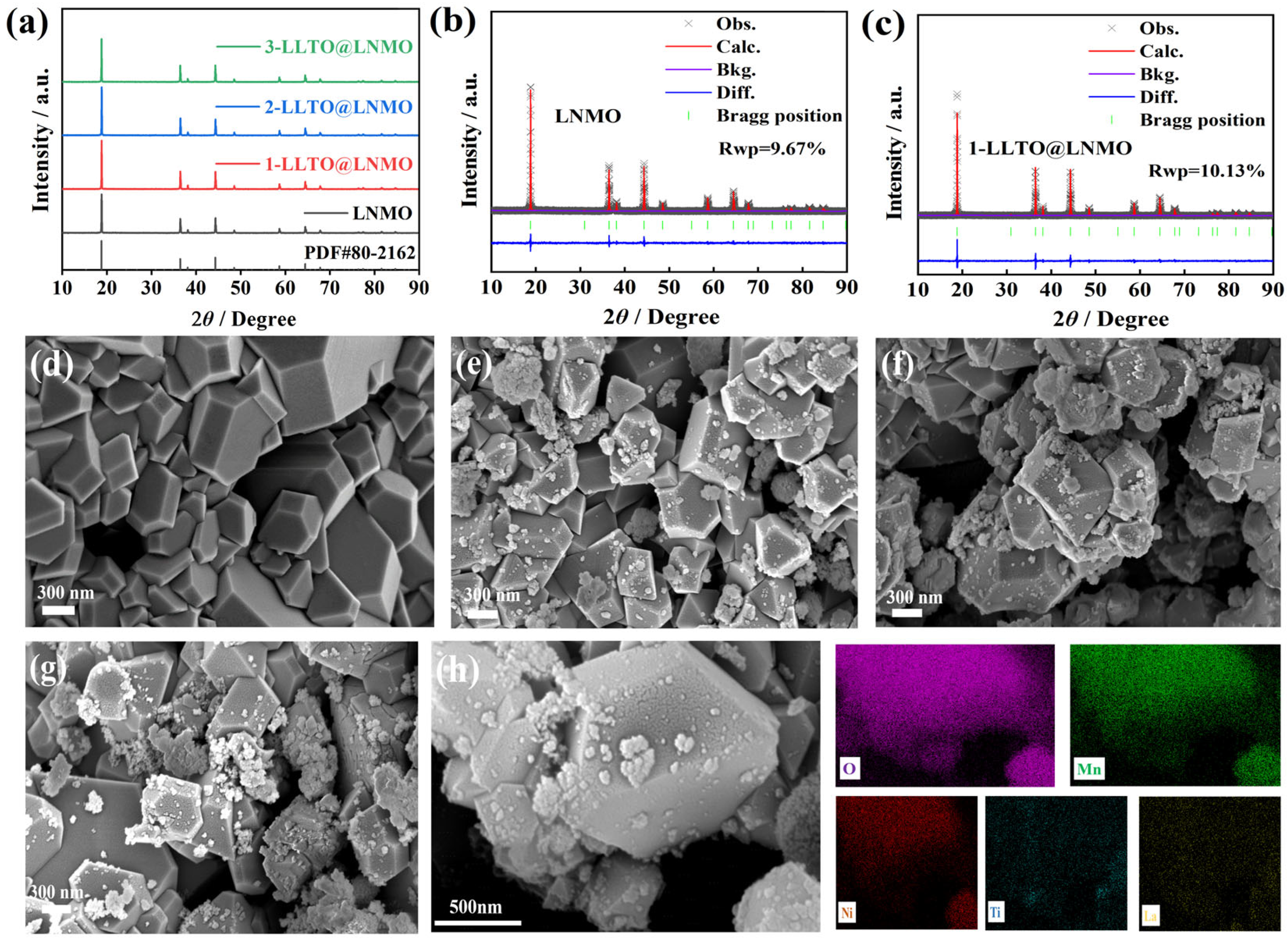
The crystal structures of LNMO and coated samples with different LLTO contents (1-LLTO@LNMO, 2-LLTO@LNMO, and 3-LLTO@LNMO) were characterized by XRD. As shown in Figure 2a, all synthesized samples display sharp diffraction peaks corresponding to the spinel structure with the Fd-3m space group (JCPDS No. 80-2162) [38]. No peaks consistent with the LLTO coating material are detected, suggesting that the LNMO crystalline structure is not influenced by the coating. In addition, Rietveld refinement was conducted to obtain more detailed structural information (Figure 2b,c and Figure S1). The refined patterns exhibit excellent agreement with the experimental data. By analyzing the refined lattice parameters (Table S1), it is observed that the lattice parameters of the coated samples are slightly larger than those of pristine LNMO. It is reported that ion exchange arises between LNMO and LLTO within the temperature range of 500 to 800 °C [39]. An annealing temperature of 500 °C was adopted in our experiments to mitigate ion doping into the LNMO lattice. Therefore, the slight increase in the refined lattice parameters for coated samples likely results from the oxidation of the LNMO surface induced by the hydrothermal treatment [40], rather than a homogeneous change in the bulk crystal structure.
The morphology and elemental distribution of the samples were investigated by FESEM and EDS. As displayed in Figure 2d–g, all the coated samples retain a particle morphology similar to that of pristine LNMO, maintaining the typical feature of a regular octahedral spinel structure [41]. Therefore, it is evident that the LLTO coating on the surface does not affect the structure of LNMO. However, distinct differences are observed between the pristine LNMO and coated samples. In contrast to the smooth surface of pristine LNMO, the coated samples exhibit increased surface roughness with higher coating content, indicating the surface coating of the LLTO layer [42]. As the coating progressed, thicker coating layers were formed, accompanied by visible surface debris due to the coating material [43]. Subsequently, the distribution of each element was confirmed by EDS mapping (Figure 2h and Figure S2), detecting Ni, Mn, and O in all samples, and La and Ti in coated LNMO samples. These results verify that the LLTO coating is applied onto the LNMO cathode, though with some inhomogeneity in thickness and coverage.
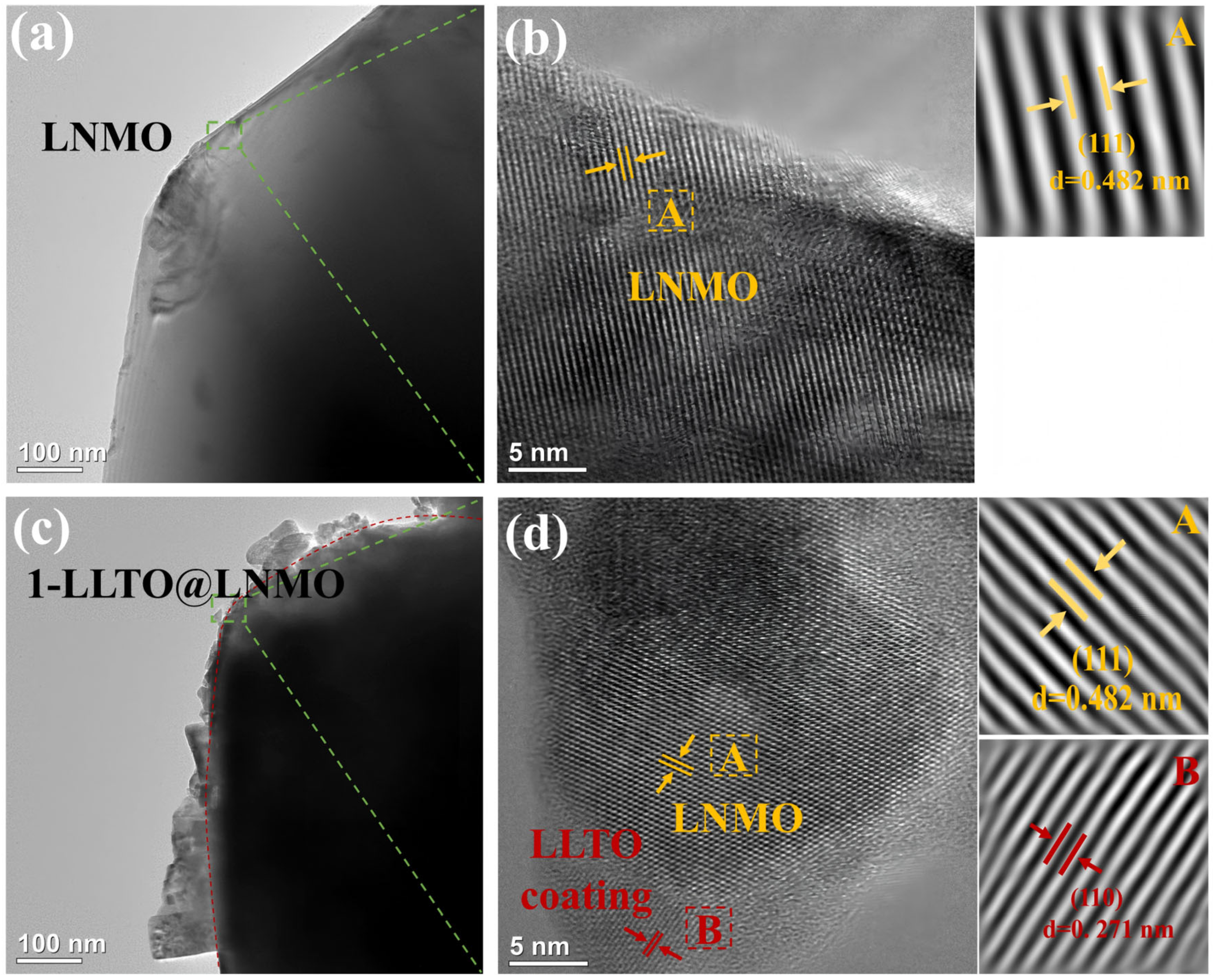
To further examine the internal lattice structure and the surface coating layer, HRTEM characterization was performed, and the details are shown in Figure 3 and Figure S3. The particles maintain an octahedral shape, which matches the results from FESEM. At higher magnification, clear lattice fringes and good crystallinity are visible. Additionally, the interplanar distance was calculated using the fast Fourier transform (FFT). The FFT patterns from the region marked by the yellow box in all samples display a lattice spacing of 0.482 nm, which is ascribed to the (111) crystal plane of spinel LNMO [44]. This indicates that the bulk phase of all samples retains a well-defined spinel structure of LNMO. Conversely, the FFT image from the region marked by the red box in Figure 3d shows a dot on the (110) plane with an interplanar distance of 0.271 nm [45], confirming the presence of a crystalline LLTO coating approximately 6–8 nm thick on the 1-LLTO@LNMO sample. As the coating content is added, the coating thickness increases in Figure S3a,c. And the coating is less uniform, with regions of agglomeration reaching ∼15–50 nm in thickness. These results demonstrate that the LLTO lattice is coherently bonded to the LNMO surface, forming an atomically matched coherent interface. During the charging and discharging cycles, this bonding can enhance the structural integrity of LNMO and improve the stability of the interface [46].
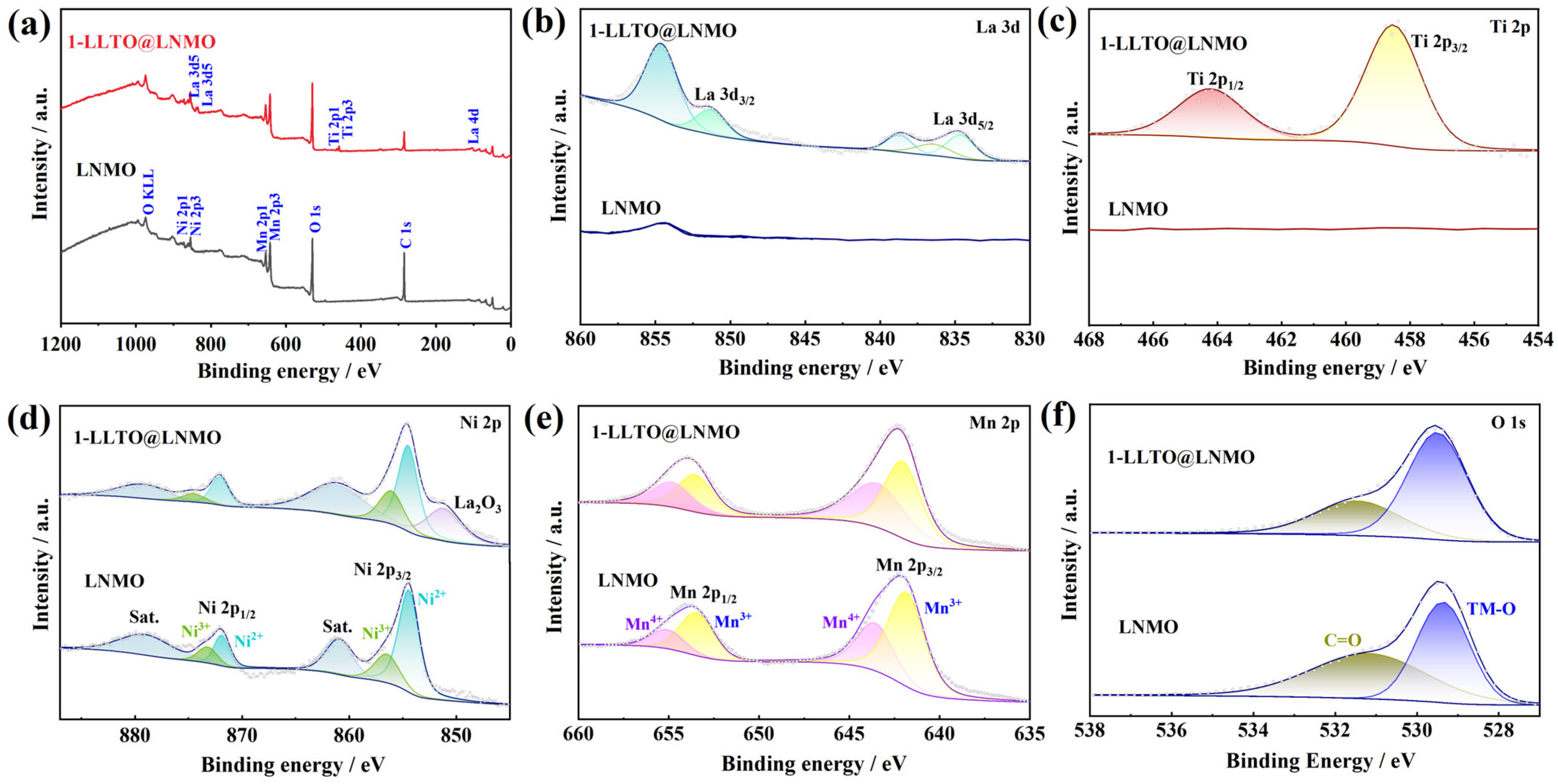
The surface chemical composition and elemental oxidation states were studied using XPS. As depicted in Figure 4a–c and Figure S4a–c, the survey spectrum of the LNMO@LLTO samples exhibits distinct peaks associated with La 3d and Ti 2p [45]. In the high-resolution Ti 2p spectrum, well-defined peaks are observed at 463.6 eV (Ti 2p1/2) and 457.9 eV (Ti 2p3/2), which are characteristic of Ti4+. Similarly, the La 3d spectrum features the peaks at 854.6 and 834.8 eV, assigned to the La 3d component of La3+. These findings further verify the presence of LLTO coating on the LNMO surface [47].
The oxidation states of nickel were analyzed utilizing the Ni 2p spectra (Figure 4d and Figure S4d). Three peaks located at 854.5 eV (Ni 2p3/2) and 872.1 eV (Ni 2p1/2) confirm the coexistence of Ni2+ and Ni3+ oxidation states on the cathode surface [48]. Quantitative deconvolution results indicate that the relative proportion of Ni2+ decreases gradually, with values of 44.84%, 34.29%, 31.61%, and 31.05% for pristine LNMO, 1-LNMO@LLTO, 2-LNMO@LLTO, and 3-LNMO@LLTO, respectively. It should be noted that these values reflect the chemical states in the near-surface region probed by XPS. The elevated Ni3+ content can lower the polarization voltage throughout cycling, which in turn enhances the cycling performance of coated LNMO samples [44]. Moreover, the La 3d3/2 peak with a binding energy of 851.4 eV is identified near the Ni 2p3/2 peak, further confirming the successful formation of the coating [49].
For the Mn 2p spectra (Figure 4e and Figure S4e), the peaks at locations 641.9, 643.7, 653.3, and 655.1 eV are identified to be Mn3+ and Mn4+ [50]. The area calculations indicate that the relative ratio of Mn3+ reduces from 67% in pristine LNMO to 45.36%, 42.12%, and 37.44% as the LLTO coating content increases. This reduction indicates that the LLTO coating promotes surface oxidation of manganese, which is consistent with previous reports [44]. The enhanced oxidation is attributed to the hydrothermal treatment, which improves structural ordering and raises the proportion of ordered to disordered phase in LNMO [44]. This reduction in the relative surface concentration of Mn3+, which is more susceptible to dissolution and Jahn-Teller distortion, is considered a favorable condition that may contribute to the improved electrochemical stability observed for the coated samples [51]. Although increased structural ordering may slow down ion transport in the bulk and thus limit rate performance, the LLTO coating compensates by facilitating the migration rate of Li+ across the interface. Consequently, the synergistic combination between surface coating and hydrothermal treatment is expected to enhance both rate capability and cycling stability.
Lastly, the O 1s spectra display peaks at 529.3, 530.9, and 532.7 eV, attributing to lattice oxygen bonded with transition metals in LNMO and adsorbed oxygen on the surface, respectively (Figure 4f and Figure S4f) [52]. The proportion of adsorbed O increases from 34.9% for pristine LNMO to 39.7%, 39.89%, and 40.43% with increasing LLTO coating content, attributable to the interaction between surface oxygen sites on LNMO and the LLTO coating layer.

3.2. Electrochemical Performance

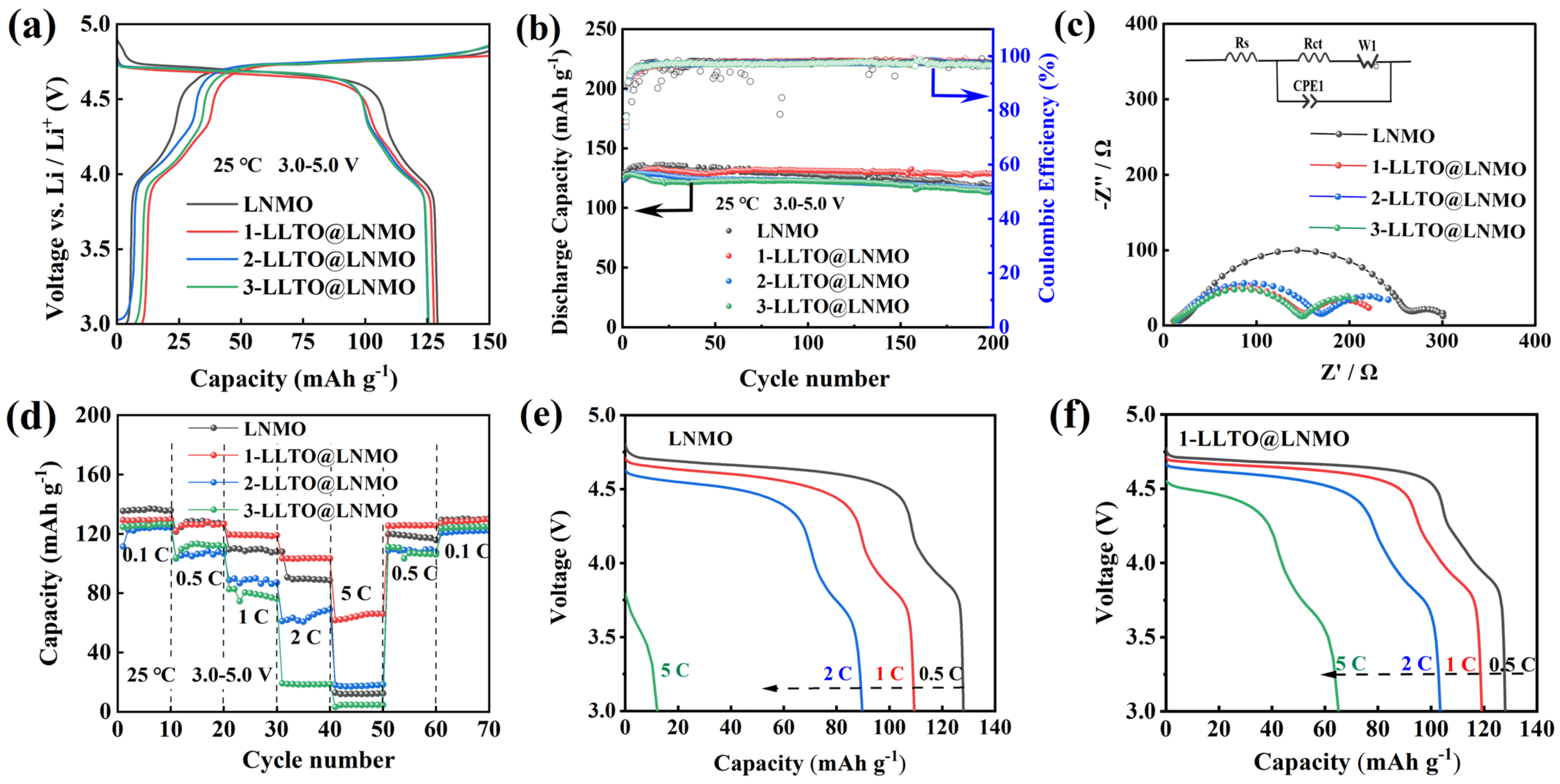
Systematically evaluated the electrochemical properties of the pristine and LLTO-modified LNMO cathodes. Figure 5a displays the initial constant current charge–discharge profiles at a voltage of 3.0 to 5.0 V. Long-term cycling was first evaluated at 0.1 C to assess the intrinsic stability of the electrodes under high-voltage conditions with minimized polarization and kinetic stress. They exhibit characteristic features of LNMO. The long plateau at approximately 4.7 V is related to the redox reaction of the Ni2+/Ni4+ couple, while a short plateau near 4 V is associated with the Mn3+/Mn4+ redox pair in the disordered phases [46]. Further kinetic insight is gained from CV (Figure S5). All curves present distinct redox pairs, with Mn3+/Mn4+ and Ni2+/Ni4+ located at 4.0 and 4.7 V, consistent with the galvanostatic results. The overpotential (ΔE), defined as the potential difference between the oxidation and reduction peaks, is a key indicator of the polarization degree during charge and discharge processes [53]. The calculated ∆E values are 0.30, 0.24, 0.26, and 0.25 V for pristine LNMO, 1-LLTO@LNMO, 2-LLTO@LNMO, and 3-LLTO@LNMO, respectively. Notably, 1-LLTO@LNMO displays the lowest ΔE value, demonstrating that the optimal LLTO coating can mitigate electrochemical polarization in the electrode. Furthermore, the redox peaks of 1-LLTO@LNMO show minimal shift upon repeated cycling, suggesting a highly reversible Mn3+/Mn4+ redox reaction. This observation underscores the critical role of the LLTO coating in mitigating Mn dissolution and promoting reaction reversibility of the LNMO cathode.
Figure 5b presents the cycling stability of all samples tested at 0.1 C within 3.0–5.0 V. The pristine LNMO electrode offers a higher initial discharge capacity of 129.2 mAh g−1, whereas the initial capacities of 1-LLTO@LNMO, 2-LLTO@LNMO and 3-LLTO@LNMO are 127.8, 125.7, and 125.7 mAh g−1, respectively. The LLTO-modified samples show slightly lower initial capacity, attributable to the partial coverage of active reaction sites on the LNMO surface by the non-active LLTO coating layer, and the minor lithium-ion consumption associated with the construction of a stable solid electrolyte interphase (SEI) during the initial charge–discharge cycles [54,55]. After 200 cycles, the 1-LLTO@LNMO electrode achieves the highest capacity retention rate of 96.5%, which significantly outperforms the 86.83% retention rate of pristine LNMO. The 2-LLTO@LNMO and 3-LLTO@LNMO samples also exhibit improved cycling retention, with values of 89.85% and 88.42%, respectively. Furthermore, it can be observed that the initial Coulomb efficiency of all the samples is very low, which is common for high-voltage LNMO due to interfacial side reactions. However, the 1-LLTO@LNMO displays a higher average Coulombic efficiency than that of the LNMO electrode in subsequent cycles. The enhanced cycling stability of the LLTO-coated electrodes may be ascribed to the LLTO layer, which acts as a robust physical barrier that suppresses side reactions under high-voltage conditions.
EIS measurements were performed after 200 cycles to further explore the evolution elucidate of interface impedance due to the LLTO coating (Figure 5c). The Nyquist plots obtained after 200 cycles are characterized by two depressed semicircles in the high-to-medium frequency range and an inclined line in the low-frequency range, which refer to surface film resistance (Rsf), charge-transfer resistance (Rct), and Warburg impedance (Zw), respectively, associated with Li+ diffusion in the electrode [56]. The EIS data were fitted using a corresponding equivalent circuit, and the derived parameters are summarized in Table S2. The Rct values for the 1/2/3 wt% LLTO@LNMO electrodes are 210.93, 241, and 137 Ω, respectively, all markedly lower than the 759.6 Ω for pristine LNMO. Additionally, the lithium-ion diffusion coefficient can be calculated through the relationship between Z’ and ω−1/2 in the low-frequency region (Figure S6). The results are presented in Table S3. The LLTO@LNMO samples exhibit high DLi+ values of 10.06 × 10⁻¹⁶, 3.25 × 10⁻¹⁶ and 7.017 × 10⁻¹⁶ cm2 s−1, respectively. This pronounced reduction in Rct and augmentation in DLi+ confirm that the LLTO coating accelerates interfacial charge-transfer kinetics and enhances structural stability [57,58]. Especially, owing to its optimal amount of LLTO coating, the 1-LLTO@LNMO electrode has the lowest Rct and highest DLi+ value, aligning perfectly with the enhanced cycling.
Rate capability measurements were performed to assess the high-current performance at different rates (0.1 C−5 C) (Figure 5d). The initial discharge capacities of the LLTO-coated LNMO samples are similar, in the range of 123–128 mAh g−1. However, the 1-LLTO@LNMO electrode represents distinctly preferable performance at current rates above 0.5 C. Its reversible specific capacity is 119.5, 103.5, and 61.8 mAh g−1 at 1, 2, and 5 C, respectively, remarkably exceeding those of pristine LNMO (109.5, 90.7, and 12.9 mAh g−1). The discharge profiles of the samples at various rates (Figure 5e,f and Figure S7) further highlight the performance advantage of 1-LLTO@LNMO. For the pristine LNMO electrode, the discharge voltage plateaus associated with the Ni4+/Ni2+ and Mn4+/Mn3+ redox reactions underwent a dramatic decline with increasing current density. This indicates that the structure has been severely damaged and the internal polarization has increased. In contrast, for the 1-LNMO@LLTO sample, its voltage distribution maintains good plateau stability under the same conditions, with a high ratio of Mn4+/Mn3+ redox capacity even at 5 C [45]. It is worth noting that both 2-LLTO@LNMO and 3-LLTO@LNMO exhibit inferior rate capability relative to 1-LNMO@LLTO, which can be attributed to the reduced electronic conductivity caused by the excessively thick LLTO coating layer. After cycling at various high rates and returning to 0.1 C, the capacity retention rates of pristine LNMO, 1-LLTO@LNMO, 2-LLTO@LNMO, and 3-LLTO@LNMO are 96.2%, 100%, 99.5%, and 99.4%, respectively. These results indicate that 1-LNMO@LLTO possesses the highest stability both during high-rate cycling and after returning to 0.1 C, confirming that an optimal amount of LLTO coating enables the interface region between electrode and electrolyte to be stable and thus enhances the rate performance of LNMO.
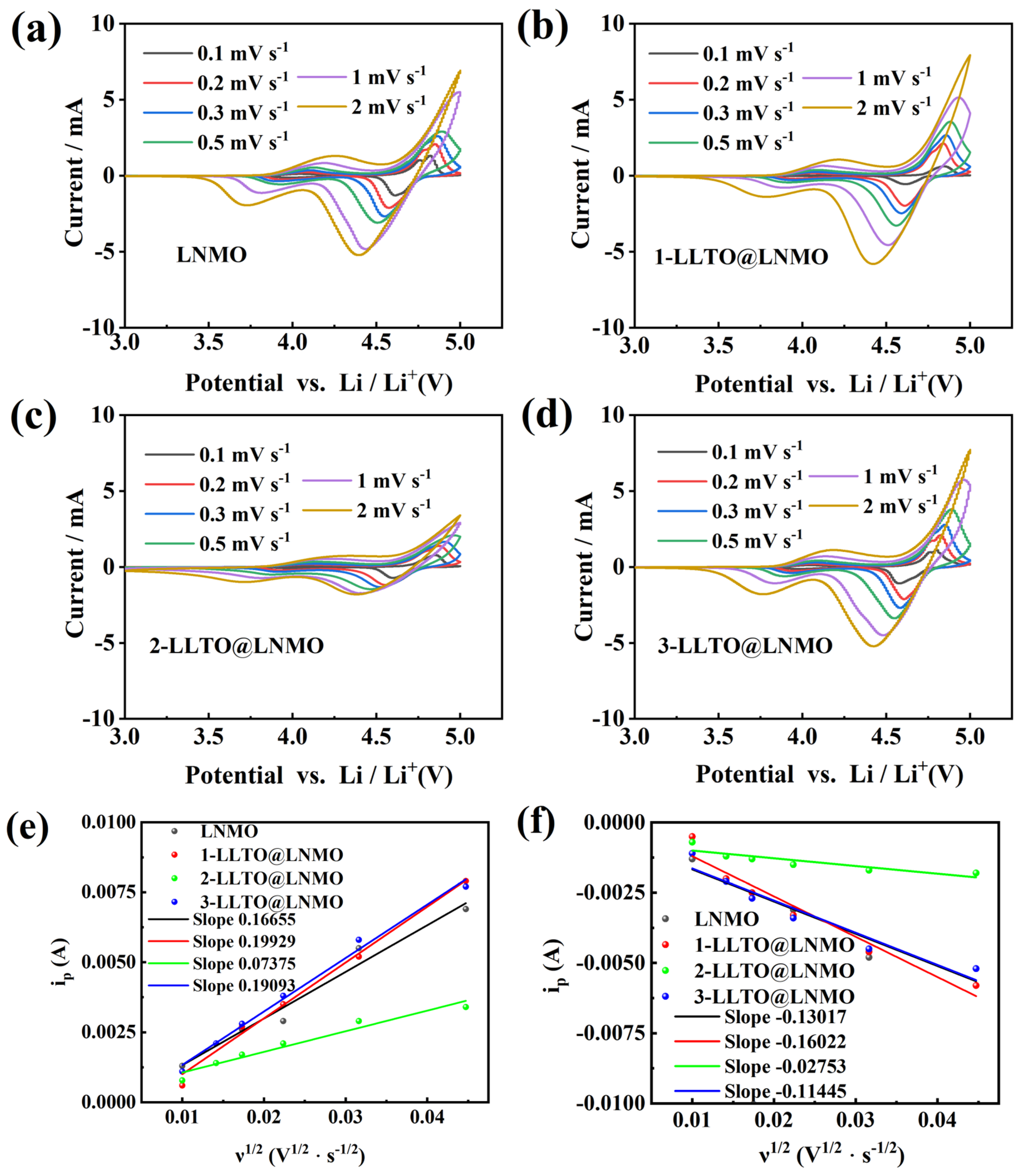
The effect of the LLTO coating on Li+ transport kinetics was evaluated by using CV at varied scan rates, with results presented in Figure 6. All samples display two distinct pairs of redox peaks, which are consistent with the results from the galvanostatic charge/discharge tests. We can see that the peak current density increases with increasing scan rate. The oxidation peaks associated with the Mn3+/Mn4+, Ni2+/Ni3+, and Ni3+/Ni4+ redox pairs move toward more positive potentials, whereas the reduction peaks associated with Ni4+/Ni3+, Ni3+/Ni2+, and Mn4+/Mn3+ shift toward more negative potentials. In addition, the redox peaks related to Ni2+/Ni3+ and Ni4+/Ni3+ gradually weaken as the scan rate elevates, implying a trend that the Ni2+ is directly oxidized to Ni4+. The Li+ diffusion coefficient (DLi+), a critical parameter for evaluating electrode kinetics behavior, can be determined according to the Randles-Sevcik equation [59,60].
i p = ( 2.69 × 10 5 ) n 3 / 2 A C 0 D L i + 1 / 2 ν 1 / 2
In this equation, ip denotes the peak current (A), n represents the number of transferred electrons, A is the electrode area (cm2), DLi+ is the Li+ diffusion coefficient (cm2 s−1), v is the scan rate (V s−1), and C0 is the bulk concentration of lithium-ion (mol cm−3).
The calculated lithium-ion diffusion coefficients (DLi+) values are summarized in Table S4. It is acknowledged that the calculated DLi+ values are approximate, as the underlying models assume conditions that may not be fully satisfied in solid-state intercalation electrodes. These values are therefore discussed primarily for comparative purposes to highlight trends among the samples. The 1-LLTO@LNMO electrode exhibits the highest DLi+ values, with 1.026 × 10⁻¹¹ cm2 s−1 for extraction and 8.24 × 10⁻¹² cm2 s−1 for insertion, respectively.
These findings confirm that the coating layer of LLTO can simultaneously boost both ionic and electronic migration rates, thereby enhancing the cycling stability and rate capability of LNMO. The fundamental mechanisms underlying these improved properties may include the following aspects [61,62]: (1) By constructing a physical protective interface, LLTO inhibits Mn3+ dissolution and stabilizes the Mn3+/Mn4+ redox couple, thus preserving structural reversibility and mitigating electrode degradation. (2) Owing to the LLTO modification, the interphase likely creates a more kinetically favorable environment for charge transfer between electrode and electrolyte, relieving the interfacial ion concentration gradient and emerging as a key factor in enhancing the rate performance. (3) The coherent bonding between the LLTO lattice and the LNMO surface can help to maintain the crystallographic integrity of the near-surface region of LNMO particles during repeated lithium (de)intercalation. A stable interface facilitates Li+ insertion/extraction, significantly boosting the cycle stability.

4. Conclusions

In the present study, we successfully fabricated a variety of LLTO-coated LNMO cathodes through a hybrid sol–gel and hydrothermal synthesis method. Comprehensive characterization confirms the existence of an LLTO layer on the LNMO surface. The electrochemical performance indicates that the optimized 1 wt% LLTO@LNMO composite delivers a high specific capacity of 127.8 mAh g−1 at 0.1 C, excellent cycling stability with 96.5% capacity retention after 200 cycles at high operating voltages, and rate capability (65.2 mAh g−1 at 5 C), significantly outperforming pristine LNMO. The observed enhancement might be attributed to the LLTO layer. It functions as a multifunctional protective layer, which not only inhibits electrolyte decomposition and transition metal dissolution but also accelerates interfacial ion migration kinetics. The main strengths of this approach include the facile coating process and the identification of an optimal coating content. Future efforts could focus on optimizing the coating uniformity and exploring the long-term stability of LNMO. Overall, employing an ion-conductive LLTO coating presents a valuable strategy for developing next-generation, cobalt-free lithium-ion batteries.

Supplementary Materials

The following supporting information can be downloaded at https://www.mdpi.com/article/10.3390/batteries12020044/s1. Figure S1: Rietveld refinement of (a) 2-LLTO@LNMO, and (b) 3-LLTO@LNMO; Figure S2: FESEM image of (a) 2-LLTO@LNMO, and (b) 3-LLTO@LNMO, and (b) 3-LLTO@LNMO; Figure S3: HRTEM and FFT images of (a)–(b) 2-LLTO@LNMO and (c)–(d) 3-LLTO@LNMO; Figure S4: XPS spectra comparison between 2-LLTO@LNMO and 3-LLTO@LNMO (a) Survey Scan, (b) Ni 2p, (c) Mn 2p, (d) O 1s, (e) La 3d, and (f) Ti 2p; Figure S5: CV curves at scan rate of 0.1 mV s−1 of (a) LNMO, (b) 1-LLTO@LNMO, (c) 2-LLTO@LNMO, (d) 3-LLTO@LNMO; Figure S6: The relationship between Z’ and ω−1/2 in the low-frequency obtained from EIS measurement; Figure S7: The discharge curves at the current densities for (a) 2-LLTO@LNMO and (b) 3-LLTO@LNMO; Table S1: Results of the Rietveld refinement for all samples; Table S2: Impedance parameters for all samples after 200 cycles at 0.1 C; Table S3: The Warburg factor and diffusion coefficient for all samples; Table S4: Results of diffusion coefficients for all samples. References [33,63] are cited in the Supplementary Materials.

Author Contributions

Writing—original draft preparation, Z.Y. (Zeng Yan); Methodology, S.W.; Validation, F.H., Investigation, S.L. and Y.L.; Writing—review and editing, Q.P., Z.Y. (Zhen Yao) and W.L. All authors have read and agreed to the published version of the manuscript.

Funding

This work was supported by Guizhou Provincial Science and Technology Projects (NO. ZK [2022]General311, and ZZSG [2024]002), Guizhou Provincial Science and Technology Achievement Transformation Program (NO. [2025]Major013), Guizhou Provincial Department of Education Science and Technology Projects (NO. QJHKYZ [2022]158, and [2023]057), National Natural Science Foundation of China (NO. 12563002), and Hubei Provincial Natural Science Foundation of China (NO. 2023AFB944).

Data Availability Statement

The original contributions presented in this study are included in the article. Further inquiries can be directed to the corresponding authors.

Conflicts of Interest

The authors declare no conflict of interest.

References

  1. Qureshi, Z.A.; Tariq, H.A.; Shakoor, R.A.; Kahraman, R.; AlQaradawi, S. Impact of coatings on the electrochemical performance of LiNi0.5Mn1.5O4 cathode materials: A focused review. Ceram. Int. 2022, 48, 7374–7392. [Google Scholar] [CrossRef]
  2. Liang, Q.; Jiang, K.; Peng, B.; Zhao, R.; Luo, Q. First principles study on the performance of Sn&F double-doped LiCoO2 in lithium-ion batteries. Chem. Phys. Lett. 2024, 851, 141489. [Google Scholar]
  3. Jin, B.; Zhang, K.; Gao, G.; Zhao, Q.; Jiang, X.; Cui, D.; Chen, K.; Lin, X.; Liu, L.; Yan, R.; et al. Active prelithiation strategies for advanced lithium storage systems: A perspective from electrochemical mechanism to structural design and application. Chem. Eng. J. 2024, 493, 152542. [Google Scholar] [CrossRef]
  4. Köder, M.; Winter, T.; Glaser, M.; Loos, M.; Walter, M. Investigating electrochemical impedance spectroscopy for state of health estimation of LiFePO4 batteries in idle state. J. Energy Storage 2023, 72, 108637. [Google Scholar] [CrossRef]
  5. Kim, Y.; Park, H.; Shin, K.; Henkelman, G.; Warner, J.H.; Manthiram, A. Rational design of coating ions via advantageous surface reconstruction in high-nickel layered oxide cathodes for lithium-ion batteries. Adv. Energy Mater. 2021, 11, 2101112. [Google Scholar] [CrossRef]
  6. Yu, Y.; Guo, J.; Xiang, M.; Su, C.; Liu, X.; Bai, H.; Bai, W.; Duan, K. Enhancing the durable performance of LiMn2O4 at high-rate and elevated temperature by nickel-magnesium dual doping. Sci. Rep. 2019, 9, 16864. [Google Scholar] [CrossRef]
  7. Feng, X.-Y.; Wu, W.-T.; Huang, Q.-Q.; Liu, Y.-C.; Ni, C.; Huang, Z.-M.; Liang, X.; Chen, C.-H.; Xiang, H.-F. Medium entropy stabilized disordered LiNi0.5Mn1.5O4 cathode with enhanced electrochemical performance. J. Alloys Compd. 2023, 948, 169768. [Google Scholar] [CrossRef]
  8. Bao, L.-R.; Tang, W.-P.; Sun, S.-Y. Semi-wet synthesis of high-performance Li1.6Mn1.6O4 for selective lithium extraction from Salt Lakes Brine. Desalination 2024, 584, 117730. [Google Scholar] [CrossRef]
  9. Xu, M.; Yang, M.; Chen, M.; Gu, L.; Luo, L.; Chen, S.; Chen, J.; Liu, B.; Han, X. Enabling structural and interfacial stability of 5 V spinel LiNi0.5Mn1.5O4 cathode by a coherent interface. J. Energy Chem. 2023, 76, 266–276. [Google Scholar] [CrossRef]
  10. Jiao, X.; Rao, L.; Yap, J.; Yu, C.-Y.; Kim, J.-H. Stabilizing cathode-electrolyte interphase of LiNi0.5Mn1.5O4 high-voltage spinel by blending garnet solid electrolyte in lithium-ion batteries. J. Power Sources 2023, 561, 232748. [Google Scholar] [CrossRef]
  11. Kong, F.; Zhang, G.; Wu, D.; Sun, F.; Tao, S.; Chu, S.; Qian, B.; Chu, W.; Song, L. Insight into the cation migration and surface structural evolution of spinel LiNi0.5Mn1.5O4 cathode material for lithium-ion batteries. Chem. Eng. J. 2023, 451, 138708. [Google Scholar] [CrossRef]
  12. Oney, G.; Sevillano, J.S.; Yahia, M.B.; Olchowka, J.; Suard, E.; Weill, F.; Demortière, A.; Cabanas, M.C.; Croguennec, L.; Carlier, D. Identification of degree of ordering in spinel LiNi0.5Mn1.5O4 through NMR and Raman spectroscopies supported by theoretical calculations. Energy Storage Mater. 2024, 70, 103486. [Google Scholar]
  13. Li, C.; Wang, D.; Zhou, X.; Gao, C.; Gao, X.; Su, L.; Chao, D.; Chen, Y. Grain boundaries modification of the spinel LiNi0.5Mn1.5O4 ceramic cathode towards low interfacial resistance for lithium-ion batteries with ultrahigh areal energy density. Acta Mater. 2025, 292, 121039. [Google Scholar] [CrossRef]
  14. Fan, X.-Y.; Liu, H.; Qin, H.; Chen, S.-F.; Zhao, J.; Guo, C.; Xu, S.-W.; Chen, T.-L.; Wei, G.-X.; Liu, X.-R.; et al. Surface modification modulating Helmholtz plane to construct robust interphase for 5 V-class LiNi0.5Mn1.5O4 cathodes. Nano Energy 2025, 141, 111105. [Google Scholar] [CrossRef]
  15. Shih, C.-P.; Krajewski, M.; Hasin, P.; Chen, C.-H.; Lee, C.-Y.; Lin, J.-Y. Spray-drying synthesis of fluorine-doped LiNi0.5Mn1.5O4 as high-voltage cathodes for lithium-ion batteries. J. Alloys Compd. 2023, 932, 167641. [Google Scholar] [CrossRef]
  16. Tong, Z.; Ye, Q.; Deng, Y.; She, Q.; Huang, A.; Xu, J.; Zhu, X. Tuning the structural disordering in hierarchical LiNi0.5Mn1.5O4 microrods for stable high-rate electrode performance. J. Alloys Compd. 2023, 937, 168544. [Google Scholar] [CrossRef]
  17. Wei, L.; Tao, J.; Yang, Y.; Fan, X.; Ran, X.; Li, J.; Lin, Y.; Huang, Z. Surface sulfidization of spinel LiNi0.5Mn1.5O4 cathode material for enhanced electrochemical performance in lithium-ion batteries. Chem. Eng. J. 2020, 384, 123268. [Google Scholar] [CrossRef]
  18. Li, F.; Lin, Y.; Chen, J.; Xi, L.; Zhang, C.; Yuan, J.; Xu, X.; Ding, X.; Fan, J.; Zhu, M.; et al. Bulk/interfacial-mediated dynamic phase stabilization restricting Mn dissolution in 5 V-class LiNi0.5Mn1.5O4 cathodes at 45 °C. Adv. Funct. Mater. 2025, e29209. [Google Scholar] [CrossRef]
  19. Qureshi, Z.A.; Ali, M.E.S.; Shakoor, R.A.; AlQaradawi, S.; Kahraman, R. Impact of synergistic interfacial modification on the electrochemical performance of LiNi0.5Mn1.5O4 cathode materials. Ceram. Int. 2024, 50, 17818–17835. [Google Scholar] [CrossRef]
  20. Ji, X.; Dai, X.; Wu, F.; Mai, Y.; Chen, H.; Gu, Y. In situ Sr2+-doped spinel LiNi0.5Mn1.5O4 cathode material for Li-ion batteries with high electrochemical performance and its impact on morphology. Ceram. Int. 2021, 47, 32043–32052. [Google Scholar] [CrossRef]
  21. Zhang, J.; Feng, Y.; Ji, Y.; Gao, C.; Chen, B.; He, Y.; Guo, J.; Guo, Z.; Huang, H. Stabilized Li-rich Mn-based oxide cathode particles with an artificial surface in-situ-preprocessing. J. Power Sources 2024, 613, 234867. [Google Scholar] [CrossRef]
  22. Karunawan, J.; Mahfudh, L.; Santosa, S.P.; Wang, F.-M.; Sumboja, A.; Iskandar, F. Ultrathin composite Al2O3/LiAlO2 coating on truncated octahedral shape Co-free LiNi0.5Mn1.5O4 for enable high performance Li-ion battery. J. Energy Storage 2024, 97, 112883. [Google Scholar] [CrossRef]
  23. Shu, Y.; Xie, Y.; Yan, W.; Meng, S.; Sun, D.; Jin, Y.; Xiang, L. Tuning the ratio of Al2O3 to LiAlO2 in the composite coating layer for high performance LiNi0.5Mn1.5O4 materials. Ceram. Int. 2020, 46, 14840–14846. [Google Scholar] [CrossRef]
  24. Pillai, A.M.; Salini, P.S.; Rekha Krishnan, G.; Chithra, A.; John, B.; Pillai, S.; SarojiniAmma, S.; Devassy, M.T. Surface engineering of Li1.5Ni0.25Mn0.75O2.5 cathode material using TiO2 nanoparticles: An approach to improve electrochemical performance and thermal stability. J. Alloys Compd. 2024, 976, 173064. [Google Scholar] [CrossRef]
  25. Hsu, S.C.; Chang-Jian, C.W.; Huang, T.Y.; Hu, C.W.; Chang, L.Y.; Chiang, H.H.; Wu, N.J.; Liu, S.A.; Huang, J.H.; Kang, J.L.; et al. Synergistic effect of doping and surface engineering on LiNi0.5Mn1.5O4 and its application as a high-performance cathode material for Li-ion batteries. Ceram. Int. 2022, 48, 27859–27869. [Google Scholar] [CrossRef]
  26. Chu, C.-T.; Mondal, A.; Kosova, N.V.; Lin, J.-Y. Improved high-temperature cyclability of AlF3 modified spinel LiNi0.5Mn1.5O4 cathode for lithium-ion batteries. Appl. Surf. Sci. 2020, 530, 147169. [Google Scholar] [CrossRef]
  27. Li, J.; Wang, J.; Lu, X.; Jiang, H.; Zhang, Q.; Wang, B.; Lai, C. Enhancing high-potential stability of Ni-rich LiNi0.8Co0.1Mn0.1O2 cathode with PrF3 coating. Ceram. Int. 2021, 47, 6341–6351. [Google Scholar] [CrossRef]
  28. Li, Q.; Zhang, W.; Li, Z.; Sun, H.; Zhang, T.; Li, J.; Xue, Z.; Zhang, T.; Yu, M.; Zhou, P. In-situ formed Li anode artificial solid electrolyte interface layer based on PEO and SnF2 for long-life lithium-oxygen batteries. J. Alloys Compd. 2025, 1017, 179109. [Google Scholar] [CrossRef]
  29. Kim, T. Origin of over-cycling tolerance achieved by metal phosphate coating for transition metal oxide lithium-ion batteries. Solid State Ion. 2023, 389, 116105. [Google Scholar] [CrossRef]
  30. Kang, H.; Bui, T.T.; Yun, B.; Ho, V.-C.; Lee, D.; Mun, J.; Kim, M.-G. Phosphazene based LATP precursor for a CEI coating layer on high voltage LiNi0.5Mn1.5O4 cathode with improved cycling durability. Mater. Chem. Phys. 2022, 290, 126492. [Google Scholar] [CrossRef]
  31. Zia, A.W.; Hussain, S.A.; Rasul, S.; Bae, D.; Pitchaimuthu, S. Progress in diamond-like carbon coatings for lithium-based batteries. J. Energy Storage 2023, 72, 108803. [Google Scholar] [CrossRef]
  32. Gim, C.; Kang, H.; Lee, S.; Oh, G.; Kansara, S.; Hwang, J.-Y. Synergetic effect of double-layer coating on silicon nanoparticles for high-performance lithium-ion battery anodes. J. Power Sources Adv. 2024, 30, 100163. [Google Scholar] [CrossRef]
  33. Zhang, J.; Sun, G.; Han, Y.; Yu, F.; Qin, X.; Shao, G.; Wang, Z. Boosted electrochemical performance of LiNi0.5Mn1.5O4 via synergistic modification of Li+-Conductive Li2ZrO3 coating layer and superficial Zr-doping. Electrochim. Acta 2020, 343, 136105. [Google Scholar] [CrossRef]
  34. Che, W.; Wan, X.; Zhang, D.; Chang, C. Fabrication and electrochemical characterization of a novel spinel Li2Ni0.5Mn1.5O4 cathode coated with conductive glass for lithium-ions batteries. Adv. Powder Technol. 2021, 32, 1802–1809. [Google Scholar] [CrossRef]
  35. Shi, J.; Xia, Y.; Han, S.; Fang, L.; Pan, M.; Xu, X.; Liu, Z. Lithium ion conductive Li1.5Al0.5Ge1.5(PO4)3 based inorganic-organic composite separator with enhanced thermal stability and excellent electrochemical performances in 5 V lithium ion batteries. J. Power Sources 2015, 273, 389–395. [Google Scholar] [CrossRef]
  36. Zhu, Y.; He, X.; Mo, Y. Origin of outstanding stability in the lithium solid electrolyte materials: Insights from thermodynamic analyses based on first-principles calculations. ACS Appl. Mater. Interfaces 2015, 7, 23685–23693. [Google Scholar] [CrossRef]
  37. Stramare, S.; Thangadurai, V.; Weppner, W. Lithium lanthanum titanates: A review. Chem. Mater. 2003, 15, 3974–3990. [Google Scholar] [CrossRef]
  38. Han, Y.; Jiang, Y.S.; Yu, F.D.; Deng, L.; Ke, W.; Zhang, S.J.; Que, L.F.; Wu, B.; Ding, F.; Zhao, L.; et al. Addressing Mn dissolution in high-voltage LiNi0.5Mn1.5O4 cathodes via interface phase modulation. Adv. Funct. Mater. 2022, 32, 2207285. [Google Scholar] [CrossRef]
  39. Mereacre, V.; Stüble, P.; Trouillet, V.; Ahmed, S.; Volz, K.; Binder, J.-R. Coating versus doping: Understanding the enhanced performance of high-voltage batteries by the coating of spinel LiNi0.5Mn1.5O4 with Li0.35La0.55TiO3. Adv. Mater. Interfaces 2023, 10, 2201324. [Google Scholar] [CrossRef]
  40. Mu, J.; Zhang, L.; He, R.; Li, X.; Bai, X.; Tian, L.; Zhang, X.; Wei, A.; Liu, Z. Enhancing the electrochemical performance of LiNi0.5Mn1.5O4 cathode material by a conductive LaCoO3 coating. J. Alloys Compd. 2021, 865, 158629. [Google Scholar] [CrossRef]
  41. Deng, S.; Wang, B.; Yuan, Y.; Li, X.; Sun, Q.; Doyle-Davis, K.; Banis, M.N.; Liang, J.; Zhao, Y.; Li, J.; et al. Manipulation of an ionic and electronic conductive interface for highly-stable high-voltage cathodes. Nano Energy 2019, 65, 103988. [Google Scholar] [CrossRef]
  42. Liu, J.; Yuan, M.; Liu, H.; Li, Z.; Wang, L.; Yan, J.; Peng, J.; Ou, S.; Xu, J. Improving the safety performance of LiNi0.5Mn1.5O4 through strategies of doping, coating and oxygen self-absorption additive. J. Power Sources 2024, 591, 233840. [Google Scholar] [CrossRef]
  43. Park, N.R.; Li, Y.; Yao, W.; Zhang, M.; Han, B.; Mejia, C.; Sayahpour, B.; Shimizu, R.; Bhamwala, B.; Dang, B.; et al. Understanding the role of lithium borate as the surface coating on high voltage single crystal LiNi0.5Mn1.5O4. Adv. Funct. Mater. 2023, 34, 2312091. [Google Scholar] [CrossRef]
  44. Wu, L.; Wang, S.; Niu, Y.; Sun, Z.; Yao, X.; Xu, Y. High-rate LiNi0.5Mn1.5O4 cathode materials for Li-ion batteries by the strategy of multi-ion co-doping. Chem. Eng. J. 2025, 516, 163892. [Google Scholar] [CrossRef]
  45. Jiang, B.; Li, Y.; Li, K.; Guo, X.; Yuan, J.; Kwame, Y.E. Research on optimizing the crystal structure and enhancing the performance of LLTO solid electrolyte through doping with high-electronegativity Fe3+. J. Eur. Ceram. Soc. 2025, 45, 117368. [Google Scholar] [CrossRef]
  46. Ding, H.; Li, S.; Cui, X.; Wang, P.; Li, C.; Jiao, S.; Song, W.-L.; Zhang, N. Li2ZnSiO4 coherent coating on high-voltage LiNi0.5Mn1.5O4 cathode for promoting cycling stability and rate capability. Chem. Eng. J. 2025, 512, 162287. [Google Scholar] [CrossRef]
  47. Kim, S.; Lee, H.; Park, J.; Ku, M.; Kim, M.; Kim, Y.-B. Lithium-preserved sintering method for perovskite-based solid electrolyte thin films via flash light sintering for all-solid-state lithium-ion batteries. J. Mater. Chem. A 2023, 11, 21586–21594. [Google Scholar] [CrossRef]
  48. Awasthi, S.; Moharana, S.; Kumar, V.; Wang, N.; Chmanehpour, E.; Sharma, A.D.; Tiwari, S.K.; Kumar, V.; Mishra, Y.K. Progress in doping and crystal deformation for polyanions cathode based lithium-ion batteries. Nano Mater. Sci. 2024, 6, 504–535. [Google Scholar] [CrossRef]
  49. Tapia-Pérez, J.; Ostos, C.; Mendoza-Merlano, C.; Arboleda-Echavarría, J.; Echavarría-Isaza, A. Effect of the Ni/CeO2 mesoporous structure on the proper balance of active sites present for CO2 methanation: An in-situ NAP-XPS study. Environ. Technol. Innov. 2024, 35, 103713. [Google Scholar] [CrossRef]
  50. Huang, J.; Zeng, J.; Zhu, K.; Zhang, R.; Liu, J. High-performance aqueous Zinc–Manganese battery with reversible Mn2+/Mn4+ double redox achieved by carbon coated MnOx nanoparticles. Nano-Micro Lett. 2020, 12, 110. [Google Scholar] [CrossRef]
  51. Sun, H.; Hu, A.; Spence, S.; Kuai, C.; Hou, D.; Mu, L.; Liu, J.; Li, L.; Sun, C.; Sainio, S.; et al. Tailoring disordered/ordered phases to revisit the degradation mechanism of high-voltage LiNi0.5Mn1.5O4 spinel cathode materials. Adv. Funct. Mater. 2022, 32, 2112279. [Google Scholar] [CrossRef]
  52. Dong, F.; Cui, S.; Lin, C.; Wan, X.; Wang, N.; Huang, X.; Liu, W.; Jin, Y. Reconsideration of simultaneous bulk doping and interface structures modification of high-voltage spinel LiNi0.5Mn1.5O4 cathode materials using elemental iodine. J. Colloid Interface Sci. 2025, 690, 137324. [Google Scholar] [CrossRef] [PubMed]
  53. El-Hallag, I.S.; Al-Owais, A.A.; El-Mossalamy, E.H. Electrochemical studies of catechol at ordinary and mesoporous platinum electrodes via convolutive voltammetry and numerical simulation methods. J. Solid State Electrochem. 2023, 27, 3325–3337. [Google Scholar] [CrossRef]
  54. Yi, J.; He, P.; Liu, H.; Ni, H.; Bai, Z.; Fan, L.-Z. Manipulating interfacial stability of LiNi0.5Co0.3Mn0.2O2 cathode with sulfide electrolyte by nanosized LLTO coating to achieve high-performance all-solid-state lithium batterie. J. Energy Chem. 2021, 52, 202–209. [Google Scholar] [CrossRef]
  55. Tan, R.; Liu, K.; Zhu, X.; Yang, S.; Zhang, Q.; Zhang, J.; Chang, Z.; Chai, P.; Wang, X.; Fontaine, O.; et al. Rational molecular design of aryl-lithium reagent enables precise chemical prelithiation of graphite anodes for achieving ideal 100% initial coulombic efficiency. J. Am. Chem. Soc. 2025, 147, 21865–21876. [Google Scholar] [CrossRef]
  56. Bai, Y.; Huang, Q.-A.; Wu, K.; Zhang, J. Decouple charge transfer reactions in the Li-ion battery. J. Energy Chem. 2024, 92, 759–798. [Google Scholar] [CrossRef]
  57. Chang, B.; Yun, D.H.; Hwang, I.; Seo, J.K.; Kang, J.; Noh, G.; Choi, S.; Choi, J.W. Carrageenan as a sacrificial binder for 5 V LiNi0.5Mn1.5O4 cathodes in lithium-ion batteries. Adv. Mater. 2023, 35, 2303787. [Google Scholar] [CrossRef]
  58. Zhang, Y.; Li, H.; Liu, J.; Zhang, J.; Cheng, F.; Chen, J. LiNi0.90Co0.07Mg0.03O2 cathode materials with Mg-concentration gradient for rechargeable lithium-ion batteries. J. Mater. Chem. A 2019, 7, 20958–20964. [Google Scholar] [CrossRef]
  59. Wei, A.; Li, W.; Chang, Q.; Bai, X.; He, R.; Zhang, L.; Liu, Z.; Wang, Y. Effect of Mg2+/F co-doping on electrochemical performance of LiNi0.5Mn1.5O4 for 5 V lithium-ion batteries. Electrochim. Acta 2019, 323, 134692. [Google Scholar] [CrossRef]
  60. Wu, Z.-H.; Shih, J.-Y.; Li, Y.-J.J.; Tsai, Y.-D.; Hung, T.-F.; Karuppiah, C.; Jose, R.; Yang, C.-C. MoO3 nanoparticle coatings on high-voltage 5 V LiNi0.5Mn1.5O4 cathode materials for improving lithium-ion battery performance. Nanomaterials 2022, 12, 409. [Google Scholar] [CrossRef]
  61. Nisar, U.; Reichel, B.; Mundszinger, M.; Wohlfahrt-Mehrens, M.; Hölzle, M.; Axmann, P. Tailoring Co-free LiNi0.5Mn1.5O4 material for high-voltage lithium-ion batteries: Particle design & grain boundary engineering. Adv. Energy Mater. 2024, 14, 2403024. [Google Scholar]
  62. Moradabadi, A.; Kaghazchi, P. Effect of lattice and dopant-induced strain on the conductivity of solid electrolytes: Application of the elastic dipole method. Materialia 2020, 9, 100607. [Google Scholar] [CrossRef]
  63. Pan, Q.; Qin, Z.; Lei, C.; Peng, J.; He, Z.; Li, Y.; Huo, G.; Cheng, Y. Improved LiMn0.6Fe0.4PO4 lattice stability and lithium-ion diffusion via Li3V2(PO4)3 and carbon co-coating for better electrochemical performance. J. Power Sources 2026, 662, 238729. [Google Scholar] [CrossRef]
Figure 1. Schematic illustration of the preparation of LNMO and LLTO@LNMO cathode materials.
Batteries 12 00044 g001
Figure 2. (a) XRD patterns showing the spinel structure of LNMO with varying LLTO coating contents. (b,c) Rietveld refinement profiles for pristine LNMO and 1-LLTO@LNMO, indicating good agreement with the experimental data. (dg) FESEM images reveal the octahedral particle morphology and increased surface roughness for coated samples. (h) EDS elemental maps of 1-LLTO@LNMO confirming the presence and distribution of the coating elements (La, Ti) on the LNMO surface.
Batteries 12 00044 g002
Figure 3. HRTEM and FFT images confirming the crystalline nature of the coating. (a,b) Reference LLTO structure. (c,d) 1-LLTO@LNMO sample, showing lattice fringes corresponding to spinel LNMO and a crystalline LLTO coating layer (~6–8 nm thick) on the surface, indicative of a coherent interface.
Batteries 12 00044 g003
Figure 4. XPS spectra comparing the surface chemistry of pristine LNMO and 1-LLTO@LNMO. (a) Survey scan showing the presence of La and Ti from the coating. High-resolution spectra of (b) La 3d, (c) Ti 2p, (d) Ni 2p, (e) Mn 2p, and (f) O 1s, revealing changes in surface oxidation states and confirming the formation of the LLTO coating.
Batteries 12 00044 g004
Figure 5. Electrochemical performance of pristine and LLTO-coated LNMO. (a) Initial charge/discharge profiles at 0.1 C, showing characteristic LNMO plateaus. (b) Cycling performance and Coulombic efficiency at 0.1 C, highlighting the superior capacity retention of the 1 wt% LLTO-coated sample. (c) EIS Nyquist plots after 200 cycles, showing reduced charge-transfer resistance for coated electrodes. (d) Rate capability from 0.1 C to 5 C, demonstrating the excellent high-rate performance of 1-LLTO@LNMO. (e,f) Discharge voltage profiles at different rates for pristine LNMO and 1-LLTO@LNMO, illustrating better voltage stability for the coated sample.
Batteries 12 00044 g005
Figure 6. CV profiles at varied scan rates for (a) LNMO, (b) 1-LLTO@LNMO, (c) 2-LLTO@LNMO, and (d) 3-LLTO@LNMO, used to evaluate Li+ transport kinetics. (e,f) The corresponding calculated lithium-ion diffusion coefficients (DLi+), presented for comparative analysis of interfacial kinetics among samples.
Batteries 12 00044 g006
Disclaimer/Publisher’s Note: The statements, opinions and data contained in all publications are solely those of the individual author(s) and contributor(s) and not of MDPI and/or the editor(s). MDPI and/or the editor(s) disclaim responsibility for any injury to people or property resulting from any ideas, methods, instructions or products referred to in the content.