Article

Scalable Fabrication of a Na/Na2In Composite Anode with Enhanced Processability and Cycling Stability for Sodium Metal Batteries

1
School of Chemistry and Chemical Engineering, Guizhou University, Guiyang 550025, China
2
School of Management, Guizhou University, Guiyang 550025, China
3
College of Chemistry and Environmental Engineering, Yangtze University, Jingzhou 434000, China
4
School of Metallurgy and Energy, Wuhan University of Science and Technology, Wuhan 430081, China
5
School of New Energy, Nanjing University of Science and Technology, Jiangyin 214400, China
*
Authors to whom correspondence should be addressed.
Batteries 2026, 12(7), 242; https://doi.org/10.3390/batteries12070242 (registering DOI)
Submission received: 8 May 2026 / Revised: 28 June 2026 / Accepted: 2 July 2026 / Published: 4 July 2026

Abstract

Sodium (Na) metal anodes suffer from poor processability, severe volume fluctuation, unstable interfacial chemistry, and uncontrolled dendrite growth during cycling, which significantly hinder their practical application. Herein, a Na/Na2In composite foil is fabricated through an in situ spontaneous alloying reaction enabled by a simple rolling–folding process using Na and indium (In) foils as precursors. Structural characterizations confirm the complete conversion of metallic In into the Na2In alloy phase, forming a continuous architecture with uniformly distributed Na2In networks embedded within the Na matrix. Owing to the sodiophilic and mechanically robust Na2In framework, the Na/Na2In composite anode effectively regulates Na plating/stripping behavior and suppresses dendritic growth, thereby maintaining a dense and stable electrode morphology during repeated charge/discharge processes. As a result, the Na/Na2In symmetric cell exhibits stable cycling for over 900 h at 0.5 mA cm−2 and 1 mAh cm−2 with low polarization hysteresis, whereas the pure Na counterpart fails after only 143 h. Moreover, full cells paired with NaFe1/3Ni1/3Mn1/3O2 cathodes deliver enhanced cycling stability, retaining 87% of the initial capacity after 100 cycles at 0.5 C, together with improved rate capability. This work demonstrates a scalable mechanical fabrication strategy for high-stability Na metal composite anodes and provides new insights into the practical development of high-energy-density Na metal batteries.

1. Introduction

Lithium batteries are widely used in consumer electronics, electric vehicles, and large-scale energy storage, owing to their superior electrochemical performance [1,2]. However, the limited reserves, uneven distribution, and high cost of lithium resources limit their further expansion in the field of large-scale energy storage [1,3]. Sodium (Na) batteries, which have similar electrochemical reaction mechanisms and preparation processes, also have the advantages of low cost and the greater abundance of Na resources. In recent years, Na-ion batteries have been preliminarily applied in commercial applications, and they represent an important development direction in the field of large-scale energy storage [3,4]. Na metal has a theoretical specific capacity of 1166 mAh g−1 and a low standard hydrogen electrode potential of −2.71 V, making it an ideal anode material for next-generation high-energy-density Na batteries [5,6,7].
However, the practical application of Na metal anodes still faces severe challenges [6]. First, the fabrication and processing of Na metal anodes remain challenging because of their low metallic bonding energy, soft nature, and high viscosity. In traditional mechanical rolling processes, Na is prone to uncontrolled dislocation movement [8,9], roll sticking, and fracture, making it difficult to fabricate ultra-thin self-supporting foils with a thickness of ≤40 µm [6,10,11]. While thick Na foils are easier to prepare, these foils significantly reduce the overall energy density of Na-ion batteries [12]. Moreover, Na anodes can undergo nearly infinite relative volume changes during cycling, which can easily lead to the repeated rupture and regeneration of the solid electrolyte interphase (SEI), as well as the continuous consumption of the active Na and electrolyte. Consequently, the Coulombic efficiency of the Na metal batteries rapidly decays during cycling [6]. More critically, the sluggish Na+ diffusion kinetics at the interface during Na plating/stripping tends to induce uneven local current density concentration, which promotes the uncontrollable growth of Na dendrites and eventually results in battery short circuits and even safety hazards [6,13].
Existing research for stabilizing Na metal anodes has mainly focused on electrolyte optimization [14], interface engineering [15], and three-dimensional (3D) host structure design [16,17,18]. Although these strategies can alleviate the dendrite growth problem at low or medium current densities to a certain extent, they fail to simultaneously address the core problem of the poor mechanical processability of Na metal. Thus, most studies still use Na foil with a thickness of ≥300 µm, which cannot meet the practical application requirements of high-energy-density batteries [6]. Mechanical rolling remains the mainstream method for preparing metal anode foils, due to its advantages of low cost, easy scalability, and process simplicity [19]. Importantly, the processability of Na metal in mechanical rolling processes could be improved through the design of composite metal matrices [10,11]. Specifically, the introduction of second-phase strengthening particles can inhibit dislocation movement, leading to improved machinability. Na-based alloy phases could provide enhanced mechanical strength while offering a high Na-ion diffusion coefficient and strong Na affinity [20,21,22]. Therefore, the incorporation of a Na-based alloy into a Na metal anode offers a promising strategy for simultaneously optimizing both electrochemical and mechanical properties [19].
Herein, a Na/Na2In composite foil with a 3D interpenetrating structure was prepared via an in situ spontaneous alloying reaction using a simple repeated rolling–folding process with metal Na and indium (In) as precursors. The phase composition, microstructure, and mechanical properties of the composite foil were systematically characterized. Then, the plating/stripping behavior, electrochemical cycling stability, and full-cell performance of the composite foil as a Na metal anode were investigated, and the structure–performance relationship of the foil was elucidated. The results show that the in situ formed Na2In alloy phase, acting as a second-phase reinforcement, significantly improves the rolling processability of metal Na and induces the formation of a continuous ion/electron dual-conduction network that guides the uniform nucleation and plating of Na, achieving ultra-long and stable cycling performance. This work offers new insights into the scalable fabrication of high-performance Na metal anodes for practical high-energy-density Na metal batteries.

2. Experimental Methods

2.1. Material Preparation

The Na/Na2In composite foil was prepared in an argon-filled glove box with water and oxygen levels below 1 ppm. Metal Na foil and In foil were stacked with a Na/In volume ratio of 9:2, corresponding to a mass ratio of approximately 1:1.67 and an initial molar ratio of approximately 3:1 (ρNa = 0.97 g cm−3; ρIn = 7.31 g cm−3). This composition was selected to balance excessive Na content with excellent rolling processability. A sandwich structure consisting of Na foil–In foil–Na foil was assembled, and the stacked precursor was initially rolled to obtain a composite foil with a thickness of approximately 1.1 mm. Subsequently, the precursor foil was repeatedly folded and rolled for 20 cycles. During this process, spontaneous alloying occurred at the freshly exposed Na/In interfaces, leading to the formation of the thermodynamically stable Na2In phase according to the reaction 2Na + In → Na2In, while the remaining Na was retained as metallic Na. Consequently, the resulting composite consists of metallic Na and Na2In with an approximate molar ratio of 1:1, exhibiting a uniform thickness and a dense microstructure.

2.2. Material Characterization

The composition information of samples was collected using an X-ray diffractometer (XRD, Bruker D8-Advance, Cu Kα radiation, Bruker AXS GmbH, Karlsruhe, Germany) and X-ray photoelectron spectroscopy (XPS, PHI VersaProbe, 4 spectrometer, Physical Electronics, Chanhassen, US). To prevent air exposure and oxidation during measurement, all samples were sealed with polyimide tape inside an argon-filled glove box. Field-emission scanning electron microscopy (SEM, JEOL JSM-7610FPlus, JEOL Ltd., Tokyo, Japan) equipped with energy-dispersive X-ray spectroscopy (EDS, Oxford ULTIM MAX 40, Oxford Instruments, High Wycombe, UK) was used to characterize the microstructure of the samples. All samples were transferred from the glove box to the electron microscope chamber via a sealed transfer vessel to avoid exposure to air or water.

2.3. Electrochemical Measurements

All batteries were assembled as 2032-type coin cells in an argon-filled glove box. The electrolyte was 1 mol L−1 NaClO4 in a carbonate solvent of dimethyl carbonate/ethylene carbonate/ethyl methyl carbonate (DMC/EC/EMC, 1:1:1 by volume) with 5 vol% fluoroethylene carbonate (FEC) additive. Symmetric cells were assembled using either Na/Na2In composite foil or pure Na foil as both the working electrode and counter electrode. Galvanostatic Na plating/stripping tests were carried out under a current density of 0.5 mA cm−2 and an areal capacity of 1 mAh cm−2. The full cells were assembled using a commercial NaFe1/3Ni1/3Mn1/3O2 (FNM) sheet as the cathode and Na/Na2In composite foil or pure Na foil as the anode. The active material loading of the cathode was about 6.2 mg cm−2. All the full cells were tested in the voltage range of 2.0–4.0 V. Rate performance was evaluated from 0.1 C to 10 C, and cycling performance was tested at 0.5 C. All electrochemical tests were conducted on a LAND battery test system. Electrochemical impedance spectroscopy (EIS) tests were performed using a Corrtest CS310X electrochemical workstation (Corrtest Instruments Corp., Ltd., Wuhan, China) in the test frequency range of 100 kHz to 10 mHz with an AC amplitude of 10 mV.

2.4. Life Cycle Assessment

The life cycle assessment (LCA) was conducted in accordance with the ISO 14040/14044 standards (Geneva, Switzerland, 2006) using a cradle-to-grave system boundary, including raw material extraction and processing, electrode fabrication via the rolling–folding process, cell assembly, battery operation, and end-of-life disposal. The carbon footprint of the Na/Na2In sodium metal battery was calculated based on the complete bill of materials and the electricity consumption during the rolling, slitting, and cell assembly processes. The carbon footprints of commercial lithium iron phosphate (LFP) and nickel-rich layered oxide (NCM) batteries were adopted from published LCA studies as benchmark values. The CO2 emission reduction was calculated as the difference in carbon footprint between the Na/Na2In battery system and the commercial LFP battery and was normalized to different annual production capacities (1, 10, and 50 GWh). The corresponding standard coal savings, SO2 and NOx emission reductions, and forest carbon sequestration equivalents were estimated using the official industrial emission conversion factors provided by the national environmental and forestry authorities.

3. Results and Discussion

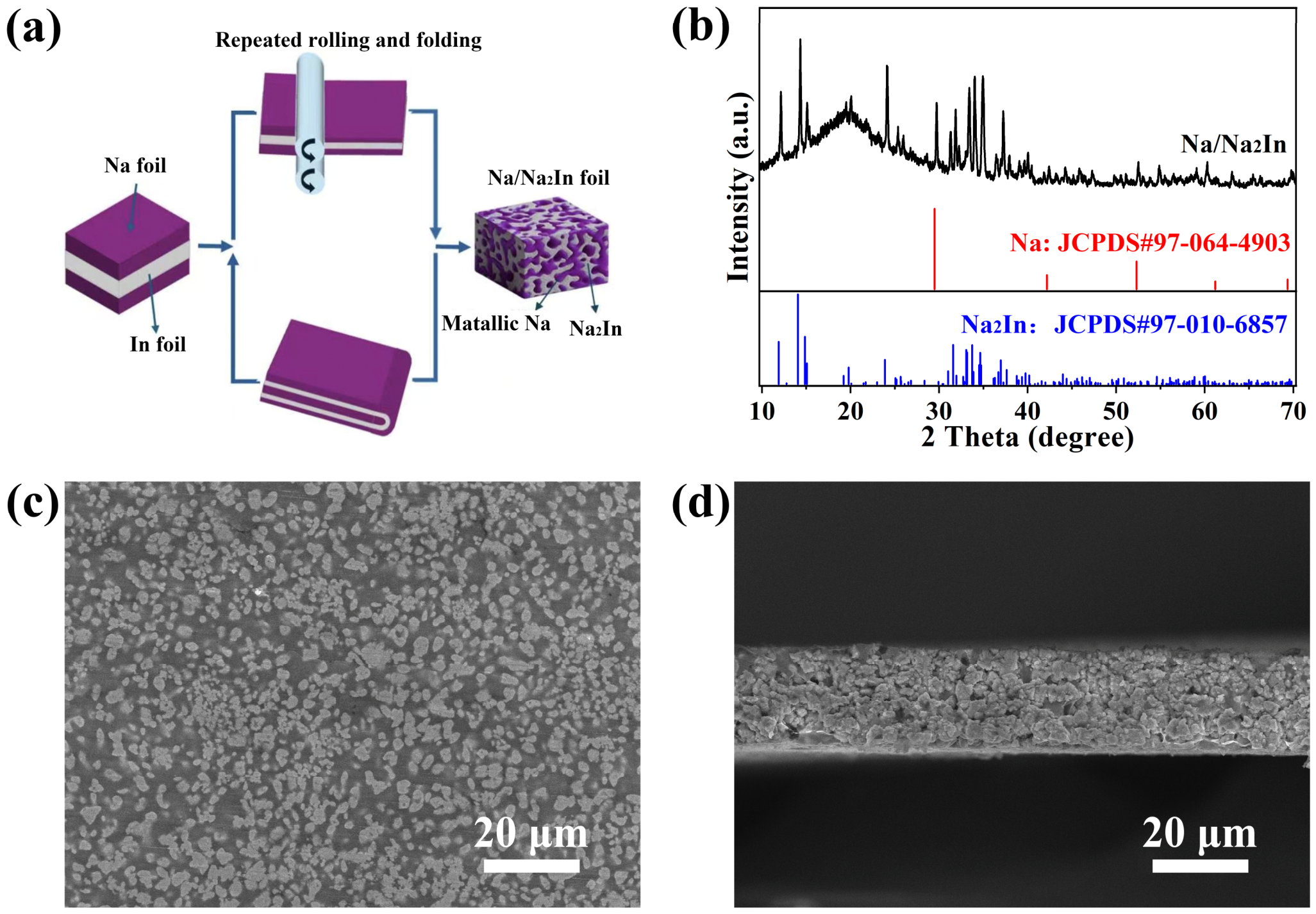
The preparation workflow of the Na/Na2In composite foil is illustrated in Figure 1a. During the repeated rolling–folding process, the “Na-In-Na” sandwich structure is continuously thinned, generating abundant fresh Na/In interfaces that facilitate the in situ alloying reaction [19]. As is shown in the XRD pattern of the Na/Na2In foil presented in (Figure 1b), the Na/Na2In composite foil only exhibits the characteristic peaks of metallic Na and the Na2In alloy, while the diffraction peak of elemental In remains absent. This result confirms that the element In fully alloys with Na during the rolling process and is entirely transformed into the target Na2In alloy phase [23]. A pair of distinct peaks is observed at 1071.9 and 1070.5 eV (Figure S1a) in the high-resolution Na 1s spectrum of Na/Na2In, corresponding to the characteristic signals of Na2In and metallic Na, respectively. As displayed in Figure S1b, a distinct signal corresponding to Na2In is observed at 453.3 eV in the high-resolution In 3d spectrum. These findings are consistent with the results of the XRD analysis. The surface SEM and EDS mapping images of the Na/Na2In composite foil are displayed in Figure 1c and Figure S2, revealing that Na2In particles are uniformly dispersed within the Na matrix. These particles exhibit remarkably uniform sizes without any obvious agglomeration, yielding a dense and completely pore-free structure. This uniform microstructure is favorable for both uniform ion transport and consistent stress distribution—two core prerequisites for achieving stable electrochemical cycling. As shown in Figure S3, the high-magnification SEM image reveals that the Na2In particles exhibit a size distribution ranging from approximately 0.65 to 2.11 μm. The cross-sectional SEM image of the composite foil in Figure 1d, reveals a dense architecture with uniform thickness and no obvious interlayer gaps or voids, indicating the effective integration of the Na and Na2In phases during repeated rolling and folding. This 3D interconnected network formed throughout the entire foil can provide a continuous transmission channel for rapid ion and electron migration in the subsequent electrochemical reaction process. Notably, ex situ XRD was performed on the Na/Na2In electrode after charging to 0.3 V to explore the structural stability of Na2In. As shown in Figure S4, the characteristic diffraction peaks of Na2In remain unchanged, demonstrating that the Na2In phase maintains its crystal structure and composition during the electrochemical process under the operating voltage window employed in this work.
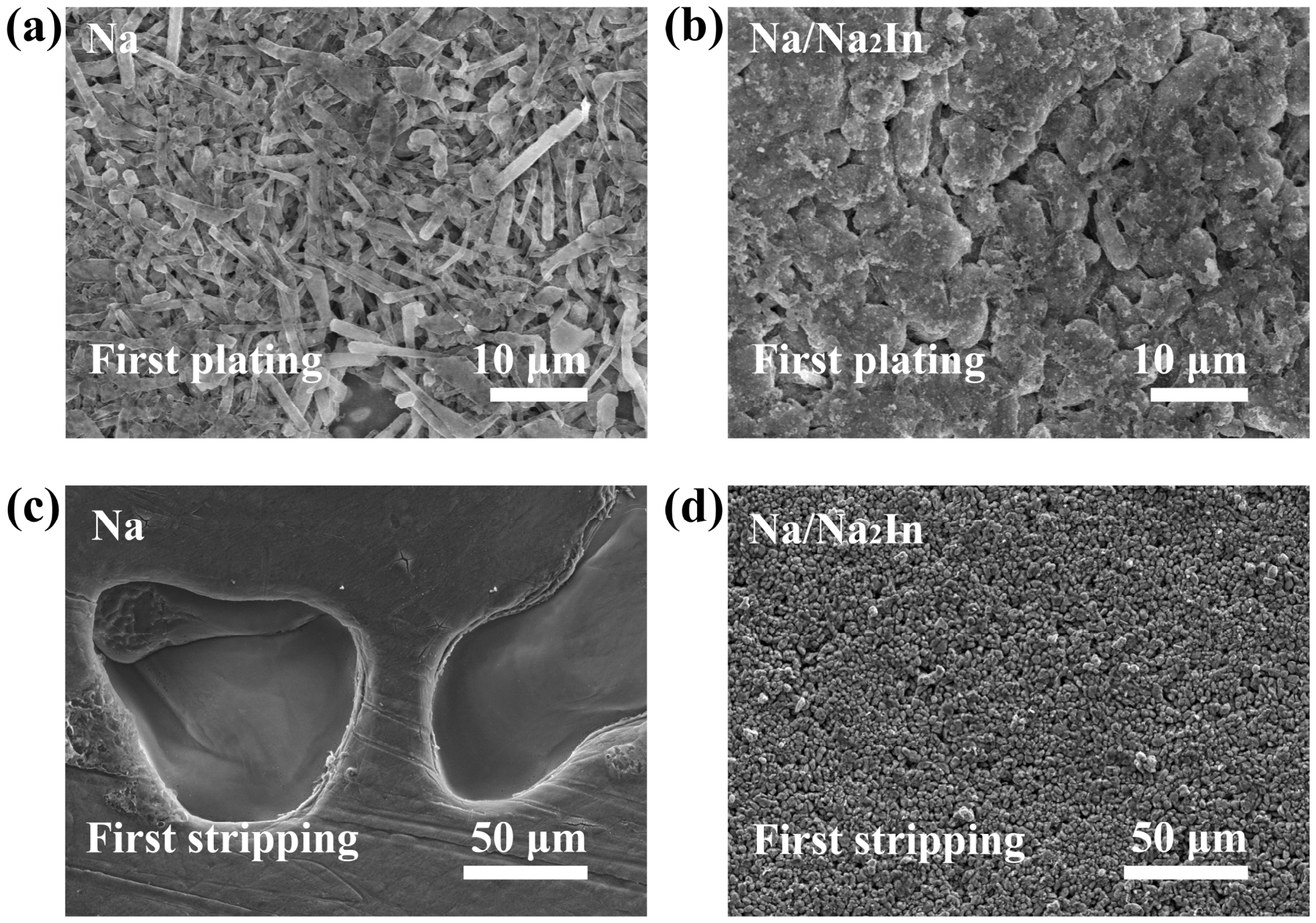
The Na plating/stripping behavior of the Na/Na2In composite foil electrode and pure Na foil electrode was studied by SEM, as shown in Figure 2. After Na plating at 0.5 mA cm−2 and 1 mAh cm−2, the pure Na electrode exhibits a large number of disorderly and stacked needle-like and moss-like Na dendrites (Figure 2a). Such irregular Na dendrite growth markedly expands the electrode/electrolyte contact area and aggravates side reactions while introducing the risk of separator perforation and internal short circuit [24,25,26]. In contrast, the surface of the deposited Na/Na2In composite electrode retains a dense and smooth morphology with no obvious dendrite formation (Figure 2b). The uniformly distributed Na2In framework effectively regulates homogeneous Na nucleation and plating, leading to significantly improved plating uniformity. Furthermore, post-stripping morphological characterization demonstrates the excellent structural stability of the Na/Na2In composite electrode. After Na stripping, the electrode still preserves a flat and compact surface morphology with uniformly dispersed Na2In particles and no obvious pores or pits (Figure 2d). This result indicates that the Na2In network can guide uniform Na stripping throughout the entire electrode volume and effectively prevents structural damage caused by local excessive stripping.
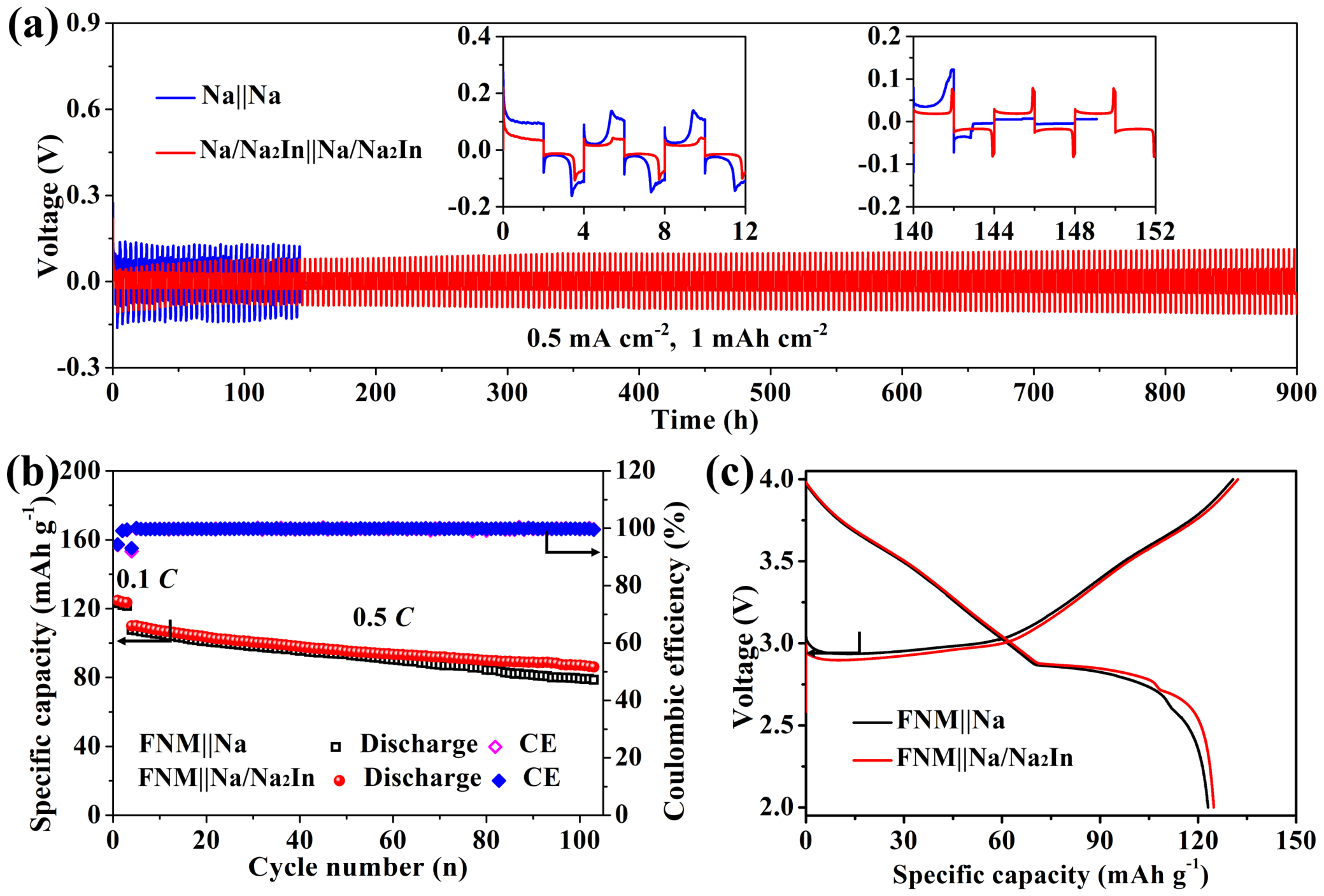
The cycling stability and interfacial kinetics of the Na/Na2In composite electrode in a symmetric cell were evaluated in symmetric cells by galvanostatic Na plating/stripping tests at 0.5 mA cm−2 with an areal capacity of 1 mAh cm−2, as shown in Figure 3a. The Na/Na2In||Na/Na2In symmetric cell exhibits highly stable cycling for more than 900 h with a low polarization overpotential. The voltage curve of this cell is smooth throughout long-term cycling without notable fluctuations, demonstrating the excellent interfacial stability and highly reversible Na plating/stripping behavior. In contrast, the Na||Na symmetric cell shows a large polarization overpotential at the beginning, and the voltage curve shows notable fluctuations throughout the test. Magnified views of the voltage curves (Figure 3a insets) show that the overpotential of the Na/Na2In composite electrode is maintained within 20 mV at the initial stage of cycling and after long-term cycling, which is much lower than that of the pure Na electrode. EIS measurement was carried out for the symmetric cells after 10 cycles to reveal the influence of Na2In in reducing polarization overpotential. As shown in Figure S5 and Table S1, the values of each resistance component were extracted using a suitable equivalent circuit model. The values of each resistance component of the Na/Na2In electrode are much smaller than that of the pure Na. Moreover, after cycling for about 143 h, the voltage of the Na||Na cell sharply drops, indicating internal short circuit caused by the growth of Na dendrites, as confirmed by the SEM image. The reduced polarization suggests accelerated interfacial charge-transfer kinetics and more uniform Na-ion transport at the electrode/electrolyte interface [26,27,28].
Full cells were assembled using the Na/Na2In composite electrode or pure Na as the anode and FNM as the cathode to evaluate the practical electrochemical performance of Na/Na2In. The SEM images show that the FNM particles possess irregular morphologies, with particle sizes ranging from several micrometers to approximately 10~15 μm (Figure S6). The specific capacity of the full cell is calculated based on the mass of active material FNM. The cycling performance of these FNM||Na/Na2In and FNM||Na full cells at 0.5 C (1 C = 120 mA g−1) is shown in (Figure 3b). The FNM||Na/Na2In full cell delivers an initial discharge capacity of 124.8 mAh g−1 and retains 78.3% of its initial capacity after 100 cycles. In contrast, the FNM||Na full cell displays a significantly accelerated capacity decay, with a capacity retention of only 73.3% after 100 cycles. The decreased capacity retention can be attributed to continuous parasitic side reactions and unstable Na plating/stripping behavior, which lead to persistent consumption of active Na and the electrolyte [29]. The first charge–discharge curves of the FNM||Na/Na2In and FNM||Na full cells are shown in Figure 3c. Notably, the FNM||Na/Na2In full cell exhibits a more stable charge and discharge platform and a smaller voltage hysteresis during cycling. The potential difference between the charge and discharge platforms of the FNM||Na/Na2In full cell is significantly lower than that of the FNM||Na full cell, confirming the Na/Na2In composite anode has faster electrochemical reaction kinetics and effectively reduces the polarization of the battery, which is consistent with the symmetric cell test results [26].
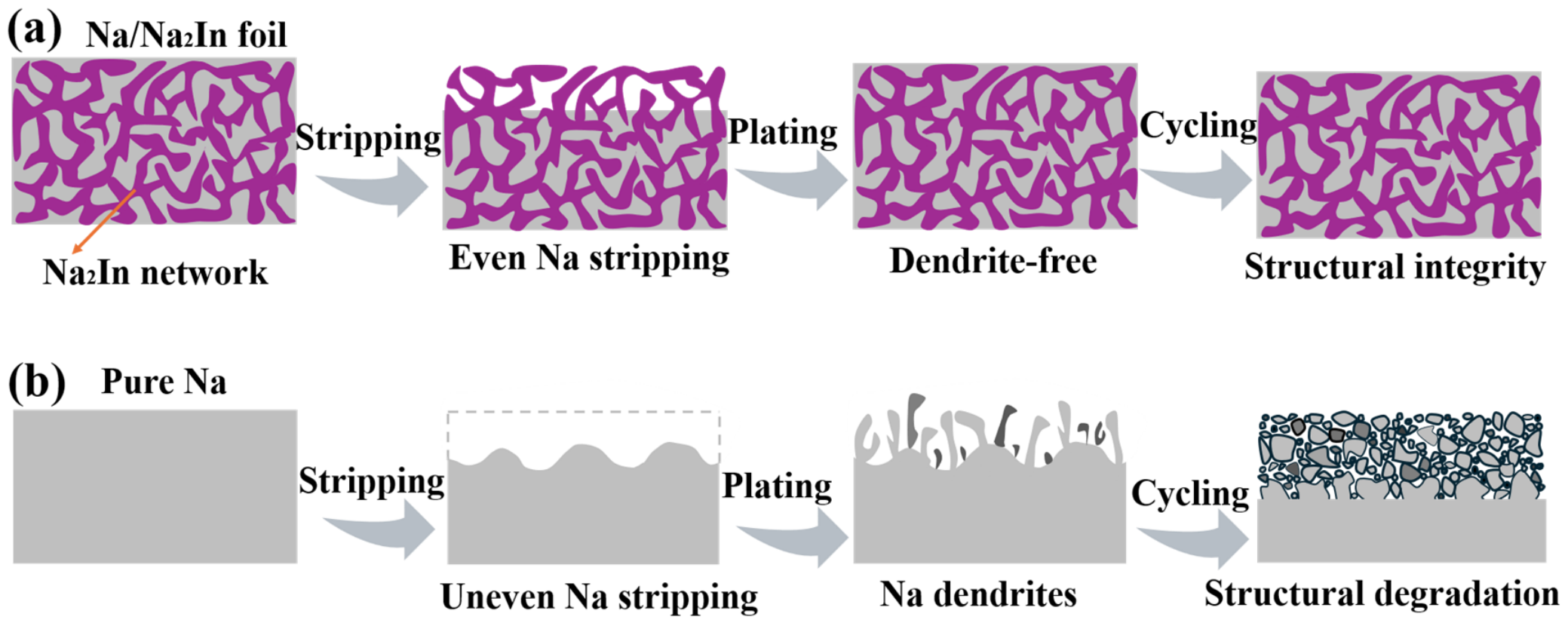
Based on the structural characterization and electrochemical test results, the enhanced cycling stability mechanism of the Na/Na2In composite anode was proposed, as illustrated in Figure 4. The in situ formed 3D interconnected Na2In network in this electrode serves multiple functions in stabilizing the Na metal anode. First, the Na2In alloy has a very low interfacial energy with metallic Na, leading to the formation of a strong interfacial bond that can effectively suppress uncontrolled dislocation motion in the Na matrix during rolling. This significantly improves the processability of metallic Na and enables the preparation of ultra-thin self-supporting foils. In addition, the Na2In alloy has a high Na ion diffusion coefficient and good sodiophilicity, which greatly reduce the nucleation barrier of Na. The Na2In alloy acts as a “high-speed channel” for rapid Na ion diffusion, guiding the uniform nucleation, plating, and stripping of Na throughout the electrode, thereby suppressing the local current concentrations and preventing the growth of Na dendrites [20]. Furthermore, the 3D Na2In network also acts as a stable mechanical skeleton, effectively alleviating volume changes during Na plating/stripping. Thus, the structural integrity and stable electrode/electrolyte interface of the electrode is maintained during long-term cycling, thereby suppressing repeated SEI rupture/reconstruction, mitigating the parasitic side reactions, and reducing the consumption of active Na and the electrolyte [6,30]. In contrast, the pure Na electrode lacks a stable skeleton and ion conduction regulation structure. During cycling, highly uneven Na stripping induces the generation of pores and rough interfaces, which induce localized current concentration during subsequent plating and lead to uncontrollable Na dendritic growth. Meanwhile, repeated volume fluctuations lead to the continuous rupture and repair of the SEI, accelerating the consumption of the electrolyte and active Na. Ultimately, this results in the complete destruction of the Na electrode structure and battery failure [6,13,24,25].
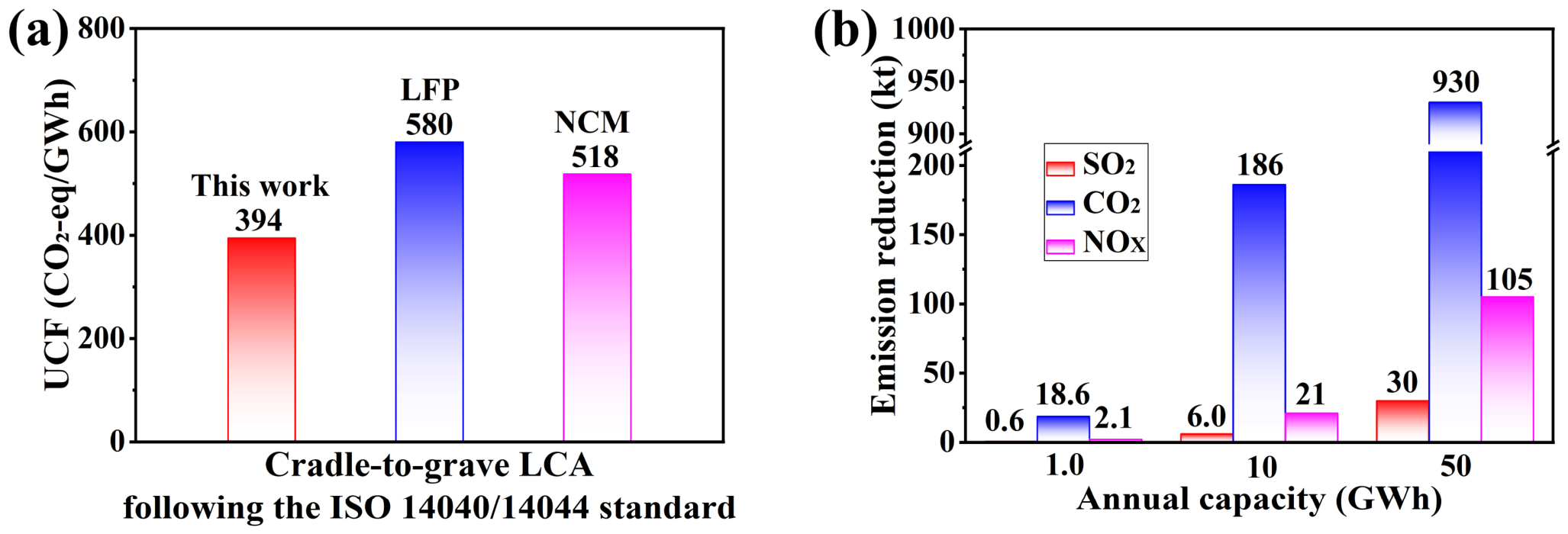
Beyond the improved processability and electrochemical performance, the practical sustainability of Na metal batteries is also an important consideration for large-scale energy storage applications. Therefore, the environmental impact and carbon emission characteristics of the Na/Na2In composite anode-based battery system were further evaluated from a life cycle assessment (LCA) perspective. Following the ISO 14040/14044 standard [31], Na metal batteries utilizing the Na/Na2In composite anode developed in this work exhibit a cradle-to-grave unit energy carbon footprint of approximately 394 t CO2-eq/GWh, corresponding to a 32% reduction relative to commercial lithium iron phosphate (LFP) batteries with a benchmark carbon footprint of ≈580 t CO2-eq/GWh, and a 24% reduction relative to commercial nickel–cobalt–manganese (NCM) ternary lithium batteries with a benchmark value of ≈518 t CO2-eq/GWh [32,33,34,35] (Figure 5a). Specifically, based on the aforementioned carbon footprint differential, for production lines with annual capacities of 1 GWh, 10 GWh and 50 GWh, the annual CO2 emission reductions are calculated to be 18.6 thousand tons, 186 thousand tons and 930 thousand tons, equivalent to the annual carbon sequestration capacity of 103 thousand, 1.03 million and 5.15 million mature broad-leaved arbors, in accordance with the unified measurement standards of national forestry authorities [36]. Correspondingly, these production scales translate to annual savings of 7.5 thousand tons, 75 thousand tons and 375 thousand tons of standard coal, alongside synchronous reductions in sulfur dioxide (SO2) emissions of 2.1 thousand tons, 21 thousand tons and 105 thousand tons, and nitrogen oxide (NOx) emissions of 0.6 thousand tons, 6 thousand tons and 30 thousand tons, according to the industrial emission benchmarks issued by the national ministry of ecology and environment (Figure 5b), thereby effectively mitigating atmospheric pollutant emissions and reducing the over-reliance of the energy storage sector on fossil energy [37]. In view of the markedly more homogeneous global geological distribution of Na resources compared with scarce lithium resources [38], the large-scale deployment of the Na-based battery system developed herein can circumvent irreversible ecological degradation induced by high-intensity lithium mining and beneficiation [39], and significantly curtail incremental carbon emissions stemming from the global cross-border long-haul transportation of lithium raw materials [40], thus holistically improving the full-chain environmental sustainability and low-carbon development potential of grid-scale electrochemical energy storage.

4. Conclusions

In this work, a Na/Na2In composite foil with a three-dimensional interpenetrating structure was successfully fabricated through a scalable rolling–folding process combined with an in situ spontaneous alloying reaction between Na and In. Structural characterization confirmed the complete conversion of metallic In into the Na2In alloy phase, forming a Na/Na2In framework with uniformly distributed Na2In domains embedded within the Na matrix. The introduction of the Na2In second phase effectively improves the processability of Na metal and enables the fabrication of dense ultra-thin self-supporting composite foils. Benefiting from the high Na-ion diffusivity and good sodiophilicity of the Na2In phase, the Na/Na2In composite anode effectively regulates homogeneous Na plating/stripping behavior and suppresses dendritic Na growth. Electrochemical measurements demonstrate that the Na/Na2In symmetric cell exhibits stable cycling for over 900 h with low polarization hysteresis, significantly outperforming its pure Na counterpart. In addition, full cells paired with FNM cathodes deliver improved cycling stability and rate capability, retaining 87% of the initial capacity after 100 cycles at 0.5 C. Overall, this work provides an effective strategy for simultaneously enhancing the mechanical processability and electrochemical stability of Na metal anodes through alloy framework engineering. The scalable fabrication process and improved electrochemical performance highlight the practical potential of the Na/Na2In composite anode for next-generation high-energy-density Na metal batteries, while also offering promising sustainability advantages for large-scale energy storage applications.

Supplementary Materials

The following supporting information can be downloaded at: https://www.mdpi.com/article/10.3390/batteries12070242/s1.

Author Contributions

Conceptualization, L.F.; methodology, J.D. and M.W.; validation, B.Z.; formal analysis, L.F.; investigation, B.Z., J.W., M.L., T.S., G.L., Y.L., J.D. and M.W.; resources, L.F.; data curation, L.F.; writing—original draft preparation, B.Z.; writing—review and editing, L.F. and M.W.; supervision, L.F.; project administration, J.D.; funding acquisition, B.Z. and L.F. All authors have read and agreed to the published version of the manuscript.

Funding

This work was supported by the Guizhou Provincial Basic Research Program (Natural Science) (No. QKHJC-ZK [2023] YB046) and the Innovation and Entrepreneurship Training Program for College Students (No. gzugc2025019).

Data Availability Statement

The raw data presented in this study are included in the article. Further inquiries can be directed to the corresponding authors.

Conflicts of Interest

The authors declare no conflicts of interest.

References

  1. Manthiram, A. An outlook on lithium ion battery technology. ACS Cent. Sci. 2017, 3, 1063–1069. [Google Scholar] [CrossRef] [PubMed]
  2. Tarascon, J.M.; Armand, M. Issues and challenges facing rechargeable lithium batteries. Nature 2001, 414, 359–367. [Google Scholar] [CrossRef] [PubMed]
  3. Usiskin, R.; Lu, Y.; Popovic, J.; Law, M.; Balaya, P.; Hu, Y.-S.; Maier, J. Fundamentals, status and promise of sodium-based batteries. Nat. Rev. Mater. 2021, 6, 1020–1035. [Google Scholar] [CrossRef]
  4. Deng, J.; Luo, W.B.; Chou, S.L.; Liu, H.K.; Dou, S.X. Sodium-ion batteries: From academic research to practical commercialization. Adv. Energy Mater. 2017, 8, 1701428. [Google Scholar]
  5. Yabuuchi, N.; Kubota, K.; Dahbi, M.; Komaba, S. Research development on sodium-ion batteries. Chem. Rev. 2014, 114, 11636–11682. [Google Scholar] [CrossRef] [PubMed]
  6. Xu, J.; Yang, J.; Qiu, Y.; Jin, Y.; Wang, T.; Sun, B.; Wang, G. Achieving high-performance sodium metal anodes: From structural design to reaction kinetic improvement. Nano Res. 2023, 17, 1288–1312. [Google Scholar] [CrossRef]
  7. Brunklaus, G.; Lennartz, P.; Winter, M. Metal electrodes for next-generation rechargeable batteries. Nat. Rev. Electr. Eng. 2024, 1, 79–92. [Google Scholar] [CrossRef]
  8. Hu, M.; Tong, Z.; Cui, C.; Zhai, T.; Li, H. Facile, Atom-economic, chemical thinning strategy for ultrathin lithium foils. Nano Lett. 2022, 22, 3047–3053. [Google Scholar] [CrossRef] [PubMed]
  9. Huang, S.; He, Z.; Li, C.; Pan, W.; Li, W.; Liu, W.; Li, T.; Chen, Y.; Chen, L. Preparation and application of thin-sodium metal. Small Sci. 2024, 4, 2300362. [Google Scholar] [PubMed]
  10. Alaneme, K.K.; Okotete, E.A.; Fajemisin, A.V.; Bodunrin, M.O. Applicability of metallic reinforcements for mechanical performance enhancement in metal matrix composites: A review. Arab J. Basic Appl. Sci. 2019, 26, 311–330. [Google Scholar] [CrossRef]
  11. Xu, B.; Guo, F. Upper and lower bounds on the creep strain and stress relaxation induced by interface diffusion in metal-matrix particulate composites. Int. J. Solids Struct. 2021, 216, 222–230. [Google Scholar] [CrossRef]
  12. Zhuang, R.; Zhang, X.; Qu, C.; Xu, X.; Yang, J.; Ye, Q.; Liu, Z.; Kaskel, S.; Xu, F.; Wang, H. Fluorinated porous frameworks enable robust anode-less sodium metal batteries. Sci. Adv. 2023, 9, eadh8060. [Google Scholar] [CrossRef] [PubMed]
  13. Arora, P.; Doyle, M.; White, R.E. Mathematical modeling of the lithium deposition overcharge reaction in lithium-ion batteries using carbon-based negative electrodes. J. Electrochem. Soc. 1999, 146, 3543–3553. [Google Scholar]
  14. Wang, C.; Wang, T.; Wang, L.; Hu, Z.; Cui, Z.; Li, J.; Dong, S.; Zhou, X.; Cui, G. Differentiated lithium salt design for multilayered PEO electrolyte enables a high-voltage solid-state lithium metal battery. Adv. Sci. 2019, 6, 1901036. [Google Scholar]
  15. Tang, X.; Han, W.; Zhang, Y.; Liu, S. Interface engineering of sodium metal anode for all-solid-state sodium batteries. J. Power Sources 2024, 623, 235397. [Google Scholar] [CrossRef]
  16. Li, Q.; Zhu, S.; Lu, Y. 3D porous Cu current collector/Li-metal composite anode for stable lithium-metal batteries. Adv. Funct. Mater. 2017, 27, 1606422. [Google Scholar]
  17. Lu, X.; Chen, R.; Shen, S.; Li, Y.; Zhao, H.; Wang, H.; Wu, T.; Su, Y.; Luo, J.; Hu, X.; et al. Spatially confined in situ formed sodiophilic-conductive network for high-performance sodium metal batteries. Nano Lett. 2024, 24, 5490–5497. [Google Scholar] [PubMed]
  18. Jia, J.; Guo, B.; Gao, H.; Zhao, Y.; Li, G.; Wang, A.; Liu, C. Stabilizing sodium metal anodes by functional polymers. Mater. Today Energy 2024, 45, 101664. [Google Scholar] [CrossRef]
  19. Wan, M.; Kang, S.; Wang, L.; Lee, H.-W.; Zheng, G.W.; Cui, Y.; Sun, Y. Mechanical rolling formation of interpenetrated lithium metal/lithium tin alloy foil for ultrahigh-rate battery anode. Nat. Commun. 2020, 11, 829. [Google Scholar] [PubMed]
  20. Ojha, M.; Alaei, S.; Jiao, W.; Zohair, M.; Eaves-Rathert, J.; Ramamurthy, J.; Harkaway, A.; Pint, C.L. Role of interface strain and chemo-mechanical effects during electroplating in sodium metal battery anodes. ACS Appl. Mater. Interfaces 2024, 16, 24641–24648. [Google Scholar] [CrossRef] [PubMed]
  21. Wu, W.; Luo, W.; Huang, Y. Less is more: A perspective on thinning lithium metal towards high-energy-density rechargeable lithium batteries. Chem. Soc. Rev. 2023, 52, 2553–2572. [Google Scholar] [CrossRef] [PubMed]
  22. Zhang, C.; Fan, H.; Chen, X.; Xu, H.; Lou, J.; Li, Y.; Huang, Y.; Li, S. Non-sticky Li-alloy leaves for long-lasting secondary batteries. Energy Environ. Sci. 2022, 15, 5251–5260. [Google Scholar]
  23. Boris, N.M.E. International centre for diffraction data (ICDD) welcomes cambridge university press as its new publisher for powder diffraction. Powder Diffr. 2012, 27, 1. [Google Scholar] [CrossRef][Green Version]
  24. Xu, W.; Wang, J.; Ding, F.; Chen, X.; Nasybulin, E.; Zhang, Y.; Zhang, J.-G. Lithium metal anodes for rechargeable batteries. Energy Environ. Sci. 2014, 7, 513–537. [Google Scholar] [CrossRef]
  25. Cen, C.; Yang, X.; Wang, X.; Fu, L.; Li, Y.; Lu, K.; He, L.; Sun, Y. Enhanced electrochemical cyclability of composite sodium metal anode with inorganic-rich solid electrolyte interphase. Chem. Eng. J. 2024, 498, 154898. [Google Scholar] [CrossRef]
  26. Chen, C.; Yang, R.; Zhu, J.; Yao, W.; Tang, Y. Superior sodium metal anodes enabled by 3D hierarchical metallic scaffolds with enhanced sodiophilicity. Adv. Sci. 2025, 12, 2500756. [Google Scholar] [CrossRef]
  27. Tang, S.; Zhang, Y.Y.; Zhang, X.G.; Li, J.T.; Wang, X.Y.; Yan, J.W.; Wu, D.Y.; Zheng, M.S.; Dong, Q.F.; Mao, B.W. Stable Na plating and stripping electrochemistry promoted by in situ construction of an alloy-based sodiophilic interphase. Adv. Mater. 2019, 31, 1807495. [Google Scholar]
  28. Fu, L.; Wang, X.; Wang, L.; Wan, M.; Li, Y.; Cai, Z.; Tan, Y.; Li, G.; Zhan, R.; Seh, Z.W.; et al. A salt-in-metal anode: Stabilizing the solid electrolyte interphase to enable prolonged battery cycling. Adv. Funct. Mater. 2021, 31, 2010602. [Google Scholar] [CrossRef]
  29. Chen, Y.; Cheng, J.; Sun, S.; Tian, Z.; Jiang, X.; Wang, Y.; He, Z.; Liu, C.; Huang, Q.; Guo, L. Constructing hierarchical porous Fe/F-codoped Na3V2(PO4)3/C composite enwrapped with carbon nanotubes as high-performance cathode for symmetric sodium ion batteries. J. Power Sources 2021, 513, 230545. [Google Scholar] [CrossRef]
  30. Wang, H.; Wu, Y.; Wang, Y.; Xu, T.; Kong, D.; Jiang, Y.; Wu, D.; Tang, Y.; Li, X.; Lee, C.-S. Fabricating Na/In/C composite anode with natrophilic Na–In Alloy enables superior Na ion deposition in the EC/PC electrolyte. Nano-Micro Lett. 2021, 14, 23. [Google Scholar] [CrossRef]
  31. Peters, J.F.; Baumann, M.; Zimmermann, B.; Braun, J.; Weil, M. The environmental impact of Li-ion batteries and the role of key parameters—A review. Renew. Sustain. Energy Rev. 2017, 67, 491–506. [Google Scholar] [CrossRef]
  32. Yudhistira, R.; Khatiwada, D.; Sanchez, F. A comparative life cycle assessment of lithium-ion and lead-acid batteries for grid energy storage. J. Clean. Prod. 2022, 358, 131999. [Google Scholar] [CrossRef]
  33. Voß, P.; Gruber, B.; Mitterfellner, M.; Plöpst, J.-D.; Degen, F.; Schmuch, R.; Lux, S. Benchmarking state-of-the-art sodium-ion battery cells—Modeling energy density and carbon footprint at the gigafactory-scale. Energy Environ. Sci. 2025, 18, 8104–8129. [Google Scholar] [CrossRef]
  34. Degen, F.; Mitterfellner, M.; Kampker, A. Comparative life cycle assessment of lithium-ion, sodium-ion, and solid-state battery cells for electric vehicles. J. Ind. Ecol. 2024, 29, 113–128. [Google Scholar] [CrossRef]
  35. Peters, J.; Buchholz, D.; Passerini, S.; Weil, M. Life cycle assessment of sodium-ion batteries. Energy Environ. Sci. 2016, 9, 1744–1751. [Google Scholar] [CrossRef]
  36. Liu, H.; Baumann, M.; Moon, H.; Zhang, X.; Dou, X.; Zarrabeitia, M.; Crenna, E.; Hischier, R.; Passerini, S.; von der Assen, N.; et al. Life cycle assessment of bio-based hard carbon for sodium-ion batteries across different production scales. Chem. Eng. J. 2024, 495, 153410. [Google Scholar] [CrossRef]
  37. Lin, X.; Meng, W.; Yu, M.; Yang, Z.; Luo, Q.; Rao, Z.; Zhang, T.; Cao, Y. Environmental impact analysis of lithium iron phosphate batteries for energy storage in China. Front. Energy Res. 2024, 12, 1361720. [Google Scholar] [CrossRef]
  38. Hwang, J.-Y.; Myung, S.-T.; Sun, Y.-K. Sodium-ion batteries: Present and future. Chem. Soc. Rev. 2017, 46, 3529–3614. [Google Scholar] [CrossRef] [PubMed]
  39. Díaz Paz, W.F.; Seghezzo, L.; Salas Barboza, A.G.; Escosteguy, M.; Arias-Alvarado, P.V.; Kruse, E.; Hufty, M.; Iribarnegaray, M.A. The water footprint of lithium extraction technologies: Insights from environmental impact reports in Argentina’s salt flats. Heliyon 2025, 11, e42523. [Google Scholar] [CrossRef] [PubMed]
  40. Gao, W.; Zeng, X.; Lv, W.; Ye, Z.; Zhou, B.; Zhang, G.; Ren, Z.; Feng, Z.; Jin, W.; Sun, Z. The role of resource sustainability for lithium-ion batteries—A review of existing carbon emission reduction perspectives. eTransportation 2025, 26, 100491. [Google Scholar] [CrossRef]
Figure 1. Preparation process and structural characterizations of the Na/Na2In composite foil. (a) Schematic of the preparation process; (b) XRD pattern; (c) Surface SEM image; (d) cross-sectional SEM image.
Batteries 12 00242 g001
Figure 2. Surface morphologies of electrodes after initial Na plating/stripping. (a) Pure Na electrode after plating; (b) Na/Na2In composite electrode after plating; (c) pure Na electrode after stripping; (d) Na/Na2In composite electrode after stripping.
Batteries 12 00242 g002
Figure 3. Electrochemical performances of Na/Na2In and pure Na electrodes at 0.5 mA cm−2 and 1 mAh cm−2: (a) symmetrical cell constant current cycling curves; (b) full-cell cycling performance; (c) full-cell first charge–discharge curves.
Batteries 12 00242 g003
Figure 4. Schematic diagram of the cycling process of (a) Na/Na2In and (b) pure Na electrodes.
Batteries 12 00242 g004
Figure 5. Life cycle carbon footprint and emission reduction benefits of Na/Na2In composite anode. (a) Cradle-to-grave unit carbon footprint of Na/Na2In, LFP and NCM electrodes (following ISO 14040/14044 standard); (b) Emission reduction in CO2, NOx and SO2 of Na/Na2In compared with LFP at different energy storage scales.
Batteries 12 00242 g005
Disclaimer/Publisher’s Note: The statements, opinions and data contained in all publications are solely those of the individual author(s) and contributor(s) and not of MDPI and/or the editor(s). MDPI and/or the editor(s) disclaim responsibility for any injury to people or property resulting from any ideas, methods, instructions or products referred to in the content.