
Review

Improving Nuclear Magnetic Dipole Moments: Gas Phase NMR Spectroscopy Research

by
Włodzimierz Makulski
Laboratory of NMR Spectroscopy, Faculty of Chemistry, University of Warsaw, Pasteura 1, 02-093 Warszawa, Poland
Magnetochemistry 2026, 12(1), 12; https://doi.org/10.3390/magnetochemistry12010012
Submission received: 29 November 2025 / Revised: 8 January 2026 / Accepted: 14 January 2026 / Published: 16 January 2026
(This article belongs to the Special Issue 10th Anniversary of Magnetochemistry: Past, Present and Future)

Abstract

High-resolution NMR spectroscopy is the leading method for determining nuclear magnetic moments. It is designed to measure stable nuclei, which can be investigated in macroscopic samples. In this work, we discuss the progress in research into light nuclei from the first three periods of the Periodic Table and several selected heavy nuclides. The 1H and 3He nuclear magnetic moments, established using the new double Penning trap facility, are also considered. Both nuclei can be used as references in gaseous mixtures. Gas-phase NMR spectroscopy enables precise measurements of the frequencies and shielding constants of isolated single molecules. They can be used to determine new, accurate nuclear magnetic moments of nuclides in stable, gaseous substances. Particular attention is paid to the importance of diamagnetic corrections for obtaining accurate results. Finding precise diamagnetic corrections—shielding factors —even for light nuclei in molecules is a significant challenge. To date, nuclear moments have been obtained primarily from experimental data. The theoretical approach is mostly unable to predict these values accurately. Some remarks are also made on pure theoretical treatments of nuclear moments.

Graphical Abstract

1. Introduction

Nuclear magnetic moments are related to a nucleus with nuclear spin, and they are expressed as a vector sum of the magnetic moments of the nucleons inside it. This is a valuable physical variable (μ), and it can be used in tests of different calculation theories. These are “ab initio”, semiempirical, or density functional theory calculations. Unfortunately, progress in theoretical computations is still limited to light nuclei, and nuclear magnetic moments are generally treated as experimental quantities. Tables of Nuclear Magnetic Dipole Moments have been published periodically by N.J. Stone for several years. One of the most effective methods for establishing these values is NMR spectroscopy. In this technique, the most critical information is the specific radiofrequency at the peak response in the absorption spectrum. This frequency is proportional to the static B0 field, the nuclear magnetic moment of the observed nucleus, and the shielding effects. Besides the frequencies being observed (ν), a crucial role in the procedure for measuring the nuclear magnetic moments is attributed to knowledge of minor but valuable corrections for shielding effects (σ), previously known as diamagnetic effects. This paper describes recent developments in the determination of nuclear magnetic moments using
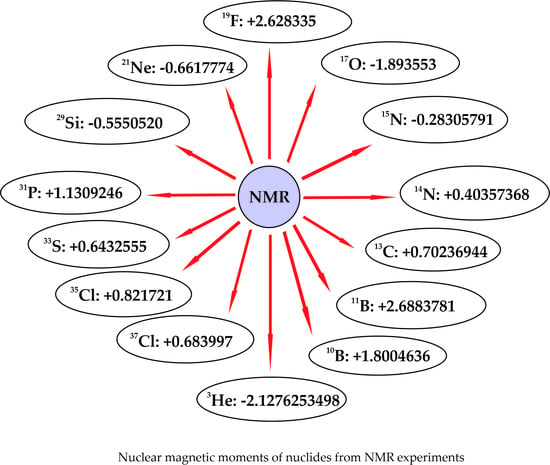
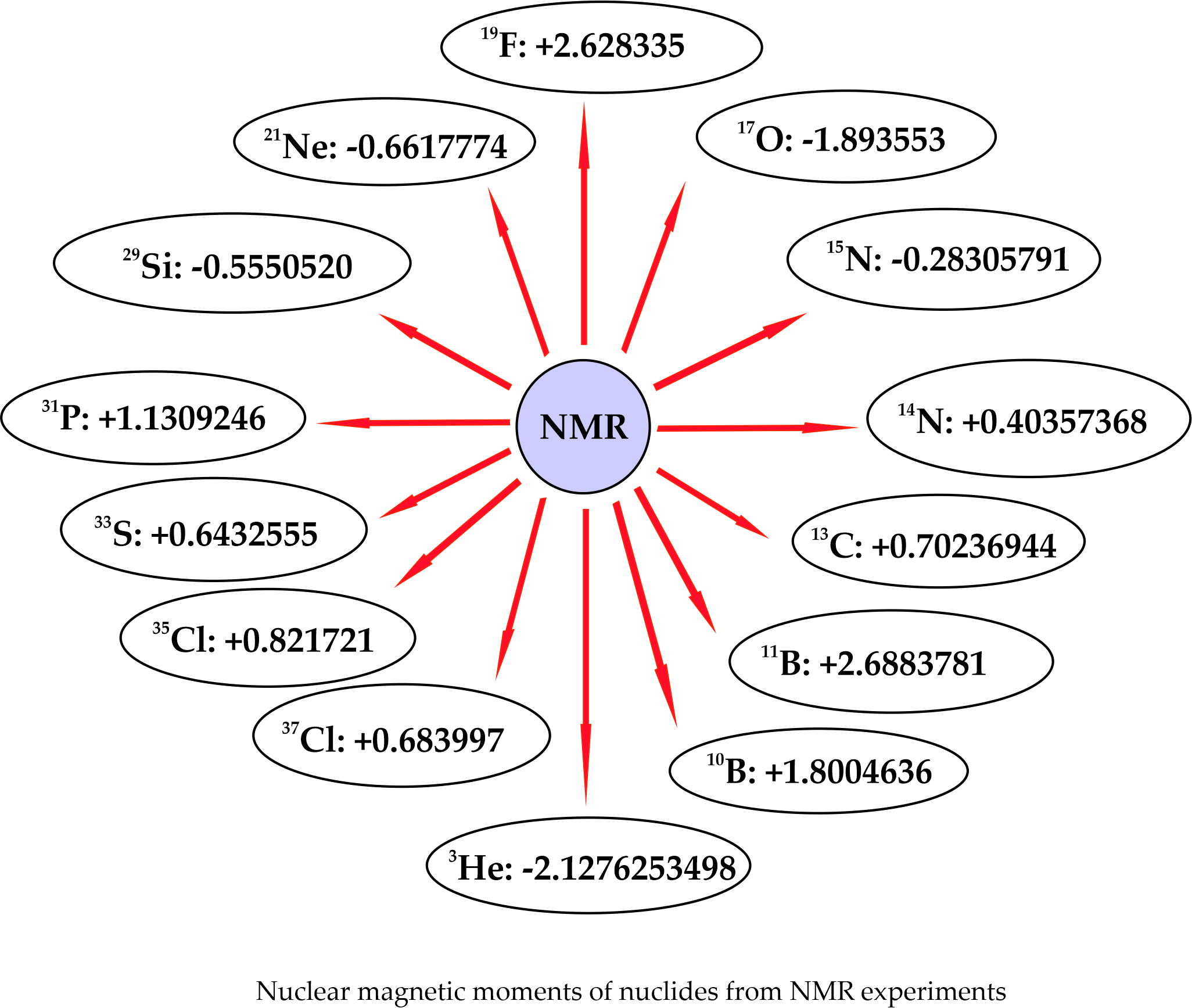
NMR spectroscopy. The nuclides of interest are shown in Figure 1 below.
In the Laboratory of NMR Spectroscopy at the Department of Chemistry at Warsaw University, we have performed several studies in this field in the gaseous state, where diamagnetic corrections and appropriate frequencies can be incorporated throughout the procedure. Gas-phase physical properties can be written as linear functions of the pressure/density of the prepared samples. Linear regression is used to solve linear dependencies analytically. The best-fit line can yield extrapolated NMR parameters for a single “isolated” molecule. The paper covers the experimental details and final results for nuclides from the first three rows of the Periodic Table of Elements, obtained from gaseous experiments, all of which are highly precise and accurate.

2. Methodology

2.1. NMR Method of µ(X) Measurements

To obtain an NMR signal, the conditions require inducing flipping between different nuclear magnetic orientations in the static magnetic field B0. In spectroscopy machines, the B0 field is produced by superconducting magnets, with fields ranging from 1 T to ~22 T (1 T = Tesla). The appropriate electromagnetic waves are in the radio-frequency (RF) region from 100 MHz to ~1000 MHz. To absorb a portion of energy in the NMR regime, the simple relations known as the Larmor equations need to be fulfilled:
h ν Y = Δ μ Y z ( 1 σ Y ) B z
h ν X = Δ μ X z ( 1 σ X ) B z ,
where Bz represents the z component of the firm, stable, and homogeneous magnetic field B0.
The precession (rotation) of the nuclear magnetic moments (NMMs) occurs around the z-axis of the magnetic field (for two different nuclei: νX and νY) at a constant rate ωL, which can be observed in the NMR spectrometer as a radio resonance frequency, where σX and σY are the absolute shielding constants. The conventional relationship between two nuclear magnetic moments and two observed frequencies (νX, νY) measured in the given sample in the same magnetic field B0 can be formulated as [1]:
μ Y z = ν Y ν X · 1 σ X 1 σ Y · I Y I X · μ X z
where µX and µY are two different magnetic moments, νX and νY are NMR frequencies from the spectra, and σX and σY are shielding constants often called diamagnetic corrections. Measurements of nuclear magnetic dipole moments using NMR spectroscopy are exact and accurate. These measurements are well suited to studies of stable isotopes and to those involving slow decay (see, for example, 3H(T)). Finally, we can consider Equation (3) converted to the form:
σ X = 1 ν X ν Y · Δ μ X Δ μ Y · I X I Y · ( 1 σ Y )
This will be used to check the consistency of the new shielding results and nuclear magnetic moments. It is possible to use other pairs of nuclei than those applied in Equation (3). In this case, experiments with the addition of helium-3 gas are beneficial.

2.2. Gas Phase NMR Measurements

The best-known extension of the gas property to higher powers of density is the so-called “virial expansion”. The dependence of density and pressure for any molecular property in a pure gas can be expressed in this straightforward manner. Several physical properties of gases can be easily understood using the general virial theorem. In our case, the more important property—the nuclear magnetic shielding of a given nucleus in a pure gas σ(ρ, T)can be described as a virial expansion in the density function (ρ) at a specific temperature (T), as shown here [1,2]:
σ(ρ,T) = σ0 + σ1(T)ρ + σ2(T)ρ2 + σ3(T)ρ3 + …
where σ0 is the shielding constant of the nucleus in the “isolated” atom or molecule, and σ1, σ2, and σ3 are virial coefficients arising from two, three, or more-body collisions. At low pressures (density below ~1.64 mol/L at 297 K), the dependences are strictly linear because only the first two coefficients are essential, in this manner:
σ(ρ,T) = σ0 + σ1(T)ρ
Similar equations can be used when exploring mixtures of gaseous substances. These systems can be studied as binary mixtures of a gaseous substance A containing the nucleus X, whose shielding σ(X) is measured, and gas B, the solvent. Equation (1) can be written as:
σ(X) = σ0(X) + σAA(X)ρA + σAB(X)ρB + …
where ρA and ρB are the densities of substances A and B, the coefficients σAA(X) and σAB(X) contain the bulk susceptibility corrections ((σA)b and (σB)b) and the terms involving intermolecular interactions during the A–A and A–B collisions (σAA(X) and σAB(X)). Again, if the concentration of substance A under investigation is sufficiently low (usually <1%), the σAA(X) can be entirely omitted, and the final equation is:
σ(X) = σ0(X) + σAB(X)ρB
Equation (6) was used for pure simple gases such as CH4, SiH4, and PH3. Sometimes the additional ingredients were maintained by small amounts of gaseous 3He. In this case, Equation (7) is valid because the amount of helium is small. Contributions to σ1 or σAB include the Van der Waals field, the electric field, and the molecular anisotropy of neighboring molecules, as well as the bulk susceptibility. The bulk susceptibility (4πχM/3 in B‖ external field) can generally be removed from σ1 or σAB, so that only the proper intermolecular effects are present. Each σ1 parameter is described by a complex function of the intermolecular separation and orientation between two interacting molecules (an intermolecular shielding surface). Ab initio methods can calculate this function, but the appropriate procedure is computationally intensive and, to date, has been obtained only for the simplest molecular systems.

2.3. State-of-the-Art Quantum Mechanical Computations

Gas-phase NMR measurements are usually straightforward and can yield precise frequency measurements when relaxation times are sufficiently long and the spectral resolution is sufficiently high. On the other hand, diamagnetic corrections (shielding constants) are more demanding and require advanced theoretical methods. Nuclear shielding in molecules is, in principle, the function of their electronic structure. Usually, a large number of electrons increases the shielding effect; however, several deshielding effects have also been observed in diamagnetic molecules [1,3]. Gas-phase experiments allow us to eliminate all intermolecular interactions by extrapolating shielding measurements to the zero-pressure limit. In this context, the experiment is associated with a significant portion of quantum chemical calculations, specifically those involving the so-called “isolated” single molecules. More popular methods include perturbative treatments. In a perturbative theoretical approach, iterative corrections yield approximate solutions [4]. The gauge-including atomic orbitals (GIAO) approach is employed chiefly here, incorporating magnetic-field-dependent gauge factors into the atomic basis sets. Several approximate perturbation theories with specific variants are used: the HF (Hartree-Fock), MCSCF (Multi-Configuration Self-Consistent-Field), the CC (Coupled Cluster), such as CCS, CC2, CCSD, CCSDT, etc., and the MP (Möller-Plesset) model up to FCI (Full Configuration Interaction). In larger molecules, the same specific methods were used: DFT (Density Functional Theory) or the ONIOM method, with great success [3]. NMR spectral parameters are first computed for the molecule’s equilibrium geometry, which can be experimental or fully optimized to minimize electron repulsion forces. These shielding values σe(X) are then corrected for vibrations and rotations, e.g., by applying the zero-point vibration correction σ(X)ZPV and by averaging over the Boltzmann distribution up to room temperature, σ(X)T (usually at 300 K). Sometimes, using gas-phase NMR data, one can separate these corrections by studying isotope effects and comparing them with quantum-chemical computations (e.g., for the H2O molecule [5]). Three factors influence calculations of NMR parameters: the size of the basis set, electron correlation, and relativistic effects. Electron-correlation effects were incorporated into the primary methods mentioned above. Even for light nuclei, it is essential to account for relativistic corrections. For example, within the so-called four-component relativistic framework, the absolute shielding of the isolated NH3 molecule was established [6]. For the BF3 molecule, the shielding constant was obtained as the sum of a nonrelativistic electron-correlated contribution and a relativistic correction computed at a lower level of theory [7]. The spin-rotation and nuclear magnetic shielding constants are analyzed for both nuclei in the HCl molecule [8]. Nonrelativistic ab initio calculations at the CCSD(T) level of theory show that relativistic effects are essential to obtain spin-rotation constants consistent with accurate experimental data. For small molecules, experimentally determined nuclear magnetic shielding should be consistent with that computed using the more sophisticated methods. It is worth noting that fully relativistic coupled-cluster (RCC) methods, often using four-component Dirac-Hartree-Fock (DHF) or two-component (2C) Hamiltonians (e.g., ZORA), are crucial for calculations of nuclear magnetic shielding constants for heavy nuclei (for example, 75As, 121Sb, 123Sb, 123Te, 125Te, and others), which significantly correct non-relativistic results. They improve agreement with experiments and resolve discrepancies in absolute shielding results. These new treatments, which incorporate spin–orbit coupling and complex calculations, are essential for heavy elements, clarify large relativistic corrections, and complement the collapse of nonrelativistic relationships between nuclear spin-rotation constants (CI) and shielding constants (σ).

2.4. Absolute Shielding Scales

Standard NMR spectra make it possible to measure the chemical shifts (δ), values expressed in ppm units against the reference, which is the liquid sample taken arbitrarily during the NMR development. Nevertheless, the more fundamental measure of electron screening effects is nuclear magnetic shielding (σ). The absolute shielding scale measures the local magnetic field at a nucleus, influenced by the nearby electron clouds. It comprises several results for a series of molecules with well-characterized shielding constants at room temperature (preferably 300 K) and for a single liquid reference substance. The absolute shielding scales utilize the magnetic shielding of at least one simple compound, for which the shielding constant is well documented and widely accepted [2,3,4]. For example, 1H [9] and 13C [10] NMR shielding is well established for many small “isolated” molecules, and the CH4 molecule is a primary reference. For other nuclei, new, usually complicated and bothersome theoretical studies are necessary, at least for a simple molecule considered as a reference. They should distinguish between intramolecular and intermolecular effects on the shielding tensor, depending on the external and induced fields at a given nucleus. They can often be compared with experimental results [2,11]. The liquid reference substance, e.g., TMS (tetramethylsilane), can be used in 1H, 13C, and 29Si resonance studies to evaluate results obtained in both gaseous and liquid states. For the determination of the nuclear shielding in the molecule on which the scale is based, it is possible to use different measurable quantities: spin precession frequencies, spin rotation constants, and/or nuclear relaxation times [3]. Gas-phase experiments are preferred because they eliminate strong intermolecular interactions that are always present in condensed phases. They are omitted entirely when gas-phase results are extrapolated to the zero-pressure limit. Using these methods, absolute shielding scales for 1H, 13C, 15N, and 29Si, as well as for other nuclei, were established. An alternative procedure for determining absolute shielding scales is based on the Ramsey–Flygare relationship [10], which, for heavy nuclei, requires relativistic corrections. The Ramsey–Flygare relationship enables the determination of nuclear shielding from the spin-rotation constant. Recent developments in absolute shielding scales for NMR spectroscopy and relativistic effects on nuclear magnetic shielding are discussed in Refs. [12,13].

3. Results

The previously studied gaseous systems are listed in Table 1.
Experimental values of nuclear moments for light nuclei, from the first rows of the Periodic Table, can be found in Table 2. They belong to particular nuclei: hydrogen isotopes 1/2/3H, 3He, 13C, 14N, 15N, 17O, 19F, 21Ne, 29Si, 31P, 33S and 35/37Cl. All values are expressed in the units of the nuclear magneton, i.e., µN = 5.0507837393(16) × 10−27 JT−1. The nuclear magneton is a physical constant calculated as µN = eħ/2cmp where p refers to the proton. The previously published results are in the third column of the table and are cited as Ref. [19]. The preferred results, with the highest accuracy and precision, are listed in the fourth column, along with their corresponding sources. The signs of nuclear magnetic moments (plus or minus) cannot be obtained from the usual NMR measurements. They were established using molecular beam magnetic resonance (the ABMR method), in which asymmetry in the absorption resonance curves upon introduction of an oscillating field can identify the quantum numbers and the sign of the nuclear moment. The spin quantum numbers, along with their parity, are also included. Hydrogen isotopes are notable for their excellent accuracy and high precision. 1H and 2H isotopes can serve as useful reference points, as they are found in many volatile hydride compounds (HD, HT, CH4, NH3, H2O, CH3F, SiH4, PH3, HCl) and as lock channels in NMR apparatuses. Therefore, it is possible to move 1H or 2H frequencies and diamagnetic correction factors (shielding constants) to other nuclides using the list of molecules shown above (Table 1).
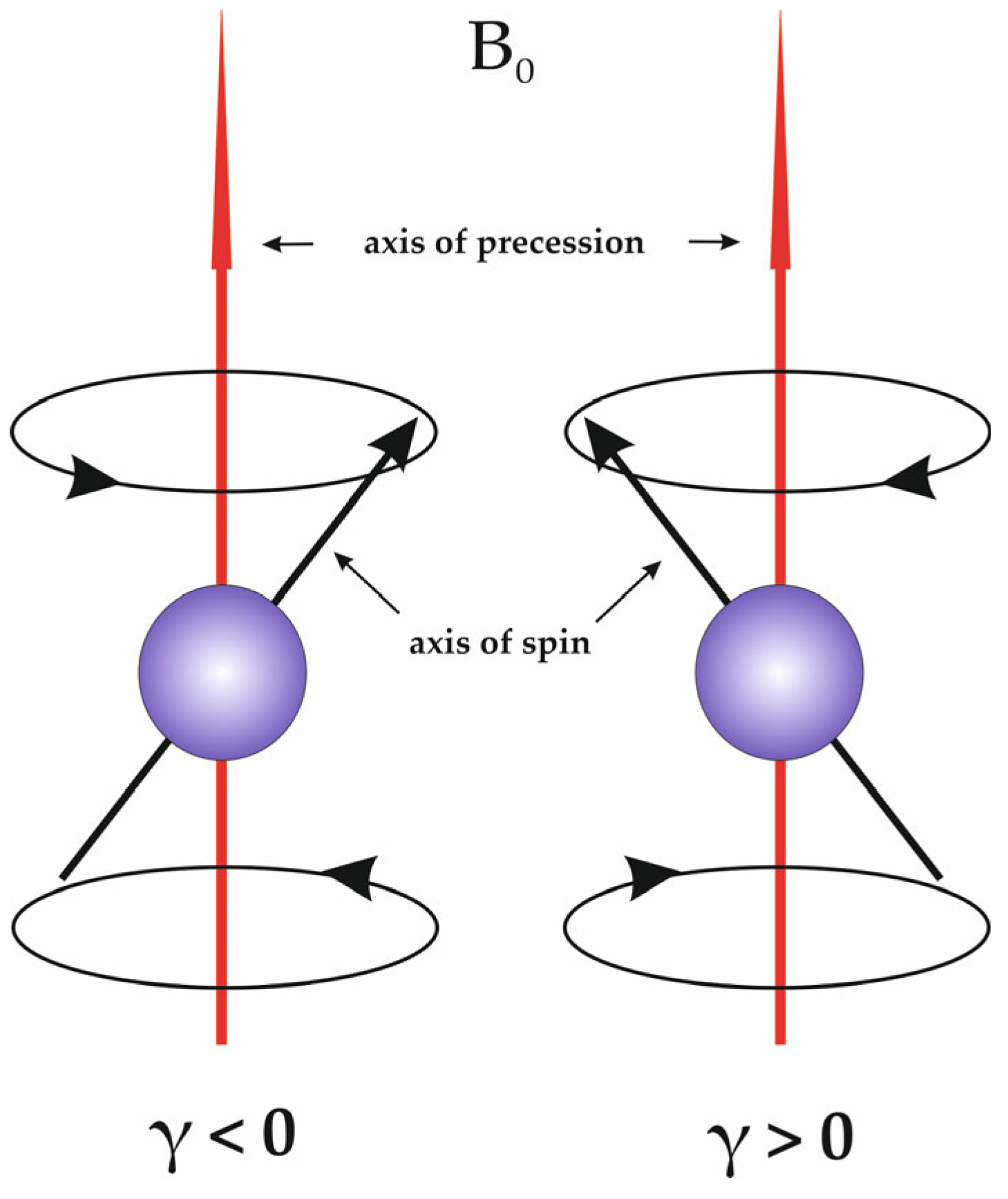
Remember that the nuclear magnetic moments μ(X)μN (written also as µX) shown in Table 2 are the projection value of the full vector onto the measurement axis. In fact the total length of the nuclear magnetic moment vector is μ X length = ( ( Ι Χ ( Ι Χ + 1 ) / I X ) / µ X larger than this projection, despite this µX is commonly referred to in the literature as the nuclear magnetic moment. Sometimes, physicists make use of the g factor of nuclei instead of nuclear magnetic moments expressed in nuclear magnetons. The g factor (g value) is a dimensionless quantity which characterizes the magnetic properties of nuclei and can be ciphered as gX = µXNIX. For proton (1H) the g factor equals +2.79284734463(82)/1/2 = +5.5856946893(16). On the other hand, the gyromagnetic ratio represented by the γ symbol, which describes the ratio of a nuclear magnetic moment to its angular momentum, is closely related to the following g factor: γX = gnµN/ħ, where ħ is the h-bar. It can be expressed in SI units s−1T−1 or equivalently in MHzT−1. The proton gyromagnetic ratio is γ(1H) is 2.6752218708(11)·108 s−1T−1 or 42.577478461(18) MHz/T. The gyromagnetic ratio of a given nucleus plays an important role in both NMR and MRI spectroscopic methods. These three constants µ(X), g(X) and γ(X), which characterize the magnetic properties of nuclei are utilized alternatively in different branches of chemistry and physics (see Figure 2). The appropriate analogs of nuclear moments one can find in Appendix A.

4. Discussion

The dipole magnetic moment of a proton (1H) is a fundamental constant in nuclear physics, with far-reaching consequences for chemistry, physics, astrophysics, and quantum theory. It has been measured many times before. Recently, a direct, precise measurement was performed using a double Penning trap system by physicists at Mainz University [20]. The experiment was conducted in two parts: the first step included isolation of a single proton in the magnetic trap, and the second step involved measurements of two frequencies—the spin-precession Larmor frequency and the cyclotron frequency of the proton in the magnetic field. Three individual protons were used, and the experiment lasted approximately 4 months, including preparatory work. The μ(1H) result published in Science in 2017 was measured at 2.79284734463(82) µN, with an accuracy of 0.3 parts per billion. Deuteron (2H/D) and triton (3H/T) nuclear magnetic moments were determined from measurements of frequency ratios in HD and HT molecules, supplemented by precise calculations of the shielding effects of H, D, and T nuclei [14]. The shielding corrections for deuterated and tritiated nuclei in HD and HT molecules are minimal: σ(D) = 26.372801(1) ppm (parts per million) and σ(T) = 26.391456(2) ppm. The operation of 3H(T) is more demanding due to its radioactivity. Triton has a long half-life of 12.32 years and can be taken as gaseous HT. The source of gaseous tritium gas (HT) can be titrated water (diluted HTO in excess of H2O). Fortunately, tritium atoms decay by beta emission of low-energy electrons (average 5.7 keV), which can penetrate only 6 cm of air and cannot escape from NMR test tubes. Careful manipulation of samples remains necessary.
Helium-3 was investigated in a Penning trap to directly measure the nuclear g-factor of the 3He+ ion, shielded by only a single electron. The nuclear magnetic moment of the 3He bare nucleus can be obtained by diamagnetic correction of 35.50738(3) ppm in He+ ion [21]. The final result is µ(3He) = −2.1276253498(15) µN, with an accuracy of 0.7 parts per billion. The terrestrial 3He gas can be supplied by some chemical trading companies (e.g., Chemgas, Isotec) at low pressures up to ~2.5 atm. It is beneficial that helium-3 can be mixed with appropriate gaseous substances and measured in conventional NMR spectrometers (see, for example: 3He/H2, 3He/NH3, 3He/CO, and 3He/CH4 and other mixtures) [18]. Analysis of these systems yields nuclear magnetic moments for 10B, 11B, 13C, 14N, 15N, 31P, and 33S.
The 13C nuclear magnetic moment was calculated in the enriched 13CH4 molecule against 1H parameters where ν0(13C)/ν0(1H) is 0.2514473143(66) using shielding correction σ0(13C) = 195.01(90) ppm [15]. Confirmation of this result was achieved using helium-3 parameters, where ν0(13C)/ν0(3He) in the zero-pressure limit is 0.3300743617(61). The final results are in excellent agreement with each other. Analogously, the appropriate frequency ratios in the NH3 molecule are as follows: ν0(14N)/ν0(1H) = 0.0722342561(4) and ν0(15N)/ν0(1H) = 0.101327121(1). These numbers were corrected using new relativistic shielding constants for the nitrogen nucleus in ammonia, σ0(14/15N) = 266.78 ppm [6] with an error of less than 1 ppm. 3He spectroscopic data confirm these final results for the magnetic moments. Similarly, accurate calculations were made in H2O (σ0(17O) = 328.4 ± 0.3) ppm) and CH3F (σ0(19F) = 470.85 ± 5 ppm) molecules to achieve 17O [5] and 19F [1] nuclear magnetic moments. 17O-enriched water was dispersed in pure gases (Kr, Xe, CH3F, and CF3H), and 1H and 17O NMR spectra were recorded. The most accurate calculations of magnetic shielding were performed in H2O, the smallest oxygen-containing molecule suitable for an NMR reference procedure. On the other hand, the 1H and 19F NMR spectra were measured in a pure CH3F molecule.
In the case of the 29Si nucleus, the stable silane, the silicon analog of methane, was employed. The measured frequency ratio is ν0(29Si)/ν0(1H) = 0.198650063(1) [16]. The main error in the magnetic moment arises from the diamagnetic correction applied to the 29Si shielding value. It can be as large as 2 ppm, depending on the precision of the theoretical calculations; σ0(29SiH4) = 482.85 ± 2 ppm. Phosphine was the simplest phosphorus hydride compound used for gaseous experiments and NMR measurements of 1H and 31P NMR spectra. The glass samples containing 3He/phosphine mixtures were prepared with great care due to PH3’s extremely poisonous, flammable, and explosive properties. The frequency ratios here are as follows: ν0(31P/ν0(1H) = 0.404698969 and ν0(31P)/ν0(3He) = 0.5312482456. The diamagnetic corrections were computed theoretically in absolute shielding units: σ0(31P) = 614.758 ± 4 ppm and σ0(1H) = 29.305 ± 0.2 ppm [17].
33S is a quadrupolar nucleus, and consequently, its NMR signal widths are often large, depending on the chemical symmetry occupied by the nucleus in molecules. Short relaxation times in the gas phase also broadened signals for simple compounds such as SO2, SO3, H2S, and CS2. Fortunately, sulfur hexafluoride (SF6), with a central sulfur atom bonded to six fluorine atoms, has an octahedral geometry. SF6 is a very stable gaseous substance. Several samples of gaseous 3He/SF6 mixtures were prepared and analyzed by 3He, 19F, and 33S NMR spectroscopy. The ratio of frequencies ν0(33S)/ν0(3He) = 0.10074480(17) were measured in the zero-pressure limit. The new nuclear magnetic moment of 33S is generally consistent with previous results but is substantially more accurate. Recalculated shielding constant σ0(33S) in the SF6 molecule using Equation (4) against 19F parameters is 396.3 ± 5 ppm [18] in good agreement with σ0(33S) = 392.6 ppm from theoretical calculations [23].
The last case of hydride compounds discussed here is hydrogen chloride, a gaseous substance in a mixture with helium-3, which was studied using 1H, 3He, 35Cl, and 37Cl NMR measurements [8]. The appropriate frequency ratios at the zero-pressure limit are as follows: ν0(35Cl)/ν0(1H) = 0.0979818(4), ν0(35Cl)/ν0(3He) = 0.1286204(5), ν0(37Cl)/ν0(1H) = 0.0815596(9), and ν0(37Cl)/ν0(3He) = 0.1070630(1). The best ab initio calculations of shielding constants in an isolated HCl molecule give σ0(35/37Cl) = 976.20 ± 5 ppm, irrespective of chlorine isotope, and σ0(1H) = 31.403 ± 0.5 ppm. These were used to calculate µ(35Cl) and µ(37Cl) of bare nuclei.
Unfortunately, boron forms only one stable gaseous hydride, diborane (B2H6), which is very reactive with moisture and oxygen and highly toxic. We therefore decided to use the fluorinated gas BF3, which is safer to handle and commercially available [7]. A reference nucleus is now the 19F nuclear magnetic moment. The experimental frequency ratios here are: ν0(11B)/ν(3He) = 0.42117005(4), ν0(10B)/ν0(3He) = 0.141033238(4), ν0(11B)/ν0(19F) = 0.341028031(5), and ν0(10B)/ν0(19F) = 0.114196831(4). The diamagnetic corrections of boron nuclei are as follows: σ(11B) = 97.882 ± 3 ppm and σ(10B) = 97.879 ± 3 ppm, suggesting a small isotope effect. The 19F diamagnetic corrections are here even larger: σ(10B19F3) = 331.95 ± 4 ppm and σ(10B19F3) = 332.01 ± 4 ppm. The accuracy of the nonrelativistic results for the equilibrium geometry largely determines the accuracy of these values and the estimated error bars.
It is known that neon does not form stable compounds at standard conditions. Because of it, the 21Ne moment was established from the 1H moment and the frequency ratio ν(21Ne)/ν(1H) = 0.07894287214(35) measured in gaseous neon against the proton resonance frequency of the residual signal of benzene-d6 used in the lock system [22]. Diamagnetic correction applied for the neon nucleus in the neon atom is assumed as σ0(21Ne) = 557.11 ± 1.5 ppm [24].
The most abundant isotopes of argon, consisting of 18 protons and a different number of neutrons, are 40Ar, 38Ar, and 36Ar. None of them possesses a magnetic moment and a non-zero spin number. In fact, argon is a unique case in the Periodic Table where contemporary NMR spectrometers have recorded no NMR spectra. However, spectroscopic measurements were carried out for 39Ar nuclei [25], with nuclear spin I = 7/2 and magnetic moment µ(39Ar) = −1.590(5)µN, employing optical spectroscopy and a Fabry-Perrot interferometer with photoelectric detection. The 39Ar nucleus is long-lived, with a half-life of 268(8) years; its samples are radioactive. They can be produced in the 39K(n,p)39Ar reaction. The quantity ratio of the 39Ar/Ar was established as ≤4·10−17. The nuclear magnetic moments of other short-lived argon isotopes were measured in fast-beam neutral-atom experiments, with reference to the NMR measurement of 37Ar [26]. The internal structure of even-even argon isotopes was studied using nuclear magnetic moments within the shell model [27].
Interestingly, specific gas phase experiments were performed for heavy nuclei: 83Kr (in gaseous krypton) [28], 129Xe and 131Xe (in gaseous xenon) [29], 183W (for WF6 in gaseous CF4) [30], 117Sn and 119Sn (for SnMe4 in gaseous CO2 and N2O) [31] and 207Pb (for PbMe4 in gaseous Xe and SF6) [32]. Obviously, the NMR method can be applied to light and heavy nuclides, which are observed primarily in liquid solutions. Good examples are here: 6Li and 7Li (LiCl and LiNO3 water solutions) [33,34], 23Na (NaCl, NaNO3, NaClO4 water solutions) [35], 39K (KCl and KNO3 water solutions) [36], 77Se (SeMe2 molecule) [37], 79Br and 81Br (KBr · Kryptofix 222 complex) [38], 75As (Na3AsO4) [39], 85Rb and 87Rb (RbCl and RbNO3 water solutions) [40], 121Sb, 123Sb (KSBF6) [39], 123Te and 125Te (TeMe2 molecule) [37], 133Cs (CsF, CsCl and CsNO3 water solutions) [41] and finally 209Bi (Bi(NO3)3 and Bi(ClO4)3 water solutions) [42,43]. Most of the papers listed above were published in the past ten years, underscoring the importance and status of investigations of nuclear magnetic moments.
All experimental results mentioned above and preferred today are included in Table 2. The frequency ratios discussed above can be helpful for future recalculations if only better diamagnetic corrections become available. When shielding corrections are denoted with a subscript 0 (σ0), they refer to a parameter for a single isolated atom or molecule. For convenience, the relevant nuclear magnetic moments μ(X) = hγXIX = µNgXIX in nuclear magnetons (μN) were recalculated to full-length analogs μ(X)length, g(X) factors, and gyromagnetic factors γ(X), which can be found in Appendix A Table A1. The appropriate correction factors for μ(X)length can be found in Appendix A, Table A2.

5. Conclusions

NMR experiments conducted over the past 20 years in the gaseous state have successfully probed various nuclear magnetic moments. Gases are well suited to this procedure because they enable the acquisition of NMR parameters from “isolated” molecules. Such molecules are not burdened by intermolecular interactions, which can be calculated relatively easily and accurately using quantum-mechanical methods. Experimental frequencies can be obtained by measuring several gaseous samples at different pressures and extrapolating to the zero-pressure limit. For low-density gases, the use of enriched material is strongly recommended. This method is not limited to the gas phase but can, under certain conditions, be extended to liquids and solutions. Measurements of nuclear magnetic moments are among the most accurate in physics and chemistry. The precision of final results depends on so-called “diamagnetic corrections,” which are more critical for heavier isotopes than for lighter ones. Therefore, theoretical advances in this field are crucial for establishing accurate nuclear magnetic moments. For the light nuclides discussed in this work, discrepancies between results (1H–21Ne) corrected using different shielding constants are typically below 0.0005%. The diamagnetic corrections rise in the series of nuclides 1H, 3He, 10/11B, 13C, 14/15N, 17O, 19Ne, 21Si, 33S, up to 35/37Cl. The same systematic increase in errors is observed in their accuracy. In this light, the hydride substances or gaseous helium-3 are more valuable reference substances than fluorine compounds. In the case of 123Sb, this error can be in the order of 0.01% of the magnetic moment and even higher for very heavy nuclei.
The best-known nuclear magnetic moment is that of the proton (1H) nucleus, +2.79284734463(82)μN. The analogous magnetic moment was estimated for the short-lived antiproton particle. A unique apparatus, using the two-particle spectroscopy method in an advanced cryogenic multi-Penning trap system, employed at CERN, was also used for the measurement of the antiproton magnetic moment with a fractional precision of 1.5 ppb (parts per billion). In the experiment, the traps are cooled to very low temperatures using cryocoolers, thereby reducing thermal noise and surface outgassing, improving the low vacuum level. Multiple traps work together to form a reservoir trap to prepare, cool, and measure ions efficiently. Superconducting magnets generate strong, uniform magnetic fields, which are essential for confining charged particles in Penning traps. The apparatus is equipped with highly sensitive cryogenic detectors, such as silicon photomultipliers, integrated directly into the cold-trap system for efficient fluorescence detection. Finally, experiments indicate that the magnetic moments of the proton and antiproton are nearly equal [44,45]. The CPT (Charge-Parity Time) theorem is then satisfied, meaning that symmetry holds between particles and their antiparticles, which have identical masses, lifetimes, and magnetic moments. It is worth remembering that magnetic dipole moments are only one of several nuclear parameters, including size, shape, charge, electric quadrupole moment, and, for unstable nuclei, decay mode and half-life. All of them serve as central points in the interpretation of nuclear structure in physical theories of matter. The history of research on nuclear magnetic moments in the light of Gamow-Teller transitions was summarized [46], where several nuclear phenomena—configuration mixing, meson exchange currents, and relativistic effects are examined.
A universal, effective calculation method for predicting nuclear magnetic moments does not exist. Precise theoretical calculations of nuclear moments in light nuclei using lattice QCD (Quantum Chromodynamics) are subject to several uncertainties arising from lattice artifacts and contamination from excited states [47]. The best results show at least a slight discrepancy between theory and experiment. Recent advances in theoretical studies of nuclear magnetic moments are reviewed in Refs. [48,49]. We can say that modern chemical procedures play an essential role in the numerical determination of nuclear moments [50,51]. Still, the benefits accrue exclusively to the fields of nuclear physics, radiochemistry, and astrophysics. Finally, currently available data indicate that nuclear magnetic moments are more experimentally determined than theoretically predicted, and even recently developed theoretical models remain approximate. Nevertheless, accurate nuclear magnetic moments can serve as good references for quantum-mechanical methods that provide the magnetic properties of particular nuclei. For specific nuclear cases, we recommend an online database of nuclear electromagnetic moments accessible via a web browser [52,53]. Recently, N.J. Stone published a short paper describing developments in the determination of nuclear magnetic and electric quadrupole moments not only of stable nuclei but also of short-lived states (<1ms) [54]. In summary, he noted that over the past thirty years, interest in the subject referred to in the title of this paper (“Nuclear moments: recent developments”) is still great and continuous. We refer the reader to this interesting publication.

Funding

This research received no external funding.

Data Availability Statement

The original contributions presented in this study are included in the article. Further inquiries can be directed to the corresponding author.

Conflicts of Interest

The author declares no conflicts of interest.

Abbreviations

The following abbreviations are used in this manuscript:
NMRNuclear Magnetic Resonance
NMMNuclear Magnetic Moment

Appendix A

Table A1. Different values of magnetic properties for light nuclei from 1H up to 37Cl.
IsotopeμlengthNgXγ(X) × 107 s−1 T−1γ(X)/2π MHz T−1
1H+4.837353498(1)+5.585694689(2)+26.752218759(8)42.57747854(1)
2H+1.212600779(3)+0.857438234(2)+4.10662889(1)6.53590288(2)
3H+5.159714352(2)+5.95792494(2)+28.53498451(1)45.4148384(2)
3He+3.685155205(3)+4.255250700(3)+20.38016826(1)+32.43604519(2)
10B+2.0789963(9)+0.6001545(3)+2.8743899(1)+4.574734(2)
11B+3.470681(1)+1.7922521(7)+8.583842(4)+13.661609(6)
13C+1.216540(1)+1.404739(1)+6.727879(7)+10.70775(1)
14N+0.5707394(1)+0.40357368(7)+1.9328824(3)+3.076278(1)
15N−0.49027068(5)−0.56611582(6)−2.711364(3)−4.3152706(5)
17O−2.240482(2)−0.7574212(8)−3.627605(4)−5.773512(6)
19F+4.55241(2)+5.25667(2)+25.1764(1)+40.0695(2)
21Ne−0.854351(1)−0.4411849(7)−2.113018(3)−3.362973(5)
29Si−0.961378(2)−1.110103(2)−5.31675(1)−8.46187(2)
31P+1.958819(8)+2.26185(1)+10.83294(5)+17.241156(8)
33S+0.830439(2)+0.428837(1)+2.053879(3)+0.32688500(5)
35Cl+1.060837(7)+0.547814(3)+2.62371(2)+4.17576(3)
37Cl+0.883036(5)+0.455998(3)+2.18396(1)+3.47589(2)
Table A2. Multipliers for the calculation of full length for the nuclear magnetic vector used in Appendix A Table A1.
IXNucleus Example ( Ι Χ ( Ι Χ + 1 ) / I X
1/21H, 3H, 3He, 13C, 15N, 19F, 29Si, 31P1.7320508076
12H, 14N1.4142135624
3/211B, 21Ne, 33S, 35Cl, 37Cl1.2909944487
2204Tl1.2247448714
5/217O1.1832159566
310B1.1547005384
7/239Ar, 45Sc, 49Ti, 51V1.1338934190
440K1.1180339887
9/273Ge, 83Kr1.1055415968

References

  1. Jaszuński, M.; Antušek, A.; Garbacz, P.; Jackowski, K.; Makulski, W.; Wilczek, M. The determination of accurate nuclear magnetic dipole moments and direct measurement of NMR shielding constants. Prog. Nucl. Magn. Reson. Spectrosc. 2012, 67, 49–63. [Google Scholar] [CrossRef]
  2. Jameson, C.J. Fundamental Intramolecular and Intermolecular Information from NMR in Gas Phase; Jackowski, K., Jaszuński, M., Eds.; RSC: London, UK, 2016; Chapter 1; pp. 1–51. [Google Scholar] [CrossRef]
  3. De Dios, A.C.; Jameson, C.J. Chapter One—Recent Advances in Nuclear Shielding Calculations. Annu. Rep. NMR Spectrosc. 2012, 77, 1–80. [Google Scholar] [CrossRef]
  4. Gauss, J.; Stanton, J.F. Perturbative treatment of triple excitations in coupled-cluster calculations of nuclear magnetic shielding constants. J. Chem. Phys. 1996, 104, 2574–2583. [Google Scholar] [CrossRef]
  5. Makulski, W.; Wilczek, M.; Jackowski, K. 17O and 1H NMR spectral parameters in isolated water molecules. Phys. Chem. Chem. Phys. 2018, 20, 22468. [Google Scholar] [CrossRef]
  6. Makulski, W.; Aucar, J.J.; Aucar, G.A. Ammonia: The molecule for establishing 14N and 15N absolute shielding scales and a source of information on nuclear magnetic moments. J. Chem. Phys. 2020, 157, 084306. [Google Scholar] [CrossRef]
  7. Jackowski, K.; Makulski, W.; Szyprowska, A.; Antušek, A.; Jaszuński, M.; Jusélius, J. NMR shielding constants in BF3 and magnetic dipole moments of 10B and 11B nuclei. J. Chem. Phys. 2009, 130, 044309. [Google Scholar] [CrossRef]
  8. Jaszuński, M.; Repisky, M.; Demissie, T.B.; Komorovsky, S.; Malkin, E.; Ruud, K.; Garbacz, P.; Jackowski, K.; Makulski, W. Spin-rotation and NMR shielding constants in HCl. J. Chem. Phys. 2013, 139, 234302. [Google Scholar] [CrossRef]
  9. Garbacz, P.; Jackowski, K. Referencing of 1H and 13C NMR shielding measurements. Chem. Phys. Lett. 2019, 728, 148–152. [Google Scholar] [CrossRef]
  10. Jackowski, K.; Słowiński, M.A. Searching for the Best Values of NMR Shielding and Spin-Spin Coupling Parameters: CH4-nFn Series of Molecules as the Example. Molecules 2023, 28, 1499. [Google Scholar] [CrossRef]
  11. Facelli, J.C. Chemical shift tensors: Theory and application to molecular structural problems. Prog. Nucl. Magn. Res. Spectrosc. 2011, 58, 176–201. [Google Scholar] [CrossRef]
  12. Bajac, D.F.E.; Aucar, I.A.; Aucar, G.A. Absolute NMR shielding scales in methyl halides obtained from experimental and calculated nuclear spin-rotation constants. Phys. Rev. A 2021, 104, 012805. [Google Scholar] [CrossRef]
  13. Aucar, G.A.; Aucar, I.A. Recent Developments in Absolute Shielding Scales for NMR Spectroscopy. Annu. Rep. NMR Spectrosc. 2019, 96, 77–141. [Google Scholar] [CrossRef]
  14. Puchalski, M.; Komasa, J.; Spyszkiewicz, A.; Pachucki, K. Nuclear magnetic shielding in HD and HT. Phys. Rev. A 2022, 105, 042802. [Google Scholar] [CrossRef]
  15. Makulski, W.; Szyprowska, A.; Jackowski, K. Precise determination of the 13C nuclear magnetic moment from 13C, 3He and 1H NMR measurements in the gas phase. Chem. Phys. Lett. 2011, 511, 224–228. [Google Scholar] [CrossRef]
  16. Makulski, W.; Jackowski, K.; Antušek, A.; Jaszuński, M. Gas-phase NMR measurements, absolute shielding scales and magnetic dipole moments of 29Si and 73Ge nuclei. J. Phys. Chem. A. 2006, 110, 11462. [Google Scholar] [CrossRef]
  17. Lantto, P.; Jackowski, K.; Makulski, W.; Olejniczak, M.; Jaszuński, M. NMR shielding constants in PH3, absolute shielding scale and the nuclear magnetic moment of 31P. J. Phys. Chem. A 2011, 115, 10617. [Google Scholar] [CrossRef]
  18. Makulski, W. Probing nuclear dipole moments and magnetic shielding constants through 3-helium NMR spectroscopy. Physchem 2022, 2, 116–130. [Google Scholar] [CrossRef]
  19. Stone, N.J. Table of Recommended Nuclear Magnetic Dipole Moments: Part 1, Long-Lived States; INDC International Nuclear Data Committee, Vienna International Centre: Vienna, Austria; Available online: https://nds.iaea.org/publications/indc/indc-nds-0794.pdf (accessed on 1 November 2019).
  20. Schneider, G.; Mooser, A.; Bohman, M.; Schön, N.; Harrington, J.; Higuchi, T.; Nagahama, H.; Sellner, S.; Smorra, C.; Blaum, K.; et al. Double-trap measurement of the proton magnetic moment at 0.3 parts per billion precision. Science 2017, 358, 1081–1084. [Google Scholar] [CrossRef]
  21. Schneider, A.; Sikora, B.; Dickopf, S.; Müller, M.; Oreshkina, N.S.; Rischka, A.; Valuev, I.A.; Ulmer, S.; Walz, J.; Harman, Z.; et al. Direct measurement of the 3He+ magnetic moments. Nature 2022, 606, 878–883. [Google Scholar] [CrossRef]
  22. Makulski, W.; Garbacz, P. Gas-phase 21Ne NMR studies and the nuclear magnetic dipole moment of neon-21. Magn. Reson. Chem. 2020, 58, 648–652. [Google Scholar] [CrossRef]
  23. Ruud, K.; Demissie, T.B.; Jaszuński, M. Ab initio and relativistic DFT study of spin-rotation and NMR shielding constants in XF6 molecules, X = S, Se, Te, Mo, and W. J. Chem. Phys. 2014, 140, 194308. [Google Scholar] [CrossRef]
  24. Kozioł, I.A.; Aucar, G. Aucar, Relativistic and QED effects on NMR magnetic shielding constant of neutral and ionized atoms and diatomic molecules. J. Chem. Phys. 2019, 150, 184301. [Google Scholar] [CrossRef]
  25. Traub, W.; Roesler, F.L.; Robertson, M.M.; Cohen, V.W. Spectroscopic Measurement of the Nuclear Spin and Magnetic Moment of 39Ar. J. Opt. Soc. Am. 1967, 57, 1452–1458. [Google Scholar] [CrossRef]
  26. Klein, A.; Brown, B.A.; Georg, U.; Keim, M.; Lievens, P.; Neugart, R.; Neuroth, M.; Silverans, R.E.; Vermeeren, L. ISOLDE Collaboration, Moments and mean square charge radii of short-lived argon isotopes. Nucl. Phys. A 1996, 602, 1–22. [Google Scholar] [CrossRef]
  27. Robinson, S.J.Q.; Sharon, Y.Y.; Zamick, L. Nuclear Structure of the even-even Argon isotopes with a focus on magnetic moments. Phys. Rev. C 2009, 79, 054322. [Google Scholar] [CrossRef]
  28. Makulski, W. 83Kr nuclear magnetic moment in terms of that of 3He. Magn. Reson. Chem. 2014, 52, 430–434. [Google Scholar] [CrossRef]
  29. Makulski, W. 129Xe and 131Xe Nuclear Magnetic Dipole Moments from Gas Phase NMR Spectra. Magn. Reson. Chem. 2015, 53, 273–279. [Google Scholar] [CrossRef]
  30. Garbacz, P.; Makulski, W. 183W nuclear dipole moment determined by gas-phase NMR spectroscopy. Chem. Phys. 2017, 498–499, 7–11. [Google Scholar] [CrossRef]
  31. Makulski, W. Tetramethyltin study by NMR Spectroscopy in the gas and liquid phase. J. Mol. Struct. 2012, 1017, 45. [Google Scholar] [CrossRef]
  32. Adrian, B.; Makulski, W.; Jackowski, K.; Demissie, T.B.; Ruud, K.; Antušek, A.; Jaszuński, M. NMR shielding scale and the nuclear magnetic dipole moment of 207Pb. Phys. Chem. Chem. Phys. 2016, 18, 16483–16490. [Google Scholar] [CrossRef]
  33. Pachucki, K.; Patkóš, V.; Yerokhin, V.A. Accurate determination of 6,7Li nuclear magnetic moments. Phys. Lett. B 2023, 846, 138189. [Google Scholar] [CrossRef]
  34. Neronov, Y.I. Determination of the magnetic moments of 6Li and 7Li nuclei using an NMR spectrometer that records signals from two nuclei simultaneously. Izmer.`Naya Tekhnika 2020, 9, 3–8. (In Russian) [Google Scholar] [CrossRef]
  35. Neronov, Y.I. Determination of the Magnetic Moment of a 23Na Nucleus Using an NMR Spectrometer with Simultaneous Detection of Signals from Two Nuclei. Tech. Phys. 2021, 66, 93–97. [Google Scholar] [CrossRef]
  36. Neronov, Y.I.; Pronin, A.N. Study of Nuclear Magnetic Resonance Spectra of Potassium Ions in Aqueous Solutions and Estimation of the Magnetic Moment of the 39K Nucleus. Meas. Tech. 2021, 64, 267–272. [Google Scholar] [CrossRef]
  37. Hurajt, A.; Antušek, A. NMR shielding constants and rederivation of accurate magnetic dipole moments of 77Se, 123Te, and 125Te nuclei. J. Chem. Phys. 2025, 163, 144306. [Google Scholar] [CrossRef]
  38. Gryff-Keller, A.; Molchanov, S.; Wodyński, A. Scalar relaxation of the second kind—A potential source of information on the dynamics of molecular movements. 2. Magnetic dipole moments and magnetic shielding of bromine nuclei. J Phys Chem. A. 2014, 118, 128–133. [Google Scholar] [CrossRef]
  39. Hurajt, A.; Kędziera, D.; Kaczmarek-Kędziera, A.; Antušek, A. Nuclear magnetic dipole moments of 75As, 121Sb, and 123Sb from ab initio calculations of NMR shielding constants and existing NMR experiments. Phys. Rev. A 2024, 109, 042815. [Google Scholar] [CrossRef]
  40. Neronov, Y.I.; Pronin, A.N. Study of NMR Signals of Rubidium in Aqueous Solutions and Determination of the Magnetic Moments of Rb-85 and Rb-87 Nuclei. Tech. Phys. 2024, 68, S478–S484. [Google Scholar] [CrossRef]
  41. Neronov, Y.I.; Pronin, A.N. NMR Spectra of Cesium in Aqueous Solutions. Determination of the Magnetic Moment of Cesium-133 Nucleus. Meas. Tech. 2022, 64, 865–870. [Google Scholar] [CrossRef]
  42. Antušek, A.; Jaszuński, M.; Misiak, M.; Makulski, W.; Jackowski, K. Nuclear magnetic dipole moment of 209Bi from NMR experiments. Phys. Rev. A 2018, 98, 052509. [Google Scholar] [CrossRef]
  43. Skripnikov, L.V.; Schmidt, S.; Ullmann, J.; Geppert, C.; Kraus, F.; Kresse, B.; Nörtershäuser, W.; Privalov, A.F.; Scheibe, B.; Shabaev, V.M.; et al. New Nuclear Magnetic Moment of 209Bi: Resolving the Bismuth Hyperfine Puzzle. Phys. Rev. Lett. 2018, 120, 093001. [Google Scholar] [CrossRef]
  44. Smorra, C.; Sellner, S.; Borchert, M.J.; Harrington, J.A.; Higuchi, T.; Nagahama, H.; Tanaka, T.; Mooser, A.; Schneider, G.; Bohman, M.; et al. A parts-per-billion measurement of the antiproton magnetic moment. Nature 2017, 550, 371–374. [Google Scholar] [CrossRef]
  45. Nagahama, H.; Smorra, C.; Sellner, S.; Harrington, J.; Higuchi, T.; Borchert, M.J.; Tanaka, T.; Besirli, M.; Mooser, A.; Schneider, G.; et al. Sixfold improved single particle measurement of the magnetic moment of the antiproton. Nat. Commun. 2017, 8, 14084. [Google Scholar] [CrossRef]
  46. Arima, A. A short history of nuclear magnetic moments and GT transitions. Sci. China Phys. Mech. Astron. 2011, 54, 188–193. [Google Scholar] [CrossRef]
  47. Wang, T. Lattice Calculation of Nuclear Magnetic Dipole Moment. Presentation on the Internet. Available online: https://indico.ihep.ac.cn/event/24637/attachments/88211/113819/Dipole%20Moment.pdf (accessed on 2 March 2025).
  48. Zhao, E. Recent progress in theoretical studies of nuclear magnetic moments. Chin. Sci. Bull. 2012, 57, 4394–4399. [Google Scholar] [CrossRef][Green Version]
  49. Li, J.; Meng, J. Nuclear magnetic moments in covariant density functional theory. Front. Phys. 2018, 13, 132109. [Google Scholar] [CrossRef]
  50. Castel, B.; Towner, I.S. Modern Theories of Nuclear Moments, Oxford, 1990, online ed.; Oxford Academic: Oxford, UK, 2023. [Google Scholar] [CrossRef]
  51. Neugart, R.; Neyens, G. Nuclear Moments. In The Euroschool Lectures on Physics with Exotic Beams; Al-Khalili, J., Roeckl, E., Eds.; Lecture Notes in Physics, volume 700; Springer: Berlin/Heidelberg, Germany, 2006; Volume II. [Google Scholar] [CrossRef]
  52. Mertzimekis, T.J. An online database of nuclear electromagnetic moments. Phys. Res. A 2016, 807, 56–60. [Google Scholar] [CrossRef]
  53. Mertzimekis, T.J. A new online database of nuclear electromagnetic moments. EPJ Web Conf. 2017, 146, 02024. [Google Scholar] [CrossRef]
  54. Stone, N.J. Nuclear moments: Recent developments. Interactions 2024, 245, 50. [Google Scholar] [CrossRef]
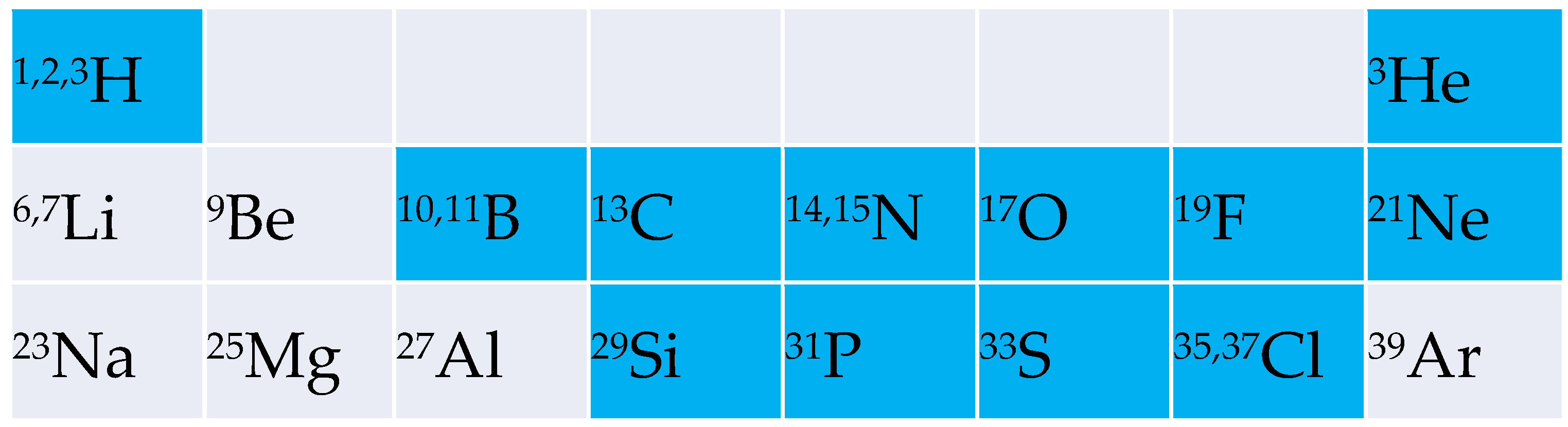
Figure 1. NMR active nuclei from the first three rows of the Periodic Table. The nuclides shown on the blue fields are discussed in this work.
Magnetochemistry 12 00012 g001
Figure 2. The sign of the gyromagnetic ratio γ is positive when the spin and nuclear magnetic moment are oriented in the same direction and negative when they are in opposite directions.
Magnetochemistry 12 00012 g002
Table 1. Gas-phase NMR measurement systems for nuclear magnetic moments (NMMs) have been developed over the past 20 years.
NMR SpectraN.M.M. TransferMoleculesReferences
1H and 2H(D)1H → 2H(D)HD[14]
1H and 3H(T)1H → 3H(T)HT[14]
19F and 10B19F → 10BBF3[7]
19F and 3He 3He → 10BBF3/3He
19F and 11B19F → 11BBF3
19F and 3He 3He → 11BBF3/3He
1H and 13C1H → 13C13CH4[15]
3He and 13C1H → 13C13CH4/3He
1H and 14N1H → 14NNH3[6]
3He and 14N3He → 14NNH3/3He
1H and 15N1H → 15NNH3
3He and 15N3He → 15NNH3/3He
1H and 17O1H → 17OH2O[5]
1H and 19F1H → 19FCH3F[1]
1H and 29Si1H → 29SiSiH4[16]
1H and 31P1H → 31PPH3[17]
3He and 31P3He → 31PPH3/3He
3He and 33S3He → 33SSF6/3He[18]
1H and 35/37Cl1H → 35/37ClHCl[8]
3He and 35/37Cl3He → 35/37ClHCl/3He
Table 2. Nuclear magnetic dipole moments of light nuclei. The quoted uncertainty reflects the experimental and theoretical uncertainties.
IsotopeI(X)µ(X)µN Ref. [19]µ(X)µNReference
1H1/2++2.792847351(9)+2.79284734462(82)Schneider et al./2017 [20]
2H1++0.857438231(5)+0.8574382335(22)Puchalski et al./2015 [14]
3H1/2++2.978962460(14)+2.978962471(10)Puchalski et al./2015 [14]
3He1/2+−2.12762531(3)−2.1276253498(15)Schneider et al./2022 [21]
10B3++1.8004636(8)+1.8004636(8)Jackowski et al./2009 [7]
11B3/2++2.688378(1)+2.6883781(11)Jackowski et al./2009 [7]
13C1/2−+0.702369(4)+0.70236944(68)Makulski et al./2011 [15]
14N1++0.403573(2)+0.40357368(7)Makulski et al./2022 [6]
15N1/2−−0.2830569(14)−0.28305791(3)Makulski et al./2022 [6]
17O5/2+−1.893543(10)−1.893553(2)Makulski et al./2018 [5]
19F1/2++2.628321(4)+2.628321(13)Jaszuński et al./2012 [1]
21Ne3/2+−0.66170(3)−0.6617774(10)Makulski et al./2020 [22]
29Si1/2+−0.555052(3)−0.5550516(31)Makulski et al./2006 [16]
31P1/2++1.130925(5)+1.1309246(50)Lantto et al./2011 [17]
33S3/2++0.64325(1)+0.6432555(10)Makulski/2022 [18]
35Cl3/2++0.82170(2)+0.821721(5)Jaszuński et al./2013 [8]
37Cl3/2++0.68400(1)+0.683997(4)Jaszuński et al./2013 [8]
Disclaimer/Publisher’s Note: The statements, opinions and data contained in all publications are solely those of the individual author(s) and contributor(s) and not of MDPI and/or the editor(s). MDPI and/or the editor(s) disclaim responsibility for any injury to people or property resulting from any ideas, methods, instructions or products referred to in the content.