
Article

Influence of the Polarizing Magnetic Field and Volume Fraction of Nanoparticles in a Ferrofluid on the Specific Absorption Rate (SAR) in the Microwave Range

1
Physics Faculty, West University of Timisoara, Bd. V. Parvan no. 4, 300223 Timisoara, Romania
2
Institute for Advanced Environmental Research, West University of Timisoara (ICAM-WUT), Oituz Str., No. 4, 300086 Timisoara, Romania
3
Department of Electronic and Electrical Engineering, Trinity College, The University of Dublin, D02 PN40 Dublin, Ireland
*
Authors to whom correspondence should be addressed.
Magnetochemistry 2026, 12(1), 5; https://doi.org/10.3390/magnetochemistry12010005 (registering DOI)
Submission received: 19 October 2025 / Revised: 25 December 2025 / Accepted: 27 December 2025 / Published: 30 December 2025
(This article belongs to the Special Issue 10th Anniversary of Magnetochemistry: Past, Present and Future)

Abstract

For the study, we used four kerosene-based ferrofluid samples containing magnetite nanoparticles stabilized with oleic acid. Starting from the initial sample (A0), the other three samples were obtained by dilution with kerosene. The complex magnetic permeability measurements were performed in the microwave region (0.5–6) GHz, for different H values of the polarizing magnetic field, between (0–115) kA/m. These measurements revealed the ferromagnetic resonance phenomenon for each sample, allowing the determination of the anisotropy field (HA) and the effective anisotropy constant (Keff) of nanoparticles, depending on the volume fraction of particles (φ). At the same time, the measurements allowed the determination of the specific magnetic loss power (pm), effective heating rate (HReff), intrinsic loss power (ILP), and specific absorption rate (SAR) as functions of the frequency (f) and magnetic field (H), of all investigated samples, using newly proposed equations for their calculation. For the first time, this study evaluates the maximum limit of the applied polarizing magnetic field (Hmax ≈ 80 kA/m) and the minimum limit volume fraction of nanoparticles (φmin ≈ 3.5%) at which microwave heating of the ferrofluid remains efficient. At the same time, the results obtained show that the temperature increase of the ferrofluid samples, upon interaction with a microwave field, can be controlled by varying both H and φ, pointing to possible applications in magnetic hyperthermia.

1. Introduction

In the last years, it has been found that the development of biomedicine is based on nanotechnology, which represents one of the important and promising approaches for the diagnosis and treatment of cancer [1,2]. In this regard, researchers have been increasingly interested in obtaining magnetic nanoparticles [3,4], intending to use them in both technological and biomedical applications [5,6,7]. One of the medical applications that has begun to be studied and developed is magnetic hyperthermia, which leads to local heating of cancerous tumor cells or tissue while leaving the surrounding healthy tissue unharmed [8]. In general, it is based on the use of magnetic nanoparticles to generate heat when exposed to an external electromagnetic field [3,9]. In magnetic hyperthermia therapy, the most widely used magnetic nanoparticles are iron oxide nanoparticles, such as magnetite (Fe3O4) [9]. These present positive potential in this field due to their unique magnetic and physical properties, highlighted by the absorption of electromagnetic radiation [9,10] expressed by the frequency dependence of the imaginary component (μ″) of the complex magnetic permeability [11].
Several studies show that in the case of magnetic nanoparticles placed in a radiofrequency magnetic field, heat generation can be due to the following two mechanisms: (i) hysteresis losses, which occur in large magnetic nanoparticles with sizes over 100 nm, due to the displacement of the Weiss domain walls [12]; (ii) Brownian and Neel relaxation losses, respectively, for superparamagnetic particles (with sizes below 15 nm), in which the magnetic hysteresis is canceled [13,14], and the heating is due to the magnetic moment of the particle. In Brownian relaxation, the particle rotates as a whole, and in Neel relaxation, the magnetic moment rotates with respect to the particle considered fixed in the crystal [12,13,14].
In addition to the study and obtaining of nanoparticles with the aim of being used in various thermal applications, the researchers also focused on obtaining composite materials by dispersing nano-/microparticles in either a solid or liquid matrix, intending to use these composites in practical applications [15,16]. One such composite material, which has been intensively studied, is ferrofluid, which is a colloidal system of single-domain magnetic nanoparticles dispersed in a carrier liquid [17], which can be used in biomedical applications [18]. In the case of the composite system, such as a ferrofluid placed in a microwave field, the generation of heat in the ferrofluid is due to another mechanism, the phenomenon of ferromagnetic resonance. This phenomenon can be highlighted for a ferrofluid by performing measurements of the complex magnetic permeability (μ(f)) in the microwave frequency range [19]. The energy dissipated in the form of heat will be taken up by the composite system (ferrofluid), meaning both nanoparticles and the dispersion medium. In view of this, in our previous papers [20,21], we demonstrated that the effective heating rate of the ferrofluid (HReff) and the effective specific absorption rate (SAR) due to interaction of ferrofluid with the microwave field can be computed with the following relations:
H R e f f = Δ T Δ t = p m ( 1 φ ) ρ L c L + φ ρ S c S
S A R = p m ( 1 φ ) ρ L + φ ρ S = p m ρ F
From Equations (1) and (2), the following relationship results for determining the effective heating rate (HReff) of the ferrofluid:
H R e f f = Δ T Δ t = ρ F S A R ( 1 φ ) ρ L c L + φ ρ S c S
In these relations, ΔT represents the temperature variation over the heating time interval (Δt); cL, ρL and cS, ρS are the specific heat and the density of the carrier liquid, and of the solid fraction from ferrofluid, respectively; ρF is the density of ferrofluid; φ is the volume fraction of nanoparticles from ferrofluid; and pm, representing the specific magnetic power loss of the ferrofluid, can be calculated with the following relation [20]:
p m = π μ 0 μ f H 0 2
where f is the frequency, H0 is the amplitude of the variable magnetic field, and μ0 is the magnetic permeability of free space.
For the calculation of both the effective heating rate of the ferrofluid (HReff) and the effective specific absorption rate (SAR), using the newly proposed Equations (1)–(3), we used the following values for the specific heat and density corresponding to both the solid phase and the liquid phase: the specific heat of the carrier liquid (kerosene), cL = 2010 J/kgK, and the density of the kerosene, ρL = 800 kg/m3 [22]; the specific heat of the solid fraction (magnetite), cS = 670 J/kgK [23], and the density of the magnetite, ρS = 5080 kg/m3 [4].
In this paper, complex magnetic permeability measurements were performed in the microwave frequency range (0.5–6 GHz) for four ferrofluid samples with different volume fractions (φ) of nanoparticles, and at various values of the applied polarizing magnetic field (H). Based on the results obtained from these measurements, and using the newly proposed Equations (1)–(3) for a biphasic composite system, this study aimed to determine the effective heating rate (HReff) and the specific absorption rate (SAR) of the investigated ferrofluid samples.
Furthermore, this study examines the dependence of HReff and SAR on the frequency (f), the applied polarizing magnetic field (H), the nanoparticle volume fraction (φ), and the effective anisotropy constant (Keff) of the nanoparticles, within the microwave range. The results allowed, for the first time, the determination of the maximum applied polarizing field (Hmax) and the minimum nanoparticle volume fraction (φmin) in the ferrofluid, at which microwave heating efficiency is significant.

2. Samples Characterization and Experimental

The initial ferrofluid used for measurements (denoted as A0) was obtained by a method called the hydrophobization technique in the absence of a dispersion medium [24,25], the nanoparticles being coated with a layer of organic molecules (oleic acid) that act as a stabilizer. Next, the resulting material was dispersed in the carrier liquid (kerosene), heated slightly to remove any traces of water, and then filtered in a magnetic field gradient to remove coarse particles from the ferrofluid [25]. From the initial sample A0, three other samples were obtained by dilution with kerosene and were involved in the measurements. The density of samples was as follows: ρF(A0) = 1300 kg/m3, ρF(A1) = 1137 kg/m3, ρF(A3) = 950 kg/m3; and ρF(A5) = 867 kg/m3. It is known that the density ρF of a ferrofluid can be written in the following form [19]:
ρ F = ( 1 φ ) ρ L + φ ρ S
where ρL is the density of the carrier liquid (kerosene), and ρS is the density of the solid fraction of the ferrofluid (magnetite). With Equation (5), the volume fraction (φ) of the magnetite nanoparticles, corresponding to each ferrofluid sample, was calculated. The following values were obtained: φ(A0) = 11.52%; φ(A1) = 7.68%; φ(A3) = 3.41%; and φ(A5) = 1.53%.
In Figure 1, the static magnetization curve (M(H)) of the initial ferrofluid sample (sample A0) is presented, obtained using the hysteresis graph method, at a low frequency field (50 Hz) [26].
As can be seen in Figure 1, the M(H) dependence of the A0 sample obeys a Langevin-type law, which indicates that the initial A0 sample has a superparamagnetic behavior [17]. Considering the magneto-granulometry analysis of Chantrell [27] and the M(H) dependence from Figure 1, the saturation magnetization (Msat), the mean magnetic diameter of particles (dm), the particle concentration (n), and the initial susceptibility (χin) were determined, and the obtained values are Msat = 20.84 kA/m; dm = 10.47 nm; n = 7.26 × 10²² m−3; and χin = 0.904.
It is known that [17] the saturation magnetization of a ferrofluid (Msat) and the spontaneous magnetization of the magnetite nanoparticles (MS) are correlated by the following relationship:
M s a t = φ m M S
In Equation (6), φm represents the magnetic volume fraction of magnetite nanoparticles in the ferrofluid, which is correlated with the volume fraction (φ) by the following relationship [17]:
φ m = φ 1 + 2 δ d m 3
where δ ≈ 2 nm is the thickness of the nonmagnetic layer (surfactant) [17] and dm = 10.47 nm is the mean magnetic diameter of magnetite nanoparticle, from samples. Using Equation (7) and the obtained values for the volume fraction (φ) from ferrofluid samples, the following values of the magnetic volume fraction (φ)m were obtained: φm(A0) = 4.36%; φm(A1) = 2.91%; φm(A3) = 1.29%; and φm(A5) = 0.58%.
The measurements of the real μ’(f,H) and imaginary μ”(f, H) components of the complex magnetic permeability of all ferrofluid samples were made with the short-circuited (SC) coaxial line method [21], over the frequency range (0.5–6) GHz and at values of H between 0 to 115 kA/m. For the measurements, the ferrofluid sample was loaded into a Hewlett–Packard (HP) 50 Ω coaxial cell in conjunction with an HP 8753C network analyzer [21,28]. The coaxial cell containing the ferrofluid was positioned between the poles of an electromagnet, ensuring that the applied polarizing magnetic field was oriented perpendicular to the cell axis.

3. Results and Discussions

3.1. Complex Magnetic Permeability in Microwave Range

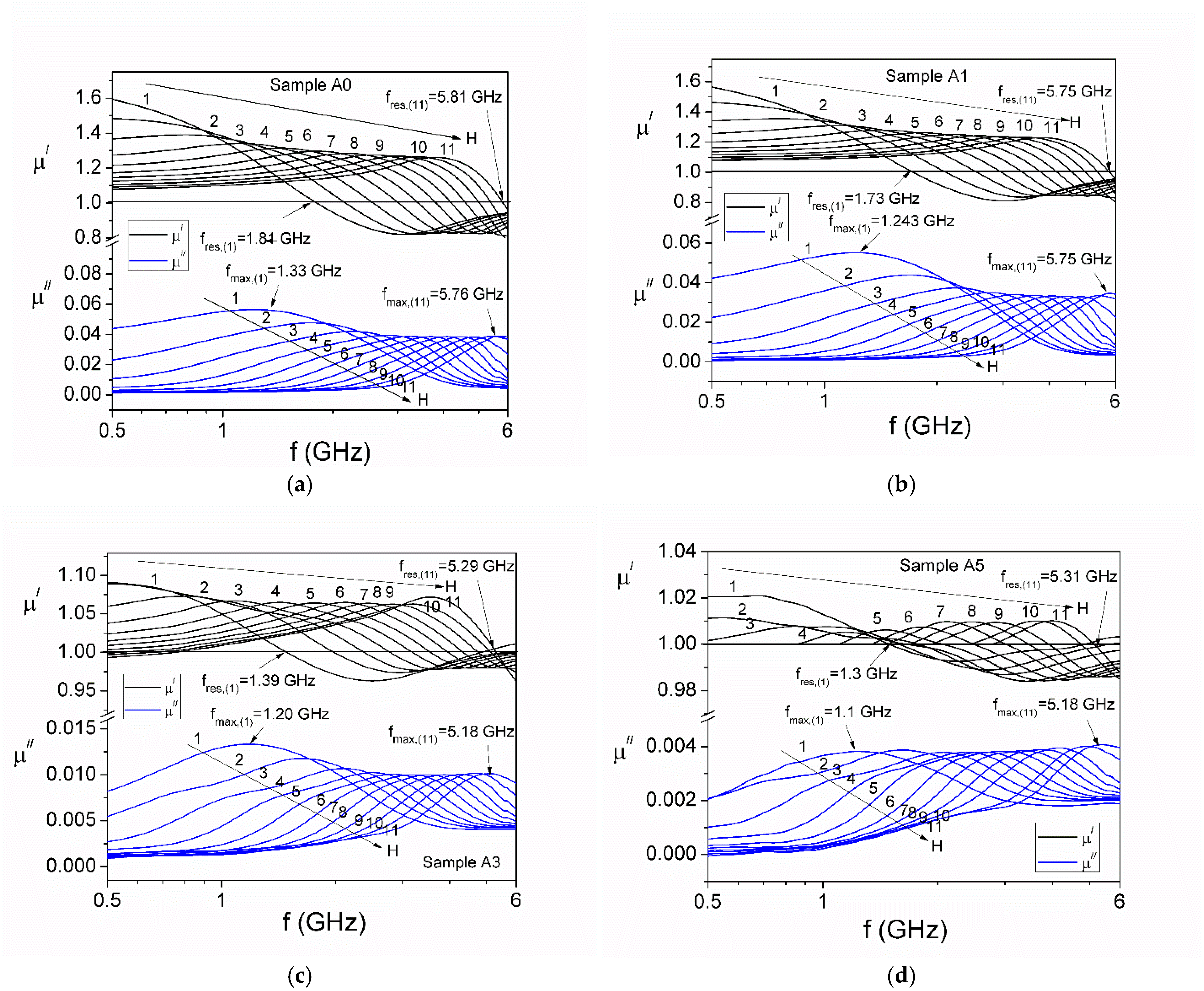
In Figure 2a–d, the frequency dependencies of the real (μ’) and imaginary (μ”) components of complex magnetic permeability are shown, for different values of the applied polarizing magnetic field (H), and different values of the volume fraction (φ) of the nanoparticles from the ferrofluid samples.
From Figure 2, it is observed that for all ferrofluid samples, the phenomenon of ferromagnetic resonance is present, highlighted by the transition of the real component (μ′) from a value above unity to a subunit value at a frequency (fres) called the resonance frequency [28]. By increasing the polarizing magnetic field H, fres shifts towards higher values for all samples. At the same time, by decreasing the volume fraction (φ), the amplitude of the real component (μ′) decreases, becoming gradually smaller with the increase in H for all samples. The imaginary component (μ″) has a maximum for all samples, at a frequency fmax which moves towards higher values when H increases. The amplitude of the component (μ″) decreases as the volume fraction (φ) of the nanoparticles in the samples decreases (see Figure 2).
It is known that [21,29] in a strong polarizing magnetic field (H >> HA), where HA is the anisotropy field, the resonance condition can be written as follows [21]:
2 π f r e s = γ H + H A
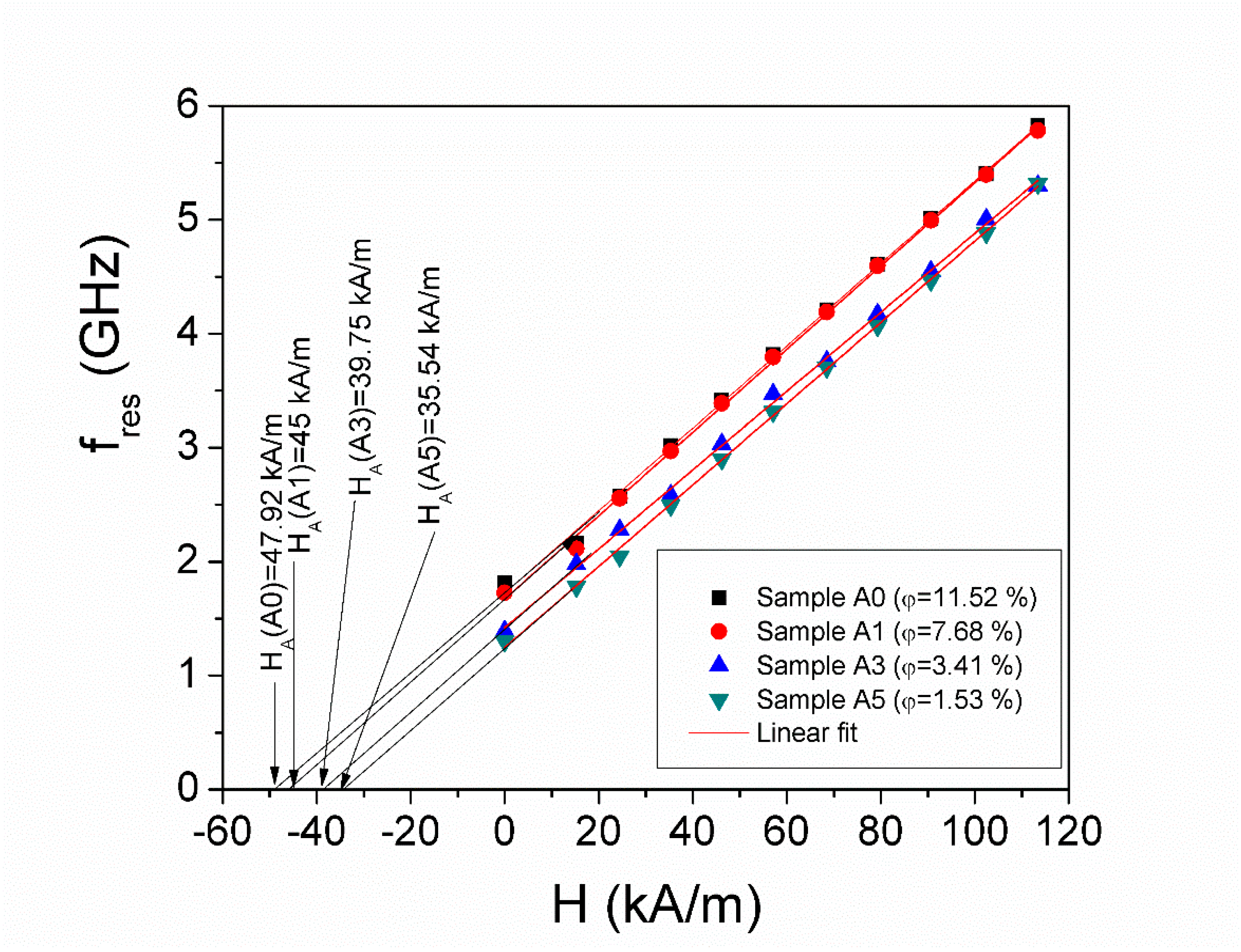
which shows a linear dependence between fres and H, whose slope is γ, called the gyromagnetic ratio of the particle [21,30]. Considering the fres values corresponding to each H value from Figure 2, of all samples with different volume fractions (φ), in Figure 3, the dependence of fres(H) is presented, which is linear, in accordance with Equation (8).
Fitting the experimental dependencies fres(H) from Figure 3 with a straight line and considering Equation (8), the slope of the line, γ (the gyromagnetic ratio of the particle), and the anisotropy field, HA, respectively, immediately result, and the obtained values are indicated in Table 1.
Considering that for single-domain nanoparticles with uniaxial anisotropy [30,31], the anisotropy field is given by the following relation:
H A = 2 K e f f μ 0 M S
we were able to determine the effective anisotropy constant (Keff) of the nanoparticles in the ferrofluid samples. The values obtained are shown in Table 1.
As can be seen in Table 1, by decreasing the volume fraction (φ) of the magnetite nanoparticles in the ferrofluid samples from 11.52% (sample A0) to 1.53% (sample A5), the effective anisotropy constant (Keff) decreases from the value of 1.44 × 10⁴ J/m3 to 1.07 × 10⁴ J/m3. The observed decrease in the effective anisotropy constant (Keff) with decreasing particle concentration is attributed to a reduction in interparticle magnetic interactions, caused by the increased interparticle distance upon dilution of the ferrofluid samples. This behavior agrees with both the theoretical models [32,33] and the experimental data [34,35], which demonstrate that the large value of the effective anisotropy constant Keff is due to the increase in the concentration of nanoparticles in the ferrofluid (i.e., of the large volume fraction). From Table 1, it is also observed that in the case of samples A0 and A1, having the volume fraction larger than that of samples A3 and A5, the experimental value of Keff is in agreement with the value obtained by other authors [31,36,37] for similar samples, being larger than the value of the anisotropy constant measured for a magnetite crystal, K = 1.1 × 10⁴ J/m3 [38]. The discrepancy between the K value measured for bulk magnetite crystals and the experimentally determined Keff values for magnetite nanoparticles in ferrofluids arises from the fact that Keff represents an effective anisotropy that accounts for shape, interparticle interactions, surface effects, and magnetocrystalline contributions.
As is known, the generation of heat in a ferrofluid placed in a variable magnetic field can be due to either the magnetic relaxation mechanism or ferromagnetic resonance [21,39]. It can be evaluated by measurements of the complex magnetic permeability (μ(f)) over a wide range of frequencies. At low frequencies (tens, hundreds of kHz), the rotation of the particles in the carrier fluid determines the Brownian relaxation process [13], and at higher frequencies (units, tens of MHz), the rotation of the magnetic moment inside the particles [14,39] determines the Néel relaxation process. These relaxation processes are characterized by the corresponding relaxation times, τB and τN, given by the following relations:
τ B = π η D 3 k T
τ N = τ 0 exp K e f f V m k T
In these relationships, η represents the viscosity of the carrier liquid (kerosene) having the value η = 1.2 × 10⁻³ Pa·s; D = dm + 2δ [17] is the hydrodynamic diameter of the particles, resulting in the value D = 14.47 nm (for our samples); Keff is the effective anisotropy constant of the particles from the ferrofluid samples (see Table 1); Vm = π(dm)3/6 is the mean magnetic volume of the particles, considered spherical; k = 1.38 × 10⁻²³ J/K is the Boltzmann constant; T = 298 K is the room temperature at which the measurements were performed and τ0 = 10−9 s is a constant [17]. Considering these values of the parameters involved in the mathematical expressions (10) and (11) corresponding to the Brownian (τB) and Neel (τN) relaxation times, respectively, we were able to evaluate the value of these relaxation times for the investigated ferrofluid samples, for the mean magnetic diameter of the particles, dm = 10.47 nm. The following values were obtained: τB = 1.383 μs, τN = 8.164 ns (for sample A0), τN = 7.169 ns (for sample A1), τN = 5.684 ns (for sample A3), and τN = 4.767 ns (for sample A5). Considering that, between the relaxation time τ and the frequency fmax at which the imaginary component (μ″) has a maximum, the Debye equation [39] is valid, 2πfmaxτ = 1, and we determined the fmax frequencies corresponding to both Brownian and Neel relaxation peaks. The following values were obtained: fmax(Brownian) = 115.1 kHz; fmax(Neel) = 19.5 MHz (for sample A0) and fmax(Neel) = 33.4 MHz (for sample A5), being much lower than the frequencies in the microwave range (0.5–6) GHz, where the phenomenon of ferromagnetic resonance was highlighted. This result confirms that Brownian and Neel relaxation losses are negligible in the microwave range compared to the ferromagnetic resonance loss for the investigated ferrofluid samples.
The gyromagnetic ratio of the particle (γ), corresponding to samples (see Table 1) in a strong polarizing field (i.e., HHA) [40], is given by the following relation:
γ = g γ e μ 0 2 1 + f max / f r e s 2 1 / 2
where μ0 = 4π × 10−7 H/m is the magnetic permeability of free space; γe = 8.791 × 10¹⁰ s−1T−1 is the gyromagnetic ratio of the electron, and g is the spectroscopic splitting factor [21,31].
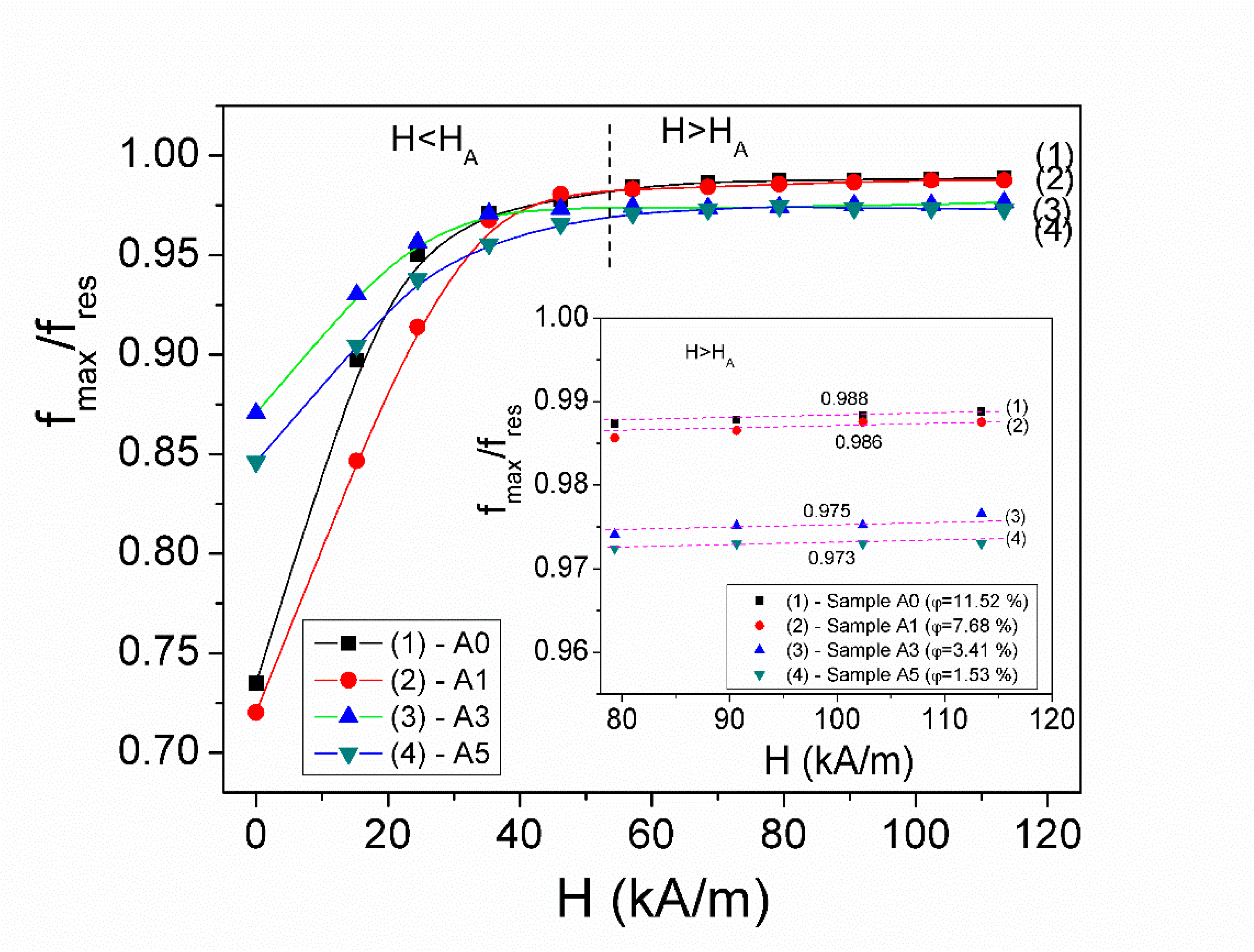
The ratio (fmax/fres) corresponding to high values of the polarizing magnetic field (H >> HA) was determined from Figure 4, in which we presented the dependence of the fmax/fres ratio on the magnetic field (H), for the four ferrofluid samples with different volume fractions (φ) of nanoparticles.
From Figure 4, it can be seen that for a high polarizing field (H >> HA), the fmax/fres ratio tends to become constant, for all the investigated samples, resulting in the following values: 0.988 for sample A0 (with φ = 11.52%); 0.986 for sample A1 (with φ = 7.68%); 0.975 for sample A3 (with φ = 3.41%); and 0.973 for sample A5 (with φ = 1.53%). Considering these values of the fmax/fres ratio for samples, using Equation (10), the spectroscopic splitting factor (g) was determined, and the obtained values are listed in Table 1. It is observed that deviations from the value 2 of g appear in the case of samples A0 and A1, whose volume fraction (φ) is higher (samples with higher concentrations of nanoparticles), which may be due to interactions between particles, or the effects of shape, surface, and magnetocrystalline anisotropy, in the case of these concentrated ferrofluid samples [34,37].

3.2. Specific Absorption Rate (SAR) in Microwave Range

It is known that through the interaction between the microwave field and the ferrofluid, energy absorption occurs, leading to heating of the ferrofluid [41]. In magnetic hyperthermia, the following equation is used to calculate the heating rate (HR):
H R = Δ T Δ t = p m ρ F c F
where ρF represents the density of the ferrofluid, and cF the specific heat of the ferrofluid [41,42,43]. In evaluating HR using Equation (13), many authors generally use the specific heat of the carrier liquid (cL) [41,43], so Equation (13) becomes the following:
H R c l a s i c = p m ρ F c L = p m [ ( 1 φ ) ρ L + φ ρ S ] c L
It can be said that Equation (14) represents the usual equation used by many authors for calculating the heating rate HR, where it was considered that the density of the ferrofluid is given by Relation (5), ρF = (1-φ)ρL + φρS. Also, for determining the specific absorption rate (SAR) of the ferrofluid, the following equation is used:
S A R = c S Δ T Δ t
In this equation, for the evaluation of SAR, the specific heat of the solid material from which the nanoparticles come (cS) [44,45,46] is considered.
The novelty of our paper consists in treating the ferrofluid as a composite system and proposing new equations (Equations (1)–(3)) for the calculation of HReff and SAR, which assume that all losses are concentrated both in the magnetic solid phase and in the carrier liquid. In this way, as we have shown in a previous paper [22], the effective specific heat (ceff) of the ferrofluid as a biphasic composite system is given by the following relation:
c e f f = ( 1 φ ) ρ L c L + φ ρ S c S ( 1 φ ) ρ L + φ ρ S
As a result, the new equation for the specific heating rate, by analogy with Equation (14), will be as follows:
H R n e w = p m ρ F c e f f = p m ( 1 φ ) ρ L c L + φ ρ S c S
which represents the new Equation (1) proposed for calculating the specific heating rate (HReff).
The specific absorption rate SAR, by analogy with Equation (15), is defined as follows:
S A R = c e f f Δ T Δ t
From Equations (1) and (18), the new Equation (2) proposed for calculating the specific absorption rate (SAR) of the ferrofluid is finally obtained.
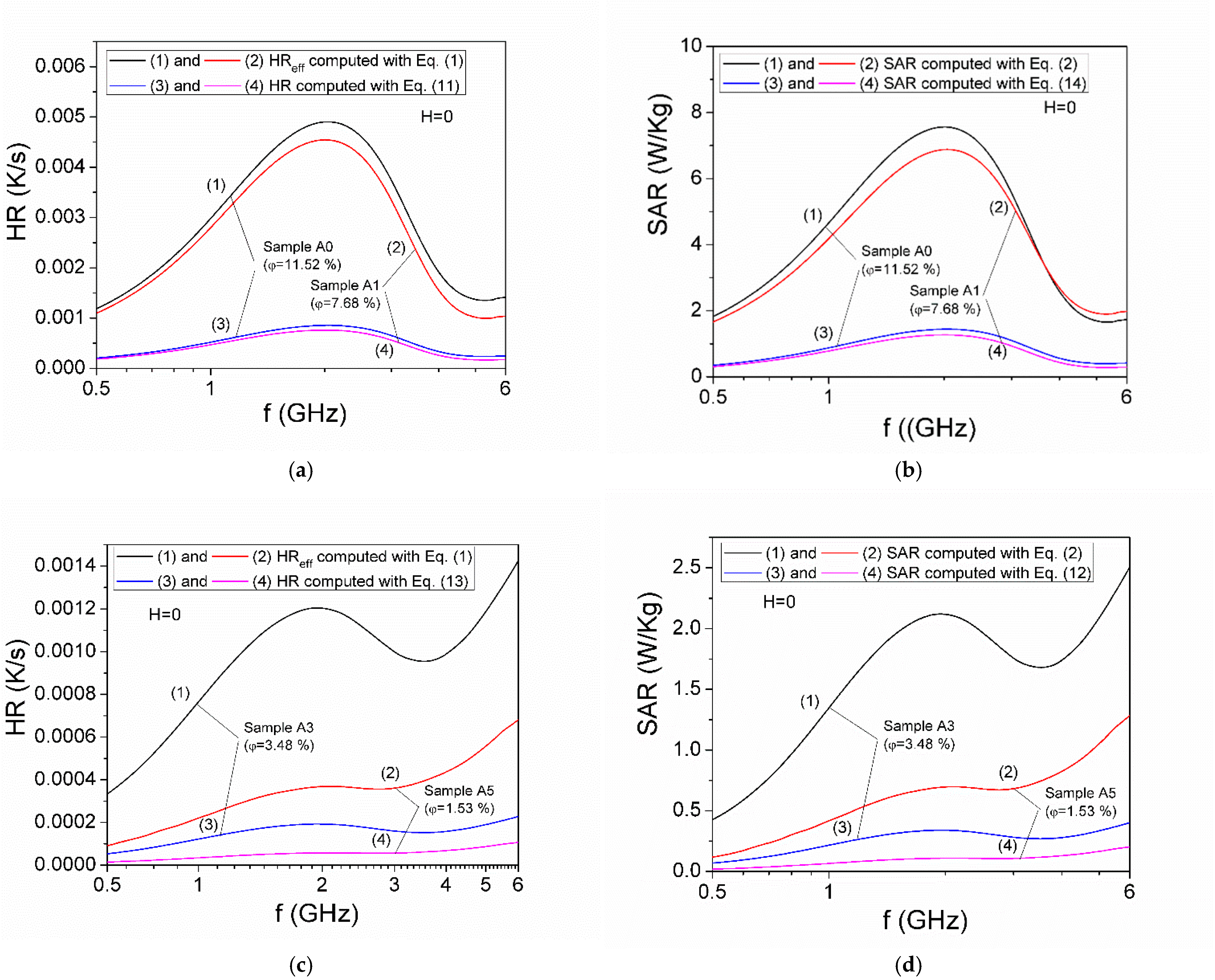
To explicitly compare the HR and SAR values resulting from Equations (1)–(3) proposed by us with those calculated using the classic Formulas (14) and (15), in Figure 5, we have graphically represented the frequency dependence of the heating rate (HR) and the specific absorption rate (SAR) for all samples and in a zero magnetic field (H = 0).
From Figure 5, it is observed that the HR and SAR values obtained with the new proposed equations are higher than those calculated classically, with Relations (13) and (14), for all ferrofluid samples. The comparative result obtained is very important and demonstrates the extent of the improvement offered by the new approach of the ferrofluid as a composite system, in determining the HR and SAR essential in hyperthermia applications.
The specific magnetic power loss of the ferrofluid (pm) corresponds to the absorbed energy per unit of volume (W/m3), and the specific absorption rate (SAR) corresponds to the absorbed energy per unit of mass (W/kg). The use of energy dissipated in ferrofluid in the form of heat, under the action of a microwave field, is relevant in magnetic hyperthermia applications [47,48,49,50].
The magnetic heating efficiency of some composite nanosystems such as ferrofluids, is generally evaluated by the specific energy absorption rate (SAR) or by an equivalent parameter, the intrinsic loss power (ILP) [Hm2/kg], obtained by eliminating the extrinsic factors [45,51] (frequency (f) and the square of the variable magnetic field amplitude (H0), being defined by the following equation:
I L P = S A R f H 0 2 = π μ 0 ρ F μ
In the study carried out, we determined both the SAR and ILP parameters for H0 values that satisfy the H0 << HA condition, corresponding to the four ferrofluid samples with different nanoparticle volume fractions (φ) and at different H values of the applied polarizing magnetic field in the range (0–115) kA/m. ILP parameters are often preferred to SAR parameters, especially in situations of magnetic hyperthermia heating corresponding to ensembles of magnetic nanoparticles [46].
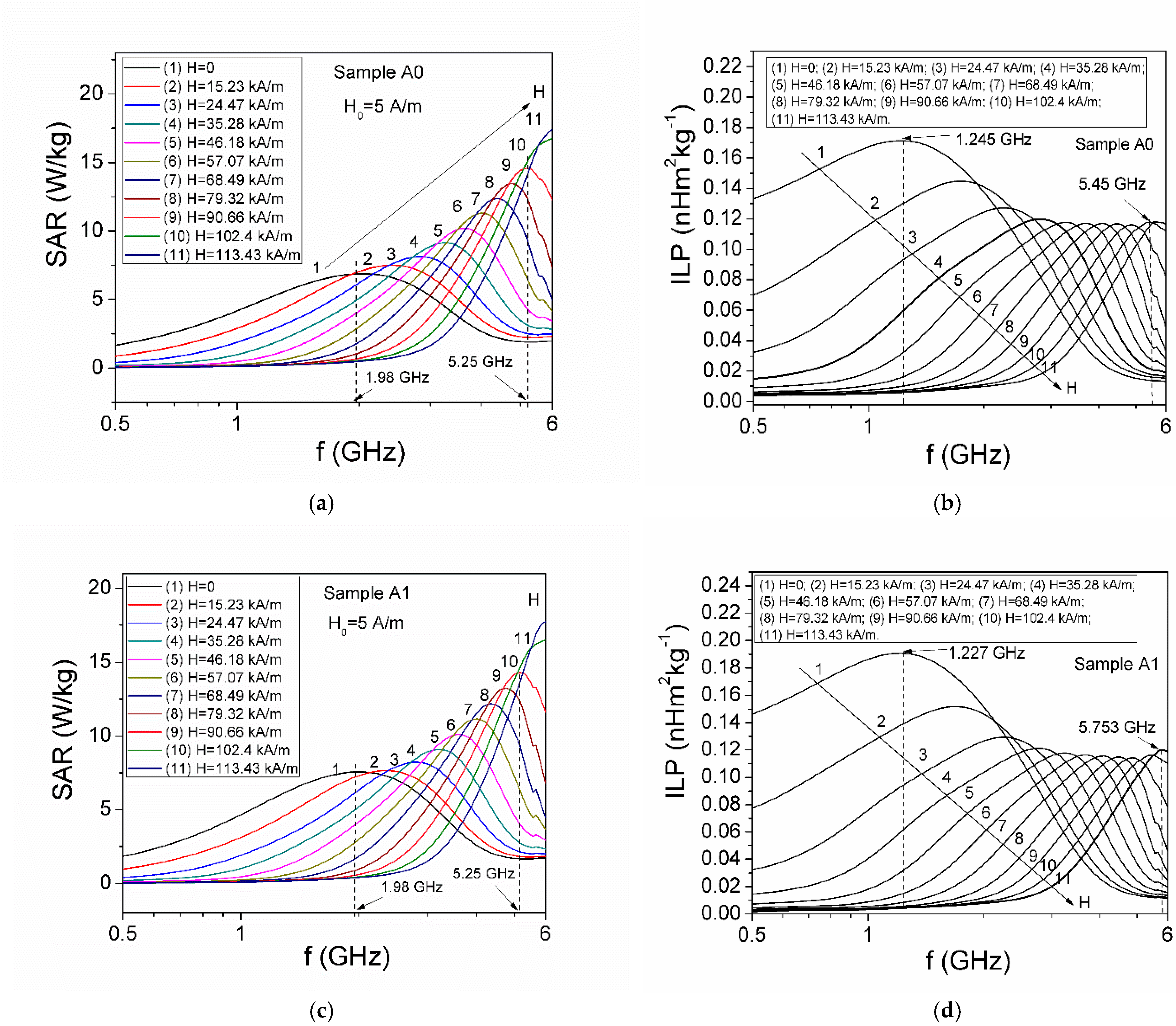
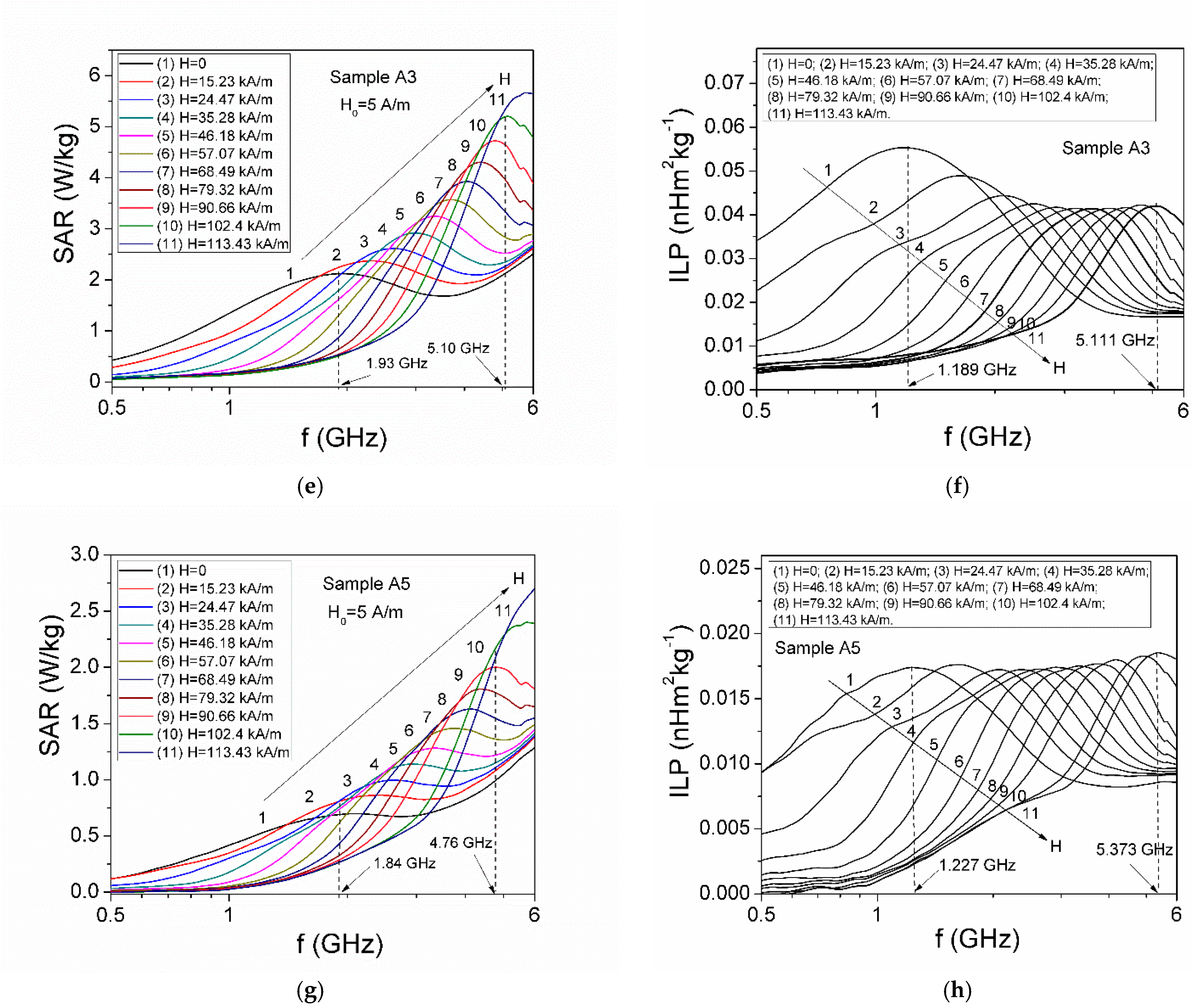
Using Equations (2), (4) and (17) and obtained values (μ″) of the complex magnetic permeability (see Figure 2a–d), the SAR and ILP values of the ferrofluid samples were determined for a value of the amplitude of the variable magnetic field (H0 = 5 A/m). In Figure 6, the frequency dependencies of SAR and ILP for different values of volume fractions (φ) of nanoparticles from samples are shown.
As can be seen in Figure 6a,c,e,g, the SAR shows a maximum approximately in the range (1.8–5.25) GHz depending on the value of the polarization magnetic field (H) for all ferrofluid samples. The SAR amplitude increases with the increase in H and by increasing the volume fraction (φ) of the nanoparticles in the ferrofluid samples. The decrease in the maximum SAR value can also be correlated with the decrease in the effective anisotropy constant (Keff) of the samples (see Table 1), at the decrease in the volume fraction (φ) [52] of the nanoparticles in the ferrofluid samples. The result can be attributed to the ratio of the amplitude of the variable magnetic field (H0) (in this paper, H0 = 5 A/m) and the anisotropy field (HA) (of the order of kA, see Table 1). If the condition H0 << HA is met, the maximum value of the specific absorption rate SAR increases when the effective anisotropy constant Keff decreases [52,53], with the result obtained agreeing with the linear response theory (LRT) [54].
From Figure 6, it is observed that in the frequency range between (2–5) GHz, the variation of both the specific absorption rate (SAR) and the intrinsic loss power (ILP) with the polarizing magnetic field (H) is non-uniform for all samples. Also, from Figure 6a,c,e,g, it is observed that at frequencies lower than 1.8 GHz, SAR decreases with increasing H, and for frequencies higher than approximately 5 GHz, SAR increases with increasing H. This behavior of the specific absorption rate SAR can be due to both the specific magnetic loss power (pm) of microwaves and the density (ρF) of the ferrofluid sample (see Equation (4)).
Figure 6b,d,f,h present a plot of the frequency dependence (f) in the microwave range (0.5–6) GHz of the ILP of ferrofluid samples with different volume fractions (φ) and at different values of the polarizing magnetic field (H). From the plots, it is seen that for all samples, the ILP has a maximum at frequencies approximately in the range of 1.2 GHz–5 GHz, and the amplitude of ILP gradually decreases with increasing H. As in the case of SAR, at frequencies lower than 1.2 GHz, the ILP decreases with increasing H, and for a frequency higher than approximately 5 GHz, the ILP increases with increasing H. The obtained results indicate the possibility of controlling the SAR or ILP of a ferrofluid having different volume fractions (φ) of nanoparticles, by means of a polarizing magnetic field (H), and could be used in magnetic hyperthermia applications [55,56].
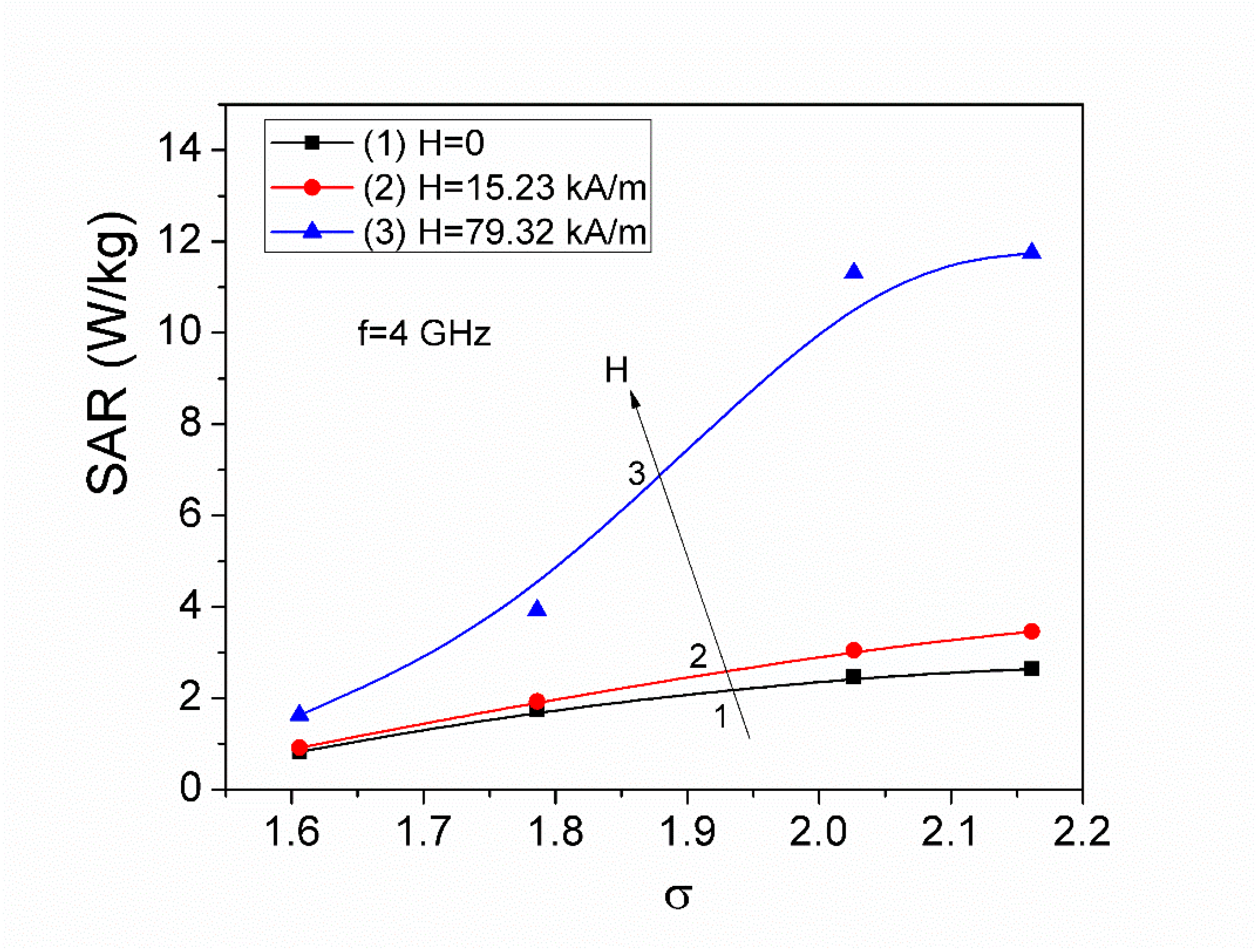
In the paper [57], theoretical calculations performed by the authors allowed the determination of the size of Zn-Cu ferrite nanoparticles, for which the effective anisotropy energy of the nanoparticles (KeffV) is greater than the thermal fluctuation energy (kBT) in the biologically acceptable range (41–46) °C, important in biomedical applications of heating by magnetic hyperthermia. Starting with this result, in Figure 7, we showed the dependence of SAR on the anisotropy parameter (σ = KeffVm/kBT), where kB is Boltzmann’s constant and Vm is the magnetic volume of the nanoparticles. This parameter was determined at room temperature (25 °C), considering the Keff values of the ferrofluid samples from Table 1, as well as the magnetic diameter (dm) of the nanoparticles determined from magnetic measurements.
From Figure 7, it is observed that for ferrofluid samples with different volume fractions (φ), the anisotropy parameter σ >> 1, indicating that the anisotropy energy is higher than the thermal fluctuation energy. This suggests good heating efficiency of the samples. It is also observed that as the volume fraction of the samples increases, the specific absorption rate (SAR) increases, with higher values obtained for larger applied polarizing magnetic fields (H). This result is important for microwave heating applications, as the heating efficiency (via SAR) can be controlled through the polarizing magnetic field (H), the frequency (f), and the volume fraction (φ) of the ferrofluid sample.
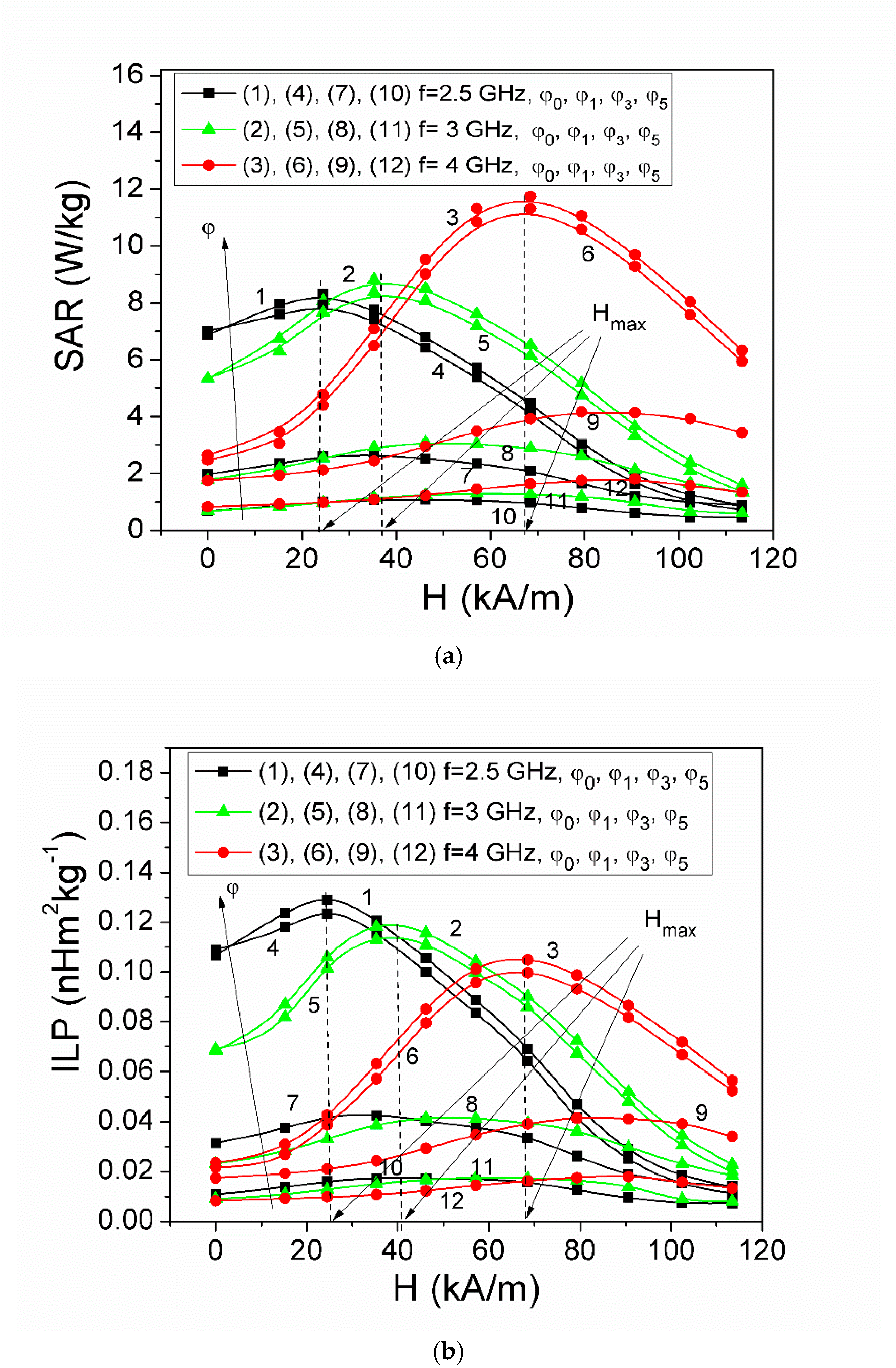
In Figure 8a, the dependence of the specific absorption rate (SAR) on the polarizing magnetic field (H) is shown, and in Figure 8b, the dependence of the intrinsic loss power (ILP) at three frequencies, 2.5 GHz, 3 GHz, and 4 GHz, for the four values of the volume fraction (φ) of the nanoparticles in the ferrofluid samples.
From Figure 8a,b, it is observed that both SAR and ILP present a maximum at a value of Hmax of the magnetic field, for each ferrofluid sample with a different volume fraction (φ), at all three frequencies investigated (2.5 GHz, 3 GHz, and 4 GHz). At the constant frequency (f), as the fraction (φ) decreases, the SAR and ILP values decrease, and the corresponding SAR and ILP maximums shift to higher Hmax values. Table 2 shows the Hmax values for both SAR and ILP, as well as the corresponding maximum SARmax and ILPmax values, respectively, at all three investigated frequencies in the (2–5) GHz range.
At the same time, from Figure 8a,b, it is observed that for values of the polarizing magnetic field (H > Hmax), both SAR and ILP decrease with increasing H. The results obtained for both SAR and ILP are significant for applications such as magnetic hyperthermia, providing useful information on the maximum applied magnetic field required to control SAR or ILP at different frequencies in the microwave range. Also, for the same volume fraction (φ), from Table 2 and Figure 8a, it is observed that the SAR value increases with increasing frequency, reaching a maximum value (SARmax) at an increasingly higher Hmax(SAR) field. Simultaneously, for the same volume fraction (φ), from Table 2 and Figure 8b, it is observed that the ILP value decreases with increasing frequency, reaching a maximum ILPmax at an increasingly higher Hmax(ILP) field.
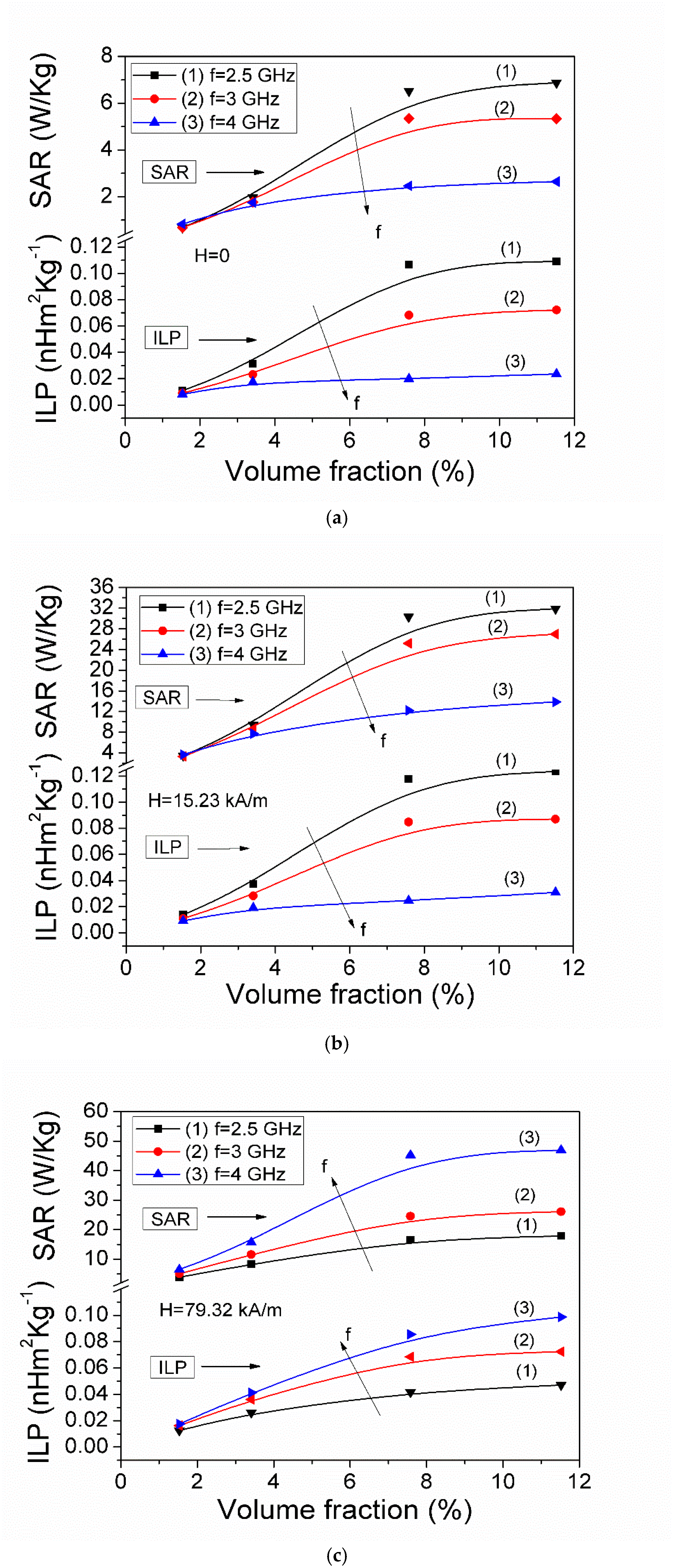
Next, we investigated the dependence of both the specific absorption rate (SAR) and the intrinsic loss power (ILP) on the volume fraction (φ) at the three microwave frequencies (2.5 GHz, 3 GHz, and 4 GHz) under varying magnitudes of the applied polarizing magnetic field, H. The first two field values, H1 = 0 and H2 = 15.23 kA/m, were selected to satisfy the condition H < Hmax, and the third, H3 = 79.32 kA/m, was chosen such that H > Hmax. These conditions were applied consistently across the investigated samples and frequencies, both for SAR (see Figure 8a) and for ILP (see Figure 8b).
In Figure 9a–c, the dependences of SAR and ILP on the volume fraction (φ) for the three chosen values of the applied polarizing magnetic field (H) and at the three microwave frequencies (f) are presented.
As shown in Figure 9, both SAR and ILP exhibit an increasing trend with the volume fraction (φ), reaching an approximately constant value for φ greater than 7.68% across all examined field strengths (H) and frequencies (f). These results are particularly relevant for magnetic hyperthermia applications, as they provide valuable insight into the control of SAR or ILP through the application of a polarizing magnetic field (H) to ferrofluid samples with different volume fractions (φ).
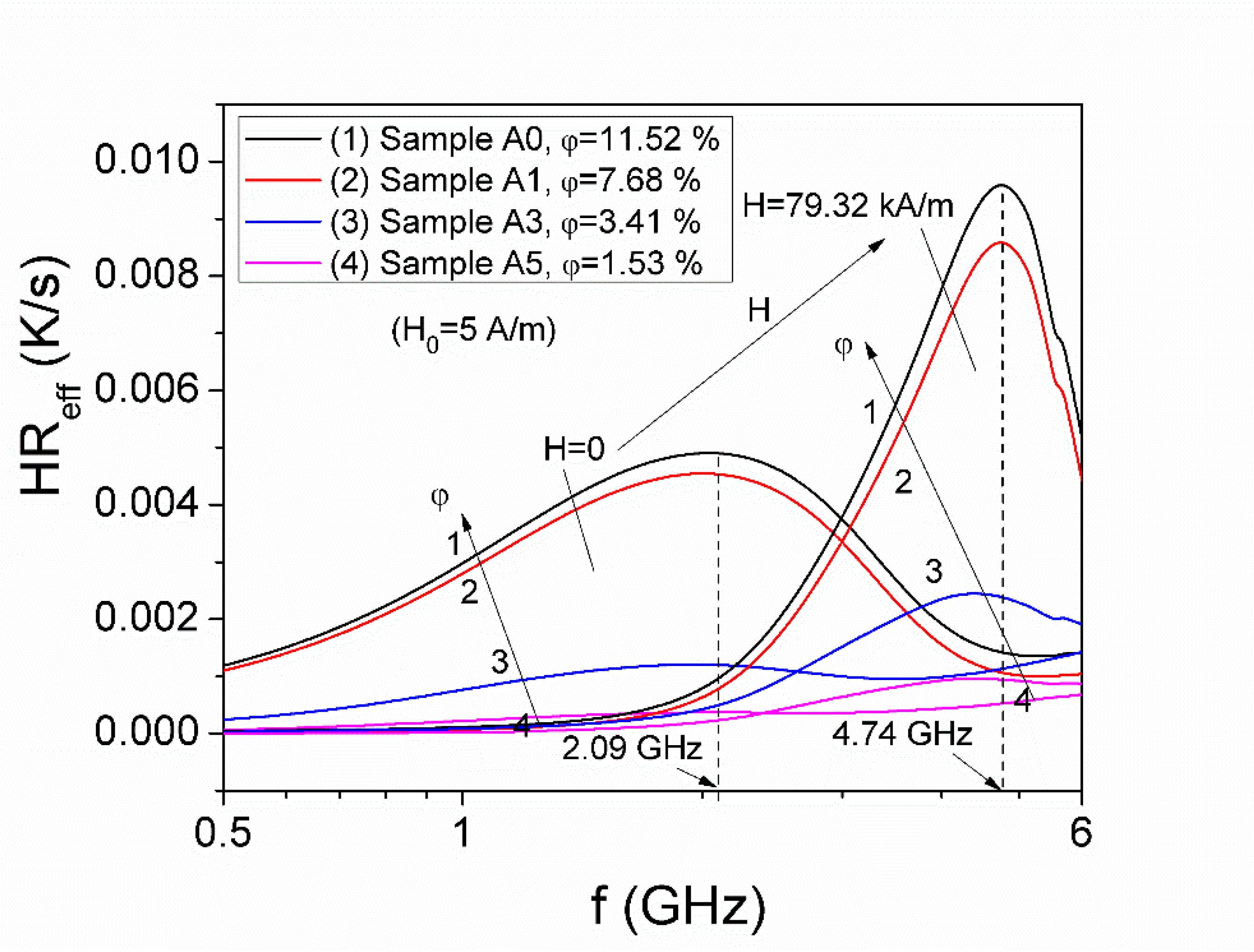
Based on Equation (3), the effective heating rate (HReff = ΔT/Δt) was determined for all ferrofluid samples. Figure 10 shows the frequency dependence of HReff for ferrofluid samples with different volume fractions for two values of the magnetic polarizing field (H = 0 and H = 79.32 kA/m).
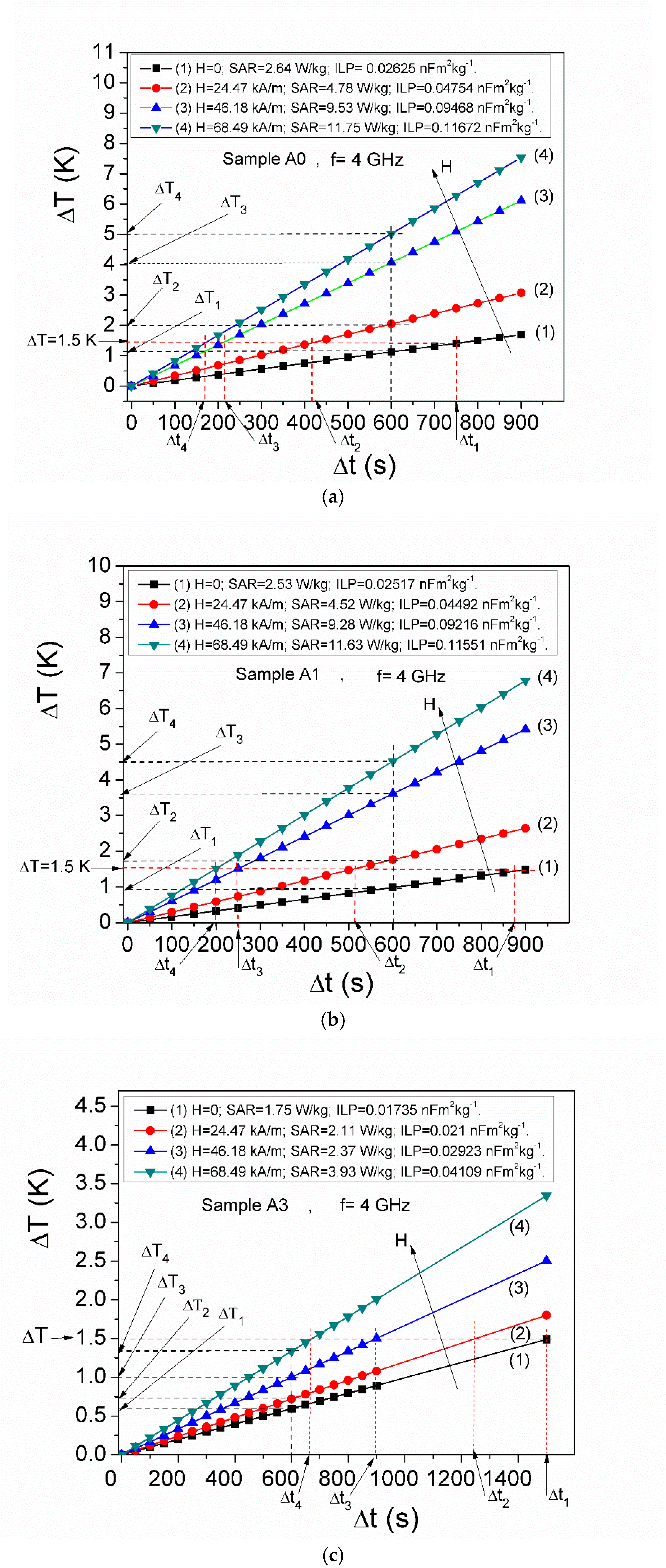
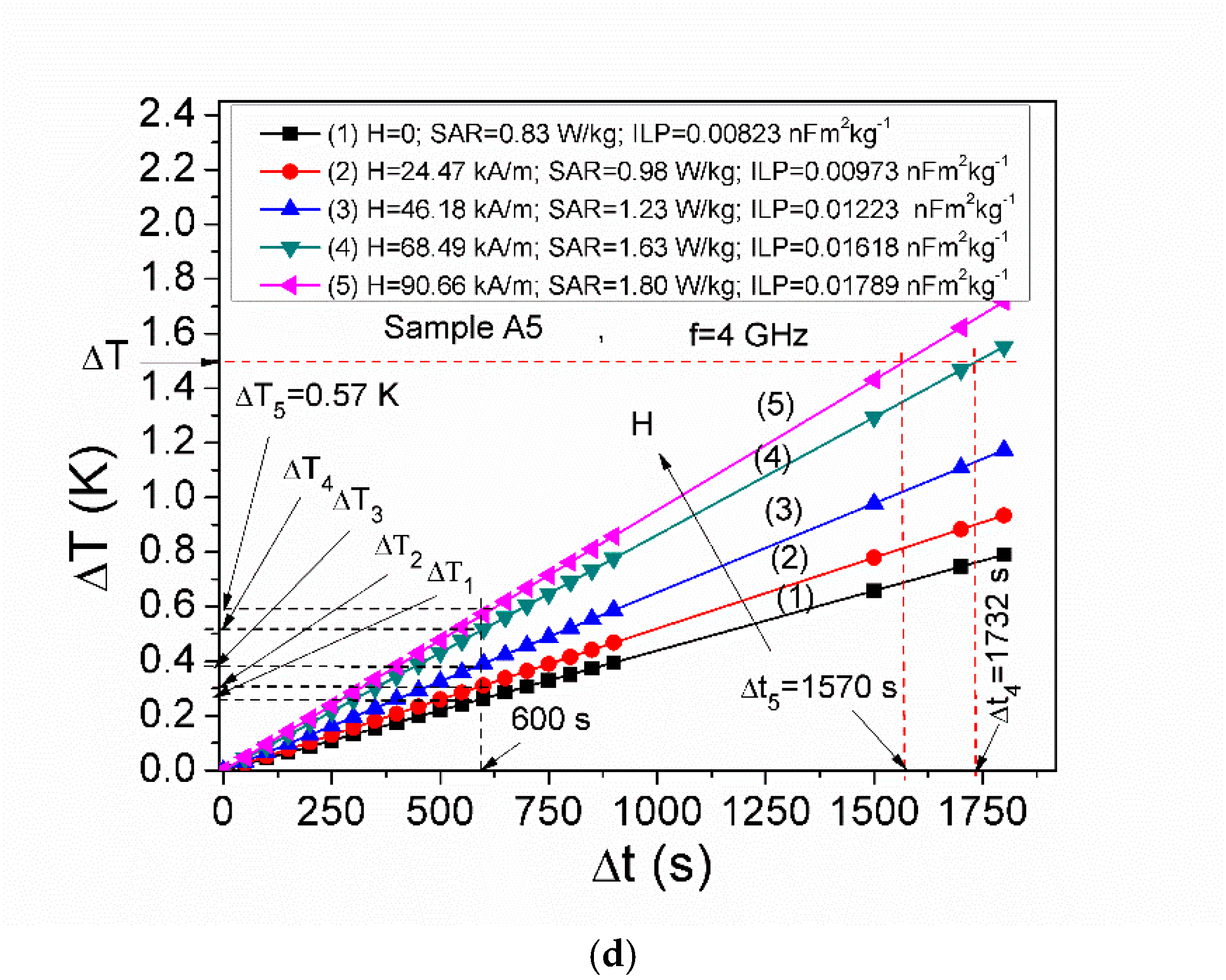
From Figure 10, it can be observed that HReff exhibits a maximum both in the absence of a polarizing magnetic field, at a frequency of approximately 2 GHz, and in the presence of a field H = 79.32 kA/m at a frequency of approximately 5 GHz. The amplitude of these maxima decreases with decreasing volume fraction (φ). For sample A0 (φ = 11.52%), the maximum value of HReff increases from approximately 0.005 to 0.0096 as the polarizing magnetic field H increases from 0 to 79.32 kA/m. This result indicates that the effective heating rate of the investigated ferrofluid samples (HReff) can be controlled both by the applied polarizing magnetic field H and by the nanoparticle volume fraction (φ). Using Relation (3), the heating rate of the samples (ΔT/Δt) was determined. Figure 11a–d shows the time dependence (Δt) of the temperature increase (ΔT) for various values of the polarizing magnetic field H, as well as the corresponding specific absorption rate (SAR) and intrinsic loss power (ILP), for H ≪ Hmax (see Figure 7) at a constant frequency f = 4 GHz.
As shown in Figure 11a–d, for the four ferrofluid samples with different volume fractions of nanoparticles (φ) at a frequency of 4 GHz, the temperature increase (ΔT) exhibits a linear dependence on time (Δt) for all values of H. These curves are theoretical dependencies in which we consider that the ferrofluid is adiabatically isolated. In the case of the experimental dependence ΔT(Δt), the curve tends asymptotically to a saturation temperature value. Saturation is explained by the balance between the heat absorbed by the ferrofluid from the alternating magnetic field and the heat dissipated by the ferrofluid to the environment [58].
The slope of each curve in Figure 11 depends on the polarizing magnetic field (H) and the nanoparticle volume fraction (φ). Therefore, at a given microwave frequency, such as f = 4 GHz, the slope of the temperature-time dependence increases with the magnitude of the polarizing magnetic field (H) for all samples. However, as the volume fraction (φ) decreases from 11.52% (sample A0, Figure 11a) to 1.53% (sample A5, Figure 11d), the slope correspondingly diminishes. This obtained result is consistent with the result in Figure 6a,c,e,g, which shows that the specific absorption rate (SAR) increases with (H) field at f = 4 GHz for all samples.
From Figure 11a–d, it can be observed that for the same application time of the microwave field, Δt = 600 s, at f = 4 GHz, by increasing the polarizing magnetic field H between the same values, (0–68.49) kA/m for all samples, an increase in temperature is obtained from the value ΔT1 (for H = 0) to the value ΔT4 (for the field H = 68.49 kA/m). The ΔT values thus obtained for all samples are indicated in Table 3.
From Table 3, it can also be observed that in the case of samples A0 (φ = 11.52%) and A1 (φ = 7.68%), which have relatively high-volume fractions (φ > 7%), the temperature increase (ΔT) is significant. Specifically, for sample A0, ΔT increases from 1.1 K (for H = 0) to 5 K (for H = 68.49 kA/m), and for sample A1, ΔT increases from 0.9 K (for H = 0) to 4.5 K (for H = 68.49 kA/m). At the same time, Table 3 shows that in the case of samples A3 (φ = 3.41%) and A5 (φ = 1.53%), having low volume fractions (φ < 3.5%), the increase in temperature ΔT is very small. Thus, for sample A3, ΔT increases from 0.59 K (for H = 0) to 1.3 K (for H = 68.49 kA/m), and for sample A5, ΔT increases from 0.25 K (for H = 0) to 0.51 K (for H = 68.49 kA/m). Furthermore, as shown in Figure 11d for sample A5 (with the lowest volume fraction), increasing the polarizing magnetic field (H) from 68.49 kA/m to a value greater than 90.66 kA/m under the same microwave exposure time of 600 s results in only a negligible increase in temperature, from 0.51 K to 0.57 K, which offers no practical benefit. Therefore, these results allow us to estimate for the first time the minimum volume fraction threshold of nanoparticles in the investigated ferrofluid samples (φmin < 3.5%), below which the heating efficiency of the ferrofluid in the microwave range is very low.
From Figure 11a–d, it can be observed that under the condition of a constant temperature increase (ΔT = 1.5 K = const.) for all samples during the microwave field application, the time required (Δt) to reach this temperature depends strongly on both the polarizing magnetic field (H) and the volume fraction (φ) of ferrofluid samples. The corresponding values are presented in Table 3. For samples A0 (φ = 11.52%) and A1 (φ = 7.68%), which possess relatively high-volume fractions (φ > 7%), the time interval required to reach the temperature ΔT = 1.5 K decreases as both the applied field (H) and the volume fraction (φ) increase (see Table 3). At the same time, from Table 3, it is observed that in the case of samples A3 (φ = 3.41%) and A5 (φ = 1.53%), having small volume fractions (φ < 3.5%), the time interval (Δt) of applying the microwave field increases greatly, reaching (30–60) minutes, even when the polarizing magnetic field (H) is increased (see Figure 11c,d). This behavior is unfavorable for practical applications, as it indicates low heating efficiency of the ferrofluid samples in the microwave frequency range.
Therefore, the results obtained in this study demonstrate that the temperature increase (ΔT) of a ferrofluid sample under microwave field exposure can be effectively controlled by adjusting the nanoparticle volume fraction within the ferrofluid (φ) and by varying the applied polarizing magnetic field (H). This finding has potential relevance for various practical applications, including thermal management, electromagnetic shielding, and magnetic hyperthermia.

4. Conclusions

For four ferrofluid samples with different nanoparticle volume fractions (φ), measurements of complex magnetic permeability were performed in the microwave range (0.5–6) GHz under various polarizing magnetic fields (H) ranging from (0–115) kA/m.
Assuming that the ferrofluid behaves as a biphasic composite system, new calculation formulas were proposed for the more accurate determination of the specific magnetic loss power (pm), the effective heating rate (HReff), the intrinsic loss power (ILP), and the specific absorption rate (SAR) as functions of frequency (f) and polarizing magnetic field (H). These equations can also be applied to other biphasic composite systems.
The dependence of SAR on the polarizing magnetic field (H) at three microwave frequencies (2.5, 3, and 4 GHz) for samples with different φ values showed a clear SAR maximum at a specific field (Hmax), which shifted toward higher H as the frequency increased. These findings identified, for the first time, a maximum effective limit of the applied field (Hmax ≈ 80 kA/m), up to which SAR increases, ensuring efficient and controllable heating of ferrofluid samples under microwave excitation.
The dependence of SAR and ILP on the nanoparticle volume fraction (ϕ) at the same three frequencies and at different fields below Hmax (0, 15.23, and 79.32 kA/m) showed a marked increase that leveled off at approximately constant values for ϕ > 3.5%, regardless of H or f. This result made it possible to identify, for the first time, a lower threshold of nanoparticle concentration (ϕmin ≈ 3.5%), below which the heating efficiency of the ferrofluid decreases substantially.
Overall, the results demonstrate that during ferrofluid–microwave interaction, the temperature variation (ΔT) depends on both the microwave frequency (f) and the application time (Δt). Furthermore, ΔT can be effectively controlled by adjusting the polarizing magnetic field (H) and the nanoparticle volume fraction (ϕ). These findings are relevant for applications such as thermal management, electromagnetic shielding, and magnetic hyperthermia.

Author Contributions

Conceptualization, I.M., C.N.M. and P.C.F.; methodology, I.M. and M.O.B.; measurements, P.C.F. and I.M.; validation, C.N.M., M.O.B. and P.C.F.; formal analysis, C.N.M. and M.O.B.; investigation, I.M. and P.C.F.; writing—original draft preparation, I.M.; writing—review and editing, I.M., C.N.M. and P.C.F.; visualization, C.N.M. and M.O.B.; supervision, P.C.F. and I.M. All authors have read and agreed to the published version of the manuscript.

Funding

This research received no external funding.

Informed Consent Statement

Not applicable.

Data Availability Statement

The data presented in this study are available upon request from the corresponding author.

Conflicts of Interest

The authors declare no conflicts of interest.

References

  1. Hartman, K.B.; Wilson, L.J.; Rosenblum, M.G. Detecting and treating cancer with nanotechnology. Mol. Diagn. Ther. 2008, 12, 1–14. [Google Scholar] [CrossRef]
  2. Sabir, S.; Bin Thani, A.S.; Abbas, Q. Nanotechnology in cancer treatment: Revolutionizing strategies against drug resistance. Front. Bioeng. Biotechnol. 2025, 13, 1548588. [Google Scholar] [CrossRef]
  3. Adzavon, K.P.; Zhao, W.; He, X.; Sheng, W. Ferroptosis resistance in cancer cells: Nanoparticles for combination therapy as a solution. Front. in Pharmac. 2024, 15, 1416382. [Google Scholar] [CrossRef]
  4. Hayashi, M.; Yokoyama, Y.; Nagata, K. Effect of Particle Size and Relative Density on Powdery Fe3O4 Microwave Heating. J. Microw. Power Electromagn. Energy 2010, 44, 198–206. [Google Scholar]
  5. Debnath, S.K.; Srivastava, R. Drug Delivery With Carbon-Based Nanomaterials as Versatile Nanocarriers: Progress and Prospects. Front. Nanotechnol. 2021, 3, 644564. [Google Scholar] [CrossRef]
  6. Beh, C.Y.; Prajnamitra, R.P.; Chen, L.L.; Hsieh, P.C.-H. Advances in biomimetic nanoparticles for targeted cancer therapy and diagnosis. Molecules 2021, 26, 5052. [Google Scholar] [CrossRef]
  7. Zhan, M.; Xu, M.; Lin, W.; He, H.; He, C. Graphene Oxide Research: Current Developments and Future Directions. Nanomaterials 2025, 15, 507. [Google Scholar] [CrossRef]
  8. Dutz, S.; Hergt, R. Magnetic nanoparticle heating and heat transfer on a microscale: Basic principles, realities and physical limitations of hyperthermia for tumour therapy. Int. J. Hyperthermia 2013, 29, 790–800. [Google Scholar] [CrossRef] [PubMed]
  9. Pucci, C.; Degl’Innocenti, A.; Gümüş, M.B.; Ciofani, G. Superparamagnetic iron oxide nanoparticles for magnetic hyperthermia: Recent advancements, molecular effects, and future directions in the omics era. Biomater. Sci. 2022, 10, 2103–2121. [Google Scholar] [CrossRef] [PubMed]
  10. Zhou, J.; Wei, B.; Qian, K.; Yao, Z.; Chen, P.; Tan, R.; Yi, P.; Jin, L.; Wang, M. Broadband electromagnetic wave absorption of Ni0.5Zn0.5Nd0.04Fe1.96O4 ferrites modified by nano-silver particles. Ceram. Int. 2023, 49, 6351–6360. [Google Scholar] [CrossRef]
  11. Barba, A.; Clausell, C.; Jarque, J.C.; Nuño, L. Magnetic complex permeability (imaginary part) dependence on the microstructure of a Cu-doped Ni–Zn-polycrystalline sintered ferrite. Ceram. Int. 2020, 46, 14558–14566. [Google Scholar] [CrossRef]
  12. Katsufuji, T.; Miyake, M.; Naka, N.; Mochizuki, M.; Kogo, S.; Kajita, T.; Shimizu, Y.; Itoh, M.; Hasegawa, T.; Shimose, S.; et al. Orbital and magnetic ordering and domain-wall conduction in ferrimagnet La5Mo4O16. Phys. Rev. Res. 2021, 3, 013105. [Google Scholar] [CrossRef]
  13. Brown, W. Thermal Fluctuations of a Single-Domain Particle. Phys. Rev. B 1963, 130, 1677–1686. [Google Scholar] [CrossRef]
  14. Yu, L.R.; Shliomis, M.I. Relaxation Phenomena in Condensed Matter. Adv. Chem. Phys. 1994, 87, 595–751. [Google Scholar]
  15. Marin, C.N.; Malaescu, I.; Sfirloaga, P.; Teusdea, A. Electric and magnetic properties of a composite consisting of silicone rubber and ferrofluid. J. Ind. Eng. Chem. 2021, 101, 405–413. [Google Scholar] [CrossRef]
  16. Gadtya, A.S.; Tripathy, D.; Rout, L.; Moharana, S. Graphene Oxide, It’s Surface Functionalisation, Preparation and Properties of Polymer-Based Composites: A Review. Compos. Interfaces 2024, 31, 29–76. [Google Scholar] [CrossRef]
  17. Rosensweig, R.E. Ferrohydrodynamics; Cambridge University Press: Cambridge, UK, 1985. [Google Scholar]
  18. Mehta, M.; Bhandari, A. Advancement in biomedical applications of ferrofluids. J. Braz. Soc. Mech. Sci. Eng. 2025, 47, 490. [Google Scholar] [CrossRef]
  19. Fannin, P.C. Use of Ferromagnetic Resonance Measurements in Magnetic Fluids. J. Mol. Liquids 2004, 114, 79–87. [Google Scholar]
  20. Marin, C.N.; Malaescu, I.; Fannin, P.C. Theoretical Evaluation of the Heating Rate of Ferrofluids. J. Therm. Anal. Calorim. 2015, 119, 1199–1203. [Google Scholar] [CrossRef]
  21. Bunoiu, O.M.; Matu, G.; Marin, C.N.; Malaescu, I. Investigation of some thermal parameters of ferrofluids in the presence of a static magnetic field. J. Magn. Magn. Mater. 2020, 498, 166132. [Google Scholar] [CrossRef]
  22. Available online: https://www.jpcfrance.eu/technical-informations/heating-systems/table-of-liquids-specific-heat/ (accessed on 2 October 2025).
  23. Available online: https://www.engineeringtoolbox.com/specific-heat-solids-d_154.html (accessed on 2 October 2025).
  24. Gabor, L.; Minea, R.; Gabor, D. Magnetic Liquids Filtering Process. RO Patent 108851, 30 September 1994. [Google Scholar]
  25. Malaescu, I.; Gabor, L.; Claici, F.; Stefu, N. Study of some magnetic properties of ferrofluids filtered in magnetic field gradient. J. Magn. Magn. Mater. 2000, 222, 8–12. [Google Scholar] [CrossRef]
  26. Ercuta, A. Sensitive AC hysteresigraph of extended driving field capability. IEEE Trans. Instrum. Meas. 2020, 69, 1643–1651. [Google Scholar]
  27. Chantrell, R.W.; Popplewell, J.; Charles, S.W. Measurements of particle size distribution parameters in ferrofluids. IEEE Trans. Magn. 1978, 14, 975–977. [Google Scholar] [CrossRef]
  28. Fannin, P.C.; MacOireachtaigh, C.; Couper, C. An Improved Technique for the Measurement of the Complex Susceptibility of Magnetic Colloids in the Microwave Region. J. Magn. Magn. Mater. 2010, 322, 2428–2433. [Google Scholar] [CrossRef]
  29. Landau, L.D.; Lifshitz, E.M.; Sovjetunion, P.Z. Reprinted in Collected Works of Landau; Pergamon Press: London, UK, 1965; Volume 8, pp. 153–169. [Google Scholar]
  30. Shliomis, M.I.; Raikher, Y.L. Experimental Investigations of Magnetic Fluids. IEEE Trans. Magn. Magn. 1980, 16, 237–250. [Google Scholar] [CrossRef]
  31. Raikher, Y.L.; Stepanov, V.I. Intrinsic Magnetic Resonance in Nanoparticles: Landau Damping in the Collision Less Regime. J. Magn. Magn. Mater. 2002, 242, 1021–1023. [Google Scholar] [CrossRef]
  32. Dormann, J.L.; Bessais, L.; Fiorani, D. A dynamic study of small interacting particles: Superparamagnetic model and spin-glass laws. J. Phys. Chem. 1988, 21, 2015. [Google Scholar] [CrossRef]
  33. Shtrikman, S.; Wohlfarth, E.P. The theory of the Vogel-Fulcher law of spin glasses. Phys. Lett. A 1981, 85, 467–470. [Google Scholar] [CrossRef]
  34. Calero-Diaz del Castillo, V.L.; Rinaldi, C. Effect of Sample Concentration on the Determination of the Anisotropy Constant of Magnetic Nanoparticles. IEEE Trans. Magn. 2010, 46, 852–859. [Google Scholar] [CrossRef]
  35. Orozco-Henao, J.M.; Muraca, D.; Sánchez, F.H.; Zélis, P.M. Determination of the effective anisotropy of magnetite/maghemite nanoparticles from Mössbauer effect spectra. J. Phys. D Appl. Phys. 2022, 55, 335302. [Google Scholar] [CrossRef]
  36. Vargas, J.M.; Lima, E., Jr.; Zysler, R.D.; Duque, J.G.S.; De Biasi, E.; Knobel, M. Effective anisotropy field variation of magnetite nanoparticles with size reduction. Eur. Phys. J. B 2008, 64, 211–218. [Google Scholar] [CrossRef]
  37. Kahmann, T.; Rösch, E.L.; Enpuku, K.; Yoshida, T.; Ludwig, F. Determination of the Effective Anisotropy Constant of Magnetic Nanoparticles—Comparison between Two Approaches. J. Magn. Magn. Mater. 2021, 519, 167402. [Google Scholar] [CrossRef]
  38. Bickford, L.R. Ferromagnetic Resonance Absorption in Magnetite Single Crystals. Phys. Rev. 1950, 78, 449–457. [Google Scholar] [CrossRef]
  39. Malaescu, I.; Marin, C.N. Study of Magnetic Fluids by Means of Magnetic Spectroscopy. Physica B Condens. Matter. 2005, 365, 134–140. [Google Scholar] [CrossRef]
  40. Fannin, P.C.; Marin, C.N. Determination of the Landau-Lifshitz damping parameter by means of complex susceptibility measurements. J. Magn. Magn. Mater. 2006, 299, 425–429. [Google Scholar] [CrossRef]
  41. Rosensweig, R.E. Heating Magnetic Fluid with Alternating Magnetic Field. J. Magn. Magn. Mater. 2002, 252, 370–374. [Google Scholar] [CrossRef]
  42. Urtizberea, A.; Natividad, E.; Arizaga, A.; Castro, M.; Mediano, A. Specific Absorption Rates and Magnetic Properties of Ferrofluids with Interaction Effects at Low Concentrations. J. Phys. Chem. C 2010, 114, 4916–4922. [Google Scholar] [CrossRef]
  43. Gonzales-Weimuller, M.; Zeisberger, M.; Krishnan, K.M. Size dependant heating rates of iron oxide nanoparticles for magnetic fluid hyperthermia. J. Magn. Magn. Mater. 2009, 321, 1947–1950. [Google Scholar] [CrossRef] [PubMed]
  44. Garaio, E.; Sandre, O.; Collantes, J.M.; Garcia, J.A.; Mornet, S.; Plazaola, F. Specific Absorption Rate Dependence on Temperature in Magnetic Field Hyperthermia Measured by Dynamic Hysteresis Losses (Ac Magnetometry). Nanotechnology 2015, 26, 015704. [Google Scholar] [CrossRef]
  45. Kallumadil, M.; Tada, M.; Nakagawa, T.; Abe, M.; Southern, P.; Pankhurst, Q.A. Suitability of commercial colloids for magnetic hyperthermia. J. Magn. Magn. Mater. 2009, 321, 1509–1513. [Google Scholar] [CrossRef]
  46. Wildeboer, R.R.; Southern, P.; Pankhurst, Q.A. On the reliable measurement of specific absorption rates and intrinsic loss parameters in magnetic hyperthermia materials. J. Phys. D Appl. Phys. 2014, 47, 495003. [Google Scholar] [CrossRef]
  47. Sardari, D.; Verg, N. Cancer treatment with hyperthermia. In Current Cancer Treatment–Novel Beyond Conventional Approaches; Ozdemir, O., Ed.; InTech: Rijeka, Croatia, 2011; pp. 454–474. [Google Scholar]
  48. Gas, P. Essential facts on the history of hyperthermia and their connections with electromedicine. Prz. Elektrotechniczny 2011, 87, 37–40. [Google Scholar]
  49. Thiesen, B.; Jordan, A. Clinical applications of magnetic nanoparticles for hyperthermia. Int. J. Hyperthermia 2008, 24, 467–474. [Google Scholar] [CrossRef]
  50. Olivia, L.; Lanier, O.; Korotych, I.; Monsalve, A.G.; Wable, D.; Savliwala, S.; Grooms, N.W.F.; Nacea, C.; Tuitt, O.R.; Dobson, J. Evaluation of magnetic nanoparticles for magnetic fluid hyperthermia. Int. J. Hyperthermia 2019, 36, 686–700. [Google Scholar]
  51. Kozissnik, B.; Bohorquez, A.C.; Dobson, J.; Rinaldi, C. Magnetic fluid hyperthermia: Advances, challenges, and opportunity. Int. J. Hyperthermia 2013, 29, 706–714. [Google Scholar]
  52. Stoner, E.; Wohlfarth, E. A mechanism of magnetic hysteresis in heterogeneous alloys. Philos. Trans. R. Soc. Lond. A Mat. Phys. Sci. 1947, 240, 559–642. [Google Scholar] [CrossRef]
  53. Apostolov, A.; Apostolova, I.; Wesselinowa, J. Specific absorption rate in Zn-doted ferrites for self-controlled magnetic hyperthermia. Eur. Phys. J. B 2019, 92, 58. [Google Scholar] [CrossRef]
  54. Carrey, J.; Mehaoui, B.; Respaud, M. Simple models for dynamic hysteresis loop calculations of magnetic single-domain nanoparticles: Application to magnetic hyperthermia optimization. J. Appl. Phys. 2011, 109, 083921. [Google Scholar] [CrossRef]
  55. Molcan, M.; Skumiel, A.; Timko, M.; Safarik, I.; Zolochevska, K.; Kopcansky, P. Tuning of Magnetic Hyperthermia Response in the Systems Containing Magnetosomes. Molecules 2022, 27, 5605. [Google Scholar] [CrossRef]
  56. Roca, A.G.; Wiese, B.; Timmis, J.; Vallejo-Fernandez, G.; O’Grady, K. Effect of Frequency and Field Amplitude in Magnetic Hyperthermia. IEEE Trans. Magn. 2012, 48, 4054–4057. [Google Scholar] [CrossRef]
  57. Apsotolov, A.T.; Apostolova, I.N.; Wesselinowa, J.M. Ferrimagnetic nanoparticles for self-controlled magnetic hyperthermia. Eur. Phys. J. B 2013, 86, 483. [Google Scholar] [CrossRef]
  58. Balanov, V.A.; Kiseleva, A.P.; Krivoshapkina, E.F.; Kashtanov, E.A.; Gimaev, R.R.; Zverev, V.I.; Krivoshapkin, P.V. Synthesis of (Mn(1−x)Znx)Fe2O4 nanoparticles for magnetocaloric applications. J. Sol-Gel Sci. Techn. 2020, 95, 795–800. [Google Scholar] [CrossRef]
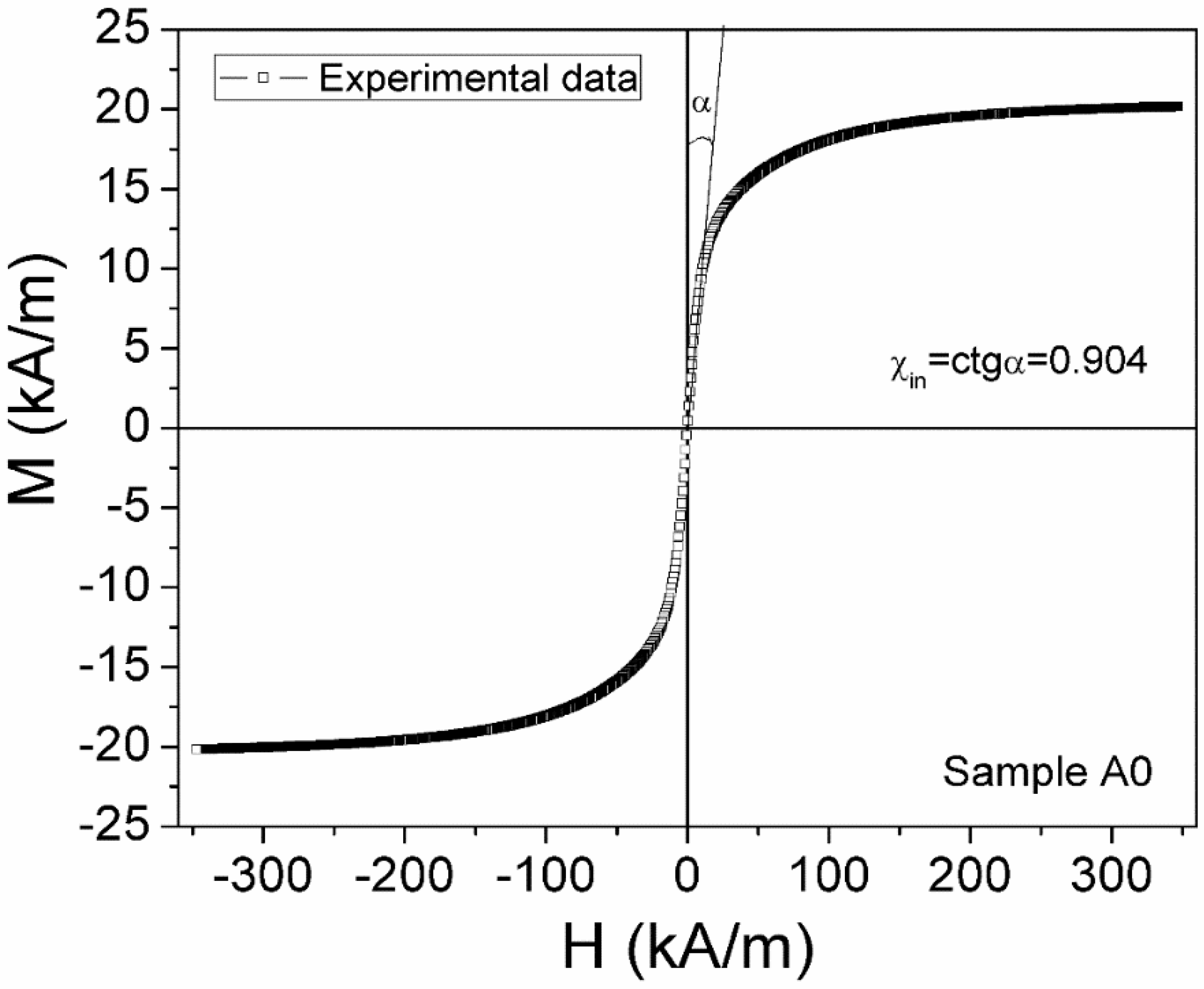
Figure 1. The magnetization curve (M(H)) of the initial ferrofluid sample A0.
Magnetochemistry 12 00005 g001
Figure 2. The components of complex permeability as a function of frequency, f, for 11 different values of polarizing magnetic field (H) corresponding to (1) 0 kA/m; (2) 15.23 kA/m; (3) 24.46 kA/m; (4) 35.28 kA/m; (5) 46.18 kA/m; (6) 57.07 kA/m; (7) 68.49 kA/m; (8) 79.33 kA/m; (9) 90.66 kA/m, (10) 102.40 kA/m, (11) 113.43 kA/m and different volume fractions, φ of nanoparticles from: (a) sample A0 (φ = 11.52%); (b) sample A1 (φ = 7.68%); (c) sample A3 (φ = 3.41%); and (d) sample A5 (φ = 1.53%).
Magnetochemistry 12 00005 g002
Figure 3. Variation of the resonance frequency (fres(H)) with the polarizing magnetic field (H) for ferrofluid samples with different volume fractions.
Magnetochemistry 12 00005 g003
Figure 4. The dependence of the ratio fmax/fres against the polarizing field (H) for the ferrofluid samples, with different volume fractions.
Magnetochemistry 12 00005 g004
Figure 5. The frequency dependence of the heating rate (HR) (a,c) and the specific absorption rate (SAR) (b,d), calculated with the new proposed Equations (1) and (2) compared to the values calculated with the classical Equations (11) and (12) for ferrofluid samples, with different volume fractions in zero field (H = 0).
Magnetochemistry 12 00005 g005
Figure 6. Frequency dependence of the specific absorption rate (SAR) (a,c,e,g) and of the intrinsic loss power (ILP) (b,d,f,h), respectively, in the microwave range of (0.5–6) GHz for different values of the polarizing magnetic field (H) between (0–115) kA/m of ferrofluid samples having different volume fractions (φ) of nanoparticles.
Magnetochemistry 12 00005 g006aMagnetochemistry 12 00005 g006b
Figure 7. SAR as a function of the anisotropy parameter, σ = KeffVm /kBT, at T = 298 K and f = 4 GHz for different values of polarizing magnetic field (H).
Magnetochemistry 12 00005 g007
Figure 8. The plot of the SAR (a) and ILP (b) against the polarizing magnetic field (H) at three frequencies (f) of 2.5 GHz, 3 GHz, and 4 GHz, for the ferrofluid samples having different volume fractions (φ) of nanoparticles.
Magnetochemistry 12 00005 g008
Figure 9. The dependence of the specific absorption rate (SAR) and intrinsic loss power (ILP) of ferrofluid samples against the volume fraction of nanoparticles at different values of applied polarizing magnetic field H = 0 (a), H = 15.23 kA/m (b), and H = 79.32 kA/m (c) and three microwave frequencies (2.5 GHz, 3 GHz, and 4 GHz).
Magnetochemistry 12 00005 g009
Figure 10. The frequency and volume fraction of the effective heating rate (HReff) at two values of the applied polarizing magnetic field.
Magnetochemistry 12 00005 g010
Figure 11. Plot of ΔT against time dependence (Δt) at a constant frequency of f = 4 GHz for different values of applied polarizing field (H) corresponding to (a) sample A0 (φ = 11.52%); (b) sample A1 (φ = 7.68%); (c) sample A3 (φ = 3.41%); and (d) sample A5 (φ = 1.53%).
Magnetochemistry 12 00005 g011aMagnetochemistry 12 00005 g011b
Table 1. Magnetic parameters determined from ferromagnetic resonance measurements.
SamplesHA (kA/m)γ (s−1A−1m)Keff (J/m3)g
A0 (φ = 11.52%)47.922.27 × 1051.44 × 1042.04
A1 (φ = 7.68%)45.002.28 × 1051.35 × 1042.05
A3 (φ = 3.41%)39.752.20 × 1051.19 × 1042.00
A5 (φ = 1.53%)35.542.24 × 1051.07 × 1042.00
Table 2. The parameters Hmax, SARmax, and ILPmax of ferrofluid samples, determined at three frequencies.
SamplesA0 (φ = 11.52%)A1 (φ = 7.68%)A3 (φ = 3.41%)A5 (φ = 1.53%)
Frequency (GHz)2.5342.5342.5342.534
Hmax(SAR) (kA/m)23.1837.4567.2024.1437.7867.5032.4048.2083.6946.2162.0187.33
SARmax (W/kg)8.248.7411.527.868.2811.172.693.054.161.081.281.79
Hmax(ILP) (kA/m)24.4039.4166.8425.0639.8867.7932.0052.7485.3638.3263.1190.72
ILPmax (nHm2kg−1)0.1290.1190.1050.1230.1140.1000.0430.0420.0410.0180.0170.017
Table 3. Variation with the polarizing magnetic field H and the volume fraction (φ) of the temperature increase (ΔT) for a microwave field application time (Δt = const.), respectively, of the values obtained for the time (Δt) when increasing the sample’s temperature by ΔT = const.
Conditionfor ΔT = 1.5 K = const.for Δt = 600 s = const.
H (kA/m)024.4746.1868.49024.4746.1868.49
time (Δt (s))Δt1Δt2Δt3Δt4----
temperature (ΔT (K))----ΔT1ΔT2ΔT3ΔT4
A0 (φ = 11.52%)7504162151701.12.04.05.0
A1 (φ = 7.68%)8745132502000.91.73.64.5
A3 (φ = 3.41%)150912458966640.590.721.01.3
A5 (φ = 1.53%)~3600~3000~240017320.250.310.380.51
Disclaimer/Publisher’s Note: The statements, opinions and data contained in all publications are solely those of the individual author(s) and contributor(s) and not of MDPI and/or the editor(s). MDPI and/or the editor(s) disclaim responsibility for any injury to people or property resulting from any ideas, methods, instructions or products referred to in the content.