Article

Irrigation, Water Deficit and Crop Load Effects on ‘Hass’ Avocado Fruit Size Under New Zealand Growing Conditions


1
School of Science, University of Waikato, Hamilton 3240, New Zealand
2
New Zealand Institute for Bioeconomy Science Limited, Te Puke 3182, New Zealand
*
Author to whom correspondence should be addressed.
Horticulturae 2026, 12(2), 230; https://doi.org/10.3390/horticulturae12020230
Submission received: 19 December 2025 / Revised: 9 February 2026 / Accepted: 9 February 2026 / Published: 13 February 2026
(This article belongs to the Special Issue Orchard Management Under Climate Change: 2nd Edition)

Abstract

The potential for ‘Hass’ avocado production is predicted to increase with climate warming in New Zealand, a country where avocado orchards often lack irrigation because of a cooler and wetter climate compared to most other major growing regions. However, intermittent summer droughts are also predicted to increase in frequency and intensity. This study assessed the effects of summer soil water deficits on fruit growth of ‘Hass’ avocado in the Bay of Plenty, New Zealand, by comparing irrigated and non-irrigated treatments. Rainfall was variable over the three years of the study (2016–17, 2017–18, and 2018–19), but each summer there was a dry period without any rainfall for 2–3 weeks that decreased soil water content in the non-irrigated treatment. Fruit number and final yields were highly variable between trees and years, an effect of variable fruit set during the spring flowering period, and were not affected by the irrigation treatments because soil water deficits did not occur until later, during the summer. Increasing tree crop load caused decreasing individual fruit weight and dry matter content at harvest. However, in the year with the highest average crop load a dry period occurred during early fruit development, and mean fruit weight at harvest was decreased by 26.4 g (10%) in the non-irrigated treatment, an effect that was only apparent after accounting for the effects of variable crop load. The trees responded to dry conditions by reducing stomatal conductance (gs) by 20%, preventing midday leaf water potential (Ψleaf) from decreasing below −0.25 MPa. Irrigation of avocado under the conditions at this site is therefore recommended when soil tension decreases below −30 kPa at 30 cm depth, and adverse effects on fruit growth are likely when tension decreases below −50 kPa. Irregular bearing of avocado under New Zealand growing conditions causes highly variable crop loads that obscure economically significant effects of mild to moderate water deficits on fruit growth. However, irrigation is still an important consideration for avocado production under current growing conditions and is likely to become more important under future climate scenarios as the risk of summer droughts increases.

1. Introduction

Careful management of plant water status is critical for production of many fleshy fruit crops, particularly during early fruit development when water deficits can have large impacts on final fruit size and quality [1,2]. However, climate change is altering evaporation and rainfall patterns globally, and water resources for irrigation in many regions where these crops are grown [3]. Avocado (Persea americana Mill.) originates from subtropical and tropical regions that have a wet-summer and dry-winter climate, but as a crop it is now widespread in drier climate zones such as in parts of California, Chile, Israel, Peru and Australia, where frequent summer irrigation is vital for successful production. Avocado has also become an important horticultural crop in New Zealand, with a production area of approximately 5000 ha in 2025, producing 2% of global supply as the 9th largest exporter international exporter of avocado. In contrast to many other producing regions, the current climate of New Zealand is considered one of the coolest in the world for commercial avocado production [4], where many avocado orchards lack irrigation because of milder temperatures, lower evaporative demand and year-round rainfall [5]. However, climate change is causing more frequent short- and medium-term summer droughts in New Zealand [6], a trend that is predicted to continue, particularly in the more northern and eastern regions where avocado is currently grown [7]. These changes pose a challenge for the continued viability of the horticultural industry, because of the significant impacts of short-term water deficits on fruit growth across many crops, including avocado, and limitations on fresh water supplies for irrigation [8].
Avocado is known to be highly sensitive to water status, and reductions in water supply below well-watered crop demand can decrease fruit number, size and yield [9,10,11]. However, identifying when and how short periods of water deficit become limiting for fruit growth can be difficult because crop responses vary with weather conditions, soil type, physiological status, crop load, and the timing or degree of water scarcity [12]. There are several plant-based indicators that can be used to estimate the level of water stress in perennial horticultural crops. These include stem water potential (Ψstem) and leaf water potential (Ψleaf) [13,14], stomatal conductance (gs) [15,16], changes in trunk diameter [17,18], leaf temperatures [19,20], and sap flow [21,22]. Significant water stress has been reported for avocado when Ψstem falls below −0.8 under Mediterranean climate conditions [23]. However, avocado is know to exhibit isohydric stomatal responses to soil water deficits, with plant water status regulated through stomatal closure [24]. Reductions in photosynthesis in avocado, caused by stomatal closure in response to water stress, have been observed when Ψstem decreased to −0.9 MPa in South Africa [25] and −1.2 MPa in California [26]. Fruit require water and carbohydrates to grow, and carbohydrates are derived from photosynthesis [27]. In an isohydric species like avocado, mild or moderate levels of stress may not be detectable as further decreases in Ψstem as the soil dries, but both water and carbohydrate supply to the fruit may be affected [28]. Fruit size and oil content in fruit (correlated with dry matter content—the ratio of dry weight to fresh weight) are both important fruit quality parameters for avocado. Periods of inadequate water supply can have a large negative impact on both.
Understanding how water stress influences fruit quality and yield in avocado is complicated by the variable nature of tree growth and reproduction from year to year. Avocado has unique characteristics that include protogynous flowering [24], a tendency for biennial bearing [29,30], and exceptionally high levels of flower and immature fruit abscission [31]. The temperate maritime climate of New Zealand, with relatively cool and variable temperatures in spring, directly influences these characteristics, causing frequent failure of the flowering opening process, irregular bearing from year to year, and a prolonged fruit growth period [4,32]. The resulting high levels of tree-to-tree variation in crop load, fruit size and flowering patterns, often observed within individual orchards, make it more difficult to detect and ameliorate the effects of moderate levels of water stress on fruit development. In the main avocado growing region of the Bay of Plenty with allophanic soils, soil water deficit is rare during the flowering period in spring but becomes more likely during the period of rapid fruit growth in summer [28,33]. However, guidelines for irrigation management have only recently been developed for avocado production in New Zealand [33], and if irrigation is available, the strategies for its use remain variable from grower to grower.
The aim of this research was to quantify the effects of short-term water deficits on avocado fruit growth, yield, and quality under New Zealand conditions, and to provide supporting information for irrigation recommendations as producers adapt to a more variable climate. Irrigated and non-irrigated ‘Hass’ avocado trees were compared on an orchard in the Bay of Plenty, New Zealand, over three seasons. ‘Hass’ avocado is the prevailing avocado cultivar grown internationally, and currently accounts for 95% of plantings in New Zealand. It was hypothesized that a decrease in soil water content during the early fruit development stage from November to February, associated with intermittent rainfall, would reduce fruit size at harvest. However, it was also hypothesized that the naturally high and uncontrolled levels of variation in crop load between trees would interact with the effect of water stress on fruit size and dry matter content, making it more difficult to detect the effect of short-term water deficits on fruit size [24]. Potential reductions in fruit dry matter content were also considered, because of avocado’s tendency for stomatal closure and decreased photosynthesis in response to decreased soil water content.

2. Materials and Methods

2.1. Study Site

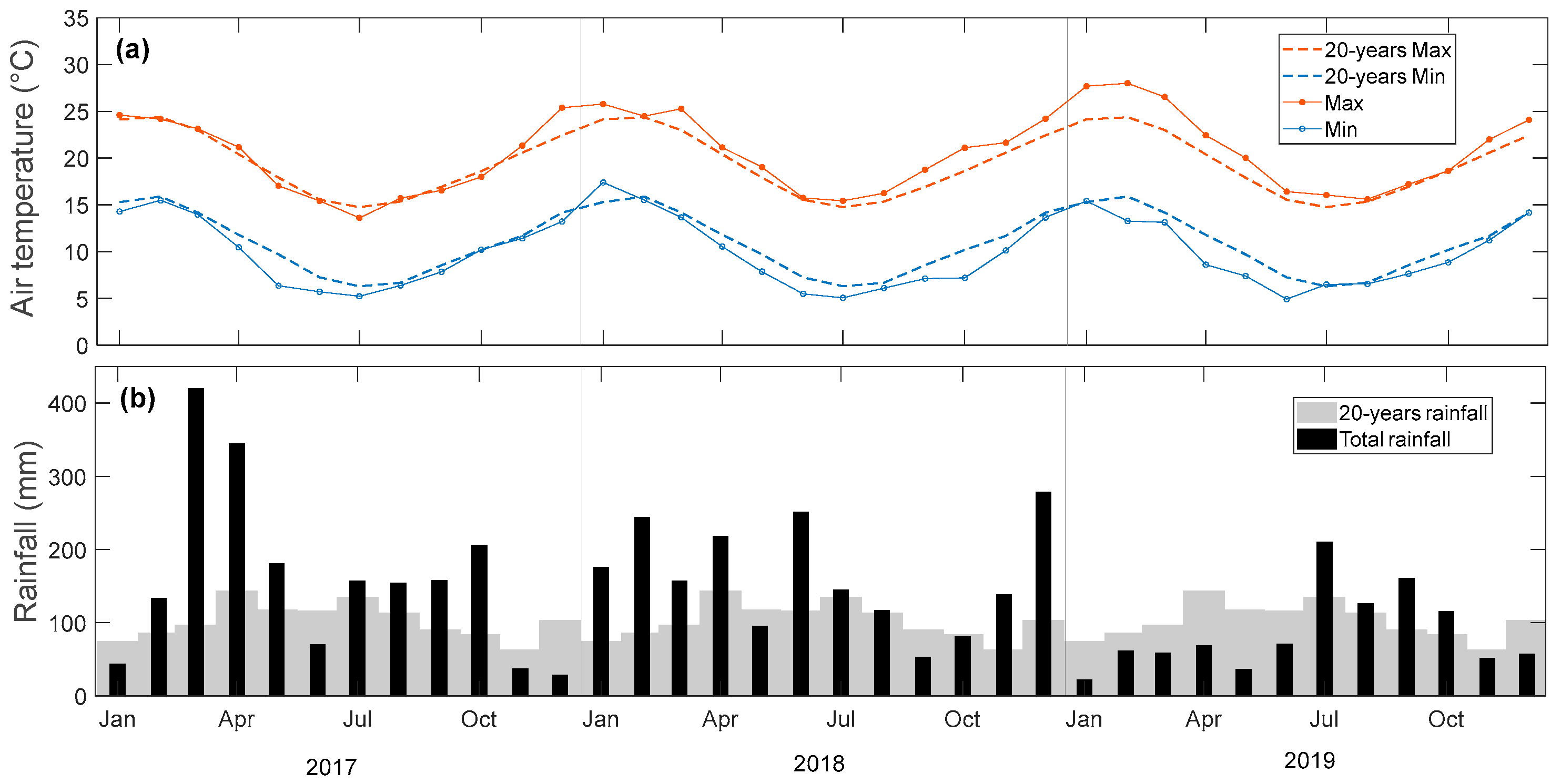
This research was conducted in a commercial avocado orchard, Omokoroa, Bay of Plenty, New Zealand (37°39′17.964″ S, 176°1′12.936″ E). The region is characterized by a mild climate with rainfall throughout the year. In Tauranga (25 km from the study site), the 30-years (1981–2010) normal mean monthly maximum and minimum air temperatures were 24 and 15 °C in January, and 14 and 6 °C in July respectively, and normal annual rainfall was 1189 mm, with mean monthly total rainfalls of 74, 95, 78, 86, and 97 mm in November, December, January, February, and March, respectively (Figure 1) [34]. The soil type of the study site was sandy loam (Typic Orthic Allophanic soil) [35]. Management of the orchard, including fertilizer applications, pruning, pest control and irrigation followed recommended practices for commercial orchards in this region [36].

2.2. Plant Materials and Experimental Design

Ten year old Persea americana ‘Hass’ avocado trees were growing on ‘Zutano’ seedling rootstocks, with 18 trees per row, 7.5 m between trees, and 9 m between rows. Within three adjacent rows, 24 healthy and mature trees with a height of 7 m and a canopy diameter of 7.5 m were selected for this study.
A complete block design with two treatments (irrigated and non-irrigated) and three rows as blocks was established (Supplementary Figure S1). There were four replicate trees per row, providing 12 trees in total per treatment. Trees of the same treatment were paired so that trees adjacent to non-irrigated pairs of trees could also be non-irrigated, to provide a buffer between treatments within rows.
Micro-sprinklers with a convex rotor (Rondo 75 lph, Rivulis, Migdal HaEmek, Israel) had been previously installed by the orchard owner below the canopy 2.5 m above the ground. For this experiment irrigation was applied for 6–8 h when soil water content of the 0–30 cm soil layer, as measured under the trees using soil moisture probes, dropped below 0.4 m3 m−3. This threshold corresponded approximately to soil water tensions reaching 30 kPa at 30 cm depth (see Section 3), the recommended irrigation trigger point for commercial orchards in this region [36]. The volume of water recommended for irrigated trees was calculated as:
I = E T o K c R
where I is the depth of irrigation (mm), ETo is the FAO-56 Penman-Montieth reference evapotranspiration (mm), Kc is a crop coefficient from 0.45 in December to 0.70 in March [33], and R is total rainfall (mm), calculated weekly. Groundwater does not contribute to the soil water balance of trees at this site [33]. Actual irrigation was controlled by the orchard owner, and tended to be less than the recommended amount before and during the experiment, because of restrictions on water availability and requirements for other parts of the orchard (see Section 3).
Sprinklers were disabled for the non-irrigated treatment from January to April in Year 0 (2016–17), and from November to April in Year 1 (2017–18) and Year 2 (2018–19), with the non-irrigated trees receiving only precipitation during the three summers of the study period. Trees in the irrigated treatment continued to receive irrigation as described above.

2.3. Experiment Timeline

Under New Zealand’s conditions, the flowering season for avocado is from early-October to early-November, and harvest starts in September the following year. The potential irrigation period, including at the study site, is generally from November to March (Table 1). From April to September rainfall usually exceeds evapotranspiration, soil water content at the study site did not fall below 0.4 m3 m−3, and irrigation was not used [33].
The experiment was conducted for three cropping years; ‘Year 0’ from October 2016 to September 2017, ‘Year 1’ from October 2017 to September 2018, and ‘Year 2’ from October 2018 to September 2019. Overall, there was no difference in soil water content between the two treatments in Year 0, because the non-irrigated treatments were established during that summer, after the dry period that occurred in that year had begun (Table 2). Differences in soil moisture appeared more clearly in Years 1 and Year 2 after irrigation treatments were applied from the beginning of the summer period. Plant water potential was measured periodically during the summer of all three years. Fruit growth and fruit abscission were monitored throughout the fruit growth period of Year 1. Fruit yield, size and dry matter content were measured at harvest in Year 0 and Year 1. Fruit set was extremely low in Year 2 despite sufficient flower numbers, resulting in a lack of fruit over the entire orchard. However, monitoring of the impact of irrigation treatments on tree water status was continued for that year, and measurement of the effects of treatments on stomatal conductance were added.

2.4. Weather

A meteorological station was installed in an open area within the orchard to record rainfall (TR-525I, tipping bucket rain gauge, Texas Electronics Inc., Dallas, TX, USA), solar radiation (LI200 pyranometer, LI-COR Inc., Lincoln, NE, USA), air temperature and humidity (HMP50 temperature and relative humidity probe, Campbell Scientific, Logan, UT, USA), and wind speed (Vector A101M anemometer, Vector Instruments, Denbighshire, UK) from January 2016 to November 2019. Sensors were connected to a data logger (CR1000, Campbell Scientific, Inc., Logan, UT, USA), meteorological data were recorded every 15 min, and daily potential evapotranspiration (ETo) for a short vegetated surface was calculated by the data logger using the FAO-56 Penman-Monteith equation [37]. To fill a gap caused by equipment failure, meteorological data for the nearby city of Tauranga were obtained for the period October to December 2016 [34].

2.5. Soil Water Content

To monitor volumetric soil water content, soil moisture probes (CS616, and CS650, Campbell Scientific Inc., Logan, UT, USA) were installed in January 2017. The soil moisture probes were calibrated in the laboratory before installation using soil samples taken from the orchard at the depths where the probes were buried. Dry soil was moistened to a known water content and packed to the same bulk density as measured in the orchard to obtain the relationship between the output values of the probes and actual volumetric soil water content.
The soil moisture probes were installed vertically halfway between the trunk and the edge of the canopy at the three depth ranges (0–30, 31–60, and 61–90 cm) on the eastern side of six irrigated trees and two non-irrigated trees. More irrigated trees were monitored because these trees were part of a separate trial monitoring tree water use at the same site [33]. These probes were connected to a data logger (CR1000, Campbell Scientific, Inc., Logan, UT, USA), and soil water content was recorded hourly. Tensiometers are commonly used by avocado growers in New Zealand (30 and 60 cm, SR Irrometer, Irrometer Company Inc., Riverside, CA, USA) and therefore were also installed next to a set of the electronic soil moisture probes to obtain a cross-reference between volumetric soil moisture and manual tensiometer measurements. A soil moisture release curve was prepared from periodic tensiometer readings and the output recorded from soil moisture probes at the same times.

2.6. Plant Water Potential

Predawn leaf water potential (Ψpd) was measured using a pressure chamber [13] (PMS Instrument Co., Ltd., Corvallis, OR, USA) on 17 and 29 January, and 4 March in 2017 (Year 0), and 12, 21 and 31 December 2017 (Year 1). At each measurement, a leaf was placed in a plastic bag before removing from the tree using a razor blade.
Leaf water potential (Ψleaf) and stem water potential (Ψstem) were measured at midday on 17 and 28 January, and 12 February 2017 (Year 0), and 30 December 2017 (Year 1), and 12 February and 6 April 2019 (Year 2), when the soil water content of non-irrigated trees decreased below 0.35 m3 m−3. At each time, for the Ψleaf measurement, a fully sun-exposed leaf was selected, placed in a plastic bag before removing from the tree using a razor blade, and then measured. For the Ψstem measurements, leaves were covered with aluminium foil for two to three hours before measurements.

2.7. Fruit Size, Dry Matter and Yield

At harvest on 2 October 2017 (Year 0) and 15 September 2018 (Year 1) fruit yield was obtained for each experimental tree by weighing all fruit, then a 50 fruit sample was selected randomly and weighed as a measure of average fruit weight. Three to five fruit per tree were placed in a plastic bag and carried to the laboratory for analysis.
In the laboratory, a 10 mm corer was used to take a longitudinal core from the stem end to the stylar end. The mesocarp was separated from the skin and seed, weighed and dried at 60 °C in an oven for three days. Dry matter content was calculated as the ratio of dry weight to fresh weight of the mesocarp sample.

2.8. Fruit Growth and Abscission

Non-destructive fruit growth measurements were conducted from December 2017 until harvest in September 2018 (Year 1). For each tree, 20 fruit were labelled, and one length and two diameters of labelled fruit were measured using digital callipers every two to three weeks.
Fruit weight was estimated using the equation [38]:
W f r u i t = 0.4644 L 1 D 1 D 2 + 8.7219
where Wfruit is fruit weight (g), L1 (cm) is fruit length, and D1 (cm) and D2 (cm) are fruit diameters.
Fruit abscission was monitored from December 2017 until harvest (Year 1). To monitor 50 fruit per tree, 5–7 fruiting branches were selected and labelled, and the remaining fruit on these branches counted every 2–3 weeks.

2.9. Stomatal Conductance

Stomatal conductance (gs) was measured on six dates during the dry period of Year 2 with a portable photosynthesis system (LI-6400, LI-COR Inc., Lincoln, NE, USA). Measurements were conducted five times a day from 11:00 to 16:00 h on six irrigated and six non-irrigated trees. At each time, five mature and fully sun-exposed leaves per tree were selected.

2.10. Statistical Analysis

All statistical analyses were carried out using R v.4.4.2 [39]. Water potential and stomatal conductance were compared by analysis of variance (ANOVA) for each date of measurement, and Tukey’s HSD test was performed for post-hoc comparison. Non-destructive fruit growth measurements were compared by ANOVA for the first and last dates of measurement only (to minimize pseudo-replication caused by repeated measurements on the same fruit over time), with fruit nested within tree. Analysis of covariance (ANCOVA) was used to test for the effect of irrigation on fruit weight and dry matter content, with yield per tree (crop load) as a covariate and row as a blocking factor. A p-value of less than 0.05 was considered to be statistically significant.

3. Results

3.1. Weather

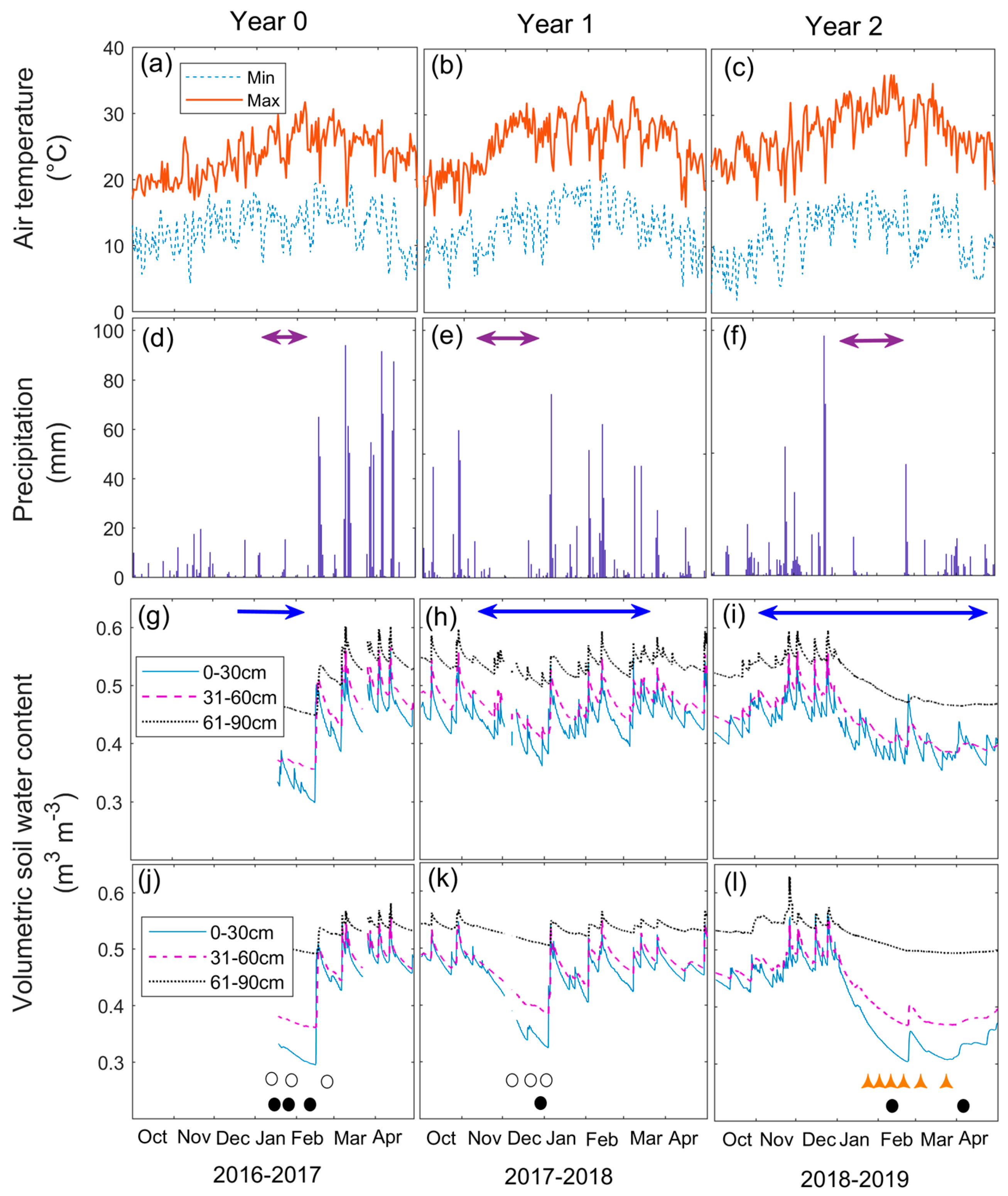
Over the three summers, January was consistently the warmest month with a monthly mean daily maximum air temperature of 29.9 °C in Year 0, 28.6 °C in Year 1, and 31 °C in Year 2 (Figure 2a–c). An unusually cool spring was observed in October of Year 2, with 15 days of minimum temperatures below 8 °C (Figure 1a and Figure 2c). An extended dry period occurred in all three summers, although its timing and length was variable: January in Year 0, December in Year 1, and February in Year 2, with a total rainfall of 43.6, 28.2, and 61.1 mm for each of these months, respectively (Figure 2d–f).

3.2. Soil Water Content

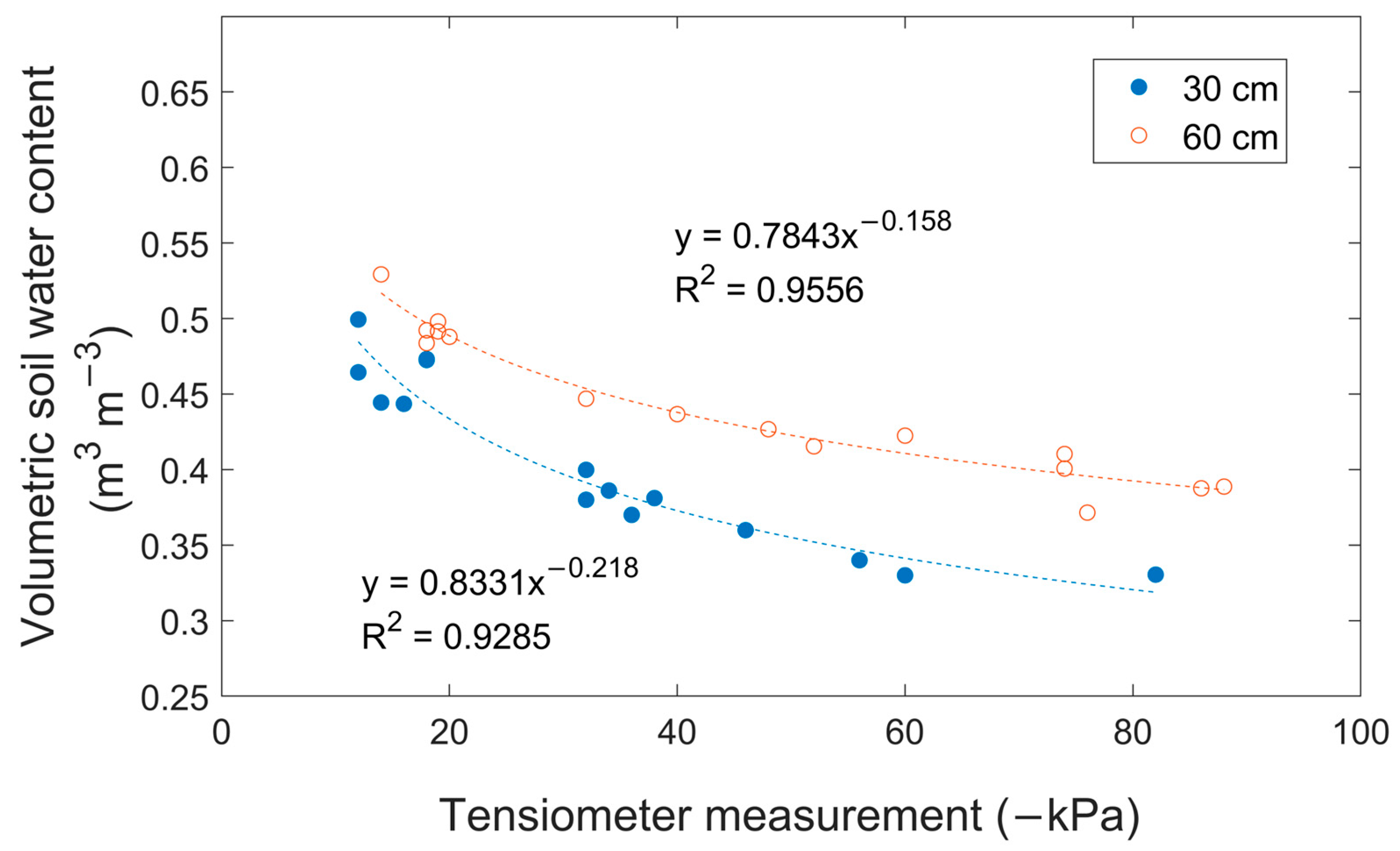
In Year 0, the irrigation treatments did not start until partway through the summer, therefore, soil water content was similar between the two treatments for the remainder of the summer period. In this year, soil water in the top layer (0–30 cm) decreased to 0.3 m3 m−3 until a significant rain event occurred on 16 February (Figure 2g,j). In Year 1 and Year 2 the soil water content of the top layer remained above 0.35 m3 m−3 for the irrigated trees (Figure 2h,i). In contrast, the soil water content for the non-irrigated trees declined below this level during the dry periods (Figure 2k,l). The driest measurement of the top layer was 0.32 m3 m−3 (−80 kPa) on 3 January in Year 1, and 0.30 m3 m−3 (−110 kPa) on 22 February in Year 2 (Figure 2k,l). Figure 3 provides the relationship between volumetric soil water content and soil water tension measured using soil tensiometers at two soil depths.

3.3. Plant Water Potential

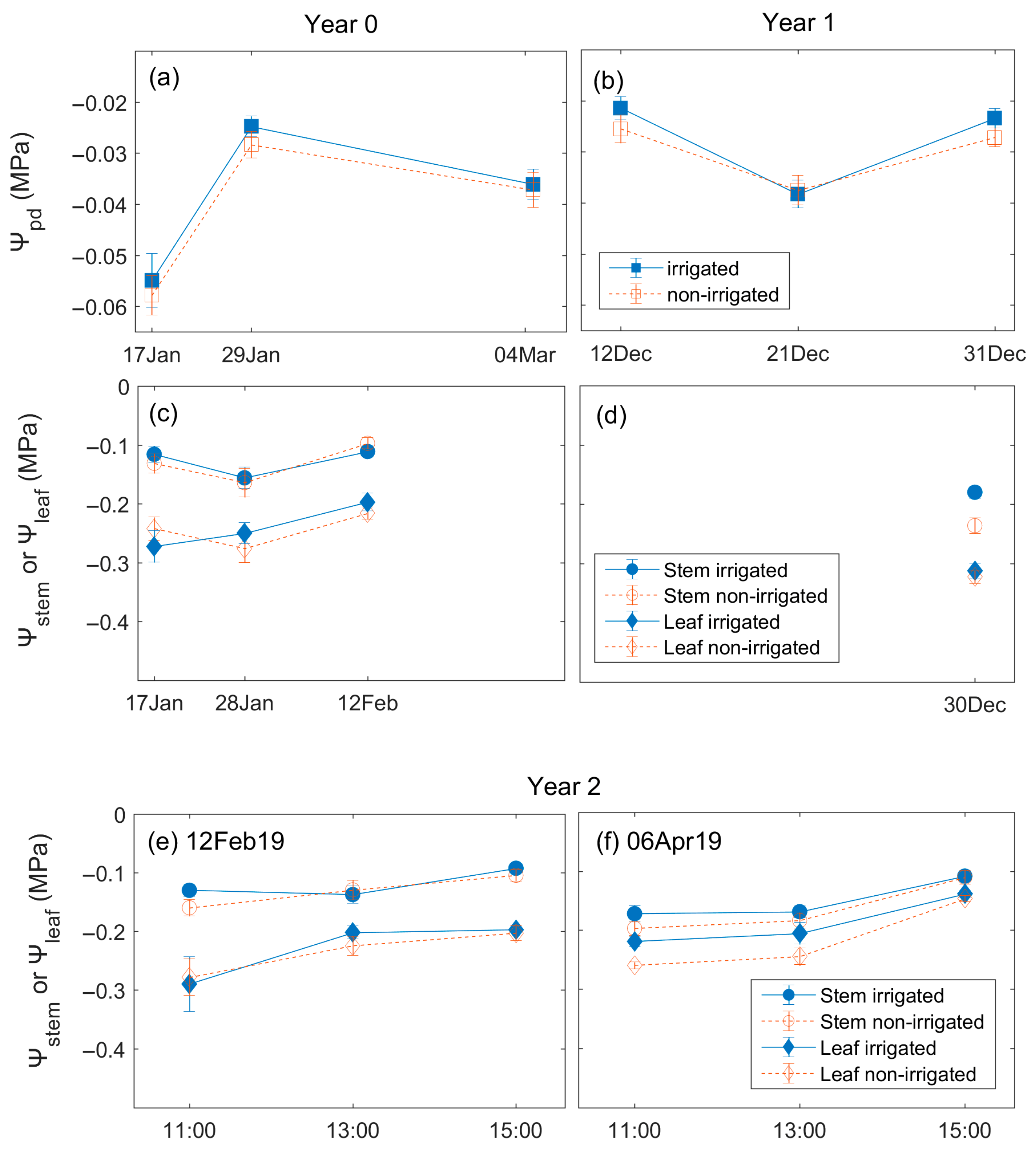
Ψpd was measured in Year 0 and Year 1 (Figure 4a,b). Both treatments were above −0.06 MPa, and no difference was detected between the two treatments in either year (p > 0.05). Ψstem and Ψleaf were also measured during the dry periods in Year 0 and Year 1 (Figure 4c,d). Overall, there was no difference in Ψstem and Ψleaf in Year 0. In Year 1, non-irrigated tree Ψstem was 0.1 MPa more negative than the irrigated treatment (p < 0.05) during the dry period, but there was no difference in Ψleaf (p > 0.05), suggesting a mild level of soil moisture stress for avocado.
Diurnal variation in Ψstem and Ψleaf was observed during the dry period in Year 2 (Figure 4e,f). Ψstem and Ψleaf was lowest in the morning and increased in the afternoon. On 12 February, the two treatments had similar values of Ψstem and Ψleaf (p > 0.05). However, by 6 April, at 1100 h, the non-irrigated treatment had lower Ψstem and Ψleaf values, relative to the irrigated treatment, and the difference in Ψleaf between treatments was significant (p < 0.05), suggesting that a mild level of water stress also developed during this dry period.

3.4. Stomatal Conductance

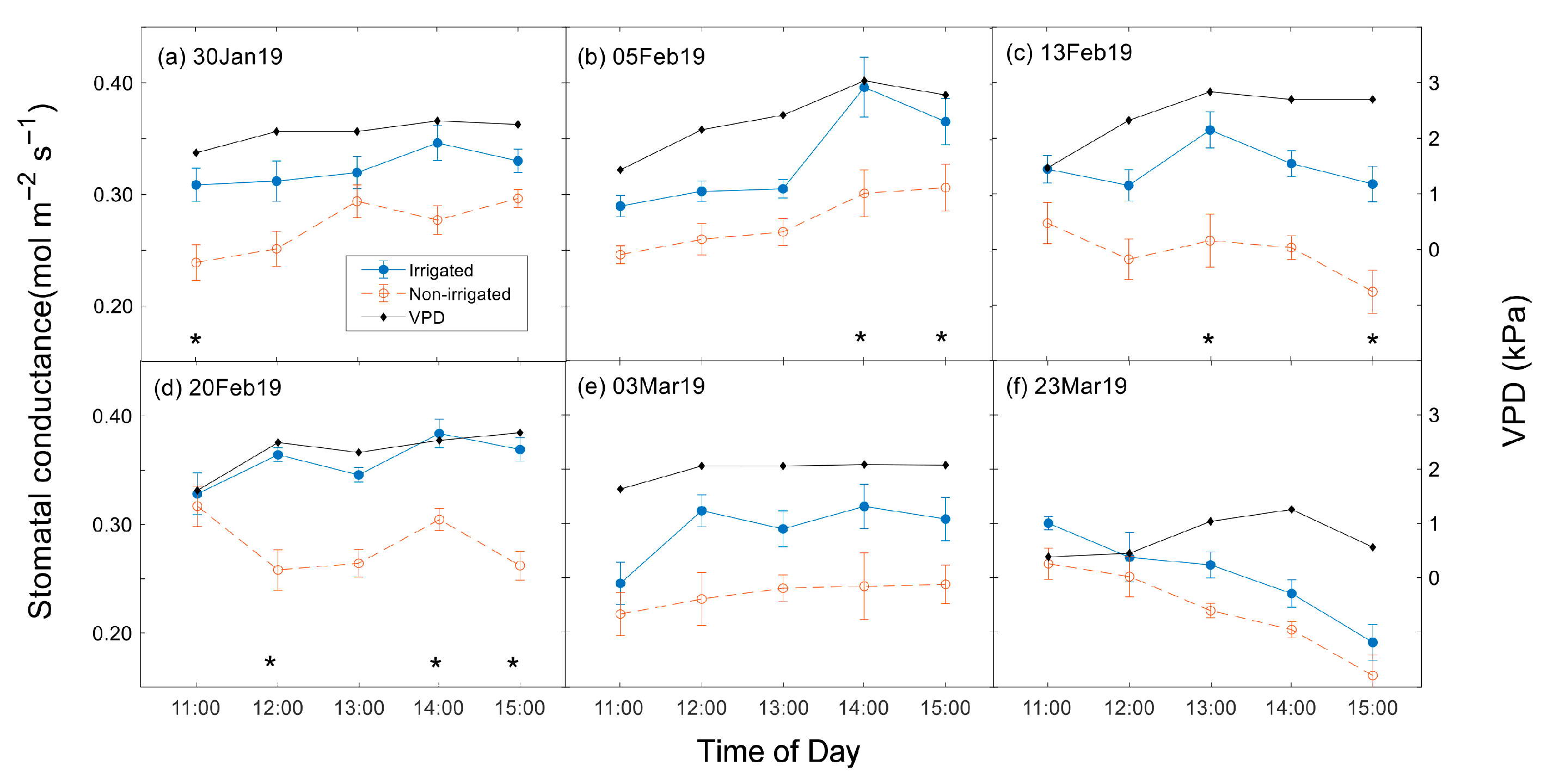
Stomatal conductance varied diurnally from late-January to late-March during the dry period in Year 2, usually reaching a maximum around the middle of the day, before declining (Figure 5). Stomatal conductance of the irrigated trees was usually above 0.3 mol m−2 s−1, whereas for non-irrigated trees gs was slightly lower, around 0.25 mol m−2 s−1, and the difference between the two treatments became more significant when the vapour pressure deficit (VPD) increased above 2.0 kPa (p < 0.05). Variation in the diurnal patterns of gs and VPD were caused by variable weather and cloud cover at the site, however mean gs was consistently lower for the non-irrigated trees during this period when soil water content was different between treatments (Figure 2).

3.5. Fruit Growth and Fruit Abscission

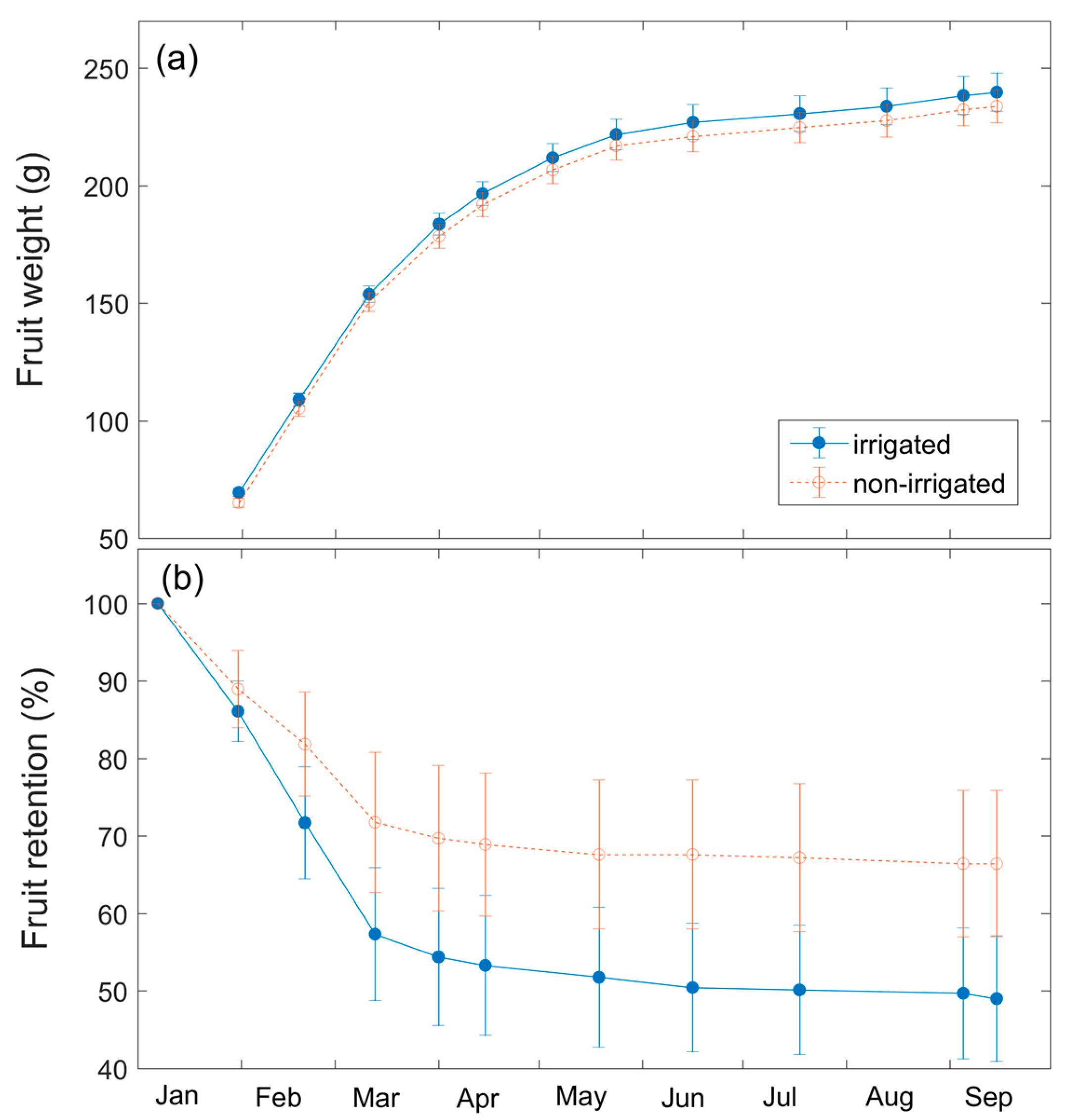
Fruit grew rapidly until early-March in Year 1, then more slowly until harvest in September (Figure 6a). Overall, from February to September, fruit increased in size from 66 ± 1.82 g and 61 ± 1.50 g (p < 0.05) in the irrigated and non-irrigated treatments, respectively, to 246 ± 8.63 g and 234 ± 3.90 g (p > 0.05) on the final date of measurement. The fruit abscission rate was highest from January to early-March, and both the irrigated and non-irrigated trees lost more than one-third of their fruit in this period (Figure 6b). The irrigated trees had higher early fruit abscission, compared to the non-irrigated trees. However, there was a high level of variation in the proportion of fruit abscised between trees, and there were no significant differences in fruit abscission between the two treatments.

3.6. Fruit Size, Dry Matter and Yield

Fruit yield varied widely between trees and years. In both Year 0 and Year 1 the lowest yields were below 30 kg per tree, whereas the highest yields were more than 200 kg per tree. Year 0 was an off-cropping year, with only one tree producing more than 200 kg, whereas Year 1 was an on-cropping year, when more than half of all trees produced more than 200 kg. Overall, there was no significant effect of irrigation on total yield per tree, but yield was significantly higher in Year 1 (Table 3). In Year 2 very few fruit were set and no harvest was possible.
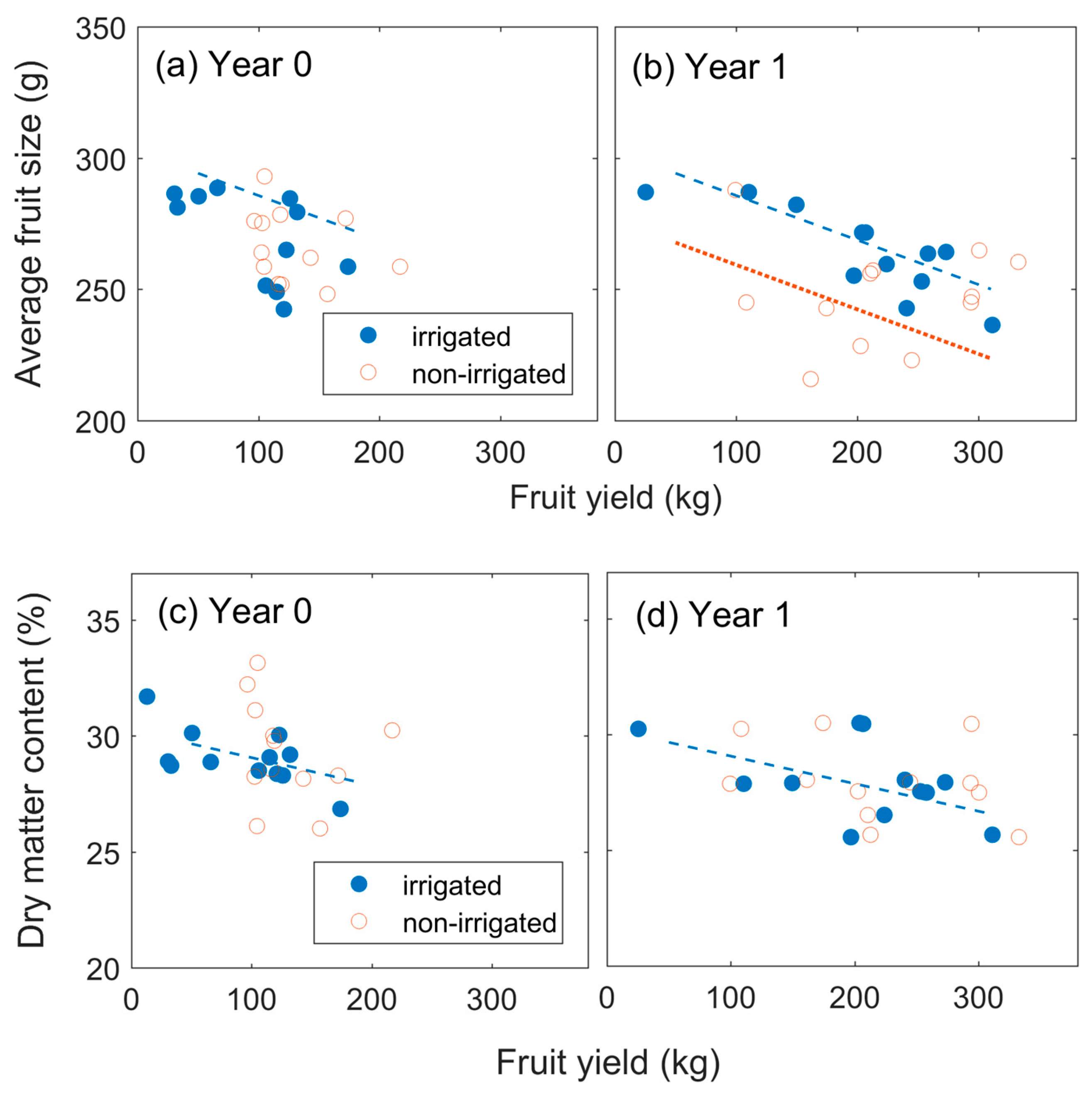
Individual fruit weight decreased with increasing fruit yield per tree (−17.0 g per fruit with every 100 kg increase in yield per tree, ANCOVA, p < 0.001; Figure 7a,b). The effect of yield on fruit weight did not change with year or irrigation (no year or irrigation interactions with yield, p > 0.05; Figure 7a,b). Lack of irrigation in Year 1 decreased individual fruit weight by 26.4 g per fruit, regardless of yield per tree (significant interaction between irrigation and year, p < 0.05; Figure 7b). Fruit dry matter content also decreased with increasing yield per tree in both years (−1.2% for every 100 kg increase in yield, ANCOVA, p < 0.001; Figure 7c,d), but there were no separate effects of irrigation or year on fruit dry matter content (no irrigation, year or interaction effects p > 0.05; Figure 7c,d).

4. Discussion

This study demonstrates the sensitivity of avocado fruit growth to water status, even under the comparatively mild growing conditions of New Zealand, where irrigation of avocado is often considered ‘optional’. Highly variable crop loads between years and trees can mask the effects of short periods of water deficits on fruit size and total yields. However, after accounting for the effects of crop load, fruit weight was reduced in the absence of irrigation, even when the level of water stress was mild compared to the levels typically seen in avocado in other countries. Isohydric stomatal closure minimized changes in plant water status as the soil dried, contributing to the difficulty of detecting water stress, and may have contributed to impacts on fruit growth by reducing carbohydrate supply during early fruit development. The sensitivity of fruit growth to even mild water deficits, combined with an increasing probability of summer water deficits linked to climate change within current avocado growing regions of New Zealand presents a clear risk for orchard productivity and continued expansion of the industry.

4.1. Weather and Soil Water Content

Soil water deficit during the flowering period (from late-September to late-October) is rare in the Bay of Plenty region of New Zealand, indicating that there is a low probability that water stress affects the flowering process [38]. Soil water content was high at all depths in early-spring in the three years of this study and no difference was detected between the two treatments. However, rainfall was irregular in summer (from December to March). Although the timing of the dry period was variable, each summer there was a month-long period with lower precipitation that caused the upper soil water content of the non-irrigated trees to decrease below 0.35 m3 m−3 (−40 kPa). Water application to the irrigated treatment was slightly under the recommended amount because of constraints on irrigation management at the orchard, however, the dry periods still created clear differences between the two treatments.
Avocado is known to have a shallow root system, with two-thirds of the root system is located in the top 60 cm of soil [10,40,41], although the actual proportion is likely to depend on the soil type. In this study on sandy loam soil the top (0–30 cm) and middle layers (31–60 cm) dried quickly during the dry periods, and soil water content in the top 30 cm appeared to be most important. In contrast, soil water content in the deeper layer (61–90 cm) was high (above 0.45 m3 m−3) throughout the year. These observations suggest that a shallow root system makes avocado highly sensitive to water scarcity.

4.2. Plant Water Status

Water potential is a good water stress indicator for a plant, and the level of water stress observed in this study was less than that recorded elsewhere. For avocado in Chile, Celedon, et al. [42] stated that Ψstem values were between −0.45 and −0.6 MPa under well-watered conditions, and dropped to −0.9 MPa during water stress with a Mediterranean marine climate, when the VPD was 3.6 kPa on sunny days. Compared to these values, the Ψstem values obtained here were higher and usually above −0.3 MPa in both treatments. Environmental conditions such as temperature and evaporative demand affect plant water potential measurements [43]. In New Zealand, the VPD rarely exceeds 3.0 kPa, possibly explaining why the Ψstem values were higher in this experiment. Overall, the water potential measurements suggest only a mild level of water stress developed in the non-irrigated treatments, with water potential differences potentially minimized by stomatal closure in response to soil drying.
Stomatal regulation is complex and involves many factors, such as plant physiological conditions, water status, nutrient availability, and weather conditions [44,45,46]. The description of stomatal behaviour of avocado is somewhat controversial, with some studies [28,47,48,49] having suggested that water stress induces stomatal closure, while others [42,50] have reported that water deficit did not influence gs but caused a decrease in Ψstem. Measurements of stomatal conductance were added to monitoring of the trees in the final year of the present study because of the lack of strong differences in water potential observed during dry periods in the first two years. The non-irrigated trees had approximately 20% lower gs compared to the irrigated treatment when soil water content was below 0.35 m3 m−3. The effect of lack of irrigation on stomatal conductance was more pronounced than the difference in water potential. This suggests isohydric stomatal behaviour, with stomatal closure in response to water stress reducing differences in water potential, but potentially also causing a decrease in carbohydrate production by restricting photosynthetic assimilation.
Carbohydrate supply is important for fruit growth. In many crop species, such as plum [51], apple [52], citrus [53] and avocado [54], a higher photosynthetic rate has been observed during fruit development. This is because fruit are a strong sink for carbohydrates, and high demand for carbohydrate for fruit growth lowers carbohydrate concentration in leaves, leading to increased photosynthetic rates [54]. However, in isohydric species such as avocado, photosynthetic activity decreases when soil water availability decreases, limiting carbohydrate accumulation in fruit. This limitation on fruit growth should be more significant for trees with a heavy crop.

4.3. Fruit Growth, Fruit Abscission and Irregular Bearing

In year 1 the dry period occurred early, before the first period of very high rates of fruit abscission had subsided and non-destructive fruit growth measurements could begin [38]. Mean fruit size was already lower in the non-irrigated treatment at the start of the monitoring period, a possible effect of the early water deficits on initial fruit growth. From the first measurement onwards fruit growth rate did not differ, and fruit size remained lower in the non-irrigated treatment for the rest of the season, although this difference gradually became less statistically significant over time. However, a larger destructive sample of fruit at harvest confirmed that the non-irrigated treatment had smaller fruit, after the effect of variable crop load between trees was accounted for (see below). Tree-to-tree variation in crop load, and the early timing of the dry period, made it difficult to detect treatment effects on fruit growth rate using non-destructive fruit monitoring alone.
Fruit abscission caused by soil water deficit was not detected in this experiment. Some studies suggested that immature fruit abscission is increased by heat stress [55,56] or carbohydrate stress [57,58], rather than water stress [31]. Severe water stress might lead to carbohydrate stress if a photosynthetic activity is reduced for an extended period, resulting in excessive fruit abscission [56]. However, rainfall patterns meant that the level of water stress imposed on the non-irrigated trees was moderate in this experiment, the stress period occurred before monitoring of the later stages of fruit abscission began, and the final yields for year 1 did not indicate that there were significant differences in mean crop load between treatments.
Crop load in avocado is strongly influenced by highly variable flower numbers and flower and fruitlet abscission during the flowering period in spring, when soil water deficits are rare in the Bay of Plenty growing region of New Zealand. Regardless of the climate, alternate bearing by avocado is typically observed as alternating on-cropping and off-cropping years [30]. In the present experiment fruit production was low in Year 0 and Year 2, and high in Year 1 across the entire orchard. However, it appears that the exceptionally low fruit yield in Year 2 was caused by weather conditions during flowering for that year, rather than the more regular alternate bearing effects on flower production. This orchard experienced an unusually cold spring in Year 2. The October monthly average daily minimum air temperature in Year 2 was 3 °C lower than that of Year 1. The reproductive process of avocado is known to be highly sensitive to temperature [59], and unusually low temperature can negatively affect the synchrony of male and female flower development [60,61], ovule viability [62], and pollen tube growth [63]. This is an example of how New Zealand’s current climate creates a more irregular pattern of avocado production compared to other countries [32].

4.4. Effect of Water Stress on Harvested Fruit Yield and Fruit Quality

Water stress in the absence of irrigation decreased avocado fruit weight at harvest by approximately 10% or 26.4 g in the second year of the study, when a period of low rainfall occurred during early fruit development. This effect was detected against a background of very high levels of variation in individual fruit weight between trees in response to crop load, with mean fruit weight decreasing as total fruit weight per tree increased. As discussed above, irregular variation in crop load is a common feature of avocado production in New Zealand, driven primarily by variation in fruit set in spring. Regardless of the cause of variable crop load, a negative correlation between crop load and fruit size is commonly observed in avocado and many other fruit crops [64]. In our study the effect of variation in crop load on fruit size was of a similar or larger magnitude compared to that of the effect of irrigation, potentially obscuring the negative effects of mild water stress that may occur at any time during summer under New Zealand growing conditions if irrigation is not used. Irrigation did not have a detectable effect on total yield per tree, because yield was determined primarily by fruit number rather than fruit size, and varied from 13 to 330 kg per tree across the two years of harvestable yields. Both total yields and mean fruit size are important determinants of the commercial viability of avocado production.
Water stress reduced fruit size, but did not influence fruit dry matter content, an indicator of fruit oil content, maturity and eating quality. Holzapfel, et al. [65] and Moreno-Ortega, et al. [66] also reported that water stress reduced avocado fruit size without affecting fruit dry matter content, but Zuazo, et al. [11] did observe reductions in fruit size and increases in fruit lipid content with deficit irrigation under semi-arid conditions. Fruit size in avocado may be determined by variation in the rate of cell division in the mesocarp [67]. Cell division continues throughout avocado fruit growth, but is most active during the first six weeks after fruit set [68]. This is the period from November to December under New Zealand conditions, and water stress during this period may directly affect fruit growth by reducing the rate of early cell division. The lack of reduction in dry matter content may be because avocado fruit have a long growing period, and oil accumulates throughout fruit growth, in particular during later fruit developmental stages in winter [69]. Therefore, water stress that occurs only in early- or mid-summer is less likely to affect oil accumulation.

4.5. Irrigation and Climate Change

Avocado is frequently cited as an exemplar of a crop that will increase in land-use suitability and potential spatial extent in New Zealand with climate warming [70,71]. These recommendations are based on reductions in the negative impacts of frost and cool spring temperatures on flowering and fruit set, but do not consider irrigation requirements. Current water use for avocado production in New Zealand is comparatively low compared to production in other countries, where avocado is often grown in water-scarce regions, and is therefore considered a water intensive crop [5]. However, over the 10 years prior to the current study the average daily temperatures in the Bay of Plenty region increased by 0.5 °C [34], and the three summers included in this study were the warmest of the preceding 20 years [34]. Drought is predicted to occur more frequently and more intensely in the northern and eastern regions of New Zealand where avocado is currently grown, likely affecting both the demand for and availability of water resources for agricultural use [3,7]. This study demonstrates that even relatively brief and mild summer water deficits can impact avocado productivity under New Zealand growing conditions, suggesting that access to irrigation is a potential limiting factor for continued expansion of this crop with climate warming.
Sustainable and effective irrigation of a horticultural crop requires accurate identification of the threshold level of water stress required for negative impacts to occur. In this experiment, the amount of irrigation water applied was calculated based on ETo and Kc. Irrigation was usually applied when soil water content dropped below 0.40 m3 m−3 (−30 kPa) at a depth of 30 cm, half-way between the trunk and the edge of the tree canopy. This threshold corresponded to the point on the soil moisture release curve where soil water potential measurements became increasingly negative, resulting in subtle but significant effects on harvest fruits size, and marked the onset of reductions in gs as soil water content decreased below 0.35 m3 m−3 (−50 kPa).
Deficit irrigation, the application of water at rates below crop demand, can improve the efficiency of irrigation water use for fruit crops such as olive [72] and grape [73]. A recent study of sustained deficit irrigation of avocado under semi-arid conditions demonstrated that a 25% reduction in irrigation below crop demand reduced overall yield by only 8%, and improved fruit quality through increases in fruit lipid concentrations [11]. A similar strategy could be beneficial even under the more humid and temperate conditions of New Zealand. Crop load also has an important role in irrigation management of avocado, as trees with a light crop have a significantly lower water demand [33,74]. Larger reductions in irrigation may be acceptable for light or non-cropping trees without affecting longer-term fruit yields, provided that the physiological response to water stress throughout the cropping cycle is well understood.

5. Conclusions

This study assessed the impact of water stress on avocado fruit size and yield by comparing between the irrigated and non-irrigated treatments in the Bay of Plenty, New Zealand. The results demonstrated that a lack of irrigation reduced avocado fruit size when there was a period of low precipitation during early fruit development, even though drought conditions were not prolonged and there were no changes in leaf water potential. However, the benefits of irrigation can be hidden by high levels of variation in fruit size caused by tree-to-tree and inter-annual variation in crop load. The results highlight the importance of irrigation for avocado under current and future New Zealand growing conditions, and provide an indication of the threshold level of soil and plant water stress that may cause reductions in yield. Additional research is required to compare the irrigation requirement of avocado between on- and off-cropping years.

Supplementary Materials

The following supporting information can be downloaded at: https://www.mdpi.com/article/10.3390/horticulturae12020230/s1, Figure S1: The experimental plot design with 12 irrigated and 12 non-irrigated avocado trees within three orchard rows (blocks). Non-irrigated trees were paired within rows to allow for separation from the adjacent irrigated trees by non-irrigated ‘buffer’ trees.

Author Contributions

Conceptualization, T.K., N.G. and M.J.C.; Methodology, T.K., N.G. and M.J.C.; Software, T.K., D.C. and N.G.; Validation, T.K., N.G., D.C. and M.J.C.; Formal Analysis, T.K. and M.J.C.; Investigation, T.K., N.G. and M.J.C.; Resources, T.K., N.G. and M.J.C.; Data Curation, T.K.; Writing—Original Draft Preparation, T.K.; Writing—Review & Editing, T.K., N.G., D.C. and M.J.C.; Visualization, T.K.; Supervision, N.G., D.C. and M.J.C.; Project Administration, T.K., N.G. and M.J.C.; Funding Acquisition, N.G. All authors have read and agreed to the published version of the manuscript.

Funding

This study was supported by New Zealand Institute for Plant & Food Research, Strategic Science Investment Fund, New Zealand Avocado, and Ministry of Business, Innovation & Employment Targeted Research Programme: Avocados for export—Delivery on an industry vision, contract C11X1305, and a University of Waikato Environmental Research Institute Doctoral Scholarship to T.K.

Data Availability Statement

The original contributions presented in this study are included in the article/Supplementary Materials. Further inquiries can be directed to the corresponding author.

Acknowledgments

The authors thank the orchard owners, Maria and Andrew Watchorn, for generously providing access to their orchard, and supporting the research.

Conflicts of Interest

Authors Teruko Kaneko and Nick Gould were employed by the company The New Zealand Institute for Plant and Food Research Limited. The remaining authors declare that the research was conducted in the absence of any commercial or financial relationships that could be construed as a potential conflict of interest.

References

  1. Hou, X.M.; Li, H.; Zhang, W.D.; Yao, Z.Z.; Wang, Y.S.; Du, T.S. Water transport in fleshy fruits: Research advances, methodologies, and future directions. Physiol. Plant. 2021, 172, 2203–2216. [Google Scholar] [CrossRef] [PubMed]
  2. Ripoll, J.; Urban, L.; Staudt, M.; Lopez-Lauri, F.; Bidel, L.P.R.; Bertin, N. Water shortage and quality of fleshy fruits—Making the most of the unavoidable. J. Exp. Bot. 2014, 65, 4097–4117. [Google Scholar] [CrossRef] [PubMed]
  3. Snyder, R.L. Climate Change Impacts on Water Use in Horticulture. Horticulturae 2017, 3, 27. [Google Scholar] [CrossRef]
  4. Wolstenholme, B.N. Ecology: Climate and soils. In The Avocado: Botany, Production and Uses, 2nd ed.; Schaffer, B.N., Wolstenholme, B.N., Whiley, A.W., Eds.; CABI Publishing: Wallingford, UK, 2013; pp. 86–117. [Google Scholar] [CrossRef]
  5. Majumdar, S.; McLaren, S.J. Towards use of life cycle–based indicators to support continuous improvement in the environmental performance of avocado orchards in New Zealand. Int. J. Life Cycle Assess. 2024, 29, 192–217. [Google Scholar] [CrossRef]
  6. Salinger, M.J.; Porteous, A.S. New Zealand climate: Patterns of drought 1941/42-2012/13. Weather Clim. 2014, 34, 2–19. [Google Scholar] [CrossRef]
  7. Bodeker, G.; Cullen, N.; Katurji, M.; McDonald, A.; Morgenstern, O.; Noone, D.; Renwick, J.; Revell, L.; Tait, A. Aotearoa New Zealand Climate Change Projections Guidance: Interpreting the Latest IPCC WG1 Report Findings. Prepared for the Ministry for the Environment, Report Number CR 501; 51p. 2022. Available online: https://environment.govt.nz/publications/aotearoa-new-zealand-climate-change-projections-guidance/ (accessed on 17 October 2025).
  8. Clothier, B.; Hall, A.; Green, S. Adapting the horticultural and vegetable industries to climate change. In Impacts of Climate Change on Land-Based Sectors and Adaptation Options; Technical Report to the Sustainable Land Management and Climate Change Adaptation Technical Working Group; Ministry of Primary Industries: Wellington, New Zealand, 2012; pp. 241–289. Available online: https://ndhadeliver.natlib.govt.nz/delivery/DeliveryManagerServlet?dps_pid=IE17583082 (accessed on 17 October 2025).
  9. Lahav, E.; Kalmar, D. Water requirements of avocado in israel. 2. Influence on yield, fruit growth and oil content. Aust. J. Agric. Res. 1977, 28, 869–877. [Google Scholar] [CrossRef]
  10. Michelakis, N.; Vougioucalou, E.; Clapaki, G. Water-use, wetted soil volume, root distribution and yield of avocado under drip irrigation. Agric. Water Manag. 1993, 24, 119–131. [Google Scholar] [CrossRef]
  11. Zuazo, V.H.D.; Lipan, L.; Rodríguez, B.C.; Sendra, E.; Tarifa, D.F.; Nemś, A.; Ruiz, B.G.; Carbonell-Barrachina, Á.A.; García-Tejero, I.F. Impact of deficit irrigation on fruit yield and lipid profile of terraced avocado orchards. Agron. Sustain. Dev. 2021, 41, 69. [Google Scholar] [CrossRef]
  12. Jones, H.G. Monitoring plant and soil water status: Established and novel methods revisited and their relevance to studies of drought tolerance. J. Exp. Bot. 2007, 58, 119–130. [Google Scholar] [CrossRef]
  13. Scholander, P.F.; Hammel, H.T.; Bradstreet, E.D.; Hemmingsen, E.A. Sap pressure in vascular plants—Negative hydrostatic pressure can be measured in plants. Science 1965, 148, 339–346. [Google Scholar] [CrossRef]
  14. McCutchan, H.; Shackel, K.A. Stem-water potential as a sensitive indicator of water-stress in prune trees (Prunus-domestica l cv French). J. Am. Soc. Hortic. Sci. 1992, 117, 607–611. [Google Scholar] [CrossRef]
  15. Naor, A.; Gal, Y.; Bravdo, B. Crop load affects assimilation rate, stomatal conductance, stem water potential and water relations of field-grown Sauvignon Blanc grapevines. J. Exp. Bot. 1997, 48, 1675–1680. [Google Scholar] [CrossRef]
  16. Liu, F.; Shahnazari, A.; Jacobsen, S.E.; Jensen, C.R.; Andersen, M.N.; Janowiak, F.; Waligorski, P. Effects of deficit irrigation and partial root-zone drying on soil and plant water status, stomatal conductance, plant growth and water use efficiency in tomato during early fruiting stage. Acta Hortic. 2008, 792, 413–419. [Google Scholar] [CrossRef]
  17. Goldhamer, D.A.; Fereres, E. Irrigation scheduling protocols using continuously recorded trunk diameter measurements. Irrig. Sci. 2001, 20, 115–125. [Google Scholar] [CrossRef]
  18. Goldhamer, D.A.; Fereres, E. Irrigation scheduling of almond trees with trunk diameter sensors. Irrig. Sci. 2004, 23, 11–19. [Google Scholar] [CrossRef]
  19. Girona, J.; Mata, M.; Goldhamer, D.A.; Johnson, R.S.; Dejong, T.M. Patterns of soil and tree water status and leaf functioning during regulated deficit irrigation scheduling in peach. J. Am. Soc. Hortic. Sci. 1993, 118, 580–586. [Google Scholar] [CrossRef]
  20. Liu, Y.; Subhash, C.; Yan, J.B.; Song, C.P.; Zhao, J.R.; Li, J.S. Maize leaf temperature responses to drought: Thermal imaging and quantitative trait loci (QTL) mapping. Environ. Exp. Bot. 2011, 71, 158–165. [Google Scholar] [CrossRef]
  21. Smith, D.M.; Allen, S.J. Measurement of sap flow in plant stems. J. Exp. Bot. 1996, 47, 1833–1844. [Google Scholar] [CrossRef]
  22. Alarcon, J.J.; Domingo, R.; Green, S.R.; Sanchez-Blanco, M.J.; Rodriguez, P.; Torrecillas, A. Sap flow as an indicator of transpiration and the water status of young apricot trees. Plant Soil 2000, 227, 77–85. [Google Scholar] [CrossRef]
  23. Scholefield, P.B.; Walcott, J.J.; Ramadasan, A. Some environmental effects on photosynthesis and water relations of avocado leaves. In California Avocado Society Yearbook; California Avocado Society: Ventura, CA, USA, 1980; Volume 64, pp. 93–106. Available online: http://avocadosource.com/cas_yearbooks/cas_yearbooks.htm (accessed on 17 October 2025).
  24. Carr, M.K.V. The water relations and irrigation requirements of avocado (Persea americana Mill.): A review. Exp. Agric. 2013, 49, 256–278. [Google Scholar] [CrossRef]
  25. Bower, J.P.; Wolstenholme, B.N.; De Jager, J. Incoming solar radiation and internal water status as stress factors in avocado, Persea americana (Mill.) cv. Edranol. In Proceedings of Technical Committee; South African Avocado Growers Association: Tzaneen, South Africa, 1978; pp. 129–133. Available online: http://209.143.153.251/Journals/SAAGA/SAAGA_1977/SAAGA_1977_PG_35-40.pdf (accessed on 17 October 2025).
  26. Sterne, R.; Zentmyer, G.; Kaufman, M. The influence of matric potential, soil texture, and soil amendment on root disease by Phytophthora cinnamonmi. Phytopathology 1977, 67, 1495–1500. [Google Scholar] [CrossRef]
  27. Matthews, M.A.; Shackel, K.A. Growth and water transport in fleshy fruit. In Vascular Transport in Plants; Holbrook, M.N., Zwieniecki, M.A., Eds.; Elsevier Academic Press: San Diego, CA, USA, 2005; pp. 181–197. [Google Scholar]
  28. Kaneko, T.; Gould, N.; Campbell, D.; Clearwater, M.J. Isohydric stomatal behaviour alters fruit vascular flows and minimizes fruit size reductions in drought-stressed ‘Hass’ avocado (Persea americana Mill.). Ann. Bot. 2024, 133, 969–982. [Google Scholar] [CrossRef] [PubMed]
  29. Garner, L.C.; Ashworth, V.; Clegg, M.T.; Lovatt, C.J. The impact of outcrossing on yields of ‘Hass’ avocado. J. Am. Soc. Hortic. Sci. 2008, 133, 648–652. [Google Scholar] [CrossRef]
  30. Lovatt, C.J. Alternate bearing of ‘Hass’ avocado: A summary of basic information to assist growers in managing their orchard. In California Avocado Society Yearbook; California Avocado Society: Ventura, CA, USA, 2010; Volume 93, pp. 125–140. Available online: http://avocadosource.com/cas_yearbooks/cas_yearbooks.htm (accessed on 17 October 2025).
  31. Garner, L.C.; Lovatt, C.J. The relationship between flower and fruit abscission and alternate bearing of ‘Hass’ avocado. J. Am. Soc. Hortic. Sci. 2008, 133, 3–10. [Google Scholar] [CrossRef]
  32. Gould, N.; Minchin, P.E.H.; Boldingh, H.; Gould, E.M.; Thorp, G. Biochemical and molecular analyses of potential markers for evaluating the competition for resources between mature fruit and open flowers in ‘Hass’ avocado trees. N. Z. J. Crop Hortic. Sci. 2019, 47, 143–154. [Google Scholar] [CrossRef]
  33. Kaneko, T.; Gould, N.; Campbell, D.; Snelgar, P.; Clearwater, M.J. The effect of soil type, fruit load and shaded area on ‘Hass’ avocado (Persea americana Mill.) water use and crop coefficients. Agric. Water Manag. 2022, 264, 107519. [Google Scholar] [CrossRef]
  34. NIWA. The National Climate Database. New Zealand, 2020. Available online: https://niwa.co.nz/climate-and-weather/national-climate-database (accessed on 7 April 2021).
  35. Hewitt, A.E. New Zealand Soil Classification, 3rd ed.; Manaaki Whenua Press: Lincoln, New Zealand, 2010. [Google Scholar]
  36. van der Heijden, D.; Kok, R. AVOCO Orchard Management Guide. Version 1.0; The New Zealand Avocado Company: Tauranga, New Zealand, 2022; Available online: https://www.avoco.co.nz/resource/avoco-orchard-management-guide/ (accessed on 17 October 2025).
  37. Allen, R.G.; Pruitt, W.O.; Wright, J.L.; Howell, T.A.; Ventura, F.; Snyder, R.; Itenfisu, D.; Steduto, P.; Berengena, J.; Yrisarry, J.B.; et al. A recommendation on standardized surface resistance for hourly calculation of reference ETO by the FAO56 Penman-Monteith method. Agric. Water Manag. 2006, 81, 1–22. [Google Scholar] [CrossRef]
  38. Kaneko, T. Water Requirements for ‘Hass’ Avocado Flowering and Fruit Development in New Zealand. Master’s Thesis, University of Waikato, Hamilton, New Zealand, 2016. [Google Scholar]
  39. R Core Team. R: A Language and Environment for Statistical Computing; R Foundation for Statistical Computing: Vienna, Austria, 2024. [Google Scholar]
  40. Lahav, E.; Kalmar, D. Determination of the irrigation regimes for an avocado plantation in spring and autumn. Aust. J. Agric. Res. 1983, 34, 717–724. [Google Scholar] [CrossRef]
  41. Lahav, E.; Whiley, A.W.; Turner, D.W. Irrigation and mineral nutrition. In The Avocado: Botany, Production and Uses, 2nd ed.; Schaffer, B.N., Wolstenholme, B.N., Whiley, A.W., Eds.; CABI Publishing: Wallingford, UK, 2013; pp. 301–342. [Google Scholar] [CrossRef]
  42. Celedon, J.M.; Gil, P.M.; Ferreyra, R.; Maldonado, P.; Barrera, C. Sensitivity and variability of two plant water stress indicators: Exploring criteria for choosing a plant monitoring method for avocado irrigation management. Chil. J. Agric. Res. 2012, 72, 379–387. [Google Scholar] [CrossRef]
  43. Williams, L.E.; Baeza, P. Relationships among ambient temperature and vapor pressure deficit and leaf and stem water potentials of fully irrigated, field-grown grapevines. Am. J. Enol. Vitic. 2007, 58, 173–181. [Google Scholar] [CrossRef]
  44. Farquhar, G.D.; Sharkey, T.D. Stomatal conductance and photosynthesis. Annu. Rev. Plant Physiol. Plant Mol. Biol. 1982, 33, 317–345. [Google Scholar] [CrossRef]
  45. Paul, M.J.; Pellny, T.K. Carbon metabolite feedback regulation of leaf photosynthesis and development. J. Exp. Bot. 2003, 54, 539–547. [Google Scholar] [CrossRef]
  46. Buckley, T.N. How do stomata respond to water status? New Phytol. 2019, 224, 21–36. [Google Scholar] [CrossRef]
  47. Bower, J.P. The effects of shade and water relations in the avocado cv Edranol. S. Afr. Avocado Grow. Assoc. Res. Rep. 1978, 2, 59–61. [Google Scholar]
  48. Ramadasan, A. Gas exchange in the avocado leaves under water stress and recovery. In California Avocado Society Yearbook; California Avocado Society: Ventura, CA, USA, 1980; Volume 64, pp. 147–152. Available online: http://avocadosource.com/cas_yearbooks/cas_yearbooks.htm (accessed on 17 October 2025).
  49. Chartzoulakis, K.; Patakas, A.; Kofidis, G.; Bosabalidis, A.; Nastou, A. Water stress affects leaf anatomy, gas exchange, water relations and growth of two avocado cultivars. Sci. Hortic. 2002, 95, 39–50. [Google Scholar] [CrossRef]
  50. Ferreyra, R.; Selles, G.; Gil, P.; Celedon, J.; Maldonado, P. Effect of Soil Available Water Depletion on Plant Water Status, Fruit Size and Yield of Avocado Trees cv. ‘Hass’. Acta Hortic. 2014, 1038, 393–399. [Google Scholar] [CrossRef]
  51. Gucci, R.; Xiloyannis, C.; Flore, J.A. Gas-exchange parameters, water relations and carbohydrate partitioning in leaves of field-grown prunus-domestica following fruit removal. Physiol. Plant. 1991, 83, 497–505. [Google Scholar] [CrossRef]
  52. Wibbe, M.L.; Blanke, M.M. Effects of defruiting on source-sink relationship, carbon budget, leaf carbohydrate content and water-use efficiency of apple-trees. Physiol. Plant. 1995, 94, 529–533. [Google Scholar] [CrossRef]
  53. Iglesias, D.J.; Lliso, I.; Tadeo, F.R.; Talon, M. Regulation of photosynthesis through source: Sink imbalance in citrus is mediated by carbohydrate content in leaves. Physiol. Plant. 2002, 116, 563–572. [Google Scholar] [CrossRef]
  54. Silber, A.; Israeli, Y.; Levi, M.; Keinan, A.; Chudi, G.; Golan, A.; Noy, M.; Levkovitch, I.; Narkis, K.; Naor, A.; et al. The roles of fruit sink in the regulation of gas exchange and water uptake: A case study for avocado. Agric. Water Manag. 2013, 116, 21–28. [Google Scholar] [CrossRef]
  55. Lomas, J. An agrometeorological model for assessing the effect of heat-stress during the flowering and early fruit-set on avocado yields. J. Am. Soc. Hortic. Sci. 1988, 113, 172–176. [Google Scholar] [CrossRef]
  56. Silber, A.; Israeli, Y.; Levi, M.; Keinan, A.; Shapira, O.; Chudi, G.; Golan, A.; Noy, M.; Levkovitch, I.; Assouline, S. Response of ‘Hass’ avocado trees to irrigation management and root constraint. Agric. Water Manag. 2012, 104, 95–103. [Google Scholar] [CrossRef]
  57. Wolstenholme, B.N.; Whiley, A.W.; Saranah, J.B. Manipulating vegetative—Reproductive growth in avocado (Persea-americana Mill) with paclobutrazol foliar sprays. Sci. Hortic. 1990, 41, 315–327. [Google Scholar] [CrossRef]
  58. Silber, A.; Naor, A.; Cohen, H.; Bar-Noy, Y.; Yechieli, N.; Levi, M.; Noy, M.; Peres, M.; Duari, D.; Narkis, K.; et al. Irrigation of “Hass’ avocado: Effects of constant vs. temporary water stress. Irrig. Sci. 2019, 37, 451–460. [Google Scholar] [CrossRef]
  59. Salazar-Garcia, S.; Garner, L.C.; Lovatt, C. Reproductive biology In The Avocado: Botany, Production and Uses, 2nd ed.; Schaffer, B.N., Wolstenholme, B.N., Whiley, A.W., Eds.; CABI Publishing: Wallingford, UK, 2013; pp. 118–167. [Google Scholar] [CrossRef]
  60. Sedgley, M.; Annells, C.M. Flowering and fruit-set response to temperature in the avocado cultivar hass. Sci. Hortic. 1981, 14, 27–33. [Google Scholar] [CrossRef]
  61. Herrero, M. Male and female synchrony and the regulation of mating in flowering plants. Philos. Trans. R. Soc. Lond. Ser. B-Biol. Sci. 2003, 358, 1019–1024. [Google Scholar] [CrossRef]
  62. Sedgley, M. Control by embryo sac over pollen-tube growth in style of avocado (Persea-americana Mill). New Phytol. 1976, 77, 149–152. [Google Scholar] [CrossRef]
  63. Johannsmeier, M.F.; Morudu, T.M. Some factors affecting pollination and yield of Hass avocados. S. Afr. Avocado Grow. Assoc. Yearb. 1999, 22, 22–25. [Google Scholar]
  64. Whiley, A.W.; Wolstenholme, B.N.; Faber, B.A. Crop management. In The Avocado: Botany, Production and Uses, 2nd ed.; Schaffer, B.N., Wolstenholme, B.N., Whiley, A.W., Eds.; CABI Publishing: Wallingford, UK, 2013; pp. 342–379. [Google Scholar] [CrossRef]
  65. Holzapfel, E.; de Souza, J.A.; Jara, J.; Guerra, H.C. Responses of avocado production to variation in irrigation levels. Irrig. Sci. 2017, 35, 205–215. [Google Scholar] [CrossRef]
  66. Moreno-Ortega, G.; Pliego, C.; Sarmiento, D.; Barcelo, A.; Martinez-Ferri, E. Yield and fruit quality of avocado trees under different regimes of water supply in the subtropical coast of Spain. Agric. Water Manag. 2019, 221, 192–201. [Google Scholar] [CrossRef]
  67. Bower, J.P.; Cutting, J.G.M.; Wolstenholme, B.N. Effect of pre- and post-harvest water stress on the potential for fruit quality defects in avocado (Persea americana Mill.). S. Afr. J. Plant Soil 1989, 6, 219–222. [Google Scholar] [CrossRef]
  68. Barmore, C.R. Avocado Fruit Maturity. In Proceedings of the First International Tropical Fruit Short Course: The Avocado, Gainesville: Fruit Crops Dept., Florida Cooperative Extension Service; Sauls, J.W., Phillips, R.L., Jackson, L.K., Eds.; Institute of Food and Agricultural Sciences, University of Florida: Gainesville, FL, USA, 1976; pp. 103–109. [Google Scholar]
  69. Liu, X.; Robinson, P.W.; Madore, M.A.; Witney, G.W.; Arpaia, M.L. ‘Hass’ avocado carbohydrate fluctuations. II. Fruit growth and ripening. J. Am. Soc. Hortic. Sci. 1999, 124, 676–681. [Google Scholar] [CrossRef]
  70. Vetharaniam, I.; Stanley, C.J.; Cummins, M.; van den Dijssel, C.; Müller, K. Modelling Climate Change Impacts on Location Suitability for Cultivating Avocado and Blueberry in New Zealand. Land 2024, 13, 1753. [Google Scholar] [CrossRef]
  71. Vetharaniam, I.; Timar, L.; Stanley, C.J.; Müller, K.; van den Dijssel, C.; Clothier, B. Modelling Climate Change Impacts on Location Suitability and Spatial Footprint of Apple and Kiwifruit. Land 2022, 11, 1639. [Google Scholar] [CrossRef]
  72. Motilva, M.J.; Tovar, M.J.; Romero, M.P.; Alegre, S.; Girona, J. Influence of regulated deficit irrigation strategies applied to olive trees (Arbequina cultivar) on oil yield and oil composition during the fruit ripening period. J. Sci. Food Agric. 2000, 80, 2037–2043. [Google Scholar] [CrossRef]
  73. Santesteban, L.G.; Miranda, C.; Royo, J.B. Regulated deficit irrigation effects on growth, yield, grape quality and individual anthocyanin composition in Vitis vinifera L. cv. ‘Tempranillo’. Agric. Water Manag. 2011, 98, 1171–1179. [Google Scholar] [CrossRef]
  74. Silber, A.; Naor, A.; Israeli, Y.; Assouline, S. Combined effect of irrigation regime and fruit load on the patterns of trunk-diameter variation of ‘Hass’ avocado at different phenological periods. Agric. Water Manag. 2013, 129, 87–94. [Google Scholar] [CrossRef]
Figure 1. Mean monthly daily maximum and minimum air temperatures compared to normal maximum and minimum air temperatures (1981 to 2010) (a), and monthly total rainfall with normal rainfall (1981 to 2010) (b), at the orchard in the Bay of Plenty from January 2017 to December 2019.
Horticulturae 12 00230 g001
Figure 2. Daily maximum and minimum temperatures (°C) (ac) and daily total rainfall (df), soil water content for irrigated trees (gi) and non-irrigated trees (jl) at three depths (0–30, 31–60, and 61–90 cm) for the summer period from October to April in three years; Year 0 (2016–17), Year 1 (2017–18) and Year 2 (2018–19). The purple horizontal arrows indicate low rainfall periods, the blue arrows the irrigation seasons, white circles (○) indicate dates of Ψpd measurement (17 and 29 January, and 4 March in 2017, Year 0, and 12, 21 and 31 December 2017, Year 1), black circles (●) date of Ψstem and Ψleaf measurements (17 and 28 January, and 12 February 2017, Year 0, and 30 December 2017, Year 1, and 12 February and 6 April 2019, Year 2, and orange triangles (▲) dates of gs measurements.
Horticulturae 12 00230 g002
Figure 3. Soil moisture release curves for depths of 30 and 60 cm at the orchard in the Bay of Plenty. The values were obtained from tensiometer readings and output values of soil moisture probes recorded during the experiment at the same time.
Horticulturae 12 00230 g003
Figure 4. Predawn leaf water potential (Ψpd) in Year 0 (a) and Year 1 (b), stem water potential (Ψstem) and leaf water potential (Ψleaf) in Year 0 (c) and Year 1 (d), and a diurnal pattern of Ψstem and Ψleaf in Year 2 on 12 February (e) and 6 April 2019 (f) for irrigated and non-irrigated treatments. The measurements were taken during low rainfall periods when the continuous soil water content measurements (Figure 2) indicated significant differences between irrigation treatments. Values are means ± SE (n = 12).
Horticulturae 12 00230 g004
Figure 5. Diurnal stomatal conductance (gs) (±1 SE) of the irrigated and non-irrigated ‘Hass’ avocado trees, and VPD obtained from meteorological measurement at the study site. The measurements were made during the dry period between late-January and late-March, 2019 (Year 2) on (a) 30 January, (b) 5 February, (c) 13 February, (d) 20 February, (e) 3 March and (f) 23 March (▲ in Figure 2l). (* below a time point indicates significant differences between gs of irrigated and non-irrigated trees for that time point, p < 0.05) (n = 6).
Horticulturae 12 00230 g005
Figure 6. Non-destructive estimates of fruit weight (a), and fruit retention (%) (b) of the irrigated and non-irrigated trees, from January to harvest in September in Year 1. Values are means ± SE (n = 12).
Horticulturae 12 00230 g006
Figure 7. The relationship between fruit yield and average individual fruit size for irrigated and non-irrigated trees in 2017 (a) and 2018 (b), and the relationship between average fruit yield and dry matter content for irrigated and non-irrigated trees in 2017 (c) and 2018 (d). Fruit size and dry matter content decreased with increasing yield per tree in both years, with no significant difference in the slope of these relationships between years (ANCOVA, blue dashed lines; yield effect p < 0.001; year effect p > 0.05). However, there was a 26.4 g decrease in average fruit size in non-irrigated trees in year 1 (decreased intercept of orange dashed line; significant year and irrigation interaction, p < 0.05).
Horticulturae 12 00230 g007
Table 1. A typical timeline for flowering, rapid and slow fruit growth, harvest, and an irrigation period under New Zealand conditions.
OctNovDecJanFebMarAprMayJunJulAugSep
FloweringHorticulturae 12 00230 i001
Rapid fruit growth Horticulturae 12 00230 i002
Slow fruit growth Horticulturae 12 00230 i003
Harvest Horticulturae 12 00230 i004
Irrigation period Horticulturae 12 00230 i005
Table 2. Summary of the three experimental years, including the timing of periods of dry conditions, tree cropping status, and the years the irrigation treatment, weather and soil moisture monitoring, water potential and stomatal conductance measurements, fruit monitoring and fruit analysis were conducted. Irrigation treatment is described as partial in Year 0 because the dry period had already begun when the monitoring of soil moisture and irrigation treatments were established, and ended with heavy rainfall before a full treatment effect on soil moisture could be established. The three years of the study are included when reporting the results because they illustrate the variability of summer rainfall and avocado yields and fruit size in New Zealand (see Section 3).
Experiment Conditions & Variables MeasuredYear 0
2016–17
Year 1
2017–18
Year 2
2018–19
Dry periodmid-January to early-Februarymid-November to late-Decembermid-February to late-March
Cropping status of alternate bearing cycleOffOnOff
Irrigation treatmentPartialYesYes
Weather monitoringYesYesYes
Soil moisture monitoringYesYesYes
Water potential measurementPredawn
Stem
Leaf
Predawn
Stem
Leaf
Stem
Leaf
Stomatal conductance measurementNoNoYes
Fruit growth and fruit abscission monitoringNoYes-
Harvest and fruit analysisYesYes-
Table 3. Average fruit yield (kg) of 12 irrigated and 12 non-irrigated avocado trees with S.E. over the three years of the study. Irrigation treatments were established in January 2017, during the summer that preceded the Year 0 harvest in October 2017. Yield per tree is an estimate of individual tree crop load, and was a significant covariate in the analysis of irrigation treatment effects on final fruit size (Figure 7). Variable fruit set resulted in no harvestable yield in 2019 (Year 2). Irrigation had no significant effect on yield (no irrigation effect, ANOVA, p = 0.14), but yield was significantly higher in 2018 (significant year effect, p < 0.001; no significant interaction between year and irrigation).
Calendar Year of HarvestIrrigatedNon-Irrigated
2017 (Year 0)91 ± 14.5130 ± 10.5
2018 (Year 1)204 ± 22.5220 ± 22.0
2019 (Year 2)--
Disclaimer/Publisher’s Note: The statements, opinions and data contained in all publications are solely those of the individual author(s) and contributor(s) and not of MDPI and/or the editor(s). MDPI and/or the editor(s) disclaim responsibility for any injury to people or property resulting from any ideas, methods, instructions or products referred to in the content.