Article

Rhodiola rosea L. Essential Oil Reduces Postharvest Strawberry Decay by Disrupting Botrytis cinerea Cell Wall and Membrane Integrity

College of Chemical Engineering, Xiangtan University, Xiangtan 411105, China
*
Author to whom correspondence should be addressed.
Horticulturae 2026, 12(2), 231; https://doi.org/10.3390/horticulturae12020231
Submission received: 19 January 2026 / Revised: 8 February 2026 / Accepted: 12 February 2026 / Published: 13 February 2026

Abstract

Botrytis cinerea poses a major threat to postharvest strawberries, causing significant losses due to gray mold. As a plant-derived antifungal agent, Rhodiola rosea L. essential oil (REO) possesses considerable healthcare benefits. However, its effectiveness and underlying mechanisms in the maintenance of postharvest products remain poorly understood. This study demonstrated that REO at 0.5 µL/mL completely inhibited the growth of B. cinerea under in vitro conditions. In vivo fumigation treatment with REO alleviated the severity of gray mold in strawberry fruit. Additionally, REO decreased natural decay and positively impacted marketability, as evidenced by higher firmness, total soluble solids, and ascorbic acid contents, as well as more favorable color attributes. Further investigations involving scanning electron microscopy, calcofluor white (CFW) staining, propidium iodide (PI) staining, 2′,7′-dichlorodihydrofluorescein diacetate assay, and cellular leakage tests were conducted to investigate the effects of REO treatment on gray mold mycelium. Results showed that REO treatment induced severe morphological distortions and collapse of mycelium. Within 30 min of exposure, REO triggered a sharp increase in PI fluorescence accompanied by a decrease in CFW fluorescence, without inducing an elevation in intracellular reactive oxygen species levels. The elevated leakage of nucleic acids and soluble proteins further confirmed that REO compromised the integrity of the cell barrier in B. cinerea. Collectively, these findings indicate that REO exerts potent antifungal activity by disrupting the integrity and functionality of B. cinerea cellular barriers, thereby reducing postharvest decay and positively impacting the marketability of strawberry fruit. Taken together, our findings suggest that REO represents a promising natural alternative for environmentally sustainable postharvest protection of strawberries.

1. Introduction

Strawberry (Fragaria × ananassa) is a berry crop of high economic value worldwide. Data from the Food and Agriculture Organization indicate its global production reached approximately 10.729 million tons in 2024 [1]. Known as the “queen of fruits,” the strawberry is rich in vital nutrients like vitamin C, folate, manganese, and potassium [2], and also contains bioactive compounds such as polyphenols, anthocyanins, and flavonoids [3]. These components impart strong antioxidant properties, which help reduce free radical levels in the body and offer multiple health benefits. However, thin peel, high water content, and vigorous metabolism render strawberry fruit highly susceptible to pathogen infection during storage and transportation, leading to decay and significant economic losses for the industry [4]. Postharvest gray mold (Botrytis cinerea) represents the most significant disease challenge in strawberry storage [5]. It typically causes yield losses of 20–50%, which can escalate to 80% under high-humidity conditions [6]. Typical symptoms of infected fruit initially include oily or small brown lesions at the infection site, progressing to a soft rot of the entire fruit accompanied by dense, gray, moldy growth on the surface [7].
Essential oils (EOs), secondary metabolites distributed in plant tissues such as leaves, fruits, flowers and roots, are rich in bioactive compounds such as terpenes and phenols. Due to their multiple advantages, including low toxicity, biodegradability, broad-spectrum antimicrobial activity, and antioxidant properties [8,9], EOs are widely recognized as potential natural alternatives to chemical fungicides. Compared to traditional chemical fungicides, EOs can synergistically inhibit pathogenic fungi through multiple mechanisms, significantly delaying the emergence of pathogen resistance [10]. Numerous studies have demonstrated that EOs effectively inhibit postharvest decay pathogens and preserve the quality of horticultural products. Kaya et al. [11] showed that thymol, eugenol and 1,8-cineole alleviate B. cinerea-induced oxidative damage in ‘Narince’ grapes by enhancing the activity of antioxidant enzymes. Tan et al. [12] further revealed that (E)-2-octenal inhibits Neofusicoccum parvum through a dual mechanism involving membrane integrity disruption and interference with mitochondrial respiration/energy metabolism, consequently preserving mango quality and prolonging its storage life.
Rhodiola rosea L., recognized as a prominent adaptogenic herb, has been extensively investigated in modern pharmacology, particularly regarding the non-volatile extracts derived from its rhizome, such as ethanolic and aqueous extracts [13]. Substantial evidence indicates that these extracts possess favorable antibacterial, antioxidant and anticancer properties [14,15,16]. In contrast, studies exploring the application of Rhodiola rosea L essential oil (REO) in the preservation of fruit and vegetables are relatively scarcer. Existing research indicates that REO possesses potential antibacterial activity [17]. Chemical analysis has shown that REO is predominantly composed of compounds including octanol, geraniol and linalool [18,19,20,21]. Notably, geraniol and linalool, as known active monoterpenes, have been demonstrated in multiple studies to significantly inhibit various postharvest pathogens affecting fruit and vegetables, including Botrytis cinerea and Monilinia fructicola [22,23]. Their mechanisms of action primarily involve the disruption of microbial cell membrane integrity, increased membrane permeability, and subsequent leakage of intracellular contents [24,25]. Based on the established relationship between these components and their mechanisms, this study proposes the following hypothesis: REO may possess bioactivity against postharvest pathogens due to its richness in geraniol and linalool, and such activity is likely mediated through the disruption of the structural integrity of the cell wall and cell membrane of the pathogens. To systematically validate this hypothesis, the present study integrated in vivo and in vitro experiments to comprehensively evaluate the antifungal activity of REO against B. cinerea and its efficacy in maintaining the postharvest quality of strawberry fruit. Furthermore, the underlying antifungal mechanism of REO was investigated. The findings of this study aim to provide a theoretical basis for the application of REO and support the development of novel strawberry preservation strategies.

2. Materials and Methods

2.1. Materials

B. cinerea was isolated from naturally infected strawberries and is currently preserved in the Department of Biotechnology and Food Engineering, School of Chemical Engineering, Xiangtan University. Strawberry (cv. Akihime) samples were harvested in January 2025 from the strawberry plantation of Hunan Huayin Green-ecology Technology Co., Ltd., Changsha, Hunan, China. Fruits of uniform size, with intact calyces, free of mechanical damage, and exhibiting 80–85% red surface coloration were selected and immediately transported to the laboratory. REO (99% purity) was obtained from Jiangxi Wanhua Flavors & Fragrances Co., Ltd. (Ji’an, China).

2.2. In Vitro

The antifungal activity of REO against B. cinerea was determined by the agar dilution method [26]. REO was added to sterile potato dextrose agar (PDA) containing 0.1% (v/v) Tween-80 to achieve final concentrations of 0 (control), 0.125, 0.250, 0.500 and 1.000 μL/mL, and the mixtures were then poured into Petri dishes (Φ = 90 mm). A 7 mm mycelial disk of B. cinerea was then placed in the center of each plate. Plates were then incubated upside down at 25 °C in darkness for 4 days. Colony diameter was measured at 24 h intervals and the inhibition rate of REO was calculated according to Equation (1).
I n h i b i t i o n   r a t e ( % ) = [ ( Δ d c Δ d t ) / Δ d c ] × 100
In Equation (1), Δdc is the net radial growth of the control (colony diameter increase over the assay period) and Δdt is the net radial growth of the REO-treated group. The minimum inhibitory concentration (MIC) and minimum fungicidal concentration (MFC) were defined as the lowest concentrations that resulted in 100% inhibition of mycelial growth after 2 days and 4 days of incubation, respectively [12].

2.3. In Vivo Infection Experiment

To investigate the in vivo protective effect of REO under controlled infection conditions, an artificial inoculation assay was performed. Strawberries were prepared with an artificial wound (2 × 2 mm) on the equatorial region using a sterile surgical blade. Each wound was inoculated with a 5 mm mycelial plug of B. cinerea. The inoculated strawberries were randomly divided into two groups: a control group (fumigated without essential oil) and an REO-treated group (fumigated with REO vapor at a headspace concentration of 20 µL/L). All strawberries were fumigated for 24 h at 25 °C in sealed containers, followed by 10 min of ventilation to remove residual volatiles. Strawberries were then transferred to a controlled environment (25 °C, 90% RH) and incubated for a total of 3 days to facilitate disease development. Disease severity was assessed daily using a disease index scale [27]. Three independent biological replicates were employed in this experiment, with each replicate comprising 18 strawberries (54 strawberries in total).
Disease severity was evaluated based on lesion diameter (d): Grade 0: d ≤ 5 mm; Grade 1: 5 < d ≤ 20 mm; Grade 2: 20 < d ≤ 30 mm; Grade 3: 30 < d ≤ 40 mm; Grade 4: d > 40 mm.
D i s e a s e   i n d e x   ( % ) = ( M i × N i ) / ( M × N ) × 100
In Equation (2), Mi is the numerical value of the rot severity scale, Ni is the number of fruits in the corresponding scale class, M is the maximum scale value, and N is the total number of fruits assessed.

2.4. Natural Storage Experiment

To evaluate the effect of REO fumigation on natural disease progression and postharvest quality, fresh strawberries were randomly assigned to a control group and an REO-fumigated group (20 μL/L), then fumigated identically as described in Section 2.3. Following fumigation and ventilation, all strawberries were stored under the same controlled conditions (25 °C, 90% RH) for a 3-day period to allow for natural infection development. Disease incidence and fruit quality parameters were monitored daily according to previously described methods [28,29].
For each treatment, three independent storage containers were used as biological replicates. Each container contained 10 strawberries for disease evaluation (30 fruits per treatment group). The number of infected fruits was recorded daily, and disease incidence was expressed as a percentage. Additionally, five strawberries were randomly selected from each container (15 fruits per treatment group) for weight loss determination. Weight loss was measured by periodic weighing and calculated as the percentage reduction from the initial weight. Color analysis was conducted on the same fruit used for weight loss assessment. Color parameters were measured at the equatorial region of each fruit with a chroma meter (CR-400, Konica Minolta, Tokyo, Japan). The color difference (ΔE) was calculated relative to initial readings. Five strawberries were randomly selected from each treatment group for firmness measurement. Firmness was determined using a hardness tester (Model GY-2, Minghan Electronic Technology Co., Ltd., Guangzhou, China) by taking three measurements at equidistant positions along the equatorial region of each fruit. Results were averaged and are expressed in kg/cm2. After firmness assessment, strawberry tissue was processed into three independent fruit homogenates to serve as biological replicates for subsequent biochemical analyses.
Total soluble solids (TSS) content was determined with a digital refractometer (PAL-1, ATAGO, Tokyo, Japan). Each homogenate was measured in triplicate and results are expressed in °Brix. Titratable acidity (TA) was assessed by titrating a 10 mL aliquot of diluted homogenate (1:10, v/v) with 0.1 M NaOH using phenolphthalein as indicator, and are expressed as percent citric acid equivalent. Ascorbic acid (AsA) content was quantified by the 2,6-dichlorophenolindophenol titration method. Briefly, 10 g of homogenate was diluted to 100 mL with 20 g/L oxalic acid solution, and a 10 mL aliquot was titrated. AsA concentration was calculated and is expressed as mg per 100 g fresh weight. All titrations were performed in triplicate.

2.5. Morphological Observation

Mycelial morphology was observed following the method of Yang et al. [30]. B. cinerea was incubated in potato dextrose broth (PDB) at 25 °C with shaking at 160 r/min for 48 h. The mycelia were collected by filtration through four layers of sterile gauze, resuspended in fresh PDB supplemented with 0, 0.5× MIC, and 1× MIC of REO, and then shaken for 0, 30, 60, and 120 min. After treatment, the mycelia were filtered again and washed three times with 0.05 M phosphate-buffered saline (PBS; pH 7.0). The samples were fixed with 3% glutaraldehyde at 4 °C for 24 h, followed by sequential dehydration in a graded ethanol series (30, 50, 70, 85, 95, and 100%; 10 min per step). Subsequently, the dehydrated samples were dried using hexamethyldisilazane, sputter-coated with gold, and finally examined under a scanning electron microscopy (SEM, JSM-6610LV, JEOL Ltd., Tokyo, Japan) to observe morphological alterations.

2.6. Analysis of Cell Wall Integrity

Cell wall integrity was assessed as described by Zhang et al. [31]. The mycelia collected in step 2.5 were placed on a glass slide, stained with 10 μL calcofluor white (CFW) for 10 s, and then destained with an equal volume of 0.1 M KOH. Subsequently, the fluorescence intensity was observed under an inverted fluorescence microscope (TS100, Nikon, Shanghai, China).

2.7. Analysis of Cell Membrane Integrity

Cell membrane integrity was assessed according to Fincheira et al. [32]. Briefly, mycelia (0.1 g) were suspended in 1 mL of PBS containing 10 μL of propidium iodide (PI), incubated at 37 °C for 5 min, and then washed three times with PBS before being immediately examined under an inverted fluorescence microscope (TS100, Nikon, Shanghai, China). To quantify intracellular leakage, culture filtrates were centrifuged at 10,000 r/min for 5 min, and the supernatants were scanned at 260 nm (OD260) and 280 nm (OD280) with a UV–Vis spectrophotometer (UV-2802S, Unico, Shanghai, China). OD260 and OD280 were used as indices of nucleic acid and soluble protein release, respectively.

2.8. Analysis of Intracellular Reactive Oxygen Species Accumulation

Intracellular reactive oxygen species (ROS) levels in B. cinerea were monitored with the membrane-permeable probe 2′,7′-dichlorofluorescin diacetate (DCFH-DA) according to the manufacturer’s protocol (CAS: 4091-99-0) [33]. Following incubation, the mycelia were washed three times with PBS and immediately visualized under an inverted fluorescence microscope (TS100, Nikon, Shanghai, China). The fluorescence intensity of hyphae from each treatment group was measured using ImageJ 1.54g (NIH, Bethesda, MD, USA) and is expressed as relative fluorescence intensity, defined as the fold change compared to the control [34].

2.9. Statistical Analyses

Statistical analyses were performed using SPSS 27.0 (IBM Crop., Armonk, NY, USA). For experiments involving three or more groups, one-way analysis of variance (ANOVA) followed by Duncan’s multiple comparison test was applied to determine significant differences among treatments. For comparisons between two independent groups, Student’s t-test for independent samples was used.

3. Results

3.1. Antifungal Activity of REO Against B. cinerea In Vitro

Table 1 shows the in vitro antifungal activity of REO at different concentrations against B. cinerea. REO exhibited a dose-dependent inhibitory effect on B. cinerea at concentrations ranging from 0 to 1 µL/mL. After both 2 and 4 days of incubation, treatment with 0.500 µL/mL REO completely prevented colony expansion. Consequently, the MIC and MFC of REO against B. cinerea were each determined to be 0.500 µL/mL.

3.2. Efficacy of REO Against Strawberry Gray Mold

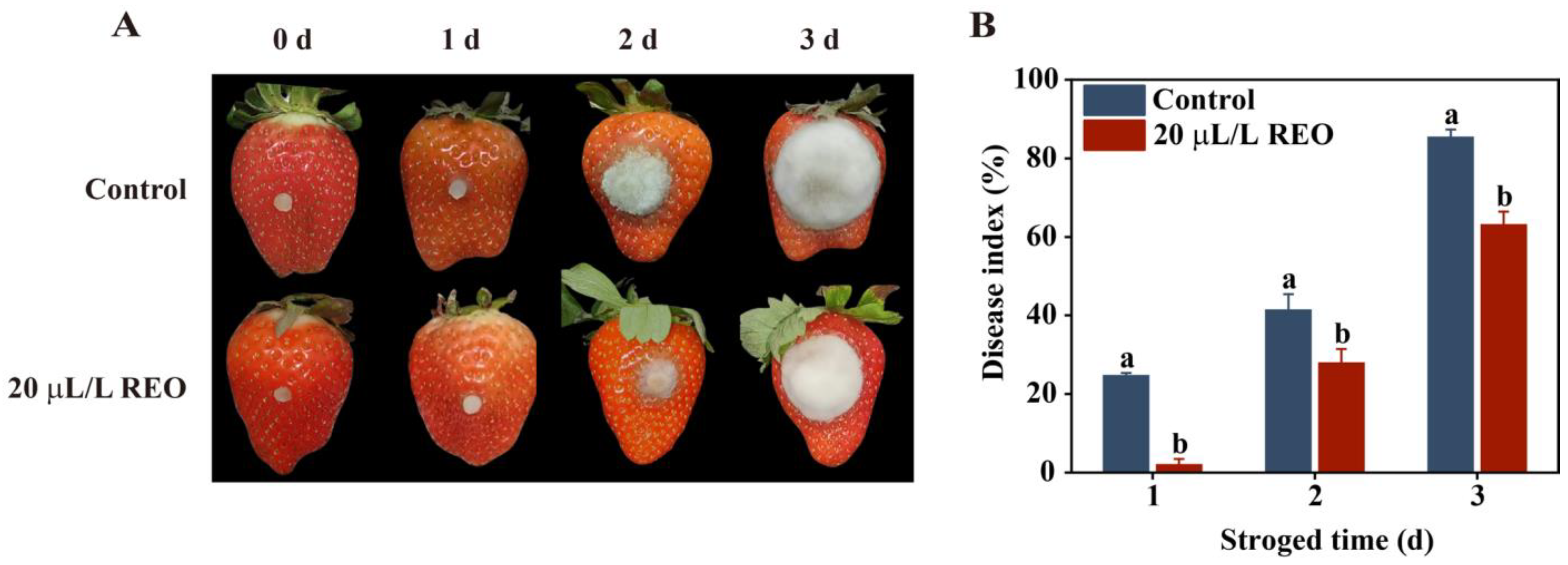
As shown in Figure 1A, visible mycelial growth was observed at the wound sites of control strawberries one day after inoculation with the B. cinerea mycelial plug. On the 2nd day, the grayish-white mold layer at the inoculation site expanded rapidly and, by the 3rd day, had spread over most of the fruit surface, resulting in a disease index of 85.18 ± 2.12% (Figure 1B). In contrast, strawberries exposed to 20 µL/L REO fumigation showed no visible symptoms on day 1 of storage. On the 2nd day after inoculation, only a small mold colony developed at the wound site. Although the lesion subsequently expanded, it was effectively suppressed compared to the control group (Figure 1A). By the 3rd day, the disease index of the REO-fumigated strawberries was 62.96 ± 3.50%, corresponding to approximately a 22% reduction relative to the control group (Figure 1B).

3.3. Fumigation with REO Decreased Decay and Maintained the Marketability of Stored Strawberries

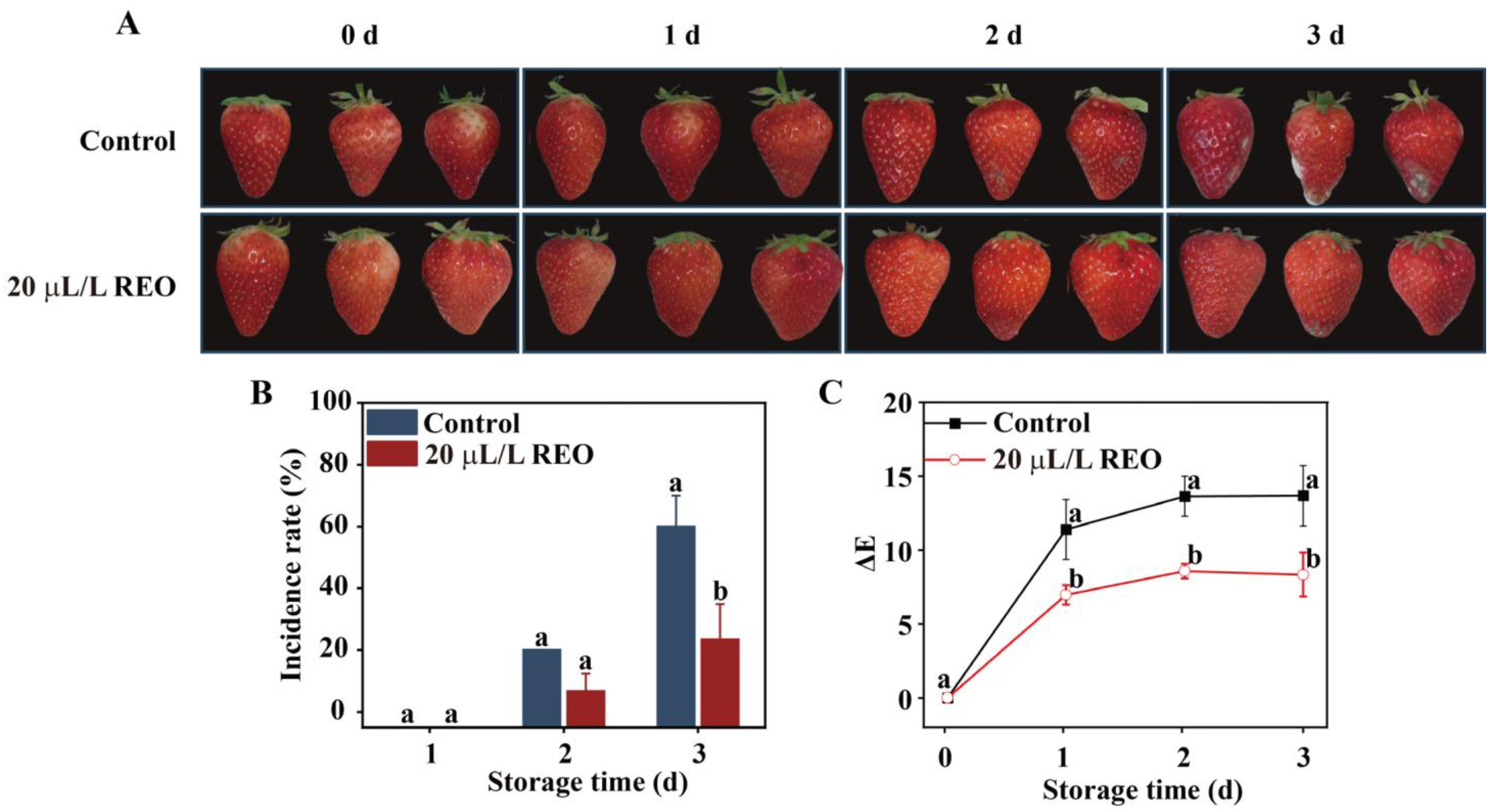
As shown in Figure 2A, no disease symptoms were observed in either group on the 1st day of treatment. On the 2nd day, gray mold spots appeared on the surface of the control group strawberries, followed by further expansion of the lesion area and the development of a distinct mold layer on the fruit surface. The disease incidence reached 60.00 ± 10.00% (Figure 2B). In contrast, the REO-treated group showed no noticeable mold spots until the 3rd day (Figure 2A), with a disease incidence significantly lower than that of the control, at only 23.33 ± 11.55% (Figure 2B). With prolonged storage time, the color of the control strawberries gradually darkened, and the ΔE value progressively increased. Compared to the control, the REO treatment effectively slowed the increase in the ΔE value of strawberries throughout the storage period. At the end of storage, the ΔE value of the REO-treated group (8.34 ± 1.48) was significantly lower than that of the control group (13.68 ± 2.04) (Figure 2C).

3.4. Effect of REO on Strawberry Weight and Firmness

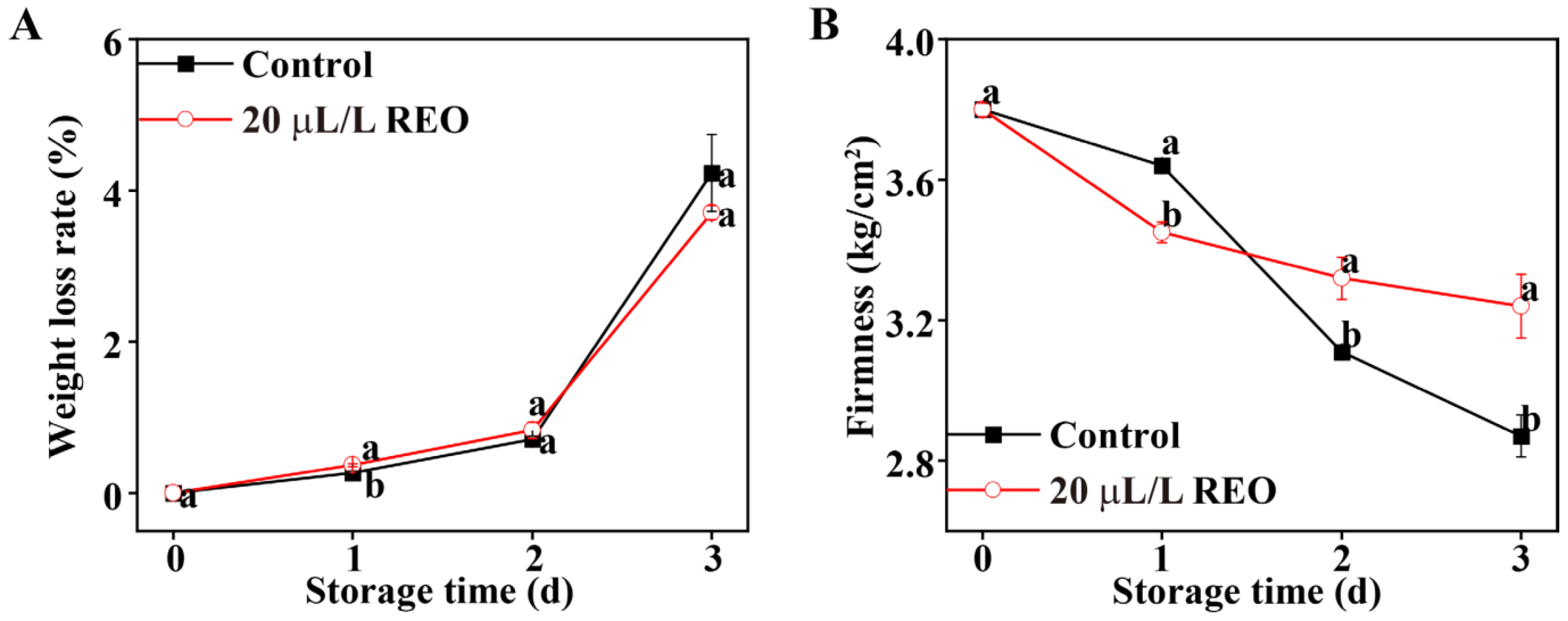
As shown in Figure 3A, the weight loss rate of strawberries in both groups continuously increased during storage, with the REO-treated group showing only a slightly lower rate than the control at the end of storage. Fruit firmness gradually decreased over the storage period, and the REO treatment slowed the decline in strawberry firmness from day 2 to day 3. After 3 days of treatment, the firmness of strawberries in the REO group was 3.24 ± 0.09 kg/cm2, which was significantly higher than that of the control group (2.87 ± 0.06 kg/cm2) (Figure 3B).

3.5. Effects of REO on Strawberry Flavor and Nutritional Components

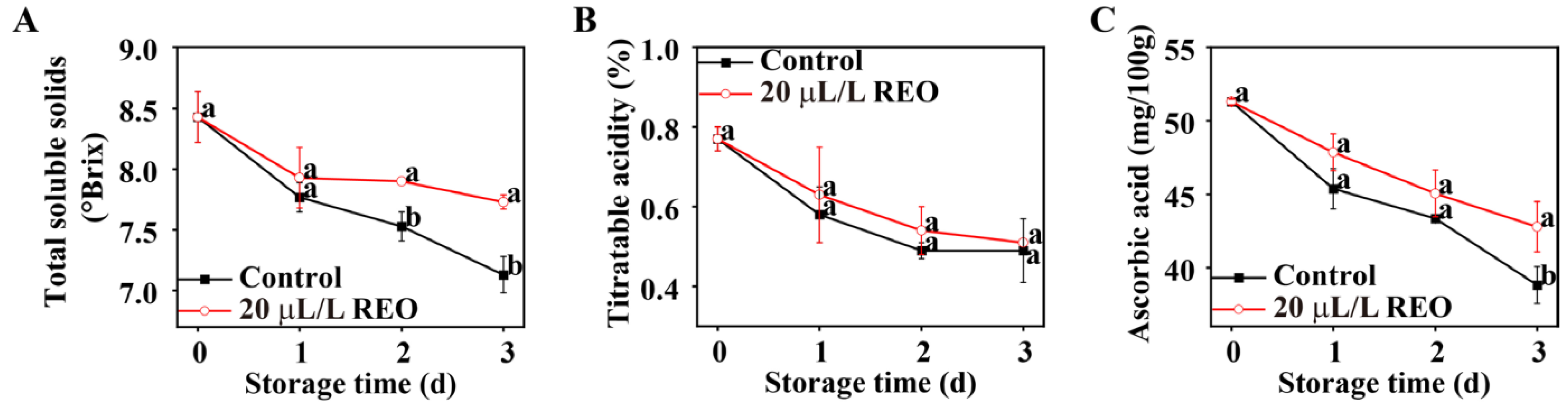
Figure 4 shows that REO can delay the consumption of TSS and AsA during storage without negatively affecting TA. As shown in Figure 4A, after 3 days of storage, the TSS of strawberries in the control group decreased from the initial 8.43 ± 0.21 °Brix to 7.13 ± 0.15 °Brix, while the treated group maintained a higher TSS (7.73 ± 0.06 °Brix). Figure 4B indicates that the TA in the control and treatment groups decreased from 0.77 ± 0.03% to 0.49 ± 0.08% and 0.51 ± 0.00%, respectively, with no significant difference observed between the two groups. The AsA of fresh strawberries was 51.29 ± 0.20 mg/100 g. After 3 days of storage, the AsA in the control group decreased to 38.81 ± 1.25 mg/100 g, whereas the REO-treated group maintained a level of 42.78 ± 1.71 mg/100 g (Figure 4C). The results indicate that REO can slow the depletion of nutritional components in strawberry fruit and exert antioxidant activity during storage, thereby helping to preserve overall strawberry quality.

3.6. REO Disrupts the Morphology of B. cinerea

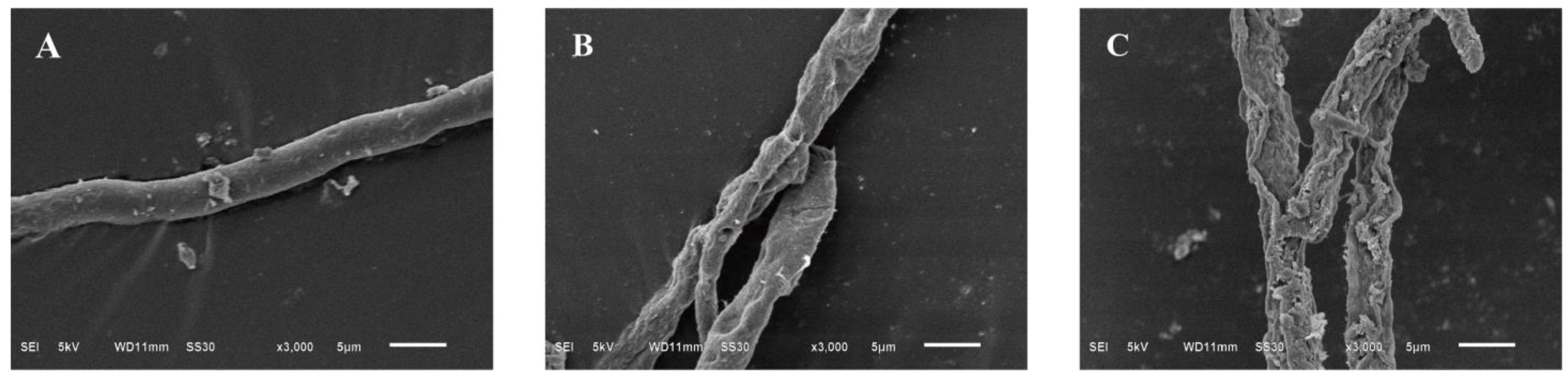
Observations by SEM revealed significant alterations in the mycelial morphology of B. cinerea following REO treatment. The hyphae in the control group displayed a regular structure, uniform diameter, and a smooth surface, indicating a normal physiological state (Figure 5A). In contrast, hyphae treated with 0.5× MIC REO exhibited slight distortion and numerous depressions on their surface (Figure 5B). Treatment with 1× MIC REO induced more severe damage, characterized by extensive wrinkling, substantial cytoplasmic leakage, and marked shrinkage of the mycelia (Figure 5C).

3.7. REO Disrupts the Integrity of the Cell Wall of B. cinerea

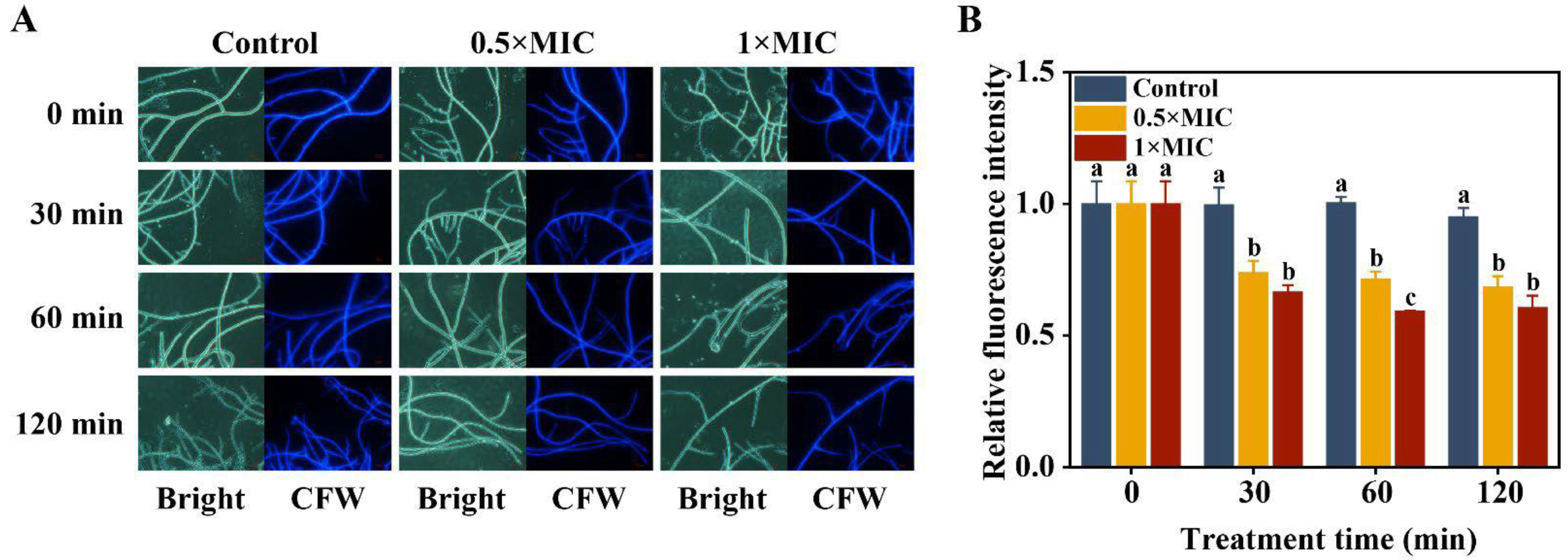
As shown in Figure 6A, the control hyphae exhibited uniform, bright blue fluorescence with a well-defined cell wall structure and maintained a high level of relative fluorescence intensity throughout the experimental period. In contrast, after 30 min of treatment, hyphae from both the 0.5× MIC and 1× MIC REO groups displayed a marked reduction and irregular distribution of blue fluorescence. The relative fluorescence intensities in these treatment groups were 26% and 33% lower than that of the control at the same time point, respectively (Figure 6B), indicating that REO treatment rapidly compromised hyphal cell wall integrity within 30 min.

3.8. REO Disrupts the Cell Membrane Integrity of B. cinerea

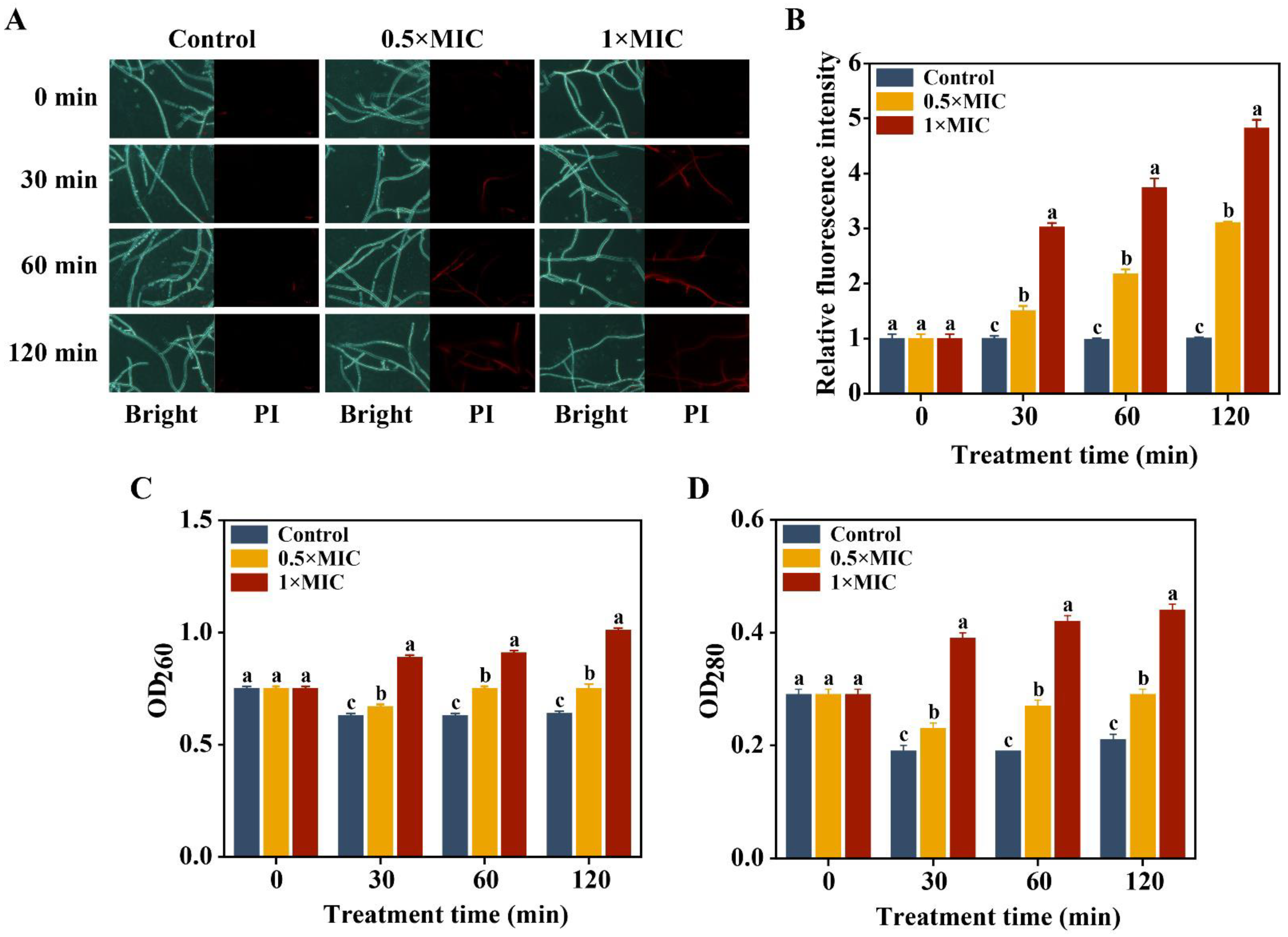
PI staining results showed that the control hyphae remained devoid of discernible red fluorescence throughout the experiment. After 30 min of REO exposure, faint red fluorescence was detected in the 0.5× MIC group, whereas the 1× MIC group exhibited pronounced fluorescence (Figure 7A). Quantitative analysis revealed that their relative fluorescence intensities were 1.50 ± 0.09 and 3.03 ± 0.08 times higher than that of the control group, respectively (Figure 7B). As the treatment duration increased, the red fluorescence intensity and fluorescence fold change in the treated hyphae continued to rise. As shown in Figure 7C,D, the leakage of intracellular nucleic acids (OD260) and soluble proteins (OD280) in B. cinerea significantly increased following REO treatment. At 120 min of treatment, the OD260 and OD280 in the 1× MIC-treated group were 1.01 ± 0.01 and 0.44 ± 0.01, respectively, both significantly higher than those in the control group (0.64 ± 0.01 and 0.21 ± 0.01), which further confirmed damage to the cell membrane integrity.

3.9. Effect of REO on Intracellular ROS Levels in B. cinerea

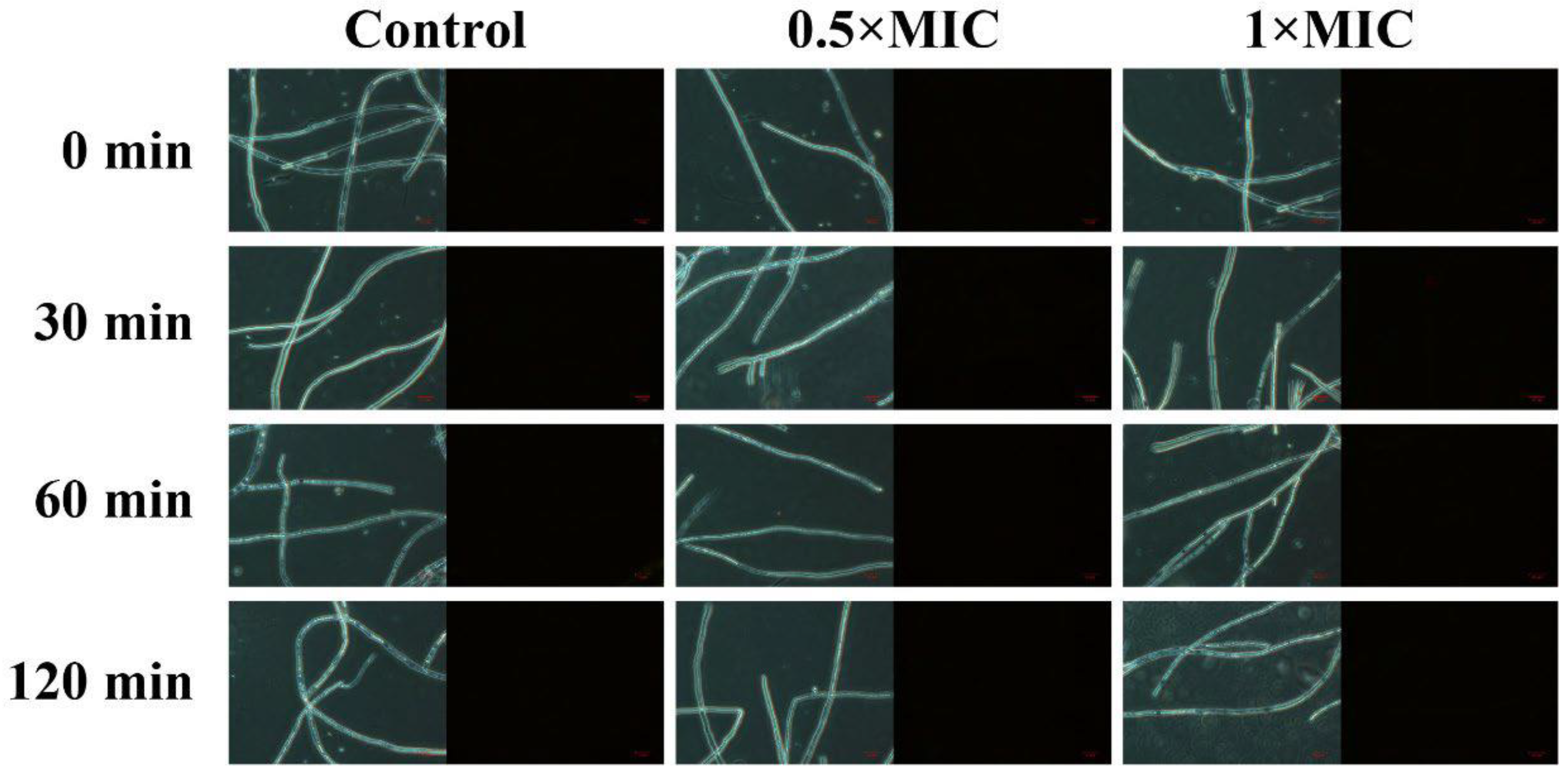
To investigate whether REO damages the cell membrane of B. cinerea through membrane lipid peroxidation, we measured intracellular ROS levels using the DCFH-DA fluorescent probe. As shown in Figure 8, no significant green fluorescence was observed in the control group, the 0.5× MIC treatment group, or the 1× MIC treatment group throughout the entire treatment period, indicating that REO treatment did not induce detectable intracellular ROS accumulation in B. cinerea.

4. Discussion

This study demonstrated that REO exhibits a pronounced inhibitory effect against B. cinerea, a major postharvest pathogen of strawberry. In vitro assays showed that a low concentration of REO (0.5 µL/mL) completely suppressed hyphal growth of B. cinerea within 4 days. This antifungal activity exceeds that reported by Fincheira et al. [32] for several other essential oils, including Origanum vulgare, Thymus vulgaris, Eucalyptus globulus, and Lavandula angustifolia, against the same pathogen. Through fumigation, the antifungal efficacy of REO was successfully translated to in vivo conditions. REO fumigation delayed the onset and progression of gray mold on strawberries during storage. In artificially inoculated strawberry fruit, treatment with 20 µL/L REO reduced the disease index by 22% compared with the control. This level of efficacy is comparable to that reported by Huang et al. [35] using a 50% Sapindus mukorossi saponin solution and by Li et al. [36] using 20 mM nerolidol against B. cinerea. Notably, REO achieved similar control at a substantially lower concentration, and a protective effect was also observed in naturally infected strawberries, further supporting the potential of REO as an effective antifungal agent for postharvest disease management. The pronounced inhibitory activity of REO may be largely attributed to its high contents of geraniol and linalool, both of which have been reported in multiple studies to exhibit strong antifungal activity against gray mold [22,25]. For instance, Lei et al. reported geraniol and linalool levels of 45.3% and 5.1%, respectively, in REO, whereas Jin et al. reported corresponding values of 24.73% and 14.51% [18,20]. Although the relative proportions of these components vary among studies, geraniol and linalool are consistently identified as major antimicrobial constituents. Their individual or synergistic effects may therefore account for the inhibitory activity of REO, even at relatively low concentrations.
Beyond direct pathogen suppression, the maintenance of commercial and nutritional quality in strawberries is also crucial. In this study, REO treatment exerted beneficial effects on several key quality attributes. Color is a primary visual determinant of fruit freshness from the consumer perspective [37]. Color deterioration in strawberries during storage can be attributed to multiple factors, including advanced maturation, increased pigment concentration due to moisture loss, and tissue browning associated with fungal infection [38,39]. In the present work, REO treatment significantly suppressed the increase in ΔE, thereby better preserving the characteristic red coloration of the fruit. Moreover, REO application effectively alleviated fruit softening during storage. Postharvest softening of strawberries arises not only from transpiration loss [40], but also from the enzymatic degradation of cell wall components, particularly pectin and cellulose, by endogenous fruit enzymes or enzymes secreted by pathogens [41,42]. We propose that REO may help preserve cell wall integrity by inhibiting the activity of cell-wall-degrading enzymes, thereby enhancing the mechanical firmness of the fruit and increasing its resistance to pathogen colonization. In terms of postharvest metabolism, strawberries typically exhibited a gradual decline in TSS, TA, and AsA during storage, primarily due to respiration, oxidative processes, and microbial activity [38,42,43]. In this study, REO treatment significantly attenuated the depletion of both TSS and AsA. As TSS is a major determinant of perceived sweetness [44] and AsA serves as a key antioxidant indicative of the fruit’s free radical scavenging capacity [38], the preservation of these constituents supports the maintenance of desirable sensory attributes and enhances the antioxidant potential of strawberries, thereby contributing to shelf-life extension.
Our investigation into the antifungal mechanism suggests that REO primarily exerts its effects by compromising the structural integrity of fungal cell walls and membranes. The characteristic depressions and deformations observed on the hyphal surface under SEM suggest that REO initially targets the fungal cell wall. Accordingly, we evaluated the cell wall integrity of B. cinerea following REO exposure and found that damage occurred as early as 30 min after treatment. Geraniol and linalool are the principal active constituents of REO. Notably, Scariol et al. [45] reported that geraniol, at higher concentrations, increases the susceptibility of Saccharomyces cerevisiae cell walls to glucanase digestion, supporting the notion that these components may contribute to REO-induced cell wall destabilization. Zhang et al. [46] demonstrated that linalool impairs the integrity and permeability of Alternaria alternata cell walls by altering alkaline phosphatase activity and chitin distribution. Their study further showed that linalool treatment increased chitinase activity while decreasing chitin synthase activity, thereby establishing a direct association between cell wall damage and disrupted chitin metabolism. In light of these findings, we speculate that REO may compromise the structural integrity of the B. cinerea cell wall by interfering with the biosynthesis of cell wall components and/or promoting their degradation, ultimately leading to the early morphological abnormalities observed in this study. This hypothesis still requires further experimental confirmation.
The pronounced hyphal shrinkage and cytoplasmic leakage observed at REO treatment indicate severe disruption of the plasma membrane. This conclusion is further supported by PI staining and increased intracellular component leakage. These effects are likely attributable to the lipophilic nature of geraniol and linalool, both terpenoids, which can insert into the lipid bilayer and thereby perturb membrane fluidity, structural integrity, and selective permeability [24]. Similar membrane-destabilizing activities have been reported for other terpenoid compounds, including citral, limonene, and eugenol, against Zygosaccharomyces rouxii [47]. The absence of a marked oxidative stress response, as reflected by unchanged intracellular ROS levels, indicates that membrane damage is more likely attributable to direct physicochemical interactions than to indirect, redox-mediated processes [32,48]. Additional mechanisms that have been reported include disruption of membrane protein conformation [49], interference with ergosterol biosynthesis [50], and alterations in membrane fatty acid composition [46]. Together, these effects would be expected to compromise membrane integrity and ultimately reduce cell viability. This hypothesis, however, requires further experimental verification.

5. Conclusions

This study demonstrates the efficacy of REO fumigation in controlling postharvest gray mold in strawberry fruit. With an in vitro MIC of 0.5 μL/mL against B. cinerea, fumigation at 20 μL/L delayed disease progression in both artificially inoculated and naturally infected fruit, while contributing to the maintenance of color difference, firmness, TSS, and AsA. The antifungal mechanism was associated with disruption of B. cinerea cell wall and membrane integrity by REO treatment, as well as the induction of severe cytoplasmic leakage, rather than through oxidative stress-mediated pathways. Overall, these results indicate that REO fumigation is a promising dual-functional strategy for suppressing B. cinerea and preserving strawberry quality during postharvest storage. Nevertheless, the present findings require further validation under commercial storage conditions. Elucidation of the precise molecular targets and assessment of the risk of resistance development remain important areas for future research.

Author Contributions

Z.W.: Writing—original draft, Investigation, Formal analysis, Data curation. J.L.: Investigation. J.Z.: Investigation. S.C.: Investigation. E.H.: Investigation. C.W.: Methodology, Supervision N.T.: Supervision, Validation, Review and editing. X.T.: Conceptualization, Methodology, Funding acquisition, Project administration, Supervision, Review and editing. All authors have read and agreed to the published version of the manuscript.

Funding

This work was supported by the National Natural Science Foundation of China (32102036), the National Natural Science Foundation of Hunan Province (2024JJ5372), and the National Innovation and Entrepreneurship Training Program for College Students (S202410530070).

Data Availability Statement

The original contributions presented in this study are included in the article. Further inquiries can be directed to the corresponding author.

Conflicts of Interest

The authors declare that they have no known competing financial interests or personal relationships that could have appeared to influence the work reported in this paper.

References

  1. Food and Agriculture Organization of the United Nations. Crops and Livestock Products: Strawberries. 2024. Available online: https://www.fao.org/faostat/zh/#data/QCL/visualize (accessed on 5 February 2026).
  2. Kebriti, I.; Solgi, M.; Velashjerdi, M. Improving quality of strawberry by novel essential oil nanoemulsions of Echinophora platyloba combined with Aloe vera gel and gum arabic. Sci. Rep. 2025, 15, 1731. [Google Scholar] [CrossRef]
  3. Giampieri, F.; Tulipani, S.; Alvarez-Suarez, J.M.; Quiles, J.L.; Mezzetti, B.; Battino, M. The strawberry: Composition, nutritional quality, and impact on human health. Nutrition 2012, 28, 9–19. [Google Scholar] [CrossRef]
  4. Huang, Z.; Wu, Z.; Luo, Z.; Gong, H.; Li, W.; Jin, P.; Deng, Z.; Fang, D. Development of temperature-sensitive and controlled-release PLA-based film for strawberry preservation. Food Packag. Shelf Life 2025, 50, 101561. [Google Scholar] [CrossRef]
  5. Lafarga, T.; Colás-Medà, P.; Abadías, M.; Aguiló-Aguayo, I.; Bobo, G.; Viñas, I. Strategies to reduce microbial risk and improve quality of fresh and processed strawberries: A review. Innov. Food Sci. Emerg. Technol. 2019, 52, 197–212. [Google Scholar] [CrossRef]
  6. Petrasch, S.; Knapp, S.J.; van Kan, J.A.L.; Blanco-Ulate, B. Grey mould of strawberry, a devastating disease caused by the ubiq uitous necrotrophic fungal pathogen Botrytis cinerea. Mol. Plant Pathol. 2019, 20, 877–892. [Google Scholar] [CrossRef]
  7. Williamson, B.; Tudzynski, B.; Tudzynski, P.; van Kan, J.A.L. Botrytis cinerea: The cause of grey mould disease. Mol. Plant Pathol. 2007, 8, 561–580. [Google Scholar] [CrossRef] [PubMed]
  8. Wang, J.; Zhao, F.; Huang, J.; Li, Q.; Yang, Q.; Ju, J. Application of essential oils as slow-release antimicrobial agents in food preservation: Preparation strategies, release mechanisms and application cases. Crit. Rev. Food Sci. Nutr. 2024, 64, 6272–6297. [Google Scholar] [CrossRef] [PubMed]
  9. Bullaro, V.; Martinelli, F.; Lounès-Hadj Sahraoui, A.; Oufensou, S. Molecular responses of phytopathogenic fungi to essential oil application: Current knowledge and perspectives. Physiol. Mol. Plant Pathol. 2025, 140, 102974. [Google Scholar] [CrossRef]
  10. Angane, M.; Swift, S.; Huang, K.; Butts, C.A.; Quek, S.Y. Essential Oils and Their Major Components: An Updated Review on Antimicrobial Activities, Mechanism of Action and Their Potential Application in the Food Industry. Foods 2022, 11, 464. [Google Scholar] [CrossRef]
  11. Kaya, O.; Karakus, S.; Bozkurt, A.; Canturk, S.; Yilmaz, T.; Hatterman-Valenti, H. Essential oil compounds and their impact on grape (Vitis vinifera L. cv. Narince) physiology under Botrytis cinerea infection. Physiol. Mol. Plant Pathol. 2025, 136, 102544. [Google Scholar] [CrossRef]
  12. Tan, X.; Jiang, X.; Reymick, O.O.; Zhu, C.; Tao, N. (E)-2-Octenal inhibits Neofusicoccum parvum growth by disrupting mitochon drial energy metabolism and is a potential preservative for postharvest mango. Food Res. Int. 2025, 201, 115639. [Google Scholar] [CrossRef]
  13. Chiang, H.-M.; Chen, H.-C.; Wu, C.-S.; Wu, P.-Y.; Wen, K.-C. Rhodiola plants: Chemistry and biological activity. J. Food Drug Anal. 2015, 23, 359–369. [Google Scholar] [CrossRef] [PubMed]
  14. Alperth, F.; Turek, I.; Weiss, S.; Vogt, D.; Bucar, F. Qualitative and Quantitative Analysis of Different Rhodiola rosea Rhizome Extracts by UHPLC-DAD-ESI-MSn. Sci. Pharm. 2019, 87, 8. [Google Scholar] [CrossRef]
  15. Sęczyk, Ł.; Sugier, D.; Dervişoğlu, G.; Özdemir, F.A.; Kołodziej, B. Phytochemical profile, in vitro bioaccessibility, and anti cancer potential of golden root (Rhodiola rosea L.) extracts. Food Chem. 2023, 404, 134779. [Google Scholar] [CrossRef] [PubMed]
  16. Kosakowska, O.; Bączek, K.; Przybył, J.L.; Pióro-Jabrucka, E.; Czupa, W.; Synowiec, A.; Gniewosz, M.; Costa, R.; Mondello, L.; Węglarz, Z. Antioxidant and Antibacterial Activity of Roseroot (Rhodiola rosea L.) Dry Extracts. Molecules 2018, 23, 1767. [Google Scholar] [CrossRef] [PubMed]
  17. Zhong, L.; Peng, L.; Fu, J.; Zou, L.; Zhao, G.; Zhao, J. Phytochemical, Antibacterial and Antioxidant Activity Evaluation of Rhodiola crenulata. Molecules 2020, 25, 3664. [Google Scholar] [CrossRef]
  18. Lei, Y.; Nan, P.; Tsering, T.; Bai, Z.; Zhong, Y. Chemical Composition of the Essential Oils of Two Rhodiola Species from Tibet. Z. Naturforsch C 2003, 58, 161–164. [Google Scholar] [CrossRef]
  19. Rohloff, J. Volatiles from rhizomes of Rhodiola rosea L. Phytochemistry 2002, 59, 655–661. [Google Scholar] [CrossRef]
  20. Jin, Y.; Park, D.W.; Li, X.; Li, D.; Row, K.H. Primary study of volatiles composition of Rhodiola sachalinensis by using gas chromatography and mass spectrometry (GC/MS). Korean J. Chem. Eng. 2010, 27, 1262–1268. [Google Scholar] [CrossRef]
  21. Shatar, S.; Adams, R.P.; Koenig, W. Comparative Study of the Essential Oil of Rhodiola rosea L. from Mongolia. J. Essent. Oil Res. 2007, 19, 215–217. [Google Scholar] [CrossRef]
  22. Kamou, N.N.; Kalogiouri, N.P.; Tryfon, P.; Papadopoulou, A.; Karamanoli, K.; Dendrinou-Samara, C.; Menkissoglu-Spiroudi, U. Impact of Geraniol and Geraniol Nanoemulsions on Botrytis cinerea and Effect of Geraniol on Cucumber Plants’ Metabolic Profile Analyzed by LC-QTOF-MS. Plants 2022, 11, 2513. [Google Scholar] [CrossRef] [PubMed]
  23. Xu, R.; Hu, W.; Zhou, J.; Jiang, W.; Chen, L.; Wang, B. Preparation of linalool microcapsules and its application on preservation and antifungal protection in postharvest sweet cherry. Food Chem. 2026, 503, 147821. [Google Scholar] [CrossRef] [PubMed]
  24. Heng, L.; Jingjing, H.; Hu, L.; Zhanquan, Z.; Subo, T.; Qingmin, C.; Wenxiao, J.; Maorun, F. Geraniol combined nerolidol inhibited soft rot caused by Pectobacteriumn aroidearum in red pickled pepper. Postharvest Biol. Technol. 2025, 226, 113540. [Google Scholar] [CrossRef]
  25. Xu, Y.; Tong, Z.; Zhang, X.; Wang, Y.; Fang, W.; Li, L.; Luo, Z. Unveiling the Mechanisms for the Plant Volatile Organic Compound Linalool To Control Gray Mold on Strawberry Fruits. J. Agric. Food Chem. 2019, 67, 9265–9276. [Google Scholar] [CrossRef]
  26. Huang, J.; Liu, S.; Liu, R.; Yi, Y.; Li, C.; Xiao, Z.; Tu, J.; Xiao, J. Mechanisms of Litsea cubeba essential oil in the control of Colletotrichum scovillei in pepper (Capsicum annuum L.): Cell membrane/wall perspective. Physiol. Mol. Plant Pathol. 2023, 127, 102103. [Google Scholar] [CrossRef]
  27. Hou, T.; Sana, S.S.; Li, H.; Xing, Y.; Nanda, A.; Netala, V.R.; Zhang, Z. Essential oils and its antibacterial, antifungal and anti-oxidant activity applications: A review. Food Biosci. 2022, 47, 101716. [Google Scholar] [CrossRef]
  28. Li, L.; Lin, B.; Ting, Y.; Li, M.; Hu, J.; Song, J.; Yan, Y.; Chen, J.; Xiao, H.; Tao, N. Berberine hydrochloride delays citrus sour rot mainly by disrupting carbohydrate and energy metabolism of Geotrichum citri-aurantii spores. Pestic. Biochem. Physiol. 2024, 202, 105933. [Google Scholar] [CrossRef]
  29. Bu, H.; Ma, Y.; Ge, B.; Sha, X.; Ma, Y.; Zhang, P.; Jin, L. Effect of Leaf Extract from Lycium barbarum on Preservation of Cherry Tomato Fruit. Horticulturae 2022, 8, 1178. [Google Scholar] [CrossRef]
  30. Yang, S.; Zhang, Y.; Wang, Y.; Qin, R.; Chen, Y.; Hu, H.; Liu, Z.; Hu, Y.; Hua, Q.; Wu, Y.; et al. A study of antibacterial activity and mechanism of potassium cinnamate intended as a natural preservative. LWT 2025, 215, 117237. [Google Scholar] [CrossRef]
  31. Zhang, Y.; Tan, Y.; OuYang, Q.; Duan, B.; Wang, Z.; Meng, K.; Tan, X.; Tao, N. γ-Cyclodextrin encapsulated thymol for citrus preservation and its possible mechanism against Penicillium digitatum. Pestic. Biochem. Physiol. 2023, 194, 105501. [Google Scholar] [CrossRef]
  32. Fincheira, P.; Jofré, I.; Espinoza, J.; Levío-Raimán, M.; Tortella, G.; Oliveira, H.C.; Diez, M.C.; Quiroz, A.; Rubilar, O. The efficient activity of plant essential oils for inhibiting Botrytis cinerea and Penicillium expansum: Mechanistic insights into antifungal activity. Microbiol. Res. 2023, 277, 127486. [Google Scholar] [CrossRef]
  33. Li, Y.; Shao, X.; Xu, J.; Wei, Y.; Xu, F.; Wang, H. Tea tree oil exhibits antifungal activity against Botrytis cinerea by affecting mitochondria. Food Chem. 2017, 234, 62–67. [Google Scholar] [CrossRef]
  34. Luo, Y.; Chen, X.; Che, J.X.; Zhang, Y.; Ouyang, Q.; Tao, N. (E)-2-Octenal suppresses the growth of a prochloraz-resistant Penicillium italicum strain and its potential antifungal mechanisms. Postharvest Biol. Technol. 2023, 205, 112515. [Google Scholar] [CrossRef]
  35. Huang, X.; Liu, W.; Dong, F.; Xu, Y.; Tian, S.; Chen, T. Sapindus mukorossi saponins inhibit gray mold on strawberry fruit by impairing membrane integrity and organellar homeostasis of Botrytis cinerea. Postharvest Biol. Technol. 2024, 207, 112594. [Google Scholar] [CrossRef]
  36. Li, X.; Gao, G.; Tian, S.; Li, B.; Qin, G.; Wang, Y. Nerolidol inhibits Botrytis cinerea growth via affecting metabolism and disrupting peroxisome. Postharvest Biol. Technol. 2026, 232, 113961. [Google Scholar] [CrossRef]
  37. Wigati, L.P.; Wardana, A.A.; Jothi, J.S.; Leonard, S.; Van, T.T.; Yan, X.; Tanaka, F.; Tanaka, F. Biochemical and color stability preservation of strawberry using edible coatings based on jicama starch/calcium propionate/agarwood bouya essential oil during cold storage. J. Stored Prod. Res. 2024, 107, 102324. [Google Scholar] [CrossRef]
  38. Zhu, Z.; Liang, J.; Zhou, C.; Huang, K.; Fan, X.; Zhou, M.; Xu, B.; Huang, C.; Li, H.; Ma, H.; et al. Synergistic enhancement of gelatin-chitosan films with vanillin Schiff base and ZnO for effective strawberry preservation. Food Control 2026, 180, 111647. [Google Scholar] [CrossRef]
  39. Zhou, Z.; Lei, Q.; Hu, X.; Khan, M.K.I.; Rafique, H.; Ren, T. Antimicrobial aerogel pads from Holo-CNF emulsions: Sustainable active packaging for enhanced strawberry preservation. Int. J. Biol. Macromol. 2025, 334, 149164. [Google Scholar] [CrossRef]
  40. Chen, L.; Jing, H.; Dong, Y.; Cao, Y.; Wu, T.; Zhu, W.; Dai, F.; Chen, M.; Liu, Y.; He, N.; et al. Sustained release of gaseous chlorine dioxide from alpha-cyclodextrin: An innovative method for strawberry preservation. Food Chem. 2025, 473, 143135. [Google Scholar] [CrossRef]
  41. Wani, S.M.; Gull, A.; Ahad, T.; Malik, A.R.; Ganaie, T.A.; Masoodi, F.A.; Gani, A. Effect of gum Arabic, xanthan and carrageenan coatings containing antimicrobial agent on postharvest quality of strawberry: Assessing the physicochemical, enzyme activity and bioactive properties. Int. J. Biol. Macromol. 2021, 183, 2100–2108. [Google Scholar] [CrossRef]
  42. Xi, K.-Y.; Xiong, S.-J.; Li, G.; Guo, C.-Q.; Zhou, J.; Ma, J.-W.; Yin, J.-L.; Liu, Y.-Q.; Zhu, Y.-X. Antifungal Activity of Ginger Rhizome Extract against Fusarium solani. Horticulturae 2022, 8, 983. [Google Scholar] [CrossRef]
  43. Zeng, Y.; Wang, Y.; Tang, J.; Zhang, H.; Dai, J.; Li, S.; Yan, J.; Qin, W.; Liu, Y. Preparation of sodium alginate/konjac glucomannan active films containing lycopene microcapsules and the effects of these films on sweet cherry preservation. Int. J. Biol. Macromol. 2022, 215, 67–78. [Google Scholar] [CrossRef] [PubMed]
  44. Liu, M.; He, C.; Chen, W.; Li, Y.; Yang, N.; Chen, X.; Xue, J.; Wang, X.; Lu, A.; Xu, Z.; et al. Carboxymethyl chitosan/peach gum polysaccharide packaging film incorporating Citrus sinensis essential oil effectively enhances the quality preservation of strawberries. Food Packag. Shelf Life 2024, 46, 101409. [Google Scholar] [CrossRef]
  45. Scariot, F.J.; Pansera, M.S.; Delamare, A.P.L.; Echeverrigaray, S. Citral and geraniol induce necrotic and apoptotic cell death on Saccharomyces cerevisiae. World J. Microbiol. Biotechnol. 2021, 37, 42. [Google Scholar] [CrossRef]
  46. Zhang, H.; Zhou, Y.; Yang, Y.; Zhao, L.; Li, H.; Long, L.; Wang, J.; Wu, X.; Wei, Z.-J. The role of linalool in managing Alternaria alternata infection and delaying black mold rot in goji berry. Postharvest Biol. Technol. 2025, 219, 113240. [Google Scholar] [CrossRef]
  47. Cai, R.; Hu, M.; Zhang, Y.; Niu, C.; Yue, T.; Yuan, Y.; Wang, Z. Antifungal activity and mechanism of citral, limonene and eugenol against Zygosaccharomyces rouxii. LWT 2019, 106, 50–56. [Google Scholar] [CrossRef]
  48. Chen, L.; Wang, Y.; Yan, T.; Cao, J.; Li, J.; Zhang, S.; Gong, D.; Long, D. Antifungal activity of Hanseniaspora uvarum VOCs against Aspergillus carbonarius in pear by activating ROS metabolism and phenylpropanoid pathway. Postharvest Biol. Technol. 2026, 234, 114088. [Google Scholar] [CrossRef]
  49. Bao, Z.; Fan, M.; Hannachi, K.; Li, T.; Zhao, J.; Li, Y.; Qian, H.; Wang, L. Antifungal activity of star anise extract against Penicillium roqueforti and Aspergillus niger for bread shelf life. Food Res. Int. 2023, 172, 113225. [Google Scholar] [CrossRef]
  50. Sharma, Y.; Khan, L.A.; Manzoor, N. Anti-Candida activity of geraniol involves disruption of cell membrane integrity and function. J. Mycol. Med. 2016, 26, 244–254. [Google Scholar] [CrossRef]
Figure 1. Antifungal effect of Rhodiola rosea L. essential oil (REO) against gray mold disease. (A) Disease progression. (B) Disease index. Different letters in the figure indicate significant differences between groups at p < 0.05.
Horticulturae 12 00231 g001
Figure 2. Effects of REO on strawberry appearance and color changes. (A) Strawberry appearance. (B) Incidence rate. (C) Color difference (ΔE). REO: Rhodiola rosea L. essential oil. Different letters in the figure indicate significant differences between groups at p < 0.05.
Horticulturae 12 00231 g002
Figure 3. Effect of REO on strawberry weight and firmness. (A) Weight loss rate. (B) Firmness. REO: Rhodiola rosea L. essential oil. Different letters in the figure indicate significant differences between groups at p < 0.05.
Horticulturae 12 00231 g003
Figure 4. Effects of REO on strawberry flavor and nutritional components. (A) Total soluble solids. (B) Titratable acidity. (C) Ascorbic acid. REO: Rhodiola rosea L. essential oil. Different letters in the figure indicate significant differences between groups at p < 0.05.
Horticulturae 12 00231 g004
Figure 5. Microscopic images of mycelium in each treatment group. (A) Control group, (B) 0.5× MIC REO treatment group and (C) 1× MIC REO treatment group. REO: Rhodiola rosea L. essential oil. Visualization was performed using SEM at 3000× magnification. Scale is 5 μm.
Horticulturae 12 00231 g005
Figure 6. Effect of REO on cell wall integrity of Botrytis cinerea. (A) Calcofluor white (CFW) staining images. Blue fluorescence indicates cell wall integrity, with its attenuation signifying damage. (B) Relative fluorescence intensity. REO: Rhodiola rosea L. essential oil. Different letters in the figure indicate significant differences between groups at p < 0.05.
Horticulturae 12 00231 g006
Figure 7. Effect of REO on cell membrane integrity of B. cinerea. (A) Propidium iodide (PI) staining images. Red fluorescence indicates compromised cell membrane integrity, with its enhanced intensity signifying severe damage. (B) Relative fluorescence intensity. (C) OD260. (D) OD280. Increased absorbance at OD260 and OD280 indicates enhanced leakage of intracellular nucleic acids and soluble proteins, respectively. REO: Rhodiola rosea L. essential oil. Different letters in the figure indicate significant differences between groups at p < 0.05.
Horticulturae 12 00231 g007
Figure 8. The effect of different concentrations of REO treatment for 120 min on reactive oxygen species (ROS) accumulation in B. cinerea. REO: Rhodiola rosea L. essential oil. Green fluorescence indicates ROS levels, with enhanced intensity reflecting elevated accumulation.
Horticulturae 12 00231 g008
Table 1. The in vitro antifungal activity of REO against B. cinerea
Concentration of REO (μL/mL)Inhibition Rate (%)
1 d2 d3 d4 d
0.12588.50 ± 2.54 b42.53 ± 0.63 c35.67 ± 1.43 c27.47 ± 1.49 c
0.250100.00 ± 0.00 a94.65 ± 0.63 b66.38 ± 2.99 b49.72 ± 0.96 b
0.500100.00 ± 0.00 a100.00 ± 0.00 a100.00 ± 0.00 a100.00 ± 0.00 a
1.000100.00 ± 0.00 a100.00 ± 0.00 a100.00 ± 0.00 a100.00 ± 0.00 a
Different letters in the table indicate significant differences between groups at p < 0.05.
Disclaimer/Publisher’s Note: The statements, opinions and data contained in all publications are solely those of the individual author(s) and contributor(s) and not of MDPI and/or the editor(s). MDPI and/or the editor(s) disclaim responsibility for any injury to people or property resulting from any ideas, methods, instructions or products referred to in the content.