Next Article in Journal
Irrigation, Water Deficit and Crop Load Effects on ‘Hass’ Avocado Fruit Size Under New Zealand Growing Conditions
Previous Article in Journal
Effect of Nitrogen Application Timing on the Photosynthetic Traits and Essential Oil Yield of Cinnamomum camphora var. linalooliferum Coppice Stands
 
 
Due to scheduled maintenance work on our servers, there may be short service disruptions on this website between 11:00 and 12:00 CEST on March 28th.
Article

Integrated Transcriptome–Metabolome Analysis Uncovers Organ-Specific Divergence in Floral Scent Biosynthesis of Nymphaea Hybrid


1
College of Environmental Ecology, Jiangsu Open University, Nanjing 210036, China
2
College of Forestry and Grassland, Nanjing Forestry University, Nanjing 210037, China
3
College of Architectural Engineering, Jiangsu Open University, Nanjing 210036, China
4
College of Art & Design, Nanjing Forestry University, Nanjing 210037, China
*
Author to whom correspondence should be addressed.
Horticulturae 2026, 12(2), 229; https://doi.org/10.3390/horticulturae12020229

Submission received: 13 January 2026 / Revised: 10 February 2026 / Accepted: 11 February 2026 / Published: 13 February 2026

Abstract

Fragrance lotus (Nymphaea hybrid) is a tropical interspecific cultivar characterized by large flowers and high scent intensity, offering dual potential for ornamental commerce and natural fragrance extraction. Floral scent determines both economic value and pollinator attraction, yet the biosynthetic organs and metabolic routes remain undocumented. To fill this gap, single flowers of the high-aroma cultivar ‘Eldorado’ at full anthesis were dissected into petal (PE), stamen (ST) and pistil (PI); each organ was subjected to untargeted LC-MS/MS metabolomics and Illumina RNA-seq. Organ-specific gene–metabolite co-expression networks were constructed by pairwise integration of transcript and metabolite matrices. All three organs formed distinct clusters in principal-component space. Compared with PE, 6221, 3352 and 5891 differentially expressed genes (DEGs) together with 30, 24 and 39 differentially accumulated metabolites (DAMs) were identified in ST, PI and PE, respectively. The phenylpropanoid biosynthesis pathway (map00940) was the only route simultaneously enriched at both transcript and metabolite levels; 59 DEGs mapped to this pathway co-linearly with three scent-related DAMs. ST contained the highest concentration of scent-active volatiles; phenylalanine ammonia-lyase (PAL), cinnamate-4-hydroxylase (C4H), 4-coumarate-CoA ligase (4CL) and benzaldehyde reductase (BAR) were all significantly up-regulated in this organ, driving the accumulation of p-coumaric acid that is subsequently channeled into benzyl alcohol via side-chain cleavage and BAR-mediated reduction, thereby generating the characteristic fragrance of Nymphaea. This study provides the first organ-level resolution of scent biosynthesis and metabolic flux partitioning in fragrance lotus, furnishing molecular targets for directed aroma improvement and efficient natural fragrance extraction.

1. Introduction

Floral scent is a key trait that mediates pollinator attraction and reproductive success, while also carrying substantial economic weight for the horticultural and fragrance industries [1]. The emission of volatile organic compounds (VOCs) is governed by a complex genetic program that differs markedly among taxa [2]. In Paeonia lactiflora, geraniol, β-caryophyllene, 2-phenylethanol, citronellol and 1,8-cineole dominate the volatile profile [3], whereas Magnolia flowers are characterized by 1,8-cineole, methyl benzoate and indole [4]. Spartium junceum scent is shaped by insect pheromone-like n-alkanes (C23–C25) [5], and monoterpenes define the aroma of Rosa damascena [6]. Jasminum grandiflorum essential oil contains >98% of 130 VOCs resolved by GC-MS/FID [7]. However, floral VOC emission is often organ-specific, reflecting spatial differences in biosynthetic activity and metabolic flux within flowers [8]. Elucidating the organ-level regulation of floral scent biosynthesis is therefore of fundamental biological and agronomic significance.
Previous studies have demonstrated that floral scent composition varies significantly among species, cultivars, developmental stages, and floral organs. VOC composition is further modulated by developmental stage and organ identity [8]. HS-SPME-GC-MS of Lagerstroemia ‘Ning Xiang 3’ revealed dynamic shifts across anthesis, floral organs and diurnal cycles [9]. In Cattleya hybrid ‘KOVA’, monoterpenes predominated, yet emission differed between labellum lobes [10]. Ceratonia siliqua volatiles varied among male, female and perfect flowers as well as among cultivars [11]. Such spatial specificity reflects localized synthesis, accumulation and release of terpenoids, benzenoids/phenylpropanoids and fatty-acid derivatives [12], all of which require coordinated gene–enzyme networks [13]. Benzenoids/phenylpropanoids are produced via the plastidic shikimate pathway starting from l-phenylalanine [12]; differential expression and enzyme activity underpin scent divergence [14]. In Nymphaea prolifera, methyl benzoate and methyl salicylate dominate the bouquet, with multiple O-methyltransferases (OMTs) catalysing the final steps [15]. Integrated metabolome–transcriptome surveys are now routinely used to identify candidate genes and regulatory hubs underlying VOC formation [16,17]. These studies have successfully identified key biosynthetic genes and pathways associated with scent formation; however, most analyses have focused on whole flowers or single tissues, while comprehensive organ-level investigations remain limited.
Genotypic divergence is equally pronounced within genera: fragrant Lilium ‘Siberia’ and non-fragrant ‘Novano’ differ in monoterpene biosynthesis [18], and Nymphaea hybrids exhibit substantial qualitative and quantitative scent diversity. Hydrocarbons represent > 75% of lotus volatiles, with 1,4-dimethoxybenzene, 1,8-cineole, terpinen-4-ol and linalool as indispensable odorants [19,20], underscoring the industrial value of Nymphaea secondary metabolism [21]. Fragrant Nymphaea hybrids combine showy flowers with intense aroma, offering high horticultural and fragrance value. We previously identified N. ‘Eldorado’ as the most VOC-rich cultivar [22] and full anthesis as the peak scent stage [23]. Nevertheless, the primary scent-synthesising organs and the core metabolic routes remain unknown. In particular, it is unclear how transcriptional regulation and metabolite accumulation differ among petals, stamens, and pistils during peak fragrance emission. Addressing these gaps would provide molecular targets for breeding high-aroma cultivars and for green extraction of natural fragrances.
In the present study, we hypothesised that (1) the three floral organs exhibit distinct transcripto mic and metabolomic signatures, and (2) the phenylpropanoid pathway constitutes the dominant scent biosynthetic route. To test these assumptions, we harvested petal (PE), stamen (ST) and pistil (PI) tissue from N. ‘Eldorado’ at full anthesis, generated paired RNA-seq and widely targeted LC-MS/MS data, and constructed organ-specific gene–metabolite co-expression networks by overlaying differentially expressed genes (DEGs) and differentially accumulated metabolites (DAMs) onto KEGG pathways. This study delivers the first organ-level map of scent biosynthesis and metabolic-flux partitioning in a fragrant water-lily, providing both theoretical insights and gene resources for molecular breeding and industrial exploitation of Nymphaea aroma.

2. Materials and Methods

2.1. Plant Material and Sampling

Nymphaea ‘Eldorado’ germplasm was collected from the Xigeng Lotus Township Germplasm Repository, Pukou District, Nanjing (32.2° N, 118.62° E). Plants were established in a single cultivation tank (5 m × 5 m × 0.5 m) at 0.6 m × 0.6 m spacing and cultivated for three consecutive years under identical fertilization and pest-management regimes. Following the sampling protocol established by our research group [22,23], three uniform three-year-old plants were selected at 08:00 h on a peak flowering day in July 2024. Tissues were harvested in the order petal (PE), stamen (ST) and pistil (PI), yielding nine samples (PE-1/2/3, ST-1/2/3, PI-1/2/3) with three biological replicates per tissue. To minimize individual variation, the three biological replicates of each tissue were pooled in liquid nitrogen, homogenised and split into two equal aliquots for parallel transcriptomic and metabolomic analyses. All samples were snap-frozen in liquid nitrogen and stored at −80 °C until analysis.

2.2. RNA Extraction and Transcriptome Sequencing

Total RNA was extracted with the HiPure Universal RNA Kit (Genepioneer R401-02, Nanjing, China). Briefly, 50 mg fresh tissue was ground in liquid nitrogen, suspended in 1 mL MagZol Reagent, vortexed for 30 s, and mixed with 200 µL chloroform by gentle inversion for 15 s. After centrifugation at 12,000× g for 15 min at 4 °C, the aqueous phase was transferred to a new tube, mixed with 0.5 volumes of ethanol, and loaded onto the spin column. On-column DNase I digestion was performed, and RNA was eluted with 65 °C RNase-free H2O. Integrity was verified with NanoDrop (Thermo Fisher Scientific Inc., Singapore) (OD260/280 = 1.8–2.1) and Agilent 2100 (Agilent Technologies Inc., Singapore) (RIN ≥ 7.0). One microgram of RNA was used to construct strand-specific libraries with the NEBNext Ultra Directional RNA Library Prep Kit (New England Biolabs, Ipswich, MA, USA), targeting 250–350 bp inserts. Libraries were sequenced on an Illumina NovaSeq 6000 platform (2 × 150 bp) to obtain ≥ 6 Gb clean data per sample. After quality trimming with fastp, clean reads were aligned to the N. colorata reference genome using HISAT2, and transcripts were assembled and quantified with StringTie [24]. Differential expression was determined with DESeq2 v1.34.0 in R 4.2.1; p values were adjusted by the Benjamini–Hochberg method, with thresholds of |log2FC| ≥ 1 and FDR ≤ 0.05 [25]. GO and KEGG enrichment analyses were performed with clusterProfiler (FDR ≤ 0.05) [26]. All detailed parameters related to the identification and functional annotation of DEGs, including raw p values, adjusted FDR values, log2 fold change values are provided in Supplementary File S1 for reference.

2.3. Metabolome Profiling

Fresh tissue (50 mg) was homogenised in 1 mL ice-cold 70% methanol (−40 °C) containing 10 µg mL−1 L-2-chlorophenylalanine as the internal standard, incubated at −20 °C for 12 h, and then centrifuged and filtered. Metabolites were separated on a Waters ACQUITY UPLC system coupled to a Xevo G2-XS QTOF mass spectrometer (Waters Corporation, Milford, MA, USA), using an HSS T3 column (2.1 × 100 mm, 1.8 µm) maintained at 40 °C. A binary gradient of 0.1% formic acid in water and acetonitrile was delivered at 0.3 mL min−1. Full-scan MS data were acquired in both positive- and negative-ion modes over m/z 50–1000. Raw files were processed with Progenesis QI v3.0. for peak alignment, deconvolution and normalisation. Putative annotations were assigned by matching accurate mass (<5 ppm) and MS/MS spectra (>80% similarity) against the HMDB and KEGG databases. Multivariate statistics (SIMCA 16) were applied: PCA for quality control and OPLS-DA for group discrimination. Differential metabolites were retained when VIP >1, p < 0.05 (Student’s t-test) and fold-change > 1.2 or <0.83. KEGG pathway enrichment was performed with an in-house Perl script using Fisher’s exact test (FDR ≤ 0.05). For integrated analysis, Pearson correlation coefficients were calculated between significantly altered metabolites and transcripts [27]. The GC–MS–based untargeted metabolomics workflow in this study was conducted in accordance with the recommendations of the Metabolomics Standards Initiative (MSI). A comprehensive summary table of all compounds identified through metabolomics analysis, including compound name, molecular formula, theoretical mass, observed mass, mass error, and references/standards used for identification, is provided in Supplementary File S2. All detailed parameters related to differentially accumulated metabolites (DAMs), such as VIP values, raw p values, adjusted FDR values, and fold-change values for each pairwise comparison, are compiled in Supplementary File S3 for reference.

2.4. Statistical Analysis and Visualization

All computations were performed in R 4.2.1. Differential abundance was assessed with DESeq2 for transcriptomes and two-tailed Student’s t-test for metabolomes; multiple testing was corrected by the Benjamini–Hochberg method, with significance set at p < 0.05. PCA, volcano plots, heat-maps and GO/KEGG enrichment bubble charts were generated with ggplot2, pheatmap and clusterProfiler. Correlation networks were constructed in Cytoscape v3.9.1, with edge colours indicating positive or negative relationships. Composite figures were assembled in Adobe Illustrator 2022.

3. Results

3.1. Quality Control and Transcriptome Profiling Overview

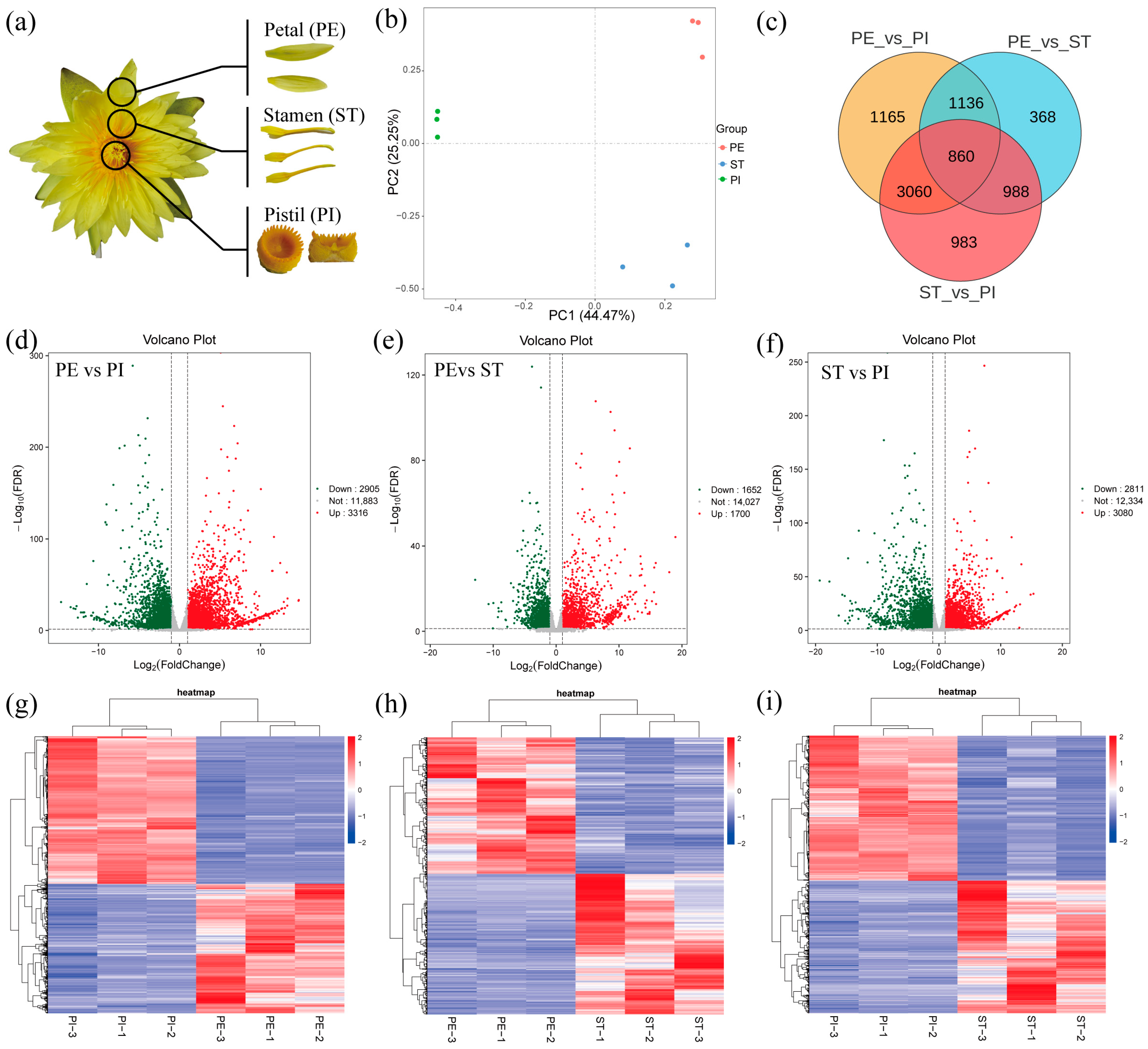
Transcriptome profiling of petal (PE), stamen (ST) and pistil (PI) tissues from Nymphaea was performed (Figure 1a). A total of 250 million high-quality clean reads were generated from nine independent libraries (Table 1). Reads per sample ranged from 22.8 to 32.8 million, corresponding to 6.85–9.85 Gb of nucleotide sequence. GC content was stable across libraries (46.6–48.0%), consistent with the nuclear genome characteristics of Lilium, whereas no excessive ambiguous bases were detected (N% = 0). Quality scores exceeded Q20 ≥ 97.5% and Q30 ≥ 93.6% in every library. These metrics indicate that the sequencing depth and accuracy are sufficient for robust differential-expression and multi-omics analyses.
Principal-component analysis (PCA) clearly separated the three floral organs along the first two axes, which collectively accounted for 69.72% of the total variance (PC1 = 44.47%, PC2 = 25.25%; Figure 1b). Venn mapping identified 860 genes ubiquitously expressed across PE, ST and PI, whereas 1165, 368 and 983 genes were uniquely expressed in PE, ST and PI, respectively (Figure 1c). Volcano filtering yielded 6221 differentially expressed genes (DEGs) between PE and PI (3316 up- and 2905 down-regulated in PE; Figure 1d), 3352 between PE and ST (1700 up, 1652 down; Figure 1e), and 5891 between ST and PI (3080 up, 2811 down; Figure 1f). Hierarchical clustering of these DEGs revealed distinct, organ-specific expression modules (Figure 1g–i), demonstrating that the dataset provides a high-resolution transcriptional atlas of Nymphaea floral organs.

3.2. Functional Interpretation of Differentially Expressed Genes

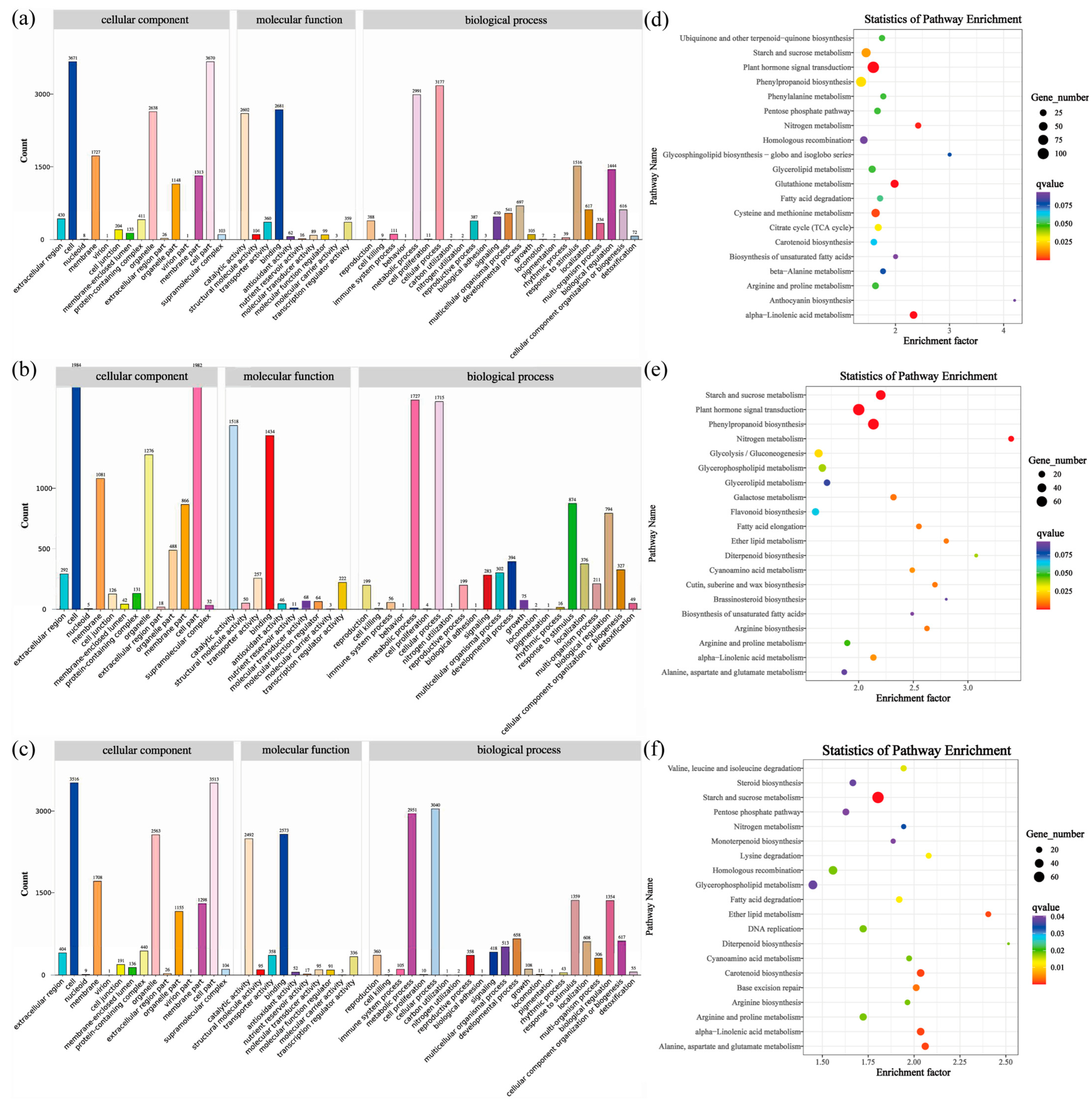
GO classification revealed that, among the DEGs between PE and PI, biological processes were dominated by “metabolic process” (2991 genes), “cellular process” (3177) and “response to stimulus” (1516); molecular functions were enriched for “catalytic activity” (2602) and “binding” (2681); cellular components were concentrated in “cell” (3671) and “organelle” (2638) (Figure 2a). A similar pattern was observed for the DEGs distinguishing PE from ST: biological process—“metabolic process” (1727), “cellular process” (1715), “response to stimulus” (874); molecular function—“catalytic activity” (1518), “binding” (1434); cellular component—“cell” (1984), “organelle” (1276) (Figure 2b). Likewise, the DEGs between ST and PI were enriched in “metabolic process” (2951), “cellular process” (3040) and “response to stimulus” (1359) at the biological level; “catalytic activity” (2492) and “binding” (2573) at the molecular level; and “cell” (3516) and “organelle” (2563) at the cellular level (Figure 2c).
KEGG pathway analysis further highlighted organ-specific metabolic programmes. In total, 13, 15 and 21 pathways were significantly enriched (q < 0.05) in PE vs. PI, PE vs. ST and ST vs. PI comparisons, respectively (Figure 2d–f). PE vs. PI DEGs were significantly enriched in starch and sucrose metabolism (map00500, 60 DEGs), plant hormone signal transduction (map04075, 106), phenylpropanoid biosynthesis (map00940, 75) and nitrogen metabolism (map00910, 19), among others. (Figure 2d). PE vs. ST DEGs mapped preferentially to phenylpropanoid biosynthesis (map00940, 66), plant hormone signal transduction (map04075, 75), starch and sucrose metabolism (map00500, 51) and nitrogen metabolism (map00910, 15) (Figure 2e). In contrast, ST vs. PI DEGs were enriched for starch and sucrose metabolism (map00500, 73), α-linolenic acid metabolism (map00592, 30), carotenoid biosynthesis (map00906, 30) and alanine, aspartate and glutamate metabolism (map00250, 27), among others (Figure 2f).

3.3. Metabolome Landscape and Identification of Differentially Accumulated Metabolites

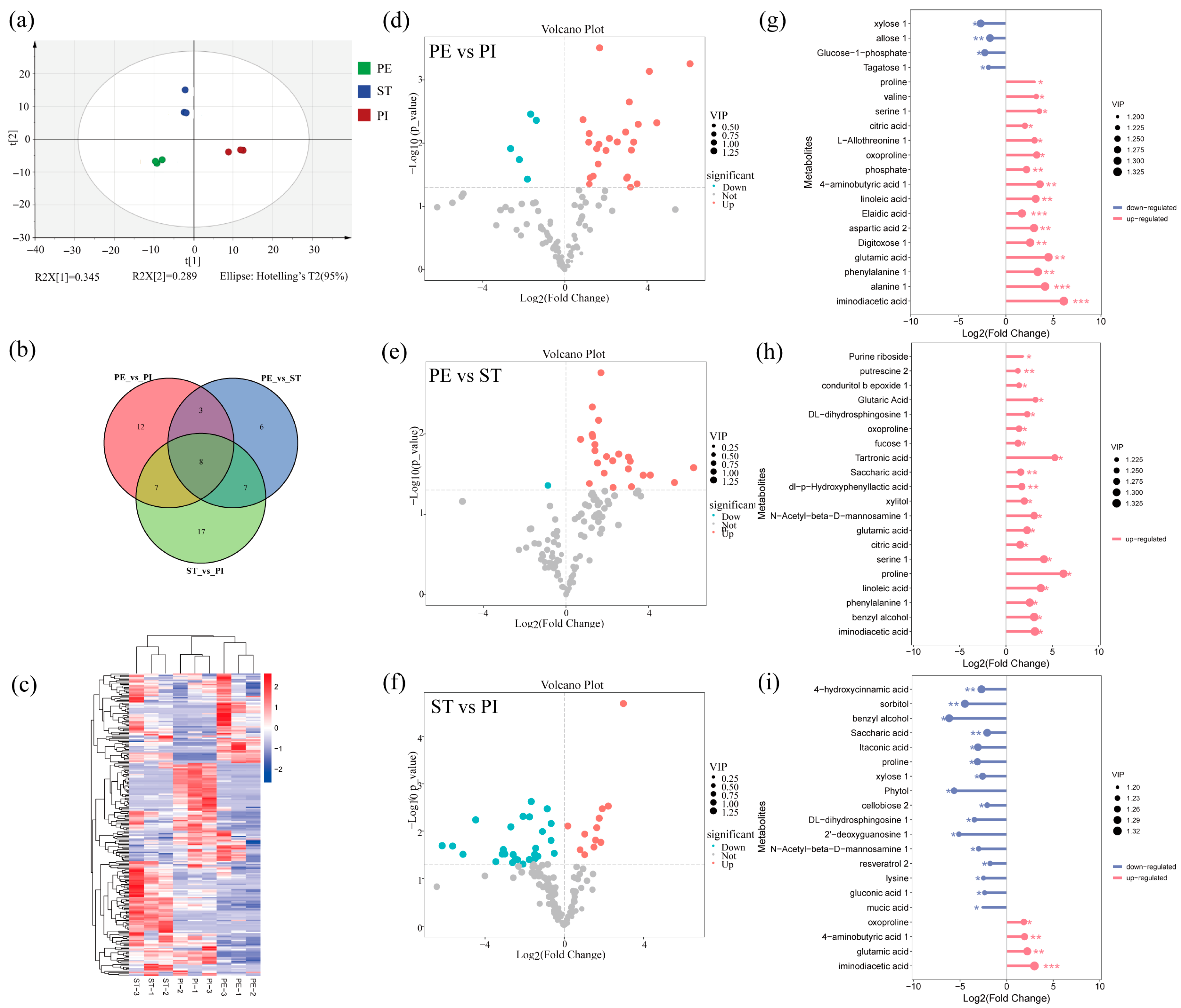
Metabolome profiling was performed for each floral organ. PCA clearly separated PE, ST and PI along PC1 (R2X = 0.345) and PC2 (R2X = 0.289; Figure 3a), mirroring the transcriptomic pattern. Pairwise comparisons identified 30, 24 and 39 differentially accumulated metabolites (DAMs) for PE vs. PI, PE vs. ST and ST vs. PI, respectively. Among these, eight DAMs were shared, whereas 12, six and 17 were uniquely enriched in PE, ST and PI (Figure 3b). Hierarchical clustering of the DAMs grouped the three organs into distinct branches, revealing organ-specific metabolic signatures (Figure 3c).
Detailed analyses showed that PE vs. PI exhibited 25 up- and five down-accumulated metabolites (Figure 3d), dominated by iminodiacetic acid (VIP = 1.33), alanine 1 (1.32), phenylalanine 1 (1.32) and glutamic acid (1.32) (Figure 3g). PE vs. ST displayed 23 up- and one down-accumulated metabolite (Figure 3e), with 1,3-diaminopropane (1.34), iminodiacetic acid (1.33), benzyl alcohol l (1.32) and phenylalanine 1 (1.32) as the main contributors (Figure 3h). ST vs. PI presented 12 up- and 27 down-accumulated metabolites (Figure 3f), including iminodiacetic acid (1.32), putrescine 2 (1.31), succinic acid (1.30) and 4-hydroxycinnamic acid (1.30) (Figure 3i).

3.4. Integrated Transcriptome–Metabolome Network Links Scent Biosynthesis to Phenylpropanoid Pathway

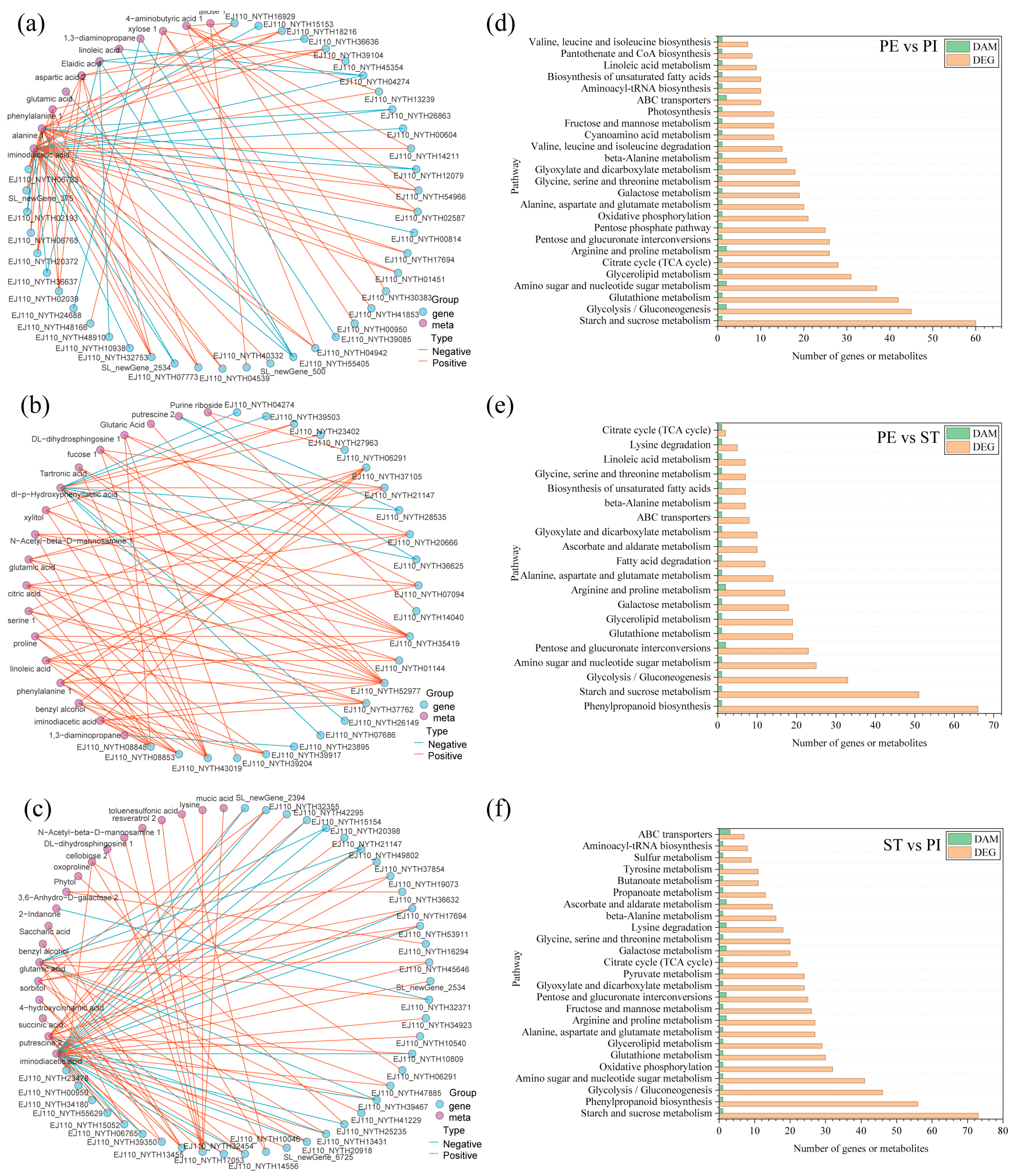
To link transcriptional and metabolic landscapes, we constructed DAM–DEG co-expression networks. Cytoscape visualisation revealed that in PE vs. PI, key phenylpropanoid pathway enzyme-encoding genes (PAL, 4CL) were positively correlated with scent compounds such as eugenol and benzyl benzoate, whereas fatty-acid genes were negatively associated with linolenic and linoleic acids (Figure 4a). In PE vs. ST, 4-hydroxycinnamic acid, PAL and CCR showed strong positive correlations with benzyl alcohol and coniferyl alcohol; conversely, linoleic acid was negatively linked to citric acid and putrescine (Figure 4b). In ST vs. PI, ST-characteristic metabolites (4-hydroxycinnamic acid, benzyl alcohol, linoleic acid) were positively connected to phenylpropanoid-encoding genes, whereas PI-characteristic metabolites (tagatose, cellobiose) were negatively correlated with polysaccharide-degradation encoding genes (Figure 4c).
Overlay of KEGG pathways on the integrated datasets further demonstrated that starch and sucrose metabolism, phenylpropanoid biosynthesis and glycolysis/gluconeogenesis (map00010) were simultaneously enriched at both the transcript and metabolite levels (Figure 4d–f). Among the significantly enriched pathways, phenylpropanoid biosynthesis was selected for detailed analysis because it is directly involved in the biosynthesis of floral scent-related volatile compounds, which is the primary focus of this study. Notably, phenylpropanoid biosynthesis (map00940) encompassed 59 DEGs and three floral-scent-related DAMs, underscoring this pathway as a pivotal route for fragrance compound synthesis in Nymphaea.
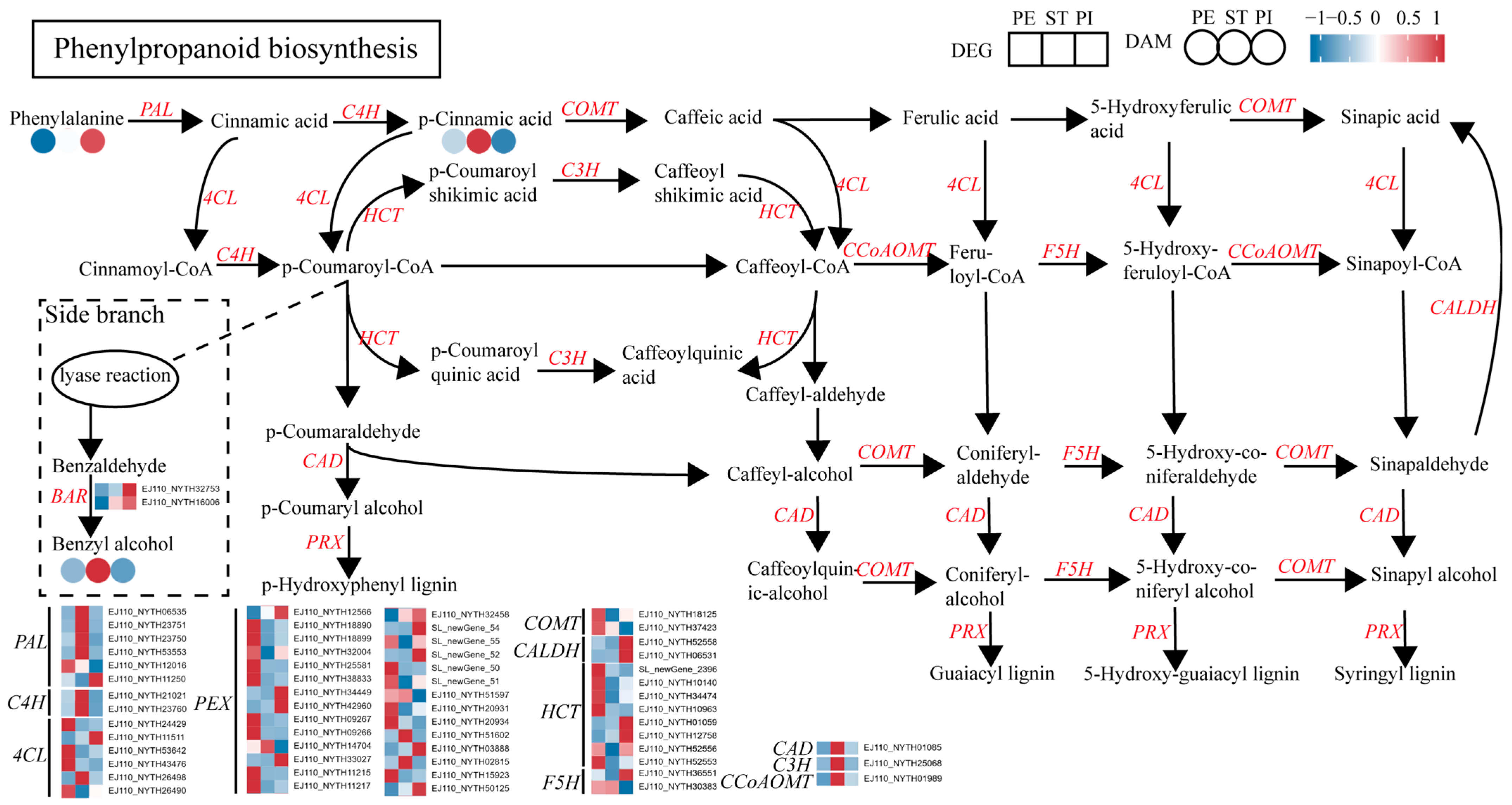
To pinpoint the regulatory hub, we generated a detailed pathway map of phenylpropanoid biosynthesis (Figure 5). PAL, C4H and 4CL—key genes encoding the core enzymatic steps—showed pronounced organ-specific expression, concomitant with differential accumulation of their immediate products phenylalanine, p-cinnamic acid and benzyl alcohol. Signal intensity was strongest in stamens, providing a clear snapshot of transcriptional–metabolic flux that underlies the organ-specific signature of volatile compound synthesis in Nymphaea.

3.5. A Proposed Model for Floral Scent Regulation in Nymphaea

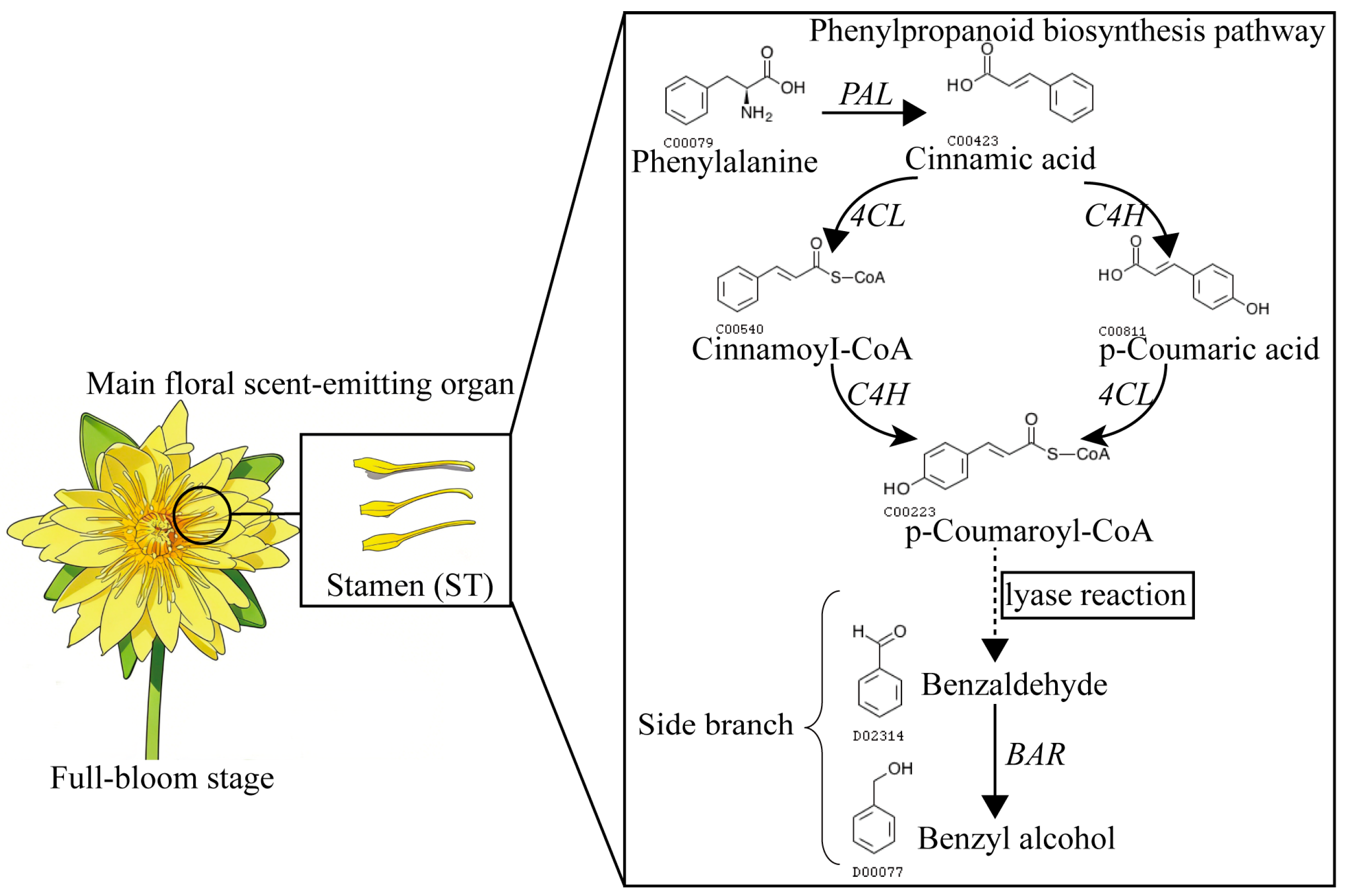
Integration of multi-omics data enabled us to propose a working model for floral scent biosynthesis in Nymphaea (Figure 6). The stamen operates as the primary scent factory, with phenylpropanoid metabolism forming the core pathway. Up-regulated PAL in stamens first converts phenylalanine to cinnamic acid, which is subsequently hydroxylated by C4H to p-coumaric acid and activated by 4CL to p-coumaroyl-CoA. This intermediate can be recycled through a cinnamoyl-CoA shunt back to p-coumaric acid. Side-chain cleavage then yields benzaldehyde, which is finally reduced to benzyl alcohol by the elevated BAR activity. Phenylalanine, p-coumaric acid, and benzyl alcohol constitute the metabolic backbone of fragrance synthesis. Notably, both p-coumaric acid and benzyl alcohol accumulate to significantly higher levels in stamens than in petals or pistils, establishing the biochemical foundation for the stamen as the key aroma source.

4. Discussion

Horticultural plants—including ornamentals and aromatic-medicinals—have long cultivation histories and are closely tied to human life. To respond to environmental changes, ensure growth and reproduction, and enhance adaptability, they release volatile compounds that differ in composition and concentration among organs [28]. Acting as signal molecules, these compounds establish interaction patterns between plants and animals or microorganisms [29], markedly increasing the utilization value of horticultural plants in fragrance and medicinal applications [30]. VOCs are low-polarity, low-molecular-weight molecules with high vapor pressure under ambient conditions, originating from multiple biosynthetic pathways connected to primary metabolism [31]. Owing to their complex composition, plant volatiles serve physiological regulation, signaling, and defense functions and can reflect plant physiological and ecological status [32,33]. Trace volatiles released by horticultural plants can modulate their own physiological metabolism and morphogenesis, influencing growth, development, and environmental adaptation [34].
Floral VOCs are the core components of floral scent. Based on their origin, biosynthetic pathway, and function, they can be divided into four classes: terpenoids, phenylpropanoids/benzenoids, fatty-acid derivatives, and amino-acid derivatives [35,36]. In our previous studies, significant differences in VOCs were found among different cultivars and flowering stages of fragrance lotus, with the yellow cultivar at full bloom producing the highest amount [22,23]; therefore, this cultivar and stage were used for the present experiments. These results are consistent with reports that the composition and emission of lily scent change with flower development, peaking at full bloom and declining at senescence [37,38]. Previous studies showed that water-lily flowers release 11 volatiles, including terpenoids (sesquiterpenes), fatty-acid derivatives (methyl decanoate), and benzenoids [39], matching our earlier metabolic data. However, the aromatic composition and VOC emission sites differ significantly among flowering plants [29]. Legumes mainly release terpenoids and phenolics through petal secretory glands [40]; in the Cattleya hybrid, monoterpenes were the dominant VOCs, and emission from the hypochile was significantly higher than from the epichile or other floral parts [10]. Therefore, to clarify inter-organ differences in volatile expression, we performed metabolomic analyses and found that PI contained more differential metabolites in each comparison group, consistent with the above studies and reflecting pronounced organ-specific divergence. Notably, subsequent quantification of differential metabolites revealed that p-coumaric acid and benzyl alcohol were significantly enriched in ST compared with PE and PI, demonstrating organ-dependent differences in metabolite identity and abundance. A study on Ceratonia siliqua similarly found that female flowers released a greater diversity of volatiles than male or perfect flowers, yet the latter two had higher abundances of major volatiles [11]. In addition, volatiles from some horticultural floral organs serve dual roles, attracting pollinators while deterring herbivores [41]. Pyrethrum releases large amounts of pyrethrin at night through the corolla and stigma, precisely attracting moth pollinators [42]. We found that the main differential metabolites were enriched in ST, suggesting that this organ may attract insects and thereby facilitate pollination of fragrance lotus.
Currently, plant-volatile research is a hotspot because of its value in compound identification, pathway elucidation, gene discovery, and ecological-function interpretation. Researchers have applied metabolomics/transcriptomics and genome sequencing to horticultural flowers such as rose, lavender, and camellia, providing new theoretical and technical support for volatile applications [43,44,45]. To date, studies on floral scent biosynthesis have focused on terpenoids, benzenoids/phenylpropanoids, and fatty-acid derivatives. Among them, benzenoids/phenylpropanoids are the second largest class of floral VOCs in plants [29]. Based on side-chain length, aromatic compounds are classified as benzenoids, phenylpropanoids, or phenylpropanoid-derived benzenoids [46]. Benzenoids and phenylpropanoids are produced from the aromatic amino acid phenylalanine (Phe) via the shikimate pathway [47]. The shikimate pathway converts Phe into cinnamate (CA) through phenylalanine ammonia-lyase (PAL) [48]. Thus, as the first step of phenylpropanoid biosynthesis, PAL plays a crucial role [49]. In this study, transcriptome sequencing identified six PAL DEGs whose expression patterns matched the release of differential metabolites, all being significantly up-regulated in ST; similar results have been reported in lily [50]. For phenylpropanoid synthesis, CA is hydroxylated by C4H to produce p-coumarate, which is further modified to yield a series of volatile benzenoids/phenylpropanoids [51]. Specifically, 4-coumarate-CoA ligase converts p-coumaric acid into p-coumaroyl-CoA [52]. Coniferyl alcohol is acetylated by acetyltransferase to form coniferyl acetate, and a series of enzymatic reactions are required to produce eugenol and isoeugenol, which are catalyzed by NADH-dependent eugenol synthase and isoeugenol synthase (IGS), respectively [53]. Eugenol and isoeugenol are then methylated by isoeugenol O-methyltransferase to yield volatile methyl eugenol and methyl isoeugenol [51]. Therefore, in other plants the catalytic action of C4H is also essential for volatile formation [53]. Likewise, transcriptome sequencing of fragrance lotus identified two C4H DEGs that were up-regulated in PE; metabolomic data similarly showed that p-coumaroyl-CoA was significantly more abundant in PE. These results further confirm that different organs of fragrance lotus modulate floral scent through the phenylpropanoid pathway.
Moreover, to synthesize benzenoids, the propyl side chain of CA is shortened by two carbons. Several chain-shortening pathways have been proposed: two non-oxidative routes (CoA-dependent or CoA-independent) in the cytosol, and a β-oxidation pathway in peroxisomes [54]. The CoA-dependent non-oxidative pathway involves conversion of CA to cinnamoyl-CoA by 4-hydroxycinnamoyl-CoA ligase, followed by hydration to 3-hydroxy-3-phenylpropanoyl-CoA and cleavage to benzaldehyde [55]. In the CoA-independent non-oxidative pathway, CA is hydrated to 3-hydroxyphenylpropionic acid and then reduced to benzaldehyde by a lyase. The final step is oxidation of benzaldehyde to benzoic acid by benzaldehyde dehydrogenase, as described in snapdragon [56] and petunia [57], followed by methylation to methyl benzoate and ethyl benzoate catalyzed by BSMT and BAHD enzymes [58]. In the present metabolomic analysis of fragrance lotus, p-coumaric acid and benzyl alcohol were significantly enriched in ST, indicating that this pathway also operates and that ST produces more benzyl alcohol than PE or PI. A similar benzaldehyde-to-benzyl alcohol reductive branch was first systematically characterised in cranberry [59], consistent with our findings. Additionally, we identified two benzaldehyde reductase (BAR) DEGs, all of which further demonstrate organ-specific aromatic biosynthesis in fragrance lotus and point to future dissection of the lyase reaction in this species.

5. Conclusions

Integrated transcriptome–metabolome analyses demonstrate that the stamen (ST) is the primary site for scent biosynthesis in Nymphaea. The phenylpropanoid pathway (PAL–C4H–4CL–BAR) is significantly activated in this organ, driving massive accumulation of p-coumaric acid and benzyl alcohol, thus establishing an “ST-dominated, phenylpropanoid-core” model for fragrance lotus aroma formation. Across the three floral organs, 6221, 3352 and 5891 DEGs together with 30, 24 and 39 DAMs were identified, respectively. PCA clearly separated each organ, and the phenylpropanoid pathway was the only scent-related route simultaneously enriched at both the transcript and metabolite levels, encompassing 59 DEGs and three scent-linked DAMs. This enabled construction of a high-resolution, organ-specific gene–metabolite network. For the first time at single-flower resolution, our study reveals the spatial division of labor and metabolic-flux control underlying fragrance biosynthesis in fragrance lotus, providing key gene resources and a theoretical framework for molecular breeding of high-aroma cultivars and for green essential-oil commercialization. Future studies should incorporate genetic or biochemical validation approaches, such as gene overexpression or silencing, to confirm the regulatory roles of candidate genes in floral scent biosynthesis. In addition, expanding the analysis to additional developmental stages or environmental conditions may further improve our understanding of organ-specific scent formation.

Supplementary Materials

The following supporting information can be downloaded at https://www.mdpi.com/article/10.3390/horticulturae12020229/s1: Supplementary File S1: Detailed information of differentially expressed genes (DEGs), including raw p-values, adjusted FDR values, and log2 fold changes; Supplementary File S2: Summary of identified metabolites, including compound name, molecular formula, theoretical mass, observed mass, mass error, and references/standards used for metabolite identification; Supplementary File S3: Detailed parameters of differentially accumulated metabolites (DAMs), including VIP values, raw p-values, adjusted FDR values, and fold-change values in each pairwise comparison.

Author Contributions

Conceptualization, Q.Z. and T.H.; Data curation, F.Z. and Y.W.; Formal analysis, Q.Z. and T.H.; Funding acquisition, Q.Z., X.Y. and Y.W.; Investigation, F.Z. and H.Z.; Methodology, Q.Z., F.Z. and T.H.; Project administration, Q.Z., X.Y. and Y.W.; Resources, H.Z.; Software, F.Z. and T.H.; Supervision, T.H.; Writing—original draft, Q.Z.; Writing—review and editing, Q.Z. and T.H. All authors have read and agreed to the published version of the manuscript.

Funding

This research was funded by Natural Science Foundation of Jiangsu Province, grant number (BK20240218, BK20230116), and the Natural Science Foundation of the Jiangsu Higher Education Institutions of China (24KJD22000).

Data Availability Statement

The data presented in this study are openly available in National Genomics Data Center (NGDC) at https://ngdc.cncb.ac.cn, reference number PRJCA056061.

Conflicts of Interest

The authors declare no conflicts of interest.

Abbreviations

The following abbreviations are used in this manuscript:
PEPetal
STStamen
PIPistil
VOCsVolatile organic compounds
DEGsDifferentially expressed genes
DAMsDifferentially accumulated metabolites
PALPhenylalanine ammonia-lyase
C4HCinnamate-4-hydroxylase
4CL4-coumarate-CoA ligase
BARBenzaldehyde reductase
OMTsO-methyltransferases
PhePhenylalanine
CACinnamate

References

  1. Kapoor, D.; Bhardwaj, S.; Sharma, N.R. Fragrance stimulation mechanisms of flowers and their regulation under environmen tal constraints. J. Plant Growth Regul. 2023, 42, 60–82. [Google Scholar] [CrossRef]
  2. Aros, D.; Garrido, N.; Rivas, C.; Medel, M.; Müller, C.; Rogers, H.; Úbeda, C. Floral scent evaluation of three cut flowers through sensorial and gas chromatography analysis. Agronomy 2020, 10, 131. [Google Scholar] [CrossRef]
  3. Kimani, S.K.; Wang, S.; Xie, J.; Bao, T.; Shan, X.; Li, H.; Adnan; Wang, L.; Gao, X.; Li, Y. Integration of R NA-Seq and metabolite analysis reveals the key floral scent biosynthetic genes in herbaceous peony. Horticulturae 2024, 10, 617. [Google Scholar] [CrossRef]
  4. Báez, D.; Morales, D.; Pino, J.A. Volatiles from Michelia champaca flower: Comparative analysis by simultaneous distillation-extraction and solid phase microextraction. Nat. Prod. Commun. 2012, 7, 659–660. [Google Scholar] [CrossRef]
  5. Miraldi, E.; Ferri, S.; Giorgi, G. Identification of volatile constituents from the flower oil of Spartium junceum. J. Essent. Oil Res. 2004, 16, 568–570. [Google Scholar] [CrossRef]
  6. Jirovetz, L.; Buchbauer, G.; Stoyanova, A.; Balinova, A.; Guangjiun, Z.; Xihan, M. Solid phase microextraction/gas chromatographic and olfactory analysis of the scent and fixative properties of the essential oil of Rosa damascena L. from China. Flavour Fragrance J. 2005, 20, 7–12. [Google Scholar] [CrossRef]
  7. Trovato, E.; Balcerzak, L.; Clio, V.; Jan, S.; Fakhry, H.; Paola, D.; Luigi, M. Gas chromatographic, sensory profile and biological properties evaluation of Egyptian Jasminum grandiflorum essential oil produced industrially by steam distillation. J. Essent. Oil Res. 2024, 36, 321–332. [Google Scholar] [CrossRef]
  8. Garcia, Y.; Friberg, M.; Parachnowitsch, A. Spatial variation in scent emission within flowers. Nord. J. Bot. 2021, 39, 3014. [Google Scholar] [CrossRef]
  9. Zhou, T.; Han, W.; Ning, K.; Zhou, Y.; Zhang, D.; El-Kassaby, Y.A.; Chong, X.; Zhang, F.; Chen, F.; Chen, H. Spatial and temporal dynamics of carnation-scented flowers in Lagerstroemia ‘Ning Xiang 3’. Ind. Crops Prod. 2024, 208, 117864. [Google Scholar] [CrossRef]
  10. Zheng, B.Q.; Li, X.Q.; Wang, Y. New insights into the mechanism of spatiotemporal scent accumulation in orchid flowers. Plants 2023, 12, 304. [Google Scholar] [CrossRef]
  11. Custódio, L.; Serra, H.; Nogueira, J.M.F.; Gonçalves, S.; Romano, A. Analysis of the volatiles emitted by whole flowers and isolated flower organs of the carob tree using HS-SPME-GC/MS. J. Chem. Ecol. 2006, 32, 929–942. [Google Scholar] [CrossRef]
  12. Abbas, F.; Zhou, Y.; O’Neill Rothenberg, D.; Alam, I.; Ke, Y.; Wang, H.-C. Aroma components in horticultural crops: Chemical diversity and usage of metabolic engineering for industrial applications. Plants 2023, 12, 1748. [Google Scholar] [CrossRef]
  13. Borghi, M.; Fernie, A.R.; Schiestl, F.P.; Bouwmeester, H.J. The sexual advantage of looking, smelling, and tasting good: The metabolic network that produces signals for pollinators. Trends Plant Sci. 2017, 22, 338–350. [Google Scholar] [CrossRef]
  14. Wang, S.; Du, Z.; Yang, X.; Wang, L.; Xia, K.; Chen, Z. An integrated analysis of metabolomics and transcriptomics reveals significant differences in floral scents and related gene expression between two varieties of Dendrobium loddigesii. Appl. Sci. 2022, 12, 1262. [Google Scholar] [CrossRef]
  15. Liu, G.; Fu, J.; Wang, L.; Fang, M.; Zhang, W.; Yang, M.; Yang, X.; Xu, Y.; Shi, L.; Ma, X.; et al. Diverse O-methyltransferases catalyze the biosynthesis of floral benzenoids that repel aphids from the flowers of waterlily Nymphaea prolifera. Hortic. Res. 2023, 10, uhad237. [Google Scholar] [CrossRef]
  16. Yang, X.L.; Li, H.Y.; Yue, Y.Z.; Ding, W.J.; Xu, C.; Shi, T.T.; Chen, G.W.; Wang, L.G. Transcriptomic analysis of the candidate genes related to aroma formation in Osmanthus fragrans. Molecules 2018, 23, 1604. [Google Scholar] [CrossRef]
  17. Li, J.; Yu, X.; Shan, Q.; Shi, Z.; Li, J.; Zhao, X.; Chang, C.; Yu, J. Integrated volatile metabolomic and transcriptomic analysis provides insights into the regulation of floral scents between two contrasting varieties of Lonicera japonica. Front. Plant Sci. 2022, 13, 989036. [Google Scholar] [CrossRef]
  18. Hu, Z.; Tang, B.; Wu, Q.; Zheng, J.; Leng, P.; Zhang, K. Transcriptome sequencing analysis reveals a difference in monoterpene biosynthesis between scented Lilium ‘Siberia’ and unscented Lilium ‘Novano’. Front. Plant Sci. 2017, 8, 1351. [Google Scholar] [CrossRef] [PubMed]
  19. Pottier, M.; Albuquerque, B.N.d.L.; Bezerra-Silva, P.C.; da Rocha, S.K.L.; Maia, A.C.D.; Hallwass, F.; Navarro-Vázquez, A.; Navarro, D.M.d.A.F. Dolabella-3,7,18-triene, the main constituent of the essential oil of the white lotus flower (Nymphaea lotus, Nymphaeaceae). Flavour Fragr. J. 2016, 31, 356–360. [Google Scholar] [CrossRef]
  20. Omata, A.; Yomogida, K.; Nakamura, S.; Ohta, T.; Izawa, Y.; Watanabe, S. The scent of lotus flowers. J. Essent. Oil Res. 1991, 3, 221–227. [Google Scholar] [CrossRef]
  21. Barrales-Cureño, H.J.; Salgado-Garciglia, R.; López-Valdez, L.G.; Reynoso-López, R.; Herrera-Cabrera, B.E.; Lucho-Constantino, G.G.; Zaragoza-Martínez, F.; Reyes-Reyes, C.; Aftab, T. Use of secondary metabolites from medicinal and aromatic plants in the fragrance industry. In Medicinal and Aromatic Plants: Healthcare and Industrial Applications; Aftab, T., Hakeem, K.R., Eds.; Springer International Publishing: Cham, Switzerland, 2021; pp. 669–690. [Google Scholar]
  22. Zhou, Q.; Shi, M.; Zhang, H.; Zhu, Z. Comparative study of the petal structure and fragrance components of the Nymphaea hybrid, a precious water lily. Molecules 2022, 27, 408. [Google Scholar] [CrossRef]
  23. Zhou, Q.; Zhao, F.; Shi, M.; Zhang, H.; Zhu, Z. Variation in the floral scent chemistry of Nymphaea ‘Eldorado’, a valuable water lily, with different flowering stages and flower parts. Plants 2024, 13, 939. [Google Scholar] [CrossRef]
  24. Pertea, M.; Pertea, G.M.; Antonescu, C.M.; Chang, T.C.; Mendell, J.T.; Salzberg, S.L. StringTie enables improved reconstruction of a transcriptome from RNA-seq reads. Nat. Biotechnol. 2015, 33, 290–295. [Google Scholar] [CrossRef]
  25. Benjamini, Y.; Hochberg, Y. Controlling the false discovery rate: A practical and powerful approach to multiple testing. J. R. Stat. Soc. 1995, 57, 289–300. [Google Scholar] [CrossRef]
  26. Yu, G.; Wang, L.G.; Han, Y.; He, Q.Y. clusterProfiler: An R package for comparing biological themes among gene clusters. Omics 2012, 16, 284–287. [Google Scholar] [CrossRef]
  27. Xia, J.; Wishart, D.S. Metabolomic data processing, analysis, and interpretation using MetaboAnalyst. Curr. Protoc. Bioinform. 2011, 14, 14.10.11–14.10.48. [Google Scholar] [CrossRef] [PubMed]
  28. Ninkovic, V.; Markovic, D.; Rensing, M. Plant volatiles as cues and signals in plant communication. Plant Cell Environ. 2021, 44, 1030–1043. [Google Scholar] [CrossRef]
  29. Mostafa, S.; Wang, Y.; Zeng, W.; Jin, B. Floral scents and fruit aromas: Functions, compositions, biosynthesis, and regulation. Front. Plant Sci. 2022, 13, 860157. [Google Scholar] [CrossRef]
  30. Lu, H.; Zhao, H.; Zhong, T.; Chen, D.; Wu, Y.; Xie, Z. Molecular regulatory mechanisms affecting fruit aroma. Foods 2024, 13, 1870. [Google Scholar] [CrossRef] [PubMed]
  31. Schuman, M.C.; Valim, H.A.; Joo, Y. Temporal dynamics of plant volatiles: Mechanistic bases and functional consequences. In Deciphering Chemical Language of Plant Communication; Blande, J.D., Glinwood, R., Eds.; Springer International Publishing: Cham, Switzerland, 2016; pp. 3–34. [Google Scholar]
  32. Bouwmeester, H.; Schuurink, R.C.; Bleeker, P.M.; Schiestl, F. The role of volatiles in plant communication. Plant J. 2019, 100, 892–907. [Google Scholar] [CrossRef] [PubMed]
  33. Widhalm, J.R.; Shih, M.-L.; Morgan, J.A.; Dudareva, N. Two-way communication: Volatile emission and uptake occur through the same barriers. Mol. Plant 2023, 16, 1–3. [Google Scholar] [CrossRef] [PubMed]
  34. Jin, J.; Zhao, M.; Jing, T.; Zhang, M.; Lu, M.; Yu, G.; Wang, J.; Guo, D.; Pan, Y.; Hoffmann, T.D.; et al. Volatile compound-mediated plant–plant interactions under stress with the tea plant as a model. Hortic. Res. 2023, 10, uhad143. [Google Scholar] [CrossRef] [PubMed]
  35. Divekar, P.A.; Narayana, S.; Divekar, B.A.; Kumar, R.; Gadratagi, B.G.; Ray, A.; Singh, A.K.; Rani, V.; Singh, V.; Singh, A.K.; et al. Plant secondary metabolites as defense tools against herbivores for sustainable crop protection. Int. J. Mol. Sci. 2022, 23, 2690. [Google Scholar] [CrossRef]
  36. Zeng, L.; Zhou, X.; Fu, X.; Hu, Y.; Gu, D.; Hou, X.; Dong, F.; Yang, Z. Effect of the biosynthesis of the volatile compound phenylacetaldehyde on chloroplast modifications in tea (Camellia sinensis) plants. Hortic. Res. 2023, 10, uhad003. [Google Scholar] [CrossRef] [PubMed]
  37. Abbas, F.; Ke, Y.; Zhou, Y.; Ashraf, U.; Li, X.; Yu, Y.; Yue, Y.; Ahmad, K.W.; Yu, R.; Fan, Y. Molecular cloning, characterization and expression analysis of LoTPS2 and LoTPS4 involved in floral scent formation in oriental hybrid Lilium variety ‘Siberia’. Phytochemistry 2020, 173, 112294. [Google Scholar] [CrossRef]
  38. Abbas, F.; Ke, Y.; Yu, R.; Fan, Y. Functional characterization and expression analysis of two terpene synthases involved in floral scent formation in Lilium ‘Siberia’. Planta 2019, 249, 71–93. [Google Scholar] [CrossRef]
  39. Zhang, L.; Chen, F.; Zhang, X.; Li, Z.; Zhao, Y.; Lohaus, R.; Chang, X.; Dong, W.; Ho, S.Y.W.; Liu, X.; et al. The water lily genome and the early evolution of flowering plants. Nature 2020, 577, 79–84. [Google Scholar] [CrossRef]
  40. Marinho, C.R.; Souza, C.D.; Barros, T.C.; Teixeira, S.P. Scent glands in legume flowers. Plant Biol. 2014, 16, 215–226. [Google Scholar] [CrossRef]
  41. Li, J.; Hu, H.; Mao, J.; Yu, L.; Stoopen, G.; Wang, M.; Mumm, R.; de Ruijter, N.C.A.; Dicke, M.; Jongsma, M.A.; et al. Defense of pyrethrum flowers: Repelling herbivores and recruiting carnivores by producing aphid alarm pheromone. N. Phytol. 2019, 223, 1607–1620. [Google Scholar] [CrossRef]
  42. Li, J.; Luo, Y.; Li, M.; Li, J.; Zeng, T.; Luo, J.; Chang, X.; Wang, M.; Jongsma, M.A.; Hu, H.; et al. Nocturnal burst emissions of germacrene D from the open disk florets of pyrethrum flowers induce moths to oviposit on a nonhost and improve pollination success. N. Phytol. 2024, 244, 2036–2048. [Google Scholar] [CrossRef]
  43. Li, H.; Li, Y.; Yan, H.; Bao, T.; Shan, X.; Caissard, J.C.; Zhang, L.; Fang, H.; Bai, X.; Zhang, J.; et al. The complexity of volatile terpene biosynthesis in roses: Particular insights into β-citronellol production. Plant Physiol. 2024, 196, 1908–1922. [Google Scholar] [CrossRef]
  44. Li, J.; Li, H.; Wang, Y.; Zhang, W.; Wang, D.; Dong, Y.; Ling, Z.; Bai, H.; Jin, X.; Hu, X.; et al. Decoupling subgenomes within hybrid lavandin provide new insights into speciation and monoterpenoid diversification of Lavandula. Plant Biotechnol. J. 2023, 21, 2084–2099. [Google Scholar] [CrossRef]
  45. Gao, T.; Shao, S.; Hou, B.; Hong, Y.; Ren, W.; Jin, S.; Gao, S.; Wang, P.; Ye, N. Characteristic volatile components and transcriptional regulation of seven major tea cultivars (Camellia sinensis) in China. Beverage Plant Res. 2023, 3, 17. [Google Scholar] [CrossRef]
  46. Muhlemann, J.K.; Klempien, A.; Dudareva, N. Floral volatiles: From biosynthesis to function. Plant Cell Environ. 2014, 37, 1936–1949. [Google Scholar] [CrossRef]
  47. Yoo, H.; Widhalm, J.R.; Qian, Y.; Maeda, H.; Cooper, B.R.; Jannasch, A.S.; Gonda, I.; Lewinsohn, E.; Rhodes, D.; Dudareva, N. An alternative pathway contributes to phenylalanine biosynthesis in plants via a cytosolic tyrosine:phenylpyruvate aminotransferase. Nat. Commun. 2013, 4, 2833. [Google Scholar] [CrossRef]
  48. Orlova, I.; Marshall-Colón, A.; Schnepp, J.; Wood, B.; Varbanova, M.; Fridman, E.; Blakeslee, J.J.; Peer, W.A.; Murphy, A.S.; Rhodes, D.; et al. Reduction of benzenoid synthesis in petunia flowers reveals multiple pathways to benzoic acid and enhancement in auxin transport. Plant Cell 2006, 18, 3458–3475. [Google Scholar] [CrossRef] [PubMed]
  49. Skaliter, O.; Livneh, Y.; Agron, S.; Shafir, S.; Vainstein, A. A whiff of the future: Functions of phenylalanine-derived aroma compounds and advances in their industrial production. Plant Biotechnol. J. 2022, 20, 1651–1669. [Google Scholar] [CrossRef] [PubMed]
  50. Shi, S.; Duan, G.; Li, D.; Wu, J.; Liu, X.; Hong, B.; Yi, M.; Zhang, Z. Two-dimensional analysis provides molecular insight into flower scent of Lilium ‘Siberia’. Sci. Rep. 2018, 8, 5352. [Google Scholar] [CrossRef] [PubMed]
  51. Dudareva, N.; Klempien, A.; Muhlemann, J.K.; Kaplan, I. Biosynthesis, function and metabolic engineering of plant volatile organic compounds. N. Phytol. 2013, 198, 16–32. [Google Scholar] [CrossRef]
  52. Deng, Y.; Lu, S. Biosynthesis and regulation of phenylpropanoids in plants. Crit. Rev. Plant Sci. 2017, 36, 257–290. [Google Scholar] [CrossRef]
  53. Huang, L.; Ho, C.T.; Wang, Y. Biosynthetic pathways and metabolic engineering of spice flavors. Crit. Rev. Food Sci. Nutr. 2021, 61, 2047–2060. [Google Scholar] [CrossRef]
  54. Widhalm, J.R.; Dudareva, N. A familiar ring to it: Biosynthesis of plant benzoic acids. Mol. Plant 2015, 8, 83–97. [Google Scholar] [CrossRef] [PubMed]
  55. Lackus, N.D.; Schmidt, A.; Gershenzon, J.; Köllner, T.G. A peroxisomal β-oxidative pathway contributes to the formation of C6–C1 aromatic volatiles in poplar. Plant Physiol. 2021, 186, 891–909. [Google Scholar] [CrossRef] [PubMed]
  56. Long, M.C.; Nagegowda, D.A.; Kaminaga, Y.; Ho, K.K.; Kish, C.M.; Schnepp, J.; Sherman, D.; Weiner, H.; Rhodes, D.; Dudareva, N. Involvement of snapdragon benzaldehyde dehydrogenase in benzoic acid biosynthesis. Plant J. 2009, 59, 256–265. [Google Scholar] [CrossRef]
  57. Kim, J.Y.; Swanson, R.T.; Alvarez, M.I.; Johnson, T.S.; Cho, K.H.; Clark, D.G.; Colquhoun, T.A. Down regulation of p-coumarate 3-hydroxylase in petunia uniquely alters the profile of emitted floral volatiles. Sci. Rep. 2019, 9, 8852. [Google Scholar] [CrossRef]
  58. Yue, Y.; Wang, L.; Li, M.; Liu, F.; Yin, J.; Huang, L.; Zhou, B.; Li, X.; Yu, Y.; Chen, F.; et al. A BAHD acyltransferase contributes to the biosynthesis of both ethyl benzoate and methyl benzoate in the flowers of Lilium oriental hybrid ‘Siberia’. Front. Plant Sci. 2023, 14, 1275960. [Google Scholar] [CrossRef]
  59. Croteau, R. Biosynthesis of benzaldehyde, benzyl alcohol and benzyl benzoate from benzoic acid in cranberry (Vaccinium macrocarpon). J. Food Biochem. 1978, 1, 317–326. [Google Scholar] [CrossRef]
Figure 1. Transcriptome analysis of different floral organs in Nymphaea. (a) Schematic of sampled tissues. (b) Principal component analysis (PCA) of transcriptome profiles. (c) Venn diagram of expressed genes among the three tissues. (df) Volcano plots of differentially expressed genes (DEGs) for each pairwise comparison. (gi) Hierarchical clustering heatmaps of the DEGs based on normalized expression values. Note: PE, petal; ST, stamen; PI, pistil.
Horticulturae 12 00229 g001
Figure 2. Functional enrichment of differentially expressed genes (DEGs). (ac) GO enrichment for the three pairwise comparisons. (df) KEGG pathway enrichment for the three pairwise comparisons. Note: PE, petal; ST, stamen; PI, pistil.
Horticulturae 12 00229 g002
Figure 3. Overview of metabolomic analyses. (a) Principal component analysis (PCA). (b) Venn diagram of differentially accumulated metabolites (DAMs). (c) Hierarchical clustering heatmap of DAMs. (df) Volcano plots for each comparison. (gi) Bar plots showing relative contents of representative DAMs. Different asterisks indicate significant differences in metabolites; specifically, * p < 0.05, ** p < 0.01, *** p < 0.001. Note: PE, petal; ST, stamen; PI, pistil.
Horticulturae 12 00229 g003
Figure 4. Integrated analysis of differentially expressed genes and metabolites. (ac) Transcript–metabolite correlation networks for the three pairwise comparisons; (df) KEGG pathways co-enriched by both DEGs and DAMs. Note: PE, petal; ST, stamen; PI, pistil.
Horticulturae 12 00229 g004
Figure 5. Metabolic circuit linking differentially expressed genes (DEG) and differentially accumulated metabolites (DAM) within the phenylpropanoid biosynthesis pathway. Note: PE, petal; ST, stamen; PI, pistil.
Horticulturae 12 00229 g005
Figure 6. Proposed metabolic circuit for floral scent biosynthesis in Nymphaea.
Horticulturae 12 00229 g006
Table 1. Overview of transcriptome sequencing quality for three floral organs of Nymphaea.
SampleReadSumBaseSumGC (%)N (%)Q20 (%)Q30 (%)
PE-132,848,6419,854,592,30047.93097.7894.18
PE-224,611,2757,383,382,50047.98097.6693.8
PE-326,219,4027,865,820,60047.98097.8994.35
ST-126,669,8088,000,942,40047.64097.7194.11
ST-228,721,0128,616,303,60047.57097.4993.58
ST-331,714,1889,514,256,40047.32097.894.19
PI-127,300,0718,190,021,30046.65097.6693.8
PI-230,172,2849,051,685,20046.67097.8194.29
PI-322,828,5166,848,554,80046.59097.793.97
Disclaimer/Publisher’s Note: The statements, opinions and data contained in all publications are solely those of the individual author(s) and contributor(s) and not of MDPI and/or the editor(s). MDPI and/or the editor(s) disclaim responsibility for any injury to people or property resulting from any ideas, methods, instructions or products referred to in the content.