


Skip to Content

Gels, Volume 5, Issue 2

2019 June - 14 articles

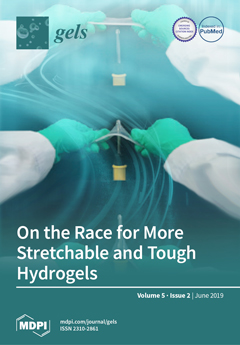
Cover Story: Overcoming poor mechanical strength of hydrogels for biomedical applications. In recent decades, the applicability of hydrogels in biomedicine has been exponentially growing due to their biocompatibility and different responses to external stimuli. However, many of these gel materials have some critical limitations due to their poor mechanical strength. Thus, a race to develop robust strategies to obtain more stretchable and tough hydrogels has begun. View this paper.
  • Issues are regarded as officially published after their release is announced to the table of contents alert mailing list .
  • You may sign up for email alerts to receive table of contents of newly released issues.
  • PDF is the official format for papers published in both, html and pdf forms. To view the papers in pdf format, click on the "PDF Full-text" link, and use the free Adobe Reader to open them.

Articles (14)

  • Article
  • Open Access
4 Citations
4,884 Views
14 Pages

Antibacterial-Agent-Immobilized Gelatin Hydrogel as a 3D Scaffold for Natural and Bioengineered Tissues

  • Tuyajargal Iimaa,
  • Takaaki Hirayama,
  • Nana Shirakigawa,
  • Daisuke Imai,
  • Takanobu Yamao,
  • Yo-ichi Yamashita,
  • Hideo Baba and
  • Hiroyuki Ijima

11 June 2019

Hydrogels and their medical applications in tissue engineering have been widely studied due to their three-dimensional network structure, biocompatibility, and cell adhesion. However, the development of an artificial bile duct to replace the recipien...

  • Feature Paper
  • Review
  • Open Access
38 Citations
6,717 Views
42 Pages

15 May 2019

Because of their inherent biocompatibility and tailorable network design, hydrogels meet an increasing interest as biomaterials for the fabrication of controlled drug delivery devices. In this regard, mathematical modeling can highlight release mecha...

  • Feature Paper
  • Article
  • Open Access
20 Citations
5,571 Views
11 Pages

14 May 2019

We prepared the small pseudopeptide Lau-l-Dopa(OBn)2-d-Oxd-OBn (Lau = lauric acid; l-Dopa = l-3,4-dihydroxyphenylalanine; d-Oxd = (4R,5S)-4-methyl-5-carboxyl-oxazolidin-2-one; Bn = benzyl) through a number of coupling reactions between lauric acid, p...

  • Feature Paper
  • Article
  • Open Access
7 Citations
5,498 Views
11 Pages

Segregation Behavior of Polysaccharide–Polysaccharide Mixtures—A Feasibility Study

  • Benjamin Zeeb,
  • Theresa Jost,
  • David Julian McClements and
  • Jochen Weiss

13 May 2019

The segregative phase separation behavior of biopolymer mixtures composed entirely of polysaccharides was investigated. First, the electrical, optical, and rheological properties of alginate, modified beet pectin, and unmodified beet pectin solutions...

  • Article
  • Open Access
11 Citations
8,050 Views
15 Pages

Cryostructuring of Polymeric Systems. 52. Properties, Microstructure and an Example of a Potential Biomedical Use of the Wide-Pore Alginate Cryostructurates

  • Natalia D. Zvukova,
  • Tamara P. Klimova,
  • Roman V. Ivanov,
  • Andrei N. Ryabev,
  • Archil V. Tsiskarashvili and
  • Vladimir I. Lozinsky

9 May 2019

Wide-pore cryostructurates were prepared via freezing sodium alginate aqueous solutions with subsequent ice sublimation from the frozen samples, followed by their incubation in the ethanol solutions of calcium chloride or sulfuric acid, rinsing, and...

  • Feature Paper
  • Review
  • Open Access
29 Citations
7,389 Views
24 Pages

On the Race for More Stretchable and Tough Hydrogels

  • Santiago Grijalvo,
  • Ramon Eritja and
  • David Díaz Díaz

28 April 2019

Hydrogels are tridimensional networks that are able to retain important amounts of water. These soft materials can be obtained through self-assembling processes involving either hydrophilic molecules or polymers, allowing the formation of the corresp...

  • Article
  • Open Access
32 Citations
7,774 Views
19 Pages

Mechanical Properties of Ca-Saturated Hydrogels with Functionalized Alginate

  • Marianne Ø. Dalheim,
  • Line Aa. Omtvedt,
  • Isabel M. Bjørge,
  • Anita Akbarzadeh,
  • João F. Mano,
  • Finn L. Aachmann and
  • Berit L. Strand

19 April 2019

In this work, the mechanical properties and stability of alginate hydrogels containing functionalized alginates (peptide and β-cyclodextrin) were studied. There is an increasing interest in the modification of alginates to add functions such as...

  • Article
  • Open Access
39 Citations
6,989 Views
16 Pages

Investigating Manuka Honey Antibacterial Properties When Incorporated into Cryogel, Hydrogel, and Electrospun Tissue Engineering Scaffolds

  • Katherine R. Hixon,
  • Savannah J. Bogner,
  • Gabriela Ronning-Arnesen,
  • Blythe E. Janowiak and
  • Scott A. Sell

18 April 2019

Honey is well-known for its wound healing capability and Manuka honey (MH) contains a unique Manuka factor, providing an additional antibacterial agent. Previously, there has not been a practical way to apply MH to a wound site, which renders treatme...

  • Article
  • Open Access
13 Citations
5,181 Views
15 Pages

Theoretical Importance of PVP-Alginate Hydrogels Structure on Drug Release Kinetics

  • Michela Abrami,
  • Paolo Marizza,
  • Francesca Zecchin,
  • Paolo Bertoncin,
  • Domenico Marson,
  • Romano Lapasin,
  • Filomena de Riso,
  • Paola Posocco,
  • Gabriele Grassi and
  • Mario Grassi

18 April 2019

Background: The new concepts of personalized and precision medicine require the design of more and more refined delivery systems. In this frame, hydrogels can play a very important role as they represent the best surrogate of soft living tissues for...

  • Review
  • Open Access
88 Citations
8,788 Views
20 Pages

17 April 2019

Supermacroporous gels, called cryogels, are unique scaffolds that can be prepared by polymerization of monomer solution under sub-zero temperatures. They are widely used in many applications and have significant potential biomaterials, especially for...

  • Article
  • Open Access
16 Citations
5,552 Views
12 Pages

Chia (Salvia hispanica L.) a Promising Alternative for Conventional and Gelled Emulsions: Technological and Lipid Structural Characteristics

  • Irene Muñoz-González,
  • Esther Merino-Álvarez,
  • Marina Salvador,
  • Tatiana Pintado,
  • Claudia Ruiz-Capillas,
  • Francisco Jiménez-Colmenero and
  • Ana M. Herrero

10 April 2019

Chia (Salvia hispanica L.) is an oilseed plant which contains proteins of high biological value and other healthy components with interesting technological properties. For these reasons, chia could be a promising option for the formation and stabiliz...

Get Alerted

Add your email address to receive forthcoming issues of this journal.

XFacebookLinkedIn
Gels - ISSN 2310-2861