
Hydrogels and Organogels for Local Anesthetic Delivery: Advances, Challenges, and Translational Perspectives




Abstract
1. Introduction
2. Methods: Literature Search and Study Selection
2.1. Literature Search Strategy
- Search terms were organized around three conceptual domains:
- (i)
- LAs (e.g., lidocaine, bupivacaine, ropivacaine, tetracaine, prilocaine),
- (ii)
- gel-based depots (e.g., hydrogel, thermogel, in situ gel, organogel, pluronic lecithin organogel, bigel, sustained release, stimuli-responsive), and
- (iii)
- delivery context or anatomical setting (e.g., perineural, nerve block, peri-incisional, infiltration, intra-articular, topical, transdermal, mucosal).
- A representative PubMed search query was as follows:(“hydrogel” OR “thermogel” OR “in situ gel” OR “organogel” OR “pluronic lecithin organogel” OR “bigel”) AND (“lidocaine” OR “bupivacaine” OR “ropivacaine” OR “tetracaine” OR “prilocaine” OR “local anesthetic”) AND (“delivery” OR “release” OR “perineural” OR “nerve block” OR “infiltration” OR “peri-incisional” OR “intra-articular” OR “topical” OR “transdermal” OR “mucosal”).
2.2. Eligibility Criteria
- Studies were considered eligible if they met the following criteria:
- (i)
- the use of a defined gel-based matrix (hydrogel, organogel, or bigel),
- (ii)
- inclusion of at least one LA payload, and
- (iii)
- reporting of release behavior, pharmacokinetics, analgesic outcomes, or biocompatibility in preclinical models or human subjects.
- Studies were excluded if they:
- (i)
- did not include a LA payload (e.g., organogel studies using only non-anesthetic probes),
- (ii)
- lacked a defined gel network structure (e.g., simple emulsions, ointments, or liquid formulations without depot behavior), or
- (iii)
- were not available in English.
2.3. Study Selection and Review Scope
- (i)
- hydrogel architectures relevant to deep-tissue and injectable delivery,
- (ii)
- organogel systems aligned with dermal, transdermal, and mucosal barriers,
- (iii)
- established and investigational clinical hydrogel products, and
- (iv)
- emerging bigel concepts that inform hybrid matrix design, even when LA–specific in vivo data were limited.
2.4. Review Focus and Framing
3. Hydrogels for Local Anesthetic Delivery
3.1. Material Design and Mechanistic Principles
3.1.1. Thermoresponsive Systems
3.1.2. Crosslinked and Dual-Network Architectures
3.1.3. Stimuli-Responsive Hydrogels
- pH-responsive hydrogels incorporate acid-labile linkages (acetals, hydrazones, imines) that cleave under mild acidosis found in inflamed or ischemic tissues [33].
- ROS-responsive networks rely on thioketal or boronic ester chemistry, which degrades in oxidative environments associated with early inflammatory bursts [34].
- Enzyme-responsive systems employ peptide crosslinkers cleavable by proteases, such as matrix metalloproteinase (MMP)-2 or MMP-9, which are upregulated during tissue remodeling, soft-tissue injury, or joint degeneration [35].
3.1.4. Multifunctional and Composite Systems
3.1.5. Mechanistic Continuum and Design Integration
3.2. Preclinical Applications
3.2.1. Peripheral Nerve Block Models
3.2.2. Surgical Wound and Soft-Tissue Infiltration Models
3.2.3. Intra-Articular Delivery Models
3.2.4. Integrative Mechanistic Patterns
- drug remains localized near the intended target,
- diffusion gradients favor sustained tissue-level exposure,
- systemic peaks are markedly attenuated, and
- degradation proceeds via hydrolytic, enzymatic, or redox-responsive pathways, without inducing fibrotic encapsulation.
3.2.5. Synthesis and Translational Implications
3.3. Clinical and Translational Progress
3.3.1. Established Topical, Dermal, and Mucosal Systems
3.3.2. Injectable Thermogelling Depots
3.3.3. Non-Thermogelling and Viscous Biodegradable Depots
3.3.4. Implant-Integrated Constructs and Device-Assisted Depots
3.3.5. Translational Synthesis and Remaining Gaps
3.4. Challenges and Future Outlook
3.4.1. Material and Formulation Constraints
3.4.2. Challenges Unique to Stimuli-Responsive Systems
3.4.3. Manufacturing, Sterilization, and Regulatory Barriers
3.4.4. Practical Barriers in Clinical Deployment
3.4.5. Health-System Constraints and Evidence Requirements
3.4.6. Future Directions in Materials, Computation, and Smart Delivery
4. Organogels for Local Anesthetic Delivery
4.1. Molecular Assembly and Network Chemistry
4.1.1. Supramolecular Assembly and Representative Gelator Families
4.1.2. Solvent and Co-Excipient Modulation of Network Structure and Drug Behavior
4.1.3. Mechanistic Implications for Local Anesthetic Delivery
4.2. Preclinical Applications
4.2.1. Dermal and Transdermal Skin Models
4.2.2. Mucosal and Cavity Models
4.2.3. Mechanistic Barrier Insights and Translational Implications
4.3. Clinical Experience
4.3.1. Structured Human Evaluation of PLO-Based Lidocaine Organogels
4.3.2. Compounded PLO Organogels in Clinical Practice
4.3.3. Overall Clinical Evidence Landscape
4.4. Challenges and Future Directions
4.4.1. Physicochemical and Mechanistic Challenges
4.4.2. Translational, Clinical, and Regulatory Limitations
4.4.3. Emerging Bigel Platforms as Hybrid Strategies
- Dual-domain partitioning: Lipophilic anesthetics preferentially reside in the organogel phase, while hydrophilic agents or buffers localize within the hydrogel domain, reducing crystallization and enabling multi-agent strategies [143].
- Improved spreadability: Hydrogel incorporation reduces greasiness and promotes uniform topical deposition, addressing the key usability limitations of classical organogels [144].
- Enhanced mechanical stability: Interpenetrated polymeric networks reduce the temperature and shear sensitivity of LMWG-based gels, improving rheological consistency across environmental conditions [145].
- Modulated release kinetics: Biphasic release patterns, with initial hydrogel-mediated diffusion followed by slower organogel-controlled efflux, may support smoother, prolonged anesthetic exposure [12].
4.4.4. Directions for Future Research
- Standardized formulation frameworks: Establish reproducible gelator–solvent ratios, hydration levels, and rheological benchmarks to minimize variability and support multicenter comparisons.
- Mechanistic pharmacokinetics: Quantify tissue partitioning, depot depletion, and systemic absorption across dermal, mucosal, and cavity models, ideally including head-to-head comparisons with hydrogels, creams, and patches.
- Comprehensive safety profiling: Assess long-term tolerability, barrier integrity, and excipient biocompatibility, particularly for formulations containing permeation enhancers or high lecithin content.
- Expansion into procedural models: Evaluate performance in surgical incision, cavity packing, wound-edge infiltration, and minimally invasive procedural anesthesia to clarify whether organogel or bigel depots can add value in perioperative settings.
- Systematic bigel development: Optimize hydrogel–organogel ratios, interfacial stabilization, and multi-payload loading strategies to leverage the full potential of biphasic architectures for both chronic and procedural use.
4.4.5. Integrative Perspective
5. Platform-Level Comparison and Decision Framework
5.1. Architectural Axes That Determine Platform Behavior
5.1.1. Axis 1: Continuous-Phase Architecture
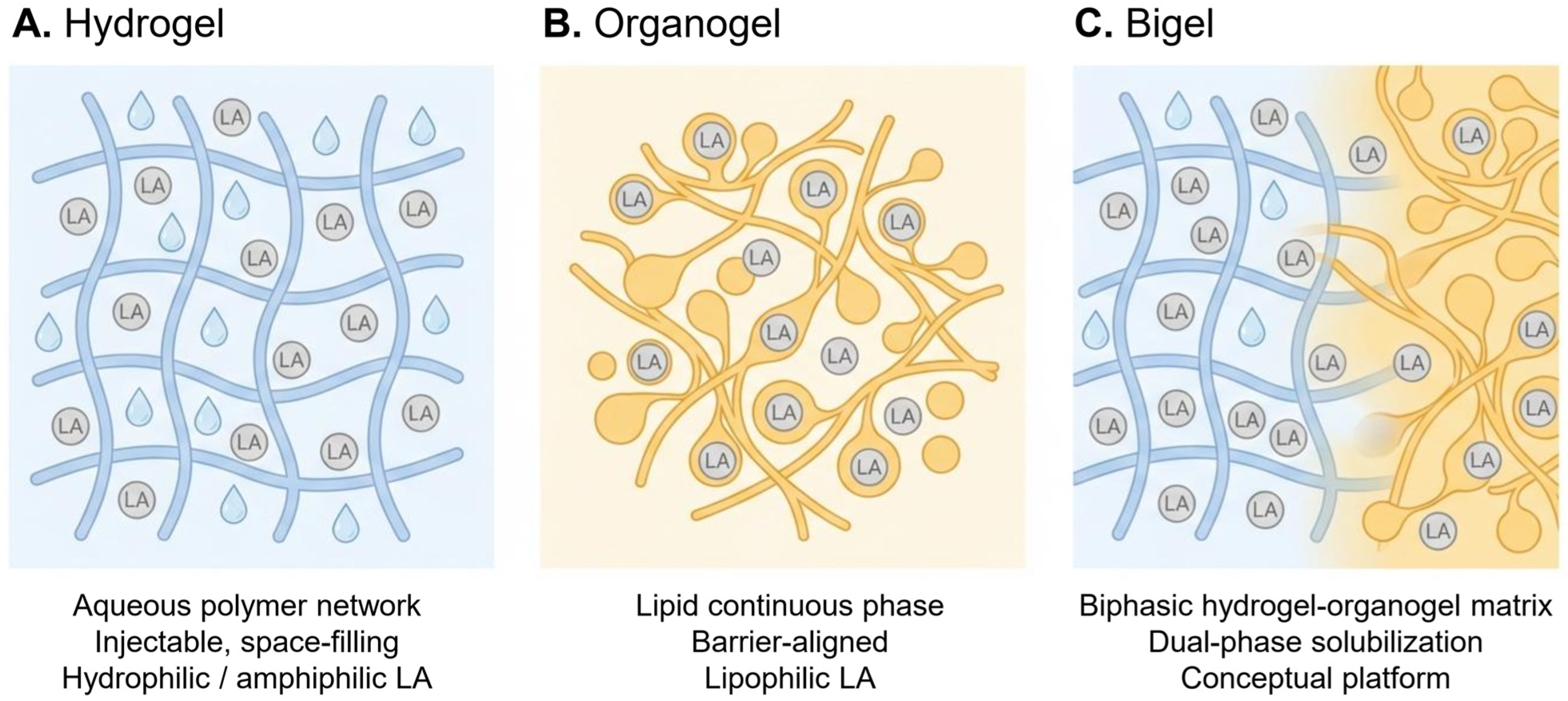
- Hydrogels feature an aqueous continuous phase supported by crosslinked or physically associated polymer networks. This structure provides hydrophilic diffusion pathways, isotropic swelling, and compatibility with hydrophilic and amphiphilic anesthetics.
- Organogels use lipid or semi-polar solvents structured by LMWGs, creating hydrophobic continuous phases with a high affinity for lipophilic LA bases and facilitating efficient barrier partitioning across lipid-rich interfaces.
- Bigels integrate both aqueous (hydrogel) and lipid (organogel) domains as interpenetrating or co-continuous phases, enabling dual solubilization and modulating the rheology and diffusion behavior of the parent organogel.
5.1.2. Axis 2: Drug-Matrix Compatibility
- Hydrogels efficiently retain ionized or amphiphilic LAs via mesh entrapment or responsive linkages.
- Organogels excel in solubilizing neutral or lipophilic LA bases, which readily partition into lipid matrices.
- Bigels offer a conceptual compromise, allowing lipophilic drug loading in lipid domains while incorporating hydrophilic excipients or buffers in aqueous regions.
5.1.3. Axis 3: Structural and Biomechanical Stability
- Hydrogels demonstrate conformability, injectability, and mechanical resilience in dynamic or hydrated planes, such as perineural, peri-incisional, intra-articular, or implant-adjacent spaces.
- Organogels maintain semi-solid cohesion on the skin or mucosa but lose stability in high-moisture or high-motion environments.
- Bigels improve upon the mechanical weaknesses of organogels through aqueous-phase reinforcement, although their deep-tissue stability remains untested.
5.2. Anatomical and Clinical Scenario Mapping
5.2.1. Skin, Dermal, and Transdermal Applications
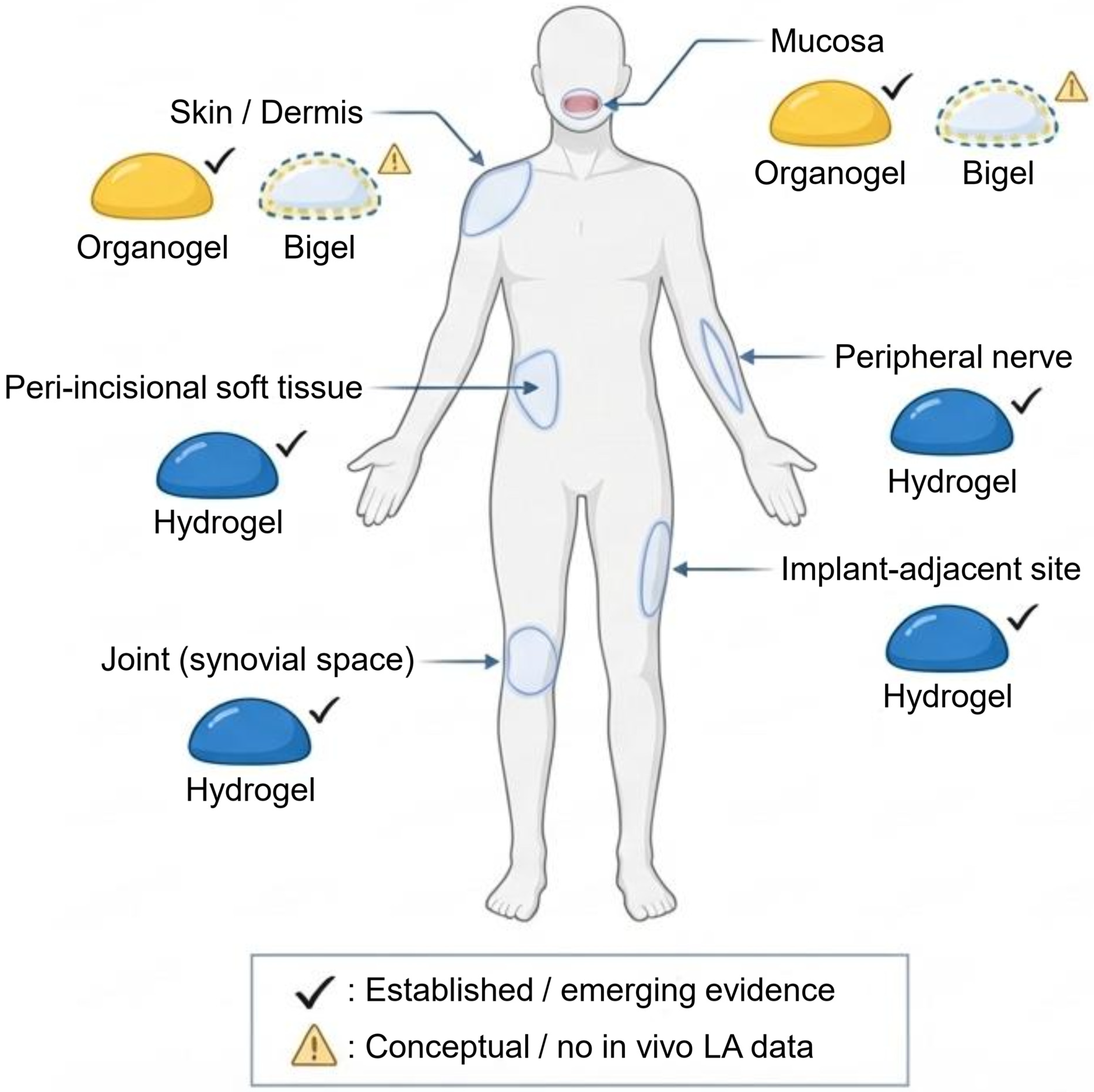
- Organogels (ideal): lipid continuity matches the stratum corneum, enabling high partitioning of lipophilic LAs and superior spreadability for outpatient dermatologic procedures and minor interventions.
- Hydrogels (useful): hydrogel plasters, patches, and dressings provide reliable surface-level anesthesia or analgesia, especially for chronic neuropathic or wound-related pain.
- Bigels (conceptual): potentially beneficial for dermal delivery when improved rheology or dual-phase release is desired.
5.2.2. Mucosal and Cavity-Accessible Environments
- Organogels perform well under moderate hydration and adhere effectively to the mucosa, facilitating needle-free analgesia.
- Hydrogels also function reliably in moist mucosal settings when formulated as thermogels or mucoadhesive networks.
- Bigels may offer hybrid advantages, although mucosal performance remains speculative.
5.2.3. Confined Soft-Tissue Planes (Oral, Dental, ENT, Buccal, Palatal)
- Hydrogels: excellent owing to their conformability and ability to localize after injection or thermogelation.
- Organogels: limited by hydration-induced destabilization.
- Bigels: conceptually attractive but unvalidated.
5.2.4. Regional, Perineural, Peri-Incisional, or Deep Soft-Tissue Delivery
- Hydrogels dominate owing to their predictable injectability, retention, and resistance to motion and edema.
- Organogels are not suitable.
- Bigels lack any evidence of anatomical persistence or safety in deep tissues.
5.2.5. Intra-Articular and Synovial Spaces
- Hydrogels are uniquely compatible with synovial turnover and biomechanical properties of joints.
- Organogels and bigels are not viable because of washout and phase instability.
5.2.6. Implant-Adjacent or Surgical-Device Interfaces
- Hydrogels have demonstrated controlled release and tunable degradation in this domain.
- Organogels and bigels lack supporting data.
5.3. Translational Landscape and Regulatory Gradient
5.3.1. Hydrogels—Most Advanced and Closest to Broad Clinical Use
- Approved products exist for dermatologic, mucosal, and wound care anesthesia.
- Investigational deep-tissue depots (perineural, intra-articular, and peri-incisional) show promising feasibility and early analgesic benefits.
- Regulatory needs include standardized pharmacokinetic endpoints, harmonized in vitro–in vivo correlations, and multicenter procedural trials.
5.3.2. Organogels—Mechanistically Appropriate but Translationally Immature
- Compounding dominates clinical use, and no regulatory-approved LA organogel depots exist.
- Heterogeneous compositions (gelator purity, hydration, and solvent ratios) compromise reproducibility and batchwise pharmacokinetics.
- Clinical evidence is limited to small dermal/mucosal or chronic neuropathic pain studies, and procedural and interventional settings remain unexplored.
5.3.3. Bigels—Concept-Stage, No Validated Pharmacology
- No in vivo analgesic data or validated pharmacokinetic profiles exist for bigels used for LA delivery.
- Phase stabilization, interpenetrating network reproducibility, and sterilization feasibility remain unresolved.
5.4. Practical Design and Selection Framework
5.4.1. Tissue Mechanics and Depot Persistence
- Dynamic or hydrated environments (perineural, peri-incisional, intra-articular):
- Barrier-dense, superficial environments (skin, mucosa):
- Confined soft tissues:
- High moisture or irrigation (surgical fields):
5.4.2. Drug Physicochemistry
- Lipophilic LAs in base form → Organogel or Bigel concept
- Ionized or amphiphilic LAs → Hydrogel
- High-dose extended analgesia with predictable pharmacokinetics → Hydrogel
- Need for multiphasic or combination-agent delivery → Hydrogel or Bigel prototypes
5.4.3. Workflow and Clinical Operations
- Ambulatory, needle-free settings → Organogel
- Operating room, peri-incisional infiltration, deep blocks → Hydrogel
- Implant-adjacent → Hydrogel
- Outpatient dermatologic procedures → Organogel or Bigel concept
5.4.4. Regulatory Feasibility and Development Pathway
- Near-term clinical translation → Hydrogel
- Early-phase formulation research → Organogel or Bigel
- High reproducibility/batch control required → Hydrogel only
- Novel dual-release or multi-agent systems → Bigel concept or multifunctional hydrogels
6. Conclusions
Author Contributions
Funding
Institutional Review Board Statement
Informed Consent Statement
Data Availability Statement
Conflicts of Interest
Abbreviations
| LA | Local anesthetic |
| ROS | Reactive oxygen species |
| LMWG | Low-molecular-weight gelator |
| PNDJ | Poly(ethylene glycol)-poly(N-isopropylacrylamide)-poly(ethylene glycol) |
| HA | Hyaluronic acid |
| MMP | Matrix metalloproteinase |
| NSAID | Non-steroidal anti-inflammatory drug |
| PLO | Pluronic–lecithin organogel |
References
- Schwenk, E.S.; Mariano, E.R. Designing the ideal perioperative pain management plan starts with multimodal analgesia. Korean J. Anesthesiol. 2018, 71, 345–352. [Google Scholar] [CrossRef]
- Chen, Y.Y.K.; Boden, K.A.; Schreiber, K.L. The role of regional anaesthesia and multimodal analgesia in the prevention of chronic postoperative pain: A narrative review. Anaesthesia 2021, 76, 8–17. [Google Scholar] [CrossRef]
- Taylor, A.; McLeod, G. Basic pharmacology of local anaesthetics. BJA Educ. 2020, 20, 34–41. [Google Scholar] [CrossRef] [PubMed]
- Paladini, G.; Di Carlo, S.; Musella, G.; Petrucci, E.; Scimia, P.; Ambrosoli, A.; Cofini, V.; Fusco, P. Continuous Wound Infiltration of Local Anesthetics in Postoperative Pain Management: Safety, Efficacy and Current Perspectives. J. Pain Res. 2020, 13, 285–294. [Google Scholar] [CrossRef]
- Kianian, S.; Bansal, J.; Lee, C.; Zhang, K.; Bergese, S.D. Perioperative multimodal analgesia: A review of efficacy and safety of the treatment options. Anesthesiol. Perioper. Sci. 2024, 2, 9. [Google Scholar] [CrossRef]
- Di Franco, S.; Alfieri, A.; Sansone, P.; Pota, V.; Coppolino, F.; Frangiosa, A.; Maffei, V.; Pace, M.C.; Passavanti, M.B.; Fiore, M. Hydrogel-Based Formulations to Deliver Analgesic Drugs: A Scoping Review of Applications and Efficacy. Biomedicines 2025, 13, 2465. [Google Scholar] [CrossRef] [PubMed]
- Lin, S.-H.; Hsu, S.-H. Smart hydrogels for in situ tissue drug delivery. J. Biomed. Sci. 2025, 32, 70. [Google Scholar] [CrossRef]
- Thang, N.H.; Chien, T.B.; Cuong, D.X. Polymer-Based Hydrogels Applied in Drug Delivery: An Overview. Gels 2023, 9, 523. [Google Scholar] [CrossRef]
- Ho, T.C.; Chang, C.C.; Chan, H.P.; Chung, T.W.; Shu, C.W.; Chuang, K.P.; Duh, T.H.; Yang, M.H.; Tyan, Y.C. Hydrogels: Properties and Applications in Biomedicine. Molecules 2022, 27, 2902. [Google Scholar] [CrossRef]
- Raut, S.; Azheruddin, M.; Kumar, R.; Singh, S.; Giram, P.S.; Datta, D. Lecithin Organogel: A Promising Carrier for the Treatment of Skin Diseases. ACS Omega 2024, 9, 9865–9885. [Google Scholar] [CrossRef]
- Hu, B.; Yan, H.; Sun, Y.; Chen, X.; Sun, Y.; Li, S.; Jing, Y.; Li, H. Organogels based on amino acid derivatives and their optimization for drug release using response surface methodology. Artif. Cells Nanomed. Biotechnol. 2020, 48, 266–275. [Google Scholar] [CrossRef]
- Martín-Illana, A.; Notario-Pérez, F.; Cazorla-Luna, R.; Ruiz-Caro, R.; Bonferoni, M.C.; Tamayo, A.; Veiga, M.D. Bigels as drug delivery systems: From their components to their applications. Drug Discov. Today 2022, 27, 1008–1026. [Google Scholar] [CrossRef]
- Shakouri, S.; Tehrani, M.M.; Koocheki, A.; Farhoosh, R.; Abdolshahi, A.; Shariatifar, N. Bigels as Novel Drug Delivery Systems: A Systematic Review on Efficiency and Influential Factors. Curr. Rev. Clin. Exp. Pharmacol. 2025, 20, 231–242. [Google Scholar] [CrossRef] [PubMed]
- Segneanu, A.-E.; Bejenaru, L.E.; Bejenaru, C.; Blendea, A.; Mogoşanu, G.D.; Biţă, A.; Boia, E.R. Advancements in Hydrogels: A Comprehensive Review of Natural and Synthetic Innovations for Biomedical Applications. Polymers 2025, 17, 2026. [Google Scholar] [CrossRef]
- Li, J.; Mooney, D.J. Designing hydrogels for controlled drug delivery. Nat. Rev. Mater. 2016, 1, 16071. [Google Scholar] [CrossRef] [PubMed]
- Chen, H.; Xu, J.; Sun, J.; Jiang, Y.; Zheng, W.; Hu, W.; Qian, H. Recent advances on thermosensitive hydrogels-mediated precision therapy. Asian J. Pharm. Sci. 2024, 19, 100911. [Google Scholar] [CrossRef]
- Protsak, I.S.; Morozov, Y.M. Fundamentals and Advances in Stimuli-Responsive Hydrogels and Their Applications: A Review. Gels 2025, 11, 30. [Google Scholar] [CrossRef] [PubMed]
- Vigata, M.; Meinert, C.; Hutmacher, D.W.; Bock, N. Hydrogels as Drug Delivery Systems: A Review of Current Characterization and Evaluation Techniques. Pharmaceutics 2020, 12, 1188. [Google Scholar] [CrossRef]
- Raina, N.; Pahwa, R.; Bhattacharya, J.; Paul, A.K.; Nissapatorn, V.; de Lourdes Pereira, M.; Oliveira, S.M.R.; Dolma, K.G.; Rahmatullah, M.; Wilairatana, P.; et al. Drug Delivery Strategies and Biomedical Significance of Hydrogels: Translational Considerations. Pharmaceutics 2022, 14, 574. [Google Scholar] [CrossRef]
- Liu, B.; Chen, K. Advances in Hydrogel-Based Drug Delivery Systems. Gels 2024, 10, 262. [Google Scholar] [CrossRef]
- Khan, B.; Arbab, A.; Khan, S.; Fatima, H.; Bibi, I.; Chowdhry, N.P.; Ansari, A.Q.; Ursani, A.A.; Kumar, S.; Hussain, J.; et al. Recent progress in thermosensitive hydrogels and their applications in drug delivery area. MedComm Biomater. Appl. 2023, 2, e55. [Google Scholar] [CrossRef]
- Sepulveda, A.F.; Kumpgdee-Vollrath, M.; Franco, M.; Yokaichiya, F.; de Araujo, D.R. Supramolecular structure organization and rheological properties modulate the performance of hyaluronic acid-loaded thermosensitive hydrogels as drug-delivery systems. J. Colloid Interface Sci. 2023, 630, 328–340. [Google Scholar] [CrossRef]
- Zhao, M.; Zhu, S.; Zhang, D.; Zhou, C.; Yang, Z.; Wang, C.; Liu, X.; Zhang, J. Long-lasting postoperative analgesia with local anesthetic-loaded hydrogels prevent tumor recurrence via enhancing CD8+T cell infiltration. J. Nanobiotechnol. 2023, 21, 50. [Google Scholar] [CrossRef]
- Jalani, G.; Rosenzweig, D.H.; Makhoul, G.; Abdalla, S.; Cecere, R.; Vetrone, F.; Haglund, L.; Cerruti, M. Tough, in-situ thermogelling, injectable hydrogels for biomedical applications. Macromol. Biosci. 2015, 15, 473–480. [Google Scholar] [CrossRef] [PubMed]
- Brambilla, E.; Locarno, S.; Gallo, S.; Orsini, F.; Pini, C.; Farronato, M.; Thomaz, D.V.; Lenardi, C.; Piazzoni, M.; Tartaglia, G. Poloxamer-Based Hydrogel as Drug Delivery System: How Polymeric Excipients Influence the Chemical-Physical Properties. Polymers 2022, 14, 3624. [Google Scholar] [CrossRef] [PubMed]
- Xu, X.; Liu, Y.; Fu, W.; Yao, M.; Ding, Z.; Xuan, J.; Li, D.; Wang, S.; Xia, Y.; Cao, M. Poly(N-isopropylacrylamide)-Based Thermoresponsive Composite Hydrogels for Biomedical Applications. Polymers 2020, 12, 580. [Google Scholar] [CrossRef]
- Overstreet, D.J.; Badha, V.S.; Heffernan, J.M.; Childers, E.P.; Moore, R.C.; Vernon, B.L.; McLaren, A.C. Temperature-responsive PNDJ hydrogels provide high and sustained antimicrobial concentrations in surgical sites. Drug Deliv. Transl. Res. 2019, 9, 802–815. [Google Scholar] [CrossRef]
- Xin, H. Double-Network Tough Hydrogels: A Brief Review on Achievements and Challenges. Gels 2022, 8, 247. [Google Scholar] [CrossRef] [PubMed]
- Dimatteo, R.; Darling, N.J.; Segura, T. In situ forming injectable hydrogels for drug delivery and wound repair. Adv. Drug Deliv. Rev. 2018, 127, 167–184. [Google Scholar] [CrossRef]
- Yang, J.; Zhao, Q.; Lu, B.; Lv, Y.; Jiang, W.; Chen, X.; Zhang, S.; Zhao, W.; Jiang, L.; Zhang, J. Injectable thermosensitive hydrogel based on hyaluronic acid and poloxamer for sustained bupivacaine release and prolonged analgesia. Int. J. Biol. Macrocol. 2025, 309, 142845. [Google Scholar] [CrossRef]
- Steverink, J.G.; van Tol, F.R.; Oosterman, B.J.; Vermonden, T.; Verlaan, J.J.; Malda, J.; Piluso, S. Robust gelatin hydrogels for local sustained release of bupivacaine following spinal surgery. Acta Biomater. 2022, 146, 145–158. [Google Scholar] [CrossRef] [PubMed]
- Salehi, S.; Naghib, S.M.; Garshasbi, H.R.; Ghorbanzadeh, S.; Zhang, W. Smart stimuli-responsive injectable gels and hydrogels for drug delivery and tissue engineering applications: A review. Front. Bioeng. Biotechnol. 2023, 11, 4126. [Google Scholar] [CrossRef] [PubMed]
- Gao, K.; Xu, K. Advancements and Prospects of pH-Responsive Hydrogels in Biomedicine. Gels 2025, 11, 293. [Google Scholar] [CrossRef] [PubMed]
- Liu, J.; Jia, B.; Li, Z.; Li, W. Reactive oxygen species-responsive polymer drug delivery systems. Front. Bioeng. Biotechnol. 2023, 11, 1115603. [Google Scholar] [CrossRef]
- Sobczak, M. Enzyme-Responsive Hydrogels as Potential Drug Delivery Systems—State of Knowledge and Future Prospects. Int. J. Mol. Sci. 2022, 23, 4421. [Google Scholar] [CrossRef]
- Geng, W.; Zhao, J.; Tao, B.; Yang, Y.; Duan, Q.; Gao, P.; He, T.; Liu, S.; Feng, Q.; Zhao, P.; et al. Regulation of rheumatoid arthritis microenvironment via a self-healing injectable hydrogel for improved inflammation elimination and bone repair. Bioact. Mater. 2024, 36, 287–300. [Google Scholar] [CrossRef]
- Zhang, W.; Ji, T.; Li, Y.; Zheng, Y.; Mehta, M.; Zhao, C.; Liu, A.; Kohane, D.S. Light-triggered release of conventional local anesthetics from a macromolecular prodrug for on-demand local anesthesia. Nat. Commun. 2020, 11, 2323. [Google Scholar] [CrossRef]
- Omidian, H.; Akhzarmehr, A.; Dey Chowdhury, S. Hydrogel Composites for Multifunctional Biomedical Applications. J. Compos. Sci. 2024, 8, 154. [Google Scholar] [CrossRef]
- He, J.; Chen, J.; Liu, T.; Qin, F.; Wei, W. Research Progress of Multifunctional Hydrogels in Promoting Wound Healing of Diabetes. Int. J. Nanomed. 2025, 20, 7549–7578. [Google Scholar] [CrossRef]
- Ding, Y.; Liu, G.; Liu, S.; Li, X.; Xu, K.; Liu, P.; Cai, K. A Multifunction Hydrogel-Coating Engineered Implant for Rescuing Biofilm Infection and Boosting Osseointegration by Macrophage-Related Immunomodulation. Adv. Healthc. Mater. 2023, 12, e2300722. [Google Scholar] [CrossRef]
- He, Y.; Qin, L.; Huang, Y.; Ma, C. Advances of Nano-Structured Extended-Release Local Anesthetics. Nanoscale Res. Lett. 2020, 15, 13. [Google Scholar] [CrossRef]
- Davodabadi, F.; Sargazi, S.; Baino, F. Recent advances in hydrogel-based drug delivery systems for enhanced cancer therapy: A review. Mater. Today Commun. 2025, 48, 113615. [Google Scholar] [CrossRef]
- Alkahtani, M.E.; Elbadawi, M.; Chapman, C.A.R.; Green, R.A.; Gaisford, S.; Orlu, M.; Basit, A.W. Electroactive Polymers for On-Demand Drug Release. Adv. Healthc. Mater. 2024, 13, e2301759. [Google Scholar] [CrossRef] [PubMed]
- Du, Y.; Du, W.; Lin, D.; Ai, M.; Li, S.; Zhang, L. Recent Progress on Hydrogel-Based Piezoelectric Devices for Biomedical Applications. Micromachines 2023, 14, 167. [Google Scholar] [CrossRef]
- Briggs, F.; Browne, D.; Asuri, P. Role of Polymer Concentration and Crosslinking Density on Release Rates of Small Molecule Drugs. Int. J. Mol. Sci. 2022, 23, 4118. [Google Scholar] [CrossRef]
- Wang, X.; Tang, Y.; Jin, Z.; Li, Q. Molecularly Engineered Controlled Release Systems for Local Anesthetics in Precise Pain Management. Adv. Funct. Mater. 2025, e20727. [Google Scholar] [CrossRef]
- Getachew, M.; Tesfaye, H.; Yihunie, W.; Ayenew, T.; Alemu, S.; Dagnew, E.M.; Biyazin, Y.; Abebe, D.; Degefu, N.; Abebaw, A. Sustained release local anesthetics for pain management: Relevance and formulation approaches. Front. Pain Res. 2024, 5, 1383461. [Google Scholar] [CrossRef]
- Kim, J.; Kim, D.; Shin, D.; Sung, T.; Rhee, S.; Kim, M.; Nam, C.; Lee, I.; Son, W.G. Effect of temperature-responsive hydrogel on femoral and sciatic nerve blocks using bupivacaine in Beagle dogs. Vet. Med. Sci. 2023, 9, 91–97. [Google Scholar] [CrossRef] [PubMed]
- Li, Y.; Chen, Y.; Xue, Y.; Jin, J.; Xu, Y.; Zeng, W.; Liu, J.; Xie, J. Injectable Hydrogel Delivery System with High Drug Loading for Prolonging Local Anesthesia. Adv. Sci. 2024, 11, 9482. [Google Scholar] [CrossRef]
- Zhang, Q.; Liu, X.; Liu, H.; Li, S.; An, Z.; Feng, Z. Construction of bupivacaine-loaded gelatin-based hydrogel delivery system for sciatic nerve block in mice. J. Biomed. Mater. Res. A 2024, 112, 1975–1984. [Google Scholar] [CrossRef]
- Mamun, A.A.; Shao, C.; Geng, P.; Wang, S.; Xiao, J. Recent advances in molecular mechanisms of skin wound healing and its treatments. Front. Immunol. 2024, 15, 5479. [Google Scholar] [CrossRef]
- Fu, X.; Zeng, H.; Guo, J.; Liu, H.; Shi, Z.; Chen, H.; Li, D.; Xie, X.; Kuang, C. A PLGA–PEG–PLGA Thermosensitive Gel Enabling Sustained Delivery of Ropivacaine Hydrochloride for Postoperative Pain Relief. Chem. Pharm. Bull. 2017, 65, 229–235. [Google Scholar] [CrossRef]
- Heffernan, J.M.; McLaren, A.C.; Glass, C.M.; Overstreet, D.J. Extended Release of Bupivacaine from Temperature-Responsive Hydrogels Provides Multi-Day Analgesia for Postoperative Pain. Pain Med. 2023, 24, 113–121. [Google Scholar] [CrossRef]
- Zhang, A.; Chen, X.; Hussain, S.A.; Mayudh Alrubie, T.; Maddu, N.; Zhang, Q. Anesthetic wound dressing loaded with propolis and bupivacaine for managing post-operative pain and wound healing. J. Bioact. Compat. Polym. 2025, 40, 229–247. [Google Scholar] [CrossRef]
- Supachawaroj, N.; Kerdmanee, K.; Limsitthichaikoon, S. Lidocaine-Loaded Thermoresponsive Gel for Accelerated Wound Healing in Dry Socket and Oral Wounds. Gels 2024, 10, 739. [Google Scholar] [CrossRef] [PubMed]
- Song, M.-H.; Yan, Y.; Chen, B.; Gong, L.; Chen, L.; Feng, J.; Han, M.; Liu, C.; Xiao, C.; Jin, M.; et al. Advances in Intra-Articular Injection Hydrogel Drug Delivery Systems in the Treatment of Rheumatoid Arthritis. Pharmaceutics 2025, 17, 1118. [Google Scholar] [CrossRef]
- Kim, T.; Seol, D.R.; Hahm, S.C.; Ko, C.; Kim, E.H.; Chun, K.; Kim, J.; Lim, T.H. Analgesic Effect of Intra-Articular Injection of Temperature-Responsive Hydrogel Containing Bupivacaine on Osteoarthritic Pain in Rats. BioMed Res. Int. 2015, 2015, 812949. [Google Scholar] [CrossRef]
- Wójcik-Pastuszka, D.; Frąk, A.; Musiał, W. Influence of the Acceptor Fluid on the Bupivacaine Release from the Prospective Intra-Articular Methylcellulose Hydrogel. Pharmaceutics 2024, 16, 867. [Google Scholar] [CrossRef]
- Sayedipour, S.S.; Schomann, T.; Van De Looij, S.M.; Rezaie, S.; Ramos, Y.F.M.; Vermonden, T.; Van Der Weerd, L.; Meulenbelt, I.; Cruz, L.J. Poloxamer-based thermosensitive injectable hydrogels containing a self-assembling peptide for In situ gelation. Comput. Struct. Biotechnol. J. 2025, 29, 248–257. [Google Scholar] [CrossRef] [PubMed]
- Overstreet, D.J.; Zdrale, G.; McLaren, A.C. Extended Release of Bupivacaine from Temperature-Responsive PNDJ Hydrogels Improves Postoperative Weight-Bearing in Rabbits Following Knee Surgery. Pharmaceuticals 2024, 17, 879. [Google Scholar] [CrossRef] [PubMed]
- Correa, S.; Grosskopf, A.K.; Lopez Hernandez, H.; Chan, D.; Yu, A.C.; Stapleton, L.M.; Appel, E.A. Translational Applications of Hydrogels. Chem. Rev. 2021, 121, 11385–11457. [Google Scholar] [CrossRef]
- Karami, P.; Stampoultzis, T.; Guo, Y.; Pioletti, D.P. A guide to preclinical evaluation of hydrogel-based devices for treatment of cartilage lesions. Acta Biomater. 2023, 158, 12–31. [Google Scholar] [CrossRef]
- Navez, M.L.; Monella, C.; Bösl, I.; Sommer, D.; Delorme, C. 5% Lidocaine Medicated Plaster for the Treatment of Postherpetic Neuralgia: A Review of the Clinical Safety and Tolerability. Pain Ther. 2015, 4, 1–15. [Google Scholar] [CrossRef]
- Campbell, B.J.; Rowbotham, M.; Davies, P.S.; Jacob, P., III; Benowitz, N.L. Systemic absorption of topical lidocaine in normal volunteers, patients with post-herpetic neuralgia, and patients with acute herpes zoster. J. Pharm. Sci. 2002, 91, 1343–1350. [Google Scholar] [CrossRef]
- Baron, R.; Allegri, M.; Correa-Illanes, G.; Hans, G.; Serpell, M.; Mick, G.; Mayoral, V. The 5% Lidocaine-Medicated Plaster: Its Inclusion in International Treatment Guidelines for Treating Localized Neuropathic Pain, and Clinical Evidence Supporting its Use. Pain Ther. 2016, 5, 149–169. [Google Scholar] [CrossRef] [PubMed]
- Gammaitoni, A.R.; Alvarez, N.A.; Galer, B.S. Pharmacokinetics and safety of continuously applied lidocaine patches 5%. Am. J. Health Syst. Pharm. 2002, 59, 2215–2220. [Google Scholar] [CrossRef] [PubMed]
- Agrawal, V.; Wilson, K.; Reyna, R.; Emran, M.A. Feasibility of 4% Topical Lidocaine for Pain Management During Negative Pressure Wound Therapy Dressing Changes in Pediatric Patients: A Case Study. J. Wound Ostomy Cont. Nurs. 2015, 42, 640–642. [Google Scholar] [CrossRef]
- Treadwell, T.; Walker, D.; Nicholson, B.; Taylor, M.; Alur, H. Treatment Of Pain In Wounds With A Topical Long Acting Lidocaine Gel. Chronic Wound Care Manag. Res. 2019, 6, 117–121. [Google Scholar] [CrossRef]
- Clegg, J.R.; Adebowale, K.; Zhao, Z.; Mitragotri, S. Hydrogels in the clinic: An update. Bioeng. Transl. Med. 2024, 9, 10680. [Google Scholar] [CrossRef]
- Chatelain, R. The Efficacy of a Novel Silver-Containing Bioresorbable Microfilm Matrix in At-Risk Surgical Wounds: A Clinical Case Series. Wounds 2021, 33, 245–252. [Google Scholar] [CrossRef]
- Donaldson, D.; Gelskey, S.C.; Landry, R.G.; Matthews, D.C.; Sandhu, H.S. A placebo-controlled multi-centred evaluation of an anaesthetic gel (Oraqix) for periodontal therapy. J. Clin. Periodontol. 2003, 30, 171–175. [Google Scholar] [CrossRef]
- Shehab, L.A.; Basheer, B.; Baroudi, K. Effectiveness of lidocaine Denti patch® system versus lidocaine gel as topical anesthetic agent in children. J. Indian Soc. Pedod. Prev. Dent. 2015, 33, 285–290. [Google Scholar] [CrossRef]
- Choi, B.-M.; Hwang, C.-S.; Yoon, Y.S.; Park, I.J.; Yoo, M.-W.; Kim, B.S. Novel temperature-responsive hydrogel injected to the incision site for postoperative pain relief in laparoscopic abdominal surgery: A single-blind, randomized, pivotal clinical trial. Surg. Endosc. 2022, 36, 5794–5802. [Google Scholar] [CrossRef]
- Cho, J.; Kim, K.H.; Lee, W.; Go, J.Y.; Kim, S.H. Effectiveness of a Novel Temperature-Responsive Hydrogel (PF72) for Postoperative Pain Relief in Breast Augmentation. J. Clin. Med. 2023, 13, 110. [Google Scholar] [CrossRef]
- Yun, C.W.; Kim, K.H.; Lee, W.; Kim, S.H. Comparative Analysis of Temperature-Responsive Hydrogel (PF 72) for Postoperative Pain After Bimaxillary Surgery: A Retro-spective Study. Aesthet. Plast. Surg. 2024, 48, 1271–1275. [Google Scholar] [CrossRef]
- Yoo, M.; Hwang, D.-Y.; Min, G.H.; Lee, H.; Kang, S.H.; Ahn, S.-H.; Suh, Y.-S.; Park, Y.S. A prospective randomized trial comparing the efficacy of temperature-responsive gel with local anesthetics versus local anesthetic infusion pump device for postoperative pain control after bariatric surgery. Ann. Surg. Treat. Res. 2024, 107, 229. [Google Scholar] [CrossRef]
- Jeon, J.H.; Seong, Y.W.; Han, J.E.; Cho, S.; Kim, J.H.; Jheon, S.; Kim, K. Randomized Trial of Poloxamer 407-Based Ropivacaine Hydrogel After Thoracoscopic Pulmonary Resection. Ann. Thorac. Surg. 2022, 114, 1189–1196. [Google Scholar] [CrossRef]
- Shin, J.K.; Jeong, H.; Lee, W.Y.; Yun, S.H.; Cho, Y.B.; Huh, J.W.; Park, Y.A.; Sim, W.S.; Kim, H.C. Efficacy of a local anesthetic gel infusion kit for pain relief after minimally invasive colorectal surgery: An open-label, randomized clinical trial. Sci. Rep. 2022, 12, 17429. [Google Scholar] [CrossRef] [PubMed]
- Deng, Y.; Wang, B.; Jiang, H.; Luan, W.; Pan, B.; Li, C. Sodium Carboxymethylcellulose Serves as Sustained-Release Agents for Providing Analgesia at the Donor Site After Costal Cartilage Harvesting in Ear Reconstruction. Aesthet. Plast. Surg. 2025, 49, 2350–2356. [Google Scholar] [CrossRef] [PubMed]
- Han, X.; Yang, Y.; Ren, T.; Ji, N.; Luo, F. Efficacy of Preemptive Topical Lidocaine 5% Plaster in the Prevention of Post-Craniotomy Pain, a Randomized Clinical Trial. J. Pain Res. 2024, 17, 4251–4261. [Google Scholar] [CrossRef] [PubMed]
- Gudin, J.; Webster, L.R.; Greuber, E.; Vought, K.; Patel, K.; Kuritzky, L. Open-Label Adhesion Performance Studies of a New Lidocaine Topical System 1.8% versus Lidocaine Patches 5% and Lidocaine Medicated Plaster 5% in Healthy Subjects. J. Pain Res. 2021, 14, 513–526. [Google Scholar] [CrossRef] [PubMed]
- Steverink, J.G.; Bruins, S.; Van Tol, F.R.; Jonkman, H.R.; Amponsah, K.B.; Marvela, J.; Smorenburg, A.J.; Oosterman, B.J.; Piluso, S.; Verlaan, J.-J. Preclinical safety and feasibility of a bupivacaine-loaded hydrogel for pain relief after spinal surgery. Sci. Rep. 2025, 15, 32350. [Google Scholar] [CrossRef] [PubMed]
- Jonkman, H.; van Tol, F.R.; Bruins, S.; Steverink, J.G.; Benneker, L.M.; Geuze, R.; de Baat, P.; Rovers, M.; Oosterman, B.J.; Verlaan, J.J. Novel implantable anesthetic for spine fixation surgery: Phase Ib safety results of a sustained-release formulation of bupivacaine. Reg. Anesth. Pain Med. 2025; online ahead of print. [Google Scholar] [CrossRef]
- Zhang, K.; Li, M.; Yao, W.; Wan, L. Cytotoxicity of Local Anesthetics on Bone, Joint, and Muscle Tissues: A Narrative Review of the Current Literature. J. Pain Res. 2023, 16, 611–621. [Google Scholar] [CrossRef]
- Roca-Arroyo, A.F.; Gutierrez-Rivera, J.A.; Morton, L.D.; Castilla-Casadiego, D.A. Hydrogel Network Architecture Design Space: Impact on Mechanical and Viscoelastic Properties. Gels 2025, 11, 588. [Google Scholar] [CrossRef]
- Neumann, M.; di Marco, G.; Iudin, D.; Viola, M.; van Nostrum, C.F.; van Ravensteijn, B.G.P.; Vermonden, T. Stimuli-Responsive Hydrogels: The Dynamic Smart Biomaterials of Tomorrow. Macromolecules 2023, 56, 8377–8392. [Google Scholar] [CrossRef] [PubMed]
- Toews, P.M.; Velraj, A.; Bates, J.S. Stimuli-responsive hydrogels, their mass transfer, intermolecular interactions, and applications in biomedical devices. J. Mater. Sci. Mater. Eng. 2025, 20, 66. [Google Scholar] [CrossRef]
- Reis, M.E.; Bettencourt, A.; Ribeiro, H.M. The regulatory challenges of innovative customized combination products. Front. Med. 2022, 9, 821094. [Google Scholar] [CrossRef]
- Jurczak, K.M.; van der Boon, T.A.B.; Devia-Rodriguez, R.; Schuurmann, R.C.L.; Sjollema, J.; van Huizen, L.; De Vries, J.P.M.; van Rijn, P. Recent regulatory developments in EU Medical Device Regulation and their impact on biomaterials translation. Bioeng. Transl. Med. 2025, 10, e10721. [Google Scholar] [CrossRef]
- Galante, R.; Pinto, T.J.A.; Colaço, R.; Serro, A.P. Sterilization of hydrogels for biomedical applications: A review. J. Biomed. Mater. Res. B Appl. Biomater. 2018, 106, 2472–2492. [Google Scholar] [CrossRef]
- Bernhardt, A.; Wehrl, M.; Paul, B.; Hochmuth, T.; Schumacher, M.; Schütz, K.; Gelinsky, M. Improved Sterilization of Sensitive Biomaterials with Supercritical Carbon Dioxide at Low Temperature. PLoS ONE 2015, 10, e0129205. [Google Scholar] [CrossRef]
- Karthik, C.; Sarngadharan, S.C.; Thomas, V. Low-Temperature Plasma Techniques in Biomedical Applications and Therapeutics: An Overview. Int. J. Mol. Sci. 2023, 25, 524. [Google Scholar] [CrossRef]
- Lu, P.; Ruan, D.; Huang, M.; Tian, M.; Zhu, K.; Gan, Z.; Xiao, Z. Harnessing the potential of hydrogels for advanced therapeutic applications: Current achievements and future directions. Signal Transduct. Target. Ther. 2024, 9, 166. [Google Scholar] [CrossRef]
- Lee, Y.; Kim, M.; Kim, N.; Byun, S.; Seo, S.; Han, J.Y. Injectable Hydrogel Systems for Targeted Drug Delivery: From Site-Specific Application to Design Strategy. Appl. Sci. 2025, 15, 1599. [Google Scholar] [CrossRef]
- Guo, A.; Cao, Q.; Fang, H.; Tian, H. Recent advances and challenges of injectable hydrogels in drug delivery. J. Control Release 2025, 385, 114021. [Google Scholar] [CrossRef]
- Bliggenstorfer, J.; Steinhagen, E. Regional anesthesia: Epidurals, TAP blocks, or wound infiltration? Semin. Colon Rectal Surg. 2021, 32, 100831. [Google Scholar] [CrossRef]
- Mishra, P.K.; Mani, S.; Singh, R.B. Evaluating the Efficacy of Pre-incisional Infiltration and Intraperitoneal Instillation of a Local Anesthetic Agent on Postoperative Analgesia and Hemodynamics in Patients Undergoing Laparoscopic Cholecystectomy Under General Anesthesia. Cureus 2022, 14, e22977. [Google Scholar] [CrossRef] [PubMed]
- Singhal, A.; Taksande, K. Continuous Catheter Techniques Versus Single-Injection Nerve Blocks: A Comprehensive Review of Postoperative Pain Management Strategies. Cureus 2024, 16, e70040. [Google Scholar] [CrossRef]
- Dong, Y.C.; Bouché, M.; Uman, S.; Burdick, J.A.; Cormode, D.P. Detecting and Monitoring Hydrogels with Medical Imaging. ACS Biomater. Sci. Eng. 2021, 7, 4027–4047. [Google Scholar] [CrossRef] [PubMed]
- Bojic, S.; Ladjevic, N.; Palibrk, I.; Soldatovic, I.; Likic-Ladjevic, I.; Meissner, W.; Zaslansky, R.; Stamer, U.M.; Baumbach, P.; Stamenkovic, D. Cost-effectiveness of the Perioperative Pain Management Bundle a registry-based study. Front. Public Health 2023, 11, 1157484. [Google Scholar] [CrossRef] [PubMed]
- Arkenberg, M.R.; Nguyen, H.D.; Lin, C.C. Recent advances in bio-orthogonal and dynamic crosslinking of biomimetic hydrogels. J. Mater. Chem. B 2020, 8, 7835–7855. [Google Scholar] [CrossRef]
- Guo, J.L.; Kim, Y.S.; Xie, V.Y.; Smith, B.T.; Watson, E.; Lam, J.; Pearce, H.A.; Engel, P.S.; Mikos, A.G. Modular, tissue-specific, and biodegradable hydrogel cross-linkers for tissue engineering. Sci. Adv. 2019, 5, eaaw7396. [Google Scholar] [CrossRef] [PubMed]
- Yoon, M.S.; Lee, J.M.; Jo, M.J.; Kang, S.J.; Yoo, M.K.; Park, S.Y.; Bong, S.; Park, C.S.; Park, C.W.; Kim, J.S.; et al. Dual-Drug Delivery Systems Using Hydrogel-Nanoparticle Composites: Recent Advances and Key Applications. Gels 2025, 11, 520. [Google Scholar] [CrossRef]
- Binaymotlagh, R.; Hajareh Haghighi, F.; Chronopoulou, L.; Palocci, C. Liposome-Hydrogel Composites for Controlled Drug Delivery Applications. Gels 2024, 10, 284. [Google Scholar] [CrossRef] [PubMed]
- Zhang, W.; Xu, W.; Ning, C.; Li, M.; Zhao, G.; Jiang, W.; Ding, J.; Chen, X. Long-acting hydrogel/microsphere composite sequentially releases dexmedetomidine and bupivacaine for prolonged synergistic analgesia. Biomaterials 2018, 181, 378–391. [Google Scholar] [CrossRef] [PubMed]
- Cadamuro, F.; Piazzoni, M.; Gamba, E.; Sonzogni, B.; Previdi, F.; Nicotra, F.; Ferramosca, A.; Russo, L. Artificial Intelligence tool for prediction of ECM mimics hydrogel formulations via click chemistry. Biomater. Adv. 2025, 175, 214323. [Google Scholar] [CrossRef]
- Huang, X.; Wong, Y.X.; Goh, G.L.; Gao, X.; Lee, J.M.; Yeong, W.Y. Machine learning-driven prediction of gel fraction in conductive gelatin methacryloyl hydrogels. Int. J. AI Mater. Des. 2024, 1, 61–75. [Google Scholar] [CrossRef]
- Wang, Y.; Wallmersperger, T.; Ehrenhofer, A. Prediction of hydrogel swelling states using machine learning methods. Eng. Rep. 2024, 6, e12893. [Google Scholar] [CrossRef]
- Venkatesh, K.P.; Brito, G.; Kamel Boulos, M.N. Health Digital Twins in Life Science and Health Care Innovation. Annu. Rev. Pharmacol. Toxicol. 2024, 64, 159–170. [Google Scholar] [CrossRef]
- Yu, H.; Gao, R.; Liu, Y.; Fu, L.; Zhou, J.; Li, L. Stimulus-Responsive Hydrogels as Drug Delivery Systems for Inflammation Targeted Therapy. Adv. Sci. 2024, 11, 6152. [Google Scholar] [CrossRef]
- Martin, B.; Brouillet, F.; Franceschi, S.; Perez, E. Evaluation of Organogel Nanoparticles as Drug Delivery System for Lipophilic Compounds. AAPS PharmSciTech 2017, 18, 1261–1269. [Google Scholar] [CrossRef]
- Sharma, J.; Agrawal, D.; Sharma, A.K.; Khandelwal, M.; Aman, S. New Topical Drug Delivery System Pharmaceutical Organogel: A Review. Asian J. Pharm. Res. Dev. 2022, 10, 75–78. [Google Scholar] [CrossRef]
- Giuri, D.; Zanna, N.; Tomasini, C. Low Molecular Weight Gelators Based on Functionalized l-Dopa Promote Organogels Formation. Gels 2019, 5, 27. [Google Scholar] [CrossRef]
- Uzan, S.; Barış, D.; Çolak, M.; Aydın, H.; Hoşgören, H. Organogels as novel carriers for dermal and topical drug delivery vehicles. Tetrahedron 2016, 72, 7517–7525. [Google Scholar] [CrossRef]
- Smith, D.K. Supramolecular gels—A panorama of low-molecular-weight gelators from ancient origins to next-generation technologies. Soft Matter 2024, 20, 10–70. [Google Scholar] [CrossRef]
- Chetia, M.; Debnath, S.; Chowdhury, S.; Chatterjee, S. Self-assembly and multifunctionality of peptide organogels: Oil spill recovery, dye absorption and synthesis of conducting biomaterials. RSC Adv. 2020, 10, 5220–5233. [Google Scholar] [CrossRef]
- Draper, E.R.; Adams, D.J. Low-Molecular-Weight Gels: The State of the Art. Chem 2017, 3, 390–410. [Google Scholar] [CrossRef]
- Mears, L.L.E.; Draper, E.R.; Castilla, A.M.; Su, H.; Zhuola; Dietrich, B.; Nolan, M.C.; Smith, G.N.; Doutch, J.; Rogers, S.; et al. Drying Affects the Fiber Network in Low Molecular Weight Hydrogels. Biomacromolecules 2017, 18, 3531–3540. [Google Scholar] [CrossRef] [PubMed]
- Patel, A.R.; Babaahmadi, M.; Lesaffer, A.; Dewettinck, K. Rheological Profiling of Organogels Prepared at Critical Gelling Concentrations of Natural Waxes in a Triacylglycerol Solvent. J. Agric. Food Chem. 2015, 63, 4862–4869. [Google Scholar] [CrossRef] [PubMed]
- Imai, M.; Hashizaki, K.; Yanagi, A.; Taguchi, H.; Saito, Y.; Motohashi, S.; Fujii, M. Skin Permeation of Testosterone from Viscoelastic Lecithin Reverse Wormlike Micellar Solution. Biol. Pharm. Bull. 2016, 39, 532–539. [Google Scholar] [CrossRef][Green Version]
- Hamed, R.; Farhan, A.; Abu-Huwaij, R.; Mahmoud, N.N.; Kamal, A. Lidocaine Microemulsion-Laden Organogels as Lipid-Based Systems for Topical Delivery. J. Pharm. Innov. 2020, 15, 521–534. [Google Scholar] [CrossRef]
- Upadhyay, K.K.; Tiwari, C.; Khopade, A.J.; Bohidar, H.B.; Jain, S.K. Sorbitan ester organogels for transdermal delivery of sumatriptan. Drug Dev. Ind. Pharm. 2007, 33, 617–625. [Google Scholar] [CrossRef] [PubMed]
- Luo, C.; Yang, B.; Zhou, Y.; Yang, J.; Han, F.; Baocai, X. Gelation properties and application based on amino acids gelators with four kinds of edible oils. Colloids Surf. A Physicochem. Eng. Asp. 2020, 585, 124184. [Google Scholar] [CrossRef]
- Gronwald, O.; Snip, E.; Shinkai, S. Gelators for organic liquids based on self-assembly: A new facet of supramolecular and combinatorial chemistry. Curr. Opin. Colloid Interface Sci. 2002, 7, 148–156. [Google Scholar] [CrossRef]
- de Araújo, D.R.; Ribeiro, L.N.d.M.; de Paula, E. Lipid-based carriers for the delivery of local anesthetics. Expert Opin. Drug Deliv. 2019, 16, 701–714. [Google Scholar] [CrossRef]
- Basu, N.; Chakraborty, A.; Ghosh, R. Carbohydrate Derived Organogelators and the Corresponding Functional Gels Developed in Recent Time. Gels 2018, 4, 52. [Google Scholar] [CrossRef] [PubMed]
- Musakhanian, J.; Osborne, D.W. Understanding Microemulsions and Nanoemulsions in (Trans)Dermal Delivery. AAPS PharmSciTech 2025, 26, 31. [Google Scholar] [CrossRef]
- Markina, A.; Ivanov, V.; Komarov, P.; Khokhlov, A.; Tung, S.H. Self-assembly of micelles in organic solutions of lecithin and bile salt: Mesoscale computer simulation. Chem. Phys. Lett. 2016, 664, 16–22. [Google Scholar] [CrossRef]
- Shakeel, A.; Farooq, U.; Gabriele, D.; Marangoni, A.G.; Lupi, F.R. Bigels and multi-component organogels: An overview from rheological perspective. Food Hydrocoll. 2021, 111, 106190. [Google Scholar] [CrossRef]
- Wojtalewicz, S.; Erickson, S.; Vizmeg, J.; Shuckra, J.; Barger, K.; Cleveland, A.; Davis, J.; Niederauer, S.; Beeman, M.; Panic, V.; et al. Assessment of glyceride-structured oleogels as an injectable extended-release delivery system of bupivacaine. Int. J. Pharm. 2023, 637, 122887. [Google Scholar] [CrossRef]
- Vigato, A.A.; Querobino, S.M.; de Faria, N.C.; de Freitas, A.C.P.; Leonardi, G.R.; de Paula, E.; Cereda, C.M.S.; Tófoli, G.R.; de Araujo, D.R. Synthesis and characterization of nanostructured lipid-poloxamer organogels for enhanced skin local anesthesia. Eur. J. Pharm. Sci. 2019, 128, 270–278. [Google Scholar] [CrossRef]
- Vigato, A.A.; Machado, I.P.; Del Valle, M.; Da Ana, P.A.; Sepulveda, A.F.; Yokaichiya, F.; Franco, M.K.K.D.; Loiola, M.C.; Tófoli, G.R.; Cereda, C.M.S.; et al. Monoketonic Curcuminoid-Lidocaine Co-Deliver Using Thermosensitive Organogels: From Drug Synthesis to Epidermis Structural Studies. Pharmaceutics 2022, 14, 293. [Google Scholar] [CrossRef] [PubMed]
- Supachawaroj, N.; Hanpramukkun, N.; Kerdmanee, K.; Limsitthichaikoon, S. Fabrication and evaluation of lidocaine-loaded thermoresponsive organogels for enhanced pain management in dry socket wounds. J. Drug Deliv. Sci. Technol. 2025, 103, 106423. [Google Scholar] [CrossRef]
- Cline, A.E.; Turrentine, J.E. Compounded Topical Analgesics for Chronic Pain. Dermatitis 2016, 27, 263–271. [Google Scholar] [CrossRef]
- Alonso, C.; Collini, I.; Carrer, V.; Barba, C.; Martí, M.; Coderch, L. Permeation kinetics of active drugs through lanolin-based artificial membranes. Colloids Surf. B Biointerfaces 2020, 192, 111024. [Google Scholar] [CrossRef]
- Ho, K.Y.; Huh, B.K.; White, W.D.; Yeh, C.C.; Miller, E.J. Topical amitriptyline versus lidocaine in the treatment of neuropathic pain. Clin. J. Pain 2008, 24, 51–55. [Google Scholar] [CrossRef]
- Hamed, R.; AbuRezeq, A.; Tarawneh, O. Development of hydrogels, oleogels, and bigels as local drug delivery systems for periodontitis. Drug Dev. Ind. Pharm. 2018, 44, 1488–1497. [Google Scholar] [CrossRef]
- Rehman, K.; Mohd Amin, M.C.I.; Zulfakar, M.H. Development and Physical Characterization of Polymer-Fish Oil Bigel (Hydrogel/Oleogel) System as a Transdermal Drug Delivery Vehicle. J. Oleo Sci. 2014, 63, 961–970. [Google Scholar] [CrossRef]
- Pușcașu, C.; Zanfirescu, A.; Negreș, S. Recent Progress in Gels for Neuropathic Pain. Gels 2023, 9, 417. [Google Scholar] [CrossRef]
- Murdan, S. Organogels in drug delivery. Expert Opin. Drug Deliv. 2005, 2, 489–505. [Google Scholar] [CrossRef] [PubMed]
- Abdallah, D.J.; Weiss, R.G. Organogels and Low Molecular Mass Organic Gelators. Adv. Mater. 2000, 12, 1237–1247. [Google Scholar] [CrossRef]
- Raytthatha, N.; Vyas, J.; Shah, I.; Upadhyay, U. Bigels: A Newer System—An Opportunity for Topical Application. Hamdan Med. J. 2022, 15, 113–121. [Google Scholar]
- Francavilla, A.; Corradini, M.G.; Joye, I.J. Bigels as Delivery Systems: Potential Uses and Applicability in Food. Gels 2023, 9, 648. [Google Scholar] [CrossRef] [PubMed]
- Srivastava, S.; Singh, A. Bigels: A review on formulation, characterization, and application in the food industry. Trends Food Sci. Technol. 2025, 165, 105285. [Google Scholar] [CrossRef]
- Blumlein, A.; McManus, J.J. Bigels formed via spinodal decomposition of unfolded protein. J. Mater. Chem. B 2015, 3, 3429–3435. [Google Scholar] [CrossRef]
- Li, Y.; Zhao, E.; Li, L.; Bai, L.; Zhang, W. Facile design of lidocaine-loaded polymeric hydrogel to persuade effects of local anesthesia drug delivery system: Complete in vitro and in vivo toxicity analyses. Drug Deliv. 2021, 28, 1080–1092. [Google Scholar] [CrossRef] [PubMed]
- Morley, T.; Fisher, J.R. Method of Producing a Composition from an Oleogel and an Aqueous Gel and the Composition. U.S. Patent 20110158920A1, 30 June 2011. Available online: https://patents.google.com/patent/US20110158920A1/en (accessed on 5 November 2025).
- Kanďárová, H.; Pôbiš, P. The “Big Three” in biocompatibility testing of medical devices: Implementation of alternatives to animal experimentation-are we there yet? Front. Toxicol. 2023, 5, 1337468. [Google Scholar] [CrossRef]
- Tettey, F.; Parupelli, S.K.; Desai, S. A Review of Biomedical Devices: Classification, Regulatory Guidelines, Human Factors, Software as a Medical Device, and Cybersecurity. Biomed. Mater. Devices 2024, 2, 316–341. [Google Scholar] [CrossRef]
- Karoyo, A.H.; Wilson, L.D. A Review on the Design and Hydration Properties of Natural Polymer-Based Hydrogels. Materials 2021, 14, 1095. [Google Scholar] [CrossRef]
- Bariş Cebe, D.; Kötekoğlu, E. Investigation of the synthesis, gelation potential, and drug-loading capacities of two novel amides. Front. Chem. 2024, 12, 1369542. [Google Scholar] [CrossRef]
- Kuzina, M.A.; Kartsev, D.D.; Stratonovich, A.V.; Levkin, P.A. Organogels versus Hydrogels: Advantages, Challenges, and Applications. Adv. Funct. Mater. 2023, 33, 2301421. [Google Scholar] [CrossRef]
- Vintiloiu, A.; Leroux, J.-C. Organogels and their use in drug delivery—A review. J. Control Release 2008, 125, 179–192. [Google Scholar] [CrossRef] [PubMed]
- Shen, Z.; Zhang, C.; Wang, T.; Xu, J. Advances in Functional Hydrogel Wound Dressings: A Review. Polymers 2023, 15, 2000. [Google Scholar] [CrossRef]
- Yeruva, T.; Yang, S.; Doski, S.; Duncan, G.A. Hydrogels for Mucosal Drug Delivery. ACS Appl. Bio Mater. 2023, 6, 1684–1700. [Google Scholar] [CrossRef]
- Lv, T.; Chen, Y.; Li, N.; Liao, X.; Heng, Y.; Guo, Y.; Hu, K. A Comprehensive Review of Thermosensitive Hydrogels: Mechanism, Optimization Strategies, and Applications. Gels 2025, 11, 544. [Google Scholar] [CrossRef]
- Thambi, T.; Li, Y.; Lee, D.S. Injectable hydrogels for sustained release of therapeutic agents. J. Control. Release 2017, 267, 57–66. [Google Scholar] [CrossRef]
- Brumberg, V.; Astrelina, T.; Malivanova, T.; Samoilov, A. Modern Wound Dressings: Hydrogel Dressings. Biomedicines 2021, 9, 1235. [Google Scholar] [CrossRef] [PubMed]
- Hosseini, S.A.; Noruzi, S.; Kesharwani, P.; Sahebkar, A. Hydrogel-based dressing for wound healing: A systematic review of clinical trials. Int. J. Biol. Macromol. 2025, 308, 142322. [Google Scholar] [CrossRef]
- Fuchs, S.; Shariati, K.; Ma, M. Specialty Tough Hydrogels and Their Biomedical Applications. Adv. Healthc. Mater. 2020, 9, 1901396. [Google Scholar] [CrossRef]
- Alsaab, H.; Bonam, S.P.; Bahl, D.; Chowdhury, P.; Alexander, K.; Boddu, S.H. Organogels in Drug Delivery: A Special Emphasis on Pluronic Lecithin Organogels. J. Pharm. Pharm. Sci. 2016, 19, 252–273. [Google Scholar] [CrossRef]
- Pandey, M.; Belgamwar, V.; Gattani, S.; Surana, S.; Tekade, A. Pluronic lecithin organogel as a topical drug delivery system. Drug Deliv. 2010, 17, 38–47. [Google Scholar] [CrossRef] [PubMed]
- Lee, J.H. Injectable hydrogels delivering therapeutic agents for disease treatment and tissue engineering. Biomater. Res. 2018, 22, 27. [Google Scholar] [CrossRef] [PubMed]
- Lupi, F.R.; Shakeel, A.; Greco, V.; Oliviero Rossi, C.; Baldino, N.; Gabriele, D. A rheological and microstructural characterisation of bigels for cosmetic and pharmaceutical uses. Mater. Sci. Eng. C Mater. Biol. Appl. 2016, 69, 358–365. [Google Scholar] [CrossRef] [PubMed]



| Platform/Domain | Evidence Type Included | Representative Models or Contexts | Rationale for Inclusion |
|---|---|---|---|
| Hydrogels—deep-tissue delivery | Preclinical studies and early-phase clinical investigations | Perineural and regional nerve block models; peri-incisional and soft-tissue infiltration; intra-articular and synovial environments; implant-adjacent depots | Strong mechanistic rationale and the most advanced translational evidence for sustained, localized LA delivery |
| Hydrogels—topical and mucosal applications | Approved clinical products, randomized trials, and prospective clinical studies | Lidocaine plasters, wound dressings, oral and dental gels | Established regulatory pathways and well-characterized pharmacokinetics supporting surface-level anesthesia and analgesia |
| Organogels—dermal and transdermal delivery | Preclinical studies and limited controlled human evaluations | Dermal, transdermal, and mucosal barrier models; chronic neuropathic or focal musculoskeletal pain | Barrier-aligned lipid matrices optimized for lipophilic LAs and needle-free outpatient use |
| Organogels—compounded clinical formulations | Observational studies, crossover trials, and clinical case series | Compounded PLO formulations used in chronic pain practice | Illustrates real-world feasibility while highlighting formulation heterogeneity and translational limitations |
| Bigels—LA–specific | None or very limited | — | No validated in vivo pharmacokinetic or analgesic data currently available for LA delivery |
| Bigels—supporting non–LA studies | Preclinical formulation and proof-of-concept studies | Biphasic hydrogel–organogel systems loaded with NSAIDs or antimicrobials | Provides indirect mechanistic support for biphasic gel architectures relevant to future anesthetic applications |
| Hydrogel Design Strategy | Representative Materials/Platforms | Primary Release/Control Mechanism | Mechanical/Anatomical Profile | Advantages of Local Anesthetic Delivery | Key Limitations/Considerations |
|---|---|---|---|---|---|
| Thermoresponsive hydrogels | Poloxamer 407; PLGA–PEG–PLGA; PNDJ; PNIPAAm-based copolymers | Temperature-triggered sol–gel transition; diffusion-dominated release | Conformable in situ gelation; suitable for perineural, peri-incisional, intra-articular spaces | Workflow compatibility; extended residence; attenuated systemic peaks | Dilution-induced erosion; limited stiffness; storage and thermal instability; burst release risk |
| Covalently crosslinked and dual-network hydrogels | HA–poloxamer hybrids; gelatin–tyramine; NHS–PEG–NHS; chemically crosslinked PEG or polysaccharides | Diffusion through dense mesh plus gradual covalent or enzymatic cleavage | Mechanically reinforced; suitable for deep soft tissue, perineural, and implant-adjacent sites | Improved depot integrity; reproducible release; tunable stiffness and degradation | Complex synthesis; potential delayed onset if too dense; resorption balance needed |
| Stimuli-responsive hydrogels | pH-labile linkers; thioketal or boronic ester ROS-responsive motifs; MMP-cleavable peptides | Context-sensitive degradation driven by acidosis, oxidative stress, or protease activity | Designed for inflamed, ischemic, or remodeling tissues such as wounds or joints | Synchronizes anesthetic exposure with biological cues; minimizes unnecessary dosing | High inter-patient variability in triggers; risk of under/over-release; sensitive manufacturing |
| Multifunctional co-delivery hydrogels | Hydrogels carrying dexmedetomidine, NSAIDs, antimicrobials, antioxidants, peptides | Combined diffusion and degradation release of multiple agents | Applicable to wounds, peri-incisional infiltration, regional blocks | Multimodal analgesia; anti-inflammatory or regenerative synergy | Formulation complexity; potential drug–drug interactions; regulatory challenge |
| Composite and particle-reinforced hydrogels | Hydrogels with liposomes, mesoporous silica, polymeric nanoparticles, graphene, or responsive fillers | Hierarchical diffusion barriers; multiphasic release; external or internal stimulus response | Enhanced strength and tunability; suitable for high-strain environments | Controlled early and late phases; on-demand or feedback-modulated analgesia | QC complexity; biocompatibility of fillers; limited clinical experience |
| Platform/Product | Matrix Type | Local Anesthetic(s) | Clinical Context/Route | Key Clinical Outcomes | Safety Profile | Reference |
|---|---|---|---|---|---|---|
| Lidoderm®/Versatis® (5% lidocaine plaster) | Hydrogel adhesive patch | Lidocaine | Dermal; chronic neuropathic pain | Reduced allodynia; improved pain scores; <0.3 μg/mL systemic absorption | Excellent tolerability; minimal sensory block | [63,64,65,66] |
| Astero® (TRI-726, 4% lidocaine) | Hydrogel wound dressing | Lidocaine | Acute and chronic wounds | Multi-day pain reduction; moisture compatibility | No device-related complications | [67,68] |
| Regenecare® HA | HA–collagen hydrogel dressing | Lidocaine | Chronic or contaminated wounds | Local analgesia; improved wound environment | Good compatibility | [69] |
| MicroLyte® Ag/Lidocaine | Silver–polymer composite thin film | Lidocaine | Wound care; postsurgical incisions | Analgesia plus antimicrobial benefits | No significant adverse events | [70] |
| Oraqix® (2.5% lidocaine + 2.5% prilocaine) | Thermogelling oral hydrogel | Lidocaine + prilocaine | Intraoral mucosal anesthesia | Rapid onset; effective procedural anesthesia | Minimal systemic absorption | [71] |
| Dentipatch® (20% lidocaine film) | Mucoadhesive hydrogel patch | Lidocaine | Oral mucosal needle-site anesthesia | Predictable transmucosal delivery | Well tolerated | [72] |
| PF72–ropivacaine thermogel | Thermoresponsive poloxamer–HA hydrogel | Ropivacaine | Peri-incisional infiltration | 72 h analgesia; reduced opioid use | No device-related adverse events | [73,74,75] |
| Welpass (poloxamer–alginate hybrid) | Injectable thermogel | Ropivacaine | Bariatric surgery infiltration | Non-inferior to continuous infusion | No complications reported | [76] |
| Poloxamer 407 ropivacaine gel | Preformed hydrogel depot | Ropivacaine | Thoracoscopic and laparoscopic surgery | 72 h analgesia similar to paravertebral or wound catheters | No impairment of wound healing | [77,78] |
| Sodium–CMC ropivacaine gel | Viscous biodegradable hydrogel | Ropivacaine | Pediatric reconstructive donor-site analgesia | Improved early pain control; reduced PCA demand | No adverse healing issues | [79] |
| Pre-incisional 5% lidocaine hydrogel plaster | Topical hydrogel patch (repurposed) | Lidocaine | Craniotomy peri-incisional anesthesia | Modest benefit in selected subgroups | Excellent tolerability | [80] |
| Gelatin-based bupivacaine-eluting pedicle screw ring | Implant-integrated hydrogel | Bupivacaine | Spinal surgery | Multi-day localized release; reduced systemic peaks | Favorable histology | [81] |
| Evidence Level | Platform/Model | Representative Composition | Anesthetic/Probe | Key Findings | Advantages | Limitations | Reference |
|---|---|---|---|---|---|---|---|
| Preclinical | Dermal organogels | Lecithin–isopropyl myristate; lanolin–poloxamer hybrid; lipid–poloxamer nanostructured organogels | Lidocaine | Prolonged dermal anesthesia; reduced flux from ~17 to ~12 μg/cm2/h; improved rheology; favorable cytocompatibility | High solubilization of lipophilic LAs; strong barrier alignment; sustained cutaneous action | Dermal-only relevance; limited data for bupivacaine/ropivacaine; few behavioral models | [131] |
| Preclinical | Transdermal organogels | Lecithin–isopropyl palmitate; PLO; permeation enhancers (oleic acid, terpenes) | Lidocaine | Enhanced skin retention; modulated stratum corneum fluidization; sustained release across ex vivo skin | Needle-free delivery; tunable permeation; improved patient comfort | High variability; permeation enhancer safety concerns; limited in vivo PK | [132] |
| Preclinical | Mucosal organogels | Thermoreversible PEG–poloxamer systems; PEG4000; Sacha inchi oil | Lidocaine | 72 h release in artificial saliva; prolonged analgesia vs. hydrogel and solution; strong mucoadhesion | Stable under high moisture; enhanced retention; ideal for oral/mucosal analgesia | Limited datasets; no perioperative mucosal models | [133] |
| Preclinical (mechanistic) | Barrier mechanistic studies | PLO; lanolin-based gels | Non-anesthetic probes (e.g., NSAIDs, dyes) | Clarified barrier transport, flux modulation, lipid phase interactions | Provides mechanistic insight into organogel behavior | Not directly anesthetic-focused; extrapolation required | [134,135] |
| Clinical | PLO-based lidocaine organogel | Lecithin–isopropyl myristate + poloxamer aqueous phase (PLO) | 5% lidocaine | Double-blind crossover trial: modest pain reduction but similar to placebo; good tolerability | Feasible human use; safe topical analgesia | Limited efficacy; no procedural/perioperative data; compounded variability | [136] |
| Clinical (observational) | Compounded organogels | Lidocaine ± ketamine/baclofen/amitriptyline mixtures in PLO | Lidocaine ± adjuncts | Used for focal neuropathic or musculoskeletal pain; evidence from case series only | Customizable; accessible in practice | No PK data; no controlled trials; inconsistent formulations | [134] |
| Conceptual/preclinical (non-LA) | Bigels | Interpenetrating hydrogel + organogel networks; biphasic lipid–aqueous matrices | Ibuprofen, metronidazole (non-LA) | Improved rheology; enhanced deposition; smoother biphasic controlled release | Combines strengths of hydrogel + organogel; theoretical LA suitability | No in vivo LA data; no PK; unvalidated for analgesia | [137,138] |
| Criterion | Hydrogels | Organogels | Bigels |
|---|---|---|---|
| Matrix architecture | Hydrated crosslinked or physically associated polymer network (aqueous continuous phase) | Lipid or semi-polar solvent structured by LMWG supramolecular assembly | Biphasic hybrid with interpenetrating aqueous (hydrogel) and lipid (organogel) domains |
| LA compatibility | Hydrophilic and amphiphilic LAs; many lipophilic LAs via mesh entrapment; suitable for responsive linkers | High solubility for neutral/lipophilic LAs; strong barrier partitioning | Conceptual dual-phase solubilization (lipophilic in lipid phase; hydrophilic excipients in aqueous phase) |
| Primary release mechanism | Diffusion plus degradation (hydrolytic, enzymatic, ROS/pH-responsive) | Diffusion through lipid matrix; barrier-modulated transport | Theoretical biphasic or multiphasic release; not yet validated in vivo |
| Mechanical/anatomical suitability | Stable in dynamic or hydrated tissues (perineural, peri-incisional, joint, soft-tissue planes) | Best suited for dermal, transdermal, or mucosal surfaces; unstable in deep, hydrated tissue environments | Improved rheology vs. organogels but lacking any deep-tissue validation |
| Regulatory maturity | Multiple approved products (topical, mucosal, wound); injectable depots investigational | No approved LA organogels; mostly compounded preparations | Preclinical formulation-stage only; no PK or analgesic data |
| Manufacturing & QC | Established sterilization methods; consistent rheology; scalable | High batch variability (gelator purity, hydration, solvent ratios) | Dual-phase QC complexity; no standardized frameworks |
| Strengths | Conformable, injectable, mechanically robust, adaptive release capability | Excellent solubilization of lipophilic LAs; strong barrier matching; needle-free delivery | Integrates hydrogel and organogel advantages; potential multiphasic release and multi-agent design |
| Limitations | Sterilization challenges for responsive linkers; risk of burst release | Formulation heterogeneity; limited to superficial tissues; limited clinical evidence | No validated in vivo analgesia; phase stability and sterilization unresolved |
| Ideal use cases | Regional blocks, peri-incisional infiltration, intra-articular dosing, implant-adjacent release | Outpatient dermal, transdermal, or mucosal anesthesia; chronic focal pain | Exploratory hybrid topical systems; early-stage formulation research |
Disclaimer/Publisher’s Note: The statements, opinions and data contained in all publications are solely those of the individual author(s) and contributor(s) and not of MDPI and/or the editor(s). MDPI and/or the editor(s) disclaim responsibility for any injury to people or property resulting from any ideas, methods, instructions or products referred to in the content. |
© 2025 by the authors. Licensee MDPI, Basel, Switzerland. This article is an open access article distributed under the terms and conditions of the Creative Commons Attribution (CC BY) license.
Share and Cite
Kim, J.-W.; Jeong, J.-O.; Choi, H. Hydrogels and Organogels for Local Anesthetic Delivery: Advances, Challenges, and Translational Perspectives. Gels 2026, 12, 22. https://doi.org/10.3390/gels12010022
Kim J-W, Jeong J-O, Choi H. Hydrogels and Organogels for Local Anesthetic Delivery: Advances, Challenges, and Translational Perspectives. Gels. 2026; 12(1):22. https://doi.org/10.3390/gels12010022
Chicago/Turabian StyleKim, Jong-Woan, Jin-Oh Jeong, and Hoon Choi. 2026. "Hydrogels and Organogels for Local Anesthetic Delivery: Advances, Challenges, and Translational Perspectives" Gels 12, no. 1: 22. https://doi.org/10.3390/gels12010022
APA StyleKim, J.-W., Jeong, J.-O., & Choi, H. (2026). Hydrogels and Organogels for Local Anesthetic Delivery: Advances, Challenges, and Translational Perspectives. Gels, 12(1), 22. https://doi.org/10.3390/gels12010022