
Recovery Trajectories of Motor Function After Hip Fracture Surgery in Older Patients: A Multicenter Growth Mixture Modeling Study in Acute Care Hospitals


Abstract
1. Introduction
2. Materials and Methods
2.1. Study Design and Setting
2.2. Participants
2.3. Bias Minimization
2.4. Sample Size
2.5. Ethics
2.6. Measurements
2.7. Statistical Analysis
3. Results
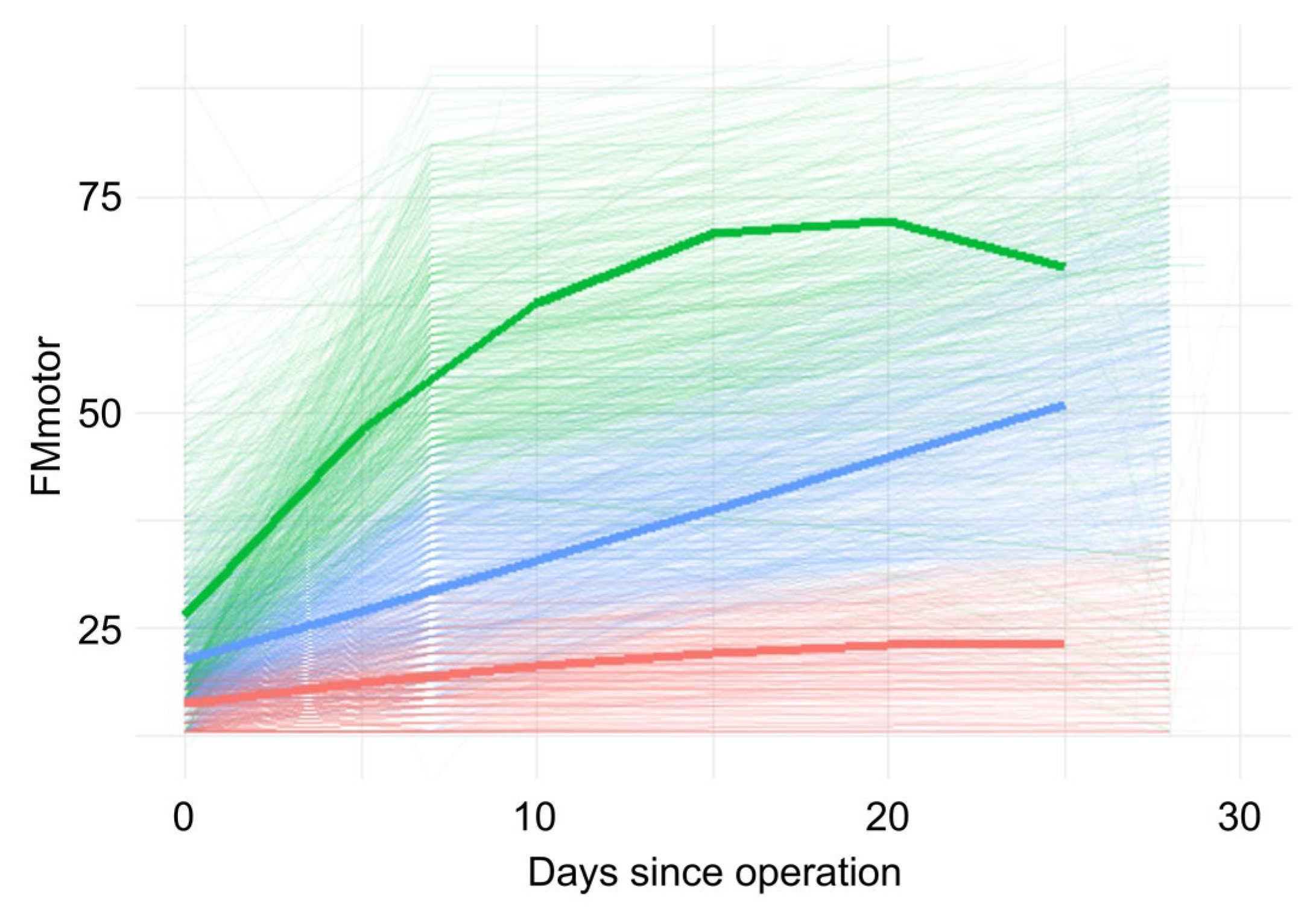
3.1. Latent Trajectory Model (≤30 Days)
- Green (Class 1): High initial FIM-motor scores with rapid early improvement, followed by a plateau.
- Blue (Class 2): Moderate initial scores with steady linear improvement throughout the postoperative period.
- Red (Class 3): Low initial scores with minimal functional gain over time.
3.2. Hospital-Level Class Distribution
3.3. Baseline Characteristics by Class
3.4. Multivariable Correlates of Class Membership
3.5. Discharge Outcomes by Class
4. Discussion
Limitations
Supplementary Materials
Author Contributions
Funding
Institutional Review Board Statement
Informed Consent Statement
Data Availability Statement
Acknowledgments
Conflicts of Interest
Abbreviations
| ADL | Activities of Daily Living |
| APP | Average Posterior Probability |
| BIC | Bayesian Information Criterion |
| DDLIS-PD | Degree of Daily Life Independence Score for People with Dementia |
| FIM | Functional Independence Measure |
| GMM | Growth Mixture Modeling |
| LOS | Length of Stay |
| OR | Odds Ratio |
| STROBE | Strengthening the Reporting of Observational Studies in Epidemiology |
References
- Feng, J.-N.; Zhang, C.-G.; Li, B.-H.; Zhan, S.-Y.; Wang, S.-F.; Song, C.-L. Global burden of hip fracture: The global burden of disease study. Osteoporos. Int. 2024, 35, 41–52. [Google Scholar] [CrossRef] [Scilit] [PubMed]
- Fukui, N.; Watanabe, Y.; Nakano, T.; Sawaguchi, T.; Matsushita, T. Predictors for ambulatory ability and the change in ADL after hip fracture in patients with different levels of mobility before injury: A 1-year prospective cohort study. J. Orthop. Trauma 2012, 26, 163–171. [Google Scholar] [CrossRef] [Scilit] [PubMed]
- Dubljanin-Raspopović, E.; Markovic Denić, L.; Marinković, J.; Grajić, M.; Tomanovic Vujadinović, S.; Bumbaširević, M. Use of early indicators in rehabilitation process to predict one-year mortality in elderly hip fracture patients. Hip Int. 2012, 22, 661–667. [Google Scholar] [CrossRef] [Scilit]
- Doherty, W.J.; Stubbs, T.A.; Chaplin, A.; Reed, M.R.; Sayer, A.A.; Witham, M.D.; Sorial, A.K. Prediction of postoperative outcomes following hip fracture surgery: Independent validation and recalibration of the Nottingham hip fracture score. J. Am. Med. Dir. Assoc. 2021, 22, 663–669.e2. [Google Scholar] [CrossRef] [Scilit] [PubMed]
- Oba, T.; Makita, H.; Inaba, Y.; Yamana, H.; Saito, T. New scoring system at admission to predict walking ability at discharge for patients with hip fracture. Orthop. Traumatol. Surg. Res. 2018, 104, 1189–1192. [Google Scholar] [CrossRef] [Scilit]
- Tam, T.-L.; Tsang, K.-K.; Lee, K.-B. Development of a prognostic model to predict post-operative mobility of patients with fragility hip fractures: A retrospective cohort study. Int. J. Orthop. Trauma Nurs. 2020, 38, 100770. [Google Scholar] [CrossRef] [Scilit]
- Nakamura, K.; Kurobe, Y.; Sue, K.; Sakurai, S.; Sasaki, T.; Yamamoto, S.; Ushiyama, N.; Taga, M.; Momose, K. Impact of early postoperative ambulation on gait recovery after hip fracture surgery: A multicenter cohort study. Sci. Rep. 2025, 15, 12893. [Google Scholar] [CrossRef] [Scilit]
- Bellelli, G.; Noale, M.; Guerini, F.; Turco, R.; Maggi, S.; Crepaldi, G.; Trabucchi, M. A prognostic model predicting recovery of walking independence of elderly patients after hip-fracture surgery. An experiment in a rehabilitation unit in Northern Italy. Osteoporos. Int. 2012, 23, 2189–2200. [Google Scholar] [CrossRef] [Scilit]
- Goubar, A.; Martin, F.C.; Potter, C.; Jones, G.D.; Sackley, C.; Ayis, S.; Sheehan, K.J. The 30-day survival and recovery after hip fracture by timing of mobilization and dementia: A UK database study. Bone Joint J. 2021, 103–B, 1317–1324. [Google Scholar] [CrossRef] [Scilit]
- Ferris, H.; Brent, L.; Coughlan, T. Early mobilisation reduces the risk of in-hospital mortality following hip fracture. Eur. Geriatr. Med. 2020, 11, 527–533. [Google Scholar] [CrossRef] [Scilit]
- Oldmeadow, L.B.; Edwards, E.R.; Kimmel, L.A.; Kipen, E.; Robertson, V.J.; Bailey, M.J. No rest for the wounded: Early ambulation after hip surgery accelerates recovery. ANZ J. Surg. 2006, 76, 607–611. [Google Scholar] [CrossRef] [Scilit] [PubMed]
- Tseng, M.-Y.; Shyu, Y.-I.L.; Liang, J. Functional recovery of older hip-fracture patients after interdisciplinary intervention follows three distinct trajectories. Gerontologist 2012, 52, 833–842. [Google Scholar] [CrossRef] [Scilit] [PubMed]
- Salpakoski, A.; Törmäkangas, T.; Edgren, J.; Sihvonen, S.; Pekkonen, M.; Heinonen, A.; Pesola, M.; Kallinen, M.; Rantanen, T.; Sipilä, S. Walking recovery after a hip fracture: A prospective follow-up study among community-dwelling over 60-year old men and women. BioMed Res. Int. 2014, 2014, 289549. [Google Scholar] [CrossRef] [Scilit] [PubMed]
- Dakhil, S.; Saltvedt, I.; Benth, J.Š.; Thingstad, P.; Watne, L.O.; Bruun Wyller, T.; Helbostad, J.L.; Frihagen, F.; Johnsen, L.G.; Taraldsen, K. Longitudinal trajectories of functional recovery after hip fracture. PLoS ONE 2023, 18, e0283551. [Google Scholar] [CrossRef] [Scilit]
- Muthén, L.K.; Muthén, B.O. How to use a Monte Carlo study to decide on sample size and determine power. Struct. Equ Model. Multidiscip. J. 2002, 9, 599–620. [Google Scholar] [CrossRef] [Scilit]
- von Elm, E.; Altman, D.G.; Egger, M.; Pocock, S.J.; Gøtzsche, P.C.; Vandenbroucke, J.P.; STROBE Initiative. The Strengthening the Reporting of Observational Studies in Epidemiology (STROBE) statement: Guidelines for reporting observational studies. J. Clin. Epidemiol. 2008, 61, 344–349. [Google Scholar] [CrossRef] [Scilit]
- Obayashi, K.; Masuyama, S. Pilot and feasibility study on elderly support services using communicative robots and monitoring sensors integrated with cloud robotics. Clin. Ther. 2020, 42, 364–371.e4. [Google Scholar] [CrossRef] [Scilit]
- Nakanishi, K.; Kanda, T.; Kobata, T.; Mori, M.; Yamada, S.; Kasamaki, Y. New score including daily life independence levels with dementia is associated with the onset of deep vein thrombosis in frail older adults. Geriatr. Gerontol. Int. 2020, 20, 414–421. [Google Scholar] [CrossRef] [Scilit]
- Hamilton, B.B.; Laughlin, J.A.; Fiedler, R.C.; Granger, C.V. Interrater reliability of the 7-level Functional Independence Measure (FIM). Scand. J. Rehabil. Med. 1994, 26, 115–119. [Google Scholar] [CrossRef] [Scilit]
- Stekhoven, D.J.; Bühlmann, P. MissForest—Non-parametric missing value imputation for mixed-type data. Bioinformatics 2012, 28, 112–118. [Google Scholar] [CrossRef] [Scilit]
- Lu, Z. Clustering longitudinal data: A review of methods and software packages. Int. Statistical Rev. 2024, 93, 425–458. [Google Scholar] [CrossRef] [Scilit]
- Spurk, D.; Hirschi, A.; Wang, M.; Valero, D.; Kauffeld, S. Latent Profile Analysis: A review and “How to” Guide of Its Application within Vocational Behavior Research. J. Vocat. Behav. 2020, 120, 103445. [Google Scholar] [CrossRef] [Scilit]
- Celeux, G.; Soromenho, G. An entropy criterion for assessing the number of clusters in a mixture model. J. Classif. 1996, 13, 195–212. [Google Scholar] [CrossRef] [Scilit]
- Jung, T.; Wickrama, K.A.S. An introduction to latent class growth analysis and growth mixture modeling. Soc. Personal. Psychol. Compass 2008, 2, 302–317. [Google Scholar] [CrossRef] [Scilit]
- Pajulammi, H.M.; Pihlajamäki, H.K.; Luukkaala, T.H.; Nuotio, M.S. Pre- and perioperative predictors of changes in mobility and living arrangements after hip fracture—A population-based study. Arch. Gerontol. Geriatr. 2015, 61, 182–189. [Google Scholar] [CrossRef] [Scilit]
- González de Villaumbrosia, C.; Sáez López, P.; Martín de Diego, I.; Lancho Martín, C.; Cuesta Santa Teresa, M.; Alarcón, T.; Ojeda Thies, C.; Queipo Matas, R.; González-Montalvo, J.I. on behalf of the Participants in the Spanish National Hip Fracture Registry. Predictive model of gait recovery at one month after hip fracture from a national cohort of 25,607 patients: The hip fracture prognosis (HF-prognosis) tool. Int. J. Environ. Res. Public Health 2021, 18, 3809. [Google Scholar] [CrossRef] [Scilit]
- Tomita, Y.; Yamamoto, N.; Inoue, T.; Noda, T.; Kawasaki, K.; Ozaki, T. Clinical prediction model for postoperative ambulatory ability outcomes in patients with trochanteric fractures. Injury 2021, 52, 1826–1832. [Google Scholar] [CrossRef] [Scilit]
- Kamimura, T.; Kobayashi, Y.; Tamaki, S.; Koinuma, M. Impact of prefracture cognitive impairment and postoperative delirium on recovery after hip fracture surgery. J. Am. Med. Dir. Assoc. 2024, 25, 104961. [Google Scholar] [CrossRef] [Scilit]
- Fu, G.; Li, M.; Xue, Y.; Wang, H.; Zhang, R.; Ma, Y.; Zheng, Q. Rapid preoperative predicting tools for 1-year mortality and walking ability of Asian elderly femoral neck fracture patients who planned for hip arthroplasty. J. Orthop. Surg. Res. 2021, 16, 455. [Google Scholar] [CrossRef] [Scilit]


| Variable | All (n = 2423) | Missing |
|---|---|---|
| Age (years) | 87.00 [81.00, 92.00] | 7 |
| BMI (kg/m2) | 20.00 [17.80, 22.40] | 22 |
| Sex-Male (%) | 543 (22.4) | 1 |
| Cognitive impairment (%) | 1201 (49.6) | 16 |
| Fracture type (%) | 3 | |
| Neck | 1230 (50.8) | |
| Intertrochanter | 1190 (49.1) | |
| Pre-fracture living situation (%) | 0 | |
| Own home | 1818 (75.0) | |
| Nursing home | 551 (22.7) | |
| Other hospital | 54 (2.2) | |
| Pre-fracture indoor walking status (%) | 1 | |
| Without aids | 1234 (50.9) | |
| One-point cane | 407 (16.8) | |
| Walker | 468 (19.3) | |
| Other aids | 93 (3.8) | |
| Wheelchair | 220 (9.1) | |
| Pre-fracture outdoor walking status (%) | 212 | |
| Without aids | 882 (36.4) | |
| One-point cane | 425 (17.5) | |
| Walker | 282 (11.6) | |
| Other aids | 49 (2.0) | |
| Wheelchair | 573 (23.6) | |
| Mediation comorbidity | ||
| Respiratory disease (%) | 236 (9.7) | 1 |
| Cardiovascular disease (%) | 606 (25.0) | 1 |
| Neurological disease (%) | 391 (16.1) | 1 |
| Hospital stay (days) | 29.00 [20.00, 46.00] | 0 |
| Waiting days for surgery (days) | 2.00 [1.00, 4.00] | 9 |
| Waiting days for rehabilitation (days) | 2.00 [1.00, 4.00] | 14 |
| Time to first walk in rehabilitation after surgery (days) | 4.00 [3.00, 7.00] | 299 |
| Average rehabilitation time per day (minutes/day) | 36.00 [26.00, 50.00] | 39 |
| FIM-Total (POD1) | 44.50 [33.00, 54.00] | 43 |
| FIM-Motor (POD1) | 18.00 [16.00, 23.00] | 43 |
| FIM-Total (POW1) | 58.00 [41.00, 79.00] | 109 |
| FIM-Motor (POW1) | 33.00 [22.00, 49.00] | 109 |
| FIM-Total (POW4) | 76.00 [52.00, 96.00] | 1434 |
| FIM-Motor (POW4) | 51.00 [32.00, 66.00] | 1434 |
| FIM-Total (POW8) | 82.00 [58.00, 102.00] | 2128 |
| FIM-Motor (POW8) | 56.00 [38.00, 72.50] | 2128 |
| FIM-Total (POW12) | 87.00 [66.50, 104.50] | 2352 |
| FIM-Motor (POW12) | 59.00 [44.50, 75.00] | 2352 |
| FIM-Total at discharge | 79.00 [54.00, 100.00] | 64 |
| FIM-Motor at discharge | 53.00 [33.00, 69.00] | 65 |
| Complications during hospitalization | ||
| Fall (%) | 105 (4.3) | 222 |
| Peripheral nerve palsy (%) | 31 (1.3) | 5 |
| DVT (%) | 129 (5.3) | 3 |
| Infection (%) | 68 (2.8) | 1 |
| Walking status at discharge (%) | 31 | |
| Without aids | 119 (4.9) | |
| One-point cane | 236 (9.7) | |
| Walker | 832 (34.3) | |
| Other aids | 26 (1.1) | |
| Wheelchair | 1179 (48.7) | |
| Destination after discharge (%) | 4 | |
| Own home | 467 (19.3) | |
| Nursing home | 479 (19.8) | |
| Rehabilitation hospital | 1362 (56.2) | |
| Other hospital | 79 (3.3) | |
| Others | 32 (1.3) |
| Variable | Class1 (N = 782) | Class2 (N = 977) | Class3 (N = 640) | Class1vs2 | Class1vs3 | Class2vs3 |
|---|---|---|---|---|---|---|
| Age (years) | 82.00 [74.00, 88.00] | 88.00 [83.00, 92.00] | 90.00 [86.00, 94.00] | <0.001 | <0.001 | <0.001 |
| BMI (kg/m2) | 20.40 [18.22, 22.87] | 19.80 [17.60, 22.20] | 19.70 [17.50, 22.10] | <0.001 | <0.001 | 0.513 |
| Hospital stay (days) | 25.00 [18.00, 40.00] | 30.00 [20.00, 47.00] | 31.00 [22.00, 49.00] | <0.001 | <0.001 | 0.042 |
| Sex-Male (%) | 183 (23.4) | 211 (21.6) | 145 (22.7) | 1 | 1 | 1 |
| Cognitive impairment (%) | 147 (18.8) | 525 (53.7) | 523 (81.7) | <0.001 | <0.001 | <0.001 |
| Fracture type (%) | ||||||
| Neck | 493 (63.0) | 481 (49.2) | 248 (38.8) | <0.001 | <0.001 | <0.001 |
| Intertrochanter | 289 (37.0) | 496 (50.8) | 392 (61.3) | |||
| Mediation comorbidity | ||||||
| Respiratory disease (%) | 72 (9.2) | 103 (10.5) | 59 (9.2) | 1 | 1 | 1 |
| Cardiovascular disease (%) | 155 (19.8) | 272 (27.8) | 173 (27.0) | <0.001 | <0.001 | 0.765 |
| Neurological disease (%) | 88 (11.3) | 169 (17.3) | 127 (19.8) | <0.001 | <0.001 | 0.219 |
| Pre-fracture living situation (%) | ||||||
| Own home | 725 (92.7) | 723 (74.0) | 353 (55.2) | <0.001 | <0.001 | <0.001 |
| Nursing home | 47 (6.0) | 228 (23.3) | 269 (42.0) | |||
| Other hospital | 10 (1.3) | 26 (2.7) | 18 (2.8) | |||
| Pre-fracture indoor walking status (%) | ||||||
| Without aids | 614 (78.5) | 436 (44.6) | 172 (26.9) | <0.001 | <0.001 | <0.001 |
| One-point cane | 90 (11.5) | 215 (22.0) | 101 (15.8) | |||
| Walker | 58 (7.4) | 228 (23.3) | 177 (27.7) | |||
| Other aids | 11 (1.4) | 39 (4.0) | 42 (6.6) | |||
| Wheelchair | 9 (1.2) | 59 (6.0) | 148 (23.1) | |||
| Pre-fracture outdoor walking status (%) | ||||||
| Without aids | 518 (66.2) | 315 (32.2) | 125 (19.5) | <0.001 | <0.001 | <0.001 |
| One-point cane | 137 (17.5) | 224 (22.9) | 83 (13.0) | |||
| Walker | 63 (8.1) | 153 (15.7) | 88 (13.8) | |||
| Other aids | 12 (1.5) | 31 (3.2) | 18 (2.8) | |||
| Wheelchair | 52 (6.6) | 254 (26.0) | 326 (50.9) | |||
| Variable | OR_class1vs2 | p_Value_class1vs2 | OR_class3vs2 | p_Value_class3vs2 |
|---|---|---|---|---|
| (Intercept) | 106.04 (28.29–397.43) | 0.05 (0.01–0.25) | ||
| Age (per year increase) | 0.95 (0.94–0.96) | 0.002 | 1.01 (1.00–1.03) | 0.187 |
| BMI (per kg/m2 increase) | 1.35 (1.04–1.75) | 0.024 | 0.77 (0.59–1.01) | 0.057 |
| Sex-Male | 1.00 (0.97–1.03) | 0.898 | 1.02 (0.99–1.06) | 0.256 |
| Cognitive impairment—Yes | 0.38 (0.29–0.49) | <0.001 | 2.80 (2.14–3.66) | <0.001 |
| Fracture type [reference: neck] | ||||
| Intertrochanter | 0.81 (0.65–1.01) | 0.061 | 1.36 (1.09–1.70) | 0.007 |
| Respiratory disease—Yes | 0.97 (0.68–1.40) | 0.869 | 0.82 (0.57–1.18) | 0.285 |
| Cardiovascular disease—Yes | 0.84 (0.65–1.08) | 0.178 | 0.96 (0.75–1.23) | 0.746 |
| Neurological disease—Yes | 0.62 (0.45–0.86) | 0.004 | 1.16 (0.87–1.55) | 0.314 |
| Residence [reference: Own home] | ||||
| Nursing home | 0.55 (0.37–0.81) | 0.003 | 1.13 (0.86–1.48) | 0.378 |
| Other hospital | 0.53 (0.23–1.19) | 0.130 | 0.92 (0.47–1.79) | 0.807 |
| Pre-fracture indoor walking status [reference: without aids] | ||||
| One-point cane | 0.52 (0.35–0.77) | 0.001 | 1.30 (0.84–2.01) | 0.239 |
| Walker | 0.51 (0.31–0.82) | 0.007 | 1.43 (0.93–2.21) | 0.105 |
| Other aids | 0.47 (0.21–1.07) | 0.069 | 2.54 (1.38–4.68) | 0.003 |
| Wheelchair | 0.42 (0.18–1.00) | 0.047 | 3.81 (2.30–6.31) | <0.001 |
| Pre-fracture outdoor walking status [reference: without aids] | ||||
| One-point cane | 0.76 (0.53–1.09) | 0.136 | 0.68 (0.43–1.10) | 0.108 |
| Walker | 0.76 (0.47–1.22) | 0.259 | 0.84 (0.51–1.40) | 0.499 |
| Other aids | 0.81 (0.36–1.82) | 0.610 | 0.52 (0.24–1.13) | 0.098 |
| Wheelchair | 0.68 (0.41–1.14) | 0.139 | 0.97 (0.61–1.55) | 0.898 |
| Variable | Class1 (N = 782) | Class2 (N = 977) | Class3 (N = 640) | Class1vs2 | Class1vs3 | Class2vs3 |
|---|---|---|---|---|---|---|
| FIM-Motor at discharge | 68.00 [58.00, 79.00] | 48.50 [38.00, 62.00] | 25.00 [19.00, 36.00] | <0.001 | <0.001 | <0.001 |
| FIM-Total at discharge | 100.00 [87.00, 113.00] | 74.00 [60.25, 92.00] | 43.00 [31.00, 60.00] | <0.001 | <0.001 | <0.001 |
| Destination after discharge (%) | ||||||
| Own home | 257 (32.9) | 151 (15.5) | 50 (7.8) | <0.001 | <0.001 | <0.001 |
| Nursing home | 46 (5.9) | 196 (20.1) | 227 (35.5) | |||
| Rehabilitation hospital | 468 (59.8) | 592 (60.8) | 300 (46.9) | |||
| Other hospital | 5 (0.6) | 21 (2.1) | 52 (8.1) | |||
| Others | 6 (0.8) | 14 (1.4) | 11 (1.7) | |||
| Walking status at discharge (%) | ||||||
| Without aids | 89 (11.5) | 19 (2.0) | 10 (1.6) | <0.001 | <0.001 | <0.001 |
| One-point cane | 180 (23.2) | 53 (5.5) | 0 (0.0) | |||
| Walker | 367 (47.2) | 372 (38.4) | 85 (13.6) | |||
| Other aids | 8 (1.0) | 16 (1.7) | 2 (0.3) | |||
| Wheelchair | 133 (17.1) | 509 (52.5) | 527 (84.5) |
Disclaimer/Publisher’s Note: The statements, opinions and data contained in all publications are solely those of the individual author(s) and contributor(s) and not of MDPI and/or the editor(s). MDPI and/or the editor(s) disclaim responsibility for any injury to people or property resulting from any ideas, methods, instructions or products referred to in the content. |
© 2025 by the authors. Licensee MDPI, Basel, Switzerland. This article is an open access article distributed under the terms and conditions of the Creative Commons Attribution (CC BY) license (https://creativecommons.org/licenses/by/4.0/).
Share and Cite
Nakamura, K.; Kurobe, Y.; Sue, K.; Yamamoto, S.; Momose, K. Recovery Trajectories of Motor Function After Hip Fracture Surgery in Older Patients: A Multicenter Growth Mixture Modeling Study in Acute Care Hospitals. Geriatrics 2025, 10, 167. https://doi.org/10.3390/geriatrics10060167
Nakamura K, Kurobe Y, Sue K, Yamamoto S, Momose K. Recovery Trajectories of Motor Function After Hip Fracture Surgery in Older Patients: A Multicenter Growth Mixture Modeling Study in Acute Care Hospitals. Geriatrics. 2025; 10(6):167. https://doi.org/10.3390/geriatrics10060167
Chicago/Turabian StyleNakamura, Keisuke, Yasushi Kurobe, Keita Sue, Shuhei Yamamoto, and Kimito Momose. 2025. "Recovery Trajectories of Motor Function After Hip Fracture Surgery in Older Patients: A Multicenter Growth Mixture Modeling Study in Acute Care Hospitals" Geriatrics 10, no. 6: 167. https://doi.org/10.3390/geriatrics10060167
APA StyleNakamura, K., Kurobe, Y., Sue, K., Yamamoto, S., & Momose, K. (2025). Recovery Trajectories of Motor Function After Hip Fracture Surgery in Older Patients: A Multicenter Growth Mixture Modeling Study in Acute Care Hospitals. Geriatrics, 10(6), 167. https://doi.org/10.3390/geriatrics10060167