Abstract
Some of the most intense thunderstorms and extreme weather events on Earth occur in the Hindu Kush Himalaya (HKH) region of Southern Asia. The need to provide end users, stakeholders, and decision makers with accurate forecasts and alerts of extreme weather is critical. To that end, a cutting edge weather modeling framework coined the High Impact Weather Assessment Toolkit (HIWAT) was created through the National Aeronautics and Space Administration (NASA) SERVIR Applied Sciences Team (AST) effort, which consists of a suite of varied numerical weather prediction (NWP) model runs to provide probabilities of straight-line damaging winds, hail, frequent lightning, and intense rainfall as part of a daily 54 h forecast tool. The HIWAT system was first deployed in 2018, and the recently released model archive hosted by the Global Hydrometeorology Resource Center (GHRC) Distributed Active Archive Center (DAAC) provides daily model outputs for the years of 2018–2022. With a nested modeling domain covering Nepal, Bangladesh, Bhutan, and Northeast India, the HIWAT archive spans the critical pre-monsoon and monsoon months of March–October when severe weather and flooding are most frequent. As part of NASA’s Transformation To Open Science (TOPS), this data archive is freely available to practitioners and researchers.
Dataset License: CC BY 4.0
1. Summary
The Hindu Kush Himalaya (HKH) region in South Asia is known for its extreme terrain ranging from the towering Himalayas mountains, at over 7200 m elevation, to the alluvial flood plains of Bangladesh, with an average country elevation of only 9 m [1]. Due to this vast range of elevation, clashing moist and dry air masses, splitting jet streams south of the Tibetan plateau, and nearby warm waters of the Bay of Bengal, extreme weather systems and intense thunderstorms [2,3] are prevalent, stemming from these ideal conditions. These favorable conditions occur during the pre-monsoon period (typically from March to June), when enhanced mid-upper level tropospheric flow combines with increasing, sometimes extreme, low-level moisture and instability producing convective available potential energy (CAPE) exceeding 5000 [4]. Historically, Bangladesh and Eastern India have especially been subject to severe weather events (e.g., damaging hail and violent tornadoes) that have resulted in staggering impacts on infrastructure and human casualties ranging in the hundreds to thousands [5,6,7,8]. Additionally, the frequent casualties associated with lightning activity has recently led the Bangladesh government to declare lightning as a national disaster [9,10].
Furthermore, for short-term weather forecasting, global scale numerical weather prediction (NWP) models are generally too coarse to use in forecasting specific severe weather hazards. Hence models that can resolve deep convection, such as the Weather Research and Forecasting (WRF) model, are more useful in this regard, especially in regions with sparse observational networks [11]. However, operating high-resolution modeling systems to provide real-time forecast guidance can require costly computing infrastructure. These factors coupled with existing economic and development challenges in the region have led to agencies, communities, and individuals not having the crucial information needed to prepare and take action when faced with extreme weather hazards.
Given these circumstances, there was a need in the HKH region for regionally focused, daily mesoscale weather forecasts of impending extreme weather that provide crucial insights to mandated agencies and the research community, as well as the general public. The High Impact Weather Assessment Toolkit (HIWAT) was thereby developed to address this need through an ensemble suite of NWP simulations that utilize the WRF modeling framework. Through the focused regional ensemble NWP approach of HIWAT, the system provides probabilistic guidance of severe thunderstorm hazards at convection-allowing resolutions, thereby vastly improving upon coarse global models and addressing the critical need of the region [4]. HIWAT specifically targets hourly, day-1, and day-2 composite probabilistic guidance for straight-line damaging winds (known regionally as “nor’westers”), large hail, frequent lightning, and intense rainfall rates as part of 54 h daily forecasts.
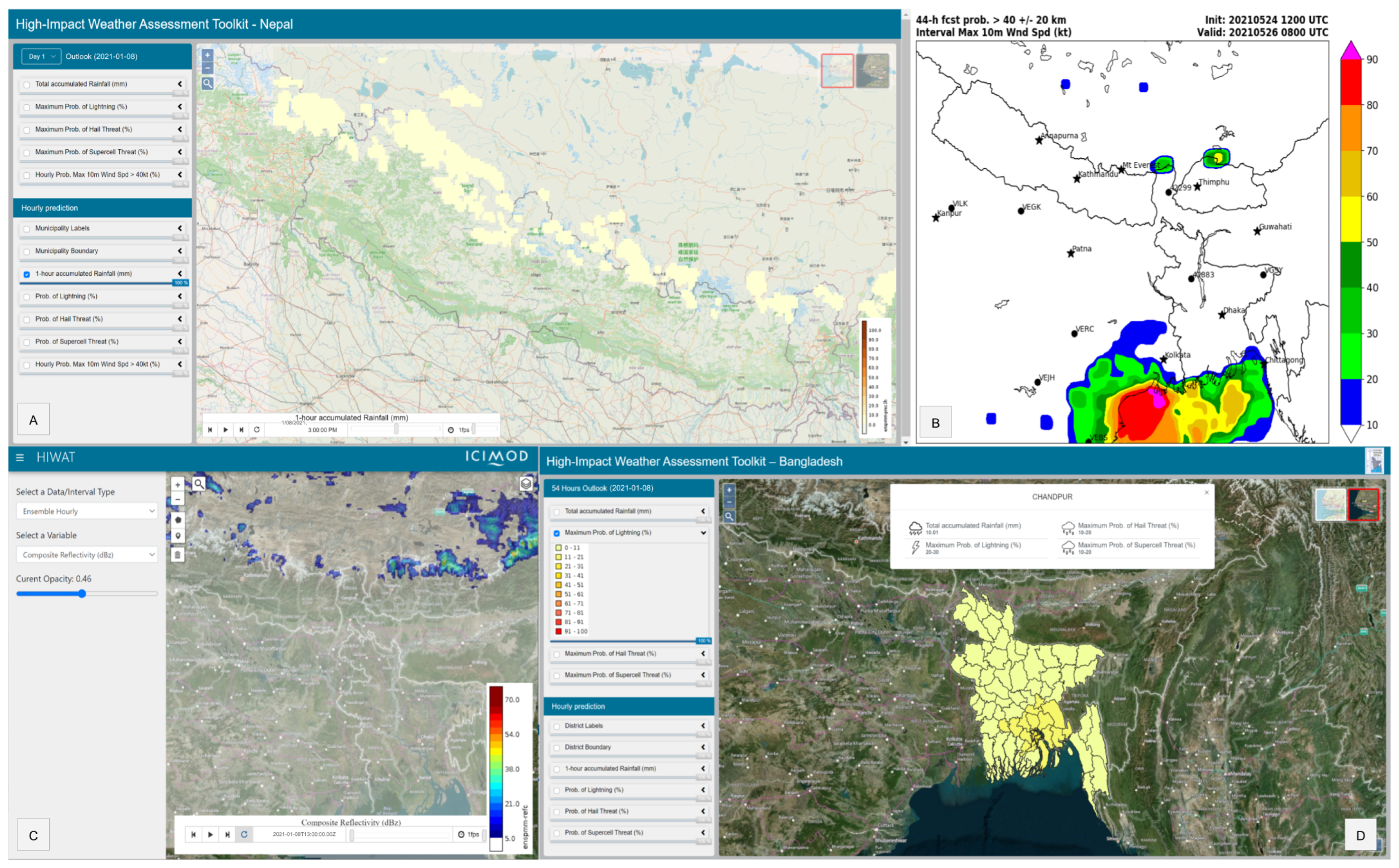
The implementation of the HIWAT geospatial service was developed as part of the NASA SERVIR program’s Applied Sciences Team (AST) effort [12] co-developed in collaboration with the International Centre for Integrated Mountain Development (ICIMOD) the regional SERVIR hub located in Kathmandu, Nepal. The SERVIR program is a joint initiative of the United States Agency for International Development (USAID), the National Aeronautics and Space Administration (NASA), and leading geospatial organizations in Asia, Africa, and Latin America [13]. SERVIR partners with countries and organizations in these regions to address critical challenges in food security, water and related disasters, land use, air quality, and climate change. The HIWAT system outputs have been customized and co-developed through a service planning approach with stakeholders and partners at National Hydrological and Meteorological Services in Nepal and Bangladesh [12]. The array of customized real-time and archived output products, which consist of the aforementioned hazard probabilities as well as basic meteorological model outputs and numerous other derived quantities, are an outcome of this co-development process [14]. Beyond the customized data products, the HIWAT service delivery of information was also tailored for each end user, leading to a variety of web-based applications available within the SERVIR Service Catalog (accessed on 27 May 2025) with several displayed in Figure 1.
Figure 1.
Four examples of the end-user customized and co-developed and regional HIWAT web applications. (A) Nepal’s Department of Hydrology and Meteorology customized HIWAT application, (B) HIWAT Model Viewer, (C) Regional HIWAT application, (D) Bangladesh Department of Meteorology HIWAT application (License: CC BY-SA 4.0).
2. Methods
As part of the NASA AST effort, HIWAT was initially developed in 2017 and implemented for operational use from 2018 to 2022 on NASA SERVIR’s high-performance computer (HPC) cluster known as the ‘SERVIR Operational Cluster Resource for Applications–Terabytes for Earth Science’ (SOCRATES). The daily HIWAT weather model archive spanning these years has been made available through the Global Hydrometeorology Resource Center (GHRC) Distributed Active Archive Center (DAAC) for the South Asia pre-monsoon and wet-monsoon months of March–September.
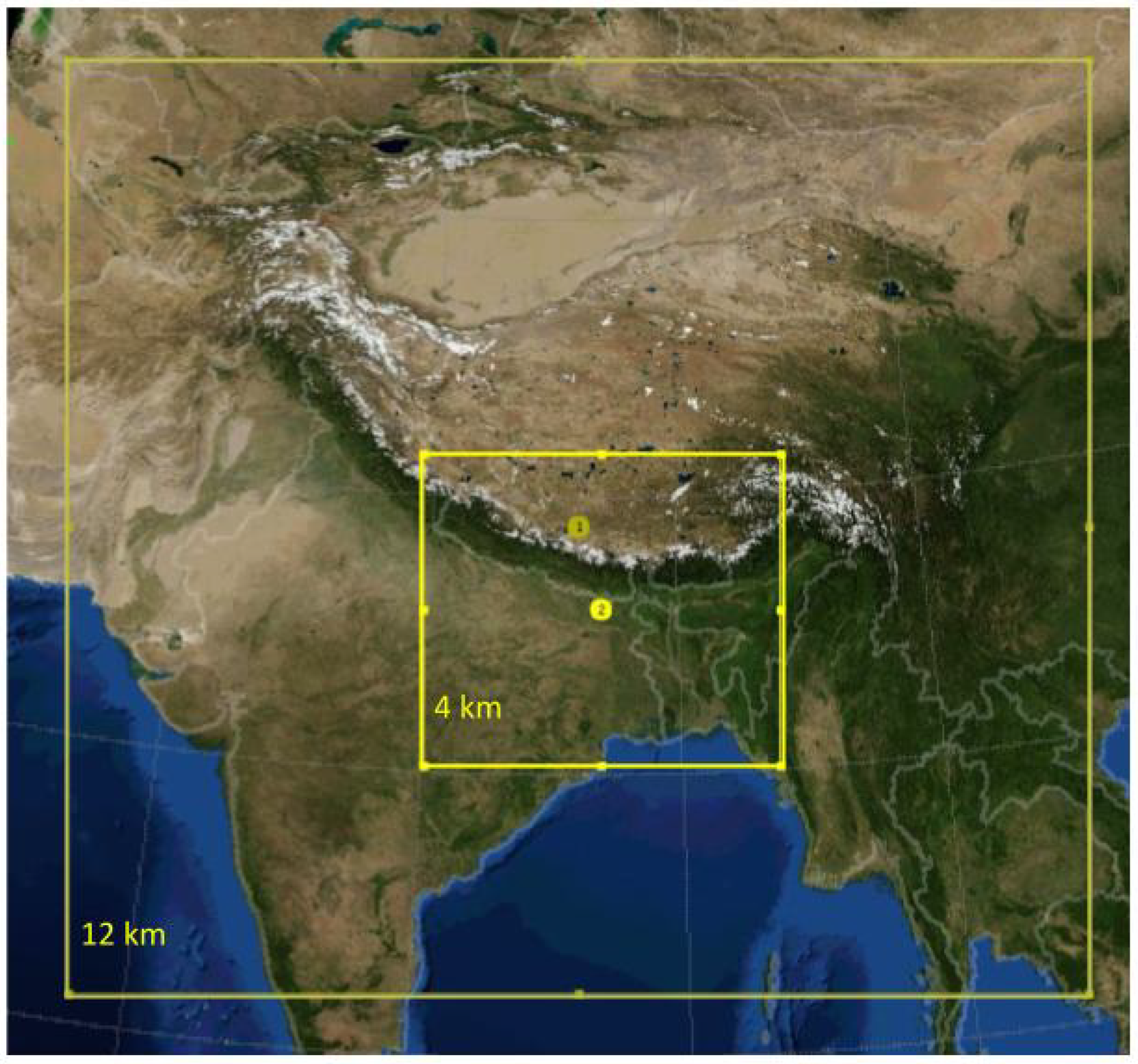
The WRF model configuration for HIWAT consists of an outer domain at 12 km grid spacing, centered on South Asia displayed in Figure 2. An additional inner domain at 4 km grid spacing encompasses Bangladesh, Nepal, and Bhutan, and part of Northeast India, with the archive spatial dimensions as N: 45.951, S: 10.632, E: 111.438, W: 60.562 covering a large portion of South Asia. The vertical dimension comprises 42 terrain-following model levels ranging from near-surface to a pressure altitude of 20 hPa [12].
Figure 2.
Nested outer (1) and inner (2) domains of the HIWAT system figure adapted from [12] (license: CC BY-SA 4.0).
To promote adequate spread in the ensemble members for meaningful probability products, diversity in the initial conditions, precipitation microphysics (MP), and planetary boundary layer (PBL) paramterizations are invoked. The 12 km and nested 4 km grid domains receive disparate initial and boundary conditions interpolated from NOAA’s Global Forecast System for the control member, and 11 arbitrarily selected instances of the Global Ensemble Forecasting System for the remaining HIWAT ensemble members. The resolution and domain extent of the 4 km resolution nest is chosen to resolve explicit processes for thunderstorm hazards while simultaneously balancing computational costs. The configuration, automated data acquisition, daily initialization, pre- and post-processing, and computed derived fields are managed using the Unified Environmental Modeling System (UEMS), which greatly simplifies and streamlines the complex workflow involved in running a real-time instance of the WRF model. A novel python code library used to create the ensemble derived products and probabilities has been developed for this functionality and can be shared upon request. Additional details about the model configuration and implementation within SOCRATES are provided by Gatlin et al. (2021) [12] and Case et al. (2023) [4].
From 2018 to 2020, HIWAT was initialized on SOCRATES using 13 nodes: 12 dedicated to individual ensemble member simulations, and a single “head node” for pre- and post-processing [4]. The model configuration for each ensemble member is shown in Table 1. The HIWAT system produces ensemble-based forecast products comparable to the High Resolution Ensemble Forecast (HREF) available through the National Centers for Environmental Prediction (NCEP) Storm Prediction Center [4,15,16,17]. Additionally, HIWAT incorporates sub-hourly information at grid points that enable a dynamic model timestep to inform the hourly outputs, which preserves the details of rapidly evolving phenomena at finer scales [18]. This approach is used for rapidly evolving phenomena such as the updraft helicity metric for denoting rotating thunderstorm updrafts, and vertically integrated graupel for representing hail threat. Finally, as a caveat, from 2021 to 2022, the number of ensembles was reduced from twelve to nine due to computing constraints.
The HIWAT ensemble products includes a variety of methods for distilling disparate NWP model outputs into digestible two-dimensional fields and probability maps. The visual fields generated and computed include postage stamp “thumbnail” plots of each individual member, “paintball” maps of fields with a high threshold applied to colorize each member differently, simple grid point probabilities, neighborhood probabilities where thresholds are applied to localized phenomena over a 20 km sub-region surrounding a grid point, and finally probability matched mean (PMM) [19], which applies an amplitude re-sampling from the overarching ensemble system to the ensemble mean field. The PMM approach is most suitable for retaining localized, high-amplitude features such as heavy rainfall areas while retaining the higher spatial accuracy of the ensemble mean solution. Additional details on the derivation of value-added ensemble products are described by Case et al. (2023) [4].
Table 1.
Twelve-member ensemble configuration of the 4 km resolution domain of the WRF-based probabilistic forecasting system used in HIWAT-HKH. The National Centers for Environmental Prediction model used for the initial boundary conditions is listed beneath each named ensemble member.
Table 1.
Twelve-member ensemble configuration of the 4 km resolution domain of the WRF-based probabilistic forecasting system used in HIWAT-HKH. The National Centers for Environmental Prediction model used for the initial boundary conditions is listed beneath each named ensemble member.
| Microphysical parameterization | |||||
| Goddard [20] | Purdue Lin [21] | WSM6 [22] | Morrison 2-moment [23] | ||
| PBL parameterization | YSU [24] | HKH1: GFS | HKH2: GEFS 03 | HKH3: GEFS 05 | HKH4: GEFS07 |
| MYJ [25] | HKH5: GEFS 09 | HKH6: GEFS 11 | HKH7: GEFS 13 | HKH8: GEFS 15 | |
| MYNN2 [26] | HKH9: GEFS 17 | HKH10: GEFS 19 | HKH11: GEFS 02 | HKH12: GEFS 04 | |
3. Data Description
The available HIWAT GHRC DAAC archive consists of daily NWP simulations for the HKH region, specifically focusing on the inner nested domain covering Bangladesh, Bhutan, Nepal, and parts of Northeastern India. The HIWAT archive spans 2 April 2017, through 2 October 2022, with the full pre-monsoon and wet-monsoon months of March–September spanning 2018–2022. The total HIWAT GHRC DAAC archive is 1,239,382 files on 349.24 TB disk storage, with the entire archive available as a cloud-oriented repository. The HIWAT archive consists of the following file types: (1) native WRF hourly output files for both day-1 and day-2 forecast domains d01 and d02 in netcdf-3 format as shown in Figure 2; (2) GRIB2 post-processed files with native and derived quantities, some of which are used by HIWAT to compute ensemble probabilities; and (3) hourly and day-1 and day-2 probability fields for the quantities and thresholds that are defined in Table 2. These include the customized hourly ensemble for the straight-line damaging winds, hail, frequent lightning, and intense rainfall fields. See the GHRC DAAC Data User Guide (accessed on 27 May 2025) for supplemental information. Additionally, for each ensemble member (1–12 for years 2018–2020 and 1–9 for 2021–2022), files are provided across both the forecast days and domains.
Table 2.
Available day-1, day-2, and ensemble products with defined probabilistic thresholds. Fill value set at 9.9990003 .
3.1. Extreme Rainfall
The HIWAT archive provides the forecast accumulations and probability of extreme rainfall. The day-1 and day-2 forecast data sets contain the probability of 3 h accumulated precipitation exceeding 25, 50, 75, and 100 mm at any 3 h interval within the 24 h window. The hourly ensemble products provide a 1 h accumulated precipitation and the PMM of total accumulated precipitation from collective ensemble members.
3.2. Lightning Activity
The HIWAT archive includes diagnosed lightning activity from the ensemble system using the Lightning Forecast Algorithm (LFA), which computes the total flash rates of both in-cloud and cloud-to-ground lightning activity from model forecast fields of cloud microphysics and vertical velocity. The algorithm produces a measure of lightning in total flashes per square kilometer per 5 min (flashes/km2/5 min) [27,28]. The probabilistic lightning products are available as day-1 and day-2 composite and hourly probabilities, with exceedance thresholds applied at 0.07 and 5.0 flash/km2/5 min, where the 0.07 threshold corresponds to the occurrence of any lightning activity (approximately one flash per hour) and the 5.0 threshold corresponds to more frequent lightning flash rates (approximately one or more flashes per minute).
3.3. Composite Radar Reflectivity
Similar to lightning and rainfall, the Composite Radar Reflectivity product is available as day-1 and day-2 forecasts as well as an hourly ensemble, with the latter providing an hourly probability. Each of these data sets used is thresholded at greater than 40 and 50.
3.4. Straight-Line Damaging Winds
Straight-line winds are available as part of the day-1 and day-2 daily summary forecasts as well as the hourly ensemble probabilities. The day-1 and day-2 daily summaries provide the probability of 10 m wind speeds exceeding thresholds of 30, 40, and 50 knots at any time during each 24 h forecast period, with an hourly ensemble probability at the same thresholds.
3.5. Large Hail Threat
The large hail threat is represented by the model-predicted total column vertically integrated graupel, an indicator for severe hail threat as shown in the published literature [18]. Hail probabilities are available as both day-1 and day-2 composites and hourly ensemble probabilities. Exceedance thresholds of 30 and 40 kg/m2. are used based on published studies, and apply a 20 km neighborhood since hail cores tend to have a small spatial footprint.
3.6. Supercell Thunderstorms
To represent the risk for supercell thunderstorms, i.e., long-lived thunderstorms characterized by rotating mid-level updrafts, HIWAT utilizes the derived quantity of maximum updraft helicity in the previous hour. Updraft helicity computes the amount of mid-level rotation in a simulated convective cell typically in the 2–5 km above-ground layer, given in units of m2/s2. The exceedance probabilities are also available as day-1 and day-2 forecast composites and hourly output frequencies. The probabilities apply a 20 km neighborhood to updraft helicity exceeding thresholds of 50, 100, and 200 m2/s2 since this quantity has small spatial footprints in the model outputs.
4. Conclusions
For greater details regarding the HIWAT model configuration and implementation within SOCRATES, please see Gatlin et al. (2021) [12] and Case et al., 2023 [4], wherein damaging wind, large hail, lightning, a meteorologically rare Nepalese tornado, and a landfalling tropical cyclone are provided as use cases demonstrating the efficacy of HIWAT to provide vital information to forecasters. Finally, the HIWAT system, focused on South Asia, has progressed since its nascent development stages into a reliable operational system. The longer-term operation of a 12-member ensemble HIWAT forecast system, based at ICIMOD Nepal, continues where vital forecast information is provided to hydrometeorological offices to support the need for high-resolution weather forecasts.
Author Contributions
Conceptualization, T.M. and J.L.C.; methodology, J.L.C., P.G. and J.S.; software, J.L.C., P.G., J.S., K.S. and D.K.S.; validation, J.L.C., P.G. and T.M.; formal analysis, J.L.C.; investigation, J.L.C.; resources, F.D.O., L.G., T.M., B.B. and R.B.T.; data curation, J.L.C. and T.M.; writing—original draft preparation, T.M. and J.L.C.; writing—review and editing, T.M. and J.L.C.; visualization, T.M.; supervision, T.M., J.L.C., B.B., R.B.T. and P.G.; project administration, T.M., J.L.C., B.B., R.B.T. and P.G.; funding acquisition, P.G., J.L.C. and J.S. All authors have read and agreed to the published version of the manuscript.
Funding
Funding for this work was provided through the cooperative agreement 80MSFC22N0004 between NASA and UAH. SERVIR is a joint NASA- and USAID-led program.
Data Availability Statement
The HIWAT archive data is freely available for use through the GHRC DAAC.
Acknowledgments
The authors would like to thank NASA’s Applied Sciences Program and Capacity Building Program, specifically Nancy Searby. We also want to thank the SERVIR program Dan Irwin, Ashutosh Limaye, Eric Anderson, Helen Blue Parache, and Meryl Kruskopf in particular. Additionally, we would like to thank the United States Agency for International Development (USAID) especially Pete Epanchin, the International Centre for Integrated Mountain Development (ICIMOD) and Bhupesh Adhikary, and the University of Alabama in Huntsville specifically Rob Griffin and the Lab for Applied Science (LAS). We would like to thank Lee Ellenburg and Brent Roberts for their support through the years. We would also like to thank Robert Rozumalski of NOAA for his help with updates and fixes to the UEMS for our application, as well as Jeff Knickerbocker and the Spatial Informatics Group (SIG) Team for assistance with configuring and hosting the virtual computer cluster for conducting simulations. In addition, we also want to extend our thanks to Jordan Bell of NASA Disasters and Christopher Hain, Paul Meyer, and Roger Allen of the NASA Short-term Prediction Research and Transition (SPoRT) Center for hosting real-time web graphics and providing in-kind computational resources for the first year of the project. Finally we would like to thank Leigh Sinclair, Will Ellett, Shannon Flynn, and Geoffrey Stano from the Global Hydrometeorology Resource Center Distributed Active Archive Center for the powerful innovation, leadership in the field, and true support.
Conflicts of Interest
Author Timothy Mayer, Deepak Kumar Shah, Francisco Delgado Olivares and Lance Gilliland were employed by the SERVIR Science Coordination Office. Author Jayanthi Srikishen was employed by the company Universities Space Research Association. Author Jonathan L. Case was employed by the company ENSCO. Author Lance Gilliland was employed by the company Amentum. Author Patrick Gatlin was employed by the NASA Marshall SpaceFlight Center, The remaining authors declare that the research was conducted in the absence of any commercial or financial relationships that could be construed as a potential conflict of interest. The authors declare no conflicts of interest. The funding agents had no role in the design of the study, in the collection, analysis, data interpretation, writing of the manuscript, or in the decision to publish the results.
References
- Barros, A.P.; Chiao, S.; Lang, T.J.; Burbank, D.; Putkonen, J. From weather to climate—Seasonal and interannual variability of storms and implications for erosion processes in the Himalaya. Spec. Pap. Geol. Soc. Am. 2006, 398, 17–38. [Google Scholar]
- Zipser, E.J.; Cecil, D.J.; Liu, C.; Nesbitt, S.W.; Yorty, D.P. Where are the most intense thunderstorms on Earth? Bull. Am. Meteorol. Soc. 2006, 87, 1057–1072. [Google Scholar]
- Choudhury, B.A.; Konwar, M.; Hazra, A.; Mohan, G.M.; Pithani, P.; Ghude, S.D.; Deshamukhya, A.; Barth, M.C. A diagnostic study of cloud physics and lightning flash rates in a severe pre-monsoon thunderstorm over northeast India. Q. J. R. Meteorol. Soc. 2020, 146, 1901–1922. [Google Scholar]
- Case, J.L.; Gatlin, P.N.; Srikishen, J.; Adhikary, B.; Mannan, M.A.; Bell, J.R. Building thunderstorm resilience in the Hindu Kush Himalaya Region through probabilistic forecasts and satellite observations. Bull. Am. Meteorol. Soc. 2023, 104, E1105–E1131. [Google Scholar]
- Bikos, D.; Finch, J.; Case, J.L. The environment associated with significant tornadoes in Bangladesh. Atmos. Res. 2016, 167, 183–195. [Google Scholar] [CrossRef]
- Islam, M.S.; Schmidlin, T.W. Lightning hazard safety measures and awareness in Bangladesh. Nat. Hazards 2020, 101, 103–124. [Google Scholar]
- Dewan, A.; Hossain, M.F.; Rahman, M.M.; Yamane, Y.; Holle, R.L. Recent lightning-related fatalities and injuries in Bangladesh. Weather Clim. Soc. 2017, 9, 575–589. [Google Scholar]
- NIRAPAD. Bangladesh Network for Information, Response And Preparedness Activities on Disaster (NIRAPAD) Monthly Hazard Incidence Report. Available online: https://www.nirapad.org.bd/home/resources/monthlyHazard (accessed on 27 May 2025).
- Rahman, M.; Nabila, I.A.; Sakib, M.S.; Silvia, N.J.; Galib, M.A.; Shobuj, I.A.; Hasan, L.; Chisty, M.A.; Rahman, F.; Alam, E.; et al. Knowledge, attitude, and practices towards lightning in Bangladesh. Sustainability 2022, 14, 448. [Google Scholar] [CrossRef]
- Holle, R.L.; Islam, A.K.M.S. Lightning fatalities in Bangladesh in May 2016. In Proceedings of the 8th Conference on the Meteorological Applications of Lightning Data, 2017 American Meteorological Society Annual Meeting, Seattle, WA, USA, 23–25 January 2017; pp. 22–26. [Google Scholar]
- Chawla, I.; Osuri, K.K.; Mujumdar, P.P.; Niyogi, D. Assessment of the Weather Research and Forecasting (WRF) model for simulation of extreme rainfall events in the upper Ganga Basin. Hydrol. Earth Syst. Sci. 2018, 22, 1095–1117. [Google Scholar]
- Gatlin, P.N.; Case, J.L.; Srikishen, J.; Adhikary, B. The high-impact weather assessment toolkit. In Earth Observation Science and Applications for Risk Reduction and Enhanced Resilience in Hindu Kush Himalaya Region: A Decade of Experience from SERVIR; Springer Nature: Cham, Switzerland, 2021; pp. 231–250. [Google Scholar]
- Frankel-Reed, J. Reflecting on a decade of collaboration between NASA and USAID: Deriving value from space for international development. In Yearbook on Space Policy 2016: Space for Sustainable Development; Springer Nature: Cham, Switzerland, 2018; pp. 163–174. [Google Scholar]
- Thapa, R.B.; Bajracharya, B.; Matin, M.A.; Anderson, E.; Epanchin, P. Service Planning Approach and Its Application. In Earth Observation Science and Applications for Risk Reduction and Enhanced Resilience in Hindu Kush Himalaya Region: A Decade of Experience from SERVIR; Springer Nature: Cham, Switzerland, 2021; p. 23. [Google Scholar]
- Roberts, B.; Gallo, B.T.; Jirak, I.L.; Clark, A.J.; Dowell, D.C.; Wang, X.; Wang, Y. What does a convection-allowing ensemble of opportunity buy us in forecasting thunderstorms? Weather Forecast. 2020, 35, 2293–2316. [Google Scholar]
- Jirak, I.; Weiss, S.; Melick, C. The SPC storm-scale ensemble of opportunity: Overview and results from the 2012 Hazardous Weather Testbed Spring Forecasting Experiment. In Proceedings of the 26th Conference on Severe Local Storms, Nashville, TN, USA, 5–8 November 2012; American Meteorological Society: Nashville, TN, USA, 2012; p. 137. [Google Scholar]
- Roberts, B.; Jirak, I.L.; Clark, A.J.; Weiss, S.J.; Kain, J.S. Postprocessing and visualization techniques for convection-allowing ensembles. Bull. Am. Meteorol. Soc. 2019, 100, 1245–1258. [Google Scholar]
- Kain, J.S.; Dembek, S.R.; Weiss, S.J.; Case, J.L.; Levit, J.J.; Sobash, R.A. Extracting unique information from high-resolution forecast models: Monitoring selected fields and phenomena every time step. Weather Forecast. 2010, 25, 1536–1542. [Google Scholar]
- Clark, A.J. Generation of ensemble mean precipitation forecasts from convection-allowing ensembles. Weather Forecast. 2017, 32, 1569–1583. [Google Scholar]
- Tao, W.K.; Wu, D.; Lang, S.; Chern, J.D.; Peters-Lidard, C.; Fridlind, A.; Matsui, T. High-resolution NU-WRF simulations of a deep convective-precipitation system during MC3E: Further improvements and comparisons between Goddard microphysics schemes and observations. J. Geophys. Res. Atmos. 2016, 121, 1278–1305. [Google Scholar]
- Chen, S.H.; Sun, W.Y. A one-dimensional time dependent cloud model. J. Meteorol. Soc. Jpn. Ser. II 2002, 80, 99–118. [Google Scholar]
- Hong, S.Y.; Lim, J.O.J. The WRF single-moment 6-class microphysics scheme (WSM6). Asia-Pac. J. Atmos. Sci. 2006, 42, 129–151. [Google Scholar]
- Morrison, H.; Thompson, G.; Tatarskii, V. Impact of cloud microphysics on the development of trailing stratiform precipitation in a simulated squall line: Comparison of one-and two-moment schemes. Mon. Weather Rev. 2009, 137, 991–1007. [Google Scholar]
- Hong, S.Y.; Noh, Y.; Dudhia, J. A new vertical diffusion package with an explicit treatment of entrainment processes. Mon. Weather Rev. 2006, 134, 2318–2341. [Google Scholar]
- Janjić, Z.I. The step-mountain eta coordinate model: Further developments of the convection, viscous sublayer, and turbulence closure schemes. Mon. Weather Rev. 1994, 122, 927–945. [Google Scholar]
- Nakanishi, M.; Niino, H. Development of an improved turbulence closure model for the atmospheric boundary layer. J. Meteorol. Soc. Jpn. Ser. II 2009, 87, 895–912. [Google Scholar]
- McCaul, E.W., Jr.; Goodman, S.J.; LaCasse, K.M.; Cecil, D.J. Forecasting lightning threat using cloud-resolving model simulations. Weather Forecast. 2009, 24, 709–729. [Google Scholar]
- McCaul, E.W.; Priftis, G.; Case, J.L.; Chronis, T.; Gatlin, P.N.; Goodman, S.J.; Kong, F. Sensitivities of the WRF lightning forecasting algorithm to parameterized microphysics and boundary layer schemes. Weather Forecast. 2020, 35, 1545–1560. [Google Scholar]
Disclaimer/Publisher’s Note: The statements, opinions and data contained in all publications are solely those of the individual author(s) and contributor(s) and not of MDPI and/or the editor(s). MDPI and/or the editor(s) disclaim responsibility for any injury to people or property resulting from any ideas, methods, instructions or products referred to in the content. |
© 2025 by the authors. Licensee MDPI, Basel, Switzerland. This article is an open access article distributed under the terms and conditions of the Creative Commons Attribution (CC BY) license (https://creativecommons.org/licenses/by/4.0/).