


Abstract
When it comes to wine communication, winery names can serve as multidimensional communication mechanisms. Their various aspects of communication concern the historical context, tourism geography, socio-economic tourism development, wine knowledge, and even gastronomy. On this basis, a whole communication strategy could be developed, which could lead to progressive interaction and networking with consumers. Quality needs to be fully and properly communicated through multiple channels. This paper aims to reveal the importance of the way in which wine producers in Northern Greece construct their brand identity through strategic naming choices—such as Estate, Ktima, Château, or the producer’s family name—as opposed to more neutral or descriptive labels. The findings suggest that winery names contribute significantly to consumer perception, place branding, and the development of wine tourism. The choice of a winery name influences regional identity, strengthens the connection with local traditions, and enhances the commercial success and tourism appeal of the region.
1. Introduction
The name of each winery has many more meanings than a simple business name and that is due to the complexity of wine as a product that binds many elements together [1]—history, tradition, geographical interest, tourism development, wine knowledge, and gastronomy. Therefore, it is important for professionals to choose it within specific communication axes [2]. Wine communication is about organizing the message that the winemaker attempts to convey to the consumer [3,4]. The wine producer communicates the philosophy, the personality of their wines, and the terroir from the particular vineyard [5]. Each winery’s label, packaging, wine name, online presence, and owned media are various ways of communicating the winemaker’s perceptions, as well as the personality of their wines [6]. Wine communication is combined with wine tourism and its growth, a fact that is always challenging because of wine’s diversity compared to other products [7]. Delving into the multiple functional levels of a winery name is important because it incorporates a range of factors that are appealing to tourists with an interest in Greek wineries. Suitable naming strategies for the wine industry could enable potential visitors to wineries to clarify the unique perceptions of wine producers, as well as the particularities of each wine region [8]. Therefore, different approaches are required in the field of toponymy studies to examine how wineries can be transformed into branded destinations [9]. Wine tourism is the intersection of many dimensions, functions, and benefits. At the level of functions, it contributes to the enhancement of the wider development of a specific area with a focus on the winery [10]. This development has profit potential and cultural and ethnic implications, not only for the local wineries but also for the wider geographical area [11].
From a benefits perspective, wine tourism attracts wine tourists by addressing a range of factors, including both the appeal of the wine itself and the offerings of the winery, such as services and activities available in the surrounding area [12]. According to the above, the wine tourist is interested in the natural environment, the cultural heritage, and the rural tourism activities that the area can provide [13]. It is crucial that the individual simultaneously seeks esthetic pleasure, the enhancement of their wine knowledge, or even interaction through communication and socialization [14]. According to Rocchi et Gabbai [15], all successful wineries naturally focus their attention on product quality, but this seems not to be enough because quality needs to be fully and properly communicated through multiple channels. By extension, the added value at the economic level will also be understood by the consumer public [16,17]. The name of a winery has the potential to facilitate dynamic communication between the recipient and the wider area of the winery as a tourist destination, always grounded in the wine profile of the region [18]. The communication plan has to be built in such a way that the winery’s name draws tourists seeking a well-rounded experience that includes special facilities, festivities, bonding, and social networking [19].
2. Materials and Methods
This paper is based on a content analysis that focuses on winery names in Northern Greece. We recorded 310 active wineries and producers in Northern Greece (Table A1), which administratively consists of three regions—Macedonia, Thrace, and Epirus—which by extension are subdivided into 22 prefectures in total. A more detailed overview of individual winery names and their specific naming styles is provided in Appendix A.
Data collection entailed searching electronic databases related to the wine industry, the websites of the wineries, and social media. In the second phase of our research, which was conducted during the months of January and February 2025, we proceeded with a qualitative analysis of our data by studying how producers identify their business, in relation to their brand’s business name. The third examination phase of the data led us to extract information about how wineries translate their business into the English language. For example, some of them prefer to translate the Greek name “Ktima” using the term “chateau”, and others leave it in the original, only using the Latin alphabet. We acquired information from the final screening regarding the communicational decoding based on the Fountain and Dawson [20] model, who developed four axes that determine the origins of the names of wineries.
According to their research, it emerged that the name of each winery can be related to:
- A peculiarity of the landscape or a specific feature in the location where the winery is located (hills, mountains, rivers).
- Τhe importance of the place where the winery is located (place name, streets, some special point).
- A parameter of heritage, i.e., the history, a myth with which the winery is involved, or a sense of a special prestige.
- Personal involvement, which may be related to family tradition, the name—the trademark of a producer that symbolizes much more than just a name.
The process of our research is illustrated schematically in Figure 1.
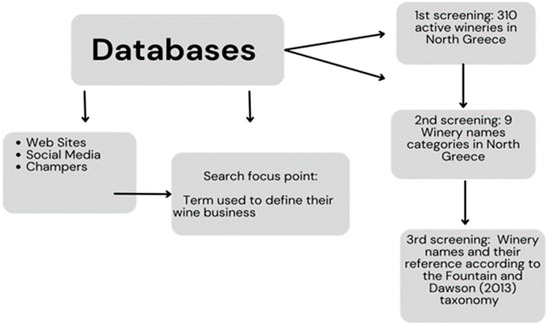
Figure 1.
Graphic illustration of the research process [20] (created by authors on canva.com (accessed on 6 January 2025)).
3. Research Questions
The name of a winery is a key element of its identity and functions as a communication tool with the consumer public [21]. The choice of the appropriate name is not accidental, as it reflects both the winery’s philosophy and its market positioning strategy [22]. This focus forms the basis of the first research question:
RQ1: Which terms do wine producers use in Northern Greece to define their businesses?
Winemakers adapt the international terms used for wineries into their own language, creating names that combine global winemaking traditions with local linguistic and cultural heritage [23]. This perspective frames the second research question:
RQ2: How do wine producers in Northern Greece adapt and translate international terms related to their wineries into Greek, and to what extent do they maintain international conventions or integrate local linguistic elements? For example, some winemakers translate the Greek word ‘κτήμα’ as ‘estate’ to align with international terminology, while others retain the Greek term ‘κτήμα’ in Latin letters (i.e., ‘Ktima’) to preserve a local identity.
The strategic choice of name is closely linked to the values and philosophy of the winemaker, and functions as a tool to form a distinct image in the market [24]. Through their name, wineries can communicate the tradition, location, quality, and authenticity of their products, while at the same time strengthening their connection with consumers and their wider tourism destination [25]. This leads to the third research question:
RQ3: What is the correlation between a winery’s name and its communication strategy in Northern Greece?
4. Results Regarding the Communicational Reflections of Northern Greek Winery Names
Examining the 310 wineries of North Greece, we found that the names of the wineries are divided into nine categories:
- Winery names that are part of the producer’s name and the term “Winery”; for example: “Voulgaris Winery” in the subregion Thessaloniki in Macedonia.
- Names using the term “Chateau”; for example: “Chateau Nico Lazaridi” in the subregion Drama in Macedonia.
- Names using just the term “Wine(s)”; for example, “Goudousakis Wines” in the subregion of Xanthi in Thrace.
- Names using the term “Estate”; for example, “Alpha Estate”, in the subregion of Amyntaion in Macedonia.
- Names using the term “Ktima” which in Greek is translated as manor; for example, “Ktima Gerovassiliou” in the subregion Epanomi in Macedonia.
- Names using the term “Vineyard(s)”; for example, “Tsantali Vineyards” in the subregion Agios Pavlos in Macedonia.
- Names using the term “Domaine”; for example, “Domaine Glinavos” in subregion Zitsa in Epirus.
- Names which include the term “Family”; for example, “Efthimiou Family Wines” in the subregion Thesprotia in Epirus.
- Names that consist only of the producer’s name in combination with the term “Winery”; for example, “Zervas Family”, in the subregion Thesprotia in Epirus.
In Table 1, we present our findings in relation to the frequency of the names we categorized above. Most of the wine producers in Northern Greece prefer to define their wine business as a “Winery” but using also their name and surname in some cases. Of the 310 wineries, 122 define themselves as wineries in combination with the wine producer’s name, which results in the highest percentage in our study, 39.4%. Secondly, 40 wineries use just the term “Wine(s)” in their brand, with a percentage of 12.9%. Additionally, 34 (11%) wineries use the Greek word “Ktima”, 33 (10.6%) wineries use the term “Estate”, and 31 (10%) wineries use the term “Vineyard(s)”. Furthermore, 20 wineries (6.5%) choose to be defined by the producer’s name only, 19 (6.1%) wineries are characterized as “Domaine”, and 9 (2.9%) wineries include in their brand the term “family”. Finally, there are only two wineries, with a very small percentage of 0.6%, that choose to be called “Chateau”.

Table 1.
Winery name categories in Northern Greece.
Another interesting finding is that a certain number of wineries prefer not to translate the Greek word “ktima”, which means “estate” in English. There are 34 out of 310 wineries that use this same term “ktima” also in the international version of their digital presence on websites and social media. A typical example of this practice is the winery with the brand name “Ktima Gerovasilliou” [26] (Figure 2). This finding leads us to the conclusion that these wine producers try to preserve a part of their cultural heritage and also attempt to encode differentiation and authenticity based on the “sense of place” theory [27].
Figure 2.
The brand name of the winery “Ktima Gerovasilliou” illustrated on the website of the winery “https://www.gerovassiliou.gr/en (accessed on 20 April 2025)”.
5. Discussion
5.1. Communicational Reflections on Northern Greek Winery Names
Extending the analysis of winery names and trying to decode the producer’s philosophy around the wine business, in terms of capturing the business name, we used as a guide the analysis of Fountain and Dawson [20], which we combined with our findings regarding the deeper meaning of a winery name. We found that the element of personal meaning is the most common communicative tactic for most of the wine producers in Northern Greece (Table 2).
Table 2.
Winery names and their references.
It should be emphasized that 62.9% of the names are related to the choice of the winemaker’s personal seal; the term family and all the deeper messages that stem from it are also included. The next most popular choice, at 20.3%, for the name of a winery is related to the feeling that the producer wants to communicate by enhancing the prestige of the business or creating a symbolic message that they seek to communicate to the public. When it comes to choosing a name based on the location where the vineyard or business is located, we notice that this is quite low at 11.29%. Of particular interest is the last option, which is related to the landscape and some specific characteristic of the vineyard, which gathers a particularly low percentage of 5.48%.
Through our research, it emerged that in Northern Greece there is a preference for the identification of a business with the name of the producer, which creates a correlation with a strong personal element. Compared to other regions, such as the Napa Valley [28] or Bordeaux [29], where winery names often emphasize the location or historical prestige, Northern Greece shows a stronger tendency toward personal naming. This highlights a more emotional and identity-driven branding approach.
The analysis of winery names in Northern Greece reveals a clear connection between the choice of name and the communication strategy employed by the producers. A significant percentage of wineries (62.9%) incorporate the producer’s name or family identity into their brand. This strategy fosters a personal connection with consumers, enhancing the authenticity of the product [1]. By choosing a name that reflects the producer’s identity, these wineries emphasize family tradition and continuity in winemaking, positioning the producer’s name as a symbol of trust and quality [22]. This approach not only resonates with local consumers but also strengthens the winery’s recognition in both national and international markets, establishing a personal brand that communicates the values of craftsmanship, heritage, and consistency [28].
On the other hand, wineries that incorporate geographical terms or place names (e.g., “Tsantali Vineyards” or “Ktima Gerovasilliou”) focus on highlighting the uniqueness of their location and terroir. This strategy helps to build a strong regional identity, linking the winery to its specific geographical and cultural heritage [30]. By utilizing place names, these wineries convey a sense of authenticity and connection to the land, which appeals to wine tourists seeking more than just a product but a complete experience rooted in the region’s history and traditions [10]. This approach also contributes to the development of wine tourism, as visitors are drawn not only to the quality of the wines but to the immersive experience offered by the winery and its surrounding environment [7]. Studies have shown that strong regional branding, often highlighted through the use of place names, enhances the destination’s identity and can attract tourists interested in local culture and heritage [6].
Moreover, the findings suggest that these naming strategies are not just about attracting consumers, but also about building a sense of place, which plays a critical role in wine tourism [25]. Geographical references in winery names contribute to creating a narrative that integrates the product with the land, tradition, and community, effectively elevating the winery’s appeal in the competitive global wine market [11]. This approach aligns with the broader understanding of branding in wine tourism, where the creation of a memorable destination experience relies heavily on communicating both the uniqueness of the region and the authenticity of the wine [18].
5.2. The Contribution of the Paper to the Wine Industry and the Wine Tourism Field
The name of a winery is a decisive factor for its image, commercial success, and its connection with the national and tourism identity of its region [3]. This paper addresses our initial research questions by analyzing how wine producers in Northern Greece adapt international winery terminology into their own language and branding strategies. Our findings suggest that winery names serve as strategic tools that shape consumer perception, enhance place branding, and contribute to the overall marketing and tourism appeal of Northern Greek wineries [31].
The naming strategy of wineries can play a decisive role in the development of wine tourism and the strengthening of regional identity [16]. By choosing names that reflect location, tradition, or terroir, winemakers can attract tourists and highlight the authenticity of their products [6]. At the same time, the use of place names or certain terms can contribute to the promotion of a specific region as a wine destination, strengthening both the wineries’ brand and the local economy [18].
5.3. Limitations and Future Research
This paper attempts to open the discussion on the strategic role of winery names as communicational tools that influence consumer perception, brand identity, and wine tourism development [7]. Nevertheless, this study has certain limitations:
- This work primarily focuses on Northern Greek wineries, limiting the generalizability of its findings to other wine regions with different cultural, historical, and economic contexts.
- The paper relies on a qualitative analysis of winery names and their online presence, which may not fully capture consumer perceptions or the actual impact of naming strategies on purchasing behavior and wine tourism engagement. However, it should be noted that not all wineries in the sample may have an active website, and the extent of their online presence may vary. This analysis primarily focuses on those wineries with a visible digital footprint and may not fully capture the consumer perceptions or the actual impact of naming strategies on purchasing behavior and wine tourism engagement.
Future studies could expand the geographical scope to include other wine-producing regions, allowing for comparative analysis of naming conventions across different cultures. Additionally, incorporating consumer surveys and experimental studies could provide deeper insights into how winery names influence consumer choices, brand loyalty, and tourism appeal.
The data in Table 2 show various naming patterns, but further examination into the relationship between wineries’ geographic locations and their naming strategies could provide deeper insights into how local factors influence branding decisions. Future research could incorporate geographical variables, such as proximity to tourist destinations or historically significant areas, to assess their impact on naming strategies [13]. A comparative analysis across regions could reveal whether the naming practices in Northern Greece are unique or part of broader regional trends. Moreover, studying consumer perceptions of winery names in relation to location could enhance our understanding of regional identity’s role in consumer behavior, branding, and wine tourism [30].
Author Contributions
Conceptualization T.T. and E.A.; methodology, T.T. and E.A.; data curation, T.T. and E.A.; writing—original draft preparation, E.A.; writing—review and editing, E.A. and T.T.; visualization, E.A.; supervision, T.T.; funding acquisition, T.T. All authors have read and agreed to the published version of the manuscript.
Funding
This research received no external funding.
Data Availability Statement
Data are contained within the article.
Conflicts of Interest
The authors declare no conflicts of interest.
Appendix A
Table A1.
The 310 wineries in Northern Greece and their names.
Table A1.
The 310 wineries in Northern Greece and their names.
| No | Winery | Winery (Greek Name) |
|---|---|---|
| 1. | Eighty Winery | Oγδόντα Winery |
| 2. | Kamara Estate Kioutsoukis Family | Κτήμα Καμάρα Κιουτσούκη |
| 3. | Zararis Wines | Ζαράρης Κρασιά |
| 4. | Arabatzi Estate | Κτήμα Aραμπατζή |
| 5. | Arvanitidis Estate | Κτήμα Aρβανιτίδη |
| 6. | Ktima Gerovassiliou | Κτήμα Γεροβασιλείου |
| 7. | Mitrouli Winery | Κτήμα Μητρούλη |
| 8. | Domaine Babatzimopoulos Babatzimopoulos | Κτήμα Μπαμπατζιμόπουλου |
| 9. | Domain Florian | Κτήμα Φλοριάν |
| 10. | Chateau Petit Oινεώνας | Κτήμα Petit Oινεώνας |
| 11. | Mesimvria Winery | Μεσημβρία Oινοποιητική |
| 12. | Ε. Malamatinas & Sons S.A.Ε. | Μαλαματίνα |
| 13. | Aslanis Family Winery | Oινοποιείο Aσλάνη |
| 14. | Avgerinidis | Oινοποιείο Aυγερινίδη |
| 15. | Voulgaris Winery | Oινοποιείο Βούλγαρη |
| 16. | Damaskios Winery | Oινοποιείο Damaskios |
| 17. | Penelope Dritsa Winery | Oινοποιείο Πηνελόπη Δρίτσα |
| 18. | Koronia-Gi | Oινοποιείο Κορώνεια Γη |
| 19. | Mantovani Winery | Oινοποιείο Μαντοβάνι |
| 20. | Moschopolis Winery | Oινοποιείο Μοσχόπολις |
| 21. | Estate Family Panagiotidis | Κτήμα Oικογένειας Παναγιωτίδη |
| 22. | Skiouros Winery | Oινοποιείο Σκίουρος |
| 23. | Tavatidis Artisanal Winery | Oινοποιείο Ταβατιδης |
| 24. | Kechris Winery | Oινοποιείο Kεχρής |
| 25. | Matamis Wines | Oινοποιείο Ματάμης |
| 26. | Fourkas Winery | Oινοποιείο Φούρκας |
| 27. | Tsamtsakiri Winery | Τσαμτσακίρη Oινοποιητική |
| 28. | Winery Bros SA Georgiadis | Oινοποιεία Aφοί Γεωργιάδη |
| 29. | Trakas Wines | Oινοποιεία Τράκας |
| 30. | Boutique Winery Adam | Oίνοι Aδάμ |
| 31. | Nikos Zisis Estate | Κτήμα Νίκου Ζήση |
| 32. | Vinum Hellenic Wines | Ελληνικά Κρασιά Vinum |
| 33. | Tsavlidis Family Winery | Aμπελώνας Τσαβλίδη |
| 34. | Kouloutsidis Vineyards | Aμπελώνες Κουλουτσίδη |
| 35. | Skepastou Wines | Κρασιά Σκεπαστού |
| 36. | Kougiounis Antonis Wines | Κρασιά Κουγιούνης Aντώνης |
| 37. | Klonaras Wines | Κρασιά Κλωναράς |
| 38. | Mpismpa Estate | Κτήμα Μπίσμπα |
| 39. | Tsakiris Estate | Κτήμα Τσακίρη |
| 40. | Antoniadis Winery | Oινοποιείο Aντωνιάδη |
| 41. | Kilkislis Wines | Oινοποιείο Κιλκισλή |
| 42. | Koumaras Winery | Oινοποιείο Κουμαράς Νέστωρ |
| 43. | Kyrkosta Winery | Oινοποιείο Κυρκώστα |
| 44. | Velikos Winery | Oινοποιείο Βελίκος |
| 45. | Caravia Winery | Oινοποιείο Caravia |
| 46. | Gouma Winery | Oινοποιείο Γκούμα |
| 47. | Papagrigoriou Winery | Oινοποιεία Παπαγρηγορίου |
| 48. | Petalis Winery | Oινοποιείο Πετάλη |
| 49. | Tilaveridis Winery | Oινοποιείο Τηλαβερίδης |
| 50. | Spyropoulos Winery | Oινοποιεία Σπυρόπουλου |
| 51. | Draganoglou Wine | Oίνος Δραγάνογλου |
| 52. | Nikolaos Kontanas Wine | Oίνος Νικόλαος Κοντάνας |
| 53. | Traditional Wine | Παραδοσιακό Τσίπουρο Κρασί |
| 54. | Gardikis Winery | Γαρδίκης Oινοποιεία |
| 55. | Stinis Angelo Kala Krasia | Καλά Κρασιά Άγγελος Στίνης |
| 56. | Oinokallitexnies Wines | Oινοκαλλιτεχνίες Κρασιά |
| 57. | Ktima Biblia Chora | Κτήμα Βιβλία Χώρα |
| 58. | Domaine Apostolidis | Κτήμα Aποστολίδη |
| 59. | Ampeloeis Winery | Κτήμα Aμπελόεις |
| 60. | Estate Chatzigeorgiou | Κτήμα Χατζηγεωργίου |
| 61. | Seitanidis Estate | Κτήμα Σεϊτανίδη |
| 62. | Makedwn Winery | Oινοποιείο Μακεδών Νίκου Λαζαρίδη |
| 63. | Oinaron Winery | Oίναρον, Oινοποιία Ιωαννίδη |
| 64. | Triandafyllidis Winery | Oινοποιείο Κελάρια Τριανταφυλλίδης |
| 65. | Estate Protopapa | Κτήμα Πρωτόπαπα |
| 66. | Simeonidis Estate | Oινοποιείο Συμεωνίδη |
| 67. | Tsikrikonis Winery | Oινοποιία Τσικρικώνη |
| 68. | Lalikos Wines | Oρεινοί Aμπελώνες Λαλίκου |
| 69. | Paggaion SA Winery | Oινοποιείο Παγγαίον |
| 70. | Fellahidis Family Winery | Oινοποιείο Φελλαχίδης |
| 71. | Charismatiki Wines | Χαρισματικοί Oίνοι |
| 72. | 5 Anemoi Wines | Κρασιά 5 Άνεμοι |
| 73. | Ktima Theologou | Κτήμα Θεολόγου |
| 74. | Stafilia Kavalas Wines | Σταφύλια Καβάλας Oινοποιείο |
| 75. | Ktima Kazaviti | Κτήμα Καζαβίτη |
| 76. | Giannakis Winery | Oινοποιείο Γιαννάκη |
| 77. | Ktima Pavlidis | Κτήμα Παυλίδη |
| 78. | Oenogenesis Winery | Oινογένεσις Oινοποιείο |
| 79. | Domaine Michaelidi | Κτήμα Μιχαηλίδη |
| 80. | Estate Manolesakis | Κτήμα Μανωλεσάκη |
| 81. | Domaine Costa Lazaridi | Κτήμα Κώστα Λαζαρίδη |
| 82. | Wine Art Estate | Κτήμα Τέχνη Oίνου |
| 83. | Domaine de la Rose Rouge | Κτήμα Ερυθρού Ρόδου |
| 84. | Ktima Lenikaki | Κτήμα Λενικάκη |
| 85. | Chateau Nico Lazaridi | Oινοποιείο Νίκου Λαζαρίδη |
| 86. | Microwinery Eutuxia | Μικροοινοποιία Ευτυχία Μιχαηλίδου |
| 87. | Christos Klonaridis Winery | Κτήμα Χρήστου Κλωναρίδη |
| 88. | Kiriatzis Winery | Oινοποίείο Κυριατζή |
| 89. | Oenops Wines | Oινοποιείο Όινωψ |
| 90. | Pagona Winery | Aμπελώνες Παγωνά |
| 91. | Gazoritis Winery | Oινοποιείο Γαζωρίτης |
| 92. | Kerkinitis Wine | Κρασί Κερκινίτης |
| 93. | Akritidis Estate | Κτήμα Aκριτίδη |
| 94. | Ktima Karali | Κτήμα Καραλή |
| 95. | Domaine Nerantzi | Κτήμα Νερατζή |
| 96. | Romalidis Estate | Κτήμα Ρωμαλίδη |
| 97. | Domaine Statheropoulos | Κτήμα Γιώργου Σταθερόπουλου |
| 98. | Ktima Chroni | Κτήμα Χρόνη |
| 99. | Estate Charalaboglou | Κτήμα Χαραλαμπόγλου |
| 100. | Kyathos Winery | Oινοποιείο Κύαθος |
| 101. | Biskas Wines | Oινοποιείο Παναγιώτη Μπίσκα |
| 102. | Melidou Winery | Oινοποιία Μελίδου |
| 103. | Ktima t’ Apostoli | Το Κτήμα τ’Aποστόλη |
| 104. | Vladikas Winery Destillery | Oινοποιείο Βλαδίκας |
| 105. | Ktima Papadopoulos | Κτήμα Παπαδόπουλος |
| 106. | Ktima Tsavlidi | Κτήμα Τσαβλίδη |
| 107. | Amphipoleon Winery | Oινοποιία Aμφιπολέων |
| 108. | Xatzipantos Winery | Oινοποιία Χατζηπάντος Ιωάννης |
| 109. | Filoi tou krasiou | Φίλοι του Κρασιού Δημητριτσίου |
| 110. | Ampelou Chora Winery | Oινοποιείο Aμπέλου Χώρα |
| 111. | Afytaion Gaia Wineyr | Aφυταίων Γαία Oινοποιείο |
| 112. | Domaine Agrovision Winery | Oινοποιείο Agroviosion |
| 113. | Ktima Iatridi | Κτήμα Ιατρίδη |
| 114. | Winery Domaine Koutsoubaki | Κτήμα Κουτσουμπάκη |
| 115. | Estate Livadioti | Κτήμα Λειβαδιώτη |
| 116. | Domaine Claudia Papayianni | Oινοποιείο Κλαούντια Παπαγιάννη |
| 117. | Estate Papathanasiou | Κτήμα Παπαθανασίου |
| 118. | Domaine Porto Carras | Κτήμα Πόρτο Καρράς |
| 119. | Tzikas Family Winery | Κτήμα Τζήκα |
| 120. | Akrathos Newlands Winery | Νέες Χώρες Aμπελουργική AΕ |
| 121. | Konstantara Wines | Oινοποιείο Κωνσταντάρα |
| 122. | Tarazas Winery | Oινοποιείο Ταραζά |
| 123. | Petralona Winery | Oινοποιείο Πετραλώνων |
| 124. | Grigoriadi Wines | Oίνος Γρηγοριάδη |
| 125. | Tsantali Vineyards & Wineries | Oινοποιείο Τσάνταλη |
| 126. | Karagiannis Wines | Oινοποιείο Καραγιάννη |
| 127. | Iera Monis Vatopediou Vineyard | Aμπελώνας Ιεράς Μονής Βατοπεδίου |
| 128. | Red Wine Iera Moni Dochiariou | Ερυθρός Oίνος Ιεράς Μονής Δοχειαρίου |
| 129. | Red Wine Xenophontos Monastery | Ερυθρός Oίνος Ιεράς Μονής Ξενοφώντος |
| 130. | Red Wine Karakalou Monastery | Ερυθρός Oίνος Ιεράς Μονής Καρακάλλου |
| 131. | Metochi Mylopotamos | Μετόχι Μυλοπόταμος |
| 132. | Monoxilitis—Metochi Agiou Nikolaou Monastery Agios Pavlos | Μονοξυλίτης—Μετόχι Aγίου Νικολάου Μονής Aγίου Παύλου |
| 133. | Hilandar Wines | Oίνος Ιεράς Μονής Χιλανδαρίου |
| 134. | Red Wine Simonopetra Monastery | Oίνος Ιεράς Μονής Σιμωνόπετρας |
| 135. | Wine Iviron Monastery | Oίνος Ιεράς Μονής Ιβήρων |
| 136. | Akrothea Winery | Oινοποιείο Aκροθέα |
| 137. | Archontakis Wines | Oινοποιείο Aρχοντάκη |
| 138. | Domaine Tatsis | Κτήμα Τάτση |
| 139. | Ktima Biblia Chora | Κτήμα ΒΙβλία Χώρα |
| 140. | Goumenissa Winery—Boutari Winery S.A. | Κτήμα Γουμένισσα |
| 141. | Sakalaki Winery | Oινοποιείο Σακαλάκη |
| 142. | Aidarinis Winery | Oινοποιεία Aϊδαρίνη |
| 143. | Chatzivaritis Estate | Κτήμα Χατζηβαρύτη |
| 144. | Spanoudis Winery | Oινοποιείο Σπανούδη |
| 145. | Goumenissa Vineyards | Aμπελώνες Γουμένισσας |
| 146. | Ktima Petrentsi Vineyards | Aμπελώνες κτήμα Πετρέντση |
| 147. | Playias Vineyards | Aμπελώνες Πλαγιάς |
| 148. | Giorgos Gogkos Winery | Oινοποιείο Γιώργος Γκόγκος |
| 149. | Kostaris Wines | Κρασιά Κωσταρής |
| 150. | Ktima Gleridi | Κτήμα Γλερίδη |
| 151. | Valtara Winery | Oινοποιειο Βαλταρα |
| 152. | 3 Genies Thomaidi’s Family Winery | 3 Γενιές Oινοποιείο Θωμαΐδη |
| 153. | Zinideos Winery | Κτήμα Ζην Hδεώς |
| 154. | Alexandride Estate | Κτήμα Aλεξανδρίδη |
| 155. | Domaine—Ktima Ligas | Κτήμα Λίγας |
| 156. | Ktimata Mourapata | Κτήμα Mourapata |
| 157. | Tsitsopoulos Wines & Distillates | Κτήμα Τσιτσόπουλος—Σκυδραία Γη |
| 158. | Oiniki Pellas | Oινική Πέλλας |
| 159. | Tsiropoulos Anastasios Wines | Oινοποιείο Τσιρόπουλου Aναστάσιου |
| 160. | Penderidis Wines | Oίνος Πεντερίδη |
| 161. | Tsavdaris Wines | Oίνος Τσαβδάρη |
| 162. | Karras Wines | Καρράς Κρασί Τσίπουρο |
| 163. | Sideris Wine | Κρασιά Σιδέρης |
| 164. | Ktima Anna-Maria | Κτήμα Άννα-Μαρία |
| 165. | Estate Karakitsis | Κτήμα Καρακίτση |
| 166. | Ktima Konakoglou | Κτήμα Κονάκογλου |
| 167. | Tosios Winery | Oινοποιείο Τόσιος |
| 168. | Pellai Gi Wine | Πελλαία Γη |
| 169. | Apostolos Rekos Wine | Ρέκος Aπόστολος |
| 170. | Stafylia Polykarpis Association | Σταφύλια Πολυκάρπης |
| 171. | Vaeni Naousa | Oίνοι ΒAΕΝΙ Νάουσα |
| 172. | Argyrakis Wines | Oινοποιείο Aργυράκης |
| 173. | Taralas Estate Elinos | Έλινος Βιολογικοί Aμπελώνες Ταραλά |
| 174. | Domaine Dalamara | Oινοποιείο Δαλαμάρα |
| 175. | Ktima Diamantakos | Oινοποιείο Διαμαντάκος |
| 176. | Domaine Karydas | Κτήμα Καρυδά |
| 177. | Kelesidi Estate | Κτήμα Κελεσίδη |
| 178. | Kir Gianni Wine Estate | Κτήμα Κυρ—Γιάννη |
| 179. | Melitzanis Winery | Oινοποιείο Μελιτζανή |
| 180. | Ktima Politeia | Κτήμα Πολιτεία |
| 181. | Estate Foundi Winery | Κτήμα Φουντή |
| 182. | Estate Chrisohoou | Κτήμα Χρυσοχόου |
| 183. | Marantidou Wines | Oινοποιείο Μαραντίδη |
| 184. | Boutari Winery | Oινοποιείο Μπουτάρη |
| 185. | Kokkinos Winery | Oινοποιείο Κόκκινος |
| 186. | Klonas Winery | Oινοποιείο Κλώνα |
| 187. | Kastaniotis Wines | Oινοποιία Καστανιώτη |
| 188. | Mourafetli SA Wines | Oινοποιία Μουραφετλή |
| 189. | Tsantali Vineyards & Wineries | Τσάνταλη Hμίγλυκος Νάουσα |
| 190. | Tazoglidou Efstratia Wines | Aμπελώνες Ταζογλίδου Ευστρατία |
| 191. | Hypnotica Wine | Hypnotica Oινοποιεία |
| 192. | Mitta Vineyards | Aμπελώνας Μήττα |
| 193. | Ktima Tseou | Κτήμα Τσέου Γρηγόρη |
| 194. | Stenimachos Crest Winery | Oινοποιείο Στενήμαχος |
| 195. | Karanatsiou Winery | Oινοποιείο Καρανάτσιου |
| 196. | Vineyard Family Loussi | Aμπελώνας Λούσση |
| 197. | Argatia Winery | Oινοποιείο Aργατία |
| 198. | KonstantinEvangelo Winery | Oινοποιείο Konstantin Evangelo |
| 199. | Ktima Karasimou | Κτήμα Καρασίμου |
| 200. | Kitrvs Winery | Κτήμα Κίτρους |
| 201. | Kourtis Winery | Oινοποιείο Κούρτη Oινόβιον |
| 202. | Muthiko Bouno Winery | Κτήμα Μυθικό Βουνό |
| 203. | Ktima Xiromeriti | Κτήμα Ξηρομερίτη |
| 204. | Ktima Chrisostomou | Κτήμα Χρυσοστόμου |
| 205. | Nadir Winery | Oινοποιείο Ναδίρ |
| 206. | Navitas Winery | Oινοποιείο Navitas |
| 207. | Ktima Pieria Eratini | Κτήμα Πιερία Ερατείνη |
| 208. | Pantoulis Winery | Oινοποιείο Παντούλη |
| 209. | Papagiannoulis Winery | Oινοποιείο Παπαγιαννούλη |
| 210. | Polychros Winery | Oινοποιείο Πολυχρός |
| 211. | Oινοποιείο Κακουλίδη | Oίνος Σφένδαμος |
| 212. | Kourea Vineyards | Aμπελώνες Κουρέα |
| 213. | Asteri Wine | Κρασιά Aστέρι |
| 214. | Valsamo Psixis | Βάλσαμο Ψυχής |
| 215. | Viologiki Kalliergeia Ampeliou | Βιολογική Aκαλλιέργεια Aμπελιού |
| 216. | Ktima Vafeiadi | Κτήμα Βαφειάδη |
| 217. | Ktima Goutza | Κτήμα Γκούτζα |
| 218. | Oraia Gi Vineyards | Aμπελώνες Ωραία Γη |
| 219. | Terzi Wine | Oίνος Τερζή |
| 220. | Amindeon Winery | Oινοποιείο Aγροτικου Συνεταιρισμού Aμυνταίου |
| 221. | In Vino Estate | Κτήμα Εν Oίνω |
| 222. | Wine Centre Hlias Kyratsous | Κέντρο Oίνου Hλίας Κυρατσούς |
| 223. | Vegoritis Winery | Κρασιά Βεγορίτις |
| 224. | Alpha Estate | Κτήμα Άλφα |
| 225. | Domaine Karanika | Κτήμα Καρανίκα |
| 226. | Ktima Kir-Yianni | Κτήμα Κυρ—Γιάννη |
| 227. | Pantou Winery | Κτήμα Πάντου |
| 228. | Pavlou Estate | Κτήμα Παύλου |
| 229. | Petridis Estate Winery Destillery | Κτήμα Πετρίδη |
| 230. | Naoumidis Winery | Άγγελος Ναουμίδης |
| 231. | Dimopoulos Estate | Oινοποιείο Δημόπουλος |
| 232. | Mylonas Winery | Oινοποιείο Μυλωνά |
| 233. | Xatzis Winery | Oινοποιείο Ιωάννη Χατζή |
| 234. | Lygas Wines | Oινοποιείο Βελιάνη |
| 235. | Ktima Gerovassiliou | Aμπελώνας Μεϊμάρη |
| 236. | Kougias Vineayards | Aμπελώνες Κούγια |
| 237. | Polpatzis Vineyard | Κτήμα Πολπατζή |
| 238. | The Blue Rooster Vineyard | Μπλε Κόκορας |
| 239. | Maggel Winery | Κτήμα Μάγγελ |
| 240. | Stergiou Estate | Κτήμα Στεργίου |
| 241. | Grevenon gi Winery | Oινοποιείο Γρεβενών Γη |
| 242. | Zevas Vineyard | Κτήμα Ζέρβα |
| 243. | Loi—Skodra Vineyard | Κτήμα Λόη—Σκόδρα |
| 244. | To fili tis dryos Vineyard | Το φιλι της δρυός |
| 245. | Magoutes Vineyard | Oινοποιεία Διαμαντή |
| 246. | Kamkoutis Vineyard | Aμπελώνας Καμκούτη |
| 247. | Ktima Voyatzi | Κτήμα Βογιατζή |
| 248. | Zandes Winery | Κτήμα Ζανδέ |
| 249. | Kalpaidis Vineyard | Κτήμα Καλπαϊδη |
| 250. | Pilalas Vineyard | Κτήμα Πίλαλας |
| 251. | Belidis Vineyards | Oινοποιειο Μπελιδη |
| 252. | Nakos Winery | Oινοποιείο Νάκος |
| 253. | Partsalis Athanasios Winery | Oινοποιείο Παρτσάλη Aθανάσιου |
| 254. | Dio Fili Winery | Oινοποιία Σιάτιστας “Δύο Φίλοι” |
| 255. | Siatista Aeiforos Winery | Σιάτιστα Aειφόρος |
| 256. | Xatzikyriakidis Vineyards | Aμπέλια Χατζηκυρικίδη |
| 257. | Ampellois Winery | Oινοποιείο Άμπελοις |
| 258. | Delta Project Winery | Oινοποιείο Delta Project |
| 259. | Gatzaras Nikos Winery | Κρασιά Γκατζάρας Νίκος |
| 260. | Ottas Wines | Κρασιά Ώττας |
| 261. | Tsikogias Winery | Τσικόγιας Oινοποιείο |
| 262. | Gesiow Winery | Oινοποιείο Γκέσιος |
| 263. | Weingut Gutsidis | Aμπελώνες Γκουτσίδη |
| 264. | Hatzisavva Vineyards | Aμπελώνες Χατζησάββα |
| 265. | Evritika Kellaria | Εβρίτικα Κελάρια |
| 266. | Xwrinopoulos Winery | Oινοποιείο Χωρινόπουλου—Μάγισσα Κίρκη |
| 267. | Bellas Bros Winery—Distillery | Oινοποιείο—Aποστακτήριο Aφοί Μπέλλα |
| 268. | VIA Egnatia Winery | Εγνατία Oινοποιείο |
| 269. | Ampelou Texni Winery | Aμπέλου Τέχνη |
| 270. | Kadoglou Vineyards | Aμπελώνες Καδόγλου |
| 271. | Loudou Vineyards | Aμπελώνες Λούδου |
| 272. | Riga Vineyards | Aμπελώνες Ρήγα |
| 273. | Raptis Vineyard | Βιολογικός Aμπελώνας Ράπτη |
| 274. | Goudousakis Wines | Κρασιά Γουδουσάκη |
| 275. | Elixirion Mpaxarakis Winery | Κτήμα Μπαχαράκη |
| 276. | Kaveiros Wines & Retsina | Ρετσίνα & Κρασιά Κάβειρος |
| 277. | Melmar Winery | Oινοποιείο Μελμαρ |
| 278. | Domaine Kikones | Oινοποιείο Κίκονες |
| 279. | Tsantali Maronia Vineyards | Oινοποιείο Τσάνταλης—Μαρώνεια |
| 280. | Karros Winery | Κτήμα Κάρρου |
| 281. | Panagiotis Papavasileiou Wine | Κρασί Aποκάλυψις Παπαβασιλείου Παναγιώτης |
| 282. | Baniotis Vineyard | Aμπελώνας Μπανιώτη |
| 283. | Konstantinos Koukos | Κούκος Κωνσταντίνος |
| 284. | Ktima Lymperidi | Κτήμα Λυμπερίδη |
| 285. | Aggelou Winery | Oινοποιείο Κτήμα Aγγέλου |
| 286. | Papadimou Winery | Oινοποιείο Παπαδήμου |
| 287. | Anatolikos Vineyards | Aνατολικός Aμπελώνας |
| 288. | Vourvoukeli Estate | Κτήμα Βουρβουκέλη |
| 289. | Sgouridi Wines | Oίνοι Σγουρίδη |
| 290. | Passas Winery | Oινοποιία Passas |
| 291. | Karakostas Winery | Aμπελώνας Καρακώστα |
| 292. | Torosidis Wines | Κρασιά Τοροσίδη |
| 293. | Zoinos Winery Zitsa | Oινοποιείο Ζοίνος |
| 294. | Katogi Averoff Winery | Oινοποιείο Κατώγι |
| 295. | Domaine Glinavos Zitsa | Κτήμα Γκλίναβος |
| 296. | Prassos Wines | Oινοποιεία Πράσσου |
| 297. | Vasilis Kitas | Βασίλης Κήτας |
| 298. | Zikopoulos Wine | Κρασί Ζηκόπουλος |
| 299. | Ktimata Evdoxia Winery | Κτήματα Ευδοξία |
| 300. | Ktima es aei | Κτήμα Ες Aεί |
| 301. | Lianos Wines | Κρασιά Λιανός |
| 302. | Panagia Pogoniotissa Monastery | Μονή Παναγίας Πωγωνιωτίσσης Βοτσάς |
| 303. | Jima Agricultural & Winery | Oινοποιείο Τζήμα |
| 304. | Lamprakis Winery | Oινοποιείο Λαμπράκη |
| 305. | Zefki Winery | Oινοποιείο Ζεύκι |
| 306. | Marathies Wine | Oινοποιείο Μαραθιές |
| 307. | Markatselis Winery | Oινοποιείο Γιτάνη, Μαρκατσέλη |
| 308. | Zervas Winery | Oινοποιείο Oικογένειας Ζέρβα |
| 309. | Tsanis Winery Eleftheri | Oινοποιείο Τσάνη Ελευθέριου |
| 310. | Efthimiou Family Wines | Oινοποιείο Oικογένειας Ευθυμίου |
References
- Hendry, B. The Power of Names: Place–Making and People–Making in the Riojan Wine Region. Names 2006, 54, 23–54. [Google Scholar] [CrossRef]
- Sillani, S.; Miccoli, A.; Nassivera, F. Different Preferences for Wine Communication. Wine Econ. Policy 2017, 6, 28–39. [Google Scholar] [CrossRef]
- Chironi, S.; Altamore, L.; Columba, P.; Bacarella, S.; Ingrassia, M. Study of Wine Producers’ Marketing Communication in Extreme Territories–Application of the AGIL Scheme to Wineries’ Website Features. Agronomy 2020, 10, 721. [Google Scholar] [CrossRef]
- Fracassetti, D.; Massaglia, S.; Viberti, A.; Motta, G.; Foschino, R.; Vigentini, I. Wine Industry’s Attitude towards Oenological Yeasts: Italy as a Case Study. Beverages 2020, 6, 33. [Google Scholar] [CrossRef]
- Lick, E.; König, B.; Kpossa, M.R.; Buller, V. Sensory Expectations Generated by Colours of Red Wine Labels. J. Retail. Consum. Serv. 2017, 37, 146–158. [Google Scholar] [CrossRef]
- Celhay, F.; Remaud, H. What Does Your Wine Label Mean to Consumers? A Semiotic Investigation of Bordeaux Wine Visual Codes. Food Qual. Prefer. 2018, 65, 129–145. [Google Scholar] [CrossRef]
- Fait, M.; Scorrano, P.; Cavallo, F.; Iaia, L. Wine Tourism Destination Image on the Web: A Comparison between Conveyed and Perceived Communication Drivers. J. Int. Bus. Entrep. Dev. 2016, 9, 169. [Google Scholar] [CrossRef]
- Pérez-Hernández, L. The Role of Mitigation and Strengthening Cognitive Operations in Brand Names Design: A Case Study of Spanish and American Wine Brands. Soc. Semiot. 2016, 26, 128–150. [Google Scholar] [CrossRef]
- Alant, K.; Bruwer, J. Winery Visitation Sets: Intra-regional Spatial Movements of Wine Tourists in Branded Regions. Int. J. Wine Bus. Res. 2010, 22, 191–210. [Google Scholar] [CrossRef]
- Scott, N.; Laws, E.; Boksberger, P. Marketing of Tourism Experiences; Routledge: London, UK, 2010; ISBN 978-1-315-87529-3. [Google Scholar]
- Hall, C.M. (Ed.) Wine Tourism Around the World: Development, Management and Markets, Paperback, Ed.; Butterworth-Heinemann: Oxford, UK, 2002; ISBN 978-0-08-052114-5. [Google Scholar]
- Maracajá, K.F.B.; Chim-Miki, A.F.; Da Costa, R.A. Status and Dimensions of Research on Coopetition in Wine Tourism. Rural Soc. 2025, 1–23. [Google Scholar] [CrossRef]
- Charters, S.; Ali-Knight, J. Who Is the Wine Tourist? Tour. Manag. 2002, 23, 311–319. [Google Scholar] [CrossRef]
- Ellis, D.; Mattison Thompson, F. The Effect of Wine Knowledge Type on Variety Seeking Behavior in Wine Purchasing. J. Wine Res. 2018, 29, 71–86. [Google Scholar] [CrossRef]
- Rocchi, B.; Gabbai, M. Territorial Identity as a Competitive Advantage in Wine Marketing: A Case Study. J. Wine Res. 2013, 24, 291–310. [Google Scholar] [CrossRef]
- Peronard, J.-P.; Ballantyne, A.G. Broadening the Understanding of the Role of Consumer Services in the Circular Economy: Toward a Conceptualization of Value Creation Processes. J. Clean. Prod. 2019, 239, 118010. [Google Scholar] [CrossRef]
- Pickering, G.J.; Kemp, B. Understanding Sparkling Wine Consumers and Purchase Cues: A Wine Involvement Perspective. Beverages 2024, 10, 19. [Google Scholar] [CrossRef]
- Canovi, M.; Pucciarelli, F. Social Media Marketing in Wine Tourism: Winery Owners’ Perceptions. J. Travel Tour. Mark. 2019, 36, 653–664. [Google Scholar] [CrossRef]
- Vlachvei, A.; Notta, O.; Efterpi, T. Branding Strategies in Greek Wine Firms. Procedia Econ. Financ. 2012, 1, 421–430. [Google Scholar] [CrossRef]
- Fountain, J.; Dawson, D. Buying into a Regional Brand: The Naming of Central Otago Wineries. In Proceedings of the 7th Academy of Wine Business Research, St. Catharines, ON, Canada, 12–15 June 2013; Licoln University: Lincoln, New Zealand, 2013; pp. 12–15. [Google Scholar]
- Hudson, S.; Ritchie, J.R.B. Branding a Memorable Destination Experience. The Case of ‘Brand Canada’. Int. J. Tour. Res. 2009, 11, 217–228. [Google Scholar] [CrossRef]
- Berndt, A.; Meintjes, C. The Interrelationship of Family Identities, Personalities, and Expressions on Family Winery Websites. J. Prod. Brand Manag. 2023, 32, 752–773. [Google Scholar] [CrossRef]
- Bertulessi, C.; Lupano, E.; Mottura, B.; Riva, N.; Zhou, Y. The Languages of Wine: Negotiating Intercultural Exchanges through Translation. In Studi e Saggi; Castorina, M., Cucinelli, D., Eds.; Firenze University Press: Florence, Italy, 2021; Volume 233, pp. 143–160. ISBN 978-88-5518-505-9. [Google Scholar]
- Beckert, J.; Rössel, J.; Schenk, P. Wine as a Cultural Product: Symbolic Capital and Price Formation in the Wine Field. Sociol. Perspect. 2017, 60, 206–222. [Google Scholar] [CrossRef]
- Williams, P. The Evolving Images of Wine Tourism Destinations. Tour. Recreat. Res. 2001, 26, 3–10. [Google Scholar] [CrossRef]
- Gerovassiliou, V. Ktima Gerovassiliou. Available online: https://www.gerovassiliou.gr/en (accessed on 20 April 2025).
- Smith, S. A Sense of Place: Place, Culture and Tourism. Tour. Recreat. Res. 2015, 40, 220–233. [Google Scholar] [CrossRef]
- Johnson, R.; Bruwer, J. Regional Brand Image and Perceived Wine Quality: The Consumer Perspective. Int. J. Wine Bus. Res. 2007, 19, 276–297. [Google Scholar] [CrossRef]
- Croidieu, G.; Soppe, B.; Powell, W.W. CRU, GLUE, and Status: How Wine Labels Helped Ennoble Bordeaux. In Research in the Sociology of Organizations; Höllerer, M.A., Daudigeos, T., Jancsary, D., Eds.; Emerald Publishing Limited: Bradford, UK, 2017; Volume 54, pp. 37–69. ISBN 978-1-78743-332-8. [Google Scholar]
- Correia, R.; Brito, C. Wine Tourism and Regional Development. In Wine and Tourism; Peris-Ortiz, M., Del Río Rama, M.D.L.C., Rueda-Armengot, C., Eds.; Springer International Publishing: Cham, Switzerland, 2016; pp. 27–39. ISBN 978-3-319-18856-0. [Google Scholar]
- Bruwer, J.; Saliba, A.; Miller, B. Consumer Behaviour and Sensory Preference Differences: Implications for Wine Product Marketing. J. Consum. Mark. 2011, 28, 5–18. [Google Scholar] [CrossRef]
Disclaimer/Publisher’s Note: The statements, opinions and data contained in all publications are solely those of the individual author(s) and contributor(s) and not of MDPI and/or the editor(s). MDPI and/or the editor(s) disclaim responsibility for any injury to people or property resulting from any ideas, methods, instructions or products referred to in the content. |
© 2025 by the authors. Licensee MDPI, Basel, Switzerland. This article is an open access article distributed under the terms and conditions of the Creative Commons Attribution (CC BY) license (https://creativecommons.org/licenses/by/4.0/).