


Abstract
Background: ChatGPT has been largely discussed since it was launched in November 2022. Problem statement: the main approaches of ChatGPT in the recent and scarce literature are more focused on the impacts for general use, applied sciences and educational systems, which evidences a relevant gap for the management field, especially related to the supply chain area. Objectives: as a novel and initial contribution, this article aims to provide a viewpoint with the main applications and other issues regarding ChatGPT in supply chains, based on the initial discovered evidence. Methods: This viewpoint article is grounded on the few articles available in specialized magazines, blogs and company websites that approach potential applications and other issues of ChatGPT in supply chains, as a systematic literature review was not possible due to the absence of papers approaching the subject in the research databases. Contributions: this article contributes to the practitioners involved in supply chain activities who desire to have an initial and structured content related to the impacts and applications of ChatGPT on supply chains. It also seeks to encourage researchers on further research deployments in this field by presenting potential research agenda topics. Results: first evidence based on quality results from the analyzed content showed that, although it may take time until this technology evolves to a desirable level of maturity, it may be applied in different areas of supply chain management (e.g., route optimization, predictive maintenance, order shipment, customer and supplier relationships, data analysis, ordering process, automating invoices, reducing waste, workforce training and guidance, amongst others), with a potential generation of significant benefits such as cost reductions and the improvement of supply chain performance.
1. Introduction
One of the most timely topics of discussion by practitioners and researchers is about ChatGPT. Most of these discussions are pretty much focused on the impacts of this emergent technology on the general use, applied sciences and educational systems, focusing on approaching not only its benefits but also possible weaknesses of this new technology. However, new topics of interests have surged since ChatGPT was launched by OpenAI in November 2022 [1]. With only a few months of existence, this promising technology has been reached by 100 million users in January 2023.
The acronym ChatGPT actually means “Chat Generative Pre-Trained Transformer”. It is a tool based on artificial intelligence and deep learning technologies that can manipulate a large amount of data, be adaptable in the face of different situations and contexts when interacting with humans and which has a purpose of providing accurate responses, explanations and solutions to users on different and broad subjects. According to [2], ChatGPT as an artificial intelligence-based technology will not replace the critical thinking skills of humans involved in supply chain activities. This author emphasizes that, actually, this technology will challenge humans as never before on the ability to ask assertive questions related to supply chain processes.
With the advent of the Supply Chain 4.0 phenomenon, many researchers have claimed the potential impacts of artificial intelligence technologies on supply chains [3,4,5,6,7,8]. However, there are no research articles specifically covering the impacts of ChatGPT on the supply chain field, as will be demonstrated by this article in Section 2, although some evidence may be currently found in technical and industry articles.
As there are still no publications exploring the theme of supply chains in scientific journals, this motivates the author to bring out this viewpoint article in order to contribute with an initial perspective about the potential applications for practitioners and topics of research to be deployed by researchers interested in the further exploration of this subject. This is relevant because, as can be evidenced by other areas of knowledge, a rapid growth in publications is being observed, demonstrating the importance of understanding the potential impacts that this disruptive technology may generate. Although many challenges and unanswered questions are still in the arena of the ChatGPT discussion, this paper aims to encourage researchers on the deployment of further empirical researches with the purpose to explore different themes of this emergent technology in the supply chain field and discover how this artificial intelligence technology may effectively support the improvement and transformation of supply chain processes.
For this aim, a set of articles covering ChatGPT in supply chains published by experts in industry magazines, specialized blogs and company websites has been collected and studied by applying a content analysis, through which it was possible to identify some applications and other issues involving the use of this technology in supply chains. This allowed the author to establish an initial view regarding the potentialities for applications and research deployments to guide practitioners and researchers on further developments related to the subject.
After presenting the subject contextualization and purpose of this article, it is structured as follows. In Section 2, the current status of ChatGPT research and the gap related to the supply chain field are presented. In the sequence, in Section 3, the subject of ChatGPT in supply chains is presented and discussed based on the content available in specialized magazines, blogs and industry websites. Lastly, in Section 4, the conclusions related to this initial discovered evidence and potential research topics to be further deployed are presented.
2. Current Status of Research on ChatGPT and the Gap for the Supply Chain Area
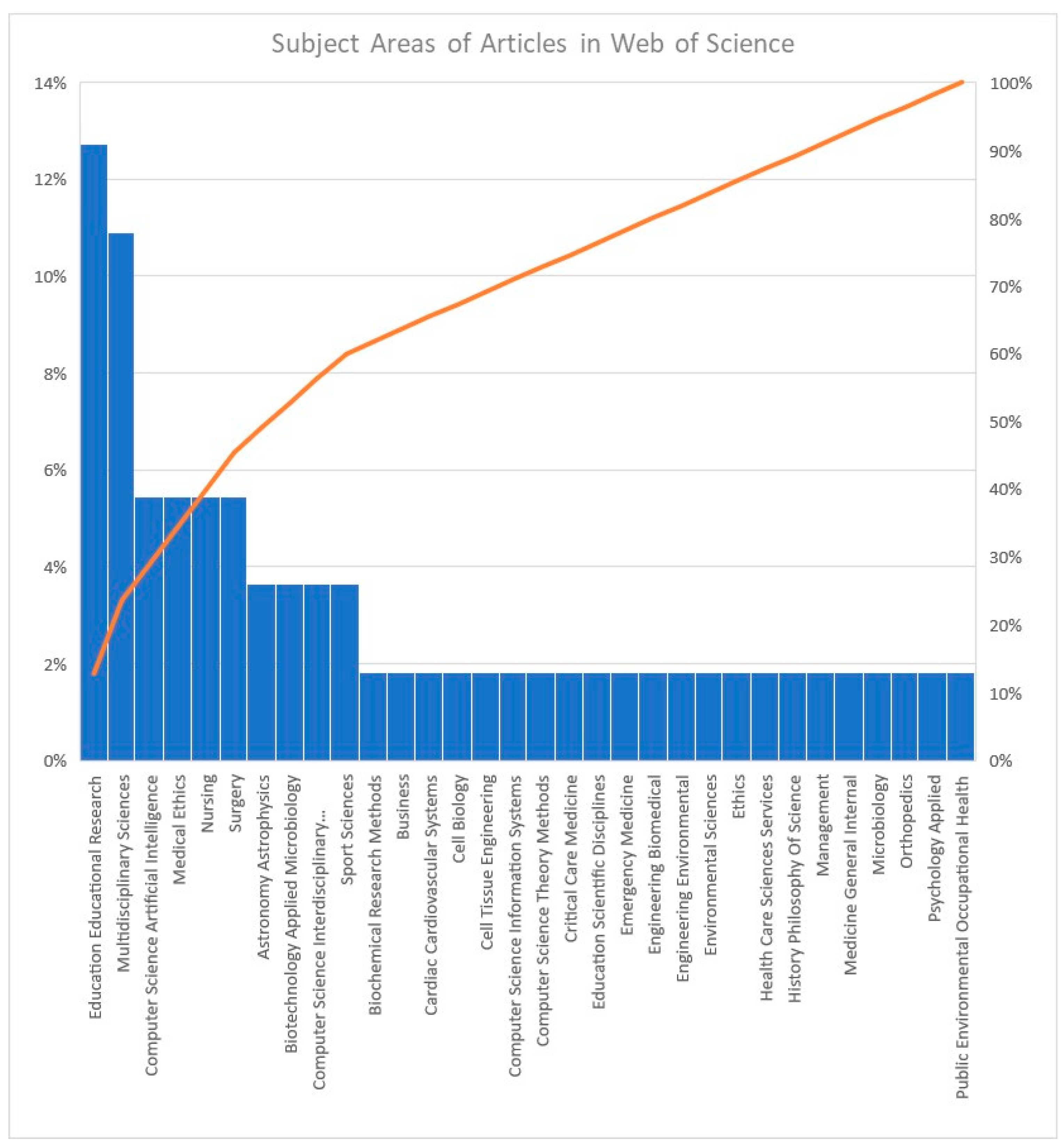
In a search conducted in March 2023 in the Web of Science database, it was possible to verify that forty (40) articles have been published approaching the ChatGPT subject. These articles are mostly focused on the Education, Educational Research, Multidisciplinary Sciences and Computer Science Artificial Intelligence fields, as can be verified through Figure 1, which shows the areas of Web of Science covered.
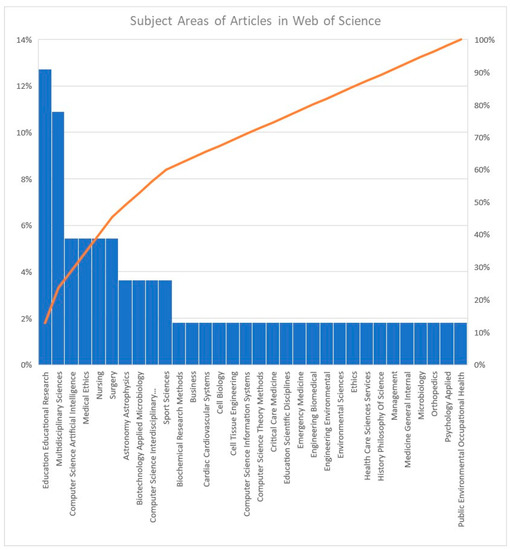
Figure 1.
Articles based on subject areas in Web of Science. Source: Data retrieved from the Web of Science database.
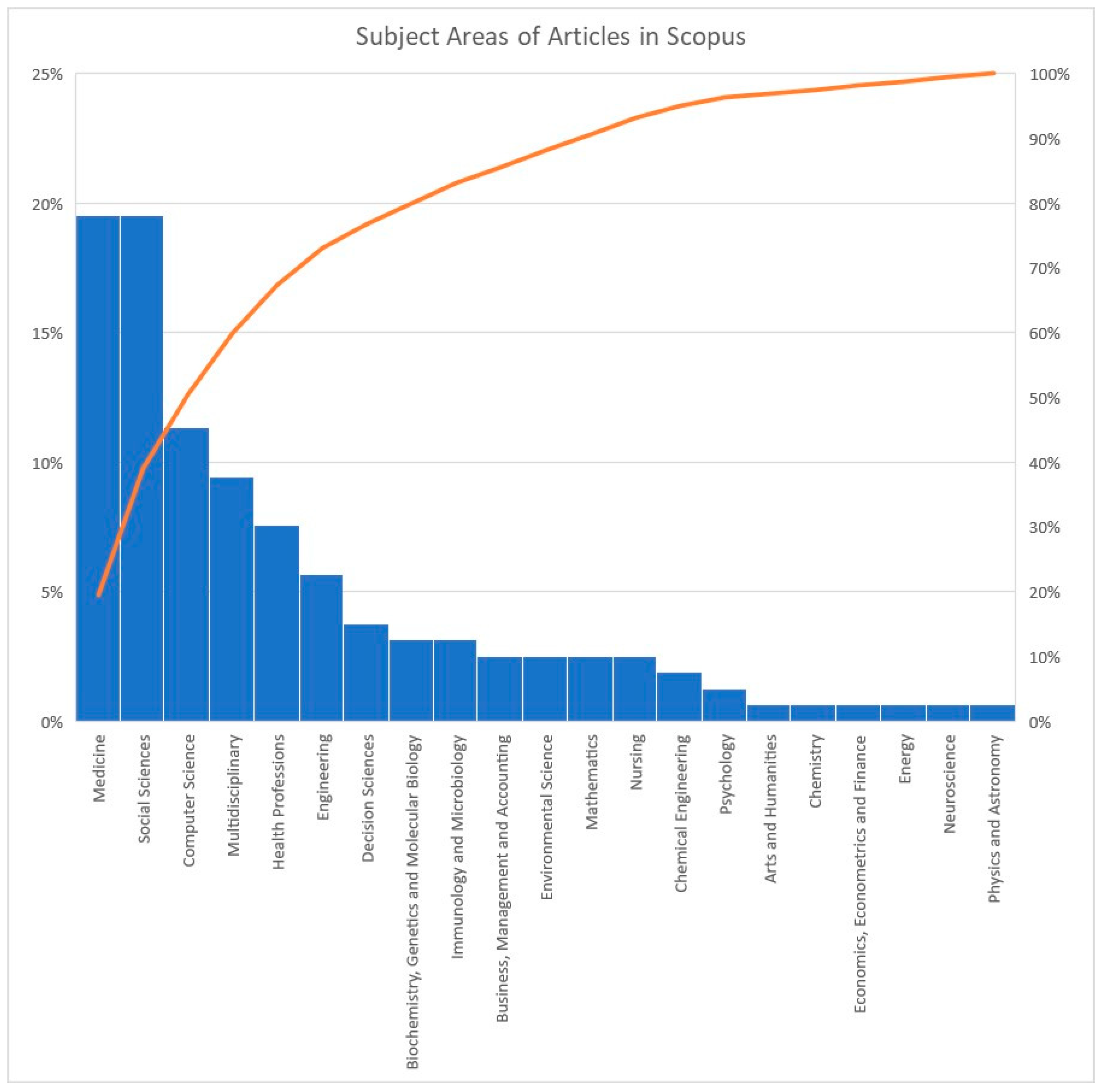
By conducting the same search on the Scopus database, ninety-eight (98) more articles were found, which are mostly classified into the medicine, social sciences, computer science and multidisciplinary subjects (Figure 2). Even though this sample of articles is higher than that of the Web of Science database, none of them are related to supply chain, logistics and operations management areas.
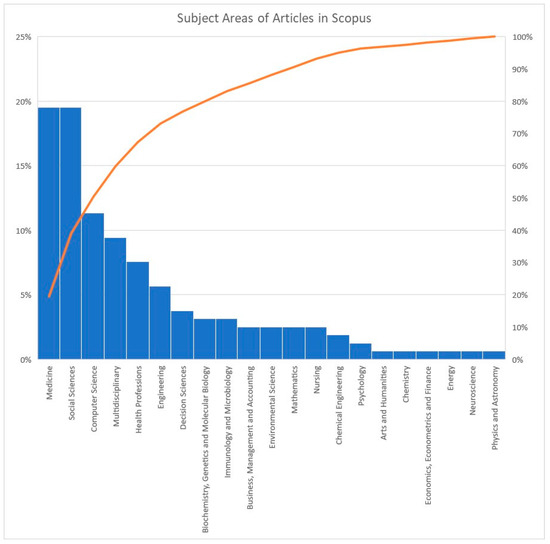
Figure 2.
Articles based on subject areas in Scopus. Source: Data retrieved from the Scopus database.
It is interesting to note the rapid growth of publications since November 2022 in the two main search databases. These studies are mostly focused on the impacts on science and research conduction, educational systems, medical applications, computers and artificial intelligence and other applied science applications. However, as demonstrated by Figure 1 and Figure 2, these studies do not cover the supply chain and operations management field, which reveals a huge opportunity for research in this area of knowledge. Although many discussions are taking place regarding the potential impacts of ChatGPT in the management field from the practitioners’ side, there is an evident gap in terms of published research approaching this matter, especially for the supply chain management area. This evidences an opportunity to explore the theme of logistics and supply chain management as an initial and novel contribution to the field, which is the main purpose of the article herein proposed.
3. ChatGPT in Supply Chains
As already mentioned, some discussions regarding ChatGPT in supply chains are taking place from the practitioners’ side, even though this is still in an incipient stage. These approaches can be found through some publications in technical and industry magazines, specialized blogs and company websites. With the aim of finding evidence of these approaches, some publications were selected in a search conducted into the Google search platform. This method was chosen as it would not otherwise be possible to conduct a systematic literature review due to the absence of publications in the field, as already demonstrated in Section 2 of this manuscript. Therefore, the criteria for search into the Google platform were the following words “ChatGPT in Supply Chains” and “ChatGPT in Logistics”. Only articles discussing ChatGPT in these specific subjects were selected. Another criterion used for selecting the articles was the reliability of the identified sources. Verified criteria such as time of existence, company’s webpage and blog’s relevance, as well as authors’ expertise were used. After this screening process, as an outcome, a sample of only ten (10) articles approaching ChatGPT in supply chains were found. They were published in 2023 (January to March). Table 1 summarizes these articles by providing their purpose and presenting the main findings and applications as discussed by each one.

Table 1.
Summary of articles’ content found in specialized magazines, blogs and company websites.
Based on these articles presented in Table 1, it is possible to identify that, although ChatGPT can support and facilitate supply chain activities and processes, especially those related to the interface between supply chain members (e.g., focus company, customers and suppliers), by streamlining communication and processes and enhancing visibility and transparency, it will not be able to initially generate huge transformations in supply chain management. Additionally, another found evidence is that this technology cannot completely replace the practitioners’ ability in the decision-making process in supply chains.
Besides the benefits and other opportunities regarding the applications of ChatGPT in supply chains, some authors have emphasized some challenges that this technology might need to overcome. These are related to skilled people to operate this disruptive technology, compliance, ethical and legal aspects and data accuracy. It is important to point out that those challenges are in the early stage of evidence, and many more studies are required in order to explore these challenges related to the adoption of ChatGPT in operations and supply chain management.
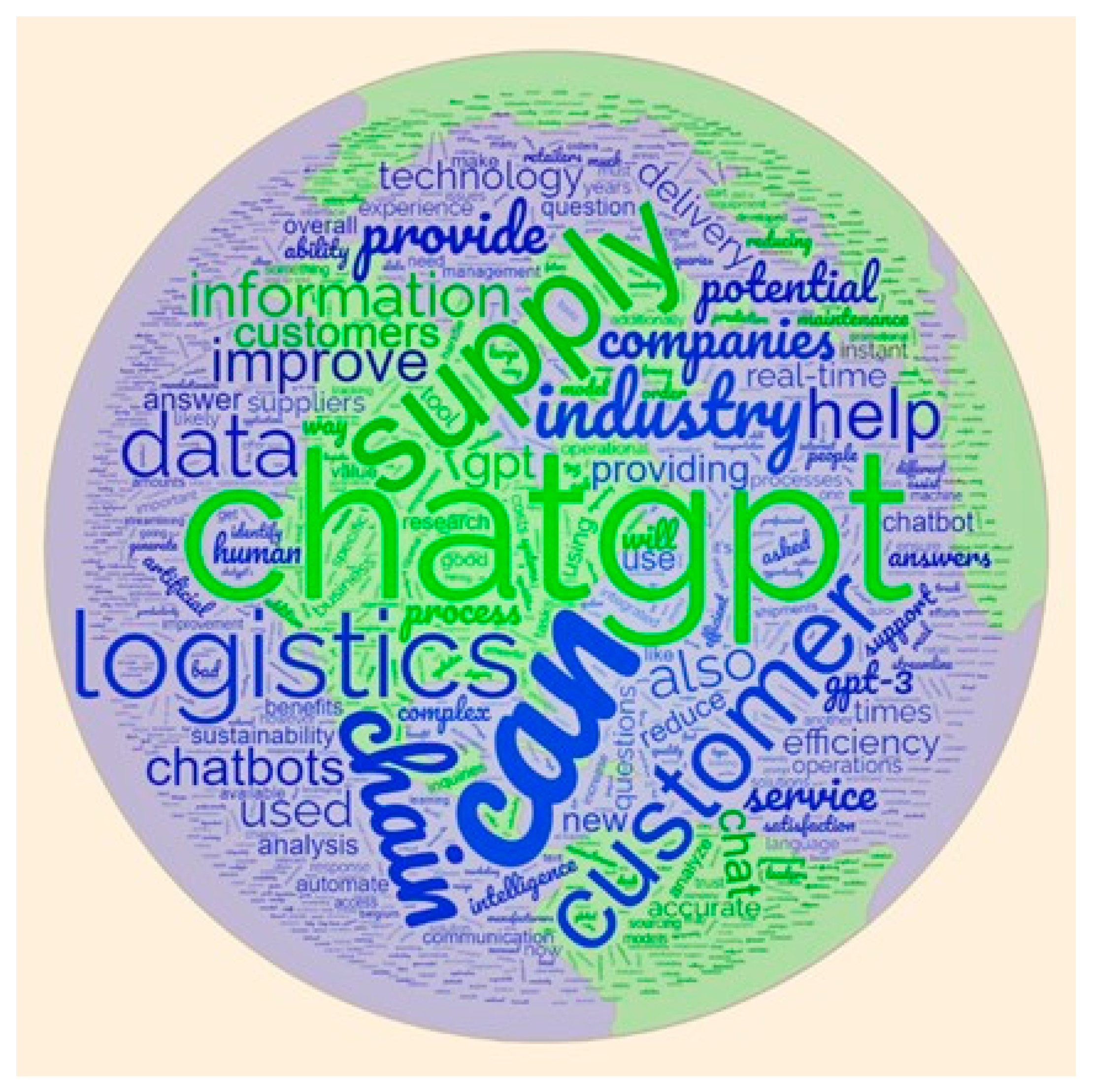
By analyzing this sample of articles with the use of the WordClouds platform (www.wordclouds.com (accessed on 10 February 2023)), it was possible to extract the following word cloud (Figure 3) from the sample, which demonstrates the main words included in the articles listed in Table 1. Some words are verbs, which are linked with what ChatGPT is able to do for supply chains. These main verbs are: can, improve, help, provide and reduce. This is because the potential impacts that ChatGPT applications can provide for supply chain management processes are, for example, improving efficiency, reducing waste and helping and supporting a supply chain’s decision-makers. Other words are substantives, which are related to the elements pertaining to supply chains that are impacted by ChatGPT applications. These words are: supply, logistics, companies, industry efficiency, customer, service, data and technology.
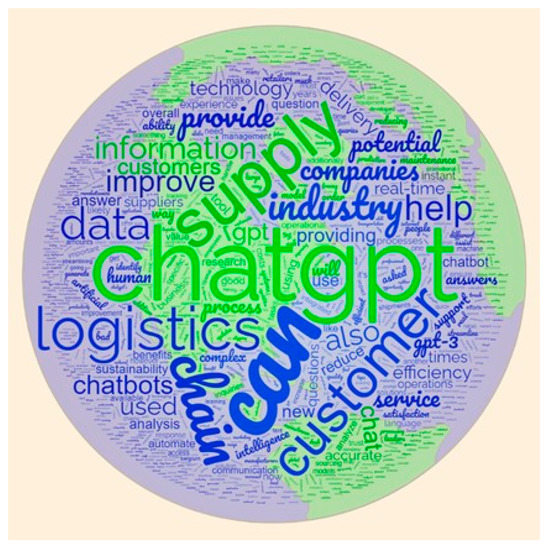
Figure 3.
Word cloud generated from the content sample. Source: Generated by applying the content in WordClouds Platform (www.wordclouds.com (accessed on 10 February 2023)).
As with that which occurs with the Industry 4.0’s technologies and their relevant impact for the innovation and improvements of supply chains’ processes’ performance [3,5,19,20,21], the content herein analyzed also demonstrates some potentialities for the improvement and innovation of supply chains, especially for those which involve communication, relationships and integrated processes across the supply chain systems. For instance, some research has clearly presented that emergent technologies cause significant impacts on innovation in specific fields (e.g., blockchain for the agricultural field [22] or digital technologies for aquaculture [23]). As showed by these examples, this potential for innovation on different fields’ supply chains may be achieved with ChatGPT implementation. However, as argued by [24], it is important to take into consideration the barriers when implementing artificial intelligence technologies such as ChatGPT on supply chains. These are dependency on multi-actor collaboration in supply chains, disparate data sources, the unwillingness of actors to embrace artificial intelligence, change management issues and lack of artificial intelligence governance framework. Additionally, this author points out the importance of the government’s intervention to support emergent technology’s adoption in supply chains.
4. Conclusions
Although ChatGPT is one of the most emergent promising technologies, many questions still remain regarding its potential application in supply chains in the short term. As identified in the analyzed articles, this technology may take time to achieve a certain stage of maturity and generate significant benefits in the complex processes of supply chain management. However, it is certain that ChatGPT is a technology that is here to stay, and it is rapidly going to start to be incorporated into supply chain activities. Another relevant evidence obtained is that the level of expertise of practitioners involved in supply chain’s activities will continue to be required, once ChatGPT can only provide accurate answers if plausible questions are performed. Therefore, the evidence demonstrates that ChatGPT can support, but it cannot replace, the whole ability of supply chain experts in the decision-making process.
As can be noticed in Table 1, initial evidence shows that ChatGPT can benefit supply chains through many applications such as route optimization, predictive maintenance, order shipment, customer and supplier relationships, data analysis, ordering process, automating invoices, reducing waste and workforce training and guidance, amongst others. These applications can potentially generate strategic outcomes in terms of cost reduction and processes’ performance. Although this article is limited by the lack of more robust content to be analyzed, especially available in the scientific databases, it accomplishes its purpose, which is to provide initial evidence regarding ChatGPT in supply chains, as an element of guidance and encouragement for practitioners and researchers interested in the development of this subject.
Potential Research Agenda
Concerning the research related to ChatGPT, it was highlighted that there are no approaches covering the subject for the supply chain field, which was the reason that motivated the author to write this viewpoint article. Due to this reason, many questions may be raised regarding this new technological phenomenon. Therefore, as one of the purposes of this manuscript, the following topics attempt to establish an initial research agenda, which is surely not limited to, but aims to contribute as an initial encouragement for researchers interested in deploying research topics related to the subject. Some topics that may be deployed, based on the initial evidence observed in this study are:
- How can ChatGPT positively impact the performance of supply chain processes (e.g., plan, source, make, delivery, return)?;
- What are the main supply chain activities that can benefit from ChatGPT technology?;
- How can ChatGPT be applied to these supply chain activities?;
- How effective can ChatGPT technology be for the supply chain’s activities? What are the most relevant ones? What are the limitations and uncertainties of ChatGPT application for supply chain activities?;
- What are the pros and cons of ChatGPT application in supply chains?;
- How can ChatGPT influence the search for more sustainable and resilient supply chains?;
- What are the barriers and critical success factors to be considered in the implementation of ChatGPT in supply chains?;
- How can ChatGPT be integrated with other emergent technologies (e.g., Big Data Analytics, Metaverse, Additive Manufacturing, Blockchain) in order to achieve a higher performance on supply chain processes?;
- What are the different attributes to be taken into account when comparing ChatGPT for general use and its applications on supply chain processes?;
- How can ChatGPT contribute to supporting supply chains during disruptive and unexpected events (e.g., pandemics, war, natural disasters)?;
- What is the role of ChatGPT in the transition from Supply Chain 4.0 to Supply Chain 5.0?;
- What aspects must be considered in terms of the confidentiality, information security and ethical aspects of supply chains when implementing ChatGPT technology?
In order to understand these potential topics, empirical research such as multiple case-studies and surveys are recommended to investigate this phenomenon. Additionally, once satisfactory content regarding ChatGPT in supply chains becomes available in the scientific search databases, a systematic literature review would be more than welcome to show the structural knowledge regarding this disruptive technology in the supply chain area. Action research could be also deployed in the sense to understand implementation issues and barriers during the rollout process of this technology in the supply chain processes of organizations.
Funding
This research received no external funding.
Data Availability Statement
Not applicable.
Conflicts of Interest
The author declares no conflict of interest.
References
- OpenAI. ChatGPT: Optimizing Language Models for Dialogue; OpenAI: San Francisco, CA, USA, 2022; Available online: https://openai.com/blog/chatgpt/ (accessed on 15 February 2023).
- Gravier, M. The more things change, the more they stay the same. In Supply Chain Management Review; Peerless Media: Framingham, MA, USA, 2023; Available online: https://www.scmr.com/article/the_more_things_change_the_more_they_stay_the_same (accessed on 10 February 2023).
- Frederico, G.F.; Garza-Reyes, J.A.; Anosike, A.; Kumar, V. Supply Chain 4.0: Concepts, Maturity and Research Agenda. Supply Chain. Manag. 2020, 25, 262–282. [Google Scholar] [CrossRef]
- Toorajipour, R.; Sohrabpour, V.; Nazarpour, A.; Oghazi, P.; Fischl, M. Artificial intelligence in supply chain management: A systematic literature review. J. Bus. Res. 2021, 122, 502–517. [Google Scholar] [CrossRef]
- Frederico, G.F. From Supply Chain 4.0 to Supply Chain 5.0: Findings from a Systematic Literature Review and Research Directions. Logistics 2021, 5, 49. [Google Scholar] [CrossRef]
- Younis, H.; Shishodia, A.; Gunasekaran, A.; Min, H.; Munim, Z.H. Applications of artificial intelligence and machine learning within supply chains: Systematic review and future research directions. J. Model. Manag. 2022, 17, 916–940. [Google Scholar] [CrossRef]
- Sharma, R.; Sundarakani, B.; Alsharairi, M. The role of artificial intelligence in supply chain management: Mapping the territory. Int. J. Prod. Res. 2022, 60, 7527–7550. [Google Scholar] [CrossRef]
- Ahmed, T.; Karmaker, C.L.; Nasir, S.B.; Moktadir, M.A.; Paul, S.K. Modeling the artificial intelligence-based imperatives of industry 5.0 towards resilient supply chains: A post-COVID-19 pandemic perspective. Comput. Ind. Eng. 2023, 177, 109055. [Google Scholar] [CrossRef] [PubMed]
- O’Marah, K. ChatGPT and Supply Chain: The Good, The Bad, and The Ugly; Zero100: London, UK, 2023; Available online: https://zero100.com/content/chatgpt-and-supply-chain-the-good-the-bad-and-the-ugly/ (accessed on 11 February 2023).
- Burian, J. Does ChatGPT Offer Real Value to the Supply Chain? IIoT World: Cleveland, OH, USA, 2023; Available online: https://www.iiot-world.com/industrial-iot/connected-industry/does-chatgpt-offer-real-value-to-the-supply-chain/ (accessed on 11 February 2023).
- Pukkila, M. Exploring the Power of ChatGPT: An Opportunity for Supply Chain Transformation; Gartner: Stamford, CT, USA, 2023; Available online: https://blogs.gartner.com/power-of-the-profession-blog/exploring-the-power-of-chatgpt-an-opportunity-for-supply-chain-transformation/ (accessed on 13 February 2023).
- Nunez, V. How Chat GPT Thinks It Can Revolutionize the Logistics Industry? ShipLilly: Medley, FL, USA, 2023; Available online: https://www.shiplilly.com/blog/how-chat-gpt-thinks-it-can-revolutionize-the-logistics-industry/ (accessed on 18 February 2023).
- Potter, R. How Can Logistics Companies Benefit with the Usage of ChatGPT? Anolytics Medium: San Francisco, CA, USA, 2023; Available online: https://anolytics.medium.com/how-can-logistics-companies-benefit-with-the-usage-of-chatgpt-c38e85d4c4cb/ (accessed on 21 February 2023).
- Berthiaume, D. ChatGPT Is Coming—What It Means for Your Enterprise; CSA: Chicago, IL, USA, 2023; Available online: https://chainstoreage.com/chatgpt-coming-what-it-means-your-enterprise (accessed on 21 February 2023).
- Ashcroft, S. How might ChatGPT help Supply Chains. In Supply Chain Digital; BizClick: London, UK, 2023; Available online: https://supplychaindigital.com/digital-supply-chain/how-can-chatgpt-help-supply-chains (accessed on 22 March 2023).
- Rhodes, A. Top 3 Benefits of Using ChatGPT in the Supply Chain Industry; Stonge: York, PA, USA, 2023; Available online: https://www.stonge.com/top-3-benefits-of-using-chatgpt-in-the-supply-chain-industry/ (accessed on 22 March 2023).
- Reddy, S. How Startups Can Leverage ChatGPT to Optimize Supply Chain Management; Inc42: New Delhi, India, 2023; Available online: https://inc42.com/resources/how-startups-can-leverage-chatgpt-to-optimise-supply-chain-management/ (accessed on 22 March 2023).
- Trivedi, S. ChatGPT and Its Role in Logistics & Supply Chain Management; Management Enthusiast: Dehrandun, India, 2023; Available online: https://managemententhusiast.com/chatgpt-and-its-role-in-logistics-supply-chain-management/ (accessed on 22 March 2023).
- Büyüközkan, G.; Göçer, F. Digital Supply Chain: Literature review and a proposed framework for future research. Comput. Ind. 2018, 97, 157–177. [Google Scholar] [CrossRef]
- Ghadge, A.; Er Kara, M.; Moradlou, H.; Goswami, M. The impact of Industry 4.0 implementation on supply chains. J. Manuf. Technol. Manag. 2020, 31, 669–686. [Google Scholar] [CrossRef]
- Garay-Rondero, C.L.; Martinez-Flores, J.L.; Smith, N.R.; Caballero Morales, S.O.; Aldrette-Malacara, A. Digital supply chain model in Industry 4.0. J. Manuf. Technol. Manag. 2020, 31, 887–933. [Google Scholar] [CrossRef]
- Udalov, A.; Udalova, Z.; Postnikova, L. Application of Blockchain Technologies in Digital Agriculture. In Networked Control Systems for Connected and Automated Vehicles; Guda, A., Ed.; Lecture Notes in Network Systems; Springer: Cham, Switzerland, 2023; Volume 509, pp. 1663–1673. [Google Scholar] [CrossRef]
- Rowan, N. The role of digital technologies in supporting and improving fishery and aquaculture across the supply chain—Quo Vadis? Aquac. Fish. 2023, 8, 365–374. [Google Scholar] [CrossRef]
- Shrivastav, M. Barriers Related to AI Implementation in Supply Chain Management. J. Glob. Inf. Manag. 2022, 30, 1–19. [Google Scholar] [CrossRef]
Disclaimer/Publisher’s Note: The statements, opinions and data contained in all publications are solely those of the individual author(s) and contributor(s) and not of MDPI and/or the editor(s). MDPI and/or the editor(s) disclaim responsibility for any injury to people or property resulting from any ideas, methods, instructions or products referred to in the content. |
© 2023 by the author. Licensee MDPI, Basel, Switzerland. This article is an open access article distributed under the terms and conditions of the Creative Commons Attribution (CC BY) license (https://creativecommons.org/licenses/by/4.0/).