1. Introduction
The current era requires adaptation to the demands of the rise of digitization throughout society. One of the most significant trends in the field of transport and logistics is the gradual digitization and electronization of all processes, including the processing of transport documents. The regulation that governs the transport contract in international road freight transport is the CMR Convention. The Convention applies to every contract for the carriage of goods by road for reward, if the place of taking over of the goods and the place designated for delivery, as specified in the contract, are situated in two different States, of which at least one is a contracting State to this Convention. This provision shall apply irrespective of the permanent residence and nationality of the parties [
1]. At present, the paper form of transport documents is used in the vast majority of cases. The introduction of electronic consignment notes (e-CMR) and other electronic documents brings with it a number of advantages, one of the most significant being the increased transparency of the transport process and the reduction in costs during transport. The aim of this paper is to carry out research on the impact of the introduction of the electronic transport document e-CMR on the competitiveness of carriers. On the basis of the results of the research among carriers, the aim of the article is also to identify the impact of the introduction of e-CMR on time savings in invoicing, which presupposes an increase in the turnover of capital in the transport services sector. A significant factor in any business document is the security of information. Therefore, another objective of the paper is to examine the impact of the introduction of e-CMR on the security and transparency of information related to the transport of goods and also the impact on the environment.
In addition to the technological aspects, the research is also devoted to the legal framework for the use of e-CMR, which results from the CMR Convention and its additional protocol on the electronic consignment note. An important part of the analysis is also the assessment of the environmental and economic impacts of digitization, as well as the identification of possible risks that the digitization of transport documents brings with it.
From the perspective of the issue under research, it is appropriate to ask research questions that we will answer.
RQ1: Which factors influence the adoption of (or intention to adopt) electronic consignment notes (e-CMR) among road freight transport companies?
RQ2: To what extent is e-CMR currently used in road freight transport companies (overall and by company size/operation scope)?
Based on the expected process and documentation efficiencies, the main hypothesis is formulated as follows.
H1: Compared to paper consignment notes, e-CMR is expected to reduce paper consumption and is associated with a shorter time lag between transport completion and invoice issuance, thereby improving operational efficiency and environmental performance.
These questions will help us better direct our research and focus on the factors that are most affected by the transition to electronic versions of consignment notes.
2. Literature Review
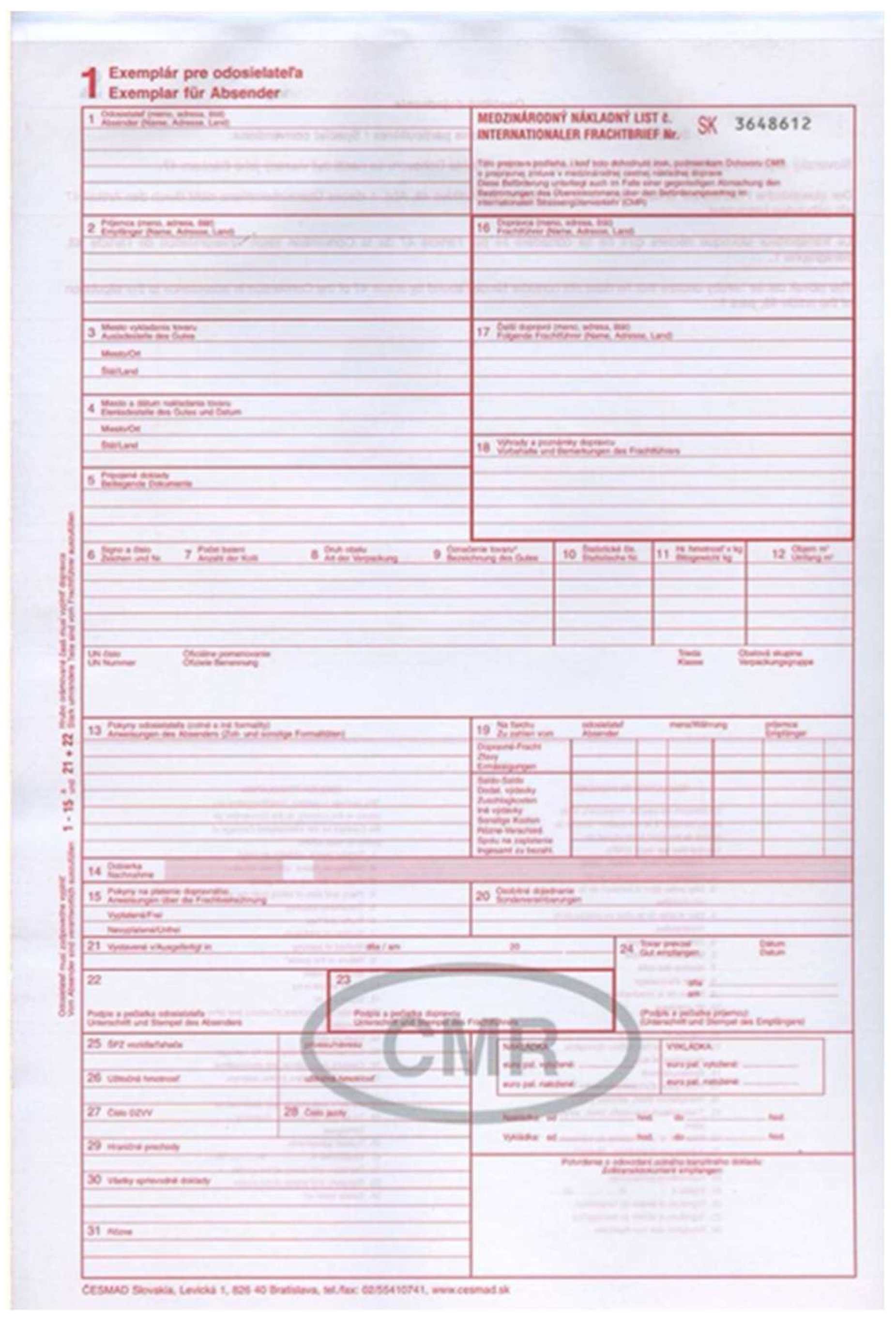
The document of the conclusion of the contract of carriage is the consignment note (NL CMR) (
Figure 1) [
1]. The consignment note shall be made out in three original copies. The first copy of the consignment note shall be given to the sender as a document of delivery of the consignment to the carrier, the second shall belong to the consignee of the consignment as a document of receipt of the consignment from the carrier, and the third shall be retained by the carrier as a document of delivery of the consignment to the consignee [
1].
From the perspective of the transport chain, the consignment note is the most widely used document in road freight transport. It is used not only for international transport, for which it is primarily intended, but also for domestic transport of goods. This is due to the fact that its construction fully meets the needs of the individual parties to the contract of carriage. The main point is the clearly defined points that must be filled in by the individual contracting parties in order to ensure, on the one hand, the validity of the consignment note and, on the other hand, the liability of the individual contracting parties arising from the CMR Convention.
The consignment note carries a lot of necessary information that is needed to fulfil the validity of the contract. It is also necessary to fill in this information correctly, given that in the event of damage to the consignment, it is the consignment note that is the document in which the data on the nature of the condition of the transported consignment are recorded. Therefore, to enhance the security of the entire transport chain, it is appropriate to introduce electronic information exchange to ensure that the data contained in transport documents are more accurate, clearer, and more legible.
An important part of the Convention concerns the limits of liability and the liability of the individual contracting parties, also from the point of view of use for purposes other than road freight transport. The liability limit is currently at the level of 8.33 SDR per kilogram of gross weight of the transported consignment [
1].
When identifying the requirements for introducing e-CMR and comparing e-CMR with the classic paper CMR consignment note, it is essential to analyze the security of the consignment note and the data it contains. In road freight transport, the consignment note is a key document for documenting the shipment and related information. In the field of road transport, it is mainly the security of the data of the individual contracting parties and of the consignment being transported, and also about the places of individual loading and unloading and also about the data on the carrier’s vehicles.
The consignment note is a document that carries sensitive information. Therefore, it is important to compare whether the data are more secure if the note is handled only by the contracting parties through employees or if it is handled only by an authorized person in electronic form. At present, the most widely used form is the classic paper form of the consignment note, for the reason that it is not possible to fully integrate and securely connect the individual contracting parties of the transport and thus ensure the full completion of the electronic version of the consignment note. In the electronic version, the information contained in the consignment note is clearly anchored in time, and it is not possible to change it so easily.
In road freight transport, it is also important to focus on the comparison of individual sectors in road freight transport. One of the key sectors is the transport of dangerous goods. In this transport, all processes must be set up so that it is possible to accurately track the individual steps during transport. These steps are important to monitor in real time today, i.e., through the use of electronic means and artificial intelligence. Various studies are based on the fact that in transport, accurate data must be used and available in real time. This issue is addressed in several studies [
2,
3] where the results are proposals for changing systems in small and medium-sized enterprises where the solutions also include the use of, for example, QR codes. Road freight transport is a basic component of multimodal transport, and it is also important in the current era to direct processes so that they are close to the complete digitization of processes. This is important mainly in cases where transport is also carried out between continents, and it is also important, due to the language barrier, to maintain the integrity and completeness of the data. From these processes, it is also possible to draw on the implementation of processes for the optimization of e-CMR [
4,
5].
These links are also important in maintaining the continuity of the entire transport chain [
6,
7,
8]. It is therefore necessary to focus on logistics activities and their electronic connection with other documents and activities that are in the transport chain. In this process, one of the most important elements is the integrity of the information and its preservation in the form in which the link in the chain entered it. In this approach, it is also important to look at it from several perspectives. First of all, how to create a data retention process. For example, the aim of the study [
9] is to assess the compliance of the Korean Electronic Bill of Lading (E-B/L) Act with the Rotterdam Rules, with a focus on the challenges of integrating blockchain technology for more efficient and secure maritime logistics [
9]. From these principles and processes, it is also possible to draw on the process of complete digitization of the CMR consignment note.
It is also very good to rely on blockchain, where this method guarantees data protection, and these methods are currently being explored for use in transport [
10]. The research team [
11] describes a scheme for verifying the integrity of data based on blockchain, which ensures greater scalability and the use of cloud resources, while preventing damage to data when entering the cloud [
11]. The results of these studies are important for setting up electronic data exchange systems.
An interesting perspective is also the digitization of processes, for example, after disasters that significantly affect the entire chain [
12]. The main thing here is to focus on how to react as quickly as possible to the situations that have arisen [
12].
Throughout the process, it is very important to maintain legal procedures, also due to the fact that transport under the CMR Convention is carried out mainly between individual states. Therefore, in addition to the procedures set out directly in the CMR Convention, it is also important to observe the individual legal frameworks in the countries through which it passes. A large number of professional scientific studies have dealt with these aspects [
13,
14,
15].
In these processes, it is also important to maintain and qualify employees in transport companies. These employees must master the processes related to the change of technology, which is why this is one of the very important aspects of this issue [
16,
17,
18].
2.1. Neutralization of the Papier CMR Consignment Note
At present, an important element of the transition from the paper to the electronic version of transport documents seems to be the neutralization of paper transport documents. The neutralization of the CMR represents the process of changing the original consignment note CMR. This process takes place for various reasons, but mainly in the case of a change in the transport order, such as a change of carrier during transport or a change in the place of unloading of the consignment. However, the neutralization of the consignment note CMR is also a very risky process. The neutralization of transport documents can be misused for various forms of fraud with or without the knowledge of the carrier:
Risk of fraud, where the carrier does not know the details of the purchase contract, which is concluded between the sender (producer of the consignment) and the carrier (customer of the transport). The consignment note CMR, in the performance of the contract, is a document that confirms the performance of the purchase contract from the position of the carrier. If the carrier plans to commit fraud and intends to transport the consignment to a place other than that declared to the producer of the consignment, he will ask the carrier to neutralize the CMR consignment note. The CMR consignment note is changed during the transport, and the consignment is actually transported to a place other than that declared in the copy received by the sender of the consignment. If the carrier neutralizes the consignment note CMR intentionally, he misleads the producer.
This creates a tax risk because, for the tax authority, the CMR consignment note is a key document used to verify whether a consignment was transported. In cases of CMR ‘neutralization’, tax evasion or an incorrect tax assessment may occur, since the authority may rely on a consignment note that describes the transport route differently from how it was actually performed.
Insurance risk: The validity of the carrier’s liability insurance is generally conditional on compliance with the CMR Convention, meaning that the carrier is not permitted to modify the information recorded in the consignment note. Neutralization is currently a very common phenomenon, especially in more complex transports with several changes. In some cases it is necessary, but it is important to realize that it can also carry risks. The main risks in carrying out neutralization are mainly the loss of evidence of the original transport, which can complicate or make it impossible to prove the course of transport and the liability of individual parties in the event of a dispute. Furthermore, there is a change in liability, where in the case of incorrect neutralization, there may be an incorrect distribution of liability between the individual participants in the transport. Likewise, theft or deterioration of the goods can be hidden by neutralization.
The basic element to minimize the risks that arise during neutralization is thorough documentation and accurate recording of every change during transport, checking the identity of individual subjects involved in the change of the consignment note, and securing documents against forgery. The digitization of documents and the course of transport can significantly contribute to minimizing the risks during a change of disposition in the consignment note.
Among the biggest advantages of using e-CMR from the point of view of neutralization, we can include mainly the increased clarity of each change made in the consignment note CMR, which is automatically recorded in the system and thus creates an unchangeable trace of all changes made. An important aspect of changing an electronic document is the fact that all interested parties, including the financial administration, will be informed of the change. This reduces the risk of data manipulation. Better traceability of each change in the NL and its identification, thanks to the digital record, facilitates reduction of the risk of loss and damage to the consignment note CMR and an increase in the accuracy of the recorded data, where, in practice, there is often a poor or illegible record of data [
19].
This issue has also been analyzed in various scientific publications. In Ref. [
20], the authors (Poliak, Tomicová, Jaśkiewicz) conducted a questionnaire survey in which the analyzed results show, for example, a high degree of experience with neutralization among drivers. The survey shows that not all carriers have experience with neutralization. It should also be noted that some of the drivers surveyed heard this term for the first time. As many as 73% of respondents had encountered neutralization in practice, and the remaining 27% of respondents did not know this term or had no personal experience with neutralization [
20].
Another important part of neutralization is also the time horizon when drivers received instructions for neutralization during transport, and according to the research, the results were as follows. As many as 67% of respondents stated that they received instructions for neutralization during transport. Only 17% of respondents stated that they received an instruction for neutralization at the beginning of the transport, and 16% of respondents stated that they received it before the end of the transport [
20].
2.2. Existing Forms of the CMR Consignment Note
The consignment note is currently used mainly in paper form. However, both variants of the consignment note are used. Therefore, it is necessary to look at both processes of use. First of all, it is necessary to realize that the use of consignment notes is a process that involves subjects throughout the transport chain. We must also add technological equipment and processes to the subjects. It is always very important to adhere to the conditions set out in the CMR Convention [
1,
19], in which all the conditions of use are clearly defined.
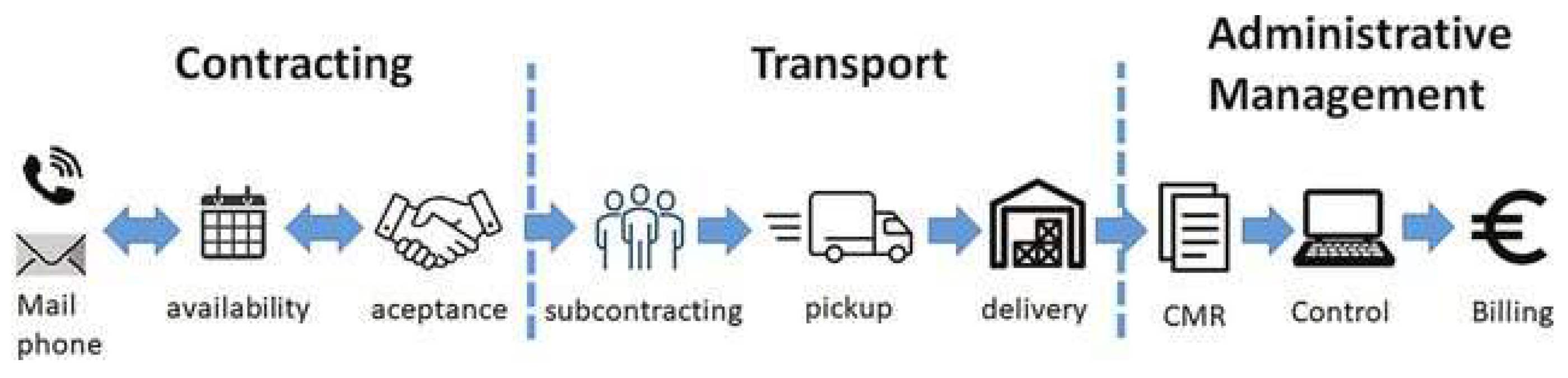
When using CMRs in paper form, the processes are divided as follows, as we can see in
Figure 2 [
21].
In the first phase, the load is assigned by telephone, e-mail or through a spreadsheet. Dispatchers distribute the load, check the availability of trucks and wait for confirmation of receipt. This is followed by transport, in which smaller carriers can also use subcontractors. At the end of this phase, the load is delivered. After delivery, the next phase of administrative management follows, in which a paper consignment note is issued and the dispatcher, after the delivery of the CMR upon the arrival of the vehicle, records all information in various systems so that it is possible to proceed with the creation of an invoice and the conclusion of the transaction [
21].
When using e-CMR, this process is significantly shortened. In the phase of concluding contracts, transport is still negotiated in the same way, but the data are stored on a platform that automatically generates an e-CMR. From this point on, the e-CMR is available in digital format to all interested parties. The carrier can register various events of the transport service on the platform using an application that allows access to the platform via a mobile phone. In addition, all information is available in real time to all parties involved through various devices. After the end of the transport stage, all data are immediately available to the employees of the administrative department. In this last stage, the e-CMR platform can be integrated with the company’s IT platform through an API (application programming interface). In this last phase, the employees should have the information directly in their company systems [
21].
Legal certainty—the CMR must provide legal certainty to all participants in the process:
CMR: the paper consignment note is recognized by several countries and is used throughout the EU, providing legal certainty for all parties involved
e-CMR: The digital consignment note is recognized in some European countries, but there are still some important countries that do not recognize the e-CMR as a credible document
Data integrity- it must not be possible to change or damage the recorded data:
CMR: Several copies of the CMR are created for each participant in the transport chain, so if there is any change in one of them, this change can be compared with the data in other copies of the consignment note. In this situation, however, it is necessary to share the copies again. However, copies of the consignment note can be damaged or lost,
E-CMR: The data are stored and guarded by a third party, outside the operational process, which is responsible for their immutability. Storing data on a digital medium allows the use of other technologies, such as Blockchain, which can help ensure the immutability of data. The digital repository also helps to prevent physical deterioration.
These processes and data integrity associated with the overall digitization of processes are examined in [
22], where the authors analyzed the processes in detail using various data processing systems, and subsequently, data modeling was possible using time savings [
23,
24]. These examined processes are also used in various variations in processes without the use of an electronic version or only with the use of an electronic version of the consignment note, as described in the following study [
25].
Consistency of information—the data that exist for a given transport must match in all copies:
CMR: Several copies of the information are created, one for each interested party. Since carbon paper is used, the information on all copies is the same. Although there are several copies, additional information can be added to some of them.
e-CMR: There is a single data repository, which ensures the consistency of information. These processes are modeled in the research [
26], where the authors examine the use of the electronic version of the consignment note from the point of view of data security in the transport chain.
Availability of information—the data must be accessible to the participants of the consultation process, and on their basis, the participants must perform the operations that have been assigned to them:
CMR: The data that are available to each interested party are as entered on their copy of the consignment note, and therefore are only accessible to the person who has a specific part of the consignment note.
e-CMR: The data are stored in a digital medium, so they are available to all interested parties on various types of devices with internet access.
Protection against incorrect data provision:
CMR: The information that is recorded is written manually by the carrier at the beginning of the transport. This information can be received in various ways, such as by telephone, when picking up the load. There is therefore a risk of data error.
e-CMR: The information is entered by the data processor and is not communicated to others. The possibility of error is not excluded, but this risk is smaller. The party that processes the data is also their originator, which prevents errors in communication.
It is also important to realize how important it is to maintain processes in companies when switching to electronic communication and handling of documents [
27,
28,
29,
30].
Reducing the amount of waste, which means any activity that requires more resources (human, financial or time) than is necessary:
CMR: Some copies of the paper consignment note must be physically delivered between the individual participants in the process. The delivery of CMR documents at the end of the transport to the administrative worker for invoicing creates a delay. Administrative staff must enter all information into their business systems.
e-CMR: The information is available in digital form from any device with internet access, and there is only one copy of the consignment note.
It is also very important in this aspect to take into account the sustainability of processes throughout the transport chain with regard to maintaining the quality and availability of transport services [
31].
When analyzing the current situation, it is important to consider all available accurate information on the use of e-CMR in practice [
32,
33,
34]. Therefore, a questionnaire was compiled in which the individual advantages and disadvantages of using this type of consignment note were precisely stated. The aim of this questionnaire survey was to obtain information on the real state of use of this type of consignment note. In this survey, transport companies were given the opportunity to comment on the state of use of e-CMR in their practice. It is very important in this research to also focus on the analysis of the market in terms of the use of e-CMR from the point of view of the possibility of evaluating the rate of use of digitization in the age of artificial intelligence [
21,
35,
36,
37,
38].
3. Materials and Methods
One of the most widely used scientific methods in areas where it is necessary to know the real values of the systems used, in our case the use of the electronic version of the consignment note, is a questionnaire survey. In this survey, companies carrying out activities in the field of road freight transport were addressed.
Questionnaire Survey
The questionnaire survey addressed 600 carriers from the Slovak Republic within the Česmad Slovakia association and 500 carriers from the Czech Republic within the Česmad Bohemia association. A total of 53 companies responded to the distributed questionnaire, of which 28 were Slovak and 25 were Czech. The survey was conducted at the beginning of November 2024. The survey was conducted in two phases: the first phase of distributing the questionnaires took place in November 2024 and the second phase took place in March 2025. The return rate of the answers was limited by the willingness of the companies to answer the questionnaire. Repeated sending would, however, distort the survey. The questionnaire contained 11 questions in the order and scope indicated, so that it was possible to cover the basic issues of using e-CMR. The questions were in sequence so that it was possible to analyze the behavior of companies in connection with the use of the CMR consignment note or its electronic version. The survey asked questions aimed at the overall area under investigation, and the detailed answers to the individual questions are given in the following part of the research.
The structure of the transport companies that participated in the research was as follows: the largest group comprised medium-sized enterprises (50–249 trucks) with 38%, followed by family (1–9 trucks) and small enterprises (10–49 trucks) with 26%. The smallest group comprised large enterprises (250 or more trucks) with 10%. It is important to note here that it is the medium-sized enterprises that form the largest group of enterprises, and it can therefore be assumed that it is in this group of enterprises that the greatest need for concluding contracts in transport is created.
Subsequently, it was very important to point out whether the electronic form of consignment notes is used at all among companies, and whether there is potential for improvement in this area. The use of electronic elements in transport still has untapped potential. Therefore, it is very important to find out what percentage of companies have real experience with using e-CMR. The questionnaire showed that companies do not currently actively use these consignment notes, but a group of companies has also emerged that are considering their introduction. There were only two companies that actually use these possibilities. This point is very important from the point of view that there is room for communication with companies about the benefits of using e-CMR.
From the data in the answers to the question of why they do not use or do not want to use e-CMR, it emerged that the biggest obstacle in this is the non-participation of partners in the use of e-CMR.
Here, it is necessary to look at the primary problem of why companies do not use, or do not want to use, electronic versions of consignment notes. The biggest disadvantage is the increased cost of purchasing software for issuing e-CMR. It is therefore necessary that in the implementation of legal norms, consideration is given to simplifying the processes for the transition to e-CMR, which has a significant impact on the economic side of implementation. If it is more economically advantageous for companies to introduce these systems, the use of e-CMR will be more accessible to them.
The questions revealed the reluctance of companies to introduce new forms of digitization in the field of consignment notes. However, the questionnaire also asked about the time horizon for the introduction of e-CMR. Companies are not yet decided on implementation at all; only 14% of companies are considering introduction in the near future, and 60% of companies are not considering introduction at all. Companies do not have relevant data on the possibility of using e-CMR and also on the advantages of using these forms of concluding transport contracts. From the companies that are going to introduce e-CMR in the near future, as it emerged from the questionnaire, it is important to obtain data on the process of introducing e-CMR into the processes in the company.
In what case would it be possible to introduce e-CMR in your company? The analysis of the question posed in this way again shows that the company would use the advantages of e-CMR if they could cooperate with other companies on this document. It is therefore important to include in this process not only transport companies, but also customers, i.e., in this case primarily consignors, consignees of goods, but also subjects involved in transport (e.g., freight forwarding companies). In this question, there could have been more answers, but unequivocally, as many as 32 companies answered that they would introduce digitization if the customer asked them to. The second most frequent answer (17 companies) was that if their administration in relation to the state administration was simplified, they would consider introducing digitization.
As was explained in the analytical part, it is important to look at the neutralization of the consignment note always as a high risk. Therefore, space was also included in the questionnaire to allow companies to express their opinion on this issue anonymously. Therefore, the question was asked whether a customer had ever asked them to neutralize the CMR consignment note. The answers in the questionnaire were unequivocally that in the practice of companies, neutralization is often used. A 70% share of companies answered that they had already encountered this request, and 30% of companies had not received this request.
In the question of how many forms on average a company uses per vehicle per week, due to the fact that it was an open question, a large numerical range of answers arose. The lowest was three forms, and the maximum value was 230. The average value was approx. 17.19 forms. When omitting extreme values, the value was approx. six forms.
An important question for obtaining information on the economic assessment of the situation is also how many days on average in the company pass from the end of the transport to the issuance of the invoice for the transport. From the numerical series that was created, the average time for issuing an invoice was determined using the arithmetic mean to be approx. 11.5 days. The maximum value in the numerical series was 120 days, and the minimum value was 0. In the case of using e-CMR, access to the data for transport is facilitated and thus also the possibility of faster invoicing. Even if the vehicle did not return to the company’s headquarters every week in international transport, it is possible to issue an invoice due to the fact that the participants in the transport relationship have the documents on the transport performed immediately at their disposal.
Also, for obtaining a more accurate economic assessment, information on the due date of invoices for transport is important. From the created numerical series of values, the arithmetic mean resulted in a due date of approx. 47 days. For the due date of invoices, the faster the due date, the lower the values of deadlocked financial resources of the company. Therefore, the use of e-CMR is also suitable to be addressed from the point of view of such deadlocked funds, which companies could use otherwise for their benefit.
4. Research
From the overall evaluation of the questionnaire survey, it follows that larger companies have a higher probability of introducing e-CMR due to the need for higher investments in information systems and more complex logistics processes. Small and medium-sized enterprises are concerned about the increased costs of implementation and insufficient knowledge of e-CMR.
The main reason for the introduction of e-CMR, as it emerged from the questionnaire, is the simplification of processes. Furthermore, it encompasses an increase in efficiency, faster exchange of information between individual subjects of the transport chain, reduction in costs, and increase in transparency. The issue is also the neutralization of transport documents, where the questionnaire revealed a high rate of demand for neutralization. In neutralization, it may be crucial for the security of the transport chain to use e-CMR, through which fraud can be more easily prevented.
Additionally important values are the data found on the due date of invoices and the number of forms issued for individual transports, due to the fact that from these factors, we can determine and evaluate the important ecological and economic factors associated with using e-CMR.
4.1. Research on the Economic Benefits of the Digitization of Transport Documents
Based on the data collection carried out from specific transport companies, we found that the digitization of transport documents also affects the invoicing process and the ecological impact of the company. Therefore, calculations were performed to determine the economic burden of the enterprise when using the classic paper form of the transport document and subsequently also the ecological impact. Economic values can significantly affect the competitiveness of the enterprise in a dynamically changing transport market [
39].
In the economic calculation, it is very important to take into account the number of transports carried out in the enterprises and also the due date of invoices. Based on a questionnaire survey conducted among carriers, the average time between the end of transport and the issuance of an invoice was found to be 11.5 days. During this time, the carrier has already performed the service and has a claim to payment, but the capital tied up in the value of the service remains unavailable, as it is not possible to start the payment process without an issued invoice. This subsequently negatively affects its cash flow and limits the ability of the enterprise to react operatively to the financial needs of the operation.
As an example, we can cite a specific transport company, where the average revenue per vehicle is EUR 1.45 per kilometer. The annual average number of kilometers driven per vehicle is 100,000 km, which, assuming 257 operating days per year, means a daily mileage of approximately 389.11 km. With these parameters, the daily invoiced amount per vehicle is approximately EUR 564.21.
If we take into account the fact that the invoice is issued on average after 11.5 days, a situation arises in which the carrier has a deadlocked capital per vehicle in the amount of EUR 6488.415. In the event that the company operates 17 vehicles, the total amount of tied-up capital increases to EUR 110,303.055. The working capital of the assessed company was at the level of EUR 1,553,192 in 2024. The value of short-term receivables was EUR 732,194. The calculation of the percentage of released capital is as follows:
Based on our calculations, where EUR 110,303.055 represents the retained financial resources in invoicing, we can state that this amount will be directly released for the needs of the enterprise. Specifically, if 7.10% of the current assets are released thanks to digitization, the release of such a significant amount directly contributes to increasing the liquidity of the carrier and its financial stability, which is one of the most significant economic benefits of digitization.
By introducing e-CMR and the subsequent digitization of the invoicing process, it is possible to issue invoices immediately after the end of the transport. This measure eliminates the time delay, and the carrier gains access to its financial resources almost immediately [
40,
41]. The result is the release of a significant part of the capital that is otherwise temporarily tied up, thus allowing for faster reinvestment in operations—for example, in the renewal of the vehicle fleet, the purchase of fuel or the coverage of wage costs.
From an economic point of view, it is an improvement in working capital, which directly increases the liquidity of the enterprise and reduces the need for external financing. In the competitive environment of transport, where even small differences in costs or efficiency can be decisive in winning a contract, digitization is one of the tools for strengthening the market position of the carrier.
A non-negligible factor is also the direct economic loss that arises from the non-introduction of digitization. If we assume an average opportunity cost for the carrier at the level of 7%, then the value of capital in the amount of EUR 110,303.055 tied up in invoices represents a potential annual loss in the amount of EUR 7721.21 (i.e., 7% of the value of the tied-up capital). This amount represents costs that could be effectively used for the benefit of the enterprise—whether in the form of investments, operating expenses or as a direct profit.
In this calculation, we used the values for the calculation of vehicle days in operation from the operation of a specific transport company, so that these values would be as close as possible to the real value.
Based on this, it can be seen that with just one factor, the amount of deadlocked capital is high. This company is ranked among smaller companies in terms of size, and therefore, for companies that have more vehicles, this number is proportionally higher. These calculations based on real values for transport companies and also a controlled questionnaire survey are important for realizing what the loss in time means for the carrier just when issuing paper documents. When using electronic forms, this time is minimized, and so this value is proportionally lower.
4.2. Research on the Impact of the Digitization of Transport Documents on the Environment
One of the important aspects in assessing the efficiency and sustainability of processes in road freight transport is the assessment of the environmental impact of administrative activities, which includes the issuance of consignment notes of the CMR type [
42,
43,
44]. For the purposes of the research, an analysis of paper consumption was carried out on a selected sample of carriers, where each of them provided data on the average weekly amount of CMR sheets consumed per vehicle. From the collected data from Czech and Slovak carriers, the estimated total annual paper consumption was calculated. Subsequently, based on the statistics of transports carried out, the total annual consumption of paper, CO
2 production and the number of trees needed in the European Union and individual V4 countries were calculated. The aim of the research was to obtain specific data on the use of printed documents—especially international consignment notes (CMR forms)—and then to quantify these data with the aim of determining their average consumption and the total volume of paper consumed at the national level. Based on the questionnaire survey conducted, data on the number of forms used by individual respondents were collected.
To calculate the average consumption of sheets per respondent, a weighted average value was used. The resulting average was then extrapolated to the level of the entire Czech Republic and subsequently the Slovak Republic with the aim of estimating the total consumption of sheets in individual countries.
Based on the respondents’ answers, the average number of CMR forms used by one vehicle during one week was calculated, resulting in a value of 17.19 forms. The calculation was based on a weighted arithmetic mean, which took into account the different numbers of forms according to the frequency of their occurrence in the respondents’ answers.
Each CMR form consists of a standard of several color-coded copies, most often in the number of five sheets (original and four copies). Based on this, the average weekly paper consumption per vehicle was calculated at 85.95 sheets. This value was then multiplied by the number of working weeks in the year, which were set at 45 weeks for the purposes of the calculation (taking into account periods of maintenance, downtime, holidays, etc.). The result of this calculation was an annual consumption of paper sheets per vehicle in the amount of 3867.75 sheets.
The next step was to transfer these results to the level of the entire Czech Republic. According to available data, the number of trucks registered in the Czech Republic for the year 2023 totaled 64,806 vehicles [
45]. After multiplying this number by the average annual paper consumption per vehicle, the total annual paper consumption in freight transport was estimated at 250,653,406 sheets of paper.
In a similar way, the situation in the Slovak Republic was also analyzed, where a similar questionnaire survey was conducted among subjects operating in the field of road freight transport.
According to updated statistical data, there are approximately 26,380 trucks used in road freight transport registered in the Slovak Republic. This represents a calculated annual paper consumption of 102,031,245 sheets of paper.
Subsequently, a recalculation was also carried out for the conditions of the EU, where, with 1,856,985 registered vehicles, the annual consumption was estimated at 7,182,353,733.75 sheets (
Table 1).
Each standard CMR form is composed of five self-copying sheets in A4 format. Due to the nature of the document and the need for its archiving or distribution to several participants in the transport chain (sender, carrier, consignee, customs authorities), the paper form is still widely used, especially in countries where the system of electronic data exchange (so-called e-CMR) has not yet been introduced. However, this method represents a materially and energetically demanding process, the environmental consequences of which can be illustrated with specific numbers.
Looking at the statistics from 2023 [
46], it is possible to identify significant differences between the individual countries of Central Europe in terms of the number of transports carried out and thus also the environmental burden caused by the use of CMR forms.
In the Czech Republic, 43.2 million transports were carried out, which is almost double compared to Slovakia. This resulted in the consumption of 216 million sheets of paper, approximately 1078 tons of paper, 1078 tons of CO2 emissions and the need to cut down almost 26,000 trees. The Czech Republic thus shows a significantly higher environmental footprint, which corresponds to its higher activity in the field of road freight transport.
Poland recorded as many as 114.9 million transports, i.e., more than five times the number of Slovak transports. This led to the consumption of over 574 million sheets of paper, which represents almost 2868 tons of paper. Emissions reached 2868 tons of CO2 and required the felling of approximately 69,000 trees. Poland thus clearly dominates in the volume of documentation and the associated ecological burden in the region.
According to Eurostat data from 2023, more than 985 million road freight transports were carried out on the territory of the European Union [
46]. Assuming that one CMR form with five sheets is produced for each transport, this means a consumption volume of approximately 4.9 billion sheets of paper. Using standard office paper with a weight of 80 g/m
2, this represents a weight of approximately 24,578 tons of paper for the entire EU. The production of this volume of paper is also associated with the production approximately 24,578 tons of CO
2 and the felling of approximately 591,000 trees.
For consistency, the CO
2 values in
Table 2 are reported as a simplified proxy proportional to the mass of paper used; therefore, CO
2 (kg) is set equal to the calculated paper weight (kg) based on A4 sheets (80 g/m
2). This represents an indicative estimate and does not replace a full life-cycle assessment using paper-specific emission factors.
From the results of the analysis, it follows that the use of paper CMR forms in road freight transport has a significant environmental impact. Annually, hundreds of millions of sheets of paper are consumed in the V4 countries, which leads to thousands of tons of CO2 produced and the felling of a large number of trees. These findings underline the need for a change in the approach to administrative processes in transport, especially with regard to the growing demands for sustainability, ecological responsibility and efficiency of logistics.
These results confirm that the consumption of paper related to the management of CMR documentation has a noticeable environmental impact with a larger number of carriers. In the context of growing demands for sustainability and digital transformation, the digitization of CMR documents (e-CMR) is therefore one of the effective tools to reduce the ecological footprint of the road freight transport sector. The implementation of e-CMR not only reduces the need for printing and storing documents, but at the same time speeds up administrative processes, reduces errors and increases the transparency of logistics flows.
The introduction of the electronic CMR (so-called e-CMR), which is currently legally possible in many EU countries, represents a solution not only from the point of view of efficiency, but also from the point of view of environmental protection. The reduction of paper consumption also means saving water, energy, fuel and emissions, thus bringing transport closer to the goals of sustainable development and decarbonization of the sector.
4.3. Implementation Conditions for e-CMR
The e-CMR Protocol establishes the legal equivalence of electronic and paper consignment notes but does not prescribe a single technical solution or a central system operator. Therefore, implementation can follow three practical governance models:
- -
Third-party SaaS platform (market model): An external provider operates the e-CMR platform and offers web/mobile applications and APIs to integrate with TMS/ERP systems. Licensing is typically provided as a non-exclusive right of use, while the provider retains ownership of the software; terms usually define user accounts, APIs, logs, data export and retention, and support services. For example, the TransFollow platform [
47].
- -
In-house solution: The carrier (or a consortium) operates the system internally, assuming full responsibility for development, hosting, availability, security and compliance.
- -
Hybrid model: A carrier uses a certified e-CMR platform for cross-company exchange while keeping internal systems as the operational “system of record” via secured API integration.
Data entry, updates and authentication responsibilities.
In an e-CMR workflow, information is entered and updated by the operational parties (consignor/sender, carrier, consignee) according to role-based permissions, while key events must be authenticated (e.g., finalization of the consignment note, carrier’s reservations and their acceptance, and transfer of the right of disposal). UNECE expert documents explicitly identify these authentication events as core requirements for a future e-CMR system. To ensure interoperability between different solutions, implementation should rely on standardized e-CMR message structures and schemas developed under UN/CEFACT (e-CMR standard package including BRS, structure and XSD schema).
Security and legal compliance.
Authentication and signatures should follow eIDAS principles (advanced/qualified e-signatures and their legal effects, including change detection for signed data). Personal data and operational data security must meet GDPR requirements [
48].
Authority access and EU alignment (eFTI).
For the EU context, the eFTI Regulation provides a harmonized framework for making regulatory freight information available electronically through certified platforms, including rules for certification and authority acceptance. The 2024 implementing act further specifies the main ICT components that Member States must set up and maintain (including access points, authorization registry, eFTI gates, and secure mediation), and assigns responsibility for hosting, updating, maintenance and security of those components to Member States. The European Commission’s published timeline indicates that eFTI platforms and service providers can start preparing for operations from January 2026, while full application is expected by July 2027 [
40].
Brief implementation plan:
- 1.
Choose governance model (SaaS/in-house/hybrid).
- 2.
Define roles and permissions + which events must be authenticated (finalization, reservations, right of disposal).
- 3.
Select interoperable data model (UN/CEFACT e-CMR schemas).
- 4.
Set signature policy (eIDAS) [
41] + security controls + ISMS benchmark (ISO 27001) [
49].
- 5.
Integrate via APIs with TMS/ERP, pilot on selected lanes.
- 6.
Scale rollout; align with EU eFTI milestones for authority access (January 2026 → July 2027) [
50].
4.4. Administration and Supervision of e-CMR Implementation
A key implementation question concerns how the e-CMR ecosystem is governed in practice—specifically, who administrates the technical solution and who supervises compliance. In this manuscript, we distinguish between system administration/operation (day-to-day operation of the technical platform used by companies to create, exchange, and archive e-CMR data) and supervision/oversight (public-law enforcement, auditability, and compliance monitoring within the transport regulatory context). The operational administration is typically performed by the platform operator selected by the participating parties (e.g., a commercial provider, a sectoral consortium, or a nationally coordinated platform), whereas supervision is generally linked to the competent public authorities acting under the applicable legal framework. Because multiple governance arrangements are plausible across countries and market segments, we present governance as a set of realistic scenarios rather than assuming a single centrally administered EU-wide operator.
To make these alternatives explicit,
Table 3 summarizes typical governance scenarios and their main trade-offs. The scenarios differ primarily in interoperability requirements, cost structure (CAPEX vs. OPEX), accountability for data governance and security, and practical scalability across cross-border transport flows.
5. Discussion
Given the issue being addressed, there is great potential for research in this area, but it is necessary to take into account all the factors that affect individual solutions. It is essential that the issue being addressed deals mainly with data integrity, data security and employee training in the use of electronic systems [
51], as is also clearly explained and linked in the study [
52].
These systems also need to be set up as systems using artificial intelligence. This is a very important future connection. Here, however, it is also necessary to scientifically evaluate the ecological and economic aspects of using AI [
53]. Subsequently, it is necessary to compare these two examined areas, namely the paper use of documents and electronic versions of documents. This area could be further addressed in a separate scientific study based on the results we have found in the economic comparison. In comparison with other studies that were carried out for the purpose of comparing before and after digitization, our achieved results were confirmed [
54,
55].
The results of the solution of the economic and ecological assessment of the use of electronic consignment notes in road transport show us that this area should also be an impulse for change. As is clear from the results, the tied-up financial resources in outstanding invoices, which are affected by undelivered consignment notes, are extensive, and companies could better develop their business without tying up such resources [
18,
56,
57,
58,
59]. Also, the ecological aspects in solving this problem came out as very strong arguments, given the high volume of paper used, leading to the use of electronic means [
42,
60,
61,
62].
In the questions in the surveys, whether in personal interviews or in distributed questionnaires, the need for communication between the individual contracting parties clearly emerged [
63]. The transport process is a highly dynamic process in which several subjects are involved. These subjects need to be connected, and the paper form was and is still the simplest option [
64]. Therefore, as it emerged from the answers, it is necessary to thoroughly examine mainly the integrity and security of the transmitted data on each side of the transport chain. If this is ensured and companies trust the security, this process will be easier to implement. Therefore, in this area, as was clearly stated in the research, it is important to introduce clearly defined rules within individual companies, that is, so that employees are properly acquainted and trained in the processes associated with the digitization of transport processes.
Also, in these processes of digitization, the legal process and the legislative unification of the whole process are very important. The CMR Convention offers a good basis here, which with its amendments offers space and possibilities to rely on the basic conditions and settings of international road freight transport in these changes. Therefore, further legislative solutions are also very necessary in this area, not only at the international level but also at the level of individual countries.
Operational time and cost implications of e-CMR adoption
Service-time perspective
While the present study quantifies the invoicing delay observed under paper-based workflows (mean 11.5 days from transport completion to invoice issuance), a balanced evaluation of e-CMR adoption also requires explicit consideration of the service time of the electronic workflow itself.
In practice, the e-CMR process can be decomposed into
- -
creation/pre-population of the consignment note,
- -
authentication and signature events (e.g., finalization, reservations and their acceptance),
- -
operational updates during transport,
- -
post-delivery closure, archiving and system-to-system transfer via API integration with TMS/ERP.
Future empirical work should measure the time required for these tasks under paper CMR versus e-CMR (e.g., time–motion observation or structured operator logs), enabling an evidence-based estimate of administrative time savings beyond invoicing acceleration.
Cost perspective (implementation and operating costs). The questionnaire evidence indicates that adoption is strongly constrained by higher initial software costs and limited partner participation, with small and medium-sized carriers explicitly concerned about increased implementation costs. Therefore, any claim regarding reduced administrative costs must be interpreted jointly with the cost structure of e-CMR deployment. A practical Total Cost of Ownership (TCO) framework distinguishes:
- -
one-off costs (process redesign, integration with TMS/ERP, onboarding partners, training, change management) and
- -
recurring costs (licensing/subscription fees, user support, cybersecurity controls, audits/compliance, and platform operation).
The present study does not contain primary cost data sufficient for a full cost–benefit analysis; however, the TCO framework is provided to delimit the scope of the quantified benefits and to motivate dedicated follow-up research.
Balanced evaluation. In this study, the main quantified benefits of e-CMR relate to:
- -
faster availability of transport data, enabling earlier invoicing compared to paper workflows and
- -
reduced paper consumption associated with consignment note documentation.
These benefits should be weighed against implementation and operating costs, which appear to be a critical barrier to adoption in practice. Consequently, we frame administrative cost reduction as a plausible outcome conditional on organizational readiness, partner participation, and the selected governance model, rather than as a universally demonstrated effect within the current dataset.
The above service-time and cost elements are presented as a conceptual evaluation framework; they are not estimated from the current dataset.
6. Results
The aim of the research was to examine the impact of the introduction of the electronic transport document e-CMR on the competitiveness of carriers and, on the basis of company data, to evaluate the effectiveness of e-CMR on time savings in invoicing, as well as the impact on security and transparency and the impact on the environment. The starting point was the examination of the legislative framework of the CMR and its additional protocol on the electronic consignment note, as well as a comprehensive analysis of the security, legal and practical aspects related to its implementation.
The results of the questionnaire survey showed that despite the growing interest in digitization in transport, the actual use of e-CMR in Slovakia and the Czech Republic is still in its initial stage. The respondents’ answers showed that the main barriers are concerns about data security, lack of information, high initial costs and legal ambiguity between individual countries. A significant influence is also the established practice and conservative approach of smaller carriers, who do not yet see sufficient motivation for change.
From an economic perspective, digitization brings clear benefits. This study demonstrated that shortening the time between transport completion and invoice issuance improves liquidity and enhances firms’ ability to respond to market challenges. Digitizing transport documents may reduce document-handling workloads and storage needs; however, a full cost–benefit assessment requires explicit measurement of implementation and operating costs, which is outside the scope of the present dataset. From an environmental point of view, the introduction of e-CMR represents a significant step towards more sustainable transport. The consumption of millions of paper forms annually within the V4 countries means a significant ecological burden—in terms not only of paper consumption, but also of CO2 emissions and the need for felling trees. By implementing the electronic form of the consignment note, these impacts can be significantly reduced. These arguments give digitization a new dimension—it is no longer just about efficiency, but also about social and ecological responsibility.
The importance of using e-CMR lies in the potential to remove administrative obstacles, speed up invoicing processes and increase legal certainty. Electronic solutions also reduce the ecological burden, especially in the area of paper consumption and emissions. However, these advantages also encounter several barriers in practice, such as the technological readiness of enterprises, legal disunity between countries or concerns about data security.
The data obtained also resulted in recommendations for state institutions, as well as the carriers themselves. A key step should be the creation of a single legal framework at the EU level, which would clearly support and unify the use of e-CMR across member states. Equally important is education, technical support and training for carriers, especially from the ranks of small and medium-sized enterprises. Supporting digitization through tax breaks or subsidy programs can be a significant impulse for accelerating the adoption of e-CMR.
Answers to research questions and hypothesis evaluation.
Concerning RQ1, the most influential adoption-limiting factors are clearly identified as the non-participation of partners (network effect) and higher initial software costs; additionally, adoption is strongly conditioned by external triggers— most notably customer requirements (32 companies) and, to a lesser extent, simplification of administrative processes toward public authorities (17 companies).
Regarding RQ2, the questionnaire survey (53 companies; 28 Slovak and 25 Czech) indicates that the actual use of e-CMR is still in its initial stage, with only two companies reporting real e-CMR use; 14% of companies were considering implementation in the near future, while 60% were not considering implementation at all.
H1 is supported by both economic and environmental quantification: economically, the average time from transport completion to invoice issuance is approximately 11.5 days, whereas e-CMR enables immediate access to transport data and thus faster invoicing and release of tied-up resources (reported as about 7.10% of current assets). However, the magnitude of time savings under e-CMR requires direct measurement under real operating conditions.
Environmentally, paper-based CMR entails substantial material consumption (averaging 17.19 CMR forms per vehicle per week; five sheets per form, i.e., 85.95 sheets per vehicle per week and 3867.75 sheets per vehicle per year) and at the EU scale (≈985 million transports/year), corresponds to approximately 4.9 billion sheets, about 24,578 tons of paper, about 24,578 tons of CO2, and roughly 591,000 trees—thereby evidencing markedly lower environmental sustainability of paper CMR compared to e-CMR.
Overall, these findings indicate that the digitization of transport documents represents a real opportunity for carriers to make their processes more efficient, reduce costs and at the same time contribute to environmental protection. Although the current state of use of e-CMR in practice has not yet reached its potential, the trend is towards its growing acceptance. For companies that decide to adopt this technology early, this can mean a significant competitive advantage in the coming years.
Due to the extensive nature of the problem, it was not possible to carry out thorough research in the field of data protection and integrity, due to the fact that these systems would work with sensitive company data. In this case, a connection with research in the field of information technology is necessary, where experts would be able to provide relevant documents for solving the given problem. Also in this area, it is necessary to carry out further research in the areas of use and connection of systems and the change in potential for change from the current form to the electronic transmission of data. This step will be absolutely necessary in the future to maintain the progress and speed not only of the transmission of information but, as was examined above, also in the area of cost reduction and from the ecological point of view of the problem being solved.
Further research will be potentially focused precisely on the use of artificial intelligence, but in the first place, on electronization between enterprises. The gradual involvement of enterprises should start from the level of enterprises that carry out international transport, followed by the subsequent involvement of smaller enterprises. It is also important to involve companies in the entire transport chain, not only transport companies but also logistics facilities in the position of the sender and, on the other hand, companies as consignees of goods.