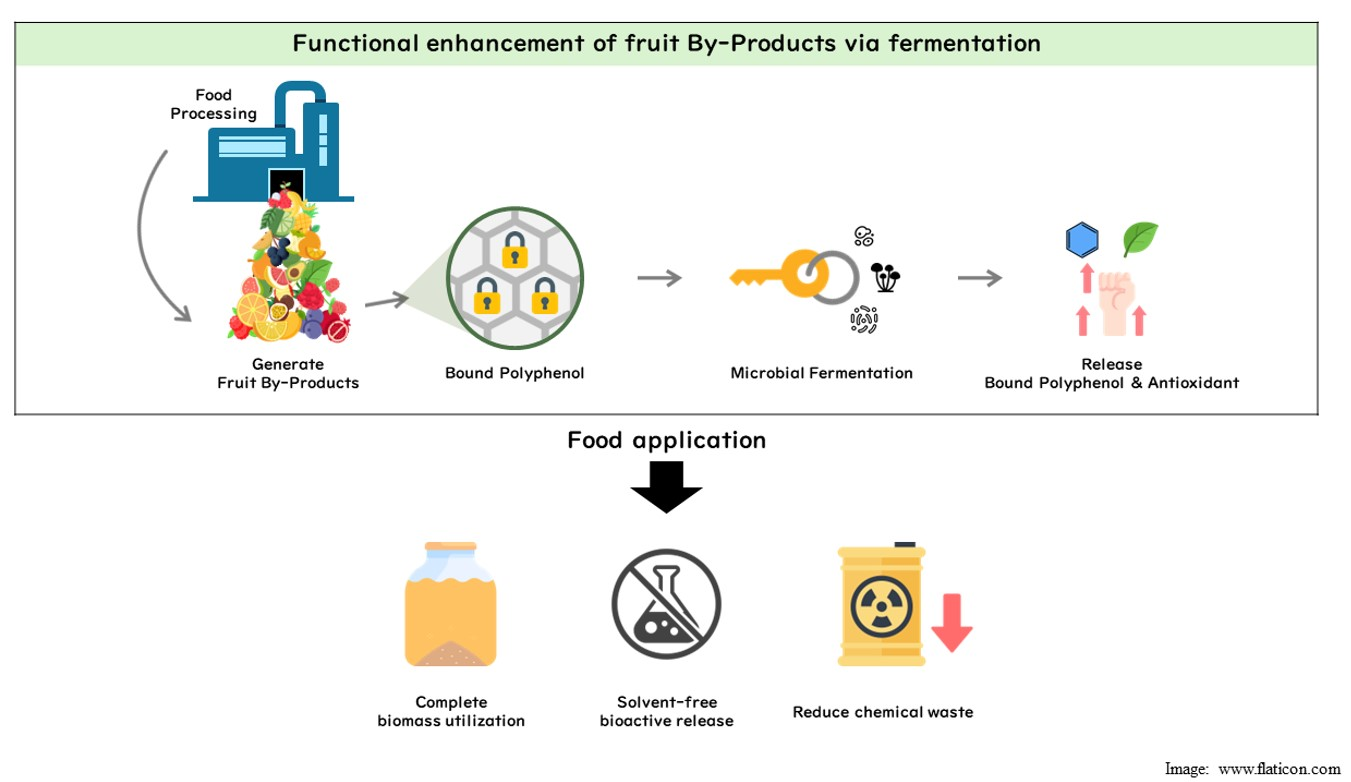
Fermentation of Fruit By-Products as a Tool for Nutritional and Environmental Sustainability



Abstract
1. Introduction
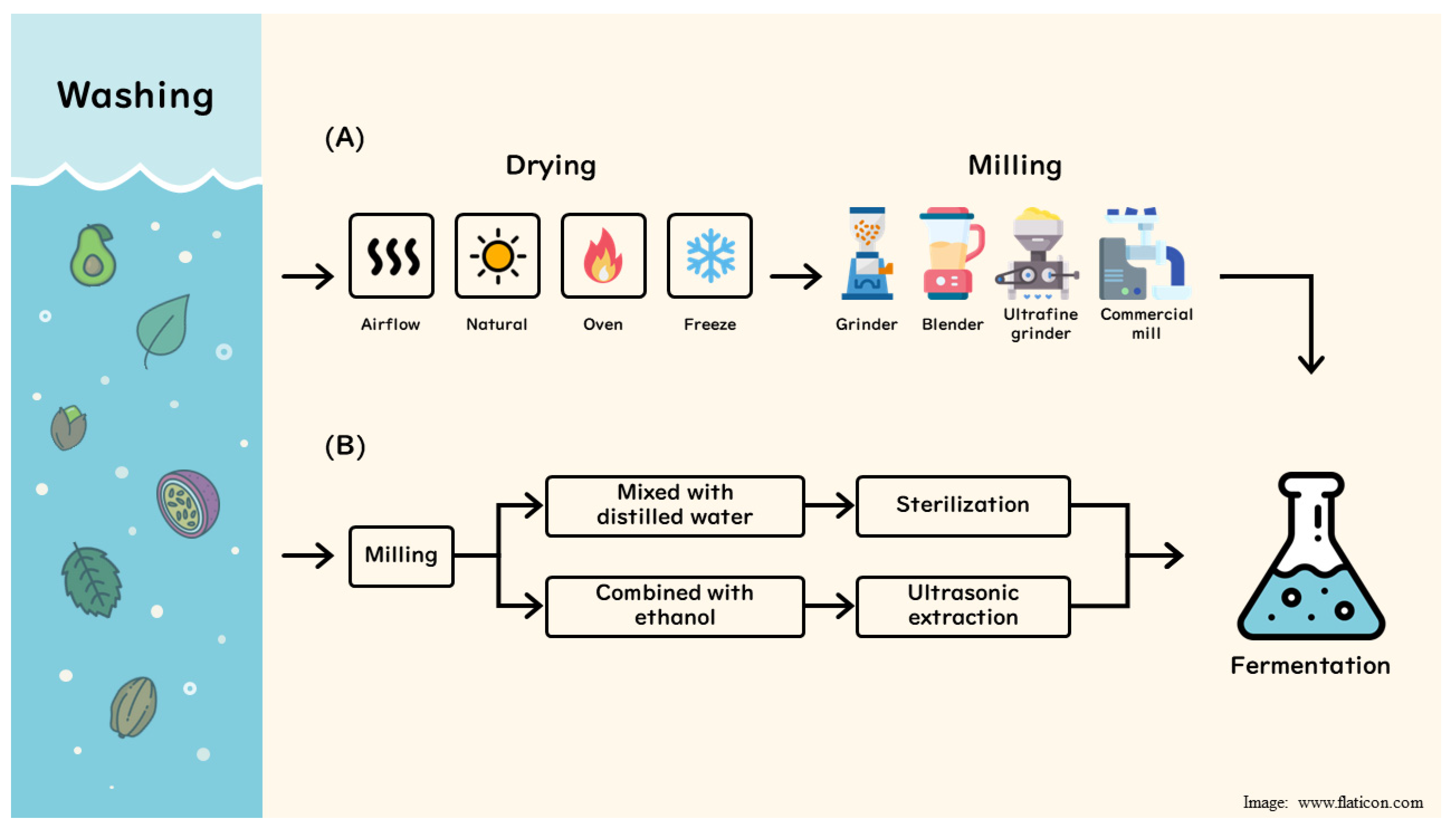
2. Pre-Treatment of By-Products
3. Fruit By-Products
3.1. Acerola
3.2. Apple
3.3. Araticum
3.4. Avocado
3.5. Banana
3.6. Baru
3.7. Blackcurrant
3.8. Chokeberry
3.9. Granadilla
3.10. Grape
3.11. Guava
3.12. Jabuticaba
3.13. Jackfruit
3.14. Lemon
3.15. Litchi
3.16. Mandarin
3.17. Mango
3.18. Mulberry
3.19. Orange
3.20. Pequi
3.21. Pineapple
3.22. Pomegranate
3.23. Pomelo
3.24. Rambutan
3.25. Raspberry
3.26. Red Bayberry
3.27. Soursop
3.28. Strawberry
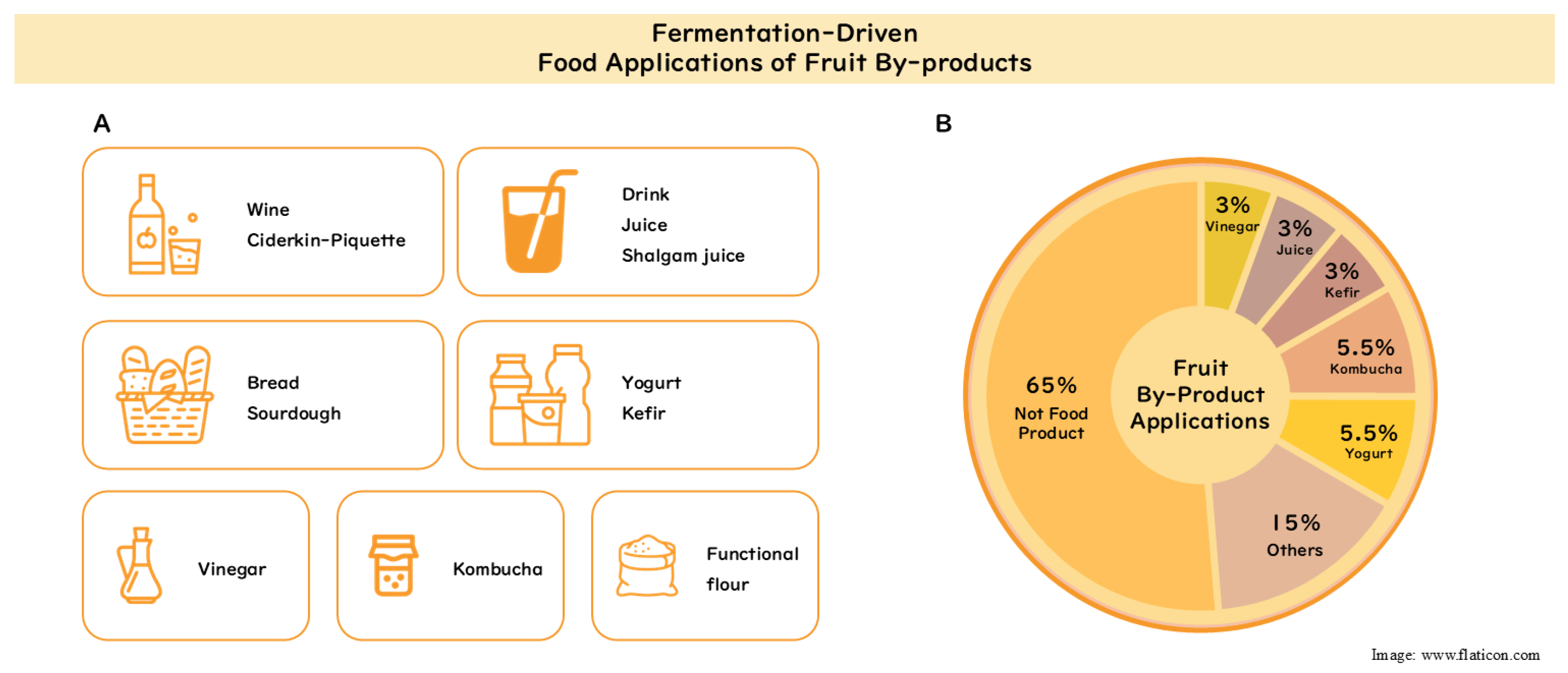
4. Food Applications of Fermented Fruit By-Products
5. Limitations and Future Perspectives
6. Conclusions
Author Contributions
Funding
Institutional Review Board Statement
Informed Consent Statement
Data Availability Statement
Acknowledgments
Conflicts of Interest
Abbreviations
| AL10 | Acerola co-product + L. paracasei L-10 |
| ALA5 | Acerola co-product + L. acidophilus LA-05 |
| AP | Apple pomace |
| APM | 75% apple pomace and 20% corn bran |
| B | Bacteria |
| Bb-12 | Bifidobacterium animalis subsp. Lactis Bb-12 |
| BD | Bacteria and yeast |
| D | yeast |
| d b | Dry basis |
| DM | Dry matter |
| EGA | equivalent of gallic acid |
| FPPE | Fermented pineapple peel extracts |
| GAE | Gallic acid equivalent |
| GL10 | Guava + Lacticaseibacillus paracasei L-10 |
| GLA5 | Guava + Lactobacillus acidophilus LA-05 |
| GSF | Granadilla seed flour |
| IC50 | Half maximal inhibitory concentration |
| K1 | Kefir with 10% raspberry pomace |
| K2 | Kefir with 20% raspberry pomace |
| K4 | Kefir with 40% raspberry pomace |
| MKF | Mango kernel flour |
| MKWF | Mango kernel water-soluble fraction |
| mMRS-A | Modified MRS broth with araticum |
| mMRS-B | Modified MRS broth with baru |
| mMRS-P | Modified MRS broth with pequi |
| MPo | Mulberry pomace |
| NF | Non-fermented |
| NPFU | Contained 5% (w/v) pineapple dietary fiber, for which the preheated milk was inoculated by the strains, followed by the ultrasound pretreatment |
| SA-FLPJ | Sugar-added fermented lemon peel juice |
| SD | Sourdough |
| SF-FLPJ | Sugar-free fermented lemon peel juice |
| TE | Trolox equivalent |
| TEAC | Trolox equivalent antioxidant capacity |
| Un-FLPJ | Unfermented lemon peel juice |
| UP | Ultrasonically stressed inocula combined with the addition of conventional extraction solution |
| UU | Ultrasonically stressed inocula combined with the addition of ultrasonication-assisted peel extract |
| VCE | Vitamin C equivalent |
| WKGs-TAC | Amphiphilic lipids extracted from water kefir grains |
| WKGs-TLC | Lipophilic lipids extracted from water kefir grains |
| WKB-TAC | Amphiphilic lipids extracted from water kefir beverage |
| WKB-TLC | Lipophilic lipids extracted from water kefir beverage |
References
- Veitía-de-Armas, L.; Reynel-Ávila, H.E.; Bonilla-Petriciolet, A.; Jáuregui-Rincón, J. Green Solvent-Based Lipid Extraction from Guava Seeds and Spent Coffee Grounds to Produce Biodiesel: Biomass Valorization and Esterification/Transesterification Route. Ind. Crops Prod. 2024, 214, 118535. [Google Scholar] [CrossRef]
- Global Market Insights. Processed Fruits and Vegetables Market Size—By Product Type, By Processing Form, By Packaging, By Distribution Channel—Growth Forecast, 2026–2035. Available online: https://www.gminsights.com/industry-analysis/processed-fruits-and-vegetables-market (accessed on 3 January 2026).
- Subiria-Cueto, R.; Coria-Oliveros, A.J.; Wall-Medrano, A.; Rodrigo-García, J.; González-Aguilar, G.A.; Martinez-Ruiz, N.D.R.; Alvarez-Parrilla, E. Antioxidant Dietary Fiber-Based Bakery Products: A New Alternative for Using Plant-by-Products. Food Sci. Technol. 2022, 42, ctaAR57520. [Google Scholar] [CrossRef]
- Angulo-López, J.E.; Flores-Gallegos, A.C.; Ascacio-Valdes, J.A.; Contreras Esquivel, J.C.; Torres-León, C.; Rúelas-Chácon, X.; Aguilar, C.N. Antioxidant Dietary Fiber Sourced from Agroindustrial Byproducts and Its Applications. Foods 2022, 12, 159. [Google Scholar] [CrossRef]
- Nicolás García, M.; Borrás Enríquez, A.; González Escobar, J.; Calva Cruz, O.; Pérez Pérez, V.; Sánchez Becerril, M. Phenolic Compounds in Agro-Industrial Waste of Mango Fruit: Impact on Health and Its Prebiotic Effect—A Review. Pol. J. Food Nutr. Sci. 2023, 73, 5–23. [Google Scholar] [CrossRef]
- Lombardi, P.; Barbero, S.; Fiore, S.; Orlandella, I.; Rovera, F.; Todella, E.; Tommasi, T. Orange Peel Waste in the Circular Economy: An Integrated Assessment Approach. Proceedings 2025, 131, 14. [Google Scholar] [CrossRef]
- Ortega-Hernández, E.; Martinez-Alvarado, L.; Acosta-Estrada, B.A.; Antunes-Ricardo, M. Solid-State Fermented Pineapple Peel: A Novel Food Ingredient with Antioxidant and Anti-Inflammatory Properties. Foods 2023, 12, 4162. [Google Scholar] [CrossRef]
- Zhang, L.; Wu, T.; Zhang, Y.; Chen, Y.; Ge, X.; Sui, W.; Zhu, Q.; Geng, J.; Zhang, M. Release of Bound Polyphenols from Wheat Bran Soluble Dietary Fiber during Simulated Gastrointestinal Digestion and Colonic Fermentation in Vitro. Food Chem. 2023, 402, 134111. [Google Scholar] [CrossRef] [PubMed]
- Fernandes, A.; Mateus, N.; De Freitas, V. Polyphenol-Dietary Fiber Conjugates from Fruits and Vegetables: Nature and Biological Fate in a Food and Nutrition Perspective. Foods 2023, 12, 1052. [Google Scholar] [CrossRef] [PubMed]
- Chen, Q.; Su, J.; Zhang, Y.; Li, C.; Zhu, S. Phytochemical Profile and Bioactivity of Bound Polyphenols Released from Rosa Roxburghii Fruit Pomace Dietary Fiber by Solid-State Fermentation with Aspergillus Niger. Molecules 2024, 29, 1689. [Google Scholar] [CrossRef]
- Chu, R.; Uaila, E.; Ismail, T.; Lazarte, C.E. Effect of Short-Term Lactic Fermentation on Polyphenol Profile and Antioxidant Capacity in White and Red Quinoa Varieties. Foods 2024, 13, 2413. [Google Scholar] [CrossRef]
- Zhou, D.-D.; Saimaiti, A.; Luo, M.; Huang, S.-Y.; Xiong, R.-G.; Shang, A.; Gan, R.-Y.; Li, H.-B. Fermentation with Tea Residues Enhances Antioxidant Activities and Polyphenol Contents in Kombucha Beverages. Antioxidants 2022, 11, 155. [Google Scholar] [CrossRef]
- Ferreira, J.; Tkacz, K.; Turkiewicz, I.P.; Santos, M.I.; Belas, A.; Lima, A.; Wojdyło, A.; Sousa, I. Influence of Particle Size and Extraction Methods on Phenolic Content and Biological Activities of Pear Pomace. Foods 2023, 12, 4325. [Google Scholar] [CrossRef]
- Yang, F.; Chen, C.; Ni, D.; Yang, Y.; Tian, J.; Li, Y.; Chen, S.; Ye, X.; Wang, L. Effects of Fermentation on Bioactivity and the Composition of Polyphenols Contained in Polyphenol-Rich Foods: A Review. Foods 2023, 12, 3315. [Google Scholar] [CrossRef]
- Salas-Millán, J.Á.; Aguayo, E. Fermentation for Revalorisation of Fruit and Vegetable By-Products: A Sustainable Approach Towards Minimising Food Loss and Waste. Foods 2024, 13, 3680. [Google Scholar] [CrossRef] [PubMed]
- Araújo, C.M.; De Albuquerque, T.M.R.; Sampaio, K.B.; De Oliveira, J.N.; Da Silva, J.Y.P.; Lima, M.D.S.; Nascimento, Y.M.D.; Da Silva, E.F.; Da Silva, M.S.; Tavares, J.F.; et al. Fermenting Acerola (Malpighia emarginata D.C.) and Guava (Psidium guayaba L.) Fruit Processing Co-Products with Probiotic Lactobacilli to Produce Novel Potentially Synbiotic Circular Ingredients. Foods 2024, 13, 1375. [Google Scholar] [CrossRef]
- De Oliveira, S.D.; De Souza, E.L.; Araújo, C.M.; Martins, A.C.S.; Borges, G.D.S.C.; Lima, M.D.S.; Viera, V.B.; Garcia, E.F.; Da Conceição, M.L.; De Souza, A.L.; et al. Spontaneous Fermentation Improves the Physicochemical Characteristics, Bioactive Compounds, and Antioxidant Activity of Acerola (Malpighia emarginata D.C.) and Guava (Psidium guajava L.) Fruit Processing by-Products. 3 Biotech 2023, 13, 315. [Google Scholar] [CrossRef] [PubMed]
- Wang, Z.; Svyantek, A.; Miller, Z. Apple and Grape Waste Pomace Fermentation and Co-Ferment Product Chemistry. Fermentation 2025, 11, 126. [Google Scholar] [CrossRef]
- Liu, L.; Zhang, C.; Zhang, H.; Qu, G.; Li, C.; Liu, L. Biotransformation of Polyphenols in Apple Pomace Fermented by β-Glucosidase-Producing Lactobacillus Rhamnosus L08. Foods 2021, 10, 1343. [Google Scholar] [CrossRef]
- Wang, Z.; Tang, H.; Li, Y.; Tian, L.; Ye, B.; Yan, W.; Liu, G.; Yang, Y. Evaluating the Dynamic Effects of Complex Probiotics as Cellulase Replacements during Fermentation of Apple Pomace. Int. J. Food Microbiol. 2024, 425, 110896. [Google Scholar] [CrossRef]
- Dulf, F.V.; Vodnar, D.C.; Dulf, E.-H. Solid-State Fermentation with Zygomycetes Fungi as a Tool for Biofortification of Apple Pomace with γ-Linolenic Acid, Carotenoid Pigments and Phenolic Antioxidants. Food Res. Int. 2023, 173, 113448. [Google Scholar] [CrossRef]
- Kalinowska, M.; Gołebiewska, E.; Zawadzka, M.; Choińska, R.; Koronkiewicz, K.; Piasecka-Jóźwiak, K.; Bujak, M. Sustainable Extraction of Bioactive Compound from Apple Pomace through Lactic Acid Bacteria (LAB) Fermentation. Sci. Rep. 2023, 13, 19310. [Google Scholar] [CrossRef] [PubMed]
- Li, J.; Ye, F.; Zhou, Y.; Lei, L.; Chen, J.; Li, S.; Zhao, G. Tailoring the Composition, Antioxidant Activity, and Prebiotic Potential of Apple Peel by Aspergillus Oryzae Fermentation. Food Chem. X 2024, 21, 101134. [Google Scholar] [CrossRef]
- Papadopoulou, D.; Chrysikopoulou, V.; Rampaouni, A.; Plakidis, C.; Ofrydopoulou, A.; Shiels, K.; Saha, S.K.; Tsoupras, A. Antioxidant, Antithrombotic and Anti-Inflammatory Properties of Amphiphilic Bioactives from Water Kefir Grains and Its Apple Pomace-Based Fermented Beverage. Antioxidants 2025, 14, 164. [Google Scholar] [CrossRef]
- de Oliveira, F.L.; Morzelle, M.C.; Moretti, M.M.D.S.; Casarotti, S.N. Fermentation of Araticum, Baru, and Pequi by-Products by Probiotic Strains: Effects on Microorganisms, Short-Chain Fatty Acids, and Bioactive Compounds. Lett. Appl. Microbiol. 2023, 76, ovad092. [Google Scholar] [CrossRef]
- De Montijo-Prieto, S.; Razola-Díaz, M.D.C.; Barbieri, F.; Tabanelli, G.; Gardini, F.; Jiménez-Valera, M.; Ruiz-Bravo, A.; Verardo, V.; Gómez-Caravaca, A.M. Impact of Lactic Acid Bacteria Fermentation on Phenolic Compounds and Antioxidant Activity of Avocado Leaf Extracts. Antioxidants 2023, 12, 298. [Google Scholar] [CrossRef] [PubMed]
- Villasante, J.; Vilas-Franquesa, A.; Fogliano, V. Solid-State Fermentation of Avocado Seed by Aspergillus Oryzae and Aspergillus Awamori: Effects on Nutritional Composition, Antioxidant Activity, and Volatile Compounds. Food Chem. 2025, 489, 144990. [Google Scholar] [CrossRef] [PubMed]
- Prisacaru, A.E.; Ghinea, C.; Apostol, L.C.; Ropciuc, S.; Ursachi, V.F. Physicochemical Characteristics of Vinegar from Banana Peels and Commercial Vinegars before and after In Vitro Digestion. Processes 2021, 9, 1193. [Google Scholar] [CrossRef]
- Sady, S.; Ligaj, M.; Pachołek, B.; Błaszczyk, A.; Płaczek, Z.; Dłużniewska, N.; Kawałek, P.; Pakuła, K.; Konopelski, A.; Gołaszewski, E. Designing the Quality Characteristics of Berry Processing Byproducts Using Fermentation. Appl. Sci. 2024, 14, 3110. [Google Scholar] [CrossRef]
- Xiao, Y.; Li, X.; Zhang, H.; Zhu, Y.; Gao, W.; Jiang, S.; Ru, G.; Sun, A. Efficient Release and Possible Mechanism of Polyphenols in the Pomace of Chokeberry (Aronia melanocarpa L.) through Solid-State Fermentation Using Trichoderma Viride. Food Biosci. 2025, 68, 106783. [Google Scholar] [CrossRef]
- Santos, T.R.; Feitosa, P.R.; Gualberto, N.C.; Narain, N.; Santana, L.C. Improvement of Bioactive Compounds Content in Granadilla (Passiflora ligularis) Seeds after Solid-State Fermentation. Food Sci. Technol. Int. 2021, 27, 234–241. [Google Scholar] [CrossRef]
- Barakat, N.; Bouajila, J.; Beaufort, S.; Rizk, Z.; Taillandier, P.; El Rayess, Y. Development of a New Kombucha from Grape Pomace: The Impact of Fermentation Conditions on Composition and Biological Activities. Beverages 2024, 10, 29. [Google Scholar] [CrossRef]
- Zhao, Y.; Liu, D.; Zhang, J.; Shen, J.; Cao, J.; Gu, H.; Cui, M.; He, L.; Chen, G.; Liu, S.; et al. Improving Soluble Phenolic Profile and Antioxidant Activity of Grape Pomace Seeds through Fungal Solid-State Fermentation. Foods 2024, 13, 1158. [Google Scholar] [CrossRef]
- Siller-Sánchez, A.; Aguilar, C.N.; Chávez-González, M.L.; Ascacio-Valdés, J.A.; Kumar Verma, D.; Aguilar-González, M. Solid-State Fermentation-Assisted Extraction of Flavonoids from Grape Pomace Using Co-Cultures. Processes 2024, 12, 2027. [Google Scholar] [CrossRef]
- Torreggiani, A.; Demarinis, C.; Pinto, D.; Papale, A.; Difonzo, G.; Caponio, F.; Pontonio, E.; Verni, M.; Rizzello, C.G. Up-Cycling Grape Pomace through Sourdough Fermentation: Characterization of Phenolic Compounds, Antioxidant Activity, and Anti-Inflammatory Potential. Antioxidants 2023, 12, 1521. [Google Scholar] [CrossRef]
- Šelo, G.; Planinić, M.; Tišma, M.; Klarić, A.-M.; Bucić-Kojić, A. Effects of Fungal Solid-State Fermentation on the Profile of Phenolic Compounds and on the Nutritional Properties of Grape Pomace. Microorganisms 2024, 12, 1310. [Google Scholar] [CrossRef]
- Akbulut, M.; Çoklar, H.; Bulut, A.N.; Hosseini, S.R. Evaluation of Black Grape Pomace, a Fruit Juice By-product, in Shalgam Juice Production: Effect on Phenolic Compounds, Anthocyanins, Resveratrol, Tannin, and in Vitro Antioxidant Activity. Food Sci. Nutr. 2024, 12, 4372–4384. [Google Scholar] [CrossRef] [PubMed]
- Takemura, M.R.C.; Da Graça, J.S.; Furtado, M.M.; Marques, M.C.; Sant’Ana, A.S.; Maróstica Junior, M.R.; Mariutti, L.R.B.; Geloneze, B.; Cazarin, C.B.B. Production of Long Fermentation Bread with Jabuticaba Peel Flour Added: Technological and Functional Aspects and Impact on Glycemic and Insulinemic Responses. Foods 2024, 13, 2878. [Google Scholar] [CrossRef] [PubMed]
- Bueno-Rojas, D.A.; Bueno-Rojas, J.A.; Rodríguez-Aguayo, C.; Calderón-Santoyo, M.; Zamora-Gasga, V.M.; Montalvo-González, E.; De Lourdes García-Magaña, M. Development of Kombucha Beverage with Jackfruit Leaves (Artocarpus heterophyllus Lam) and/or Soursop Leaves (Annona muricata). Food Chem. 2025, 469, 142348. [Google Scholar] [CrossRef]
- Hoang, B.Q.; Nguyen, H.T.; Duong, D.N.T. Developement of Lactic Acid Fermentation of Jackfruit (Artocarpus heterophyllus) Seed Drink and Its Physicochemical and Sensory Properties. J. Food Sci. Technol. 2024, 61, 1180–1187. [Google Scholar] [CrossRef]
- Hsu, C.-L.; Tsai, C.-F.; Chen, P.-C.; Chen, T.-C.; Cho, T.-Y.; Hung, J.-F.; Chen, Y.-J.L. Evaluation of Lemon Peel Juice Fermentation Methods and Its Impact on Hyperlipidemia and Health Management. J. Food Biochem. 2024, 2024, 5700338. [Google Scholar] [CrossRef]
- Zhang, Y.; Huang, J.; Zhou, R.; Zhang, S.; Li, Y.; Huang, R.; Liu, R.; Wu, C. Litchi (Litchi chinensis Sonn.) Seed Starch as a Sustainable Feedstock for Vinegar Fermentation: Enhancement of Quality and Bioactive Properties. LWT 2025, 224, 117865. [Google Scholar] [CrossRef]
- Mamy, D.; Boateng, I.D.; Chen, X. Two-Pot Optimization of Nutrient Sources to Enhance Antioxidants in Citrus reticulata Peel Powder through Solid-State Fermentation with Aspergillus Niger CGMCC 3.6189. Food Biosci. 2024, 59, 104145. [Google Scholar] [CrossRef]
- Vilas-Franquesa, A.; Fryganas, C.; Casertano, M.; Montemurro, M.; Fogliano, V. Upcycling Mango Peels into a Functional Ingredient by Combining Fermentation and Enzymatic-Assisted Extraction. Food Chem. 2024, 434, 137515. [Google Scholar] [CrossRef]
- Vilas-Franquesa, A.; Villasante, J.; Fogliano, V. Fungal Fermentation Effectively Upcycles Mango Kernel Flour into a Functional Ingredient. LWT 2024, 206, 116558. [Google Scholar] [CrossRef]
- Tang, S.; Cheng, Y.; Wu, T.; Hu, F.; Pan, S.; Xu, X. Effect of Lactobacillus Plantarum-Fermented Mulberry Pomace on Antioxidant Properties and Fecal Microbial Community. LWT 2021, 147, 111651. [Google Scholar] [CrossRef]
- Du, H.; Yang, H.; Wang, X.; Zhu, F.; Tang, D.; Cheng, J.; Liu, X. Effects of Mulberry Pomace on Physicochemical and Textural Properties of Stirred-Type Flavored Yogurt. J. Dairy Sci. 2021, 104, 12403–12414. [Google Scholar] [CrossRef] [PubMed]
- Ganiyu, O.; Olunbamigbe, O.O.; Ogunsuyi, O.B.; Aro, O.P.; Oyeleye, I.S.; Ademosun, A.O. Evaluating the Nutrient Composition and Antioxidant Properties of Orange (Citrus sinensis) Peels through Penicillium Camemberti-Based Solid-Substrate Fermentation. Discov. Food 2024, 4, 114. [Google Scholar] [CrossRef]
- Razola-Díaz, M.D.C.; De Montijo-Prieto, S.; Guerra-Hernández, E.J.; Jiménez-Valera, M.; Ruiz-Bravo, A.; Gómez-Caravaca, A.M.; Verardo, V. Fermentation of Orange Peels by Lactic Acid Bacteria: Impact on Phenolic Composition and Antioxidant Activity. Foods 2024, 13, 1212. [Google Scholar] [CrossRef]
- Yu, H.; Xu, X.; Hao, J.; Zuo, X.; Wang, J.; Zhu, L.; Chen, M.; Lyu, Y.; Yan, Z.; Shen, Y.; et al. Mixed Fermentation of Citrus Peel Pomace with Trichoderma Koningii, Aspergillus Oryzae and Lactobacillus Casei: Process Optimization, Antioxidant Activities and Non-Targeted Metabolomics Analysis. Food Biosci. 2025, 66, 106180. [Google Scholar] [CrossRef]
- Hu, X.; Zeng, J.; Shen, F.; Xia, X.; Tian, X.; Wu, Z. Citrus Pomace Fermentation with Autochthonous Probiotics Improves Its Nutrient Composition and Antioxidant Activities. LWT 2022, 157, 113076. [Google Scholar] [CrossRef]
- Dikmetas, D.N.; Nemli, E.; Karbancioglu-Guler, F.; Apak, R.; Bener, M.; Zhang, W.; Jia, N.; Zhao, C.; Tomas, M.; Capanoglu, E. Lactic Acid Bacterial Culture Selection for Orange Pomace Fermentation and Its Potential Use in Functional Orange Juice. ACS Omega 2025, 10, 11038–11053. [Google Scholar] [CrossRef] [PubMed]
- Casas-Rodríguez, A.D.; Ascacio-Valdés, J.A.; Dávila-Medina, M.D.; Medina-Morales, M.A.; Londoño-Hernández, L.; Sepúlveda, L. Evaluation of Solid-State Fermentation Conditions from Pineapple Peel Waste for Release of Bioactive Compounds by Aspergillus niger spp. Appl. Microbiol. 2024, 4, 934–947. [Google Scholar] [CrossRef]
- Zhang, X.; Zheng, Y.; Zhou, C.; Cao, J.; Zhang, Y.; Wu, Z.; Pan, D.; Cai, Z.; Xia, Q. Combining Thermosonication Microstress and Pineapple Peel Extract Addition to Achieve Quality and Post-Acidification Control in Yogurt Fermentation. Ultrason. Sonochemistry 2024, 105, 106857. [Google Scholar] [CrossRef] [PubMed]
- Lou, K.; Zheng, Y.; Tan, X.; Wang, L.; Tong, C.; Huang, S.; Cai, X.; Zhou, C.; Cao, J.; Zhang, H.; et al. Influence of Sonication-Assisted Fermentation on the Physicochemical Features and Antioxidant Activities of Yogurts Fortified by Polyphenol-Rich Pineapple Peel Powder with Varied Chemical Profiling. Food Res. Int. 2024, 198, 115333. [Google Scholar] [CrossRef]
- Vafajoo, A.; Sabahi, H.; Ebrahimi, S.N.; Ahmadikia, K. Optimization of Biomimetic Fermentation Technique for Enhanced and Eco-Friendly Extraction of Phenolics from Pomegranate Peel. Bioresour. Technol. Rep. 2024, 28, 101986. [Google Scholar] [CrossRef]
- Zheng, Z.; Xu, Y.; Qu, H.; Zhou, H.; Yang, H. Enhancement of Anti-Diabetic Activity of Pomelo Peel by the Fermentation of Aspergillus Oryzae CGMCC23295: In Vitro and in Silico Docking Studies. Food Chem. 2024, 432, 137195. [Google Scholar] [CrossRef]
- De La Rosa-Esteban, K.; Sepúlveda, L.; Chávez-González, M.; Torres-León, C.; Estrada-Gil, L.; Aguilar, C.; Ascacio-Valdés, J. Valorization of Mexican Rambutan Peel through the Recovery of Ellagic Acid via Solid-State Fermentation Using a Yeast. Fermentation 2023, 9, 723. [Google Scholar] [CrossRef]
- Cerda-Cejudo, N.D.; Buenrostro-Figueroa, J.J.; Sepúlveda, L.; Estrada-Gil, L.E.; Torres-León, C.; Chávez-González, M.L.; Aguilar, C.N.; Ascacio-Valdés, J.A. Enhancing the Release of Ellagic Acid from Mexican Rambutan Peel Using Solid-State Fermentation. Biomass 2024, 4, 1005–1016. [Google Scholar] [CrossRef]
- Stamenković Stojanović, S.; Živković, L.; Stanojević, J.; Danilović, B.; Mančić, S.; Karabegović, I. Enhancing Kefir with Raspberry Pomace: Storage-Dependent Changes in Quality and Stability. Fermentation 2025, 11, 265. [Google Scholar] [CrossRef]
- Zhu, Y.; Lv, J.; Gu, Y.; He, Y.; Chen, J.; Zhou, Z.; Ye, X. Polysaccharides of Chinese Bayberry Pomace Wine: Structural Characteristics, Antioxidant Activity and Influence on the Bayberry Wine. Food Biosci. 2022, 50, 102025. [Google Scholar] [CrossRef]
- Olędzki, R.; Harasym, J. Acerola (Malpighia emarginata) Anti-Inflammatory Activity—A Review. Int. J. Mol. Sci. 2024, 25, 2089. [Google Scholar] [CrossRef] [PubMed]
- Vega-Baudrit, J.R.; Camacho, M.; Batista-Menezes, D.; Corrales-Ureña, Y.; Zúñiga, J.M.; Chacón, A.M.; Lecot, N.; Henríquez, L.C.; Lopretti, M. Acerola (Malpighia spp.) Waste: A Sustainable Approach to Nutraceutical, Pharmaceutical, and Energy Applications. Recycling 2023, 8, 96. [Google Scholar] [CrossRef]
- Zhang, F.; Wang, T.; Wang, X.; Lü, X. Apple Pomace as a Potential Valuable Resource for Full-Components Utilization: A Review. J. Clean. Prod. 2021, 329, 129676. [Google Scholar] [CrossRef]
- Kauser, S.; Murtaza, M.A.; Hussain, A.; Imran, M.; Kabir, K.; Najam, A.; An, Q.U.; Akram, S.; Fatima, H.; Batool, S.A.; et al. Apple Pomace, a Bioresource of Functional and Nutritional Components with Potential of Utilization in Different Food Formulations: A Review. Food Chem. Adv. 2024, 4, 100598. [Google Scholar] [CrossRef]
- Honório, A.B.M.; De-la-Cruz-Chacón, I.; Martínez-Vázquez, M.; Da Silva, M.R.; Campos, F.G.; Martin, B.C.; Da Silva, G.C.; Fernandes Boaro, C.S.; Ferreira, G. Impact of Drought and Flooding on Alkaloid Production in Annona crassiflora Mart. Horticulturae 2021, 7, 414. [Google Scholar] [CrossRef]
- Arruda, H.S.; Borsoi, F.T.; Andrade, A.C.; Pastore, G.M.; Marostica Junior, M.R. Scientific Advances in the Last Decade on the Recovery, Characterization, and Functionality of Bioactive Compounds from the Araticum Fruit (Annona crassiflora Mart.). Plants 2023, 12, 1536. [Google Scholar] [CrossRef]
- Fernandes Almeida, R.; Ferreira Moreno, I.; Paula Oliveira Machado, A.; Angela, A.; Meireles, M.; Karla Figueira Da Silva, L.; Augusto Caldas Batista, E. Araticum (Annona crassiflora Mart.): A Critical Review for the Food Industry. Food Res. Int. 2024, 184, 114241. [Google Scholar] [CrossRef]
- Rodríguez-Martínez, B.; Romaní, A.; Eibes, G.; Garrote, G.; Gullón, B.; Del Río, P.G. Potential and Prospects for Utilization of Avocado By-Products in Integrated Biorefineries. Bioresour. Technol. 2022, 364, 128034. [Google Scholar] [CrossRef] [PubMed]
- Merino, D.; Bertolacci, L.; Paul, U.C.; Simonutti, R.; Athanassiou, A. Avocado Peels and Seeds: Processing Strategies for the Development of Highly Antioxidant Bioplastic Films. ACS Appl. Mater. Interfaces 2021, 13, 38688–38699. [Google Scholar] [CrossRef] [PubMed]
- Platonovskiy, N.G.; Ibrasheva, L.R.; Obukhova, N.I.; Puchkova, O.S.; Babkina, A.V. International Banana Trade: Volumes, Countries, and Trends. In Sustainable Development of the Agrarian Economy Based on Digital Technologies and Smart Innovations; Popkova, E.G., Bogoviz, A.V., Sergi, B.S., Kaurova, O.V., Maloletko, A.N., Eds.; Springer Nature: Cham, Switzerland, 2024; pp. 25–30. [Google Scholar]
- Zou, F.; Tan, C.; Zhang, B.; Wu, W.; Shang, N. The Valorization of Banana By-Products: Nutritional Composition, Bioactivities, Applications, and Future Development. Foods 2022, 11, 3170. [Google Scholar] [CrossRef]
- Alvarado, M.C.; Yaptenco, K.F.; Ignacio, C.C.D.; Acabal, C.; Acedo, A.L., Jr. Banana Peel Waste as a Source of Nanocellulose—Recent Progress, Challenges and Future Prospects. In Proceedings of the International Exchange and Innovation Conference on Engineering & Sciences (IEICES), Fukuoka, Japan, 17–10 October 2024; Volume 10, pp. 33–41. [Google Scholar] [CrossRef]
- Zaini, H.M.; Saallah, S.; Roslan, J.; Sulaiman, N.S.; Munsu, E.; Wahab, N.A.; Pindi, W. Banana Biomass Waste: A Prospective Nanocellulose Source and Its Potential Application in Food Industry—A Review. Heliyon 2023, 9, e18734. [Google Scholar] [CrossRef] [PubMed]
- Alves-Santos, A.M.; Fernandes, D.C.; Naves, M.M.V. Baru (Dipteryx alata Vog.) Fruit as an Option of Nut and Pulp with Advantageous Nutritional and Functional Properties: A Comprehensive Review. NFS J. 2021, 24, 26–36. [Google Scholar] [CrossRef]
- Lima, D.C.; Alves, M.D.R.; Noguera, N.H.; Nascimento, R.D.P.D. A Review on Brazilian Baru Plant (Dipteryx alata Vogel): Morphology, Chemical Composition, Health Effects, and Technological Potential. Future Foods 2022, 5, 100146. [Google Scholar] [CrossRef]
- Wang, Z.; Svyantek, A.; Miller, Z.; Watrelot, A.A.; Kadium, V.R. Postharvest Evaluations of Blackcurrant Fruits with Chitosan and Ultraviolet A Treatments. Appl. Sci. 2024, 14, 12052. [Google Scholar] [CrossRef]
- Wądrzyk, M.; Plata, M.; Korzeniowski, Ł.; Janus, R.; Lewandowski, M. Towards Sustainable Valorization of Blackcurrant Pomace: Investigation of Hot-Water Extraction Combined with Hydrothermal Liquefaction. Renew. Energy 2025, 240, 122117. [Google Scholar] [CrossRef]
- Azman, E.M.; Nor, N.D.M.; Charalampopoulos, D.; Chatzifragkou, A. Effect of Acidified Water on Phenolic Profile and Antioxidant Activity of Dried Blackcurrant (Ribes nigrum L.) Pomace Extracts. LWT 2022, 154, 112733. [Google Scholar] [CrossRef]
- Schmid, V.; Steck, J.; Mayer-Miebach, E.; Behsnilian, D.; Bunzel, M.; Karbstein, H.P.; Emin, M.A. Extrusion Processing of Pure Chokeberry (Aronia melanocarpa) Pomace: Impact on Dietary Fiber Profile and Bioactive Compounds. Foods 2021, 10, 518. [Google Scholar] [CrossRef]
- Saracila, M.; Untea, A.E.; Oancea, A.G.; Varzaru, I.; Vlaicu, P.A. Comparative Analysis of Black Chokeberry (Aronia melanocarpa L.) Fruit, Leaves, and Pomace for Their Phytochemical Composition, Antioxidant Potential, and Polyphenol Bioaccessibility. Foods 2024, 13, 1856. [Google Scholar] [CrossRef]
- Ba, L.; Luo, C.; Li, X.; Cao, S.; Luo, D. Research Progress on the Nutritional Components, Bioactivity, Health Effects, and Food Applications of Passion Fruit Peel (PFP). Foods 2025, 14, 3397. [Google Scholar] [CrossRef] [PubMed]
- OIV. OIV Statistical Brief: Wine, Table Grapes & Dried Grapes in 2024. Available online: https://www.oiv.int/sites/default/files/documents/OIV_Statistical_Brief-Wine_Table_Grapes_and_Dried_Grapes_in_2024.pdf (accessed on 28 January 2026).
- Oliveira, M.; Teixeira, B.M.M.; Toste, R.; Borges, A.D.S. Transforming Wine By-Products into Energy: Evaluating Grape Pomace and Distillation Stillage for Biomass Pellet Production. Appl. Sci. 2024, 14, 7313. [Google Scholar] [CrossRef]
- Castellanos-Gallo, L.; Ballinas-Casarrubias, L.; Espinoza-Hicks, J.C.; Hernández-Ochoa, L.R.; Muñoz-Castellanos, L.N.; Zermeño-Ortega, M.R.; Borrego-Loya, A.; Salas, E. Grape Pomace Valorization by Extraction of Phenolic Polymeric Pigments: A Review. Processes 2022, 10, 469. [Google Scholar] [CrossRef]
- Santos, A.S.D.; Dalzot, J.C.T.; Pereira, G.A.; Cunha, J.G.D.; Evangelista, T.Y.L.; Fonseca, W.L.; Almeida, M.D.S.; Lacerda, J.J.D.J.; Filho, J.F.D.S.; Zuffo, A.M.; et al. Pruning and Fruit Thinning of Psidium guajava cv. Paluma under a Seasonal Tropical Climate. Agriculture 2023, 13, 1537. [Google Scholar] [CrossRef]
- Muzaffar, K.; Sofi, S.A.; Ahmad Mir, S. Guava Wastes and By-Products. In Handbook of Fruit Wastes and By-Products; CRC Press: Boca Raton, FL, USA, 2022; pp. 99–112. [Google Scholar]
- Benvenutti, L.; Zielinski, A.A.F.; Ferreira, S.R.S. Jaboticaba (Myrtaceae cauliflora) Fruit and Its by-Products: Alternative Sources for New Foods and Functional Components. Trends Food Sci. Technol. 2021, 112, 118–136. [Google Scholar] [CrossRef]
- Nsubuga, D.; Banadda, N.; Kabenge, I.; Wydra, K.D. Potential of Jackfruit Waste as Anaerobic Digestion and Slow Pyrolysis Feedstock. J. Biosyst. Eng. 2021, 46, 163–172. [Google Scholar] [CrossRef]
- Fabil, M.; Dubey, P.K.; Roy, S.; Sharma, M. Jackfruit Seed Valorization: A Comprehensive Review of Nutritional Potential, Value Addition, and Industrial Applications. Food Humanit. 2024, 3, 100406. [Google Scholar] [CrossRef]
- Yuniarti, L.; Fakih, T.; Tejasari, M.; Indriyanti, R.; Maryam, E.; Nugroho, B. Comprehensive Bioactive Compound Profiling of Artocarpus heterophyllus Leaves: LC-MS/MS Analysis, Antioxidant Potential, and Molecular Insights. Drug Des. Dev. Ther. 2025, 19, 1195–1213. [Google Scholar] [CrossRef]
- Magalhães, D.; Vilas-Boas, A.A.; Teixeira, P.; Pintado, M. Functional Ingredients and Additives from Lemon By-Products and Their Applications in Food Preservation: A Review. Foods 2023, 12, 1095. [Google Scholar] [CrossRef]
- Punia, S.; Kumar, M. Litchi (Litchi chinenis) Seed: Nutritional Profile, Bioactivities, and Its Industrial Applications. Trends Food Sci. Technol. 2021, 108, 58–70. [Google Scholar] [CrossRef]
- Li, Y.; Yu, Y.; Wu, J.; Xu, Y.; Xiao, G.; Li, L.; Liu, H. Comparison the Structural, Physicochemical, and Prebiotic Properties of Litchi Pomace Dietary Fibers before and after Modification. Foods 2022, 11, 248. [Google Scholar] [CrossRef]
- Kalompatsios, D.; Ionescu, A.-I.; Athanasiadis, V.; Chatzimitakos, T.; Mantiniotou, M.; Kotsou, K.; Bozinou, E.; Lalas, S.I. Maximizing Bioactive Compound Extraction from Mandarin (Citrus reticulata) Peels through Green Pretreatment Techniques. Oxygen 2024, 4, 307–324. [Google Scholar] [CrossRef]
- Lee, S.-H.; Park, S.H.; Park, H. Assessing the Feasibility of Biorefineries for a Sustainable Citrus Waste Management in Korea. Molecules 2024, 29, 1589. [Google Scholar] [CrossRef]
- Singh, P.; Singh, H.; Agrawal, S.B.; Agrawal, M. Assessment of the Differential Trade-off between Growth, Subsistence, and Productivity of Two Popular Indian Hybrid Mango Varieties under Elevated Ozone Exposure. Sci. Total Environ. 2023, 889, 164275. [Google Scholar] [CrossRef]
- Mahmoud, H.; Nabil, H.; Shahein, A.; Darwish, W.; Mohamed, Z. Mango, the King of Fruits, with Fascinating Pharmacological Activities and Medicinal Uses. Open Vet. J. 2025, 15, 3380. [Google Scholar] [CrossRef]
- Ullah, M.A.; Kiloes, A.M.; Aziz, A.A.; Joyce, D.C. Impact of Factors Contributing to Internal Disorders of Mango (Mangifera indica L.) Fruit—A Systematic Literature Review. Sci. Hortic. 2024, 331, 113150. [Google Scholar] [CrossRef]
- Yi, S.; Huang, Y.; Liu, Z.; Zhu, Z.; Su, H. Predicting the Potential Geographical Distribution of Mango, an Important Tropical Economic Tree Species, under Current and Climate Change Based on Maxent Model. Front. Plant Sci. 2025, 16, 1633654. [Google Scholar] [CrossRef] [PubMed]
- Du, H.; Wang, X.; Yang, H.; Zhu, F.; Liu, J.; Cheng, J.; Lin, Y.; Tang, D.; Liu, X. Regulation on the Quality of Yogurt by Phenolic Fraction of Mulberry Pomace Supplemented before and after Fermentation. Food Control 2023, 144, 109333. [Google Scholar] [CrossRef]
- Ben Hsouna, A.; Sadaka, C.; Generalić Mekinić, I.; Garzoli, S.; Švarc-Gajić, J.; Rodrigues, F.; Morais, S.; Moreira, M.M.; Ferreira, E.; Spigno, G.; et al. The Chemical Variability, Nutraceutical Value, and Food-Industry and Cosmetic Applications of Citrus Plants: A Critical Review. Antioxidants 2023, 12, 481. [Google Scholar] [CrossRef]
- Salar, F.J.; Sánchez-Bravo, P.; Mena, P.; Cámara, M.; García-Viguera, C. Comparison of Vitamin C and Flavanones between Freshly Squeezed Orange Juices and Commercial 100% Orange Juices from Four European Countries. Int. J. Food Sci. Nutr. 2024, 75, 255–263. [Google Scholar] [CrossRef]
- Silva, M.D.D.; Moreira, R.P.L.; Rosa, A.P.; Borges, A.C. Optimization of Microwave-Assisted Extraction of Tannins and Phenolic Compounds Obtained from the Pequi Tree (Caryocar brasiliense). Chem. Eng. Process.-Process Intensif. 2025, 217, 110462. [Google Scholar] [CrossRef]
- Melo, J.O.F.; Conchinhas, B.; Leitão, A.E.B.; Ramos, A.L.C.C.; Sousa, I.M.N.D.; Ferreira, R.M.D.S.B.; Ribeiro, A.C.; Batista-Santos, P. Phenolic Compounds Characterization of Caryocar brasiliense Peel with Potential Antioxidant Activity. Plants 2024, 13, 2016. [Google Scholar] [CrossRef] [PubMed]
- Abraham, R.A.; Joshi, J.; Abdullah, S. A Comprehensive Review of Pineapple Processing and Its By-Product Valorization in India. Food Chem. Adv. 2023, 3, 100416. [Google Scholar] [CrossRef]
- Ko, K.; Dadmohammadi, Y.; Abbaspourrad, A. Nutritional and Bioactive Components of Pomegranate Waste Used in Food and Cosmetic Applications: A Review. Foods 2021, 10, 657. [Google Scholar] [CrossRef]
- Xiao, L.; Ye, F.; Zhou, Y.; Zhao, G. Utilization of Pomelo Peels to Manufacture Value-Added Products: A Review. Food Chem. 2021, 351, 129247. [Google Scholar] [CrossRef]
- Zhang, T.; Zhou, X.; Wang, K.; Sun, L.; Zhuang, Y. A Review: Extraction, Phytochemicals, and Biological Activities of Rambutan (Nephelium lappaceum L.) Peel Extract. Heliyon 2022, 8, e11314. [Google Scholar] [CrossRef]
- Yang, J.; Wu, L.; Wang, T.; Zhao, Y.; Zheng, X.; Liu, Y. An Integrated Extraction–Purification Process for Raspberry Leaf Polyphenols and Their In Vitro Activities. Molecules 2023, 28, 6321. [Google Scholar] [CrossRef]
- Sójka, M.; Hejduk, A.; Piekarska-Radzik, L.; Ścieszka, S.; Grzelak-Błaszczyk, K.; Klewicka, E. Antilisterial Activity of Tannin Rich Preparations Isolated from Raspberry (Rubus idaeus L.) and Strawberry (Fragaria X Ananassa Duch). Fruit Sci. Rep. 2025, 15, 10196. [Google Scholar] [CrossRef]
- Zhang, S.; Yu, Z.; Sun, L.; Ren, H.; Zheng, X.; Liang, S.; Qi, X. An Overview of the Nutritional Value, Health Properties, and Future Challenges of Chinese Bayberry. PeerJ 2022, 10, e13070. [Google Scholar] [CrossRef] [PubMed]
- Chang, G.; Cai, C.; Xiang, Y.; Fang, X.; Yang, H. Extraction and Study of Hypoglycemic Constituents from Myrica Rubra Pomace. Molecules 2022, 27, 846. [Google Scholar] [CrossRef]
- Santos, I.L.; Rodrigues, A.M.D.C.; Amante, E.R.; Silva, L.H.M.D. Soursop (Annona muricata) Properties and Perspectives for Integral Valorization. Foods 2023, 12, 1448. [Google Scholar] [CrossRef] [PubMed]
- Pukalskienė, M.; Pukalskas, A.; Dienaitė, L.; Revinytė, S.; Pereira, C.V.; Matias, A.A.; Venskutonis, P.R. Recovery of Bioactive Compounds from Strawberry (Fragaria × ananassa) Pomace by Conventional and Pressurized Liquid Extraction and Assessment Their Bioactivity in Human Cell Cultures. Foods 2021, 10, 1780. [Google Scholar] [CrossRef]
- Sousa, T.L.D.; Filho, J.G.D.O.; Cabassa, I.D.C.C.; Lemes, A.C.; Egea, M.B. Unraveling the Potential of Baru (Dipteryx alata Vog.) Fruit Fractions as a Sustainable Food Ingredient: Chemical and Technological Characteristics and Prebiotic Potential. Sustainability 2024, 16, 10976. [Google Scholar] [CrossRef]
- Puupponen-Pimiä, R.; Nohynek, L.; Suvanto, J.; Salminen, J.-P.; Seppänen-Laakso, T.; Tähtiharju, J.; Honkapää, K.; Oksman-Caldentey, K.-M. Natural Antimicrobials from Cloudberry (Rubus chamaemorus) Seeds by Sanding and Hydrothermal Extraction. ACS Food Sci. Technol. 2021, 1, 917–927. [Google Scholar] [CrossRef]
- Cerda-Cejudo, N.D.; Buenrostro-Figueroa, J.J.; Sepúlveda-Torre, L.; Torres-León, C.; Chávez-González, M.L.; Ascacio-Valdés, J.A.; Aguilar, C.N. Solid-State Fermentation for the Recovery of Phenolic Compounds from Agro-Wastes. Resources 2023, 12, 36. [Google Scholar] [CrossRef]
- George, J.; Edwards, D.; Pun, S.; Williams, D. Evaluation of Antioxidant Capacity (ABTS and CUPRAC) and Total Phenolic Content (Folin-Ciocalteu) Assays of Selected Fruit, Vegetables, and Spices. Int. J. Food Sci. 2022, 2022, 2581470. [Google Scholar] [CrossRef]
- Bouhzam, I.; Cantero, R.; Margallo, M.; Aldaco, R.; Bala, A.; Fullana-i-Palmer, P.; Puig, R. Life Cycle Assessment and Yield to Optimize Extraction Time and Solvent: Comparing Deep Eutectic Solvents vs Conventional Ones. Sci. Total Environ. 2024, 955, 177038. [Google Scholar] [CrossRef]



| Source Material | By-Product Source | Fermented Product Type | Microorganism | TPC | Antioxidant Activity of Fermented By-Products | Reference | |||||
|---|---|---|---|---|---|---|---|---|---|---|---|
| Free Radical Scavenging Activity | Reducing Power | ||||||||||
| ABTS | DPPH | HOSC | ORAC | CUPRAC | FRAP | ||||||
| Acerola | Co-products (peel, seeds, and pomace) | Not Food Product | Lactobacillus acidophilus, Lacticaseibacillus paracasei | – | AL10 (0~48 h): 16.89~22.08 µmol/g ALA5 (0~48 h): 18.24~28.79 µmol/g | AL10 (0~48 h): 13.51~14.19 µmol/g ALA5 (0~48 h): 5.70~9.87 µmol/g | – | – | – | AL10 (0~48 h): 11.60~13.60 µmol FeSO4/g ALA5 (0~48 h): 19.70~28.40 µmol FeSO4/g | [16] |
| By-products | Not Food Product | Spontaneous fermentation | 0~120 h: 779.25~1628.30 mg EGA/100 g | 0~120 h: 1.51~1.66 µmol TEAC/100 g | – | – | – | – | 0~120 h: 361.17~428.53 µmol TEAC/100 g | [17] | |
| Apple | Pomace | Ciderkin-piquette | Saccharomyces cerevisiae, Saccharomyces paradoxus | 0.1 mg/mL | – | 530.84 ± 2.17 TEAC µm/µL | – | – | – | 1.02 ± 0.02 mM Ferrous Equivalent/µL | [18] |
| Pomace | Not Food Product | Lactobacillus rhamnosus | Unfermented apple pomace: 383.00 μg/mL Day 3: 440.45 μg/mL Day 6: 480.80 μg/mL | – | Increasing 32% at least, in comparison with unfermented apple pomace | 1.14-fold on average after fermentation | – | – | – | [19] | |
| Pomace | Not Food Product | Lactiplantibacillus plantarum, Saccharomyces cerevisiae, Bacillus subtilis | APM (Day 9): increased by up to 108.19% compared to unfermented materials | – | – | – | – | – | – | [20] | |
| Pomace | Not Food Product | Actinomucor elegans, Umbelopsis isabellina | A. elegans: ↑ 27% (Day 4), then ↓ U. isabellina: ↑ 12% (Day 6), then stable | – | A. elegans: ↑ 13.5% (Day 4), then ↓ U. isabellina: ↑ 3.5% (Day 6), then ↓ (All > 70%; strong activity) | – | – | – | – | [21] | |
| Pomace | Not Food Product | LAB strains, Spontaneous fermentation | Lactiplantibacillus spp.: 2.301~4.082 mg GAE/g dw AP FS: 3.035 mg GAE/g dw AP NF: 2.975 mg GAE/g dw AP | Lactiplantibacillus spp.: 62.78~82.61% FS: 73.45% NF: 75.40% | Lactiplantibacillus spp.: 71.88~95.02% FS: 76.43% NF: 96.04% | – | – | Lactiplantibacillus spp.: 670.04~1114.68 µM of Trolox equivalents FS: 879.00 µM of Trolox equivalents NF: 591.50 µM of Trolox equivalents | Lactiplantibacillus spp.: 742.76~1647.21 µM Fe2+/Lextract FS: 1168.12 µM Fe2+/Lextract NF: 1150.73 µM Fe2+/Lextract | [22] | |
| Peel | Not Food Product | Aspergillus oryzae | Day 0~12: 137.35~314.71 GAE mg | Day 4~12: increased than day 0 (↓ IC50) | – | – | – | – | Day 4: proximate value to day 0 Day8, 12: increased than day 0 | [23] | |
| Pomace | Kefir | Water kefir grains | WKGs-TAC and TLC: 3.72~245.54 mg GAE/g Extract WKB-TAC and TLC: 47.62~1404.76 mg GAE/g Extract | WKGs-TAC: 5.12~10.06 μmol TE/g Extract WKB-TAC: 5.84~199.76 μmol TE/g Extract | WKGs-TAC: 0.0005~0.0040 μmol TE/g Extract WKB-TAC: 0.0028~0.0507 μmol TE/g Extract | – | – | – | WKGs-TAC and TLC: 0.89~53.69 μmol TE/g Extract WKB-TAC and TLC: 8.26~351.01 μmol TE/g Extract | [24] | |
| Araticum | Peel and Seeds | Not Food Product | Lactobacillus acidophilus spp., Bifidobacterium animalis | Unfermented: 55.55 ± 0.77 mg GAE/g Fermented mMRS-A L. acidophilus spp.: 579.46~614.81 µg EAG/mL Bb-12: 657.74 ± 16.81 µg EAG/mL NF: 537.37 ± 11.57 µg EAG/mL | Unfermented: 1019.20 ± 55.10 mM TE/g | Unfermented: 350.67 ± 6.14 mM ET/g Fermented mMRS-A L. acidophilus spp.: 1.69~1.90 mM ET/mL Bb-12: 2.05 ± 0.04 mM ET/mL NF: 1.82 ± 0.02 mM ET/mL | – | – | – | Unfermented: 1175.23 ± 25.65 mM ferrous sulfate/g Fermented mMRS-A after 48 h L. acidophilus spp.: 5.09~6.01 mM ferrous sulfate/mL Bb-12: 6.67 ± 0.16 mM ferrous sulfate/mL NF: 4.70 ± 0.48 mM ferrous sulfate/mL | [25] |
| Avocado | Leaf | Not Food Product | Pediococcus acidilactici, Pediococcus pentosaceus, Levilactobacillus brevis, Lactiplantibacillus plantarum, Leuconostoc mesenteroides | L. mesenteroides 215, 219T (24~96 h): 17.34~20.49 mg GAE/g dw L. brevis 4121T, 5354 (24~96 h): 17.83~29.39 mg GAE/g dw L. plantarum 748T, 9567 (24~96 h): 21.98~30.72 mg GAE/g dw Pediococcus spp. (24~96 h): 17.46~29.56 mg GAE/g dw | – | L. mesenteroides 215, 219T (24~96 h): 27.84~47.47 mg TE/g dw L. brevis 4121T, 5354 (24~96 h): 29.23~47.20 mg TE/g dw L. plantarum 748T, 9567 (24~96 h): 25.56~49.68 mg TE/g dw Pediococcus spp. (24~96 h): 28.90~51.32 mg TE/g dw | – | – | – | L. mesenteroides 215, 219T (24~96 h): 57.49~72.96 mg TE/g dw L. brevis 4121T, 5354 (24~96 h): 58.29~91.58 mg TE/g dw L. plantarum 748T, 9567 (24~96 h): 71.58~96.61 mg TE/g dw Pediococcus spp. (24~96 h): 50.34~93.33 mg TE/g dw | [26] |
| Seed | Not Food Product | Aspergillus oryzae, Aspergillus awamori | A. awamori 0 h: 65.49 mg GAE/g AVS paste 96 h: 75.79 mg GAE/g AVS paste A. oryzae 48 h: 69.43 mg GAE/g AVS paste 72 h: 67.88 mg GAE/g AVS paste | – | Control 96 h: 32.63 umol TE/g AVS paste A. oryzae 96 h: 42.12 µmol TE/g AVS paste A. awamori 0 h: 51.17 µmol TE/g AVS paste 72 h: 66.57 µmol TE/g AVS paste 96 h: 75.82 µmol TE/g AVS paste | – | – | – | – | [27] | |
| Banana | Peel | Vinegar | Saccharomyces cerevisiae, Acetic acid bacteria(Spontaneous fermentation) | 4.03~5.72 mg GAE/L | – | 5.42~60.92% | – | – | – | – | [28] |
| Baru | Mesocarp | Not Food Product | Lactobacillus acidophilus spp., Bifidobacterium animalis | Unfermented: 3.06 ± 0.33 mg GAE/g Fermented mMRS-B L. acidophilus spp.: 786.87~968.69 µg EAG/mL Bb-12: 982.15 ± 23.87 µg EAG/mL NF: 571.38 ± 25.42 µg EAG/mL | Unfermented: 167.66 ± 4.90 mM TE/g | Unfermented: 17.93 ± 0.26 mM ET/g Fermented mMRS-B L. acidophilus spp.: 3.45~4.14 mM ET/mL Bb-12: 4.11 ± 0.14 mM ET/mL NF: 2.70 ± 0.22 mM ET/mL | – | – | – | Unfermented: 110.58 ± 3.95 mM ferrous sulfate/g Fermented mMRS-B L. acidophilus spp.: 12.02~15.41 mM ferrous sulfate/mL Bb-12: 15.24 ± 0.20 mM ferrous sulfate/mL NF: 4.99 ± 0.62 mM ferrous sulfate/mL | [25] |
| Blackcurrant | Pomace | Not Food Product | Lactobacillus acidophilus, Lactococcus lactis, Lactobacillus rhamnosus, Saccharomyces cerevisiae | Control: 56.96 ± 2.11 mg GA/L B: 78.72 ± 1.28 mg GA/L D: 72.58 ± 1.28 mg GA/L BD: 70.91 ± 1.93 mg GA/L | Control: 0.57 ± 0.09 mmol Trolox/L B: 0.63 ± 0.10 mmol Trolox/L D: 0.58 ± 0.08 mmol Trolox/L BD: 0.55 ± 0.04 mmol Trolox/L | Control: 0.14 ± 0.04 mmol Trolox/L B: 0.36 ± 0.03 mmol Trolox/L D: 0.25 ± 0.05 mmol Trolox/L BD: 0.21 ± 0.04 mmol Trolox/L | – | – | – | Control: 0.39 ± 0.05 mmol FeSO4/L B: 0.73 ± 0.04 mmol FeSO4/L D: 0.40 ± 0.04 mmol FeSO4/L BD: 0.35 ± 0.03 mmol FeSO4/L | [29] |
| Chokeberry | Pomace | Not Food Product | Lactobacillus acidophilus, Lactococcus lactis subsp. Lactis, Lactobacillus rhamnosus, Saccharomyces cerevisiae | Control: 122.51 ± 0.84 mg GA/L B (LAB strains, Day 2): 90.43 ± 1.28 mg GA/L D (yeast strains, Day 2): 158.21 ± 3.17 mg GA/L BD (all the abovementioned strains, Day 2): 140.36 ± 2.69 mg GA/L | Control: 1.30 ± 0.09 mmol Trolox/L B: 1.08 ± 0.19 mmol Trolox/L D: 1.67 ± 0.07 mmol Trolox/L BD: 1.29 ± 0.03 mmol Trolox/L | Control: 0.44 ± 0.02 mmol Trolox/L B: 0.35 ± 0.04 mmol Trolox/L D: 0.67 ± 0.04 mmol Trolox/L BD: 0.59 ± 0.05 mmol Trolox/L | – | – | – | Control: 0.68 ± 0.09 mmol FeSO4/L B: 0.50 ± 0.03 mmol FeSO4/L D: 0.77 ± 0.05 mmol FeSO4/L BD: 0.75 ± 0.04 mmol FeSO4/L | [29] |
| Pomace | Not Food Product | Trichoderma viride | Unfermented: 67.83 ± 1.04 mg·g−1 Fermented: 107.21 ± 0.95 mg·g−1 | ↑ 20.34% (initial ↓ then ↑) | Peek at day 6 | – | Peek at day 6 | – | – | [30] | |
| Granadilla | Seeds | Not Food Product | Aspergillus niger | Initial moisture 50%, 48 h, 80% Acetone: 4713.3 mg GAE/100 g of GSF d.b. (highest data) | Initial moisture 50%, 168 h, 80% Acetone: 749.74 ± 2.65 µmol of Trolox/g of GSF d.b. (highest data) | Initial moisture 50%, 168 h, 80% Acetone: 214.99 µmol of Trolox/g of GSF d.b. (highest data) | – | – | – | Initial moisture 50%, 168 h, 80% Acetone: 708.02 ± 4.13 µmol of Trolox/g of GSF d.b. (highest data) | [31] |
| Grape | Pomace | Ciderkin-piquette | Saccharomyces cerevisiae, Saccharomyces paradoxus | ≥0.55 mg/mL | – | 705.79 ± 49.82 TEAC µm/µL | – | – | – | 25.97 ± 0.11 mM Ferrous Equivalent/µL | [18] |
| Pomace | Kombucha | SCOBY | 20 g sucrose, 20 °C, Day 7: 507.14 ± 9.21 GAE mg/L (highest data) | – | 20 g sucrose, 20 °C, Day 7: 1.08 ± 0.03 DPPH IC50 mL/L (highest data) | – | – | – | – | [32] | |
| Pomace Seeds | Not Food Product | Aspergillus niger, Monascus anka, Eurotium cristatum | Eurotium cristatum: 9.21-fold increase after 12 days (highest data) | M. anka: 3.64-fold increase after 12 days (highest data) | Eurotium cristatum: 3.91-fold increase after 12 days (highest data) | – | – | – | – | [33] | |
| Pomace | Not Food Product | Aspergillus niger, Saccharomyces cerevisiae, Pichia stipitis | – | – | Single culture: no increased Co-culture (120 h): 12.99 EqTrolox/L | – | – | – | Single culture: no increased Co-culture (120 h): 24.77 EqTrolox/L | [34] | |
| Pomace | Sourdough | Lactiplantibacillus plantarum | – | Unfermented: 0.11~0.62 mM Trolox eq Fermented: 0.18~1.02 mM Trolox eq | Unfermented: 7.0~74.1% Fermented: 13.1~95.2% | – | – | – | – | [35] | |
| Pomace | Not Food Product | Trametes Versicolor | Laboratory Jars: 76% decreased after 15 days Tray bioreactor: 77% decreased after 15 days | Laboratory Jars: 82% decreased after 15 days Tray bioreactor: 72% decreased after 15 days | Laboratory Jars: 82% decreased after 15 days Tray bioreactor: 83% decreased after 15 days | – | – | – | Laboratory Jars: 77% decreased after 15 days Tray bioreactor: 84% decreased after 15 days | [36] | |
| Pomace | Shalgam juice | Saccharomyces cerevisiae | Day 9~44: 799.23~1.102 mg GAE/L | Day 9~44: 4.52~8.63 mmol TE/L | Day 9~44: 2.83~3.68 mmol TE/L | – | – | – | – | [37] | |
| Guava | Co-products(peel, seeds, and pomace) | Not Food Product | Lactobacillus acidophilus, Lacticaseibacillus paracasei | – | GL10 0~48 h: 18.50~21.05 µmol/g GLA5 0~48 h: 23.94~28.50 µmol/g | GL10 0~48 h: 9.14~10.77 µmol/g GLA5 0~48 h: 14.50~15.51 µmol/g | – | – | – | GL10 0~48 h: 15.30~20.70 µmol FeSO4/g GLA5 0~48 h: 19.80~28.40 µmol FeSO4/g | [16] |
| By-products | Not Food Product | Spontaneous fermentation | 0~120 h: 39.68~59.68 mg EGA/100 g | 0~120 h: 0.70~1.17 µmol TEAC/100 g | – | – | – | – | 0~120 h: 244.42~265.30 µmol TEAC/100 g | [17] | |
| Jabuticaba | Peel | Bread | Yeast | – | – | – | – | Formulations: 123.0~929.8 µmol TE/g | – | – | [38] |
| Jackfruit | Leaf | Kombucha | SCOBY | Day 0~10: 0.23~0.43 mg GAE/mL | Day 0~10: 0.13 ± 0.00 mg TE/mL | Day 0~10: 0.13~0.14 mg TE/mL | – | – | – | Day 0~10: 0.41~0.59 mg TE/mL | [39] |
| Seed | Drink | Lactiplantibacillus plantarum | Unfermented: 293.92 ± 2.09 mg GAE/g DM Fermented: 299.56 ± 1.98 mg GAE/g DM | – | Unfermented: 268.60 ± 10.80 mg AAE/g DM Fermented: 271.32 ± 6.57 mg AAE/g DM | – | – | – | – | [40] | |
| Lemon | Peel | Juice | Yeast strains | Un-FLPJ: 422.62 ± 0.01 µg/g SA-FLPJ: 368.96 ± 0.33 µg/g SF-FLPJ: 1292.58 ± 1.07 µg/g | – | Un-FLPJ: 22,581.86 ± 0.4 EC50 ppm SA-FLPJ: 27,946.90 ± 1.96 EC50 ppm SF-FLPJ: 19,117.66 ± 2.41 EC50 ppm | – | – | – | – | [41] |
| Litchi | Seed | Vinegar | Saccharomyces bayanus, Acetobacter pasteurianus, Acetobacter oryzoeni | Acid hydrolysis: 431.77~881.36 mg GAE/L Enzymatic hydrolysis: 475.17~1001.88 mg GAE/L | – | Acid hydrolysis: 54.53~67.42% Enzymatic hydrolysis: 50.38~75.92% | – | – | – | – | [42] |
| Mandarin | Peel | Not Food Product | Aspergillus niger | UF-CRPP: 13.73 ± 0.74 mg GAE/g FI-CRPP: 15.81 ± 0.13 mg GAE/g FO-CRPP: 17.19 ± 0.02 mg GAE/g | UF-CRPP: 23.65 ± 0.82 μmol TE/g FI-CRPP: 29.07 ± 1.35 μmol TE/g FO-CRPP: 34.48 ± 0.17 μmol TE/g | UF-CRPP: 16.58 ± 0.26 μmol TE/g FI-CRPP: 17.91 ± 0.39 μmol TE/g FO-CRPP: 26.08 ± 0.26 μmol TE/g | – | – | – | – | [43] |
| Mango | Peel | Not Food Product | Lactiplantibacillus plantarum, Bifidobacterium animalis | Treatments: 2.106~3.276 mg GAE/100 mg DM | – | Treatments: 1.383~3.270 mM TE | – | – | – | Treatments: 0.454~1.220 mM TE | [44] |
| Kernel | Functional Flour | Aspergillus oryzae, Aspergillus awamori, Lactiplantibacillus plantarum | MKF Control (0~96 h): 2.402~2.982 mg GAE/g A. spp. (48~96 h): 2.443~2.718 mg GAE/g MKWF Control (0~96 h): 0.913~1.526 mg GAE/g A. spp. (48~96 h): 3.095~7.949 mg GAE/g | MKF Control (0~96 h): 0.151~0.238 μM TE A. spp. (48~96 h): 0.150~0.470 μM TE MKWF Control (0~96 h): 41.414~49.119 μM TE A. spp. (48~96 h): 47.231~65.043 μM TE | MKF Control (0~96 h): 9.387~9.955 mM TE A. spp.(48~96 h): 7.972~14.822 mM TE MKWF Control (0~96 h): 14.663~16.869 mM TE A. spp. (48~96 h): 33.298~64.451 mM TE | – | – | – | – | [45] | |
| Mulberry | Pomace | Not Food Product | Lactobacillus plantarum | – | Day 3: 480.22 ± 5.77 mg Trolox/100 mL (highest data) | Day 3: 275.06 ± 4.24 mg Trolox/100 mL (highest data) | – | Day 3: 331.05 ± 2.07 mg Trolox/100 mL (highest data) | – | Day 3: 334.19 ± 20.17 mg Trolox/100 mL | [46] |
| Pomace | Yogurt | Starter culture | 1% MPo (Day 1~28): 0.70~0.86 mg GAE/g 2% MPo (Day 1~28): 2.47~4.37 mg GAE/g 3% MPo (Day 1~28): 3.92~5.48 mg GAE/g | – | – | – | – | – | – | [47] | |
| Orange | Peel | Not Food Product | Penicillium camemberti | Unfermented: 0.54 ± 0.05 mg GAE/g Fermented: 2.06 ± 0.55 mg GAE/g | – | Unfermented: 60.39 ± 1.40% Fermented: 81.68 ± 0.18% | – | – | – | Unfermented: 9.58 ± 0.42 mg AAE/100 g Fermented: 10.77 ± 0.27 mg AAE/100 g | [48] |
| Peel | Not Food Product | Levilactobacillus brevis, Lactiplantibacillus plantarum strains | – | 3 strains (24~48 h) and control: 9604.9~11,807.8 µg TE/g dw | 3 strains (24~48 h) and control: 2214.4~2625.0 µg TE/g dw | – | – | – | – | [49] | |
| Peel | Not Food Product | Trichoderma koningii, Aspergillus oryzae, Lactobacillus casei | The optimal combination (strain ratio 1:5:7, inoculum amount 6%, fermentation temperature 30 °C): 515.37 μg GAE/mL | Significantly higher vs. Control | No significant difference vs. Control | – | – | – | Significantly higher vs. Control | [50] | |
| Pomace | Not Food Product | Lactobacillus plantarum strains, Bacillus subtilis | Unfermented: 5.55 mg GAE g−1 DW BPF increased the total phenolic content of Citrus Pomace by up to 133.15% | BPF: 24.83 Vc mg g−1 (increased 226.1%) | BPF: 18.76 Vc mg g−1 (increased 397.8%) | – | – | – | – | [51] | |
| Pomace | Juice | Lactobacillus acidophilus, Lactobacillus casei, Lactobacillus plantarum | Orange pomace samples (Day 0~4): 292.71~540.67 mg GAE/100 g DW | – | Orange pomace samples (Day 0~4): 231.40~300.98 mg TE/100 g DW | – | – | Orange pomace samples (Day 0~4): 235.06~423.01 mg TE/100 g DW | – | [52] | |
| Pequi | Mesocarp and Exocarp | Not Food Product | Lactobacillus acidophilus, Bifidobacterium animalis subsp. lactis | L. acidophilus spp.: 1348.15~1398.65 µg EAG/mL Bb-12: 1472.73 ± 10.10 µg EAG/mL NF: 1425.59 ± 47.74 µg EAG/mL | – | L. acidophilus spp.: 11.78~12.17 mM ET/mL Bb-12: 11.62 ± 0.09 mM ET/mL NF: 13.4 ± 0.44 mM ET/mL | – | – | – | L. acidophilus spp.: 31.87~33.87 mM ferrous sulfate/mL Bb-12: 34.54 ± 1.00 mM ferrous sulfate/mL NF: 32.48 ± 1.51 mM ferrous sulfate/mL | [25] |
| Pineapple | Peel | Not Food Product | Aspergillus niger strains | – | A. niger HT3 (Treatment 7): 77.38 ± 6.64% A. niger Aa20 (Treatment 6): 81.41 ± 4.06% | A. niger HT3 (Treatment 6): 60.28 ± 1.74% A. niger Aa20 (Treatment 6, from F): 57.87 ± 0.46% | – | – | – | A. niger HT3 (Treatment 8): 176.64 ± 27.81 mEq Trolox/g A. niger Aa20 (Treatment 4): 113.39 ± 5.99 mEq Trolox/g | [53] |
| Peel | Not Food Product | Lactobacillus plantarum, Lactobacillus rhamnosus, Aspergillus oryzae | L. plantarum (Day 5): ↑ 248.11% A. oryzae (Day 5): ↑ 182.0% L. rhamnosus (Day 5): ↑ 158.4% | – | Lactobacillus spp. Day 1~5: ↑ 48.52~238.52% (250~1000 µg/mL FPPE) | – | – | – | – | [7] | |
| Peel | Yogurt | Lactobacillus delbrueckii, Streptococcus thermophilus | Day 14: highest in UP | Day 14: highest in UP | Day 14: highest in UU | – | – | – | Day 14: highest in UU, 2.22 mmol/L | [54] | |
| Peel | Yogurt | Lactobacillus bulgaricus, Streptococcus thermophilus | Control: 52.207 µg/mL (lowest data) NPFU: 104.931 µg/mL (highest data) | ↑ during storage; further ↑ with ultrasound | ↑ during storage; further ↑ with ultrasound | – | – | – | Control: 1.833 mmol/L (lowest data) NPFU: 2.8667 mmol/L (highest data) | [55] | |
| Pomegranate | Peel | Not Food Product | Aspergillus tubingensis | Control, 48 h: 167.7 mg GAE/g DM 1:10 ratio, 48 h: 300.3 mg GAE/g DM (highest data) | – | Control, 48 h: 156.44 mg GAE/g DM 1:10 ratio, 48 h: 256.34 mg GAE/g DM (highest data) | – | – | – | – | [56] |
| Pomelo | Peel | Not Food Product | Aspergillus oryzae | Day 0~12: 19.46~74.67 mg GAE/g | Day 0~12: 4.09~35.49 mg VCE/g | Day 0~12: 2.37~3.84 mg VCE/g | Day 0~12: 88.74~103.88 mg VCE/g | – | – | Day 0~12: 2.06~7.03 mg TE/g | [57] |
| Rambutan | Peel | Not Food Product | Saccharomyces cerevisiae, Yarrowia lipolytica | Treatment 1~15: 55.33~103.66 mg/g | Treatment 1~15: 94.00~100.00% | Treatment 1~15: 47.2~63% | – | – | – | – | [58] |
| Peel | Not Food Product | Aspergillus niger | Treatment 10: 73.18 ± 0.29 mg/g (highest data) | Treatment 10: 98.44 ± 0.14% (highest data) | Treatment 10: 74.73 ± 0.11% (highest data) | – | – | – | – | [59] | |
| Raspberry | Pomace | Not Food Product | Lactobacillus acidophilus, Lactococcus lactis, Lactobacillus rhamnosus, Saccharomyces cerevisiae strains | Control: 80.39 ± 1.74 mg GA/L B: 69.79 ± 3.02 mg GA/L D: 82.06 ± 2.94 mg GA/L BD: 77.32 ± 1.67 mg GA/L | Control: 0.42 ± 0.05 mmol Trolox/L B: 0.33 ± 0.06 mmol Trolox/L D: 0.70 ± 0.16 mmol Trolox/L BD: 0.41 ± 0.17 mmol Trolox/L | Control: 0.20 ± 0.05 mmol Trolox/L B: 0.21 ± 0.04 mmol Trolox/L D: 0.36 ± 0.13 mmol Trolox/L BD: 0.17 ± 0.02 mmol Trolox/L | – | – | – | Control: 0.27 ± 0.05 mmol FeSO4/L B: 0.29 ± 0.07 mmol FeSO4/L D: 0.47 ± 0.02 mmol FeSO4/L BD: 0.25 ± 0.03 mmol FeSO4/L | [29] |
| Pomace | Kefir | Kefir starter | K2: 78.24 ± 3.29 mg/L (9-fold higher than control) | – | K1~K4: 15.5~95.91% | – | – | – | – | [60] | |
| Red Bayberry | Pomace | Wine | Yeast, lactic acid bacteria, and acetic acid bacteria | – | Concentration-dependent increase | Concentration-dependent increase | – | – | – | Concentration-dependent increase | [61] |
| Soursop | Leaf | Kobucha | SCOBY | Day 0~10: 0.59~0.74 mg GAE/mL | Day 0~10: 0.12~0.13 mg TE/mL | Day 0~10: 0.08~0.12 mg TE/mL | – | – | – | Day 0~10: 0.56~0.89 mg TE/mL | [39] |
| Strawberry | Pomace | Not Food Product | Lactobacillus acidophilus, Lactococcus lactis subsp. Lactis, Lactobacillus rhamnosus, Saccharomyces cerevisiae | Control: 67.56 ± 1.28 mg GA/L B: 71.46 ± 1.67 mg GA/L D: 78.72 ± 2.94 mg GA/L BD: 77.04 ± 3.77 mg GA/L | Control: 0.59 ± 0.09 mmol Trolox/L B: 0.71 ± 0.07 mmol Trolox/L D: 0.80 ± 0.03 mmol Trolox/L BD: 0.76 ± 0.06 mmol Trolox/L | Control: 0.14 ± 0.09 mmol Trolox/L B: 0.15 ± 0.07 mmol Trolox/L D: 0.21 ± 0.04 mmol Trolox/L BD: 0.20 ± 0.02 mmol Trolox/L | – | – | – | Control: 0.38 ± 0.04 mmol FeSO4/L B: 0.35 ± 0.04 mmol FeSO4/L D: 0.49 ± 0.07 mmol FeSO4/L BD: 0.38 ± 0.02 mmol FeSO4/L | [29] |
| Fruit | By-Product Type | Proportion | Basis | Annual By-Product Production | Reference |
|---|---|---|---|---|---|
| Acerola | Seed, bagasse, ripe fruit, peel, and pulp | 40% | Fruit volume | 24,400 tons (Brazil) | [63] |
| Apple | Pomace | 25–30% | Residue | 5–7 million tons | [64] |
| Araticum | Peel and seed | 45–55% | Fruit’s mass | – | [68] |
| Avocado | Peel and seed | 20–30% | Fruit | 1.2 million tons | [70] |
| Banana | Peel | 35% | Total fruit weight | 40 million tons | [72] |
| Baru | Epicarp, mesocarp, and endocarp | 95.7% | Processed fruit mass | 2200 tons | [76,116] |
| Blackcurrant | Pomace | 25–30% | Fruit weight | 15,000–20,000 tons (Poland) | [78] |
| Chokeberry | Pomace | 16–30% | w/w of fruit | 10,000 tons (Poland) | [80] |
| Granadilla | Peel | 50–60% | Total fruit weight | 1 million tons (China) | [82] |
| Grape | Pomace | 16.7% | w/v of fruit | 10.5–13.1 million tons | [84] |
| Guava | Residue | 30% | Fruit weight | 2.25 million tons | [1,87] |
| Jabuticaba | Peel, seed, and adhered pulp | 40% | Whole fruit | – | [88] |
| Jackfruit | Peel and seed | 80% | Fruit weight | 2.96 million tons | [89] |
| Lemon | Peel, seed, and pulp | 50% | Fruit | – | [92] |
| Litchi | Peel and seed | 30–40% | Mass of fruit | 0.54 million tons | [93] |
| Mandarin | Peel | 30% | Wet fruit mass | 60,000 tons (Korea) | [96] |
| Mango | Peel and seed | 30–60% | Fruit weight | 20 million tons | [5] |
| Mulberry | Pomace | 40% | Total fruit weight | – | [101] |
| Orange | Peel, seed, and pulp | 60% | Fresh weight | 55 million tons | [6] |
| Pequi | Endocarp, seed, and peel | 91% | Fruit mass | 72,000 tons | [104] |
| Pineapple | Crown, peel, and core | 80% | Total fruit weight | 22.5 million tons | [7] |
| Pomegranate | Rind and seed | 54% | Fruit | 1.62 million tons | [107] |
| Pomelo | Peel | 30–50% | w/w of fruit | 2.8–4.7 million tons | [108] |
| Rambutan | Peel, seed, and embryo | 61.3% | Dry weight of fruit | – | [109] |
| Raspberry | Pomace | 9% | Weight of processed fruit | 0.5 million tons | [111,117] |
| Red Bayberry | Pomace | 20% | Fruit’s weight | – | [113] |
| Soursop | Peel and seed | 10–28.5% | Fruit | – | [114] |
| Strawberry | Pomace | 4–11% | Fruit weight | – | [115] |
Disclaimer/Publisher’s Note: The statements, opinions and data contained in all publications are solely those of the individual author(s) and contributor(s) and not of MDPI and/or the editor(s). MDPI and/or the editor(s) disclaim responsibility for any injury to people or property resulting from any ideas, methods, instructions or products referred to in the content. |
© 2026 by the authors. Licensee MDPI, Basel, Switzerland. This article is an open access article distributed under the terms and conditions of the Creative Commons Attribution (CC BY) license.
Share and Cite
Kim, D.; Choe, U.; Park, Y.-J. Fermentation of Fruit By-Products as a Tool for Nutritional and Environmental Sustainability. Foods 2026, 15, 578. https://doi.org/10.3390/foods15030578
Kim D, Choe U, Park Y-J. Fermentation of Fruit By-Products as a Tool for Nutritional and Environmental Sustainability. Foods. 2026; 15(3):578. https://doi.org/10.3390/foods15030578
Chicago/Turabian StyleKim, Doheon, Uyory Choe, and Young-Jin Park. 2026. "Fermentation of Fruit By-Products as a Tool for Nutritional and Environmental Sustainability" Foods 15, no. 3: 578. https://doi.org/10.3390/foods15030578
APA StyleKim, D., Choe, U., & Park, Y.-J. (2026). Fermentation of Fruit By-Products as a Tool for Nutritional and Environmental Sustainability. Foods, 15(3), 578. https://doi.org/10.3390/foods15030578