Characterization of Coffee Silverskin from Different Origins to Evaluate Its Potential as an Ingredient in Novel Food Products

 ,
,  , ,
, ,  and
and 
Abstract
1. Introduction
2. Materials and Methods
2.1. Plant Material
2.2. Chemical Composition
2.3. Physico-Chemical Properties
2.4. Techno-Functional Properties
2.5. Polyphenolic Profile
2.5.1. Extraction Method
2.5.2. High Performance Liquid Chromatography Analysis
2.6. Caffeine Content
2.7. Antioxidant Analysis
2.7.1. Extraction Method
2.7.2. Methodology
2.8. Statistical Analysis
3. Results and Discussions
3.1. Chemical Composition
3.2. Physico-Chemical Properties
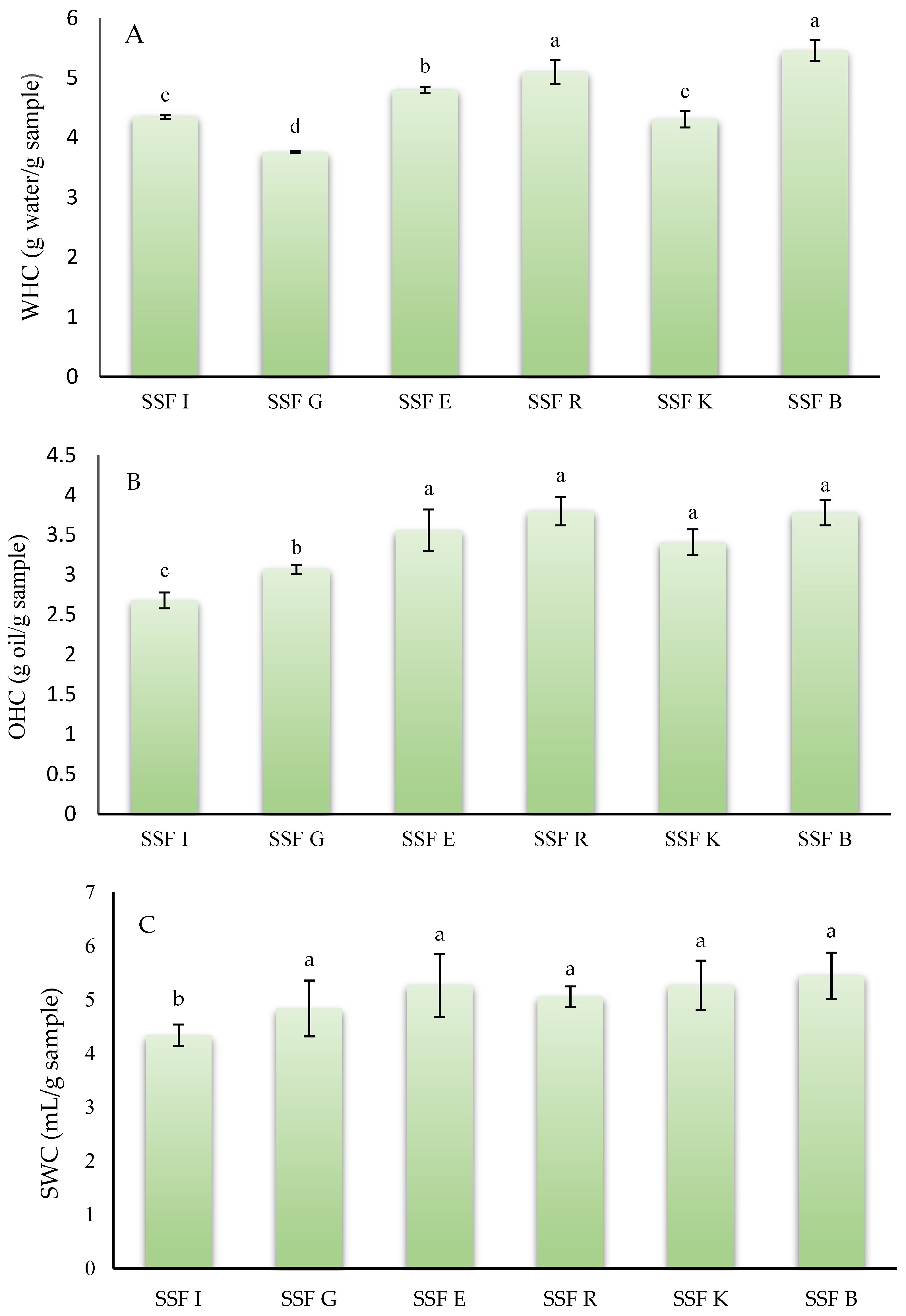
3.3. Techno-Functional Properties
3.4. Polyphenolic Profile
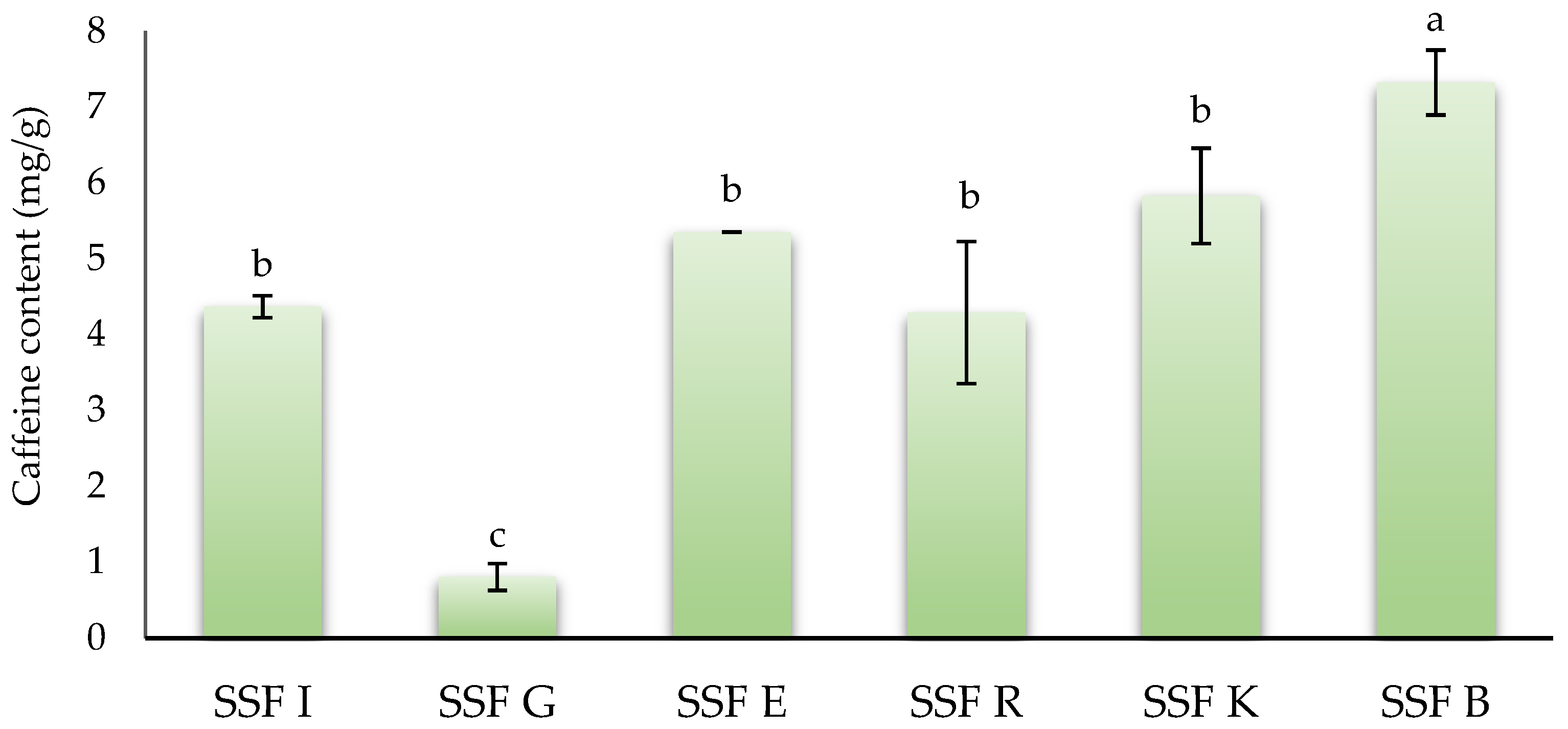
3.5. Caffeine Content
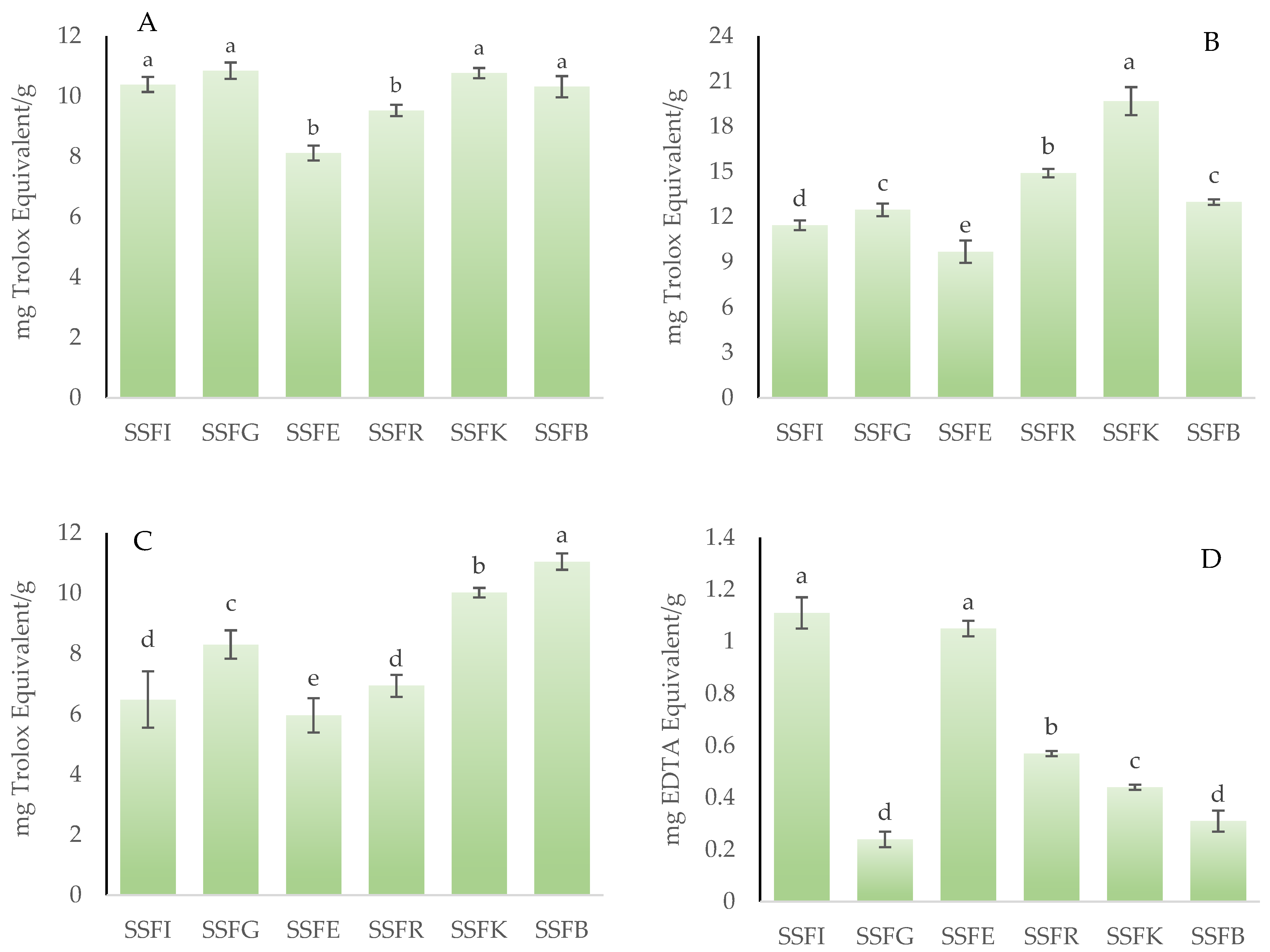
3.6. Antioxidant Capacity
4. Conclusions
Author Contributions
Funding
Institutional Review Board Statement
Informed Consent Statement
Data Availability Statement
Acknowledgments
Conflicts of Interest
References
- Dauber, C.; Romero, M.; Chaparro, C.; Ureta, C.; Ferrari, C.; Lans, R.; Frugoni, L.; Echeverry, M.V.; Calvo, B.S.; Trostchansky, A.; et al. Cookies enriched with coffee silverskin powder and coffee silverskin ultrasound extract to enhance fiber content and antioxidant properties. Appl. Food Res. 2024, 4, 100373. [Google Scholar] [CrossRef]
- Narita, Y.; Inouye, K. Review on utilization and composition of coffee silverskin. Food Res. Int. 2014, 61, 16–22. [Google Scholar] [CrossRef]
- Zhang, X.; Wang, W.; Yang, W.; Su, P.; Ge, Y.; Jiang, K.; Huang, J. Optimized carbonization of coffee shell via response surface methodology: A circular economy approach for environmental remediation. Environm. Pollution 2023, 346, 123018. [Google Scholar] [CrossRef] [PubMed]
- Al-Fawaeir, S.; Alawneh, J.M.; Al-Odat, I. Influence of coffee consumption on serum lipid profile parameters: Can coffee consumption lead to health consequences in humans? J. Agric. Food Res. 2023, 14, 100904. [Google Scholar] [CrossRef]
- Therdtatha, P.; Jareontanahun, N.; Chaisuwan, W.; Yakul, K.; Paemanee, A.; Manassa, A.; Moukamnerd, C.; Phimolsiripol, Y.; Sommano, S.R.; Seesuriyachan, P. Production of functional Arabica and Robusta green coffee beans: Optimization of fermentation with microbial cocktails to improve antioxidant activity and metabolomic profiles. Biocatal. Agric. Biotechnol. 2023, 53, 102869. [Google Scholar] [CrossRef]
- International Coffee Organization. Coffee Market Report: March 2023. Available online: https://www.ico.org/documents/cy2022-23/cmr-0323-e.pdf (accessed on 15 July 2025).
- Foreign Agricultural Service. U.S. Department of Agriculture. Available online: https://www.fas.usda.gov/data/production/commodity/0711100 (accessed on 22 November 2025).
- Nzekoue, F.K.; Angeloni, S.; Navarini, L.; Angeloni, C.; Freschi, M.; Hrelia, S.; Vitali, L.A.; Sagratini, G.; Vittori, S.; Caprioli, G. Coffee silverskin extracts: Quantification of 30 bioactive compounds by a new HPLC-MS/MS method and evaluation of their antioxidant and antibacterial activities. Food Res. Int. 2020, 133, 109128. [Google Scholar] [CrossRef]
- Nolasco, A.; Squillante, J.; Velotto, S.; D’Auria, G.; Ferranti, P.; Mamone, G.; Errico, M.E.; Avolio, R.; Castaldo, R.; Cirillo, T.; et al. Valorization of coffee industry wastes: Comprehensive physico-chemical characterization of coffee silverskin and multipurpose recycling applications. J. Clean. Prod. 2022, 370, 133520. [Google Scholar] [CrossRef]
- Gottstein, V.; Bernhardt, M.; Dilger, E.; Keller, J.; Breitling-Utzmann, C.M.; Schwarz, S.; Kuballa, T.; Lachenmeier, D.W.; Bunzel, M. Coffee silver skin: Chemical characterization with special consideration of dietary fiber and heat-induced contaminants. Foods 2021, 10, 1705. [Google Scholar] [CrossRef]
- Arya, S.S.; Venkatram, R.; More, P.R.; Vijayan, P. The wastes of coffee bean processing for utilization in food: A review. J. Food Sci. Technol. 2022, 59, 429–444. [Google Scholar] [CrossRef]
- Cantele, C.; Tedesco, M.; Ghirardello, D.; Zeppa, G.; Bertolino, M. Coffee silverskin as a functional ingredient in vegan biscuits: Physicochemical and sensory properties and in vitro bioaccessibility of bioactive compounds. Foods 2022, 11, 717. [Google Scholar] [CrossRef]
- Bertolino, M.; Barbosa-Pereira, L.; Ghirardello, D.; Botta, C.; Rolle, L.; Guglielmetti, A.; Borotto Dalla Vecchia, S.; Zeppa, G. Coffee silverskin as nutraceutical ingredient in yogurt: Its effect on functional properties and its bioaccessibility. J. Sci. Food Agric. 2019, 99, 4267–4275. [Google Scholar] [CrossRef]
- AOAC. Official Methods of Analysis of AOAC International, 18th ed.; AOAC: Washington, DC, USA, 2007. [Google Scholar]
- Chau, C.F.; Huang, Y.L. Comparison of the chemical composition and physicochemical properties of different fibers prepared from the peel of Citrus Sinensis L. Cv. Liucheng. J. Agric. Food Chem. 2023, 51, 2615–2618. [Google Scholar] [CrossRef] [PubMed]
- Robertson, J.A.; de Monredon, F.D.; Dysseler, P.; Guillon, F.; Amado, R.; Thibault, J.F. Hydration properties of dietary fibre and resistant starch: A european collaborative study. J. Food Sci. Technol. 2000, 33, 72–79. [Google Scholar] [CrossRef]
- Genskowsky, E.; Puente, L.A.; Pérez-Álvarez, J.A.; Fernández-López, J.; Muñoz, L.A.; Viuda-Martos, M. Determination of polyphenolic profile, antioxidant activity and antibacterial properties of maqui [Aristotelia chilensis (Molina) Stuntz] a Chilean blackberry. J. Sci. Food Agric. 2016, 96, 4235–4242. [Google Scholar] [CrossRef] [PubMed]
- Mpofu, A.; Sapirstein, H.D.; Beta, T. Genotype and environmental variation in phenolic content, phenolic acid composition, and antioxidant activity of hard spring wheat. J. Agric. Food Chem. 2006, 54, 1265–1270. [Google Scholar] [CrossRef]
- Grillo, G.; Boffa, L.; Binello, A.; Mantegna, S.; Cravotto, G.; Chemat, F.; Dizhbite, T.; Lauberte, L.; Telysheva, G. Cocoa bean shell waste valorisation; extraction from lab to pilot-scale cavitational reactors. Food Res. Int. 2019, 115, 200–208. [Google Scholar] [CrossRef]
- Brand-Williams, W.; Cuvelier, M.E.; Berset, C. Use of a free radical method to evaluate antioxidant activity. J. Food Sci. Technol. 1995, 28, 25–30. [Google Scholar] [CrossRef]
- Oyaizu, M. Studies on products of browning reaction: Antioxidative activity of products of browning reaction prepared from glucosamine. Jap. J. Nut. 1986, 44, 307–315. [Google Scholar] [CrossRef]
- Gullón, B.; Pintado, M.E.; Fernández-López, J.; Pérez-Álvarez, J.A.; Viuda-Martos, M. In vitro gastrointestinal digestion of pomegranate peel (Punica granatum) flour obtained from co-products: Changes in the antioxidant potential and bioactive compounds stability. J. Funct. Foods 2015, 19, 617–628. [Google Scholar] [CrossRef]
- Mahdavi, B.; Yaacob, W.A.; Din, L.B. Chemical composition, antioxidant, and antibacterial activity of essential oils from Etlingera sayapensis A.D. Poulsen & Ibrahim. Asian Pac. J. Trop. Med. 2017, 10, 819–826. [Google Scholar] [CrossRef]
- Costa Vimercati, W.; da Silva Araújo, C.; Levate Macedo, L.; Gomes Correa, J.L.; Pimenta, C.J. Encapsulation of coffee silverskin extracts by foam mat drying and comparison with powders obtained by spray drying and freeze-drying. J. Food Sci. 2022, 87, 1767–1779. [Google Scholar] [CrossRef]
- Costa, A.S.; Alves, R.C.; Vinha, A.F.; Costa, E.; Costa, C.S.; Nunes, M.A.; Almeida, A.A.; Santos-Silva, A.; Oliveira, M.B.P.P. Nutritional, chemical and antioxidant/pro-oxidant profiles of silverskin, a coffee roasting by-product. Food Chem. 2018, 267, 28–35. [Google Scholar] [CrossRef] [PubMed]
- Bobková, A.; Poláková, K.; Demianová, A.; Belej, L.; Bobko, M.; Jurčaga, L.; Gálik, B.; Novotná, I.; Iriondo-DeHond, A.; Del Castillo, M.D. Comparative analysis of selected chemical parameters of Coffea arabica, from cascara to silverskin. Foods 2022, 11, 1082. [Google Scholar] [CrossRef] [PubMed]
- Bessada, S.M.F.; Alves, R.C.; Costa, A.S.G.; Nunes, M.A.; Oliveira, M.B.P. Coffea canephora silverskin from different geographical origins: A comparative study. Sci. Total Environ. 2018, 645, 1021–1028. [Google Scholar] [CrossRef]
- Pourfarzad, A.; Mahdavian-Mehr, H.; Sedaghat, N. Coffee silverskin as a source of dietary fiber in bread-making: Optimization of chemical treatment using response surface methodology. J. Food Sci Technol. 2013, 50, 599–606. [Google Scholar] [CrossRef]
- Thangavelu, K.P.; Tiwari, B.K.; Kerry, J.P.; Álvarez, C.A. Comprehensive study on the characterisation properties of power ultrasound-treated apple pomace powder and coffee silverskin powder. Eur. Food Res. Technol. 2022, 248, 1939–1949. [Google Scholar] [CrossRef]
- Franca, A.S.; Basílio, E.P.; Resende, L.M.; Fante, C.A.; Oliveira, L.S. Coffee silverskin as a potential ingredient for functional foods: Recent advances and a case study with chocolate cake. Foods 2024, 13, 3935. [Google Scholar] [CrossRef]
- Alghooneh, A.; Mohammad Amini, A.; Behrouzian, F.; Razavi, S.M.A. Characterisation of cellulose from coffee silverskin. Int. J. Food Prp. 2017, 20, 2830–2843. [Google Scholar] [CrossRef]
- Behrouzian, F.; Amini, A.S.; Alghooneh, A.; Razavi, S.M.A. Characterization of dietary fiber from coffee silverskin: An optimization study using response surface methodology. Bioact. Carbohydr. Diet. Fibre 2016, 8, 58–64. [Google Scholar] [CrossRef]
- Mammolenti, D.; Lupi, F.R.; Baldino, N.; Gabriele, D. Technological advancements of insoluble dietary fiber from food by-product processing: A review. Foods 2025, 14, 1822. [Google Scholar] [CrossRef]
- Alahmari, L.A. Dietary fiber influence on overall health, with an emphasis on CVD, diabetes, obesity, colon cancer, and inflammation. Front. Nutr. 2024, 11, 1510564. [Google Scholar] [CrossRef]
- Iriondo-DeHond, A.; Rios, M.B.; Herrera, T.; Rodriguez-Bertos, A.; Nuñez, F.; San Andres, M.I.; Sanchez-Fortun, S.; del Castillo, M.D. Coffee silverskin extract: Nutritional value, safety and effect on key biological functions. Nutrients 2019, 11, 2693. [Google Scholar] [CrossRef] [PubMed]
- Martuscelli, M.; Esposito, L.; Di Mattia, C.D.; Ricci, A.; Mastrocola, D. Characterization of coffee silver skin as potential food-safe ingredient. Foods 2021, 10, 1367. [Google Scholar] [CrossRef] [PubMed]
- Vezzulli, F.; Fontanella, M.C.; Lambri, M.; Beone, G.M. Specialty and high-quality coffee: Discrimination through elemental characterization via ICP-OES, ICP-MS, and ICP-MS/MS of origin, species, and variety. J. Sci. Food Agric. 2023, 103, 4303–4316. [Google Scholar] [CrossRef] [PubMed]
- Nzekoue, F.K.; Borsetta, G.; Navarini, L.; Abouelenein, D.; Xiao, J.; Sagratini, G.; Vittori, S.; Caprioli, G.; Angeloni, S. Coffee silverskin: Characterization of B-vitamins, macronutrients, minerals and phytosterols. Food Chem. 2022, 372, 131188. [Google Scholar] [CrossRef]
- Vargas-Sánchez, R.D.; Torres-Martínez, B.M.; Torrescano-Urrutia, G.R.; Sánchez-Escalante, A. Physicochemical, techno-functional and antioxidant characterization of coffee silverskin. Biotecnia 2023, 25, 43–50. [Google Scholar] [CrossRef]
- Pellegrini, M.; Lucas-Gonzalez, R.; Ricci, A.; Fontecha, J.; Fernández-López, J.; Pérez-Álvarez, J.A.; Viuda-Martos, M. Chemical, fatty acid, polyphenolic profile, techno-functional and antioxidant properties of flours obtained from quinoa (Chenopodium quinoa Willd) seeds. Ind. Crops Prod. 2018, 111, 38–46. [Google Scholar] [CrossRef]
- Quagliata, E.; Gazzara, S.; Dauber, C.; Rodríguez, A.; Panizzolo, L.; Irigaray, B.; Gámbaro, A.; Mendiola, J.A.; Vieitez, I.; del Castillo, M.D. Novel insights into torrefacto and natural coffee silverskin: Composition, bioactivity, safety, and environmental impact for sustainable food applications. Foods 2025, 14, 3388. [Google Scholar] [CrossRef]
- Lu, T.; Sun, Y.; Huang, Y.; Chen, X. Effects of roasting on the chemical compositions, color, aroma, microstructure, and the kinetics of changes in coffee pulp. J. Food Sci. 2023, 88, 1430–1444. [Google Scholar] [CrossRef]
- López-Marcos, M.C.; Bailina, C.; Viuda-Martos, M.; Pérez-Alvarez, J.A.; Fernández-López, J. Properties of dietary fibers from agroindustrial coproducts as source for fiber-enriched foods. Food Biopr. Technol. 2015, 8, 2400–2408. [Google Scholar] [CrossRef]
- Badia-Olmos, C.; Laguna, L.; Haros, C.M.; Tárrega, A. Techno-functional and rheological properties of alternative plant-based flours. Foods 2023, 12, 1411. [Google Scholar] [CrossRef] [PubMed]
- Ballesteros, L.F.; Teixeira, J.A.; Mussatto, S.I. Chemical, Functional, and structural properties of spent coffee grounds and coffee silverskin. Food Bioprocess Technol. 2014, 7, 3493–3503. [Google Scholar] [CrossRef]
- Wagner, C.E.; Richter, J.K.; Ikuse, M.; Ganjyal, G.M. Classification of select functional dietary fiber ingredients based on quantitative properties and latent qualitative criteria. J. Food Sci. 2024, 89, 6098–6112. [Google Scholar] [CrossRef] [PubMed]
- Ateş, G.; Elmacı, Y. Coffee silverskin as fat replacer in cake formulations and its effect on physical, chemical and sensory attributes of cakes. J. Food Sci. Technol. 2018, 90, 519–525. [Google Scholar] [CrossRef]
- Wang, S.; Fang, Y.; Xu, Y.; Zhu, B.; Piao, J.; Zhu, L.; Yao, L.; Liu, K.; Wang, S.; Zhang, Q.; et al. The effects of different extraction methods on physicochemical, functional and physiological properties of soluble and insoluble dietary fiber from Rubus chingii Hu. Fruits. J. Funct. Food 2022, 93, 105081. [Google Scholar] [CrossRef]
- Song, Y.; Shi, Y.; Liu, Y.; Ma, Y.; Lin, C.; Nie, N.; Song, X.; Yang, J. Physicochemical properties of soluble dietary fiber from passion fruit peel based on various extraction methods. Agric. Nat. Resour. 2025, 15, 44. [Google Scholar] [CrossRef]
- Kalla-Bertholdt, A.-M.; Baier, A.K.; Rauh, C. Potential of modification of techno-functional properties and structural characteristics of citrus, apple, oat, and pea dietary fiber by high-intensity ultrasound. Foods 2023, 12, 3663. [Google Scholar] [CrossRef]
- Manoliu, D.-R.; Ciobotaru, M.C.; Ciobanu, M.M.; Boișteanu, P.C. Development and characterization of meat-based pasta enriched with apple and sugar beet fibers. Foods 2025, 14, 3837. [Google Scholar] [CrossRef]
- Feng, J.; Kong, B.; Sun, F.; Xia, X. Effect of potato dietary fiber on the quality, microstructure, and thermal stability of chicken patty. Foods 2022, 11, 3978. [Google Scholar] [CrossRef]
- Mannino, G.; Kunz, R.; Maffei, M.E. Discrimination of green coffee (Coffea arabica and Coffea canephora) of different geographical origin based on antioxidant activity, high-throughput metabolomics, and DNA RFLP fingerprinting. Antioxidants 2023, 12, 1135. [Google Scholar] [CrossRef]
- Panusa, A.; Petrucci, R.; Lavecchia, R.; Zuorro, A. UHPLC-PDA-ESI-TOF/MS metabolic profiling and antioxidant capacity of Arabica and robusta coffee silverskin: Antioxidants vs phytotoxins. Food Res. Intern. 2017, 99, 155–165. [Google Scholar] [CrossRef]
- Jiang, Q.; Wang, S.; Yang, Y.; Luo, J.; Yang, R.; Li, W. Profiles of Free and Bound Phenolics and Their Antioxidant Capacity in Rice Bean (Vigna umbellata). Foods 2023, 12, 2718. [Google Scholar] [CrossRef] [PubMed]
- Pinaffi, A.C.D.; Sampaio, G.R.; Soares, M.J.; Shahidi, F.; de Camargo, A.C.; Torres, E.A.F.S. Insoluble-bound polyphenols released from guaraná powder: Inhibition of alpha-glucosidase and proanthocyanidin profile. Molecules 2020, 25, 679. [Google Scholar] [CrossRef]
- Suwannachot, J.; Collado Reginio, F.; Hamauzu, Y.Y.; Kiharu Ogawa, Y. Assessment of free, esterified, and insoluble-bound phenolics of green and red perilla leaves and changes during simulated gastrointestinal digestion. Food Chem. Adv. 2022, 1, 100018. [Google Scholar] [CrossRef]
- Wu, H.; Liu, Z.; Lu, P.; Barrow, C.; Dunshea, F.R.; Suleria, H.A. R: Bioaccessibility and bioactivities of phenolic compounds from roasted coffee beans during in vitro digestion and colonic fermentation. Food Chem. 2022, 386, 132794. [Google Scholar] [CrossRef] [PubMed]
- Gamboa-Gómez, C.I.; Morales-Castro, J.; Barragan-Zuñiga, J.; Denise Herrera, M.; Zamilpa-Álvarez, A.; Gónzalez, J.L.; Martínez-Aguilar, G.; Morales-Castro, E.P.; Anese, M.; Alongi, M. Influence of coffee roasting degree on antioxidant and metabolic parameters: Comprehensive in vitro and in vivo analysis. Curr. Res. Food Sci. 2024, 9, 100861. [Google Scholar] [CrossRef]
- Zhang, Y.; Bai, B.; Yan, Y.; Liang, J.; Guan, X. Bound polyphenols from red quinoa prevailed over free polyphenols in reducing postprandial blood glucose rises by inhibiting α-glucosidase activity and starch digestion. Nutrients 2022, 14, 728. [Google Scholar] [CrossRef]
- Lippolis, T.; Cofano, M.; Caponio, G.R.; De Nunzio, V.; Notarnicola, M. Bioaccessibility and bioavailability of diet polyphenols and their modulation of gut microbiota. Int. J. Mol. Sci. 2023, 24, 3813. [Google Scholar] [CrossRef]
- Machado, M.; Espírito Santo, L.; Machado, S.; Lobo, J.C.; Costa, A.S.G.; Oliveira, M.B.P.P.; Ferreira, H.; Alves, R.C. Bioactive potential and chemical composition of coffee by-products: From pulp to silverskin. Foods 2023, 12, 2354. [Google Scholar] [CrossRef]
- Giordano, M.; Bertolino, M.; Belviso, S.; Ghirardello, D.; Zeppa, G. Effects of species, post-harvest treatment, and roasting on fibre, volatile compounds, and polyphenol contents in coffee silverskin. Foods 2022, 11, 3132. [Google Scholar] [CrossRef]
- Peixoto, J.A.B.; Andrade, N.; Machado, S.; Costa, A.S.G.; Puga, H.; Oliveira, M.B.P.P.; Martel, F.; Alves, R.C. Valorizing coffee silverskin based on its phytochemicals and antidiabetic potential: From lab to a pilot scale. Foods 2022, 11, 1671. [Google Scholar] [CrossRef] [PubMed]
- Linne, B.M.; Tello, E.; Simons, C.T.; Peterson, D.G. Characterization of the impact of chlorogenic acids on tactile perception in coffee through an inverse effect on mouthcoating sensation. Food Res. Int. 2023, 172, 113167. [Google Scholar] [CrossRef] [PubMed]
- Tieghi, H.; de Almeida Pereira, L.; Silva Viana, G.; Katchborian-Neto, A.; Brandão Santana, D.; Mincato, R.L.; Ferreira Dias, D.; Chagas-Paula, D.A.; Gomes Soares, M.; de Araújo, W.G.; et al. Effects of geographical origin and post-harvesting processing on the bioactive compounds and sensory quality of Brazilian specialty coffee beans. Food Res. Int. 2024, 186, 114346. [Google Scholar] [CrossRef] [PubMed]
- Šeremet, D.; Fabečić, P.; Vojvodić Cebin, A.; Mandura Jarić, A.; Pudić, R.; Komes, D. Antioxidant and sensory assessment of innovative coffee blends of reduced caffeine content. Molecules 2022, 27, 448. [Google Scholar] [CrossRef]
- Saavedra Velásquez, N.; Cuadrado Peñafiel, V.; de la Vega Marcos, R. Can caffeine improve your performance? Psychophysiological effects. A systematic review. Nutr. Hosp. 2024, 41, 677–685. [Google Scholar] [CrossRef]
- Koskinakis, S.E.; Stergiopoulos, C.; Vasileiou, C.; Krokida, M. Sustainable valorization of coffee silverskin waste: Pressurized liquid extraction of bioactive compounds. Foods 2025, 14, 615. [Google Scholar] [CrossRef]
- Del Castillo, M.D.; Fernandez-Gomez, B.; Martinez-Saez, N.; Iriondo-Dehond, A.; Martirosyan, D.M.; Mesa, M.D.; Dolores, M.; Castillo, D. Coffee silverskin extract for aging and chronic diseases. In Functional Foods for Chronic Diseases; Martirosyan, D.M., Ed.; Food Science Publisher: Dallas, TX, USA, 2016; pp. 386–409. [Google Scholar]
- Dong, S.; Ding, L.; Zheng, X.; Wang, O.; Cai, S. Phenolic compositions of different fractions from coffee silver skin and their antioxidant activities and inhibition towards carbohydrate-digesting enzymes. Foods 2024, 13, 3083. [Google Scholar] [CrossRef]
- Jirarat, W.; Kaewsalud, T.; Yakul, K.; Rachtanapun, P.; Chaiyaso, T. Sustainable valorization of coffee silverskin: Extraction of phenolic compounds and proteins for enzymatic production of bioactive peptides. Foods 2024, 13, 1230. [Google Scholar] [CrossRef]



| Moisture | Protein | Fat | Ash | TDF | IDF | SDF | |
|---|---|---|---|---|---|---|---|
| SSFI | 4.40 ± 0.39 c | 15.08 ± 0.32 a | 1.20 ± 0.07 c | 4.65 ± 0.27 b | 74.30 ± 0.62 b | 58.35 ± 1.20 ab | 15.95 ± 0.53 b |
| SSFG | 4.50 ± 0.15 c | 12.37 ± 0.10 d | 1.70 ± 0.08 b | 4.25 ± 0.52 bc | 76.86 ± 1.23 a | 58.68 ± 0.55 ab | 18.18 ± 0.76 a |
| SSFE | 4.94 ± 0.28 bc | 13.10 ± 0.03 cd | 1.85 ± 0.07 b | 4.23 ± 0.25 c | 75.21 ± 2.65 a | 55.88 ± 0.52 c | 19.33 ± 0.94 a |
| SSFR | 5.69 ± 0.18 b | 12.98 ± 0.31 d | 2.10 ± 0.12 a | 5.34 ± 0.22 a | 72.35 ± 0.40 b | 60.58 ± 0.48 a | 11.77 ± 0.22 d |
| SSFK | 6.41 ± 0.44 a | 13.94 ± 0.10 bc | 1.88 ± 0.08 b | 5.01 ± 0.20 ab | 71.81 ± 1.33 c | 57.81 ± 1.25 b | 14.00 ± 0.47 c |
| SSFB | 5.26 ± 0.22 b | 14.21 ± 0.12 b | 1.96 ± 0.04 ab | 4.91 ± 0.25 ab | 73.09 ± 1.24 b | 54.02 ± 1.58 c | 19.07 ± 2.19 a |
| Calcium | Iron | Potassium | Magnesium | Sodium | Phosphorus | |
|---|---|---|---|---|---|---|
| SSFI | 9.25 ± 0.19 dB | 0.19 ± 0.02 bF | 17.59 ± 0.30 aA | 5.10 ± 0.04 aD | 0.45 ± 0.13 bE | 5.30 ± 0.11 aC |
| SSFG | 16.44 ± 0.18 aA | 0.20 ± 0.01 bF | 12.53 ± 0.22 cB | 2.25 ± 0.04 cD | 0.66 ± 0.10 aE | 2.74 ± 0.08 cC |
| SSFE | 13.31 ± 0.33 bA | 0.12 ± 0.01 dE | 12.69 ± 0.25 cB | 3.53 ± 0.10 bC | 0.66 ± 0.04 aD | 3.99 ± 0.06 bC |
| SSFR | 10.58 ± 0.14 cB | 0.26 ± 0.01 aF | 14.44 ± 0.63 bA | 2.22 ± 0.07 cD | 0.56 ± 0.04 aE | 5.23 ± 0.07 aC |
| SSFK | 12.24 ± 0.06 bA | 0.20 ± 0.01 bF | 8.68 ± 0.37 dB | 2.09 ± 0.06 cC | 0.53 ± 0.03 aE | 1.01 ± 0.08 dD |
| SSFB | 13.25 ± 0.07 bA | 0.16 ± 0.02 cF | 6.66 ± 0.10 eB | 2.57 ± 0.02 cC | 0.63 ± 0.06 aE | 1.02 ± 0.05 dD |
| pH | Aw | L* | a* | b* | |
|---|---|---|---|---|---|
| SSFI | 5.79 ± 0.01 a | 0.541 ± 0.005 c | 54.60 ± 0.38 a | 5.77 ± 0.04 d | 21.34 ± 0.13 d |
| SSFG | 4.47 ± 0.03 e | 0.586 ± 0.001 a | 51.41 ± 1.31 b | 7.95 ± 0.24 c | 22.18 ± 0.40 c |
| SSFE | 4.30 ± 0.01 f | 0.579 ± 0.001 a | 53.92 ± 1.22 a | 7.94 ± 0.18 c | 23.28 ± 0.51 b |
| SSFR | 5.15 ± 0.01 b | 0.568 ± 0.001 b | 51.85 ± 0.22 b | 8.89 ± 0.22 a | 22.34 ± 0.11 c |
| SSFK | 4.68 ± 0.01 d | 0.400 ± 0.000 e | 55.45 ± 1.37 a | 8.40 ± 0.18 b | 27.20 ± 0.38 a |
| SSFB | 4.96 ± 0.00 c | 0.420 ± 0.000 d | 53.99 ± 0.40 a | 8.96 ± 0.19 a | 26.50 ± 0.37 b |
| SSFI | SSFG | SSFE | SSFR | SSFK | SSFB | |
|---|---|---|---|---|---|---|
| Compound | Free | |||||
| Vanillin | 1.00 ± 0.01 cE | 0.41 ± 0.11 dC | 1.63 ± 0.04 aD | 0.65 ± 0.08 dE | 1.43 ± 0.01 bF | 1.17 ± 0.11 cD |
| Ferulic acid | 1.61 ± 0.02 bD | 0.17 ± 0.00 cC | 2.60 ± 0.01 aC | 1.69 ± 0.02 bD | 1.68 ± 0.10 bF | 2.55 ± 0.40 aC |
| 3-caffeoylquinic acid | 0.87 ± 0.04 eE | nd | 1.67 ± 0.05 dD | 47.44 ± 0.08 aA | 29.79 ± 1.80 bA | 4.11 ± 1.23 cB |
| 4-caffeoylquinic acid | 2.07 ± 0.42 cC | 1.55 ± 0.02 cB | 1.83 ± 0.32 cD | 4.99 ± 0.06 bC | 9.21 ± 1.42 aC | 4.67 ± 0.83 bB |
| 5-caffeoylquinic acid | 2.29 ± 0.34 cC | 2.13 ± 0.34 cA | 2.40 ± 0.45 cC | 8.42 ± 0.75 aB | 3.69 ± 0.32 bE | 3.78 ± 0.51 bC |
| 4,5-dicaffeoylquinic acid | 7.30 ± 2.40 cA | 2.53 ± 0.38 dA | 9.98 ± 0.04 bA | 7.52 ± 0.54 cB | 12.48 ± 1.70 aB | 12.96 ± 1.01 aA |
| Caffeic acid derivative | 4.57 ± 0.04 bB | 1.55 ± 0.03 dB | 5.90 ± 0.08 aB | 4.94 ± 0.75 abC | 6.67 ± 1.06 aD | 2.91 ± 0.44 cC |
| Total polyphenols | 19.71 ± 3.27 e | 8.34 ± 0.88 f | 26.01 ± 0.99 d | 75.65 ± 2.28 a | 64.95 ± 6.41 b | 32.15 ± 4.53 c |
| Compound | Bound | |||||
| Vanillic acid derivative | 3.75 ± 1.00 dE | 21.70 ± 0.01 bA | 13.04 ± 0.01 cD | 26.05 ± 2.26 bB | 54.26 ± 3.97 aA | 48.39 ± 3.23 aB |
| Caffeic acid | 58.25 ± 1.25 bB | 13.84 ± 0.09 eC | 65.11 ± 0.06 aA | 45.92 ± 3.76 cA | 23.86 ± 2.49 dB | 47.88 ± 0.89 cB |
| Ferulic acid | 109.10 ± 0.05 aA | 12.22 ± 0.11 eD | 64.58 ± 0.03 bA | 14.83 ± 2.77 eC | 24.02 ± 2.41 dB | 29.03 ± 1.35 cC |
| 4-Hydroxybenzoic acid | 18.28 ± 2.60 aD | 9.49 ± 0.07 bE | 16.89 ± 2.35 aC | 2.86 ± 0.33 cD | 10.35 ± 0.39 bC | 1.60 ± 1.33 cD |
| 4,5-dicaffeoylquinic acid | 48.29 ± 0.02 cC | 17.39 ± 2.05 fB | 41.59 ± 0.01 dB | 30.42 ± 2.80 eB | 54.46 ± 1.91 bA | 60.58 ± 1.49 aA |
| Total polyphenols | 219.39 ± 4.32 a | 65.15 ± 2.26 e | 184.32 ± 0.11 b | 117.22 ± 11.59 d | 156.60 ± 10.78 c | 185.88 ± 8.96 b |
Disclaimer/Publisher’s Note: The statements, opinions and data contained in all publications are solely those of the individual author(s) and contributor(s) and not of MDPI and/or the editor(s). MDPI and/or the editor(s) disclaim responsibility for any injury to people or property resulting from any ideas, methods, instructions or products referred to in the content. |
© 2025 by the authors. Licensee MDPI, Basel, Switzerland. This article is an open access article distributed under the terms and conditions of the Creative Commons Attribution (CC BY) license.
Share and Cite
Candela-Salvador, L.; Lucas-González, R.; Pérez-Álvarez, J.A.; Fernández-López, J.; Viuda-Martos, M. Characterization of Coffee Silverskin from Different Origins to Evaluate Its Potential as an Ingredient in Novel Food Products. Foods 2026, 15, 97. https://doi.org/10.3390/foods15010097
Candela-Salvador L, Lucas-González R, Pérez-Álvarez JA, Fernández-López J, Viuda-Martos M. Characterization of Coffee Silverskin from Different Origins to Evaluate Its Potential as an Ingredient in Novel Food Products. Foods. 2026; 15(1):97. https://doi.org/10.3390/foods15010097
Chicago/Turabian StyleCandela-Salvador, Laura, Raquel Lucas-González, José A. Pérez-Álvarez, Juana Fernández-López, and Manuel Viuda-Martos. 2026. "Characterization of Coffee Silverskin from Different Origins to Evaluate Its Potential as an Ingredient in Novel Food Products" Foods 15, no. 1: 97. https://doi.org/10.3390/foods15010097
APA StyleCandela-Salvador, L., Lucas-González, R., Pérez-Álvarez, J. A., Fernández-López, J., & Viuda-Martos, M. (2026). Characterization of Coffee Silverskin from Different Origins to Evaluate Its Potential as an Ingredient in Novel Food Products. Foods, 15(1), 97. https://doi.org/10.3390/foods15010097