
Dental Splints and Sport Performance: A Review of the Current Literature

 ,
,  ,
, 
 ,
,  ,
,  and
and
Abstract
1. Introduction
- Stabilization Splints (Flat Plane Splints): Designed to cover the upper or lower arch, these splints evenly distribute bite forces to reduce muscle activity and protect the teeth. They are commonly used to manage TMD and bruxism.
- Anterior Bite Plane Splints: These cover only the front teeth, disengaging the back teeth to prevent clenching. Due to the possibility of posterior teeth shifting with prolonged use, they are usually advised for short-term use only.
- Repositioning Splints: These alter the jaw’s position to reduce TMJ strain and are often used to treat joint-related issues. However, they can cause permanent bite changes if used for extended periods.
- Soft and Hard Splints: Soft splints are generally more comfortable and suitable for mild bruxism, while rigid splints are more durable and adequate for severe cases. Hybrid splints, with a hard outer layer and soft inner layer, provide a balance of comfort and durability.
- Stock Mouthguards: These are pre-shaped and available in multiple sizes, making them the most convenient and cost-effective choice. However, their generic fit often results in less comfort and reduced protection. Since they cannot be customized, wearers may need to clench their jaws to keep them securely in position.
- Boil-and-Bite Mouthguards: Made from thermoplastic materials, such as ethylene-vinyl acetate (EVA), these mouthguards soften when exposed to hot water. Once heated, the user bites into the material, shaping it to match the structure of their teeth and gums. This molding process provides a more customized fit than stock mouthguards, improving comfort and protection. However, their effectiveness relies on proper shaping during the fitting process.
- Custom-Fitted Mouthguards: These mouthguards are custom-made by dental professionals using precise impressions of the wearer’s teeth. They offer the best possible fit, comfort, and protection, but they also come at a higher cost. Due to their exceptional performance, they are especially recommended for athletes participating in high-contact sports.
2. Materials and Methods
2.1. Protocol and Registration
2.2. Search Processing
2.3. Eligibility Criteria and Study Selection
2.4. Data Processing
3. Results
3.1. Selection and Characteristics of Study
3.2. Synthesis of Results
4. Discussion
5. Conclusions
Author Contributions
Funding
Institutional Review Board Statement
Informed Consent Statement
Data Availability Statement
Conflicts of Interest
References
- Cesanelli, L.; Cesaretti, G.; Ylaitė, B.; Iovane, A.; Bianco, A.; Messina, G. Occlusal Splints and Exercise Performance: A Systematic Review of Current Evidence. Int. J. Environ. Res. Public Health 2021, 18, 10338. [Google Scholar] [CrossRef] [PubMed]
- ADA Council on Access; Prevention and Interprofessional Relations; ADA Council on Scientific Affairs. Using mouthguards to reduce the incidence and severity of sports-related oral injuries. J. Am. Dent. Assoc. 2006, 137, 1712–1720. [Google Scholar] [CrossRef] [PubMed]
- Wanke, E.M.; Schreiter, J.; Groneberg, D.A.; Weisser, B. Muscular imbalances and balance capability in dance. J. Occup. Med. Toxicol. 2018, 13, 36. [Google Scholar] [CrossRef] [PubMed]
- Wanke, E.M.; Gabrys, L.; Leslie-Spinks, J.; Ohlendorf, D.; Groneberg, D.A. Functional muscle asymmetries and laterality in Latin American formation dancers. J. Back Musculoskelet. Rehabil. 2018, 31, 931–938. [Google Scholar] [CrossRef]
- Wanke, E.M.; Mill, H.; Arendt, M.; Wanke, A.; Koch, F.; Groneberg, D.A. Occupational accidents in professional dancers with regard to different professional dance styles. Work 2014, 49, 597–606. [Google Scholar] [CrossRef] [PubMed]
- Dias, A.; Redinha, L.A.; Silva, L.M.; and Pezarat-Correia, P.C. Effects of Dental Occlusion on Body Sway, Upper Body Muscle Activity and Shooting Performance in Pistol Shooters. Appl. Bionics Biomech. 2018, 2018, 9360103. [Google Scholar] [CrossRef] [PubMed]
- Kandel, E.; Schwartz, J.; Jessell, T.; Sielgelbaum, S.; Hudspeth, A. (Eds.) Principles of Neural Science; McGraw-Hill: New York, NY, USA, 2013; pp. 943–947. [Google Scholar]
- Baldini, A.; Nota, A.; Tripodi, D.; Longoni, S.; Cozza, P. Evaluation of the correlation between dental occlusion and posture using a force platform. Clinics 2013, 68, 45–49. [Google Scholar] [CrossRef] [PubMed]
- Huggare, J.A.; Raustia, A.M.; Makofsky, H.W. Head posture and cervicovertebral and craniofacial morphology in patients with craniomandibular dysfunction. CRANIO® 1992, 10, 173–179. [Google Scholar] [CrossRef]
- Göttfert, F.; Herzog, J.; Maurer-Grubinger, C.; Oremek, G.; Holzgreve, F.; Groneberg, D.A.; Ohlendorf, D. Balance Stability and Cervical Spine Range of Motion While Wearing a Custom-Made Mandibular Splint with Special Consideration of the Sex. Appl. Sci. 2022, 12, 11856. [Google Scholar] [CrossRef]
- Moon, H.J.; Lee, Y.K. The relationship between dental occlusion/-temporomandibular joint status and general body health: Part 1. Dental occlusion and TMJ status exert an influence on general body health. J. Altern. Complement. Med. 2011, 17, 995–1000. [Google Scholar] [CrossRef]
- Kui, A.; Pop, S.; Buduru, S.; Neguciociu, M. The use of Occlusal Splints in Temporomandibular disorders—An overview. Acta Stomatol. Marisiensis J. 2020, 3, 3–8. [Google Scholar] [CrossRef]
- Alqutaibi, A.Y.; Aboalrejal, A.N. Types of Occlusal Splint in Management of Temporomandibular Disorders (TMD). J. Arthritis 2015, 4, 176. [Google Scholar] [CrossRef]
- Dias, A.; Redinha, L.; Vaz, J.R.; Cordeiro, N.; Silva, L.; Pezarat–Correia, P. Effects of occlusal splints on shoulder strength and activation. Ann. Med. 2019, 51, 15–21. [Google Scholar] [CrossRef] [PubMed]
- Leroux, E.; Leroux, S.; Maton, F.; Ravalec, X.; Sorel, O. Influence of dental occlusion on the athletic performance of young elite rowers: A pilot study. Clinics 2018, 73, 453. [Google Scholar] [CrossRef]
- Grosdent, S.; O’Thanh, R.; Domken, O.; Lamy, M.; Croisier, J.L. Dental Occlusion Influences Knee Muscular Performances in Asymptomatic Females. J. Strength Cond. Res. 2014, 28, 492–498. [Google Scholar] [CrossRef]
- Garner, D.P.; Lamira, J. Respiratory outcomes with the use of a lower custom fit genioglossal-effecting oral appliance. Clin. Exp. Dent. Res. 2019, 6, 100–106. [Google Scholar] [CrossRef] [PubMed]
- Grondin, F.; Hall, T.; Ella, B.; Laurentoye, M.; Ella, B. Upper cervical range of motion is impaired in patients with temporomandibular disorders. Cranio 2014, 33, 91–99. [Google Scholar] [CrossRef] [PubMed]
- Subachanya, R.; Saravana, P.G.L. Oclussal splints therapy in TMD pain management: A review. J. Glob. Oral Health 2022, 5, 102–106. [Google Scholar] [CrossRef]
- Ainoosah, S.; Farghal, A.E.; Alzemei, M.S.; Saini, R.S.; Gurumurthy, V.; Quadri, S.A.; Okshah, A.; Mosaddad, S.A.; Heboyan, A. Comparative analysis of different types of occlusal splints for the management of sleep bruxism: A systematic review. BMC Oral Health 2024, 24, 29. [Google Scholar] [CrossRef]
- Sakshi, N.; Sneha, S.M.; Abhilasha, B. Comparing Boil and Bite with Customized Mouthguard Based on Subjective Experience of Boxers—A Pilot Study. Int. J. Health Sci. Res. 2021, 11, 358–366. [Google Scholar] [CrossRef]
- Patrick, D.G.; Van Noort, R.; Found, M.S. Scale of protection and the various types of sports mouthguard. Br. J. Sports Med. 2005, 39, 278–281. [Google Scholar] [CrossRef] [PubMed]
- Borg, G.A. Psychophysical bases of perceived exertion. Med. Sci. Sports Exerc. 1982, 14, 377–381. [Google Scholar] [CrossRef] [PubMed]
- Wang, X.; Soh, K.G.; Samsudin, S.; Deng, N.; Liu, X.; Zhao, Y.; Akbar, S. Effects of high-intensity functional training on physical fitness and sport-specific performance among the athletes: A systematic review with meta-analysis. PLoS ONE 2023, 18, e0295531. [Google Scholar] [CrossRef]
- Wilmore, J.H.; Costill, D.L. Physiology of Sport and Exercise, 3rd ed.; Human Kinetics: New York, NY, USA, 2004; pp. 78–80. [Google Scholar]
- Noakes, T.D. Lore of Running, 4th ed.; Human Kinetics: Cape Town, South Africa, 2001; pp. 23–26. [Google Scholar]
- Julià-Sánchez, S.; Álvarez-Herms, J.; Cirer-Sastre, R.; Corbi, F.; Burtscher, M. The Influence of Dental Occlusion on Dynamic Balance and Muscular Tone. Front. Physiol. 2020, 10, 1626. [Google Scholar] [CrossRef] [PubMed]
- Didier, H.; Assandri, F.; Gaffuri, F.; Cavagnetto, D.; Abate, A.; Villanova, M.; Maiorana, C. The Role of Dental Occlusion and Neuromuscular Behavior in Professional Ballet Dancers’ Performance: A Pilot Study. Healthcare 2021, 9, 251. [Google Scholar] [CrossRef]
- Patti, A.; Bianco, A.; Messina, G.; Bellafiore, M.; Battaglia, G.; Iovane, A.; Traina, M.; Palma, A. The influence of the stomatognathic system on explosive strength: A pilot study. J. Phys. Ther. Sci. 2016, 28, 72–75. [Google Scholar] [CrossRef]
- de la Parte, A.; Monticelli, F.; Toro-Román, V.; Pradas, F. Differences in Oral Health Status in Elite Athletes According to Sport Modalities. Sustainability 2021, 13, 7282. [Google Scholar] [CrossRef]
- Minty, M.; Canceill, T.; Lê, S.; Dubois, P.; Amestoy, O.; Loubieres, P.; Christensen, J.E.; Champion, C.; Azalbert, V.; Grasset, E.; et al. Oral health and microbiota status in professional rugby players: A case-control study. J. Dent. 2018, 79, 53–60. [Google Scholar] [CrossRef]
- Ayadi, H.; Ben Saad, H.; Talbi, M.; Boughzela, A.; Moalla, W.; Granacher, U.; Chaouachi, A. Effects of wearing fixed orthodontic appliance on dynamic balance, reaction time, and pain perception in adolescents and young adult elite athletes. Somatosens. Mot. Res. 2023, 41, 230–237. [Google Scholar] [CrossRef]
- Klineberg, I.; Jagger, R.G. Occlusion and Clinical Practice: An Evidence-Based Approach. Br. Dent. J. 2004, 197, 106–107. [Google Scholar]
- Verban, E.M.; Groppel, J.L.; Pfautsch, E.W.; Ramseyer, G.C. The Effects of a Mandibular Orthopedic Repositioning Appliance on Shoulder Strength. J. Craniomandib. Pract. 1984, 2, 232–237. [Google Scholar] [CrossRef] [PubMed]
- Ringhof, S.; Hellmann, D.; Meier, F.; Etz, E.; Schindler, H.J.; Stein, T. The effect of oral motor activity on the athletic performance of professional golfers. Front. Psychol. 2015, 6, 750. [Google Scholar] [CrossRef]
- Valenti, C.; Di Pasquale, F.; Pancrazi, G.P.; Falocci, N.; Nanussi, A.; Biscarini, A.; Pagano, S. Evaluation of different electromyographic parameters of temporomandibular dysfunction in athletes. J. Bodyw. Mov. Ther. 2024, 42, 56–63. [Google Scholar] [CrossRef]
- Maurer, C.; Heller, S.; Sure, J.-J.; Fuchs, D.; Mickel, C.; Wanke, E.M.; Groneberg, D.A.; Ohlendorf, D. Strength improvements through occlusal splints? The effects of different lower jaw positions on maximal isometric force production and performance in different jumping types. PLoS ONE 2018, 13, e0193540. [Google Scholar] [CrossRef] [PubMed]
- Hutton, B.; Salanti, G.; Caldwell, D.M.; Chaimani, A.; Schmid, C.H.; Cameron, C.; Ioannidis, J.P.A.; Straus, S.; Thorlund, K.; Jansen, J.P.; et al. The PRISMA Extension Statement for Reporting of Systematic Reviews Incorporating Network Meta-analyses of Health Care Interventions: Checklist and Explanations. Ann. Intern. Med. 2015, 162, 777–784. [Google Scholar] [CrossRef]
- Allen, C.R.; Dabbs, N.C.; Zachary, C.S.; Garner, J.C. The Acute Effect of a Commercial Bite-Aligning Mouthpiece on Strength and Power in Recreationally Trained Men. J. Strength Cond. Res. 2014, 28, 499–503. [Google Scholar] [CrossRef] [PubMed]
- Golem, D.L.; Arent, S.M. Effects of Over-the-Counter Jaw-Repositioning Mouth Guards on Dynamic Balance, Flexibility, Agility, Strength, and Power in College-Aged Male Athletes. J. Strength Cond. Res. 2015, 29, 500–512. [Google Scholar] [CrossRef] [PubMed]
- Maurer, C.; Stief, F.; Jonas, A.; Kovac, A.; Groneberg, D.A.; Meurer, A.; Ohlendorf, D. Influence of the Lower Jaw Position on the Running Pattern. PLoS ONE 2015, 10, e0135712. [Google Scholar] [CrossRef]
- Battaglia, G.; Giustino, V.; Iovane, A.; Bellafiore, M.; Martines, F.; Patti, A.; Traina, M.; Messina, G.; Palma, A. Influence of occlusal vertical dimension on cervical spine mobility in sports subjects. Acta Medica Mediterr. 2016, 32, 1589–1595. [Google Scholar] [CrossRef]
- Buscà, B.; Morales, J.; Solana-Tramunt, M.; Miró, A.; García, M. Effects of Jaw Clenching While Wearing a Customized Bite-Aligning Mouthpiece on Strength in Healthy Young Men. J. Strength Cond. Res. 2016, 30, 1102–1110. [Google Scholar] [CrossRef]
- Ringhof, S.; Stein, T.; Hellmann, D.; Schindler, H.J.; Potthast, W. Effect of Jaw Clenching on Balance Recovery: Dynamic Stability and Lower Extremity Joint Kinematics after Forward Loss of Balance. Front. Psychol. 2016, 7, 291. [Google Scholar] [CrossRef] [PubMed]
- Fischer, H.; Weber, D.; Beneke, R. No Improvement in Sprint Performance With a Neuromuscular Fitted Dental Splint. Int. J. Sports Physiol. Perform. 2017, 12, 414–417. [Google Scholar] [CrossRef]
- Golem, D.L.; Davitt, P.M.; Arent, S.M. The effects of over-the-counter jaw-repositioning mouthguards on aerobic performance. J. Sports Med. Phys. Fit. 2017, 57, 865–871. [Google Scholar] [CrossRef]
- Kinjo, R.; Wada, T.; Churei, H.; Ohmi, T.; Hayashi, K.; Yagishita, K.; Uo, M.; Ueno, T. Development of a Wearable Mouth Guard Device for Monitoring Teeth Clenching during Exercise. Sensors 2021, 21, 1503. [Google Scholar] [CrossRef]
- Carbonari, B.; Balducci, F.; Cesaretti, G.; Cesanelli, L.; Botticelli, D.; Messina, G. Performance, balance and posture variations with Occlusal Splint and Taopatch® devices: A retrospettive cross-over study. J. Sports Med. Phys. Fit. 2021, 61, 317–323. [Google Scholar] [CrossRef] [PubMed]
- Cardoso, F.; Monteiro, A.S.; Vilas-Boas, J.P.; Pinho, J.C.; Pyne, D.B.; Fernandes, R.J. Effects of Wearing a 50% Lower Jaw Advancement Splint on Biophysical and Perceptual Responses at Low to Severe Running Intensities. Life 2022, 12, 253. [Google Scholar] [CrossRef] [PubMed]
- Inchingolo, A.D.; Pezzolla, C.; Patano, A.; Ceci, S.; Ciocia, A.M.; Marinelli, G.; Malcangi, G.; Montenegro, V.; Cardarelli, F.; Piras, F.; et al. Experimental Analysis of the Use of Cranial Electromyography in Athletes and Clinical Implications. Int. J. Environ. Res. Public Health 2022, 19, 7975. [Google Scholar] [CrossRef] [PubMed]
- Parrini, S.; Rossini, G.; Nebiolo, B.; Airale, M.; Franceschi, A.; Cugliari, G.; Deregibus, A.; Castroflorio, T. Variations in athletic performance with occlusal splint in track and field athletes: A randomized clinical trial. J. Sports Med. Phys. Fit. 2022, 62, 375–381. [Google Scholar] [CrossRef] [PubMed]
- Dias, A.; Redinha, L.; Tavares, F.; Silva, L.; Malaquias, F.; Pezarat-Correia, P. The effect of a controlled mandible position mouthguard on upper body strength and power in trained rugby athletes—A randomized within subject study. Injury 2021, 53, 457–462. [Google Scholar] [CrossRef]
- Kalman, L.; Piva, A.M.d.O.D.; de Queiroz, T.S.; Tribst, J.P.M. Biomechanical Behavior Evaluation of a Novel Hybrid Occlusal Splint-Mouthguard for Contact Sports: 3D-FEA. Dent. J. 2021, 10, 3. [Google Scholar] [CrossRef] [PubMed]
- Sanchez-Avila, M.B.; Gutmann, J.L.; Navas-Barrantes, E.; Leal-Fernandez, M.C.; Mejia-Morales, S. Management of external replacement root resorption in a tooth with a history of avulsion. Endod. Pract. Today 2020, 14, 145–150. [Google Scholar]
- Sarao, S.K.; Rattai, J.; Levin, L. Dental Trauma Among Hockey Players: Preventive Measures, Compliance and Injury Types. J. Can. Dent. Assoc. 2021, 87, l8. [Google Scholar]
- Gould, T.E.; Piland, S.G.; Caswell, S.V.; Ranalli, D.; Mills, S.; Ferrara, M.S.; Courson, R. National Athletic Trainers’ Association Position Statement: Preventing and Managing Sport-Related Dental and Oral Injuries. J. Athl. Train. 2016, 51, 821–839. [Google Scholar] [CrossRef]
- Gelb, H.; Mehta, N.R.; Forgione, A.G. The Relationship Between Jaw Posture and Muscular Strength in Sports Dentistry: A Reappraisal. Cranio® 1996, 14, 320–325. [Google Scholar] [CrossRef] [PubMed]
- Arent, S.M.; McKenna, J.; Golem, D.L. Effects of a neuromuscular dentistry-designed mouthguard on muscular endurance and anaerobic power. Comp. Exerc. Physiol. 2010, 7, 73–79. [Google Scholar] [CrossRef]
- Baldini, A.; Beraldi, A.; Nota, A.; Danelon, F.; Ballanti, F.; Longoni, S. Gnathological postural treatment in a professional basketball player: A case report and an overview of the role of dental occlusion on performance. Ann. Stomatol. 2012, 3, 51–58. [Google Scholar]
- Baldini, A.; Nota, A.; Cravino, G.; Cioffi, C.; Rinaldi, A.; Cozza, P. Influence of Vision and Dental Occlusion on Body Posture in Pilots. Aviat. Space Environ. Med. 2013, 84, 823–827. [Google Scholar] [CrossRef]
- Bracco, P.; Deregibus, A.; Piscetta, R. Effects of different jaw relations on postural stability in human subjects. Neurosci. Lett. 2004, 356, 228–230. [Google Scholar] [CrossRef] [PubMed]
- Hellmann, D.; Giannakopoulos, N.N.; Blaser, R.; Eberhard, L.; Schindler, H.J. The effect of various jaw motor tasks on body sway. J. Oral Rehabil. 2011, 38, 729–736. [Google Scholar] [CrossRef]
- D’Ermes, V.; Basile, M.; Rampello, A.; Di Paolo, C. Influence of occlusal splint on competitive athletes performances. Ann. Di Stomatol. 2012, 3, 113–118. [Google Scholar]
- Ebben, W.P.; Flanagan, E.P.; Jensen, R.L. Jaw Clenching Results in Concurrent Activation Potentiation During the Countermovement Jump. J. Strength Cond. Res. 2008, 22, 1850–1854. [Google Scholar] [CrossRef] [PubMed]
- D’attilio, M.; Bondi, D.; Castellani, M.; Verratti, V.; Pietrangelo, T. Sports performance adaptations through occlusal splint: Case reports of triathlon athletes. Cranio® 2021, 41, 556–564. [Google Scholar] [CrossRef] [PubMed]
- Baum, S.; van Kampen, H.; Ballenberger, N.; von Piekartz, H. Einfluss dentaler Okklusionsveränderungen auf die Rehabilitation eines glenohumeralen Innenrotationsdefizits (GIRD) bei Profivolleyballern. Sportverletz. Sportschaden 2019, 33, 160–171. [Google Scholar] [CrossRef]
- Militi, A.; Cicciù, M.; Sambataro, S.; Bocchieri, S.; Cervino, G.; De Stefano, R.; Fiorillo, L. Dental occlusion and sport performance. Minerva Dent. Oral Sci. 2020, 69, 112–118. [Google Scholar] [CrossRef]
- Ono, Y.; Tanaka, Y.; Sako, K.; Tanaka, M.; Fujimoto, J. Association between Sports-Related Concussion and Mouthguard Use among College Sports Players: A Case-Control Study Based on Propensity Score Matching. Int. J. Environ. Res. Public Health 2020, 17, 4493. [Google Scholar] [CrossRef]
- Paterson, N.T.; Gorham, D.A.; Matela, R.; Moffatt, J.E.; Greasley, A. A finite element study of the mechanics of sports mouthguards. Sports Eng. 2004, 7, 182–195. [Google Scholar]
- Mojarad, F.; Farhadian, M.; Torkaman, S. The Prevalence of Sports-related Dental Injuries and the Rate of Awareness of Mouthguard Use among Child Athletes. J. Pediatr. Res. 2020, 7, 358–364. [Google Scholar] [CrossRef]
- Biagi, R.; Mirelli, C.; Ventimiglia, R.; Ceraulo, S. Traumatic Dental Injuries: Prevalence, First Aid, and Mouthguard Use in a Sample of Italian Kickboxing Athletes. Dent. J. 2024, 12, 310. [Google Scholar] [CrossRef] [PubMed]
- Mackala, K.; Stodółka, J.; Siemienski, A.; Ćoh, M. Biomechanical Analysis of Squat Jump and Countermovement Jump From Varying Starting Positions. J. Strength Cond. Res. 2013, 27, 2650–2661. [Google Scholar] [CrossRef] [PubMed]
- Haughey, J.P.; Fine, P. Effects of the lower jaw position on athletic performance of elite athletes. BMJ Open Sport Exerc. Med. 2020, 6, e000886. [Google Scholar] [CrossRef] [PubMed]
- Schulze, A.; Kwast, S.; Busse, M. Influence of Mouthguards on Physiological Responses in Rugby. Sports Med. Int. Open 2019, 3, 25–31. [Google Scholar] [CrossRef] [PubMed]
- Dunn-Lewis, C.; Luk, H.-Y.; Comstock, B.A.; Szivak, T.K.; Hooper, D.R.; Kupchak, B.R.; Watts, A.M.; Putney, B.J.; Hydren, J.R.; Volek, J.S.; et al. The Effects of a Customized Over-the-Counter Mouth Guard on Neuromuscular Force and Power Production in Trained Men and Women. J. Strength Cond. Res. 2012, 26, 1085–1093. [Google Scholar] [CrossRef] [PubMed]


| Database Search Indicators | |
|---|---|
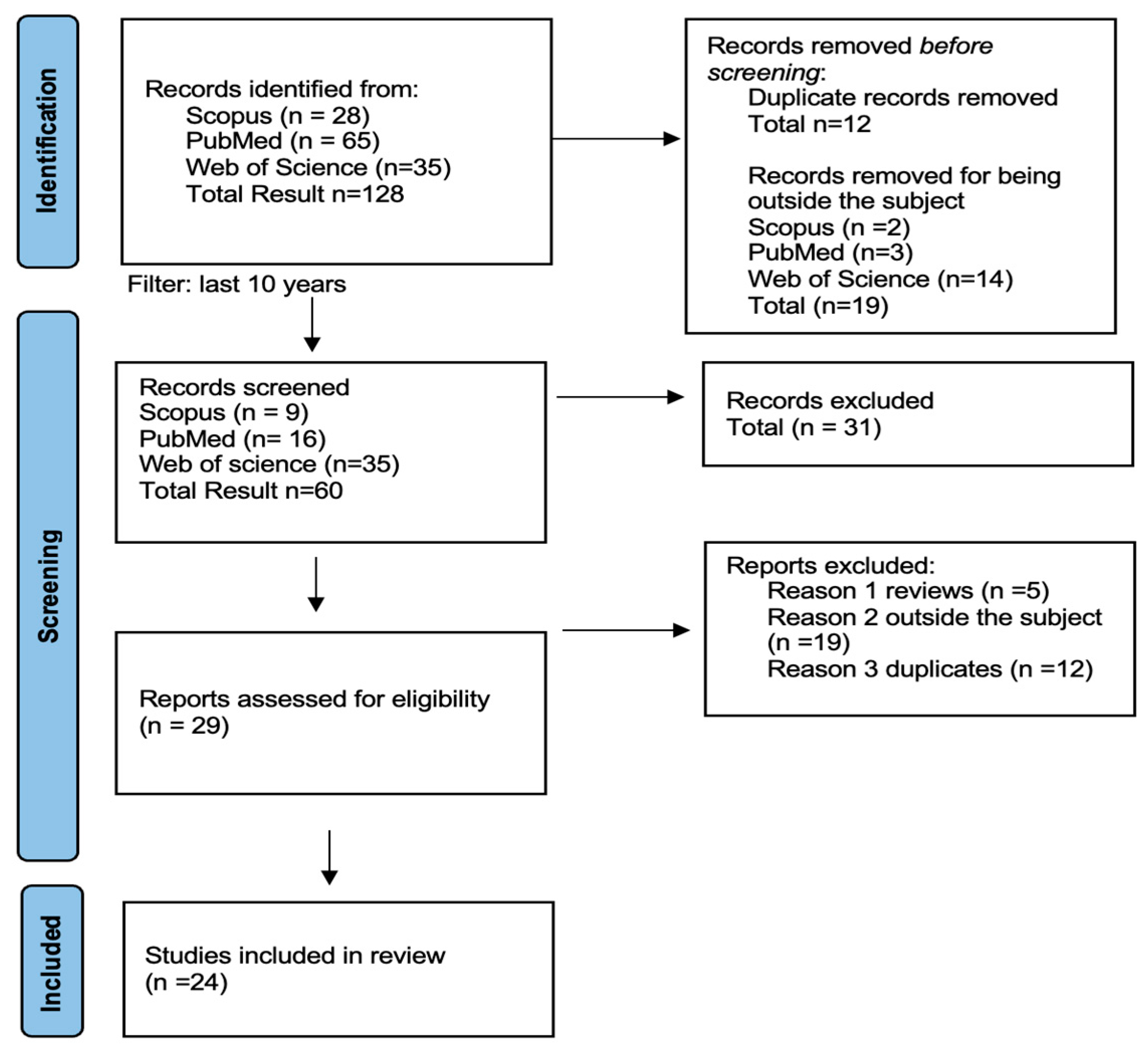
| Article screening strategy | KEYWORDS: A (“dental occlusion”) AND B (“sport performance”) AND C (“occlusal splints”) AND (“sports dentistry”). |
| Boolean Indicators: A AND B AND C AND D. | |
| Timespan: 2014–2024 | |
| Electronic Databases: PubMed; Scopus; and WOS. |
| Year | Authors | Category | Intervention | Results | Oral Splint Category, Occlusal Modifications |
|---|---|---|---|---|---|
| 2014 | Allen et al. [39]; | 21 recreationally male-trained colleges. | Maximum countermovement vertical jump; one repetition maximum bench press. | Slight increases in vertical jump (PF = 0.08) and bench press (RFD p = 0.45) during the countermovement (CMVJ p = 0.13) were observed in the mouthpiece condition, and these improvements were minimal and not statistically significant. | Mouthpiece. |
| 2015 | Golem and Arent. [40]; | 20 male collegiate athletes. | Muscular power, dynamic balance, flexibility, agility, and muscular strength. | The jaw-repositioning technique did not affect performance. Muscular power p = 0.78, dynamic balance p = 0.99, agility p = 0.22, and muscular strength p = 0.47. | Placebo mouth guard, a self-adapted jaw-repositioning mouth guard, and a custom-fitted jaw-repositioningmouth guard. |
| 2015 | Ringhof et al. [35]; | 14 male professional golfers. | Shot precision and shot length over three different Distances. | Statistical analysis showed that oral motor activity did not affect golf shot precision or length for 60 m, 160 m, or driving distance. Only Pin length at 160 m was statistically significantly impacted by oral motor tasks (p = 0.043, η2p = 0.22). | Oral splint. |
| 2015 | Maurer et al. [41]; | 20 healthy young recreational runners. | Kinematic 3D analysis of running; Wingate test 30 s; and Spirometry. | There was no discernible variation in running pace among the four situations (p = 1.00) Under splint conditions, a more symmetrical running pattern was discernible. | Occlusal splint in the lower jaw. |
| 2016 | Battaglia et al. [42]; | 18 physically active subjects, 18 sedentary subjects. | Cervical range of motion. | Occlusal splints failed to improve the physical performance significantly; cervical range of motion p ≥ 0.05. | Custom. |
| 2016 | Patti et al. [29]; | 60 male football players. | Squat jumps with different mandible positions: mouth closed and mouth open. | There was a statistically significant difference between the outcomes (p < 0.0001). | Occlusal factors. |
| 2016 | Busca et al. [43]; | 28 physically active male subjects. | Jump ability and isometric maximal strength tests. | Significantly higher performance for handgrip force (F(2,54) = 32.71, p ≤ 0.05) and all variables of the back-row exercise (F(2,54) = 13.74, p ≤ 0.05) and countermovement vertical jump (F(2,54) = 8.04, p ≤ 0.05), as peak force, while wearing the mouthpiece. | Customized bite-aligning mouthpiece. |
| 2016 | Ringhof et al. [44]; | 12 healthy young adults. | Dynamic stability, bite forces. | Both conditions led to a considerable rise in bite forces (p = 0.011). However, the findings demonstrated that, according to the factors under investigation, biting with a submaximal force had no discernible effect on the recovery behavior of healthy young adults (p = 0.515). | Hydrostatic splints. |
| 2017 | Fisher, Weber and Beneke [45]; | 23 physically active subjects. | Wingate test 30 s. | Results showed moderate to perfect correlations between all splint conditions, with coefficients of variation ranging from 1.3% to 6.6%. | Custom, upper jaw. |
| 2017 | Golem and Davitt and Arent [46]; | 20 College-aged male athletes. | Respiratory flow dynamic tests at rest; maximal treadmill test. | This study’s OTC self-adapted jaw-repositioning mouthguards did not improve aerobic performance (p = 0.35). | Placebo mouthguard, self-adapted jaw-repositioning mouthguard, custom-fitted jaw-repositioning mouthguard. |
| 2018 | Dias et al. [6]; | 13 national-level male shooters. | Surface electromyography, shooting score. | No evident changes in EMG activity (p = 0.069). | Custom splints in the upper jaw. |
| 2018 | Maurer et al. [37]; | 23 healthy, mid-age recreational runners. | Squat jump, countermovement jump, and drop jumps from four different heights and three maximal strength tests: trunk flexion and extension, leg press in both legs. | The squat jump, countermovement leap, drop jumps, trunk extension, leg press force, and rate of force generation all showed significant results. A 3% to 12% improvement is the result of the following circumstances. | Custom splints in the lower jaw. |
| 2018 | Leroux et al. [15]; | 7 members of the “Pôle France Aviron”. | Body balance, paravertebral muscle contraction symmetry, and muscular power. | Negative impacts of an occlusal disturbance on the athletic performance of young elite rowers caused a notable 17.7% drop in the athletes’ muscle strength (p = 0.030). | Occlusal silicone splint. |
| 2019 | Dias et al. [14]; | 14 male healthy subjects. | Isokinetic strength was evaluated in shoulder abduction/adduction and arm external/internal rotation tests. | There were no changes in muscle activity in the middle deltoid under either condition. There was a substantial increase in the anterior deltoid (p < 0.01) and pectoralis major (p < 0.01) muscular EMG activity in the OS condition compared to other conditions. In the lower trapezius, the OS condition significantly increased the peak EMG compared to the N condition (p < 0.05). | Occlusal splints in the upper jaw. |
| 2020 | Julia-Sanchez et al. [27]; | 30 physically active subjects. | Excursion Balance Test. | The Star Excursion Balance Test composite score was considerably higher for measures taken in cotton rolls mandibular position (p < 0.001) and in patients with proper occlusion (p = 0.04). | Occlusal splints. |
| 2021 | Kinjo et al. [47]; | 3 male participants. | Dental occlusion tests were performed with the MG sensor. | The MG sensor is essential for detecting personal teeth-clenching habits during exercise. No significant differences were observed between either sensor (p > 0.005). The EMG and MG sensor outputs differed significantly (p < 0.05). | Wearable MG device with force sensors on both sides of the maxillary to monitor teeth clenching. |
| 2021 | Didier et al. [28]; | 20 ballet dancers. | Electromyography (EMG) data and balance tests. | All of the performed EMG tests and the Flamingo Balance Test revealed statistically significant adjustments (p < 0.001 for scans 9 and 11). There were just three dancers whose asymmetry of muscle activation remained unchanged. | Customized occlusal splint. |
| 2021 | Carbonari et al. [48]; | 18 athletes. | Surface electromyography kinesiography, the squat jump and countermovement jump, and the handgrip test. | Applying an occlusal splint and Taopatch (R) devices either separately or together instantly impacted the occlusal postural muscles’ strength and balance. The squat jump increased the height of 10–14 mm. The biting and Taopatch® devices alone resulted in a more substantial handgrip (~5 lbs). | Customized soft occlusal splint to the lower arch, nanotechnological devices. |
| 2022 | Cardoso et al. [49]; | 16 middle- and long-distance runners. | 7 × 800 m intermittent running. | No differences between placebo and lower jaw advancer were found (e.g., 52.1 ± 9.9 vs. 53.9 ± 10.7 mL·kg−1·min−1 of oxygen uptake, 3.30 ± 0.44 vs. 3.29 ± 0.43 m of stride length and 16 ± 3 vs. 16 ± 2 Borg scores). | Two lower intraoral splints, custom (a placebo and a lower jaw advancer. |
| 2022 | Inchingolo et al. [50]; | 25 athletes (20 football players). | Electromyographic recording using two clamping tests. | Splint treatment showed an overall efficacy of 72%, statistically significant efficacy on rebalancing of the barycenter. | Custom occlusal splint. |
| 2022 | Parini et al. [51]; | 16 track and field athletes. | Countermovement jump; drop jump; 10 m and 30 m sprint tests. | The majority of the athletes who were evaluated performed better in countermovement jump, 10 m, and 30 m sprint tests during training sessions with occlusal splints than athletes without them, although it was not able to show an increase in sports performance. | Custom occlusal splint. |
| 2022 | Dias et al. [52]; | 22 male amateur rugby players. | 1 bench press test. | Controlled mouthguards increase peak power in the ballistic bench press exercise (p < 0.05). | Controlled mouthguard, jaw in centric relation, non-controlled mouthguard, occlusal splint. |
| 2022 | Kalman et al. [53]; | A 3D volumetric skull with teeth was designed. | Static structural and mechanical analysis. | The hybrid occlusal splint-mouthguard minimized jaw displacement during chewing, reducing stresses in maxillary and mandibular teeth. Compared to the custom design, the hybrid design showed a greater degree of stress on its occlusal section (7.05 MPa) than the MG design (6.19 MPa). | Conventional custom mouthguard, hybrid occlusal splint. |
| 2022 | Göttfert et al. [10]; | 41 male and 50 female subjects. | Cervical spine range of movement, balance stability. | Bipedal and unipedal standing demonstrated a greater range of motion extension and improved balance stability in females by up to 4°. When wearing a splint, there are very few differences in adaptation between the sexes (men p ≤ 0.01 and p ≤ 0.001 and women p ≤ 0.001 and 0.04). | Custom splints. |
Disclaimer/Publisher’s Note: The statements, opinions and data contained in all publications are solely those of the individual author(s) and contributor(s) and not of MDPI and/or the editor(s). MDPI and/or the editor(s) disclaim responsibility for any injury to people or property resulting from any ideas, methods, instructions or products referred to in the content. |
© 2025 by the authors. Licensee MDPI, Basel, Switzerland. This article is an open access article distributed under the terms and conditions of the Creative Commons Attribution (CC BY) license (https://creativecommons.org/licenses/by/4.0/).
Share and Cite
Popovici, C.; Bordea, I.R.; Inchingolo, A.D.; Inchingolo, F.; Inchingolo, A.M.; Dipalma, G.; Muntean, A.L. Dental Splints and Sport Performance: A Review of the Current Literature. Dent. J. 2025, 13, 170. https://doi.org/10.3390/dj13040170
Popovici C, Bordea IR, Inchingolo AD, Inchingolo F, Inchingolo AM, Dipalma G, Muntean AL. Dental Splints and Sport Performance: A Review of the Current Literature. Dentistry Journal. 2025; 13(4):170. https://doi.org/10.3390/dj13040170
Chicago/Turabian StylePopovici, Cornelia, Ioana Roxana Bordea, Alessio Danilo Inchingolo, Francesco Inchingolo, Angelo Michele Inchingolo, Gianna Dipalma, and Ana Lucia Muntean. 2025. "Dental Splints and Sport Performance: A Review of the Current Literature" Dentistry Journal 13, no. 4: 170. https://doi.org/10.3390/dj13040170
APA StylePopovici, C., Bordea, I. R., Inchingolo, A. D., Inchingolo, F., Inchingolo, A. M., Dipalma, G., & Muntean, A. L. (2025). Dental Splints and Sport Performance: A Review of the Current Literature. Dentistry Journal, 13(4), 170. https://doi.org/10.3390/dj13040170