

Au(III) Cyclometallated Compounds with 2-Arylpyridines and Their Derivatives or Analogues: 34 Years (1989–2022) of NMR and Single Crystal X-ray Studies



Abstract
1. Introduction
2. Reviewed Data
2.1. Au(III)-2PPY* Compounds
2.1.1. Au(III)-2PPY* Dihalides
2.1.2. Au(III)-2ppy* Compounds with Auxiliary Ligands Other Than Halides
2.1.3. Au(III)-2PPY* Compounds with Auxiliary Ligands Other Than Halides

| R1 | R2 | L1 | L2 | L1L2 | Counterion | NMR Solvent | X-ray (CCDC) | Geometry | Activity $ |
|---|---|---|---|---|---|---|---|---|---|
| 3-methyl | H | 3-carboxy-2-thiolatepropionate | DMSO-d6 [2] | ||||||
| 3-methyl | H | pyridine | acetate | ClO4− | MAXQEH [2] | trans(N,N) | |||
| 5-n-butyl | H | diethylaminocarbodithioate | PF6− | DMSO-d6 [11] | BIO1 [11] | ||||
| 4-tert-butyl | H | acetate | acetate | CDCl3 DMSO-d6 [2] | |||||
| 3,5-dimethyl | H | acetate | acetate | CDCl3 [2] | |||||
| H | 2-methyl | phenyl | Br | JOTROB [12] | trans(C,N) | ||||
| H | 4-methyl | CN | CN | DMSO-d6 [27] | LUM2 [27] | ||||
| H | 4-methyl | methyl | methyl | CDCl3 CD2Cl2 [52,53] | QICNUN [52] | ||||
| H | 4-methyl | methyl | Cl | CD2Cl2 [54] | |||||
| H | 4-methyl | methyl | Br | CD2Cl2 [52,53] | |||||
| H | 4-methyl | ethyl | Br | CD2Cl2 [52] | |||||
| H | 4-methyl | allyl-η3 | (CF3SO2)2N− | CD2Cl2 [55] | ROVXUY [55] | ||||
| H | 4-methyl | allyl | Br | CD2Cl2 [53,55] | ROVYAF [55] | trans(C,N) | |||
| H | 4-methyl | allyl | trideuteroacetonitrile | (CF3SO2)2N− | CD3CN [55] | ||||
| H | 4-methyl | ethynyl | ethynyl | CD2Cl2 [56] | LUWJUL [56] | ||||
| H | 4-methyl | n-butylethynyl | n-butylethynyl | CD2Cl2 [56] | |||||
| H | 4-methyl | n-butylethynyl | Br | CD2Cl2 [56] | |||||
| H | 4-methyl | n-hexane-1,6-diethynyl | CD2Cl2 [56] | ||||||
| H | 4-methyl | thiacyclopentane | methyl | CF3SO3− | CD2Cl2 [54] | ||||
| H | 4-methyl | 1,4,7-trithiacyclononane-κ3-S,S,S | 2PF6− | CD3NO2 [5] | MOCFIV [5] | ||||
| H | 4-methyl | acetate | acetate | CDCl3 CD2Cl2 [31,53] | BIO1 [31] | ||||
| H | 4-methyl | acetate | methyl | CD2Cl2 [54] | IDAJII [54] a | trans(C,N) | |||
| H | 4-methyl | trifluoroacetate | trifluoroacetate | CD2Cl2 CD3CN C6D6 CD3COOD CF3COOD [52,53,57] | QICPAV [52] | ||||
| H | 4-methyl | trifluoroacetate | hydroxymethyl | CD2Cl2 [58] | |||||
| H | 4-methyl | trifluoroacetate | methoxyl | CD2Cl2 CD3OD [58] | |||||
| H | 4-methyl | trifluoroacetate | methoxyethyl | CD2Cl2 CD3OD [58] | YIDHIF [58] | trans(C,N) | |||
| H | 4-methyl | trifluoroacetate | formylmethyl | CD2Cl2 [59] | QEFVUV [59] | trans(C,N) | |||
| H | 4-methyl | trifluoroacetate | acetate | CD2Cl2 [58] | |||||
| H | 4-methyl | trifluoroacetate | CH3OCH(CH(CH3)2)CH2− | CD2Cl2 [58] | YIDGIE [58] | trans(C,N) | |||
| H | 4-methyl | trifluoroacetate | CH3OC(CH3)(CH2CH3)CH2− | CD2Cl2 [58] | |||||
| H | 4-methyl | trifluoroacetate | CH3OC((CH3)2)CH(CH3)− | CD2Cl2 [58] | YIDHEB [58] | trans(C,N) | |||
| H | 4-methyl | trifluoroacetate | CH3OCH(CH2CH2CH2CH3)CH2− | CD2Cl2 [58] | YIDHAX [58] | trans(C,N) | |||
| H | 4-methyl | trifluoroacetate | CH3OCH(CH2CH2CH3)CH(CH3)− | CD2Cl2 [58] | YIDGOK [58] | trans(C,N) | |||
| H | 4-methyl | trifluoroacetate | CH3OCH(CH3)CH(CH2CH2CH3)− | CD2Cl2 [58] | YIDGAW [58] | trans(C,N) | |||
| H | 4-methyl | trifluoroacetate | CH3OCH(C6H5)CH2− | CD2Cl2 [58] | YIDGUQ [58] a | trans(C,N) | |||
| H | 4-methyl | trifluoroacetate | CH3CH2OCH2CH2− | CD2Cl2 CD3CD2OD [58] | |||||
| H | 4-methyl | trifluoroacetate | (CH3)2CHOCH2CH2− | CD2Cl2 [58] | |||||
| H | 4-methyl | trifluoroacetate | (CH3)3COCH2CH2− | CD2Cl2 [58] | |||||
| H | 4-methyl | trifluoroacetate | CH3COOCH2CH2− | CD2Cl2 CD3COOD [58] | YIDGEA [58] | trans(C,N) | |||
| H | 4-methyl | trifluoroacetate | CF3COOCH2CH2− | CD2Cl2 CF3COOD [57] | FUWXIG [57] | trans(C,N) | |||
| H | 4-methyl | trifluoroacetate | CF3CH2OCH2CH2− | CD2Cl2 CF3CD2OD [57] | FUWXOM [57] | trans(C,N) | |||
| H | 4-methyl | trifluoroacetate | CF3COOCH(CH(CH3)2)CH2− | CD2Cl2 [58] | YIDFUP [58] b | trans(C,N) | |||
| H | 4-methyl | trifluoroacetate | CF3COOCH(CH2CH2CH2CH3)CH2− | CD2Cl2 CF3COOD [58] | |||||
| H | 4-methyl | trifluoroacetate | CF3COOCH=CH− | CD2Cl2 [59] | QEFWAC [59] c | trans(C,N) | |||
| H | 4-methyl | trifluorosulfonate | methyl | CD2Cl2 [54] | IDAJOO [54] | trans(C,N) | |||
| H | 4-methyl | HNC(CH3)OCH2CH2− 1 | CF3COO− | CD2Cl2 CD3CN [60] | IPISEH [60] | trans(C,N) | |||
| H | 4-methyl | 1,1-dimethylbiguanidate | Cl− | DMSO-d6 [8] | BIO1 [8] | ||||
| H | 4-methyl | acetonitrile | methyl | BF4− | CD3CN [60] | IPISAD [60] | trans(C,N) | ||
| H | 4-methyl | trimethylsilylethynyl | trimethylsilylethynyl | CD2Cl2 [37,56] | LUWJEV [56] a | LUM1 [37] | |||
| H | 4-methyl | trimethylsilylethynyl | Br | CD2Cl2 [56] | |||||
| H | 4-methyl | trimethylsilylethynyl | ethynyl | CD2Cl2 [56] | LUWJIZ [56] | trans(HCC,N) | |||
| H | 4-methyl | oxybis(n-propylborinate) | CDCl3 [47] | ||||||
| H | 4-methyl | phenyl | phenyl | CD2Cl2 [14,52] | |||||
| H | 4-methyl | phenyl | Br | CD2Cl2 [52,53] | |||||
| H | 4-methyl | 2-methylphenyl | 2-methylphenyl | CD2Cl2 [14] | FONRIL [14] | ||||
| H | 4-methyl | 3-methylphenyl | 3-methylphenyl | CD2Cl2 [14] | |||||
| H | 4-methyl | phenylethynyl | phenylethynyl | CD2Cl2 [56] | LUWJOF [56] | ||||
| H | 4-methyl | phenylethynyl | Br | CD2Cl2 [56] | LUWKAS [56] | trans(C,N) | |||
| H | 4-methyl | phenylethynyl | ethynyl | CD2Cl2 [56] | LUWKIA [56] | trans(C6H5CC,N) | |||
| H | 4-methyl | phenylethynyl | trifluoroacetate | CD2Cl2 [56] | |||||
| H | 4-methyl | phenylethynyl | trimethylsilylethynyl | CD2Cl2 [56] | |||||
| H | 4-methyl | 4-n-butylphenylethynyl | 4-n-butylphenylethynyl | CD2Cl2 [37] | LUM1 [37] | ||||
| H | 4-methyl | naphth-2-yl | naphth-2-yl | CD2Cl2 [14] | |||||
| H | 4-methyl | naphth-1-yl | Cl | CD2Cl2 [14] | FONSAE [14] | trans(C,N) | |||
| H | 4-methyl | anthracen-2-yl | anthracen-2-yl | C6D6 [14] | |||||
| H | 4-methyl | 4-fluorophenyl | 4-fluorophenyl | CD2Cl2 [14] | FOPCAQ [14] | ||||
| H | 4-methyl | 4-fluorophenyl | Cl | CDCl3 [14] | FONRUX [14] | trans(C,N) | |||
| H | 4-methyl | 2,4-difluorophenyl | 2,4-difluorophenyl | CD2Cl2 [14] | |||||
| H | 4-methyl | 2,5-difluoro-3,6-dibromophenyl | 2,5-difluoro-3,6-dibromophenyl | CD2Cl2 [61] | |||||
| H | 4-methyl | 4-trifluoromethylphenyl | 4-trifluoromethylphenyl | CD2Cl2 [14] | FOPCEU [14] a | ||||
| H | 4-methyl | 4-chlorophenylethynyl | 4-chlorophenylethynyl | CD2Cl2 [61] | |||||
| H | 4-methyl | 4-methoxyphenyl | 4-methoxyphenyl | CD2Cl2 [14] | |||||
| H | 4-methyl | 4-methoxyphenylethynyl | 4-methoxyphenylethynyl | CDCl3 [37] | AJOXAZ [37] | LUM1 [37] | |||
| H | 4-methyl | 4-isopropoxyphenyl | 4-isopropoxyphenyl | C6D6 [14] | FONROR [14] | ||||
| H | 4-methyl | 4-formylbenzene-1,2-diolate | DMSO-d6 [62] | ||||||
| H | 4-methyl | 4-benzoxyphenyl | 4-benzoxyphenyl | CD2Cl2 [14] | |||||
| H | 4-methyl | 4-acetylphenyl | 4-acetylphenyl | CD2Cl2 [14] | |||||
| H | 4-methyl | acetophen-2,8-diyl | CD2Cl2 [14] | FONSEI [14] a | trans(CCH2,N) | ||||
| H | 4-methyl | anthracene-9,10-dione-1,2-diolate | DMSO-d6 solid phase [62] | ||||||
| H | 4-methyl | 3-ethoksycarbonylphenyl | 3-ethoksycarbonylphenyl | CD2Cl2 [14] | |||||
| H | 4-methyl | 2-thiolatebenzoate | ICUMEY [51] | trans(S,N) | BIO1 [51] | ||||
| H | 4-methyl | 1-phenylbiguanidate | Cl− | DMSO-d6 [8] | BIO1 [8] | ||||
| H | 4-methyl | L-phenylalaninate | Cl− | CDCl3 [31] | BIO1 [31] | ||||
| H | 4-methyl | L-methioninate | Cl− | CDCl3 [31] | BIO1 [31] | ||||
| H | 4-methyl | 3-nitrophenyl | 3-nitrophenyl | CD2Cl2 [14] | FOPCIY [14] | ||||
| H | 4-methyl | ethylene-1,2-bis(4-methylphenylsulfonylazanide) | unknown [63] | BIO1, BIO2 [63] | |||||
| H | 4-methyl | benzene-1,2-bis(acetylazanide) | unknown [63] | BIO1, BIO2 [63] | |||||
| H | 4-methyl | benzene-1,2-bis(4-methylphenylsulfonylazanide) | unknown [63] | BIO1, BIO2 [63] | |||||
| H | 4-methyl | sulfonebis(cyanomethyl) | BIO1 [64] | ||||||
| H | 4-methyl | sulfonebis(benzoylmethyl) | unknown [64] | BIO1 [64] | |||||
| H | 4-methyl | 1-benzothiophen-2-yl | 1-benzothiophen-2-yl | CD2Cl2 [14] | FONREH [14] | ||||
| H | 4-methyl | triphenylphosphine | methyl | CF3SO3− | CD2Cl2 [54] | IDAJUU [54] | trans(C,N) | ||
| H | 4-methyl | 1,2-bis(diphenylphosphino)benzene 2A | 2Cl− | CDCl3 [9] | BIO1 [9] | ||||
| H | 4-methyl | oxybis(phenylborinate) | CDCl3 [47,65] | CAT [65] | |||||
| H | 4-methyl | oxybis(naphth-1-ylborinate) | CDCl3 [47] | ||||||
| H | 4-methyl | oxybis(4-tert-butylphenylborinate) | CDCl3 [47] | ||||||
| H | 4-methyl | oxybis(4-vinylphenylborinate) | CDCl3 [47] | FUXGIQ [47] a | |||||
| H | 4-methyl | oxybis(4-isopropoxyphenylborinate) | CDCl3 [47] | FUXGAI [47] | |||||
| H | 4-methyl | oxybis(4-acetylphenylborinate) | CDCl3 [47] | FUXGOW [47] a | |||||
| H | 4-methyl | oxybis(thiophen-3-ylborinate) | CDCl3 [47] | ||||||
| H | 4-methyl | oxybis(ferrocenylborinate) | CDCl3 [47] | FUXGEM [47] d | |||||
| H | 3-ethyl | trifluoroacetate | trifluoroacetate | CD2Cl2 [53] | |||||
| H | 3-n-butyl | diethylaminocarbodithioate | PF6− | DMSO-d6 [11] | BIO1 [11] | ||||
| H | 4-n-butyl | diethylaminocarbodithioate | PF6− | DMSO-d6 [11] | BIO1 [11] | ||||
| H | 4-n-butyl | di(n-butyl)aminocarbodithioate | PF6− | DMSO-d6 [11] | BIO1 [11] | ||||
| H | 4-tert-butyl | dimethylaminocarbodithioate | PF6− | DMSO-d6 [26] | BIO1 [26] | ||||
| H | 4-tert-butyl | diethylaminocarbodithioate | PF6− | DMSO-d6 [26] | NIKHIB [26] e | BIO1 [26] | |||
| H | 4-tert-butyl | di(n-butyl)aminocarbodithioate | SbF6− | CD3CN [26] | BIO1 [26] | ||||
| H | 4-tert-butyl | (n-but-1,4-diyl)aminocarbodithioate | PF6− | CD2Cl2 [26] | BIO1 [26] | ||||
| H | 4-tert-butyl | N-(ethoxycarbonylmethyl)methylaminocarbodithioate | PF6− | DMSO-d6 [26] | BIO1 [26] | ||||
| H | 4-tert-butyl | 4-methoxyphenylethynyl | 4-methoxyphenylethynyl | CD2Cl2 [37] | LUM1 [37] | ||||
| H | 4-tert-butyl | benzene-1-olate-2-acetylazanide | CD2Cl2 [25] | BIO1 [25] | |||||
| H | 4-tert-butyl | benzene-1,2-bis(acetylazanide) | CD2Cl2 [25] | BIO1 [25] | |||||
| H | 4-tert-butyl | benzene-1-olate-2-(N-(acridin-9-yl))azanide | CD2Cl2 [25] | KIGPEY [25] a | trans(N,N) | BIO1 [25] | |||
| H | 4-tert-butyl | benzene-1-azanide-2-(N-(acridin-9-yl)azanide | CD2Cl2 [25] | KIGPIC [25] a | trans(NH,N) | BIO1 [25] | |||
| H | 4-tert-butyl | ortho-bis(dicarboranyl) | CD2Cl2 [66] | WUCKUD [66] a | |||||
| H | 3,5-dimethyl | trifluoroacetate | trifluoroacetate | CD2Cl2 [53] | JAZJED [53] | ||||
| H | 4-fluoro | 4-fluorophenyl | 4-fluorophenyl | CDCl3 [14] | |||||
| H | 4-fluoro | 3-ethoksycarbonylphenyl | 3-ethoksycarbonylphenyl | CDCl3 [14] | |||||
| H | 2,4-difluoro | phenylethynyl | phenylethynyl | CD2Cl2 [15] | LUM2 [15] | ||||
| H | 2,4-difluoro | methylenebis(3-n-butyl-1H-imidazol-1-yl-2-ylidene) | 2PF6− | CD3CN [19] | LUM1 [19] | ||||
| H | 2,4-difluoro | methylenebis(3-(3-sulfonate-n-propyl)-1H-imidazol-1-yl-2-ylidene) | D2O [19] | LUM1 [19] | |||||
| H | 3,5-difluoro | trifluoroacetate | trifluoroacetate | CD2Cl2 [53] | JAYZAO [53] | ||||
| H | 3-trifluoromethyl | pentafluorophenyl | pentafluorophenyl | CD2Cl2 [18] | MIZHIP [18] | LUM2 [18] | |||
| H | 3-trifluoromethyl | pentafluorophenyl | Cl | CD2Cl2 [18] | MIZHEL [18] | trans(Cl,N) | LUM2 [18] | ||
| H | 3-trifluoromethyl | pentafluorophenyl | 4-fluorophenylethynyl | DMF-d7 [18] | MIZJAJ [18] | trans(CC,N) | LUM2 [18] | ||
| H | 3-trifluoromethyl | trifluoroacetate | trifluoroacetate | CD2Cl2 [53] | |||||
| H | 3-trifluoromethyl | 4-bis(2,4,6-trimethylphenyl)boranylphenylethynyl | pentafluorophenyl | DMSO-d6 [18] | MIYYAX [18] | trans(CC,N) | LUM2 [18] | ||
| H | 4-trifluoromethyl | trifluoroacetate | trifluoroacetate | CD2Cl2 [53] | JAZJAZ [53] | ||||
| H | 4-trifluoromethyl | diethylaminocarbodithioate | PF6− | DMSO-d6 [11] | BIO1 [11] | ||||
| H | 5-trifluoromethyl | trifluoroacetate | trifluoroacetate | CD2Cl2 [53] | |||||
| H | 4-methoxy | 4-methoxyphenylethynyl | 4-methoxyphenylethynyl | CD2Cl2 [37] | LUM1 [37] | ||||
| H | 4-methoxy | trifluoroacetate | trifluoroacetate | CD2Cl2 [53] | |||||
| H | 4-n-butoxy | diethylaminocarbodithioate | PF6− | DMSO-d6 [11] | BIO1 [11] | ||||
| H | 2-trifluoromethoxy | pentafluorophenyl | pentafluorophenyl | CD2Cl2 [18] | MIYYEB [18] a | LUM2 [18] | |||
| H | 2-trifluoromethoxy | pentafluorophenyl | Cl | CD2Cl2 [18] | MIYXOK [18] | trans(Cl,N) | LUM2 [18] | ||
| H | 4-trifluoromethoxy | pentafluorophenyl | pentafluorophenyl | CD2Cl2 [18] | MIZHOV [18] a | LUM2 [18] | |||
| H | 4-trifluoromethoxy | pentafluorophenyl | Cl | CD2Cl2 [18] | MIYXUQ [18] | trans(Cl,N) | LUM2 [18] | ||
| H | 4-formyl | 1,2-bis(diphenylphosphino)benzene 2B | 2Cl− | CDCl3 [9] | BIO1 [9] | ||||
| H | 4-nitro | trifluoroacetate | trifluoroacetate | CD2Cl2 [53] | JAZJON [53] | ||||
| H | 4-phenyl | methylenebis(3-n-butyl-1H-imidazol-1-yl-2-ylidene) | 2PF6− | CD3CN [19] | LUM1 [19] | ||||
| H | 3,5-bis(pentafluorophenyl) | trifluoroacetate | trifluoroacetate | CD2Cl2 [53] | JAZCOG [53] | ||||
| 5-tert-butyl | 4-tert-butyl | diethylaminocarbodithioate | BIO1 [26] | ||||||
| 6-(4-tert-butylphenyl) | 4-tert-butyl | norbornane-2-ol-3-yl | SbF6− | CD2Cl2 [67] | PEZQUI [67] | trans(C,N) | |||
| 6-(4-tert-butylphenyl) | 4-tert-butyl | diethyl ether | Cl | H2N(B(C6F5)3)2− | CD2Cl2 [68] | ||||
| 6-(4-tert-butylphenyl) | 4-tert-butyl | diethyl ether | methyl | H2N(B(C6F5)3)2− | CD2Cl2 [69] | ||||
| 6-(4-tert-butylphenyl) | 4-tert-butyl | diethyl ether | 2-methylallyl | H2N(B(C6F5)3)2− | CD2Cl2 [69] | ||||
| 6-(4-tert-butylphenyl) | 4-tert-butyl | diethyl ether | phenyl | H2N(B(C6F5)3)2− | CD2Cl2 [68] | ||||
| 6-(4-tert-butylphenyl) | 4-tert-butyl | diethyl ether | 4-tert-butylphenyl | H2N(B(C6F5)3)2− | CD2Cl2 [69] | ||||
| 6-(4-tert-butylphenyl) | 4-tert-butyl | diethyl ether | 4-fluorophenyl | H2N(B(C6F5)3)2− | CD2Cl2 [68] | ||||
| 6-(4-tert-butylphenyl) | 4-tert-butyl | diethyl ether | pentafluorophenyl | H2N(B(C6F5)3)2− | CD2Cl2 [68] | ||||
| 6-(4-tert-butylphenyl) | 4-tert-butyl | diethyl ether | 4-trifluoromethylphenyl | H2N(B(C6F5)3)2− | CD2Cl2 [69] | ||||
| 6-(4-tert-butylphenyl) | 4-tert-butyl | diethyl ether | 4-chlorophenyl | H2N(B(C6F5)3)2− | CD2Cl2 [69] | ||||
| 6-(4-tert-butylphenyl) | 4-tert-butyl | diethyl ether | 4-methoxyphenyl | H2N(B(C6F5)3)2− | CD2Cl2 [69] | ||||
| 6-(4-tert-butylphenyl) | 4-tert-butyl | diethyl ether | 4-nitrophenyl | H2N(B(C6F5)3)2− | CD2Cl2 [69] | ||||
| 6-(4-tert-butylphenyl) | 4-tert-butyl | dimethyl thioether | phenyl | H2N(B(C6F5)3)2− | CD2Cl2 [69] | ||||
| 6-(4-tert-butylphenyl) | 4-tert-butyl | dimethyl thioether | 4-tert-butylphenyl | H2N(B(C6F5)3)2− | CD2Cl2 [69] | ||||
| 6-(4-tert-butylphenyl) | 4-tert-butyl | dimethyl thioether | 4-fluorophenyl | H2N(B(C6F5)3)2− | CD2Cl2 [69] | ||||
| 6-(4-tert-butylphenyl) | 4-tert-butyl | dimethyl thioether | pentafluorophenyl | H2N(B(C6F5)3)2− | CD2Cl2 [69] | ||||
| 6-(4-tert-butylphenyl) | 4-tert-butyl | dimethyl thioether | 4-trifluoromethylphenyl | H2N(B(C6F5)3)2− | CD2Cl2 [69] | ||||
| 6-(4-tert-butylphenyl) | 4-tert-butyl | dimethyl thioether | 4-chlorophenyl | H2N(B(C6F5)3)2− | CD2Cl2 [69] | ||||
| 6-(4-tert-butylphenyl) | 4-tert-butyl | dimethyl thioether | 4-methoxyphenyl | H2N(B(C6F5)3)2− | CD2Cl2 [69] | ||||
| 6-(4-tert-butylphenyl) | 4-tert-butyl | dimethyl thioether | 4-nitrophenyl | H2N(B(C6F5)3)2− | CD2Cl2 [69] | ||||
| 6-(4-tert-butylphenyl) | 4-tert-butyl | methyl | µ-H 3 | H2N(B(C6F5)3)2− | CD2Cl2 [70] | ||||
| 6-(4-tert-butylphenyl) | 4-tert-butyl | pentafluorophenyl | µ-H 3 | H2N(B(C6F5)3)2− | CD2Cl2 [70] | ||||
| 6-(4-tert-butylphenyl) | 4-tert-butyl | H | µ-H 4 | H2N(B(C6F5)3)2− | CD2Cl2 [70] | ||||
| 6-(4-tert-butylphenyl) | 4-tert-butyl | methyl | µ-H 4 | H2N(B(C6F5)3)2− | CD2Cl2 [70] | ||||
| 6-(4-tert-butylphenyl) | 4-tert-butyl | pentafluorophenyl | H | CD2Cl2 [71] | |||||
| 6-(4-tert-butylphenyl) | 4-tert-butyl | pentafluorophenyl | triethylsilane | H2N(B(C6F5)3)2− | CD2Cl2 [71] | ||||
| 6-(4-tert-butylphenyl) | 4-tert-butyl | pentafluorophenyl | 4,4,5,5-tetramethyl-1,3,2-dioxaborolane | H2N(B(C6F5)3)2− | CD2Cl2 [71] | ||||
| 6-(4-tert-butylphenyl) | 4-tert-butyl | adamantane-1-µ-thiolate 5 | adamantane-1-µ-thiolate 5 | H2N(B(C6F5)3)2− | CD2Cl2 [72] | FIDBUS [72] f | |||
| 6-(4-tert-butylphenyl) | 4-tert-butyl | (CH3)3CCOCHCH3− | SbF6− | CD2Cl2 [73] | KEKGEP [73] a | trans(C,N) | |||
| 6-(4-tert-butylphenyl) | 4-tert-butyl | CH3COCHC(CH3)3− | SbF6− | CD2Cl2 [73] | |||||
| 6-(4-tert-butylphenyl) | 4-tert-butyl | trifluoroacetate | methyl | CD2Cl2 [74] | |||||
| 6-(4-tert-butylphenyl) | 4-tert-butyl | trifluoroacetate | ethyl | CD2Cl2 [74] | |||||
| 6-(4-tert-butylphenyl) | 4-tert-butyl | 4-fluorophenyl | trifluoroacetate | CD2Cl2 [74] | QEZYAX [74] | trans(C,N) | |||
| 6-(4-tert-butylphenyl) | 4-tert-butyl | pentafluorophenyl | trifluoroacetate | CD2Cl2 [74] | |||||
| 6-(4-tert-butylphenyl) | 4-tert-butyl | thiophen-2-yl | trifluoroacetate | CD2Cl2 [74] | |||||
| 6-(4-tert-butylphenyl) | 4-tert-butyl | dibenzopyrrolate | diethyl ether | H2N(B(C6F5)3)2− | CD2Cl2 [72] | ||||
| 3-methyl | 2-fluoro | methyl | F | CD2Cl2 [21] | DAJRUE [21] | trans(C,N) | |||
| 3-methyl | 2-fluoro | methyl | Br | CD2Cl2 [21] | |||||
| 3-methyl | 2-fluoro | trifluoroacetate | trifluoroacetate | CD2Cl2 [21] | |||||
| 3-methyl | 2-fluoro | pentafluorophenyl | pentafluorophenyl | CD2Cl2 [21] | DAJSAL [21] g | ||||
| 3-methyl | 2-fluoro | 3,5-bis(trifluoromethyl)phenyl | F | CD2Cl2 [21] | DAJROY [21] | trans(C,N) | |||
| 3-methyl | 2-fluoro | 3,5-bis(trifluoromethyl)phenyl | Br | CD2Cl2 [21] | DAJRIS [21] | trans(C,N) | |||
| 3-methyl | 2-fluoro | 3,5-bis(trifluoromethyl)phenyl | 2,4,6-trifluorophenyl | CD2Cl2 [21] | DAJSEP [21] | trans(C3,5-bis(trifluoromethyl)phenyl,N) | |||
| 4-methyl | 4-methoxy | 4-methoxyphenylethynyl | 4-methoxyphenylethynyl | CD2Cl2 [37] | AJOXIH [37] a | LUM1 [37] | |||
| 5-methyl | 4-methoxy | 4-methoxyphenylethynyl | 4-methoxyphenylethynyl | CD2Cl2 [37] | AJOXED [37] a | LUM1 [37] | |||
| 6-methyl | 4-methyl | trifluoroacetate | trifluoroacetate | CD2Cl2 [53] | JAZBOF [53] | ||||
| 4-trifluoromethyl | 4-methyl | trifluoroacetate | trifluoroacetate | CD2Cl2 [53] | JAYZOC [53] a | ||||
| 5-trifluoromethyl | 4-methoxy | 4-methoxyphenylethynyl | 4-methoxyphenylethynyl | CD2Cl2 [37] | LUM1 [37] | ||||
| 5-trifluoromethyl | 2-diphenylamino | phenylethynyl | phenylethynyl | CDCl3 [75] | WECYUB [75] | LUM2 [75] | |||
| 3-methoxy | 4-methyl | trifluoroacetate | trifluoroacetate | CD2Cl2 [53] | JAZKAA [53] | ||||
| 4-methoxy | 4-methyl | trifluoroacetate | trifluoroacetate | CD2Cl2 [53] | JAYZIW [53] | ||||
| 6-methoxy | 4-methyl | trifluoroacetate | trifluoroacetate | CD2Cl2 [53] | JAYYOB [53] a | ||||
| 5-carboxy | 4-carboxy | trifluoroacetate | trifluoroacetate | CD3CN DMSO-d6 [22] | GALBAA [22] h | CAT [22] | |||
| 5-carboxy | 4-carboxy | trifluorocarboxylethyl | Cl | DMSO-d6 [23] | |||||
| 5-carboxy | 4-carboxy | trifluorocarboxylethyl | Br | DMSO-d6 [23] | |||||
| 5-carboxy | 4-carboxy | trifluorocarboxylethyl | trifluoroacetate | DMSO-d6 [23] | |||||
| 5-ethoxycarbonyl | 4-ethoxycarbonyl | N3 | N3 | PUXGUN [76] | |||||
| 5-ethoxycarbonyl | 4-ethoxycarbonyl | trifluoroacetate | trifluoroacetate | CD2Cl2 DMSO-d6 [22] | GALBEE [22] | CAT [22] | |||
| 5-ethoxycarbonyl | 4-ethoxycarbonyl | trifluorocarboxylethyl | Cl | CD2Cl2 DMSO-d6 [23] | |||||
| 5-ethoxycarbonyl | 4-ethoxycarbonyl | trifluorocarboxylethyl | Br | CD2Cl2 DMSO-d6 [23] | |||||
| 5-ethoxycarbonyl | 4-ethoxycarbonyl | trifluorocarboxylethyl | trifluoroacetate | DMSO-d6 [23] | |||||
| 4-dimethylamino | 2,3,4-trifluoro | pentafluorophenyl | pentafluorophenyl | CD2Cl2 [24] | WASQOZ [24] | LUM2 [24] | |||
| 4-dimethylamino | 3-trifluoromethyl | pentafluorophenyl | pentafluorophenyl | CD2Cl2 [24] | LUM2 [24] | ||||
| 4-dimethylamino | 3-trifluoromethyl | 4-fluorophenylethynyl | 4-fluorophenylethy+nyl | CD2Cl2 [24] | LUM2 [24] | ||||
| 4-dimethylamino | 4-trifluoromethoxy | pentafluorophenyl | pentafluorophenyl | CD2Cl2 [24] | LUM2 [24] | ||||
| 3-nitro | 4-methyl | trifluoroacetate | trifluoroacetate | CD2Cl2 [53] | JAZBIZ [53] a |
2.2. Au(III)-2ArPY* Compounds
2.2.1. Au(III)-2ArPY* Dihalides
| Parent 2ArPY* Ring System | R1 | R2 | X | NMR Solvent | X-ray (CCDC) | Activity $ |
|---|---|---|---|---|---|---|
| 2ArPy* ligands of type A (Scheme 2) | ||||||
| 2-benzylpyridine* | H | H | Cl | CDCl3 CD2Cl2 CD3CN CD3COCD3 DMSO-d6 [9,13,18,33,62,77,78,79,80,81,82] | HOSHEE [16] | BIO1 [25,79,83] CAT [16,17] |
| 3-methyl | H | Cl | DMSO-d6 [83] | |||
| 4-methyl | H | Cl | DMSO-d6 [83] | |||
| 5-methyl | H | Cl | CD2Cl2 [83] | |||
| 6-methyl | H | Cl | DMSO-d6 [83] | |||
| 3-methoxy | H | Cl | DMSO-d6 [83] | |||
| 6-methoxy | H | Cl | CD2Cl2 [83] | |||
| 3-isopropoxy | H | Cl | CD2Cl2 [83] | |||
| 3-n-butoxy | H | Cl | CD2Cl2 [83] | |||
| 3-acetomethoxy | H | Cl | CD2Cl2 [83] | |||
| H | 2-methyl | Cl | CD2Cl2 [83] | |||
| H | 3-methyl | Cl | DMSO-d6 [83] | |||
| H | 4-methyl | Cl | DMSO-d6 [83] | |||
| H | 4-ethyl | Cl | DMSO-d6 [83] | |||
| H | 4-n-butyl | Cl | CD2Cl2 [83] | |||
| H | 4-tert-butyl | Cl | CDCl3 [17] | CAT [17] | ||
| H | 4-n-hexyl | Cl | CD2Cl2 [83] | |||
| H | 4-chloro | Cl | DMSO-d6 [83] | |||
| H | 2-methoxy | Cl | DMSO-d6 [83] | |||
| H | 4-phenyl | Cl | CD2Cl2 [83] | |||
| H | 4-benzyl | Cl | CD2Cl2 [83] | |||
| 2-(1-methylbenzyl)pyridine* | H | H | Cl | CDCl3 DMSO-d6 [77] | R/S 1 | CAT [17] |
| 2-(1,1-dimethylbenzyl)pyridine* | H | H | Cl | CD2Cl2 [77] | ZETYAY [77] | |
| 2-(1-methoxybenzyl)pyridine* | H | H | Cl | DMSO-d6 [17] | CAT [17] | |
| 2-(1-phenylbenzyl)pyridine* | H | H | Cl | DMSO-d6 [83] | ||
| 2-(1-carboxymethoxyiminobenzyl)pyridine* | H | H | Cl | DMSO-d6 [84] | ||
| 2-(1-benzoxyiminobenzyl)pyridine* | H | H | Cl | DMSO-d6 [17] | CAT [17] | |
| 2-benzoylpyridine* | H | H | Cl | CD2Cl2 CD3CN DMSO-d6 [9,17,18,33,81,83,84,85,86] | PUKYAV [85] | BIO1 [30] CAT [17] |
| H | H | Br | DMSO-d6 [30] | AZOKOS [30] | ||
| H | H | I | DMSO-d6 [30] | |||
| 2-phenoxypyridine* | H | H | Cl | DMSO-d6 [9,87] | FIJZIH [87] | BIO1 [83] CAT [17] |
| 4-methyl | H | Cl | DMSO-d6 [88] | |||
| 5-methyl | H | Cl | DMSO-d6 [88] | |||
| 6-methyl | H | Cl | CD2Cl2 [88] | |||
| 5-ethyl | H | Cl | DMSO-d6 [88] | |||
| 5-n-propyl | H | Cl | DMSO-d6 [88] | |||
| 5-n-butyl | H | Cl | CD2Cl2 [88] | |||
| 5-fluoro | H | Cl | DMSO-d6 [88] | |||
| 5-chloro | H | Cl | DMSO-d6 [88] | |||
| 5-bromo | H | Cl | DMSO-d6 [88] | |||
| 5-iodo | H | Cl | DMSO-d6 [88] | |||
| 5-methoxy | H | Cl | CD2Cl2 [83] | |||
| 5-methoxycarbonyl | H | Cl | CD2Cl2 [88] | |||
| 5-(2-methoxycarbonylethyl) | H | Cl | CDCl3 [88] | |||
| 5-(3-acetoxy-n-propyl) | H | Cl | CD2Cl2 [88] | |||
| 5-aminocarbonyl | H | Cl | DMSO-d6 [88] | |||
| 5-methylaminocarbonyl | H | Cl | DMSO-d6 [88] | |||
| 5-dimethylaminocarbonyl | H | Cl | DMSO-d6 [88] | |||
| 5-cyclopentylaminocarbonyl | H | Cl | DMSO-d6 [88] | KAGYIB [88] | ||
| 5-acetamido | H | Cl | DMSO-d6 [88] | |||
| 5-(3-cyano-n-propyl) | H | Cl | CDCl3 [88] | |||
| 5-phenyl | H | Cl | DMSO-d6 [88] | |||
| 5-benzyl | H | Cl | CD2Cl2 [83] | |||
| 5-benzamido | H | Cl | DMSO-d6 [88] | |||
| H | 4-tert-butyl | Cl | CDCl3 [17] | IFUQUX [17] | ||
| 2-phenylsulfanylpyridine* | H | H | Cl | DMSO-d6 [87] | FIKNOC [87] | BIO1 [83] |
| 2-anilinopyridine* | H | H | Cl | DMSO-d6 [9,18,87,89] | PUGMAF [89] | BIO1 [83] |
| H | H | Br | DMSO-d6 [89] | |||
| H | 4-methyl | Cl | DMSO-d6 [89] | |||
| 2-(1-methylanilino)pyridine* | H | H | Cl | DMSO-d6 [83,89] | ||
| 2-(1-propionylanilino)pyridine* | H | H | Cl | CDCl3 [40] | ||
| 2ArPy* ligands of type B (Scheme 3) | ||||||
| 2-(naphth-2-yl)pyridine* | H | H | Cl | DMSO-d6 [19] | ||
| 2-(9,9-dimethylfluoren-2-yl)pyridine* | H | H | Cl | DMSO-d6 [6,90] | ||
| 4-methyl | H | Cl | CD2Cl2 [90] | |||
| 4-dimethylamino | H | Cl | CD2Cl2 [6,90] | |||
| H | 7-trifluoromethyl | Cl | CD2Cl2 [90] | |||
| 2-(9,9-di(n-butyl)fluoren-2-yl)pyridine* | H | H | Cl | DMSO-d6 [19] | ||
| 2-(dibenzofuran-4-yl)pyridine* | H | H | Cl | DMSO-d6 [6] | ||
2.2.2. Au(III)-2ArPY* Compounds with Auxiliary Ligands Other Than Halides
| Parent 2ArPY* Ring System | R1 | R2 | L1 | L2 | L1L2 | Counterion | NMR Solvent | X-ray (CCDC) | Geometry | Activity $ |
|---|---|---|---|---|---|---|---|---|---|---|
| 2ArPy* ligands of type A (Scheme 2) | ||||||||||
| 2-benzylpyridine* | H | H | acetate | acetate | CDCl3 [31,91] | BIO1 [31] | ||||
| H | H | 1R,2R-cyclohexane-1,2-diamine | 2Cl− 2ClO4− 2BF4− | DMSO-d6 [92] DMSO-d6 [92] DMSO-d6 [92] | TOFDUQ [92] TOFFAY [92] a | BIO1 [92] | ||||
| H | H | dimethylaminocarbodithioate | PF6− | CD3CN [93] | RADKOA [93] | BIO1 [93] | ||||
| H | H | diethylaminocarbodithioate | PF6− | CD3CN [93] | RADLER [93] | BIO1 [93] | ||||
| H | H | azacyclohexane-1-carbodithioate | PF6− | CD3CN [93] | RADLAN [93] | BIO1 [93] | ||||
| H | H | 4-(4-bromophenyl)-1,4-diazacyclohexane-1-carbodithioate | PF6− | CD3CN [93] | BIO1 [93] | |||||
| H | H | 4-(4-methoxyphenyl)-1,4-diazacyclohexane-1-carbodithioate | PF6− | CD3CN [93] | RADKUG [93] b | BIO1 [93] | ||||
| H | H | 4-ethoxycarbonylazacyclohexane-1-carbodithioate | PF6− | DMSO-d6 [82] | OVIKOW [82] | BIO1 [82] | ||||
| H | H | 4-aminocarbonylazacyclohexane-1-carbodithioate | PF6− | DMSO-d6 [82] | OVILAJ [82] OVIKUC [82] c | BIO1 [82] | ||||
| H | H | 1,1-dimethylbiguanidate | PF6− | DMSO-d6 [33] | CEWGUK [33] | BIO1 [33] | ||||
| H | H | 1,2-bis(ethylimine)ethane-1,2-dithiolate | CDCl3 [94] | |||||||
| H | H | phenylethynyl | phenylethynyl | CD3COCD3 [95] | ||||||
| H | H | phenylethynyl | Cl | CD3COCD3 [95] | ECEGOM [95] ECEGOM 01 [95] | trans(C,N) | ||||
| H | H | pentafluorophenyl | pentafluorophenyl | CD2Cl2 [18] | MIYXIE [18] | LUM2 [18] | ||||
| H | H | 4-trifluoromethylphenyl | 4-trifluoromethylphenyl | CDCl3 [14] | ||||||
| H | H | benzene-1,2-diolate | CDCl3 [96] | BIO1, BIO2 [96] | ||||||
| H | H | anthracene-9,10-dione-1,2-diolate | DMSO-d6 solid phase [62] | |||||||
| H | H | 1,1′-binaphthyl-2-one-2′-olate-1-yl | CDCl3 [45] | R/S 1 | ||||||
| H | H | 2-thiolatebenzoate | CDCl3 [51] | BIO1 [51] | ||||||
| H | H | 3-ethoksycarbonylphenyl | 3-ethoksycarbonylphenyl | CDCl3 [14] | ||||||
| H | H | benzene-1-olate-2-acetylazanide | CDCl3 [96] | BAZSEB [96] | trans(N,N) | BIO1, BIO2 [25,96] | ||||
| H | H | ethylene-1,2-bis(4-methylphenylsulfonylazanide) | unknown [63] | BIO1, BIO2 [63] | ||||||
| H | H | benzene-1,2-bis(acetylazanide) | unknown [63] | XEWBOR [63] | BIO1, BIO2 [63] | |||||
| H | H | benzene-1,2-bis(4-methylphenylsulfonylazanide) | unknown [63] | BIO1, BIO2 [63] | ||||||
| H | H | 1-acetamidobenzene-2-acetylazanide | Cl | XEWBUX [63] | trans(N,N) | |||||
| H | H | benzene-1-olate-2-(N-(acridin-9-yl))azanide | CD2Cl2 [25] | BIO1 [25] | ||||||
| H | H | isatinate | isatinate | CDCl3 [97] | BIO1, BIO2 [97] | |||||
| H | H | phtalimidate | phtalimidate | CDCl3 [97] | SEVDON [97] d | BIO1, BIO2 [97] | ||||
| H | H | saccharinate | saccharinate | CDCl3 [97] | SEVDUT [97] e | BIO1, BIO2 [97] | ||||
| H | H | L-phenylalaninate | Cl− | CDCl3 [31] | BIO1 [31] | |||||
| H | H | sulfonebis(cyanomethyl) | BIO1 [64] | |||||||
| H | H | sulfonebis(benzoylmethyl) | unknown [64] | BIO1 [64] | ||||||
| H | H | benzoylmethyl benzoyl(2-(tert-butylamino)ethyl) sulfone | unknown [64] | DEFGUR [64] | BIO1 [64] | |||||
| H | H | 4-methylphenylsulfonyliminocarbo(phenylazanide)thiolate | CDCl3 [98] | |||||||
| H | H | 4-nitrophenylazanide | acetate | CDCl3 [91] | ||||||
| H | H | thiophen-2-yl | thiophen-2-yl | CD2Cl2 [95] | ECEGAY [95] | |||||
| H | H | 2,5-bis(ethoxycarbonyl)thiophen-3,4-diolate | CDCl3 [96] | BIO1, BIO2 [96] | ||||||
| H | H | phenyliminocarbo(pyrrol-5-yl-1-ate)thiolate | CDCl3 [99] | |||||||
| H | H | phenyliminocarbo(2,4-dimethylpyrrol-5-yl-1-ate)thiolate | CDCl3 [99] | FUJHUQ [99] d | trans(S,N) | |||||
| H | H | phenyliminocarbo(2,4-dimethyl-3-ethylpyrrol-5-yl-1-ate)thiolate | CDCl3 [99] | |||||||
| H | H | 4-nitrophenyliminocarbo(pyrrol-5-yl-1-ate)thiolate | CDCl3 [99] | BIO1 [99] | ||||||
| H | H | 4-nitrophenyliminocarbo(2,4-dimethylpyrrol-5-yl-1-ate)thiolate | CDCl3 [99] | |||||||
| H | H | 4-nitrophenyliminocarbo(2,4-dimethyl-3-ethylpyrrol-5-yl-1-ate)thiolate | CDCl3 [99] | |||||||
| H | H | 2-(4-aminophenylsulfonamido)thiazol-3-yl | DMSO-d6 [97] | |||||||
| H | H | 2,2′-bipyridine | CD3CN [100] | |||||||
| H | H | 1,10-phenanthroline | CD3CN [100] | |||||||
| H | H | triphenylphosphine | Cl | BF4− Cl− | CDCl3 CD2Cl2 DMSO-d6 [77,85] | PUKYEZ [85] d | trans(P,N) | |||
| H | H | 1,2-bis(diphenylphosphino)ethane | 2BF4− | CD2Cl2 [77] | ||||||
| H | H | 1,2-bis(diphenylphosphino)benzene 2A | 2Cl− | CDCl3 [9] | USEDOO [9] 3A,f | BIO1 [9] | ||||
| H | H | 1,3,5-triazaphosphaadamantane | Cl | PF6− | CD3COCD3 [79] | QUMZIJ [79] g | trans(P,N) | BIO1 [79] | ||
| H | H | 1,2,3,4-tetraacetyl-6-thioglucose-6-yl | Cl | CD3COCD3 [79] | BIO1 [79] | |||||
| H | H | 1,2,3,4-tetraacetyl-6-thioglucose-6-yl | 1,2,3,4-tetraacetyl-6-thioglucose-6-yl | CD3COCD3 [79] | BIO1 [79] | |||||
| 2-(1-methylbenzyl)pyridine* | H | H | triphenylph osphine | Cl | BF4− | CDCl3 [77] | R/S 1 | |||
| H | H | 1,2-bis(diphenylphosphino)ethane | 2BF4− | CD2Cl2 [77] | R/S 1 | |||||
| 2-(1,1-dimethylbenzyl)pyridine* | H | H | triphenylphosphine | Cl | BF4− | CDCl3 [77] | ||||
| 2-benzoylpyridine* | H | H | 2-benzoylpyridine* | BF4− | DMSO-d6 [85] | |||||
| H | H | SCN | SCN | DMSO-d6 [30] | ||||||
| H | H | N3 | N3 | DMSO-d6 [30] | AZOLAF [30] | |||||
| H | H | n-pentane-2,4-dione-3-yl | Cl | CDCl3 [30] | ||||||
| H | H | dimethylaminocarbodithioate | PF6− | CD3CN [93] | BIO1 [93] | |||||
| H | H | diethylaminocarbodithioate | PF6− | CD3CN [93] | BIO1 [93] | |||||
| H | H | azacyclohexane-1-carbodithioate | PF6− | CD3CN [93] | RADLIV [93] | BIO1 [93] | ||||
| H | H | 4-(4-bromophenyl)-1,4-diazacyclohexane-1-carbodithioate | PF6− | CD3CN [93] | BIO1 [93] | |||||
| H | H | 4-(4-methoxyphenyl)-1,4-diazacyclohexane-1-carbodithioate | PF6− | CD3CN [93] | BIO1 [93] | |||||
| H | H | 1,1-dimethylbiguanidate | PF6− | DMSO-d6 [33] | BIO1 [33] | |||||
| H | H | pentafluorophenyl | pentafluorophenyl | CD2Cl2 [18] | MIYXEA [18] | LUM2 [18] | ||||
| H | H | 1,1′-binaphthyl-2-one-2′-olate-1-yl | CDCl3 [45] | R/S 1 | ||||||
| H | H | 1,2-bis(diphenylphosphino)benzene 2B | 2Cl− | CDCl3 [9] | USEDII [9] 3B | BIO1 [9] | ||||
| 2-phenoxypyridine* | H | H | 4-fluorophenylethynyl | 4-fluorophenylethynyl | CDCl3 CD3CN [40] | |||||
| H | H | 1,1′-binaphthyl-2-one-2′-olate-1-yl | CDCl3 [45] | R/S 1 | ||||||
| H | H | 1,2-bis(diphenylphosphino)benzene 2C | 2Cl− | CDCl3 [9] | USEDEE [9] 3C,h | BIO1 [9] | ||||
| 2-anilinopyridine* | H | H | pentafluorophenyl | pentafluorophenyl | CD2Cl2 [18] | MIZHUB [18] d | LUM2 [18] | |||
| H | H | benzene-1,2-diolate | CDCl3 [96] | BIO1, BIO2 [96] | ||||||
| H | H | 3,5-di(tert-butyl)benzene-1,2-diolate | BIO [96] | |||||||
| H | H | 2-thiolatebenzoate | CDCl3 [51] | BIO1 [51] | ||||||
| H | H | 3-ethoksycarbonylphenyl | 3-ethoksycarbonylphenyl | CDCl3 [14] | ||||||
| H | H | anthracene-9,10-dione-1,2-diolate | DMSO-d6 solid phase [62] | |||||||
| H | H | 1,1′-binaphthyl-2-one-2′-olate-1-yl | CDCl3 [45] | R/S 1 | ||||||
| H | H | sulfonebis(benzoylmethyl) | unknown [64] | BIO1 [64] | ||||||
| H | H | ethylene-1,2-bis(4-methylphenylsulfonylazanide) | unknown [63] | BIO1, BIO2 [63] | ||||||
| H | H | benzene-1,2-bis(acetylazanide) | BIO1, BIO2 [63] | |||||||
| H | H | benzene-1,2-bis(4-methylphenylsulfonylazanide) | unknown [63] | BIO1, BIO2 [63] | ||||||
| H | H | dimethyliminocarbo(phenylazanide)thiolate | B(C6H5)4− | DMSO-d6 [101] | MIRLIK [101] | trans(S,N) | ||||
| H | H | dicyclohexyliminocarbo(phenylazanide)thiolate | B(C6H5)4− | DMSO-d6 [101] | MIRLOQ [101] | trans(S,N) | ||||
| H | H | oxydiethyliminocarbo(phenylazanide)thiolate | B(C6H5)4− | DMSO-d6 [101] | ||||||
| H | H | triphenylphosphine | Cl | BF4− | DMSO-d6 [87] | FIKQAR [87] | trans(P,N) | |||
| H | H | tris(4-methylphenyl)phosphine | Cl | Cl− | CDCl3 [89] | |||||
| H | H | 1,2-bis(diphenylphosphino)benzene 2D | 2Cl− | CDCl3 [9] | USEDUU [9] 3D | BIO1 [9] | ||||
| 2ArPy* ligands of type B (Scheme 3) | ||||||||||
| 2-(naphth-2-yl)pyridine* | H | H | methylenebis(3-n-butyl-1H-imidazol-1-yl-2-ylidene) | 2PF6− | CD3CN [19] | LUM1 [19] | ||||
| 2-(9,9-dimethylfluoren-2-yl)pyridine* | H | H | bis(2-acetylidephenyl)acetylene | CD2Cl2 [39] | LUM1 [39] | |||||
| H | H | pentafluorophenyl | pentafluorophenyl | CD2Cl2 [90] | MEDPOD [90] i | LUM1 [90] | ||||
| H | H | 3,3′-bis(trifluoromethyl)-5,5′-bipyrazolate | DMSO-d6 [6] | |||||||
| H | H | 1,1-dimethylmethylenebis(3-trifluoromethylpyrazol-5-ylate) | CD2Cl2 [6] | QOCBES [6] j | LUM1 [6] | |||||
| 4-methyl | H | pentafluorophenyl | pentafluorophenyl | CD2Cl2 [90] | MEDPIX [90] k | LUM1 [90] | ||||
| 4-dimethylamino | H | pentafluorophenyl | pentafluorophenyl | CD2Cl2 [90] | MEDPAP [90] | LUM1 [90] | ||||
| 4-dimethylamino | H | 1,1-dimethylmethylenebis(3-trifluoromethylpyrazol-5-ylate) | CD2Cl2 [6] | QOCBUI [6] | LUM1 [6] | |||||
| H | 7-trifluoromethyl | pentafluorophenyl | pentafluorophenyl | CD2Cl2 [90] | MEDPET [90] | LUM1 [90] | ||||
| 2-(9,9-di(n-butyl)fluoren-2-yl)pyridine* | H | H | methylenebis(3-n-butyl-1H-imidazol-1-yl-2-ylidene) | 2PF6− | CD3CN [19] | LUM1 [19] | ||||
| 2-(9,9-di(n-hexyl)fluoren-2-yl)pyridine* | 5-methyl | H | phenylethynyl | phenylethynyl | CDCl3 [75] | LUM1 [75] | ||||
| 5-methyl | H | 3,5-bis(trifluoro)phenylethynyl | 3,5-bis(trifluoro)phenylethynyl | CDCl3 [75] | LUM1 [75] | |||||
| 5-trifluoromethyl | H | 3,5-bis(trifluoro)phenylethynyl | 3,5-bis(trifluoro)phenylethynyl | CDCl3 [75] | LUM1 [75] | |||||
| 5-methyl | 7-(4-diphenylaminophenyl) | phenylethynyl | phenylethynyl | CDCl3 [75] | LUM1 [75] | |||||
| 5-trifluoromethyl | 7-(4-diphenylaminophenyl) | phenylethynyl | phenylethynyl | CDCl3 [75] | LUM1 [75] | |||||
| 2-(9,9-(1,1′-biphenyl-2,2′-diyl)fluoren-2-yl)pyridine* | 5-trifluoromethyl | H | 3,5-bis(trifluoro)phenylethynyl | 3,5-bis(trifluoro)phenylethynyl | CDCl3 [75] | LUM1 [75] | ||||
| 2-(9,9-bis(2-hydroxyethyl)fluoren-2-yl)pyridine* | H | H | phenylethynyl | phenylethynyl | DMSO-d6 [102] | |||||
| 2-(dibenzofuran-4-yl)pyridine* | H | H | bis(2-acetylidephenyl)acetylene | CD2Cl2 [39] | LUM1 [39] | |||||
| H | H | 1,1-dimethylmethylenebis(3-trifluoromethylpyrazol-5-ylate) | DMSO-d6 [6] | QOCBOC [6] | LUM1 [6] | |||||
| 4-dimethylamino | H | 1,1-dimethylmethylenebis(3-trifluoromethylpyrazol-5-ylate) | DMSO-d6 [6] | LUM1 [6] | ||||||
2.3. Au(III)-ArPY#* Compounds
| Parent ArPY#* Ring System | R1 | R2 | L1 | L2 | L1L2 | Counterion | NMR Solvent | X-ray (CCDC) | Geometry | Activity $ |
|---|---|---|---|---|---|---|---|---|---|---|
| 2-phenylquinoline* | H | H | 2-phenylquinoline* | BF4− | DMSO-d6 [103] | ZINHUB [103] | trans(C,N) | CAT [103] | ||
| 4-methoxycarbonyl | H | Cl | Cl | CDCl3 [2] | ||||||
| 4-methoxycarbonyl | H | dimethylaminocarbodithioate | PF6− | DMSO-d6 [2] | ||||||
| 4-methoxycarbonyl | H | 2-(4-methoxycarbonylquinolin-2-yl)phenyl | Cl | MAXQUX [2] | trans(C,N) | |||||
| 1-phenylisoquinoline* | H | H | Cl | Cl | DMSO-d6 [10] | |||||
| H | H | CN | CN | CD2Cl2 [27] | DUZDAF [27] DUZDAF 01 [27] DUZDAF 02 [27] | LUM2 [27] | ||||
| H | H | bis(2-acetylidephenyl)acetylene | CD2Cl2 [39] | LUM1 [39] | ||||||
| H | H | 4-methoxyphenylethynyl | 4-methoxyphenylethynyl | CD2Cl2 [37] | LUM1 [37] | |||||
| H | 4-methoxy | 4-methoxyphenylethynyl | 4-methoxyphenylethynyl | CD2Cl2 [37] | AJOXON [37] a | LUM1 [37] | ||||
| 1-(naphth-2-yl)isoquinoline* | H | H | Cl | Cl | DMSO-d6 [19] | |||||
| H | H | methylenebis(3-n-butyl-1H-imidazol-1-yl-2-ylidene) | 2PF6− | CD3CN [19] | LUM1 [19] | |||||
| H | H | methylenebis(3-(3-sulfonate-n-propyl)-1H-imidazol-1-yl-2-ylidene) | D2O [19] | LUM1 [19] | ||||||
| 1-(9,9-di(n-hexyl)fluoren-2-yl)isoquinoline* | H | 7-(4-diphenylaminophenyl) | phenylethynyl | phenylethynyl | CDCl3 [75] | LUM1 [75] | ||||
| 3-phenylisoquinoline* | H | H | 3-phenylisoquinoline* | BF4− | DMSO-d6 [103] | CAT [103] | ||||
| H | H | 1,1′-binaphthyl-2-one-2′-olate-1-yl | CDCl3 [45] | R/S 1 | ||||||
| H | 4-tert-butyl | phenylethynyl | phenylethynyl | CDCl3 [102] | ||||||
| 3-(9,9-bis(2-hydroxyethyl)fluoren-2-yl)isoquinoline* | H | H | phenylethynyl | phenylethynyl | DMSO-d6 [102] | BIO1 [102] | ||||
| H | H | 4-methylphenylethynyl | 4-methylphenylethynyl | DMSO-d6 [102] | ||||||
| H | H | 4-fluorophenylethynyl | 4-fluorophenylethynyl | DMSO-d6 [102] | ||||||
| 7,8-benzoquinoline* | H | H | Cl | Cl | DMSO-d6 [5,9,10,15,104] | |||||
| H | H | I | I | CDCl3 [105,106] | EWIWUE [105] | |||||
| H | H | n-butyl | Cl | CDCl3 [106] | ||||||
| H | H | n-butyl | H2O | SbF6− | CD2Cl2 [106] | |||||
| H | H | trifluoroacetate | trifluoroacetate | CD3COCD3 [106,107] | CAT [107] | |||||
| H | H | phenyl | Br | CDCl3 [106] | ||||||
| H | H | 4-phenyl-n-butyl | Cl | CDCl3 [106] | FIBRUG [106] b | trans(C,N) | ||||
| H | H | 4-phenyl-n-butyl | H2O | SbF6− | FIBROA [106] | trans(C,N) | ||||
| H | H | phenylethynyl | phenylethynyl | CD2Cl2 [15] | IZOTAT [15] | LUM1 [15] | ||||
| H | H | 2,4,6-tris(trifluoromethyl)phenyl | Cl | CD2Cl2 [41] | GIVROU [41] | trans(C,N) | LUM2 [41] | |||
| H | H | 1,1′-binaphthyl-2-one-2′-olate-1-yl | CDCl3 [45] | R/S 1 | ||||||
| H | H | pyridine | I | SbF6− | CD3CN [105] | EWIXAL [105] | trans(I,N) | |||
| H | H | 1,2-(bis(pyridin-4-yl)sulfanyl)ethene-1,2-dithiolate | CD2Cl2 [108] | QUVXIR [108] | ||||||
| H | H | 1,2-bis(diphenylphosphino)benzene 2 | 2Cl− | CDCl3 [9] | BIO1 [9] |
2.4. Discussion of Single Crystal X-ray Structures
2.5. Discussion of 15N NMR Spectra
3. Applications
3.1. Biological Activity
3.2. Catalytic Activity
3.3. Luminescence
4. Conclusions
Author Contributions
Funding
Data Availability Statement
Conflicts of Interest
References
- Constable, E.C.; Leese, T.A. Cycloaurated derivatives of 2-phenylpyridine. J. Organomet. Chem. 1989, 363, 419–424. [Google Scholar] [CrossRef]
- Parish, R.V.; Wright, J.P.; Pritchard, R.G. Mercury(II) and gold(III) derivatives of 2-phenylpyridines and 2-phenyl-4-(methylcarboxylato)quinoline. J. Organomet. Chem. 2000, 596, 165–176. [Google Scholar] [CrossRef]
- Fan, D.; Yang, C.T.; Ranford, J.D.; Lee, P.F.; Vittal, J.J. Chemical and biological studies of the dichloro(2-phenylpyridine)gold(III) complex and its derivatives. Dalton Trans. 2003, 2680–2685. [Google Scholar] [CrossRef]
- Pazderski, L.; Pawlak, T.; Sitkowski, J.; Kozerski, L.; Szlyk, E. 1H, 13C, 15N and 195Pt NMR studies of Au(III) and Pt(II) chloride organometallics with 2-phenylpyridine. Magn. Reson. Chem. 2009, 47, 932–941. [Google Scholar] [CrossRef] [PubMed]
- Janzen, D.E.; Doherty, S.R.; van Derveer, D.G.; Hinkle, L.M.; Benefield, D.A.; Vashi, H.M.; Grant, G.J. Cyclometallated gold(III) complexes with a trithiacrown ligand: Solventless Au(III) cyclometallation, intramolecular gold-sulfur interactions, and fluxional behavior in 1,4,7-trithiacyclononane Au(III) complexes. J. Organomet. Chem. 2014, 755, 47–57. [Google Scholar] [CrossRef]
- Malmberg, R.; Bachmann, M.; Blacque, O.; Venkatesan, K. Thermally Robust and Tuneable Phosphorescent Gold(III) Complexes Bearing (N^N)-Type Bidentate Ligands as Ancillary Chelates. Chem. Eur. J. 2019, 25, 3627–3636. [Google Scholar] [CrossRef] [PubMed]
- Segato, J.; Del Zotto, A.; Belpassi, L.; Belanzoni, P.; Zuccaccia, D. Hydration of alkynes catalyzed by [Au(X)(L)(ppy)]X in the green solvent γ-valerolactone under acidfree conditions: The importance of the preequilibrium step. Catal. Sci. Technol. 2020, 10, 7757–7767. [Google Scholar] [CrossRef]
- Kim, J.H.; Ofori, S.; Mertens, R.T.; Parkin, S.; Awuah, S.G. Water-Soluble Gold(III)–Metformin Complex Alters Mitochondrial Bioenergetics in Breast Cancer Cells. ChemMedChem 2021, 16, 3222–3230. [Google Scholar]
- Kim, J.H.; Ofori, S.; Parkin, S.; Vekaria, H.; Sullivan, P.G.; Awuah, S.G. Anticancer gold(III)-bisphosphine complex alters the mitochondrial electron transport chain to induce in vivo tumor inhibition. Chem. Sci. 2021, 12, 7467–7479. [Google Scholar] [CrossRef]
- Martín, J.; Gomez-Bengoa, E.; Genoux, A.; Nevado, C. Synthesis of Cyclometalated Gold(III) Complexes via Catalytic Rhodium to Gold(III) Transmetalation. Angew. Chem. Int. Ed. 2022, 61, e202116755. [Google Scholar] [CrossRef]
- Zhang, J.J.; Ng, K.M.; Lok, C.N.; Sun, R.W.Y.; Che, C.M. Deubiquitinases as potential anti-cancer targets for gold(III) complexes. Chem. Commun. 2013, 49, 5153–5155. [Google Scholar] [CrossRef] [PubMed]
- Wu, Q.; Du, C.; Huang, Y.; Liu, X.; Long, Z.; Song, F.; You, J. Stoichiometric to catalytic reactivity of the aryl cycloaurated species with arylboronic acids: Insight into the mechanism of gold-catalyzed oxidative C(sp2)–H arylation. Chem. Sci. 2015, 6, 288–293. [Google Scholar] [CrossRef] [PubMed]
- Shaw, A.P.; Tilset, M.; Heyn, R.H.; Jakobsen, S. Microwave methods for the synthesis of gold(III) complexes. J. Coord. Chem. 2011, 64, 38–47. [Google Scholar] [CrossRef]
- Maity, A.; Sulicz, A.N.; Deligonul, N.; Zeller, M.; Hunter, A.D.; Gray, T.G. Suzuki–Miyaura coupling of arylboronic acids to gold(III). Chem. Sci. 2015, 6, 981–986. [Google Scholar] [CrossRef]
- Garg, J.A.; Blacque, O.; Venkatesan, K. Syntheses and Photophysical Properties of Luminescent Mono-cyclometalated Gold(III) cis-Dialkynyl Complexes. Inorg. Chem. 2011, 50, 5430–5441. [Google Scholar] [CrossRef]
- von Wachenfeldt, H.; Polukeev, A.V.; Loganathan, N.; Paulsen, F.; Roese, P.; Garreau, M.; Wendt, O.F.; Stand, D. Cyclometallated gold(III) aryl-pyridine complexes as efficient catalysts for three-component synthesis of substituted oxazoles. Dalton Trans. 2015, 44, 5347–5353. [Google Scholar] [CrossRef]
- Kung, K.K.Y.; Lo, V.K.Y.; Ko, H.M.; Li, G.L.; Chan, P.Y.; Leung, K.C.; Zhou, Z.; Wang, M.Z.; Che, C.M.; Wong, M.K. Cyclometallated Gold(III) Complexes as Effective Catalysts for Synthesis of Propargylic Amines, Chiral Allenes and Isoxazoles. Adv. Synth. Catal. 2013, 355, 2055–2070. [Google Scholar] [CrossRef]
- Bachmann, M.; Fessler, R.; Blacque, O.; Venkatesan, K. Towards blue emitting monocyclometalated gold(III) complexes—Synthesis, characterization and photophysical investigations. Dalton Trans. 2019, 48, 7320–7330. [Google Scholar] [CrossRef]
- Hung, F.F.; To, W.P.; Zhang, J.J.; Ma, C.; Wong, W.Y.; Che, C.M. Water-Soluble Luminescent Cyclometalated Gold(III) Complexes with cis-Chelating Bis(N-Heterocyclic Carbene) Ligands: Synthesis and Photophysical Properties. Chem. Eur. J. 2014, 20, 8604–8614. [Google Scholar] [CrossRef]
- Jiang, J.J.; Chau, A.K.H.; Wong, M.K.; Leung, F.K.C. Controlled Supramolecular Assembly of Gold (III) Amphiphiles in Aqueous Media. Eur. J. Inorg. Chem. 2022, 2022, e202200281. [Google Scholar] [CrossRef]
- Kumar, R.; Linden, A.; Nevado, C. Evidence for Direct Transmetalation of AuIII−F with Boronic Acids. J. Am. Chem. Soc. 2016, 138, 13790–13793. [Google Scholar] [CrossRef] [PubMed]
- Levchenko, V.A.; Siah, H.S.M.; Oien-Odegaard, S.; Kaur, G.; Fiksdahl, A.; Tilset, M. Catalytic studies of cyclometalated gold(III) complexes and their related UiO-67 MOF. Mol. Catal. 2020, 492, 111009. [Google Scholar] [CrossRef]
- Levchenko, V.A.; Nova, A.; Oien-Odegaard, S.; Balcells, D.; Tilset, M. Synthesis, Characterization, and Reactivity of Cyclometalated Gold(III) Dihalide Complexes in Aqua Regia. Eur. J. Inorg. Chem. 2020, 2020, 3249–3258. [Google Scholar] [CrossRef]
- Bachmann, M.; Terreni, J.; Blacque, O.; Venkatesan, K. Rationally Designed Blue Triplet Emitting Gold(III) Complexes Based on a Phenylpyridine-Derived Framework. Chem. Eur. J. 2017, 23, 3837–3849. [Google Scholar] [CrossRef]
- Williams, M.R.M.; Bertrand, B.; Fernandez-Cestau, J.; Waller, Z.A.E.; O’Connell, M.A.; Searcey, M.; Bochmann, M. Acridine-decorated cyclometallated gold(III) complexes: Synthesis and anti-tumour investigations. Dalton Trans. 2018, 47, 13523–13534. [Google Scholar] [CrossRef]
- Williams, M.R.M.; Bertrand, B.; Hughes, D.L.; Waller, Z.A.E.; Schmidt, C.; Ott, I.; O’Connell, M.; Searcey, M.; Bochmann, M. Cyclometallated Au(III) dithiocarbamate complexes: Synthesis, anticancer evaluation and mechanistic studies. Metallomics 2018, 10, 1655–1666. [Google Scholar] [CrossRef]
- Szentkuti, A.; Garg, J.A.; Blacque, O.; Venkatesan, K. Monocyclometalated Gold(III) Complexes Bearing π-Accepting Cyanide Ligands: Syntheses, Structural, Photophysical, and Electrochemical Investigations. Inorg. Chem. 2015, 54, 10748–10760. [Google Scholar] [CrossRef]
- Fan, D.; Yang, C.T.; Ranford, J.D.; Vittal, J.J.; Lee, P.F. Synthesis, characterization, and biological activities of 2-phenylpyridine gold(III) complexes with thiolate ligands. Dalton Trans. 2003, 3376–3381. [Google Scholar] [CrossRef]
- Fan, D.; Melendez, E.; Ranford, J.D.; Lee, P.F.; Vittal, J.J. Study on carbon–hydrogen activation of ketones by Gold(III) complexes and the synthesis and characterization of two ketonylgold(III) complexes. J. Organomet. Chem. 2004, 689, 2969–2974. [Google Scholar] [CrossRef]
- Gukathasan, S.; Parkin, S.; Black, E.P.; Awuah, S.G. Tuning Cyclometalated Gold(III) for Cysteine Arylation and Ligand-Directed Bioconjugation. Inorg. Chem. 2021, 60, 14582–14593. [Google Scholar] [CrossRef]
- Abas, E.; Gomez-Bachiller, M.; Colom, E.; Pardina, E.; Rodríguez-Dieguez, A.; Grasa, L.; Laguna, M. Cyclometallated gold(III) complexes against colon cancer. X-ray structure of [Au(C,NPhenylpyridine)(OAc)2]. J. Organomet. Chem. 2020, 920, 121340. [Google Scholar] [CrossRef]
- Ivanov, M.A.; Puzyk, M.V.; Balashev, K.P. Spectral Properties of 2-Phenylpyridinate Complexes of Au(III) with Diimine Ligands. Optics Spectrosc. 2006, 100, 382–385. [Google Scholar] [CrossRef]
- Babak, M.V.; Chong, K.R.; Rapta, P.; Zannikou, M.; Tang, H.M.; Reichert, L.; Chang, M.R.; Kushnarev, V.; Heffeter, P.; Meier-Menches, S.M.; et al. Interfering with Metabolic Profile of Triple-Negative Breast Cancers Using Rationally Designed Metformin Prodrugs. Angew. Chem. Int. Ed. 2021, 60, 13405–13413. [Google Scholar] [CrossRef] [PubMed]
- Kuwamura, N.; Hayashida, K.; Tsuge, K.; Yoshinari, N.; Konno, T. A Drastic Difference in Photoluminescent Behavior between Cysteinato and Penicillaminato Gold(III) Complexes with a Phenylpyridinato Ligand. Chem. Lett. 2014, 43, 1846–1848. [Google Scholar] [CrossRef]
- Mayans, J.G.; Suppo, J.S.; Echavarren, A.M. Photoredox-Assisted Gold-Catalyzed Arylative Alkoxycyclization of 1,6-Enynes. Org. Lett. 2020, 22, 3045–3049. [Google Scholar] [CrossRef]
- Tlahuext-Aca, A.; Hopkinson, M.N.; Daniliuc, C.G.; Glorius, F. Oxidative Addition to Gold(I) by Photoredox Catalysis: Straightforward Access to Diverse (C,N)-Cyclometalated Gold(III) Complexes. Chem. Eur. J. 2016, 22, 11587–11592. [Google Scholar] [CrossRef] [PubMed]
- Au, V.K.M.; Wong, K.M.C.; Zhu, N.; Yam, V.W.W. Luminescent Cyclometalated Dialkynylgold(III) Complexes of 2-Phenylpyridine-Type Derivatives with Readily Tunable Emission Properties. Chem. Eur. J. 2011, 17, 130–142. [Google Scholar] [CrossRef]
- Garg, J.A.; Blacque, O.; Fox, T.; Venkatesan, K. Stable and Tunable Phosphorescent Neutral Cyclometalated Au(III) Diaryl Complexes. Inorg. Chem. 2010, 49, 11463–11472. [Google Scholar] [CrossRef]
- Malmberg, R.; Suter, D.; Blacque, O.; Venkatesan, K. Monocyclometalated (CN) Gold(III) Metallacycles: Tunable Emission and Singlet Oxygen (1O2) Generation Properties. Chem. Eur. J. 2021, 27, 14410–14417. [Google Scholar] [CrossRef]
- Ko, H.M.; Deng, J.R.; Cui, J.F.; Kung, K.K.Y.; Leung, Y.C.; Wong, M.K. Selective modification of alkyne-linked peptides and proteins by cyclometalated gold(III) (C^N) complex-mediated alkynylation. Bioorg. Med. Chem. 2020, 28, 115375. [Google Scholar] [CrossRef]
- Szentkuti, A.; Bachmann, M.; Garg, J.A.; Blacque, O.; Venkatesan, K. Monocyclometalated Gold(III) Monoaryl Complexes—A New Class of Triplet Phosphors with Highly Tunable and Efficient Emission Properties. Chem. Eur. J. 2014, 20, 2585–2596. [Google Scholar] [CrossRef] [PubMed]
- Zehnder, T.N.; Blacque, O.; Venkatesan, K. Luminescent monocyclometalated cationic gold(III) complexes: Synthesis, photophysical characterization and catalytic investigations. Dalton Trans. 2014, 43, 11959–11972. [Google Scholar] [CrossRef] [PubMed]
- Rubbiani, R.; Zehnder, T.N.; Mari, C.; Blacque, O.; Venkatesan, K.; Gasser, G. Anticancer Profile of a Series of Gold(III) (2-phenyl)pyridine Complexes. ChemMedChem 2014, 9, 2781–2790. [Google Scholar] [CrossRef] [PubMed]
- Jiang, J.J.; Cui, J.F.; Yang, B.; Ning, Y.; Lai, N.C.H.; Wong, M.K. Chiral Cyclometalated Oxazoline Gold(III) Complex-Catalyzed Asymmetric Carboalkoxylation of Alkynes. Org. Lett. 2019, 21, 6289–6294. [Google Scholar] [CrossRef] [PubMed]
- Cui, J.F.; Ko, H.M.; Shing, K.P.; Deng, J.R.; Lai, N.C.H.; Wong, M.K. C,O-Chelated BINOL/Gold(III) Complexes: Synthesis and Catalysis with Tunable Product Profiles. Angew. Chem. Int. Ed. 2017, 56, 3074–3079. [Google Scholar] [CrossRef]
- Mansour, M.A.; Lachicotte, R.J.; Gysling, H.J.; Eisenberg, R. Syntheses, Molecular Structures, and Spectroscopy of Gold(III) Dithiolate Complexes. Inorg. Chem. 1998, 37, 4625–4632. [Google Scholar] [CrossRef]
- Browne, A.R.; Deligonul, N.; Anderson, B.L.; Zeller, M.; Hunter, A.D.; Gray, T.G. Cyclometalated (boroxinato)gold(III) complexes from arrested transmetalation. Chem. Commun. 2015, 51, 15800–15803. [Google Scholar] [CrossRef]
- Kubo, K.; Nakano, M.; Tamura, H.; Matsubayashi, G.E.; Nakamoto, M. Preparation and oxidation of polarized Au(III) complexes having both the C-deprotonated-2-phenylpyridine (ppy) and a sulfur-rich dithiolate ligand and X-ray crystal structure of [Au(η2-C,N-ppy)-(η2-S,S-C8H4S8)]·0.5DMF. J. Organomet Chem. 2003, 669, 141–148. [Google Scholar] [CrossRef]
- Kubo, K.; Nakano, M.; Tamura, H.; Matsubayashi, G.E. X-ray Crystal Structure and Electrical Conductivity of [Au(ppy)(C8H4S8)]2[PF6] [ppy- = C-deprotonated 2-phenylpyridine(-); C8H4S82- = 2-{(4,5-ethylenedithio)-1,3-dithiol-2-ylidene}-1,3-dithiole-4,5-dithionate(2-)]. Eur. J. Inorg. Chem. 2003, 22, 4093–4098. [Google Scholar] [CrossRef]
- Kubo, K.; Nakao, A.; Ishii, Y.; Kato, R.; Matsubayashi, G.E. Structures and electrical conductivities of cation radical salts based on unsymmetrical [Au(III)(C-N)(S-S)] type dithiolate complexes. Synth. Met. 2005, 153, 425–428. [Google Scholar] [CrossRef]
- Henderson, W.; Nicholson, B.K.; Faville, S.J.; Fan, D.; Ranford, J.D. Gold(III) thiosalicylate complexes containing cycloaurated 2-arylpyridine, 2-anilinopyridine and 2-benzylpyridine ligands. J. Organomet. Chem. 2001, 631, 41–46. [Google Scholar] [CrossRef]
- Langseth, E.; Gorbitz, C.H.; Heyn, R.H.; Tilset, M. Versatile Methods for Preparation of New Cyclometalated Gold(III) Complexes. Organometallics 2012, 31, 6567–6571. [Google Scholar] [CrossRef]
- Hylland, K.T.; Schmidtke, I.L.; Wragg, D.S.; Nova, A.; Tilset, M. Synthesis of substituted (N,C) and (N,C,C) Au(III) complexes: The influence of sterics and electronics on cyclometalation reactions. Dalton Trans. 2022, 51, 5082–5097. [Google Scholar] [CrossRef]
- Venugopal, A.; Shaw, A.P.; Tornroos, K.W.; Heyn, R.H.; Tilset, M. Synthesis of a Coordinatively Labile Gold(III) Methyl Complex. Organometallics 2011, 30, 3250–3253. [Google Scholar] [CrossRef]
- Holmsen, M.S.M.; Nova, A.; Oien-Odegaard, S.; Heyn, R.H.; Tilset, M. A Highly Asymmetric Gold(III) η3-Allyl Complex. Angew. Chem. Int. Ed. 2020, 59, 1516–1520. [Google Scholar] [CrossRef] [PubMed]
- Witzel, S.; Holmsen, M.S.M.; Rudolph, M.; Dietl, M.C.; Oien-Odegaard, S.; Rominger, F.; Tilset, M.; Hashmi, A.S.K. Simple Mercury-Free Synthesis and Characterization of Symmetric and Unsymmetric Mono- and Dialkynyl (tpy)Au(III) Complexes. Organometallics 2020, 39, 2830–2837. [Google Scholar] [CrossRef]
- Langseth, E.; Nova, A.; Traseth, E.A.; Rise, F.; Oien, S.; Heyn, R.H.; Tilset, M. A Gold Exchange: A Mechanistic Study of a Reversible, Formal Ethylene Insertion into a Gold(III)−Oxygen Bond. J. Am. Chem. Soc. 2014, 136, 10104–10115. [Google Scholar] [CrossRef] [PubMed]
- Holmsen, M.S.M.; Ihlefeldt, F.S.; Oien-Odegaard, S.; Langseth, E.; Wencke, Y.; Heyn, R.H.; Tilset, M. Markovnikov at Gold: Nucleophilic Addition to Alkenes at Au(III). Organometallics 2018, 37, 1937–1947. [Google Scholar] [CrossRef]
- Holmsen, M.S.M.; Nova, A.; Balcells, D.; Langseth, E.; Oien-Odegaard, S.; Heyn, R.H.; Tilset, M.; Laurenczy, G. Trans-Mutation at Gold(III): A Mechanistic Study of a Catalytic Acetylene Functionalization via a Double Insertion Pathway. ACS Catal. 2017, 7, 5023–5034. [Google Scholar] [CrossRef]
- Holmsen, M.S.M.; Nova, A.; Balcells, D.; Langseth, E.; Oien-Odegaard, S.; Traseth, E.A.; Heyn, R.H.; Tilset, M. Small-molecule activation at Au(III): Metallacycle construction from ethylene, water, and acetonitrile. Dalton Trans. 2016, 45, 14719–14724. [Google Scholar] [CrossRef]
- Eppel, D.; Eryigit, A.; Rudolph, M.; Bruckner, M.; Rominger, F.; Asiri, A.M.; Hashmi, A.S.K. Mechanochemical Gold(III)-Carbon Bond Formation. Angew. Chem. Int. Ed. 2021, 60, 13636–13640. [Google Scholar] [CrossRef] [PubMed]
- Smith, T.S.; Lane, J.R.; Mucalo, M.R.; Henderson, W. Cycloaurated gold(III) complexes derived from the functionalised catecholate ligands alizarin and 3,4-dihydroxybenzaldehyde. Trans. Met. Chem. 2016, 41, 581–589. [Google Scholar] [CrossRef]
- Kilpin, K.J.; Henderson, W.; Nicholson, B.K. Organogold(III) complexes containing chelating bis(amidate) ligands: Synthesis, characterisation and biological activity. Polyhedron 2007, 26, 434–447. [Google Scholar] [CrossRef]
- Henderson, W.; Nicholson, B.K.; Wilkins, A.L. Facile syntheses of four-membered aurathietane dioxide [Au–CHR-SO2-CHR] ring systems, and the first isonitrile insertion reaction into a gold(III)–carbon bond. J. Organomet. Chem. 2005, 690, 4971–4977. [Google Scholar] [CrossRef]
- Dien, L.X.; Murayama, T.; Hung, N.T.; Truong, Q.D.; Chinh, H.D.; Yoshimura, M.; Haruta, M.; Ishida, T. Efficient non-volatile organogold complex for TiO2-supported gold cluster catalysts: Preparation and catalytic activity for CO oxidation. J. Catal. 2022, 408, 236–244. [Google Scholar] [CrossRef]
- Chambrier, I.; Hughes, D.L.; Jeans, R.J.; Welch, A.J.; Budzelaar, P.H.M.; Bochmann, M. Do Gold(III) Complexes Form Hydrogen Bonds? An Exploration of AuIII Dicarboranyl Chemistry. Chem. Eur. J. 2020, 26, 939–947. [Google Scholar] [CrossRef] [PubMed]
- Savjani, N.; Rosca, D.A.; Schormann, M.; Bochmann, M. Gold(III) Olefin Complexes. Angew. Chem. Int. Ed. 2013, 52, 874–877. [Google Scholar] [CrossRef]
- Rocchigiani, L.; Fernandez-Cestau, J.; Budzelaar, P.H.M.; Bochmann, M. Arene C–H activation by gold(III): Solvent-enabled proton shuttling, and observation of a pre-metallation Au–arene intermediate. Chem. Commun. 2017, 53, 4358–4361. [Google Scholar] [CrossRef]
- Rocchigiani, L.; Fernandez-Cestau, J.; Budzelaar, P.H.M.; Bochmann, M. Reductive Elimination Leading to C-C Bond Formation in Gold(III) Complexes: A Mechanistic and Computational Study. Chem. Eur. J. 2018, 24, 8893–8903. [Google Scholar] [CrossRef]
- Rocchigiani, L.; Fernandez-Cestau, J.; Chambrier, I.; Hrobarik, P.; Bochmann, M. Unlocking Structural Diversity in Gold(III) Hydrides: Unexpected Interplay of cis/trans-Influence on Stability, Insertion Chemistry, and NMR Chemical Shifts. J. Am. Chem. Soc. 2018, 140, 8287–8302. [Google Scholar] [CrossRef]
- Rocchigiani, L.; Budzelaar, P.H.M.; Bochmann, M. Heterolytic bond activation at gold: Evidence for gold(III) H–B, H–Si complexes, H–H and H–C cleavage. Chem. Sci. 2019, 10, 2633–2642. [Google Scholar] [CrossRef] [PubMed]
- Currie, L.; Rocchigiani, L.; Hughes, D.L.; Bochmann, M. Carbon–sulfur bond formation by reductive elimination of gold(III) thiolates. Dalton Trans. 2018, 47, 6333–6343. [Google Scholar] [CrossRef] [PubMed]
- Rocchigiani, L.; Fernandez-Cestau, J.; Agonigi, G.; Chambrier, I.; Budzelaar, P.H.M.; Bochmann, M. Gold(III) Alkyne Complexes: Bonding and Reaction Pathways. Angew. Chem. Int. Ed. 2017, 56, 13861–13865. [Google Scholar] [CrossRef] [PubMed]
- Smith, D.A.; Rosca, D.A.; Bochmann, M. Selective Au−C Cleavage in (C∧N∧C)Au(III) Aryl and Alkyl Pincer Complexes. Organometallics 2012, 31, 5998–6000. [Google Scholar] [CrossRef]
- Wong, B.Y.W.; Wong, H.L.; Wong, Y.C.; Au, V.K.M.; Chan, M.Y.; Yam, V.W.W. Multi-functional bis(alkynyl)gold(III) N^C complexes with distinct mechanochromic luminescence and electroluminescence properties. Chem. Sci. 2017, 8, 6936–6946. [Google Scholar] [CrossRef] [PubMed]
- Levchenko, V.; Oien-Odegaard, S.; Wragg, D.; Tilset, M. Crystal structure of (N^C) cyclometalated AuIII diazide at 100 K. Acta Cryst. E 2020, 76, 1725–1727. [Google Scholar] [CrossRef] [PubMed]
- Cinellu, M.A.; Zucca, A.; Stoccoro, S.; Minghetti, G.; Manassero, M.; Santoni, M. Synthesis and Characterization of Gold(III) Adducts and Cyclometallated Derivatives with 2-Substituted Pyridines. Crystal Structure of [Au{NC5H4(CMe2C2H4)-2}Cl2]. J. Chem. Soc. Dalton Trans. 1995, 2865–2872. [Google Scholar] [CrossRef]
- Niedzielska, D.; Pawlak, T.; Bozejewicz, M.; Wojtczak, A.; Pazderski, L.; Szlyk, E. Structural and spectroscopic studies of Au(III) and Pd(II) chloride complexes and organometallics with 2-benzylpyridine. J. Mol. Struct. 2013, 1032, 195–202. [Google Scholar] [CrossRef]
- Bertrand, B.; Spreckelmeyer, S.; Bodio, E.; Cocco, F.; Picquet, M.; Richard, P.; Le Gendre, P.; Orvig, C.; Cinellu, M.A.; Casini, A. Exploring the potential of gold(III) cyclometallated compounds as cytotoxic agents: Variations on the C^N theme. Dalton Trans. 2015, 44, 11911–11918. [Google Scholar] [CrossRef]
- De Paiva, R.E.F.; Du, Z.; Nakahata, D.H.; Lima, F.A.; Corbi, P.P.; Farrell, N.P. Gold-Catalyzed C–S Aryl-Group Transfer in Zinc Finger Proteins. Angew. Chem. Int. Ed. 2018, 57, 9305–9309. [Google Scholar] [CrossRef]
- Kim, J.H.; Mertens, R.T.; Agarwal, A.; Parkin, S.; Berger, G.; Awuah, S.G. Direct intramolecular carbon(sp2)–nitrogen(sp2) reductive elimination from gold(III). Dalton Trans. 2019, 48, 6273–6282. [Google Scholar] [CrossRef] [PubMed]
- Pettenuzzo, A.; Vezzu, K.; Di Paolo, M.L.; Fotopoulou, E.; Marchio, L.; Via, L.D.; Ronconi, L. Design, physico-chemical characterization and in vitro biological activity of organogold(III) glycoconjugates. Dalton Trans. 2021, 50, 8963–8979. [Google Scholar] [CrossRef] [PubMed]
- Zhu, Y.; Cameron, B.R.; Mosi, R.; Anastassov, V.; Cox, J.; Qin, L.; Santucci, Z.; Metz, M.; Skerlj, R.T.; Fricker, S.P. Inhibition of the cathepsin cysteine proteases B and K by square-planar cycloaurated gold(III) compounds and investigation of their anti-cancer activity. J. Inorg. Biochem. 2011, 105, 754–762. [Google Scholar] [CrossRef] [PubMed]
- Lin, Y.; Vong, K.; Matsuoka, K.; Tanaka, K. 2-Benzoylpyridine Ligand Complexation with Gold Critical for Propargyl Ester-Based Protein Labeling. Chem. Eur. J. 2018, 24, 10595–10600. [Google Scholar] [CrossRef]
- Fuchita, Y.; Ieda, H.; Tsunemune, Y.; Kinoshita-Nagaoka, J.; Kawano, H. Synthesis, structure and reactivity of a new six-membered cycloaurated complex of 2-benzoylpyridine [AuCl2(pcp-C1,N)] [pcp = 2-(2-pyridylcarbonyl)phenyl]. Comparison with the cycloaurated complex derived from 2-benzylpyridine. J. Chem. Soc. Dalton Trans. 1998, 791–796. [Google Scholar] [CrossRef]
- Niedzielska, D.; Pawlak, T.; Czubachowski, T.; Pazderski, L. 1H, 13C and 15N NMR studies of Au(III) and Pd(II) chloride complexes and organometallics with 2-acetylpyridine and 2-benzoylpyridine. J. Spectrosc. 2013, 2013, 982832. [Google Scholar] [CrossRef]
- Fuchita, Y.; Ieda, H.; Kayama, A.; Kinoshita-Nagaoka, J.; Kawano, H.; Kameda, S.; Mikuriya, M. Cycloauration of 2-substituted pyridine derivatives. Synthesis, structure and reactivity of six-membered cycloaurated complexes of 2-anilino-, 2-phenoxy- and 2-(phenylsulfanyl)-pyridine. J. Chem. Soc. Dalton Trans. 1998, 4095–4100. [Google Scholar] [CrossRef]
- Zhu, Y.; Cameron, B.R.; Skerlj, R.T. Cycloauration of substituted 2-phenoxypyridine derivatives and X-ray crystal structure of gold, dichloro-[2-[[5-[(cyclopentylamino)carbonyl]-2-pyridinyl-κN]oxy]phenyl-κC]-, (SP-4-3)-. J. Organomet. Chem. 2003, 677, 57–72. [Google Scholar] [CrossRef]
- Nonoyama, M.; Nakajima, K.; Nonoyama, K. Direct cycloauration of 2-anilinopyridine (Hanp) with tetrachloroaurate(III) and the X-ray crystal structure of [AuCl2(anp)]. Polyhedron 1997, 16, 4039–4044. [Google Scholar] [CrossRef]
- Bachmann, M.; Blacque, O.; Venkatesan, K. Harnessing White-Light Luminescence via Tunable Singlet-and Triplet-Derived Emissions Based on Gold(III) Complexes. Chem. Eur. J. 2017, 23, 9451–9456. [Google Scholar] [CrossRef]
- Cinellu, M.A.; Minghetti, G.; Pinna, M.V.; Stoccoro, S.; Zucca, A.; Manassero, M. Synthesis and Characterization of Mononuclear Amidogold(III) Complexes—Crystal Structure of [Au(N2C10H7(CMe2C6H4)-6](NHC6H3Me2-2,6)][PF6]—Oxidation of 4-Methylaniline to Azotoluene. Eur. J. Inorg. Chem. 2003, 2003, 2304–2310. [Google Scholar] [CrossRef]
- Gukathasan, S.; Parkin, S.; Awuah, S.G. Cyclometalated Gold(III) Complexes Bearing DACH Ligands. Inorg. Chem. 2019, 58, 9326–9340. [Google Scholar] [CrossRef]
- Mertens, R.T.; Parkin, S.; Awuah, S.G. Cancer cell-selective modulation of mitochondrial respiration and metabolism by potent organogold(III) dithiocarbamates. Chem. Sci. 2020, 11, 10465–10482. [Google Scholar] [CrossRef]
- Tang, H.; Saunders, G.C.; Henderson, W. Platinum(II), palladium(II), and gold(III) complexes of dianionic, secondary dithiooxamide ligands. J. Coord. Chem. 2019, 72, 2550–2561. [Google Scholar] [CrossRef]
- Bonsignore, R.; Thomas, S.R.; Rigoulet, M.; Jandl, C.; Pothig, A.; Bourissou, D.; Barone, G.; Casini, A. C-C Cross-Couplings from a Cyclometalated Au(III) C^N Complex: Mechanistic Insights and Synthetic Developments. Chem. Eur. J. 2021, 27, 14322–14334. [Google Scholar] [CrossRef] [PubMed]
- Goss, C.H.A.; Henderson, W.; Wilkins, A.L.; Evans, C. Synthesis, characterisation and biological activity of gold(III) catecholate and related complexes. J. Organomet. Chem. 2003, 679, 194–201. [Google Scholar] [CrossRef]
- Kilpin, K.J.; Henderson, W.; Nicholson, B.K. Synthesis, characterisation and biological activity of cycloaurated organogold(III) complexes with imidate ligands. Polyhedron 2007, 26, 204–213. [Google Scholar] [CrossRef]
- Risi, M.C.; Saunders, G.C.; Henderson, W. The coordination chemistry of sulfonyl-substituted thioureas towards the d8 metal centres platinum(II), palladium(II), nickel(II) and gold(III). Inorg. Chim. Acta 2021, 526, 120506. [Google Scholar] [CrossRef]
- Tang, H.; Saunders, G.C.; Ma, X.; Henderson, W. Pyrrole thioamide complexes of the d8 metals platinum(II), palladium(II) and gold(III). Inorg. Chim. Acta 2020, 502, 119282. [Google Scholar] [CrossRef]
- Finagenova, G.O.; Balashev, K.P. Mixed-Ligand Cyclometalated Pd(II) and Au(III) Complexes Based on 2-Benzylpyridine. Russ. J. Gen. Chem. 2008, 78, 682–684. [Google Scholar] [CrossRef]
- Smith, T.S.; Henderson, W.; Nicholson, B.K. Cycloaurated gold(III) complexes with monoanionic thiourea ligands. Inorg. Chim. Acta 2013, 408, 27–32. [Google Scholar] [CrossRef]
- Luo, Y.; Cao, B.; Zhong, M.; Liu, M.; Xiong, X.; Zou, T. Organogold(III) Complexes Display Conditional Photoactivities: Evolving From Photodynamic into Photoactivated Chemotherapy in Response to O2 Consumption for Robust Cancer Therapy. Angew. Chem. Int. Ed. 2022, 61, e202212689. [Google Scholar] [CrossRef]
- Ko, H.M.; Kung, K.K.Y.; Cui, J.F.; Wong, M.K. Bis-cyclometallated gold(III) complexes as efficient catalysts for synthesis of propargylamines and alkylated indoles. Chem. Commun. 2013, 49, 8869–8871. [Google Scholar] [CrossRef]
- Niedzielska, D.; Pazderski, L.; Wojtczak, A.; Kurzawa, M.; Scianowski, J.; Szlyk, E. Structural and spectroscopic studies of Au(III) chloride compounds with 7,8-benzoquinoline. Polyhedron 2018, 139, 155–171. [Google Scholar] [CrossRef]
- Serra, J.; Parella, T.; Ribas, X. Au(III)-aryl intermediates in oxidant-free C–N and C–O cross-coupling catalysis. Chem. Sci. 2017, 8, 946–952. [Google Scholar] [CrossRef] [PubMed]
- Serra, J.; Font, P.; Carrizo, E.D.S.; Mallet-Ladeira, S.; Massou, S.; Parella, T.; Miqueu, K.; Amgoune, A.; Ribas, X.; Bourissou, D. Cyclometalated gold(III) complexes: Noticeable differences between (N,C) and (P,C) ligands in migratory insertion. Chem. Sci. 2018, 9, 3932–3940. [Google Scholar] [CrossRef] [PubMed]
- Blons, C.; Mallet-Ladeira, S.; Amgoune, A.; Bourissou, D. (P,C) Cyclometalated Gold(III) Complexes: Highly Active Catalysts for the Hydroarylation of Alkynes. Angew. Chem. Int. Ed. 2018, 57, 11732–11736. [Google Scholar] [CrossRef]
- Bechu, D.; Petre, A.M.; Hosseini, M.W.; Baudron, S.A. Heterometallic coordination polymers based on homo- and heteroleptic Au(III) dithiolene complexes. CrystEngComm 2020, 22, 5760–5767. [Google Scholar] [CrossRef]
- Zhang, X.P.; Yang, G.; Wang, L.; Ng, S.W. Trichlorido(2-phenylpyridine-κN)-gold(III). Acta Cryst. E 2007, 63, m1582. [Google Scholar] [CrossRef]
- Mruk, J.; Pazderski, L.; Scianowski, J.; Wojtczak, A. Structural and NMR spectroscopic studies of 2-phenylsulfanylpyridine and its analogues or derivatives, and their Au(III) chloride complexes. Inorg. Chim. Acta 2020, 500, 119182. [Google Scholar] [CrossRef]
- Marek, R.; Lycka, A. 15N NMR Spectroscopy in Structural Analysis. Curr. Org. Chem. 2002, 6, 35–66. [Google Scholar] [CrossRef]
- Pazderski, L. 15N and 31P NMR coordination shifts in transition metal complexes with nitrogen- and phosphorus-containing heterocycles. Annu. Rep. NMR Spectrosc. 2013, 80, 33–180. [Google Scholar]
- Pazderski, L. 15N NMR coordination shifts in transition metal complexes and organometallics with heterocycles containing nitrogen—Update for 2012–2020. Annu. Rep. NMR Spectrosc. 2020, 101, 151–284. [Google Scholar]
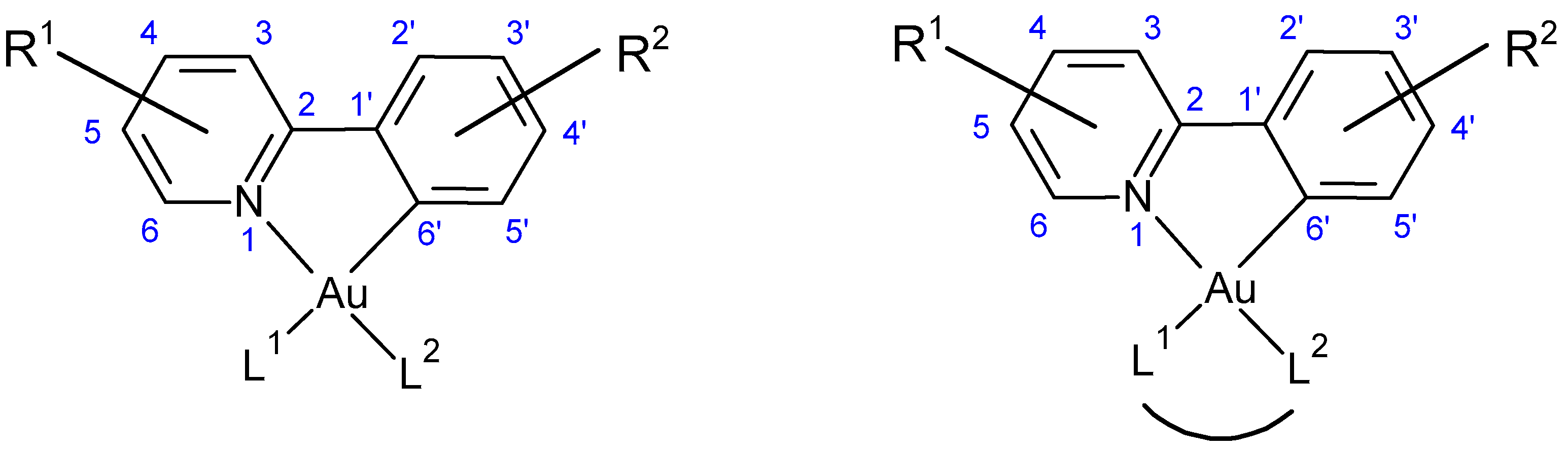
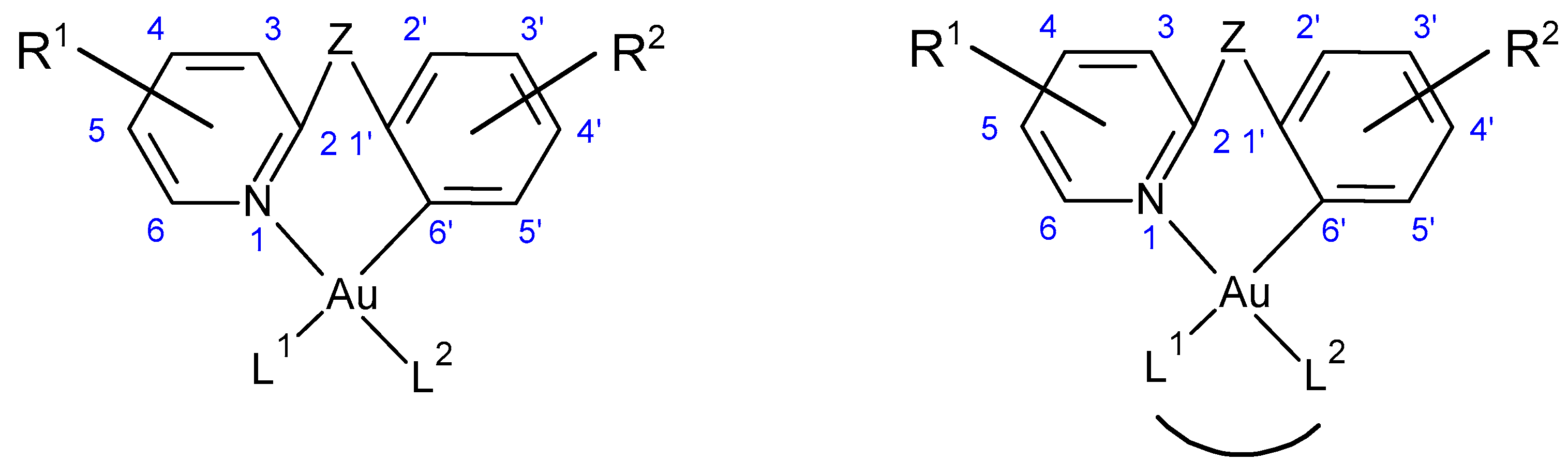
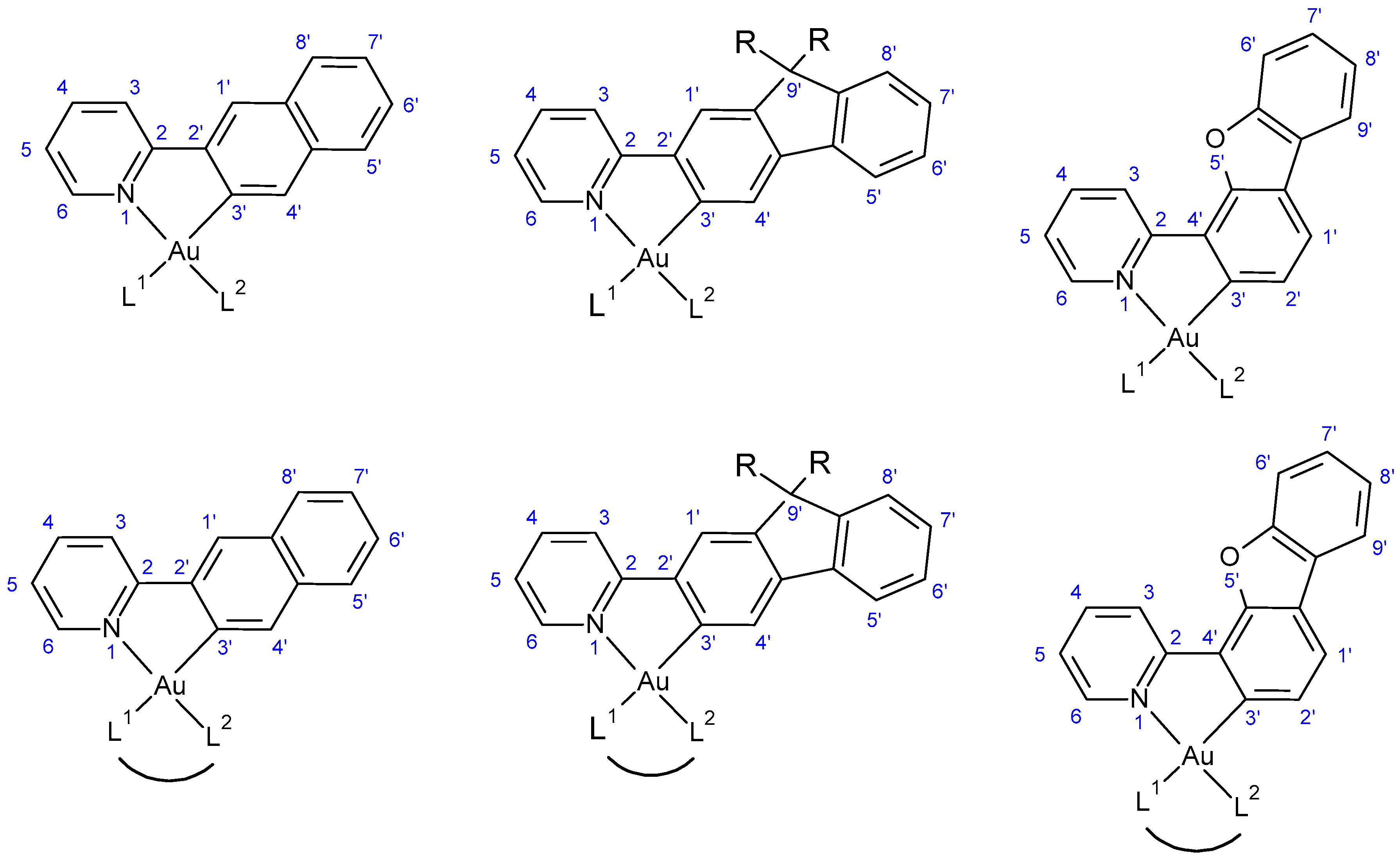
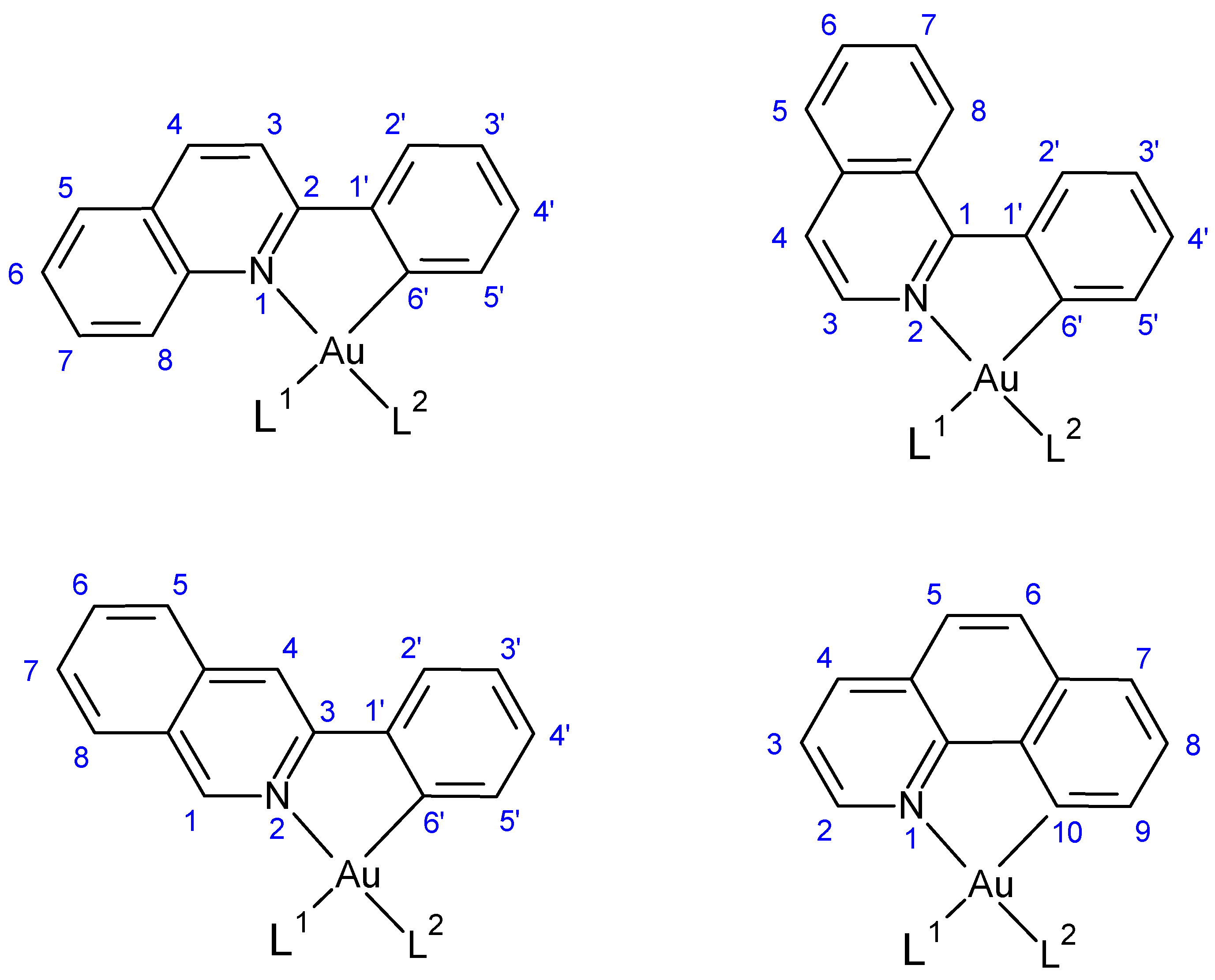
| R1 | R2 | X | Y | NMR Solvent | X-ray (CCDC) | Activity $ |
|---|---|---|---|---|---|---|
| H | H | Cl | Cl | DMSO-d6 [1,2,3,4,5,6,7,8,9,10] | IJAQEP [3] | CAT [16,17] |
| 3-methyl | H | Cl | Cl | DMSO-d6 [10] | ||
| 4-n-propyl | H | Cl | Cl | DMSO-d6 [2] | ||
| 5-n-butyl | H | Cl | Cl | DMSO-d6 [11] | ||
| H | 2-methyl | Cl | Cl | DMSO-d6 [10] | ||
| H | 2-methyl | Br | Br | JOTQOA [12] a | ||
| H | 3-methyl | Cl | Cl | DMSO-d6 [10] | ||
| H | 4-methyl | Cl | Cl | DMSO-d6 [5,8,9,10,13] | CAT [17] | |
| H | 3-n-butyl | Cl | Cl | DMSO-d6 [11] | ||
| H | 4-tert-butyl | Cl | Cl | DMSO-d6 [10] | BIO1 [25,26] | |
| H | 2-fluoro | Cl | Cl | DMSO-d6 [10] | ||
| H | 4-fluoro | Cl | Cl | DMSO-d6 [10,14] | FOPBUJ [14] | |
| H | 2,4-difluoro | Cl | Cl | DMSO-d6 [15] | HOSHOO [16] | CAT [16] |
| H | 4-chloro | Cl | Cl | DMSO-d6 [17] | CAT [17] | |
| H | 3-trifluoromethyl | Cl | Cl | CD2Cl2 DMSO-d6 [10,18] | ||
| H | 4-trifluoromethyl | Cl | Cl | DMSO-d6 [10,18] | ||
| H | 3-methoxy | Cl | Cl | DMSO-d6 [10] | ||
| H | 4-methoxy | Cl | Cl | DMSO-d6 [17] | CAT [17] | |
| H | 4-n-butoxy | Cl | Cl | DMSO-d6 [11] | ||
| H | 3,5-dimethoxy | Cl | Cl | DMSO-d6 [10] | ||
| H | 2-trifluoromethoxy | Cl | Cl | CD2Cl2 [18] | MIYYUR [18] | |
| H | 4-trifluoromethoxy | Cl | Cl | DMSO-d6 [18] | ||
| H | 4-formyl | Cl | Cl | DMSO-d6 [8,9] | ||
| H | 2-phenyl | Cl | Cl | DMSO-d6 [10] | ||
| H | 3-phenyl | Cl | Cl | DMSO-d6 [10] | ||
| H | 4-phenyl | Cl | Cl | DMSO-d6 [10,19] | ||
| H | 4-(9-bromo-n-nonoxy) | Cl | Cl | CDCl3 [20] | ||
| H | 4-(9-trimethylammonio-n-nonoxy) 1 | Cl | Cl | CD3OD [20] | ||
| H | 4-(9-(4-methylphenylsulfonoxy)-n-nonoxy) | Cl | Cl | CD2Cl2 [20] | ||
| 3-methyl | 2-fluoro | F | F | CD2Cl2 [21] | DAJRAK [21] | |
| 3-methyl | 2-fluoro | Cl | Cl | CD2Cl2 [21] | DAJQOX [21] | |
| 3-methyl | 3,4,5-trimethoxy | F | F | CD2Cl2 [21] | DAJREO [21] | |
| 3-methyl | 3,4,5-trimethoxy | Cl | Cl | CD2Cl2 [21] | DAJQUD [21] | |
| 5-carboxy | 4-carboxy | Cl | Cl | DMSO-d6 [22,23] | GAKZUR [22] b | CAT [22] |
| 5-carboxy | 4-carboxy | Br | Br | DMSO-d6 [23] | VUVLAC [23] b | |
| 5-carboxy | 4-carboxy | I | I | DMSO-d6 [23] | VUVKUV [23] b | |
| 5-carboxy | 4-carboxy | Cl 2 | I 2 | DMSO-d6 DMF-d7 [23] | VUVKOP [23] b | |
| 5-carboxy | 4-carboxy | Br 2 | I 2 | DMSO-d6 DMF-d7 [23] | VUVLEG [23] b | |
| 5-ethoxycarbonyl | 4-ethoxycarbonyl | Cl | Cl | CDCl3 DMSO-d6 [22,23] | CAT [22] | |
| 5-ethoxycarbonyl | 4-ethoxycarbonyl | Br | Br | CD2Cl2 DMSO-d6 [23] | ||
| 5-ethoxycarbonyl | 4-ethoxycarbonyl | I | I | CD2Cl2 DMSO-d6 [23] | ||
| 4-dimethylamino | 2,3,4-trifluoro | Cl | Cl | CD2Cl2 [24] | ||
| 4-dimethylamino | 3-trifluoromethyl | Cl | Cl | CD2Cl2 [24] | ||
| 4-dimethylamino | 4-trifluoromethoxy | Cl | Cl | CD2Cl2 [24] |
| L1 | L2 | L1L2 | Counterion | NMR Solvent | X-ray (CCDC) | Geometry | Activity $ |
|---|---|---|---|---|---|---|---|
| CN | CN | DMSO-d6 [27] | DUZCOS [27] | LUM2 [27] | |||
| SCN | NCS | DMSO-d6 [28] | ILETOI [28] | trans(S,N) | BIO1 [28] | ||
| ethane-1,2-dithiolate | CDCl3 [2] | ||||||
| propan-1-ol-2,3-dithiolate | DMSO-d6 [28] | BIO1 [28] | |||||
| 1,4,7-trithiacyclononane-κ3-S,S,S | 2PF6− | CD3NO2 [5] | MOCFOB [5] | ||||
| propan-2-one-1-yl | Cl | BIGRAL [29] | trans(C,N) | ||||
| propan-2-one-1-yl | NO3 | DMSO-d6 [29] | BIGREP [29] | trans(C,N) | |||
| n-pentane-2,4-dione-3-yl | Cl | CDCl3 [30] | |||||
| acetate | acetate | CDCl3 DMSO-d6 [3,31] | IJAQIT [3] a DUNCAT [31] | BIO1 [3,31] | |||
| malonate | DMSO-d6 [3] | BIO1 [3] | |||||
| cyclobutane-1,1-dicarboxylate | DMSO-d6 [3] | IJAQUF [3] | BIO1 [3] | ||||
| 2-thiolatepropionate | DMSO-d6 [28] | BIO1 [28] | |||||
| 2,3-dithiolatesuccinic acid | DMSO-d6 [28] | BIO1 [28] | |||||
| ethane-1-amine-2-thiolate | B(C6H5)4− | DMSO-d6 [2] | |||||
| ethane-1,2-diamine | 2ClO4− | CD3OD [32] | |||||
| dimethylaminocarbodithioate | PF6− | DMSO-d6 [2] | |||||
| diethylaminocarbodithioate | B(C6H5)4− PF6− | DMSO-d6 [2,11] | MAXQOR [2] | BIO1 [11] | |||
| di(n-butyl)aminocarbodithioate | PF6− | DMSO-d6 [11] | BIO1 [11] | ||||
| 1,1-dimethylbiguanidate | Cl− PF6− | D2O DMSO-d6 [8,33] | REBLET [8] CEWGOE [33] b | BIO1 [8,33] | |||
| 2-amine-3-thiolatepropionate & 2-amine-3-thiolatepropionic acid 1A | NO3− | CD3OD [34] | LORCOM [34] c | trans(S,N) | |||
| 2-amine-3-methyl-3-thiolatebutyrate | CD3OD [34] | LORCEC [34] d | trans(S,N) | ||||
| 2-amine-3-methyl-3-thiolatebutyrate & 2-amine-3-methyl-3-thiolatebutyric acid 1B | NO3− | CD3OD [34] | LORCIG [34] e | trans(S,N) | |||
| trimethylphosphine | Cl | BF4− | CD3COCD3 [35] | QUNSIE [35] | trans(P,N) | ||
| tricyclohexylphosphine | Cl | BF4− | CD2Cl2 [36] | IVAYUB [36] f | trans(P,N) | ||
| trimethylsilylethynyl | trimethylsilylethynyl | CD2Cl2 [37] | LUM1 [37] | ||||
| triisopropylsilylethynyl | triisopropylsilylethynyl | CD2Cl2 [15] | IZOSUM [15] | LUM2 [15] | |||
| phenyl | phenyl | CDCl3 [38] | EWOJUW [38] f | LUM2 [38] | |||
| 1,1′-biphen-2,2′-diyl | CD2Cl2 [38] | EWOJOQ [38] | LUM2 [38] | ||||
| phenylethynyl | phenylethynyl | CDCl3 [15] | IZOSOG [15] | LUM2 [15] | |||
| 4-ethylphenylethynyl | 4-ethylphenylethynyl | CDCl3 [37] | LUM1 [37] | ||||
| 4-(phenylethynyl)phenylethynyl | 4-(phenylethynyl)phenylethynyl | CDCl3 [15] | LUM1 [15] | ||||
| bis(2-acetylidephenyl)acetylene | DMSO-d6 [39] | LUM1 [39] | |||||
| 4-fluorophenylethynyl | 4-fluorophenylethynyl | CD2Cl2 CD3CN [15,40] | IZOTIB [15] f | LUM2 [15] | |||
| pentafluorophenyl | pentafluorophenyl | CDCl3 [38] | LUM2 [38] | ||||
| 4-trifluoromethylphenyl | 4-trifluoromethylphenyl | CD2Cl2 [38] | EWOKAD [38] f | LUM2 [38] | |||
| 4-trifluoromethylphenylethynyl | 4-trifluoromethylphenylethynyl | CD2Cl2 [37] | LUM1 [37] | ||||
| 2,4,6-tris(trifluoromethyl)phenyl | Cl | CD2Cl2 [41] | GIVRIO [41] | trans(C,N) | LUM2 [41] | ||
| 2,4,6-tris(trifluoromethyl)phenyl | I | CD2Cl2 [41] | GIVSOV [41] | trans(C,N) | LUM2 [41] | ||
| 2,4,6-tris(trifluoromethyl)phenyl | CN | CD2Cl2 [41] | GIVSEL [41] | trans(Cphenyl,N) | LUM2 [41] | ||
| 2,4,6-tris(trifluoromethyl)phenyl | H2O | CF3SO3− | CD2Cl2 [42] | XOLCEI [42] | trans(C,N) | BIO1 [43] CAT [42] LUM1 [42] | |
| 2,4,6-tris(trifluoromethyl)phenyl | OH | CD2Cl2 [43] | FONDIX [43] | trans(C,N) | BIO1 [43] | ||
| 2,4,6-tris(trifluoromethyl)phenyl | trifluoroacetate | CD2Cl2 [43] | FONCIW [43] f | trans(C,N) | BIO1 [43] | ||
| 2,4,6-tris(trifluoromethyl)phenyl | 4-fluoroaniline | CF3SO3− | CD2Cl2 [42] | XOLCUY [42] f | trans(C,N2ppy) | CAT [42] LUM1 [42] | |
| 2,4,6-tris(trifluoromethyl)phenyl | 4-phenylpyridine | CF3SO3− | CD2Cl2 [42] | XOLCIM [42] | trans(C,N2ppy) | BIO1 [43] CAT [42] LUM1 [42] | |
| 2,4,6-tris(trifluoromethyl)phenyl | quinoline | CF3SO3− | CD2Cl2 [42] | XOLCOS [42] | trans(C,N2ppy) | BIO1 [43] CAT [42] LUM1 [42] | |
| 2,4,6-tris(trifluoromethyl)phenyl | phenylethynyl | CD2Cl2 [41] | GIVSUB [41] | trans(Cphenyl,N) | LUM2 [41] | ||
| 2,4,6-tris(trifluoromethyl)phenyl | 4-diphenylaminophenylethynyl | CD2Cl2 [41] | LUM2 [41] | ||||
| 2,4,6-tris(trifluoromethyl)phenyl | trimethyl phosphite | CF3SO3− | CD2Cl2 [42] | XOLDAF [42] g | trans(C,N) | CAT [42] LUM1 [42] | |
| 2,4,6-tris(trifluoromethyl)phenyl | triphenylphosphine | CF3SO3− | CD2Cl2 [42] | XOLDEJ [42] f | trans(C,N) | BIO1 [43] CAT [42] LUM1 [42] | |
| 4-methoxyphenylethynyl | 4-methoxyphenylethynyl | CDCl3 [37] | AJOWUS [37] | LUM1 [37] | |||
| 3,4,5-trimethoxyphenylethynyl | 3,4,5-trimethoxyphenylethynyl | CD2Cl2 [15] | IZOTOH [15] | ||||
| 1,1′-biphenyl-2,2′-diolate | CD2Cl2 [44] | ||||||
| 1,1′-binaphthyl-2-one-2′-olate-1-yl | CDCl3 [45] | R/S | |||||
| toluene-3,4-dithiolate | DMSO-d6 [46] | HIRZIR [46] | |||||
| benzoate | benzoate | DMSO-d6 [3] | IJAQOZ [3] h | BIO1 [3] | |||
| 2-thiolatebenzoate | DMSO-d6 [28] | ILETIC [28] i | trans(S,N) | BIO1 [28,51] | |||
| 1-phenylbiguanidate | Cl− | DMSO-d6 [8] | BIO1 [8] | ||||
| 1-(2-phenylethyl)biguanidate | PF6− | DMSO-d6 [33] | BIO1 [33] | ||||
| 4-aminophenylethynyl | 4-aminophenylethynyl | DMSO-d6 [37] | LUM1 [37] | ||||
| L-cysteinate | 1/2 Cl− 1/2 ClO4− | DMSO-d6 [28] | ILETEY [28] g | trans(S,N) | |||
| L-phenylalaninate | Cl− | CDCl3 [31] | BIO1 [31] | ||||
| L-methioninate | Cl− | CDCl3 [31] | BIO1 [31] | ||||
| N-acetyl-L-cysteinate | Cl | AZOKUY [30] | trans(S,N) | ||||
| 2,2′-bipyridine | 2Cl− | CD3OD [32] | |||||
| 2,3-bis(pyridin-2-yl)-6,7-dimethylquinoxaline | 2Cl− | CD3CN [32] | |||||
| thiophen-2-yl | thiophen-2-yl | CDCl3 [38] | EWOKEH [38] | LUM2 [38] | |||
| thiophen-2-ylethynyl | thiophen-2-ylethynyl | CDCl3 [15] | |||||
| 1,3-bis(2,6-diisopropylphenyl)imidazol-2-ylidene | Cl | Cl− BF4− | CDCl3 CD2Cl2 CD3COCD3 [7,36] | CAT [7] | |||
| 1,3-bis(2,6-diisopropylphenyl)imidazol-2-ylidene | H2O | 2BF4− | CD2Cl2 [7] | ||||
| 1,3-dicyclohexylimidazol-2-ylidene | Cl | BF4− | CD3COCD3 [36] | IVAZAI [36] | trans(C,N) | ||
| 1,3-bis(2,4,6-trimethylphenyl)imidazol-2-ylidene | Cl | BF4− | CD2Cl2 [36] | ||||
| 1,3-bis(2,4,6-trimethylphenyl)imidazolin-2-ylidene | Cl | BF4− | CD2Cl2 [36] | ||||
| methylenebis(3-methyl-1H-imidazol-1-yl-2-ylidene) | 2PF6− | CD3CN [19] | LUM1 [19] | ||||
| methylenebis(3-n-butyl-1H-imidazol-1-yl-2-ylidene) | 2PF6− | CD3CN [19] | LUM1 [19] | ||||
| methylenebis(3-(3-sulfonate-n-propyl)-1H-imidazol-1-yl-2-ylidene) | D2O [19] | LUM1 [19] | |||||
| 1,2-ethylenebis(3-n-butyl-1H-imidazol-1-yl-2-ylidene) | 2PF6− | CD3CN [19] | LUM1 [19] | ||||
| 1,3-propylenebis(3-n-butyl-1H-imidazol-1-yl-2-ylidene) | 2PF6− | CD3CN [19] | LUM1 [19] | ||||
| 3,3′-bis(trifluoromethyl)-5,5′-bipyrazolate | DMSO-d6 [6] | ||||||
| 1,1-dimethylmethylenebis(3-trifluoromethylpyrazol-5-ylate) | CD2Cl2 [6] | ||||||
| triphenylphosphine | Cl | CF3SO3− BF4− | CDCl3 CD3CN [7,36] | IVAYOV [36] | trans(P,N) | CAT [7] | |
| triphenylphosphine | FBF3 | BF4− | IVAZEM [36] f | trans(P,N) | |||
| triphenylphosphine | H2O | 2BF4− | CD2Cl2 [36] | ||||
| P(4-trifluoromethylphenyl)3 | Cl | BF4− | CD2Cl2 [36] | ||||
| P(4-methoxyphenyl)3 | Cl | BF4− | CD3CN [36] | ||||
| 1,2-bis(diphenylphosphino)benzene 2 | 2Cl− | CDCl3 [9] | BIO1 [9] | ||||
| benzene-1-(diphenylphosphine)-2-thiolate | B(C6H5)4− | DMSO-d6 [2] | MAXQIL [2] | trans(P,N) | |||
| oxybis(4-isopropoxyphenylborinate) | CDCl3 [47] | ||||||
| 2-((4,5-ethylenedithio)-1,3-dithiole-2-ylidene)-1,3-dithiole-4,5-dithiolate | DMSO-d6 [48] | TAFJEQ [48] j | |||||
| 2-((4,5-ethylenedithio)-1,3-dithiole-2-ylidene)-1,3-dithiole-4,5-dithiolate & 2-((4,5-ethylenedithio)-1,3-dithiole-2-ylidene)-1,3-dithiole-4-thione-5-thiolate 3A | PF6− AsF6− TaF6− | AMEXIZ [49] YEDPUT [50] k YEDQAA [50] k | |||||
| 2-((4,5-ethylenedioxy)-1,3-dithiole-2-ylidene)-1,3-dithiole-4,5-dithiolate | DMSO-d6 [50] | ||||||
| 2-((4,5-ethylenedioxy)-1,3-dithiole-2-ylidene)-1,3-dithiole-4,5-dithiolate & 2-((4,5-ethylenedioxy)-1,3-dithiole-2-ylidene)-1,3-dithiole-4-thione-5-thiolate 3B | BF4− | YEDPON [50] | |||||
| 2-(bis(n-decylthio)-1,3-dithiole-2-ylidene)-1,3-dithiole-4,5-dithiolate | CDCl3 [48] |
| X-ray (CCDC) | Au–N | Au–C | N–Au–C | Element Trans to N | Element Trans to C |
|---|---|---|---|---|---|
| [Au(2PPY*)XY] (2PPY* = a-R1-2-(b-R2-phenyl)pyridine*, a = 3–6, b = 2–5; X, Y = F, Cl, Br, I) | |||||
| IJAQEP [3] | 2.03(1) | 1.95(2) | 83.0(6) | Cl | Cl |
| JOTQOA [12] | 2.04(1) | 2.05(1) | 80.9(5) | Br | Br |
| FOPBUJ [14] | 2.037(6) | 2.026(5) | 81.8(2) | Cl | Cl |
| HOSHOO [16] | 2.015(8) | 2.02(1) | 82.0(4) | Cl | Cl |
| MIYYUR [18] | 2.034(5) | 2.020(5) | 81.3(2) | Cl | Cl |
| DAJRAK [21] | 1.975(5) | 1.967(5) | 81.6(2) | F | F |
| DAJQOX [21] | 2.036(3) | 2.021(4) | 80.8(1) | Cl | Cl |
| DAJREO [21] | 1.977(3) | 1.983(5) | 81.2(2) | F | F |
| DAJQUD [21] | 2.034(7) 2.031(8) | 2.02(1) 2.032(9) | 80.7(3) 81.0(3) | Cl | Cl |
| GAKZUR [22] | 2.041(2) | 2.025(2) | 81.63(7) | Cl | Cl |
| VUVLAC [23] | 2.066(3) | 2.045(3) | 81.6(1) | Br | Br |
| VUVKUV [23] | 2.069(7) | 2.05(1) | 80.0(4) | I | I |
| VUVKOP [23] | 2.08(2) | 2.04(2) | 82.8(6) | I | Cl |
| VUVLEG [23] | 2.084(3) | 2.028(4) | 80.9(1) | I | Br |
| [Au(2ppy*)L1L2] and [Au(2ppy*)(L1L2)] (L1, L2 ≠ F, Cl, Br, I) | |||||
| DUZCOS [27] | 2.051(4) | 2.042(5) | 81.4(2) | C | C |
| ILETOI [28] | 2.064(6) | 2.012(9) | 81.4(4) | S | N |
| MOCFOB [5] | 2.068(5) | 2.057(5) | 81.2(2) | S | S |
| BIGRAL [29] | 2.111(5) | 2.018(7) | 81.1(2) | C | Cl |
| BIGREP [29] | 2.114(3) | 2.004(4) | 81.8(2) | C | O |
| IJAQIT [3] | 2.028(8) | 2.005(8) | 81.6(3) | O | O |
| DUNCAT [31] | 2.014(5) | 1.998(5) | 81.4(2) | O | O |
| IJAQUF [3] | 2.002(4) | 1.999(4) | 81.3(2) | O | O |
| MAXQOR [2] | 2.06(1) | 2.04(2) | 82.2(5) | S | S |
| REBLET [8] | 2.042(4) 2.036(6) | 2.035(5) 2.032(7) | 81.3(2) 81.5(3) | N | N |
| CEWGOE [33] | 2.038(2) | 2.021(2) | 81.16(9) | N | N |
| LORCOM [34] | 2.053(6) 2.061(6) | 1.976(8) 2.022(6) | 81.9(3) 79.8(3) | S | N |
| LORCEC [34] | 2.074(4) | 2.029(5) | 81.6(2) | S | N |
| LORCIG [34] | 2.083(5) | 2.010(5) | 81.1(3) | S | N |
| QUNSIE [35] | 2.102(2) | 2.044(3) | 81.1(1) | P | Cl |
| IVAYUB [36] | 2.119(3) | 2.042(3) | 80.7(1) | P | Cl |
| IZOSUM [15] | 2.051(2) | 2.052(2) | 80.33(9) | C | C |
| EWOJUW [38] | 2.111(2) | 2.066(2) | 80.02(7) | C | C |
| EWOJOQ [38] | 2.125(2) | 2.089(3) | 79.4(1) | C | C |
| IZOSOG [15] | 2.060(2) | 2.038(2) | 81.33(8) | C | C |
| IZOTIB [15] | 2.059(2) 2.068(2) | 2.039(2) 2.043(2) | 80.95(9) 81.00(9) | C | C |
| EWOKAD [38] | 2.080(4) | 2.087(3) | 79.8(1) | C | C |
| GIVRIO [41] | 2.083(2) | 2.018(3) | 81.5(1) | C | Cl |
| GIVSOV [41] | 2.100(3) | 2.037(4) | 80.9(1) | C | I |
| GIVSEL [41] | 2.085(3) | 2.038(2) | 81.0(1) | C | C |
| XOLCEI [42] | 2.076(3) | 2.006(3) | 82.1(1) | C | O |
| FONDIX [43] | 2.067(3) | 2.015(3) | 81.6(1) | C | O |
| FONCIW [43] | 2.077(6) | 2.006(6) | 82.1(2) | C | O |
| XOLCUY [42] | 2.096(2) | 2.017(2) | 81.60(9) | C | N |
| XOLCIM [42] | 2.075(4) | 2.025(7) | 82.5(2) | C | N |
| XOLCOS [42] | 2.075(3) | 2.016(3) | 81.6(1) | C | N |
| GIVSUB [41] | 2.086(3) | 2.052(3) | 80.8(1) | C | C |
| XOLDAF [42] | 2.085(4) | 2.063(5) | 80.9(2) | C | P |
| XOLDEJ [42] | 2.102(3) | 2.051(3) | 81.0(1) | C | P |
| AJOWUS [37] | 2.13(3) 2.19(5) | 1.95(2) 1.87(8) | 82(1) 81(3) | C | C |
| IZOTOH [15] | 2.057(1) | 2.038(1) | 80.89(5) | C | C |
| HIRZIR [46] | 2.079(6) | 2.035(7) | 81.1(3) | S | S |
| IJAQOZ [3] | 2.007(8) | 2.001(9) | 81.8(4) | O | O |
| ILETIC [28] | 2.073(6) | 1.998(8) | 81.6(3) | S | O |
| ILETEY [28] | 2.087(6) 2.095(6) | 2.008(9) 2.020(9) | 80.4(3) 81.2(3) | S | N |
| AZOKUY [30] | 2.091(5) 2.088(5) | 2.035(7) 2.033(7) | 81.1(3) 81.1(3) | S | Cl |
| EWOKEH [38] | 2.097(3) 2.090(3) | 2.069(4) 2.051(3) | 80.8(1) 80.5(1) | C | C |
| IVAZAI [36] | 2.06(2) 2.07(2) | 2.05(1) 2.03(2) | 80.9(9) 82(1) | C | Cl |
| IVAYOV [36] | 2.100(2) | 2.045(2) | 80.83(7) | P | Cl |
| IVAZEM [36] | 2.092(5) | 2.044(6) | 82.0(2) | P | F |
| MAXQIL [2] | 2.08(2) 2.08(2) | 2.02(2) 2.04(2) | 79.9(9) 79.3(9) | P | S |
| TAFJEQ [48] | 2.063(2) | 2.042(5) | 80.6(2) | S | S |
| AMEXIZ [49] | 2.070(6) 2.066(7) | 2.053(7) 2.034(6) | 81.1(3) 80.4(2) | S | S |
| YEDPUT [50] | 2.08(1) 2.06(2) 1.98(2) 2.07(2) | 2.09(1) 2.08(1) 2.10(2) 2.07(1) | 82.0(6) 82.1(6) 79.8(7) 80.5(6) | S | S |
| YEDQAA [50] | 2.06(1) 2.10(1) 2.09(1) 2.048(9) | 2.08(1) 2.07(1) 2.08(1) 2.09(1) | 81.3(4) 81.4(5) 82.1(5) 81.0(4) | S | S |
| YEDPON [50] | 2.078(9) 2.076(9) | 2.064(9) 2.055(9) | 81.9(3) 80.2(3) | S | S |
| [Au(2PPY*)L1L2] and [Au(2PPY*)(L1L2)] (L1, L2 ≠ F, Cl, Br, I) | |||||
| MAXQEH [2] | 2.01(2) | 2.01(2) | 79.5(8) | N | O |
| JOTROB [12] | 2.12(1) | 2.021(7) | 80.5(3) | C | Br |
| QICNUN [52] | 2.130(3) | 2.062(3) | 80.0(1) | C | C |
| ROVXUY [55] | 2.12(2) | 2.04(2) | 80.9(7) | C | C |
| ROVYAF [55] | 2.11(3) | 2.02(4) | 82(1) | C | Br |
| LUWJUL [56] | 2.04 | 2.03 | 80.6 | C | C |
| MOCFIV [5] | 2.063(4) | 2.043(4) | 81.2(2) | S | S |
| IDAJII [54] | 2.117(2) | 2.001(2) | 81.36(8) | C | O |
| QICPAV [52] | 1.991(6) | 1.995(8) | 81.8(3) | O | O |
| YIDHIF [58] | 2.09(1) | 2.02(1) | 81.5(4) | C | O |
| QEFVUV [59] | 2.090(2) | 2.006(3) | 81.69(9) | C | O |
| YIDGIE [58] | 2.108(7) | 1.998(9) | 81.6(3) | C | O |
| YIDHEB [58] | 2.137(3) | 2.012(4) | 81.4(1) | C | O |
| YIDHAX [58] | 2.117(7) | 1.999(9) | 81.6(3) | C | O |
| YIDGOK [58] | 2.131(3) | 2.007(3) | 81.7(1) | C | O |
| YIDGAW [58] | 2.127(3) | 2.009(4) | 81.5(2) | C | O |
| YIDGUQ [58] | 2.126(2) 2.113(2) | 2.010(3) 2.002(2) | 81.45(9) 82.0(1) | C | O |
| YIDGEA [58] | 2.094(8) 2.105(6) | 2.014(8) 2.003(9) | 81.1(3) 81.3(3) | C | O |
| FUWXIG [57] | 2.098(2) | 1.992(4) | 81.8(1) | C | O |
| FUWXOM [57] | 2.107(4) | 2.006(4) | 81.5(2) | C | O |
| YIDFUP [58] | 2.110(4) | 2.013(4) | 81.6(2) | C | O |
| QEFWAC [59] | 2.07(1) 2.07(1) | 2.01(1) 2.01(1) | 82.7(4) 81.1(5) | C | O |
| IDAJOO [54] | 2.109(2) | 1.995(2) | 82.20(8) | C | O |
| IPISEH [60] | 2.127(2) | 2.019(3) | 80.6(1) | C | N |
| IPISAD [60] | 2.114 | 2.002 | 82.2 | C | N |
| LUWJEV [56] | 2.09(2) | 2.05(2) | 83(1) | C | C |
| LUWJIZ [56] | 2.069(6) | 2.040(7) | 81.5(2) | C | C |
| FONRIL [14] | 2.11(1) | 2.08(1) | 80.1(4) | C | C |
| LUWJOF [56] | 2.283 | 1.845 | 79.9 | C | C |
| LUWKAS [56] | 2.076(7) | 2.024(4) | 81.4(2) | C | Br |
| LUWKIA [56] | 2.072 | 2.07 | 81.2 | C | C |
| FONSAE [14] | 2.111(4) | 2.023(4) | 81.2(2) | C | Cl |
| FOPCAQ [14] | 2.124(6) 2.114(5) 2.112(4) 2.114(4) | 2.051(5) 2.065(5) 2.069(6) 2.069(6) | 80.6(2) 80.3(2) 80.2(2) 79.9(2) | C | C |
| FONRUX [14] | 2.116(3) | 2.023(4) | 81.1(1) | C | Cl |
| FOPCEU [14] | 2.112(8) | 2.05(1) | 79.9(4) | C | C |
| AJOXAZ [37] | 2.074(3) | 2.032(3) | 81.2(1) | C | C |
| FONROR [14] | 2.115(4) | 2.063(5) | 80.0(2) | C | C |
| FONSEI [14] | 2.134(4) | 2.057(5) | 79.6(3) | C | C |
| ICUMEY [51] | 2.068(3) | 2.010(3) | 81.4(1) | S | O |
| FOPCIY [14] | 2.112(3) | 2.056(4) | 80.4(1) | C | C |
| FONREH [14] | unknown | unknown | unknown | C | C |
| IDAJUU [54] | 2.146(2) | 2.051(2) | 80.68(7) | C | P |
| FUXGIQ [47] | 2.009(9) 2.020(9) | 1.95(2) 2.04(2) | 78.7(6) 85.0(6) | O | O |
| FUXGAI [47] | 2.020(5) | 1.993(7) | 82.1(2) | O | O |
| FUXGOW [47] | 2.020(3) | 2.004(4) | 81.7(1) | O | O |
| FUXGEM [47] | 2.022(3) | 1.994(5) | 81.5(1) | O | O |
| NIKHIB [26] | 2.061(2) 2.057(2) | 2.037(3) 2.029(3) | 80.6(1) 80.9(1) | S | S |
| KIGPEY [25] | 2.028(3) | 2.034(4) | 81.1(1) | N | O |
| KIGPIC [25] | 2.063(7) | 2.015(6) | 80.9(3) | N | N |
| WUCKUD [66] | 2.097(2) | 2.075(3) | 79.4(1) | C | C |
| JAZJED [53] | 2.000(2) | 2.022(2) | 81.83(8) | O | O |
| JAYZAO [53] | 2.003(3) | 2.004(5) | 81.9(1) | O | O |
| MIZHIP [18] | 2.078(2) | 2.041(2) | 81.11(8) | C | C |
| MIZHEL [18] | 2.043(2) | 2.045(2) | 81.1(1) | Cl | C |
| MIZJAJ [18] | 2.070(2) | 2.042(2) | 81.03(8) | C | C |
| MIYYAX [18] | 2.072(3) | 2.044(3) | 81.3(1) | C | C |
| JAZJAZ [53] | 2.007(2) | 1.991(2) | 81.82(9) | O | O |
| MIYYEB [18] | 2.070(2) | 2.049(2) | 80.9(1) | C | C |
| MIYXOK [18] | 2.024(3) 2.036(3) | 2.055(4) 2.050(4) | 81.1(1) 80.8(1) | Cl | C |
| MIZHOV [18] | 2.075(3) | 2.040(3) | 81.0(1) | C | C |
| MIYXUQ [18] | 2.040(3) | 2.049(4) | 81.1(1) | Cl | C |
| JAZJON [53] | 2.005(2) | 1.988(2) | 81.63(8) | O | O |
| JAZCOG [53] | 2.00(1) | 2.02(2) | 82.2(6) | O | O |
| PEZQUI [67] | 2.180(2) | 1.995(3) | 81.2(1) | C | O |
| FIDBUS [72] | 2.107(6) | 2.066(8) | 81.2(3) | S | S |
| KEKGEP [73] | 2.13(1) | 2.06(2) | 81.8(7) | C | O |
| QEZYAX [74] | 2.163(8) | 2.014(6) | 80.6(3) | C | O |
| DAJRUE [21] | 2.08(1) 2.083(9) | 1.99(1) 1.99(1) | 81.6(4) 81.7(4) | C | F |
| DAJSAL [21] | 2.076(4) | 2.044(3) | 81.0(2) | C | C |
| DAJROY [21] | 2.073(6) | 1.984(7) | 81.7(3) | C | F |
| DAJRIS [21] | 2.106(4) | 2.027(4) | 81.6(2) | C | Br |
| DAJSEP [21] | 2.092(4) | 2.058(4) | 80.5(1) | C | C |
| AJOXIH [37] | 2.065(3) | 2.038(4) | 81.2(1) | C | C |
| AJOXED [37] | 2.066(3) | 2.041(4) | 81.0(1) | C | C |
| JAZBOF [53] | 2.034(3) 2.033(3) | 1.994(4) 1.993(4) | 81.6(1) 81.7(1) | O | O |
| JAYZOC [53] | 2.013(4) 2.008(5) | 1.995(5) 2.001(5) | 82.0(2) 82.1(2) | O | O |
| WECYUB [75] | 2.060(4) 2.055(4) | 2.046(5) 2.041(5) | 80.8(2) 80.2(2) | C | C |
| JAZKAA [53] | 1.997(2) | 1.994(2) | 81.42(9) | O | O |
| JAYZIW [53] | 1.999(4) | 2.000(5) | 81.8(2) | O | O |
| JAYYOB [53] | 2.043(2) | 1.995(2) | 81.23(8) | O | O |
| GALBAA [22] | 2.008(2) | 1.991(3) | 81.9(1) | O | O |
| PUXGUN [76] | 2.033(2) | 2.027(2) | 81.03(8) | N | N |
| GALBEE [22] | 2.002(3) 2.007(3) | 1.993(3) 1.999(4) | 81.7(1) 81.7(1) | O | O |
| WASQOZ [24] | 2.054(2) | 2.047(2) | 80.45(8) | C | C |
| JAZBIZ [53] | 2.008(3) | 1.996(3) | 81.5(1) | O | O |
| [Au(2ArPY*)X2] (2ArPY* ≠ 2PPY*; X = F, Cl, Br, I) | |||||
| HOSHEE [16] | 2.06(1) | 2.04(2) | 87.2(6) | Cl | Cl |
| ZETYAY [77] | 2.040(3) | 2.021(5) | 85.7(1) | Cl | Cl |
| PUKYAV [85] | 2.035(5) | 2.033(8) | 89.6(3) | Cl | Cl |
| AZOKOS [30] | 2.08(2) 2.09(4) | 2.02(3) 2.01(3) | 88(1) 88(2) | Br | Br |
| FIJZIH [87] | 2.02(1) | 2.03(2) | 86.6(6) | Cl | Cl |
| KAGYIB [88] | 2.054(5) | 2.016(6) | 86.6(2) | Cl | Cl |
| IFUQUX [17] | 2.057(3) | 1.992(5) | 86.6(2) | Cl | Cl |
| FIKNOC [87] | 2.061(9) | 2.04(2) | 88.1(5) | Cl | Cl |
| PUGMAF [89] | 2.05(2) | 2.02(2) | 87.2(9) | Cl | Cl |
| [Au(2ArPY*)L1L2] and [Au(2ArPY*)(L1L2)] (2ArPY* ≠ 2PPY*; L1, L2 ≠ F, Cl, Br, I) | |||||
| TOFDUQ [92] | 2.031(5) 2.046(5) | 2.031(5) 2.020(6) | 88.7(2) 87.7(2) | N | N |
| TOFFAY [92] | 2.041(7) 2.028(7) | 2.025(8) 2.028(7) | 87.7(3) 87.1(3) | N | N |
| RADKOA [93] | 2.070(2) | 2.042(3) | 88.3(1) | S | S |
| RADLER [93] | 2.069(5) | 2.061(6) | 89.0(2) | S | S |
| RADLAN [93] | 2.065(3) | 2.042(3) | 89.2(1) | S | S |
| RADKUG [93] | 2.070(2) | 2.046(2) | 89.63(7) | S | S |
| OVIKOW [82] | 2.12(2) 2.11(2) | 2.03(2) 2.04(2) | 90.0(6) 89.9(7) | S | S |
| OVILAJ [82] | 2.067(4) | 2.061(6) | 88.5(2) | S | S |
| OVIKUC [82] | 2.072(4) | 2.054(3) | 88.2(1) | S | S |
| CEWGUK [33] | 2.036(2) | 2.028(3) | 87.9(1) | N | N |
| ECEGOM [95] ECEGOM 01 [95] | 2.074(2) 2.085(3) | 2.017(2) 2.022(3) | 88.85(8) 87.6(1) | C | Cl |
| MIYXIE [18] | 2.079(2) | 2.061(3) | 87.6(1) | C | C |
| BAZSEB [96] | 2.052(6) 2.041(7) | 2.005(7) 2.018(7) | 89.7(3) 87.7(3) | N | O |
| XEWBOR [63] | 2.058(3) | 2.031(3) | 88.1(1) | N | N |
| XEWBUX [63] | 2.053(2) | 2.012(2) | 87.43(9) | N | Cl |
| SEVDON [97] | 2.046(9) | 2.04(1) | 88.2(4) | N | N |
| SEVDUT [97] | 2.040(4) | 2.021(4) | 89.3(2) | N | N |
| DEFGUR [64] | 2.086(2) | 2.069(2) | 86.23(9) | C | C |
| ECEGAY [95] | 2.114(3) | 2.070(3) | 87.0(1) | C | C |
| FUJHUQ [99] | 2.090(5) | 2.043(7) | 87.1(3) | S | N |
| PUKYEZ [85] | 2.079(9) | 2.03(1) | 85.8(4) | P | Cl |
| USEDOO [9] 1 | 2.096(5) | 2.100(5) | 84.2(2) | P | P |
| QUMZIJ [79] | 2.096(2) 2.100(2) | 2.040(2) 2.041(2) | 87.39(8) 87.27(8) | P | Cl |
| AZOLAF [30] | 1.99(3) 1.98(4) | 2.10(4) 2.10(4) | 93(2) 89(2) | N | N |
| RADLIV [93] | 2.062(2) 2.054(2) | 2.042(2) 2.040(2) | 90.70(8) 90.15(7) | S | S |
| MIYXEA [18] | 2.072(3) | 2.066(3) | 88.5(1) | C | C |
| MIZHUB [18] | 2.088(2) | 2.068(2) | 91.04(8) | C | C |
| MIRLIK [101] | 2.071(2) | 2.019(4) | 89.5(1) | S | N |
| MIRLOQ [101] | 2.068(3) | 2.020(3) | 90.8(1) | S | N |
| FIKQAR [87] | 2.09(1) | 2.06(1) | 85.3(5) | P | Cl |
| MEDPOD [90] | 2.074 | 2.053 | 81.3 | C | C |
| QOCBES [6] | 2.029(2) 2.035(2) | 2.025(3) 2.018(3) | 80.8(1) 81.1(1) | N | N |
| MEDPIX [90] | 2.069(3) | 2.045(2) | 80.94(9) | C | C |
| MEDPAP [90] | 2.075(2) | 2.051(3) | 80.90(9) | C | C |
| QOCBUI [6] | 2.015(6) | 2.012(5) | 81.0(2) | N | N |
| MEDPET [90] | 2.077(3) | 2.039(3) | 81.1(1) | C | C |
| QOCBOC [6] | 2.035(2) | 2.032(2) | 81.3(1) | N | N |
| [Au(ArPY#*)L1L2] and [Au(ArPY#*)(L1L2)] (ArPY#* ≠ 2PPY*, 2ArPY*) | |||||
| ZINHUB [103] | 2.175(3) 2.171(3) | 2.045(4) 2.041(4) | 79.4(1) 78.9(1) | C | N |
| MAXQUX [2] | 2.223(9) | 2.03(1) | 81.0(4) | C | Cl |
| DUZDAF [27] DUZDAF 01 [27] DUZDAF 02 [27] | 2.045(2) 2.06(1) 2.04(1) 2.053(4) | 2.023(3) 2.036(6) 2.021(5) 2.021(5) | 81.0(1) 81.5(3) 80.7(3) 80.9(2) | C | C |
| AJOXON [37] | 2.063(2) | 2.034(3) | 80.6(1) | C | C |
| EWIWUE [105] | 2.113(8) | 2.055(7) | 81.5(3) | I | I |
| FIBRUG [106] | 2.141(2) | 2.024(3) | 82.4(1) | C | Cl |
| FIBROA [106] | 2.141(3) | 2.001(5) | 82.3(2) | C | O |
| IZOTAT [15] | 2.061(2) | 2.067(2) | 81.93(8) | C | C |
| GIVROU [41] | 2.090(3) | 2.004(3) | 83.2(1) | C | Cl |
| EWIXAL [105] | 2.068(7) | 2.02(1) | 82.8(3) | I | N |
| QUVXIR [108] | 2.074(3) | 2.070(3) | 81.6(1) | S | S |
| 2PPY or 2ArPY | [Au(2PPY*)Cl2] or [Au(2ArPY*)Cl2]: Au–N Bond Length | [Au(2PPY)Cl3] or [Au(2ArPY)Cl3]: Au–N Bond Length |
|---|---|---|
| 2-phenylpyridine | 2.03(1) IJAQEP [3] | 2.035(6) YIDMAA [109] |
| 2-(2,4-difluorophenyl)pyridine | 2.015(8) HOSHOO [16] | 2.047(4) HOSHUU [16] |
| 2-(2-trifluoromethoxyphenyl)pyridine | 2.034(5) MIYYUR [18] | 2.041(1) MIYZEC [18] |
| 2-benzylpyridine | 2.06(1) HOSHEE [16] | 2.046(3) HOSHII [16] |
| 2-benzoylpyridine | 2.035(5) PUKYAV [85] | 2.053(2) MIYZAY [18] |
| 2-phenylsulfanylpyridine | 2.061(9) FIKNOC [87] | 2.06(1) DUCYEI [110] |
| Parent Ring System | R1 | R2 | L1 | L2 | L1L2 | Counterion | NMR Solvent | 15N Chemical Shift | 15N Coordination Shift |
|---|---|---|---|---|---|---|---|---|---|
| 2-phenylpyridine* | Cl | Cl | DMSO-d6 | −148.9 [4] | −77.0 a | ||||
| 1,3-bis(2,6-diisopropylphenyl)imidazol-2-ylidene | Cl | Cl− | CD3COCD3 | −147.7 [7] | −75.8 a | ||||
| 4-methyl | methyl | methyl | CD2Cl2 | −131.0 [53] | −56.1 b | ||||
| 4-methyl | methyl | Br | CD2Cl2 | −121.6 [53] | −46.7 b | ||||
| 4-methyl | allyl | Br | CD2Cl2 | −122.6 [53] | −47.7 b | ||||
| 4-methyl | acetate | acetate | CD2Cl2 | −164.4 [53] | −89.5 b | ||||
| 4-methyl | trifluoroacetate | trifluoroacetate | CD2Cl2 | −165.6 [53] | −90.7 b | ||||
| 4-methyl | HNC(CH3)OCH2CH2 | CF3COO− | CD2Cl2 | −129.0 [60] | −54.1 b | ||||
| 4-methyl | phenyl | Br | CD2Cl2 | −127.9 [53] | −53.0 b | ||||
| 3,5-dimethyl | trifluoroacetate | trifluoroacetate | CD2Cl2 | −167.1 [53] | −94.5 c | ||||
| 3,5-bis(pentafluorophenyl) | trifluoroacetate | trifluoroacetate | CD2Cl2 | −167.7 [53] | −94.7 d | ||||
| 6-methyl | 4-methyl | trifluoroacetate | trifluoroacetate | CD2Cl2 | −161.7 [53] | −88.2 e | |||
| 4-trifluoromethyl | 4-methyl | trifluoroacetate | trifluoroacetate | CD2Cl2 | −160.4 [53] | −95.5 f | |||
| 3-methoxy | 4-methyl | trifluoroacetate | trifluoroacetate | CD2Cl2 | −164.9 [53] | −101.0 g | |||
| 4-methoxy | 4-methyl | trifluoroacetate | trifluoroacetate | CD2Cl2 | −187.1 [53] | −92.9 h | |||
| 6-methoxy | 4-methyl | trifluoroacetate | trifluoroacetate | CD2Cl2 | −187.7 [53] | −66.2 i | |||
| 3-nitro | 4-methyl | trifluoroacetate | trifluoroacetate | CD2Cl2 | −163.9 [53] | −104.5 j | |||
| 2-benzylpyridine* | Cl | Cl | DMSO-d6 | −151.8 [78] −154.2 $ [80] | −90.9 k −93.3 k | ||||
| 2-benzoylpyridine* | Cl | Cl | DMSO-d6 | −165.0 [86] | −104.7 l | ||||
| 7,8-benzoquinoline* | Cl | Cl | DMSO-d6 | −143.3 [104] | −69.2 m |
| Reference | General Formula | Auxiliary Ligand(s) | Cancer Cells | Non-Cancerous Cells |
|---|---|---|---|---|
| [3] | [Au(2ppy*)L2] [Au(2ppy*)(LL)] | L = acetate, benzoate; LL = malonate, cyclobutane-1,1-dicarboxylate | leukemia MOLT-4; C2Cl2 mouse tumour | |
| [8] | [Au(2PPY*)(LL)]+ (2PPY = 2-phenyl- and 2-(4-methylphenyl)pyridine) | LL = 1,1-dimethylbiguanidate, 1-phenylbiguanidate | breast MDA-MB 231, MDA-MB 468; lung H460 | |
| [9] | [Au(ArPY#*)(LL)]2+ (ArPY# = 2-phenyl-, 2-(4-methylphenyl)-, 2-(4-formylphenyl)-, 2-benzyl-, 2-benzoyl-, 2-phenoxy- and 2-anilinopyridine; 7,8-benzoquinoline) | LL = 1,2-bis(diphenylphosphino)benzene | breast MDA-MB 231; lung H460; ovarian A2780, OVCAR8 | |
| [11] | [Au(2PPY*)(LL)]+ (2PPY = 2-phenyl-, 5-n-butyl-2-phenyl-, 2-(3-n-butylphenyl)-, 2-(4-n-butylphenyl)-, 2-(4-trifluoromethylphenyl)- and 2-(4-n-butoxyphenyl)pyridine) | LL = diethylaminocarbodithioate, di-n-butylaminocarbodithioate | breast MCF-7; MDA-MB-231; cervix HeLa; liver HepG2; lung NCI-H460; glioblastoma U87; melanoma B16 | immortalized liver (MIHA) |
| [25] | [Au(2ArPY*)Cl2] [Au(2ArPY*)(LL)] (2ArPY = 2-(4-tert-butylphenyl)- and 2-benzylpyridine) | LL = benzene-1-olate-2-acetylazanide, benzene-1,2-bis(acetylazanide), benzene-1-olate-2-(N-(acridin-9-yl))azanide, benzene-1-azanide-2-(N-(acridin-9-yl)azanide | breast MCF-7; lung A549; leukemia HL60 | |
| [26] | [Au(2PPY*)(LL)] (2PPY = 2-(4-tert-butylphenyl)- and 2-(4-tert-butylphenyl)-5-tert-butylpyridine) | LL = dimethylaminocarbodithioate, diethylaminocarbodithioate, di(n-butyl)aminocarbodithioate, (n-but-1,4-diyl)aminocarbodithioate, N-(ethoxycarbonylmethyl)methylaminocarbodithioate | breast MCF-7, MDA-MB-231; colon HCT-116; lung A549; leukemia HL60 | umbilical vein endothelial cells HUVEC |
| [28] | [Au(2ppy*)L1L2] [Au(2ppy*)(LL)] | L1 = SCN, L2 = NCS; LL = propan-1-ol-2,3-dithiolate, 2-thiolatepropionate, 2,3-dithiolatesuccinic acid, 2-thiolatebenzoate | leukemia MOLT-4; C2Cl2 mouse tumour | |
| [30] | [Au(2-benzoylpyridine*)Cl2] | lung H358, H460; pancreas MiaPaCa | ||
| [31] | [Au(2ArPY*)L2] [Au(2ArPY*)(LL)]+ (2ArPY = 2-phenyl-, 2-(4-methylphenyl)- and 2-benzylpyridine) | L = acetate; LL = L-phenylalaninate, L-methioninate | colon caco-2/TC7 | |
| [33] | [Au(2ArPY*)Cl2] [Au(2ArPY*)(LL)]+ (2ArPY = 2-phenyl-, 2-benzyl- and 2-benzoylpyridine) | LL = 1,1-dimethylbiguanidate, 1-(2-phenylethyl)biguanidate | breast MDA-MB-231; ovarian A2780, A2780cis | murine hepatocytes TAMH, cardiomyocytes AC10 |
| [43] | [Au(2ppy*)L1L2]0/+ | L1 = 2,4,6-tris(trifluoromethyl)phenyl, L2 = H2O, OH, trifluoroacetate, 4-phenylpyridine, quinoline triphenylphosphine | cervix HeLa | lung fibroblasts MRC-5 |
| [51] | [Au(2ArPy*)(LL)] (2ArPy = 2-phenyl-, 2-(4-methylphenyl)-, 2-benzyl- and 2-anilinopyridine) | LL = 2-thiolatebenzoate | murine leukemia P388 | |
| [63] a | [Au(2ArPy*)(LL)] (2ArPy = 2-(4-methylphenyl)-, 2-benzyl- and 2-anilinopyridine) | LL = ethylene-1,2-bis(4-methylphenylsulfonylazanide), benzene-1,2-bis(acetylazanide), benzene-1,2-bis(4-methylphenylsulfonylazanide) | murine leukemia P388 | |
| [64] | [Au(2ArPy*)(LL)] (2ArPy = 2-(4-methylphenyl)-, 2-benzyl- and 2-anilinopyridine) | LL = sulfonebis(cyanomethyl), sulfonebis(benzoylmethyl), benzoylmethyl benzoyl(2-(tert-butylamino)ethyl) sulfone | murine leukemia P388 | |
| [79] | [Au(2-benzylpyridine*)Cl2] [Au(2-benzylpyridine*)LCl]+ [Au(2-benzylpyridine*)L2] | L = 1,3,5-triazaphosphaadamantane, 1,2,3,4-tetraacetyl-6-thioglucose-6-yl | colon HCT116; lung A549; mammary MCF-7; ovarian A2780 | embryonic kidney cells HEK-293T |
| [82] | [Au(2-benzylpyridine*)(LL)] | LL = 4-ethoxycarbonylazacyclohexane-1-carbodithioate, 4-aminocarbonylazacyclohexane-1-carbodithioate | cervix HeLa; bowel HT29; ovarian A2780 | |
| [83] | [Au(2ArPY*)Cl2] (2ArPY = 2-benzyl, 2-phenoxy-, 2-phenylsulfanyl- and 2-anilinopyridine) | breast MDA-MB-231; colon DLD-1, HCT-116, HT29; kidney A-498, ACHN; lung A549; prostate PC-3; uterus MES-SA | ||
| [92] | [Au(2-benzylpyridine*)(LL)]2+ | LL = 1R,2R-cyclohexane-1,2-diamine | breast MCF7; ovarian A2780, OVCAR-8 | retinal pigment epithelial cells engineered to overexpress MYC gene RPE MYC |
| [93] | [Au(2ArPY*)(LL)] (2ArPY = 2-benzyl- and 2-benzoylpyridine) | LL = dimethylaminocarbodithioate, diethylaminocarbodithioate, azacyclohexane-1-carbodithioate, 4-(4-bromophenyl)-1,4-diazacyclohexane-1-carbodithioate, 4-(4-methoxyphenyl)-1,4-diazacyclohexane-1-carbodithioate | breast MDA-MB-231, MDA-MB-175; ovarian A2780 | retinal pigment epithelial cells engineered to overexpress NEO gene RPE-NEO; diploid lung fibroblasts MRC5 |
| [96] a | [Au(2ArPy*)(LL)] (2ArPy = 2-benzyl- and 2-anilinopyridine) | LL = benzene-1,2-diolate, 3,5-di(tert-butyl)benzene-1,2-diolate, benzene-1-olate-2-acetylazanide, 2,5-bis(ethoxycarbonyl)thiophen-3,4-diolate | leukemia P388 | |
| [97] a | [Au(2-benzylpyridine)L2] | L = isatinate, phtalimidate, saccharinate | murine leukemia P388 | |
| [99] | [Au(2-benzylpyridine*)(LL)] | LL = 4-nitrophenyliminocarbo(pyrrol-5-yl-1-ate)thiolate | lung A549 | |
| [102] | [Au(3-(9,9-bis(2-hydroxyethyl)fluoren-2-yl)isoquinoline*)L2] b | L = phenylethynyl | colon HCT116; liver HepG2; lung A549; melanoma A375 |
| Reference | General Formula | Auxiliary Ligand(s) | Reactants | Products |
|---|---|---|---|---|
| [7] | [Au(2ppy*)LCl]+ | L = 1,3-bis(2,6-diisopropylphenyl)imidazol-2-ylidene, triphenylphosphine | alkynes + H2O | enoles |
| [16] | [Au(2ArPY*)Cl2] (2ArPY = 2-phenyl-, 2-(2,4-difluorophenyl)- and 2-benzylpyridine) | arylacetylenes + acyl chlorides + benzylimines | oxazoles | |
| [17] | [Au(2ArPY*)Cl2] (2ArPY = 2-phenyl-, 2-(4-methylphenyl)-, 2-(4-chlorophenyl)-, 2-(4-methoxyphenyl)-, 2-benzyl-, 2-(1-methylbenzyl)-, 2-(1-methoxybenzyl)-, 2-(1-benzoxyiminobenzyl)-, 2-benzoyl-, 2-phenoxy- and 2-(4-tert-butylphenoxy)pyridine) | terminal alkynes + aldehydes + amines | propargylic amines, allenes or oxazoles | |
| [22] | [Au(2PPY*)L2] (2PPY = 5-carboxy-2-(4-carboxyphenyl)- and 5-ethoxycarbonyl-2-(4-ethoxycarbonylphenyl)pyridine) | L = Cl, trifluoroacetate | propargyl esters + styrene | cyclopropane derivatives |
| [42] | [Au(2ppy*)L1L2]+ | L1 = 2,4,6-tris(trifluoromethyl)phenyl, L2 = H2O, 4-fluoroaniline, 4-phenylpyridine, quinoline, trimethyl phosphite, triphenylphosphine | benzylic amines + O2 (photooxidation) | benzylic imines |
| [65] | [Au(2-(4-methylphenyl)pyridine*)(LL)] | LL = oxybis(phenylborinate) | CO + O2 | CO2 |
| [103] | [Au(ArPY#*)2]+ (ArPY# = 2-phenylquinoline, 3-phenylisoquinoline) | (a) benzaldehyde + piperidine + phenylacetylene (b) methylethynylethanol + 1-methylindol | (a) 1-((phenylethynyl)(phenyl)methyl)piperidine (b) 3-substituted 1-methylindol | |
| [106] | [Au(7,8-benzoquinoline*)L2] | L = trifluoroacetate | diphenylacetylene + 1,3,5-trimethoxybenzene | styrene derivative |
| Reference | General Formula | Auxiliary Ligand(s) | Lifetime | Maximal Quantum Yield |
|---|---|---|---|---|
| [6] | [Au(2ArPY*)(LL)] (2ArPY = 2-(9,9-dimethylfluoren-2-yl)-, 4-dimethylamino-2-(9,9-dimethylfluoren-2-yl)-, 2-(dibenzofuran-4-yl)- and 4-dimethylamino-2-(dibenzofuran-4-yl)pyridine) | LL = 1,1-dimethylmethylenebis(3-trifluoromethylpyrazol-5-ylate) | >10 µs | 22% |
| [15] | [Au(ArPY#*)L2] (ArPY# = 2-phenyl- and 2-(2,4-difluorophenyl)pyridine; 7,8-benzoquinoline) | L = triisopropylsilylethynyl, phenylethynyl, 4-fluorophenylethynyl, 4-(phenylethynyl)phenylethynyl | >10 µs or <10 µs | 11% |
| [18] | [Au(2ArPY*)LCl] [Au(2ArPY*)L1L2] (2PPY = 2-(3-trifluoromethylphenyl)-, 2-(2-trifluoromethoxyphenyl)-, 2-(4-trifluoromethoxyphenyl)-, 2-benzyl-, 2-benzoyl- and 2-anilinopyridine) | L, L1, L2 = pentafluorophenyl, 4-fluorophenylethynyl, 4-bis(2,4,6-trimethylphenyl)boranylphenylethynyl) | <10 µs | 5% |
| [19] | [Au(ArPY#*)(LL)]2+ (ArPY# = 2-phenyl-, 2-(2,4-difluorophenyl)-, 2-(4-phenylphenyl)-, 2-(naphth-2-yl)- and 2-(9,9-di(n-butyl)fluoren-2-yl)pyridine; 1-(naphth-2-yl)isoquinoline) | LL = methylenebis(3-methyl-1H-imidazol-1-yl-2-ylidene, methylenebis(3-n-butyl-1H-imidazol-1-yl-2-ylidene, methylenebis(3-(3-sulfonate-n-propyl)-1H-imidazol-1-yl-2-ylidene), 1,2-ethylenebis(3-n-butyl-1H-imidazol-1-yl-2-ylidene), 1,3-propylenebis(3-n-butyl-1H-imidazol-1-yl-2-ylidene | >10 µs | 10% |
| [24] | [Au(2PPY*)L2] (2PPY = 4-dimethylamino-2-(2,3,4-trifluoro)phenyl)-, 4-dimethylamino-2-(3-trifluoromethyl)phenyl)- and 4-dimethylamino-2-(4-trifluoromethoxy)phenyl)pyridine) | L = pentafluorophenyl, 4-fluorophenylethynyl | <10 µs | 28% |
| [27] | [Au(ArPY#*)L2] (ArPY# = 2-phenyl- and 2-(4-methylphenyl)pyridine; 1-phenylisoquinoline) | L = CN | <10 µs | 26% |
| [37] | [Au(ArPY#*)L2] (ArPY# = 2-phenyl-, 2-(4-methylphenyl)-, 2-(4-tert-butylphenyl)-, 4-methyl-2-(4-methoxyphenyl)-, 5-methyl-2-(4-methoxyphenyl)- and 5-trifluoromethyl-2-(4-methoxyphenyl)pyridine; 1-phenyl- and 1-(4-methoxyphenyl)isoquinoline) | L = trimethylsilylethynyl, 4-ethylphenylethynyl, 4-n-butylphenylethynyl, 4-trifluoromethylphenylethynyl, 4-methoxyphenylethynyl, 4-aminophenylethynyl | >10 µs | 10% |
| [38] | [Au(2ppy*)L2] [Au(2ppy*)(LL)] | L = phenyl, pentafluorophenyl, 4-trifluoromethylphenyl, thiophen-2-yl; LL = 1,1′-biphen-2,2′-diyl | <10 µs | 2% |
| [39] | [Au(ArPY#*)(LL)] (ArPY# = 2-phenyl-, 2-(9,9-dimethylfluoren-2-yl)- and 2-(dibenzofuran-4-yl)pyridine; 1-phenylisoquinoline) | LL = bis(2-acetylidephenyl)acetylene | >10 µs | 75% |
| [41] | [Au(ArPY#*)L1L2] (ArPY# = 2-phenylpyridine; 7,8-benzoquinoline) | L1 = 2,4,6-tris(trifluoromethyl)phenyl, L2 = Cl, I, CN, phenylethynyl, 4-diphenylaminophenylethynyl | <10 µs | 39% |
| [42] | [Au(2ppy*)L1L2]+ | L1 = 2,4,6-tris(trifluoromethyl)phenyl, L2 = H2O, 4-fluoroaniline, 4-phenylpyridine, quinoline, trimethyl phosphite, triphenylphosphine | >10 µs | 18% |
| [75] | Au(ArPY#*)L2] (ArPY# = 5-trifluoromethyl-2-(2-diphenylamino)phenyl-, 5-methyl-2-(9,9-di(n-hexyl)fluoren-2-yl)-, 5-trifluoromethyl-2-(9,9-di(n-hexyl)fluoren-2-yl)-, 5-methyl-2-(7-(4-diphenylaminophenyl)-9,9-di(n-hexyl)fluoren-2-yl)-, 5-trifluoromethyl-2-(7-(4-diphenylaminophenyl)-9,9-di(n-hexyl)fluoren-2-yl)- and 5-trifluoromethyl-2-(9,9-(1,1′-biphenyl-2,2′-diyl)fluoren-2-yl)pyridine; 1-(7-(4-diphenylaminophenyl)- (9,9-di(n-hexyl)fluoren-2-yl))isoquinoline) | L = phenylethynyl, 3,5-bis(trifluoro)phenylethynyl) | >10 µs or <10 µs | 84% |
| [90] | [Au(2ArPY*)L2] (2ArPY = 2-(9,9-dimethylfluoren-2-yl)-, 4-methyl-2-(9,9-dimethylfluoren-2-yl)-, 4-methylamino-2-(9,9-dimethylfluoren-2-yl)- and 2-(7-trifluoromethyl-9,9-dimethylfluoren-2-yl)pyridine) | L = pentafluorophenyl | >10 µs | 17% |
Disclaimer/Publisher’s Note: The statements, opinions and data contained in all publications are solely those of the individual author(s) and contributor(s) and not of MDPI and/or the editor(s). MDPI and/or the editor(s) disclaim responsibility for any injury to people or property resulting from any ideas, methods, instructions or products referred to in the content. |
© 2023 by the authors. Licensee MDPI, Basel, Switzerland. This article is an open access article distributed under the terms and conditions of the Creative Commons Attribution (CC BY) license (https://creativecommons.org/licenses/by/4.0/).
Share and Cite
Pazderski, L.; Abramov, P.A. Au(III) Cyclometallated Compounds with 2-Arylpyridines and Their Derivatives or Analogues: 34 Years (1989–2022) of NMR and Single Crystal X-ray Studies. Inorganics 2023, 11, 100. https://doi.org/10.3390/inorganics11030100
Pazderski L, Abramov PA. Au(III) Cyclometallated Compounds with 2-Arylpyridines and Their Derivatives or Analogues: 34 Years (1989–2022) of NMR and Single Crystal X-ray Studies. Inorganics. 2023; 11(3):100. https://doi.org/10.3390/inorganics11030100
Chicago/Turabian StylePazderski, Leszek, and Pavel A. Abramov. 2023. "Au(III) Cyclometallated Compounds with 2-Arylpyridines and Their Derivatives or Analogues: 34 Years (1989–2022) of NMR and Single Crystal X-ray Studies" Inorganics 11, no. 3: 100. https://doi.org/10.3390/inorganics11030100
APA StylePazderski, L., & Abramov, P. A. (2023). Au(III) Cyclometallated Compounds with 2-Arylpyridines and Their Derivatives or Analogues: 34 Years (1989–2022) of NMR and Single Crystal X-ray Studies. Inorganics, 11(3), 100. https://doi.org/10.3390/inorganics11030100

