


Abstract
With the rapid development of communication and the rise of new network services, the resource provisioning of the optical access network becomes more significant than before, especially under the multiple-domain networking situation with the requirement of cross-domain service support. For the sake of high resource utilization to establish more connections of services, this paper proposes a cross-domain resource allocation (CDRA) scheme in a software-defined optical access network to meet the huge bandwidth supporting the requirement of new network services. To achieve this purpose, the global evaluation strategy with the consideration of the traffic situation in each node in its domain is presented in the CDRA scheme, and its interaction process makes decisions for comprehensive optimal resource allocation by integrating radio resources and optical aggregation resources of the entire access network. Furthermore, to manage the resources among multiple domains and support the interaction process of the CDRA scheme, a cross-domain unified control architecture is firstly upgraded by using software-defined networking technology, which includes the further design of CDRA function modules with the global evaluation strategy. The simulation results verify the feasibility of the upgraded architecture and further show that the proposed CDRA scheme can effectively decrease the blocking probability with a 29.35% improvement, balance the network load, and enhance the utilization of network resources of the network.
1. Introduction
With the development and popularization of Internet of Things (IoT) application technology under fifth generation (5G) or even sixth generation (6G) mobile communication, network services are integrated into various communication scenarios such as civil, commercial, and industrial [1,2]. The communication network architecture presents trends of huge capacity and a large scale as network facilities are deployed rapidly, especially for the optical access network [3]. To support more bandwidth-consumed service connections, a more efficient resource allocation is urged to provide high resource utilization under the finite available resources. Significantly, a large number of network services ubiquitously exist with bandwidth requirements, such as live video, industrial production, synchronization of financial information, and social security, which may inflict substantial damage to users when confronted with network blocking during the network accessing process [4,5]. Motivated by the drawback above, it is a burning issue to design a huge-capacity optical access network for future communication development, meeting the connection requirements of new network services.
With the above issues in mind, the existing access networks often contain multiple access forms [6,7,8]. As shown in Figure 1, it is a typical optical access network with an aggregation ring, where under the same optical convergence network, there is a radio network, a passive optical network (PON), the Internet of Things, and so on [9,10,11]. Furthermore, to support access services for users or devices within network coverage, various access networks will be overlapped in the same area, e.g., optical access networks and wireless access networks are deployed in the same area. Specifically, multi-functional access devices emerge with the development of access technology, which are capable of supporting diverse access network forms [12,13,14]. For example, macro and micro evolved NodeB (eNB) in mobile networks can be connected to the network through radio and optical fiber, respectively [15]. The interconnection between access networks overlapped in the same area as the access network devices will effectively integrate a variety of access networks, forming an efficient network architecture and providing necessary network conditions for the service connection mechanism [16,17,18]. Note that it is undeniable that hybrid networking among access networks may lead to the complexity of the network form and the heterogeneity of network resources, requiring the unified control of multiple network domains and effective resource scheduling on such a complex network. A software-defined network (SDN) is a widely recognized network-centralized control technology, which can realize programmable control of underlying network equipment and support heterogeneous network resource integration [19,20,21]. Therefore, it is important to construct an optical access network architecture with the implementation of SDN technology [22].
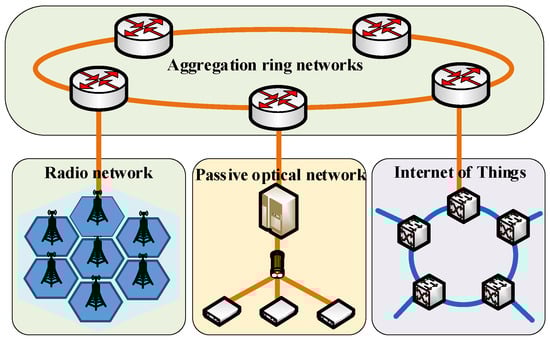
Figure 1.
Optical access network with aggregation ring.
In this paper, we research the connection technology of optical access networks, especially the resource allocation scheme in optical access networks. Driven by the finite available resources of a network, we propose a CDRA scheme in a software-defined optical access network, aiming to establish more connections for service requests in multiple domain (radio and optical) networks for better access performance. A CDRA-oriented unified control architecture is firstly introduced with several cross-domain function modules in the optical access network, which integrates multiple layers of resources to provide an effective cross-domain resource allocation for each service. Subsequently, we propose a CDRA scheme with its interaction process to realize the control of CDRA, where a CDRA-oriented global evaluation strategy is presented in a scheme to optimize the network performance and play a definite network balancing role. The simulation results show that the proposed CDRA scheme can effectively decrease the blocking probability, balance the network load, and enhance the utilization of network resources.
The rest of the paper is organized as follows. The related works are summarized in Section 2. Section 3 introduces the system model and unified control architecture with its three function modules in optical access networks. The CDRA scheme, including the interaction process and global evaluation strategy, is proposed in Section 4. Then, we describe the simulation testbed and present the demonstration results and performance evaluation analysis in Section 5. Section 6 concludes the whole paper by summarizing our main contributions and future works.
2. Related Works
Increasingly significant challenges always exist in access networks due to the continual advent of sophisticated applications with diverse service requirements, especially with the development of 5G or even 6G communications [23]. In this case, to support a variety of connection services, there are several kinds of research on traditional radio access networks in terms of capacity, latency, energy, etc. As for resource allocation, the authors in [24] discussed many efficient resource allocations and management in the cloud-based radio access network, including user assignment, remote radio head selection, throughput maximization, spectrum management, network utility, and power allocation. Moreover, a fog-based radio access network was considered in [25], where the communication and computation resources are comprehensively allocated to satisfy the diverse quality of service (QoS) requirements of different users, especially for latency. To flexibly provide customized service, the authors in [26] proposed priority-based resource provisioning with network slicing, which was employed to achieve optimal bandwidth and power allocation for high throughput. Focusing on energy saving in the radio domain, the authors in [27] presented energy-efficient multi-operator resource allocation that adopts the complete virtualization of mobile networks. Meanwhile, considering the abundant bandwidth resource support in the optical domain, the optical access network also becomes the infrastructure of the access network to converge the server connections, e.g., PON. Therefore, the efficiency of resource allocation in access networks needs to be considered not only in the radio domain but also in the optical domain.
Due to its high capacity and long reach, PON has gradually become one of the leading access technologies, even playing a vital role in wireless infrastructures [28]. Similar to the access network in the radio domain, resource allocation is also a significant research object in terms of its capacity, QoS, energy, etc. To increase the bandwidth utilization of access networks in the optical domain, the authors in [29] presented deep-learning-based dynamic resource allocation where the bandwidth demand of end-users is predicted to reduce the control overhead of the request–grant mechanism. Considering the difference in the priority of services, for the sake of delay and bandwidth satisfaction, the authors in [30] presented a double fair dynamic bandwidth allocation scheme that includes wavelength fair allocation and timeslot fair allocation. Pursuing low computational complexity in resource allocation, the authors in [31] proposed a QoS-aware scheduling procedure in PON, which mainly presented service-differentiated dynamic bandwidth allocation to achieve high transmission delay tolerance and power efficiency. The authors in [32] presented an energy-efficient bandwidth allocation, where centralized and decentralized paradigms are compared to examine the differences in their offloading procedures. The results show that comparable energy saving is achieved between the centralized and decentralized cases, and the decentralized case has a lower upstream delay and comparable offloading delay compared to the centralized case, but there may be a degradation in the network performance of the decentralized case due to using fixed long cycles. Besides, our previous work in [33] proposed a unified multi-controller architecture, and a globalization strategy of resource allocation is presented in the optical domain. Nevertheless, this globalization strategy only provides a simple approach for selecting the path with the minimum hop of service in routing, which does not take the resource constraints into consideration. As a result, there are several resource allocations in the access network in the optical domain, with multiple aspects, e.g., efficiency and resource management. However, for the sake of high resource utilization in the whole access network, multiple resource domain scenarios need to be comprehensively considered, especially for the radio and optical domains. More importantly, under multiple resource domains, there are more severe challenges in terms of resource management and its control.
Benefiting from the separation of the data plane and the control plane, SDN technology facilitates the virtualization of network functions so that multiple network attributes can be easily integrated [34]. In this case, the interconnection between multiple domains becomes simple via comprehensive resource allocation for service requests in the access network, satisfying the diverse service requirements [35,36]. For the inter-domain bandwidth reservation, the authors in [37] presented an architecture that achieved guaranteed bandwidth properties, where a distributed server infrastructure was adopted in the control plane. Regarding the data plane, the authors in [38] proposed a routing scheme based on a time-shifted multilayer graph framework, which considers the resource regarding both spatial and temporal aspects. For the multiple domains within the radio access network, transport network, and core network, the authors in [39] presented end-to-end network slicing, whereas the resources in the optical domain are out of consideration. Considering radio, optical, and mobile edge computing resources, the authors in [40] presented optimized dynamic resource allocation with three optimization phases for three resource domains. With this method of resource allocation, although three aspects of resources are considered, the allocation within each resource domain is isolated, and hence, the final result may fall into the local optimal solution. Therefore, comprehensive consideration of resource-oriented constraints under multiple domains is still required to provide globally efficient resource allocation in an optical access network.
In summary, with the rapid development of communication and the rise of new network services, the resource provisioning of the access network becomes more significant than before. In this direction, many research studies have been conducted not only in the radio domain but also in the optical domain, and the multiple-domain scenario occurs with the demand for a comprehensive resource efficiency improvement among different domains. However, there are few research studies on joint resource allocation with the aim of global optimization, especially under resource-oriented constraints. Thus, this paper proposes a CDRA scheme based on a global evaluation strategy, which allocates optimal resources to services according to the traffic situation of each node within its corresponding domain among all candidate paths. Besides, unified control architecture with cross-domain function modules is introduced in advance to illustrate the cross-domain operation with the consideration of a global evaluation strategy. To clarify the main features of the existing works and the proposed work in this paper, a comparison is shown in Table 1.

Table 1.
Main feature summary of existing works compared with the proposed work.
3. Unified Control Architecture with Cross-Domain Function Modules
In order to improve the capacity of optical access networks, this section upgrades the unified control function architecture, where CDRA functional modules and their collaboration relationship are introduced.
3.1. System Model
The optical access network architecture, which is physically superimposed by wireless multi-hop networks and PON networks, can be represented as G (VP, VR, VU, VO, Lp, LR, LO, FR, FO, T) in the network. VP = {vp1, vp2,…, vpn}, VR = {vr1, vr2, …, vrn}, VU = {vu1, vu2, …, vun}, and VO = {vo1, vo2, …, von} represent the sets of PON nodes, radio network nodes, multi-function access device nodes, and optical transmission network nodes, respectively. LR = {lr1, lr2, …, lrn}, LP = {lp1, lp2, …, lpn}, and LO = {lo1, lo2, …, lon} represent the link sets of the radio, PON, and optical transmission networks, respectively. FR = {f1, f2, …, fn} and FO = {ω1, ω2, …, ωn} represent the radio frequency set and wavelength set of fiber links, respectively. T = {t1, t2, …, tf} is the set of time slots in a period of PON. Each service demand is defined as Di (si, di, bi), where si, di, and bi are the destination node, source node, and bandwidth requirement of ith service demand.
3.2. Unified Control Architecture for Optical Access Network
Generally, under the separation of data and control, each hardware manufacturer can no longer design and install the corresponding software system for each hardware, so the hardware can be generalized. Furthermore, the control plane can be conducive to the unified flexible management of hardware equipment produced by various manufacturers, realizing centralized control and reducing the difficulty of network maintenance. In this case, the network deployment cycle can be shortened, which also reduces the operation costs. Thus, the unified control architecture of the optical access network is shown in Figure 2, which is mainly divided into two planes, namely the data plane and the control plane.
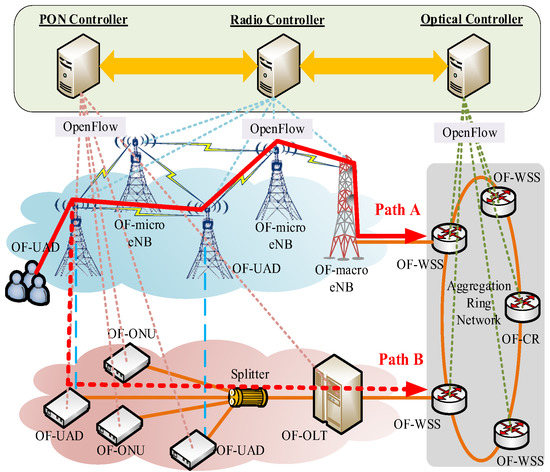
Figure 2.
Unified control architecture in optical access network.
The data plane includes optical transmission networks and access networks, in which optical transmission networks are mainly optical aggregation ring networks [41,42,43] and access networks are mainly access networks with radio multi-hop networks and PON networks overlapping. Specifically, optical transmission networks are mainly composed of aggregation ring networks, including OpenFlow-enabled WSS (OF-WSS) and the OpenFlow-enabled core router (OF-CR). Radio multi-hop networks include OpenFlow-enabled Macro eNB (OF-macro eNB) connecting to OF-WSS through optical fibers, and OpenFlow-enabled micro eNB (OF-micro eNB) communicating with each other through radio. Meanwhile, there are OpenFlow-enabled access devices (OF-UAD) in radio multi-hop networks, which are equivalent to a pair of interconnected micro eNB and an OpenFlow-enabled optical network unit (OF-ONU), realizing communication between radio networks and PON. PON networks include an OpenFlow-enabled optical line terminal (OF-OLT), an optical splitter, and OF-ONU, which form a tree network structure via the connection between fiber links.
The control plane consists of multiple interconnected controllers including the PON controller (PC), radio controller (RC), and optical controller (OC), corresponding to PON, radio networks, and optical networks, respectively. The controllers communicate with each other through the radio-PON controller interface (RPI), the radio-optical interface (ROI), and the optical-PON controller interface (OPI), interacting and sharing network information to achieve centralized network control. The control plane manages data plane devices and implements software-defined control through the OpenFlow protocol. Note that the lateral transactions of the controllers in the architecture are mainly considered in this paper since joint resource optimization among multiple domains is the focus.
Based on the upgraded architecture, the CDRA scheme can be implemented through the multi-domain network convergence interconnection. To support that, we designed RC, OC, and PC to collect the information on the resource occupation in its corresponding domain, and the cross-domain resource allocation mechanism is executed in OC with a global evaluation strategy. After obtaining the optimal resource allocation solution, OC sends the result to RC and PC to finish the subsequent actual resource occupation. In this case, OC centrally works for the solution decision and the distribution of request and response messages when the cross-domain service is required. The actual condition monitoring and resource allocation operation are completed by the controller in its subordinate domain. Based on this partially centralized architecture, the control plane overhead of the upgraded architecture may be the middle state between the centralized and distributed cases. There is lower latency compared with the complete centralized architecture since distributed resource allocation can be determined for services that do not require cross-domain transmission. Besides, the computing requirement of OC is greater than that of RC and PC due to the execution of the CDRA mechanism with a global evaluation strategy. When the services requiring a connection reach the network node, the resource allocation of the service can be implemented in the original network. In addition, it has the ability to find certain candidate paths in cross-domain networks by using OF-UAD. The two service candidate paths are shown in Figure 2, where path A is based on the radio network and path B is based on the PON network. Compared with the normal resource allocation of the service in a single-layer network, the CDRA can provide more optional resources for the connection of services, which can effectively increase the success rate of the service connection.
3.3. Cross-Domain Function Modules
In order to implement the architecture mentioned above and provide user services with a successful connection, the functional modules of RC, OC, and PC need to be extended, which is shown in Figure 3. Specifically, RC, OC, and PC are the controllers in multi-domain networks, where they are responsible for collecting the information of services and the physical layer device in their own domains. To establish them, various interfaces are required including RPI, ROI, and OPI.
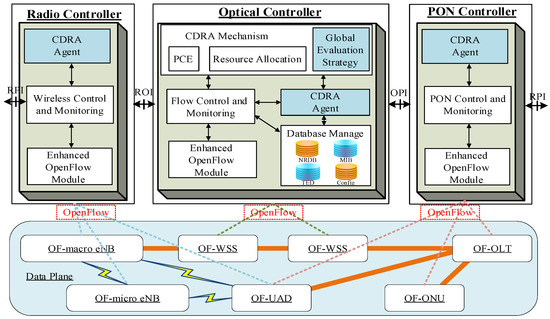
Figure 3.
Unified control architecture in optical access network.
- (1)
- RC
The RC is mainly responsible for the control of the radio network and interacts with other controllers through the inter-controller interaction interface to complete control of the CDRA mechanism. The related function modules are described as follows:
Enhanced OpenFlow Module: When receiving the status information that the wireless base station interface is occupied, this module is used to send flow table modification information to upgrade the control interface of the wireless base station, which could implement wireless resource allocation.
CDRA Agent: Through the interaction of OC and PC with the ROI and RPI interfaces, this module is used to share network resources and status information, as well as process or send CDRA requests to support the CDRA mechanism.
Wireless Control and Monitoring: It is responsible for compiling and managing the wireless network status through the OpenFlow protocol, controlling the relay forwarding of wireless transmission services, monitoring the integrated wireless service and wireless resource occupancy status, and providing them to the CDRA interaction agent.
- (2)
- OC
The OC is in charge of the optical transmission networks’ management, performing the necessary calculation and resource allocation as the core controller for the CDRA mechanism. Its main modules are described as follows:
Enhanced OpenFlow Module: Using the OpenFlow protocol to interact with the underlying programmable devices, this module is used to send the flow table modification information to upgrade the control interface of the underlying optical network devices, which realizes the software-defined control of optical transmission networks.
Flow Control and Monitoring: This module is responsible for monitoring and compiling the state of the underlying optical transmission network equipment through the OpenFlow protocol, configuring the various OF-WSS flow tables for the underlying data transmission according to the results of resource allocation.
Database Manage: The real-time state information and resource occupancy information of the network is saved in this module, and the optical connection information is stored after the optical connection is established.
CDRA Agent: This module interacts with RC and PC, shares network resource information and the status of each layer, generates the CDRA request, and provides related information on the CDRA scheme module to support the reasonable and effective allocation of network resources.
CDRA Mechanism: It contains three sub-modules, namely, the path computation element (PCE), resource allocation strategy, and global evaluation strategy. The PCE calculates the candidate paths for the CDRA mechanism. The global evaluation strategy can determine whether to invoke the CDRA policy and allocate resources by evaluating the status of the entire network.
- (3)
- PC
The PC is mainly responsible for monitoring the resource status in the PON network, interacting with other controllers, and supporting the CDRA mechanism. The main modules are described as follows:
Enhanced OpenFlow Module: When receiving the status information that the OF-ONU or OF-OLT interface is occupied, this module is used to send flow table modification information to upgrade the control interface of devices to implement dynamic bandwidth allocation in networks.
CDRA Agent: Interacting with OC and RC via OPI and RPI interfaces, this module is used to share network resources and status information, and process or send CDRA requests to support resource allocation.
PON Control and Monitoring: This module is in charge of compiling and managing the state of PON networks through the OpenFlow protocol, controlling the up/down transmission of OF-ONU and OF-OLT, and monitoring and integrating the PON network access services and network status, as well as providing them to the CDRA interaction proxy.
3.4. Enhanced OpenFlow Protocol
In order to realize effective control of the multi-domain network and support the CDRA mechanism, the OpenFlow protocol needs to be extended as the enhanced OpenFlow protocol in the enhanced OpenFlow module, as shown in Figure 4. The enhanced OpenFlow protocol mainly includes rules, actions, and stats. The rules include various characteristics of the network, including the input/output interface, radio network, optical transmission network, and PON characteristics. The radio network characteristics include the radio frequency and port constraints, the optical transmission network characteristics include the center wavelength and channel spacing, and the PON characteristics include ONU, the time slot, and the bandwidth. The actions include all executable network operations in the network, including switching, adding, dropping, repeating, offloading, onloading, uploading, downloading, and deleting. All operation actions in the network can be realized by combining the actions and rules in a specific order. Stats are used to monitor the flow status of the underlying devices and provide necessary data for the control strategy.
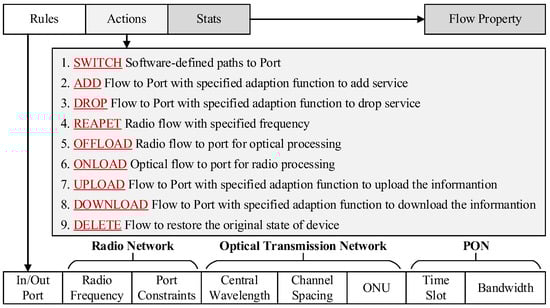
Figure 4.
Enhanced OpenFlow protocol in enhanced OpenFlow module.
4. Proposed CDRA Scheme with Interaction Process
Based on the upgraded control architecture, this section designs the necessary interaction process to implement the CDRA scheme, where the global evaluation strategy is further proposed to optimize the network performance and play a definite network balancing role.
4.1. CDRA Interaction Process
According to the CDRA functional requirements, we propose the interaction process between the CDRA controller and underlying devices, as shown in Figure 5. As for the interaction process in the upgraded architecture, PC, RC, and OC send monitoring requests to the corresponding underlying devices in a certain period. After receiving the monitoring requests, the underlying devices return their status to the controllers. The controllers collect all the status information of the underlying devices and update their database. In addition, as the central controller of CDRA, OC sends monitoring requests and status information of the optical networks to RC and PC periodically. PC and RC return all device status information when they receive the requests. Accordingly, all OC, RC, and PC will have the status information of all devices in the networks.
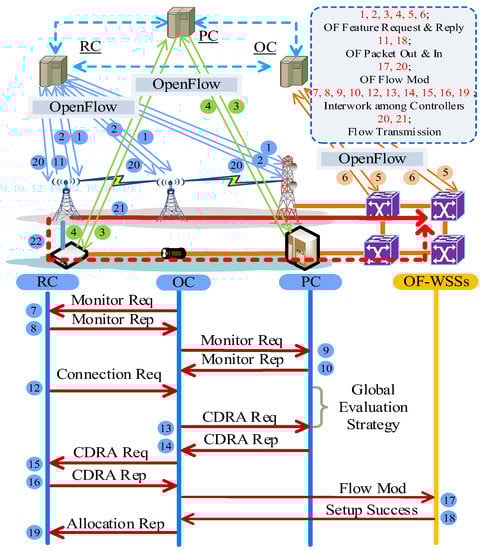
Figure 5.
Interaction process for CDRA scheme.
We present network services as an example in Figure 5. When the services with connection requirements arrive, the micro eNB sends a service connection request to the RC. The RC calculates the working path and the resources occupied according to the state information of the wireless network, and then it sends a resource allocation request to the OC. When receiving the request, the OC executes the global evaluation strategy to obtain a reasonable and effective service connection path in the global scope, then it sends CDRA requests to the PC and RC to request the allocated resources. Subsequently, PC and RC configure resources according to the requests and return the confirmation information. After receiving the confirmation information from PC and RC, OC sends the flow information to the underlying OF-WSS according to the allocation information. Next, OF-WSS configures the optical transmission path for the connection and returns the completion information to OC. Finally, the OC sends the allocation response to RC. Then, the RC uses the allocated resources to transmit information on the working path. The types of information corresponding to all the interactions are shown in Figure 5. Summarizing the process above, the interaction we proposed can maximize the reuse of the frame structure and effectively reduce the complexity of the information interaction.
4.2. CDRA Scheme with Global Evaluation Strategy
The proposed CDRA scheme is used to realize the construction of service connections using multi-domain network resources, but the cross-domain transmission of services may result in additional delays and other costs. When the heavily loaded network domain is occupied, it may affect the quality of service. Therefore, it is necessary to evaluate the impact of resource allocation decisions on the remaining resources in the whole network. Therefore, we design a global evaluation strategy, which is capable of reasonably evaluating the gains and deteriorations via the resource allocation decisions of the connection candidate paths, providing effective guidance for the reasonable allocation of network resources.
Based on the resources collected by OC and the working path information allocated by RC, OC can find k alternative links by using the K-shortest-path routing algorithm in the global network scope, which are the shortest and non-repetitive links. Subsequently, in a single layer of the wireless network, the K-shortest-path routing algorithm is also adopted to find k alternative wireless links, which are the shortest and non-repetitive links. There are 2k alternative paths. The network transmission functions of the wireless layer, PON layer, and optical convergence layer are shown as (1), (2), and (3), respectively.
where Wn represents the traffic weight of nodes on the path in the radio network, and Hrp represents the number of hops on the path in the radio network. Since all optical network units (ONUs) in the PON network share bandwidth resources, the flow weight passing through PON is only related to the total load. Hence, Wm represents the buffer weight of the mth node, and Ho represents the number of ONUs passing through the PON. Wl represents the traffic weight of the fiber link on the path in the optical transmission network, and Hop is the number of hops on the path in optical transmission networks.
Then, we can obtain the resource function of the path, as shown in (4).
where , , , , , and represent the relative proportion weight of radio, PON, optical transmission link and radio-PON conversion, PON-optical conversion, and radio-optical conversion, respectively. ,, and represent the step function of radio-PON, PON-optical, and radio-optical conversion, respectively. If the above conversions are carried out, the value will be 1; otherwise, the value will be 0.
Finally, the global resource optimization factor can be further obtained by the above formulas, which is to select the optimal case among all path candidates. Note that in order to keep the value dimensions of different paths comparable, we obtain the unitized result by solving the ratio of the path to the maximum value of all candidate paths. In this case, the global resource optimization factor can be calculated by (5).
The path with the smallest is the globally optimal path. The CDRA scheme will be adopted when the optimal path belongs to the global shortest k paths in connection processes, whereas the CDRA scheme will not be adopted when all global optimal paths belong to the shortest k paths in the wireless layer.
5. Performance Evaluation with Result Analysis
In order to assess the performance of CDRA and the upgraded architecture, this section builds a simulation platform for cross-domain resource allocation in an optical access network.
5.1. Simulation Platform Testbed
To evaluate the effectiveness of cross-domain resource allocation with the upgraded architecture, we built a simulation platform based on the C-based discrete event simulation software OPNET and the Python programming environment. Then, we draw a contrast between the performance between the conventional single-domain resource allocation (SDRA) scheme and the proposed CDRA scheme. The SDRA scheme searches the resources of working paths for service requests within the radio network. The simulated topology with mesh construction is illustrated in Figure 6. In the simulation, an optical transmission network includes six optical switching nodes and three PONs. A radio multi-hop network includes 37 wireless nodes, where each PON has 4 ONUs to connect to the base station in the radio network, and its total bandwidth is 1 GHz. These wireless nodes contain four macro eNBs, and the ONUs have wireless communication functions, which correspond to the multi-functional access devices in wireless networks. The network is controlled by three controllers based on the extended OpenFlow protocol. The bandwidth of wireless network services is a random value from 1 MHz to 50 MHz. The arrival of network service requests is assumed following the Poisson distribution to request the connection between any two random nodes in a radio network to represent the traffic load. The number of services arriving in each simulation is 100,000, and the services are aggregated in the optical line terminal (OLT) and the macro eNB. Enormous aggregation services use the optical convergence layer optical wavelength resource for transmission, and the single wavelength bandwidth is 12.5 GHz. Each link in the radio network has 20 channels, and there are 385 wavelength slots in each fiber link of the optical network. The k shortest paths are calculated by Yen’s algorithm with the Dijkstra algorithm, and three alternative paths are adopted in this paper, i.e., k = 3 [44].
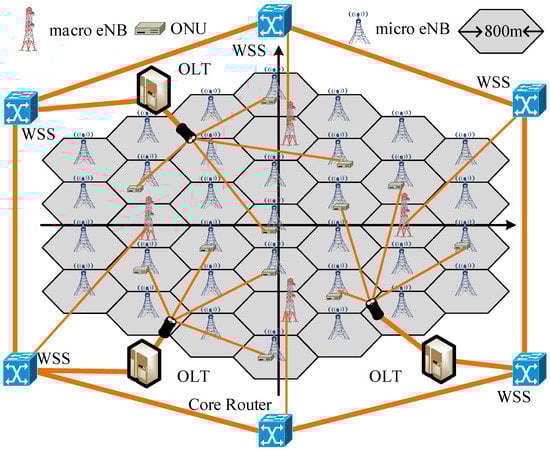
Figure 6.
Optical access network simulated topology.
5.2. Architecture Controller Verification
Based on the simulation system above, the CDRA scheme is designed and validated through the cooperation of multiple SDN controllers. Figure 7a,b show the whole signaling process of the CDRA scheme using the OpenFlow protocol, which is captured by Wireshark capture software deployed in RC and OC.
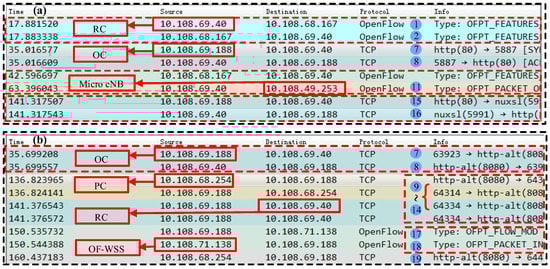
Figure 7.
Wireshark capture of the message sequence for CDRA in (a) RC and (b) OC.
It is shown that 10.108.69.40, 10.108.69.188, and 10.108.68.254 denote the internet protocol (IP) addresses of the RC, OC, and PC, respectively, while 10.108.68.167 and 10.108.71.138 represent the IP addresses of the micro eNB and OF-WSS, respectively. The OpenFlow features request and reply are responsible for monitoring by regularly querying OpenFlow-enable bandwidth-variable optical switches (OF-BVOSs) about the current status. At the very beginning, the micro eNB sends a service request to the RC. The RC obtains the request and sends a connection resources allocation request to the OC via transmission control protocol (TCP) message 7. When receiving the request, the OC executes the global evaluation strategy to obtain reasonable and effective service connection paths in the global scope, then it sends CDRA requests to the PC and RC to request allocated resources via TCP messages 9 to 14. After receiving the confirmation information from PC and RC, OC sends the flow information to the underlying OF-WSS according to the allocation information via OpenFlow Flow_Mod message 17. Next, OF-WSS configures the optical transmission path for the connection path and returns the completion information to OC via OpenFlow Packet_In message 18. Finally, the OC sends the allocation response to RC via TCP message 19.
5.3. Performance Evaluation with Result Analysis
This subsection shows the statistics of the blocking probability, resource availability rate, load balancing degree, and average hop of successful requests, compared with the SDRA mechanism.
Figure 8 compares the blocking probability of the conventional SDRA scheme and the proposed CDRA scheme, which is defined as the ratio of the number of blocked service requests to the number of total service requests in the access connection process. The blocked service requests are the services rejected by the optical access network due to the lack of enough bandwidth resources for them. As the load increases, the blocking probability increases, regardless of the schemes in the simulation. It can be noted that the proposed CDRA scheme achieves a lower blocking probability than that of the SDRA scheme. This occurs because the proposed CDRA scheme can effectively utilize multi-layer network resources to support connection establishment, and in terms of resource allocation, the function is sufficiently flexible and balanced. In this case, more available resources are adequately and efficiently provided to connect the service, including the wireless and optical domains. In particular, when the satisfied blocking probability is considered 1%, the proposed CDRA scheme has a 29.35% improvement compared with the conventional SDRA scheme. As a result, the proposed CDRA scheme achieves better blocking probability performance than the conventional SDRA scheme due to its higher resource utilization efficiency.
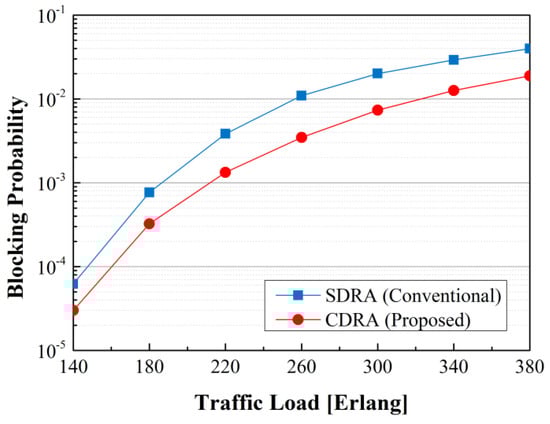
Figure 8.
Performance comparison in terms of blocking probability.
Figure 9 compares the resource availability rate of the CDRA and SDRA schemes, which is defined as the ratio of the number of available resources after connection serving the total number of offered resources in networks. A higher value of the resource availability rate represents leaving more available resources for future service requests. It can be observed in the figure that as the load increases, the resource availability rate decreases among all schemes. This is because more services arrive at networks in the unit time, consuming more resources for connection establishment. Even then, the proposed CDRA scheme always obtains a higher resource availability rate than that of the conventional SDRA scheme. This is because a global resource optimization factor is presented in the proposed CDRA scheme, where a globally optimal path may be selected to achieve the lowest resource consumption. Given this result, more available resources can be provided to future incoming services, which is the main factor explaining why the CDRA scheme achieves a lower blocking probability than that of the SDRA scheme.
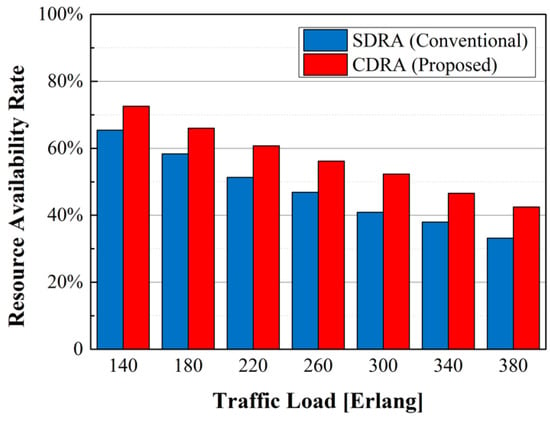
Figure 9.
Performance comparison in terms of resource availability rate.
Figure 10 compares the load balancing degree of CDRA and SDRA, which is defined as the variance of the ratio of the occupied to offered resources for all links. To calculate this parameter, it is first important to compute the ratio of the number of already occupied resources to the total number of offered resources in each link. Then, the variance of all ratios for links is computed as the final result. Note that a lower value of the load balancing degree represents a smaller load difference among all links in networks, contributing to the stable operation of the network. It can be seen from the figure that the load balancing degree of CDRA is much lower than that of SDRA. This is due to the fact that the global evaluation strategy adopted in CDRA can balance the traffic load among all links and network layers, which is the main defect of SDRA. Adopting the global evaluation strategy, the case requiring the lowest resource cost may be selected for connection establishment in the radio and optical domains, and the consumption among different channels is considered to realize a balanced relationship.
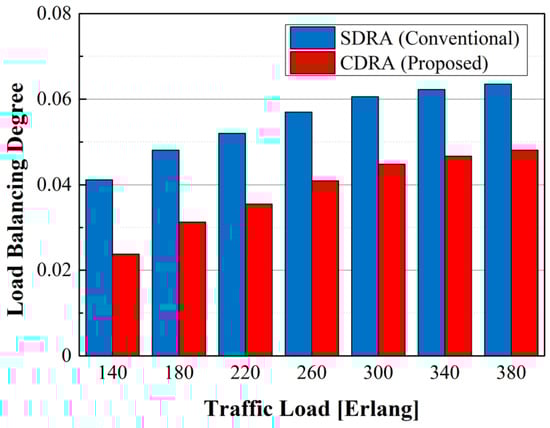
Figure 10.
Performance comparison in terms of load balancing degree.
Figure 11 compares the performance of CDRA and SDRA in terms of the average hop of successful requests, which is defined as the ratio of the number of hops used to the number of total requests with a successful service connection. It can be observed that the average hop of successful requests tends to decrease with the increase in traffic load. This is due to the fact that fewer available resources remain in networks when the traffic load becomes higher. In this case, the requests with a long distance and more hops may be easily blocked due to the insufficiency of the available resource in networks. Compared with the SDRA scheme, the CDRA scheme has fewer average hops of successful requests. This is because CDRA can realize service connections across multiple network domains and optimize paths globally, whereas SDRA can only search for the shortest path in a single network domain.
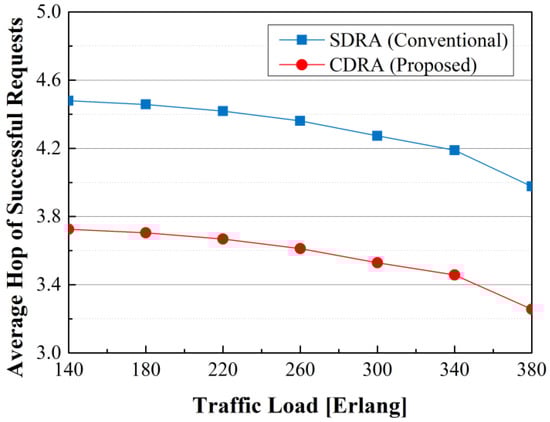
Figure 11.
Performance comparison in terms of average hop of successful requests.
6. Conclusions
This paper researches the connection technology of optical access networks, especially the resource allocation scheme in optical access networks. Driven by the finite available resources of a network, we propose a CDRA scheme in a software-defined optical access network, aiming to establish more connections for service requests in multiple domain (radio and optical) networks for better access performance. The proposed CDRA scheme can integrate multiple layers of resources to provide effective cross-domain resource allocation for services. To optimize network performance and evaluate the advantages and disadvantages of alternative resource allocation paths, we propose a global evaluation strategy to optimize the network performance and play a definite network balancing role. In order to carry out this mechanism, we employed unified control architecture in an optical access network, and we further upgraded the cross-domain function module. The interaction process was designed for the control of the cross-domain resource allocation mechanism. Finally, the simulation platform was built to verify the performance of the cross-domain mechanism among architecture controllers. The simulation results show that the cross-domain resource allocation scheme can effectively decrease the blocking probability, balance the network load, and enhance the utilization of network resources of the network.
Author Contributions
Conceptualization, B.B. and Y.L.; methodology, B.B. and W.B.; software, W.B.; validation, B.B., Q.Y. and S.L.; formal analysis, H.Y. and C.L.; investigation, Z.S. and X.L.; resources, Y.L. and S.L.; data curation, H.Y.; writing—original draft preparation, B.B. and W.B.; writing—review and editing, H.Y. and Y.L. All authors have read and agreed to the published version of the manuscript.
Funding
This research was funded by the NSFC project (62122015, 61871056), Beijing Natural Science Foundation (4202050), Fund of SKL of IPOC (BUPT) (IPOC2021ZT04, IPOC2020A004), and Beijing University of Posts and Telecommunications-China Mobile Research Institute Joint Innovation Center.
Institutional Review Board Statement
Not applicable.
Informed Consent Statement
Not applicable.
Conflicts of Interest
The authors declare no conflict of interest. The funders had no role in the design of the study; in the collection, analyses, or interpretation of data; in the writing of the manuscript, or in the decision to publish the results.
References
- Saliou, F.; Chanclou, P.; Neto, L.A.; Simon, G.; Potet, J.; Gay, M.; Bramerie, L.; Debregeas, H. Optical access network interfaces for 5G and beyond. J. Opt. Commun. Netw. 2021, 13, D32–D42. [Google Scholar] [CrossRef]
- Bao, B.; Yang, H.; Yao, Q.; Yu, A.; Chatterjee, B.C.; Oki, E.; Zhang, J. SDFA: A service-driven fragmentation-aware resource allocation in elastic optical networks. IEEE Trans. Netw. Serv. Manag. 2021, 19, 353–365. [Google Scholar] [CrossRef]
- Alimi, I.A.; Patel, R.K.; Muga, N.J.; Pinto, A.N.; Teixeira, A.L.; Monteiro, P.P. Towards Enhanced Mobile Broadband Communications: A Tutorial on Enabling Technologies, Design Considerations, and Prospects of 5G and beyond Fixed Wireless Access Networks. Appl. Sci. 2021, 11, 10427. [Google Scholar] [CrossRef]
- Borges, R.M.; de Souza Lopes, C.H.; Lima, E.S.; de Oliveira, M.A.; Cunha, M.S.B.; Alexandre, L.C.; da Silva, L.G.; Pereira, L.A.M.; Spadoti, D.H.; Romero, M.A.; et al. Integrating Optical and Wireless Techniques towards Novel Fronthaul and Access Architectures in a 5G NR Framework. Appl. Sci. 2021, 11, 5048. [Google Scholar] [CrossRef]
- Yang, H.; Yao, Q.; Bao, B.; Yu, A.; Zhang, J.; Vasilakos, A.V. Multi-associated parameters aggregation-based routing and resources allocation in multi-core elastic optical networks. IEEE ACM Trans. Netw. 2022, 30, 2145–2157. [Google Scholar] [CrossRef]
- Afraz, N.; Slyne, F.; Gill, H.; Ruffini, M. Evolution of Access Network Sharing and Its Role in 5G Networks. Appl. Sci. 2019, 9, 4566. [Google Scholar] [CrossRef]
- Bao, B.; Yang, H.; Wan, Y.; Yao, Q.; Yu, A.; Zhang, J.; Chatterjee, B.; Oki, E. Node-Oriented Traffic Prediction and Scheduling Based on Graph Convolutional Network in Metro Optical Networks. In Proceedings of the Optical Fiber Communication Conference (OFC), San Francisco, CA, USA, 6–10 June 2021. [Google Scholar]
- Kani, J.; Terada, J.; Hatano, T.; Kim, S.; Asaka, K.; Yamada, T. Future optical access network enabled by modularization and softwarization of access and transmission functions. J. Opt. Commun. Netw. 2020, 12, D48–D56. [Google Scholar] [CrossRef]
- Wang, X.; Ji, Y.; Zhang, J.; Bai, L.; Zhang, M. Low-Latency Oriented Network Planning for MEC-Enabled WDM-PON Based Fiber-Wireless Access Networks. IEEE Access 2019, 7, 183383–183395. [Google Scholar] [CrossRef]
- Yang, H.; Bao, B.; Li, C.; Yao, Q.; Yu, A.; Zhang, J.; Ji, Y. Blockchain-enabled Tripartite Anonymous Identification Trusted Service Provisioning in Industrial IoT. IEEE Internet Things 2021, 9, 2419–2431. [Google Scholar] [CrossRef]
- Kretsis, A.; Sartzetakis, I.; Soumplis, P.; Mitropoulou, K.; Kokkinos, P.; Nicopolitidis, P.; Papadimitriou, G.; Varvarigos, E. ARMONIA: A Unified Access and Metro Network Architecture. Appl. Sci. 2020, 10, 8318. [Google Scholar] [CrossRef]
- Ai, Y.; Qiu, G.; Liu, C.; Sun, Y. Joint resource allocation and admission control in sliced fog radio access networks. China Commun. 2020, 17, 14–30. [Google Scholar] [CrossRef]
- Koyasako, Y.; Suzuki, T.; Yamada, T.; Shimada, T.; Yoshida, T. Demonstration of Real-Time Motion Control Method for Access Edge Computing in PONs. IEEE Access 2022, 10, 168–175. [Google Scholar] [CrossRef]
- Msongaleli, D.L.; Kucuk, K.; Kavak, A. Adaptive Polling Medium Access Control Protocol for Optic Wireless Networks. Appl. Sci. 2019, 9, 1071. [Google Scholar] [CrossRef]
- Sun, S.; Yan, H.; Maccartney, G.R.; Rappaport, T. Millimeter wave small-scale spatial statistics in an urban microcell scenario. In Proceedings of the International Conference on Communications (ICC), Paris, France, 21–25 May 2017. [Google Scholar]
- Song, Z.; Ji, W.; Yin, R.; Li, J.; Gong, Z.; Yun, H. Highly Reliable Metro-Access Network Based on a Dual-Fiber Ring Architecture and Optimized Protection Mechanisms. IEEE Access 2021, 9, 136419–136437. [Google Scholar] [CrossRef]
- Yang, S.; He, N.; Li, F.; Trajanovski, S.; Chen, X.; Wang, Y.; Fu, X. Survivable Task Allocation in Cloud Radio Access Networks with Mobile-Edge Computing. IEEE Internet Things 2021, 8, 1095–1108. [Google Scholar] [CrossRef]
- Han, X.; Meng, X.; Kang, Q.; Su, Y. Survivable Virtual Network Link Shared Protection Method Based on Maximum Spanning Tree. IEEE Access 2019, 7, 92137–92150. [Google Scholar] [CrossRef]
- Alvizu, R.; Maier, G.; Kukreja, N.; Pattavina, A.; Morro, R.; Capello, A.; Cavazzoni, C. Comprehensive survey on T-SDN: Software-defined networking for transport networks. IEEE Commun. Surv. Tutor. 2017, 19, 2232–2283. [Google Scholar] [CrossRef]
- Kalkan, K.; Zeadally, S. Securing Internet of Things (IoT) with software defined networking (SDN). IEEE Commun. Mag. 2017, 56, 186–192. [Google Scholar] [CrossRef]
- Fondo-Ferreiro, P.; Mhiri, S.; López-Bravo, C.; González-Castaño, F.J.; Gil-Castiñeira, F. Fast Decision Algorithms for Efficient Access Point Assignment in SDN-Controlled Wireless Access Networks. IEEE Trans. Netw. Serv. Manag. 2019, 16, 1059–1070. [Google Scholar] [CrossRef]
- Coronado, E.; Khan, S.N.; Riggio, R. 5G-EmPOWER: A Software-Defined Networking Platform for 5G Radio Access Networks. IEEE Trans. Netw. Serv. Manag. 2019, 16, 715–728. [Google Scholar] [CrossRef]
- Rahimi, P.; Chrysostomou, C.; Pervaiz, H.; Vassiliou, V.; Ni, Q. Joint Radio Resource Allocation and Beamforming Optimization for Industrial Internet of Things in Software-Defined Networking-Based Virtual Fog-Radio Access Network 5G-and-Beyond Wireless Environments. IEEE Trans. Ind. Inform. 2022, 18, 4198–4209. [Google Scholar] [CrossRef]
- Ejaz, W.; Sharma, S.K.; Saadat, S.; Naeem, M.; Anpalagan, A.; Chughtai, N.A. A comprehensive survey on resource allocation for CRAN in 5G and beyond networks. J. Netw. Comput. Appl. 2020, 160, 102638. [Google Scholar] [CrossRef]
- Ma, Y.; Wang, H.; Xiong, J.; Diao, J.; Ma, D. Joint Allocation on Communication and Computing Resources for Fog Radio Access Networks. IEEE Access 2020, 8, 108310–108323. [Google Scholar] [CrossRef]
- Hossain, A.R.; Ansari, N. Priority-Based Downlink Wireless Resource Provisioning for Radio Access Network Slicing. IEEE Trans. Veh. Technol. 2021, 70, 9273–9281. [Google Scholar] [CrossRef]
- Marzouk, F.; Barraca, J.P.; Radwan, A. On Energy Efficient Resource Allocation in Shared RANs: Survey and Qualitative Analysis. IEEE Commun. Surv. Tutor. 2020, 22, 1515–1538. [Google Scholar] [CrossRef]
- Zhang, C.; Zeng, H.; Yi, X.; Xiong, R. Global load-balancing ONU assignment for a software-defined reconfigurable PON. J. Opt. Commun. Netw. 2020, 12, 177–191. [Google Scholar] [CrossRef]
- Hatem, J.A.; Dhaini, A.R.; Elbassuoni, S. Deep Learning-Based Dynamic Bandwidth Allocation for Future Optical Access Networks. IEEE Access 2019, 7, 97307–97318. [Google Scholar] [CrossRef]
- Zhan, N.; Gan, C.; Hui, J.; Guo, Y. Fair Resource Allocation Based on User Satisfaction in Multi-OLT Virtual Passive Optical Network. IEEE Access 2020, 8, 134707–134715. [Google Scholar] [CrossRef]
- Hadi, M.; Bhar, C.; Agrell, E. General QoS-aware scheduling procedure for passive optical networks. J. Opt. Commun. Netw. 2020, 12, 217. [Google Scholar] [CrossRef]
- Helmy, A.; Nayak, A. Centralized vs. Decentralized Bandwidth Allocation for Supporting Green Fog Integration in Next-Generation Optical Access Networks. IEEE Commun. Mag. 2020, 58, 33–39. [Google Scholar] [CrossRef]
- Thyagaturu, A.S.; Mercian, A.; McGarry, M.P.; Reisslein, M.; Kellerer, W. Software Defined Optical Networks (SDONs): A Comprehensive Survey. IEEE Commun. Surv. Tutor. 2016, 18, 2738–2786. [Google Scholar] [CrossRef]
- Han, P.; Liu, Y.; Guo, L. QoS satisfaction aware and network reconfiguration enabled resource allocation for virtual network embedding in Fiber-Wireless access network. Comput. Netw. 2018, 143, 30–48. [Google Scholar] [CrossRef]
- Mosahebfard, M.; Vardakas, J.; Ramantas, K.; Verikoukis, C. SDN/NFV-Based Network Resource Management for Converged Optical-Wireless Network Architectures. In Proceedings of the 21st International Conference on Transparent Optical Networks (ICTON), Angers, France, 9–13 July 2019. [Google Scholar]
- Giuliari, G.; Roos, D.; Wyss, M.; García-Pardo, J.A.; Legner, M.; Perrig, A. Colibri: A cooperative lightweight inter-domain bandwidth-reservation infrastructure. In Proceedings of the 17th International Conference on emerging Networking Experiments and Technologies (CoNEXT), New York, NY, USA, 12–15 December 2021. [Google Scholar]
- Liu, Q.; Lin, X.; Yue, S.; Sun, W.; Hu, W. A Routing Scheme for Bulk Data Transfers in Multi-Domain OCS Networks with Assistive Storage. In Proceedings of the IEEE International Conference on Communications (ICC), Shanghai, China, 20–24 May 2019. [Google Scholar]
- Li, X.; Ni, R.; Chen, J.; Lyu, Y.; Rong, Z.; Du, R. End-to-End Network Slicing in Radio Access Network, Transport Network and Core Network Domains. IEEE Access 2020, 8, 29525–29537. [Google Scholar] [CrossRef]
- Lagkas, T.; Klonidis, D.; Sarigiannidis, P.; Tomkos, I. Optimized Joint Allocation of Radio, Optical, and MEC Resources for the 5G and Beyond Fronthaul. IEEE Trans. Netw. Serv. Manag. 2021, 18, 4639–4653. [Google Scholar] [CrossRef]
- Yang, H.; Cui, Y.; Zhang, J. Unified Multi-Layer among Software Defined Multi-Domain Optical Networks (Invited). Electronics 2015, 4, 329–338. [Google Scholar] [CrossRef]
- Shafi, M.; Molisch, A.F.; Smith, P.J.; Haustein, T.; Zhu, P.; Silva, P.; Tufvesson, F.; Benjebbour, A. 5G: A tutorial overview of standards, trials, challenges, deployment, and practice. IEEE J. Sel. Area Commun. 2017, 35, 1201–1221. [Google Scholar] [CrossRef]
- Bao, B.; Xu, Z.; Li, C.; Sun, Z.; Liu, S.; Li, Y. TDTS: Three-Dimensional Traffic Scheduling in Optical Fronthaul Networks with Conv-LSTM. Photonics 2021, 8, 451. [Google Scholar] [CrossRef]
- Zhao, L.; Hu, W.; Zhang, X. Architecture and performance of grouped ROADM rings with shared optical amplifier and grouped add/drop ports for hybrid data center network. Opt. Switch. Netw. 2017, 23, 1–4. [Google Scholar] [CrossRef]
- Yang, H.; Bai, W.; Yu, A.; Yao, Q.; Zhang, J.; Lin, Y.; Lee, Y. Bandwidth Compression Protection against Collapse in Fog-Based Wireless and Optical Networks. IEEE Access 2018, 6, 54760–54768. [Google Scholar] [CrossRef]
Publisher’s Note: MDPI stays neutral with regard to jurisdictional claims in published maps and institutional affiliations. |
© 2022 by the authors. Licensee MDPI, Basel, Switzerland. This article is an open access article distributed under the terms and conditions of the Creative Commons Attribution (CC BY) license (https://creativecommons.org/licenses/by/4.0/).