Article

Ultrafast Manipulation of Broadband Terahertz Waves by a Double-Pulse Laser Field


1
College of Physics and Electronic Engineering, Northwest Normal University, Lanzhou 730070, China
2
School of Mathematics and Physics, Lanzhou Jiaotong University, Lanzhou 730070, China
*
Author to whom correspondence should be addressed.
Photonics 2026, 13(5), 442; https://doi.org/10.3390/photonics13050442
Submission received: 16 March 2026 / Revised: 28 April 2026 / Accepted: 28 April 2026 / Published: 30 April 2026
(This article belongs to the Special Issue Laser-Driven Ultrafast Dynamics and Imaging in Atoms and Molecules)

Abstract

We present a method to control broadband terahertz generation rapidly during the interaction of a strong laser field with a gas. To achieve it, we utilize a few-cycle double-pulse, which is a combination of two identically colored femtosecond fields with a time delay, as a driving laser field. By varying the laser delay, the magnitude of the amplitude of generated terahertz field changes drastically, making it suitable for use as a terahertz optical ultrafast switch, with an optical period of only a few femtoseconds from ON-OFF-ON and an enhancement ratio of 100. Furthermore, a change in time delay can alter the terahertz field waveform, easily generating terahertz electric fields with positive and negative polarity or any phase in the range of [0, 1.0 π ]. The strength of such terahertz source can be boosted by raising the laser wavelength. Our study will provide an effective approach for ultrafast terahertz modulation.

1. Introduction

Terahertz (THz) radiation, which lies between the microwave and far-infrared regions in the electromagnetic spectrum and serves as a bridge between the transitional fields of electronics and optics, has transient, coherence, low energy, broadband, stability and other characteristics [1,2,3]. Due to its unique property, THz technology has a wide range of applications in radiation, detection, communication, switching [4,5,6,7], and so on. During the last decade, mechanical, electrical, thermal and optical approaches have been developed to modulate THz waves (see, for example, Ref. [8] and references therein), among which the switching technology has been rapidly developed. Because of the speed limitation of electrical switching, all-optical switching has received a great deal of interest. For instance, Hu et al. established an optical switching with a period of 16 ps in 2021 by using THz waves in the 0.4–1.0 THz range interacting with embedded vanadium dioxide to change the spatial layout of interconnect architectures [8]. In 2024 Yu et al. proposed a theoretical framework and experimental validation of a non-Ermian hypersurface containing a pair of anti-chiral anomalies as a novel method for effective THz switching, achieving modulation depths of over 70% and periods of less than 9 ps for THz waves in the range of 0.6–0.95 THz [9]. Recent studies have proposed a variety of alternative sorts of switches [10,11,12,13,14,15]. However, these THz emitters are extremely narrow-band.
In addition to manipulating the THz magnitude via switches, modulation of the THz waveform is also crucial, and various waveforms are typically required to facilitate diverse scientific fields. Among the studies controlling THz waveforms, Bai et al. demonstrated a scheme to generate waveform-controlled THz radiation from air plasma by varying the filament length and the carrier-envelope-phase of few-cycle driving laser pulses [16]. Wang et al. demonstrated that different THz waveforms undergoing a phase shift of π can be obtained by changing the position of external DC field along the laser filament [17]. Flender et al. in 2019 demonstrated that it is possible to control THz waveforms by the relative phase between the fundamental frequency waveform and the second harmonic, which not only influences the waveform’s amplitude, but also changes its positive and negative sign [18]. Jiao et al. proven the THz waveform controlling with rippled plasma driven by an inhomogeneous electrostatic field [19]. In 2024, Paparo et al. established that the main effect of laser chirp is to lengthen the duration of the pulses, narrowing the THz spectrum, and that a positive chirp makes the waveform more bipolar [20]. Moreover, they proposed that combining chirp with relative phase can be used to control the THz waveform (the influence of laser chirp on the THz waveform can also be found in Refs. [18,21]). Very recently, Guo et al. achieved control over the polarity of the emitted THz electric field by changing the direction of the pump laser incident on the heterostructure [22]. Additionally, metasurfaces and metamaterials have recently been developed to act as efficient THz modulators [23,24,25,26]. One significant work is that Kamaraju et al. demonstrated subcycle femtosecond control of THz waveform with a time-dependent metamaterial [27]. How to regulate the waveform and polarity of the THz field on the super-fast time scale through additional methods remains a subject to be studied.
In this work, we present a theoretical prediction for an ultrafast optical THz magnitude modulation with a period of only a few femtoseconds using a double-pulse femtosecond laser interacting with a gas. In comparison to the above-mentioned optical switches, our approach offers the advantages of being faster and having a wider frequency band. Furthermore, the time delay in the double-pulse laser field allows for control of THz waveforms, particularly their polarity. Our findings will be beneficial for the development of THz applications.

2. Theoretical Model

The simulations in this paper are performed based on the photocurrent (PC) model [28,29,30], which states when a strong laser pulse interacts with a gas, it ionizes atoms or molecules, resulting in free electrons. These liberated electrons subsequently accelerate in the laser field, producing a transverse current J ( t ) that oscillates over time and radiates a THz wave. J ( t ) can be expressed as:
J ( t ) = e t v ( t , t ) d ρ ( t ) ,
where e is the electron charge, v ( t , t ) denotes the velocity that free electrons ionized at the moment t , and d ρ ( t ) denotes the change in the density of the free electrons during the time interval from t to t + d t which can be expressed as:
d ρ ( t ) d t = W ( t ) [ ρ 0 ρ ( t ) ] ,
where ρ 0 is the initial density of the gas, ρ ( t ) denotes the density of ionized free electrons, and the ionization rate W ( t ) can be calculated by the Ammosov-Delone-Krainov (ADK) tunneling ionization model [31]. The velocity v ( t , t ) satisfies the equation
v ( t , t ) = ( e / m e ) t t E ( t ) d t ,
where m e is the electron mass and E ( t ) is the electric field of the laser pulse.
The THz radiation field is then obtained by applying a Fourier transform to the time derivative of the electron current:
E THz ( ω ) F [ d J ( t ) d t ] ,
where F denotes the Fourier transform. The inverse Fourier transform is performed to obtain the time-domain THz electric field. According to the PC model, the magnitude of residual current [ J ( t ) ] determines the intensity of the low-frequency THz radiation. To be clear, the results obtained using the PC model are only predictions for microscopic THz generation. If we are to simulate a real experiment, we must also consider the macroscopic effects [32].

3. Results and Discussion

3.1. Waveform of Driving Laser Field

In the present simulations, a double-pulse is used as driving laser field, which can be expressed as
E ( t ) = E 1 ( t ) + E 2 ( t ) ,
E 1 ( t ) = E 1 f ( t ) cos ( ω t + φ 1 ) ,
E 2 ( t ) = E 2 f ( t Δ t ) cos [ ω ( t Δ t ) + φ 2 ] ,
where E 1 and E 2 are the peak amplitudes of the two laser fields, φ 1 and φ 2 are their phases of the carrier envelopes (CEP). The pulse has a Gaussian envelope with f ( t ) = e 2 ln 2 ( t / τ ) 2 , τ is the pulse duration (full width of half height), and Δ t is the time delay between two pulses. Such a driving field can be easily generated by an interferometer, and the delay between the two pulses can be precisely regulated, which has been recently used to control high-order harmonic generation [33,34,35,36], which is another nonlinear process during the interaction of laser and gas. Further, two Ti:sapphire laser beams with a controlled time delay utilized to boost THz radiation from a preformed plasma in liquid water [37]. In our simulations, we set the phase to φ 1 = 0 .

3.2. The Dependence of THz Field Strength on the Laser Time Delay

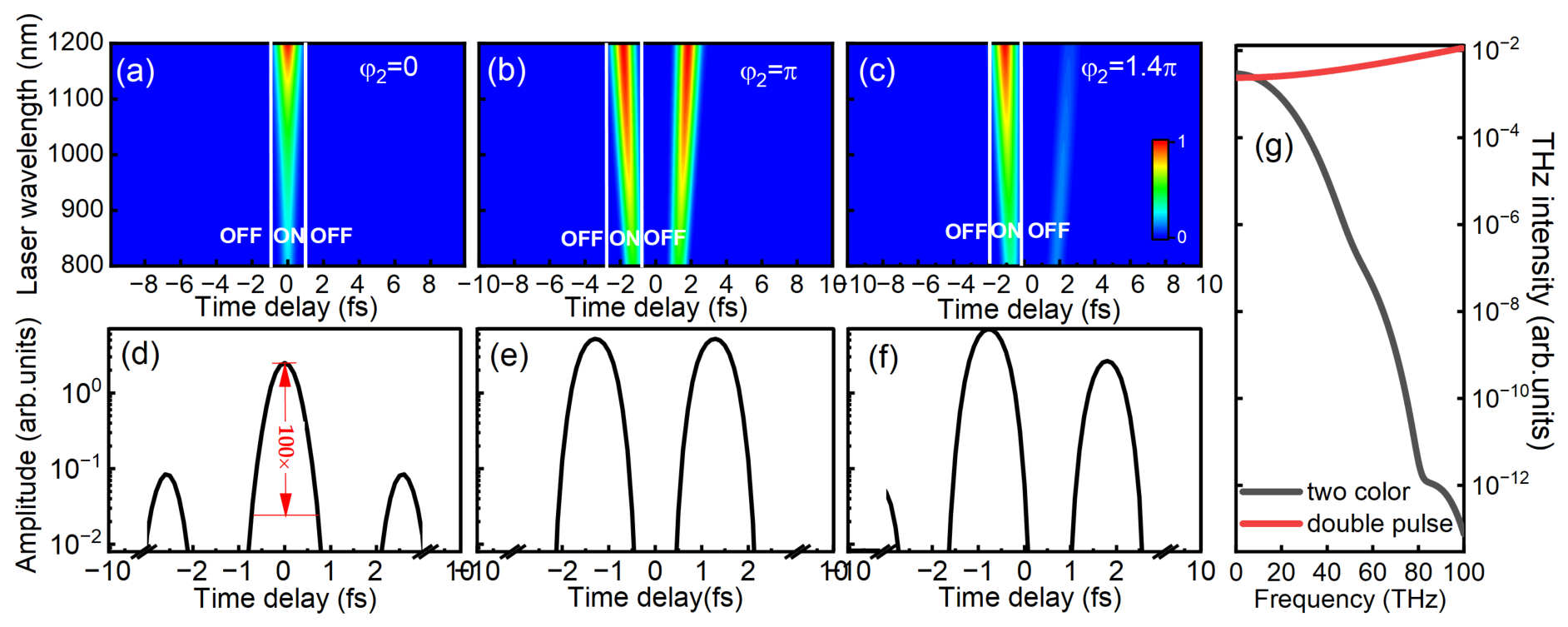
First, we show the variation of the THz field (0.1–10 THz) amplitude with time delay between two laser pulses, as shown in Figure 1, in which three phases, φ 2 = 0 , 1.0 π and 1.4 π are illustrated. The other parameters used in the simulation are: I 1 + I 2 = E 1 2 + E 2 2 = 2.45 × 10 14 W / cm 2 with an intensity ratio I 2 / I 1 = 1.0 , τ = 3 fs, laser wavelength varies from 800 nm to 1200 nm, and target atom is Ar. Here, we adopt laser pulse with short duration to ensure strong THz radiation. It is noteworthy that some laboratories can now produce near-infrared to mid-infrared high-energy single-cycle or even sub-cycle laser pulses [38]. Figure 1a–c depict that, obviously, there are mainly one or two THz emissions during the entire time interval, as time delay varies from 10 fs to 10 fs, relying on the laser relative phase. For φ 2 = 0 , a strong emission centered on Δ t = 0 ; for φ 2 = 1.0 π , two emissions of the same strength centering on Δ t = 1.3 fs and 1.3 fs, respectively; and for φ 2 = 1.4 π , two emissions, one stronger one weaker, radiated around Δ t = 0.8 fs and 1.8 fs, respectively. As shown in Figure 1d–f for THz amplitude changing with delays for 800-nm driving pulse at three laser phases, it clearly displays an ultrafast optical switching speed less than 2 fs from OFF-ON-OFF THz radiation, with an enhancement ratio of 100. For φ 2 = 0.0 π , for example, the THz amplitude switches from a off-state level at 0.8 fs (OFF) to a maximum (ON) at 0.0 fs, then to a off-state level (OFF) at 0.8 fs (here, “off-state level” merely refers to a value that is much smaller than the strongest THz yield). As the laser wavelength increases, the THz radiation strength increases too, but the switching speed for THz OFF-ON or ON-OFF stays at the same level. Such regulation also applies to strong high-frequency THz radiation and other laser intensities. In Figure 1g we show the THz spectra generated by one of our proposed 800-nm double-pulse laser and a commonly used 800 + 400 nm two-color field. In the former, φ 2 = 1.4 π and Δ t = 0.8 fs. In the latter, intensity ratio between second harmonic and fundamental field is 0.1, phase delay is 0.5 π , and pulse duration is 50 fs. To get a fair comparison, we chose a total intensity of 2.0 × 10 14 W / cm 2 for two-color laser field to have the same ionization level as a double pulse. Our simulations show that the low-frequency THz radiations generated by two laser fields are almost at the same level, while the high-frequency THz radiation generated by the double-pulse laser field is significantly stronger than that generated by the two-color laser field. In addition, the intensity ratio between two laser components in double-pulse field influences THz intensity. For instance, when I 2 / I 1 = 0.1 , THz radiation centered on Δ t = 0 that shown in Figure 1d declines, while the other two rise, producing three OFF-ON-OFF THz switching with nearly equal radiation strengths.

3.3. Ultrafast Tuning of the THz Field Waveform

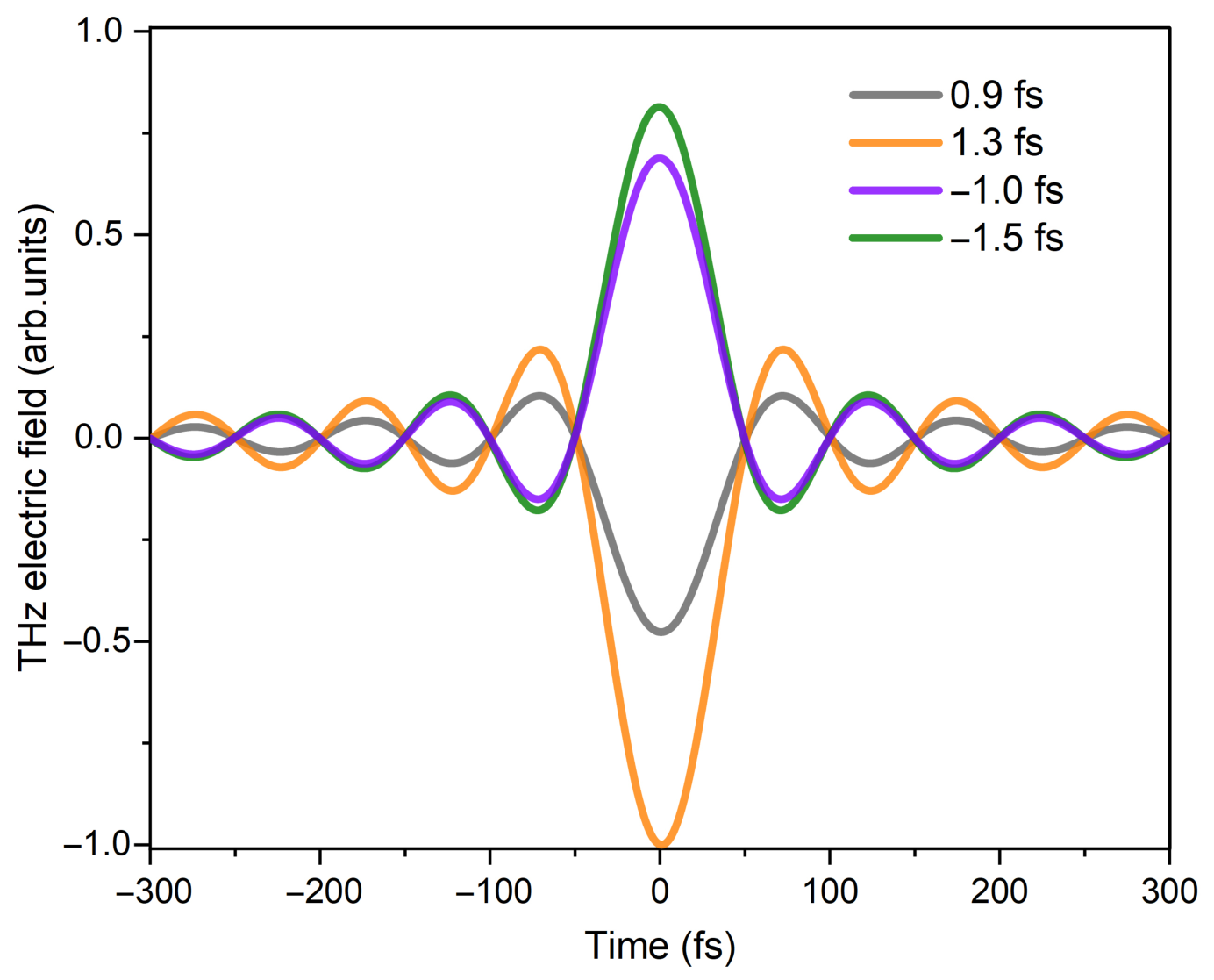
Another crucial parameter worth regulating is the waveform of THz field. This can be easily achieved with a double-pulse laser field. Here we focus on two phase delays: φ 2 = 0 and π . For ultrashort pulses with φ 2 = π , Equation (5) evolves to E ( t ) = 2 f ( t Δ t / 2 ) sin ( ω Δ t / 2 ) sin [ ω ( t Δ t / 2 ) ] for small relative time delays. In addition to having a delay of Δ t / 2 relative to time origin, and different amplitude with a modulation factor | sin ( ω Δ t / 2 ) | , the waveforms of laser fields synthesized with different Δ t have only two kinds, depending on the sign of Δ t : +sine shape for Δ t near −1.3 fs or −sine shape for Δ t around 1.3 fs. In Figure 2 we depict the waveforms of the THz field at four time delays: −1.5, −1.0, 0.9 and 1.3 fs. The amplitudes of the THz fields differ for different time delays, but they have in-phase or antiphase waveforms. Laser pulses with a negative delay generate positive-polarity (+cos) THz pulse, whereas laser pulses with a positive delay produce negative-polarity (−cos) THz field. That is, the electric fields for two strong THz radiations illustrated in Figure 1b have exactly the opposite polarity, and they can convert to each other on a time scale of several femtoseconds, noting that the time interval between two strongest emissions is 2.6 fs. Such control is equally effective for other laser intensity ratios and wavelengths. With the increasing of laser pulse duration, more THz waveforms will be generated, but the THz field strength decreases. Such two THz waveforms can be generated using laser field with φ 2 = 1.4 π , too.
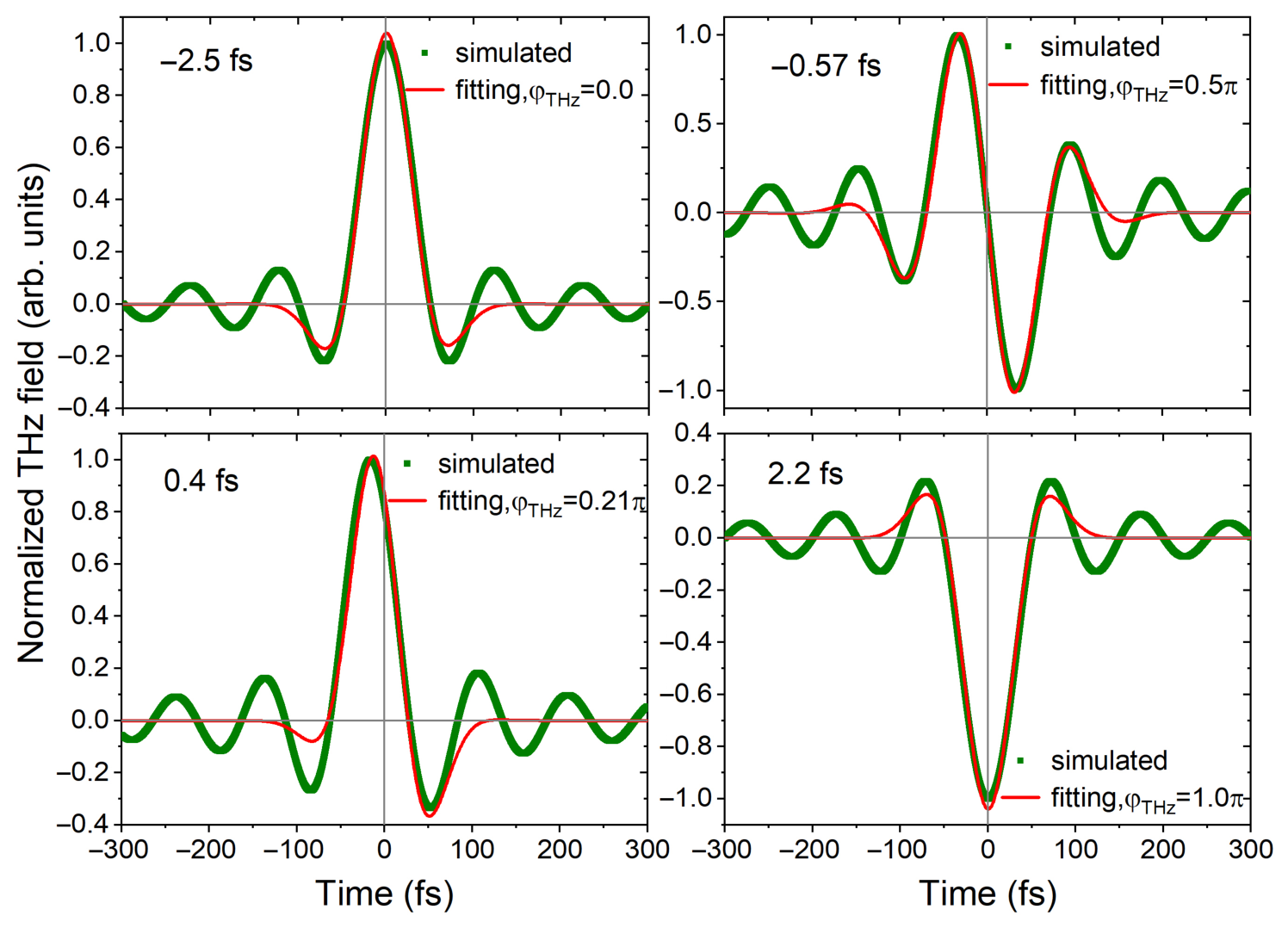
For φ 2 = 0 and I 2 / I 1 = 1 , Equation (5) evolves as E ( t ) = 2 f ( t Δ t / 2 ) cos ( ω Δ t / 2 ) cos [ ω ( t Δ t / 2 ) ] at short Δ t around Δ t = 0 . Though the laser field with various Δ t has the same cosinoidal waveform at τ = 3 fs, the generated THz waveforms are slightly time-delay dependent (at shorter laser duration, i.e., τ = 2 fs, there is only one laser and THz waveform). On the other hand, time delays near Δ t = 2.6 fs and 2.6 fs only generate one laser, and correspondingly, one THz field waveform. We can adjust the laser intensity ratio to produce more THz waveforms. In Figure 3 we show the THz field waveforms at some time delays, for I 2 / I 1 = 0.5 and τ = 3 fs. When Δ t changes from −2.5 fs, to −0.57 fs, to 0.4 fs, and to 2.2 fs, the shape of the THz field also changes, and the corresponding phase changes from 0 to 0.5 π , to 0.21 π , and 1.0 π , which are determined by fitting the simulated results with a formula E THz ( t ) = E THz e 2 ln 2 ( t / τ THz ) 2 cos ( ω THz t + φ THz ) . These fields are no more than 10 times weaker than the strongest one at Δ t = 0 . By tuning Δ t with bigger values, we can obtain arbitrary THz waveform with phase in the range [0.5 π , π ].

3.4. Ultrafast Modulation of Laser Energy and Ionization

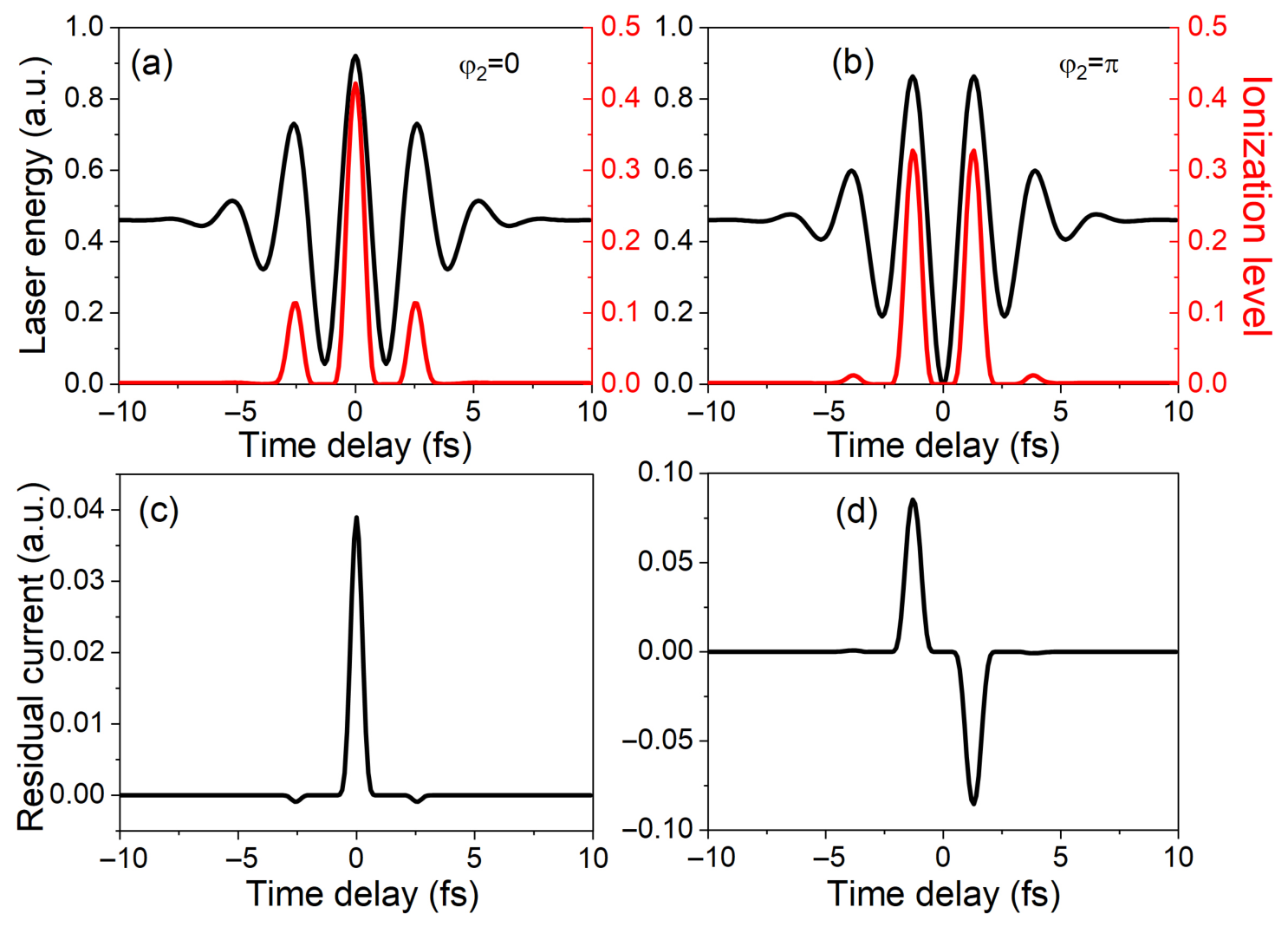
To understand the above results, take 800-nm wavelength for an example, Figure 4a,b show the variation of energy fluence of driving laser field, F = E ( t ) 2 d t , as a function of time delay between two beams for two phases of 0 and π , respectively. When the delay Δ t between the two laser beams is relatively large ( | Δ t > 8 fs | ) , the total laser energy is a constant, F = 2 E 1 ( t ) 2 d t = 2 E 2 ( t ) 2 d t . When two laser beams overlap each other, on the other hand, they are coherently superimposed, and the total laser energy oscillates with time delay. Consequently, when Δ t satisfy φ 2 ω 800 nm Δ t = 2 k π ( k = 0 , ± 1 , ) , F reaches the maximum; while when Δ t satisfy φ 2 ω 800 nm Δ t = ( 2 k + 1 ) π , F reaches the minimum. For two laser phases, the maximum field fluence appears at Δ t = 0 , and ± 1.3 fs, respectively. As a result, ionization level of atoms at the end of the laser pulse (calculated with ADK model) oscillates with time delay, too, and the maximum one contributes the strong THz emissions that shown in Figure 1. Figure 4c,d show the corresponding residual current at two phases. The magnitude of which matches well the trend of laser fluence and ionization change with time delay. For φ 2 = π , especially, the residual currents induced by two strong ionizations have the opposite sign, which is responsible for the regulation of the polarity of the THz field shown in Figure 2.

3.5. Terahertz Field Strength Dependence on Laser Wavelength

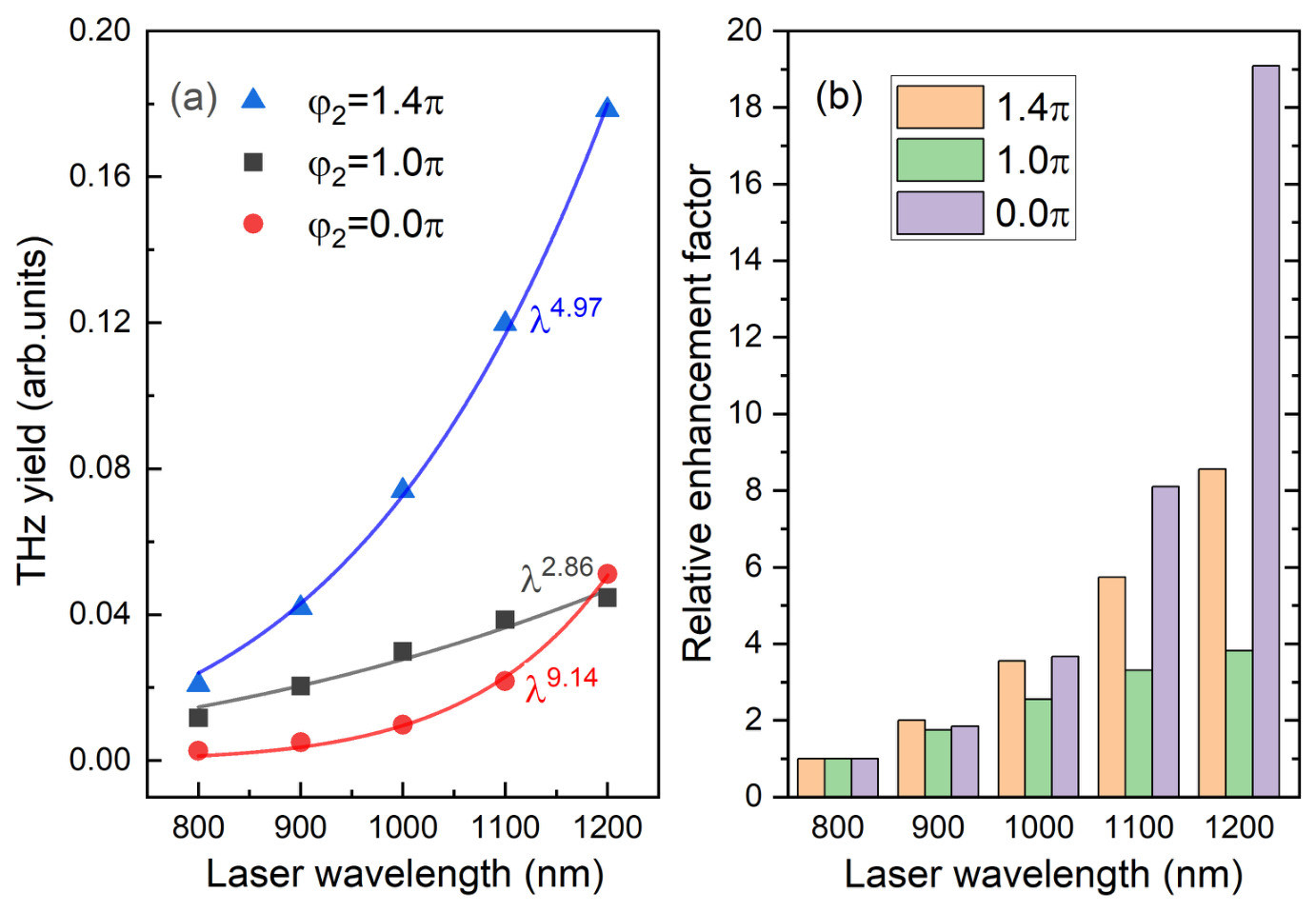
Finally, we show quantitatively the variation of the THz field amplitude at different laser wavelengths, which is very important for the sake of getting strong THz sources. It can be seen from Figure 1a–c that the maximum value of the amplitude increases gradually as the laser wavelength increases (the optimal time delay maybe slightly depends on laser wavelength for φ 2 = π and 1.4 π ). A clearer numerical result is given in Figure 5a, in which we show the dependence of strongest THz yield on laser wavelength for three phases. Obviously, THz intensity increases with the increasing of the driving laser wavelength. In Figure 5b we further give the enhancement factor of THz yield generated at various wavelengths relative to that of 800-nm driving field, which displays a strong laser phase dependence, especially at longer wavelength. When λ increases from 800 nm to 1200 nm, THz yield increases by 19.1, 3.8, and 8.6 times, respectively, for φ 2 = 0 , 1.0 π and 1.4 π . The fitting from simulated results shows a wavelength scaling law of THz yield as λ 9.14 , λ 2.86 , and λ 4.97 , at three phases, respectively. These laws are qualitatively consistent with those in the two-color field [39,40,41,42,43]. In general, THz radiation strength depends both on the number of free electrons and the symmetry of the laser field waveform. For φ 2 = 0 , ionization probability at the end of laser pulse calculated from ADK model remains almost constant at short wavelengths (800 and 900 nm), then slightly increases as the wavelength becomes longer due to the few-cycle effect [44], which scales as λ 0.16 . For φ 2 = 1.0 π and 1.4 π , somewhat counterintuitively, ionization probability decreases with wavelength as λ 0.92 and λ 0.30 . We also checked maximal drift velocity dependence on wavelength, which gives scaling law of λ 1.13 , λ 0.94 and λ 1.08 , respectively, at three phases. Therefore, the rapid enhancement of THz field with laser wavelength is likely due to the laser field’s symmetry dependency on laser wavelength. That is, integration v d ( t ) d ρ ( t ) depends on the laser wavelength (similar detailed interpretation can be found in Ref. [45]). Such asymmetry also depends on the relative phase of two laser pulses, so laser fields with different phases produce different THz intensities, even at the same laser wavelength.

4. Conclusions

In conclusion, the femtosecond double-pulse laser field with time delay is a promising type of driving pulse that can be used to ultrafast modulate THz amplitude and waveform. To fill the research gap in ultrafast optical switching and controlling THz waveforms, we have numerically simulated THz radiation generation from the interaction of a double-pulsed laser field with argon atoms using a photocurrent model. The results reveal that as the time delay between the two laser pulses of the driving field varies, the THz amplitude also changes drastically. Based on this feature, we can obtain an ultrafast optical THz switch with a photoperiod of just a few femtoseconds, which is substantially faster than conventional optical switching. This tendency is determined not only by the electrons’ ionization probability, but also by the degree of offset of their drift speeds. In addition, we discovered that altering the delay of the double-pulse laser field is also an effective approach for modulating the THz waveform, where the polarity of the THz electric field can be easily converted on a finite time scale, and THz field with more phases can also be produced. Our simulations also show an intriguing wavelength scaling law, whereby the intensity of the THz field can increase by increasing the wavelength of the driving laser. Our study is of great significance and provides an effective method for modulating THz generation.

Author Contributions

Conceptualization, L.-P.L. and G.-L.W.; Software, L.Z.; Validation, L.-P.L.; Formal analysis, L.-P.L.; Investigation, L.-P.L. and J.-X.D.; Resources, Z.-H.J., S.-F.Z. and G.-L.W.; Data curation, L.-P.L.; Writing—original draft preparation, L.-P.L. and G.-L.W.; Writing—review & editing, G.-L.W.; Visualization, L.-P.L. and G.-L.W.; Supervision, G.-L.W.; Project administration, J.-X.D. and G.-L.W.; Funding acquisition, J.-X.D., L.Z., Z.-H.J., S.-F.Z. and G.-L.W. All authors have read and agreed to the published version of the manuscript.

Funding

This work was supported by the National Natural Science Foundation of China (Grant Nos. 12364040, 12465025, 12574315, and 12504322), the Natural Science Foundation of Gansu Province, China (Grant No. 26JRRA578).

Data Availability Statement

Data underlying the results presented in this paper are not publicly available at this time but may be obtained from the authors upon reasonable request.

Conflicts of Interest

The authors declare no conflicts of interest.

References

  1. Yin, M.; Tang, S.; Tong, M. The application of terahertz spectroscopy to liquid petrochemicals detection: A review. Appl. Spectrosc. Rev. 2016, 51, 379. [Google Scholar] [CrossRef]
  2. Markelz, A.G.; Roitberg, A.; Heilweil, E.J. Pulsed terahertz spectroscopy of DNA, bovine serum albumin and collagen between 0.1 and 2.0 THz. Chem. Phys. Lett. 2000, 320, 42. [Google Scholar] [CrossRef]
  3. Tielrooij, K.J.; Timmer, R.L.A.; Bakker, H.J.; Bonn, M. Structure dynamics of the proton in liquid water probed with terahertz time-domain spectroscopy. Phys. Rev. Lett. 2009, 102, 198303. [Google Scholar] [CrossRef] [PubMed]
  4. Son, J.H.; Oh, S.J.; Cheon, H. Potential clinical applications of terahertz radiation. J. Appl. Phys. 2019, 125, 190901. [Google Scholar] [CrossRef]
  5. Fu, X.; Liu, Y.; Chen, Q.; Fu, Y.; Cui, T.-J. Applications of terahertz spectroscopy in the detection and recognition of substances. Front. Phys. 2022, 10, 869537. [Google Scholar] [CrossRef]
  6. Jansen, C.; Wietzke, S.; Peters, O.; Scheller, M.; Vieweg, N.; Salhi, M.; Krumbholz, N.; Jördens, C.; Hochrein, T.; Koch, M. Terahertz imaging: Applications and perspectives. Appl. Opt. 2010, 49, 48. [Google Scholar] [CrossRef]
  7. Federici, J.; Moeller, L. Review of terahertz and subterahertz wireless communications. J. Appl. Phys. 2010, 107, 111101. [Google Scholar] [CrossRef]
  8. Hu, Y.; Tong, M.; Xu, Z.; Cheng, X.; Jiang, T. Spatiotemporal terahertz metasurfaces for ultrafast all-optical switching with electric-triggered bistability. Laser Photonics Rev. 2021, 15, 2000456. [Google Scholar] [CrossRef]
  9. Yu, Z.; He, W.; Hu, S.; Ren, Z.; Wan, S.; Cheng, X.; Hu, Y.; Jiang, T. Creating anti-chiral exceptional points in non-hermitian metasurfaces for efficient terahertz switching. Adv. Sci. 2024, 11, e2402615. [Google Scholar] [CrossRef]
  10. Buchmann, A.; Hoberg, C.; Novelli, F. An ultra-fast liquid switch for terahertz radiation. APL Photonics 2022, 7, 121302. [Google Scholar] [CrossRef]
  11. Hui, D.; Alqattan, H.; Zhang, S.; Pervak, V.; Chowdhury, E.; Hassan, M.T. Ultrafast optical switching and data encoding on synthesized light fields. Sci. Adv. 2023, 9, 1015. [Google Scholar] [CrossRef]
  12. Wang, Q.; Li, B.; Zeng, L.; Yang, Q.; Zhang, X.; Wen, R.; Deng, C. Switchable quadruple narrowband to broadband terahertz perfect absorber based on graphene and VO2 metamaterials. Diam. Relat. Mater. 2024, 142, 110832. [Google Scholar] [CrossRef]
  13. Miyamaru, F.; Morita, H.; Nishiyama, Y.; Nishida, T.; Nakanishi, T.; Kitano, M.; Takeda, M.W. Ultrafast optical control of group delay of narrow-band terahertz waves. Sci. Rep. 2014, 4, 4346. [Google Scholar] [CrossRef] [PubMed]
  14. Sarker, D.; Nakti, P.P.; Tahmid, M.I.; Mamun, M.A.Z.; Zubair, A. Tunable multistate terahertz switch based on multilayered graphene metamaterial. Opt. Quantum Electron. 2023, 55, 159. [Google Scholar] [CrossRef]
  15. Zhang, C.; Lou, J.; Zhang, J.; Wang, Z.; Ji, C.-Y.; Yuan, H.; Huang, Y.; Li, Z.; Zhu, W.; Zhao, S.; et al. Space-time wavefront synchronized terahertz metasurface. Adv. Mater. 2026, 38, e20890. [Google Scholar] [CrossRef] [PubMed]
  16. Bai, Y.; Song, L.; Xu, R.; Li, C.; Liu, P.; Zeng, Z.; Zhang, Z.; Lu, H.; Li, R.; Xu, Z. Waveform-controlled terahertz radiation from the air filament produced by few-cycle laser pulses. Phys. Rev. Lett. 2012, 108, 255004. [Google Scholar] [CrossRef]
  17. Wang, T.-J.; Ju, J.; Liu, Y.; Li, R.; Xu, Z.; Chin, S.L. Waveform control of enhanced THz radiation from femtosecond laser filament in air. Appl. Phys. Lett. 2017, 110, 221102. [Google Scholar] [CrossRef]
  18. Flender, R.; Sarosi, K.; Petracs, E.; Borzsonyi, A.; Chikan, V. Control of THz field waveform emitted from air plasma by chirping two-color laser pulses. Opt. Commun. 2019, 436, 222. [Google Scholar] [CrossRef]
  19. Jiao, Z.-H.; Song, J.-H.; Zhang, S.; Li, X.-Y.; Wang, G.-L.; Zhao, S.-F. Controllable waveform terahertz generation using rippled plasma driven by an inhomogeneous electrostatic field. Opt. Express 2023, 31, 442. [Google Scholar] [CrossRef]
  20. Paparo, D.; Martinez, A.; Rubano, A.; Houard, J.; Hideur, A.; Vella, A. THz generation by two-color plasma: Time shaping and ultra-broadband polarimetry. Sensors 2024, 24, 4265. [Google Scholar] [CrossRef]
  21. Xu, X.; Huang, Y.; Zhang, Z.; Liu, J.; Lou, J.; Gao, M.; Wu, S.; Fang, G.; Zhao, Z.; Chen, Y.; et al. Laser-chirp controlled terahertz wave generation from air plasma. Chin. Phys. Lett. 2023, 40, 045201. [Google Scholar] [CrossRef]
  22. Guo, Y.; Chen, Z.; Cai, M.; Jin, Z.; Wang, X.; Zhang, C.; V.Balakin, A.; P.Shkurinov, A.; Peng, Y.; Zhu, Y.; et al. Ultrafast photogalvanic effect in ferromagnet/Dirac semimetal heterostructures diagnosed by terahertz emission spectroscopy. ACS Photonics 2026, 13, 1330. [Google Scholar] [CrossRef]
  23. Cai, H.; Huang, Q.; Hu, X.; Liu, Y.; Fu, Z.; Zhao, Y.; He, H.; Lu, Y. All-optical and ultrafast tuning of terahertz plasmonic metasurfaces. Adv. Opt. Mater. 2018, 6, 1800143. [Google Scholar] [CrossRef]
  24. Wang, L.; Zhang, Y.; Guo, X.; Chen, T.; Liang, H.; Hao, X.; Hou, X.; Kou, W.; Zhao, Y.; Zhou, T.; et al. A review of thz modulators with dynamic tunable metasurfaces. Nanomaterials 2019, 9, 965. [Google Scholar] [CrossRef] [PubMed]
  25. Wang, Q.; Zhang, X.; Xu, Q.; Feng, X.; Niu, L.; Chen, X.; Lu, Y.; Feng, J.; Fang, M.; Zhang, X.; et al. Nonlinear metasurfaces for completed control of amplitude, phase, and polarization in broadband terahertz generation. Adv. Mater. 2025, 37, 2500392. [Google Scholar] [CrossRef]
  26. Jang, J.; Rho, J.; Shin, H.J. Ultrafast all-optical switching and active sub-cycle waveform control via time-variant photodoping of terahertz metasurfaces. Adv. Sci. 2025, 12, 2413719. [Google Scholar] [CrossRef]
  27. Kamaraju, N.; Rubano, A.; Jian, L.; Saha, S.; Venkatesan, T.; Nötzold, J.; Campen, R.K.; Wolf, M.; Kampfrath, T. Subcycle control of terahertz waveform polarization using all-optically induced transient metamaterials. Light Sci. Appl. 2014, 3, e155. [Google Scholar] [CrossRef]
  28. Oh, T.I.; You, Y.S.; Kim, K.Y. Two-dimensional plasma current and optimized terahertz generation in two-color photoionization. Opt. Express 2012, 20, 19778. [Google Scholar] [CrossRef]
  29. Kim, K.Y. Generation of coherent terahertz radiation in ultrafast laser-gas interactions. Phys. Plasmas 2009, 16, 056706. [Google Scholar] [CrossRef]
  30. Kim, K.Y.; Glownia, J.H.; Taylor, A.J.; Rodriguez, G. Terahertz emission from ultrafast ionizing air in symmetry-broken laser fields. Opt. Express 2007, 15, 4577. [Google Scholar] [CrossRef]
  31. Ammosov, M.V.; Delone, N.B.; Krainov, V.P. Tunnel ionization of complex atoms and of atomic ions in an alternating electromagnetic field. Sov. Phys. JETP 1986, 64, 1911. [Google Scholar]
  32. Jiao, Z.-H.; Zhang, X.-X.; Zhang, S.; Du, J.-X.; Wang, G.-L.; Zhao, S.-F.; Zhang, Y.; Jiang, Y. Macroscopic effects on the terahertz generation from the two-color filamentation. Opt. Express 2025, 33, 26628. [Google Scholar] [CrossRef]
  33. Oldal, L.G.; Csizmadia, T.; Ye, P.; Harshitha, N.G.; Zaïr, A.; Kahaly, S.; Varjú, K.; Füle, M.; Major, B. Generation of high-order harmonics with tunable photon energy and spectral width using double pulses. Phys. Rev. A 2020, 102, 013504. [Google Scholar] [CrossRef]
  34. Oldal, L.G.; Ye, P.; Filus, Z.; Csizmadia, T.; Grósz, T.; Marco, M.D.; Bengery, Z.; Seres, I.; Gilicze, B.; Jójárt, P.; et al. All-optical experimental control of high-harmonic photon energy. Phys. Rev. Appl. 2021, 16, L011001. [Google Scholar] [CrossRef]
  35. Schuster, V.; Hilbert, V.; Klas, R.; Liu, C.; Tschernajew, M.; Bernhardt, B.; Rothhardt, J.; Limpert, J. Agile spectral tuning of high order harmonics by interference of two driving pulses. Opt. Express 2021, 29, 22117. [Google Scholar] [CrossRef]
  36. Mandal, A.; Rost, J.M.; Pfeifer, T.; Singh, K.P. Widely tunable XUV harmonics using double IR pulses. Opt. Express 2022, 30, 45020. [Google Scholar] [CrossRef]
  37. E, Y.; Jin, Q.; Zhang, X.-C. Enhancement of terahertz emission by a preformed plasma in liquid water. Appl. Phys. Lett. 2019, 115, 101101. [Google Scholar] [CrossRef]
  38. Xu, L.; Takahashi, E.J. Dual-chirped optical parametric amplification of high-energy single-cycle laser pulses. Nat. Photon. 2024, 18, 99. [Google Scholar] [CrossRef]
  39. Clerici, M.; Peccianti, M.; Schmidt, B.E.; Caspani, L.; Shalaby, M.; Giguère, M.; Lotti, A.; Couairon, A.; Légaré, F.; Ozaki, T.; et al. Wavelength scaling of terahertz generation by gas ionization. Phys. Rev. Lett. 2013, 110, 253901. [Google Scholar] [CrossRef] [PubMed]
  40. Nguyen, A.; Kaltenecker, K.J.; Delagnes, J.C.; Zhou, B.; Cormier, E.; Fedorov, N.; Bouillaud, R.; Descamps, D.; Thiele, I.; Skupin, S.; et al. Wavelength scaling of terahertz pulse energies delivered by two-color air plasmas. Opt. Lett. 2019, 44, 1488. [Google Scholar] [CrossRef]
  41. Nikolaeva, I.A.; Shipilo, D.E.; Panov, N.A.; Liu, W.W.; Savelev, A.; Kosareva, O. Scaling law of THz yield from two-color femtosecond filament for fixed pump power. Photonics 2022, 9, 974. [Google Scholar] [CrossRef]
  42. Jang, D.; Schwartz, R.M.; Woodbury, D.; Griff-Mcmahon, J.; Younis, A.H.; Milchberg, H.M.; Kim, K.Y. Efficient terahertz and Brunel harmonic generation from air plasma via mid-infrared coherent control. Optica 2019, 6, 1338. [Google Scholar] [CrossRef]
  43. Nguyen, A.; de Alaiza Martinez, P.G.; Dechard, J.; Thiele, I.; Babushkin, I.; Skupin, S.; Berge, L. Spectral dynamics of THz pulses generated by two-color laser filaments in air: The role of Kerr nonlinearities and pump wavelength. Opt. Express 2017, 25, 4720. [Google Scholar] [CrossRef]
  44. Chetty, D.; Glover, R.D.; Tong, X.M.; deHarak, B.A.; Xu, H.; Haram, N.; Bartschat, K.; Palmer, A.J.; Luiten, A.N.; Light, P.S.; et al. Carrier-envelope phase-dependent strong-field excitation. Phys. Rev. Lett. 2022, 128, 173201. [Google Scholar] [CrossRef] [PubMed]
  45. Yang, C.-X.; Zhang, L.; Jiao, Z.-H.; Zhao, S.-F.; Wang, G.-L. Terahertz dependence on the laser phase and wavelength in two-color circularly polarized laser field. J. Opt. Soc. Am. B 2024, 41, 7. [Google Scholar] [CrossRef]
Figure 1. The variation of normalized amplitude of THz electric field (0.1–10 THz) with time delay between two laser pulses and laser wavelength for CEP (a) φ 2 = 0, (b) 1.0 π and (c) 1.4 π with I 2 : I 1 = 1:1. (df) Relative THz field amplitude changes with laser time delays for three laser phases at laser wavelength of 800 nm. (g) THz spectra generated by an 800-nm double pulse and an 800 + 400 nm two-color laser field. Corresponding laser parameters are given in the text.
Photonics 13 00442 g001
Figure 2. The modulation of the THz electric field polarity with laser time delay. Here, φ 2 = π , λ = 800 nm and I 2 / I 1 = 1.0 .
Photonics 13 00442 g002
Figure 3. The same as Figure 2, but for φ 2 = 0 and I 2 / I 1 = 0.5 . Red line is the fitting curve with a formula E THz ( t ) = E THz e 2 ln 2 ( t / τ THz ) 2 cos ( ω THz t + φ THz ) .
Photonics 13 00442 g003
Figure 4. The variation of the laser fluence and ionization level with time delay between two laser beams for (a) φ 2 = 0 and (b) φ 2 = 1.0 π . (c,d) Corresponding residual currents. I 2 / I 1 = 1.0 .
Photonics 13 00442 g004
Figure 5. (a) The variation of strongest THz yield with laser wavelengths. The symbols (solid squares, triangles, and circles) represent the simulated values; solid lines are fitting curves. (b) Enhancement factor of THz yield at different laser wavelengths relative to that of 800-nm field.
Photonics 13 00442 g005
Disclaimer/Publisher’s Note: The statements, opinions and data contained in all publications are solely those of the individual author(s) and contributor(s) and not of MDPI and/or the editor(s). MDPI and/or the editor(s) disclaim responsibility for any injury to people or property resulting from any ideas, methods, instructions or products referred to in the content.