Article

A Silicon MEMS-Based Fiber-Optic Fabry–Perot Underwater Acoustic Sensor with a Micro-Perforated Central-Bossed Diaphragm

State Key Laboratory of Widegap Semiconductor Optoelectronic Materials and Technologies, North University of China, Taiyuan 030051, China
*
Author to whom correspondence should be addressed.
Photonics 2026, 13(5), 443; https://doi.org/10.3390/photonics13050443
Submission received: 2 April 2026 / Revised: 27 April 2026 / Accepted: 27 April 2026 / Published: 1 May 2026
(This article belongs to the Special Issue Recent Research on Optical Sensing and Precision Measurement)

Abstract

To address the demand for underwater acoustic detection with hydrostatic pressure resistance, this paper proposes a fiber-optic Fabry–Perot (F-P) underwater acoustic sensor based on micro-electromechanical system (MEMS) technology. According to the F-P interference principle, the diaphragm deforms under acoustic pressure, inducing variations in the F-P cavity length which modulate the interference spectrum and enable the measurement of underwater acoustic signals. A sensing diaphragm with a composite structure consisting of a central boss and a micro-hole array is designed, which improves the optical signal quality while reducing the influence of the pressure difference between the inner and outer surfaces of the diaphragm on sensor operation. MEMS fabrication, computer numerical control (CNC) machining, and laser fusion splicing technologies are employed to achieve batch fabrication of the sensing units and adhesive-free integration of the sensor. Experimental results show that the proposed sensor exhibits a flat frequency response within ±1.5 dB over the range of 1 kHz to 10 kHz, with an average signal-to-noise ratio (SNR) of 86.35 dB. The sensitivity reaches −181.79 dB re 1 rad/μPa at 10 kHz, with a maximum nonlinearity of 0.48% F.S., a repeatability error of 0.15% F.S. and a dynamic range of 100.83 dB. The proposed sensor features miniaturization, high consistency, hydrostatic pressure self-balancing capability, and immunity to electromagnetic interference, providing a solid foundation for hydrostatic-pressure-resistant underwater acoustic measurements in deep-sea environments.

1. Introduction

Driven by the growing strategic demands in fields such as marine resource exploration, underwater communication, and environmental monitoring, the detection and recognition of underwater acoustic signals have become a primary research focus. Benefiting from the advantages of miniaturization and batch fabrication enabled by MEMS technology, MEMS-based underwater acoustic sensors have attracted considerable attention [1,2,3]. Most of the MEMS underwater acoustic sensors rely on electrical sensing mechanisms [4,5,6,7], mainly including piezoelectric, piezoresistive, and capacitive types [8,9,10]. Piezoelectric underwater acoustic sensors based on thin-film materials have attracted significant attention due to their high sensitivity [11]. However, electrical sensors are inherently active devices, which impose stringent requirements on electrical insulation and hermetic packaging in complex underwater environments. Moreover, they are susceptible to electromagnetic interference, thereby limiting their practical applications.
Fiber-optic MEMS sensors offer distinct advantages [12,13], including strong immunity to electromagnetic interference, corrosion resistance, and excellent electrical insulation, providing a promising alternative for acoustic detection in complex underwater environments. According to their sensing principles and measured physical quantities, these sensors can be classified into interferometric types [14,15,16], diffractive types [17,18,19], acoustic pressure types and acoustic vector types [20]. Li et al. improved the dynamic range of a fiber-optic F-P underwater acoustic sensor by optimizing the corrugated structure parameters of a polyethylene terephthalate (PET) diaphragm, while maintaining a high sensitivity of −149.24 dB re 1 rad/μPa [21]. Zhang et al. employed a metallic diaphragm with an Archimedean spiral configuration as the sensing element, achieving relatively flat signal-to-noise ratio and sensitivity within the frequency range of 1 kHz to 20 kHz, with an average sensitivity of −172.52 dB re 1 rad/μPa [22]. Wang et al. developed an ultra-high-sensitivity hollow F-P ultrasonic sensor using 3D printing technology, exhibiting a sensitivity of 797 mV/kPa, a bandwidth of 1.2 MHz, and a central response frequency of 1.5 MHz [23]. Despite these advances in improving the acoustic performance of fiber-optic sensors, most reported designs employ sealed air cavities in the sensing unit to enhance sensitivity. However, in underwater environments, such sealed diaphragm-based structures lead to severe pressure imbalance between the internal and external surfaces, resulting in excessive deformation of the diaphragm. This not only reduces the linear operating range of the sensor but also significantly limits its applicable depth in deep-sea environments. Therefore, mitigating the detrimental effects of high hydrostatic pressure on the sensing structure remains a critical challenge in underwater acoustic detection.
In this paper, a silicon MEMS-based fiber-optic F-P underwater acoustic sensor with a composite diaphragm structure consisting of a central boss and a micro-hole array is proposed. The micro-hole array enables automatic hydrostatic pressure equalization be-tween the inside and outside of the F-P cavity, effectively eliminating the initial cavity length drift and measurement range limitations induced by hydrostatic pressure. Meanwhile, the central boss structure significantly enhances the quality of the interference signal. The sensing unit is fabricated using MEMS processes combined with CNC machining, providing feasibility for batch production. Adhesive-free integration of the sensing probe is achieved by CO2 laser fusion splicing. A hybrid packaging structure composed of 316L stainless steel and polyether ether ketone (PEEK) is employed as the housing, ensuring long-term stability and structural reliability in liquid environments. Finally, an underwater acoustic testing platform is established to evaluate the hydrostatic pressure resistance and acoustic detection performance of the proposed sensor.

2. Structural Design and Theoretical Analysis

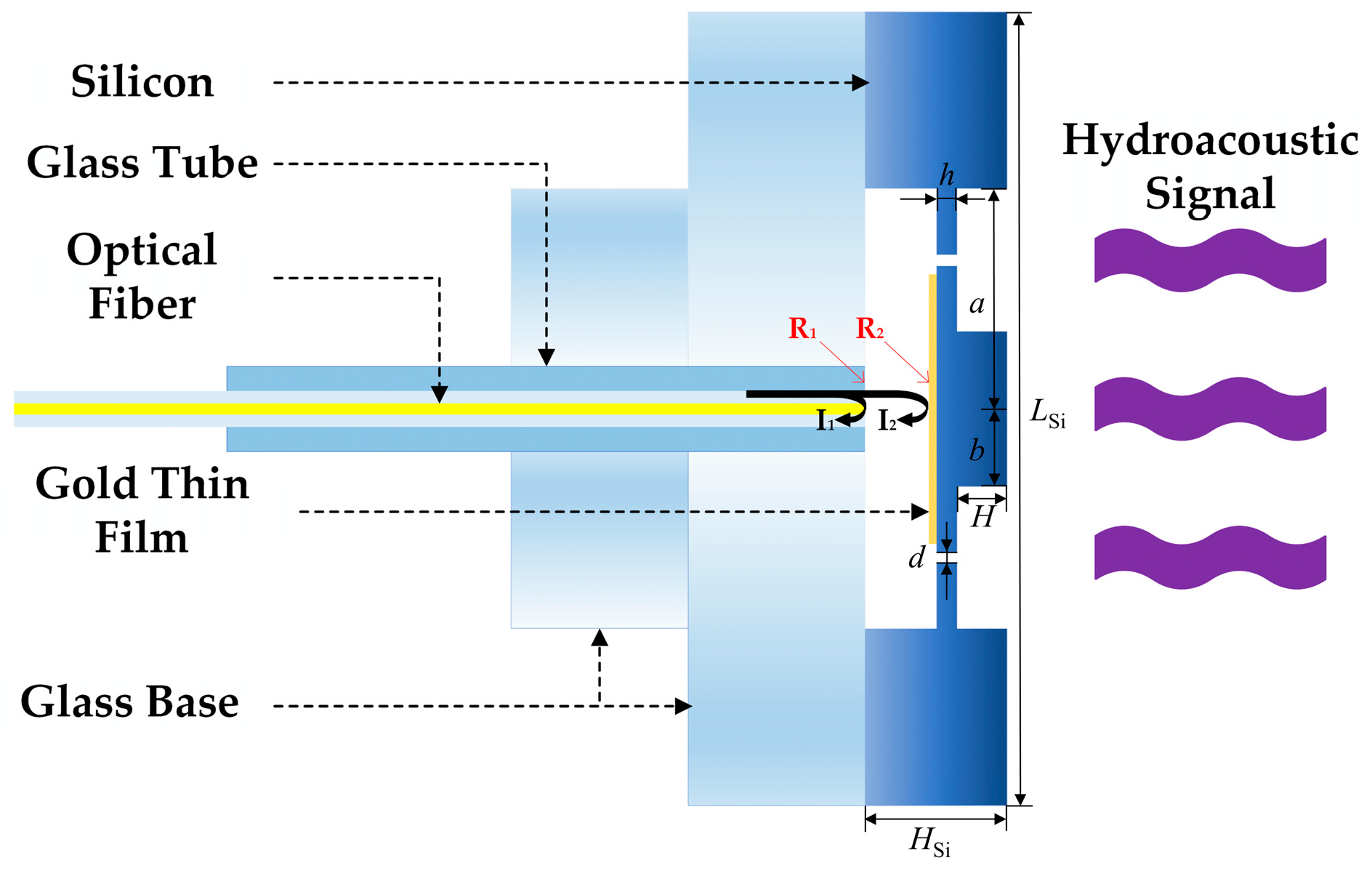
A schematic diagram of the silicon MEMS-based fiber-optic F-P underwater acoustic sensor is shown in Figure 1. The sensor consists of a single-mode fiber, a capillary glass tube, and a sensing unit. A central boss structure is designed on the diaphragm to effectively concentrate stress in the peripheral region. When the diaphragm deforms under pressure, this configuration significantly improves the parallelism of the reflective surfaces and reduces the divergence angle of the reflected light, thereby enhancing the confinement of the reflected beam. A gold film is deposited on the inner surface of the diaphragm to increase reflectivity and further enhance the intensity of the interference spectrum. In addition, a micro-hole array is introduced in the diaphragm, forming a micro-perforated structure that enables real-time hydrostatic pressure balance across the diaphragm.

2.1. Structural Design and Optical Principles of the Sensor

When the light beam propagates from the single-mode fiber into the sensing probe, it sequentially encounters the surface R1 formed by the fiber end face and the surface R2 formed by the inner surface of the sensing diaphragm. R1 and R2 constitute the F-P cavity. The two reflected beams undergo coherent superposition within the cavity, and the total reflected intensity returning to the demodulation unit can be approximately described by the two-beam interference model as:
I = I 1 + I 2 + 2 η I 1 I 2 cos 4 π n L λ + π ,
Δ φ = 4 π n λ Δ L ,
where I is the total reflected optical intensity received at the detection system. λ is the central wavelength of the incident optical signal. I 1 and I 2 are respectively the optical intensity components reflected from R1 and R2 surfaces back into the optical fiber. n is the refractive index of the cavity medium. L is the physical cavity length of the F-P cavity. η is the optical coupling efficiency factor accounting for energy loss caused by beam divergence and related effects, and Δ φ is the phase variation in the interference spectrum.
When an external acoustic signal acts on the diaphragm, the resulting elastic deformation induces a variation in the cavity length ΔL, which in turn leads to a change in the phase variation in the interference spectrum Δφ. When the medium inside the F-P cavity is switched from air to liquid, the change in refractive index alters the reflectivity of the reflective surfaces. According to Fresnel’s law, the reflectivity depends on the refractive indices of the incident and transmitted media, and can be expressed as:
R = N 1 N 2 N 1 + N 2 2 ,
where N 1 is the refractive index of the incident medium, N 2 is the refractive index of the transmitted medium, and R is the reflectivity at the interface between the two media.
The refractive indices of air, water, and the fiber core are respectively taken as 1, 1.33, and 1.45. According to Equation (3), the reflectivity of R1 is approximately 3.4% for an air-filled F-P cavity, whereas it decreases significantly to about 0.2% for a water-filled F-P cavity. Since R2 is a highly reflective gold-coated surface, its reflectivity in the water-filled F-P cavity decreases slightly but remains above 90%. In the water-filled F-P cavity, the reflectivity of R1 decreases significantly, whereas R2 maintains a high reflectivity. This leads to a large intensity imbalance between the two interfering beams, thereby degrading the fringe visibility of the interference signal. The fringe visibility of the interference signal can be expressed as:
V = I m a x I m i n I m a x + I m i n = 2 η I 1 I 2 I 1 + I 2 ,
where V is the fringe visibility of the interference signal, and I m a x and I m i n are respectively the maximum and minimum intensities of the interference spectrum.
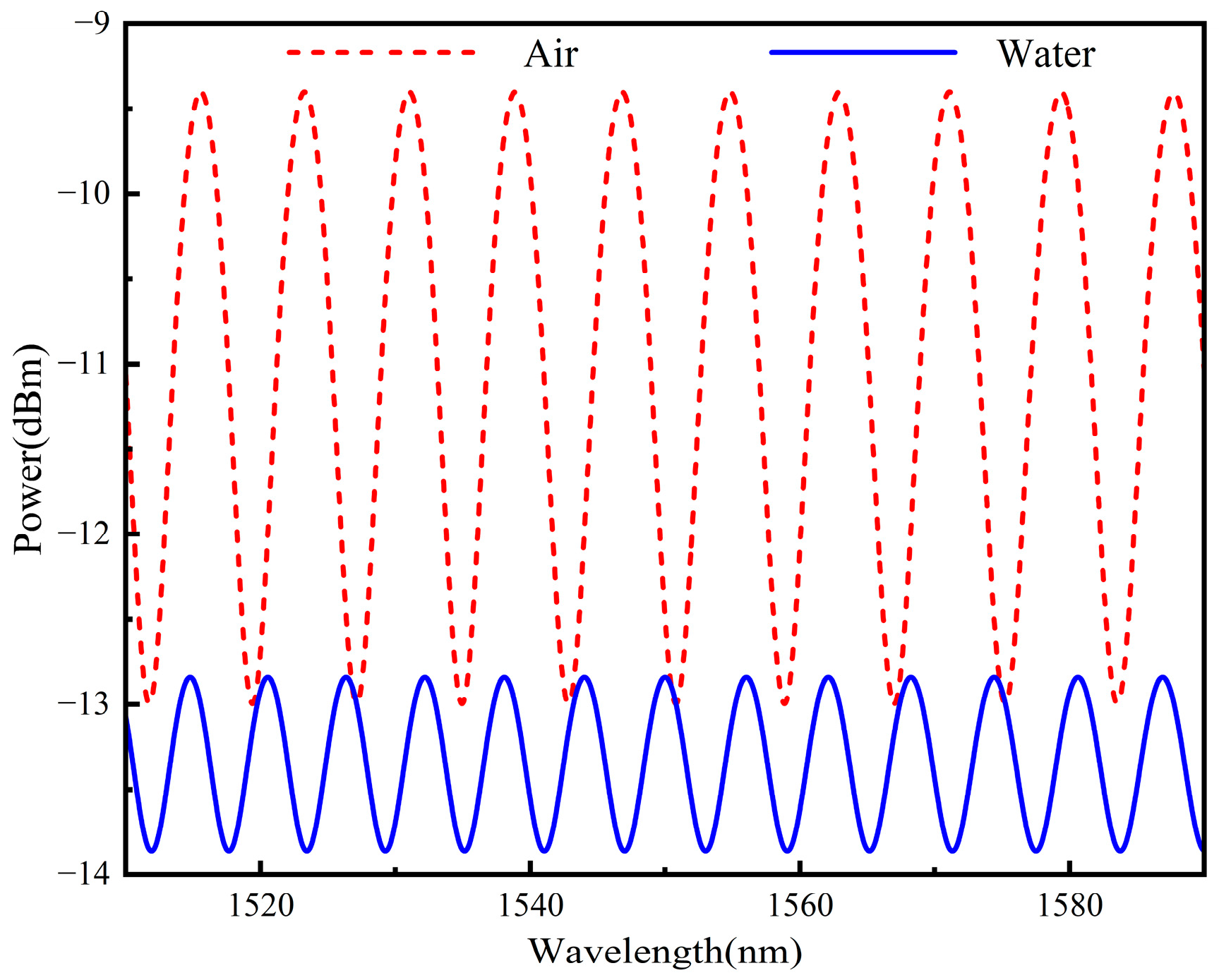
A comparison of the simulated interference spectra of the F-P cavity filled with air and water is shown in Figure 2. The fringe visibility of the water-filled cavity is significantly lower than that of the air-filled cavity. Although filling the F-P cavity with water leads to a reduction in fringe visibility, stable and reliable operation can still be achieved provided that the initial spectrum (i.e., the air-filled cavity spectrum) exhibits sufficiently high visibility, or that the reflectivity of R1 is enhanced (e.g., by coating the fiber end face), ensuring that the signal intensity remains well above the requirement of the demodulation system.

2.2. Mechanical Sensing Principle

Based on the small deflection theory of thin plates, when acoustic pressure is applied to the diaphragm, the resulting deformation induces a cavity length variation that is primarily determined by the geometric parameters of the diaphragm. Assuming that the central boss structure possesses sufficiently high stiffness compared to the overall diaphragm, it can be regarded as a rigid body with negligible deformation. Under this assumption, the motion of the central boss can be approximated as a rigid translation in the normal direction. To characterize the transduction relationships between acoustic pressure and cavity length, as well as between acoustic pressure and the phase of the interference signal, the mechanical sensitivity of the central boss structure and the phase sensitivity of the underwater acoustic sensor expressed in dB re 1 rad/μPa are defined as follows [24]:
S = P Y = 3 1 ν 2 16 E h 3 · a 4 b 4 4 a 2 b 2 ln a b 1 b a 4 ,
M = 20 lg 4 π n λ · S ,
where S is the mechanical sensitivity of the central boss structure, M is the phase sensitivity of the underwater acoustic sensor, P is the acoustic pressure applied to the diaphragm, Y is the displacement at the center of the diaphragm, E is Young’s modulus of the material, ν is Poisson’s ratio, h is the thickness of the diaphragm, a is the effective radius of the diaphragm, and b is the radius of the central boss.
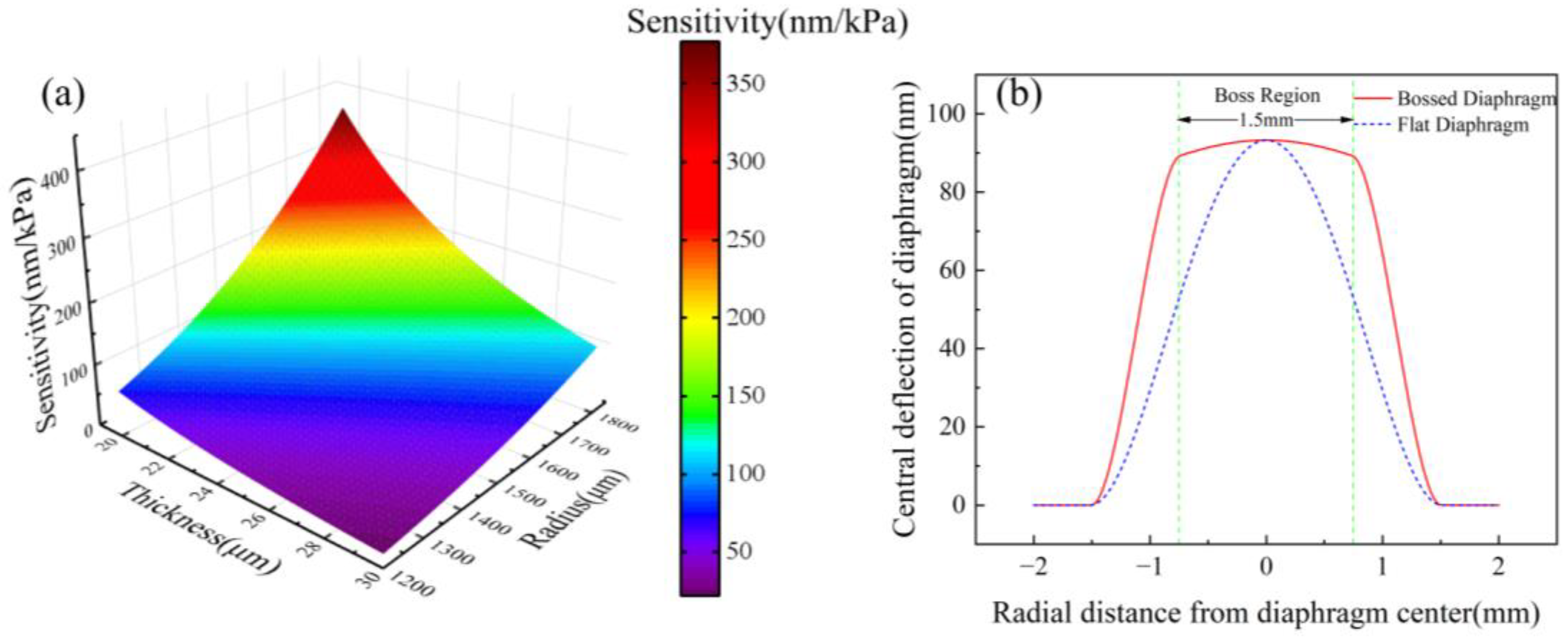
In this paper, the radius and thickness ratio between the central boss and the diaphragm are respectively designed to be 1:2 and 3:1. The simulated relationship between diaphragm dimensions and sensitivity is shown in Figure 3a. Under the condition of identical sensitivity, a comparison of the inner surface deformation between a flat diaphragm and a diaphragm with a central boss is presented in Figure 3b. It can be observed that the introduction of the central boss leads to a flatter deformation profile within the effective reflective region of the diaphragm, thereby improving the parallelism of the reflective surface and significantly reducing the divergence angle of the reflected light. This facilitates better confinement of the reflected beam and enhances the intensity of the interference spectrum.
The natural frequency is primarily determined by the effective bending stiffness and the total effective mass of the diaphragm. When both sides of the diaphragm are in contact with a liquid, the added mass effect significantly reduces the natural frequency, and a correction factor must be introduced. The effective bending stiffness of the diaphragm and the corresponding expression for its natural frequency in a liquid medium on both sides are given as follows [25]:
D = E h 3 12 1 ν 2 ,
f A i r = 10.33 2 π r 2 D ρ d h ,
f L i q u i d = f A i r 1 + 1.337 ρ m a ρ d h ,
where D is the effective bending stiffness of the diaphragm, f A i r and f L i q u i d are respectively the characteristic frequencies of the diaphragm in air and liquid, ρ m is the density of the surrounding liquid, and ρ d is the density of the diaphragm material.
In general, a higher natural frequency of the diaphragm corresponds to a wider flat-response bandwidth. Increasing the diaphragm thickness, reducing the diaphragm radius, and optimizing the central boss structure can all contribute to enhancing the natural frequency to a certain extent. Based on finite element analysis and the requirements of the practical testing environment, the structural parameters of the proposed silicon MEMS-based fiber-optic F-P underwater acoustic sensor are listed in Table 1.

3. Sensor Fabrication and Packaging

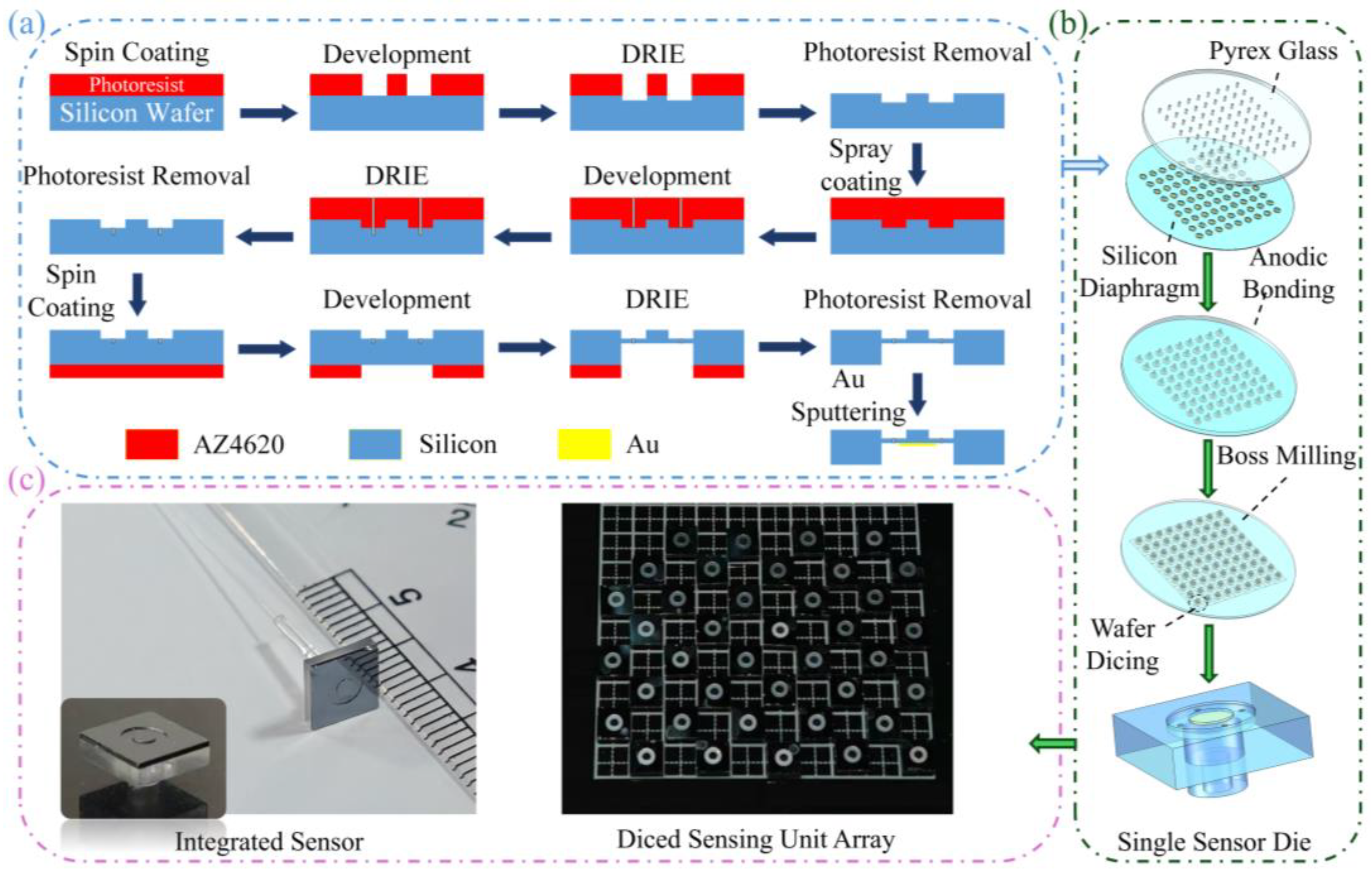
The fabrication process of the silicon MEMS-based fiber-optic F-P underwater acoustic sensor is illustrated in Figure 4, which mainly includes three steps: MEMS fabrication of the sensing diaphragm, silicon–glass anodic bonding and dicing, and adhesive-free sensor integration. The detailed MEMS fabrication process of the sensing diaphragm is shown in Figure 4a. A 4-inch silicon wafer with a thickness of 300 μm is selected, and deep reactive ion etching (DRIE) is employed to form the central boss, micro-hole array, and groove structures. A Cr/Au thin film, with thicknesses of 30 nm for Cr and 300 nm for Au, is deposited on the inner surface of the groove structure using DC magnetron sputtering, where the Cr layer serves as an adhesion layer to enhance the bonding strength of the gold film. The anodic bonding and subsequent dicing of the sputtered silicon wafer and the borosilicate glass are illustrated in Figure 4b. A double-side polished Pyrex glass wafer with through-holes fabricated by CNC machining is first bonded to the silicon wafer with the diaphragm structure via anodic bonding. Subsequently, an external boss structure is machined at the glass through-hole region, and individual sensing units are finally obtained by wafer dicing. The sensor integration process is shown in Figure 4c. A single-mode fiber is first fusion-spliced to a capillary glass tube using a CO2 laser splicer. The fiber with the glass tube is then inserted into the through-hole of the sensing unit. The fiber end is connected to an optical interrogator (TV125, Tongwei Sensing, Beijing, China) via a patch cord. The insertion depth of the fiber is manually adjusted, and when the interference spectrum exhibits the maximum fringe visibility, the Pyrex glass substrate is permanently bonded to the capillary tube using CO2 laser fusion splicing, thereby completing the adhesive-free integration of the sensor.
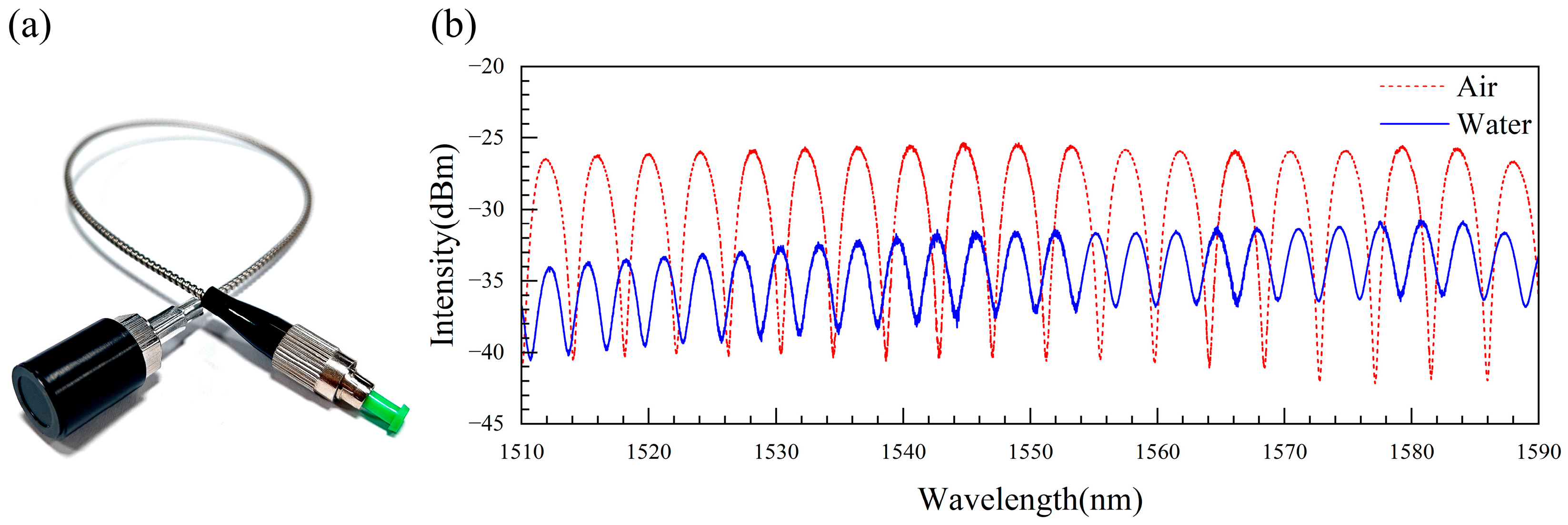
The sensor housing and the armored fiber tail are fabricated from 316L stainless steel. The sensing unit is securely bonded to the metal housing using epoxy adhesive (353ND, Epoxy Technology Inc., Billerica, MA, USA) to enhance structural stability. The metal package is then assembled with a PEEK insulating cap via threaded connection and immersed in an ultrasonic cleaner, where vibration facilitates the filling of the F-P cavity with liquid. Deionized water is used to ensure a clean and impurity-free internal environment. When the optical cavity length of the interference spectrum increases to 1.33 times its initial value, the ultrasonic excitation is stopped. After the spectrum stabilizes, a dedicated water-proof acoustic-transparent membrane (thermoplastic polyurethane, TPU, ~0.012 mm thickness, >80% acoustic transmission) is attached to the front end of the plastic cap to isolate external impurities while reducing acoustic transmission loss, thereby completing the sensor packaging. A photograph of the packaged sensor is shown in Figure 5a. Before packaging, the F-P cavity is filled with air, whereas after packaging it is filled with water. A comparison of the corresponding interference spectra is presented in Figure 5b. The optical cavity length in water increases by a factor of 1.33, while the fringe visibility decreases, which is consistent with the theoretical simulation results shown in Figure 2.

4. Experiments and Analysis

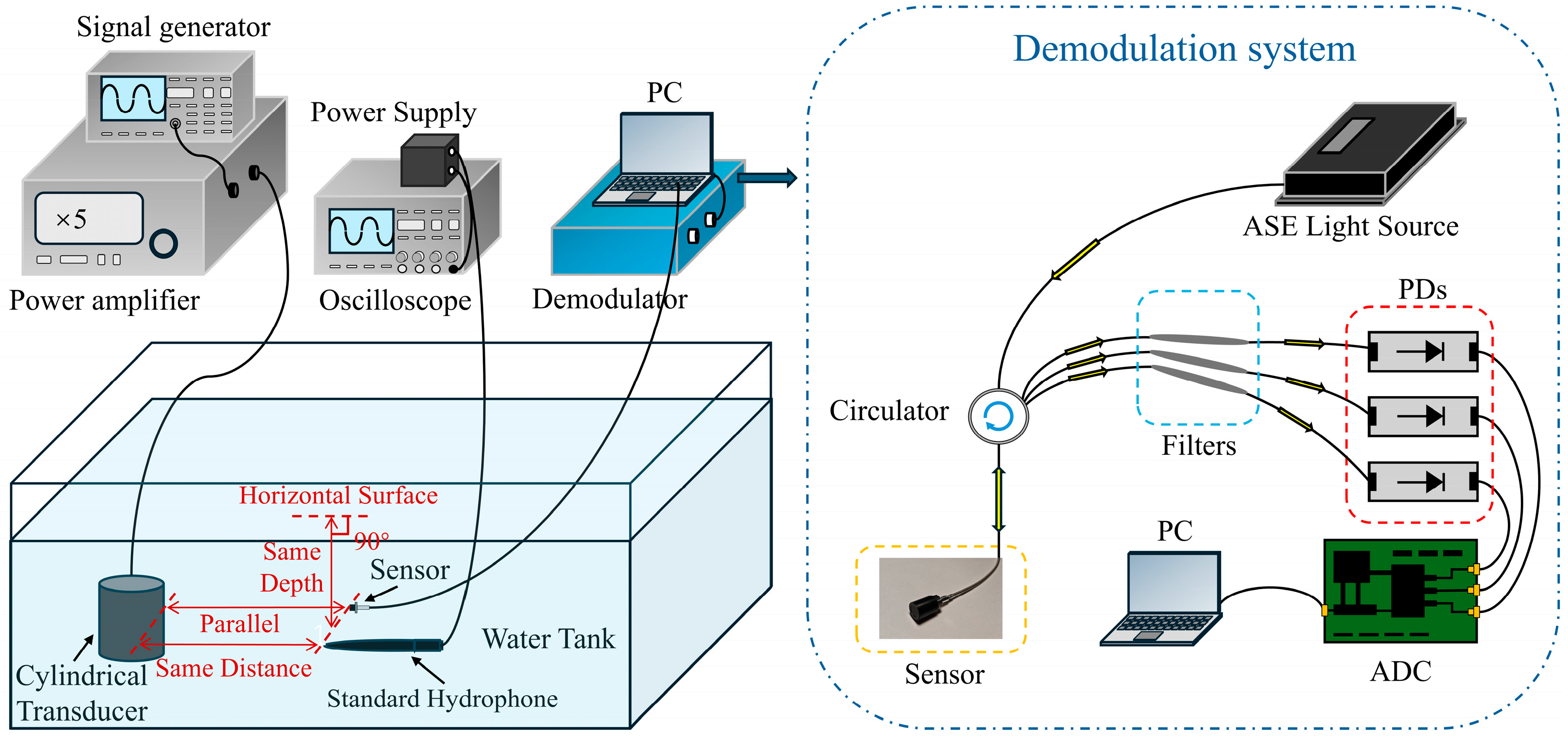
A schematic diagram of the constructed underwater acoustic testing platform is shown in Figure 6. The system consists of a rectangular water tank, a cylindrical acoustic source transducer (CT1(2), China Shipbuilding Industry Corporation No. 715 Research Institute, Hangzhou, China), a standard hydrophone (RHSA-5, China Shipbuilding Industry Corporation No. 715 Research Institute, Hangzhou, China), a signal generator (DG4062, RIGOL Technologies, Suzhou, China), a power amplifier (ATA-6013C, Aigtek, Xi’an, China), a hydrophone power supply (China Shipbuilding Industry Corporation No. 715 Research Institute, Hangzhou, China), an oscilloscope (DSOX2004A, Keysight Technologies, Santa Rosa, CA, USA), and a three-wavelength dynamic demodulation system. The dimensions of the rectangular water tank are 1.5 m × 1.1 m × 0.8 m. The three-wavelength dynamic demodulation system serves as the core unit for real-time extraction and processing of underwater acoustic signals. It mainly consists of an amplified spontaneous emission (ASE) broadband light source (LSM-ASE-CL-F, Junfeng Technology, Tianjin, China), an optical fiber circulator, optical filters, photodetectors (PDs, GaAs PIN photodiodes, Mingguang Technology, Beijing, China), and an analog-to-digital converter (ADC, AD7667, Analog Devices, Norwood, MA, USA). During the experiment, the broadband continuous spectrum generated by the ASE source enters the sensor probe through the optical fiber circulator and undergoes interference within the F-P cavity. The interference spectrum is modulated by the external acoustic pressure. The modulated interference signal returns to the circulator and is then separated into three optical channels by optical filters. These signals are converted into electrical signals by a PD array, and the resulting voltage signals are acquired by the ADC module. The raw data are processed to extract the phase variation in the interference spectrum, which is dis-played in real time on the host computer. After further processing, the cavity length variation in the fiber-optic F-P underwater acoustic sensor is reconstructed, enabling high-sensitivity measurement of the external acoustic pressure. The demodulation system features high accuracy and fast response.
To evaluate the hydrostatic pressure resistance of the silicon MEMS-based fiber-optic F-P underwater acoustic sensor in a liquid environment, the sensor under test was vertically immersed in a rectangular water tank. Starting from the water surface (0 cm), the immersion depth was increased in steps of 10 cm, and the sensor was held at each depth for 10 s to ensure stability. The interference spectrum at each depth was acquired using the optical interrogator, and the initial cavity length shift at each measurement point was calculated using the host computer demodulation program. The relationship between water depth and hydrostatic pressure can be expressed as:
P H = ρ m g H ,
where P H is the hydrostatic pressure applied to the sensor, ρ m is the density of water, taken as 1000 kg/m3, g is the gravitational acceleration, taken as 9.8 m/s2, and h is the immersion depth of the sensor.
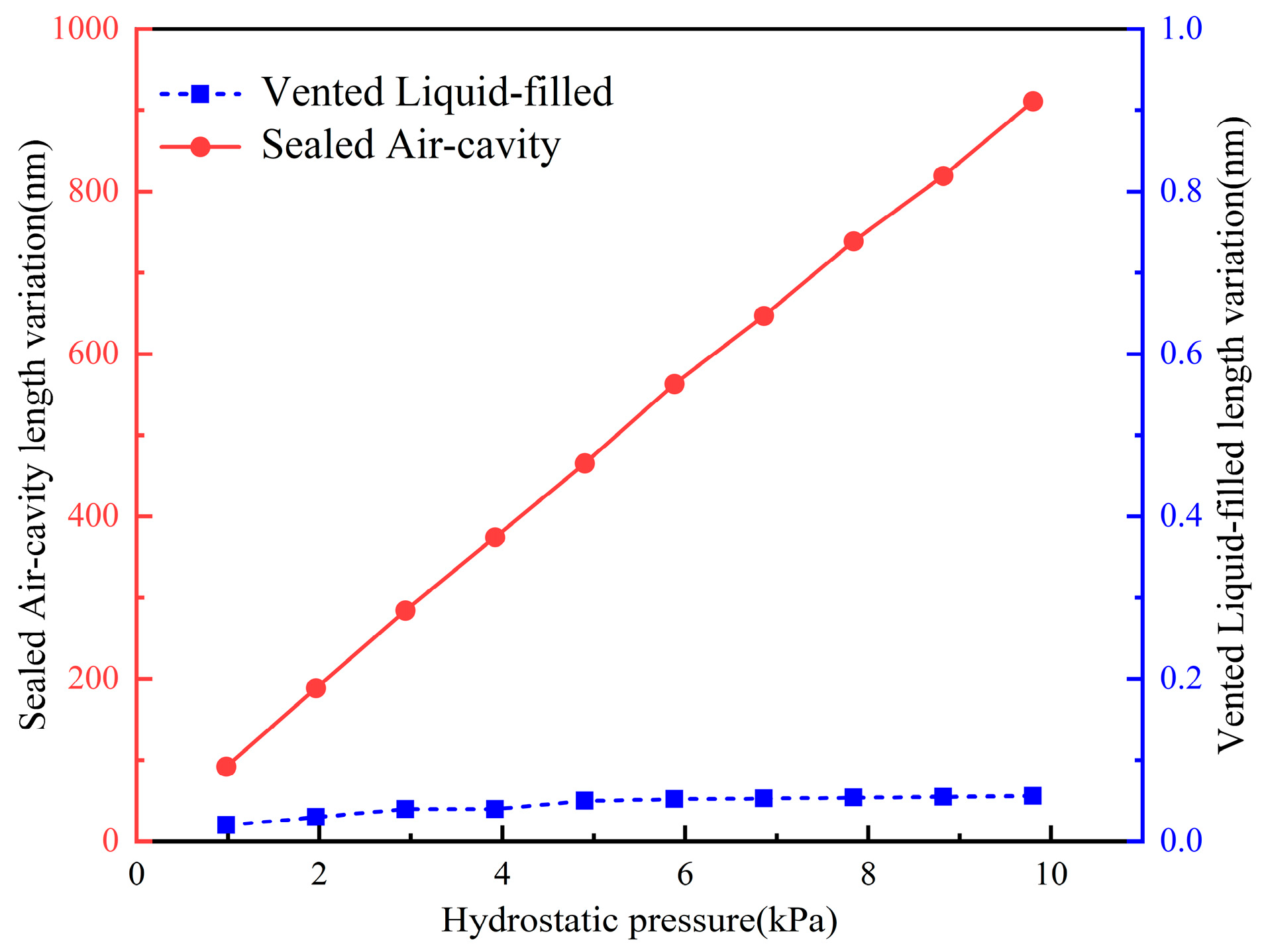
According to Equation (10), an immersion depth of 10 cm corresponds to a hydrostatic pressure of approximately 980 Pa. Based on this, the hydrostatic pressure corresponding to each test depth is calculated. The relationship between the initial cavity length shift and the hydrostatic pressure of the sensor under test is shown in Figure 7.
The results in Figure 7. indicate that when the diaphragm is fluidically connected on both sides and the F-P cavity is filled with water, the cavity length exhibits excellent stability within the tested pressure range, with the cavity length shift remaining nearly constant. In contrast, for the sealed air-filled cavity sensor used as a control group, the cavity length of the F-P cavity decreases significantly under hydrostatic pressure, and the cavity length shift increases linearly with increasing hydrostatic pressure. These results verify the effectiveness of the micro-hole array structure, which enables fluidic communication between the internal and external regions of the diaphragm, thereby establishing an automatic pressure-balancing mechanism between the inside and outside of the F-P cavity. This ensures reliable operation and measurement range stability of the sensor in deep-water environments.
To evaluate the dynamic performance of the silicon MEMS-based fiber-optic Fabry–Perot underwater acoustic sensor, a sinusoidal excitation signal is generated by a signal generator and amplified to drive the transducer, producing acoustic signals at specific frequencies. When the acoustic signal reaches the sensor, the diaphragm deformation modulates the interference signal, which is then transmitted to the three-wavelength dynamic demodulation system for real-time extraction of cavity length variations. A standard hydrophone simultaneously receives the acoustic signal. The peak-to-peak voltage measured by the oscilloscope connected to the hydrophone, combined with its calibrated sensitivity, is used to calculate the acoustic pressure amplitude as the reference value. During the experiment, the acoustic source transducer, the standard hydrophone, and the sensor are positioned at the same horizontal depth. To ensure far-field conditions and satisfy the plane-wave approximation, the distance between the source and the receivers is set to be greater than 30 cm, thereby ensuring that both the sensor and the hydrophone are subjected to an equivalent acoustic pressure field.
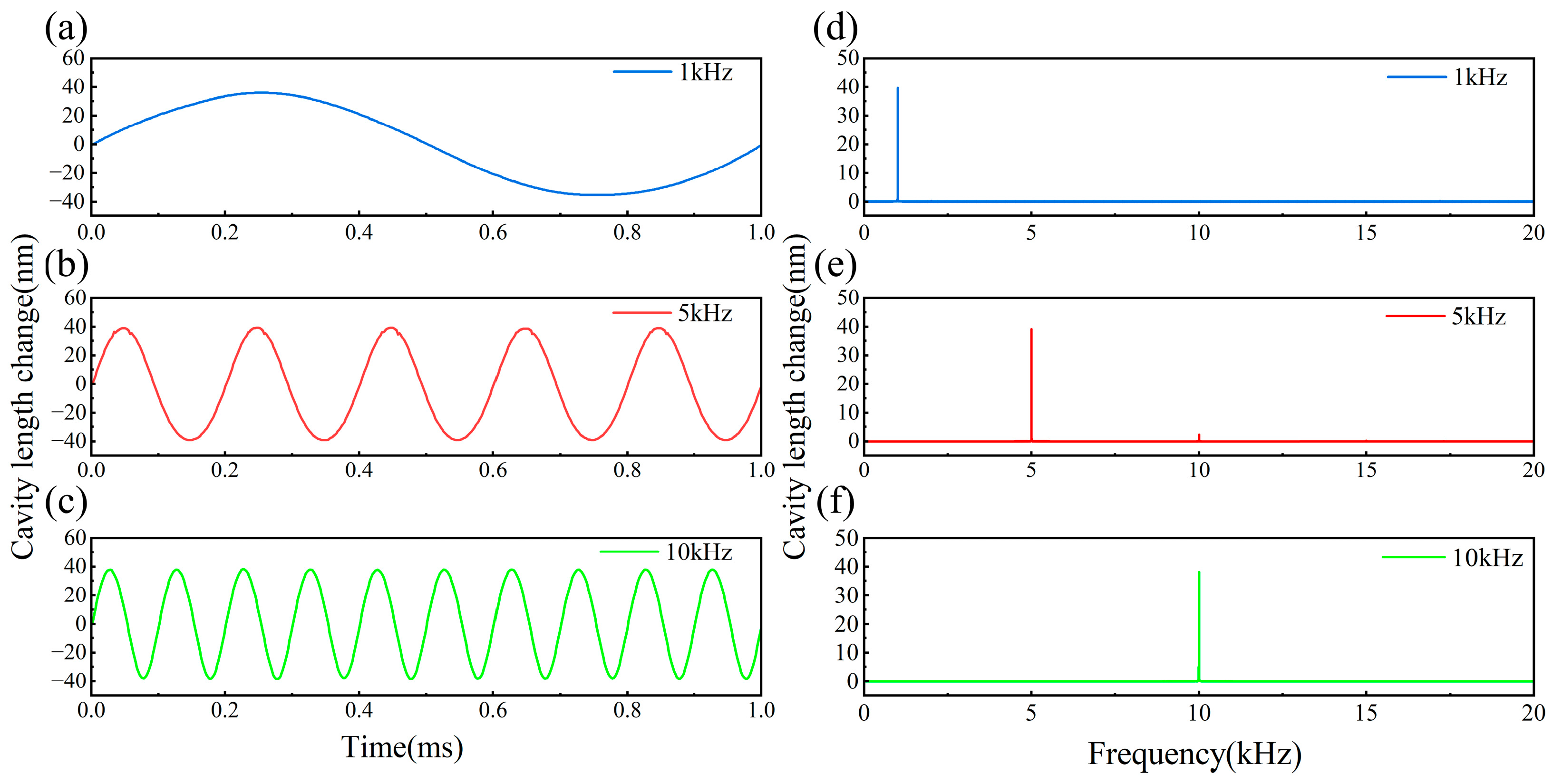
Three frequencies, 1 kHz, 5 kHz, and 10 kHz, are selected as test points. The output is adjusted to maintain an acoustic pressure of 1 kPa. The response of the sensor under sinusoidal excitation at different frequencies is shown in Figure 8. Figure 8a–c present the output waveforms of the sensor within 1 ms at each test frequency, while Figure 8d–f show the corresponding frequency spectra. The experimental results demonstrate that the output waveforms closely match the excitation signals, exhibiting good sinusoidal characteristics.
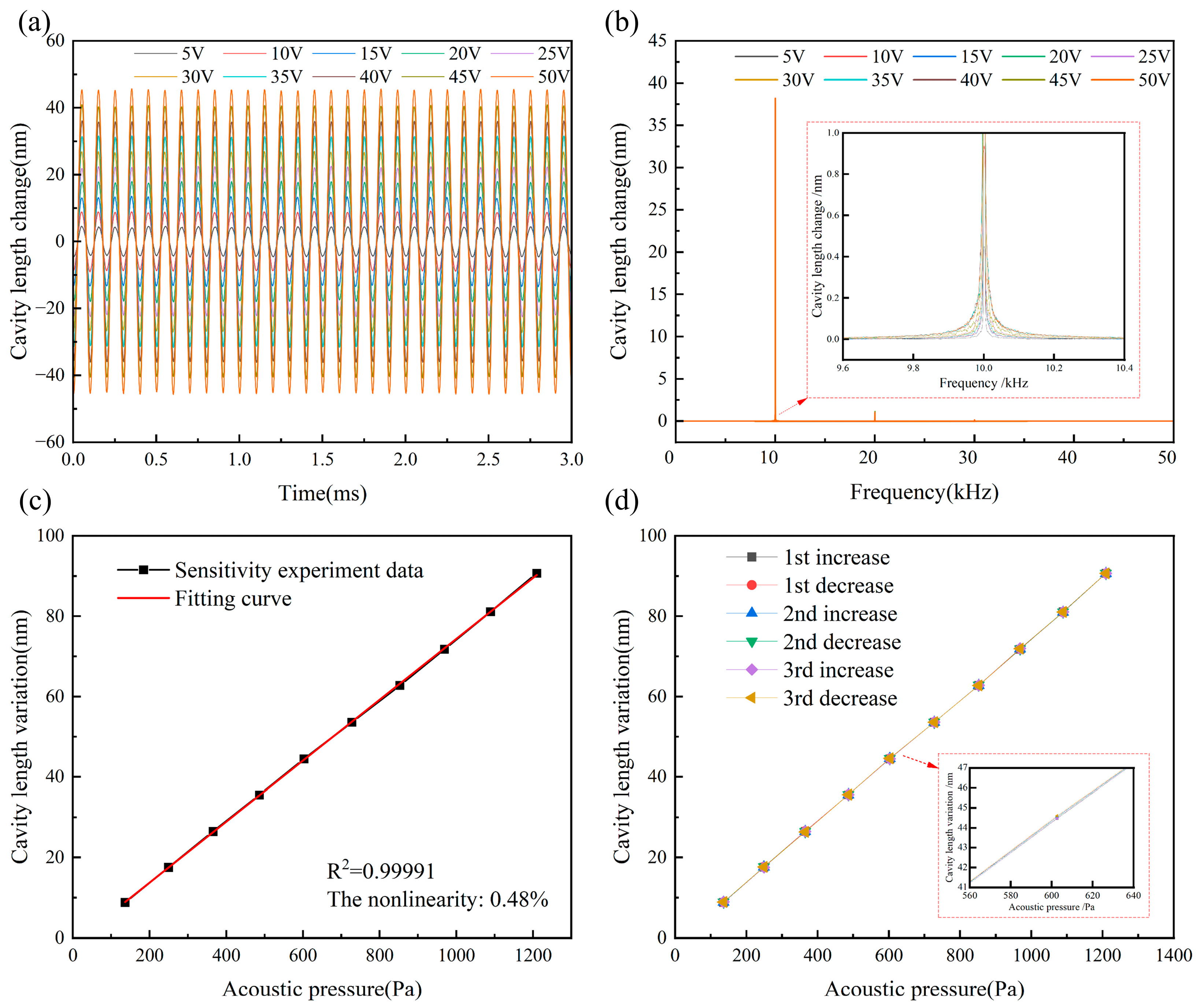
The output frequency of the signal generator is set to 10 kHz, and the driving voltage is increased from 5 V to 50 V in steps of 5 V, corresponding to a reference acoustic pressure range of 136 Pa to 1209 Pa as measured by the hydrophone. To ensure data reliability, the sensor output waveform at each pressure level is recorded for no less than 3 s. The test results of the sensor at 10 kHz are shown in Figure 9. Figure 9a presents the sensor output waveforms under different acoustic pressures, exhibiting standard sinusoidal characteristics consistent with the excitation signal. Figure 9b shows the corresponding output spectra, with the frequency maintained at 10 kHz, matching the excitation frequency. Figure 9c illustrates the relationship between acoustic pressure and the sensor output. Lin-ear fitting yields a sensitivity of 75.78 nm/kPa, with a maximum nonlinearity of 0.48% F.S. Based on Equation (6), the sensitivity of the sensor at 10 kHz is calculated to be −181.79 dB re 1 rad/μPa. Figure 9d shows the repeatability test results of the sensor. At 10 kHz, three complete loading–unloading cycles are performed with the same pressure step, and each pressure level is maintained for 3 s. The processed results indicate a repeatability error of 0.15% F.S. These experimental results demonstrate that the sensor exhibits excellent linear response characteristics, negligible hysteresis, and high repeatability at 10 kHz, indicating strong reliability for acoustic detection.
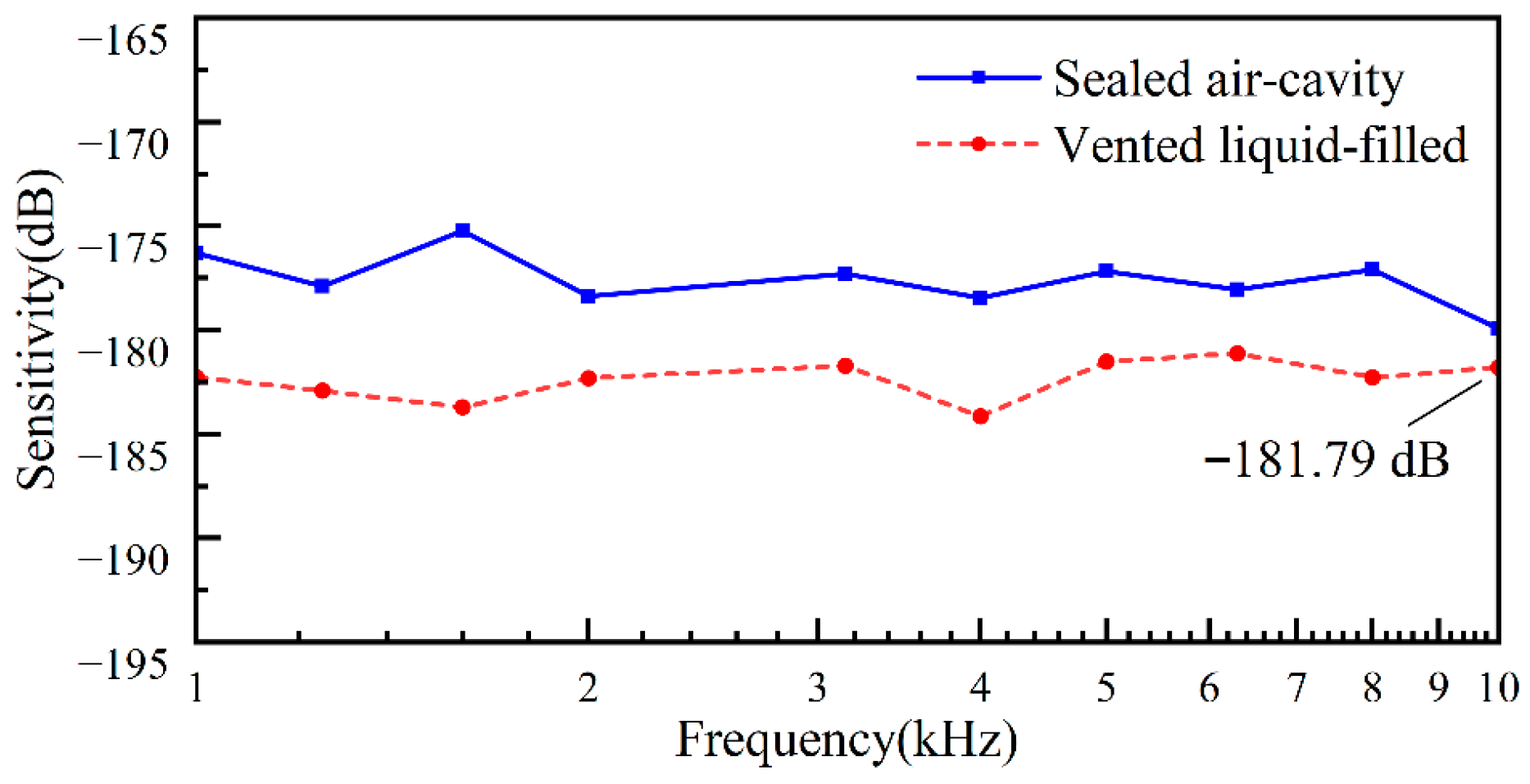
Within the frequency range of 1 kHz to 10 kHz, test points are selected according to the one-third octave standard. At each test point, the frequency is kept constant, and the driving voltage of the signal generator is increased from 5 V to 50 V in steps of 5 V to excite the acoustic source. By synchronously recording the demodulated output of the sensor and the acoustic pressure amplitude measured by the reference hydrophone, the mechanical sensitivity at each frequency is obtained. The phase sensitivity of the sensor is then calculated based on Equation (6), and a comparison is conducted with that of a sealed air-filled cavity sensor. The measured frequency response characteristics are shown in Figure 10. The results indicate that although filling the F-P cavity with water leads to a slight reduction in sensitivity compared with the air-filled configuration, the proposed sensor exhibits an excellent flat frequency response within ±1.5 dB over the range of 1 kHz to 10 kHz.
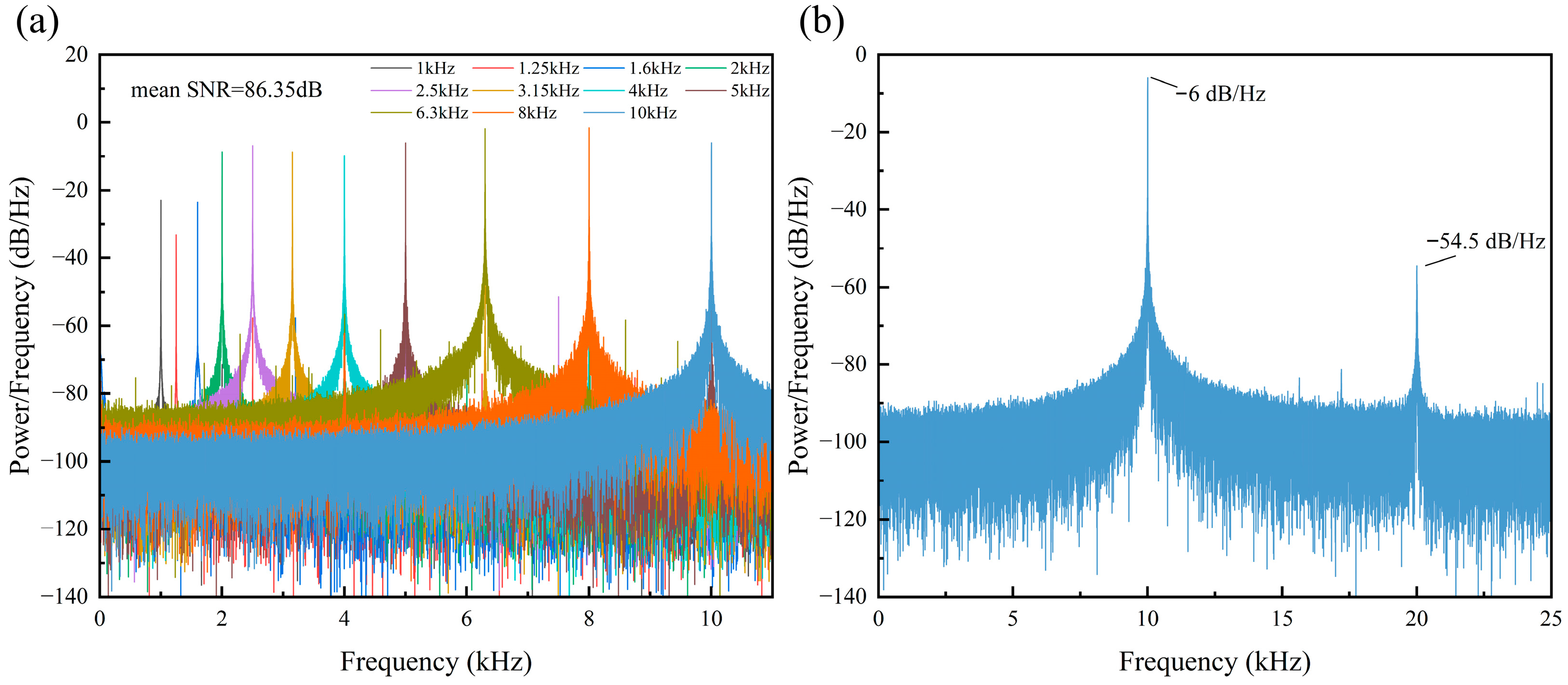
In the frequency range from 1 kHz to 10 kHz, test points were selected according to the 1/3-octave standard. The driving voltage of the signal generator was maintained at 50 V, and the demodulated output of the sensor was recorded. By applying FFT and incorporating the resolution bandwidth (RBW), the power spectral density of the sensor was obtained, as shown in Figure 11. Figure 11a shows the power spectral density of the sensor at different frequencies from 1 kHz to 10 kHz. The average signal-to-noise ratio (SNR) within this range is 86.35 dB, indicating good signal processing capability and noise immunity in the tested frequency band. Figure 11b shows the power spectral density of the sensor at 10 kHz. The results indicate that the THD at 10 kHz is −48.5 dB, which is well below −30 dB, confirming that the sensor operates within the linear regime under a 50 V excitation, and the maximum linear operating acoustic pressure is 181.65 dB re 1 μPa. At 10 kHz, based on the sensor’s SNR and phase sensitivity, the MDP is calculated to be 11 mPa/ H z , corresponding to 80.82 dB re 1 μPa/ H z . Since the THD is −48.5 dB, the dynamic range of the sensor at 10 kHz is 100.83 dB.
Table 2 shows a comparison of the key characteristics of underwater acoustic sensors with different sensitive diaphragm materials, where some parameter details are not mentioned in the referenced papers. Although the sensor designed in this study has a lower sensitivity, it demonstrates excellent performance in terms of signal-to-noise ratio and dynamic range. In practical applications, the sensor’s parameters can be adjusted by modifying diaphragm size or optimizing the demodulation system to meet specific requirements.


5. Conclusions

A silicon MEMS-based fiber-optic Fabry–Perot underwater acoustic sensor with a micro-perforated central-bossed diaphragm is designed and fabricated by integrating fiber-optic sensing technology with MEMS technology. The optical signal quality is improved, and automatic hydrostatic pressure balancing is achieved across the diaphragm. The results of hydrostatic pressure tests and underwater dynamic acoustic pressure measurements demonstrate that the initial cavity length remains nearly unchanged at different depths. The sensor achieves a sensitivity of −181.79 dB and a dynamic range of 100.83 dB at 10 kHz, and exhibits a flat frequency response within ±1.5 dB over the range of 1 kHz to 10 kHz, with an average SNR of 86.35 dB. The maximum nonlinearity is 0.48% F.S., and the repeatability error is 0.15% F.S. The proposed sensor features high consistency, stable cavity length under varying hydrostatic pressures, and a compact structure. It provides an effective solution for acoustic detection in deep-sea environments under high hydrostatic pressure and shows broad application prospects in deep-sea resource exploration, underwater vehicle sonar systems, and large-scale fiber-optic hydrophone array networks.

Author Contributions

Conceptualization, Z.F.; methodology, P.J.; software, Q.R.; validation, Z.F., J.W. and H.W. (Huarui Wang); writing—original draft preparation, Z.F.; writing—review and editing, Z.F., J.L. and H.W. (Haiyang Wang); project administration, P.J. All authors have read and agreed to the published version of the manuscript.

Funding

This research was funded by the State key Laboratory of Extreme Environment Optoelectronic Dynamic Measurement Technology and Instrument (grant number 2024-SYSJJ-02); and the National Natural Science Foundation of China (grant number 52505617).

Institutional Review Board Statement

Not applicable.

Informed Consent Statement

Not applicable.

Data Availability Statement

The data will be made available upon request.

Conflicts of Interest

The authors declare no conflicts of interest.

References

  1. Liu, M.; Zhang, L.; Qu, W.; Da, L.; Liu, T. Advances in MEMS Hydrophone Technology. IEEE Access 2025, 13, 79955–79976. [Google Scholar] [CrossRef]
  2. Zhang, G.; Liu, M.; Shen, N.; Wang, X.; Zhang, W. The Development of the Differential MEMS Vector Hydrophone. Sensors 2017, 17, 1332. [Google Scholar] [CrossRef]
  3. Hadeed, M.; Bhatti, H.S.; Aizzuddin, A.M.; Vorathin, E.; Mohamad, H. Review of fibre optic hydrophones for potential application in offshore carbon storage monitoring. Sens. Actuators A Phys. 2025, 386, 116341. [Google Scholar] [CrossRef]
  4. Wang, S.; Wang, Y.; Wang, Z.; Wu, Z.; Xin, Y.; Zhou, X. A brief review on hydrophone based on PVDF piezoelectric film. Ferroelectrics 2023, 603, 150–156. [Google Scholar] [CrossRef]
  5. Shi, S.; Geng, W.; Bi, K.; He, J.; Hou, X.; Mu, J.; Li, F.; Chou, X. Design and fabrication of a novel MEMS piezoelectric hydrophone. Sens. Actuators A Phys. 2020, 313, 112203. [Google Scholar] [CrossRef]
  6. Yang, D.; Yang, L.; Chen, X.; Qu, M.; Zhu, K.; Ding, H.; Li, D.; Bai, Y.; Ling, J.; Xu, J.; et al. A piezoelectric AlN MEMS hydrophone with high sensitivity and low noise density. Sens. Actuators A Phys. 2021, 318, 112493. [Google Scholar] [CrossRef]
  7. Zhang, J.Z.; Cary, B.G.; Yeiser, A.; McHugh, C.I.; Nakajima, H.H.; Lang, J.H.; Kymissis, I.; Olson, E.S. A Pvdf-Trfe Intracochlear Hydrophone and Amplifier for Totally Implantable Cochlear Implants. In Proceedings of the 2022 IEEE 35th International Conference on Micro Electro Mechanical Systems (MEMS), Tokyo, Japan, 9–13 January 2022; IEEE: New York, NY, USA, 2022; pp. 408–411. [Google Scholar] [CrossRef]
  8. Roh, T.; Yeo, H.G.; Joh, C.; Roh, Y.; Kim, K.; Seo, H.S.; Choi, H. Fabrication and underwater testing of a vector hydrophone comprising a triaxial piezoelectric accelerometer and spherical hydrophone. Sensors 2022, 22, 9796. [Google Scholar] [CrossRef]
  9. Okamoto, Y.; Nguyen, T.V.; Takahashi, H.; Takei, Y.; Okada, H.; Ichiki, M. Highly sensitive low-frequency-detectable acoustic sensor using a piezoresistive cantilever for health monitoring applications. Sci. Rep. 2023, 13, 6503. [Google Scholar] [CrossRef]
  10. Zhao, J.; Hu, Q.; Fu, T.; Liu, H.; Yao, Y.; Zhou, W.; Zhu, Z. Capacitive Low-Frequency Hydrophone Based on Micronanostructured Iontronic Hydrogel for Underwater Monitoring. ACS Nano 2024, 18, 22010–22020. [Google Scholar] [CrossRef]
  11. Zhang, H.; Liu, Z.; Xiao, B.; Wu, B.; Zhang, Z.; Ping, Q.; Qiu, L.; Lou, L. A Piezoelectric MEMS Vector Hydrophone Based on Sc0.2Al0.8N. IEEE Trans. Electron Devices 2025, 72, 3120–3126. [Google Scholar] [CrossRef]
  12. Wang, J.; Li, Y.; Yang, N.; Huang, Y.; Liu, G.; Wang, H.; Jia, P. MEMS-Based High-Temperature Fiber-Optic Acoustic Pressure Sensor for Harsh Environment Monitoring. IEEE Sens. J. 2025, 25, 24061–24068. [Google Scholar] [CrossRef]
  13. Zhai, H.; Wang, Q.; Zhou, B.; Fan, Y.; Wang, F.; Yao, Q.; Xia, J. Advances in fiber-optic-based 3D shape sensing technology. Opt. Laser Technol. 2025, 190, 113190. [Google Scholar] [CrossRef]
  14. Dass, S.; Jha, R. Underwater low acoustic frequency detection based on in-line Mach–Zehnder interferometer. J. Opt. Soc. Am. B 2021, 38, 570–575. [Google Scholar] [CrossRef]
  15. Ma, J.; Yu, Y.; Jin, W. Demodulation of diaphragm based acoustic sensor using Sagnac interferometer with stable phase bias. Opt. Express 2015, 23, 29268–29278. [Google Scholar] [CrossRef]
  16. Zhu, W.; Li, D.; Liu, J.; Wang, R. Membrane-free acoustic sensing based on an optical fiber Mach–Zehnder interferometer. Appl. Opt. 2020, 59, 1775–1779. [Google Scholar] [CrossRef]
  17. Foster, S.B.; Cranch, G.A.; Harrison, J.; Tikhomirov, A.E.; Miller, G.A. Distributed feedback fiber laser strain sensor technology. J. Light. Technol. 2017, 35, 3514–3530. [Google Scholar] [CrossRef]
  18. Li, C.; Peng, X.; Liu, J.; Wang, C.; Fan, S.; Cao, S. D-shaped fiber Bragg grating ultrasonic hydrophone with enhanced sensitivity and bandwidth. J. Light. Technol. 2019, 37, 2100–2108. [Google Scholar] [CrossRef]
  19. Zhang, F.; Jiang, S.; Zhang, X.; Wang, C.; Ni, J.; Peng, G. Ultra-thin fiber laser hydrophone with static pressure equalization and improved response. IEEE Photonics Technol. Lett. 2019, 31, 1968–1970. [Google Scholar] [CrossRef]
  20. Wu, J.; Wang, R.; Zhang, X.; Li, H.; Liu, G.; Dong, X.; Zhang, W.; Zhang, G. Design simulation and process realization of a flexible MEMS vector hydrophone. Sens. Rev. 2025, 45, 165–174. [Google Scholar] [CrossRef]
  21. Li, S.; Zhang, Y.; Ma, C.; Wang, A.; Wang, Y.; Zhong, Z.; Shan, M.; Liu, B. MEMS optical fiber F-P hydrophone based on corrugated PET diaphragm. IEEE Trans. Instrum. Meas. 2023, 72, 7001710. [Google Scholar] [CrossRef]
  22. Zang, P.; Wang, S.; Jiang, J.; Li, Z.; Yang, H.; Dai, X.; Liu, T. A Fiber-Optic Extrinsic Fabry–Perot Hydrophone Based on Archimedes Spiral-Type Sensitive Diaphragm. IEEE Sens. J. 2022, 22, 22654–22660. [Google Scholar] [CrossRef]
  23. Wang, A.; Fan, X.; Chen, G.; Liu, Y.; Li, Z.; Zhang, Z.; Wang, X.; Zhang, F.; Zhang, Z.; Qiu, H.; et al. Ultrahigh-Sensitivity 3D-Printed Hollow Fabry–Perot Fiber Ultrasound Sensor for Photoacoustic Imaging. ACS Photonics 2025, 12, 4553–4562. [Google Scholar] [CrossRef]
  24. Sun, Y.; Feng, G.; Georgiou, G.; Niver, E.; Noe, K.; Chin, K. Center embossed diaphragm design guidelines and Fabry–Perot diaphragm fiber optic sensor. Microelectron. J. 2008, 39, 711–716. [Google Scholar] [CrossRef]
  25. Cao, Z. Theory of Vibration of Plates and Shells; China Railway Publishing House: Beijing, China, 1989; pp. 273–289. [Google Scholar]
Figure 1. Schematic diagram of the sensor structure.
Photonics 13 00443 g001
Figure 2. Comparison of simulated spectral signals in air and water.
Photonics 13 00443 g002
Figure 3. Analysis of diaphragm sensitivity and structural characteristics: (a) Relationship between diaphragm dimensions and sensitivity; (b) Comparison of inner surface deformation between diaphragms with a central boss and flat diaphragms.
Photonics 13 00443 g003
Figure 4. Sensor fabrication process: (a) MEMS fabrication process of the sensing diaphragm, where the slashed region indicates the micro-perforated structure formed by DRIE; (b) wafer bonding and dicing; (c) sensor integration.
Photonics 13 00443 g004
Figure 5. (a) Photograph of the packaged sensor; (b) Experimental comparison of spectral signals in air and water.
Photonics 13 00443 g005
Figure 6. Schematic diagram of the underwater acoustic testing platform.
Photonics 13 00443 g006
Figure 7. Hydrostatic pressure resistance test results.
Photonics 13 00443 g007
Figure 8. Results of sinusoidal acoustic excitation: (a) Sensor output waveform at 1 kHz; (b) Sensor output waveform at 5 kHz; (c) Sensor output waveform at 10 kHz; (d) Sensor output spectrum at 1 kHz; (e) Sensor output spectrum at 5 kHz; (f) Sensor output spectrum at 10 kHz.
Photonics 13 00443 g008
Figure 9. Sensor test results at 10 kHz: (a) Sensor output waveforms under different acoustic pressures; (b) Sensor output spectra under different acoustic pressures; (c) Relationship between acoustic pressure and sensor output; (d) Repeatability test results of the sensor.
Photonics 13 00443 g009
Figure 10. Comparison of frequency response between sealed air-cavity and vented liquid-filled cavity sensors.
Photonics 13 00443 g010
Figure 11. Power spectral density of the sensor: (a) at 10 kHz; (b) in the frequency range from 1 kHz to 10 kHz.
Photonics 13 00443 g011
Table 1. Design parameters of the sensor.
Parameter DescriptionSymbolValue (Unit)
Diaphragm radius a 1500 μm
Diaphragm thickness h 25 μm
Central boss radius b 750 μm
Central boss thickness H 75 μm
Micro-perforation diameter d 100 μm
Number of perforations N 4
Radial position of micro-perforations R d 1.25 mm
Side length of the Si die L S i 6 mm
Thickness of the Si die H S i 300 μm
Density of Silicon ρ d 2329 kg/m3
Young’s modulus E 170 GPa
Poisson’s ratio ν 0.28
Table 2. Performance comparison of F-P hydrophones with different sensing diaphragms. ‘-’ indicates that the corresponding parameter is not reported in the referenced literature.
Ref.MaterialF-P Cavity MediumSensitivity
(dB re 1 rad/μPa)
SNR (dB)Bandwidth (Hz)MDP (mPa/ H z )Dynamic Range (dB)
[21]PETAir−149.24-20~800673.12
(μPa/ H z )
72.21
[22]MetalWater−172.5252.11k~20k3.9-
[23]3D-Printed PolymerAir797 (mV/kPa)-1.2M2.56 (NEP Density)-
This WorkSiliconWater−181.7986.351k~10k11100.83
Disclaimer/Publisher’s Note: The statements, opinions and data contained in all publications are solely those of the individual author(s) and contributor(s) and not of MDPI and/or the editor(s). MDPI and/or the editor(s) disclaim responsibility for any injury to people or property resulting from any ideas, methods, instructions or products referred to in the content.