Article

Spectral Phase Control in Dissociation Dynamics of HD+ by Strong Laser Fields


1
Key Laboratory of Atomic and Molecular Physics and Functional Materials of Gansu Province, College of Physics and Electronic Engineering, Northwest Normal University, Lanzhou 730070, China
2
Hunan Key Laboratory of Supermicrostructure and Ultrafast Process, School of Physics, Central South University, Changsha 410083, China
3
School of Physics and Information Science, Shaanxi University of Science and Technology, Xi’an 710021, China
*
Author to whom correspondence should be addressed.
These authors contributed equally to this work.
Photonics 2026, 13(4), 383; https://doi.org/10.3390/photonics13040383
Submission received: 22 March 2026 / Revised: 4 April 2026 / Accepted: 8 April 2026 / Published: 16 April 2026
(This article belongs to the Special Issue Laser-Driven Ultrafast Dynamics and Imaging in Atoms and Molecules)

Abstract

Achieving selective cleavage of specific chemical bonds using ultrafast laser pulses remains a central challenge in ultrafast strong-field molecular physics. Here, we theoretically investigate the coherent control of strong-field dissociation of the heteronuclear molecular ion HD+ initially prepared in vibrationally excited states driven by an ultrashort pulse with a quadratic spectral phase. Our results reveal a pronounced sensitivity of both the total dissociation probability and the branching ratio (H+ + D vs. H + D+) to the chirp rate of the laser pulse. To uncover the underlying physical mechanism, we analyze the population dynamics in the coupled 1 s σ and 2 p σ electronic states and identify pronounced Rabi oscillations arising from the coherent interplay between multiphoton excitation and field-induced stimulated emission. By tuning the laser chirp rate, these oscillations can be suppressed via quantum interference, thereby reshaping the dissociation dynamics and significantly enhancing the dissociation probability of the H + D+ channel. These findings demonstrate that spectral-phase engineering provides a robust and versatile strategy for selective control of branching ratios in strong-field molecular dissociation.

1. Introduction

The interaction of intense ultrafast laser fields with molecules can induce a wide range of nonlinear dynamical processes, including molecular alignment [1,2], orientation [3,4,5,6,7,8], dissociation [9,10,11,12,13], above-threshold dissociation [14,15,16], sequential and non-sequential multiple ionization [17,18,19,20,21], and Coulomb explosion [22]. Among these phenomena, achieving selective control of molecular dissociation remains a central objective in ultrafast strong-field molecular physics. Advances in ultrafast laser technology have enabled precise manipulation of coupled electronic and nuclear motion on femtosecond timescales, providing new opportunities to steer chemical bond cleavage and reaction pathways [23,24]. Coherent control has emerged as an effective approach for manipulating dissociation dynamics with tailored laser fields. In general, coherent control can be implemented through two complementary strategies: time-domain and frequency-domain manipulations. Time-domain control exploits adjustments of laser parameters, such as pulse duration, peak intensity, and interpulse delay, to influence transient excitation and nuclear wave-packet evolution [25,26,27,28]. Frequency-domain control, by contrast, relies on shaping the spectral amplitude or spectral phase of the laser field to induce constructive or destructive interference among different frequency components. In particular, spectral-phase modulation can significantly modify the temporal structure and instantaneous frequency of a laser pulse without changing the total pulse energy, thereby providing a powerful way for controlling dissociation outcomes [29,30,31,32].
In the weak-field regime, dissociation dynamics are typically dominated by single-photon processes. For gas-phase molecules initially prepared in vibrational eigenstates of the ground electronic state, previous studies have explored how spectral-phase modulation affects transient dissociation dynamics [33,34,35,36,37,38,39]. These investigations indicate that steady-state observables such as fragment yields and energy distributions are generally insensitive to the spectral phase of laser pulse, although carefully designed phase modulation can produce measurable effects in specific dissociation channels [40,41]. In the strong-field regime, however, multiphoton absorption, nonadiabatic coupling, and field-induced resonances give rise to highly nonlinear dissociation dynamics. Simple diatomic systems, such as H 2 + , have been extensively studied, revealing mechanisms including tunneling ionization, Rabi-type oscillations between the 1 s σ g and 2 p σ u electronic states, and charge-resonance enhanced ionization [42,43,44,45]. For heteronuclear molecules, recent theoretical studies have found that both the total dissociation probability and the branching ratios between competing channels can be highly sensitive to the spectral phase of the laser pulse. Importantly, the influence of spectral phase depends strongly on the initial vibrational state of molecules, where coherent interference can selectively enhance or suppress particular dissociation pathways [46,47].
Hydrogen molecules and their molecular ions serve as prototypical systems for investigating ultrafast strong-field dynamics. In contrast to the homonuclear H 2 + ion, the heteronuclear molecular ion HD+ possesses a permanent dipole moment and lacks inversion symmetry, leading to distinct multiphoton absorption characteristics and asymmetric dissociation behaviors. These properties make HD+ an ideal platform for studying laser-controlled molecular dissociation and testing coherent control strategies [48,49,50,51,52,53]. In this work, we theoretically propose to control the strong-field dissociation dynamics of HD+ driven by ultrashort laser pulses with a quadratic spectral phase. By numerically solving the time-dependent Schrödinger equation (TDSE), we analyze how the laser chirp rate influences the total dissociation probability and the branching ratio between the H+ + D and H + D+ channels. Particularly, we demonstrate that the role played by the laser-driven Rabi-type oscillations between the coupled 1 s σ and 2 p σ electronic states in controlling the dissociation pathways. Our results confirm that the chirp-induced spectral-phase modulation can effectively control population dynamics through quantum interference, thereby enabling selective control of competing dissociation channels in the strong-field regime.

2. Numerical Models and Methods

As a prototypical system, we focus on the photodissociation of the molecular ion HD+. The system is described by a one-dimensional, two-state model in the adiabatic representation, consisting of the ground electronic state ( 1 s σ ) and the first excited electronic state ( 2 p σ ), as illustrated in Figure 1. Rotational motion and higher electronic states are neglected, which is a common approximation for simple molecular ions [54,55]. This model captures the essential physics of electronic-state coupling and nuclear wave-packet dynamics along the bond-stretching coordinate, providing a reasonable framework to investigate multiphoton excitation, stimulated emission, and chirp-induced quantum interference. Nuclear wave-packet dynamics are governed by the TDSE, which incorporates adiabatic potentials and dipole interactions with the linearly polarized laser field [56]:
i t Ψ 1 ( R , t ) Ψ 2 ( R , t ) = 1 2 μ / R 0 0 / R + 0 P 12 ( R ) P 21 ( R ) 0 2 Ψ 1 ( R , t ) Ψ 2 ( R , t ) + V 1 ( R ) + Δ E 11 ( R ) 0 0 V 2 ( R ) + Δ E 22 ( R ) Ψ 1 ( R , t ) Ψ 2 ( R , t ) ε ( t ) d 11 ( R ) d 12 ( R ) d 21 ( R ) d 22 ( R ) Ψ 1 ( R , t ) Ψ 2 ( R , t ) ,
with
Δ E 11 ( R ) 1 2 μ P 12 2 ( R ) + Q 11 ( R ) , Δ E 22 ( R ) 1 2 μ P 12 2 ( R ) + Q 22 ( R ) .
Here, μ is the reduced mass of HD+, μ = M H M D M H + M D , and R is the internuclear distance. The adiabatic potential energy curves V i ( R ) ( i = 1 , 2 ) and the corresponding transition and permanent dipole moments d i j ( R ) used in this work are adopted from ref. [54] and are interpolated in our calculations. Specifically, the off-diagonal element d 12 ( R ) = d 21 ( R ) denotes the transition dipole moment between the 1 s σ and 2 p σ states, while the diagonal elements d 11 ( R ) and d 22 ( R ) correspond to their permanent dipole moments. Due to the mass asymmetry of the nuclei in HD+, nonadiabatic couplings must be considered, introducing the derivative coupling terms P i j ( R ) and Q i j ( R ) through a unitary transformation of potential energies and dipole moments [54,55]. The terms P i j ( R ) and Q i j ( R ) account for the nonadiabatic effects arising from the action of nuclear derivatives on the channel functions.
The time-dependent electric field of the laser pulse with a coherent phase can be written as [33,57]
E ( t ) = E 0 Re A ( ω ) e i ϕ ( ω ) e i ω t d ω ,
where A ( ω ) is the real-valued spectral amplitude and ϕ ( ω ) is the spectral phase. The pulse duration and temporal profile are determined by ϕ ( ω ) , while the pulse energy | E ( t ) | 2 d t | A ( ω ) e i ϕ ( ω ) | 2 d ω | A ( ω ) | 2 d ω is independent of the spectral phase. We consider a Gaussian frequency distribution centered at ω 0 with a quadratic phase:
A ( ω ) e i ϕ ( ω ) = τ 0 2 2 π e τ 0 2 ( ω ω 0 ) 2 / 2 + i β 0 ( ω ω 0 ) 2 / 2 ,
where ω 0 is the central frequency; τ 0 is the pulse duration; and β 0 is the chirp rate. The corresponding time-dependent electric field is
E ( t ) = E 0 Re τ 0 2 τ 0 2 i β 0 exp t 2 2 τ 2 i β t 2 2 i ω 0 t ,
where E 0 is the electric-field amplitude of the transform-limited pulse, β = β 0 ( τ 0 4 + β 0 2 ) , τ 2 = τ 0 2 1 + β 0 2 τ 0 4 . The corresponding full width at half maximum (FWHM) of the pulse is τ FWHM = τ 8 ln 2 .
The initial vibrational eigenfunctions of the ground electronic state are obtained by diagonalizing the nuclear Hamiltonian using the Fourier Grid Hamiltonian (FGH) method [58]. The internuclear coordinate is discretized on a uniform grid with a spatial step of d R = 0.02 a.u., spanning the range R [ 0.5 a . u . , 200 a . u . ] . Time propagation of the nuclear wave packet is performed using the split-operator method in combination with the fast Fourier transform (FFT) algorithm [59]. A temporal step size of d t = 0.01 fs is adopted to ensure numerical stability and convergence. To suppress unphysical reflections at the grid boundaries, an absorbing boundary function is applied [60]. Based on the resulting time-dependent wave functions, both the population dynamics of individual vibrational states in the ground electronic state and the evolution of populations in different electronic states are subsequently evaluated.
The time-dependent populations in each electronic state are computed as
P i ( t ) = 0 | Ψ i ( R , t ) | 2 d R .
Here, i refers to the 1 s σ and 2 p σ electronic states, and the dissociation probability for the H+ + D and H + D+ channels is obtained via the asymptotic probability flux at a sufficiently large internuclear separation, fixed at R c = 25 a.u.:
J ^ H + / D + ( t ) = μ Im Ψ i ( R , t ) Ψ i ( R , t ) R R = R c ,
The time-integrated flux over [0, t] yields the dissociation probability
P H + / D + ( t ) = 0 t J ^ H + / D + ( t ) d t ,
To quantify the relative yield of the D+ fragment, we define the branching ratio
Γ D + ( t ) = P D + ( t ) P H + ( t ) + P D + ( t ) .
This framework enables a detailed investigation of the effect of laser spectral phase (chirp rate) on Rabi oscillations and the selective control of dissociation pathways in HD+.

3. Results and Discussions

We examine the influence of both the initial vibrational state of HD+ and the spectral phase of the laser pulse on the dissociation probabilities of two fragmentation channels, H+ + D and H + D+, as well as the corresponding branching ratio Γ D + ( t = t f ) . Only the bond-stretching vibrational mode is considered, and three vibrational eigenstates ( ν = 5 , 6 , 7 ) of the ground electronic state are selected as the initial states, respectively. Lower vibrational levels have relatively small dissociation probabilities, and increasing their dissociation probability would require stronger laser fields, which may also induce ionization. Higher vibrational levels, on the other hand, can be fully dissociated even under weaker fields. This selection allows us to investigate the mechanism of spectral phase control effectively. To ensure that the excitation energy from each initial vibrational state to the excited electronic state is identical, laser pulses with wavelengths of 400 nm, 425 nm, and 451 nm are applied for ν = 5 , 6 , and 7, respectively. This choice effectively isolates the role of spectral-phase control in the dissociation dynamics of HD+ by eliminating variations due to laser wavelength.
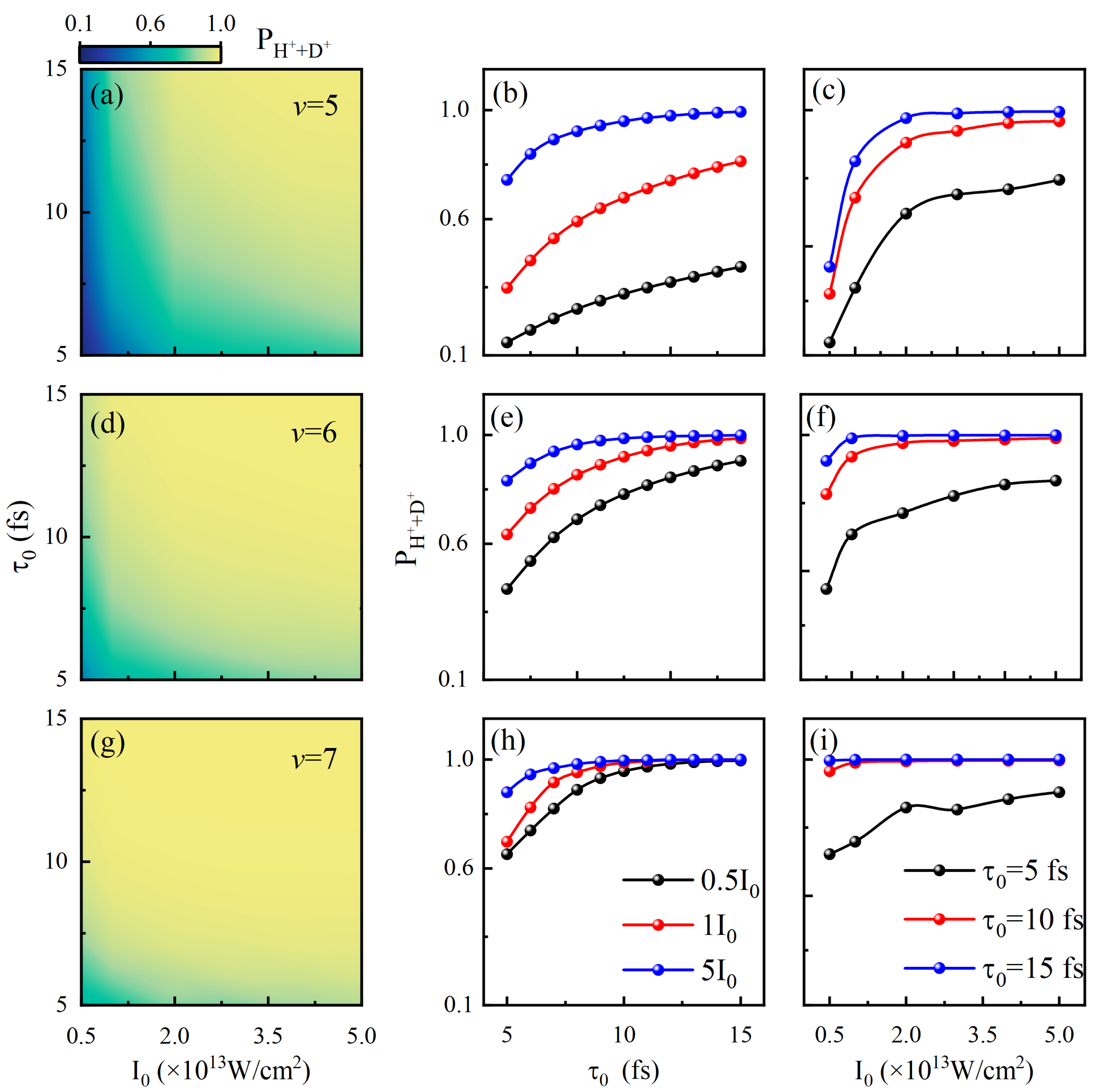
Figure 2 shows the total dissociation probability P H + + D + ( t = t f ) of HD+ as functions of the laser peak intensity I 0 and pulse duration τ 0 for three initial vibrational states, with Figure 2a,d,g corresponding to ν = 5 , 6, and 7, respectively. In general, P H + + D + increases monotonically with both peak intensity and pulse duration, reflecting more efficient population transfer from the ground electronic state to the excited electronic state under stronger and longer laser pulses. Among the three states, ν = 7 reaches near-complete dissociation at relatively lower peak intensities, which can be attributed to its larger average internuclear separation and higher initial vibrational energy that facilitate access to the dissociative continuum.
To further disentangle the individual contributions of pulse duration τ 0 and peak intensity I 0 , we examine P H + + D + by varying τ 0 at fixed I 0 , and conversely by varying I 0 at fixed τ 0 . At a given peak intensity I 0 , increasing the pulse duration τ 0 enhances P H + + D + by allowing the nuclear wave packet more time to evolve into the dissociative region, as shown in Figure 2b,e,h. Conversely, for a fixed pulse duration, increasing the peak intensity strengthens the laser–molecule interaction, thereby promoting population transfer to the excited electronic state and facilitating dissociation, as illustrated in Figure 2c,f,i. These trends are consistent across all three vibrational states, although the specific threshold values of intensity and pulse duration required for significant dissociation vary with the initial vibrational energy and the spatial distribution of the nuclear wave functions.
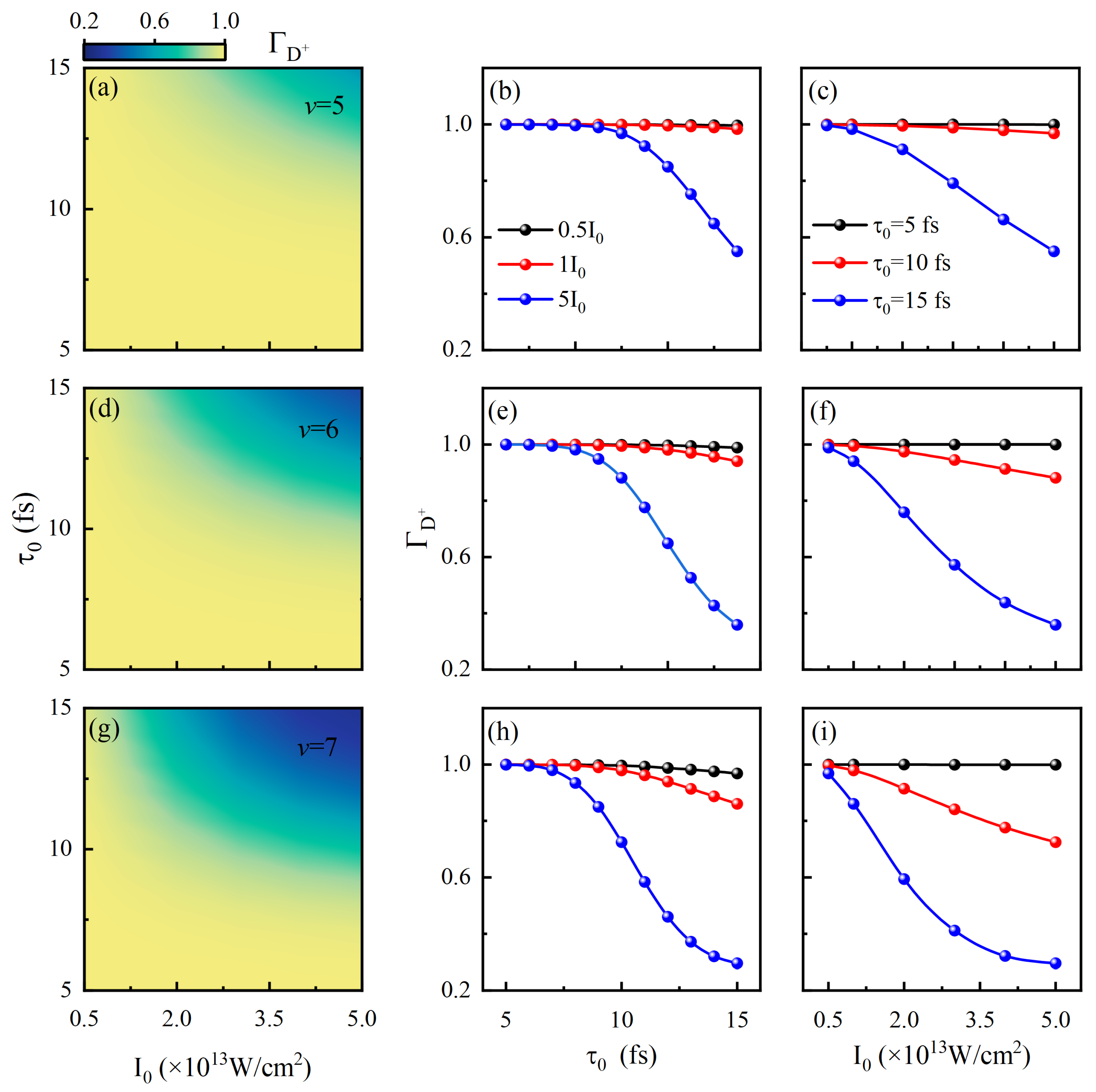
Having established the dependence of the total dissociation probability on the laser peak intensity I 0 and pulse duration τ 0 , we next investigate how these laser parameters affect the dissociation branching ratio Γ D + . Figure 3 shows the dissociation branching ratio Γ D + of HD+ as a function of the laser peak intensity I 0 and pulse duration τ 0 for the three initial vibrational states of the ground electronic state. Figure 3a,d,g correspond to ν = 5 , 6, and 7, respectively. Overall, Γ D + decreases with increasing peak intensity and pulse duration. According to Equation (8), since Γ D + represents the branching ratio for dissociation via the excited 2 p σ state, this decrease indicates that the relative contribution from the ground electronic state ( 1 s σ ) dissociation channel becomes more significant under stronger fields and longer pulses.
To disentangle the individual effects of the laser parameters, we further examine Γ D + at a fixed peak intensity I 0 or pulse duration τ 0 . Figure 3b,e,h depict Γ D + as a function of pulse duration for ν = 5 , 6, and 7 at different peak intensities, while Figure 3c,f,i show its variation with peak intensity at fixed pulse durations. For ν = 5 and 6, Γ D + remains near unity at lower peak intensities, indicating that dissociation is dominated by the excited electronic state channel. As the peak intensity increases, however, Γ D + decreases, reflecting the growing contribution of the ground electronic-state pathway to the total dissociation yield. For the highest vibrational state ν = 7 , the combination of laser peak intensity and pulse duration is sufficient to achieve nearly complete dissociation along the excited electronic state channel. In contrast, for ν = 5 and 6, although increasing the laser intensity and pulse duration enhances the total dissociation probability, Γ D + decreases, showing that the relative contribution of the excited electronic-state channel is reduced due to activation of the ground-electronic-state pathway. These results indicate that while ν = 7 can be efficiently dissociated via the excited electronic state pathway with appropriately chosen laser parameters, selective enhancement of the excited electronic state channel for ν = 5 and 6 is limited under transform-limited pulse conditions. This motivates further investigation into whether spectral-phase modulation can serve as a strategy to improve channel-selective dissociation of the lower vibrational states.
Figure 4 illustrates the chirp-dependent control of the dissociation dynamics of HD+ initially prepared in the vibrational states ν = 5 and 6 of the ground electronic state, with a fixed laser peak intensity of 1 × 10 13 W/cm2. Figure 4a,b show the dissociation probabilities of the ground electronic state ( P H + ) and excited electronic state ( P D + ) as functions of the chirp rate β 0 for the two initial vibrational states, respectively. For the initial vibrational state ν = 5 , compared with the transform-limited pulse, P H + remains nearly zero across the entire chirp rate β 0 range, indicating that the laser field is insufficiently strong to effectively activate the ground electronic state channel. In contrast, P D + gradually decreases with increasing absolute chirp rate | β 0 | . This chirp dependence arises from the chirp-induced temporal stretching and broadening of the instantaneous frequency distribution, which reduces the effective peak field amplitude at constant pulse energy, weakens the laser–molecule coupling, and consequently decreases the total dissociation probability. For the higher initial vibrational state ν = 6 , P H + exhibits a slight increase with the chirp rate β 0 , reflecting partial activation of the ground electronic state channel at this higher vibrational energy. Simultaneously, P D + decreases slightly, although it remains the dominant dissociation pathway. These results highlight the more nuanced interplay between ground- and excited-state electronic channels at higher vibrational energies and demonstrate that spectral-phase modulation via the chirp rate β 0 can finely tune the relative contributions of these pathways, enabling control over the dissociation dynamics.
Figure 4c,d display the dissociation branching ratio Γ D + as a function of the chirp rate β 0 for ν = 5 and 6, respectively. At this intensity, Γ D + exhibits only a weak dependence on the chirp rate β 0 , indicating that the dissociation process remains predominantly governed by the excited electronic state channel.
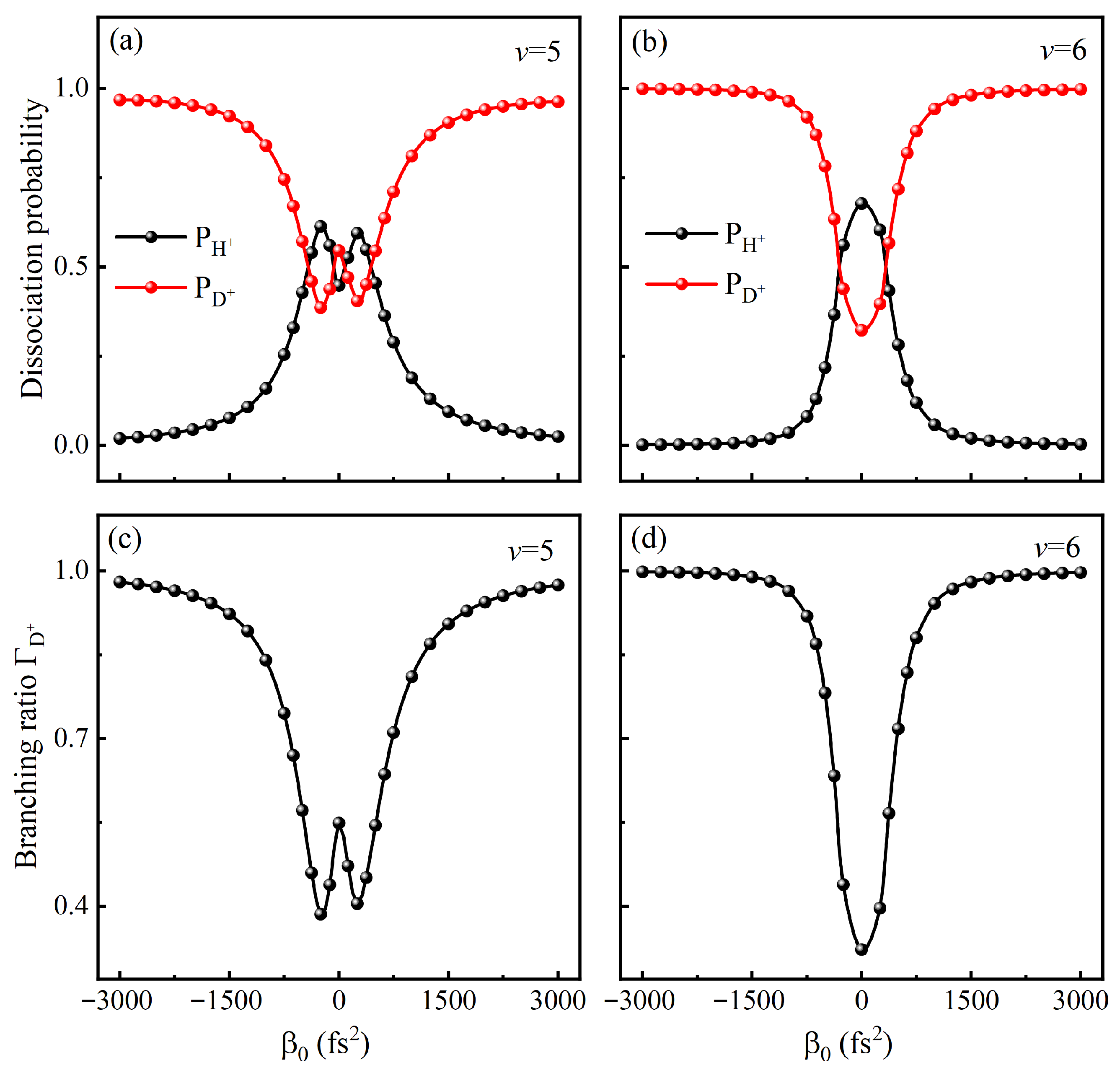
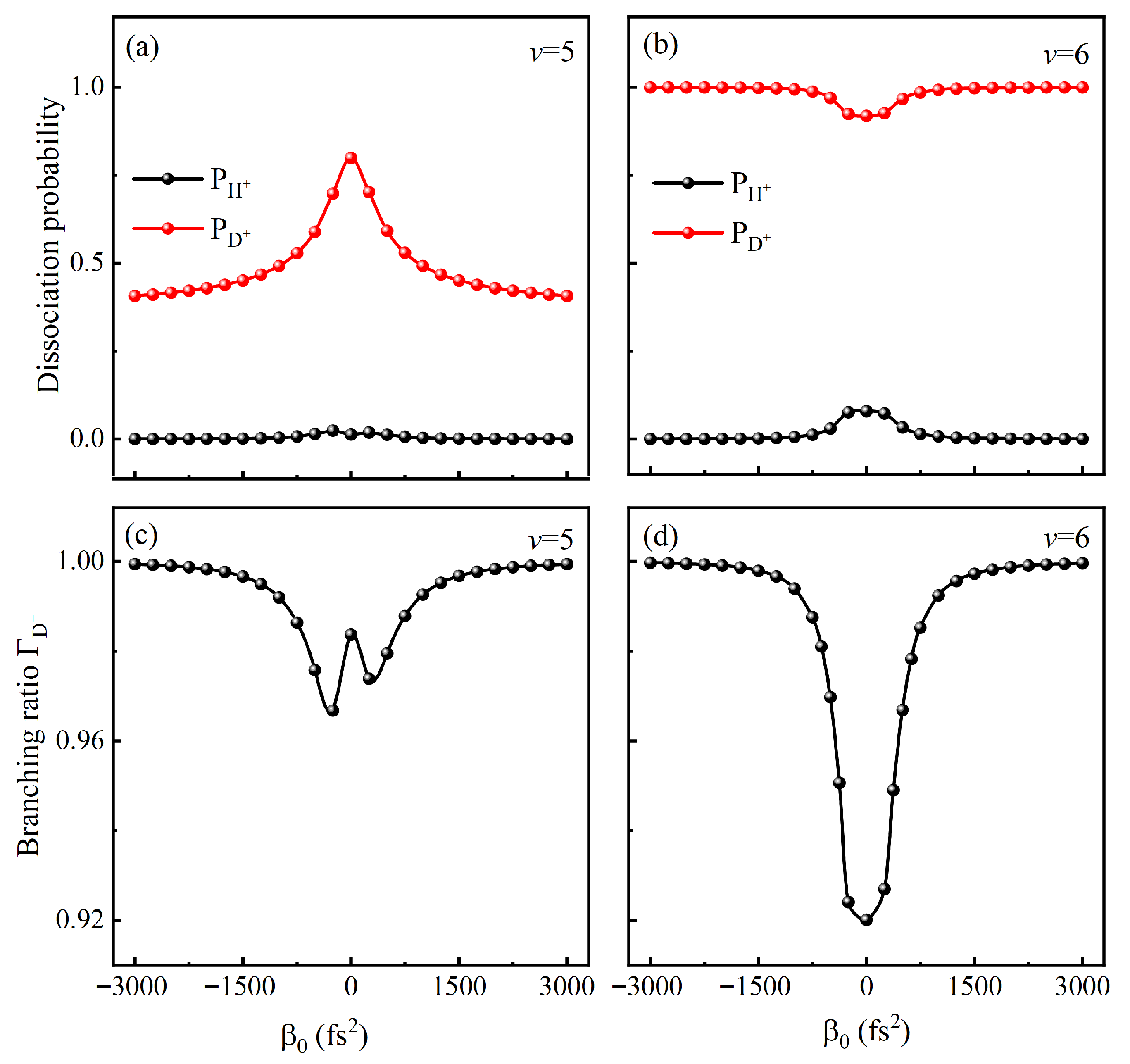
Figure 5 illustrates the chirp-dependent control of the dissociation dynamics of HD+ at a laser peak intensity of 5 × 10 13 W/cm2 for molecules initially prepared in the vibrational states ν = 5 and 6 of the ground electronic state. Figure 5a,b presents the dissociation probabilities of the ground electronic state ( P H + ) and excited electronic state ( P D + ) as functions of the chirp rate β 0 . For the initial vibrational state ν = 5 , at small chirp values ( | β 0 | 375 fs2), the excited electronic state dissociation probability P D + is even lower than that obtained with the transform-limited pulse, leading to a reduction in the branching ratio Γ D + (Figure 5c). As the absolute value of the chirp rate increases beyond | β 0 | 500 fs2, P D + gradually increases, while the contribution from the ground electronic state dissociation channel is effectively suppressed. In particular, when β 0 = ± 3000 fs2, the branching ratio Γ D + also increases, indicating that chirped pulses can selectively enhance the excited electronic state dissociation channel H + D+ and thereby promote controlled bond cleavage. For the higher initial vibrational state ν = 6 , increasing the absolute value of the chirp rate enhances the dissociation probabilities in channel H + D+, while the branching ratio Γ D + in Figure 5d correspondingly increases. These results suggest that, under the present strong-field conditions, the excited electronic state dissociation channel becomes increasingly dominant with increasing absolute chirp rate. Overall, spectral-phase modulation via chirp rate provides an effective means to control the relative contributions of the ground- and excited-state dissociation pathways, enabling selective control of the branching ratio Γ D + in the strong-field regime.
To further clarify the physical mechanisms underlying the observed dynamical behaviors in Figure 4 and Figure 5, we analyze the time evolution of electronic-state populations for different initial vibrational states. Figure 6 presents the temporal evolution of the populations in the ground electronic state and the excited electronic state for the initial vibrational states ν = 5 and ν = 6 at a moderate peak intensity of I 0 = 1 × 10 13 W/cm2 under different chirp rates. For the initial vibrational state ν = 5 , under the transform-limited pulse (Figure 6b), the system is initially fully populated in the ground electronic state. As the laser field interacts with the molecule, the nuclear wave packet propagates toward the resonant internuclear distance R 1 , where a near-resonant condition enables three-photon excitation to the excited electronic state. At the end of the laser pulse, the ground electronic state population decreases to approximately 0.18, while the excited electronic state population increases to about 0.75. Weak oscillatory structures appear at later times, originating from single-photon stimulated emission from the excited electronic state back to the ground electronic state, leading to field-driven Rabi-type population oscillations between the two electronic states. At this intensity, ground electronic state dissociation is negligible. The residual ground-electronic-state population mainly arises from population transfer back to the ground electronic state. As the nuclear wave packet propagates along the excited electronic-state potential-energy surface, part of the population may undergo single-photon stimulated emission back to the ground electronic-state surface at larger internuclear separations. If the returning wave packet does not possess sufficient kinetic energy to overcome the ground electronic state potential barrier, it becomes trapped in the bound region, leaving a finite population in the ground electronic state.
When a linear chirp of 3000 and 3000 fs2 is introduced (Figure 6a,c), the population dynamics are significantly modified. For ν = 5 , the final ground electronic state population increases to approximately 0.59, while the excited electronic state population decreases and the oscillatory behavior is strongly suppressed. The chirp modifies the instantaneous frequency of the laser pulse, introducing a time-dependent detuning that shortens the effective resonance window for three-photon excitation and suppresses coherent single-photon Rabi oscillations. As a result, the bidirectional population exchange between the two electronic states is weakened. For ν = 6 , a similar trend is observed, although the oscillatory features are more pronounced due to the higher vibrational energy and the broader spatial distribution of the nuclear wave packet. Under the transform-limited pulse, the interplay between three-photon excitation and single-photon stimulated emission produces stronger Rabi-type oscillations and more efficient excitation to the excited electronic state. The introduction of chirp suppresses these oscillations and stabilizes the population predominantly in the excited electronic state, demonstrating the effectiveness of chirp control across different initial vibrational states.
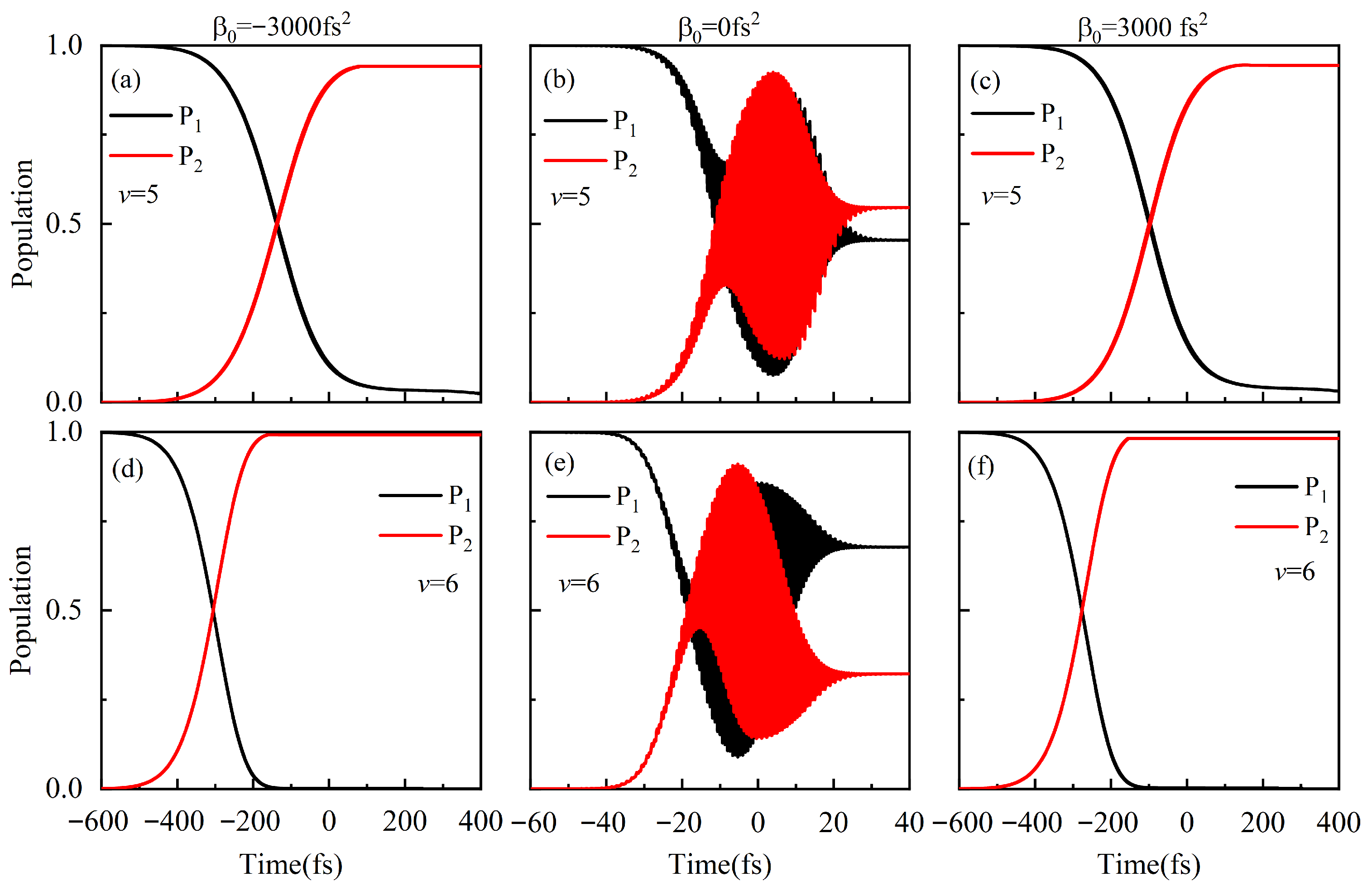
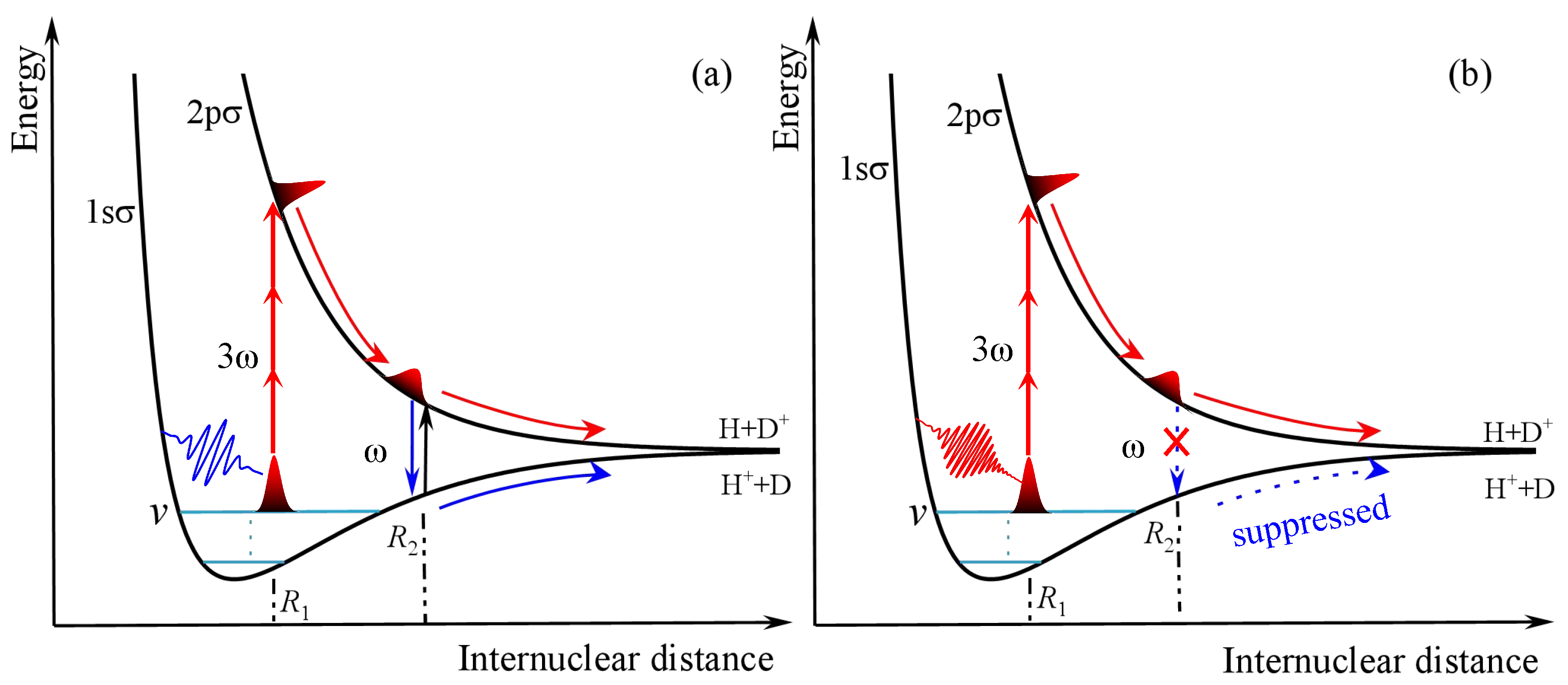
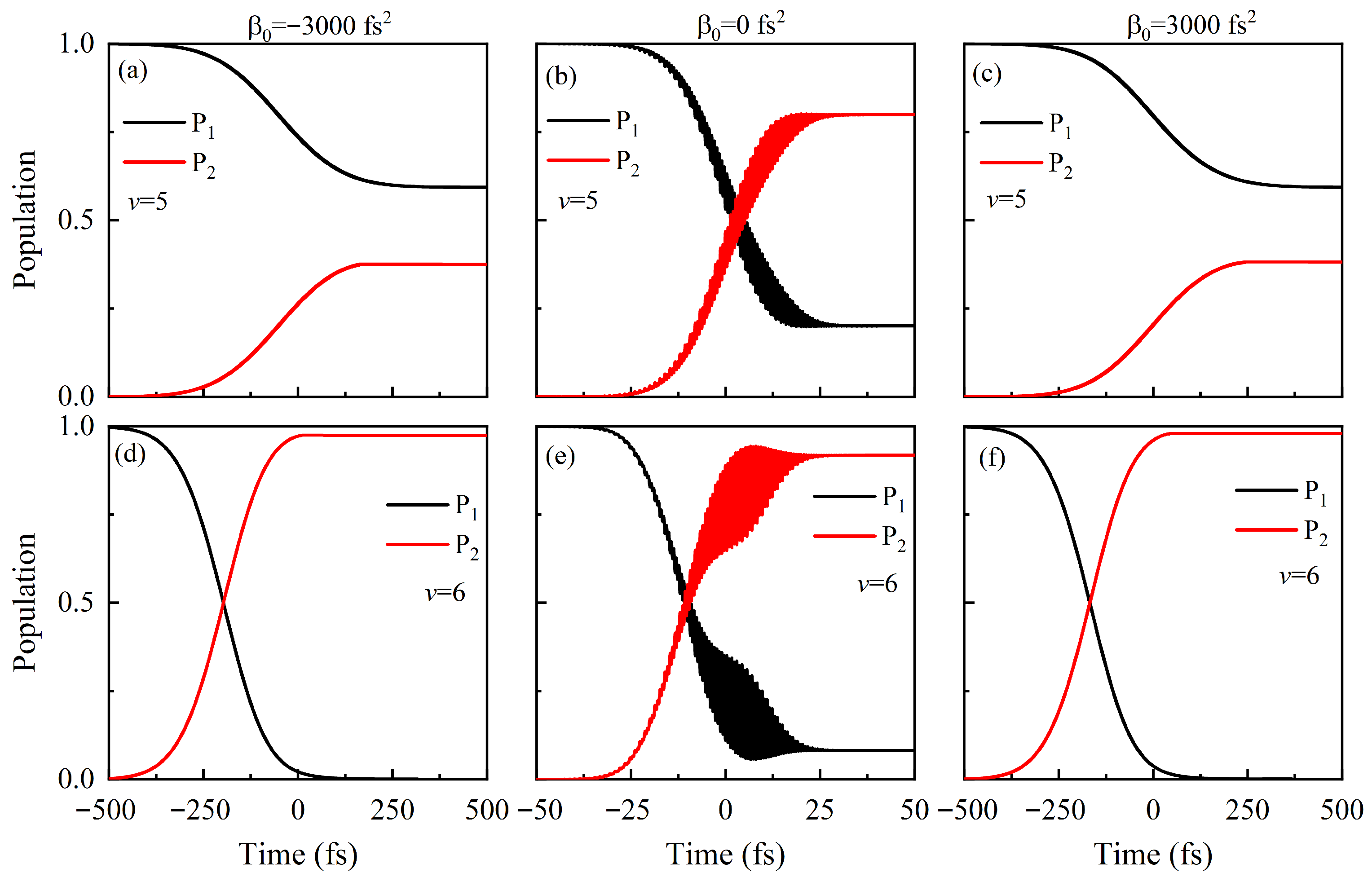
Figure 7 shows the electronic-state population dynamics at a higher peak intensity of I 0 = 5 × 10 13 W/cm2 for the same initial vibrational states. For ν = 5 and β 0 = 0 (Figure 7b), both ground and excited electronic state populations exhibit pronounced oscillatory structures, indicating that the system enters a strongly coupled regime under the intense laser field [61]. The competition between three-photon excitation and one-photon stimulated emission generates large-amplitude Rabi oscillations between the electronic states, as illustrated in Figure 1a. This coherent population exchange reflects strong coupling between the two electronic states and leads to repeated population transfer, which enhances the probability of ground-electronic-state dissociation via back-transfer to the ground-electronic-state potential surface. When a linear chirp of 3000 or 3000 fs 2 is applied (Figure 7a,c), the population dynamics are significantly changed. For ν = 5 and ν = 6 , the ground electronic state population is nearly fully depleted, while the excited electronic state population approaches unity, and oscillatory behavior largely disappears. From a quantum-mechanical perspective, the interaction between the chirped laser pulse and the HD+ molecule can be understood as quantum interference between competing multiphoton excitation pathways. The dominant pathways are: (i) near-resonant three-photon absorption from the ground 1 s σ state to the excited 2 p σ state, and (ii) one-photon stimulated emission from the 2 p σ state back to the 1 s σ state, forming a closed transition loop that governs the net population transfer. The chirp induces a continuous variation of the instantaneous frequency, thereby modifying the relative phases accumulated along these pathways. This phase modulation disrupts the interference condition and suppresses Rabi-type oscillations between these two electronic states. As a result, the population promoted to the excited state is effectively prevented from returning to the ground state, leaving the nuclear wave packet predominantly on the excited-state potential energy curve and promoting dissociation. Consequently, the ground-state dissociation channel is strongly suppressed, while dissociation via the excited electronic state dominates, as shown in Figure 1b.
These results indicate that the competition between three-photon excitation to the excited electronic state and single-photon stimulated emission to the ground electronic state governs the population evolution and the selection of dissociation pathways. Spectral-phase modulation via chirp rate provides an effective means to control the coherent coupling dynamics and finely tune the relative contributions of the ground and excited-electronic-state dissociation channels, enabling selective control of dissociation dynamics and branching ratios in the strong-field regime.

4. Conclusions and Outlooks

In this work, we systematically investigate the dissociation dynamics of HD+ driven by chirped laser pulses by solving the two-state TDSE. Our results show that the total dissociation probability increases with both laser intensity and pulse duration, while higher vibrational states reach near-complete dissociation at relatively lower intensities. The branching ratio between the two fragmentation channels (H+ + D and H + D+) is strongly influenced by the interplay between vibrational energy and laser parameters, with ground electronic state dissociation becoming increasingly significant in the strong-field regime. Chirp-rate modulation provides an effective mechanism for controlling the dissociation pathways. Properly tailored chirp rates enhance the excited electronic-state dissociation channel while suppressing the ground-electronic-state contribution, thereby enabling selective control of both the dissociation probability and the branching ratio. Time-resolved electronic-state population analysis further reveals that the competition between three-photon excitation to the excited electronic state and one-photon stimulated emission back to the ground electronic state governs the population dynamics. The chirped laser can effectively suppress Rabi-type oscillations. These findings demonstrate that chirp-controlled strong-field dynamics provide a practical route for manipulating molecular dissociation pathways. The present control strategy may be extended to other molecular systems and offers potential applications in selective bond breaking and strong-field molecular control.

Author Contributions

Conceptualization, W.-Q.J. and S.-F.Z.; methodology, W.-Q.J. and S.-F.Z.; software, T.C. and W.-Q.J.; validation, T.C.; formal analysis, T.C., W.-Q.J. and S.-F.Z.; investigation, T.C.; data curation, T.C.; writing—original draft preparation, T.C.; writing—review and editing, W.-Q.J., J.-X.D., Z.-Q.Y., Z.-H.J., G.-L.W. and S.-F.Z.; visualization, T.C.; supervision, W.-Q.J. and S.-F.Z.; project administration, W.-Q.J. and S.-F.Z.; funding acquisition, J.-X.D., Z.-Q.Y., Z.-H.J., G.-L.W. and S.-F.Z. All authors have read and agreed to the published version of the manuscript.

Funding

This research was supported by the National Natural Science Foundation of China (NSFC; grant Nos. 12574315, 12364040, 12465025, and 12504322).

Data Availability Statement

Data underlying the results presented in this paper are not publicly available at this time but may be obtained from the authors upon reasonable request.

Conflicts of Interest

The authors declare no conflicts of interest.

References

  1. Mullins, T.; Karamatskos, E.T.; Wiese, J.; Onvlee, J.; Rouzée, A.; Yachmenev, A.; Trippel, S.; Küpper, J. Picosecond pulse-shaping for strong three-dimensional field-free alignment of generic asymmetric-top molecules. Nat. Commun. 2022, 13, 1431. [Google Scholar] [CrossRef] [PubMed]
  2. Amin, M.; Hartmann, J.M.; Samanta, A.K.; Küpper, J. Laser-Induced Alignment of Nanoparticles and Macromolecules for Coherent-Diffractive-Imaging Applications. J. Am. Chem. Soc. 2025, 147, 7445–7451. [Google Scholar] [CrossRef] [PubMed]
  3. Shu, C.C.; Hong, Q.Q.; Guo, Y.; Henriksen, N.E. Orientational quantum revivals induced by a single-cycle terahertz pulse. Phys. Rev. A 2020, 102, 063124. [Google Scholar] [CrossRef]
  4. Hong, Q.Q.; Fan, L.B.; Shu, C.C.; Henriksen, N.E. Generation of maximal three-state field-free molecular orientation with terahertz pulses. Phys. Rev. A 2021, 104, 013108. [Google Scholar] [CrossRef]
  5. Hong, Q.Q.; Lian, Z.Z.; Shu, C.C.; Henriksen, N.E. Quantum control of field-free molecular orientation. Phys. Chem. Chem. Phys. 2023, 25, 32763–32777. [Google Scholar] [CrossRef]
  6. Fan, L.B.; Shu, C.C.; Dong, D.Y.; He, J.; Henriksen, N.E.; Nori, F. Quantum coherent control of a single molecular-polariton rotation. Phys. Rev. Lett. 2023, 130, 043604. [Google Scholar] [CrossRef]
  7. Hong, Q.Q.; Dong, D.Y.; Henriksen, N.E.; Nori, F.; He, J.; Shu, C.C. Precise quantum control of molecular rotation toward a desired orientation. Phys. Rev. Res. 2025, 7, L012049. [Google Scholar] [CrossRef]
  8. Hong, Q.Q.; Zhang, Z.J.; Shu, C.C.; He, J.; Dong, D.Y.; Ding, D.J. Precise quantum control of unidirectional field-free molecular orientation. Phys. Rev. A 2026, 113, 013118. [Google Scholar] [CrossRef]
  9. Zhang, W.B.; Gong, X.C.; Li, H.; Lu, P.F.; Sun, F.H.; Ji, Q.Y.; Lin, K.; Ma, J.Y.; Li, H.X.; Qiang, J.J.; et al. Electron-nuclear correlated multiphoton-route to Rydberg fragments of molecules. Nat. Commun. 2019, 10, 757. [Google Scholar] [CrossRef]
  10. Guo, Z.N.; Fang, Y.Q.; Ge, P.P.; Yu, X.Y.; Wang, J.G.; Han, M.; Gong, Q.H.; Liu, Y.Q. Probing tunneling dynamics of dissociative H2 molecules using two-color bicircularly polarized fields. Phys. Rev. A 2021, 104, L051101. [Google Scholar] [CrossRef]
  11. Shi, G.Q.; Xiang, Y.L.; Lei, J.T.; Sun, S.H.; Liu, Z.Y.; Hu, B.T. Dissociation pathways established in strong-field single ionization of molecular CO. Appl. Phys. B 2022, 128, 213. [Google Scholar] [CrossRef]
  12. García-Vela, A. Quantum control of resonance lifetimes in molecular photodissociation with intense laser fields. J. Chem. Theory Comput. 2025, 21, 1547–1560. [Google Scholar] [CrossRef] [PubMed]
  13. Sola, I.R.; García-Vela, A. Preparing superposition states to modify the spectra and to achieve complete selectivity in photodissociation reactions. J. Chem. Theory Comput. 2025, 21, 7267–7278. [Google Scholar] [CrossRef] [PubMed]
  14. Giusti-Suzor, A.; He, X.; Atabek, O.; Mies, F.H. Above-threshold dissociation of H 2 + in intense laser fields. Phys. Rev. Lett. 1990, 64, 515. [Google Scholar] [CrossRef] [PubMed]
  15. Orr, P.A.; Williams, I.D.; Greenwood, J.B.; Turcu, I.C.E.; Bryan, W.A.; Pedregosa-Gutierrez, J.; Walter, C.W. Above threshold dissociation of vibrationally cold HD+ molecules. Phys. Rev. Lett. 2007, 98, 163001. [Google Scholar] [CrossRef]
  16. Lu, P.F.; Wang, J.P.; Li, H.; Lin, K.; Gong, X.C.; Song, Q.Y.; Ji, Q.Y.; Zhang, W.B.; Ma, J.Y.; Li, H.X.; et al. High-order above-threshold dissociation of molecules. Proc. Natl. Acad. Sci. USA 2018, 115, 2049–2053. [Google Scholar] [CrossRef]
  17. Guo, Z.N.; Zhang, Z.H.; Deng, Y.K.; Wang, J.G.; Ye, D.F.; Liu, J.; Liu, Y.Q. Probing H2 double ionization with bicircular laser fields. Phys. Rev. Lett. 2024, 132, 143201. [Google Scholar] [CrossRef]
  18. Jia, Y.W.; Yuen, C.H.; Jing, W.Q.; Zhou, Z.Y.; Lin, C.D.; Zhao, S.F. Improved model for the dissociative sequential double ionization of nitrogen molecules by an intense few-cycle infrared laser pulse. Phys. Rev. A 2024, 110, 023112. [Google Scholar] [CrossRef]
  19. Jia, Y.W.; Wang, H.H.; Yuen, C.H.; Lin, C.D.; Zhao, S.F. Modeling the dissociative sequential triple ionization of nitrogen molecules by ultrashort intense infrared laser pulses. Phys. Rev. A 2025, 112, L031101. [Google Scholar] [CrossRef]
  20. Hashim, S.; Habibović, D.; Figueira de Morisson Faria, C. Below-threshold nonsequential double ionization with linearly polarized two-color fields. I. Symmetry and dominance. Phys. Rev. A 2025, 112, 023118. [Google Scholar] [CrossRef]
  21. Hashim, S.; Habibović, D.; Figueira de Morisson Faria, C. Below-threshold nonsequential double ionization with linearly polarized two-color fields. II. Quantum interference. Phys. Rev. A 2025, 112, 023119. [Google Scholar] [CrossRef]
  22. Bhattacharyya, S.; Borne, K.; Ziaee, F.; Pathak, S.; Wang, E.; Venkatachalam, A.S.; Li, X.; Marshall, N.; Carnes, K.D.; Fehrenbach, C.W.; et al. Strong-field-induced coulomb explosion imaging of tribromomethane. J. Phys. Chem. Lett. 2022, 13, 5845–5853. [Google Scholar] [CrossRef]
  23. Guo, K.Y.; Hu, X.Q.; Li, M.; Jia, C.C.; Zhang, S.B.; Cao, C.P.; Xie, W.H.; Cao, W.; Liu, K.L.; Zhou, Y.M.; et al. Probing Coupled Rotational and Electronic Dynamics during Laser-Induced Molecular Fragmentation. Ultrafast Sci. 2024, 4, 0073. [Google Scholar] [CrossRef]
  24. Liu, Y.P.; Jia, C.C.; Ge, P.P.; Li, M.; Hu, X.Q.; Guo, K.Y.; Cao, W.; Wu, Y.; Wang, J.G.; Lu, P.X. Radial Coupling at Conical Intersection Governs Competing Fragmentation Pathways in Halomethane Cations. Phys. Rev. Lett. 2026, 136, 053201. [Google Scholar] [CrossRef] [PubMed]
  25. Tiwari, A.K.; Henriksen, N.E. Pulse-train control of photofragmentation at constant field energy. J. Chem. Phys. 2014, 141, 204301. [Google Scholar] [CrossRef] [PubMed]
  26. Tiwari, A.K.; Henriksen, N.E. Phase-only laser control in the weak-field limit: Two-pulse control of IBr photofragmentation revisited. J. Chem. Phys. 2016, 144, 014306. [Google Scholar] [CrossRef]
  27. Kobayashi, Y.; Chang, K.F.; Zeng, T.; Neumark, D.M.; Leone, S.R. Direct mapping of curve-crossing dynamics in IBr by attosecond transient absorption spectroscopy. Science 2019, 365, 79–83. [Google Scholar] [CrossRef]
  28. Serrano-Jiménez, A.; Bañares, L.; García-Vela, A. Weak-field coherent control of photodissociation in polyatomic molecules. Phys. Chem. Chem. Phys. 2019, 21, 7885–7893. [Google Scholar] [CrossRef]
  29. Tannor, D.J.; Kosloff, R.; Rice, S.A. Coherent pulse sequence induced control of selectivity of reactions: Exact quantum mechanical calculations. J. Chem. Phys. 1986, 85, 5805–5820. [Google Scholar] [CrossRef]
  30. Assion, A.; Baumert, T.; Bergt, M.; Brixner, T.; Kiefer, B.; Seyfried, V.; Strehle, M.; Gerber, G. Control of chemical reactions by feedback-optimized phase-shaped femtosecond laser pulses. Science 1998, 282, 919–922. [Google Scholar] [CrossRef]
  31. Shapiro, M.; Brumer, P. On the origin of pulse shaping control of molecular dynamics. J. Phys. Chem. A 2001, 105, 2897–2902. [Google Scholar] [CrossRef]
  32. Shu, C.C.; Yuan, K.J.; Dong, D.Y.; Petersen, I.R.; Bandrauk, A.D. Identifying strong-field effects in indirect photofragmentation reactions. J. Phys. Chem. Lett. 2017, 8, 1–6. [Google Scholar] [CrossRef] [PubMed]
  33. Shu, C.C.; Henriksen, N.E. Coherent control of indirect photofragmentation in the weak-field limit: Control of transient fragment distributions. J. Chem. Phys. 2011, 134, 164308. [Google Scholar] [CrossRef] [PubMed]
  34. Tiwari, A.K.; Dey, D.; Henriksen, N.E. Laser-pulse-shape control of photofragmentation in the weak-field limit. Phys. Rev. A 2014, 89, 023417. [Google Scholar] [CrossRef]
  35. Csehi, A.; Halász, G.J.; Cederbaum, L.S.; Vibók, Á. Photodissociation of D 2 + induced by linearly chirped laser pulses. J. Chem. Phys. 2015, 143, 014305. [Google Scholar] [CrossRef]
  36. Garcia-Vela, A.; Henriksen, N.E. Coherent control of photofragment distributions using laser phase modulation in the weak-field limit. J. Phys. Chem. Lett. 2015, 6, 824–829. [Google Scholar] [CrossRef]
  37. Csehi, A.; Halász, G.J.; Cederbaum, L.S.; Vibók, Á. Tracking the photodissociation probability of D 2 + induced by linearly chirped laser pulses. J. Chem. Phys. 2016, 144, 074309. [Google Scholar] [CrossRef]
  38. Sun, Z.P.; Wang, C.Y.; Zhao, W.K.; Zheng, Y.J.; Yang, C.L. Control of photodissociation of the NaI molecule via pulse chirping. Phys. Chem. Chem. Phys. 2018, 20, 20957–20962. [Google Scholar] [CrossRef]
  39. García-Vela, A. Weak-field coherent control of molecular photofragment state distributions. Phys. Rev. Lett. 2018, 121, 153204. [Google Scholar] [CrossRef]
  40. Dey, D.; Henriksen, N.E. On weak-field (one-photon) coherent control of photoisomerization. J. Phys. Chem. Lett. 2020, 11, 8470–8476. [Google Scholar] [CrossRef]
  41. Liu, Y.; Meng, J.Q.; Sun, Z.G.; Shu, C.C. Unveiling ultrafast-weak-field coherent control of indirect dissociation reactions. J. Phys. Chem. Lett. 2024, 15, 8393–8401. [Google Scholar] [CrossRef]
  42. Xu, H.; Li, Z.C.; He, F.; Wang, X.; Atia-Tul-Noor, A.; Kielpinski, D.; Sang, R.T.; Litvinyuk, I.V. Observing electron localization in a dissociating H 2 + molecule in real time. Nat. Commun. 2017, 8, 15849. [Google Scholar] [CrossRef] [PubMed][Green Version]
  43. Hu, C.X.; He, F. Nuclear momentum distributions governed by Rabi flopping in the dissociation of hydrogen molecular ions in strong laser fields. Phys. Rev. A 2021, 104, 063107. [Google Scholar] [CrossRef]
  44. Pan, S.Z.; Hu, C.X.; Zhang, W.B.; Zhang, Z.H.; Zhou, L.R.; Lu, C.X.; Lu, P.F.; Ni, H.C.; Wu, J.; He, F. Rabi oscillations in a stretching molecule. Light Sci. Appl. 2023, 12, 35. [Google Scholar] [CrossRef] [PubMed]
  45. Sun, Z.P.; Liu, Y.Q. Manipulating quantum interference in two-color (ω+ 3ω) strong laser field photodissociation dynamics of D 2 + . J. Phys. Chem. A 2024, 128, 5021–5027. [Google Scholar] [CrossRef]
  46. Jing, W.Q.; Sun, Z.P.; Zhao, S.F.; Shu, C.C. Unveiling coherent control of halomethane dissociation induced by a single strong ultraviolet pulse. J. Phys. Chem. Lett. 2023, 14, 11305–11312. [Google Scholar] [CrossRef]
  47. Jing, W.Q.; Jia, L.J.; Sun, Z.P.; Zhao, S.F.; Shu, C.C. Dissociation of chlorobromomethane molecules coherently controlled by ultrafast strong field. Acta Phys. Sin. 2024, 73, 243301. [Google Scholar] [CrossRef]
  48. Sheehy, B.; Walker, B.; DiMauro, L.F. Phase control in the two-color photodissociation of HD+. Phys. Rev. Lett. 1995, 74, 4799. [Google Scholar] [CrossRef]
  49. Yuan, K.J.; Liu, Z.T.; Yu, J.; Chen, M.D.; Cong, S.L. Theoretical study of above-threshold dissociation of HD+ in femtosecond laser fields. J. Theor. Comput. Chem. 2009, 8, 1197–1215. [Google Scholar] [CrossRef]
  50. Yang, D.; Cong, S.L. Nuclear interference in dissociating of HD+ in ultrashort laser fields. Phys. Rev. A 2011, 84, 013424. [Google Scholar] [CrossRef]
  51. Chatterjee, S.; Dutta, B.; Bhattacharyya, S.S. Asymmetric branching of dissociated photofragments of HD+ in an intense femtosecond laser field. Phys. Rev. A 2011, 83, 063413. [Google Scholar] [CrossRef]
  52. Bhattacharya, R.; Chatterjee, S.; Bhattacharyya, S.S. Preparation and probing of coherent vibrational wave packets in the ground electronic state of HD+. Phys. Rev. A 2012, 85, 033424. [Google Scholar] [CrossRef]
  53. Yao, H.B.; Cao, C.H.; Sun, Z.P.; Li, W.L.; Tao, Y.H.; Dong, X.H.; Wumaier, T. Controlling strong-field fragments of HD+ with a synthesized two-color laser pulse. Phys. Chem. Chem. Phys. 2023, 25, 11665–11672. [Google Scholar] [CrossRef] [PubMed]
  54. Esry, B.D.; Sadeghpour, H.R. Adiabatic formulation of heteronuclear hydrogen molecular ion. Phys. Rev. A 1999, 60, 3604. [Google Scholar] [CrossRef]
  55. Zhang, W.; Shu, C.C.; Ho, T.S.; Rabitz, H.; Cong, S.L. Optimal control of charge transfer for slow H+ + D collisions with shaped laser pulses. J. Chem. Phys. 2014, 140, 094304. [Google Scholar] [CrossRef]
  56. Grønager, M.; Henriksen, N.E. Real-time control of electronic motion: Application to HD+. J. Phys. Chem. A 1998, 102, 4277–4283. [Google Scholar] [CrossRef]
  57. Yang, A.; Jing, W.Q.; Zhang, B.S.; Fan, L.B.; Jia, L.J.; Shu, C.C. Spectral phase control of an ultrashort pulse for exploring the Autler-Townes effect in hydrogen atomic ionization through a resonant state. Phys. Rev. A 2025, 112, 053116. [Google Scholar] [CrossRef]
  58. Marston, C.C.; Balint-Kurti, G.G. The Fourier grid Hamiltonian method for bound state eigenvalues and eigenfunctions. J. Chem. Phys. 1989, 91, 3571–3576. [Google Scholar] [CrossRef]
  59. Kosloff, R. Time-dependent quantum-mechanical methods for molecular dynamics. J. Phys. Chem. 1988, 92, 2087–2100. [Google Scholar] [CrossRef]
  60. Zhao, S.F.; Zhou, X.X.; Li, P.C.; Chen, Z.J. Isolated short attosecond pulse produced by using an intense few-cycle shaped laser and an ultraviolet attosecond pulse. Phys. Rev. A 2008, 78, 063404. [Google Scholar] [CrossRef]
  61. Cao, P.K.; Zhang, Q.B.; Liu, K.L.; Lu, P.X. Resolving the time evolution of the dissociative nuclear wave packet in the repulsive state of H 2 + via wave-packet interference. Phys. Rev. A 2022, 105, 043116. [Google Scholar] [CrossRef]
Figure 1. Panels (a,b) illustrate the dissociation mechanisms of HD+ driven by transform-limited and chirped laser pulses, respectively. The black curves represent the adiabatic potential energy curves of the ground electronic state ( 1 s σ ) and the excited electronic state ( 2 p σ ). Red arrows indicate three-photon absorption pathways, while blue arrows denote net two-photon pathways corresponding to three-photon absorption followed by one-photon stimulated emission. Black arrows represent single-photon dissociation pathways. The vibrational levels of the ground electronic state are labeled by ν .
Photonics 13 00383 g001
Figure 2. Total dissociation probability of HD+ versus the laser peak intensity I 0 and pulse duration τ 0 . Panels (a,d,g) present three-dimensional plots of the total dissociation probability as functions of I 0 and τ 0 for the initial vibrational states ν = 5 , 6, and 7, respectively. Panels (b,e,h) show the total dissociation probability as a function of the pulse duration at fixed peak intensities of I 0 = 0.5 , 1, and 5 × 10 13 W/cm2, respectively. Panels (c,f,i) depict the total dissociation probability as a function of the laser peak intensity for pulse durations of τ 0 = 5 , 10, and 15 fs.
Photonics 13 00383 g002
Figure 3. Dissociation branching ratio Γ D + versus the laser peak intensity I 0 and pulse duration τ 0 . Panels (a,d,g) present Γ D + as a function of I 0 and τ 0 for the initial vibrational states ν = 5 , 6, and 7, respectively. Panels (b,e,h) show Γ D + as a function of the pulse duration at fixed peak intensities of I 0 = 0.5 , 1, and 5 × 10 13 W/cm2, respectively. Panels (c,f,i) illustrate Γ D + as a function of the laser peak intensity for pulse durations of τ 0 = 5 , 10, and 15 fs.
Photonics 13 00383 g003
Figure 4. Dependence of HD+ dissociation dynamics on the chirp rate β 0 at a laser peak intensity of I 0 = 1 × 10 13 W/cm2. Panels (a,b) depict the dissociation probabilities along the ground and excited electronic states as functions of β 0 for the initial vibrational states ν = 5 and 6, respectively. The black and red curves represent the ground electronic state and excited electronic state dissociation probabilities, respectively. Panels (c,d) present the corresponding branching ratios Γ D + for ν = 5 and 6.
Photonics 13 00383 g004
Figure 5. Dependence of HD+ dissociation dynamics on the chirp rate β 0 at a higher laser peak intensity of I 0 = 5 × 10 13 W/cm2. Panels (a,b) depict the dissociation probabilities along the ground and excited electronic states as functions of β 0 for initial vibrational states ν = 5 and 6, respectively. The black and red curves represent the ground-electronic-state and excited-electronic-state dissociation probabilities, respectively. Panels (c,d) present the corresponding branching ratios Γ D + for ν = 5 and 6.
Photonics 13 00383 g005
Figure 6. Temporal evolution of electronic state populations at a moderate laser peak intensity of I 0 = 1 × 10 13 W/cm2. Panels (ac) depict the time-dependent populations of the ground and excited electronic states for the initial vibrational state ν = 5 under chirp rates of β 0 = 3000 , 0, and 3000 fs2, respectively. Panels (df) show the corresponding evolution for ν = 6 under the same chirp rates. Black and red curves represent the populations of the ground and excited electronic states, respectively.
Photonics 13 00383 g006
Figure 7. Temporal evolution of electronic state populations at a higher laser peak intensity of I 0 = 5 × 10 13 W/cm2. Panels (ac) depict the time-dependent populations of the ground and excited electronic states for the initial vibrational state ν = 5 under chirp rates of β 0 = 3000 , 0, and 3000 fs2, respectively. Panels (df) illustrate the corresponding evolution for ν = 6 under the same chirp rates. Black and red curves represent the populations of the ground and excited electronic states, respectively.
Photonics 13 00383 g007
Disclaimer/Publisher’s Note: The statements, opinions and data contained in all publications are solely those of the individual author(s) and contributor(s) and not of MDPI and/or the editor(s). MDPI and/or the editor(s) disclaim responsibility for any injury to people or property resulting from any ideas, methods, instructions or products referred to in the content.