


Abstract
We report on the generation and spectral shaping of ultrabroadband terahertz-to-infrared radiation (>119 THz) from air plasma excited by a conventional tightly focused femtosecond Ti:Sa laser pulse with a duration of 35 fs assisted by its second harmonic (SH). A controllable and large frequency detuning between the SH and blueshifted component of the fundamental spectrum was achieved by utilizing spectral broadening of the fundamental pulse under filamentation and adjusting the longitudinal separation of the two cascaded filaments. For convenience, the resulting ultrabroadband emission is divided into a low-frequency part (<30 THz), an intermediate-frequency part (~50 THz), and a high-frequency part (~100 THz) that can be optimized with the filaments’ longitudinal separation. We attribute such ultrabroadband THz radiation generation to the excitation of photocurrent from the nonlinear interaction of SH with both the field at the fundamental frequency and its blueshifted component acquired during filamentation. Theoretical calculations based on time-dependent Schrödinger equation, as well as the Maxwell–Schrödinger equation for spectral broadening dynamics, reproduced the spectral features as well as the distinct dependence of the low- and high-frequency THz components.
1. Introduction
Air plasma excited by femtosecond pulses is a unique coherent terahertz (THz) radiation source that exhibits an extremely broad emission bandwidth compared to conventional THz emitters such as photoconductive switches and optical rectification in nonlinear crystals [1,2,3,4,5,6,7]. With the air breakdown coherent detection method, it has been demonstrated that THz radiation up to 35 THz can be readily obtained from air plasma pumped by conventional femtosecond pulses with a duration of 40 fs in the two-color ( and ) scheme [8,9]. However, understanding and engineering of such broadband radiation remain challenging. Later, H. G. Roskos and co-workers demonstrated that shorter pump pulse duration can lead to even larger THz bandwidth [2,10]. With a 10 fs few-cycle pulse, Eiichi Matsubara et al. have obtained a record bandwidth up to 200 THz from air plasma [4,11,12]. The extension of plasma-based emission toward higher frequencies greatly broadens both the spectral bandwidth and the application scope of such sources. A broader radiation spectrum provides a wider effective detection window, since many important elementary excitations, including molecular vibrations and rotations, phonons, magnons, and intraband electronic transitions, are distributed over a wide spectral range from the far infrared to the near infrared. Therefore, the generation of higher-frequency radiation is of particular importance for probing ultrafast internal dynamics in materials. In addition, a broader spectral range generally corresponds to a shorter field transient in the time domain, which is beneficial for improving the temporal resolution of coherent detection. In the meantime, it is known that as the optical pump pulse propagates and undergoes filamentation, it may experience significant spectrum broadening due to the Kerr- and plasma-induced phase-modulation and self-steepening [13,14,15,16,17]. Numerical simulations combining nonlinear pump pulse propagation and THz generation have revealed that pump pulse reshaping in the temporal and spectral domains results in a broader THz spectrum [16,17,18]. However, the spontaneous spectral transformation of the fundamental and its second harmonic (SH) inside the filamentary propagation is difficult to tailor because of the extremely nonlinear and complex self-interaction and nonlinear coupling between the pulse components. Consequently, a method of utilizing the evolving spectra of the two-color optical pump pulses in a controllable manner for producing ultrabroadband THz radiation is highly desired.
In this work, we propose a cascaded two-color filamentation method to tailor and utilize the evolving spectra of the fundamental pulse and its second harmonic, and demonstrate spectral shaping of broadband terahertz-to-infrared radiation up to 119 THz pumped with a commercial 35 fs laser system. We show that the spectrum of the fundamental wave is strongly broadened and blueshifted during nonlinear filamentation, and the degree of spectral broadening increases gradually along the propagation direction inside the plasma filament, while SH experiences almost no spectral reshaping due to its much weaker intensity. With the tuning of the longitudinal separation of the two cascaded filaments, it was observed that a strong high-frequency THz component (~100 THz), an intermediate THz component (~50 THz), and a relatively low-frequency THz component (<30 THz) can be generated and optimized. The optimization mechanism can be outlined as follows: (i) the fundamental pulse spectrum broadens significantly during propagation from plasma-induced frequency upshift; (ii) the focal shift controls the spatial overlap between the second harmonic and the blueshifted component of the fundamental spectrum; and (iii) the effective local detuning in the region of spatiotemporal overlap determines the frequencies present in the THz spectrum, generated via the ionization-induced wave mixing process. An unexpected high-frequency THz componentwas observed when the 400 nm second-harmonic beam was focused downstream with respect to the 800 nm fundamental beam, highlighting the importance of proper relative positioning of pump pulse components not only in the temporal domain but also in the spatial one.
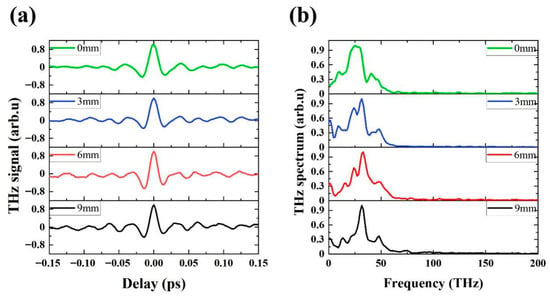
2. Proposed Method and Experimental Setup
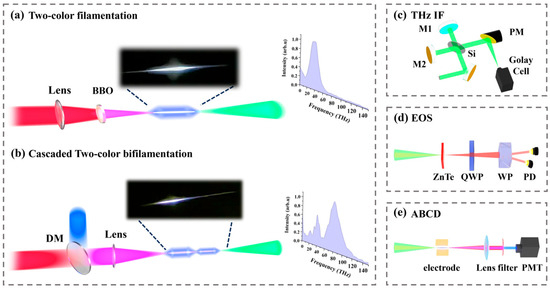
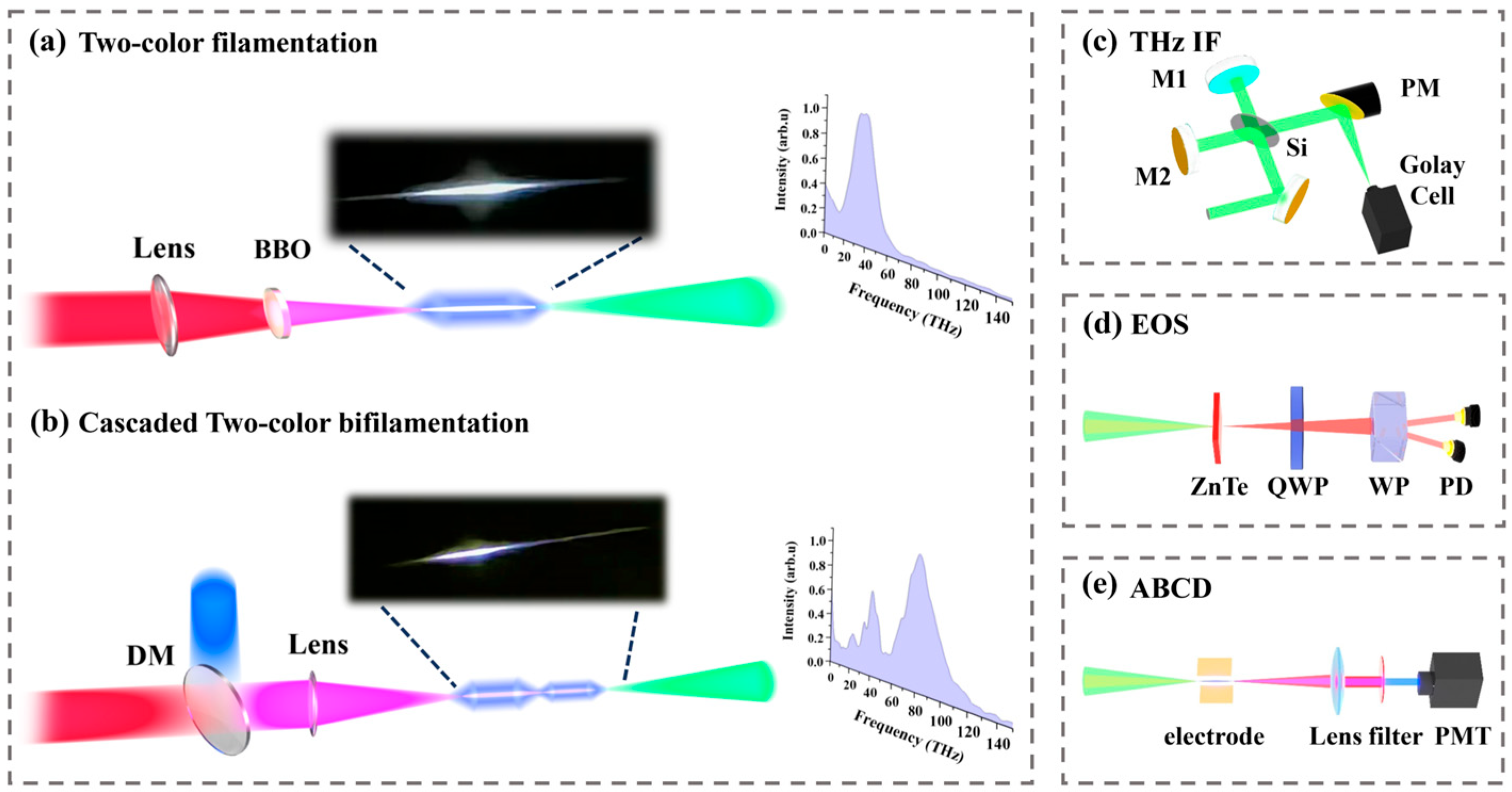
In the classic scheme of air plasma driven by two-color fields for THz generation as presented in Figure 1a, the fundamental optical field and its second harmonic are co-focused by the common convex lens before the second harmonic generation crystal [2,18,19,20,21]. This in-line setup has been widely used in subsequent studies due to its simplicity and intrinsic stabilization of the relative phase between the and fields [22,23,24,25]. Nevertheless, with this simple optical setup, the parameters of the two optical fields, such as their polarization and energies, as well as their spatial and temporal overlap, are not independent and cannot be readily controlled or optimized. Later, Dai and co-workers demonstrated an improved inline setup to manipulate the polarization of the and fields with attosecond control of the time delay between them, which has been recently developed into a three-color scheme by some of the current authors [26,27]. With the improved inline setup, the energies and spatial overlap of the two- or three-color fields still cannot be manipulated. For independent control of the parameters of the two optical fields, an interferometer-type setup with two arms for the and fields has been used [28]. Very recently, with the interferometer setup, Y. Yang and co-workers have reported a counterintuitive phenomenon, namely a significantly enhanced THz yield was achieved when the two foci of the and fields are intentionally separated in the longitudinal direction, which has been attributed to plasma absorption effect [29]. Inspired by this new optical setup arrangement, here we propose a two-color bifilamentation setup in which the spontaneous nonlinear spectral broadening of the pump pulse can be utilized in a controllable manner to introduce a controllable frequency detuning between the fundamental and its second harmonic. The basic idea is that the spectral broadening of the fundamental pulse occurs progressively along the filament. Therefore, one can displace the focus of the beam to interact effectively with any spatial segment of the fundamental pulse filament. Consequently, the effective local frequency detuning can be tuned when the focus of the second harmonic is scanned along the plasma filament of the fundamental pump pulse.
Figure 1.
Experimental conceptual diagram and its detection methods: Red (800 nm), Blue (400 nm), Purple (800 nm + 400 nm), and Green (THz) are shown as in the figure respectively. (a) Terahertz radiation generation via conventional collinear two-color fields. (b) Terahertz radiation generation via two-color cascaded plasma filaments. Three typical methods for detecting THz signals are shown in (c–e): (c) THz interferometry (THz IF), where PM denotes a parabolic mirror. (d) Electro-optic sampling (EOS), where QWP denotes a quarter-wave plate, WP denotes a Wollaston prism, and PD denotes a photodiode. (e) Air-biased coherent detection (ABCD), where PMT denotes a photomultiplier tube.
In the experiment, we used a Ti: sapphire femtosecond amplifier (model: Solstice Ace, Spectral Physics, Milpitas, CA, USA), which produces a laser pulse with a central wavelength of 800 nm, a pulse width of 35 fs, a beam spot diameter is 11 mm, and an energy of . The critical power for Kerr self-focusing in 1 atm air is typically about 3 GW at 800 nm. For the second-harmonic beam at 400 nm, the corresponding value is approximately 0.8 GW due to the approximate scaling. The experimental setup is schematically shown in Figure 1. In the conventional two-color scheme for THz generation from air plasma presented in Figure 1a, a convex lens is employed before the second harmonic generation crystal to focus both the fundamental and SH together in order to produce air plasma. In the two-color bifilamentation experiment, the 800 nm laser passes through a thick barium metaborate (BBO) crystal for frequency doubling, generating a mixed beam at 800 nm and 400 nm. It should be noted that propagation through the BBO crystal may introduce both a relative temporal walk-off and a certain amount of residual chirp between the and pulses. Under the present experimental conditions, however, the BBO crystal thickness is only 100 μm, so the additional group-delay dispersion is estimated to be small, and the resulting pulse broadening is negligible for 35 fs pulses. Therefore, although some residual chirp cannot be completely excluded, its influence is expected to be weaker than that of the temporal overlap, relative phase, and focusing geometry of the two-color field. To maximize the efficiency of terahertz radiation from plasma, we first optimized the rotation angle of the BBO crystal to maximize the intensity of the 400 nm beam. Based on our measurements, the energy ratio of the 800 nm beam to the 400 nm beam was approximately 10:1. The BBO crystal belongs to a type I phase-matched crystal (). Therefore, the polarization direction of the generated 400 nm beam is perpendicular to that of the 800 nm beam. We therefore added a half-wave plate to the 400 nm beam to adjust its polarization direction, making it parallel to that of the 800 nm beam. The two components are spatially separated by a dichroic mirror and propagate independently. An optical delay line composed of a pair of reflectors is installed for the 800 nm beam, allowing us to control the optical path of 800 nm on the micrometer scale to ensure the temporal overlap of the two-color pulses. As shown in Figure 1b, the two independently propagating light beams are recombined by another dichroic mirror (DM), and then co-focused in the air through a lens with a focal length of 15 cm or 50 cm to form two plasma filaments (i.e., secure bifilamentation). We added a laser beam shrinking system composed of a combination of positive (10 cm) and negative (−7.5 cm) lenses to the optical path of the 400 nm beam. By finely adjusting the position of the convex lens relative to the concave lens, the 400 nm laser can be tuned to converge or diverge. After being focused by the lens, the position of its focal point along the spatial z-axis can be manually controlled by adjusting the convergence and divergence effects of the light beam. In the meantime, the 800 nm light remains as a parallel beam, and its focal point remains unchanged. By changing the position of the 400 nm focal point, we can control the relative position of the two filaments. The terahertz radiation is collected and focused by a pair of parabolic mirrors in the downstream of the plasma filament, and a thick high-resistivity silicon wafer is placed between the parabolic mirrors to filter out the pump light. A Golay cell, which has a relatively flat responsivity over a broad spectral range of 0.0375–750 THz (0.4 µm–8 mm), is used behind the parabolic mirror to detect the power of terahertz radiation. For THz spectrum measurement, we constructed a THz interferometer [3], as illustrated in Figure 1c. By measuring the intensity of the signal versus the moving distance of mirror 2 (M2), and performing the Fourier transform of the signal along the delay , the spectrum of terahertz radiation can be obtained. To compare the interferometric method employed with other traditional methods for THz pulse characterization, we have also built two detection systems based on electro-optic sampling (EOS) [30] and air-biased coherent detection (ABCD) [31] principles, as presented in Figure 1d,e.
3. Experimental Results
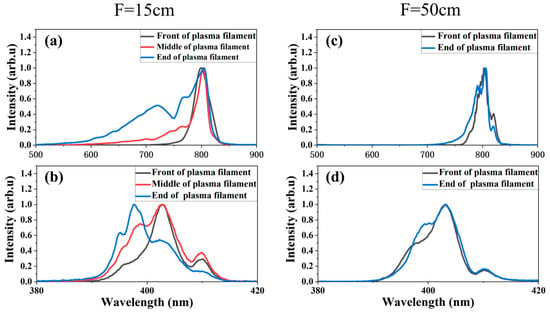
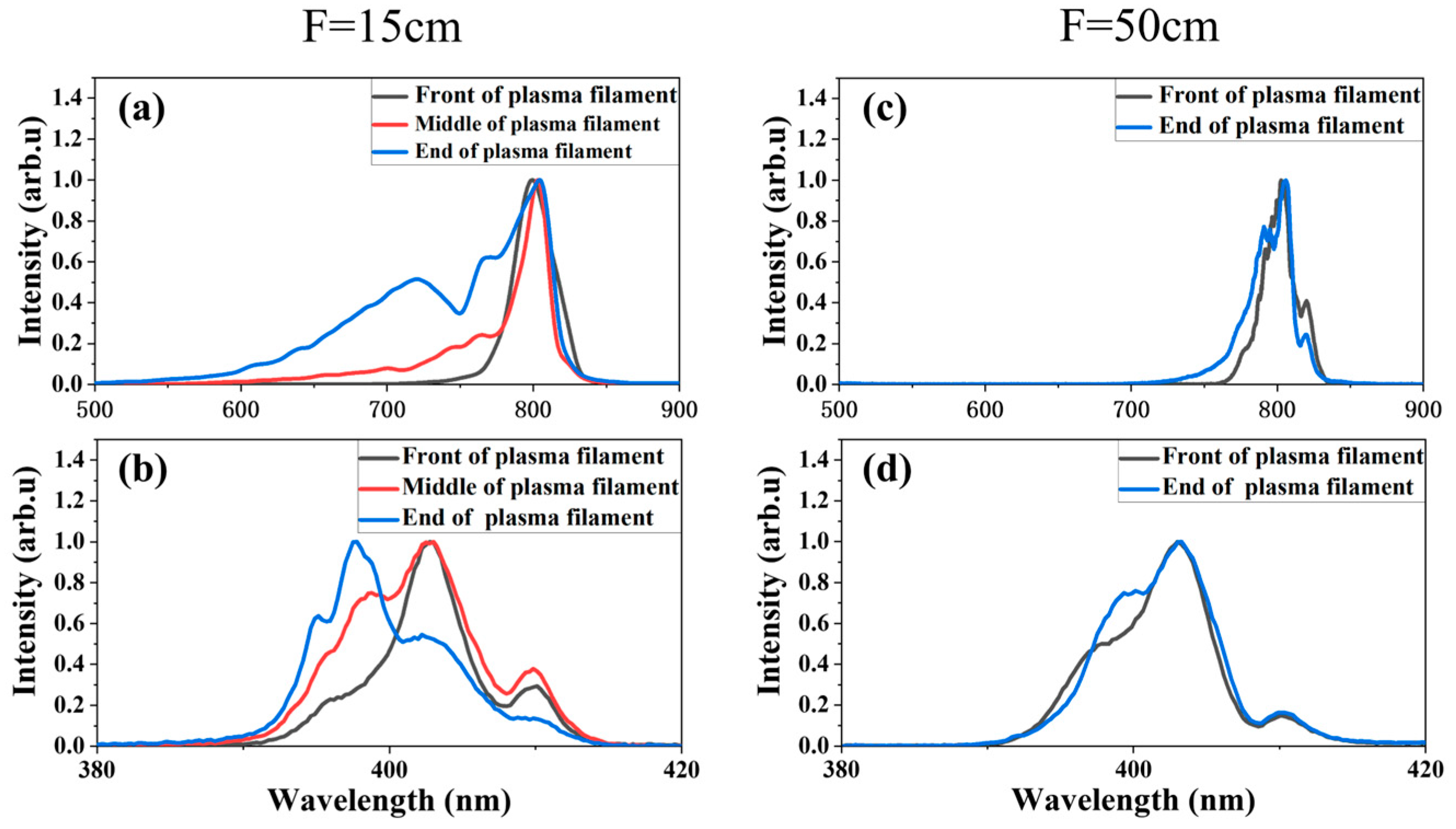
In our measurements, we first adopted a simple method to characterize the spectrum broadening of the pump pulse during its propagation inside the plasma filament. We inserted a 100 thick optical cover glass into the plasma filament at an incident angle of approximately with respect to the laser propagation direction. The aim of using the large incident angle is to maximize the interaction area and reduce damage to the cover glass. Without severe damage to the cover glass in a short time interval of a few seconds, the in situ laser spectra inside the plasma filament can be detected using a spectrometer, by utilizing the reflected light. In the experiments, we have installed this cover plate at different locations to examine the pump pulse spectrum at the upstream, middle, and downstream positions inside the filament plasma. Under focusing, the 800 nm pump laser experienced significant spectral broadening, as shown in Figure 2a. As the plasma filament evolves, a spectral broadening of up to ~200 nm occurs along the plasma filament. The component at 400 nm experiences only slight spectral broadening and a frequency shift less than 5 nm since its intensity is much weaker than that of 800 nm. We have tested the pump pulse spectra at 800 nm and 400 nm individually in the cases of single color filamentation and two-color bifilamentation. No significant difference was observed among the three situations, indicating that the broadening of the 800 nm pump pulse spectrum is mainly due to the nonlinear self-action of the 800 nm pulse during filamentation, and the Kerr- and plasma-induced cross-phase modulation effect plays a negligible role. The most probable origin of the blueshifted component of the 800 nm pulse is the adiabatic frequency upconversion due to ionization-induced temporal gradient of the plasma refractive index [32], which was previously detected in similar configurations [16,17].
Figure 2.
Spectral evolution of pump light at different positions of plasma filaments under different focusing conditions: (a,b) Spectral evolution of 800 nm and 400 nm laser pulses under the focusing condition of 15 cm. (c,d) Spectral evolution of 800 nm and 400 nm laser pulses under the focusing condition of 50 cm.
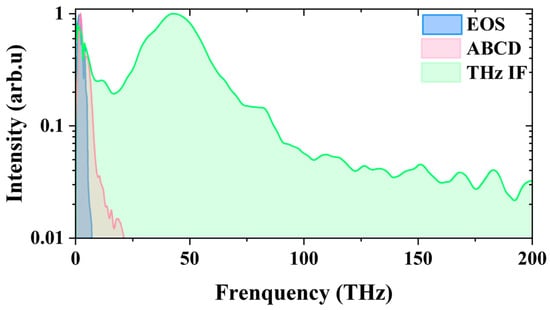
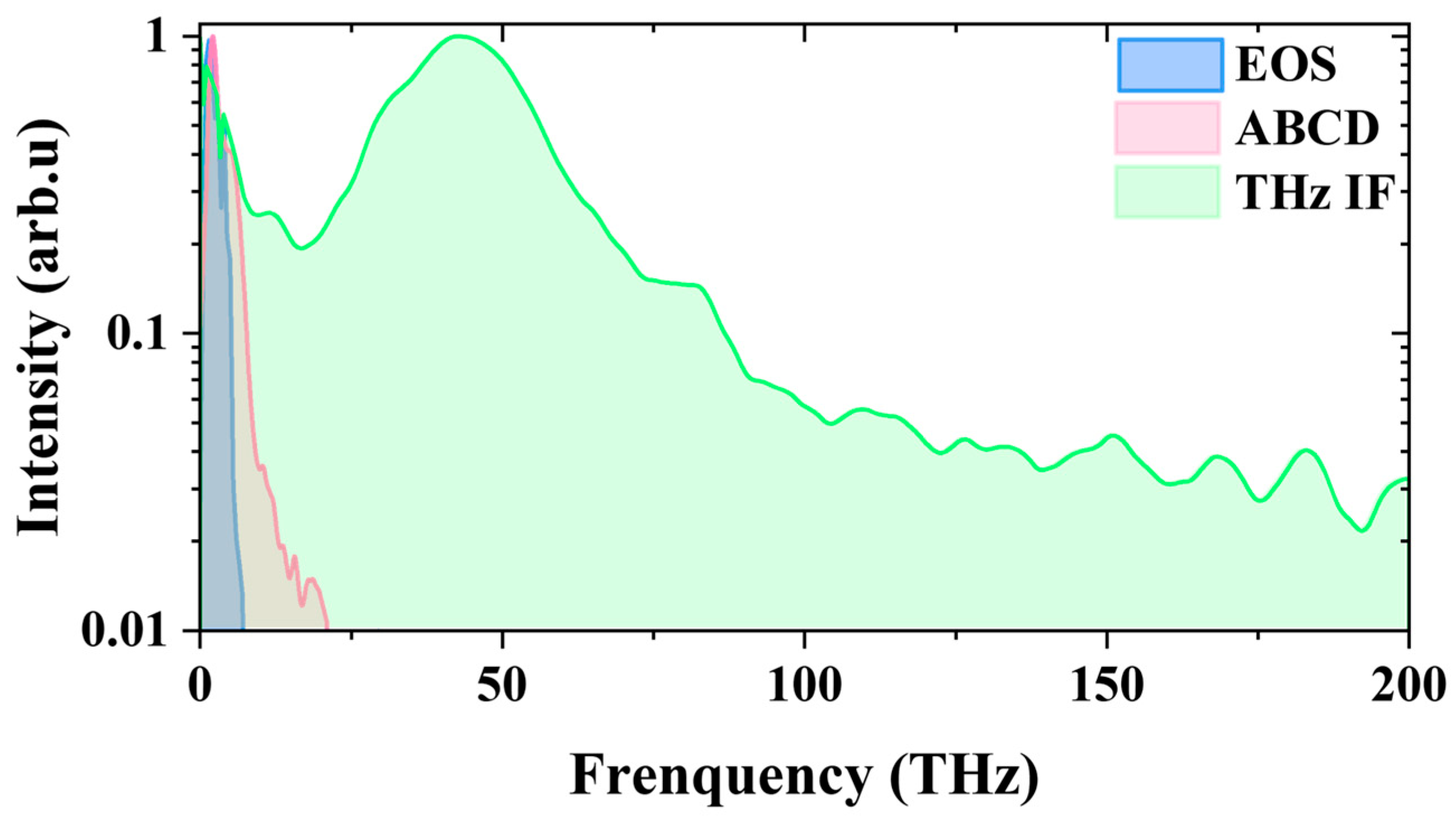
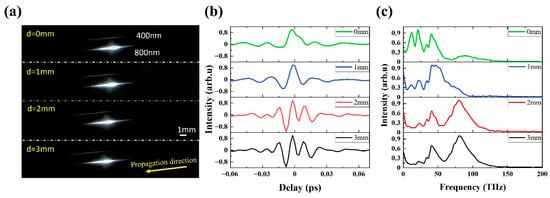
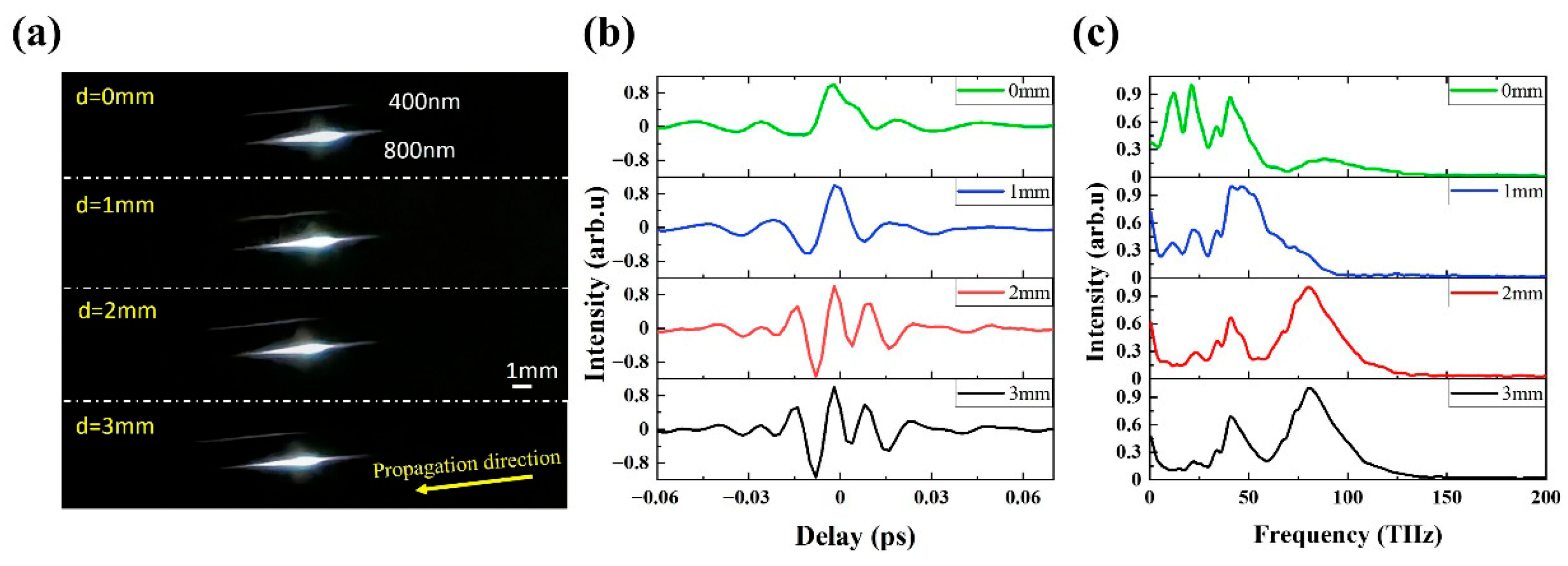
We then compare the THz spectrum obtained under different schemes for generation and detection. The typical results are presented in Figure 3. In the case of the conventional cofilamentation arrangement for THz generation, we have implemented the three different methods for THz spectrum measurements. We noticed that while the classic EOS method is limited to the bandwidth below 5 THz due to phonon absorption, the ABCD method shows a broad spectrum extending up to 20 THz, in agreement with previous reports [8]. With the THz interferometer, we obtained a much broader THz spectrum centered around 40 THz. In the case of bifilamentation with the two filaments longitudinally separated by about 3 mm, an ultrabroad radiation spectrum up to 119 THz (defined at 10% of the maximum intensity) can be routinely obtained, as presented in Figure 4c. Here, we would like to emphasize that we employed a 35 fs pulse from a commercial femtosecond laser system, rather than a sophisticated few-cycle femtosecond laser source, which was necessary to generate THz spectrum beyond 100 THz in the previous studies [4,11,12]. This cascaded two-color bifilamentation method therefore provides a simple and easily accessible method for generation of ultrabroad THz-to-infrared radiation from very low frequencies up to 119 THz with conventional 35 fs laser pulses.
Figure 3.
Differences among the three detection methods in the frequency domain in the case of two-color cofilamentation for THz generation.
Figure 4.
(a) Image of two-color plasma filaments with control of the relative position of the focuses within the range of double focus overlap. To clearly demonstrate the relative positions of the two focal points, we applied a slight offset to filaments along the transverse spatial axis here. (b) Terahertz interference signals at different positions. (c) Terahertz spectrum from Fourier transforms.
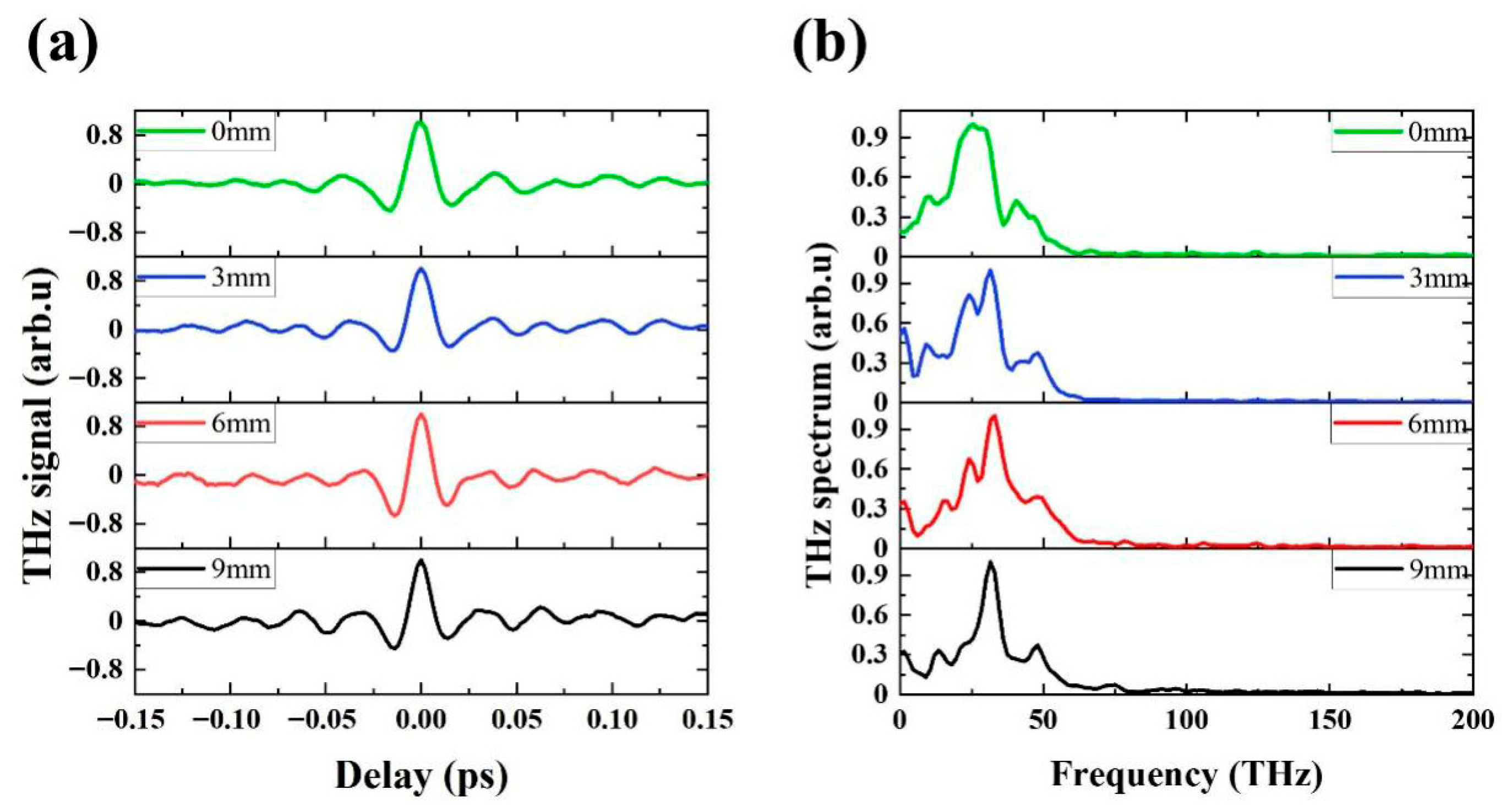
To gain insight into this ultrabroad THz spectrum, we systematically measured the THz interferometer trace and the corresponding THz spectra at different focal positions. In the experiment, we selected four representative positions for the measurements. The parameter is defined as the relative spatial separation between the two focal points along the propagation direction. Specifically, corresponds to the case where the two foci overlap. As increases, the 400 nm focus gradually leaves the center of the plasma filament formed by the 800 nm pulse into the downstream direction, reaching the downstream region of the filament at . We recorded the evolution of the relative spatial positions of the two beams using a camera. To more clearly visualize the relative focal positions, we slightly separated the two beams along the transverse () spatial direction during imaging, thereby producing two distinct plasma filaments that are directly visible, as shown in Figure 4a. After our measurement, the length of the 800 nm filament is approximately 6 mm, while the length of the 400 nm filament is slightly shorter than that of the 800 nm one, approximately 5 mm. At , the generated THz radiation spectrum is mainly distributed below 50 THz, exhibiting two pronounced peaks centered at approximately 20 THz and 40 THz. As the 400 nm focus is progressively shifted downstream along the plasma filament, the THz spectral components gradually move toward higher frequencies. At , the spectrum shows two distinct peaks centered at about 45 THz and 80 THz in Figure 4c.
In our experiments, we found that the THz spectral components generated at mm are highly similar to those obtained under conventional collinear propagation. We therefore infer that this relative focal configuration more closely corresponds to the conventional cofilamentation case. This can be attributed to the fact that the 800 nm pulse energy is much higher than that of the 400 nm pulse. Consequently, during propagation, the 800 nm beam experiences a stronger self-focusing effect, shifting its effective focus closer to the lens. As a result, the configuration naturally corresponds to the 400 nm focus being located downstream of the 800 nm focus. Along the propagation path of the plasma filament, the 800 nm spectrum gradually undergoes spectral broadening and frequency shifting because of ionization-induced local temporal gradient of the refraction index [16,17,32]. In contrast, because of its lower intensity, the 400 nm pulse experiences much weaker broadening, and its spectrum shows no pronounced change. As the 400 nm focal position is shifted, the primary interaction region between the two pulses is correspondingly modified, which alters the frequency components of the two-color field and, consequently, leads to significant modification of the spectral content of the emitted THz radiation.
To further validate our hypothesis, we repeated the experiment using a 50 cm focal-length lens. Under 50 cm focusing, the numerical aperture for focusing becomes smaller, and a longer plasma filament (~20 mm) is formed in space. Consequently, the on-axis peak intensity decreases. This reduction in intensity weakens the plasma-induced frequency upshift, thereby leading to less spectral broadening and frequency shifting of the pump pulses. We recorded the evolution of the pump spectra both before and after the plasma filament, as shown in Figure 2c,d. In this configuration, we performed measurements at four representative positions following the same relative focal arrangements as in the 15 cm case, and the corresponding THz spectral evolution is presented in Figure 5. We find that the THz spectral components are insensitive to the relative focal position, while the overall THz intensity exhibits a slight increase as the focal position is varied. These results further highlight the critical role of the pump spectral characteristics in the THz generation process.
Figure 5.
THz interferometer measurements at different relative focal positions under F = 50 cm focusing. (a) Time-domain THz interferogram (trace). (b) Corresponding Fourier transform (THz spectrum).
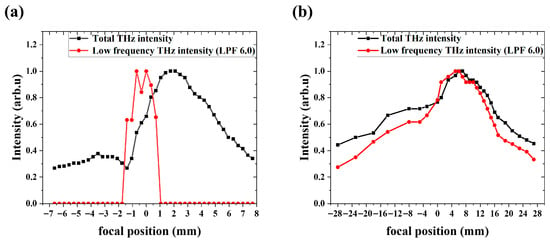
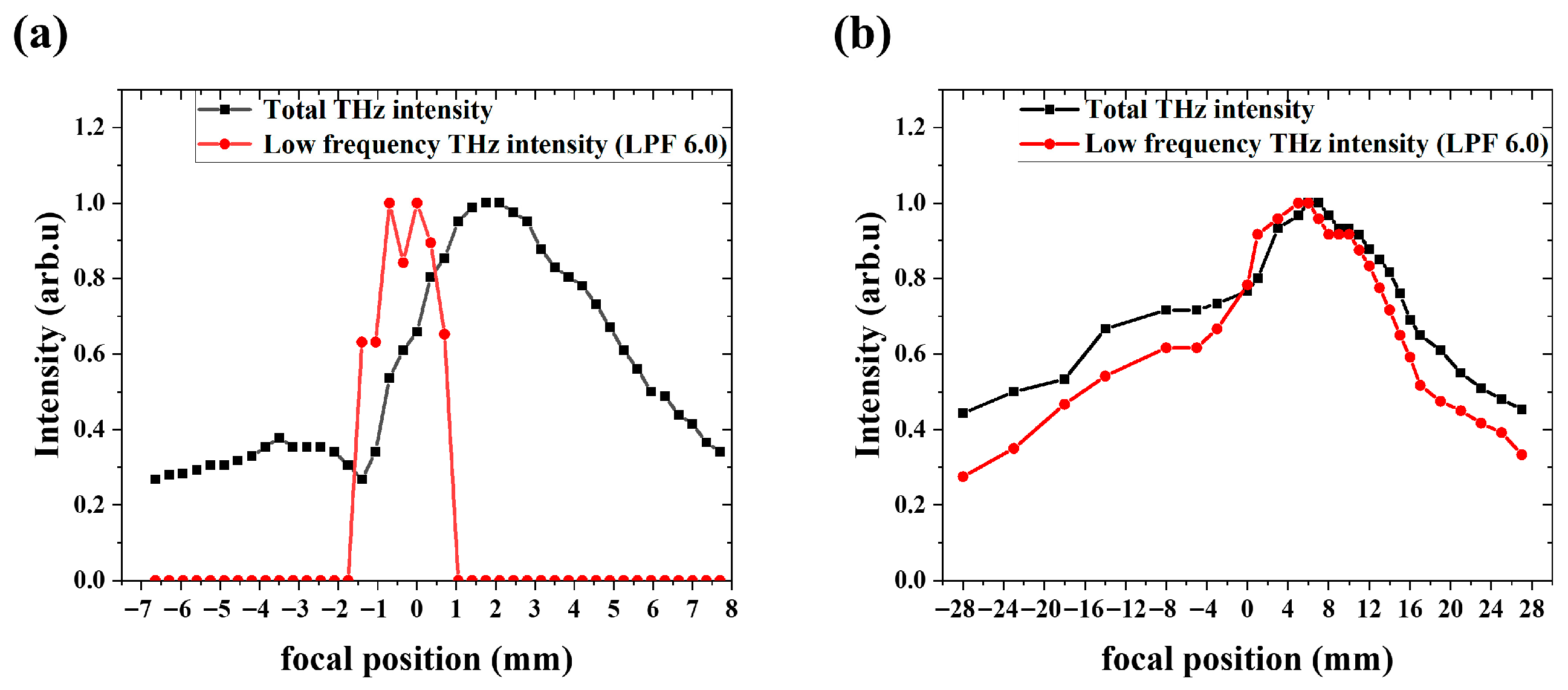
The results in Figure 4 indicate that the different THz spectral components depend differently on the relative focal positions. We next measured the total terahertz energy yield under different relative positions of the two filaments, with the results shown in Figure 6. We find that the terahertz radiation generated under separated-foci conditions is stronger than that obtained when the two foci overlap. Moreover, the terahertz emission detected by the Golay cell reaches its maximum when the 400 nm focus is located downstream of the 800 nm focus. This observation has been reported in the literature [29,33]. However, we observed additional peculiar phenomena in the low-frequency (LF) THz band during the experiments. We used a terahertz low-pass filter LPF 6.0 (QMC), which has a sharp transmission edge around 6 THz, allowing us to measure the THz energy below 6 THz. The intensity variation in LF terahertz is shown by the red line with circle markers in Figure 6a. As seen, the dependence of the LF terahertz intensity on separation is opposite of that of the total terahertz intensity. Surprisingly, when the intensity of total terahertz shows a minimum around , the intensity of LF terahertz nearly reaches its maximum. Since the THz intensity below 6 THz behaves very differently from the total terahertz intensity, the total terahertz energy can therefore be mainly attributed to the high-frequency components above 6 THz, in agreement with the results in Figure 4.
Figure 6.
Total terahertz energy and the terahertz energy of only the low-frequency component (<6 THz) as functions of the relative position of bifilaments . (a) focal length of , (b) cm focusing condition.
To identify the underlying physical mechanism, we repeated the experiment using a lens with a focal length of . The black and red dotted lines in Figure 6b represent the dependence of the intensities of total and LF terahertz under the 50 cm focusing condition, respectively. As the relative position of bifilaments changes, the intensities of the total and LF terahertz signals show a similar dependence. Moreover, it was observed that the intensity of terahertz radiation is not at a maximum when the dual focal points coincide, whereas it is when the 400 nm focal point is ~5 mm (downstream) ahead of the 800 nm filament. This can be explained by the rather high lengths of the filaments formed, which introduces uncertainty in determining the exact position of the focus.
4. Discussion
The THz emission spectrum from air plasma is strongly influenced by several factors, among which the frequency detuning between the pump spectral components is particularly important [16,23,34,35,36,37]. Under 15 cm focusing, we observe substantial spectral broadening (blueshift) of the 800 nm fundamental along the filament (see Figure 2), consistent with dynamics expected when an intense pulse ionizes medium during propagation [16,17,32]. The local detuning in the region of spatiotemporal overlap between fundamental and second-harmonic fields inevitably depends on both the focal shift and the temporal delay. Since the blueshift increases with propagation distance, the downstream part of the plasma filament contains more strongly blueshifted components. Therefore, shifting the 400 nm focus toward this downstream region increases the local detuning between the fields and improves their overlap in the high-detuning zone. For 50 cm focusing, the blueshift is much less significant, which is probably due to lower intensities and, consequently, lower ionization rates. Because blueshifted components are essentially absent under 50 cm focusing (see Figure 2c,d), changing the 400 nm focus does not lead to variation in the local detuning.
In addition to the blueshift effect and induced frequency detuning, a crucial parameter influencing the generated THz spectra is the temporal scale of the current source, which, in the case of a photocurrent, is determined by the duration of gas ionization (the characteristic time of the plasma density growth) [35]. Given that the ionization duration is significantly shorter than the pulse duration, the spectral components of the THz radiation—arising from distinct spectral components of the pump pulse—are individually broadband (possessing a bandwidth greater than inverse pulse duration), as is seen in Figure 4 and Figure 5 showing the experimentally measured THz spectra.
To get a more detailed picture of ultrabroadband THz generation, we simulated the THz spectra numerically using a quantum-mechanical approach (see Appendix A). First, we solved the three-dimensional time-dependent Schrödinger equation (3D TDSE) in spherical coordinates for a hydrogen atom in a multicomponent field corresponding approximately to the experimentally measured spectra shown in Figure 2. The goal was to study how the presence of a strongly blueshifted component around 700 nm affects the THz spectrum. We compared THz spectra of dipole acceleration [35] excited by two- and three-component pulses of the form
where is the slowly varying amplitude of the field component at the wavelength ; , , and are the corresponding peak intensity, central frequency, and phase shift, respectively; is the speed of light; is the electric constant; is the intensity full width at half maximum (FWHM) duration; is the time variable; and is the unit vector along the -axis. The use of the hydrogen atom to study the ionization-induced blue shift in air is justified by the fact that the hydrogen atom has an ionization potential (and, accordingly, an ionization threshold) close to those in nitrogen and oxygen molecules.
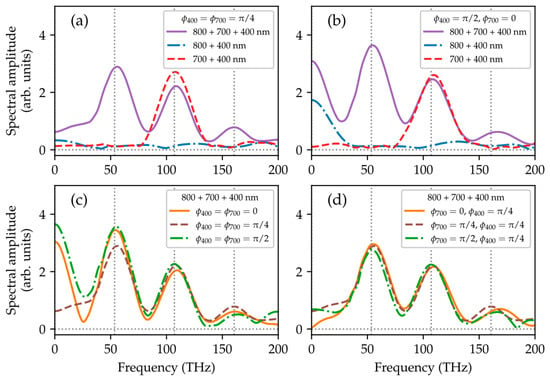
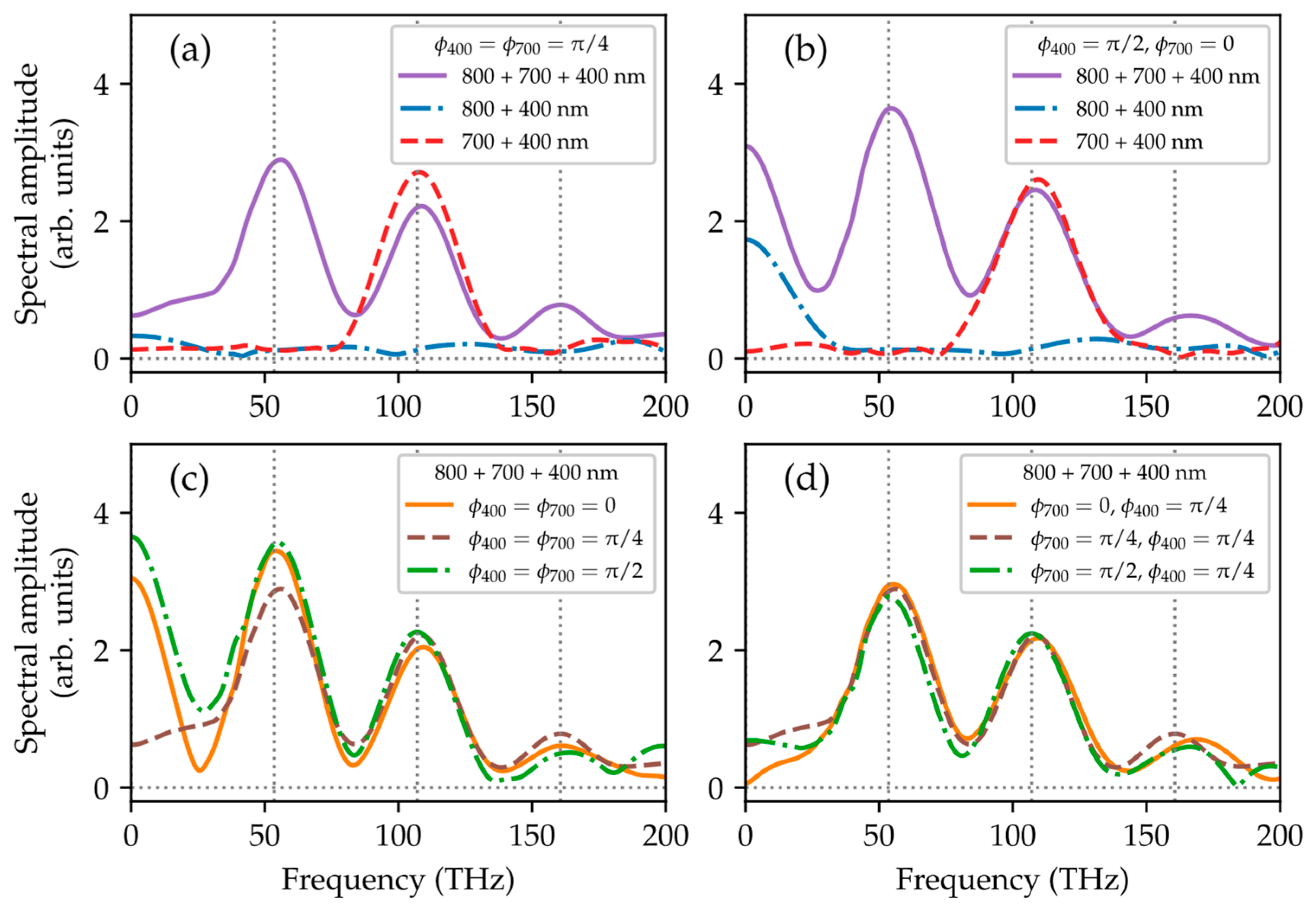
The calculated THz spectra are shown in Figure 7. As seen, the presence of 700 nm blueshifted component significantly modifies the THz spectrum. While 800 nm and 400 nm produce a THz spectrum mostly concentrated in the low-frequency part, approximately below the ionization duration, the 700 nm and 400 nm together produce a THz response around the detuning frequency , as expected from previous studies [23,34,35,36,37]. However, when all three components (at 800, 700, and 400 nm) are present, the spectrum contains additional peaks around odd multiples of . This can be explained by multiphoton mixing involving both photons at 700 nm and 800 nm, resulting in combination frequencies , . For the parameters chosen for Figure 7, the frequency difference between 700 and 800 nm is large compared to the inverse ionization duration. Therefore, spectral components in the THz pulse (as well as in the ionizing pulse itself) are well separated and interfere only weakly with each other. Under these conditions, the phase between 800 and 400 nm mostly affects the low-frequency part of the power spectrum (see also Refs. [22,23,35,36,37,38,39]; see Figure 7c), while the phase between 800 nm and 700 nm has only a weak effect on the THz spectrum (see Figure 7d). At the same time, the phases and determine the phases of the quasi-monochromatic components: the phase of the component at frequency is equal to , where N is integer.
Figure 7.
Spectra of THz response of a hydrogen atom on two- and three-component excitation at 800, 700, and 400 nm for different relative phases between components. Spectra are calculated via the 3D TDSE solution. The vertical dotted grid lines mark multiples of the 700–800 nm detuning . Panels (a,b) compare THz spectra excited by a pulse containing all three components and two-component pulses having only one of the 800 or 700 nm components for different fixed relative phases and of the 400 and 700 nm components. The three-color pulse is specified by Equation (1) with the intensity FWHM and respective peak intensities of components , , and . For the two-component pulse containing 800 and 400 nm, and . For the two-component pulse containing 700 and 400 nm, and . Panels (c,d) present THz spectra excited by a three-component pulse for different relative phases with fixed phase shift between 700 and 400 nm (c) or 800 and 400 nm (d).
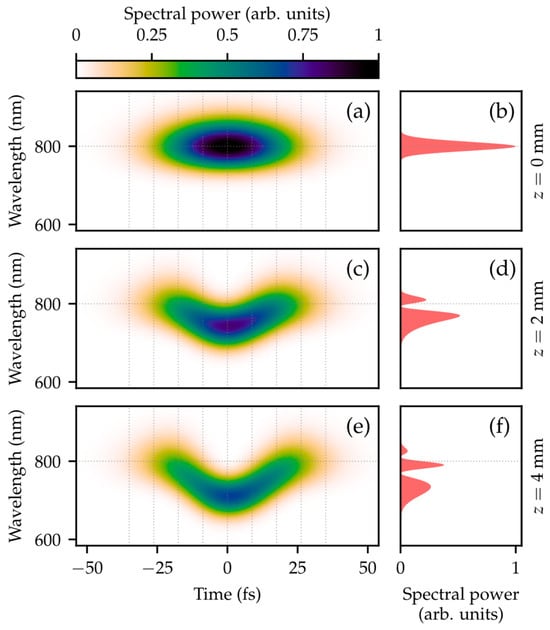
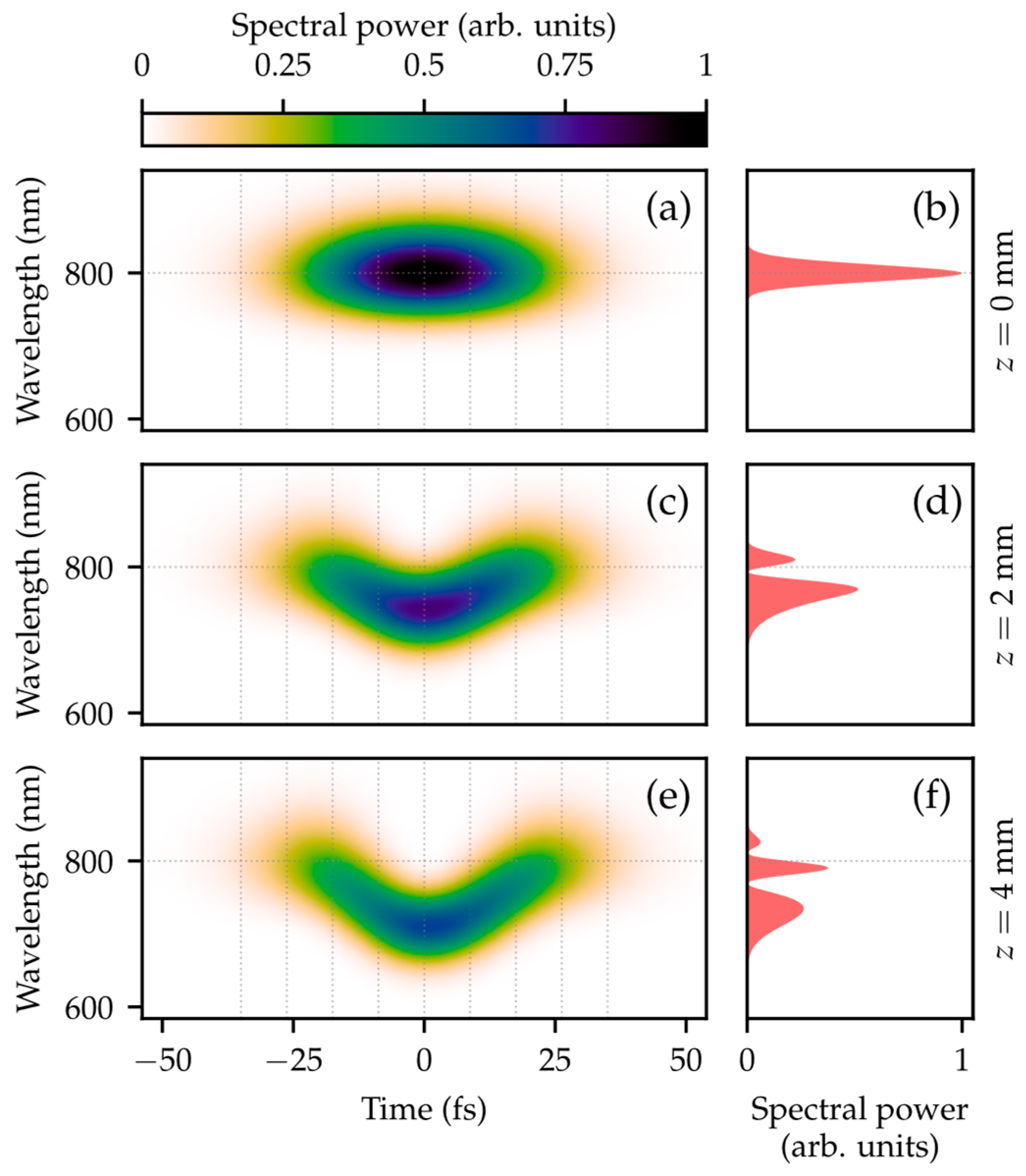
However, the realistic spectrum of the ultrafast pulse undergoing ionization blueshift differs from a simple superposition of a few discrete components (see Figure 2a). To get a more realistic reference waveform of a laser pump undergoing blueshift during propagation, we performed numerical simulation of Maxwell–Schrödinger equations. Only the 800 nm pulse was sent to a gas consisting of hydrogen atoms at atmospheric pressure. The corresponding spectrograms and spectra of the blueshifted radiation are shown in Figure 8. As seen, after 2 mm of propagation, the blueshifted spectrum reaches 700 nm. Importantly, the central part is blueshifted more strongly than the pulse head and tail. This is natural since the blueshift is caused by the temporal gradient of the refractive index, which in turn is caused by ionization, and the ionization rate is highest near the pulse envelope maximum.
Figure 8.
(a,c,e) Spectrograms (Gabor transforms) and (b,d,f) spectra of an 800 nm pulse propagating in a gas consisting of hydrogen atoms at atmospheric pressure after propagation distances (a,b), (c,d), and (e,f). The propagation is modeled numerically via Maxwell–Schrödinger equations. The input pulse at has the form of Equation (1) with , , and . The dotted vertical grid lines mark time delays (centers of 400 nm pulses) for which the spectra in Figure 9 are presented.
This observation helps to explain the experimental dependences of low- and high-frequency THz energy (as shown in Figure 6): To obtain significant low-frequency THz radiation, one requires that, in the spatiotemporal region of overlap between the fundamental and second-harmonic fields, the relative detuning be small. However, due to the blueshift of the central part, this can be achieved only when the center of the 400 nm pulse overlaps the head or tail of the fundamental pulse, where the peak intensity and hence the ionization are weak, resulting in weak low-frequency THz output. Therefore, when the focal displacement between the 800 and 400 nm components is introduced, the 400 nm overlaps spatially with the blueshifted 800 nm region, and little or no low-frequency THz radiation is observed. On the contrary, to obtain high-frequency THz radiation at 100 THz, one needs to organize spatial overlap between 400 nm and the blueshifted radiation, and since the blueshift is stronger around the temporal pulse maximum, the resulting 100 THz component is also strong.
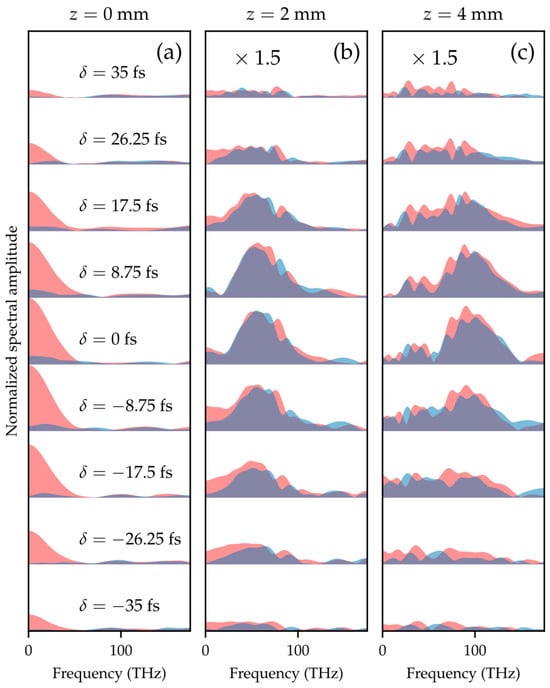
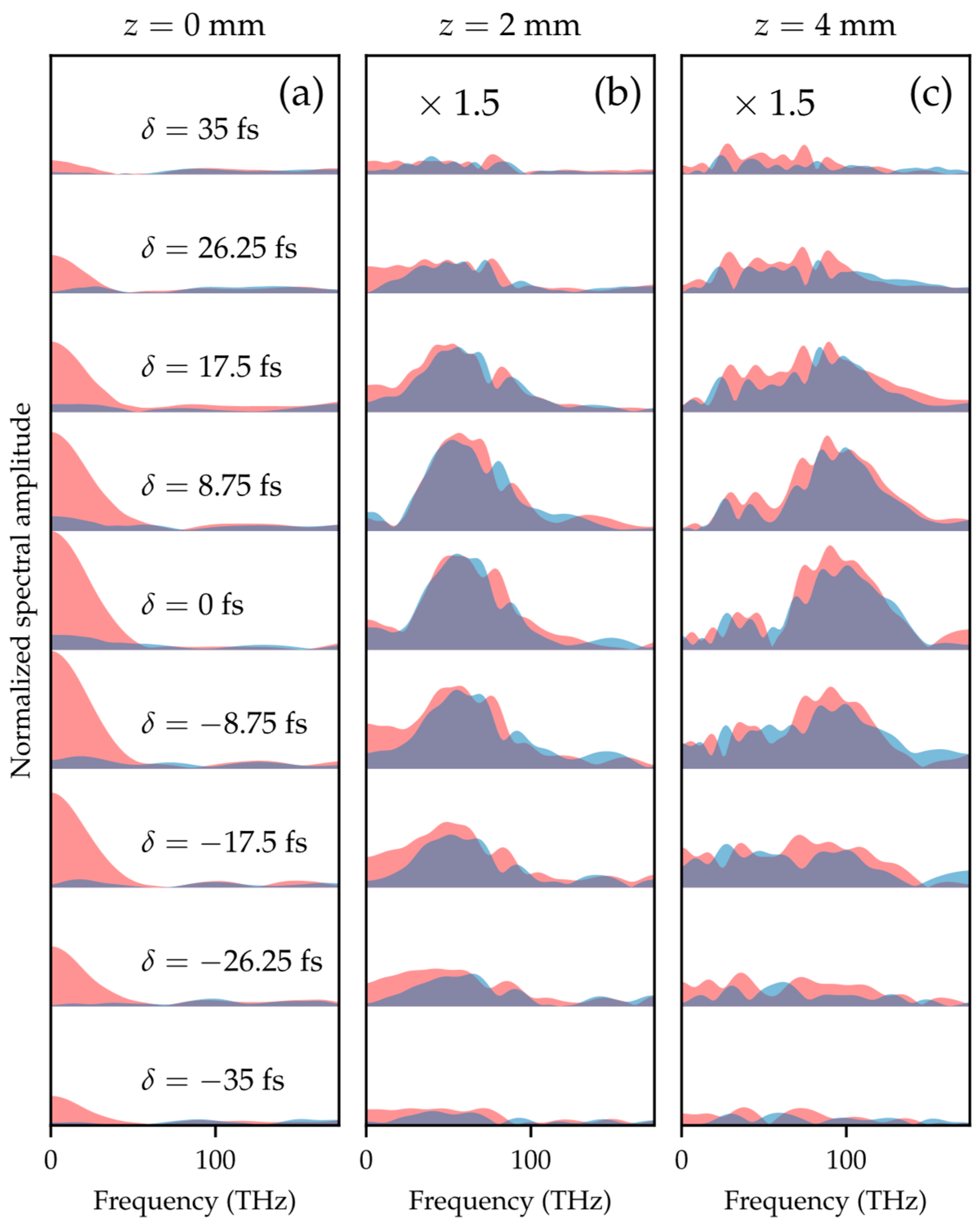
We also calculated the local THz response (at specific propagation distances) of such a blueshifted 800 nm pulse combined with a weaker 400 nm pulse of a preset temporal shape at various temporal delays. That is, a result of Maxwell–Schrödinger calculations with the 800 nm input, with , was superimposed by a 400 nm pulse of the form with where is the time delay. The resulting field served as the external field for local 3D TDSE calculations of the THz response. The calculated THz spectra for different propagation distances, time delays and relative phases are presented in Figure 9. As seen, the average THz frequency grows with the propagation distance, as does the blueshift (see Figure 8). Since both fundamental and second-harmonic spectra are broader than in the situation illustrated by Figure 7, the different spectral components in THz spectrum that previously (in Figure 7) were separated can now merge and interfere with each other, forming a more complicated spectral supercontinuum profile, closer to that observed in experiments. This interference is sensitive to the relative phase , which can now affect the high-frequency part of the THz spectrum more strongly. The situation here is, in some ways, analogous to that in [36,37]. There, the broad spectrum (inverse transform-limited duration) of the chirped pump pulse was required to achieve a broad tuning range up to tens and hundreds of THz. Here, the spectral broadening of an 800 nm pulse allows a broad THz spectrum, while the interference between components originating from different parts of the broad pump spectrum via different parametric channels is responsible for the complex character of the resulting spectrum. One can also consider this as a version of the degenerate ionization-induced wave mixing, in which a single frequency can be represented as different combinations of pump frequencies. Usually, this refers to situations when two or more odd harmonics of some frequency are combined in a centrosymmetric medium, like the fundamental and third harmonics [40]. However, when two close frequencies are present within a broad spectrum (broader than the inverse ionization duration), this can also lead to similar effects of parametric channel competition and interference.
Figure 9.
Spectra of THz of a hydrogen atom excited by blueshifted 800 nm field combined with 400 nm field at different propagation distances equal to (a) 0, (b) 2 mm, and (c) 4 mm, after 800 nm and time delays between the 800 and 400 nm components. The red and blue shadings correspond to optimal and pessimal phases between the 800 and 400 nm components corresponding to maximum and minimum of total THz signal energy below 200 THz, respectively. The 800 nm pulse is the result of Maxwell–Schrödinger calculations presented in Figure 8 with the parameters described in the caption. The 400 nm pulse has an intensity FWHM duration of and a peak intensity of .
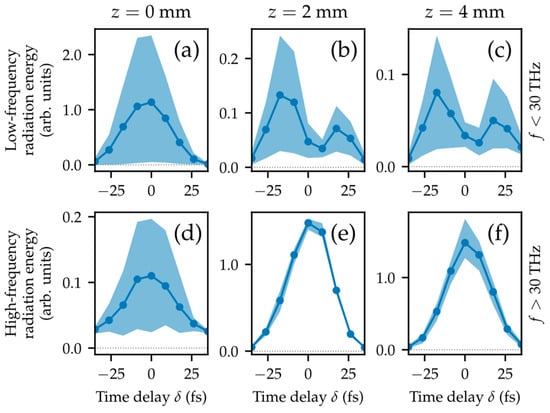
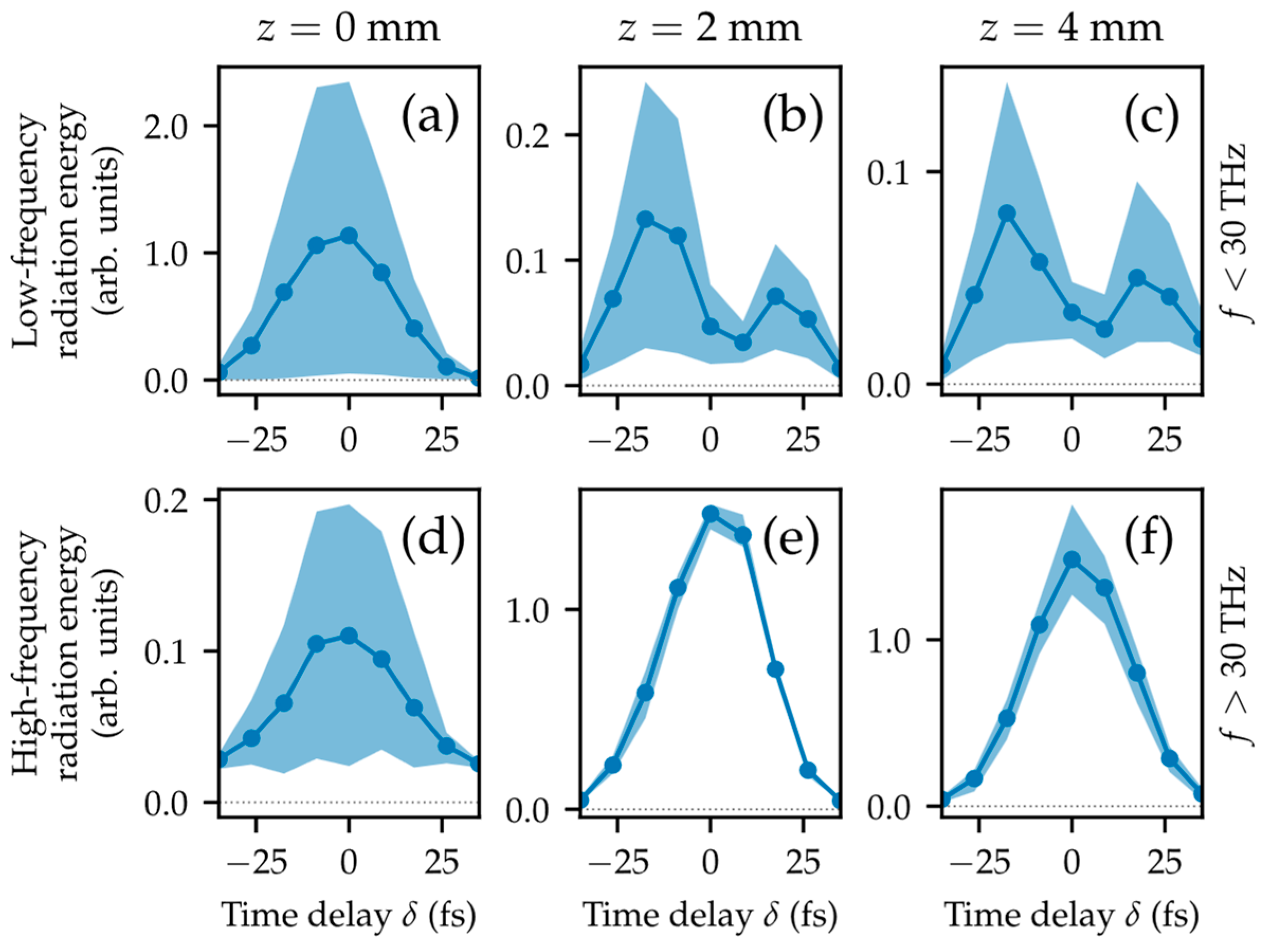
Also note that for large enough propagation distances, while the optimal time delay for high-frequency THz response is around zero, the optimal time delay for low-frequency radiation differs from zero, consistent with what was explained earlier: To obtain low-frequency radiation, one needs to overlap the 400 nm pulse effectively with the head or tail of the 800 nm pulse. Consequently, the relative energy contribution of the low-frequency part also decreases with propagation distance. To illustrate this more clearly, we calculated the corresponding radiated energies (within the dipole approximation) in the low-frequency (below 30 THz), as well as in the intermediate- and high-frequency parts of the THz range and plotted the dependences of these energies on time delay in Figure 10. As seen, for large propagation distances, the high frequencies almost fully determine the total energy. This is consistent with the experimental observation where the optimal time delay was chosen with respect to the highest total THz energy. And for large enough focal displacement, this corresponds to the highest high-frequency contribution with almost zero low-frequency component, as seen in Figure 6.
Figure 10.
Energies radiated in low-frequency (a–c) and high-frequency (d–f) parts of the THz frequency range vs. time delay between the 400 and 800 nm components of the ionizing pulse for different propagation distances of the 800 nm component. Shading shows the energy range for different relative phases , and the line shows the average over . The calculation parameters are the same as in Figure 9.
To summarize, the experimentally observed high-frequency THz radiation is due to the presence of the blueshifted components in the fundamental spectrum, which appear during pulse propagation through the self-induced plasma density gradient. The broad spectrum of the fundamental field results in a broad supercontinuum THz spectrum with a complex structure due to interference between different parametric channels. The focal displacement (two-foci setup) provides better spatial overlap between the blueshifted spectral component of the fundamental pulse and the second-harmonic pulse. At the same time, the optimization of time delay for large focal displacement results in weaker low-frequency THz radiation, since low-frequency THz radiation in this case requires overlap of the central part of the 400 nm pulse with the head or tail of the 800 nm pulse.
Author Contributions
Conceptualization, Z.L., V.A.K. and Y.L.; methodology, Z.L. and X.Q.; software, A.A.R. and V.A.K.; formal analysis, A.A.R., V.A.K., A.A.S., C.L. and Y.L.; writing—original draft preparation, Z.L.; writing—review and editing, V.A.K. and Y.L.; visualization, Z.L., A.A.R., V.A.K. and A.A.S.; supervision, Y.L.; funding acquisition, Y.L. All authors have read and agreed to the published version of the manuscript.
Funding
This work was supported by National Natural Science Foundation of China (12595342), the Shanghai Sci-tech Co-research Program (25HB2701200). The development of computer code and simulations were supported by the Russian Science Foundation (Grant. No. 25-72-10172).
Data Availability Statement
The data presented in this study are available from the corresponding author on reasonable request.
Conflicts of Interest
The authors declare no conflicts of interest.
Appendix A
To simulate the interaction of the hydrogen atom with an external electric field , the 3D TDSE was solved numerically (atomic units are used),
where is the electron wavefunction, is the distance between the electron and the ion, and are the polar and azimuthal spherical angles, respectively, corresponding to the polar axis x. The initial condition corresponds to the ground () state. The wavefunction is expanded in spherical harmonics [41]:
where , is the orbital quantum number, and are Legendre polynomials. Due to the cylindrical symmetry of the problem, the magnetic quantum number is restricted to zero (). Substituting Equation (A2) into Equation (A1) yields a system of coupled equations for the radial functions ,
where .
The system of Equation (A3) is solved using the split-step method, with a finite-difference discretization of the radial coordinate and the Numerov approximation for the second derivative. The calculations are performed in the domain and , where the parameters and were chosen based on the quiver radius and the momentum of free electrons in the laser field. An equidistant grid with a radial step of is employed. The time step is . Wavefunction absorption near the grid boundary is implemented via an imaginary potential with a total width of 50.
The properties of the radiation generated by an atom are determined by the dipole acceleration . According to the Ehrenfest theorem, it is given by
The spectral density of the dipole acceleration is defined as the squared magnitude of the Fourier transform of ,
To account for propagation effects in an optically dense medium, we developed numerical code for solving the coupled 3D TDSE and the one-dimensional wave equation for the total electric field directed along x in a moving frame of reference (, ) using the forward-propagating wave approximation [42]:
Here, is the projection of field onto x-axis, is the atomic gas density corresponding to atmospheric pressure. In the numerical code, the medium was divided into layers, where the full propagation distance, is the spatial step (equal to 2 μm in numerical simulations). In each layer, the 3D TDSE was solved for the wavefunction, and the corresponding dipole acceleration was calculated and substituted in Equation (A4).
References
- Hamster, H.; Sullivan, A.; Gordon, S.; White, W.; Falcone, R.W. Subpicosecond, electromagnetic pulses from intense laser-plasma interaction. Phys. Rev. Lett. 1993, 71, 2725. [Google Scholar] [CrossRef] [Scilit]
- Cook, D.J.; Hochstrasser, R.M. Intense terahertz pulses by four-wave rectification in air. Opt. Lett. 2000, 25, 1210. [Google Scholar] [CrossRef] [Scilit] [PubMed]
- Kim, K.Y.; Taylor, A.J.; Glownia, J.H.; Rodriguez, G. Coherent control of terahertz supercontinuum generation in ultrafast laser–gas interactions. Nat. Photonics 2008, 2, 605. [Google Scholar] [CrossRef] [Scilit]
- Matsubara, E.; Nagai, M.; Ashida, M. Ultrabroadband coherent electric field from far infrared to 200 THz using air plasma induced by 10 fs pulses. Appl. Phys. Lett. 2012, 101, 011105. [Google Scholar] [CrossRef] [Scilit]
- Wu, Q.; Zhang, X.C. Free-space electro-optic sampling of terahertz beams. Appl. Phys. Lett. 1995, 67, 3523. [Google Scholar] [CrossRef] [Scilit]
- Nahata, A.; Weling, A.S.; Heinz, T.F. A wideband coherent terahertz spectroscopy system using optical rectification and electro-optic sampling. Appl. Phys. Lett. 1996, 69, 2321. [Google Scholar] [CrossRef] [Scilit]
- Löffler, T.; Kreß, M.; Thomson, M.; Hahn, T.; Hasegawa, N.; Roskos, H.G. Comparative performance of terahertz emitters in amplifier-laser-based systems. Semicond. Sci. Technol. 2005, 20, S134. [Google Scholar] [CrossRef] [Scilit]
- Dai, J.; Xie, X.; Zhang, X.-C. Detection of broadband terahertz waves with a laser-induced plasma in gases. Phys. Rev. Lett. 2006, 97, 103903. [Google Scholar] [CrossRef] [Scilit]
- Karpowicz, N.; Dai, J.; Lu, X.; Chen, Y.; Yamaguchi, M.; Zhao, H.; Zhang, X.-C.; Zhang, L.; Zhang, C.; Price-Gallagher, M. Coherent heterodyne time-domain spectrometry covering the entire “terahertz gap”. Appl. Phys. Lett. 2008, 92, 011131. [Google Scholar] [CrossRef] [Scilit]
- Roskos, H.G.; Thomson, M.D.; Kreß, M.; Löffler, T. Broadband THz emission from gas plasmas induced by femtosecond optical pulses: From fundamentals to applications. Laser Photonics Rev. 2007, 1, 349. [Google Scholar] [CrossRef] [Scilit]
- Matsubara, E.; Nagai, M.; Ashida, M. Coherent infrared spectroscopy system from terahertz to near infrared using air plasma produced by 10-fs pulses. J. Opt. Soc. Am. B 2013, 30, 1627. [Google Scholar] [CrossRef] [Scilit]
- Thomson, M.D.; Blank, V.; Roskos, H.G. Terahertz white-light pulses from an air plasma photo-induced by incommensurate two-color optical fields. Opt. Express 2010, 18, 23173. [Google Scholar] [CrossRef] [Scilit] [PubMed]
- Gustafson, T.K.; Taran, J.P.; Haus, H.A.; Lifsitz, J.R.; Kelley, P.L. Self-Modulation, Self-Steepening, and Spectral Development of Light in Small-Scale Trapped Filaments. Phys. Rev. 1969, 177, 306. [Google Scholar] [CrossRef] [Scilit]
- Fang, X.J.; Kobayashi, T. Evolution of a super-broadened spectrum in a filament generated by an ultrashort intense laser pulse in fused silica. Appl. Phys. B 2003, 77, 167. [Google Scholar] [CrossRef] [Scilit]
- Couairon, A.; Bergé, L. Light Filaments in Air for Ultraviolet and Infrared Wavelengths. Phys. Rev. Lett. 2002, 88, 135003. [Google Scholar] [CrossRef] [Scilit]
- Babushkin, I.; Kuehn, W.; Koehler, C.; Skupin, S.; Bergé, L.; Reimann, K.; Woerner, M.; Herrmann, J.; Elsaesser, T. Ultrafast Spatiotemporal Dynamics of Terahertz Generation by Ionizing Two-Color Femtosecond Pulses in Gases. Phys. Rev. Lett. 2010, 105, 053903. [Google Scholar] [CrossRef] [Scilit] [PubMed]
- Nomura, Y.; Shirai, H.; Ishii, K.; Tsurumachi, N.; Voronin, A.A.; Zheltikov, A.M.; Fuji, T. Phase-stable sub-cycle mid-infrared conical emission from filamentation in gases. Opt. Express 2012, 20, 24741. [Google Scholar] [CrossRef] [Scilit]
- Andreeva, V.A.; Kosareva, O.G.; Panov, N.A.; Shipilo, D.E.; Solyankin, P.M.; Esaulkov, M.N.; de Alaiza Martínez, P.G.; Shkurinov, A.P.; Makarov, V.A.; Bergé, L.; et al. Ultrabroad Terahertz Spectrum Generation from an Air-Based Filament Plasma. Phys. Rev. Lett. 2016, 116, 063902. [Google Scholar] [CrossRef] [Scilit] [PubMed]
- KKim, Y.; Glownia, J.H.; Taylor, A.J.; Rodriguez, G. Terahertz emission from ultrafast ionizing air in symmetry-broken laser fields. Opt. Express 2007, 15, 4577. [Google Scholar] [CrossRef] [Scilit]
- Wang, T.-J.; Chen, Y.; Marceau, C.; Théberge, F.; Châteauneuf, M.; Dubois, J.; Chin, S.L. High energy terahertz emission from two-color laser-induced filamentation in air with pump pulse duration control. Appl. Phys. Lett. 2009, 95, 131108. [Google Scholar] [CrossRef] [Scilit]
- Rodriguez, G.; Dakovski, G.L. Scaling behavior of ultrafast two-color terahertz generation in plasma gas targets: Energy and pressure dependence. Opt. Express 2010, 18, 15130. [Google Scholar] [CrossRef] [Scilit]
- Zhang, Z.; Liu, Z.; Wang, S.; Lu, C.; Fan, Z.; Kostin, V.A.; Liu, Y. Spectral tailoring of the terahertz radiation from air plasma excited by two-color femtosecond pulses. Appl. Phys. Lett. 2023, 123, 031108. [Google Scholar] [CrossRef] [Scilit]
- Zhang, Z.; Kostin, V.A.; Silaev, A.A.; Liu, Z.; Wang, S.; Lu, C.; Fan, Z.; Liu, Y. Spectral asymmetry effect in terahertz generation by two-color ionizing femtosecond pulses. Phys. Rev. A 2025, 111, 023508. [Google Scholar] [CrossRef] [Scilit]
- Kim, K.Y.; Glownia, J.H.; Taylor, A.J.; Rodriguez, G. High-Power Broadband Terahertz Generation via Two-Color Photoionization in Gases. IEEE J. Quantum Electron. 2012, 48, 797. [Google Scholar] [CrossRef] [Scilit]
- You, Y.S.; Oh, T.I.; Kim, K.Y. Off-Axis Phase-Matched Terahertz Emission from Two-Color Laser-Induced Plasma Filaments. Phys. Rev. Lett. 2012, 109, 183902. [Google Scholar] [CrossRef] [Scilit] [PubMed]
- Zhang, Z.; Chen, Y.; Cui, S.; He, F.; Chen, M.; Zhang, Z.; Yu, J.; Chen, L.; Sheng, Z.; Zhang, J. Manipulation of polarizations for broadband terahertz waves emitted from laser plasma filaments. Nat. Photonics 2018, 12, 554. [Google Scholar] [CrossRef] [Scilit]
- Liu, S.; Fan, Z.; Lu, C.; Gui, J.; Luo, C.; Wang, S.; Liang, Q.; Zhou, B.; Houard, A.; Mysyrowicz, A.; et al. Coherent control of boosted terahertz radiation from air plasma pumped by a femtosecond three-color sawtooth field. Phys. Rev. A 2020, 102, 063522. [Google Scholar] [CrossRef] [Scilit]
- Zhang, L.-L.; Wang, W.-M.; Wu, T.; Zhang, R.; Zhang, S.-J.; Zhang, C.-L.; Zhang, Y.; Sheng, Z.-M.; Zhang, X.-C. Observation of Terahertz Radiation via the Two-Color Laser Scheme with Uncommon Frequency Ratios. Phys. Rev. Lett. 2017, 119, 235001. [Google Scholar] [CrossRef] [Scilit] [PubMed]
- Zhang, Y.; Jiao, Z.-H.; He, T.; Zhao, J.; Fan, X.; Chen, T.; Wang, G.-L.; Yan, T.-M.; Zhou, X.-X.; Jiang, Y. Intensity-surged and bandwidth-extended terahertz radiation in two-foci cascading plasmas. Opt. Lett. 2022, 47, 3816. [Google Scholar] [CrossRef] [Scilit]
- Gallot, G.; Grischkowsky, D. Electro-optic detection of terahertz radiation. J. Opt. Soc. Am. B 1999, 16, 1204. [Google Scholar] [CrossRef] [Scilit]
- Ho, I.-C.; Guo, X.; Zhang, X.-C. Design and performance of reflective terahertz air-biased-coherent-detection for time-domain spectroscopy. Opt. Express 2010, 18, 2872. [Google Scholar] [CrossRef] [Scilit]
- Gildenburg, V.B.; Kim, A.V.; Krupnov, V.A.; Semenov, V.E.; Sergeev, A.M.; Zharova, N.A. Adiabatic frequency up-conversion of a powerful electromagnetic pulse producing gas ionization. IEEE Trans. Plasma Sci. 1993, 21, 34. [Google Scholar] [CrossRef] [Scilit]
- Zhao, J.; Zhang, Y.; Gao, Y.; Li, M.; Liu, X.; Liu, W.; Yan, T.-M.; Jiang, Y. Temporal-spatial manipulation of bi-focal bi-chromatic fields for terahertz radiations. Commun. Phys. 2024, 7, 408. [Google Scholar] [CrossRef] [Scilit]
- Balčiūnas, T.; Lorenc, D.; Ivanov, M.; Smirnova, O.; Zheltikov, A.; Dietze, D.; Unterrainer, K.; Rathje, T.; Paulus, G.G.; Baltuška, A. CEP-stable tunable THz-emission originating from laser-waveform-controlled sub-cycle plasma-electron bursts. Opt. Express 2015, 23, 15278. [Google Scholar] [CrossRef] [Scilit] [PubMed]
- Silaev, A.A.; Kostin, V.A.; Laryushin, I.D.; Vvedenskii, N.V. Ionization mechanism of the generation of tunable ultrashort pulses in the mid-infrared range. JETP Lett. 2018, 107, 151. [Google Scholar] [CrossRef] [Scilit]
- Silaev, A.A.; Romanov, A.A.; Vvedenskii, N.V. Generation of tunable mid-and far-infrared pulses during gas ionization by a chirped two-color laser field. Opt. Lett. 2020, 45, 4527. [Google Scholar] [CrossRef] [Scilit] [PubMed]
- Silaev, A.A.; Romanov, A.A.; Vvedenskii, N.V. Multicolor and supercontinuum radiation generation in terahertz and mid-infrared ranges due to gas ionization by two-color chirped laser pulses. J. Opt. Soc. Am. B 2023, 40, A28–A35. [Google Scholar] [CrossRef] [Scilit]
- Tailliez, C.; Stathopulos, A.; Skupin, S.; Buožius, D.; Babushkin, I.; Vaicaitis, V.; Bergé, L. Terahertz pulse generation by two-color laser fields with circular polarization. New J. Phys. 2020, 22, 103038. [Google Scholar] [CrossRef] [Scilit]
- Zhou, Z.; Zhang, D.; Liu, J.; Zhao, Z.; Lin, C.D. Searching for optimal THz generation through calculations of the asymmetry of photoelectron momentum distributions by an improved strong-field-approximation method. Phys. Rev. A 2023, 107, 013106. [Google Scholar] [CrossRef] [Scilit]
- Fu, B.; Zhang, Z.; Liu, Z.; Wang, K.; Song, L.; Li, W.; Kostin, V.A.; Silaev, A.A.; Zhuang, L.; Lu, C. Efficient terahertz radiation generation from air plasma with mid-and near-infrared three-color femtosecond pulses. Opt. Express 2025, 33, 22610. [Google Scholar] [CrossRef] [Scilit]
- Bandrauk, A.D.; Chelkowski, S.; Diestler, D.J.; Manz, J.; Yuan, K.-J. Quantum simulation of high-order harmonic spectra of the hydrogen atom. Phys. Rev. A 2009, 79, 023403. [Google Scholar] [CrossRef] [Scilit]
- Shon, N.H.; Suda, A.; Midorikawa, K. Generation and propagation of high-order harmonics in high-pressure gases. Phys. Rev. A 2000, 62, 023801. [Google Scholar] [CrossRef] [Scilit]
Disclaimer/Publisher’s Note: The statements, opinions and data contained in all publications are solely those of the individual author(s) and contributor(s) and not of MDPI and/or the editor(s). MDPI and/or the editor(s) disclaim responsibility for any injury to people or property resulting from any ideas, methods, instructions or products referred to in the content. |
© 2026 by the authors. Licensee MDPI, Basel, Switzerland. This article is an open access article distributed under the terms and conditions of the Creative Commons Attribution (CC BY) license.