


Abstract
The purpose of this research study is to present some new operations, including rejection, symmetric difference, residue product, and maximal product of Pythagorean fuzzy graphs (PFGs), and to explore some of their properties. This research article introduces certain notions, including intuitionistic fuzzy graphs of 3-type (IFGs3T), intuitionistic fuzzy graphs of 4-type (IFGs4T), and intuitionistic fuzzy graphs of n-type (IFGsnT), and proves that every IFG(n − 1)T is an IFGnT (for 2). Moreover, this study discusses the application of Pythagorean fuzzy graphs in decision making.
1. Introduction
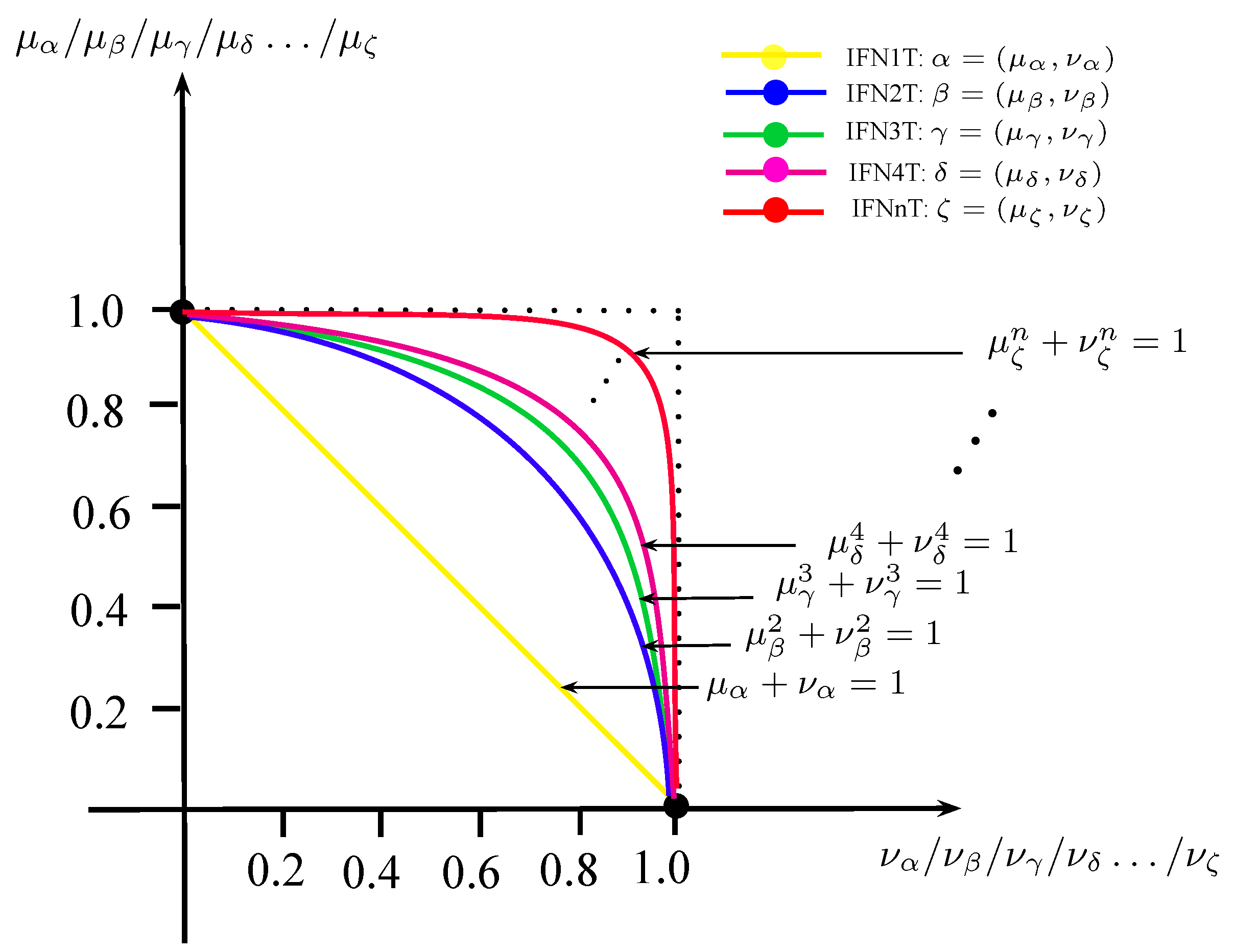
Intuitionistic fuzzy sets (IFSs) [1] of first type, an extension of Zadeh’s notion of the fuzzy set [2] which itself extends the classical notion of a set, are sets whose elements have degrees of membership and non-membership. Yager [3,4] considered the Pythagorean fuzzy sets (PFSs) as a new generalization of IFSs which is characterized by the membership and the non-membership degree satisfying the condition that their square sum is not greater than 1. Some results for PFSs and the Pythagorean fuzzy TODIM approach to multi-criteria decision making have been presented in [5,6]. Zhang and Xu [7] dealt with the mathematical form of the PFS and introduced the concept of the Pythagorean fuzzy number (PFN). They also discussed a series of the basic operational laws of PFNs and proposed the Pythagorean fuzzy aggregation operators, including the Pythagorean fuzzy weighted averaging operator. The PFS is more general than the IFS because the space of PFSs’ membership degree is greater than the space of IFSs’ membership degree. For instance, when a decision-maker gives the evaluation information whose membership degree is 0.5 and non-membership degree is 0.8, it can be known that the IFN fails to address this issue because . However, . On the other hand, the notions of IFSs of second type (IFSs2T), IFSs of third type (IFSs3T), IFSs of fourth type (IFSs4T), and IFSs of n-th type (IFSsnT) have been studied in [8,9,10,11]. For convenience, IFSnT is represented by IFNnT—that is, The key difference between IFN1T, IFN2T, IFN3T, IFN4T, …, IFnNT is their different constraint conditions. That is, , respectively. The comparison of these spaces is shown in Figure 1. For other notation applications, readers are referred to [12,13,14,15,16,17,18,19,20].
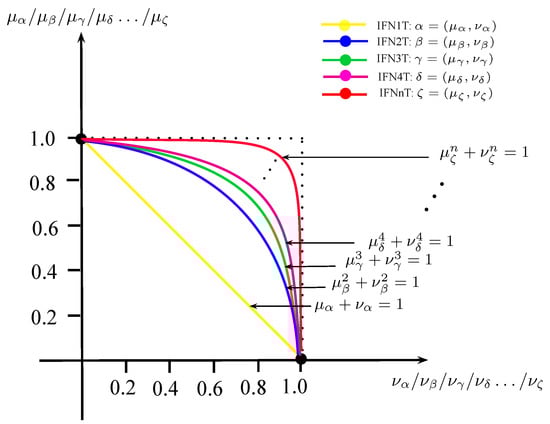
Figure 1.
Comparison of spaces of intuitionistic fuzzy sets of n-th type (IFSsnT, given as IFNnT): IFN1T, IFN2T, IFN3T, IFN4T, ⋯, IFNnT.
A graph is a convenient way of interpreting information involving the relationship between objects. Fuzzy graphs are designed to represent the structures of relationships between objects such that the existence of a concrete object (vertex) and the relationship between two objects (edge) are matters of degree. The concept of fuzzy graphs was initiated by Kaufmann [21]. Later, Rosenfeld [22] discussed several theoretical concepts, including paths, cycles, and connectedness in fuzzy graphs. Mordeson and Peng [23] defined some operations on fuzzy graphs and investigated their properties. Parvathi and Karunambigai [24] considered intuitionistic fuzzy graphs (IFGs). Later, Akram and Davvaz [25] discussed IFGs. Akram and Dudek [26] described intuitionistic fuzzy hypergraphs with applications. Recently, Naz et al. [27] originally proposed the concept of Pythagorean fuzzy graphs(PFGs), a generalization of the notion of Akram and Davvaz’s IFGs [25], along with their applications in decision-making. Akram and Naz [28] studied the energy of PFGs with applications. Dhavudh and Srinivasan [29,30] dealt with IFGs2T. The graph operations perform a substantial role in many fields, especially in computer science. For example, the Cartesian product offers a significant model for linking computers. There are various operations on PFGs. Verma et al. [31] presented some operations of PFGs. In this research study, we present some new operations, including rejection, symmetric difference, residue product, and maximal product of PFGs (IFGs2T), which may be suggestive of some aspects of network design. We explore some of their properties, especially the degree of vertices, and total degree as its modification, of resultant PFGs, acquired from given PFGs using these operations. We introduce certain new notions, including IFGs3T, IFGs4T, and IFGsnT, and prove that every IFG(n − 1)T is an IFGnT (for ). Moreover, we show that the definition and operations of PFGs (IFGs2T) mentioned in [29,31] contain some flaws. Finally, we discuss the application of PFGs in decision making.
2. Operations on Pythagorean Fuzzy Graphs
Definition 1.
[27] A Pythagorean fuzzy graph (PFG) on a nonempty set V is a pair with a PFS on V and a PFR on V such that
and for all , where, and represent the membership and non-membership functions of , respectively. A PFG is also called an intuitionistic fuzzy graph of 2-type (IFG2T). For convenience, IFS2T(PFS) is represented by IFN2T(PFN) (i.e., ).
Example 1.
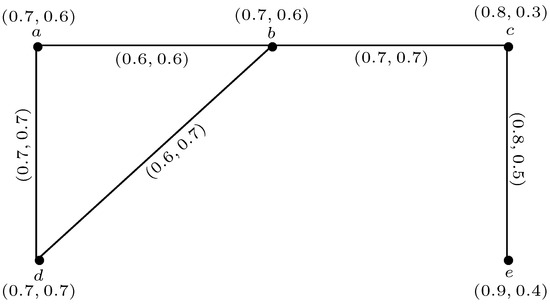
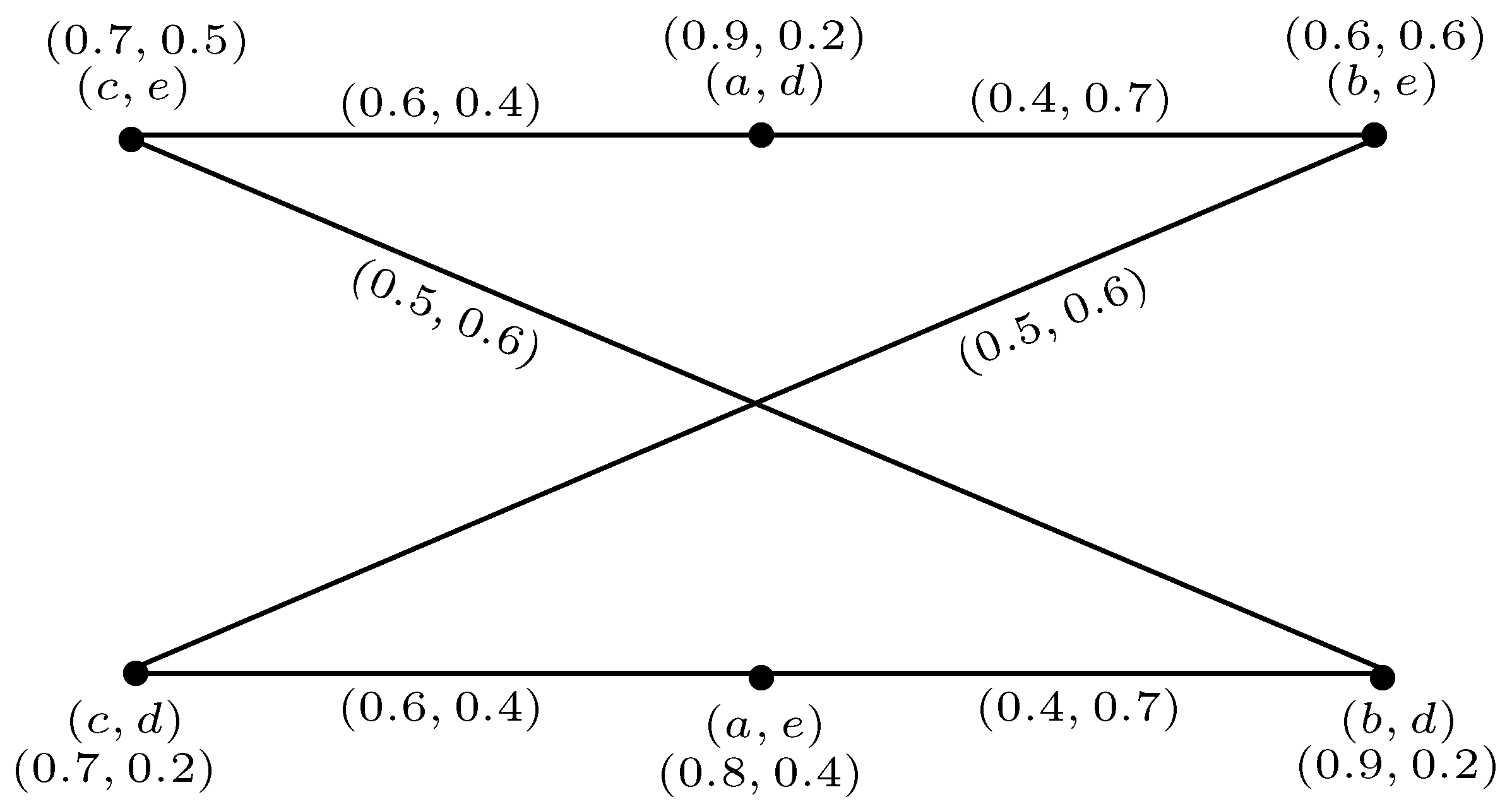
Consider a simple graph such that Let
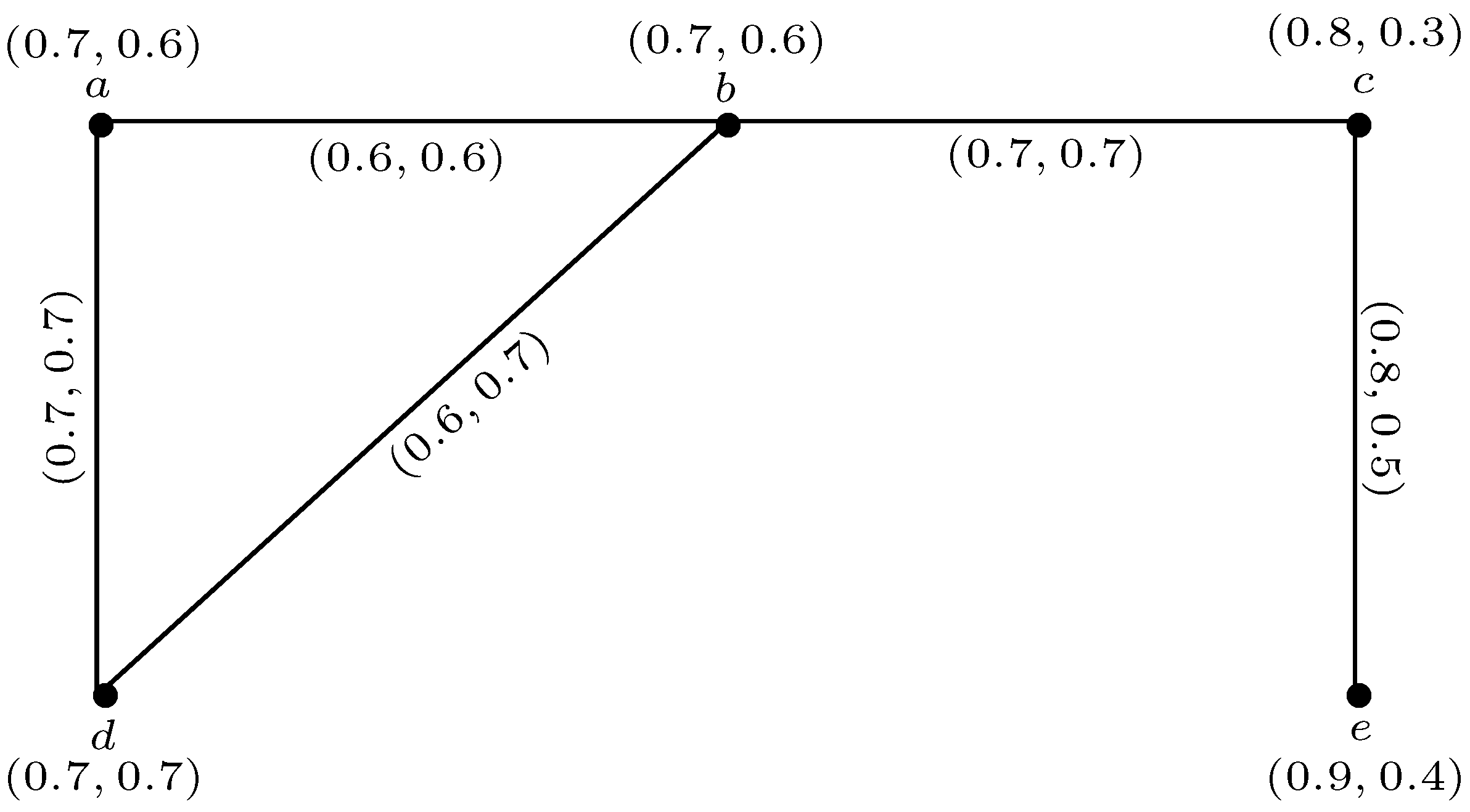
be the Pythagorean fuzzy vertex set and the Pythagorean fuzzy edge set defined on V and E, respectively. By direct calculations, it is easy to see from Figure 2 that is a PFG (IFG2T).
Figure 2.
Pythagorean fuzzy graph (PFG) (intuitionistic fuzzy graph of second type, IFG2T).
Definition 2.
Let and be two PFGs of the graphs and , respectively. The rejection of and is denoted by and defined as:
- (i)
- for all
- (ii)
- for all ,
- (iii)
- for all and
- (iv)
- for all and
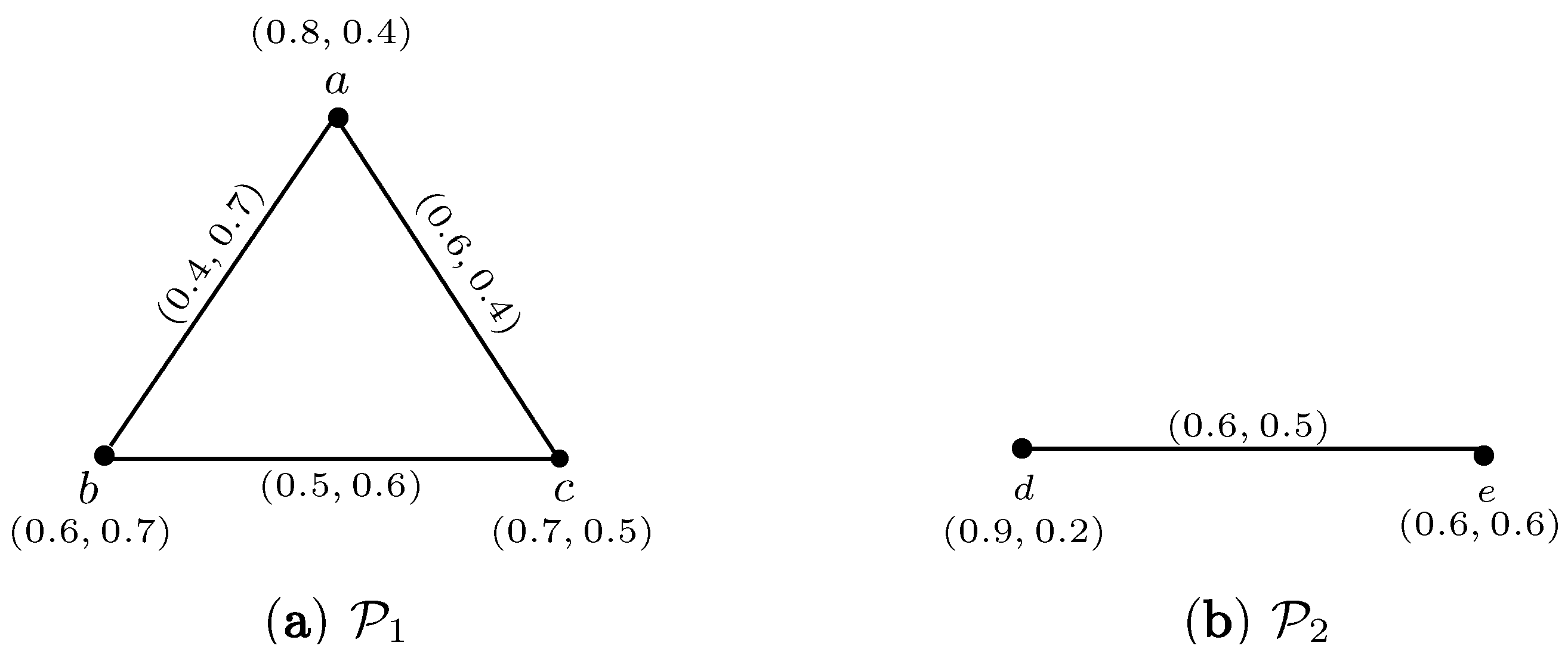
Example 2.
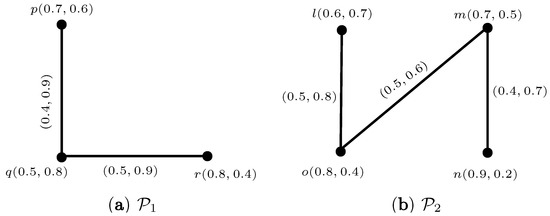
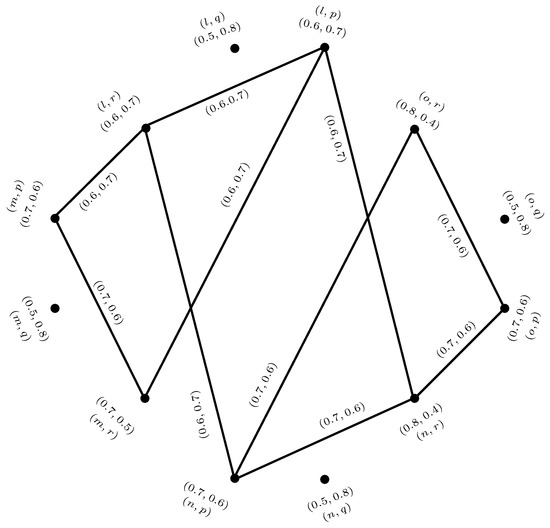
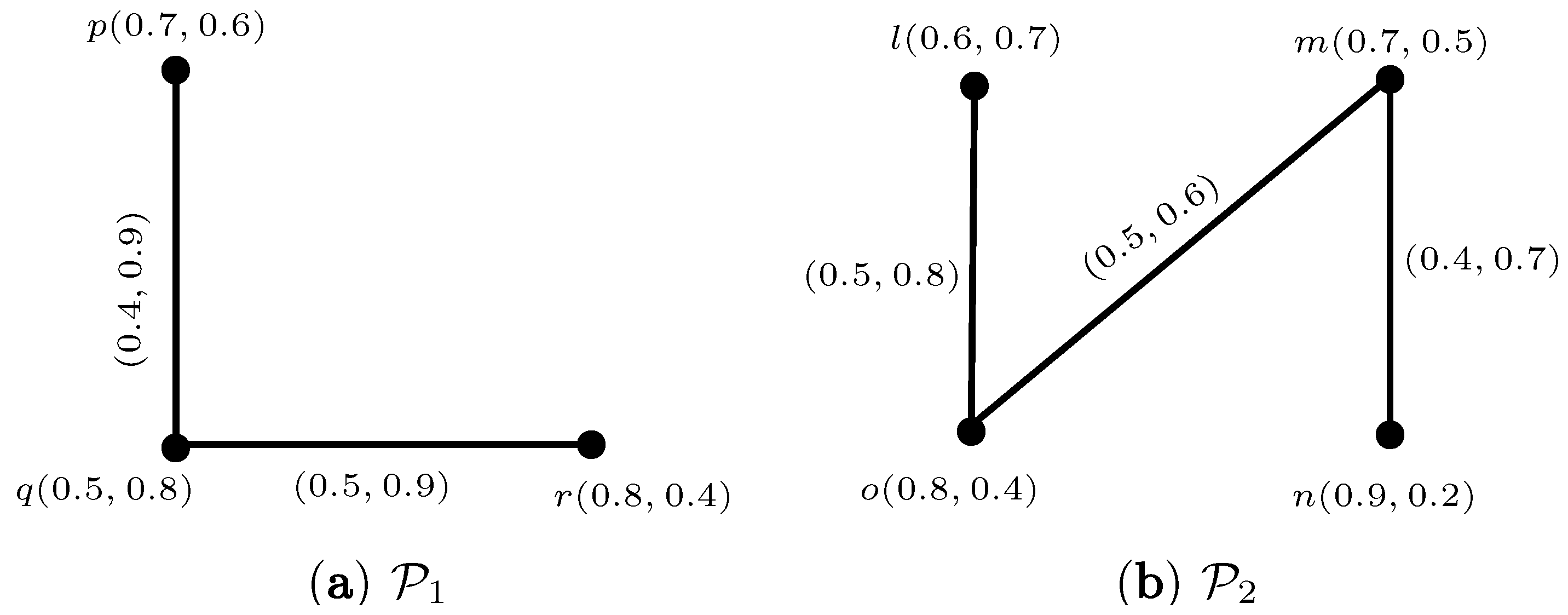
Consider two PFGs and on and , respectively, as shown in Figure 3. Their rejection is shown in Figure 4.
Figure 3.
PFGs.
Figure 4.
Rejection of two PFGs.
Proposition 1.
Let and be the PFGs of the graphs and , respectively. The rejection of and is a PFG.
Proof.
Let and be the PFGs of the graphs and , respectively. Then, for ,
If , ,
If , ,
If , ,
Hence, from all cases it is clear that is a PFR on . Hence, is a PFG. ☐
Definition 3.
Let and be two PFGs. For any vertex ,
Definition 4.
Let and be two PFGs. For any vertex ,
Example 3.
Consider two PFGs and as in Example 2. Their rejection is shown in Figure 4. Then, by definition of vertex degree in rejection,
Therefore, . Also, the total degree of vertex is given by:
Therefore,
Similarly, we can find the degree and total degree of all vertices in .
Definition 5.
Let be two PFGs of the graphs and , respectively. The symmetric difference of is denoted by and defined as:
- (i)
- (ii)
- (iii)
- (iv)
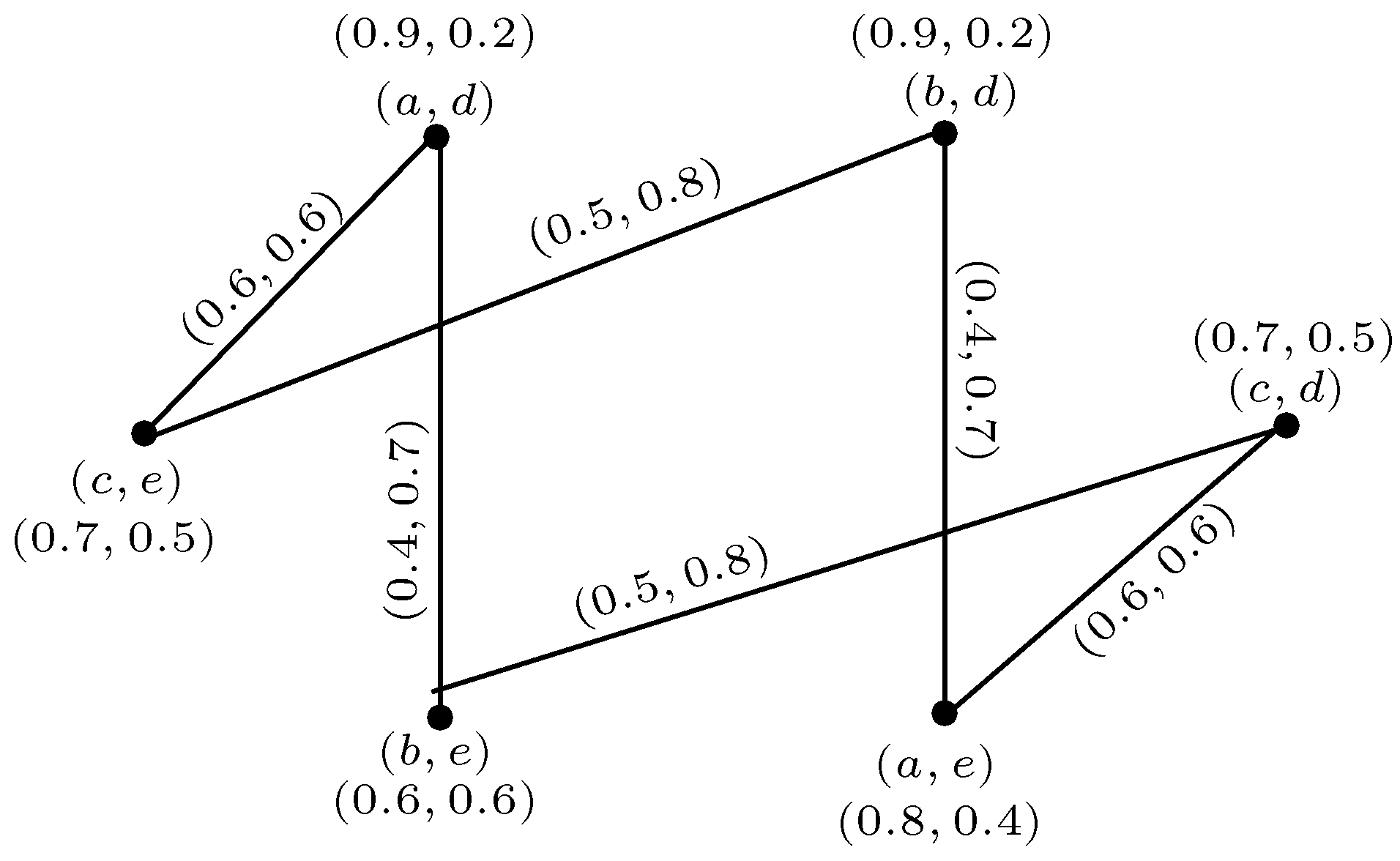
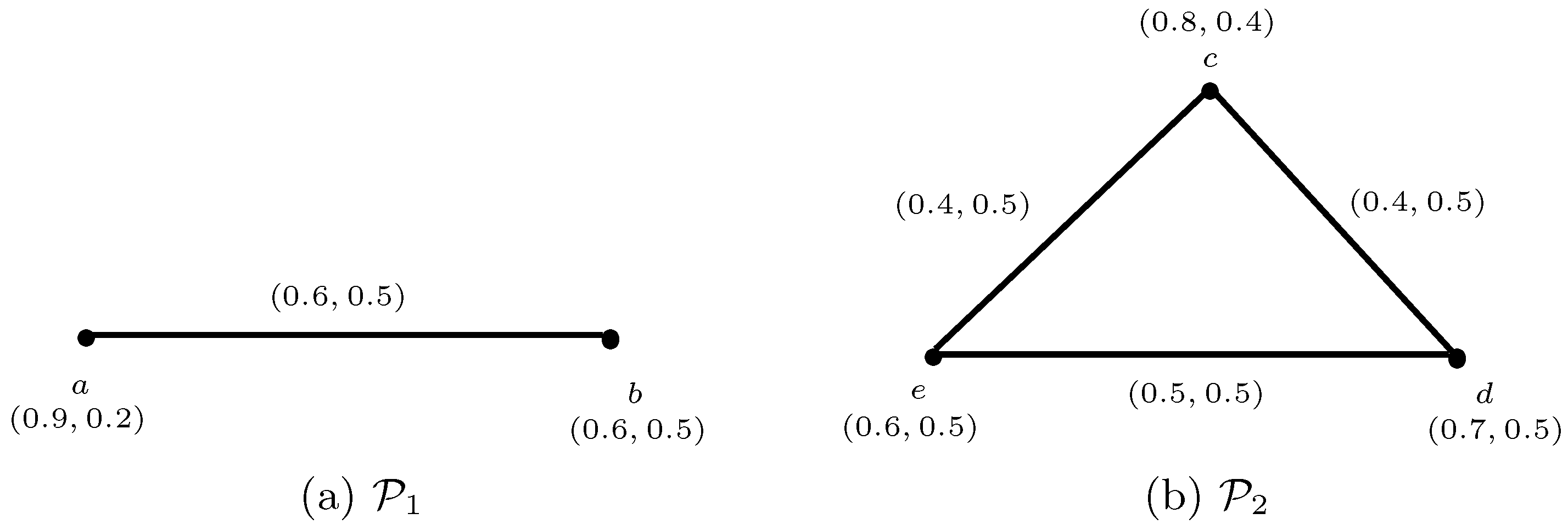
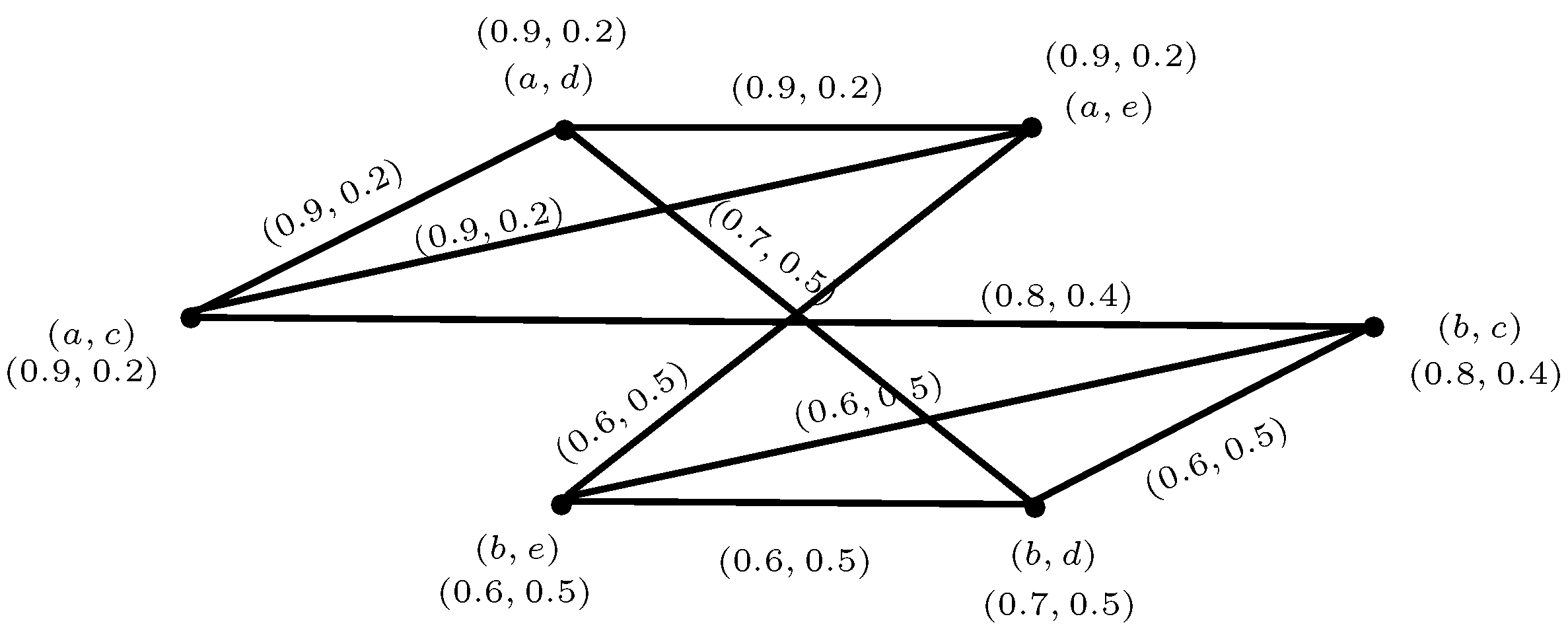
Example 4.
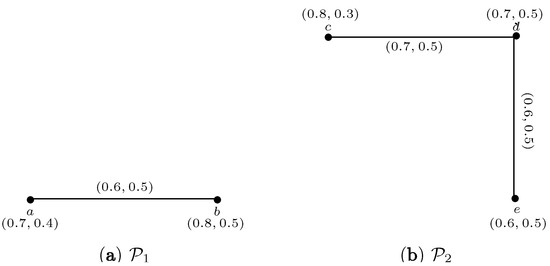
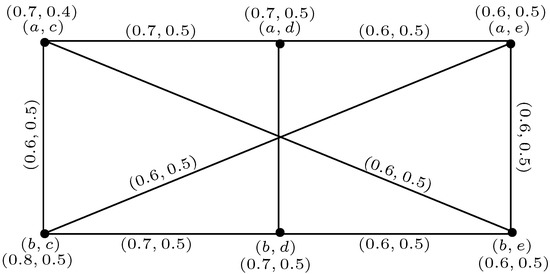
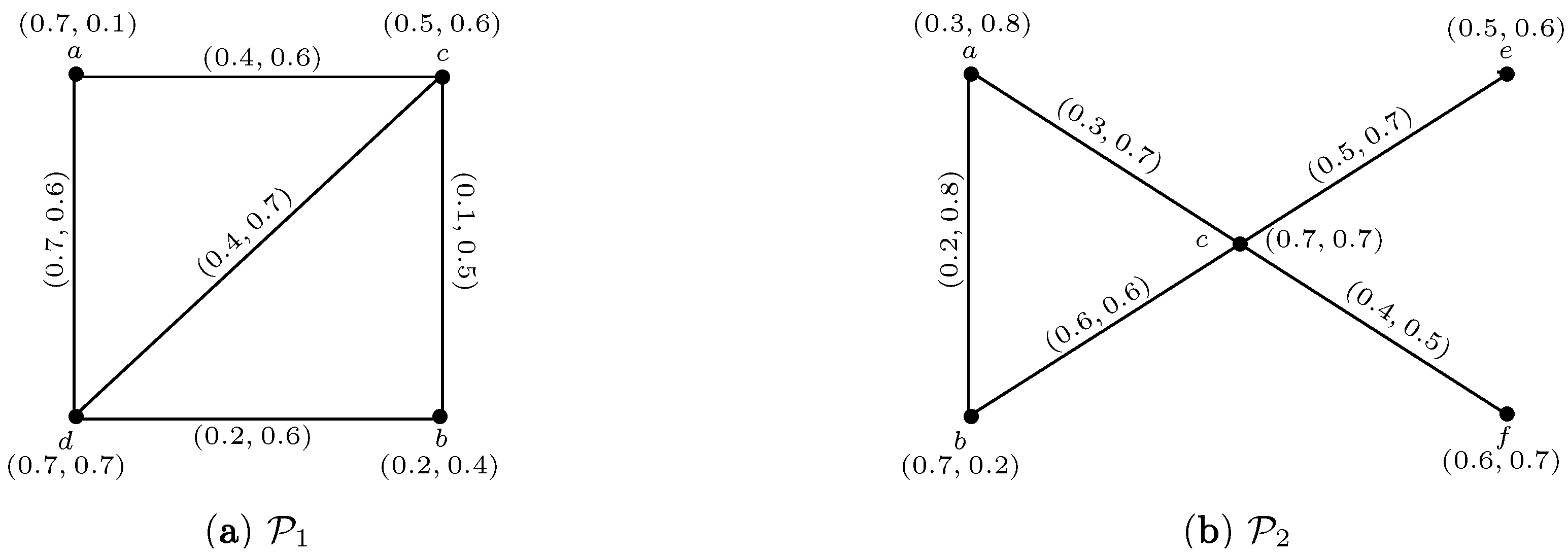
Consider two PFGs , respectively, as shown in Figure 5. Their symmetric difference is shown in Figure 6.
Figure 5.
PFGs.
Figure 6.
Symmetric difference of two PFGs.
Proposition 2.
Let be two PFGs of the graphs , respectively. The symmetric difference of is a PFG of .
Proof.
Let be two PFGs of the graphs , respectively. Let
If ,
If ,
If ,
If ,
Hence, is a PFG. ☐
Definition 6.
Let be two PFGs. For any vertex ,
Theorem 1.
Let be two PFGs. If . Then, for all , where .
Proof.
By definition of vertex degree of symmetric difference, we have
Hence,, where . ☐
Definition 7.
Let be two PFGs. For any vertex ,
Theorem 2.
Let be two PFGs. If
- (i)
- (ii)
for all
Proof.
For any vertex ,
Where . ☐
Example 5.
Consider two PFGs as in Example 4. Their symmetric difference is shown in Figure 6. Then, by Theorem 1, we must have
Therefore, .
In addition, by Theorem 2, we must have
Therefore, .
Similarly, we can find the degree and total degree of all vertices in .
Definition 8.
Let be two PFGs of the graphs , respectively. The Residue product of is denoted by and defined as:
- (i)
- (ii)
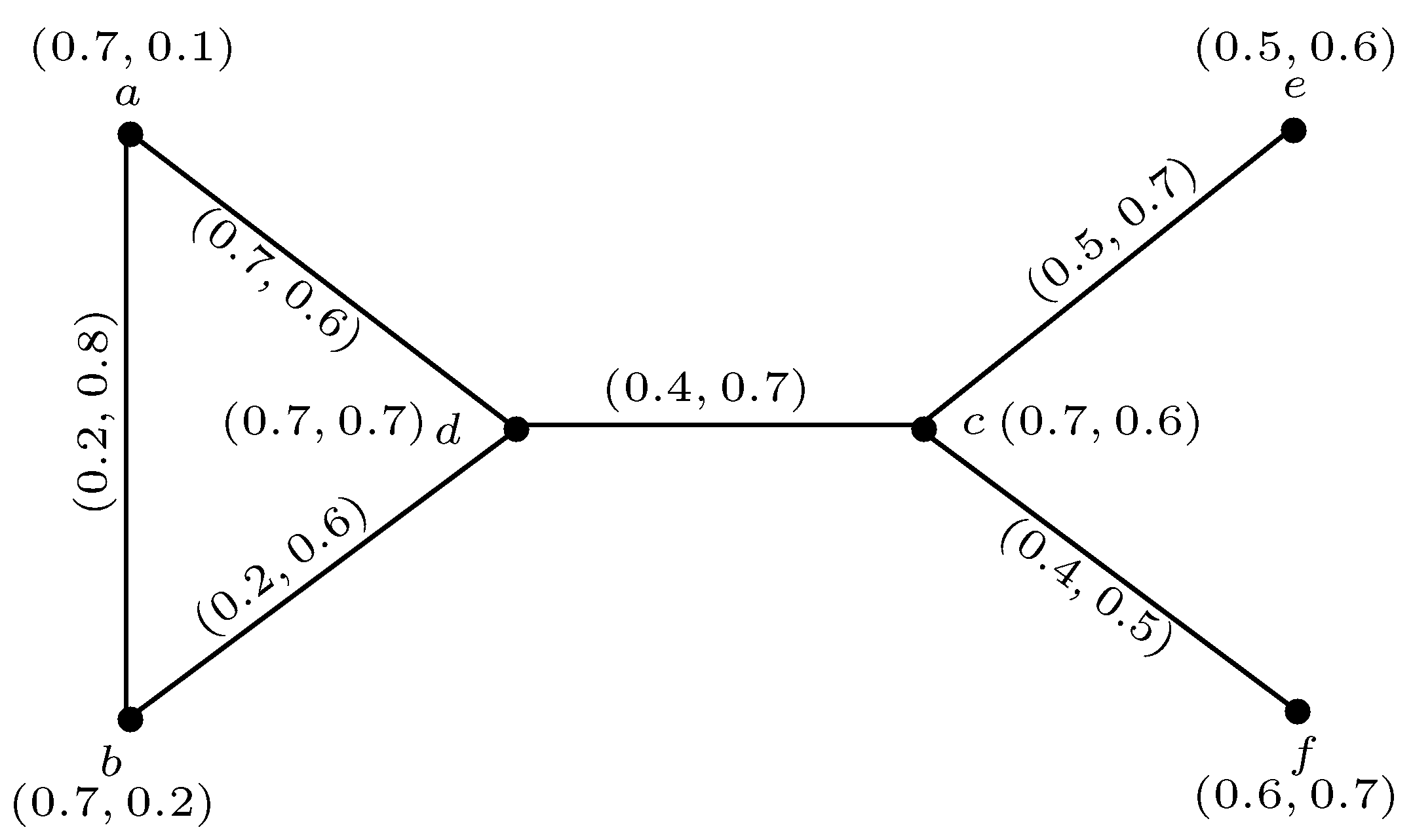
Example 6.
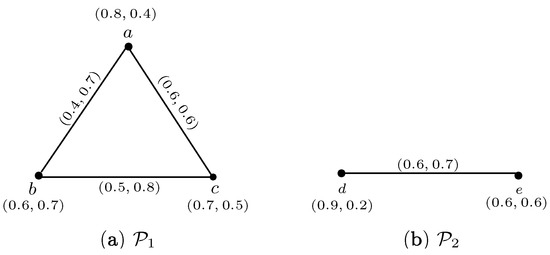
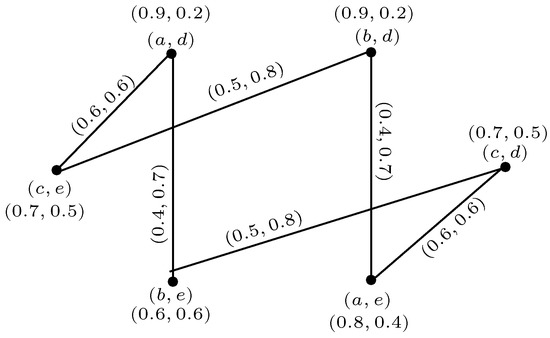
Figure 7.
PFGs.
Figure 8.
Residue product of two PFGs.
Proposition 3.
Let be two PFGs of the graphs , respectively. The Residue product of is a PFG of .
Proof.
Let be two PFGs of the graphs , respectively. Let If , then
Hence, is a PFG. ☐
Definition 9.
Let be two PFGs. For any vertex ,
Definition 10.
Let be two PFGs. For any vertex
Example 7.
Consider two PFGs as in Example 6. Their Residue product is shown in Figure 8. Then by definition of vertex degree in Residue product,
Therefore, .
In addition, by definition of total vertex degree in Residue product,
Therefore, .
Similarly, we can find the degree and total degree of all vertices in .
Definition 11.
Let and be two PFGs of and , respectively. The Maximal product of and is denoted by and defined as:
- (i)
- for all
- (ii)
- for all and
- (iii)
- for all and
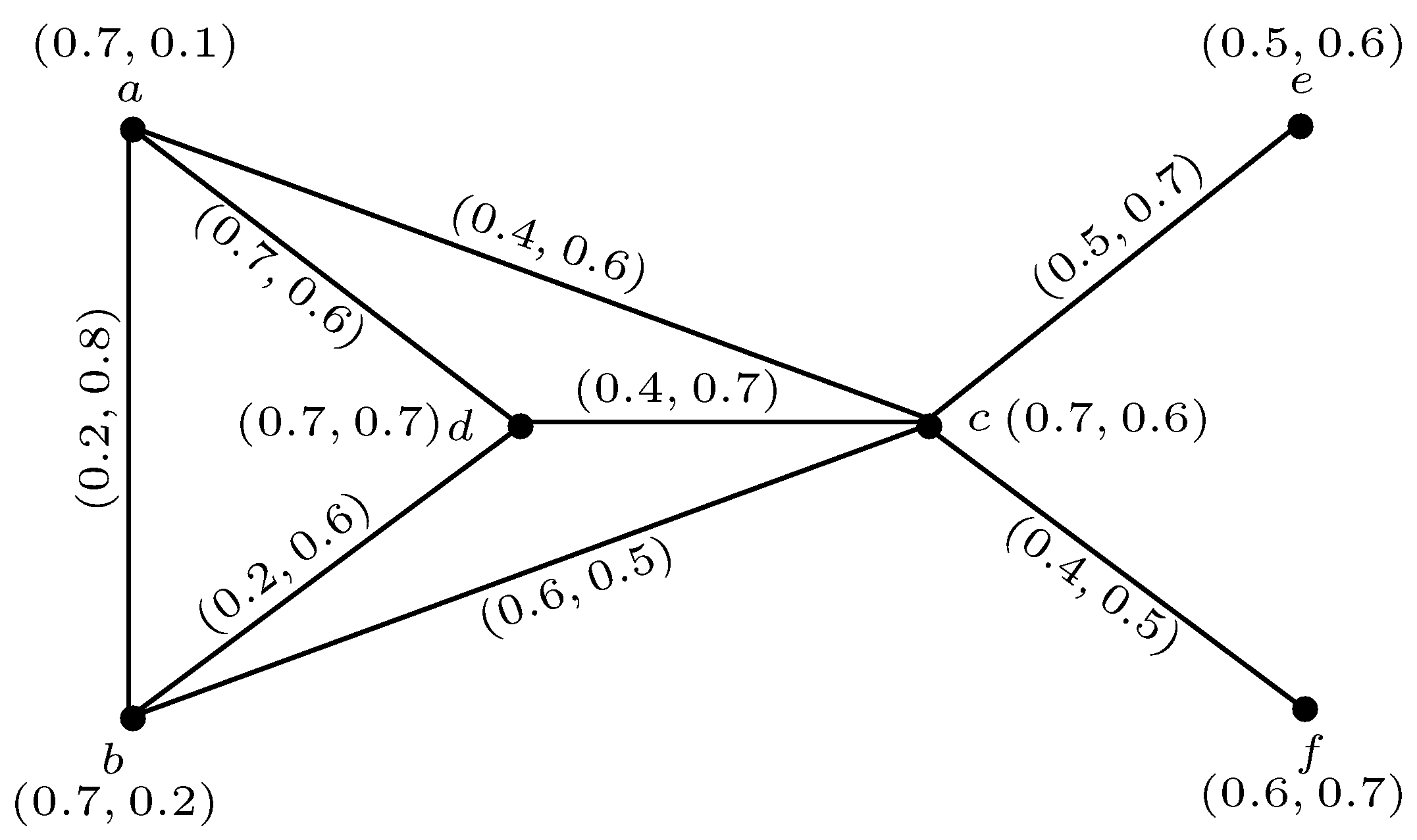
Example 8.
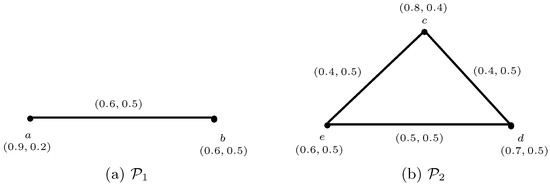
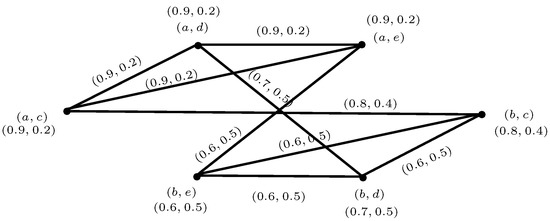
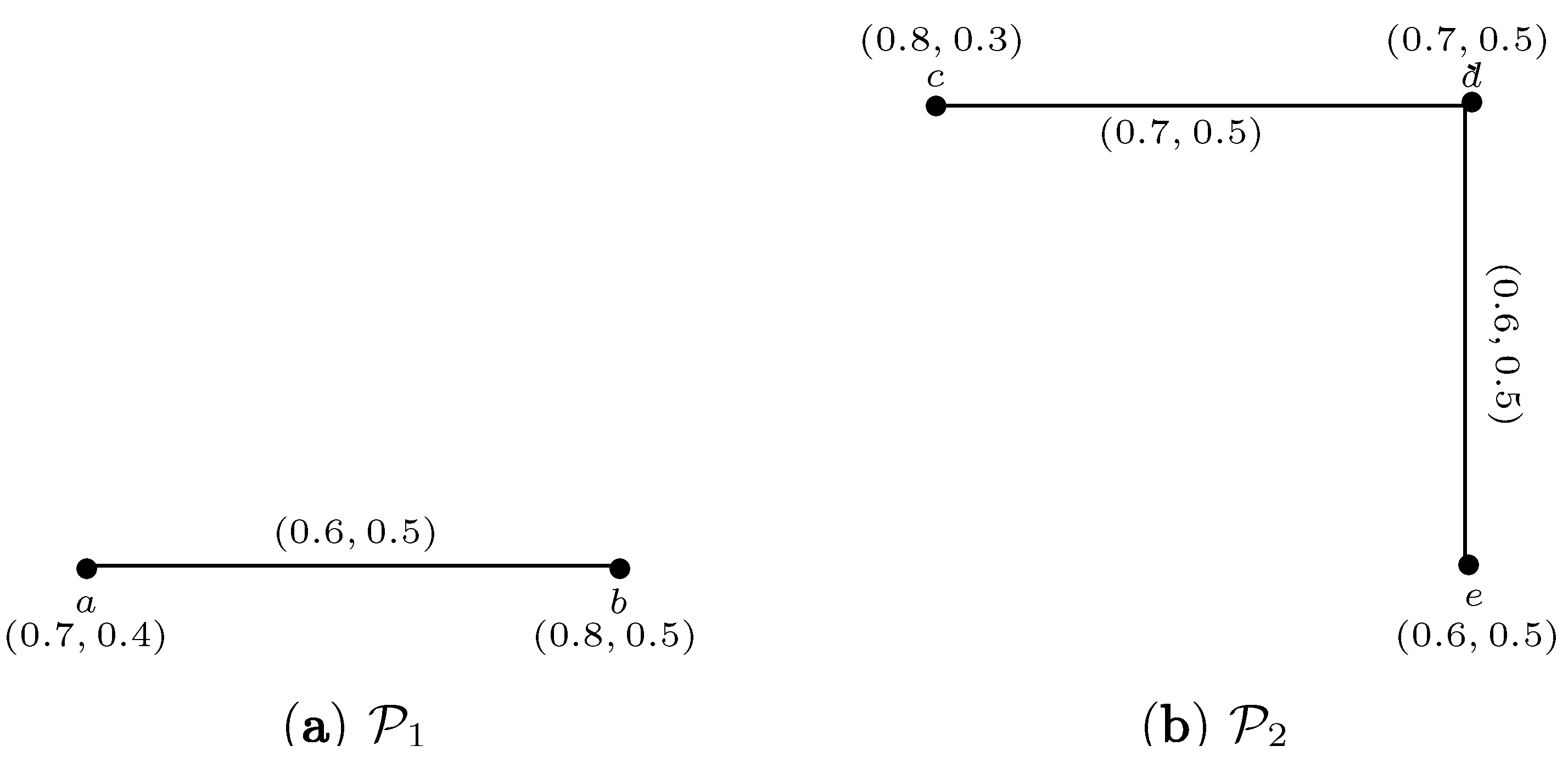
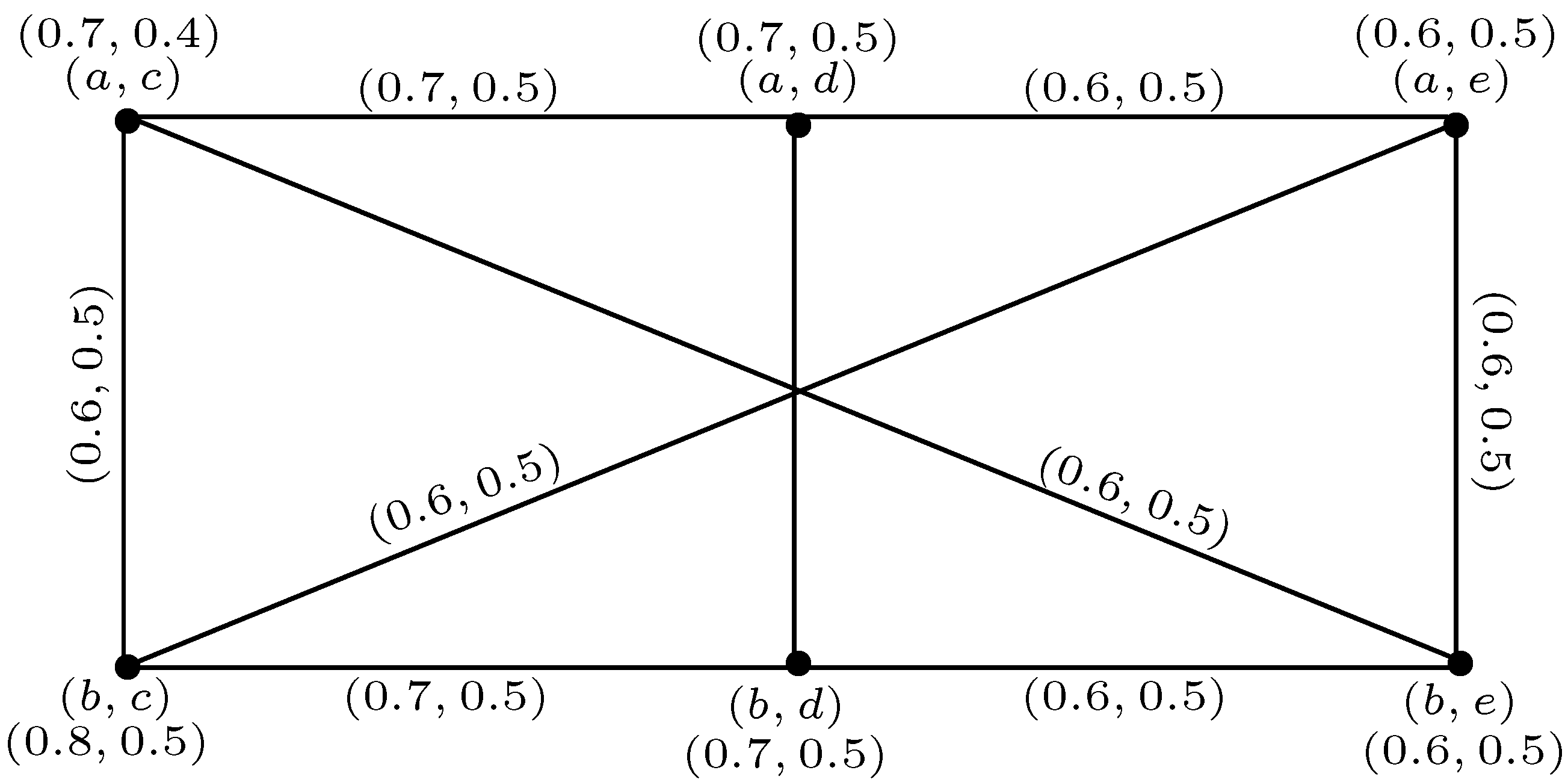
Consider two PFGs , respectively, as shown in Figure 9. Their Maximal product is shown in Figure 10.
Figure 9.
PFGs.
Figure 10.
Maximal product of two PFGs.
Proposition 4.
Let and be two PFGs of the graph and , respectively. The Maximal product of and is a PFG of .
Proof.
Let and be two PFGs of the graph and , respectively. Let .
If and
If and
Hence, the Maximal product of two PFGs is a PFG. ☐
Definition 12.
Let and be two PFGs. For any vertex
Theorem 3.
Let and be two PFGs. If , and , . Then
Proof.
By definition of vertex degree of we have
☐
Definition 13.
Let and be two PFGs. For any vertex ,
Theorem 4.
Let and be two PFGs.
- (i)
- If and , then ,
- (ii)
- If and , then
Proof.
By definition of vertex degree of we have
- (i)
- If and
- (ii)
- If and
☐
Example 9.
Consider two PFGs as in Example 8. Their Maximal product is shown in Figure 10. Then, by Theorem 3, we must have
Therefore, .
In addition, by Theorem 4, we must have
Therefore, .
Similarly, we can find the degree and total degree of all vertices in .
3. Intuitionistic Fuzzy Graphs of n-th Type
Definition 14.
An intuitionistic fuzzy graph of third type (IFG3T, for short) on a nonempty set V is a pair with an IFS3T on V and an IFR3T on V such that
and for all , where, and represent the membership and non-membership functions of , respectively. For convenience, IFS3T is represented by IFN3T (i.e.,
Example 10.
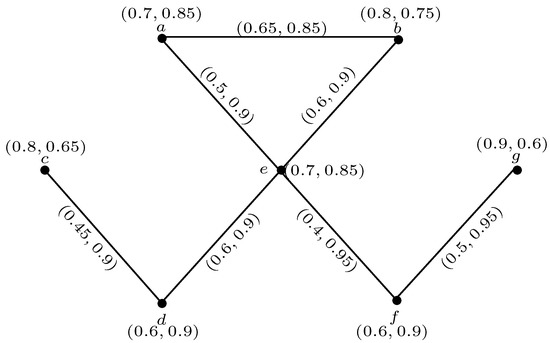
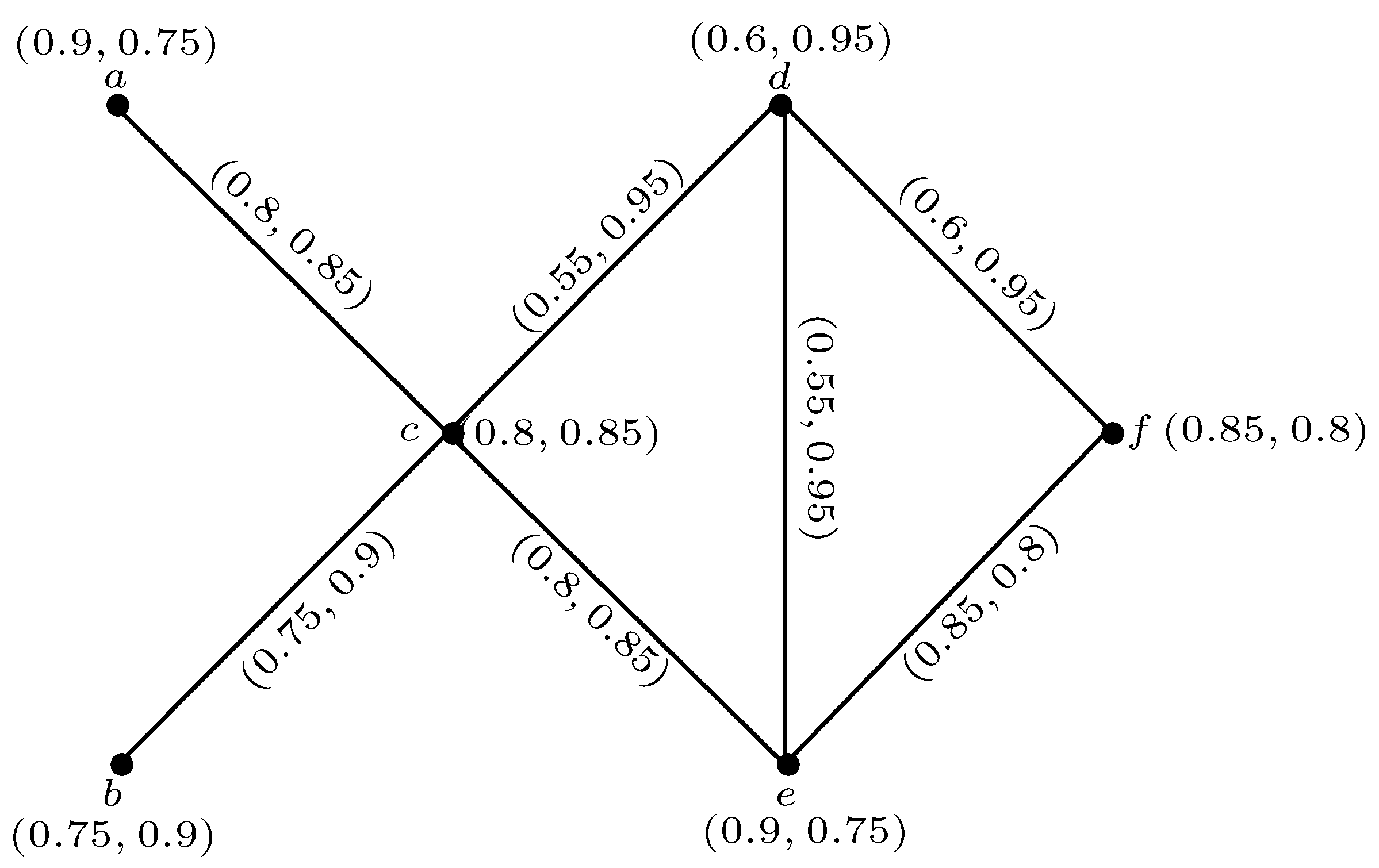
Consider a simple graph such that and Let
be an intuitionistic fuzzy vertex set of third type and an intuitionistic fuzzy edge set of third type defined on V and E, respectively.
By direct calculations, it is easy to see from Figure 11 that is an IFG3T.
Figure 11.
IFG3K.
Definition 15.
An intuitionistic fuzzy graph of fourth type (IFG4T, for short) on a nonempty set V is a pair with an IFS4T on V and an IFR4T on V such that
and for all , where, and represent the membership and non-membership functions of , respectively. For convenience, IFS4T is represented by IFN4T (i.e.,
Example 11.
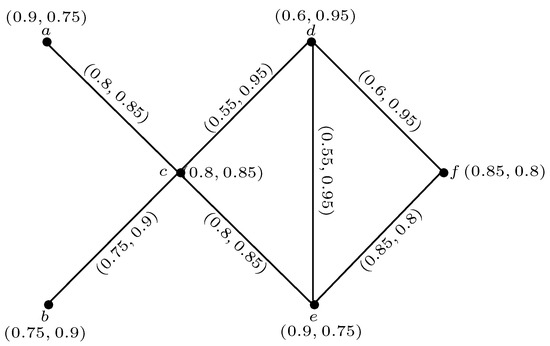
Consider a graph , where and Let
be an intuitionistic fuzzy vertex set of fourth type and an intuitionistic fuzzy edge set of fourth type defined on V and E, respectively.
By direct calculations, it is easy to see from Figure 12 that is an IFG4T.
Figure 12.
IFG4K.
Definition 16.
An intuitionistic fuzzy graph of n-th type (IFGnT, for short) on a non-empty set V is a pair with an IFSnT on V and an IFRnT on V such that
and for all , where, and represent the membership and non-membership functions of , respectively. For convenience, IFSnT is represented by IFNnT (i.e., .
The key difference between IFN1T, IFN2T, IFN3T, IFN4T,…, IFnNT is their different constraint conditions. That is, , respectively. The comparison of these spaces is shown in Figure 1.
Theorem 5.
Every IFG(n − 1)T is an IFGnT (for .
Proof.
Let be an IFG of -th type. Then for any edge
where and Since , therefore, and for all .
Thus,
This implies that is an IFGnT for . This completes the proof. ☐
Remark 1.
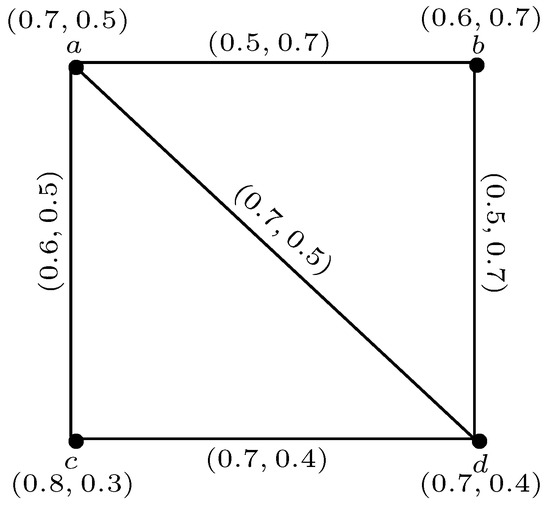
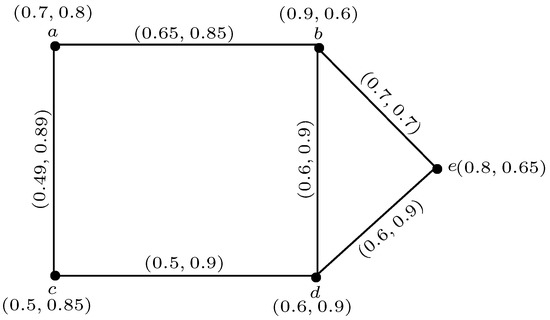
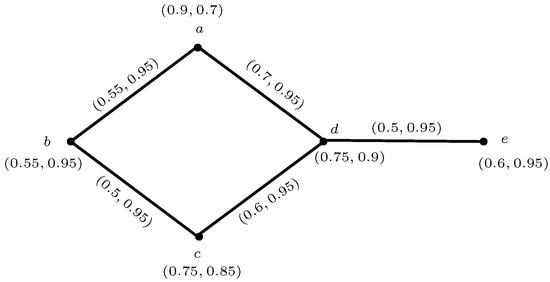
The converse of Theorem 5 may not be true, as can be seen in the following examples.
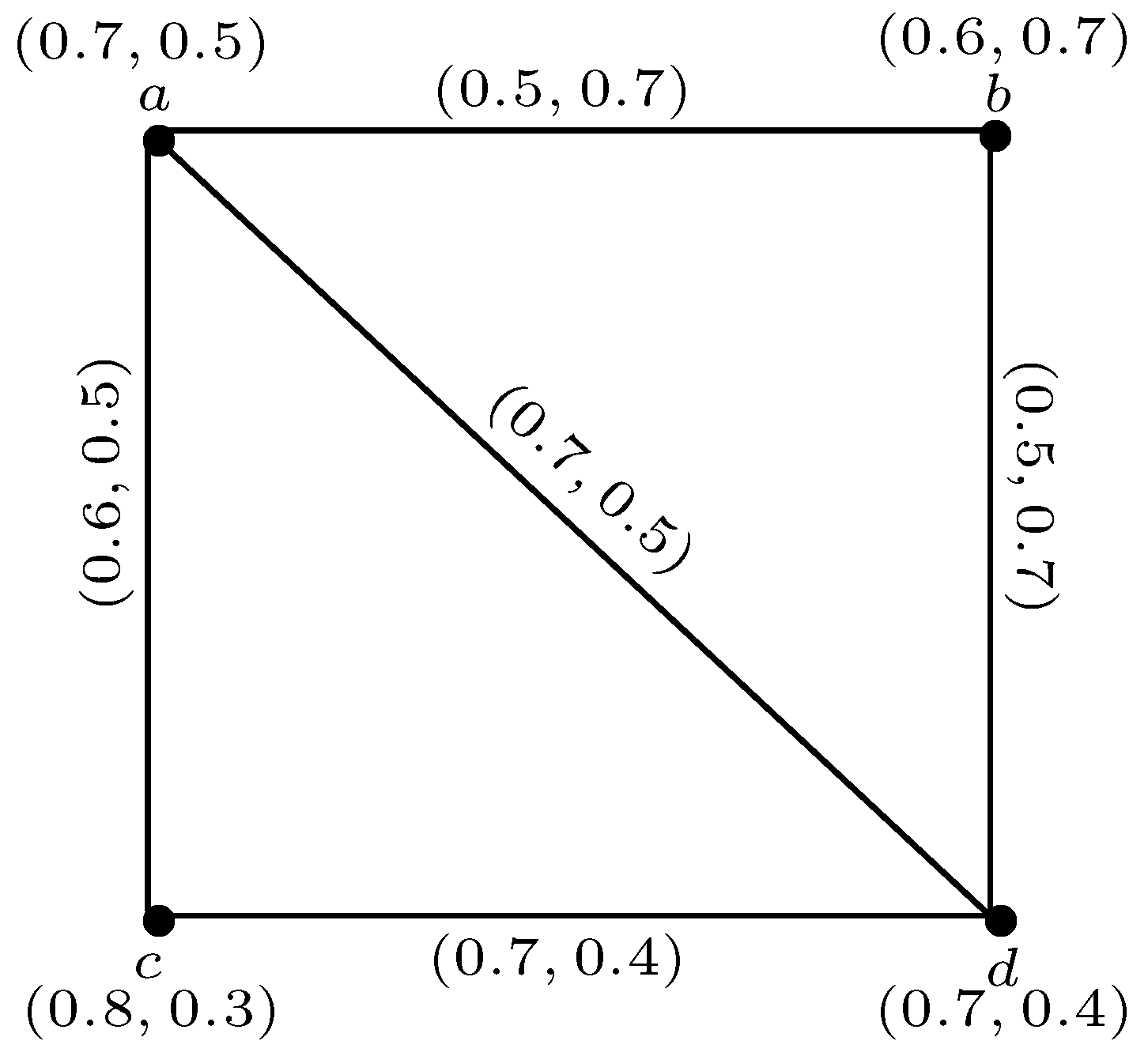
1.Consider as shown in Figure 13.
Figure 13.
.
Notice that
This implies that is an IFG2T(PFG). However,
This shows that is not an IFG1T. Thus, we conclude that every PFG(IF2T) may not be an IFG1T.
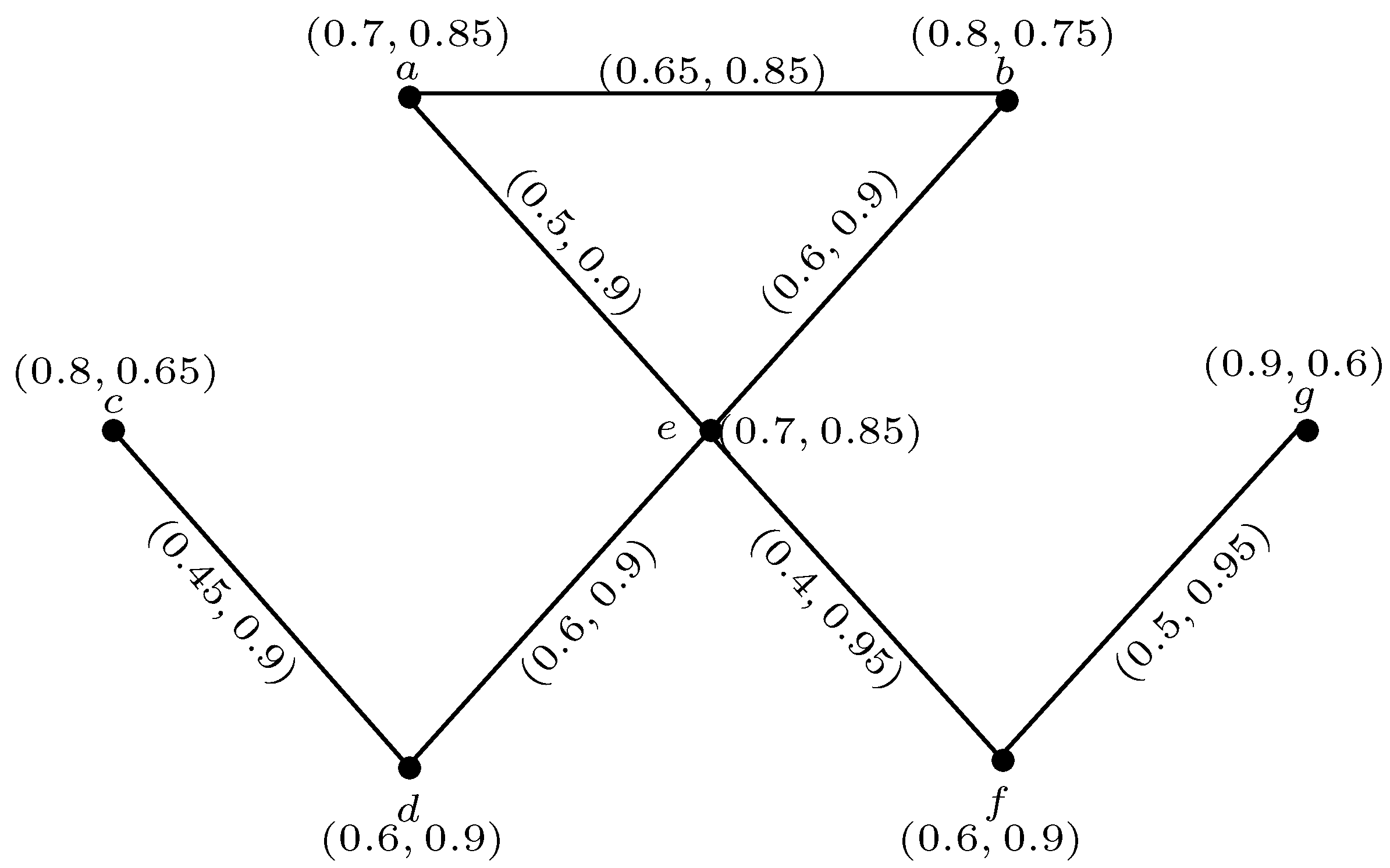
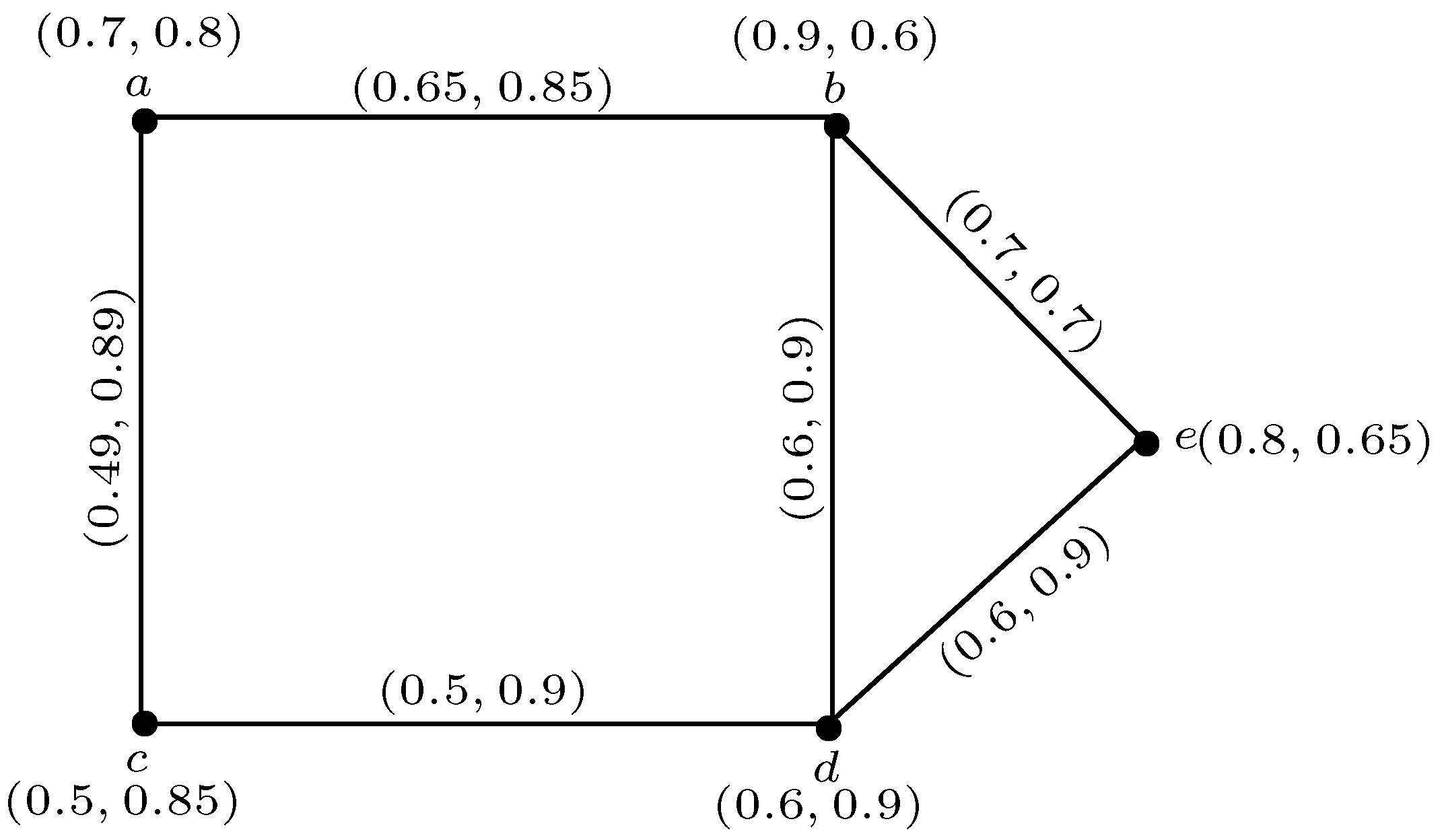
2.Consider as shown in Figure 14.
Figure 14.
.
We see that
Thus, is an IFG3T. However,
This shows that is not an IFG2T. Hence, every IFG3T may not be an IFG2T.
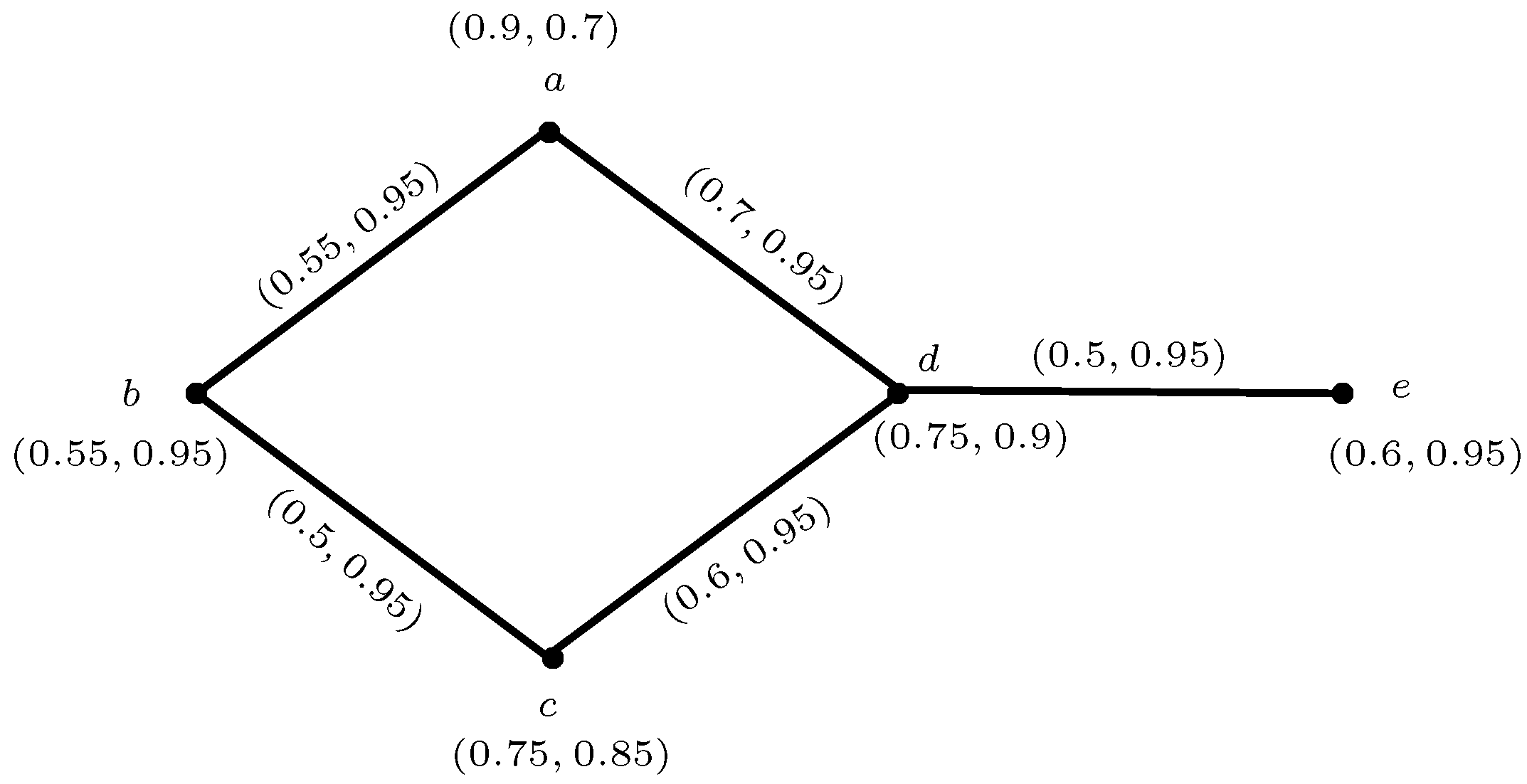
3.Consider as shown in Figure 15.
Figure 15.
.
We see that
Thus, is an IFG4T. However,
This shows that is not an IFG3T. Hence, every IFG4T may not be an IFG3T.
Consequently, every IFGnT need not be an IFGT (for .
4. Some Flaws in the Definition of PFGs (IFGs2T)
Dhavudh and Srinivasan [29,30] dealt with IFGs2T, and Verma et al. [31] presented some operations of PFGs (IFGs2T). In this section, we show by counter examples that definition [29,30] and operations [31] of PFGs contain some flaws.
Definition 17.
[29,31] A PFG (IFG2T) on a nonempty set V is a pair with a PFS on V and a PFR on V such that
and for all
Example 12.
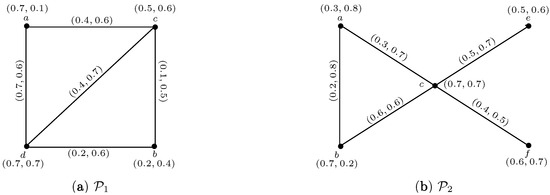
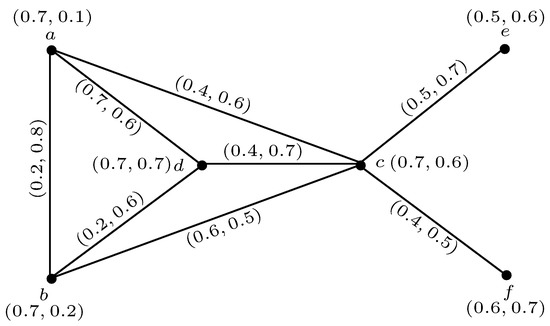
Consider two PFGs and on and , respectively, as shown in Figure 16.
Figure 16.
PFGs.
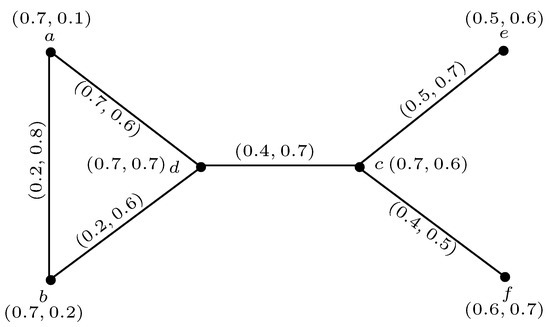
(a) Union of two PFGs
Using Definition 17, we see that the union as displayed in Figure 17 is not a PFG, since
Figure 17.
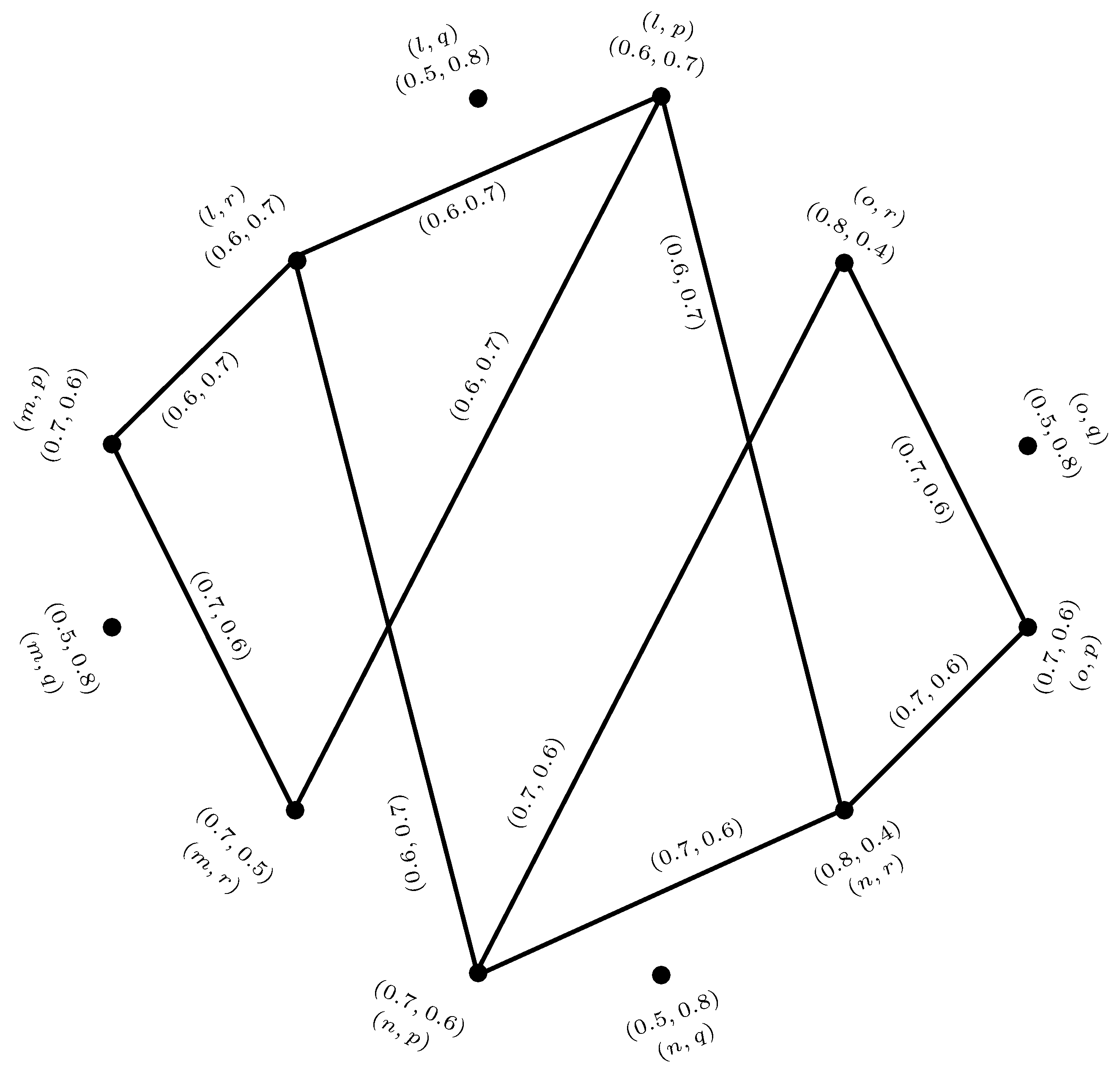
Union of two PFGs.
(b) Direct sum
Definition 17 shows that direct sum of PFGs and as displayed in Figure 18 is not a PFG, since
Figure 18.
Direct Sum of two PFGs.
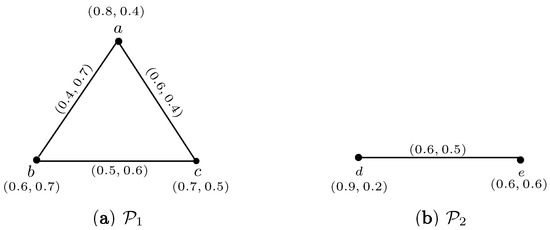
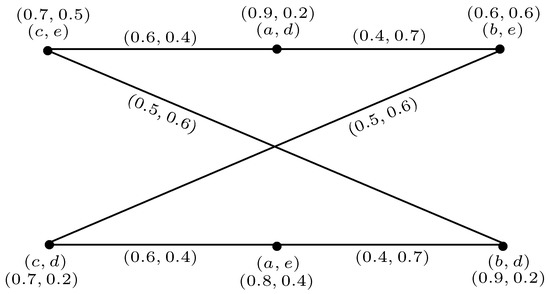
(c) Residue product
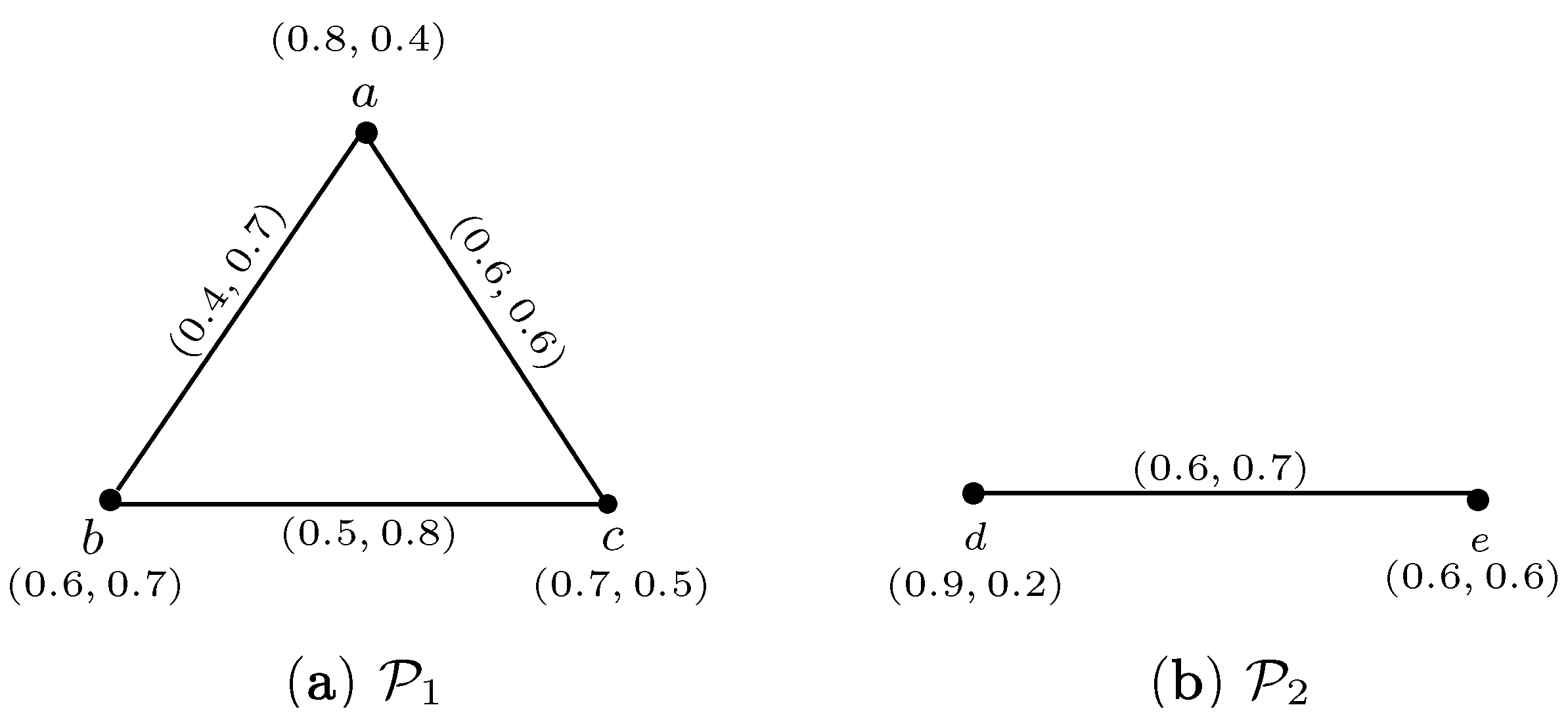
Consider two PFGs and as shown in Figure 19.
Figure 19.
PFGs.
Definition 17 shows that Residue product as displayed in Figure 20 is not a PFG, since
Figure 20.
Residue Product of two PFGs.
Remark 2.
By applying Definition 1, it has been shown in [27] that all these operations hold. Thus, we conclude that Definition 1 [27] is more powerful than Definition 17 [29,31].
5. Application to Group Decision-Making
In this section, we apply the concept of PFGs to a decision-making problem. A group decision-making problem concerning the “selection of most important investment object” is solved to illustrate the applicability of the proposed concept of PFGs in a realistic scenario based on Pythagorean fuzzy preference relations (PFPRs) [27]. The algorithm of the selection of the most important investment object within the framework of a PFPR is outlined in Algorithm 1.
Selection of the Most Important Investment Object
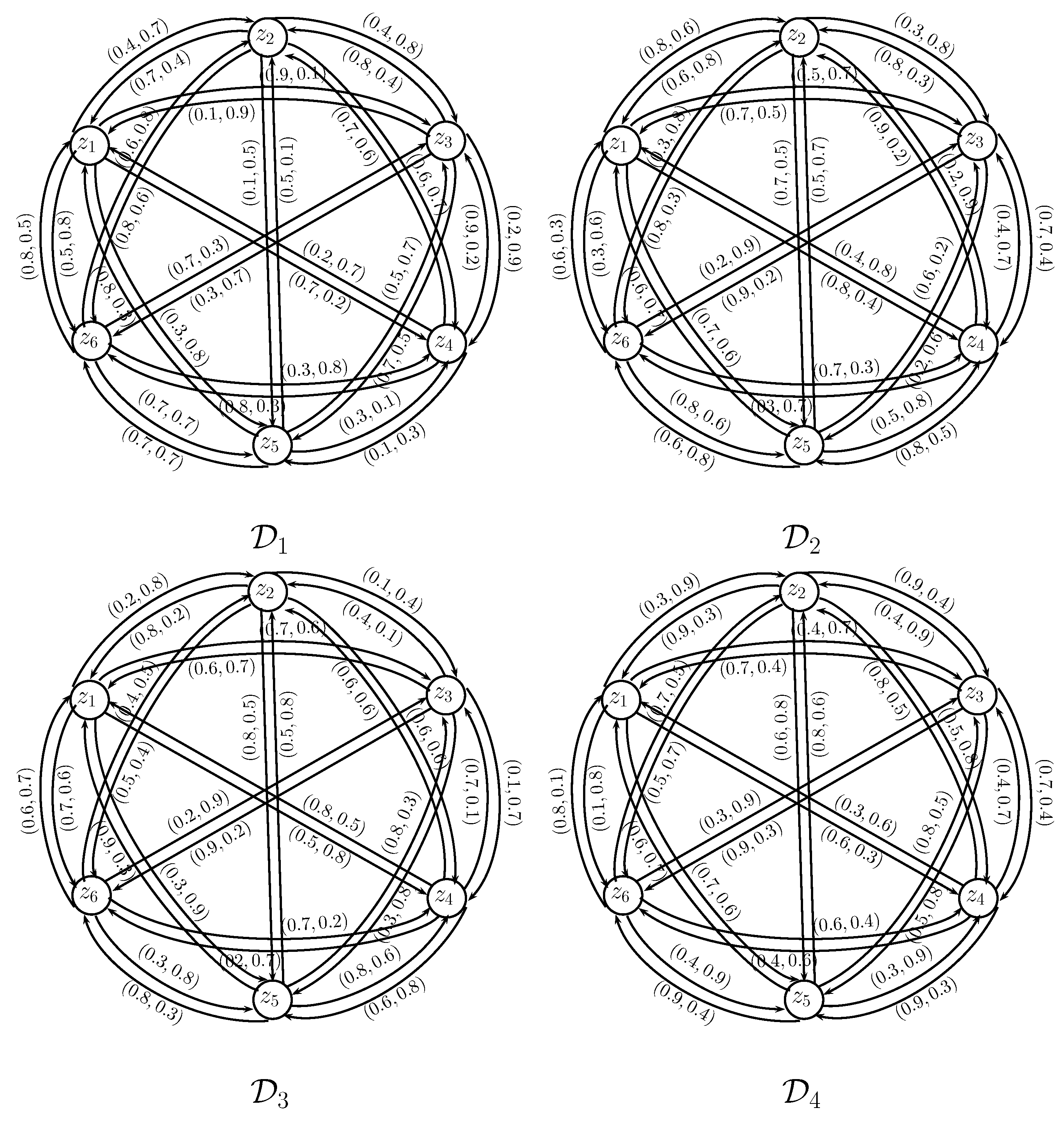
A risk preference investor wants to put an idle fund into in the Shanghai Stock Exchange as a long-term investment. He thinks that six companies, , which represent six different industries, are very promising. Given that his time and energy are limited, he plans to choose the most important investment object from these options. Therefore, he consults his investment adviser and three stock specialists , and . The decision makers compare six companies with respect to the possibility of the increasing trend of the stock prices and the appraisements of these corporate stocks, and provide their preference information on , which are represented by the Pythagorean fuzzy element (PFE) which indicates the preferences of experts over each pair of stocks [32]. The corresponding PFPRs are shown as follows.
The PFDGs corresponding to PFPRs given in Table 1, Table 2, Table 3 and Table 4 are shown in Figure 21.

Table 1.
Pythagorean fuzzy preference relation (PFPR) of the investment adviser.
Table 2.
PFPR of the first stock specialist.
Table 3.
PFPR of the second stock specialist.
Table 4.
PFPR of the third stock specialist.
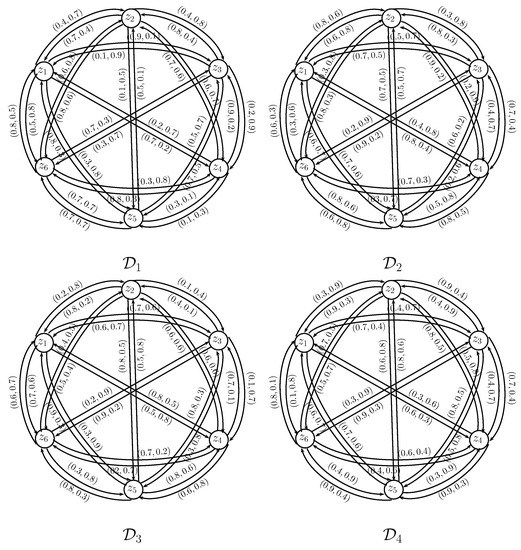
Figure 21.
Pythagorean fuzzy digraphs.
Compute the averaged PFE of the company over all the other companies for the experts by the Pythagorean fuzzy averaging (PFA) operator:
The aggregation results of the experts are as follows:
- e1:
- , , , , , ;
- e2:
- , , , , , ;
- e3:
- , , , , , ;
- e4:
- , , , , , .
To determine the weights of the experts, we first utilize the Pythagorean fuzzy Hamming distance between two PFEs:
to compute and obtain the difference matrix as follows:
Using , we determine the deviation of the expert from the reaming experts as follows:
Compute a collective PFE of the company over all the other companies using the Pythagorean fuzzy weighted averaging (PFWA) operator [4]
That is,
Compute the score function [7] of , and rank all the companies according to the values of :
Then, . Thus, the optimal choice is
We present our proposed method in the following Algorithm.
| Algorithm 1: A discrete set of alternatives , a set of experts , and construction of PFPR for each expert. |
|
6. Conclusions
A Pythagorean fuzzy set model is suitable for modeling problems with uncertainty, indeterminacy, and inconsistent information in which human knowledge is necessary and human evaluation is needed. Pythagorean fuzzy models give more precision, flexibility, and compatibility to the system as compared to the classical, fuzzy, and intuitionistic fuzzy models. A fuzzy graph can well describe the uncertainty of all kinds of networks. In this paper, we introduced new operations, including rejection, symmetric difference, residue product, and maximal product of Pythagorean fuzzy graphs. These graph products are suggestive of some aspects of network design. They may be useful for the configuration processing of space structures. The repeated application of these operations in constructing a network generates graphs that display fractal properties. Next, we introduced certain notions, including intuitionistic fuzzy graphs of 3-type (IFGs3T), intuitionistic fuzzy graphs of 4-type (IFGs4T), and intuitionistic fuzzy graphs of n-type (IFGsnT), and proved that every intuitionistic fuzzy graph of -th type is an intuitionistic fuzzy graph of n-th type (for ). We are planing to extend our research work to (1) interval-valued Pythagorean fuzzy graphs; (2) simplified interval-valued Pythagorean fuzzy graphs; (3) hesitant Pythagorean fuzzy graphs.
Author Contributions
M.A., A.H., F.I. and J.M.D. conceived and designed the experiments; A.H., F.I. and J.M.D. wrote the paper.
Conflicts of Interest
The authors declare no conflict of interest.
References
- Atanassov, K.T. Intuitionistic Fuzzy Sets. In VII ITKR’s Session; Sgurev, V., Ed.; Central Science-Technical Library of Bulgarian Academy of Science: Sofia, Bulgaria, 1984. [Google Scholar]
- Zadeh, L.A. Fuzzy sets. Inf. Control 1965, 8, 338–353. [Google Scholar] [CrossRef]
- Yager, R.R. Pythagorean fuzzy subsets. In Proceedings of the 2013 Joint IFSA World Congress and NAFIPS Annual Meeting, Edmonton, AB, Canada, 24–28 June 2013; pp. 57–61. [Google Scholar]
- Yager, R.R. Pythagorean membership grades in multi-criteria decision making. IEEE Trans. Fuzzy Syst. 2014, 22, 958–965. [Google Scholar] [CrossRef]
- Peng, X.; Yang, Y. Some results for Pythagorean fuzzy sets. Int. J. Intell. Syst. 2015, 30, 1133–1160. [Google Scholar] [CrossRef]
- Ren, P.; Xu, Z.; Gou, X. Pythagorean fuzzy TODIM approach to multi-criteria decision making. Appl. Soft Comput. 2016, 42, 246–259. [Google Scholar]
- Zhang, X.; Xu, Z. Extension of TOPSIS to multiple criteria decision making with Pythagorean fuzzy sets. Int. J. Intell. Syst. 2014, 29, 1061–1078. [Google Scholar] [CrossRef]
- Atanassov, K.T.; Vassilev, P. On intuitionistic fuzzy pairs of n-th type. Adv. Data Anal. Comput. Intell. 2017, 13, 265–274. [Google Scholar]
- Rangasamy, P.; Palaniappan, N. Some operations on intuitionistic fuzzy sets of second type. Fuzzy Sets Syst. 2003, 10, 1–19. [Google Scholar]
- Srinivasan, R.; Venkatesan, K. Properties of intuitionistic fuzzy sets of fourth type. Int. J. Curr. Res. Sci. Technol. 2017, 3, 21–25. [Google Scholar]
- Srinivasan, R.; Begum, S.S. Some properties of intuitionistic fuzzy sets of third type. Int. J. Sci. Hum. 2015, 1, 53–58. [Google Scholar]
- Yager, R.R.; Abbasov, A.M. Pythagorean membership grades, complex numbers, and decision making. Int. J. Intell. Syst. 2013, 28, 436–452. [Google Scholar] [CrossRef]
- Akram, M.; Shahzadi, S. Novel intuitionistic fuzzy soft multiple-attribute decision-making methods. Neural Comput. Appl. 2018, 29, 435–447. [Google Scholar] [CrossRef]
- Akram, M.; Masood, H. A new approach based on intuitionistic fuzzy rough graphs for decision-making. J. Intell. Fuzzy Syst. 2018, 34, 2325–2342. [Google Scholar]
- Nirmala, G.; Vijaya, M. Fuzzy graphs on composition, tensor and normal products. Int. J. Sci. Res. Publ. 2012, 2, 1–7. [Google Scholar]
- Sarwar, M.; Akram, M. An algorithm for computing certain metrics in intuitionistic fuzzy graphs. J. Intell. Fuzzy Syst. 2016, 30, 2405–2416. [Google Scholar] [CrossRef]
- Shahzadi, S.; Akram, M. Intuitionistic fuzzy soft graphs with applications. J. Appl. Math. Comput. 2017, 55, 369–392. [Google Scholar] [CrossRef]
- Shahzadi, S.; Akram, M. Graphs in an intuitionistic fuzzy soft environment. Axioms 2018, 7, 20. [Google Scholar] [CrossRef]
- Xu, Z.; Cai, X. Intuitionistic fuzzy information aggregation. In Intuitionistic Fuzzy Information Aggregation; Springer: Berlin/Heidelberg, Germany, 2012. [Google Scholar]
- Zafar, F.; Akram, M. A novel decision-making method based on rough fuzzy information. Int. J. Fuzzy Syst. 2018, 20, 1000–1014. [Google Scholar] [CrossRef]
- Kaufmann, A. Introduction a la Theorie des Sour-Ensembles Flous; Masson et Cie: Paris, France, 1973. [Google Scholar]
- Rosenfeld, A. Fuzzy graphs. In Fuzzy Sets and Their Applications; Zadeh, L.A., Fu, K.S., Shimura, M., Eds.; Academic Press: New York, NY, USA, 1975; pp. 77–95. [Google Scholar]
- Mordeson, J.N.; Peng, C.S. Operations on fuzzy graphs. Inf. Sci. 1994, 79, 159–170. [Google Scholar] [CrossRef]
- Parvathi, R.; Karunambigai, M.G. Intuitionistic fuzzy graphs. In Computational Intelligence Theory and Applications; Springer: Berlin/Heidelberg, Germany, 2006; pp. 139–150. [Google Scholar]
- Akram, M.; Davvaz, B. Strong intuitionistic fuzzy graphs. Filomat 2012, 26, 177–196. [Google Scholar] [CrossRef]
- Akram, M.; Dudek, W.A. Intuitionistic fuzzy hypergraphs with applications. Inf. Sci. 2013, 218, 182–193. [Google Scholar] [CrossRef]
- Naz, S.; Ashraf, S.; Akram, M. A novel approach to decision-making with Pythagorean fuzzy information. Mathematics 2018, 6, 95. [Google Scholar] [CrossRef]
- Akram, M.; Naz, S. Energy of Pythagorean fuzzy graphs with applications. Mathematics 2018, 6, 136. [Google Scholar] [CrossRef]
- Dhavudh, S.S.; Srinivasan, R. Intuitionistic fuzzy graphs of second type. Adv. Fuzzy Math. 2017, 12, 197–204. [Google Scholar]
- Dhavudh, S.S.; Srinivasan, R. Properties of intuitionistic fuzzy graphs of second type. Int. J. Comput. Appl. Math. 2017, 12, 815–823. [Google Scholar]
- Verma, R.; Merigo, J.M.; Sahni, M. Pythagorean fuzzy graphs: Some results. arXiv, 2018; arXiv:1806.06721v1. [Google Scholar]
- Zhou, W.; Xu, Z.; Chen, M. Preference relations based on hesitant-intuitionistic fuzzy information and their application in group decision making. Comput. Ind. Eng. 2015, 87, 163–175. [Google Scholar] [CrossRef]
© 2018 by the authors. Licensee MDPI, Basel, Switzerland. This article is an open access article distributed under the terms and conditions of the Creative Commons Attribution (CC BY) license (http://creativecommons.org/licenses/by/4.0/).