


Abstract
By means of a fixed point theorem of coincidence degree theory, sufficient conditions are established for the existence of a positive almost periodic solution to a kind of delayed predator–prey model with Hassell-Varley type functional response. The method used in this paper offers a possible means to study the existence of positive almost periodic solutions to the models in biological populations. Finally, an example as well as numerical simulations are given to illustrate the feasibility and effectiveness of our results.
1. Introduction
It is well-known that the theoretical study of predator–prey systems in mathematical ecology has a long history starting with the pioneering work of Lotka and Volterra [1,2]. The principles of the Lotka-Volterra model, conservation of mass and decomposition of the rates of change in birth and death processes have remained valid until today, and many theoretical ecologists still adhere to them. This general approach has been applied to many biological systems, in particular with functional response. In population dynamics, a functional response of the predator to the prey density refers to the change in the density of prey attached per unit of time per predator as the prey density changes. During the last 10 years, there has been extensive investigation of the dynamics of predator–prey models with the different functional responses in the literature, (see [3,4,5,6,7,8,9,10,11,12,13]] and references therein).
In 1969, Hassell and Varleys [14] introduced a general predator–prey system, in which the functional response is dependent on the predator density in different ways. It is called a Hassell-Varley type functional response, which takes the following form:
where θ is called the Hassell-Varley constant. In the typical predator–prey interaction where predators do not form groups, one can assume that , producing the so-called ratio-dependent predator–prey system. For terrestrial predators that form a fixed number of tight groups, it is often reasonable to assume . For aquatic predators that form a fixed number of tights groups, may be more appropriate. A unified mechanistic approach was provided by Cosner [16] where the Hassell-Varley functional response was derived. Hsu [16] studied System (1) and presented a systematic global qualitative analysis of it. In [17], Wang considered the following periodic predator–prey model with Hassell-Varley type functional response and time-varying delay:
where a, b, c, d, r and δ are nonnegative periodic functions with period T and m is a nonnegative constant. By using Mawhin’s continuation theorem of coincidence degree theory, they obtained sufficient conditions for the existence of positive periodic solutions of System (2).
In real world phenomena, the environment varies due to various factors such as the seasonal effects of weather, food supplies, mating habits and harvesting, etc. So, it is usual to assume the periodicity of parameters in the systems. However, in applications, if the various constituent components of the temporally nonuniform environment has incommensurable (nonintegral multiples, see Example 1) periods, then one has to consider the environment to be almost periodic since there is no a priori reason to expect the existence of periodic solutions. Hence, if we consider the effects of environmental factors, almost periodicity is sometimes more realistic and more general than periodicity. In recent years, the almost periodic solution of the continuous models in biological populations has been studied extensively (see [18,19,20,21,22,23,24,25] and the references cited therein).
Example 1. Let us consider the following simple population model:
In Equation 3, is -periodic function and is -periodic function, which imply that Equation (3) has incommensurable periods. Then, there is no a priori reason to expect the existence of periodic solutions of Equation (3). Thus, it is important to study the existence of almost periodic solutions to Equation (3).
Motivated by the above reason and considering that a delay may occur in the functional response of System (2), in this paper, we consider the following almost periodic predator–prey model with Hassell-Varley type functional response and time-varying delays:
where a, b, c, d, r, δ, τ and σ are nonnegative almost periodic functions and m is a nonnegative constant.
It is well known that Mawhin’s continuation theorem of coincidence degree theory is an important method to investigate the existence of positive periodic solutions to some kinds of non-linear ecosystems (see [11,12,13,26,27,28,29,30,31,32,33,34]). However, it is difficult to use it to investigate the existence of positive almost periodic solutions of non-linear ecosystems. Therefore, to the best of the author’s knowledge, so far, there have been scarcely any papers concerning the existence of positive almost periodic solutions to System (4) by using Mawhin’s continuation theorem. Motivated by the above reason, the main purpose of this paper is to establish some new sufficient conditions based on the existence of positive almost periodic solutions to System (4) by using Mawhin’s continuous theorem of coincidence degree theory.
Let , and denote the sets of real numbers, integers and positive integers, respectively. Related to a continuous bounded function f, we use the following notations:
The organization of this paper is as follows. In Section 2, we make some preparations. In Section 3, by using Mawhin’s continuation theorem of coincidence degree theory, we establish some new sufficient conditions for the existence of at least one positive almost periodic solution to System (4). Two illustrative examples and numerical simulations are given in Section 4.
2. Preliminaries
Definition 1. ([35,36]) is called almost periodic, if for any , it is possible to find a real number , for any interval with length , there exists a number τ in this interval such that , . τ is called to the ϵ-almost period of x, denotes the set of ϵ-almost periods for x and l is called to the length of the inclusion interval for . The collection of such functions is denoted by .
Lemma 1. ([35,36]) If , then x is bounded and uniformly continuous on .
Lemma 2. ([35,36]) If , then if and only if is bounded on .
Lemma 3. ([23]) Assume that . For arbitrary interval with , let and , then ones have
Lemma 4. ([23]) If , then for arbitrary interval with , there exist , and such that
Lemma 5. ([23]) If , then for arbitrary interval with , there exist , and such that
Lemma 6. ([23]) If , then for , there exists such that , where .
For , we denote by
the mean value and the set of Fourier exponents of x, respectively.
Lemma 7. ([23]) Assume that and , then for and , there exists a positive constant independent of such that
Let in the above lemma, we obtain
Lemma 8. Assume that and , then for , there exists a positive constant independent of such that
In the following we recall the famous Mawhin’s coincidence degree theorem.
Let and be real Banach spaces, be a linear mapping and be a continuous mapping. The mapping L is called a Fredholm mapping of index zero if the following conditions hold:
- is closed in ;
- .
If L is a Fredholm mapping of index zero and there exist continuous projectors and such that , . It follows that is invertible and its inverse is denoted by . If Ω is an open bounded subset of , the mapping N will be called L-compact on if the following conditions are satisfied:
- is bounded;
- is compact.
Since is isomorphic to , there exists an isomorphism .
Mawhin’s Continuous Theorem. ([37]) Let be an open bounded set, L be a Fredholm mapping of index zero and N be L-compact on . If all the following conditions hold:
- (a)
- (b)
- (c)
- where is an isomorphism.
Then, has a solution to
Under the invariant transformation , System (4) reduces to
Set , where
where
, , is a given positive constant. Define the norm
Similar to the proof given in [23], it follows that
Lemma 9. ([23]) and are Banach spaces endowed with .
Lemma 10. ([23]) Let , , then L is a Fredholm mapping of index zero.
Lemma 11. ([23]) Define , and by
Then N is L-compact on is an open and bounded subset of .
3. Results
Let
where ω is defined as that in Equation (8).
Theorem 1. Assume that
- , , and ,
then System (4) has at least one positive almost periodic solution.
Proof. It is easy to see that if System (5) has one almost periodic solution , then is a positive almost periodic solution to System (4). Therefore, to complete the proof, it can be given that System (5) has one almost periodic solution.
In order to use the Mawhin’s continuous theorem, we set the Banach spaces and as those in Lemma 9 and the same as those defined in Lemmas 10 and 11, respectively. We must still find an appropriate open and bounded subset .
Corresponding to the operator equation , , we have
Suppose that is a solution of System (6) for some , where . By Lemma 6, there exist two sequences and such that
where , .
From and Lemma 8, for , there exists a constant independent of such that
For , we consider and , where ω is defined as that in Equation (8). By Lemma 4, there exist , and such that
Integrating the first equation of System (6) from to leads to
which yields that
By the integral mean value theorem, in Equations (8) and (9), there exists such that
which implies from Equation (10) that
which implies that
Let and . It follows from the first equation of System 6 that
By Lemma 3, it follows from Equations (11) and (12) that
which implies that
In view of Equation (7), letting in the above inequality leads to
Similarly, in view of Lemma 4, there exist , and such that
Multiplying both sides of the second equation of System (6) by and integrating it from to leads to
which yields from Equation (8) that
From Equations (8) and (14), we get from Equation (15) that
Let and . It follows from the second equation of System (6) that
By Lemma 3, it follows from Equations (16) and (17) that
which implies that
In view of Equation (7), letting in the above inequality leads to
From and Lemma 8, for , there exists a constant independent of such that
Let
On the other hand, for , by Lemma 5, there exist , and such that
Integrating the first equation of System (6) from to leads to
which yields from Equation (19) that
By Equation (20), we have that
It follows from (21) that
Further, we obtain from the first equation of System (6) that
It follows from Equations (22) and (23) that
Obviously, is a constant independent of . So it follows from Equation (24) that
In view of , there must exist small enough such that . By Lemma 7, for , there must exist such that
From Lemma 5, there also exist , and such that
Integrating the second equation of System (6) from to leads to
which yields from (26) that
which implies that
Further, we obtain from the second equation of System (6) that
It follows from Equations (27) and (28) that
Obviously, is a constant independent of . So it follows from Equation (29) that
Set . Clearly, C is independent of . Let . Therefore, Ω satisfies condition of Mawhin’s continuous theorem.
Now we show that condition of Mawhin’s continuous theorem holds, i.e., we prove that for all . If it is not true, then there exists at least one constant vector such that
Similar to the argument as that in Equations (13), (18), (25) and (30), it follows that
Then . This contradicts the fact that . This proves that condition of Mawhin’s continuous theorem holds.
Finally, we will show that condition of Mawhin’s continuous theorem is satisfied. Let us consider the homotopy
where
From the above discussion it is easy to verify that on , . Further, has a solution:
A direct computation yields
By the invariance property of homotopy, we have
where is the Brouwer degree and J is the identity mapping since . Obviously, all the conditions of Mawhin’s continuous theorem are satisfied. Therefore, System (5) has at least one almost periodic solution, that is, System (4) has at least one positive almost periodic solution. This completes the proof. ☐
Corollary 1. Assume that holds. Suppose further that a, b, c, d, r, δ, τ and σ of System (4) are continuous nonnegative periodic functions with different periods, then System (4) has at least one positive almost periodic solution.
Remark 1. By Corollary 1, it is easy to prove the existence of at least one positive almost periodic solution of Equation (3) in Example 1, although there is no a priori reason to expect that a positive periodic solution to Equation (3) exists.
Corollary 2. Assume that holds. Suppose further that a, b, c, d, r, δ, τ and σ of System (4) are continuous nonnegative ω-periodic functions, then System has at least one positive ω-periodic solution.
Remark 2. For the periodic case, Mawhin’s Continuous Theorem can be applied to the study of the discrete predator–prey model [38]. For the almost periodic case, by the Fourier series theory of almost periodic sequence [39], Mawhin’s Continuous Theorem could be also applied to the study of the discrete predator–prey model.
4. Two Examples and Numerical Simulations
Example 2. Consider the following delayed predator–prey model with Hassell-Varley type functional response:
Then System (31) has at least one positive almost periodic solution.
Proof. Corresponding to System (4), we have , , , , , and , . Then and . Choosing so that Equation (8) holds, that is, for ,
By an easy calculation, we obtain that
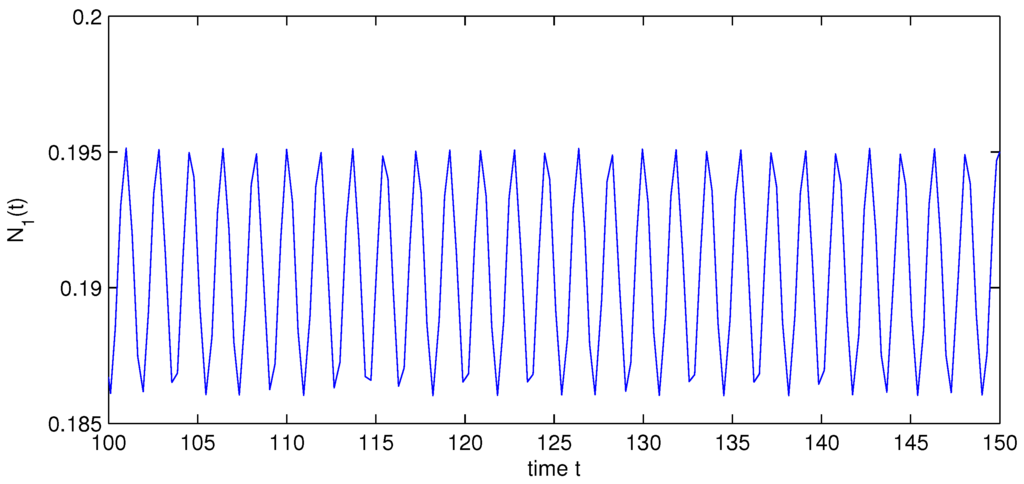
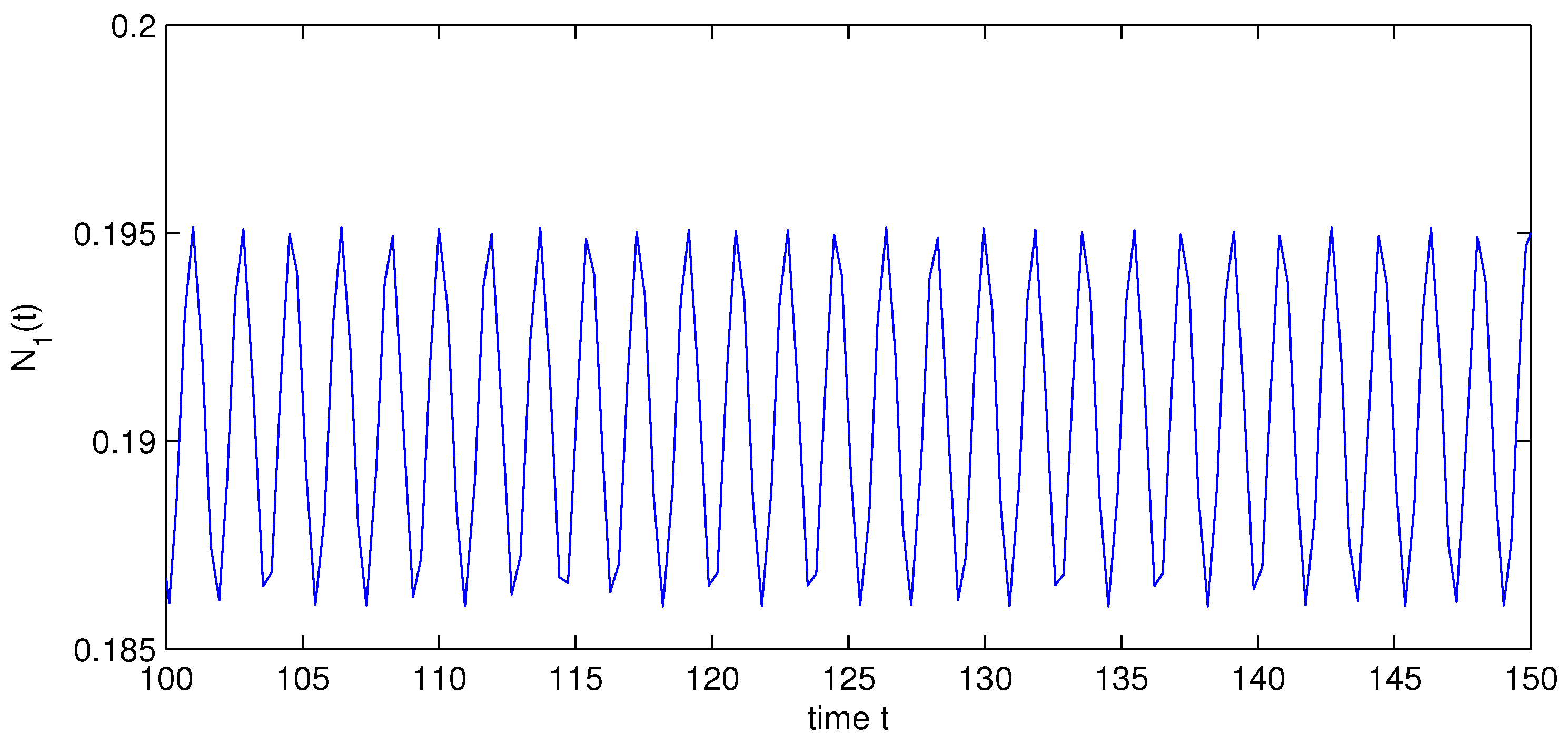
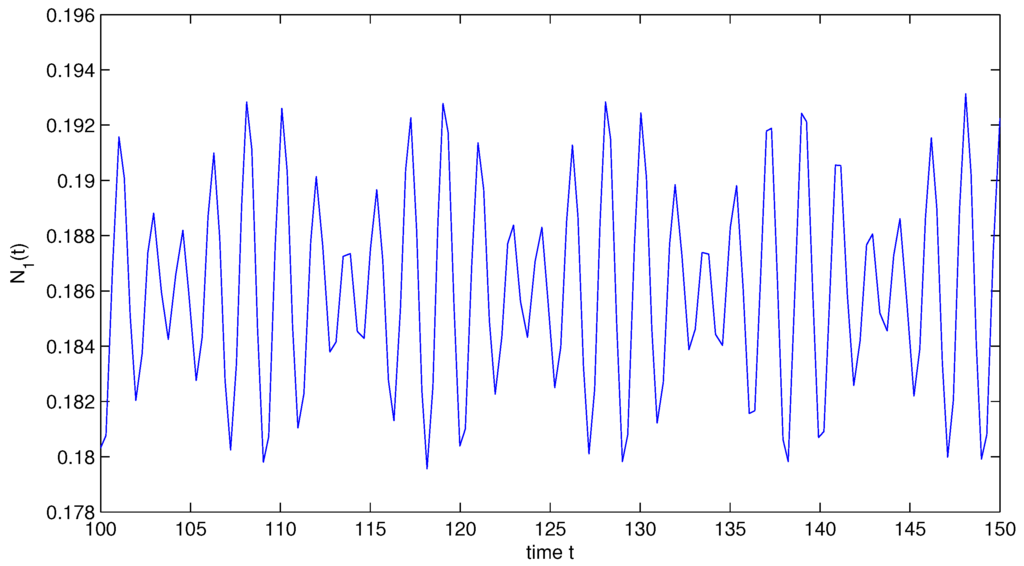
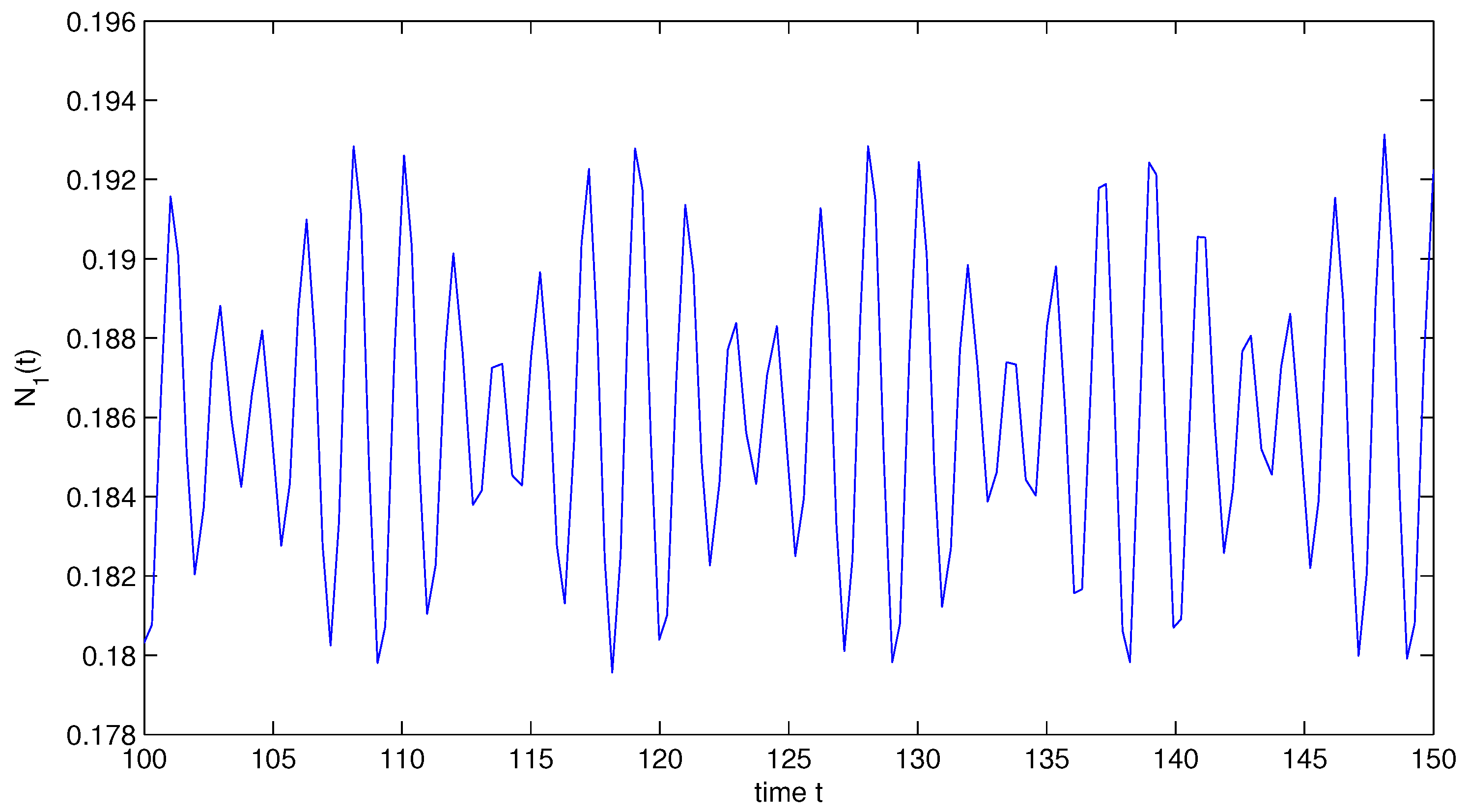
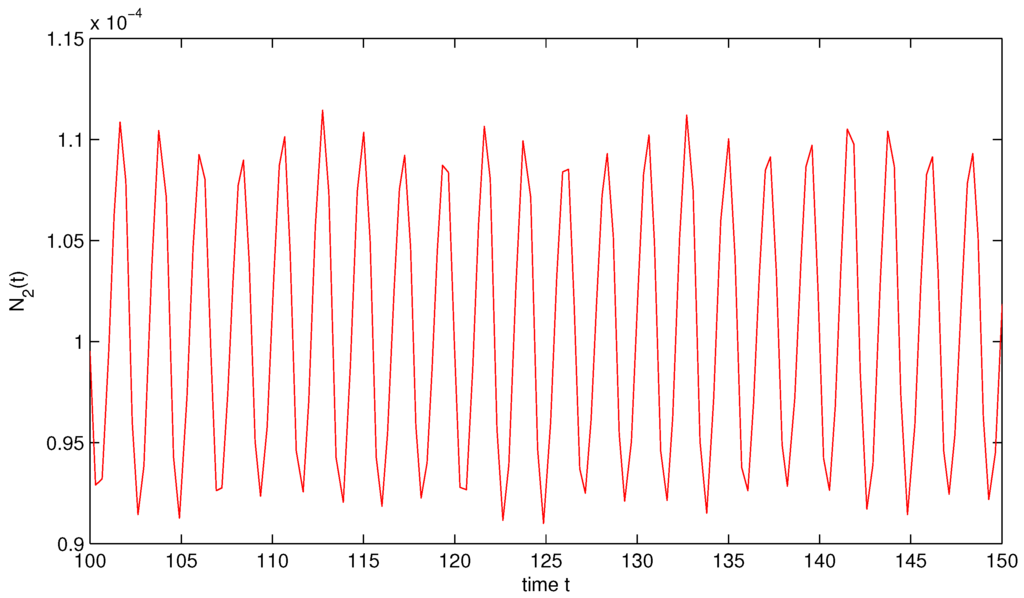
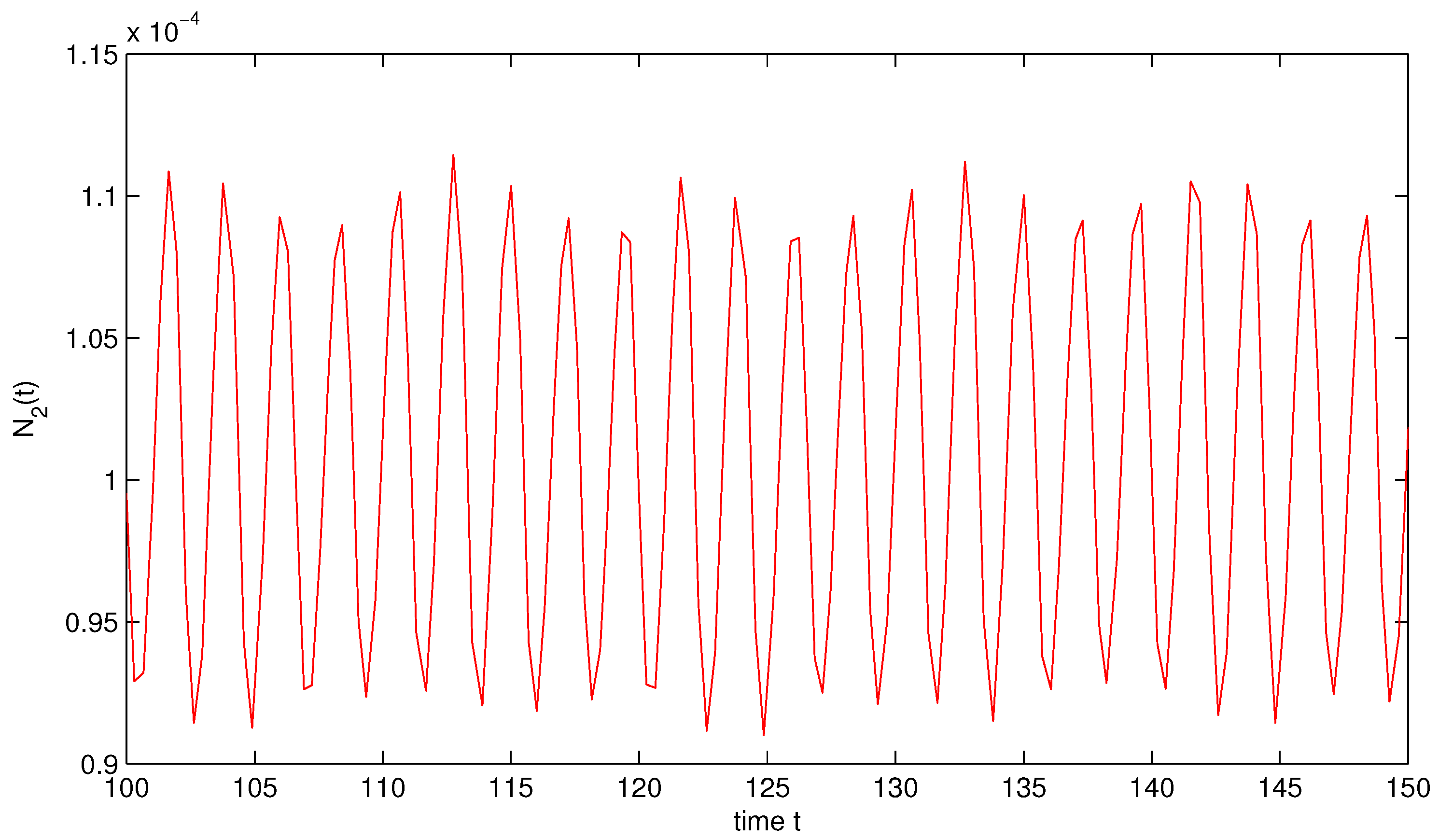
which implies that holds. By Theorem 1, System (31) gives at least one positive almost periodic solution (see Figure 1 and Figure 2). This completes the proof. ☐
Figure 1.
State variable of System (31).
Figure 2.
State variable of System (31).
Example 3. Consider the following delayed almost periodic predator–prey model with Hassell-Varley type functional response:
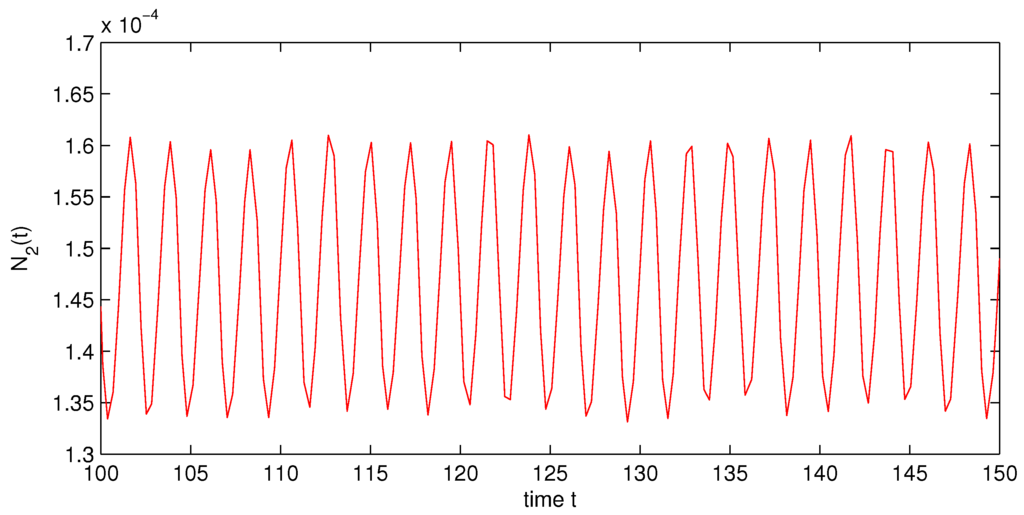
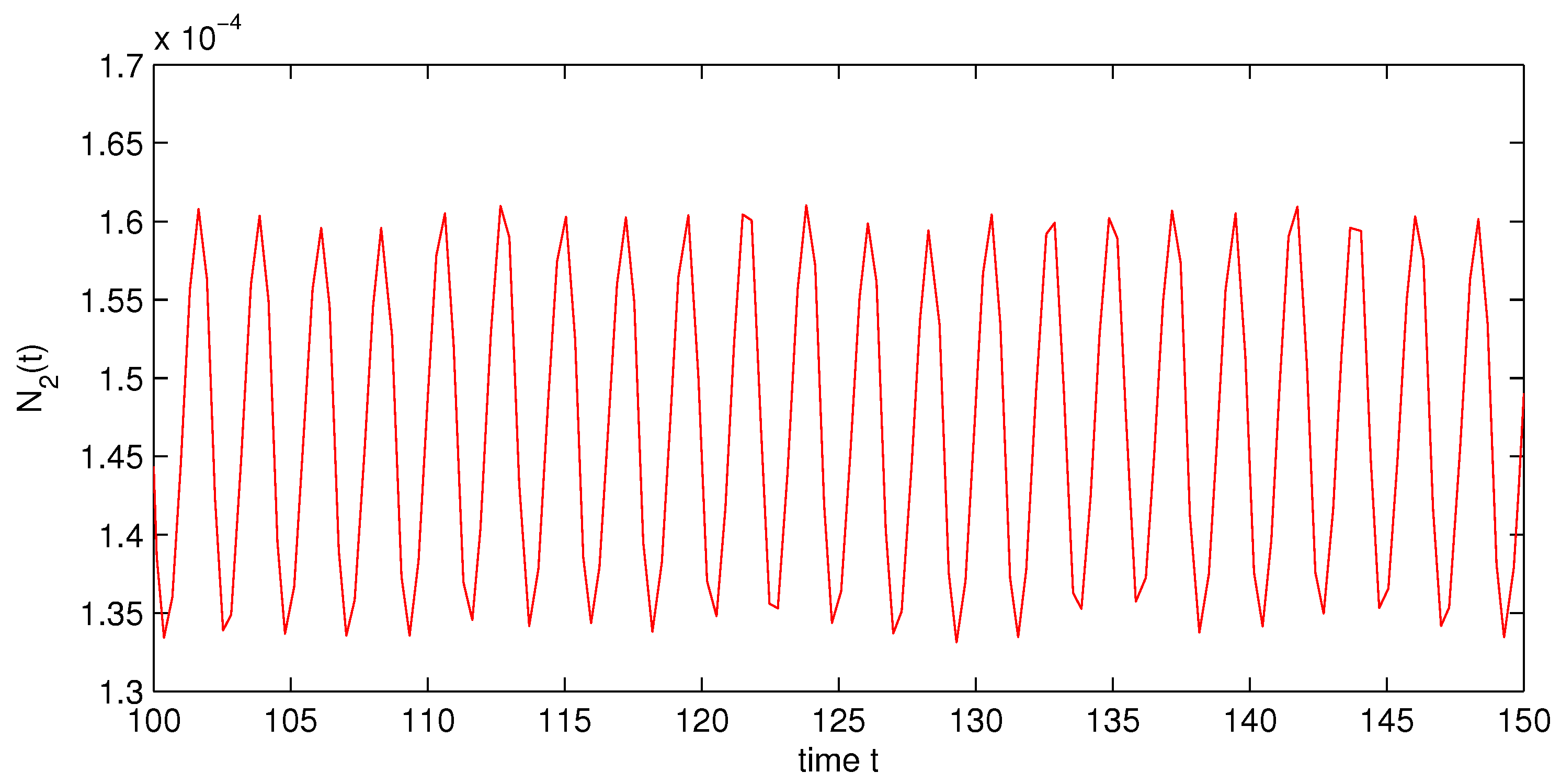
In System (32), and are almost periodic functions, which are not periodic functions. Similar to the argument as given in Example 2, it is easy to prove that System (32) gives at least one positive almost periodic solution (see Figure 3 and Figure 4).
Figure 3.
State variable of System (32).
Figure 4.
State variable of System (32).
5. Conclusions
By using a fixed point theorem of coincidence degree theory, some criterions for the existence of positive almost periodic solution to a kind of delayed predator–prey model with Hassell-Varley type functional response are obtained. Theorem 1 provides sufficient conditions for the existence of a positive almost periodic solution to System (4). The results obtained in this paper are unprecedented, being different from the results obtained in [33,34]. Therefore, the method used in this paper provides a possible means to study the existence of positive almost periodic solutions to the models for biological populations.
Acknowledgments
This work was supported by the Funding for Applied Technology Research and Development of Panzhihua City under Grant 2015CY-S-14 and the Natural Science Foundation of Ningxia Province under Grant NZ15255.
Author Contributions
T.Z., L.P. and Y.L. collectively carried out this study, collected data, and analyzed them. T.Z. and L.P. wrote the manuscript. Y.L. helped to revised the manuscript. All authors read and approved the final manuscript.
Conflicts of Interest
The authors declare no conflict of interest.
References
- Lotka, A.J. Elements of Physical Biology; Williams and Wilkins: Baltimore, MD, USA, 1925. [Google Scholar]
- Volterra, V. Fluctuations in the abundance of species considered mathematically. Nature 1926, 118, 558–560. [Google Scholar] [CrossRef]
- Ma, Z. Mathematical Modelling and Study of Species Ecology; Anhui Education Publishing Company: Hefei, China, 1996. [Google Scholar]
- Chen, L.; Song, X.; Lu, Z. Mathematical Models and Methods in Ecology; Scientific and Technical Publisher of Sichuan: Chengdu, China, 2003. [Google Scholar]
- Huo, H.F.; Li, W.T. Stable periodic solution of the discrete periodic Leslie-Gewer predator-prey model. Math. Comput. Model. 2004, 40, 261–269. [Google Scholar] [CrossRef]
- Hsu, S.B.; Hwang, T.W.; Kuang, Y. Global analysis of the Michaelis-Menten type ratio-dependent predator-prey system. J. Math. Biol. 2001, 42, 489–506. [Google Scholar] [CrossRef] [PubMed]
- Liu, S.; Beretta, E. A stage-structured predator-prey model of Beddington-DeAngelis type. SIAM J. Appl. Math. 2006, 66, 1101–1129. [Google Scholar] [CrossRef]
- Fan, M.; Kuang, Y. Dynamics of a nonautonomous predator-prey system with the Beddington-DeAngelis functional. J. Math. Anal. Appl. 2004, 295, 15–39. [Google Scholar] [CrossRef]
- Wang, H.; Zhong, S. Asymptotic behavior of solutions in nonautonomous predator-prey patchy system with beddington-type functional response. J. Appl. Math. Comput. 2006, 172, 122–140. [Google Scholar] [CrossRef]
- Wang, H.L. Dispersal permanence of periodic predator-prey model with Ivlev-type functional response and impulsive effects. Appl. Math. Model. 2010, 34, 3713–3725. [Google Scholar] [CrossRef]
- Ding, X.; Lu, C.; Liu, M. Periodic solutions for a semi-ratio-dependent predator-prey system with nonmonotonic functional response and time delay. Nonlinear Anal. RWA 2008, 9, 762–775. [Google Scholar] [CrossRef]
- Wei, F.Y. Existence of multiple positive periodic solutions to a periodic predator-prey system with harvesting terms and Holling III type functional response. Commun. Nonlinear Sci. Numer. Simulat. 2011, 16, 2130–2138. [Google Scholar] [CrossRef]
- Liu, G.R.; Yan, J.R. Positive periodic solutions for neutral delay ratio-dependent predator-prey model with Holling type III functional response. Appl. Math. Comput. 2011, 218, 4341–4348. [Google Scholar] [CrossRef]
- Hassell, M.; Varley, G. New inductive population model for insect parasites and its bearing on biological control. Nature 1969, 223, 1133–1136. [Google Scholar] [CrossRef] [PubMed]
- Cosner, C.; DeAngelis, D.; Ault, J.; Olson, D. Effects of spatial grouping on the functional response of predators. Theor. Popul. Biol. 1999, 56, 65–75. [Google Scholar] [CrossRef] [PubMed]
- Hsu, S.B.; Hwang, T.W.; Kuang, Y. Global dynamics of a predator-prey model with Hassell-Varley type functional response. J. Math. Biol. 2008, 10, 1–15. [Google Scholar]
- Wang, K. Periodic solutions to a delayed predator-prey model with Hassell-Varley type functional response. Nonlinear Anal. RWA 2011, 12, 137–145. [Google Scholar] [CrossRef]
- Zhang, T.W. Multiplicity of positive almost periodic solutions in a delayed Hassell-Varleytype predator-prey model with harvesting on prey. Math. Meth. Appl. Sci. 2013, 37, 686–697. [Google Scholar]
- Zhang, T.W.; Li, Y.K.; Ye, Y. Persistence and almost periodic solutions for a discrete fishing model with feedback control. Commun. Nonlinear Sci. Numer. Simul. 2011, 16, 1564–1573. [Google Scholar] [CrossRef]
- Zhang, T.W.; Li, Y.K.; Ye, Y. On the existence and stability of a unique almost periodic solution of Schoener’s competition model with pure-delays and impulsive effects. Commun. Nonlinear Sci. Numer. Simul. 2012, 17, 1408–1422. [Google Scholar] [CrossRef]
- Zhang, T.W.; Gan, X.R. Existence and permanence of almost periodic solutions for Leslie-Gower predator-prey model with variable delays. Elect. J. Differ. Equa. 2013, 2013, 1–21. [Google Scholar]
- Zhang, T.W.; Gan, X.R. Almost periodic solutions for a discrete fishing model with feedback control and time delays. Commun. Nonlinear Sci. Numer. Simulat. 2014, 19, 150–163. [Google Scholar] [CrossRef]
- Zhang, T.W. Almost periodic oscillations in a generalized Mackey-Glass model of respiratory dynamics with several delays. Int. J. Biomath. 2014, 7, 1450029. [Google Scholar] [CrossRef]
- Shu, J.Y.; Zhang, T.W. Multiplicity of almost periodic oscillations in a harvesting mutualism model with time delays. Dynam. Cont. Disc. Impul. Syst. B Appl. Algor. 2013, 20, 463–483. [Google Scholar]
- Liao, Y.Z.; Zhang, T.W. Almost periodic solutions of a discrete mutualism model with variable delays. Discret. Dyn. Nat. Soc. 2012, 2012, 742102. [Google Scholar] [CrossRef]
- Zhang, T.W.; Li, Y.K. Positive periodic solutions for a generalized impulsive n-species Gilpin-Ayala competition system with continuously distributed delays on time scales. Int. J. Biomath. 2011, 4, 23–34. [Google Scholar] [CrossRef]
- Fazly, M.; Hesaaraki, M. Periodic solutions for predator-prey systems with Beddington-DeAngelis functional response on time scales. Nonlinear Anal. RWA 2008, 9, 1224–1235. [Google Scholar] [CrossRef]
- Zhu, Y.L.; Wang, K. Existence and global attractivity of positive periodic solutions for a predator-prey model with modified Leslie-Gower Holling-type II schemes. J. Math. Anal. Appl. 2011, 384, 400–408. [Google Scholar] [CrossRef]
- Zhao, C.J. On a periodic predator-prey system with time delays. J. Math. Anal. Appl. 2007, 331, 978–985. [Google Scholar] [CrossRef]
- Wang, K. Existence and global asymptotic stability of positive periodic solution for a predator-prey system with mutual interference. Nonlinear Anal. RWA 2009, 10, 2774–2783. [Google Scholar] [CrossRef]
- Wang, K.; Zhu, Y.L. Global attractivity of positive periodic solution for a Volterra model. Appl. Math. Comput. 2008, 203, 493–501. [Google Scholar] [CrossRef]
- Ding, X.Q.; Jiang, J.F. Periodicity in a generalized semi-ratio-dependent predator-prey system with time delays and impulses. J. Math. Anal. Appl. 2009, 360, 223–234. [Google Scholar] [CrossRef]
- Liu, G.R.; Yan, J.R. Existence of positive periodic solutions for neutral delay Gause-type predator-prey system. Appl. Math. Model. 2011, 35, 5741–5750. [Google Scholar] [CrossRef]
- Zhang, G.D.; Shen, Y.; Chen, B.S. Positive periodic solutions in a non-selective harvesting predator-prey model with multiple delays. J. Math. Anal. Appl. 2012, 395, 298–306. [Google Scholar] [CrossRef]
- Fink, A.M. Almost Periodic Differential Equation; Spring-Verlag: Berlin, Germany; Heidleberg, Germany; New York, NY, USA, 1974. [Google Scholar]
- He, C.Y. Almost Periodic Differential Equations; Higher Education Publishing House: Beijing, China, 1992. (In Chinese) [Google Scholar]
- Gaines, R.; Mawhin, J. Coincidence Degree and Nonlinear Differential Equations; Springer Verlag: Berlin, Germany, 1977. [Google Scholar]
- Zhang, G.D.; Shen, Y.; Chen, B.S. Bifurcation analysis in a discrete differential-algebraic predator-preysystem. Appl. Math. Model. 2014, 38, 4835–4848. [Google Scholar] [CrossRef]
- Zhang, S.N.; Zheng, G. Almost periodic solutions of delay difference systems. Appl. Math. Comput. 2002, 131, 497–516. [Google Scholar] [CrossRef]
© 2016 by the authors; licensee MDPI, Basel, Switzerland. This article is an open access article distributed under the terms and conditions of the Creative Commons by Attribution (CC-BY) license (http://creativecommons.org/licenses/by/4.0/).