1. Introduction
The leather industry plays a significant role in economic development and contributes in part to environmental sustainability by utilizing by-products from the meat industry as raw material [
1]. Nevertheless, the tanning process is resource-intensive, requiring large amounts of water and chemical inputs, which leads to considerable generation of solid and liquid wastes. It is estimated that for every ton of raw material processed, only 150 kg are converted into finished products, while approximately 1.2 million tons of solid waste are generated annually worldwide [
2,
3,
4,
5].
The tanning process is a crucial stage in leather production and involves a series of unit operations that transform hides, previously subjected to beamhouse treatments, into finished leather. The chemical and physical stabilization of hides is achieved through the diffusion of tanning agents into the skin matrix, resulting in efficient binding with the collagen fibers. Tanning processes are categorized according to the type of tanning agent employed, with the most common being mineral tanning using basic chromium sulfate, vegetable tanning with plant-derived tannins, and synthetic tanning [
6].
The fixation of tanning agents occurs through the formation of cross-links between collagen fibers, the main structural component of hides. The nature and intensity of these cross-links vary depending on the type of tanning agent and can be influenced by factors such as pH, temperature, concentration of the tanning medium, and exposure time [
6,
7]. Conventional chromium salts, particularly basic chromium sulfate, have a basicity of approximately 33% and a chromium oxide content ranging from 16% to 26%, with solubility under acidic conditions. These salts form macromolecules capable of establishing covalent bonds with the polypeptide chains of collagen. However, leather production and chromium tanning generate large amounts of organic and inorganic pollutants. Among these, shavings produced during the splitting stage represent the most significant waste streams due to their high toxicity, preventing direct disposal into the environment [
8].
According to the Brazilian National Solid Waste Policy (Law No. 12.305/2010), industrial wastes are classified according to their characteristics and origin, with potential environmental impacts being the main criterion [
9]. The Brazilian Standard ABNT NBR 10.004/2004 [
10] establishes two main categories: hazardous (Class I) and non-hazardous (Class II). Class I wastes pose risks to human health and the environment if improperly managed and are characterized by properties such as flammability, corrosivity, toxicity, reactivity, and pathogenicity.
Leather residues containing trivalent chromium (Cr
3+), such as tannery sludge, finished wet blue shavings, and semi-finished scraps, fall under Class I hazardous wastes. Under oxidative conditions—such as high soil pH or elevated manganese oxide concentrations—Cr
3+ can be oxidized to hexavalent chromium (Cr
6+), which is more toxic and mobile, thereby contaminating soil and water resources [
11,
12]. Consequently, such wastes must be disposed of in specialized landfills to minimize environmental risks.
Recent research has focused on alternative treatment and valorization pathways for tannery solid wastes, including gelatin extraction for biodegradable films [
13], elastin recovery [
14], their use as low-cost adsorbents for dye removal, nitrogen source for agriculture following chromium removal [
15], and biogas production [
16].
Despite these efforts, the leather industry still generates significant amounts of solid residues from chromium tanning, particularly
wet blue shavings and trimmings, which are commonly landfilled. Chromium recovery and recycling processes are under investigation, mostly based on chemical or thermal degradation of the organic fraction [
6,
8]. However, these methods often remain costly or inefficient.
Wet blue leather waste, being a collagen-rich organic material, could serve as a promising precursor for the production of activated carbon. Its specific physicochemical characteristics (chemical composition and particle size) may yield carbons with unique adsorption properties. Producing activated carbon from this waste not only adds value but also contributes to meeting the growing national demand for this material.
Activated carbon is a porous carbonaceous material prepared by carbonization and activation of organic precursors, commonly of plant origin. Due to its highly developed surface area and pore structure, activated carbon can adsorb contaminants in both liquid and gaseous phases. A wide range of raw materials—including wood, bones, coconut shells, and sugarcane bagasse—have been employed in its production. The final properties of activated carbon strongly depend on the precursor and activation conditions, which determine its specific applications [
17].
Activation can be achieved either physically (using steam or carbon dioxide) or chemically (using agents such as zinc chloride, sulfuric acid, phosphoric acid, potassium hydroxide, potassium carbonate or sodium hydroxide), usually after carbonization. Both routes enhance porosity by removing volatile organic compounds and generating unsaturated sites, which increase adsorption capacity. Owing to its high surface area (400–3500 m
2 g
−1) and pore diversity (macro, meso, and micropores), activated carbon is widely recognized as one of the most effective adsorbents, with applications in purification, decolorization, and deodorization of liquids and gases [
18,
19,
20].
Furthermore, human activities and industrial operations have markedly intensified the release of emerging contaminants into the environment, raising significant global concerns regarding environmental safety and public health. Although this issue has been extensively investigated worldwide, effective and economically viable mitigation strategies remain limited. Among the most critical emerging contaminants are pharmaceuticals (including hormones and antibiotics), personal care products, synthetic dyes, and pesticides, which are widely detected in aquatic and terrestrial ecosystems.
Dye-containing wastewater is a major environmental concern because it combines high visibility pollution, chemical persistence, and potential toxicity, making its treatment both environmentally and technologically challenging. These compounds are typically characterized by complex aromatic molecular structures, which confer high chemical stability and pronounced resistance to biodegradation. Their persistence in aquatic environments can significantly reduce light penetration, thereby disrupting photosynthetic activity and altering aquatic ecosystems. Furthermore, several dyes and pigments exhibit toxic effects toward microorganisms, impairing enzymatic and metabolic functions essential to ecosystem balance [
21]. Methylene blue is widely employed as a model dye in wastewater treatment studies due to several practical and scientific advantages. It is a well-characterized cationic dye with a stable and known molecular structure, high water solubility, and strong absorbance in the visible region, which allows accurate and straightforward quantification by UV–Vis spectroscopy. Its chemical stability and resistance to biodegradation make it representative of persistent synthetic dyes commonly found in industrial effluents. Moreover, methylene blue is frequently discharged from textile, paper, and dyeing processes, making it environmentally relevant. Owing to its widespread use, reproducibility, and ease of analysis, methylene blue serves as a reliable benchmark compound for evaluating and comparing the performance of adsorption, photocatalytic, and other advanced wastewater treatment technologies [
22,
23,
24,
25].
Among the available technologies for dye remediation, sorption-based processes stand out due to their high removal efficiency and, in certain cases, their ability to preserve and recover the active compounds. However, the large-scale application of these methods depends on the development of cost-effective and environmentally sustainable adsorbents. In this context, industrial by-products and waste-derived materials, commonly referred to as low-cost alternative adsorbents (LCAs), such as residual wet blue leather, have emerged as promising solutions that align with the principles of sustainability and circular economy [
26,
27,
28].
Therefore, the objective of this study is to investigate the production of activated carbon from wet blue leather waste and evaluate its performance as an efficient adsorbent for methylene blue dye removal, thereby offering a sustainable route for managing hazardous tannery residues while adding value to an underutilized by-product.
2. Materials and Methods
The
wet blue leather sawdust was provided by ÁUREA tannery, located in Rio Grande do Sul (RS), Brazil. The wet blue leather had a chromium content of approximately 20 g kg
−1. The chromium content was determined by atomic absorption spectroscopy (model Spectra AA 55, Varian, USA). SEM micrograph (magnification of 1000 times) (Zeiss, model EVO LS25, Germany) and X-ray diffraction (XRD) (Rigaku, Miniflex II, Japan) obtained for
wet blue leather are presented in Pasquali et al. [
29].
2.1. Activated Carbon Production
To evaluate the effect of temperature and duration of the pyrolysis process, a full factorial design (2
2) with a triplicate at the central point was applied, resulting in seven experiments. The studied variables and their respective levels are presented in
Table 1.
For each run, 5.0 g of residual wet blue leather was subjected to pyrolysis under nitrogen flow (100 cm3·min−1) at a heating rate of 10 °C·min−1, according to the experimental design. The outlet gases were bubbled through water to monitor possible chromium leaching with the pyrolytic oil.
The pyrolysis experiments were conducted at temperatures of 500, 600, and 700 °C. After the pyrolysis step, the resulting chars were allowed to cool to room temperature and subsequently subjected to a chemical activation. The resulting chars were activated with 1:1 HCl hot solution. The samples were then dried in an oven at 105 °C for 24 h, stored, and subsequently characterized.
2.2. Characterization of Activated Carbon
The prepared carbons were characterized using several analytical techniques. Surface area was determined by nitrogen adsorption (Quantachrome Nova 2200e, USA) before and after acid activation. Measurements were conducted isothermally at −196 °C after degassing approximately 100 mg of sample under vacuum at 300 °C for 3 h. The Brunauer–Emmett–Teller (BET) equation was applied to calculate surface area.
Elemental composition was analyzed using an energy-dispersive X-ray (EDX) system (Noran Instruments, USA) coupled to a JEOL JSM 6300 F SEM at 20 kV accelerating voltage. Total chromium content in the carbon samples and in liquid effluents from pyrolysis and activation was determined by atomic absorption spectrometry (Varian AA model).
2.3. Adsorption Experiments
Adsorption studies were performed with the activated carbon sample showing the highest surface area, using methylene blue as the model dye.
2.3.1. Equilibrium Time
Batch experiments were conducted at room temperature (25 °C) with 20 mL of methylene blue solution (150 mg·L−1) and 100 mg of activated carbon. Independent tests were carried out at contact times of 5, 10, 30, 60, 120, 180, and 360 min. Residual dye concentrations were measured by UV–Vis spectrophotometry (Agilent 8453, USA) at 624 nm.
2.3.2. Adsorption Capacity
The effects of temperature, pH, and dye concentration on adsorption capacity were investigated using a full factorial design (2
3) with a triplicate at the central point. Contact time and adsorbent mass (0.1 g) were kept constant. The experimental factors and levels are presented in
Table 2.
Adsorption capacity was expressed as milligrams of dye adsorbed per gram of adsorbent (mg·g−1). Statistical analyses were performed using Statistica software, version 6.0.
3. Results and Discussion
The experimental design matrix for the preparation of activated carbons, with their respective surface areas (before and after activation with 1:1 HCl), is presented in
Table 3.
Statistical analysis indicated a significant positive effect of pyrolysis temperature (
p < 0.1) on surface area, showing that higher temperatures promote the development of more porous activated carbons. For the evaluated conditions, the largest surface areas, both before and after HCl activation, were obtained at 700 °C. Among these, the shortest residence time (1.5 h) produced the best result (508.8 m
2 g
−1). The difference in surface area observed between the activated carbons prepared at 700 °C was directly related to their chromium content (
Table 4).
Based on the statistical analysis and textural characterization results, the pyrolysis conditions at 700 °C were selected for the subsequent stages of this study, as they provided the most favorable structural properties among the evaluated conditions. At this temperature, the activated carbons exhibited the highest surface areas both before and after HCl activation, indicating a more developed porous structure. In particular, the sample prepared at 700 °C with the shortest residence time (1.5 h) achieved the highest surface area (508.8 m2 g−1), demonstrating that elevated temperature combined with reduced residence time was the most effective condition. Furthermore, variations in surface area among the activated carbons produced at 700 °C were closely associated with differences in chromium content, highlighting the relevance of this temperature in optimizing both textural properties and material composition. Therefore, pyrolysis at 700 °C was adopted as the optimal condition for further adsorption and performance studies.
Furthermore, the activated carbon with the highest chromium content (5.3%) was obtained at the longest pyrolysis time (4.5 h). In contrast, the extract from this condition contained less chromium, suggesting that a longer residence time favors chromium retention in the solid phase. An inverse relationship between chromium content and surface area was observed: the greater the chromium retained, the smaller the surface area. Similar behavior was reported by Oliveira et al. [
30], who observed a reduction in surface area from 889 to 556 m
2 g
−1 when chromium content increased from 10% to 13% in carbons produced from the same residue using CO
2 as a physical activator.
Activated carbon, characterized by thermal stability, high performance, strong adsorption capacity, extensive specific surface area, and a well-developed pore network, has been widely recognized as an effective adsorbent for the removal of both organic and inorganic pollutants. It can be produced from various carbonaceous materials under diverse preparation conditions. For example, leather waste was utilized by Kong et al. [
30] as a precursor for activated carbon production through both physical (steam) and chemical (pyrophosphoric acid, H
4P
2O
7) activation under varying conditions of carbonization temperature, time, and impregnation ratio. The results demonstrated that H
4P
2O
7 promotes carbonaceous material formation, leading to activated carbons with distinct structural and functional properties.
Independently of pyrolysis conditions in our study, the activation step with 1:1 HCl significantly increased the surface areas. This improvement indicates that chromium incorporated into the leather matrix may act as a chemical activating agent, similar to ZnCl2, H3PO4, or NaOH reported in the literature. In this regard, the activated carbon produced at 700 °C/4.5 h exhibited a surface area of 508.0 m2 g−1, which was twice as high as that reported by Oliveira et al. (251.0 m2 g−1) when ZnCl2 was used for activation.
Chromium speciation was further evaluated through EDX analysis (
Table 5). The high oxygen content suggests the presence of chromium oxides (Cr
2O
3), indicating that Cr may occur as Cr
6+. Oliveira et al. [
30] also reported the coexistence of Cr(III) and Cr(VI) in carbons derived from
wet blue leather, with XPS analysis confirming Cr
3+ as the predominant species.
The findings shows that chromium embedded in the structural network of wet blue leather can act as a chemical activator, resulting in activated carbons with enhanced surface areas. This behavior provides an environmentally relevant alternative for the valorization of this residue, rather than its conventional disposal in industrial landfills. The elevated chromium content observed in the carbons not only contributed to surface area development but also suggests potential applicability as catalysts in reactions where supported chromium serves as the active phase.
Adsorption Tests
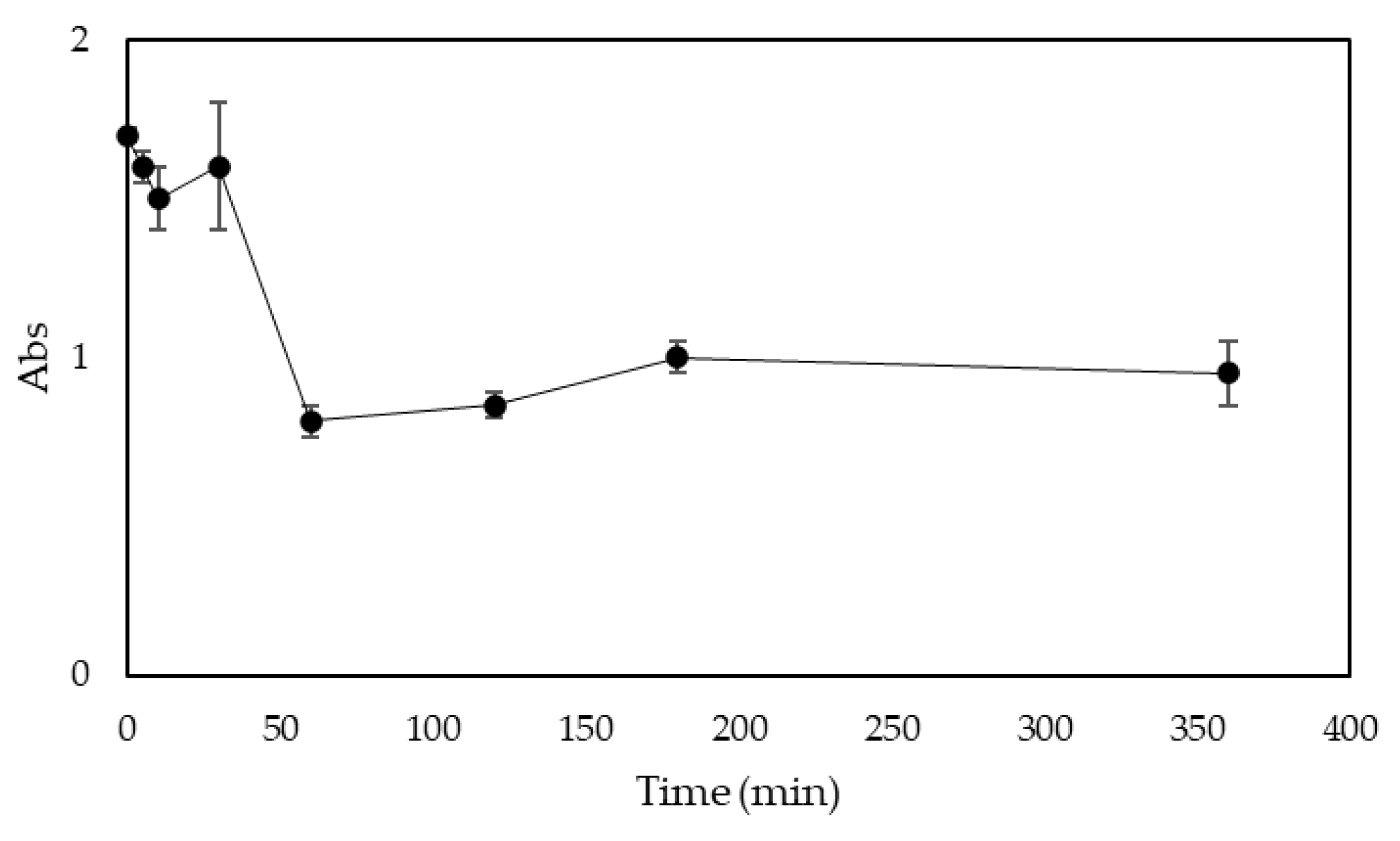
Based on the equilibrium time assay for the removal of methylene blue dye shown in
Figure 1, a contact time of 60 min was selected and subsequently maintained as a constant parameter in the following experimental design (
Table 6).
The adsorption capacity of methylene blue (mg g
−1) under different experimental conditions, along with the design matrix in triplicate, is shown in
Table 6.
Regression analysis of the data identified the optimized experimental conditions for maximum adsorption. ANOVA results are shown in
Table 7.
The model achieved a correlation coefficient (R
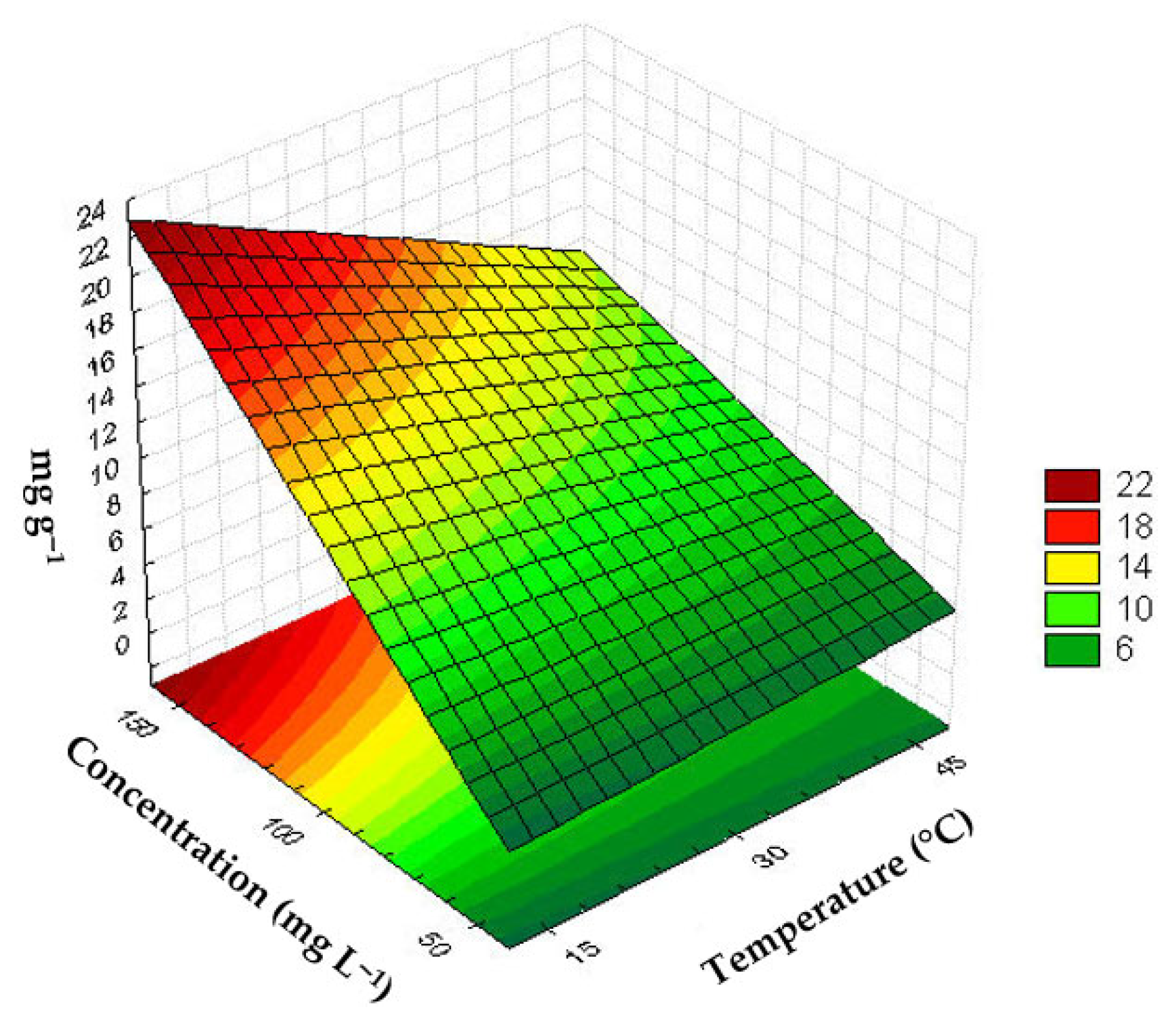
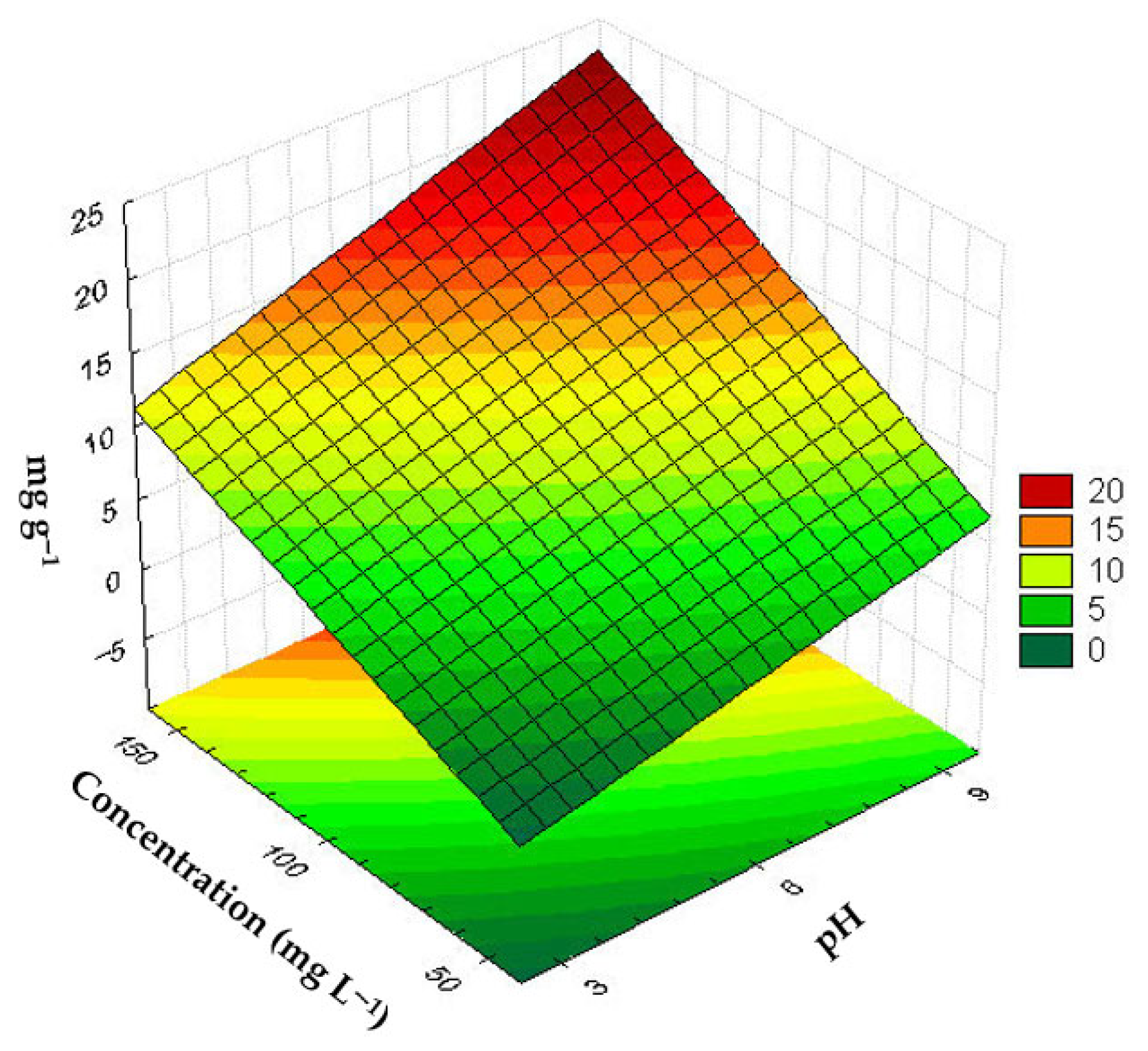
2 = 0.9648), indicating that 96.48% of the variability was explained. Since Fcalc exceeded Ftab at 95% confidence, the model was considered statistically validated. Response surface plots (
Figure 2 and
Figure 3) confirmed the positive effects of both initial dye concentration and pH on adsorption capacity, while temperature exhibited a negative influence. The highest q values were obtained at lower temperatures.
The influence of pH on adsorption is closely related to changes in surface charge of the adsorbent and the dissociation degree of the adsorbate, which govern electrostatic interactions. Adsorption experiments further demonstrated that pH plays an important parameter, with higher values improving electrostatic interactions between the activated carbon and cationic dye molecules. Conversely, temperature exerted a negative influence, confirming the exothermic nature of the adsorption process. The obtained q values demonstrate that the produced activated carbons exhibit competitive adsorption capacity compared to other adsorbents reported in the literature.
In our previously study [
21], chicken feathers, an abundant and low-cost agricultural byproduct, have been investigated as effective sorbent materials for the removal of reactive yellow dye from aqueous solutions. Owing to their keratin-rich structure, feathers exhibit dual adsorption and absorption capabilities, which contribute to their dye removal performance. Acid activation with 1.0 mol L
−1 HCl resulted in enhanced adsorption capacity, with optimal performance observed at 70 °C and pH 5.5, as described by the Langmuir isotherm model. Experimental design analysis demonstrated that temperature and pH significantly affect adsorption efficiency, with higher temperatures favoring the process. Kinetic evaluation indicated pseudo-first-order behavior, characterized by rapid initial uptake and equilibrium attainment within 120 min. Thermodynamic parameters confirmed an endothermic and spontaneous adsorption process at elevated temperatures, highlighting the feasibility of employing poultry industry residues as sustainable sorbents for wastewater remediation.
Overall, these results demonstrate the dual role of chromium: as both a pore-forming agent and an active site modifier, enabling potential applications in adsorption and catalysis. Nonetheless, further studies are necessary to optimize pyrolysis and activation conditions, evaluate long-term stability, and expand applicability toward different pollutants and catalytic systems.
A major challenge associated with the present study is the lack of industrial-scale production of activated carbon derived from wet-blue leather waste. The transition from laboratory-scale synthesis to industrial implementation requires the involvement of industrial partners capable of converting wet-blue leather waste into activated carbon under controlled and reproducible conditions. In addition, scale-up studies are essential to evaluate process feasibility, operational stability, and cost-effectiveness. Reduction and optimization tests are also necessary to minimize material losses, energy consumption, and chemical usage during large-scale production.
Despite these challenges, the study presents important opportunities. The reuse of wet-blue leather waste as a precursor for activated carbon offers a sustainable solution for the management of a problematic industrial residue, contributing to waste valorization and circular economy strategies. The effective removal of dyes demonstrated in this work highlights the strong potential of this material for wastewater treatment applications. From an environmental perspective, this approach not only reduces the volume of leather waste destined for disposal but also enables the recycling of the material into a high-value product for pollutant removal. Therefore, the proposed strategy combines environmental appeal with practical applicability, opening promising pathways for sustainable dye remediation technologies.




 ,
,