1. Introduction
Globulins are proteins that are soluble in dilute saline solutions. Their crystalline structure exhibits a compact structure due to the presence of salt bridges and hydrophobic groups that form packed layers [
1]. These require a solution concentration between 0.5 and 1 M NaCl for optimal solubility.
The recombinant expression of amaranth 11S globulin (AMR0) in
E.coli, is influenced by various factors, including redox conditions and deficiencies in protein quality control resulting from the high synthesis rate. These factors impact the folding and processing kinetics of the proteins, leading to the formation of aggregated conformations due to partial or incorrect folding [
2,
3]. Inclusion bodies are expressed intracellularly in the cytosol, which hinders the purification process. Their dense and insoluble nature limits their interaction with purification agents. These characteristics promote the use of time-consuming and low-yield processes involving protein extraction through cell lysis, inclusion body solubilization, purification, and protein refolding, resulting in inefficient processes. Therefore, the high-throughput purification of proteins expressed in inclusion bodies poses a significant challenge to their effective utilization.
The purification process utilizes chromatographic methods, such as cation exchange, size exclusion, immobilized metal affinity chromatography (IMAC), and reversed phase, to achieve the desired purity percentages. However, these methods do not consistently yield the necessary yield to scale up the process [
4,
5]. Another method for treating inclusion bodies involves the use of mild buffers when the biological function of the protein relies on its folding [
6]. However, these techniques are not exempt from having to go through refolding methods such as dialysis. This process results in a decrease in the yield of purification and an investment of time and resources.
The use of denaturing and chaotropic agents at low concentrations is a convenient purification method, especially when the biological function of the polypeptide chain is the primary concern. These agents effectively denature proteins, enabling their interaction with solubilizing and purification agents [
7,
8].
Amaranth 11S globulin (amarantin) has been modified with peptides valine-tyrosine (VY), which have antihypertensive biological activity [
9]. When released, these peptides act as inhibitors of the angiotensin-converting enzyme I (ACE). ACE is a key molecule in the renin–angiotensin–aldosterone system, which increases pressure. Four VY peptides were strategically integrated in tandem into the variable region V, resulting in the creation of a recombinant amarantin modified with antihypertensive peptides (AMR5). This modified amarantin was successfully expressed in
E.coli and purified using an immobilized metal affinity chromatography (IMAC) method. However, the yield obtained was found to be very low [
9].
Hypertension is a chronic condition marked by persistently elevated blood pressure. It can lead to serious health complications, including stroke, heart failure, kidney failure, and more. High blood pressure is one of the most common prevalent diseases worldwide. According to estimates by the World Health Organization, by 2024, one in three adults would have suffered from high blood pressure. Therefore, it is necessary to develop strategies to help lower blood pressure in the population with this disease. The use of proteins and peptides with antihypertensive properties could serve as an alternative to allopathic treatment for patients with high blood pressure.
Despite the potential of amarantin modified with antihypertensive peptides (AMR5) to be incorporated into nutraceutical foods, an efficient purification methodology is still required. Such a methodology would allow for the structural and functional evaluation of the amarantin for their subsequent application. This work proposes a purification procedure that produces a high percentage of purification and an advantageous yield. This is achieved through the use of solubilizing, chaotropic and denaturing agents.
2. Materials and Methods
The biomass was obtained from the shake flask fermentation of
E.coli BL21(DE3) CodonPlus-RIL, which had been transformed with the pET-Amar6His plasmid (to obtain the AMR0 protein) or the pET-AmarR5 plasmid (to obtain the AMR5 protein). The cells were grown in potato extract medium for six hours after induction [
9].
2.1. Purification
The initial purification process was conducted on the AMR0 protein. The following steps were carried out at room temperature (25 °C). One gram of E. coli biomass was collected, and three washes of biomass were performed. These consisted of adding 10 mL of deionized water, homogenizing for 4 min in a Genie SR238 (Scientific industries, New York, USA) disruptor, and centrifuging at 10,000 rpm for 8 min, separating the precipitate from the solution. Then, 10 mL of Buffer E (20 mM Tris-HCl at pH 8.5, 100 mM β-mercaptoethanol, and 0.5 M NaCl) were added to the precipitate, homogenized for 4 min and centrifuged. This procedure was repeated by adding 150 µL of lysozyme at a concentration of 1 mg/mL to the buffer. The samples were then incubated at 37 °C for one hour and sonicated for 30 min in an ultrasonic bath (PS-20A) at 10 min intervals. The samples were subsequently subjected to centrifugation. The recovered precipitate was then added to 10 mL of Buffer E with 1 M urea. The mixture was homogenized for 8 min and subsequently subjected to centrifugation. The urea concentration was increased to 6 M. Then, 10 mL of this solution was applied, homogenized for 8 min, and then subjected to centrifugation (10,000 rpm, 8 min). Three washes were performed with this urea concentration in buffer E. Ten milliliters of deionized water were added to the precipitate to remove the remaining urea. The material was subsequently homogenized and subjected to centrifugation. This process was repeated three times. Next, seven distinct treatments were administered to enhance the degree of purification. These treatments included washes with the following substances: (a) Ethanol, (b) Acetone, (c) Hexane, (d) Hexane:0.05 M NaCl 1:1, (e) Tris-HCl buffer pH 11, (f) Temperature increase to 70 °C in Tris-HCl buffer pH 8, (g) Buffer at the theoretical isoelectric point of amarantin (6.69). The different solvents were added to the pellets (10 mL each), and vortexed for 3 min. Subsequently, the four samples were stored in a −20 °C freezer for 30 min. Following this, the samples were centrifuged at 10,000 rpm for 10 min. The supernatant was then separated, and the protein precipitate was recovered. When using buffers at pH 11 and 6.69, the samples were vortexed for 3 min, maintained at room temperature for 30 min, and then subjected to centrifugation at 10,000 rpm for 10 min. The mixture was then separated, and the protein precipitate was recovered. In the case of an increase at 70 °C, the process was maintained for 30 min, followed by centrifugation at 10,000 rpm for 10 min. The supernatant was separated, and the protein precipitate was successfully recovered.
The samples obtained from these procedures were analyzed by SDS-PAGE gel electrophoresis. The best results were selected to perform the final purification protocol.
The final purification protocol was applied to purify the AMR5 protein.
2.2. Yield Determination
The yield of the recombinant proteins was determined by densitometry. A calibration curve was constructed using lysozyme as the standard protein, at different quantities, and run on a 14% SDS-PAGE gel. Additionally, AMR0 and AMR5 proteins were analyzed on the same gel. The protein quantities in the AMR0 and AMR5 samples were determined using Image Lab software version 5.2.1
2.3. Determination of ACE Inhibitory Activity
To determine the ACE inhibitory activity of the samples, they were hydrolyzed with pancreatin at an enzyme-to-substrate ratio of 1:100. The samples were then incubated at 37 °C for 18 h. The reaction was then stopped by boiling the sample. ACE inhibitor activity was analyzed in accordance with the procedure outlined in [
10]. The IC50, defined as the amount of sample required to inhibit ACE activity by 50%, was reported. Captopril was used as a positive control.
2.4. Statistical Analysis
All determinations were performed in triplicate. The results are presented as means ± standard deviations. To determine significant differences in each measured parameter, a t-Student test was performed with a significance level of 0.05, which was performed using R Studio software version 4.3.2.
3. Results and Discussion
To obtain the desired recombinant proteins, it is necessary to first lysate the membrane of the microorganism in question. An effective and specific method for lysing the
E. coli membrane is enzymatic lysis using lysozyme, an enzyme that reacts with the peptidoglycan layer and breaks the glycosidic bond. However, it is necessary to remove the outer membrane [
11]. During the purification process, contaminating proteins were extracted using buffer E due to its components: Tris-HCl at pH 8, which is used as a pH stabilizing agent, and β-mercaptoethanol is used at a concentration of 100 mM for each buffer. This element has been shown to protect disulfide bonds from reductive reactions at low concentrations [
12], making it a crucial component throughout the treatment process. Similarly, 0.5 M NaCl was added to both buffers, given that this agent has two functions: solubilizing the globulins [
13] and removing soluble proteins.
The concentrations of the agents that make up Buffer E were selected based on prior testing of different variables (see
Supplementary Information)
As illustrated in
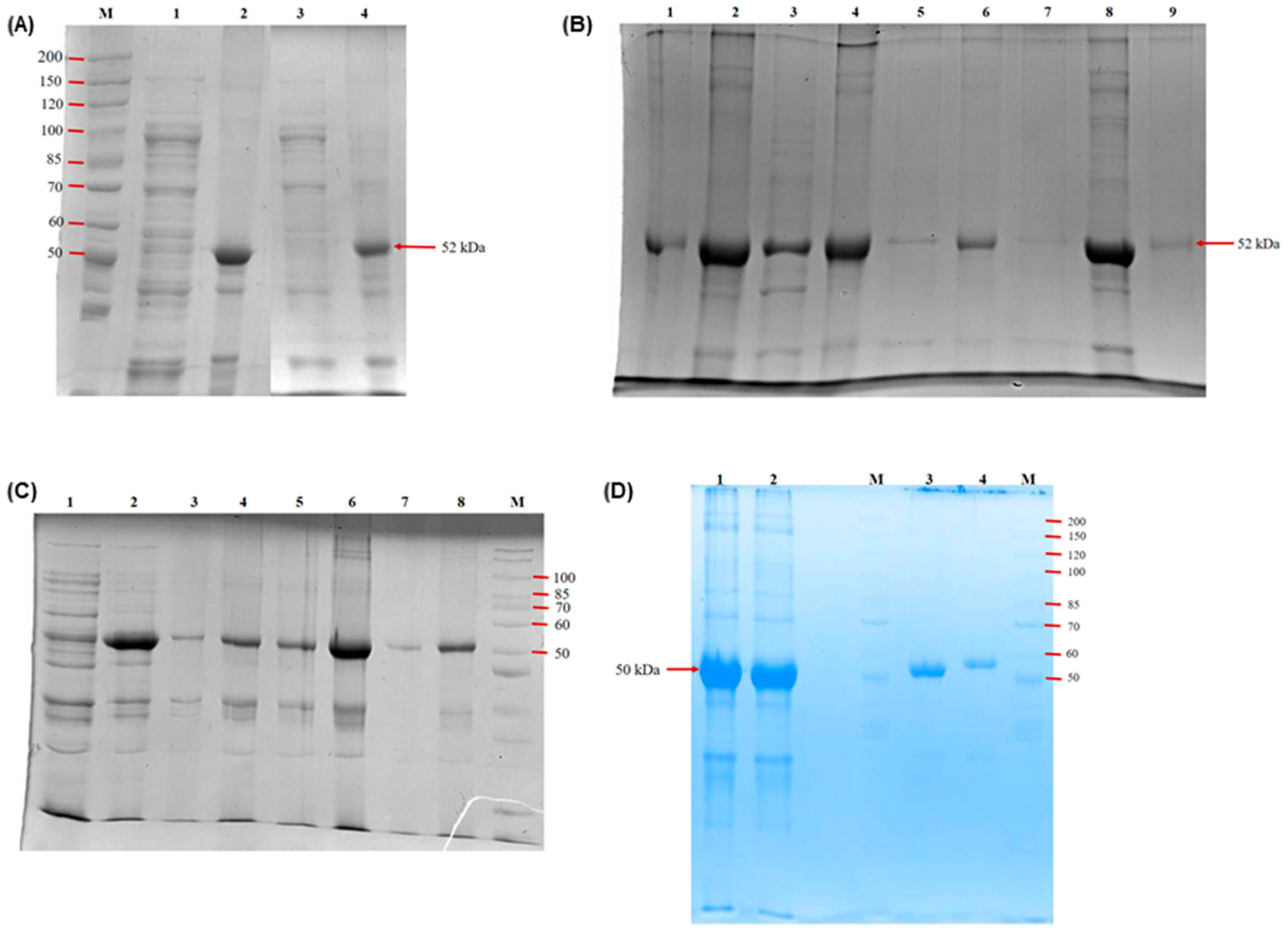
Figure 1A, the SDS-PAGE gel displays the presence of both proteins. It is evident that nearly all amarantins (AMR0 and AMR5) are present in inclusion bodies. According to the report by Medina-Godoy et al. (2004) [
2], the molecular weight of the 11S amaranth globulin was found to be 50–52 kDa. It is evident that the AMR0 band is at the same level as the 50 kDa marker band.
According to Medina-Godoy et al. (2004), and Espinosa-Hernández et al. (2019) [
2,
9] recombinant amarantin is produced in insoluble structures in the
E. coli cytoplasm, which is why it is necessary to use urea at different concentrations to purify it. These inclusion bodies are formed from the accumulation of protein in the cytoplasm of the host cell. Given the high expression rate of the recombinant proteins, as well as the reducing environment of the cytoplasm, it is likely that a trimeric folding different from the native hexameric form occurs due to the difficulty in forming disulfide bonds under these conditions [
3]. Urea, classified as a chaotropic agent, exerts its function by modifying the structural network of water and weakening the hydrophobic interactions that may be present in inclusion bodies [
14]. Two concentrations of urea were utilized in this study. Initially, 1 M was employed for differential solubilization or removal of loosely bound contaminants prior to full solubilization at 6 M. This approach was adopted due to the findings from a previous experiment, where 6 M was utilized for solubilization of inclusion bodies. However, in the present case, various contaminant proteins were found to be challenging to remove.
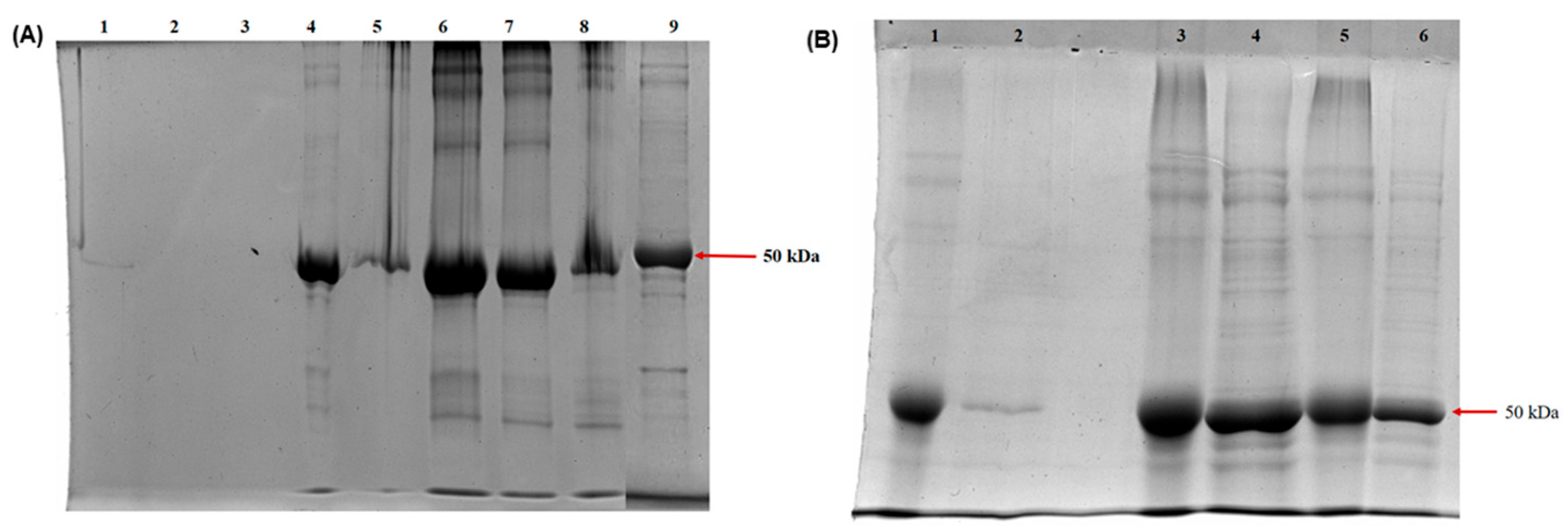
Once the urea was removed by washing with deionized water, extractions with organic solvents were tested to extract fractions bound to the recombinant proteins through hydrophobic interactions. Three solvents were tested: acetone, ethanol, and hexane. However, as shown in
Figure 2A, no contaminating fractions were obtained in the supernatants, probably due to the limited interaction with these agents due to their globular nature [
13].
Therefore, extraction with 1:1 hexane/0.05 M NaCl was chosen, since salt helps solubilize amarantin, allowing greater interaction with contaminating proteins bound to the fraction of interest. This was observed through the formation of an interface, which was also analyzed by electrophoresis.
On the other hand, the samples were treated at pH 11 to extract the recombinant protein, assuming greater solubility of amarantin by bringing the samples to a pH far from their isoelectric point. However, amarantin’s solubility was very low, and it remained in the insoluble fraction, as illustrated in
Figure 2B. Few contaminating proteins were extracted at this pH.
To improve the degree of purity, the pellet was resuspended in a pH buffer at the isoelectric point of the recombinant protein. The recombinant protein would be present in the precipitated pellet obtained from this treatment. However, other contaminant proteins were also precipitated.
Figure 2B shows that a large amount of contaminant proteins of low and high molecular weight were extracted from the supernatant of this treatment; however, a significant concentration of amarantin was also involved. Another treatment consisted of subjecting the protein to a temperature of 70 °C, since 11S globulins have been reported to be thermostable [
9,
15]. After heat treatment, centrifugation revealed that a large portion of the protein precipitated, while some remained soluble. Other contaminating proteins were extracted from this fraction. Heat treatment takes advantage of the thermostability of some proteins, including the recombinant protein. This process denatures proteins that are more heat labile, preventing stable interactions.
Since only positive results were obtained with the hexane-NaCl treatment, the other treatments were discarded. After the hexane-NaCl extraction, the decision was made to use heat treatment.
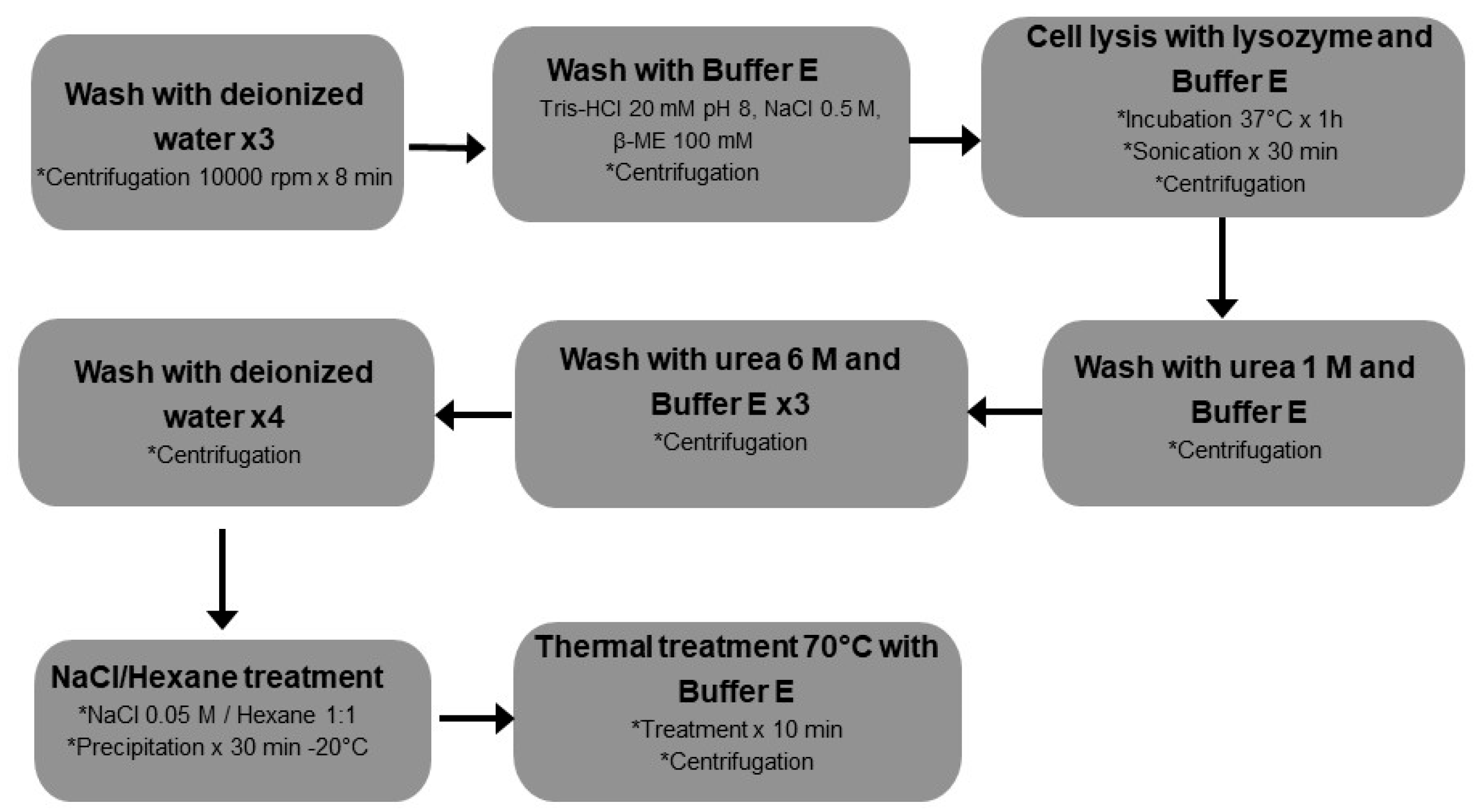
Finally, the final purification protocol shown in
Figure 3 was determined from the electrophoretic analyses performed.
Samples from each treatment of the AMR0 purification methodology were analyzed using SDS-PAGE gels (
Figure 1B) according to this protocol. The gels were constructed using a Mini-PROTEAN Tetra Cell, Bio-Rad, CA, USA
Using the same protocol, samples from each step of the AMR5 purification methodology were analyzed with an SDS-PAGE gel (
Figure 1C).
Figure 1D shows the final electrophoretic analysis contrasting the purity of AMR0 and AMR5 samples after cell lysis and after the release of inclusion bodies and purified precipitates.
The purity obtained through purification was 95.8 ± 1.1% for AMR0 and 91.9 ± 1.2% for AMR5. The yields of the purification procedures were calculated from the densitometry results to be 0.83 g ± 0.05 and 1.24 ± 0.06 g of AMR0 and AMR5 per liter of fermented medium, respectively, showing a significant difference. These yields are 20 and 30 times higher than those reported by [
16] for amaranth 11S proglobulin purification using ammonium sulfate precipitation and size exclusion chromatography (0.06–0.08 g/L) and for the purification of the modified amarantin acidic subunit in the variable region III using electroelution (40 mg/L), respectively [
10].
Methods involving the use of washes with denaturing agents and gentle, low-concentration washes have been shown to be more effective and cost-efficient for the purification of proteins expressed in inclusion bodies than more specific methods, such as chromatography, which is more convenient when deciding to scale up these types of processes. Lychko et al. (2023) [
8] compared the final purity, productivity, costs and sustainability of two methods for purifying reflectins expressed in inclusion bodies. They found that the non-chromatographic method involving detergents and chaotropic salts, was superior to purification by reversed-phase chromatography and IMAC in all the aforementioned aspects. Reddy Patakottu et al. (2023) [
17] took advantage of Ulp1 inclusion body expression to develop a rapid and efficient purification method using urea and DTT at low concentrations. This method does not require subsequent refolding steps. Conversely, Singhvi et al. (2021) [
7] used a combination of organic solvents and urea at an alkaline pH to efficiently purify inclusion bodies of human growth hormone expressed heterologously in
E.coli. They obtained an overall yield of up to 50%. This study demonstrated that combining chaotropic agents such as urea, which facilitate the unfolding to remove contaminating proteins bound to the polypeptide chain of interest, with reducing agents at low concentrations to protect disulfide bonds, especially in proteins with high cysteine content such as amarantin, is an efficient alternative for purifying insoluble proteins.
Finally, pure recombinant proteins were obtained in an insoluble form. This characteristic does not affect their biological activity, since they are storage proteins that will be hydrolyzed to release the bioactive peptides contained within their structure. An ACE inhibitory activity test was performed on these proteins, yielding an IC50 of 0.456 ± 0.001 mg/mL (8.52 μM) for AMR0 and 0.034 ± 0.002 mg/mL (0.61 μM) for AMR5. This result corroborates the activity of the peptides added to the AMR5 protein. The AMR5 value agrees with that reported in [
9]. The value obtained for the positive control, captopril was 23 nM. The value obtained for AMR0 is comparable to those reported for peptides extracted and identified from
Cicada chrysalis protein enzymatic hydrolysates [
18]. The angiotensin-converting enzyme (ACE) inhibitory value obtained for AMR5 is better than that reported for purified fractions of tilapia skin [
19], similar to the results reported for peptides isolated from yellow tuna [
20] and
Cicada chrysalis protein hydrolysates [
18]. As can be seen, purifying the proteins from the inclusion bodies, which resulted in their insoluble form did not affect their bioactivity.