


Abstract
Hydrogen doping using existing natural gas pipelines is a promising solution for hydrogen transportation. A large number of non-metallic seals are currently used in long-distance natural gas pipelines. Compared with metallic seals, non-metallic seals have the advantages of corrosion resistance, light weight, and easy processing, which can improve the safety and economy of pipelines. In order to ensure the long-term safe use of seals in hydrogen-doped natural gas pipelines, this paper selects the non-metallic seals commonly used in long-distance natural gas pipelines and carries out the hydrogen-doped sealing test, hydrogen-doped aging test, and hydrogen-doped anti-explosion test on the non-metallic seals under the conditions of different hydrogen-doped ratios. At the same time, combined with the actual working conditions of a hydrogen-doped natural gas pipeline, the external environment, and other factors, the applicability evaluation index system was established, and the applicability evaluation model based on hydrogen-doped physical and chemical properties, fuzzy comprehensive evaluation, and the structural entropy weight method was developed and applied in the field. The results show that the evaluation result of nitrile rubber in soft seals is 1.7845, and the evaluation result of graphite-polytetrafluoroethylene material in hard seals is 1.5988, and both of them are at a good level. This paper provides technical support and judging strategies for the selection of non-metallic sealing materials for hydrogen-doped natural gas pipelines.
1. Introduction
Hydrogen energy can be divided into “gray hydrogen”, “blue hydrogen”, and “green hydrogen” according to the production source [1,2]. Hydrogen energy has the advantages of non-pollution, sustainability, zero emissions, high efficiency, etc., and has gradually become one of the important directions of new energy development [3]. At present, the United States, the European Union, Japan, South Korea, and other countries have long-term plans in the field of hydrogen energy [4]. In the future, hydrogen energy will occupy at least 15% of China’s terminal energy system, so it will become the main body of China’s terminal energy system [5].
Compared with long trailer transportation, a hydrogen pipeline has the advantages of high transportation volume, long transportation distance, high transportation efficiency, and long service life [6,7]. Pipeline transportation has been regarded as the main mode of hydrogen transportation in the future. However, the initial investment of a pure hydrogen pipeline is large, and the construction cost is about $800,000 per kilometer, so our country has taken a different approach on the basis of pure hydrogen pipeline hydrogen transportation and gradually carried out natural gas hydrogen-doped pipeline transportation with different hydrogen-doped ratios [8,9]. Hydrogen-doped natural gas pipeline transportation can realize the low-cost, high-efficiency transportation of hydrogen, so it has become the mainstream direction of the domestic transportation of hydrogen [10]. During long-term transportation of hydrogen-doped natural gas pipelines, hydrogen will inevitably enter into the pipeline, elbow, weld, tee, valve, seals, and other materials, which will cause certain damage to the materials [11,12,13].
The research and construction of hydrogen transport pipelines in Europe and the United States started earlier, and after years of research and engineering experience accumulation, they have formed relatively complete systems. The standard ASME B31.12 “Hydrogen Pipelines and Pipelines” prepared by the American Society of Engineers and CGA G-5.6-2005 (R2013) “Hydrogen Pipeline System” prepared by the European Compressed Gas Association are applicable to the design, construction, operation, and maintenance of hydrogen pipeline [14,15,16,17,18].
The research and construction of a long-distance hydrogen pipeline in China started late, and there is a big gap between China and developed countries. In recent years, China has successively built a number of hydrogen transport pipelines and has carried out a number of related tests but has not yet formulated and published national standards and specifications for hydrogen long-distance transport pipelines. Its related standards are GB/T 34542 “Hydrogen storage and Transportation system”, GB/T 9711 “Steel pipe for oil and Gas industry pipeline transportation system”, T/CSPSTC 103-2022 “Hydrogen pipeline engineering design Code”, and so on [19,20,21,22]. GB/T 34542.2-2018 provides a hydrogen embrittlement sensitivity evaluation method for hydrogen pipelines and containers. By conducting relevant tests on small samples in a hydrogen environment, changes in their mechanical properties can be evaluated [23,24,25]. In summary, the above are the relevant standards for the performance inspection of hydrogen pipeline bodies.
At present, the risk evaluation of non-metallic seals for hydrogen-doped natural gas pipelines in transportation is still in the beginning stage, basically in the blank [26,27,28]. For this reason, there is an urgent need to comprehensively analyze the performance parameters of hydrogen-doped seals, hydrogen-doped anti-explosion, and hydrogen-doped aging. At the same time, combined with the actual operating conditions of hydrogen-doped natural gas pipelines and their surrounding external environment, an applicability evaluation method based on the risk evaluation index system of non-metallic seals is established to provide a basis for the selection of sealing strategies for hydrogen-doped natural gas pipelines.
2. Procedures
The structure of the methodology in this paper includes the analysis of the hydrogen-doped sealing performance of non-metallic seals, the analysis of hydrogen-doped anti-explosion performance, the analysis of hydrogen-doped aging performance, the construction of a risk indicator system based on hydrogen-doped sealing performance, the calculation of indicator weights, fuzzy comprehensive evaluation, and a case application, The specific evaluation processes is shown in Figure 1.
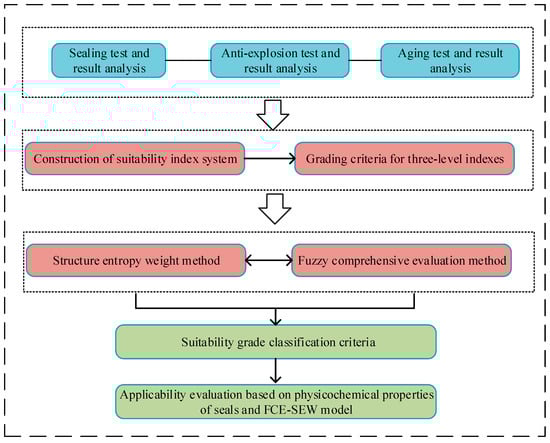
Figure 1.
Non-metal seal suitability evaluation process.
2.1. Experimental Study on the Performance of Non-Metallic Seals Under Hydrogen-Doping Conditions
As shown in Figure 2, the valve seals of a long-distance natural gas station were investigated on-site, and after communicating with field personnel and collecting material accounts, it can be seen that the types of non-metallic seals of the long-distance pipeline mainly include fluorine rubber, nitrile rubber, nylon, graphite-polytetrafluoroethylene, and other materials. Combined with the field application situation and application prospect of each material, fluorine rubber, nitrile rubber, nylon, graphite-polytetrafluoroethylene, and para-polystyrene-polytetrafluoroethylene, five types of materials were selected [29,30,31,32,33]. In order to analyze the sealing performance, aging performance, and anti-explosion performance of different non-metallic seals under hydrogen-doped conditions, hydrogen-doped sealing tests, hydrogen-doped aging tests, and hydrogen-doped anti-explosion tests were carried out, respectively, under the conditions of no hydrogen and 5% hydrogen-doped conditions.
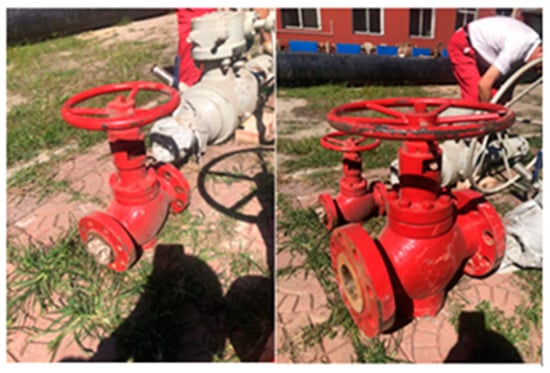
Figure 2.
Site survey of valve materials in the station.
2.1.1. Hydrogen-Doped Sealing Test and Result Analysis
According to the method of GB/T 12385-2008 A, hydrogen-doped sealing tests were carried out on non-metallic seals of different materials, and the results are shown in Table 1. The inner diameter of the sample is 80 mm, the outer diameter is 135 mm, and the thickness is 3 mm. According to ISO 16111, if the leakage rate of 120 mL hydrogen is lower than 6 mL/h, the hydrogen storage device meets the leakage requirements [34,35]. It can be seen that the hydrogen-doping sealing performance of each non-metallic seal meets the requirements of the leakage rate, and the influence of a 5% hydrogen-doping environment on the leakage rate of the seals is not obvious.

Table 1.
Comparison of sealing test results of different sealing materials.
2.1.2. Hydrogen-Doped Anti-Explosion Test and Result Analysis
According to the GB/T 34903.2-2017 standard, non-metallic seals of different materials are used to carry out hydrogen-doped anti-explosion tests. The different hydrogen-doped conditions of the anti-explosion test results are shown in Table 2. The shape of the sample is an O-ring, the section diameter is 5.33 mm, and the inner diameter is 37.47 mm. According to the number and length of cracks found after the test to determine the grade, the anti-explosion results include five grades, respectively, 0, 1, 2, 3, and 4. Level 0 represents the best performance, and level 4 represents the worst performance. The results show that the anti-explosion performance test results of all tested materials are consistent under different hydrogen-doped conditions [36,37,38]. The impact of a 5% hydrogen-doping environment on the sealing material is not obvious.
Table 2.
Comparison of anti-explosion test results of different sealing materials.
According to the anti-explosion grade, fluorine rubber has the worst anti-explosion performance, and the other materials have the same anti-explosion performance grade. Due to the hydrogen-free conditions of fluororubber, seals in service for a long time have not seen anomalies, and the actual field pressure relief rate is much lower than 120 MPa/h, so these comprehensive rating results can only be used as relatively good or bad anti-explosion performance evaluation results. Therefore, it is recommended to use nitrile rubber as a soft seal.
2.1.3. Hydrogen-Doped Aging Test and Result Analysis
According to the GB/T 34903.2-2017 standard requirements for different materials, non-metallic seals were subjected to a hydrogen-doped aging test, and the test results are shown in Figure 3 and Figure 4 [39,40,41]. The sample shape is a dumbbell spline, the thickness is 2 mm, the standard distance is 25 mm, and the length is 75 mm. According to the standard requirements, rubber performance requirements for tensile properties include a change rate of ±50% [modulus of elasticity (50% or 100% elongation), tensile strength, elongation at break] and hardness of +10/−20 units (initial nominal hardness of 90 +5/−20 units) for Shore A and IRHD. The plastic performance requirements for tensile properties include a change rate of ±50% [modulus of elasticity (50% or 100% elongation), tensile strength, and elongation at break]. The results of hydrogen-doped aging tests for the five types of materials are shown in Figure 2 and Figure 3, respectively. Among the soft seals, the maximum change rate of the fluorine rubber index is 48.8%, the maximum change rate of the nitrile rubber index is 46.9%, and the maximum change rate of the two is similar; among the hard seals, the maximum change rate of nylon is 38%, the maximum change rate of graphite-PTFE is 21.4%, the maximum change rate of para-polyphenyl-polytetrafluoroethylene is 27.3%, and it can be seen that the maximum change rate of graphite-PTFE is the minimum.
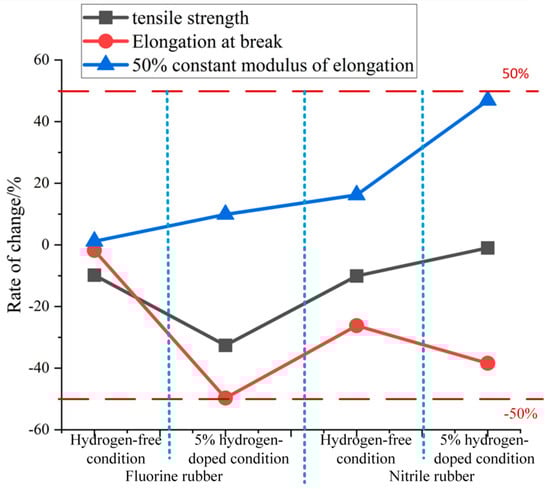
Figure 3.
Comparison of aging test results for rubber materials.
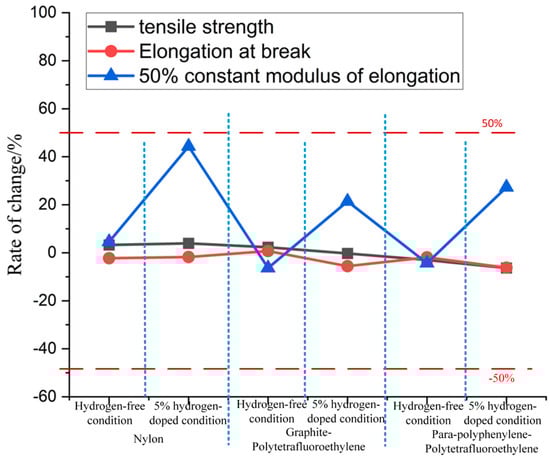
Figure 4.
Comparison of aging test results of plastic materials.
2.2. Comprehensive Evaluation of the Applicability of Non-Metallic Seals Based on Hydrogen-Doped Physical and Chemical Properties and SEW-FCE
The applicability evaluation method developed in this paper is mainly divided into three steps. First, in order to deeply analyze the applicability of hydrogen-doped non-metallic seals, the physicochemical properties of seals under hydrogen-doped conditions are crucial. Therefore, the applicability index system based on the physicochemical properties of hydrogen-doped non-metallic seals is established in this paper. Secondly, index weights are inevitably involved in the process of applicability evaluation. The structural entropy weight method is a method that is not affected by subjective judgment or expert experience and can determine the weights objectively, thus establishing an indicator system with weights, which is convenient for applicability evaluation. Finally, a fuzzy comprehensive evaluation method is used to make a scientific, reasonable, and practical quantitative evaluation of fuzzy data.
2.2.1. Construction of Suitability Index System Based on Physicochemical Properties of Hydrogen Blending
By identifying the hazardous and harmful factors of seals for hydrogen-doped natural gas pipelines, the applicability assessment index is determined. The occurrence of seal failure events is mainly due to the unsafe state of seals and unsafe human behavior. In order to prevent failure, the practical application effect of a seal in the field for many years was investigated and analyzed, and the influence of temperature, pressure, gas composition, and other parameters of the non-metallic seal in the hydrogen-doped environment was comprehensively considered.
This paper constructs an applicability assessment index system for non-metallic seals under hydrogen-doped conditions from three aspects: sealing reasons, environmental reasons, and human reasons. The evaluation index system includes 3 second-level evaluation indexes and 10 third-level evaluation indexes. The second-level indexes include the sealing performance of non-metallic seals P1, operation parameters P2, and management level P3, and the content of the specific index system is shown in Figure 5.
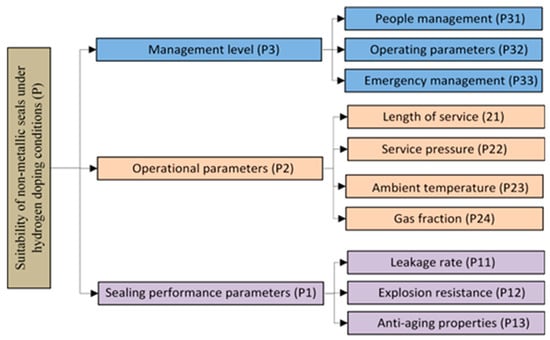
Figure 5.
Indicator system for evaluating the suitability of non-metallic seals under hydrogen-doping conditions.
As can be seen from Figure 4, the evaluation indicators for the safe operation of seals include leakage rate, seal anti-explosion performance, seal aging performance, ambient temperature, service pressure, and other parameters. The evaluation indicator system constructed can be used for both hazard identification and quantitative evaluation. For this reason, the corresponding grading criteria are established for each indicator factor, and the scoring guidelines for the three-level indicators are shown in Table 3.
Table 3.
Grading criteria for three-level indexes.
2.2.2. Structure Entropy Weight Method
The structure entropy weight method (SEW) was first proposed by Cheng Qiyue in 2010 [42,43,44]. It can be sorted according to the importance of each index, and the potential uncertainty can be quantitatively analyzed using entropy law. The statistical analysis of deviation data can be realized through entropy and blindness analysis. The weights of each index are obtained. The specific calculation procedure is as follows:
- Step 1: Gather expert opinions and form a typical ranking.
Experts who are familiar with the evaluation objects are selected to form an expert group to rank the importance of each indicator in the index system. Members of the evaluation team form a typical ranking of opinions based on years of experience or relevant professional knowledge according to the Delphi method.
- Step 2: Uncertainty analysis of typical ordering.
Suppose M evaluators are invited to conduct a questionnaire survey and obtain m responses. Each questionnaire corresponds to a set of events, which can be expressed as ; the corresponding typical order is . Then, the typical ranking of group m questionnaires can be represented by the A matrix as A (, ). The elements in matrix A represent the sequence number obtained from the analysis of the jth index by the ith expert.
Transform the qualitative value of typical sorting into quantitative values, and then the information entropy calculation formula of serial number x is as follows:
where , , , and is the information entropy transformation parameter.
The significance intensity of an event is calculated as follows:
The relative importance coefficient of events in order x can be expressed as:
According to computational reasoning, the ranking results are quantified, which can reflect the degree of the evaluator’s cognition of each event.
According to the entropy weight method, the membership function of event ranking is as follows:
where x is the number of qualitative rankings of events given by all evaluators. As shown in Table 4, if event A1 is the first choice, then x is equal to 1, and so on. is the value of the affiliation function corresponding to x.
Table 4.
Results of the weighting of secondary indicators.
The denotes the affiliation of the sorted number x, and denotes the affiliation matrix.
Assume that the m evaluators are equally vocal. The agreement of the m evaluators on the event is referred to as the average recognition. The calculation process is as follows:
Uncertainty arising from evaluator knowledge is referred to as blindness. It is calculated as follows:
- Step 3: Normalization process.
Define that all invited evaluators have an overall understanding of each event.
Then the overall assessment vector for all events by m evaluators is:
To obtain the weights of the events, normalize as follows:
where , and is the weighted vector of the set , the overall judgment of the m evaluators on the importance of the events. It satisfies the wishes and perceptions of all m evaluators.
2.2.3. Fuzzy Comprehensive Evaluation Method
The fuzzy comprehensive evaluation method (FCE) is a method built on fuzzy sets, which can deal with fuzzy evaluation objects by precise numerical means and can deeply dig into the information presenting fuzziness and make a quantitative evaluation of it to fit reality [45,46,47]. The specific realization is to establish a mapping relationship between the indicator set U and the evaluation language set Y. The method first needs to establish the set relationship between U and Y, then establish the n fuzzy evaluation matrix R from U to Y, and finally calculate the comprehensive evaluation value of the target.
The calculation steps are as follows:
- Step 1: Establish the set of assessment indicators
- Step 2: Establish a collection of assessment indicator weights:
- Step 3: Establish the collection of rubrics:
Set the evaluation rating matrix as:
- Step 4: The establishment of the affiliation matrix: the experts scored each indicator separately, thus forming a set of comments within the five risk intervals for a particular indicator, and the aggregation of the scoring results for all indicators is called the affiliation matrix, as follows:
- Step 5: Establish the assessment matrix: according to the combination of the set of weights obtained by the weight calculation method and the affiliation matrix, the assessment matrix can be obtained as:
- Step 6: Determine the risk level.
The result of the risk rating is:
In the formula, the risk level in which the subject of the assessment is located is derived by mapping E to the risk level classification criteria.
3. Application of the Proposed Methodology in a Long-Distance Natural Gas Pipeline
The material of a natural gas long-distance pipeline is X60 pipe steel, the diameter of the pipeline is 660 mm, the design working pressure is 6.4 MPa, the main component of the medium is methane, and it has been in safe operation for many years. In order to realize the goal of carbon peaking and carbon neutrality as soon as possible, the natural gas pipeline company plans to gradually carry out the pipeline hydrogen-doping work in the process of promoting energy transition. In order to ensure the safety of hydrogen-doped energy transportation, there is an urgent need for seal selection and evaluation technology under hydrogen-doped conditions. It can be used to evaluate the applicability of the sealing performance of valves and other components in the commonly used natural gas pipeline transportation process. To this end, five materials, namely, fluoroelastomer, nitrile rubber, nylon, graphite-polytetrafluoroethylene (PTFE), and butyl terephthalate-polytetrafluoroethylene (BTE-PTFE), were chosen in this paper to evaluate the operational safety of seals for long-distance natural gas pipelines under 5% hydrogen-doping conditions.
3.1. Calculation of Indicator Weights
Three groups of experts in non-metallic seal sealing performance, operation management, personnel management, and other roles were selected to rank the importance of secondary indicators and tertiary indicators. According to the results of the importance ranking, the structural entropy weighting method was used to determine the weights of indicators at all levels. The specific calculation parameters of the weights of the secondary indicators include the average recognition, blindness, overall awareness, and normalized weights, and the results of the specific parameter calculations are shown in Table 4.
The solution process is the same as that in Table 4. The third-level indicators subordinate to each second-level indicator are, respectively, calculated according to the process of the structure entropy weight method, and the calculation results are shown in Table 5.
Table 5.
Three-level index weight.
3.2. Applicability Evaluation Based on Physicochemical Properties of Seals and FCE-SEW Model
3.2.1. Establish a Set of Evaluation Indicators
According to the evaluation index system, the second-level evaluation index set is established. Secondly, the third-level evaluation index set is , respectively, where i is the number of the second-level indicator and n is the number of the third-level indicator to which each second-level indicator belongs.
3.2.2. Establish the Weight Set of Evaluation Indicators
According to the calculation results of the structure entropy weight method, the weight set of the secondary index is
The weight set of the three-level indicators is
3.2.3. Building a Collection of Rubrics
Combined with the actual situation in the field of hydrogen-doped natural gas pipelines, the rubric of the sealing index of hydrogen-doped pipelines is categorized into four grades, namely:
The evaluation grade matrix is:
The suitability grade classification criteria are shown in Table 6.
Table 6.
Suitability grade classification criteria.
3.2.4. Establish Membership Matrix
Taking fluororubbers as an example, the physical and chemical performance test results of the hydrogen-doped sealing tests, hydrogen-doped anti-explosion tests, and hydrogen-doped aging tests are provided, and 10 experts in different fields were invited to score the three levels of indicators, as shown in Table 7 below.
Table 7.
Third-level indicator comment form.
Based on the assessment scoring results, the affiliation matrix of each secondary indicator was established using Formula (2) as follows:
3.2.5. Calculation of the Assessment Matrix
According to the affiliation matrix and the set of weights of each secondary indicator, the evaluation matrix of each secondary indicator Pi is established using Equation (3):
3.2.6. Determination of the Level of the Indicator
Based on the set of rubrics, the risk level of each secondary indicator is:
The result of the ranking of the level 1 indicator is
A comparison of the applicability class intervals in Table 6 shows that the results of the operational safety evaluation of fluoroelastomers under 5% hydrogen-doping conditions are of medium level. Similar to the above calculation process, the suitability evaluation of NBR, nylon, graphite-PTFE, and para-polyphenylene-PTFE were carried out, respectively, and the final results of the operational risk level evaluation of the seals are shown in Table 8 below.
Table 8.
Results of the evaluation of the suitability class of seals made of different materials.
Based on the hydrogen blending performance test of non-metallic seals and the SEW-FCE fuzzy evaluation model, it can be seen that nitrile butadiene rubber is superior to fluorine rubber in soft seals and is of good grade. In the hard seals, nylon, graphite-polytetrafluoroethylene, and para-polystyrene polytetrafluoroethylene, three types of plastics, are of good grade. Compared with the risk assessment results, it can be seen that 1.5988 < 1.7141 < 1.7845; that is, the ranking of the plastics is graphite-polytetrafluoroethylene > para-polystyrene polytetrafluoroethylene > nylon.
4. Conclusions
There are many safety risk indicators for non-metallic seals in long-distance hydrogen-doped natural gas pipelines. This paper establishes a risk assessment index system for hydrogen-doped seals through the three aspects of sealing performance, operation parameters, and the management level of non-metallic seals, innovatively proposes a fuzzy applicability assessment model for non-metallic seals based on hydrogen-doped physicochemical properties and an SEW-FCE model, and carries out non-metallic seal tests and an applicability assessment of non-metallic seals for the five types of materials that have been selected in the field. Hydrogen-doped seals were tested and evaluated for five types of materials preferred in the field.
The results show that nitrile butadiene rubber has the best performance in soft sealing, and its performance is of a good grade. It can be seen that its good performance grade is mainly due to its good hydrogen-doped anti-explosion grade and anti-aging performance. In the hard seals, the performance of the graphite-polytetrafluoroethylene is the best, and its good performance grade is due to its best anti-aging performance.
In this paper, an index evaluation system and applicability assessment model of hydrogen-doped non-metallic seals was constructed for the first time, which can provide a judgment strategy for the selection of non-metallic seals for hydrogen-doped pipelines and the assessment of operational risks during operation. With the large number of applications of hydrogen-doped natural gas pipelines, the applicability evaluation method of hydrogen-doped nonmetallic seals proposed in this paper can provide support for the selection of seals and operational safety.
In fact, the effect of hydrogen on the performance of non-metals mainly includes hydrogen damage and hydrogen leakage, because hydrogen molecules are very small and it is possible for them to leak through non-metals. In future studies, the permeation and diffusion mechanism of hydrogen in non-metallic materials can be revealed by membrane permeation experiments and full-size permeation experiments, and then the action mechanism of hydrogen on non-metallic seals can be further studied. In addition, the performance index of short-term aging tests has certain limitations, and its applicability can be further analyzed by analyzing the performance of seals after long-term aging tests in the future.
Author Contributions
Conceptualization, X.L.; methodology, X.L.; validation, F.F.; formal analysis, W.M.; investigation, J.Y.; writing—original draft preparation, X.L.; writing—review and editing, K.W. and J.R.; funding acquisition, X.L. All authors have read and agreed to the published version of the manuscript.
Funding
This research was supported by the Technical Study on Defect Detection and Safety Evaluation of Vehicle-mounted Type III Hydrogen Storage Cylinders (Grant No. 2022DQ03-10), the key technology research on hydrogen blending and delivery of in-service natural gas pipelines (Grant No. DTXNY202203), and CNPC Science and Technology Project “Research and Development of Corrosion Resistant Materials for Extreme Environments” (Grant No. 2023ZZ11-02).
Data Availability Statement
The data presented in this research are available on request from the corresponding author.
Conflicts of Interest
Authors: Xiaobin Liang, Weifeng Ma, Ke Wang, and Junjie Ren are employed by the CNPC Tubular Goods Research Institute; author Fan Fei is employed by the China National Pipeline Network Group Beijing Pipeline Co., Ltd.; the authors declare that the research was conducted in the absence of any commercial or financial relationships that could be construed as a potential conflict of interest. All authors have read and agreed to the published version of the manuscript.
References
- Hassanpouryouzband, A.; Wilkinson, M.; Haszeldine, R.S. Hydrogen energy futures–foraging or farming? Chem. Soc. Rev. 2024, 53, 2258–2263. [Google Scholar] [CrossRef] [PubMed]
- Zhang, Q.; Masoudi, M.; Sun, L.; Zhang, L.; Yang, L.; Song, Y. Hydrogen and Cushion Gas Adsorption–Desorption Dynamics on Clay Minerals. ACS Appl. Mater. Interfaces 2024, 16, 53994–54006. [Google Scholar] [CrossRef] [PubMed]
- Edwards, P.P.; Kuznetsov, V.L.; David, W.I.F. Hydrogen energy. Philos. Trans. R. Soc. A Math. Phys. Eng. Sci. 2007, 365, 1043–1056. [Google Scholar] [CrossRef]
- Rosen, M.A.; Koohi-Fayegh, S. The prospects for hydrogen as an energy carrier: An overview of hydrogen energy and hydrogen energy systems. Energy Ecol. Environ. 2016, 1, 10–29. [Google Scholar] [CrossRef]
- Huang, W.; Dai, J. Towards a sustainable energy future: Factors affecting solar-hydrogen energy production in China. Sustain. Energy Technol. Assess. 2022, 52, 102059. [Google Scholar] [CrossRef]
- Khan, M.A.; Young, C.; Layzell, D.B. The techno-economics of hydrogen pipelines. Transit. Accel. Tech. Briefs 2021, 1, 1–40. [Google Scholar]
- Dehdari, L.; Burgers, I. Purification of hydrogen from natural gas/hydrogen pipeline mixtures. Sep. Purif. Technol. 2022, 282, 120094. [Google Scholar] [CrossRef]
- Parker, N. Using Natural Gas Transmission Pipeline Costs to Estimate Hydrogen Pipeline Costs. Master’s Thesis, University of California, Davis, CA, USA, 2004. [Google Scholar]
- Mahajan, D.; Tan, K.; Venkatesh, T.; Kileti, P.; Clayton, C.R. Hydrogen blending in gas pipeline networks—A review. Energies 2022, 15, 3582. [Google Scholar] [CrossRef]
- Erdener, B.C.; Sergi, B.; Guerra, O.J.; Chueca, A.L.; Pambour, K.; Brancucci, C.; Hodge, B.M. A review of technical and regulatory limits for hydrogen blending in natural gas pipelines. Int. J. Hydrog. Energy 2023, 48, 5595–5617. [Google Scholar] [CrossRef]
- Chae, M.J.; Kim, J.H.; Moon, M.; Park, S.; Lee, Y.S. The present condition and outlook for hydrogen-natural gas blending technology. Korean J. Chem. Eng. 2022, 39, 251–262. [Google Scholar] [CrossRef]
- Isaac, T. HyDeploy: The UK’s first hydrogen blending deployment project. Clean Energy 2019, 3, 114–125. [Google Scholar] [CrossRef]
- Cristello, J.B.; Yang, J.M.; Hugo, R.; Lee, Y.; Park, S.S. Feasibility analysis of blending hydrogen into natural gas networks. Int. J. Hydrog. Energy 2023, 48, 17605–17629. [Google Scholar] [CrossRef]
- Tazedakis, A.S.; Voudouris, N.; Dourdounis, E.; Mannucci, G.; Di Vito, L.F.; Fonzo, A. Qualification of high-strength linepipes for hydrogen transportation based on ASME B31. 12 code. Pipeline Technol. J. 2021, 42–50. [Google Scholar]
- Shargay, C.; Livingston, H.L.; Moukabaa, H.; Duggan, K. Comparison of ASME B31. 12 Versus B31. 3 for Hydrogen-Containing Piping in Refinery Services. In Proceedings of the Pressure Vessels and Piping Conference, Baltimore, MA, USA, 17–21 July 2011; Volume 44564, pp. 819–833. [Google Scholar]
- Ishikawa, N.; Sakimoto, T.; Shimamura, J.; Wang, J.; Wang, Y.Y. Integrity assessment of linepipes for transporting high pressure hydrogen based on ASME B31. 12. In Proceedings of the International Pipeline Conference, Calgary, AB, Canada, 26–30 September 2022; American Society of Mechanical Engineers: New York, NY, USA, 2022; Volume 86564, p. V001T08A012. [Google Scholar]
- Moretto, P.; Quong, S. Legal requirements, technical regulations, codes, and standards for hydrogen safety. In Hydrogen Safety for Energy Applications; Butterworth-Heinemann: Oxford, UK, 2022; pp. 345–396. [Google Scholar]
- Yang, Y.; Xu, H.; Lu, Q.; Bao, W.; Lin, L.; Ai, B.; Zhang, B. Development of standards for hydrogen storage and transportation. In E3S Web of Conferences, Proceedings of the 2020 5th International Conference on Advances in Energy and Environment Research (ICAEER 2020), Shanghai, China, 18–20 September 2020; EDP Sciences: Hulis, France, 2020; Volume 194, p. 02018. [Google Scholar]
- Xiaolu, C.; Yanmei, Y.; Wei, B.; Bing, L.; Xiao, T.; Junfu, L.; Ling, L. Research on standards and standard system of hydrogen pipeline in China. In E3S Web of Conferences, Proceedings of the 4th International Conference on Environment Resources and Energy Engineering (ICEREE 2024), Kunming, China, 21–23 February 2024; EDP Sciences: Hulis, France, 2024; Volume 520, p. 04016. [Google Scholar]
- Peng, S.; Zhang, Y.H.; Wang, B.; Chai, C.; Jia, S.; Liu, Q.; Mi, Z. Influence of hydrogen volume/specimen surface area ratio on hydrogen embrittlement sensitivity of X52 pipeline steel. Int. J. Press. Vessel. Pip. 2024, 209, 105217. [Google Scholar] [CrossRef]
- Ding, H.; Qi, D.T.; Qi, G.Q.; Wei, B.; Ding, N.; Li, H.B.; Sun, Y.J. Cracking analysis of a newly built gas transmission steel pipe. Eng. Fail. Anal. 2020, 118, 104868. [Google Scholar] [CrossRef]
- Tong, K.; Fan, Z.H.; Qu, T.T.; Bai, X.L. Test analysis of corrosion perforation in a crude oil gathering pipeline. In Materials Science Forum; Trans Tech Publications Ltd.: Bäch, Switzerland, 2020; Volume 993, pp. 1209–1217. [Google Scholar]
- Yang, Y.; Wang, G.; Zhang, S.; Zhang, L.; Lin, L. Review of hydrogen standards for China. In E3S Web of Conferences, Proceedings of the 2019 4th International Conference on Advances in Energy and Environment Research (ICAEER 2019), Shanghai, China, 16–18 August 2019; EDP Sciences: Hulis, France, 2019; Volume 118, p. 03032. [Google Scholar]
- Wang, D.; Liao, B.; Zheng, J.; Huang, G.; Hua, Z.; Gu, C.; Xu, P. Development of regulations, codes and standards on composite tanks for on-board gaseous hydrogen storage. Int. J. Hydrog. Energy 2019, 44, 22643–22653. [Google Scholar] [CrossRef]
- Zhai, J.M. Evaluation of Hydrogen Embrittlement Sensitivity of 4130X Material Based on the Disc Method. In Proceedings of the Pressure Vessels and Piping Conference, Calgary, AB, Canada, 26–30 September 2022; American Society of Mechanical Engineers: New York, NY, USA, 2022; Volume 86182, p. V04BT06A033. [Google Scholar]
- Tong, S.; Li, X.; Ding, H.; Shuai, J.; Mei, Y.; Chan, S.H. Large-scale transient simulation for consequence analysis of hydrogen-doped natural gas leakage and explosion accidents. Int. J. Hydrog. Energy 2024, 54, 864–877. [Google Scholar] [CrossRef]
- Zhu, J.; Pan, J.; Zhang, Y.; Li, Y.; Li, H.; Feng, H.; Chen, D.; Kou, Y.; Yang, R. Leakage and diffusion behavior of a buried pipeline of hydrogen-blended natural gas. Int. J. Hydrog. Energy 2023, 48, 11592–11610. [Google Scholar] [CrossRef]
- Niu, P.; Fu, G.; Wei, X.; Chen, X.; Zhang, B. Exploration of the application of hydrogen-doped natural gas in low-pressure gas transmission and distribution networks. In Advances in Energy Materials and Environment Engineering; CRC Press: Boca Raton, FL, USA, 2022; pp. 476–482. [Google Scholar]
- Wu, W.; Yu, B. The mechanical and thermal properties of KH590-basalt fibre-reinforced silicone rubber/fluorine rubber composites. J. Rubber Res. 2020, 23, 163–171. [Google Scholar] [CrossRef]
- Bhattacharjee, S.; Bhowmick, A.K.; Avasthi, B.N. Degradation of hydrogenated nitrile rubber. Polym. Degrad. Stab. 1991, 31, 71–87. [Google Scholar] [CrossRef]
- Shakiba, M.; Rezvani Ghomi, E.; Khosravi, F.; Jouybar, S.; Bigham, A.; Zare, M.; Abdouss, M.; Moaref, R.; Ramakrishna, S. Nylon—A material introduction and overview for biomedical applications. Polym. Adv. Technol. 2021, 32, 3368–3383. [Google Scholar] [CrossRef]
- He, H.; Jiang, B.; Yuan, J.; Liu, Y.; Bi, X.; Xin, S. Cost-effective electrogeneration of H2O2 utilizing HNO3 modified graphite/polytetrafluoroethylene cathode with exterior hydrophobic film. J. Colloid Interface Sci. 2019, 533, 471–480. [Google Scholar] [CrossRef]
- Hu, T.; He, P.; Yang, Z.; Wang, W.; Zhang, H.; Shao, L.; Lü, F. Emission of airborne microplastics from municipal solid waste transfer stations in downtown. Sci. Total Environ. 2022, 828, 154400. [Google Scholar] [CrossRef]
- Ban, J.; Zhu, L.; Shen, R.; Yang, W.; Hao, M.; Liu, G.; Wang, X. Research on hydrogen distribution characteristics in town hydrogen-doped methane pipeline. Sci. Rep. 2024, 14, 20347. [Google Scholar] [CrossRef]
- Hongqiang, C.; Junlei, L.I.; Chenglong, Z.; Yonghai, Z. Research progress in the study of flammability and explosion characteristics of hydrogen-doped combustible gases. Mech. Eng. 2023, 45, 345–361. [Google Scholar]
- Shelby, J.E.; Hall, M.M.; Snyder, M.J.; Wachtel, P.B. A Radically New Method for Hydrogen Storage in Hollow Glass Microspheres; Technical report; Alfred University: Alfred, NY, USA, 2009. [Google Scholar]
- Ouyang, X.; Peng, D.; Peng, S.; Cong, C.; Man, J.; Wu, X.; Liu, X. Evaluation of rapid gas decompression (RGD) resistance of sealing materials for hydrogen-doped pipeline valves. In Journal of Physics: Conference Series, Proceedings of the 2024 5th International Conference on Advanced Material and Clean Energy, Kuala Lumpur, Malaysia, 23–25 February 2024; IOP Publishing: Bristol, UK, 2024; Volume 2789, p. 012001. [Google Scholar]
- Yang, K.; Li, W.; Dai, X.; Guo, Y.; Pang, L. Effect of hydrogen ratio on leakage and explosion characteristics of hydrogen-blended natural gas in utility tunnels. Int. J. Hydrog. Energy 2024, 64, 132–147. [Google Scholar] [CrossRef]
- Stephens, J.R. Thermal aging effects in refractory metal alloys. In Proceedings of the Symposium on Space Nuclear Power Systems, Albuquerque, NM, USA, 13–15 January 1986. [Google Scholar]
- Nagrale, S.; Brown, A.D.; Bakis, C.E.; Hamilton, R.F. Augmentation of low frequency daming via hydrogen-doping in a hybrid shape memory alloy composite. J. Intell. Mater. Syst. Struct. 2022, 33, 1018–1027. [Google Scholar] [CrossRef]
- Cui, J.; Kong, Y.; Liu, C.; Cai, B.; Khan, F.; Li, Y. Failure probability analysis of hydrogen doped pipelines based on the Bayesian network. Eng. Fail. Anal. 2024, 156, 107806. [Google Scholar] [CrossRef]
- Liu, F.; Zhao, S.; Weng, M.; Liu, Y. Fire risk assessment for large-scale commercial buildings based on structure entropy weight method. Saf. Sci. 2017, 94, 26–40. [Google Scholar] [CrossRef]
- Zhao, X.; Guo, H.T.; Huang, C.L.; Zhong, J.S. Teaching evaluation system research based on structure entropy weight method. J. Discret. Math. Sci. Cryptogr. 2017, 20, 179–191. [Google Scholar] [CrossRef]
- Liang, X.; Liang, W.; Zhang, L.; Guo, X. Risk assessment for long-distance gas pipelines in coal mine gobs based on structure entropy weight method and multi-step backward cloud transformation algorithm based on sampling with replacement. J. Clean. Prod. 2019, 227, 218–228. [Google Scholar] [CrossRef]
- Zhu, L. Research and application of AHP-fuzzy comprehensive evaluation model. Evol. Intell. 2022, 15, 2403–2409. [Google Scholar] [CrossRef]
- Li, Y.; Sun, Z.; Han, L.; Mei, N. Fuzzy comprehensive evaluation method for energy management systems based on an internet of things. IEEE Access 2017, 5, 21312–21322. [Google Scholar] [CrossRef]
- Wu, X.; Hu, F. Analysis of ecological carrying capacity using a fuzzy comprehensive evaluation method. Ecol. Indic. 2020, 113, 106243. [Google Scholar] [CrossRef]
Disclaimer/Publisher’s Note: The statements, opinions and data contained in all publications are solely those of the individual author(s) and contributor(s) and not of MDPI and/or the editor(s). MDPI and/or the editor(s) disclaim responsibility for any injury to people or property resulting from any ideas, methods, instructions or products referred to in the content. |
© 2024 by the authors. Licensee MDPI, Basel, Switzerland. This article is an open access article distributed under the terms and conditions of the Creative Commons Attribution (CC BY) license (https://creativecommons.org/licenses/by/4.0/).