


Integration of Renewable Energy and Electric Vehicles in Power Systems: A Review

 ,
,  , and
, and
Abstract
1. Introduction
2. Related Work
3. Contribution
- To the best of the authors’ knowledge, this is the first comprehensive review of the amalgamation of renewable energy technology within power grids, coupled with electrification applications.
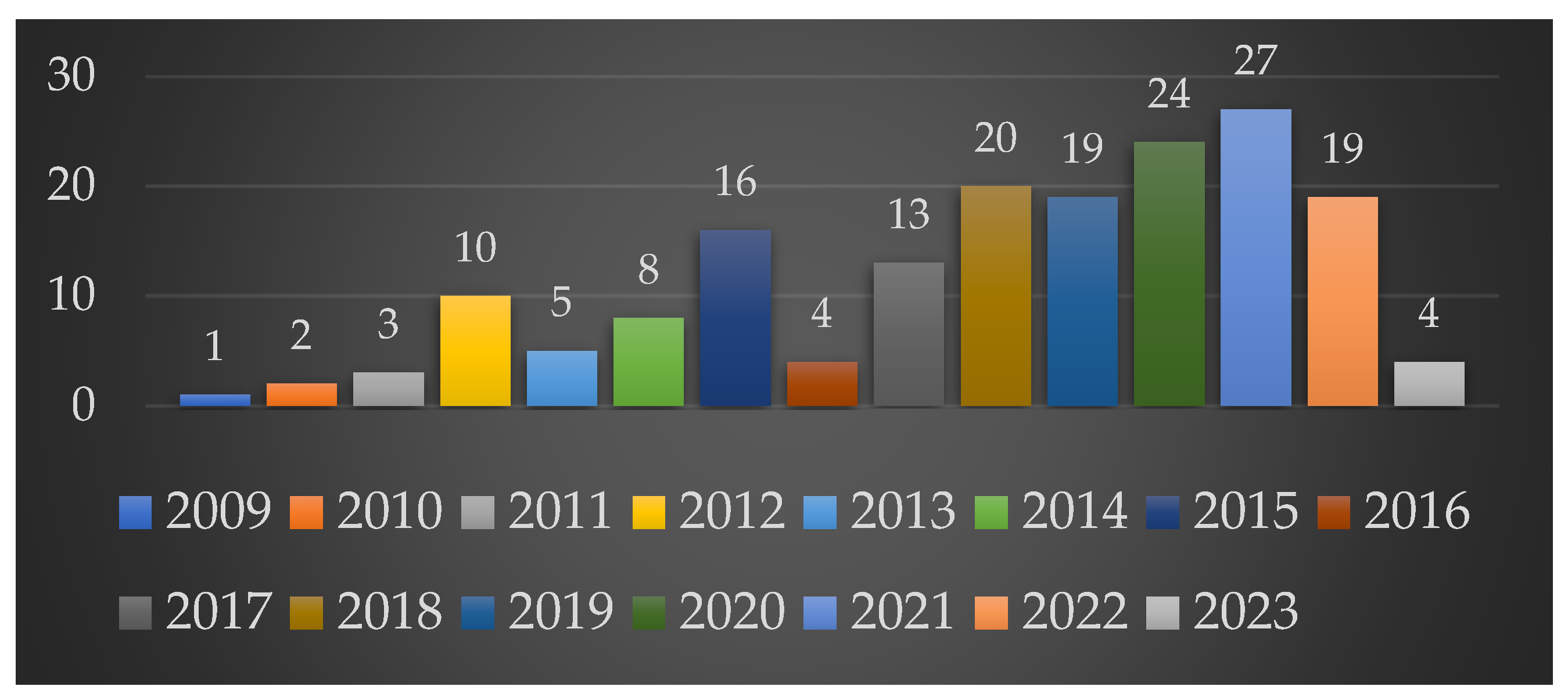
- The publications were arranged in chronological order to highlight the research focus of the last fifteen years. This enables researchers to ascertain whether additional inquiry is justified.
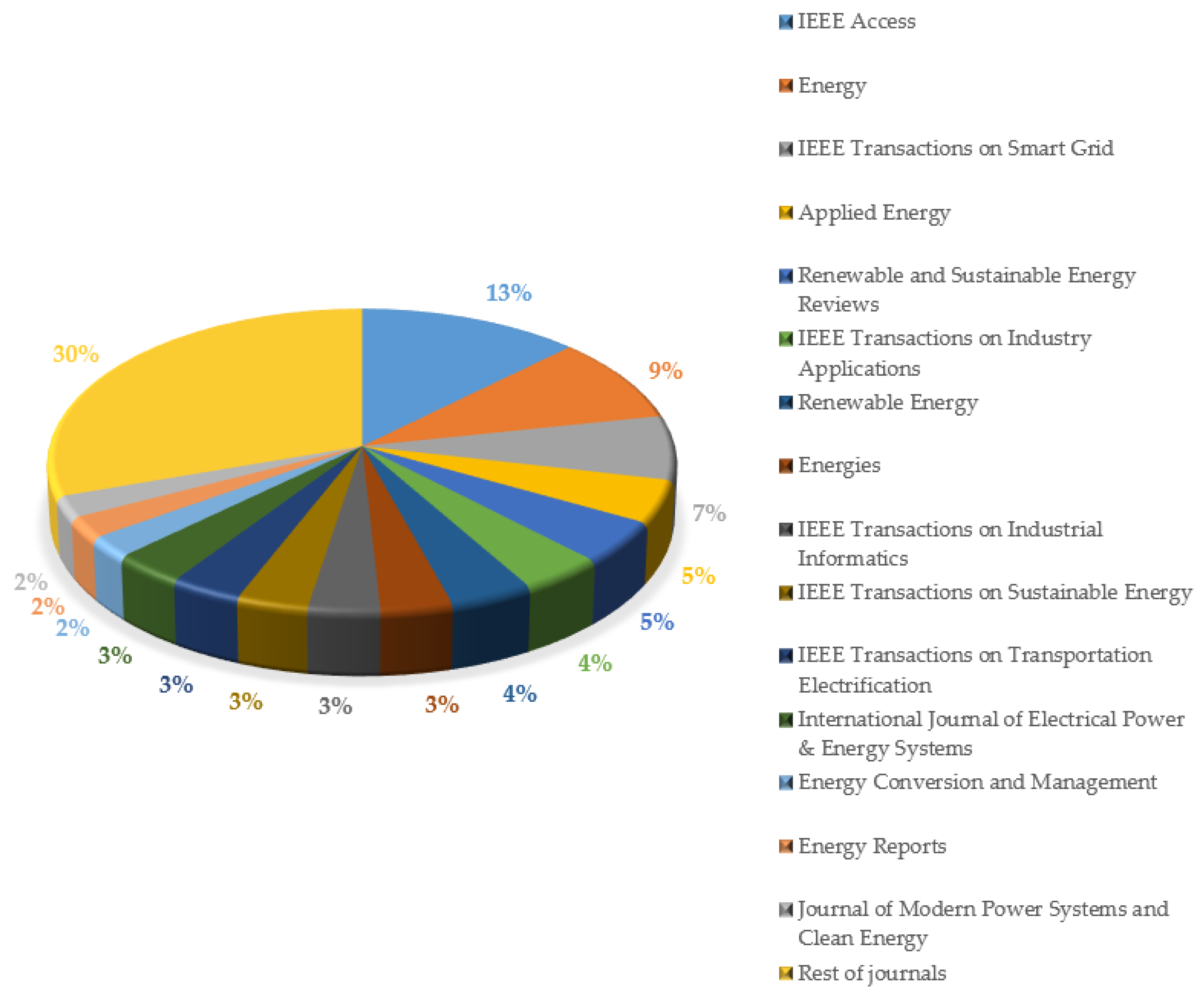
- The estimation of the impact of highly influential journals is determined by the aggregate number of publications attributed to each respective journal. This information enables researchers to determine the frequency of publication in a given journal, thereby aiding in the selection of an appropriate venue for disseminating their research findings.
- The analytical presentation of each work’s contribution in a table facilitates the researchers’ comprehension of the topic and enables them to acquire a general understanding of it efficiently.
- A taxonomy of integration objectives pertaining to renewable energy sources and electric vehicles is carried out.
- The analysis of relevant literature led to the extraction of conclusions pertaining to the algorithms utilized and their specific implementation details.
- The identification of gaps in the existing literature has led to the highlighting of potential areas for future research.
4. Renewable Energy Sources
4.1. Wind Energy
4.2. Solar Energy
5. Electric Vehicles
- 1832: Robert Anderson created the first primitive EV.
- 1901: Edison tackles the issue of EV batteries; Ferdinand Porsche created the first hybrid EV.
- 1968: Oil crises lead to a resurgent interest in EVs.
- 1971: NASA’s lunar rover was the first electric vehicle utilized for Moon exploration.
- 1974: Many companies started to design and produce EVs.
- 1990: New regulation for electromobility.
- 1997: Toyota Prius was the first mass-produced hybrid EV.
- 2010: Nissan Leaf was the first mass-produced full electric EV; Chevy Volt was the first mass-produced plug-in hybrid EV.
- 2013: Cost reduction for EV batteries.
- 2014: Massive production of EVs from different companies.
- 2022: Global sales of electric vehicles increased by about 60%, surpassing 10 million for the first time.
- Vehicles using a gasoline engine and an electric motor are called hybrid electric vehicles. While the car is moving slowly or at a complete stop, such as in traffic, the electric motor assists with propulsion.
- Similar to hybrid electric vehicles, but with the added convenience of being able to plug in and charge from an electrical outlet, plug-in hybrid electric vehicles offer the best of both worlds.
- Vehicles using electric motors and batteries as power sources are known as full electric vehicles.
6. Bibliographic Analysis
6.1. Chronological Distribution Analysis of Research Works
6.2. Citations and Impact of Works in Terms of Publications Per Journal
7. Contributions of the Published Works
8. RESs’ and EVs’ Integration Objectives
8.1. Type of EVs
8.2. Type of RES
8.3. Integration of RESs and EVs into Power Systems Targeting Emissions
8.4. EV Charging Station—EV Parking Lot
8.5. EV Batteries and Battery Energy Storage Systems
8.6. Control Approaches for EVs to Integrate RESs
8.7. EV Aggregator
8.8. Cost Impact
9. Algorithms and Implementation Details
10. Research Gaps for Future Discussion
10.1. Power System Demand
10.2. Insufficient Capacity of Charging Infrastructure
10.3. Smart Energy Management Systems
10.4. Integration of Other RESs
10.5. Resiliency and Adaptability of Power Systems
10.6. Wireless Charging
10.7. Environmental Impact of RESs’ Integration
11. Conclusions
Author Contributions
Funding
Data Availability Statement
Conflicts of Interest
References
- Freris, L.; Infield, D. Renewable Energy in Power Systems; Wiley: Hoboken, NJ, USA, 2019; ISBN 978-1-118-78858-5. [Google Scholar]
- Installed Solar Energy Capacity. Available online: https://ourworldindata.org/grapher/installed-solar-PV-capacity (accessed on 9 April 2023).
- Renewable Energy. Available online: https://www.eea.europa.eu/en/topics/in-depth/renewable-energy (accessed on 9 April 2023).
- Electric Vehicles—Worldwide|Statista Market Forecast. Available online: https://www.statista.com/outlook/mmo/electric-vehicles/worldwide (accessed on 9 April 2023).
- Transport and Environment Report 2021. Available online: https://www.eea.europa.eu/publications/transport-and-environment-report-2021 (accessed on 9 April 2023).
- Lukic, S.M.; Cao, J.; Bansal, R.C.; Rodriguez, F.; Emadi, A. Energy Storage Systems for Automotive Applications. IEEE Trans. Ind. Electron. 2008, 55, 2258–2267. [Google Scholar] [CrossRef]
- Leitman, S.; Brant, B. Build Your Own Electric Vehicle; McGraw Hill: New York, NY, USA, 2008; ISBN 978-0-07-154373-6. [Google Scholar]
- Ehsani, M.; Gao, Y.; Emadi, A. Modern Electric, Hybrid Electric, and Fuel Cell Vehicles: Fundamentals, Theory, and Design, 2nd ed.; Power Electronics and Applications Series; CRC Press: Boca Raton, FL, USA, 2009; ISBN 978-1-4200-5400-2. [Google Scholar]
- Dhameja, S. Electric Vehicle Battery Systems; Butterworth-Heinemann: Oxford, UK, 2001; ISBN 978-0-7506-9916-7. [Google Scholar]
- Garcia-Valle, R.; Peças Lopes, J.A. (Eds.) Electric Vehicle Integration into Modern Power Networks; Power Electronics and Power Systems Series; Springer: Berlin/Heidelberg, Germany, 2012; ISBN 978-1-4614-0134-6. [Google Scholar]
- Lowry, J.; Larminie, J. Electric Vehicle Technology Explained; Wiley: Hoboken, NJ, USA, 2012; ISBN 978-1-119-94273-3. [Google Scholar]
- Xygkis, T.C.; Korres, G.N.; Manousakis, N.M. Fisher Information-Based Meter Placement in Distribution Grids via the D-Optimal Experimental Design. IEEE Trans. Smart Grid 2018, 9, 1452–1461. [Google Scholar] [CrossRef]
- Share of Cumulative Power Capacity by Technology, 2010–2027—Charts-Data & Statistics-IEA. Available online: https://www.iea.org/data-and-statistics/charts/share-of-cumulative-power-capacity-by-technology-2010-2027 (accessed on 9 April 2023).
- Kong, F.; Dong, C.; Liu, X.; Zeng, H. Blowing Hard Is Not All We Want: Quantity vs. Quality of Wind Power in the Smart Grid. In Proceedings of the IEEE INFOCOM 2014-IEEE Conference on Computer Communications, Toronto, ON, Canada, 27 April–2 May 2014. [Google Scholar] [CrossRef]
- Peterson, E.W.; Hennessey, J.P., Jr. On the use of power laws for estimates of wind power potential. J. Appl. Meteorol. Climatol. 1978, 17, 390–394. [Google Scholar] [CrossRef]
- Mabel, M.C.; Fernandez, E. Estimation of Energy Yield From Wind Farms Using Artificial Neural Networks. IEEE Trans. Energy Convers. 2009, 24, 459–464. [Google Scholar] [CrossRef]
- Solar Photovoltaic Technology Basics. Available online: https://www.energy.gov/eere/solar/solar-photovoltaic-technology-basics (accessed on 9 April 2023).
- The History of the Electric Car. Available online: https://www.energy.gov/articles/history-electric-car (accessed on 9 April 2023).
- Types of Electric Vehicles. Available online: https://nspower.ca/your-home/energy-products/electric-vehicles/types (accessed on 9 April 2023).
- Pontes, J.; Holland, M.; Hanley, S.; Fortuna, C. Tesla #1 in World BEV Sales by Big Margin—2022 World EV Sales Report—CleanTechnica. Available online: https://cleantechnica.com/2023/02/07/tesla-1-in-world-bev-sales-by-big-margin-2022-world-ev-sales-report/ (accessed on 9 April 2023).
- Fattori, F.; Anglani, N.; Muliere, G. Combining Photovoltaic Energy with Electric Vehicles, Smart Charging and Vehicle-to-Grid. Sol. Energy 2014, 110, 438–451. [Google Scholar] [CrossRef]
- Li, C.; Shan, Y.; Zhang, L.; Zhang, L.; Fu, R. Techno-Economic Evaluation of Electric Vehicle Charging Stations Based on Hybrid Renewable Energy in China. Energy Strategy Rev. 2022, 41, 100850. [Google Scholar] [CrossRef]
- Eid, A.; Mohammed, O.; El-Kishky, H. Efficient Operation of Battery Energy Storage Systems, Electric-Vehicle Charging Stations and Renewable Energy Sources Linked to Distribution Systems. J. Energy Storage 2022, 55, 105644. [Google Scholar] [CrossRef]
- Honarmand, M.; Zakariazadeh, A.; Jadid, S. Integrated Scheduling of Renewable Generation and Electric Vehicles Parking Lot in a Smart Microgrid. Energy Convers. Manag. 2014, 86, 745–755. [Google Scholar] [CrossRef]
- Nikoobakht, A.; Aghaei, J.; Khatami, R.; Mahboubi-Moghaddam, E.; Parvania, M. Stochastic Flexible Transmission Operation for Coordinated Integration of Plug-in Electric Vehicles and Renewable Energy Sources. Appl. Energy 2019, 238, 225–238. [Google Scholar] [CrossRef]
- Oldenbroek, V.; Verhoef, L.A.; van Wijk, A.J.M. Fuel Cell Electric Vehicle as a Power Plant: Fully Renewable Integrated Transport and Energy System Design and Analysis for Smart City Areas. Int. J. Hydrogen Energy 2017, 42, 8166–8196. [Google Scholar] [CrossRef]
- Hedegaard, K.; Ravn, H.; Juul, N.; Meibom, P. Effects of Electric Vehicles on Power Systems in Northern Europe. Energy 2012, 48, 356–368. [Google Scholar] [CrossRef]
- Alghoul, M.A.; Hammadi, F.Y.; Amin, N.; Asim, N. The Role of Existing Infrastructure of Fuel Stations in Deploying Solar Charging Systems, Electric Vehicles and Solar Energy: A Preliminary Analysis. Technol. Forecast. Soc. Chang. 2018, 137, 317–326. [Google Scholar] [CrossRef]
- Ekman, C.K. On the Synergy between Large Electric Vehicle Fleet and High Wind Penetration—An Analysis of the Danish Case. Renew. Energy 2011, 36, 546–553. [Google Scholar] [CrossRef]
- Dallinger, D.; Wietschel, M. Grid Integration of Intermittent Renewable Energy Sources Using Price-Responsive Plug-in Electric Vehicles. Renew. Sustain. Energy Rev. 2012, 16, 3370–3382. [Google Scholar] [CrossRef]
- Li, Y.; Yang, J.; Song, J. Nano Energy System Model and Nanoscale Effect of Graphene Battery in Renewable Energy Electric Vehicle. Renew. Sustain. Energy Rev. 2017, 69, 652–663. [Google Scholar] [CrossRef]
- Li, Y.; Yang, J.; Song, J. Design Structure Model and Renewable Energy Technology for Rechargeable Battery towards Greener and More Sustainable Electric Vehicle. Renew. Sustain. Energy Rev. 2017, 74, 19–25. [Google Scholar] [CrossRef]
- Zhang, N.; Hu, Z.; Han, X.; Zhang, J.; Zhou, Y. A Fuzzy Chance-Constrained Program for Unit Commitment Problem Considering Demand Response, Electric Vehicle and Wind Power. Int. J. Electr. Power Energy Syst. 2015, 65, 201–209. [Google Scholar] [CrossRef]
- Raoofat, M.; Saad, M.; Lefebvre, S.; Asber, D.; Mehrjedri, H.; Lenoir, L. Wind Power Smoothing Using Demand Response of Electric Vehicles. Int. J. Electr. Power Energy Syst. 2018, 99, 164–174. [Google Scholar] [CrossRef]
- Nikoobakht, A.; Aghaei, J.; Niknam, T.; Farahmand, H.; Korpås, M. Electric Vehicle Mobility and Optimal Grid Reconfiguration as Flexibility Tools in Wind Integrated Power Systems. Int. J. Electr. Power Energy Syst. 2019, 110, 83–94. [Google Scholar] [CrossRef]
- Domínguez-Navarro, J.A.; Dufo-López, R.; Yusta-Loyo, J.M.; Artal-Sevil, J.S.; Bernal-Agustín, J.L. Design of an Electric Vehicle Fast-Charging Station with Integration of Renewable Energy and Storage Systems. Int. J. Electr. Power Energy Syst. 2019, 105, 46–58. [Google Scholar] [CrossRef]
- Zeynali, S.; Rostami, N.; Feyzi, M.R. Multi-Objective Optimal Short-Term Planning of Renewable Distributed Generations and Capacitor Banks in Power System Considering Different Uncertainties Including Plug-in Electric Vehicles. Int. J. Electr. Power Energy Syst. 2020, 119, 105885. [Google Scholar] [CrossRef]
- Abubakr, H.; Mohamed, T.H.; Hussein, M.M.; Guerrero, J.M.; Agundis-Tinajero, G. Adaptive Frequency Regulation Strategy in Multi-Area Microgrids Including Renewable Energy and Electric Vehicles Supported by Virtual Inertia. Int. J. Electr. Power Energy Syst. 2021, 129, 106814. [Google Scholar] [CrossRef]
- Fazelpour, F.; Vafaeipour, M.; Rahbari, O.; Rosen, M.A. Intelligent Optimization to Integrate a Plug-in Hybrid Electric Vehicle Smart Parking Lot with Renewable Energy Resources and Enhance Grid Characteristics. Energy Convers. Manag. 2014, 77, 250–261. [Google Scholar] [CrossRef]
- Yang, Z.; Li, K.; Niu, Q.; Xue, Y. A Comprehensive Study of Economic Unit Commitment of Power Systems Integrating Various Renewable Generations and Plug-in Electric Vehicles. Energy Convers. Manag. 2017, 132, 460–481. [Google Scholar] [CrossRef]
- Bamisile, O.; Babatunde, A.; Adun, H.; Yimen, N.; Mukhtar, M.; Huang, Q.; Hu, W. Electrification and Renewable Energy Nexus in Developing Countries; an Overarching Analysis of Hydrogen Production and Electric Vehicles Integrality in Renewable Energy Penetration. Energy Convers. Manag. 2021, 236, 114023. [Google Scholar] [CrossRef]
- Pan, J.; Liu, T. Optimal Scheduling for Unit Commitment with Electric Vehicles and Uncertainty of Renewable Energy Sources. Energy Rep. 2022, 8, 13023–13036. [Google Scholar] [CrossRef]
- Andersen, P.H.; Mathews, J.A.; Rask, M. Integrating Private Transport into Renewable Energy Policy: The Strategy of Creating Intelligent Recharging Grids for Electric Vehicles. Energy Policy 2009, 37, 2481–2486. [Google Scholar] [CrossRef]
- Wang, J.; Liu, C.; Ton, D.; Zhou, Y.; Kim, J.; Vyas, A. Impact of Plug-in Hybrid Electric Vehicles on Power Systems with Demand Response and Wind Power. Energy Policy 2011, 39, 4016–4021. [Google Scholar] [CrossRef]
- Liu, W.; Hu, W.; Lund, H.; Chen, Z. Electric Vehicles and Large-Scale Integration of Wind Power—The Case of Inner Mongolia in China. Appl. Energy 2013, 104, 445–456. [Google Scholar] [CrossRef]
- Weis, A.; Jaramillo, P.; Michalek, J. Estimating the Potential of Controlled Plug-in Hybrid Electric Vehicle Charging to Reduce Operational and Capacity Expansion Costs for Electric Power Systems with High Wind Penetration. Appl. Energy 2014, 115, 190–204. [Google Scholar] [CrossRef]
- Schuller, A.; Flath, C.M.; Gottwalt, S. Quantifying Load Flexibility of Electric Vehicles for Renewable Energy Integration. Appl. Energy 2015, 151, 335–344. [Google Scholar] [CrossRef]
- Schill, W.-P.; Gerbaulet, C. Power System Impacts of Electric Vehicles in Germany: Charging with Coal or Renewables? Appl. Energy 2015, 156, 185–196. [Google Scholar] [CrossRef]
- Wang, M.; Mu, Y.; Jia, H.; Wu, J.; Yu, X.; Qi, Y. Active Power Regulation for Large-Scale Wind Farms through an Efficient Power Plant Model of Electric Vehicles. Appl. Energy 2017, 185, 1673–1683. [Google Scholar] [CrossRef]
- Fan, V.H.; Dong, Z.; Meng, K. Integrated Distribution Expansion Planning Considering Stochastic Renewable Energy Resources and Electric Vehicles. Appl. Energy 2020, 278, 115720. [Google Scholar] [CrossRef]
- Park, S.-W.; Cho, K.-S.; Hoefter, G.; Son, S.-Y. Electric Vehicle Charging Management Using Location-Based Incentives for Reducing Renewable Energy Curtailment Considering the Distribution System. Appl. Energy 2022, 305, 117680. [Google Scholar] [CrossRef]
- Kiviluoma, J.; Meibom, P. Influence of Wind Power, Plug-in Electric Vehicles, and Heat Storages on Power System Investments. Energy 2010, 35, 1244–1255. [Google Scholar] [CrossRef]
- Soares, M.C.; Borba, B.; Szklo, A.; Schaeffer, R. Plug-in Hybrid Electric Vehicles as a Way to Maximize the Integration of Variable Renewable Energy in Power Systems: The Case of Wind Generation in Northeastern Brazil. Energy 2012, 37, 469–481. [Google Scholar] [CrossRef]
- Bellekom, S.; Benders, R.; Pelgröm, S.; Moll, H. Electric Cars and Wind Energy: Two Problems, One Solution? A Study to Combine Wind Energy and Electric Cars in 2020 in The Netherlands. Energy 2012, 45, 859–866. [Google Scholar] [CrossRef]
- Nunes, P.; Farias, T.; Brito, M.C. Day Charging Electric Vehicles with Excess Solar Electricity for a Sustainable Energy System. Energy 2015, 80, 263–274. [Google Scholar] [CrossRef]
- Verma, A.; Raj, R.; Kumar, M.; Ghandehariun, S.; Kumar, A. Assessment of Renewable Energy Technologies for Charging Electric Vehicles in Canada. Energy 2015, 86, 548–559. [Google Scholar] [CrossRef]
- Nunes, P.; Farias, T.; Brito, M.C. Enabling Solar Electricity with Electric Vehicles Smart Charging. Energy 2015, 87, 10–20. [Google Scholar] [CrossRef]
- Fathabadi, H. Utilization of Electric Vehicles and Renewable Energy Sources Used as Distributed Generators for Improving Characteristics of Electric Power Distribution Systems. Energy 2015, 90, 1100–1110. [Google Scholar] [CrossRef]
- Carrión, M.; Zárate-Miñano, R. Operation of Renewable-Dominated Power Systems with a Significant Penetration of Plug-in Electric Vehicles. Energy 2015, 90, 827–835. [Google Scholar] [CrossRef]
- Rahbari, O.; Vafaeipour, M.; Omar, N.; Rosen, M.A.; Hegazy, O.; Timmermans, J.-M.; Heibati, S.; Bossche, P.V.D. An Optimal Versatile Control Approach for Plug-in Electric Vehicles to Integrate Renewable Energy Sources and Smart Grids. Energy 2017, 134, 1053–1067. [Google Scholar] [CrossRef]
- McPherson, M.; Ismail, M.; Hoornweg, D.; Metcalfe, M. Planning for Variable Renewable Energy and Electric Vehicle Integration under Varying Degrees of Decentralization: A Case Study in Lusaka, Zambia. Energy 2018, 151, 332–346. [Google Scholar] [CrossRef]
- Bellocchi, S.; Gambini, M.; Manno, M.; Stilo, T.; Vellini, M. Positive Interactions between Electric Vehicles and Renewable Energy Sources in CO2-Reduced Energy Scenarios: The Italian Case. Energy 2018, 161, 172–182. [Google Scholar] [CrossRef]
- Taibi, E.; Fernández del Valle, C.; Howells, M. Strategies for Solar and Wind Integration by Leveraging Flexibility from Electric Vehicles: The Barbados Case Study. Energy 2018, 164, 65–78. [Google Scholar] [CrossRef]
- Colmenar-Santos, A.; Muñoz-Gómez, A.-M.; Rosales-Asensio, E.; López-Rey, Á. Electric Vehicle Charging Strategy to Support Renewable Energy Sources in Europe 2050 Low-Carbon Scenario. Energy 2019, 183, 61–74. [Google Scholar] [CrossRef]
- Ata, M.; Erenoğlu, A.K.; Şengör, İ.; Erdinç, O.; Taşcıkaraoğlu, A.; Catalão, J.P.S. Optimal Operation of a Multi-Energy System Considering Renewable Energy Sources Stochasticity and Impacts of Electric Vehicles. Energy 2019, 186, 115841. [Google Scholar] [CrossRef]
- Sadeghi, D.; Hesami Naghshbandy, A.; Bahramara, S. Optimal Sizing of Hybrid Renewable Energy Systems in Presence of Electric Vehicles Using Multi-Objective Particle Swarm Optimization. Energy 2020, 209, 118471. [Google Scholar] [CrossRef]
- Forrest, K.E.; Tarroja, B.; Zhang, L.; Shaffer, B.; Samuelsen, S. Charging a Renewable Future: The Impact of Electric Vehicle Charging Intelligence on Energy Storage Requirements to Meet Renewable Portfolio Standards. J. Power Sources 2016, 336, 63–74. [Google Scholar] [CrossRef]
- Mesarić, P.; Krajcar, S. Home Demand Side Management Integrated with Electric Vehicles and Renewable Energy Sources. Energy Build. 2015, 108, 1–9. [Google Scholar] [CrossRef]
- Azarhooshang, A.; Sedighizadeh, D.; Sedighizadeh, M. Two-Stage Stochastic Operation Considering Day-Ahead and Real-Time Scheduling of Microgrids with High Renewable Energy Sources and Electric Vehicles Based on Multi-Layer Energy Management System. Electr. Power Syst. Res. 2021, 201, 107527. [Google Scholar] [CrossRef]
- Yu, L.; Li, Y.P. A Flexible-Possibilistic Stochastic Programming Method for Planning Municipal-Scale Energy System through Introducing Renewable Energies and Electric Vehicles. J. Clean. Prod. 2019, 207, 772–787. [Google Scholar] [CrossRef]
- Ampah, J.D.; Afrane, S.; Agyekum, E.B.; Adun, H.; Yusuf, A.A.; Bamisile, O. Electric Vehicles Development in Sub-Saharan Africa: Performance Assessment of Standalone Renewable Energy Systems for Hydrogen Refuelling and Electricity Charging Stations (HRECS). J. Clean. Prod. 2022, 376, 134238. [Google Scholar] [CrossRef]
- Drude, L.; Pereira Junior, L.C.; Rüther, R. Photovoltaics (PV) and Electric Vehicle-to-Grid (V2G) Strategies for Peak Demand Reduction in Urban Regions in Brazil in a Smart Grid Environment. Renew. Energy 2014, 68, 443–451. [Google Scholar] [CrossRef]
- Atia, R.; Yamada, N. More Accurate Sizing of Renewable Energy Sources under High Levels of Electric Vehicle Integration. Renew. Energy 2015, 81, 918–925. [Google Scholar] [CrossRef]
- Shi, R.; Li, S.; Zhang, P.; Lee, K.Y. Integration of Renewable Energy Sources and Electric Vehicles in V2G Network with Adjustable Robust Optimization. Renew. Energy 2020, 153, 1067–1080. [Google Scholar] [CrossRef]
- Wang, Y.; Wang, X.; Shao, C.; Gong, N. Distributed Energy Trading for an Integrated Energy System and Electric Vehicle Charging Stations: A Nash Bargaining Game Approach. Renew. Energy 2020, 155, 513–530. [Google Scholar] [CrossRef]
- Gong, L.; Cao, W.; Liu, K.; Yu, Y.; Zhao, J. Demand Responsive Charging Strategy of Electric Vehicles to Mitigate the Volatility of Renewable Energy Sources. Renew. Energy 2020, 156, 665–676. [Google Scholar] [CrossRef]
- Bastida-Molina, P.; Hurtado-Pérez, E.; Moros Gómez, M.C.; Vargas-Salgado, C. Multicriteria Power Generation Planning and Experimental Verification of Hybrid Renewable Energy Systems for Fast Electric Vehicle Charging Stations. Renew. Energy 2021, 179, 737–755. [Google Scholar] [CrossRef]
- Richardson, D.B. Electric Vehicles and the Electric Grid: A Review of Modeling Approaches, Impacts, and Renewable Energy Integration. Renew. Sustain. Energy Rev. 2013, 19, 247–254. [Google Scholar] [CrossRef]
- Mwasilu, F.; Justo, J.J.; Kim, E.-K.; Do, T.D.; Jung, J.-W. Electric Vehicles and Smart Grid Interaction: A Review on Vehicle to Grid and Renewable Energy Sources Integration. Renew. Sustain. Energy Rev. 2014, 34, 501–516. [Google Scholar] [CrossRef]
- Liu, L.; Kong, F.; Liu, X.; Peng, Y.; Wang, Q. A Review on Electric Vehicles Interacting with Renewable Energy in Smart Grid. Renew. Sustain. Energy Rev. 2015, 51, 648–661. [Google Scholar] [CrossRef]
- Chellaswamy, C.; Ramesh, R. Future Renewable Energy Option for Recharging Full Electric Vehicles. Renew. Sustain. Energy Rev. 2017, 76, 824–838. [Google Scholar] [CrossRef]
- Affam, A.; Buswig, Y.M.; Othman, A.-K.B.H.; Julai, N.B.; Qays, O. A Review of Multiple Input DC-DC Converter Topologies Linked with Hybrid Electric Vehicles and Renewable Energy Systems. Renew. Sustain. Energy Rev. 2021, 135, 110186. [Google Scholar] [CrossRef]
- Liu, C.; Abdulkareem, S.S.; Rezvani, A.; Samad, S.; Aljojo, N.; Foong, L.K.; Nishihara, K. Stochastic Scheduling of a Renewable-Based Microgrid in the Presence of Electric Vehicles Using Modified Harmony Search Algorithm with Control Policies. Sustain. Cities Soc. 2020, 59, 102183. [Google Scholar] [CrossRef]
- Zou, Y.; Zhao, J.; Ding, D.; Miao, F.; Sobhani, B. Solving Dynamic Economic and Emission Dispatch in Power System Integrated Electric Vehicle and Wind Turbine Using Multi-Objective Virus Colony Search Algorithm. Sustain. Cities Soc. 2021, 67, 102722. [Google Scholar] [CrossRef]
- Farhoodnea, M.; Mohamed, A.; Shareef, H.; Zayandehroodi, H. Power Quality Impact of Renewable Energy Based Generators and Electric Vehicles on Distribution Systems. Procedia Technol. 2013, 11, 11–17. [Google Scholar] [CrossRef]
- van der Kam, M.J.; Meelen, A.A.H.; van Sark, W.G.J.H.M.; Alkemade, F. Diffusion of Solar Photovoltaic Systems and Electric Vehicles among Dutch Consumers: Implications for the Energy Transition. Energy Res. Soc. Sci. 2018, 46, 68–85. [Google Scholar] [CrossRef]
- Turkdogan, S. Design and Optimization of a Solely Renewable Based Hybrid Energy System for Residential Electrical Load and Fuel Cell Electric Vehicle. Eng. Sci. Technol. Int. J. 2021, 24, 397–404. [Google Scholar] [CrossRef]
- Feng, J.; Yang, J.; Wang, H.; Wang, K.; Ji, H.; Yuan, J.; Ma, Y. Flexible Optimal Scheduling of Power System Based on Renewable Energy and Electric Vehicles. Energy Rep. 2022, 8, 1414–1422. [Google Scholar] [CrossRef]
- Chakir, A.; Abid, M.; Tabaa, M.; Hachimi, H. Demand-Side Management Strategy in a Smart Home Using Electric Vehicle and Hybrid Renewable Energy System. Energy Rep. 2022, 8, 383–393. [Google Scholar] [CrossRef]
- Allouhi, A.; Rehman, S. Grid-Connected Hybrid Renewable Energy Systems for Supermarkets with Electric Vehicle Charging Platforms: Optimization and Sensitivity Analyses. Energy Rep. 2023, 9, 3305–3318. [Google Scholar] [CrossRef]
- Latifi, M.; Khalili, A.; Rastegarnia, A.; Sanei, S. A Bayesian Real-Time Electric Vehicle Charging Strategy for Mitigating Renewable Energy Fluctuations. IEEE Trans. Ind. Inform. 2019, 15, 2555–2568. [Google Scholar] [CrossRef]
- Ravichandran, A.; Sirouspour, S.; Malysz, P.; Emadi, A. A Chance-Constraints-Based Control Strategy for Microgrids with Energy Storage and Integrated Electric Vehicles. IEEE Trans. Smart Grid 2018, 9, 346–359. [Google Scholar] [CrossRef]
- Zahedmanesh, A.; Muttaqi, K.M.; Sutanto, D. A Cooperative Energy Management in a Virtual Energy Hub of an Electric Transportation System Powered by PV Generation and Energy Storage. IEEE Trans. Transp. Electrif. 2021, 7, 1123–1133. [Google Scholar] [CrossRef]
- Wu, H.; Shahidehpour, M.; Alabdulwahab, A.; Abusorrah, A. A Game Theoretic Approach to Risk-Based Optimal Bidding Strategies for Electric Vehicle Aggregators in Electricity Markets with Variable Wind Energy Resources. IEEE Trans. Sustain. Energy 2016, 7, 374–385. [Google Scholar] [CrossRef]
- Sharma, P.; Mishra, A.; Saxena, A.; Shankar, R. A Novel Hybridized Fuzzy PI-LADRC Based Improved Frequency Regulation for Restructured Power System Integrating Renewable Energy and Electric Vehicles. IEEE Access 2021, 9, 7597–7617. [Google Scholar] [CrossRef]
- Jiao, F.; Zou, Y.; Zhang, X.; Zhang, B. A Three-Stage Multitimescale Framework for Online Dispatch in a Microgrid with EVs and Renewable Energy. IEEE Trans. Transp. Electrif. 2022, 8, 442–454. [Google Scholar] [CrossRef]
- Mou, X.; Zhang, Y.; Jiang, J.; Sun, H. Achieving Low Carbon Emission for Dynamically Charging Electric Vehicles Through Renewable Energy Integration. IEEE Access 2019, 7, 118876–118888. [Google Scholar] [CrossRef]
- Abedinia, O.; Lu, M.; Bagheri, M. An Improved Multicriteria Optimization Method for Solving the Electric Vehicles Planning Issue in Smart Grids via Green Energy Sources. IEEE Access 2020, 8, 3465–3481. [Google Scholar] [CrossRef]
- Akhtar, I.; Jameel, M.; Altamimi, A.; Kirmani, S. An Innovative Reliability Oriented Approach for Restructured Power System Considering the Impact of Integrating Electric Vehicles and Renewable Energy Resources. IEEE Access 2022, 10, 52358–52376. [Google Scholar] [CrossRef]
- Shafie-Khah, M.; Siano, P.; Fitiwi, D.Z.; Mahmoudi, N.; Catalao, J.P.S. An Innovative Two-Level Model for Electric Vehicle Parking Lots in Distribution Systems with Renewable Energy. IEEE Trans. Smart Grid 2018, 9, 1506–1520. [Google Scholar] [CrossRef]
- Liu, H.; Zeng, P.; Guo, J.; Wu, H.; Ge, S. An Optimization Strategy of Controlled Electric Vehicle Charging Considering Demand Side Response and Regional Wind and Photovoltaic. J. Mod. Power Syst. Clean Energy 2015, 3, 232–239. [Google Scholar] [CrossRef]
- Habib, H.U.R.; Waqar, A.; Hussien, M.G.; Junejo, A.K.; Jahangiri, M.; Imran, R.M.; Kim, Y.-S.; Kim, J.-H. Analysis of Microgrid’s Operation Integrated to Renewable Energy and Electric Vehicles in View of Multiple Demand Response Programs. IEEE Access 2022, 10, 7598–7638. [Google Scholar] [CrossRef]
- Khan, A.; Memon, S.; Sattar, T.P. Analyzing Integrated Renewable Energy and Smart-Grid Systems to Improve Voltage Quality and Harmonic Distortion Losses at Electric-Vehicle Charging Stations. IEEE Access 2018, 6, 26404–26415. [Google Scholar] [CrossRef]
- Hamajima, T.; Amata, H.; Iwasaki, T.; Atomura, N.; Tsuda, M.; Miyagi, D.; Shintomi, T.; Makida, Y.; Takao, T.; Munakata, K.; et al. Application of SMES and Fuel Cell System Combined with Liquid Hydrogen Vehicle Station to Renewable Energy Control. IEEE Trans. Appl. Supercond. 2012, 22, 5701704. [Google Scholar] [CrossRef]
- Nour, M.; Magdy, G.; Chaves-Avila, J.P.; Sanchez-Miralles, A.; Petlenkov, E. Automatic Generation Control of a Future Multisource Power System Considering High Renewables Penetration and Electric Vehicles: Egyptian Power System in 2035. IEEE Access 2022, 10, 51662–51681. [Google Scholar] [CrossRef]
- Bayani, R.; Manshadi, S.D.; Liu, G.; Wang, Y.; Dai, R. Autonomous Charging of Electric Vehicle Fleets to Enhance Renewable Generation Dispatchability. CSEE J. Power Energy Syst. 2022, 8, 669–681. [Google Scholar] [CrossRef]
- Li, S.; Zhao, P.; Gu, C.; Li, J.; Cheng, S.; Xu, M. Battery Protective Electric Vehicle Charging Management in Renewable Energy System. IEEE Trans. Ind. Inform. 2023, 19, 1312–1321. [Google Scholar] [CrossRef]
- Zeng, B.; Dong, H.; Sioshansi, R.; Xu, F.; Zeng, M. Bilevel Robust Optimization of Electric Vehicle Charging Stations with Distributed Energy Resources. IEEE Trans. Ind. Appl. 2020, 56, 5836–5847. [Google Scholar] [CrossRef]
- Chen, X.; Zhang, T.; Ye, W.; Wang, Z.; Iu, H.H.-C. Blockchain-Based Electric Vehicle Incentive System for Renewable Energy Consumption. IEEE Trans. Circuits Syst. II Express Briefs 2021, 68, 396–400. [Google Scholar] [CrossRef]
- Guzman, C.P.; Arias, N.B.; Franco, J.F.; Soares, J.; Vale, Z.; Romero, R. Boosting the Usage of Green Energy for EV Charging in Smart Buildings Managed by an Aggregator Through a Novel Renewable Usage Index. IEEE Access 2021, 9, 105357–105368. [Google Scholar] [CrossRef]
- Wang, B.; Dehghanian, P.; Zhao, D. Chance-Constrained Energy Management System for Power Grids with High Proliferation of Renewables and Electric Vehicles. IEEE Trans. Smart Grid 2020, 11, 2324–2336. [Google Scholar] [CrossRef]
- Deb, S.; Goswami, A.K.; Harsh, P.; Sahoo, J.P.; Chetri, R.L.; Roy, R.; Shekhawat, A.S. Charging Coordination of Plug-In Electric Vehicle for Congestion Management in Distribution System Integrated with Renewable Energy Sources. IEEE Trans. Ind. Appl. 2020, 56, 5452–5462. [Google Scholar] [CrossRef]
- Zhang, T.; Chen, W.; Han, Z.; Cao, Z. Charging Scheduling of Electric Vehicles with Local Renewable Energy Under Uncertain Electric Vehicle Arrival and Grid Power Price. IEEE Trans. Veh. Technol. 2014, 63, 2600–2612. [Google Scholar] [CrossRef]
- Jampeethong, P.; Khomfoi, S. Coordinated Control of Electric Vehicles and Renewable Energy Sources for Frequency Regulation in Microgrids. IEEE Access 2020, 8, 141967–141976. [Google Scholar] [CrossRef]
- Hajiakbari Fini, M.; Golshan, M.E.H.; Marti, J.R. Coordinated Participation of Electric Vehicles and Generating Units in Primary Frequency Control in the Presence of Renewables. IEEE Trans. Transp. Electrif. 2023, 9, 130–141. [Google Scholar] [CrossRef]
- Wang, B.; Dehghanian, P.; Zhao, D. Coordinated Planning of Electric Vehicle Charging Infrastructure and Renewables in Power Grids. IEEE Open Access J. Power Energy 2023, 10, 233–244. [Google Scholar] [CrossRef]
- Li, Y.; Ni, Z.; Zhao, T.; Yu, M.; Liu, Y.; Wu, L.; Zhao, Y. Coordinated Scheduling for Improving Uncertain Wind Power Adsorption in Electric Vehicles—Wind Integrated Power Systems by Multiobjective Optimization Approach. IEEE Trans. Ind. Appl. 2020, 56, 2238–2250. [Google Scholar] [CrossRef]
- Li, Y.; Han, M.; Yang, Z.; Li, G. Coordinating Flexible Demand Response and Renewable Uncertainties for Scheduling of Community Integrated Energy Systems with an Electric Vehicle Charging Station: A Bi-Level Approach. IEEE Trans. Sustain. Energy 2021, 12, 2321–2331. [Google Scholar] [CrossRef]
- Yang, Y.; Jia, Q.-S.; Deconinck, G.; Guan, X.; Qiu, Z.; Hu, Z. Distributed Coordination of EV Charging with Renewable Energy in a Microgrid of Buildings. IEEE Trans. Smart Grid 2018, 9, 6253–6264. [Google Scholar] [CrossRef]
- Nguyen, H.N.T.; Zhang, C.; Zhang, J. Dynamic Demand Control of Electric Vehicles to Support Power Grid with High Penetration Level of Renewable Energy. IEEE Trans. Transp. Electrif. 2016, 2, 66–75. [Google Scholar] [CrossRef]
- Saber, A.Y.; Venayagamoorthy, G.K. Efficient Utilization of Renewable Energy Sources by Gridable Vehicles in Cyber-Physical Energy Systems. IEEE Syst. J. 2010, 4, 285–294. [Google Scholar] [CrossRef]
- Kikusato, H.; Fujimoto, Y.; Hanada, S.; Isogawa, D.; Yoshizawa, S.; Ohashi, H.; Hayashi, Y. Electric Vehicle Charging Management Using Auction Mechanism for Reducing PV Curtailment in Distribution Systems. IEEE Trans. Sustain. Energy 2020, 11, 1394–1403. [Google Scholar] [CrossRef]
- Lee, W.; Xiang, L.; Schober, R.; Wong, V.W.S. Electric Vehicle Charging Stations with Renewable Power Generators: A Game Theoretical Analysis. IEEE Trans. Smart Grid 2015, 6, 608–617. [Google Scholar] [CrossRef]
- Wang, W.; Liu, L.; Liu, J.; Chen, Z. Energy Management and Optimization of Vehicle-to-Grid Systems for Wind Power Integration. CSEE J. Power Energy Syst. 2021, 7, 172–180. [Google Scholar] [CrossRef]
- Junquera Martínez, I.; García-Villalobos, J.; Zamora, I.; Eguía, P. Energy Management of Micro Renewable Energy Source and Electric Vehicles at Home Level. J. Mod. Power Syst. Clean Energy 2017, 5, 979–990. [Google Scholar] [CrossRef]
- Monteiro, V.; Pinto, J.G.; Afonso, J.L. Experimental Validation of a Three-Port Integrated Topology to Interface Electric Vehicles and Renewables with the Electrical Grid. IEEE Trans. Ind. Inform. 2018, 14, 2364–2374. [Google Scholar] [CrossRef]
- Moradisizkoohi, H.; Elsayad, N.; Mohammed, O.A. Experimental Verification of a Double-Input Soft-Switched DC–DC Converter for Fuel Cell Electric Vehicle with Hybrid Energy Storage System. IEEE Trans. Ind. Appl. 2019, 55, 6451–6465. [Google Scholar] [CrossRef]
- Singh, S.; Chauhan, P.; Jap Singh, N. Feasibility of Grid-Connected Solar-Wind Hybrid System with Electric Vehicle Charging Station. J. Mod. Power Syst. Clean Energy 2021, 9, 295–306. [Google Scholar] [CrossRef]
- Jan, M.U.; Xin, A.; Rehman, H.U.; Abdelbaky, M.A.; Iqbal, S.; Aurangzeb, M. Frequency Regulation of an Isolated Microgrid with Electric Vehicles and Energy Storage System Integration Using Adaptive and Model Predictive Controllers. IEEE Access 2021, 9, 14958–14970. [Google Scholar] [CrossRef]
- Muttaqi, K.M.; Islam, M.R.; Sutanto, D. Future Power Distribution Grids: Integration of Renewable Energy, Energy Storage, Electric Vehicles, Superconductor, and Magnetic Bus. IEEE Trans. Appl. Supercond. 2019, 29, 3800305. [Google Scholar] [CrossRef]
- Mu, C.; Liu, W.; Xu, W. Hierarchically Adaptive Frequency Control for an EV-Integrated Smart Grid with Renewable Energy. IEEE Trans. Ind. Inform. 2018, 14, 4254–4263. [Google Scholar] [CrossRef]
- Khodayar, M.E.; Wu, L.; Shahidehpour, M. Hourly Coordination of Electric Vehicle Operation and Volatile Wind Power Generation in SCUC. IEEE Trans. Smart Grid 2012, 3, 1271–1279. [Google Scholar] [CrossRef]
- Astero, P.; Choi, B.J.; Liang, H. Multi-agent Transactive Energy Management System Considering High Levels of Renewable Energy Source and Electric Vehicles. IET Gener. Transm. Distrib. 2017, 11, 3713–3721. [Google Scholar] [CrossRef]
- Shafie-khah, M.; Vahid-Ghavidel, M.; Di Somma, M.; Graditi, G.; Siano, P.; Catalão, J.P.S. Management of Renewable-based Multi-energy Microgrids in the Presence of Electric Vehicles. IET Renew. Power Gener. 2019, 14, 417–426. [Google Scholar] [CrossRef]
- Vithayasrichareon, P.; Mills, G.; MacGill, I.F. Impact of Electric Vehicles and Solar PV on Future Generation Portfolio Investment. IEEE Trans. Sustain. Energy 2015, 6, 899–908. [Google Scholar] [CrossRef]
- de Quevedo, P.M.; Munoz-Delgado, G.; Contreras, J. Impact of Electric Vehicles on the Expansion Planning of Distribution Systems Considering Renewable Energy, Storage, and Charging Stations. IEEE Trans. Smart Grid 2019, 10, 794–804. [Google Scholar] [CrossRef]
- Singh, B.; Verma, A.; Chandra, A.; Al Haddad, K. Implementation of Solar PV-Battery and Diesel Generator Based Electric Vehicle Charging Station. IEEE Trans. Ind. Appl. 2020, 56, 4007–4016. [Google Scholar] [CrossRef]
- Ahmadi, A.; Esmaeel Nezhad, A.; Siano, P.; Hredzak, B.; Saha, S. Information-Gap Decision Theory for Robust Security-Constrained Unit Commitment of Joint Renewable Energy and Gridable Vehicles. IEEE Trans. Ind. Inform. 2020, 16, 3064–3075. [Google Scholar] [CrossRef]
- Gao, S.; Jia, H. Integrated Configuration and Optimization of Electric Vehicle Aggregators for Charging Facilities in Power Networks with Renewables. IEEE Access 2019, 7, 84690–84700. [Google Scholar] [CrossRef]
- Gao, S.; Chau, K.T.; Liu, C.; Wu, D.; Chan, C.C. Integrated Energy Management of Plug-in Electric Vehicles in Power Grid with Renewables. IEEE Trans. Veh. Technol. 2014, 63, 3019–3027. [Google Scholar] [CrossRef]
- Chung, H.-M.; Maharjan, S.; Zhang, Y.; Eliassen, F. Intelligent Charging Management of Electric Vehicles Considering Dynamic User Behavior and Renewable Energy: A Stochastic Game Approach. IEEE Trans. Intell. Transp. Syst. 2021, 22, 7760–7771. [Google Scholar] [CrossRef]
- Zhang, X.S.; Yu, T.; Pan, Z.N.; Yang, B.; Bao, T. Lifelong Learning for Complementary Generation Control of Interconnected Power Grids with High-Penetration Renewables and EVs. IEEE Trans. Power Syst. 2018, 33, 4097–4110. [Google Scholar] [CrossRef]
- Kim, G.; Hur, J. Methodology for Security Analysis of Grid- Connected Electric Vehicle Charging Station with Wind Generating Resources. IEEE Access 2021, 9, 63905–63914. [Google Scholar] [CrossRef]
- Traube, J.; Lu, F.; Maksimovic, D.; Mossoba, J.; Kromer, M.; Faill, P.; Katz, S.; Borowy, B.; Nichols, S.; Casey, L. Mitigation of Solar Irradiance Intermittency in Photovoltaic Power Systems with Integrated Electric-Vehicle Charging Functionality. IEEE Trans. Power Electron. 2013, 28, 3058–3067. [Google Scholar] [CrossRef]
- Hu, J.; Zhou, H.; Li, Y.; Hou, P.; Yang, G. Multi-Time Scale Energy Management Strategy of Aggregator Characterized by Photovoltaic Generation and Electric Vehicles. J. Mod. Power Syst. Clean Energy 2020, 8, 727–736. [Google Scholar] [CrossRef]
- Kirihara, K.; Kawabe, T. Novel Emission Dispatch for Adding Electric Vehicles and Renewable Energy Sources with Short-Term Frequency Stability. IEEE Access 2021, 9, 110695–110709. [Google Scholar] [CrossRef]
- Esmaeili, M.; Anvari-Moghaddam, A.; Muyeen, S.M.; Peric, V.S. On the Role of Renewable Energy Policies and Electric Vehicle Deployment Incentives for a Greener Sector Coupling. IEEE Access 2022, 10, 53873–53893. [Google Scholar] [CrossRef]
- Yang, H.; Pan, H.; Luo, F.; Qiu, J.; Deng, Y.; Lai, M.; Dong, Z.Y. Operational Planning of Electric Vehicles for Balancing Wind Power and Load Fluctuations in a Microgrid. IEEE Trans. Sustain. Energy 2017, 8, 592–604. [Google Scholar] [CrossRef]
- Ugirumurera, J.; Haas, Z.J. Optimal Capacity Sizing for Completely Green Charging Systems for Electric Vehicles. IEEE Trans. Transp. Electrif. 2017, 3, 565–577. [Google Scholar] [CrossRef]
- Zhang, M.; Zhang, N.; Guan, D.; Ye, P.; Song, K.; Pan, X.; Wang, H.; Cheng, M. Optimal Design and Operation of Regional Multi-Energy Systems with High Renewable Penetration Considering Reliability Constraints. IEEE Access 2020, 8, 205307–205315. [Google Scholar] [CrossRef]
- Swief, R.A.; El-Amary, N.H.; Kamh, M.Z. Optimal Energy Management Integrating Plug in Hybrid Vehicle Under Load and Renewable Uncertainties. IEEE Access 2020, 8, 176895–176904. [Google Scholar] [CrossRef]
- Eseye, A.T.; Lehtonen, M.; Tukia, T.; Uimonen, S.; Millar, R.J. Optimal Energy Trading for Renewable Energy Integrated Building Microgrids Containing Electric Vehicles and Energy Storage Batteries. IEEE Access 2019, 7, 106092–106101. [Google Scholar] [CrossRef]
- Shao, C.; Feng, C.; Shahidehpour, M.; Zhou, Q.; Wang, X.; Wang, X. Optimal Stochastic Operation of Integrated Electric Power and Renewable Energy with Vehicle-Based Hydrogen Energy System. IEEE Trans. Power Syst. 2021, 36, 4310–4321. [Google Scholar] [CrossRef]
- Affolabi, L.; Shahidehpour, M.; Gan, W.; Yan, M.; Chen, B.; Pandey, S.; Vukojevic, A.; Paaso, E.A.; Alabdulwahab, A.; Abusorrah, A. Optimal Transactive Energy Trading of Electric Vehicle Charging Stations with On-Site PV Generation in Constrained Power Distribution Networks. IEEE Trans. Smart Grid 2022, 13, 1427–1440. [Google Scholar] [CrossRef]
- Melhem, F.Y.; Grunder, O.; Hammoudan, Z.; Moubayed, N. Optimization and Energy Management in Smart Home Considering Photovoltaic, Wind, and Battery Storage System with Integration of Electric Vehicles. Can. J. Electr. Comput. Eng. 2017, 40, 128–138. [Google Scholar] [CrossRef]
- El-Taweel, N.A.; Farag, H.; Shaaban, M.F.; AlSharidah, M.E. Optimization Model for EV Charging Stations with PV Farm Transactive Energy. IEEE Trans. Ind. Inform. 2022, 18, 4608–4621. [Google Scholar] [CrossRef]
- Ahmed, E.M.; Mohamed, E.A.; Elmelegi, A.; Aly, M.; Elbaksawi, O. Optimum Modified Fractional Order Controller for Future Electric Vehicles and Renewable Energy-Based Interconnected Power Systems. IEEE Access 2021, 9, 29993–30010. [Google Scholar] [CrossRef]
- Xie, R.; Wei, W.; Khodayar, M.E.; Wang, J.; Mei, S. Planning Fully Renewable Powered Charging Stations on Highways: A Data-Driven Robust Optimization Approach. IEEE Trans. Transp. Electrif. 2018, 4, 817–830. [Google Scholar] [CrossRef]
- Fathabadi, H. Plug-In Hybrid Electric Vehicles: Replacing Internal Combustion Engine with Clean and Renewable Energy Based Auxiliary Power Sources. IEEE Trans. Power Electron. 2018, 33, 9611–9618. [Google Scholar] [CrossRef]
- Saber, A.Y.; Venayagamoorthy, G.K. Plug-in Vehicles and Renewable Energy Sources for Cost and Emission Reductions. IEEE Trans. Ind. Electron. 2011, 58, 1229–1238. [Google Scholar] [CrossRef]
- Zhang, H.; Hu, Z.; Song, Y. Power and Transport Nexus: Routing Electric Vehicles to Promote Renewable Power Integration. IEEE Trans. Smart Grid 2020, 11, 3291–3301. [Google Scholar] [CrossRef]
- Gupta, N. Probabilistic Optimal Reactive Power Planning with Onshore and Offshore Wind Generation, EV and PV Uncertainties. IEEE Trans. Ind. Appl. 2020, 56, 4200–4213. [Google Scholar] [CrossRef]
- Appino, R.R.; Munoz-Ortiz, M.; Ordiano, J.A.G.; Mikut, R.; Hagenmeyer, V.; Faulwasser, T. Reliable Dispatch of Renewable Generation via Charging of Time-Varying PEV Populations. IEEE Trans. Power Syst. 2019, 34, 1558–1568. [Google Scholar] [CrossRef]
- Liu, X. Research on Flexibility Evaluation Method of Distribution System Based on Renewable Energy and Electric Vehicles. IEEE Access 2020, 8, 109249–109265. [Google Scholar] [CrossRef]
- Saber, A.Y.; Venayagamoorthy, G.K. Resource Scheduling Under Uncertainty in a Smart Grid With Renewables and Plug-in Vehicles. IEEE Syst. J. 2012, 6, 103–109. [Google Scholar] [CrossRef]
- Liu, H.; Pan, H.; Wang, N.; Yousaf, M.Z.; Goh, H.H.; Rahman, S. Robust Under-Frequency Load Shedding With Electric Vehicles Under Wind Power and Commute Uncertainties. IEEE Trans. Smart Grid 2022, 13, 3676–3687. [Google Scholar] [CrossRef]
- Gao, S.; Chau, K.T.; Liu, C.; Wu, D.; Li, J. SMES Control for Power Grid Integrating Renewable Generation and Electric Vehicles. IEEE Trans. Appl. Supercond. 2012, 22, 5701804. [Google Scholar] [CrossRef]
- Kavousi-Fard, A.; Niknam, T.; Fotuhi-Firuzabad, M. Stochastic Reconfiguration and Optimal Coordination of V2G Plug-in Electric Vehicles Considering Correlated Wind Power Generation. IEEE Trans. Sustain. Energy 2015, 6, 822–830. [Google Scholar] [CrossRef]
- Liu, D.; Wang, L.; Wang, W.; Li, H.; Liu, M.; Xu, X. Strategy of Large-Scale Electric Vehicles Absorbing Renewable Energy Abandoned Electricity Based on Master-Slave Game. IEEE Access 2021, 9, 92473–92482. [Google Scholar] [CrossRef]
- Salama, H.S.; Said, S.M.; Aly, M.; Vokony, I.; Hartmann, B. Studying Impacts of Electric Vehicle Functionalities in Wind Energy-Powered Utility Grids with Energy Storage Device. IEEE Access 2021, 9, 45754–45769. [Google Scholar] [CrossRef]
- Masuta, T.; Yokoyama, A. Supplementary Load Frequency Control by Use of a Number of Both Electric Vehicles and Heat Pump Water Heaters. IEEE Trans. Smart Grid 2012, 3, 1253–1262. [Google Scholar] [CrossRef]
- Joseph, P.K.; Elangovan, D.; Sanjeevikumar, P. System Architecture, Design, and Optimization of a Flexible Wireless Charger for Renewable Energy-Powered Electric Bicycles. IEEE Syst. J. 2021, 15, 2696–2707. [Google Scholar] [CrossRef]
- Carli, G.; Williamson, S.S. Technical Considerations on Power Conversion for Electric and Plug-in Hybrid Electric Vehicle Battery Charging in Photovoltaic Installations. IEEE Trans. Power Electron. 2013, 28, 5784–5792. [Google Scholar] [CrossRef]
- Cai, G.; Kong, L. Techno-Economic Analysis of Wind Curtailment/Hydrogen Production/Fuel Cell Vehicle System with High Wind Penetration in China. CSEE J. Power Energy Syst. 2017, 3, 44–52. [Google Scholar] [CrossRef]
- Masood, A.; Hu, J.; Xin, A.; Sayed, A.R.; Yang, G. Transactive Energy for Aggregated Electric Vehicles to Reduce System Peak Load Considering Network Constraints. IEEE Access 2020, 8, 31519–31529. [Google Scholar] [CrossRef]
- Bashash, S.; Fathy, H.K. Transport-Based Load Modeling and Sliding Mode Control of Plug-In Electric Vehicles for Robust Renewable Power Tracking. IEEE Trans. Smart Grid 2012, 3, 526–534. [Google Scholar] [CrossRef]
- Wang, R.; Wang, P.; Xiao, G. Two-Stage Mechanism for Massive Electric Vehicle Charging Involving Renewable Energy. IEEE Trans. Veh. Technol. 2016, 65, 4159–4171. [Google Scholar] [CrossRef]
- Giordano, F.; Ciocia, A.; Leo, P.D.; Mazza, A.; Spertino, F.; Tenconi, A.; Vaschetto, S. Vehicle-to-Home Usage Scenarios for Self-Consumption Improvement of a Residential Prosumer with Photovoltaic Roof. IEEE Trans. Ind. Appl. 2020, 56, 2945–2956. [Google Scholar] [CrossRef]
- Alkawsi, G.; Baashar, Y.; Abbas, U.D.; Alkahtani, A.A.; Tiong, S.K. Review of Renewable Energy-Based Charging Infrastructure for Electric Vehicles. Appl. Sci. 2021, 11, 3847. [Google Scholar] [CrossRef]
- Chen, X.; Zhang, H.; Xu, Z.; Nielsen, C.P.; McElroy, M.B.; Lv, J. Impacts of Fleet Types and Charging Modes for Electric Vehicles on Emissions under Different Penetrations of Wind Power. Nat. Energy 2018, 3, 413–421. [Google Scholar] [CrossRef]
- Chowdhury, N.; Hossain, C.; Longo, M.; Yaïci, W. Optimization of Solar Energy System for the Electric Vehicle at University Campus in Dhaka, Bangladesh. Energies 2018, 11, 2433. [Google Scholar] [CrossRef]
- Osório, G.; Shafie-khah, M.; Coimbra, P.; Lotfi, M.; Catalão, J. Distribution System Operation with Electric Vehicle Charging Schedules and Renewable Energy Resources. Energies 2018, 11, 3117. [Google Scholar] [CrossRef]
- Badea, G.; Felseghi, R.-A.; Varlam, M.; Filote, C.; Culcer, M.; Iliescu, M.; Răboacă, M. Design and Simulation of Romanian Solar Energy Charging Station for Electric Vehicles. Energies 2018, 12, 74. [Google Scholar] [CrossRef]
- Bellocchi, S.; Manno, M.; Noussan, M.; Vellini, M. Impact of Grid-Scale Electricity Storage and Electric Vehicles on Renewable Energy Penetration: A Case Study for Italy. Energies 2019, 12, 1303. [Google Scholar] [CrossRef]
- Sayed, K.; Abo-Khalil, A.G.; Alghamdi, A.S. Optimum Resilient Operation and Control DC Microgrid Based Electric Vehicles Charging Station Powered by Renewable Energy Sources. Energies 2019, 12, 4240. [Google Scholar] [CrossRef]
- AlHammadi, A.; Al-Saif, N.; Al-Sumaiti, A.S.; Marzband, M.; Alsumaiti, T.; Heydarian-Forushani, E. Techno-Economic Analysis of Hybrid Renewable Energy Systems Designed for Electric Vehicle Charging: A Case Study from the United Arab Emirates. Energies 2022, 15, 6621. [Google Scholar] [CrossRef]
- Yang, X.; Niu, D.; Sun, L.; Wang, K.; De, G. Participation of Electric Vehicles in Auxiliary Service Market to Promote Renewable Energy Power Consumption: Case Study on Deep Peak Load Regulation of Auxiliary Thermal Power by Electric Vehicles. Energy Sci. Eng. 2021, 9, 1465–1476. [Google Scholar] [CrossRef]
- Ilango, R.; Rajesh, P.; Shajin, F.H. S2NA-GEO Method–Based Charging Strategy of Electric Vehicles to Mitigate the Volatility of Renewable Energy Sources. Int. Trans. Electr. Energy Syst. 2021, 31, e13125. [Google Scholar] [CrossRef]
- Eser, P.; Chokani, N.; Abhari, R.S. Impacts of Battery Electric Vehicles on Renewable Integration within the 2030 European Power System. Int. J. Energy Res. 2018, 42, 4142–4156. [Google Scholar] [CrossRef]
- Luca de Tena, D.; Pregger, T. Impact of Electric Vehicles on a Future Renewable Energy-Based Power System in Europe with a Focus on Germany. Int. J. Energy Res. 2018, 42, 2670–2685. [Google Scholar] [CrossRef]
- Sadeghi, D.; Amiri, N.; Marzband, M.; Abusorrah, A.; Sedraoui, K. Optimal Sizing of Hybrid Renewable Energy Systems by Considering Power Sharing and Electric Vehicles. Int. J. Energy Res. 2022, 46, 8288–8312. [Google Scholar] [CrossRef]
- Long, T.; Jia, Q.-S. Matching Uncertain Renewable Supply with Electric Vehicle Charging Demand—A Bi-Level Event-Based Optimization Method. Complex Syst. Model. Simul. 2021, 1, 33–44. [Google Scholar] [CrossRef]
- Šare, A.; Krajačić, G.; Pukšec, T.; Duić, N. The Integration of Renewable Energy Sources and Electric Vehicles into the Power System of the Dubrovnik Region. Energy Sustain. Soc. 2015, 5, 27. [Google Scholar] [CrossRef]
- Mamun, K.A.; Islam, F.R.; Haque, R.; Chand, A.A.; Prasad, K.A.; Goundar, K.K.; Prakash, K.; Maharaj, S. Systematic Modeling and Analysis of On-Board Vehicle Integrated Novel Hybrid Renewable Energy System with Storage for Electric Vehicles. Sustainability 2022, 14, 2538. [Google Scholar] [CrossRef]
- Dutta, A.; Prakash, S. Utilizing Electric Vehicles and Renewable Energy Sources for Load Frequency Control in Deregulated Power System Using Emotional Controller. IETE J. Res. 2019, 68, 1500–1511. [Google Scholar] [CrossRef]

| Plug-In Hybrid Electric Vehicles | Full Electric Vehicles | ||
|---|---|---|---|
| EV Company | EV Sales | EV Company | EV Sales |
| BYD | 1,857,549 | Tesla | 1,314,330 |
| Tesla | 1,314,330 | BYD | 913,052 |
| Volkswagen | 831,844 | SAIC | 671,725 |
| SAIC | 724,911 | Volkswagen | 571,067 |
| Geely-Volvo | 606,114 | Geely-Volvo | 383,936 |
| n/n | Reference | Year | Citations |
|---|---|---|---|
| 1 | [79] | 2014 | 1003 |
| 2 | [78] | 2013 | 970 |
| 3 | [160] | 2011 | 927 |
| 4 | [132] | 2012 | 424 |
| 5 | [165] | 2012 | 369 |
| n/n | Journal Title | Publications |
|---|---|---|
| 1 | IEEE Access | 22 |
| 2 | Energy | 16 |
| 3 | IEEE Transactions on Smart Grid | 12 |
| 4 | Applied Energy | 8 |
| 4 | Renewable and Sustainable Energy Reviews | 8 |
| 6 | IEEE Transactions on Industry Applications | 7 |
| 6 | Renewable Energy | 7 |
| 8 | Energies | 6 |
| 8 | IEEE Transactions on Industrial Informatics | 6 |
| 8 | IEEE Transactions on Sustainable Energy | 6 |
| 8 | IEEE Transactions on Transportation Electrification | 6 |
| 8 | International Journal of Electrical Power & Energy Systems | 6 |
| 13 | Energy Conversion and Management | 4 |
| 13 | Energy Reports | 4 |
| 13 | Journal of Modern Power Systems and Clean Energy | 4 |
| Reference | Contribution |
|---|---|
| [21] | Study of EV and PV production considering vehicle-to-grid techniques, uncontrolled charging, and smart charging. |
| [22] | Implementation of solar PV and WT systems for the development of eco-friendly EV charging stations. |
| [23] | Optimal integration of battery energy storage systems, WTs, and PVs in distribution systems considering the increase in demand due to the existence of EV charging stations. |
| [24] | An RES and EV microgrid scheduling proposal based on empirical restrictions, errors related to renewable power forecasting, spinning reservation, and EV owners’ delight. |
| [25] | Implementation of flexible transmission technology for optimally integrating plug-in EVs and RESs. |
| [26] | Proposal of a fully sustainable and profitable power system incorporating PVs, WTs, fuel cell EVs, and hydrogen. |
| [27] | An analysis of the effects of widespread deployment of different type EVs in Northern Europe’s power systems. |
| [28] | Techno-economic feasibility analysis of incorporating PV systems into fuel stations for EV charging. |
| [29] | The impact of EV charging strategies on wind energy production and utilization in Danish energy systems. |
| [30] | Balancing of intermittent RESs in the presence of plug-in EVs. |
| [31] | Development of graphene nano battery for EVs. |
| [32] | A review of EV battery design models and energy systems. |
| [33] | A unit commitment model that incorporates energy demand, EVs, and wind generation and optimizes the scheduling of power demands during periods of high wind generation. |
| [34] | Regulation of EV charging loads and mitigation of rapid fluctuations in distributed RESs through power smoothing or ramp rate limitation. |
| [35] | A smart grid reconfiguration method considering uncertainty in wind energy and EV penetration to maximize system flexibility and lower predicted operational costs. |
| [36] | Optimization of fast-charging station installation and operation in light of EV demand and the existence of RESs. |
| [37] | An optimization method for optimal placement of PVs, WTs, and capacitor banks in power systems considering plug-in EV load demand. |
| [38] | A plug-in EV coordination control technique for improving frequency stability and preserving micro-grid dynamic considering RESs as well. |
| [39] | Optimization frameworks for a movie theater complex’s plug-in hybrid EV parking lot’s power supply, location, and time-variable charge distribution. |
| [40] | A hybrid unit commitment framework considering several cases including renewables and demand side management for dispatchable plug-in EV loads. |
| [41] | A complete strategy for addressing the approaching electrification issues in emergent nations. |
| [42] | An optimal unit commitment scheduling linked with solar and wind energy as well as EVs, minimizing the power system’s economic cost, including unit operating expenses and electric vehicle charging and discharging costs. |
| [43] | A business model for speeding up the integration of EVs in terms of an intelligent rechargeable network. |
| [44] | The interactions between plug-in hybrid EVs, wind generation, and demand response are studied through a unit commitment model. |
| [45] | Calculation of the feasibility of incorporating EVs into the Inner Mongolian energy system in order to exploit the wind potential. |
| [46] | A capacity expansion model to identify the lowest-cost combination of additional power plants and regulated auto charging to meet several aspects such as EV availability, operating limitations, and so on. |
| [47] | Assessment of EV fleets’ potential using variable RESs for charging and minimizing conventional generation. |
| [48] | A formulation that simulates modes of charging that are intermediate. |
| [49] | An efficient power plant model that takes into account EVs’ temporal traveling behaviors using a virtual power plant based on EV aggregation, as it supports power system operation with maximum and lowest generating outputs. |
| [50] | A multiobjective expansion planning framework that maximizes charging station utilization and reduces investment net present value. |
| [51] | An EV-responsive variable renewable energy curtailment method to reduce energy waste and economic losses. |
| [52] | An investment model combining power and heat generation and production of EVs and WTs. |
| [53] | A forecast of the power generation potential of WTs and plug-in hybrid EVs in Northeast Brazil. |
| [54] | The charging and discharging of EVs at night and how this affects the amount of wind power is studied. |
| [55] | Analysis of the potential synergistic effects of EV charging, solar, and wind in Portugal. |
| [56] | Analysis of EV charging costs utilizing RESs in Canada. |
| [57] | Integration of PVs and EV smart charging to establish the minimal penetration levels needed to meet climate and energy targets. |
| [58] | Power distribution network implications of charging or discharging plug-in hybrid EVs and/or EVs as well as distributed generators using renewable energy. |
| [59] | A two-stage model incorporating stochastic processes for plug-in EV charging and integration of RESs. |
| [60] | An adaptive intelligent controller to handle energy demand inconsistencies and generation source intermittency to integrate RESs and EVs. |
| [61] | A decentralized model for EV integration and considering environmental conditions. |
| [62] | Evaluation of EV integration into the Italian power network and its synergy with renewable energy electricity generation, including CO2 emissions, costs, and medium-to-long-term curtailments. |
| [63] | Analysis of the EVs’ impact on a small isolated power supply, specifically in terms of their static additional demand or as vehicles with vehicle-to-grid (V2G) services and smart charging. |
| [64] | A smart charging technique that addresses renewable energy resource critical effects and supports EV energy demand, enhancing grid dependability, and power quality. |
| [65] | Minimization of the daily gas and power costs for a multi-energy system structure considering residential and commercial endusers, operational flexibility, and EVs as a new type of electrical demand. |
| [66] | A multi-objective approach to optimize the sizing of a microgrid with electric vehicles in two modes, while accounting for their unpredictable behavior. |
| [67] | An examination of how plug-in electric vehicles’ integration intelligence influences the energy storage system capacity to satisfy the objectives of RESs in California. |
| [68] | A technique that assists utilities in managing energy consumption in microgrids with EV fleets, while a small residential, solar-powered building model schedules daily household load using home demand-side management based on three appliance categories and EV battery energy storage systems. |
| [69] | Examination of microgrid operation involving EVs and RESs through a multi-layer energy management system that incorporates real-time and day-ahead electricity markets. |
| [70] | Municipal energy system design using flexible-possibilistic stochastic programming to minimize cost and emissions. |
| [71] | Design of a station capable of simultaneously recharging and refilling fuel cell and battery EVs in Sub-Saharan Africa. |
| [72] | Two different dispatch techniques considering V2G technology and PV generation for Florianópolis’ urban area in Brazil. |
| [73] | An optimization model considering RESs and EV operating patterns. |
| [74] | Optimal scheduling of EVs that have the capability to deliver energy in both directions while accounting for various uncertainties. |
| [75] | A cooperative game framework that employs Nash bargaining to facilitate trading of energy among incorporated power systems and charging facilities for EVs. |
| [76] | Optimization of the charging of EVs to mitigate the variability of RESs. |
| [77] | Proposal of a hybrid RES system configuration for EV charging stations, considering economical, environmental, and technical aspects. |
| [78] | A review of RESs’ integration considering EVs’ economical, environmental and technical consequences. |
| [79] | A literature review on RESs’ integration and the possible solutions employing EVs along with smart V2G system viability. |
| [80] | A review of the interaction between EVs and RESs in smart grids. |
| [81] | A review of future energy options for EV charging mechanisms and a plan to cut greenhouse gas emissions by automatically recharging EV battery banks with wind and solar power. |
| [82] | A survey of hybrid EVs and renewable energy systems considering multiple input DC–DC converter topologies. |
| [83] | A stochastic programming framework for scheduling a grid-connected microgrid in advance including wind turbines, solar units, microturbines, fuel cells, and two fleets of plug-in EVs. |
| [84] | A financial emissions dispatch model that incorporates plug-in EVs and WTs. |
| [85] | Power quality analysis of fuel cell generation units, solar panels, and WTs with high EV charging station penetration. |
| [86] | A Bass diffusion model to estimate any future diffusion considering the integration of solar panels and EVs utilizing historic information obtained from the Netherlands. |
| [87] | Analysis and design of hybrid power networks for the utility and transportation needs of a single-family building. |
| [88] | Evaluation of power system flexibility and scheduling flexible resources incorporating renewable energy and EVs using an improved particle swarm optimization (PSO) technique. |
| [89] | A management system model for a household equipped with adjustable electric loads, an EV, and a microgrid powered by wind and PV generation, along with battery storage. |
| [90] | Optimizing renewable power networks in supermarkets alongside EV charging stations. |
| [91] | A scheduling and pricing technique for plug-in EVs’ charging/discharging to synchronize and track with power generation of renewable sources. |
| [92] | An online optimal mixed integer linear programming control technique for managing microgrids that incorporate RESs, EVs, and battery storage. |
| [93] | A tripartite collaborative decision-making procedure enabling the virtual energy hub to participate in the electricity market as a business entity. |
| [94] | EV aggregators’ best bidding techniques with fluctuating wind generation. |
| [95] | A frequency regulation approach for a hybrid power system comprising EVs and hybrid renewable generation in a deregulated environment. |
| [96] | Optimization of EVs’ charging dispatch and account for renewable energy and load demand multiuncertainties. |
| [97] | Adaptive, dynamic, wireless EV charging system that utilizes wind energy and power grid electricity to meet charging demand while reducing power grid peak demand pressure and carbon emissions. |
| [98] | This study aims to optimize the utilization of EVs as devices for storing energy for a sustainable power network, with the goal of reducing emissions. |
| [99] | Study of power network reliability issues relating to electric vehicles and solar and wind energy. |
| [100] | A two-stage management model for plug-in EV parking lots, taking into account the size and placement of PV panels and WTs. |
| [101] | A hybrid solar and wind generation probabilistic model to address extensive EV charging demands. |
| [102] | An optimization strategy for microgrids that incorporates RESs and EVs to facilitate demand response programs. |
| [103] | A DC microgrid connecting the EV charging stations to intermittent solar and wind power energy sources on a separate network from the United Kingdom’s main power grid. |
| [104] | Application of Kalman filter for liquid hydrogen station in vehicles. |
| [105] | Analysis of parameters of a load frequency controler. |
| [106] | A Q-iteration algorithm for reinforcement learning to coordinate the charging of EVs as a sequential decision-making approach, reducing renewable power curtailment and enhancing system flexibility. |
| [107] | A scheduling technique for vehicle-to-grid systems that addresses the challenges posed by renewable energy volatility and battery protection. |
| [108] | Plug-in EV charging station design optimization using a bilevel approach. |
| [109] | A prioritization ranking algorithm and blockchain-based EV incentive system to maximize renewable energy use. |
| [110] | AMPL and CPLEX were utilized to develop an aggregation method for optimizing a green energy index (GEI) in an EV charging coordination setting at a workplace. It investigates the interactions of building-integrated photovoltaics (BIPVs). |
| [111] | A bilevel energy management system for power grids that extensively incorporates RESs and EVs. |
| [112] | A gradient boosting regression tree method to estimate the level of charge of plug-in EV batteries in a solar powered charging-cum-parking lot. |
| [113] | A Markov decision process (MDP) optimal scheduling solution for EV charging stations powered by RESs in order to reduce waiting time. |
| [114] | A particle-swarm-algorithm-based adaptive control method for the coordinated control of wind farms, photovoltaic power, and EVs in a microgrid in terms of its frequency regulation. |
| [115] | A coordination technique for primary frequency management in a system that includes hydro-generation units and EVs. |
| [116] | A coordinated planning model for expanding EV charging infrastructure and renewables utilizing model predictive control (MPC) learning and the CVX optimizer. |
| [117] | A hybrid EV–wind power stochastic scheduling model for power systems to study pollution emission, wind power curtailment, and generation cost. |
| [118] | A two-stage optimum planning framework for a community power system that integrates EV charging stations, demand response, and dynamic pricing. |
| [119] | A study of the coordination challenges associated with charging EVs using wind generation in a group of buildings. |
| [120] | A dynamic energy consumption control approach that utilizes the frequency deviation signal to synchronize the different discharging/charging phases of EVs while accounting for periodic RESs’ generation. |
| [121] | An efficient management method of RESs, EVs, and thermal units to establish a sustainable and intelligent power grid. |
| [122] | A charging management system for EVs based on a greedy-based auction method to mitigate photovoltaic curtailment caused by voltage spike in the distribution system. |
| [123] | Investigation of the price rivalry between RESs’ generation with EV charging stations in a smart grid context by modeling their competitive price adjustment through game theory and maximizing their own payoff with a best response algorithm to prove supermodularity convergence. |
| [124] | A decomposition of wavelet packets is used to determine supercapacitor power, grid-connected wind, and EVs. A knapsack problem examines the EV fleet’s energy management demands, while dynamic programming optimizes EV and wind dispatch. |
| [125] | A review about EV owners’ chances and obstacles to establish a home-based system that utilizes micro RESs to power vehicles. |
| [126] | A three-port integrated topology (TPIT) connects EVs and solar panels to the electrical grid, minimizing conversion steps and allowing novel operation modes and control algorithms without compromising power quality. |
| [127] | A three-level DC–DC converter equipped with dual inputs for fuel cell EVs featuring a hybrid power preservation network. |
| [128] | Optimal renewables’ minimization in a store complex power system with a hybrid PV–WT microgrid and backup EV charging station. |
| [129] | Frequency regulation methods for a microgrid that is isolated featuring electric vehicles and a power preserving system. |
| [130] | A summary of the most recent trends and advancements in energy storage, renewable energy, electric vehicles, magnetic buses, and superconductors for future power grids. |
| [131] | A frequency control approach that is hierarchically adaptive for a smart grid integrated with electric vehicles and that can accommodate changes in load and wind generation. |
| [132] | A model for unit commitment that incorporates stochastic security restrictions and requirements related to power systems and plug-in EVs. |
| [133] | A management system utilizing multiple agents for balancing of demand and supply with high renewable energy and EVs and maximum participant profit within voltage control constraints. |
| [134] | A stochastic optimization algorithm for microgrid scheduling that considers several energy sources and EV charging in parking lots. |
| [135] | Prediction model for CO2 emissions and industry cost in a power system integrating EVs and solar power. |
| [136] | A mathematical model to incorporate investment decisions into current aspects like EV and energy storage systems, which may affect future distribution network planning and expansion. |
| [137] | A control method implemented on a system consisting of a solar array, storage battery, grid, an EV charging station, and a diesel-powered generator. |
| [138] | This study examines the impact of plug-in EVs and wind farms on security-restricted generation unit commitment. |
| [139] | Optimization model of smart-meter-equipped EV aggregators in distribution systems. |
| [140] | Mathematical modelling of intelligent charging and vehicle-to-grid operation in distribution grids. |
| [141] | An intelligent EV charging management solution for transportation system charging stations decreasing the power grid’s negative effects from charging EV fleets in electromobility. Both games’ Nash equilibria were solved online. |
| [142] | RESs’ and EVs’ integration control and management of the generation–demand imbalances. |
| [143] | A security analysis of EV charging stations that utilize wind generation that considers charging frequency. |
| [144] | Implementation of a DC charger for EVs into a photovoltaic power infrastructure. |
| [145] | An aggregator for managing the energy profiles of photovoltaic power and EVs using a convex quadratic programming model and a robust multi-time scale energy management method. |
| [146] | An optimization model for emission dispatch that incorporates EVs and RESs as variables. |
| [147] | A combination of a net present value technique, a dynamic model, and a logit regression model demonstrates that incentive policies to accelerate plug-in EVs’ deployment or DC charging station expansion affect wind capacity investment in the energy market, and vice versa. |
| [148] | Operational planning of EVs in a microgrid to balance fluctuations in wind power and demand. |
| [149] | This study addresses the optimal planning problem of a fully sustainable EV charging station, which relies exclusively on solar panels for its energy supply. |
| [150] | Optimal designing and execution of power networks integrating RESs and hydrogen fuel cell vehicles. |
| [151] | A robust optimal week-ahead generation scheduling methodology considering renewable energy resources, plug-in hybrid EV behavior, and load unpredictability, as well as two heuristic-based algorithms, the gravitational search algorithm and the water cycle algorithm. |
| [152] | Determination of the most effective energy trading strategy for the microgrid of a building that incorporates storage units, EVs, and RESs. |
| [153] | An optimal approach for enhancing the stochastic performance of a power system that incorporates RESs and hydrogen vehicles. |
| [154] | An optimal two-level transactive energy trading framework for EV charging stations with solar panels. |
| [155] | This study proposes a method for balancing the residential consumption and production in a home equipped with photovoltaic and wind generation, EVs, and storage units. |
| [156] | An algorithm designed to manage solar farms and EV charging stations. |
| [157] | An EV and load frequency controller designed for interconnected electricity networks. |
| [158] | A two-step method addressing the planning problem of a charging EV station fueled solely by renewable energy sources based on risk theory, while MILP and LP reformulations affect the model precision and the computational tractability. |
| [159] | Replacement of the internal combustion engine of a plug-in hybrid EV with a compact rooftop solar module and a small front-mounted wind turbine. |
| [160] | A method for optimizing costs and reducing emissions by considering both plug-in vehicles and renewable energy sources. |
| [161] | A social coordinator’s second-order cone program (SOCP) model for routing of plug-in EVs to explicitly describe either plug-in EVs’ driving range or power grid electrical constraints. |
| [162] | A probabilistic AC–DC load flow method for efficient reactive power management in the presence of EVs, photovoltaic uncertainties, and offshore or onshore wind power. |
| [163] | A two-stage stochastic programming solution for power systems including RESs and plug-in EVs. |
| [164] | A flexibility evaluation method for power systems integrating EVs and RESs using a dichotomous embedded social learning algorithm. |
| [165] | This study examines the scheduling of smart grid resources while accounting for plug-in EVs and the uncertainty associated with RESs. |
| [166] | A model for optimizing under-frequency load shedding requirements that accounts for uncertainties in wind power and the randomness of EVs’ commuting patterns. |
| [167] | A control system for superconducting magnetic energy storage that can be utilized in distribution grids incorporating EVs and RESs. |
| [168] | An optimal distribution feeder reconfiguration method for smart grids with plug-in EVs and WTs. |
| [169] | A deep reinforcement learning algorithm is used to develop a technique for large-scale EVs to absorb abandoned renewable energy electricity. |
| [170] | Analysis of the effects of multiple EV integration/control methodologies on utility grid performance considering the stochastic characteristics of residential loads and wind power output based on practical daily loading patterns. |
| [171] | A hybrid WT and PV system that also employs EVs and thermocompressors as regulated loads for extra load frequency control (LFC). |
| [172] | Flexible wireless charging system architecture, design, and optimization for renewable-energy-powered electric bicycles. |
| [173] | Technical concerns for EV and plug-in hybrid EV battery charging considering solar installations. |
| [174] | A techno-economic examination of China’s fuel cell vehicle system, hydrogen production, and wind curtailment. |
| [175] | Transactive energy for combined EVs to lower peak system load taking into account network constraints. |
| [176] | Modeling and control architecture for efficient tracking of renewable electricity with plug-in EVs. |
| [177] | A two-stage EV charging system that decides on the generated energy of the following day, at every time, dynamically. |
| [178] | This study explores the potential benefits of using a vehicle-to-home system to increase self-consumption of a domestic consumer who has a solar-powered roof. |
| [179] | An analysis of research pertaining to EV charging stations that use renewable energy sources. |
| [180] | Impacts of EV fleet types and charging options on emissions under variable wind power penetrations using an integrated energy system optimization model (IESOM). |
| [181] | Solar energy system optimization for EVs on the University Campus in Dhaka, Bangladesh, utilizing the HOMER software. |
| [182] | The operation of a distribution system that includes charging schedules for EVs and RESs. |
| [183] | EV batteries’ charging in Romania using solar generation. |
| [184] | An Italian case assessment of the degree to which power storage can support EVs and achieve high levels of renewable energy integration by utilizing excess renewable energy that would otherwise be curtailed, quantifying the associated costs based on EnergyPLAN software. |
| [185] | Managing and control of a DC microgrid EV charging station utilizing solar PV arrays and WTs. |
| [186] | A techno-economic analysis of hybrid RES systems optimized for EV charging in the United Arab Emirates. |
| [187] | EVs’ utilization for auxiliary thermal power’s peak load management. |
| [188] | A charging approach for EVs to reduce the volatility of RESs. |
| [189] | An investigation on the effects that EVs’ batteries have on the incorporation of RESs into the European grid by 2030. |
| [190] | The influence of EVs on Germany’s prospective renewable energy infrastructure. |
| [191] | This study focuses on sizing a hybrid renewable energy system with multiple objectives, including power sharing and EVs. |
| [192] | An optimization strategy to balance renewable generation and fluctuating EV charging demand. |
| [193] | Integration of RESs and EVs into the Dubrovnik region’s electricity network. |
| [194] | This study involves the development and evaluation of a hybrid renewable generation grid with storage units to satisfy EV charging. |
| [195] | Usage of EVs and RES as an emotional controller for load frequency management in deregulated systems. |
| Present research objectives of reviewed works | Type of EVs |
| Type of RES | |
| Integration of RESs and EVs into power systems targeting emissions | |
| EV charging station—EV parking lot | |
| EV batteries and battery energy storage systems | |
| Control approaches for EVs to integrate RESs | |
| EV aggregator | |
| Cost impact | |
| Research gaps for future work | Power systems demand |
| Insufficient capacity of the charging infrastructure | |
| Smart energy management systems | |
| Integration of other RESs | |
| Resiliency and adaptability of power systems | |
| Wireless charging | |
| Environmental impact of RESs’ integration |
| Type of EV | Reference |
|---|---|
| Plug-in hybrid EVs | [39,44,46,53,58,82,151,159,173] |
| Full EVs | [21,22,23,24,25,27,28,29,30,31,32,33,34,35,36,37,38,40,42,43,45,47,48,49,50,51,52,54,55,56,57,59,60,61,62,63,64,65,66,67,68,69,70,72,73,74,75,76,77,78,79,80,81,83,84,85,86,88,89,90,91,92,93,94,95,96,97,98,99,100,101,102,103,105,106,107,108,109,110,111,112,113,114,115,116,117,118,119,120,121,122,123,124,125,126,127,128,129,130,131,132,133,134,135,136,137,138,139,140,141,142,143,144,145,146,147,148,149,152,154,155,156,157,158,160,161,162,163,164,165,166,167,168,169,170,171,172,175,176,177,178,179,180,181,182,183,184,185,186,187,188,189,191,192,193,194,195] |
| Fuel cell EVs | [26,41,71,87,104,150,153,174,190] |
| RES Integration | Reference |
|---|---|
| PV | [21,28,55,57,61,69,72,73,86,93,106,108,109,110,112,122,123,126,135,137,144,145,149,152,154,156,158,172,173,178,181,183] |
| Wind | [27,29,33,34,35,43,44,45,46,49,52,53,54,56,74,84,91,94,97,117,119,120,124,132,138,140,143,147,148,153,166,167,168,170,174,176,180,192] |
| PV&Wind | [22,23,24,25,26,30,36,37,38,39,40,41,42,47,48,50,51,58,59,60,62,63,64,65,66,67,68,70,71,75,76,77,78,79,80,81,82,83,85,87,88,89,90,92,95,96,98,99,100,101,102,103,104,105,107,111,113,114,116,118,121,125,127,128,129,130,131,133,134,136,139,141,142,146,151,155,157,159,160,161,162,163,164,165,169,171,177,179,182,184,185,186,187,188,189,190,191,193,194,195] |
| EV charging station | [22,23,28,36,71,75,77,85,90,103,108,118,123,128,136,137,143,147,149,154,156,158,179,185] |
| EV parking lot | [24,39,100,112,182,183] |
| Formulation | Algorithm | Reference |
|---|---|---|
| Mathematical algorithms | Integer programming | [132,149] |
| Mixed integer non-linear programming | [139] | |
| Mixed integer linear programming | [24,46,47,65,68,80,82,92,94,100,118,136,150,152,155,182] | |
| Stochastic programming | [25,50,59,65,69,70,83,100,132,163] | |
| Cone programming | [161] | |
| Heuristic algorithms | Particle swarm optimization | [66,88,112,121,128,160,162,164,165,191] |
| Genetic algorithm | [36,76,129,183] | |
| Virus colony search algorithm | [84] | |
| Harris hawks algorithm | [38] | |
| Grey wolf optimization algorithm | [96] | |
| Cuckoo search algorithm | [98] | |
| Artificial bee colony algorithm | [102,128] | |
| Extreme learning machine algorithm | [107] | |
| Alternating direction method of multipliers | [111] | |
| Model predictive control learning | [116] | |
| Parameter adaptive differential evolution algorithm | [117] | |
| Self-adaptive imperialist competitive algorithm | [148] | |
| Gravitational search algorithm | [151] | |
| Water cycle algorithm | [151] | |
| Artificial ecosystem optimization algorithm | [157] | |
| Soft actor-critic deep reinforcment learning algorithm | [169] | |
| Autoregressive moving average algorithm | [178] | |
| Spike neural network learning algorithm | [188] | |
| Golden eagle algorithm | [188] |
| Optimization Tool | Reference |
|---|---|
| CPLEX | [24,25,35,42,46,47,59,65,69,73,75,80,92,94,100,110,118,132,136,138,150,152,154,177,182,192] |
| GAMS | [24,25,35,59,65,68,69,80,94,102,108,132,136,138,152,170,182] |
| EnergyPlan | [41,45,55,57,62,79,80,184,193] |
| HOMER | [22,28,66,71,77,87,102,128,174,181,186,191,193] |
| Remix | [190] |
| PLEXOS | [63] |
| PSCAD | [93] |
| CVX | [116] |
Disclaimer/Publisher’s Note: The statements, opinions and data contained in all publications are solely those of the individual author(s) and contributor(s) and not of MDPI and/or the editor(s). MDPI and/or the editor(s) disclaim responsibility for any injury to people or property resulting from any ideas, methods, instructions or products referred to in the content. |
© 2023 by the authors. Licensee MDPI, Basel, Switzerland. This article is an open access article distributed under the terms and conditions of the Creative Commons Attribution (CC BY) license (https://creativecommons.org/licenses/by/4.0/).
Share and Cite
Manousakis, N.M.; Karagiannopoulos, P.S.; Tsekouras, G.J.; Kanellos, F.D. Integration of Renewable Energy and Electric Vehicles in Power Systems: A Review. Processes 2023, 11, 1544. https://doi.org/10.3390/pr11051544
Manousakis NM, Karagiannopoulos PS, Tsekouras GJ, Kanellos FD. Integration of Renewable Energy and Electric Vehicles in Power Systems: A Review. Processes. 2023; 11(5):1544. https://doi.org/10.3390/pr11051544
Chicago/Turabian StyleManousakis, Nikolaos M., Panagiotis S. Karagiannopoulos, George J. Tsekouras, and Fotios D. Kanellos. 2023. "Integration of Renewable Energy and Electric Vehicles in Power Systems: A Review" Processes 11, no. 5: 1544. https://doi.org/10.3390/pr11051544
APA StyleManousakis, N. M., Karagiannopoulos, P. S., Tsekouras, G. J., & Kanellos, F. D. (2023). Integration of Renewable Energy and Electric Vehicles in Power Systems: A Review. Processes, 11(5), 1544. https://doi.org/10.3390/pr11051544

